
In Depth
See Also

Elizabethan era

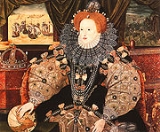
The Elizabethan Era is the period associated with the reign of Queen Elizabeth I Elizabeth I of England

Elizabeth I was Queen of England [i], Queen of France , and Queen of Ireland [i] ... 

  and is often considered to be a golden age in English history History of England

England is the largest and most populous of the constituent countries [i] of the United Kingdom [i]. ... 

. It was the height of the English Renaissance English Renaissance

"English Renaissance" is a term often used to describe a cultural [i] and artistic movement [i] ... 

, and saw the flowering of English literature English literature

The term English literature refers to literature [i] written in the English language [i], including lite ... 

 and poetry English poetry

The history of English poetry stretches from the middle of the 7th century to the present day.... 

. This was also the time during which Elizabethan theatre English Renaissance theatre

English Renaissance theatre is English drama written between the Reformation [i] and the closure of the ... 

 grew and William Shakespeare William Shakespeare

William Shakespeare was an English [i] poet [i] and playwright [i] widely regarded as the great ... 

, among others, composed plays that broke away from England's past style of plays. It was an age of expansion and exploration abroad, while at home the Protestant Reformation Protestant Reformation

The Protestant Reformation, also referred to as the Protestant Revolution, was a movement in the 1... 

 was established and successfully defended against the Catholic Roman Catholic Church

The Roman Catholic Church or Catholic Church is the Christian [i] Church [i] ... 

 powers of the Continent.

Discussions

  Discussion Features

   Ask a question about 'Elizabethan era'

   Start a new discussion about 'Elizabethan era'

   Answer questions about 'Elizabethan era'

   'Elizabethan era' discussion forum

Timeline

1558   Elizabethan era begins: Queen Mary I of England Mary I of England

Mary I , also known as Mary Tudor, was Queen of England [i] and Queen of Ireland [i] ... 

 dies and is succeeded by her half-sister Elizabeth Elizabeth I of England

Elizabeth I was Queen of England [i], Queen of France , and Queen of Ireland [i] ... 

.


Encyclopedia


The Elizabethan Era is the period associated with the reign of Queen Elizabeth I Elizabeth I of England

Elizabeth I was Queen of England [i], Queen of France , and Queen of Ireland [i] ... 

  and is often considered to be a golden age in English history History of England

England is the largest and most populous of the constituent countries [i] of the United Kingdom [i]. ... 

. It was the height of the English Renaissance English Renaissance

"English Renaissance" is a term often used to describe a cultural [i] and artistic movement [i] ... 

, and saw the flowering of English literature English literature

The term English literature refers to literature [i] written in the English language [i], including lite ... 

 and poetry English poetry

The history of English poetry stretches from the middle of the 7th century to the present day.... 

. This was also the time during which Elizabethan theatre English Renaissance theatre

English Renaissance theatre is English drama written between the Reformation [i] and the closure of the ... 

 grew and William Shakespeare William Shakespeare

William Shakespeare was an English [i] poet [i] and playwright [i] widely regarded as the great ... 

, among others, composed plays that broke away from England's past style of plays. It was an age of expansion and exploration abroad, while at home the Protestant Reformation Protestant Reformation

The Protestant Reformation, also referred to as the Protestant Revolution, was a movement in the 1... 

 was established and successfully defended against the Catholic Roman Catholic Church

The Roman Catholic Church or Catholic Church is the Christian [i] Church [i] ... 

 powers of the Continent.

Highlights


The Elizabethan Age is viewed so highly because of the contrasts with the periods before and after. It was a brief period of largely internal peace between the English Reformation English Reformation

The English Reformation was the process whereby the external authority of the Roman Catholic Church [i]... 

 and the battles between Protestants and Catholics and the battles between parliament Parliament

A parliament is a legislature [i], especially in those countries whose system of government is based on ... 

 and the monarchy that would engulf the seventeenth century. The Protestant/Catholic divide was settled, for a time, by the Elizabethan Religious Settlement and parliament was still not strong enough to challenge royal absolutism.

England was also well-off compared to the other nations of Europe. The Italian Renaissance Italian Renaissance

The Italian Renaissance began the opening phase of the Renaissance [i], a period of great cultural chang ... 

 had come to an end under the weight of foreign domination of the peninsula. France was embroiled in its own religious battles that would only be settled in 1598 with the Edict of Nantes. In part because of this, but also because the English had been expelled from their last outposts on the continent, the centuries long conflict between France and England was suspended during the Elizabethan era.

The one great rival was Spain, with which England conflicted both in Europe and the Americas in skirmishes that exploded into the Anglo-Spanish War of 1585-1604. An attempt by Philip II of Spain Philip II of Spain

Philip II was the first official King of Spain [i] from 1556 [i] until 1598 [i], king of Naples and Sicily [i] ... 

 to invade England with the Spanish Armada Spanish Armada

------

The Spanish Armada or "Great/Grand Armada" or "The Mother of all armada"(Old Spanish [i] ... 

 in 1588 was famously defeated, but the tide of war turned against England with a disastrously unsuccessful attack upon Spain in 1589 the Drake-Norris Expedition, 1589. Thereafter Spain provided some support for Irish Catholics in a draining guerilla war against England and Spanish naval and land forces inflicted a series of defeats upon English forces, which badly damaged both the English Exchequer and economy that until then had been so carefully restored under Elizabeth's prudent guidance. English colonization and trade would be frustrated until the signing of the Treaty of London Treaty of London, 1604

The Treaty of London, signed in 1604 [i], concluded the 20-year Anglo-Spanish War [i]. ... 

 the year following Elizabeth's death.

England during this period had a centralized, well organized, and effective government, largely a result of the reforms of Henry VII Henry VII of England

Henry VII , King of England [i], Lord of Ireland [i] , was the fo ... 

 and Henry VIII Henry VIII of England

Henry VIII was King of England [i] and Lord of Ireland [i] from ... 

. Economically the country began to benefit greatly from the new era of Atlantic trade.

Modern historians and biographers in post-imperial Europe have tended to take a far more literal-minded and dispassionate view of the Tudor period. Elizabethan England was not particularly successful in a military sense during the period. The economic well being of the country has also been called into question.

The Elizabethan era also saw England begin to play a leading role in the slave trade History of slavery

The history of slavery covers many different forms of human exploitation across many cultures and throug... 

 and saw a series of bloody English military campaigns in still Catholic Ireland Ireland

Ireland is the third largest [i] island [i] in Europe [i]. ... 

—notably the Desmond Rebellions and the Nine Years War.

See also modern Elizabethan historiography and assessments Elizabeth I of England

Elizabeth I was Queen of England [i], Queen of France , and Queen of Ireland [i] ... 

 for more.

Despite the heights achieved during the era, less than 40 years after the death of Elizabeth the country was to descend into the English Civil War English Civil War

The English Civil War was a series of armed conflicts and political machinations which took place betwee... 

.

Some weapons used were the yew Taxus

Taxus is a genus [i] of yew [i]s, small coniferous [i] tree [i]s or shrub [i]s in the yew ... 

 English longbow English longbow

The English longbow, also called the Welsh longbow, was a powerful type of [[Middle Ages|medieval]... 

 and the newly invented musket Musket

A musket is a muzzle-loaded, smoothbore [i] long gun [i], which its user generally fires from the should... 

.

Fashion and the domestic arts

See also 1550-1600 in fashion 1550-1600 in fashion

Fashion in the period 1550-1600 in Western Europe [i]an clothing [i] is characterized by increased opule... 


Elizabethan court fashion Fashion

The term fashion usually applies to a prevailing mode of expression, but quite often applies to a person... 

 was heavily influenced by Spanish and French styles. Notable garments of this period include the farthingale Farthingale

Farthingale is a term applied to any of several structures used under Western Europe [i]an women's clothing [i] ... 

 for women, military styles like the mandilion Mandilion

A mandilion or mandelion is a loose men's hip-length pullover coat or jacket [i], open down t ... 

 for men, and ruffs Ruff

The Ruff is a medium-sized wader [i].
... 

 for both sexes.

The Elizabethan era also saw a great flowering of domestic embroidery Embroidery

Embroidery is the art [i] or handicraft [i] of decorating fabric [i] or other material [i]s with ... 

 for both clothing Clothing

Clothing is defined, in its broadest sense, as coverings for the torso and limbs as well as coverings fo... 

 and furnishings. Predominant styles include canvas work generally done in tent stitch and blackwork Blackwork Embroidery

Blackwork Embroidery is normally simply referred to as "Blackwork".
... 

 in silk Silk

Silk is a natural protein [i] fibre [i] that can be woven [i] into textile [i]s. ... 

 on linen Linen

Linen is a material made from the fibers of the flax [i] plant. ... 

. Toward the end of the reign the fashion for blackwork gradually gave way to polychrome Polychrome

Polychrome is one of the terms used to describe the use of multiple colors [i] in one entity. ... 

 work in silk that foreshadows the crewelwork in wool that would dominate Jacobean embroidery Jacobean embroidery

Jacobean embroidery refers to embroidery [i] styles that flourished in the reign of King James I of England [i] ... 

.

The food of this time period includes lear , all types of animal meat, and numerous types of fruits and vegetables. A banquet was used for a dessert or snack course.


Elizabethan Festivals, Holidays, and Celebrations


During the Elizabethan era, the years were broken up by annual holidays just as they are now. People looked forward to each and every holiday because their opportunities for leisure were limited, time away from hard work being restricted to periods after church on Sundays, and so for the most part, leisure and festivities took place on a public church holy day. Every month had its own holiday, some of which are listed below:

  • January: The first Monday after Twelfth Night of January was Plough Monday. It celebrated returning to work after the Christmas celebrations and the New Year.
  • February: Feb. 2nd was Candlemas; although often still very cold, Candlemas was the first day of Spring. This was the day when all Christmas decorations were burnt. It included candlelight and torchlight processions. Feb. 14th was Valentine's Day. Sending gifts to one another was a Pagan tradition [citation needed], still carried on under a Christian guise.
  • March: Sometime between the 3rd and 9th of March was Shrove Tuesday . This was an apprentice's favorite holiday, because they were allowed to run amok in the city in mobs, wreaking havoc and general mayhem. This was acceptable because it was supposedly cleansing the city of its vices before Lent. All the foods which would be forbidden during lent were eaten up; often large community feasts were held at Shrovetide during which food could be gathered and redistributed so everybody would have enough to eat in the last few weeks of cold weather before crops could begin to grow. They would also tie a cockerel to a stack and stone it to death, simply because the cockerel was the symbol of France. The day after Shrove Tuesday was Ash Wednesday. This was the first day of Lent when everyone began to abstain from eating certain foods, such as meat. A Jack-o-lent was set up in each city, a sort of scarecrow on which one could take out one's annoyance at being deprived of foods. At the end of the month came Lady Day on March 24, the first of the Quarter Days when rents and salaries and other obligations would be due and payable: Lady Day was the legal New Year when courts of law convened after a winter break; and it marked the moment when the Angel Gabriel came to announce to the Virgin that she would bear a child
  • April: The first of April was All Fool's Day. This was a day for tricks, jests, jokes, and a general day of the jester.
  • May: The first day of May was May Day, considered to be the first day of Summer. This was a big and much appreciated festival. It was one of the few Pagan festivals that really had nothing to do with the Church. It was celebrated with the youth going into the woods for a nighttime party. They didn't return until the next morning with a large tree trunk, which was put up as the phallic 'maypole'. The maypole was decorated and then feasting, dancing and games took place around it.
  • June: Midsummer Day was St. John the Baptist Day observed on June 24th---another Quarter Day. St. John's was a holdover from the Solstice observations of ancient times. Midsummertide involved fire and water: bonfires, torchlight processions and dances, aquatic sports, boating, swimming, and all kinds of outdoor contests as people celebrated the longest day and shortest night of the year, trying to give strength to the sun which would fade and move south after this season. Midsummer was like the 'summer Christmas' with many symbolic images in a mirror of the winter celebration exactly six months later. Fairies were said to be easier to see on Midsummer, and houses were protected against mischiveous wee folk, while grandmothers told tales, sang songs and many watched or performed plays by flickering firelight.
  • July: St. Swithin's Day was celebrated on the 15th. This was a very minor celebration, honoring the legend that after the ceremony of moving St. Swithin's bones, it rained for 40 days: "St. Swithin's Day if thou hast rain, forty days it shall remain: St. Swithin's Day if it be fair, for forty days shall rain no more."
  • August: On the first of August, Lammastide, or Lammas Day, was the first day of Autumn. The name perhaps derived from 'loaf-mass', and was the festival of the first wheat harvest of the year. People decorated loaves of bread baked from the first harvested wheat, and dressed horses with garlands and played games like apple-bobbing and had processions of candles. Many trial marriages were started on Lammastide, especially in the country: if the couple were still together by the following Lammastide they would schedule a wedding. Lammas is also the birthday of Shakespeare's Juliet
  • September: On the 29th of September was Michaelmas, another Quarter Day, during which rents and salaries were paid at harvest time. Michaelmas celebrated St. Michael the Archangel with a traditional feast of goose or chicken: it was said that winter could be predicted by the color of the goose bones. Michaelmas is the season of the old fashioned Harvest Home, the ancestor-feast of the American Thanksgiving. This was the time when everybody was busy preserving food for the winter: the wealth of more easily perishable food was eaten at a great feast---at varying dates at each farm and community. Much of the rest was dried, smoked, processed or packed away to last through the winter.
  • October: On the 25th was St. Crispin's Day. Bonfires, revels, and an elected 'King Crispin' were all featured in this celebration. You may recognize St. Crispin's Day from Shakespeare's play King Henry V, when the King gives a famous speech to encourage his men when they are heavily outnumbered in battle, that they will all be remembered on St. Crispin's day. On the 28th was the Lord Mayor's Show, which still takes place today in London. The 31st of October marks the beginning of the days of the dead: The Eve of All Hallows after sundown followed by All Hallows Day, when the holy ones were venerated, and finishing with All Souls Day on November 2. This was a Celtic festival celebrating the end of the Celtic year. The souls of the dead supposedly returned to walk the Earth: between this time and Martinmas spirits and fairies were more visible. Various masks were worn and bonfires lit to ward off evil spirits and drive away the dark.
  • November: The first of November was the beginning of Winter, and Martinmas commonly marked the end of the harvest cycle on the 11th. The 17th of November was the anniversary of Queen Elizabeth's accession to the throne, celebrated even 100 years after the Queen's death. The last Sunday in November marks the beginning of the Advent Season: something like Lent, this was a time of fasting in preparation for the Christmas feast to follow.
  • December: The Twelve Days of Christmas started at sundown on the 24th of December, and lasted until Epiphany on the 6th of January. Christmas was the last of the Quarter Days for the year. A Lord of Misrule was selected, and he selected a council to help him.


All together they planned all the parties and managed all the fun.
Once upon a time the much discussed and loathed Fruit Cake had its own special holiday---this was Twlefth Night. The fruit cake symbolizes all of the gold, spices and jewels presented as gifts to the Christ child.
By cooking a bean into a cake, and the finder of the bean became the King. A pea might also be cooked in, and a Queen of the Pea chosen as well, both regardless of gender. Carolers would set out to sing for money, and mummers came out to perform again. Youths might run around with a wooden cup or bowl, asking the householders to fill it with ale, a coin, or some food for them: it was considered bad luck to refuse.

Other youths might set out with a large bowl of spiced ale with roasted apples, offering the lord of the house a drink of the cider for a coin. Much begging was carried on during the season, and generosity was expected. The lords were expected to fill their houses with as much food as they could. Marchpane, or marzipan, was exceptionally popular. A yule log was brought in, a large portion of tree trunk expected to burn throughout the season. All greenery, more notably holly and ivy was used. Christmas trees as we know them were unknown in England, even though there were stick pyramids made of greens and fruit set out as decorations. All kinds of magical greens were brought into the houses and palaces: anything that remained green in the hard winters of the Little Ice Age were considered to be powerful symbols of rebirth and hope in the dark cold of winter.

Gifts were presented at New Year instead of Christmas Day, and even though Father Christmas is not mentioned, its thought that the spirit of a jolly red-robed old man may have lingered long after the good humored Roman god Saturn left England--- even though no Elizabethan expected a generous gift from a mysterious and kindly stranger, the spirit was alive and soon to be reborn. At least Saturn might have been a character in a Christmas masque or a play!

If Christmas was the dawn, and New Year was the high noon of the Christmas celebrations, then Twelfth Night was the glorious Midnight: a glittering night of confusion and merriment. Twelfth Night was known for its tricks and mischief: beggars dressed as kings, masters disguised as servants. At midnight all the disguises come off and the truth is revealed in an Epiphany: the beggar child in the manger is the Messiah. The great wheel of the Elizabethan year turns again; life goes on.

Notable Elizabethans

  • Richard Grenville
  • Ben Jonson Ben Jonson

    Benjamin Jonson was an English [i] Renaissance [i] dramatist [i], poet [i] ... 

  • Thomas Kyd Thomas Kyd

    Thomas Kyd was an English [i] dramatist [i], the author of The Spanish Tragedy [i], and one ... 

  • Christopher Marlowe Christopher Marlowe

    Disambiguation: Marlowe [i] is also a 1969 movie about Raymond Chandler [i]'s detective Philip Marlowe [i] ... 

  • Thomas North
  • Walter Raleigh Walter Raleigh

    Sir [i] Walter Raleigh is a famed English [i] writer [i], poet [i], courtier [i] and ... 

  • William Shakespeare William Shakespeare

    William Shakespeare was an English [i] poet [i] and playwright [i] widely regarded as the great ... 

  • Sir Philip Sidney Philip Sidney

    Sir Philip Sidney became one of the Elizabethan Age's [i] most prominent figures. ... 

  • Edmund Spenser Edmund Spenser

    Edmund Spenser was an English [i] poet [i] and Poet Laureate [i]. ... 

  • Francis Walsingham Francis Walsingham

    Sir Francis Walsingham is remembered by history as the "spymaster [i]" of Queen [i] Elizabeth I of England [i] ... 

  • Sir Robert Bell Sir Robert Bell (Knight)

    Sir Robert Bell of Beaupre Hall [i], Norfolk, was a Speaker of the House of Commons [i] ... 

  • William Cecil, 1st Baron Burghley William Cecil, 1st Baron Burghley

    William Cecil, 1st Baron Burghley , was an English [i] politician [i], the chief advisor of Queen Elizabeth I [i] ... 

  • Francis Bacon Francis Bacon

    Francis Bacon, 1st Viscount St Alban, KC [i] was an English [i] philosopher [i], ... 

  • John Dee John Dee

    John Dee was a noted British [i] mathematician [i], astronomer [i] ... 

  • John Dowland
  • Francis Drake Francis Drake

    Sir Francis Drake, Vice Admiral [i], was an English [i] privateer [i], navigator [i] ... 

  • Humphrey Gilbert Humphrey Gilbert

    Sir Humphrey Gilbert was an English adventurer from Devon, who served the crown during the reign of Quee... 

  • Mary Sidney Mary Sidney

    Mary Sidney Herbert, Countess of Pembroke, was one of the first English [i] women to achieve a s ... 


See also

  • Tudor England History of England

    England is the largest and most populous of the constituent countries [i] of the United Kingdom [i]. ... 

  • English Renaissance English Renaissance

    "English Renaissance" is a term often used to describe a cultural [i] and artistic movement [i] ... 

  • Elizabethan theatre English Renaissance theatre

    English Renaissance theatre is English drama written between the Reformation [i] and the closure of the ... 

  • Elizabethan architecture Elizabethan architecture

    Elizabethan Style, in architecture [i], the term given to the early Renaissance [i] style in England [i]... 

  • Music in Elizabethan Era Music in Elizabethan Era

    Music in the Elizabethan [i] Era, or Elizabethan Music, refers to music during the sixteenth centu ... 

  • Tudor style Tudor style architecture

    The Tudor style in English architecture [i] is the final development of medieval architecture during the ... 

  • 1550-1600 in fashion 1550-1600 in fashion

    Fashion in the period 1550-1600 in Western Europe [i]an clothing [i] is characterized by increased opule... 


Compare

  • Tudorbethan Tudorbethan architecture

    The Tudorbethan Style, also called Mock Tudor in the 20th century, first manifested itself in dome... 

  • Jacobethan Jacobethan

    Jacobethan is the style designation coined in 1933 by John Betjeman [i] to describe the English Revival style [i] ... 


References


Fashion and the domestic arts:

  • Arnold, Janet: Queen Elizabeth's Wardrobe Unlock'd, W S Maney and Son Ltd, Leeds 1988. ISBN 0-901286-20-6


  • Ashelford, Jane. The Visual History of Costume: The Sixteenth Century. 1983 edition , 1994 reprint .


  • Digby, George Wingfield. Elizabethan Embroidery. New York: Thomas Yoseloff, 1964.

Further reading


  • Hutton, Ronald:The Rise and Fall of Merry England: The Ritual Year, 1400-1700, 2001. ISBN 0-19-285447-X
  • Hutton, Ronald: The Stations of the Sun: A History of the Ritual Year in Britain, 2001. ISBN 0-19-285448-8
  • Strong, Roy: The Cult of Elizabeth, The Harvill Press, 1999. ISBN 0-7126-6493-9