

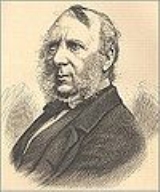
George Cruikshank

Encyclopedia
George Cruikshank was a British caricaturist and book illustrator, praised as the "modern Hogarth
" during his life. His book illustrations for his friend Charles Dickens
, and many other authors, reached an international audience.
, was one of the leading caricaturists of the late 1790s and Cruikshank started his career as his father's apprentice and assistant.
His older brother, Isaac Robert, also followed in the family business as a caricaturist and illustrator. Cruikshank's early work was caricature; but in 1823, at the age of 31, he started to focus on book illustration.
On 16 October 1827, he married Mary Ann Walker (1807–1849). Two years after her death, on 7 March 1851, he married Eliza Widdison. The two lived at 263 Hampstead Road, North London
.
Upon his death, it was discovered that Cruikshank had fathered 11 illegitimate children with a mistress named Adelaide Attree, his former servant, who lived close to where he lived with his wife. Adelaide was ostensibly married and had taken the married surname 'Archibold'.
He achieved early success collaborating with William Hone
in his political satire The Political House That Jack Built (1819). His first major work was Pierce Egan's Life in London (1821). This was followed by The Comic Almanack (1835–1853) and Omnibus (1842).
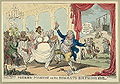
 His gained notoriety with his political prints that attacked the royal family and leading politicians. In 1820 he received a royal bribe of £100 for a pledge "not to caricature His Majesty" (George IV of the United Kingdom
) "in any immoral situation". His work included a personification of England named John Bull
who was developed from about 1790 in conjunction with other British satirical artists such as James Gillray
, and Thomas Rowlandson
.
Cruikshank replaced one of his major influences, James Gillray
, as England's most popular satirist. For a generation he delineated Tories, Whigs
and Radicals impartially. Satirical material came to him from every public event – wars abroad, the enemies of Britain (he was highly patriotic), the frolic, among other qualities, such as the weird and terrible, in which he excelled. His hostility to enemies of Britain and a crude racism is evident in his illustrations commissioned to accompany William Maxwell's
History of the Irish rebellion in 1798 (1845) where his lurid depictions of incidents in the rebellion
were characterised by the simian
-like portrayal of Irish rebels. Among the other racially engaged works of Cruikshank there were caricatures about the "legal barbarities" of the Chinese, the subject given by his friend, Dr. W. Gourley, a participant in the ideological battle around the Arrow War
, 1856–60.
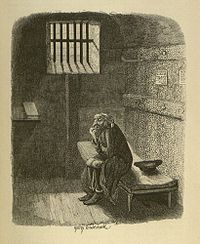
, Cruikshank illustrated Sketches by Boz
(1836), The Mudfog Papers
(1837–38) and Oliver Twist
(1838). Cruikshank even acted in Dickens' amateur theatrical company.
On 30 December 1871 Cruikshank published a letter in The Times
which claimed credit for much of the plot of Oliver Twist. The letter launched a fierce controversy around who created the work. Cruikshank was not the first Dickens illustrator to make such a claim. Robert Seymour
who illustrated the Pickwick Papers suggested that the idea for that novel was originally his; however, in his preface to the 1867 edition, Dickens strenuously denied any specific input.
The friendship between Cruikshank and Dickens soured further when Cruikshank became a fanatical teetotaler in opposition to Dickens' views of moderation.
in later life, Cruikshank's health and work began to decline in quality. He died on 1 February 1878 and was originally buried in Kensal Green Cemetery
. In November 1878 his remains were exhumed and reburied in St. Paul's Cathedral. Punch magazine
, which presumably did not know of his large illegitimate familyhttp://www.independent.co.uk/news/uk/the-secret-life-of-a-virtuous-artist-john-wardroper-turned-sleuth-to-find-the-startling-truth-about-george-cruikshank-illustrator-and-friend-of-dickens-and-a-man-revered-as-a-stern-moralist-1559547.html, said in its obituary: "There never was a purer, simpler, more straightforward or altogether more blameless man. His nature had something childlike in its transparency."
In his lifetime he created nearly 10,000 prints, illustrations, and plates. Collections of his works are in the British
and the Victoria and Albert
museums.
Others
William Hogarth
William Hogarth was an English painter, printmaker, pictorial satirist, social critic and editorial cartoonist who has been credited with pioneering western sequential art. His work ranged from realistic portraiture to comic strip-like series of pictures called "modern moral subjects"...
" during his life. His book illustrations for his friend Charles Dickens
Charles Dickens
Charles John Huffam Dickens was an English novelist, generally considered the greatest of the Victorian period. Dickens enjoyed a wider popularity and fame than had any previous author during his lifetime, and he remains popular, having been responsible for some of English literature's most iconic...
, and many other authors, reached an international audience.
Early life
Cruikshank was born in London. His father, Isaac CruikshankIsaac Cruikshank
Isaac Cruikshank , Scottish painter and caricaturist, was born in Edinburgh. His sons Isaac Robert Cruikshank and George Cruikshank also became artists, and the latter in particular achieved fame as an illustrator and caricaturist. Cruikshank is known for his social and political satire.His...
, was one of the leading caricaturists of the late 1790s and Cruikshank started his career as his father's apprentice and assistant.
His older brother, Isaac Robert, also followed in the family business as a caricaturist and illustrator. Cruikshank's early work was caricature; but in 1823, at the age of 31, he started to focus on book illustration.
On 16 October 1827, he married Mary Ann Walker (1807–1849). Two years after her death, on 7 March 1851, he married Eliza Widdison. The two lived at 263 Hampstead Road, North London
North London
North London is the northern part of London, England. It is an imprecise description and the area it covers is defined differently for a range of purposes. Common to these definitions is that it includes districts located north of the River Thames and is used in comparison with South...
.
Upon his death, it was discovered that Cruikshank had fathered 11 illegitimate children with a mistress named Adelaide Attree, his former servant, who lived close to where he lived with his wife. Adelaide was ostensibly married and had taken the married surname 'Archibold'.
Sociopolitical caricatures and illustrations
Cruikshank's early career was renowned for his social caricatures of English life for popular publications.He achieved early success collaborating with William Hone
William Hone
William Hone was an English writer, satirist and bookseller. His victorious court battle against government censorship in 1817 marked a turning point in the fight for British press freedom.-Biography:...
in his political satire The Political House That Jack Built (1819). His first major work was Pierce Egan's Life in London (1821). This was followed by The Comic Almanack (1835–1853) and Omnibus (1842).
George IV of the United Kingdom
George IV was the King of the United Kingdom of Great Britain and Ireland and also of Hanover from the death of his father, George III, on 29 January 1820 until his own death ten years later...
) "in any immoral situation". His work included a personification of England named John Bull
John Bull
John Bull is a national personification of Britain in general and England in particular, especially in political cartoons and similar graphic works. He is usually depicted as a stout, middle-aged man, often wearing a Union Flag waistcoat.-Origin:...
who was developed from about 1790 in conjunction with other British satirical artists such as James Gillray
James Gillray
James Gillray , was a British caricaturist and printmaker famous for his etched political and social satires, mainly published between 1792 and 1810.- Early life :He was born in Chelsea...
, and Thomas Rowlandson
Thomas Rowlandson
Thomas Rowlandson was an English artist and caricaturist.- Biography :Rowlandson was born in Old Jewry, in the City of London. He was the son of a tradesman or city merchant. On leaving school he became a student at the Royal Academy...
.
Cruikshank replaced one of his major influences, James Gillray
James Gillray
James Gillray , was a British caricaturist and printmaker famous for his etched political and social satires, mainly published between 1792 and 1810.- Early life :He was born in Chelsea...
, as England's most popular satirist. For a generation he delineated Tories, Whigs
British Whig Party
The Whigs were a party in the Parliament of England, Parliament of Great Britain, and Parliament of the United Kingdom, who contested power with the rival Tories from the 1680s to the 1850s. The Whigs' origin lay in constitutional monarchism and opposition to absolute rule...
and Radicals impartially. Satirical material came to him from every public event – wars abroad, the enemies of Britain (he was highly patriotic), the frolic, among other qualities, such as the weird and terrible, in which he excelled. His hostility to enemies of Britain and a crude racism is evident in his illustrations commissioned to accompany William Maxwell's
William Hamilton Maxwell
William Hamilton Maxwell was a Scots-Irish novelist.He was educated at Trinity College, Dublin. He claimed to have entered the British Army and seen service in the Peninsular War and the Battle of Waterloo, but this is generally believed to be untrue...
History of the Irish rebellion in 1798 (1845) where his lurid depictions of incidents in the rebellion
Irish Rebellion of 1798
The Irish Rebellion of 1798 , also known as the United Irishmen Rebellion , was an uprising in 1798, lasting several months, against British rule in Ireland...
were characterised by the simian
Simian
The simians are the "higher primates" familiar to most people: the Old World monkeys and apes, including humans, , and the New World monkeys or platyrrhines. Simians tend to be larger than the "lower primates" or prosimians.- Classification and evolution :The simians are split into three groups...
-like portrayal of Irish rebels. Among the other racially engaged works of Cruikshank there were caricatures about the "legal barbarities" of the Chinese, the subject given by his friend, Dr. W. Gourley, a participant in the ideological battle around the Arrow War
Second Opium War
The Second Opium War, the Second Anglo-Chinese War, the Second China War, the Arrow War, or the Anglo-French expedition to China, was a war pitting the British Empire and the Second French Empire against the Qing Dynasty of China, lasting from 1856 to 1860...
, 1856–60.
Charles Dickens
For Charles DickensCharles Dickens
Charles John Huffam Dickens was an English novelist, generally considered the greatest of the Victorian period. Dickens enjoyed a wider popularity and fame than had any previous author during his lifetime, and he remains popular, having been responsible for some of English literature's most iconic...
, Cruikshank illustrated Sketches by Boz
Sketches by Boz
Sketches by "Boz," Illustrative of Every-day Life and Every-day People is a collection of short pieces published by Charles Dickens in 1836 accompanied by illustrations by George Cruikshank. The 56 sketches concern London scenes and people and are divided into four sections: "Our Parish",...
(1836), The Mudfog Papers
The Mudfog Papers
The Mudfog Papers was written by Victorian era novelist Charles Dickens and published from 1837–38 in the monthly literary serial Bentley's Miscellany, which he then edited....
(1837–38) and Oliver Twist
Oliver Twist
Oliver Twist; or, The Parish Boy's Progress is the second novel by English author Charles Dickens, published by Richard Bentley in 1838. The story is about an orphan Oliver Twist, who endures a miserable existence in a workhouse and then is placed with an undertaker. He escapes and travels to...
(1838). Cruikshank even acted in Dickens' amateur theatrical company.
On 30 December 1871 Cruikshank published a letter in The Times
The Times
The Times is a British daily national newspaper, first published in London in 1785 under the title The Daily Universal Register . The Times and its sister paper The Sunday Times are published by Times Newspapers Limited, a subsidiary since 1981 of News International...
which claimed credit for much of the plot of Oliver Twist. The letter launched a fierce controversy around who created the work. Cruikshank was not the first Dickens illustrator to make such a claim. Robert Seymour
Robert Seymour
Robert Seymour may refer to:* Robert Seymour , illustrator of work by Charles Dickens* Bob Seymour , American football running back...
who illustrated the Pickwick Papers suggested that the idea for that novel was originally his; however, in his preface to the 1867 edition, Dickens strenuously denied any specific input.
The friendship between Cruikshank and Dickens soured further when Cruikshank became a fanatical teetotaler in opposition to Dickens' views of moderation.
Temperance
In the late 1840s, Cruikshank's focus shifted from book illustration to an obsession with temperance and anti-smoking. Formerly a heavy drinker, he now supported, lectured to, and supplied illustrations for the National Temperance Society and the Total Abstinence Society among others. The best known of these are The Bottle, 8 plates (1847), with its sequel, The Drunkard's Children, 8 plates (1848), with the ambitious work, The Worship of Bacchus, published by subscription after the artist's oil painting, now in the Tate Gallery, London. For his efforts he was made vice president of the National Temperance League in 1856.Later years
After developing palsyPalsy
In medicine, palsy is the paralysis of a body part, often accompanied by loss of sensation and by uncontrolled body movements, such as shaking. Medical conditions involving palsy include cerebral palsy , brachial palsy , and Bell's palsy ....
in later life, Cruikshank's health and work began to decline in quality. He died on 1 February 1878 and was originally buried in Kensal Green Cemetery
Kensal Green Cemetery
Kensal Green Cemetery is a cemetery in Kensal Green, in the west of London, England. It was immortalised in the lines of G. K. Chesterton's poem The Rolling English Road from his book The Flying Inn: "For there is good news yet to hear and fine things to be seen; Before we go to Paradise by way of...
. In November 1878 his remains were exhumed and reburied in St. Paul's Cathedral. Punch magazine
Punch (magazine)
Punch, or the London Charivari was a British weekly magazine of humour and satire established in 1841 by Henry Mayhew and engraver Ebenezer Landells. Historically, it was most influential in the 1840s and 50s, when it helped to coin the term "cartoon" in its modern sense as a humorous illustration...
, which presumably did not know of his large illegitimate familyhttp://www.independent.co.uk/news/uk/the-secret-life-of-a-virtuous-artist-john-wardroper-turned-sleuth-to-find-the-startling-truth-about-george-cruikshank-illustrator-and-friend-of-dickens-and-a-man-revered-as-a-stern-moralist-1559547.html, said in its obituary: "There never was a purer, simpler, more straightforward or altogether more blameless man. His nature had something childlike in its transparency."
In his lifetime he created nearly 10,000 prints, illustrations, and plates. Collections of his works are in the British
British Museum
The British Museum is a museum of human history and culture in London. Its collections, which number more than seven million objects, are amongst the largest and most comprehensive in the world and originate from all continents, illustrating and documenting the story of human culture from its...
and the Victoria and Albert
Victoria and Albert Museum
The Victoria and Albert Museum , set in the Brompton district of The Royal Borough of Kensington and Chelsea, London, England, is the world's largest museum of decorative arts and design, housing a permanent collection of over 4.5 million objects...
museums.
Samples of his work
The Life and Opinions of Tristram Shandy, GentlemanThe Life and Opinions of Tristram Shandy, Gentleman
The Life and Opinions of Tristram Shandy, Gentleman is a novel by Laurence Sterne. It was published in nine volumes, the first two appearing in 1759, and seven others following over the next 10 years....
Others
Further reading
- Cruikshank, George. (1980). Graphic Works of George Cruikshank. Dover Publications. ISBN 0-486-23438-X
- Catalogue of Political and Personal Satires Preserved in the Department of Prints and Drawings in the British Museum, Mary Dorothy George. Vol VI 1938, Vol VII, 1942 VOL VIII 1947, VOL IX 1949
- Dictionary of British Cartoonists and caricaturists 1730–1980 Bryant and Heneage, Scolar Press 1994
- The Book Illustrations of George Cruikshank Buchanan-Brown, John. Charles Tuttle 1980
- George Cruikshank A Catalogue Raisonne of the work executed during the years 1896–1977 Cohn, Albert M . Bookmans Journal, London 1924
- Bates, William, George Cruikshank : the artist, the humourist, and the man, with some account of his brother Robert. A critico-bilbiographical essay, Amsterdam, Emmering, 1972
External links
- SurLaLune Fairy Tale Pages: Fairy Tale Illustrations of George Cruikshank
- George Cruikshank (Cleveland Museum of Art)
- George Cruikshank at Lambiek.net
- Biographical information
- George Cruikshank cartoons at CartoonStock (Commercial site)
- Online Gallery of Illustrations by George Cruikshank
- The Comic Almanack fully and openly available through the University of Florida Digital Collections
- George Cruikshank letters, 1845 and 1868 from the Woodson Research Center at Rice University
- Patten Research Material on George Cruikshank from the Woodson Research Center at Rice University