
All Topics  
Art of Ancient Egypt

 
Art of Ancient Egypt

   Email Print
   Bookmark   Link


Art of Ancient Egypt


Ancient Egyptian art refers to the style of painting, sculpture, crafts and architecture developed by the civilization
Civilization

A civilization is a society or culture group normally defined as a complex society characterized by the practice of agriculture and settlement in towns and city....
 in the lower Nile
Nile

The Nile is a major north-flowing river in Africa, generally regarded as the List of rivers by length in the world.The Nile has two major tributary, the White Nile and Blue Nile, the latter being the source of most of the Nile's water and silt, but the former being the longer of the two....
 Valley
Valley

In geology, a valley is a Depression with predominant extent in one direction. A very deep river valley may be called a canyon or gorge....
 from 5000 BC to 300 AD. Ancient Egypt
Ancient Egypt

Ancient Egypt was an Ancient history civilization in eastern North Africa, concentrated along the lower reaches of the Nile in what is now the modern nation of Egypt....
ian art as expression in painting and sculpture was both highly stylized and symbolic. Much of the surviving art comes from tombs and monuments and thus there is an emphasis on life after death and the preservation of knowledge of the past.

In a more narrow sense, Ancient Egyptian art refers to the canonical 2nd
Second dynasty of Egypt

The Second Dynasty of ancient Egypt is often combined with the First dynasty of Egypt under the group title, Early Dynastic Period of Egypt. The capital at that time was Thinis....
 and 3rd Dynasty
Third dynasty of Egypt

Third Dynasty The Third Dynasty of ancient Egypt is the first dynasty of the Old Kingdom. Other dynasties of the Old Kingdom include the Fourth dynasty of Egypt, Fifth dynasty of Egypt and Sixth dynasty of Egypt....
 art developed in Egypt from 3000 BC and used until the 3rd century.


Discussion
Ask a question about 'Art of Ancient Egypt'
Start a new discussion about 'Art of Ancient Egypt'
Answer questions from other users
Full Discussion Forum


Recent Posts


Encyclopedia


Ancient Egyptian art refers to the style of painting, sculpture, crafts and architecture developed by the civilization
Civilization

A civilization is a society or culture group normally defined as a complex society characterized by the practice of agriculture and settlement in towns and city....
 in the lower Nile
Nile

The Nile is a major north-flowing river in Africa, generally regarded as the List of rivers by length in the world.The Nile has two major tributary, the White Nile and Blue Nile, the latter being the source of most of the Nile's water and silt, but the former being the longer of the two....
 Valley
Valley

In geology, a valley is a Depression with predominant extent in one direction. A very deep river valley may be called a canyon or gorge....
 from 5000 BC to 300 AD. Ancient Egypt
Ancient Egypt

Ancient Egypt was an Ancient history civilization in eastern North Africa, concentrated along the lower reaches of the Nile in what is now the modern nation of Egypt....
ian art as expression in painting and sculpture was both highly stylized and symbolic. Much of the surviving art comes from tombs and monuments and thus there is an emphasis on life after death and the preservation of knowledge of the past.

In a more narrow sense, Ancient Egyptian art refers to the canonical 2nd
Second dynasty of Egypt

The Second Dynasty of ancient Egypt is often combined with the First dynasty of Egypt under the group title, Early Dynastic Period of Egypt. The capital at that time was Thinis....
 and 3rd Dynasty
Third dynasty of Egypt

Third Dynasty The Third Dynasty of ancient Egypt is the first dynasty of the Old Kingdom. Other dynasties of the Old Kingdom include the Fourth dynasty of Egypt, Fifth dynasty of Egypt and Sixth dynasty of Egypt....
 art developed in Egypt from 3000 BC and used until the 3rd century. Most elements of Egyptian art remained remarkably stable over that 3000 year period. There wasn't strong outside influence. The same basic conventions and quality of observation started at a high level and remained near that level over the period.

Periods


  • Predynastic
    Predynastic Egypt

    The Predynastic Period of Egypt is traditionally the period between the Early Neolithic and the beginning of the Pharaonic monarchy beginning with King Narmer....
    (4210 BC–2680 BC)
  • Old Kingdom
    Old Kingdom

    The Old Kingdom is the name commonly given to that period in the 3rd millennium BCE when Ancient Egypt attained its first continuous peak of civilization in complexity and achievement ? this was the first of three so-called "Kingdom" periods, which mark the high points of civilization in the lower Nile Valley ....
    (2680 BC–2258 BC)
  • Middle Kingdom
    Middle Kingdom of Egypt

    The middle kingdom is the period in the history of ancient Egypt stretching from the establishment of the Eleventh dynasty of Egypt to the end of the Fourteenth dynasty of Egypt, roughly between 2040 BC and 1640 BC....
     (2258 BC–1786 BC)
  • New Kingdom
    New Kingdom

    The New Kingdom, sometimes referred to as the Egyptian Empire, is the period in ancient Egyptian History of Ancient Egypt between the 16th century BC and the 11th century BC, covering the Eighteenth dynasty of Egypt, Nineteenth dynasty of Egypt, and Twentieth dynasty of Egypt....
     (1786 BC–1085 BC)
  • Amarna Period
    Amarna art

    The Ancient Egyptian art style known as Amarna Art was a style of art that was adopted in the Amarna , and is noticeably different from more conventional Art of Ancient Egypt styles....
     (1085 BC–1055 BC)
  • Late Period
    Late Period of Ancient Egypt

    The Late Period of Egypt refers to the last flowering of native Egyptian rulers after the Third Intermediate Period from the 26th Saite Dynasty into Persian Empire History of Egypt under Achaemenid Persian domination and ended with the death of Alexander the Great....
    (1055 BC]]–287 BC)
  • Ptolemaic
    Ptolemaic dynasty

    The Ptolemaic dynasty was a Hellenistic Macedonian royal family which ruled the Ptolemaic Empire in Egypt for nearly 300 years, from 305 BC to 30 BC....


Symbolism

Symbolism also played a important role in establishing a sense of order. Symbolism, ranging from the pharaoh's regalia (symbolizing his power to maintain order) to the individual symbols of Egyptian gods and goddesses, is omnipresent in Egyptian art. Animal
Animal

Animals are a major group of multicellular, eukaryotic organisms of the Kingdom Animalia or Metazoa. Their body plan eventually becomes fixed as they develop, although some undergo a process of metamorphosis later on in their life....
s were usually also highly symbolic figures in Egyptian art. Colors were more expressive rather than natural: red skin implied vigorous tanned youth, whereas yellow skin was used for women or middle-aged men who worked indoors; blue or gold indicated divinity because of its unnatural appearance and association with precious materials; the use of black for royal figures expressed the fertility of the Nile from which Egypt was born. Stereotypes were employed to indicate the geographical origins of foreigners

Art forms

Egypt
Ancient Egyptian art forms are characterized by regularity and detailed depiction of human beings and nature, and were intended to provide company to the deceased in the “other world”. Artists endeavored to preserve everything of the present time as clearly and permanently as possible. Completion took precedence over style. Some art forms present an extraordinarily vivid representation of their time and the life, as the ancient Egyptian life was lived thousand of years before.

Egyptian art in all forms obeyed one law: the mode of representing man, nature and the environment remained almost the same for thousands of years and the most admired artists were those who replicated most admired styles of the past.

Architecture

Ancient Egyptian architects used sun-dried and kiln-baked bricks, fine sandstone, limestone and granite. Architects carefully planned all their work. The stones had to fit precisely together. Ramps were used to allow workmen to move up as the height of the construction grew. When the top of the structure was completed, the artists decorated from the top down, removing ramp sand as they went down.

Over a period of time, primitive structures of clay and reeds matured, and there emerged magnificent monumental structures of granites, with very thick walls. The massive sloping exterior walls contained only a few small openings. Hieroglyphic and pictorial carvings in brilliant covers were abundantly used to decorate the structures, including many motifs, like the scarab, sacred beetle, the solar disk and the vulture.

The belief in existence of life beyond death resulted in a mammoth and impressive architectural style to house the mummified bodies. Construction of a burial monument commenced as soon a pharaoh was named, and continued until he died. Some constructions are very large and finely decorated, while some are relatively small like King Tutankhamen’s tomb, as he died very young. Another interesting aspect of ancient Egyptian architecture is that no structural support was provided, except the strength and balance of the structure itself, with one exception being the mud brick roofs of common houses that were supported by palm logs.

Paper

Egypt
The word paper
Paper

Paper is thin material mainly used for writing upon, printing upon or packaging. It is produced by pressing together moist fibers, typically cellulose pulp derived from wood, rags or grasses, and drying them into flexible sheets....
 is derived from "papyrus
Papyrus

Papyrus is a thick paper material produced from the pith of the papyrus plant, Cyperus papyrus, a wetland Cyperaceae that was once abundant in the Nile Delta of Egypt....
", a plant which was cultivated in the Nile delta
Nile Delta

The Nile Delta is the River delta formed in Northern Egypt where the Nile River spreads out and drains into the Mediterranean Sea. It is one of the world's largest river deltas?from Alexandria in the west to Port Said in the east, it covers some 240 km of Mediterranean coastline?and is a rich agricultural region....
. Papyrus sheets were derived after processing the papyrus plant. Some rolls of papyrus discovered are lengthy, up to 10 meters. The technique for crafting papyrus was lost over time, but was rediscovered by an Egyptologist in the 1940s. Papyrus was used by ancient Egyptians for writing and painting.

Papyrus texts illustrate all dimensions of ancient Egyptian life and include literary, religious, historical and administrative
Administration (government)

The term administration, as used in the Context of government, differs according to jurisdiction....
 documents. The pictorial script
Writing system

A writing system is a type of symbolic system used to represent elements or statements expressible in language....
 used in these texts ultimately provided the model for two most common alphabet
Alphabet

An alphabet is a standardized set of letter basic written symbols each of which roughly represents a phoneme, a spoken language, either as it exists now or as it was in the past....
s in the world, the Roman and the Arabic
Arabic alphabet

The Arabic alphabet is the writing system used for writing several languages of Asia and Africa, such as Arabic language, Persian language, and Urdu language....
.

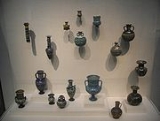
Pottery

Egypte Louvre 232 Pot
Ancient Egyptians used steatite (some varieties were called soapstone
Soapstone

Soapstone is a metamorphic rock, a talc-schist. It is largely composed of the mineral talc and is rich in magnesium. It is produced by dynamothermal metamorphism and metasomatism, which occurs at the areas where tectonic plates are subduction, changing rocks by heat and pressure, with influx of fluids, but without melting....
) and carved small pieces of vase
Vase

The vase is an open container, often used to hold cut flowers. It can be made from a number of materials including ceramics and glass art. The vase is often decorated and thus used to extend the beauty of its contents....
s, amulet
Amulet

An amulet , a close cousin of the talisman consists of any object intended to bring good luck and/or protection to its owner.Potential amulets include: Gemstone or simple Gemstone, statues, coins, drawings, pendants, jewelry ring, plants, animals, etc.; even words said in certain occasions?for example: vade retro satana?, to repe...
s, images of deities, of animal
Animal

Animals are a major group of multicellular, eukaryotic organisms of the Kingdom Animalia or Metazoa. Their body plan eventually becomes fixed as they develop, although some undergo a process of metamorphosis later on in their life....
s and several other objects. Ancient Egyptian artists also discovered the art of covering pottery with enamel
Vitreous enamel

In a discussion of material science, enamel is the colorful result of fusing powdered glass to a substrate by firing, usually between 750 and 850 degrees Celsius....
. Covering by enamel was also applied to some stone works.

Different types of pottery items were deposited in tombs of the dead. Some such pottery items represented interior parts of the body, like the heart
Heart

The heart is a muscle organ in all vertebrates responsible for pumping blood through the blood vessels by repeated, rhythmic contractions, or a similar structure in annelids, mollusks, and arthropods....
 and the lung
Lung

The lung is the essential respiration organ in air-breathing animals, including most tetrapods, a few fish and a few snails. In mammals and the more complex life forms, the two lungs are located in the chest on either side of the heart....
s, the liver
Liver

The liver is a vital organ present in vertebrates and some other animals; it has a wide range of functions, a few of which are detoxification, protein synthesis, and production of biochemicals necessary for digestion....
 and smaller intestine
Intestine

In anatomy, the intestine is the segment of the Gastrointestinal tract extending from the stomach to the anus and, in humans and other mammals, consists of two segments, the small intestine and the large intestine....
s, which were removed before embalming
Embalming

File:Embalming fluid.jpgEmbalming, in most modern cultures, is the art and science of temporarily preserving human remains to forestall decomposition and to make them suitable for display at a funeral....
. A large number of smaller objects in enamel pottery were also deposited with the dead. It was customary to craft on the walls of the tombs cones of pottery, about six to ten inches tall, on which were engraved or impressed legends relating to the dead occupants of the tomb
Tomb

For the New York prison see The Tombs.A tomb is a repository for the remains of the death. The term generally refers to any structurally enclosed interment space or burial chamber, of varying sizes....
s. These cones usually contained the names of the deceased, their titles, offices which they held, and some expressions appropriate to funeral
Funeral

A funeral is a ceremony marking a person's death. Funerary customs comprise the complex of beliefs and practices used by a culture to remember the dead, from the funeral itself, to various monuments, prayers, and rituals undertaken in their honour....
 purposes.

Sculpture

Amenhotepiii
The ancient art of Egyptian sculpture
Sculpture

Sculpture is Three-dimensional space artwork created by shaping or combining hard and or plastic material, sound, and or text and or light, commonly Stone sculpture , metal, glass, or wood....
 evolved to represent the ancient Egyptian gods, Pharaoh
Pharaoh

Pharaoh is a title used in many modern discussions of the ancient Egyptian rulers of all periods. In antiquity this title began to be used for the ruler who was the religious and political leader of united ancient Egypt, only during the New Kingdom, specifically, during the middle of the Eighteenth dynasty of Egypt....
s,and the kings and queens, in physical form. Massive statues were built to represent gods and famous kings and queens. These statues were supposed to give eternal life to the kings and queens, and to enable the subjects to see them in physical forms.

Very strict conventions were followed while crafting statues: male statues were darker than the female ones; in seated statues, hands were required to be placed on knees and specific rules governed appearance of every Egyptian god. For example, the sky god (Horus
Horus

Horus is a god of the Ancient Egyptian religion, most commonly known by the Greek language version Horus, of the Egyptian language Heru/Har....
) was essentially to be represented with a falcon’s head, the god of funeral rites (Anubis
Anubis

Anubis is the Greek language name for a jackal-headed deity associated with mummy and the afterlife in Egyptian mythology. In the ancient Egyptian language, Anubis is known as Inpu, ....
) was to be always shown with a jackal’s head. Artistic works were ranked according to exact compliance with all the conventions, and the conventions were followed so strictly that over three thousand years, very little changed in the appearance of statues. These conventions were intended to convey a timelessness and non aging representation of the figure's ka, or life for an eternal afterlife.

Hieroglyphs


The hieroglyphic
Egyptian hieroglyphs

Egyptian hieroglyphs was a formal writing system used by the ancient Egyptians that contained a combination of logographic and alphabetic elements....
 script consisted of a variety of pictures and symbols. Some symbols had independent meanings, whereas some symbols were used in combination. In addition, some hieroglyphs were used phonetically, in a similar fashion to the Greek
Greek alphabet

The Greek alphabet is a set of twenty-four letters that has been used to write the Greek language since the late 9th century BC or early 8th century BCE....
 and Roman alphabets. Some symbols also conveyed multiple meanings; for example, legs could mean to walk, to run, to go and to come. The script was written in three directions: from top to bottom, from left to right, and from right to left. This style of writing continued to be used by the ancient Egyptians
Egyptians

Egyptians is the name of the nationality and Mediterranean North African ethnic group native to Egypt.Egyptian identity is closely tied to the Geography of Egypt, dominated by the lower Nile Valley, the small strip of cultivable land stretching from the Cataracts of the Nile to the Mediterranean Sea and enclosed by desert both to the Easte...
 for nearly 3500 years, from 3300 BC until the third century AD.

Many art works of the period contain hieroglyphs and hieroglyphs themselves constitute an attractive feature of ancient Egyptian art. Knowledge of hieroglyphic script was lost after it was superseded by other scripts. In the 19th century the Frenchman Champollion finally succeeded in deciphering the mysterious script, opening up a wealth of knowledge to archaeologists and Egyptologists.

Literature

Ancient Egyptian literature, most often written on papyrus, also contains elements of ancient Egyptian art, as the texts and connected pictures were recorded on papyrus or on wall paintings and so on. They date from the Old Kingdom
Old Kingdom

The Old Kingdom is the name commonly given to that period in the 3rd millennium BCE when Ancient Egypt attained its first continuous peak of civilization in complexity and achievement ? this was the first of three so-called "Kingdom" periods, which mark the high points of civilization in the lower Nile Valley ....
 to the Greco-Roman period.

The subject matter of such literature-related art forms include hymns to the gods, mythological and magical texts, mortuary texts. Other subject matters were biographical and historical texts, scientific premises, including mathematical and medical texts, wisdom texts dealing with instructive literature, fables and stories.

Paintings

Maler Der Grabkammer Der Nefertari 004
Ancient Egyptian paintings survived due to the extremely dry climate. The ancient Egyptians created paintings to make the afterlife of the deceased a pleasant place. Accordingly, beautiful paintings were created. The themes included journey through the afterworld or their protective deities introducing the deceased to the gods of the underworld. Some examples of such paintings are paintings of Osiris and warriors. Some tomb paintings show activities that the deceased were involved in when they were alive and wished to carry on doing for eternity.

In the New Kingdom
New Kingdom

The New Kingdom, sometimes referred to as the Egyptian Empire, is the period in ancient Egyptian History of Ancient Egypt between the 16th century BC and the 11th century BC, covering the Eighteenth dynasty of Egypt, Nineteenth dynasty of Egypt, and Twentieth dynasty of Egypt....
 and later, the Book of the Dead
Book of the Dead

"The Book of Dead" is the common name for the ancient Egyptian funerary text known as "Spells of Coming" "Forth By Day". The book of dead was a description of the ancient Egyptian conception of the Duat and a collection of hymns, spells, and instructions to allow the deceased to pass through obstacles in the afterlife....
 was buried with the entombed person. It was considered important for an introduction to the afterlife.

Egyptian paintings are painted in such a way to show a profile view and a side view of the animal or person. For example, the painting to the right shows the head from a profile view and the body from a frontal view. There main colors were red, blue, black, gold, and green.

Evolution

The Ancient Egyptian art style known as Amarna art
Amarna art

The Ancient Egyptian art style known as Amarna Art was a style of art that was adopted in the Amarna , and is noticeably different from more conventional Art of Ancient Egypt styles....
 was a style of art that was adopted in the Amarna Period
Amarna

The site of Amarna is located on the east bank of the Nile River in the modern Egyptian province of Minya Governorate, some 58 km south of the city of al-Minya, 312 km south of the Egyptian capital Cairo and 402 km north of Luxor....
 (i.e. during and just after the reign of Akhenaten
Akhenaten

Akhenaten , was a Pharaoh of the Eighteenth dynasty of Egypt, who died 1336 BC or 1334 BC. He is especially noted for attempting to compel the Egyptian population in the monotheism worship of Aten, although there are doubts as to how successful he was at this....
 in the late Eighteenth Dynasty
Eighteenth dynasty of Egypt

The Eighteenth Dynasty is perhaps the best known of all the dynasties of ancient Egypt. As well as a number of Egypt's most powerful pharaohs, it included Tutankhamun, whose tomb, uncovered by Howard Carter in 1922, was one of the greatest of all archaeological discoveries, being completely undisturbed by tomb robbers....
), and is noticeably different from more conventional Egyptian art
Art of Ancient Egypt

Ancient Egyptian art refers to the style of painting, sculpture, crafts and architecture developed by the civilization in the lower Nile Valley from 5000 BC to 300 AD....
 styles.

It is characterized by a sense of movement and activity in images, with figures having raised heads, many figures overlapping and many scenes busy and crowded. Also, the human body is portrayed differently in Amarna style artwork than Egyptian art on the whole. For instance, many depictions of Akhenaten's body give him distinctly feminine qualities, such as large hips, prominent breasts, and a larger stomach and thighs. This is a divergence from the earlier Egyptian art which shows men with perfectly chiseled bodies. Faces are still shown exclusively in profile. Not many buildings from this period have survived the ravages of later kings, partially as they were constructed out of standard size blocks, known as Talatat
Talatat

Talatat are stone blocks of standardized size used during the reign of Akhenaton in the building of the Aton temples at Karnak and Akhetaten. The standardized size and their small weight made construction more efficient Their use may have begun in the second year of Akhenton's reign....
, which were very easy to remove and reuse. Temples in Amarna, following the trend, did not follow traditional Egyptian customs and were open, without ceilings, and had no closing doors.

In the generation after Akhenaten's death, artists reverted to their old styles. There were still traces of this period's style in later art.

See also

  • Ancient Egypt
    Ancient Egypt

    Ancient Egypt was an Ancient history civilization in eastern North Africa, concentrated along the lower reaches of the Nile in what is now the modern nation of Egypt....
  • Art
    Art

    Art is the process or product of deliberately arranging elements in a way that appeals to the senses or emotions. It encompasses a diverse range of human activities, creations, and modes of expression, including music and literature....
  • Reserve head
    Reserve head

    Reserve heads are distinctive bust made primarily of fine limestone that have been found in a number of non-royal tombs of the Fourth dynasty of Egypt; primarily from the reigns of Egyptian pyramids-building pharaohs Khufu to Khafre, circa 2551-2496 B.C....


External links

  • : A well-annotated introduction to the arts of Egypt