


Cyrus cylinder

Encyclopedia
The Cyrus Cylinder is an ancient clay cylinder, now broken into several fragments, on which is written a declaration in Akkadian
cuneiform script
in the name of the Achaemenid
king Cyrus the Great
. It dates from the 6th century BC and was discovered in the ruins of Babylon
in Mesopotamia
(modern Iraq
) in 1879. It is currently in the possession of the British Museum
, which sponsored the expedition that discovered the cylinder. It was created and used as a foundation deposit
following the Persian conquest of Babylon
in 539 BC, when the Neo-Babylonian Empire
was invaded by Cyrus and incorporated into his Persian Empire.
The text on the Cylinder praises Cyrus the Great, sets out his genealogy and portrays him as a king from a line of kings. The Babylonian king Nabonidus
, (see earlier Cylinder of Nabonidus
), who was defeated and deposed by Cyrus, is denounced as an impious oppressor of the people of Babylonia and his low-born origins are implicitly contrasted to Cyrus's kingly heritage. The victorious Cyrus is portrayed as having been chosen by the chief Babylonian god Marduk
to restore peace and order to the Babylonians. The text states that Cyrus was welcomed by the people of Babylon as their new ruler and entered the city in peace. It appeals to Marduk to protect and help Cyrus and his son Cambyses
. It extols Cyrus's efforts as a benefactor of the citizens of Babylonia who improved their lives, repatriated displaced people and restored temples and cult sanctuaries across Mesopotamia
and elsewhere in the region. It concludes with a description of how Cyrus repaired the city wall of Babylon and found a similar inscription placed there by an earlier king.
The Cylinder's text has traditionally been seen by Biblical scholars as corroborative evidence of Cyrus’ policy of the repatriation
of the Jewish people
following their Babylonian captivity
(an act that the Book of Ezra
attributes to Cyrus), as the text refers to the restoration of cult sanctuaries and repatriation of deported peoples. This interpretation has been disputed, as the text identifies only Mesopotamian sanctuaries, and makes no mention of Jews, Jerusalem, or Judea. The Cylinder has also been claimed to be an early "human rights charter", though the British Museum and scholars of ancient Near Eastern history reject this view as anachronistic and a misunderstanding of the Cylinder's generic nature. It was adopted as a symbol by the Shah of Iran's pre-1979 government, which put it on display in Tehran
in 1971 to commemorate 2,500 years of the Iranian monarchy.
 The Assyro
-British
archaeologist Hormuzd Rassam
discovered the Cyrus Cylinder in March 1879 during a lengthy programme of excavations in Mesopotamia carried out for the British Museum. It had been placed as a foundation deposit
in the foundations of the Ésagila
, the city's main temple. Rassam's expedition followed on from an earlier dig carried out in 1850 by the British archaeologist Austen Henry Layard
, who excavated three mounds in the same area but found little of importance. In 1877, Layard became Britain's ambassador to the Ottoman Empire
, which ruled Mesopotamia at the time. He helped Rassam, who had been his assistant in the 1850 dig, to obtain a firman (decree) from the Ottoman Sultan
Abdul Hamid II
to continue the earlier excavations. The firman was only valid for a year but a second firman, with much more liberal terms, was issued in 1878. It was granted for two years (through to 15 October 1880) with the promise of an extension to 1882 if required. The Sultan's decree authorised Rassam to "pack and dispatch to England any antiquities [he] found ... provided, however, there were no duplicates." A representative of the Sultan was instructed to be present at the dig to examine the objects as they were uncovered.
With permission secured, Rassam initiated a large-scale excavation at Babylon and other sites on behalf of the Trustees of the British Museum. He undertook the excavations in four distinct phases. In between each phase, he returned to England to bring back his finds and raise more funds for further work. The Cyrus Cylinder was found on the second of his four expeditions to Mesopotamia, which began with his departure from London on 8 October 1878. He arrived in his home town of Mosul
on 16 November and travelled down the Tigris
to Baghdad
, which he reached on 30 January 1879. During February and March, he supervised excavations on a number of Babylonian sites, including Babylon itself.
He soon uncovered a number of important buildings including the Ésagila temple. This was a major shrine to the chief Babylonian god Marduk
, although its identity was not fully confirmed until the German archaeologist Robert Koldewey
's excavation of 1900. The excavators found a large number of business documents written on clay tablets and, buried in the temple's foundations, the Cyrus Cylinder. Rassam gave conflicting accounts of where his discoveries were made. He wrote in his memoirs, Asshur and the land of Nimrod, that the Cylinder had been found in a mound at the southern end of Babylon near the village of Jumjuma or Jimjima. However, in a letter sent on 20 November 1879 to Samuel Birch
, the Keeper of Oriental Antiquities at the British Museum, he wrote, "The Cylinder of Cyrus was found at Omran [Tell Amran-ibn-Ali] with about six hundred pieces of inscribed terracottas before I left Baghdad." He left Baghdad on 2 April, returning to Mosul and departing from there on 2 May for a journey to London which lasted until 19 June.
The discovery was announced to the public by Sir Henry Rawlinson, the President of the Royal Asiatic Society
, at a meeting of the Society on 17 November 1879. He described it as "one of the most interesting historical records in the cuneiform character that has yet been brought to light", though he erroneously described it as coming from the ancient city of Borsippa
rather than Babylon. Rawlinson's "Notes on a newly-discovered Clay Cylinder of Cyrus the Great" were published in the society's journal the following year, including the first partial translation of the text.
A horse bone bearing cuneiform inscriptions apparently derived from the Cyrus Cylinder has also been discovered in China along with a second bone inscribed with an as yet unknown text. The bones were acquired by the Beijing Palace Museum in 1985. Their origin is unclear, but Irving Finkel has hypothesized that they may reflect a proclamation in another format (perhaps leather or clay), derived from the Cyrus Cylinder's text, though for some reason only one in twenty of the original cuneiform symbols were copied. Finkel suggests that this may indicate that the text (or even the original cylinder itself) was sent around the Persian Empire and was copied to make the bone's inscription at some point.
The main body of the Cylinder, discovered by Rassam in 1879, is fragment "A". It underwent restoration in 1961, when it was re-fired and plaster filling was added. The smaller fragment, "B", is a section measuring 8.6 centimetres (3.4 in) by 5.6 centimetres (2.2 in). The latter fragment was acquired by J.B. Nies of Yale University
from an antiquities dealer. Nies published the text in 1920. The fragment was apparently broken off the main body of the Cylinder during the original excavations in 1879 and was either removed from the excavations or was retrieved from one of Rassam's waste dumps. It was not confirmed as part of the Cylinder until Paul-Richard Berger of the University of Münster
definitively identified it it in 1970. Yale University lent the fragment to the British Museum temporarily (but, in practice, indefinitely) in exchange for "a suitable cuneiform tablet" from the British Museum collection.
Although the Cylinder clearly post-dates Cyrus the Great's conquest of Babylon in 539 BC, the date of its creation is unclear. It is commonly said to date to the early part of Cyrus's reign over Babylon, some time after 539 BC. The British Museum puts the Cylinder's date of origin at between 539–530 BC.
The text is written in an extremely formulaic style that can be divided into six distinct parts:
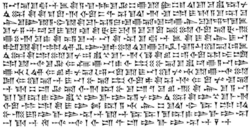
The start of the text is partly broken; the surviving content reprimands the character of the deposed Babylonian king Nabonidus
. It lists his alleged crimes, charging him with the desecration of the temples of the gods and the imposition of forced labor
upon the populace. According to the proclamation, as a result of these offenses, the god Marduk abandoned Babylon and sought a more righteous king. Marduk called forth Cyrus to enter Babylon and become its new ruler.
Midway through the text, the writer switches to a first-person narrative
in the voice of Cyrus, addressing the reader directly. A list of his titles is given (in a Mesopotamian rather than Persian style): "I am Cyrus, king of the world, great king, powerful king, king of Babylon, king of Sumer
and Akkad
, king of the four quarters [of the earth], son of Cambyses, great king, king of Anshan, descendent of Teispes
, great king, king of Anshan, the perpetual seed of kingship, whose reign Bel
[Markuk] and Nebo
love, and with whose kingship, to their joy, they concern themselves." He describes the pious deeds he performed after his conquest: he restored peace to Babylon and the other cities sacred to Marduk, freeing their inhabitants from their "yoke," and he "brought relief to their dilapidated housing (thus) putting an end to their (main) complaints". He repaired the ruined temples in the cities he conquered, restored their cults, and returned their sacred images as well as their former inhabitants which Narbonidus had taken to Babylon. Near the end of the inscription Cyrus highlights his restoration of Babylon's city wall, saying: "I saw within it an inscription of Ashurbanipal
, a king who preceded me." The remainder is missing but presumably describes Cyrus's rededication of the gateway mentioned.
A partial transcription by F.H. Weissbach in 1911 was supplanted by a much more complete transcription after the identification of the "B" fragment; this is now available in German and in English. Several editions of the full text of the Cyrus Cylinder are available online, incorporating both "A" and "B" fragments.
A false translation of the text – affirming, among other things, the abolition of slavery and the right to self-determination, a minimum wage and asylum – has been promoted on the Internet and elsewhere. As well as making claims that are not found on the real cylinder, it has been edited, referring to the Zoroastrian divinity Ahura Mazda
rather than the Mesopotamian god Marduk
. The false translation has been widely circulated; alluding to its claim that Cyrus supposedly has stated that "Every country shall decide for itself whether or not it wants my leadership." Iranian Nobel Peace Prize
winner Shirin Ebadi
in her acceptance speech described Cyrus as "the very emperor who proclaimed at the pinnacle of power 2,500 years ago that ... he would not reign over the people if they did not wish it". Similarly, United States President George W. Bush referred in a 2006 speech to Cyrus declaring that his people had "the right to worship God in freedom" – a statement made nowhere in the text of the cylinder.
The text is a royal building inscription, a genre which had no equivalent in Old Persian
literature. It illustrates how Cyrus co-opted local traditions and symbols to legitimize his conquest and control of Babylon. Many elements of the text were drawn from long-standing Mesopotamian themes of legitimizing rule in Babylonia: the preceding king is reprimanded and he is proclaimed to have been abandoned by the gods for his wickedness; the new king has gained power through the divine will of the gods; the new king rights the wrongs of his predecessor, addressing the welfare of the people; the sanctuaries of the gods are rebuilt or restored, offerings to the gods are made or increased and the blessings of the gods are sought; and repairs are made to the whole city, in the manner of earlier rightful kings.
Both continuity and discontinuity are emphasized in the text of the Cylinder. It asserts the virtue of Cyrus as a gods-fearing king of a traditional Mesopotamian type. On the other hand, it constantly discredits Nabonidus, reviling the deposed king's deeds and even his ancestry and portraying him as an impious destroyer of his own people. As Fowler and Hekster note, this "creates a problem for a monarch who chooses to buttress his claim to legitimacy by appropriating the 'symbolic capital' of his predecessors." The Cylinder's reprimand of Nabonidus also discredits Babylonian royal authority by association. It is perhaps for this reason that the Achaemenid rulers made greater use of Assyrian rather than Babylonian royal iconography and tradition in their declarations; the Cylinder refers to the Assyrian king Ashurbanipal
as "my predecessor", rather than any native Babylonian ruler.
The Cylinder itself is part of a continuous Mesopotamian tradition of depositing a wide variety of symbolic items, including animal sacrifices, stone tablets, terracotta cones, cylinders and figures. Newly crowned kings of Babylon would make public declarations of their own righteousness when beginning their reigns, often in the form of declarations that were deposited in the foundations of public buildings. Some contained messages, while others did not, and they had a number of purposes: elaboration of a building's value, commemoration of the ruler or builder and the magical sanctification of the building, through the invocation of divine protection.
The cylinder was not intended to be seen again after its burial, but the text inscribed on it would have been used for public purposes. Archive copies were kept of important inscriptions and the Cylinder's text may likewise have been copied. In January 2010, the British Museum announced that two cuneiform tablets in its collection had been found to be inscribed with the same text as that on the Cyrus Cylinder, which, according to the Museum, "show that the text of the Cylinder was probably a proclamation that was widely distributed across the Persian Empire."
of Assyria, who conquered Babylon twelve years later. As a conqueror, Marduk-apla-iddina faced many of the same issues of legitimacy that Cyrus did when he conquered Babylon. He declares himself to have been chosen personally by Marduk, who ensured his victory. When he took power, he performed the sacred rites and restored the sacred shrines. He states that he found a royal inscription placed in the temple foundations by an earlier Babylonian king, which he left undisturbed and honored. All of these claims also appear in Cyrus's Cylinder. Twelve years later, the Assyrian king Sargon II
defeated and exiled Marduk-apla-iddina, taking up the kingship of Babylonia. Sargon's annals describe how he took on the duties of a Babylonian sovereign, honouring the gods, maintaining their temples and respecting and upholding the privileges of the urban elite. Again, Cyrus's Cylinder makes exactly the same points. Nabonidus, Cyrus's deposed predecessor as king of Babylon, commissioned foundation texts on clay cylinders – such as the Cylinder of Nabonidus
, also in the British Museum – that follows the same basic formula.
The text of the Cylinder thus indicates a strong continuity with centuries of Babylonian tradition, as part of an established rhetoric advanced by conquerors. As Kuhrt puts it, the Cylinder:
The familiarity with long-established Babylonian tropes suggests that the Cylinder was authored by the Babylonian priests of Marduk, working at the behest of Cyrus. It can be compared with another work of around the same time, the Verse Account of Nabonidus, in which the former Babylonian ruler is excoriated as the enemy of the priests of Marduk and Cyrus is presented as the liberator of Babylon. Both works make a point of stressing Cyrus's qualifications as a king from a line of kings, in contrast to the non-royal ancestry of Nabonidus, who is described by the Cylinder as merely maţû, "insignificant".
The Verse Account is so similar to the Cyrus Cylinder inscription that the two texts have been dubbed an example of "literary dependence" – not the direct dependence of one upon the other, but mutual dependence upon a common source. This is characterised by the historian Morton Smith
as "the propaganda put out in Babylonia by Cyrus's agents, shortly before Cyrus's conquest, to prepare the way of their lord." This viewpoint has been disputed; as Simon J. Sherwin of the University of Cambridge
puts it, the Cyrus Cylinder and the Verse Account are "after the event" compositions which reuse existing Mesopotamian literary themes and do not need to be explained as the product of pre-conquest Persian propaganda.
The German historian Hanspeter Schaudig has identified a line on the Cylinder ("He [i.e. Marduk] saved his city Babylon from its oppression") with a line from tablet VI of the Babylonian "Epic of Creation", Enûma Eliš, in which Marduk builds Babylon. Johannes Haubold suggests that reference represents Cyrus's takeover as a moment of ultimate restoration not just of political and religious institutions, but of the cosmic order underpinning the universe.
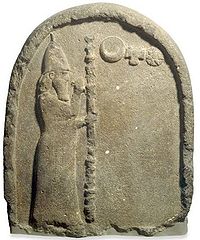 The Cyrus Cylinder's vilification of Nabonidus is consistent with other Persian propaganda regarding the deposed king's rule. In contrast to the Cylinder's depiction of Nabonidus as an illegitimate ruler who ruined his country, the reign of Nabonidus was largely peaceful, he was recognised as a legitimate king and he undertook a variety of building projects and military campaigns commensurate with his claim to be "the king of Babylon, the universe, and the four corners [of the Earth]".
The Assyriologist Paul-Alain Beaulieu
has interpreted Nabonidus's exaltation of the moon god Sin
as "an outright usurpation of Marduk's prerogatives". Although the Babylonian king continued to make rich offerings to Marduk, his greater devotion to Sin was unacceptable to the Babylonian priestly elite. Nabonidus came from the unfashionable north of Babylonia, introduced foreign gods and went into a lengthy self-imposed exile which was said to have prevented the celebration of the vital New Year festival. Cyrus's conquest of Babylonia was resisted by Nabonidus and his supporters, as the Battle of Opis
demonstrated. Briant comments that "it is doubtful that even before the fall of [Babylon] Cyrus was impatiently awaited by a population desperate for a 'liberator'". However, Cyrus's takeover as king does appear to have been welcomed by some of the Babylonian population. The Judaic historian Lisbeth S. Fried says that there is little evidence that the high-ranking priests of Babylonia during the Achaemenid period were Persians and characterises them as Babylonian collaborators.
The inscription goes on to describe Cyrus returning to their original sanctuaries the statues of the gods that Nabonidus had brought to the city before the Persian invasion. This restored the normal cultic order to the satisfaction of the priesthood. It alludes to temples being restored and deported groups being returned to their homelands but does not imply an empire-wide programme of restoration. Instead, it refers to specific areas in the border region between Babylonia and Persia, including sites that had been devastated by earlier Babylonian military campaigns. The Cylinder indicates that Cyrus sought to acquire the loyalty of the ravaged regions by funding reconstruction, the return of temple properties and the repatriation of the displaced populations. However, it is unclear how much actually changed on the ground; there is no archaeological evidence for any rebuilding or repairing of Mesopotamian temples during Cyrus's reign.
The text presents Cyrus as entering Babylon peacefully and being welcomed by the population as a liberator. This presents an implicit contrast with previous conquerors, notably the Assyrian rulers Tukulti-Ninurta I
, who invaded and plundered Babylon in the 12th century BC, and Sennacherib
, who did the same thing 150 years before Cyrus conquered the region. The massacre and enslavement of conquered people was common practice and was explicitly highlighted by conquerors in victory statements. The Cyrus Cylinder presents a very different message; Johannes Haubold notes that it portrays Cyrus's takeover as a harmonious moment of convergence between Babylonian and Persian history, not a natural disaster but the salvation of Babylonia.
However, the Cylinder's account of Cyrus's conquest clearly does not tell the whole story, as it suppresses any mention of the earlier conflict between the Persians and the Babylonians; Max Mallowan
describes it as a "skilled work of tendentious history". The text omits the Battle of Opis, in which Cyrus's forces defeated and apparently massacred Nabonidus's army. Nor does it explain a two-week gap reported by the Nabonidus Chronicle between the Persian entry into Babylon and the surrender of the Esagila temple. Lisbeth S. Fried suggests that there may have been a siege or stand-off between the Persians and the temple's defenders and priests, about whose fate the Cylinder and Chronicle makes no mention. She speculates that they were killed or expelled by the Persians and replaced by more pro-Persian members of the Babylonian priestly elite. As Walton and Hill put it, the claim of a wholly peaceful takeover acclaimed by the people is "standard conqueror's rhetoric and may obscure other facts". Describing the claim of one's own armies being welcomed as liberators as "one of the great imperial fantasies", Bruce Lincoln, Professor of Divinity at the University of Chicago
, notes that the Babylonian population repeatedly revolted against Persian rule in 522BC, 521BC, 484BC and 482BC (though not against Cyrus or his son Cambeses). The rebels sought to restore national independence and the line of native Babylonian kings – perhaps an indication that they were not as favourably disposed towards the Persians as the Cylinder suggests.
The Persians' policy towards their subject people, as described by the Cylinder, was traditionally viewed as an expression of tolerance, moderation and generosity "on a scale previously unknown." The policies of Cyrus toward subjugated nations have been contrasted to those of the Assyrians and Babylonians, who had treated subject peoples harshly; he permitted the resettling of those who had been previously deported and sponsored the reconstruction of religious buildings. Cyrus was often depicted positively in Western tradition by sources such as the Old Testament of the Bible and the Greek writers Herodotus
and Xenophon
. The Cyropaedia of Xenophon was particularly influential during the Renaissance
when Cyrus was romanticised as an exemplary model of a virtuous and successful ruler.
Modern historians argue that while Cyrus's behavior was indeed conciliatory, it was driven by the needs of the Persian Empire, and was not an expression of personal tolerance per se. The empire was too large to be centrally directed; Cyrus followed a policy of using existing territorial units to implement a decentralized system of government. The magnanimity shown by Cyrus won him praise and gratitude from those he spared. The policy of toleration described by the Cylinder was thus, as Biblical historian Rainer Albertz puts it, "an expression of conservative support for local regions to serve the political interests of the whole [empire]." Another Biblical historian, Alberto Soggin
, comments that it was more "a matter of practicality and economy ... [as] it was simpler, and indeed cost less, to obtain the spontaneous collaboration of their subjects at a local level than to have to impose their sovereignty by force."
(1–4:5) provides a narrative account of the rebuilding project. Scholars have linked one particular passage from the Cylinder to the Old Testament account:
This passage has often been interpreted as a reference to the benign policy instituted by Cyrus of allowing exiled peoples, such as the Jews, to return to their original homelands The Cylinder's inscription has been linked with the reproduction in the Book of Ezra of two texts that are claimed to be edicts issued by Cyrus concerning the repatriation of the Jews and the reconstruction of the Temple in Jerusalem. The two edicts (one in Hebrew
and one in Aramaic
) are substantially different in content and tone, leading some historians to argue that one or both may be a post hoc fabrication. The question of their authenticity remains unresolved, though it is widely believed that they do reflect some sort of Persian royal policy, albeit perhaps not one that was couched in the terms given in the text of the Biblical edicts.
The dispute over the authenticity of the biblical edicts has prompted interest in this passage from the Cyrus Cylinder, specifically concerning the question of whether it indicates that Cyrus had a general policy of repatriating subject peoples and restoring their sanctuaries. The text of the Cylinder is very specific, listing places in Mesopotamia and the neighboring regions. It does not describe any general release or return of exiled communities but focuses on the return of Babylonian deities to their own home cities. It emphasises the re-establishment of local religious norms, reversing the alleged neglect of Nabonidus – a theme that Amélie Kuhrt describes as "a literary device used to underline the piety of Cyrus as opposed to the blasphemy of Nabonidus." She suggests that Cyrus had simply adopted a policy used by earlier Assyrian rulers of giving privileges to cities in key strategic or politically sensitive regions and that there was no general policy as such. Lester Grabbe, a historian of early Judaism, has written that "the religious policy of the Persians was not that different from the basic practice of the Assyrians and Babylonians before them" in tolerating – but not promoting – local cults, other than their own gods.
Cyrus may have seen Jerusalem, situated in a strategic location between Mesopotamia and Egypt, as worth patronising for political reasons. His Achaemenid successors generally supported indigenous cults in subject territories as an expression of their legitimacy as rulers, thereby currying favour with the cults' devotees. Conversely, the Persian kings could, and did, destroy the shrines of peoples who had rebelled against them, as happened at Miletos in 494 BC following the Ionian Revolt
. The Babylonians had done the same; the Temple of Jerusalem had been razed as the result of a Babylonian invasion prompted by repeated Judean revolts against Babylonian rule. As such, it was clearly in a different category from the local Mesopotamian temples neglected by Nabonidus and restored by Cyrus. The Persians evidently did give permission for its reconstruction, which would have been required given the circumstances of its destruction. However, the Cylinder's text does not describe any general policy of a return of exiles or mention any sanctuary outside Babylonia; the Biblical historian Bob Becking concludes that "it has nothing to do with Judeans, Jews or Jerusalem." Peter Ross Bedford argues that the Cylinder "is thus not a manifesto for a general policy regarding indigenous cults and their worshippers throughout the empire." Kuhrt comments that "the purely Babylonian context of the Cylinder provides no proof" of the historicity of Cyrus's return of the Jewish exiles and the rebuilding of the Temple in Jerusalem, though Becking links this with the lack of any references to the Jews in surviving Achaemenid texts – an indication that the Persians seem not to have regarded them as being of any great importance.
The German scholar Josef Wiesehöfer
summarizes the widely held traditional view by noting that "Many scholars have read into [...] sentences [from the text of Cylinder] a confirmation of the Old Testament passages about the steps taken by Cyrus towards the erection of the Jerusalem temple and the repatriation of the Judaeans" and this interpretation was, according to Wiesehöfer, for some scholars a strict belief "that the instructions to this effect were actually provided in these very formulations of the Cyrus Cylinder".
called it "the world's first charter of human rights
". The cylinder was a key symbol of the Shah's political ideology and is still regarded by some commentators as a charter of human rights, despite the disagreement of some historians and scholars.
by saying that the Cyrus Cylinder was the precursor to the modern Universal Declaration of Human Rights
.
In his 1971 Nowruz
(New Year) speech, the Shah declared that 1971 would be Cyrus the Great Year, during which a grand commemoration would be held to celebrate 2,500 years of Persian monarchy. It would serve as a showcase for a modern Iran in which the contributions that Iran had made to world civilization would be recognized. The main theme of the commemoration was the centrality of the monarchy within Iran's political system, associating the Shah of Iran with the famous monarchs of Persia's past, and with Cyrus in particular. The Shah looked to the Achaemenid period as "a moment from the national past that could best serve as a model and a slogan for the imperial society he hoped to create."
The Cyrus Cylinder was adopted as the symbol for the commemoration, and Iranian magazines and journals published numerous articles about ancient Persian history. The British Museum loaned the original Cylinder to the Iranian government for the duration of the festivities; it was put on display at the Shahyad Monument (now the Azadi Tower
) in Tehran
. The 2,500 year celebrations
commenced on October 12, 1971 and culminated a week later with a spectacular parade at the tomb of Cyrus in Pasargadae
. On October 14, the shah's sister, Princess Ashraf Pahlavi, presented the United Nations Secretary General U Thant
with a replica of the Cylinder. The princess asserted that "the heritage of Cyrus was the heritage of human understanding, tolerance, courage, compassion and, above all, human liberty". The Secretary General accepted the gift, linking the Cylinder with the efforts of the United Nations General Assembly
to address "the question of Respect for Human Rights in Armed Conflict". Since then the replica Cylinder has been kept at the United Nations Headquarters
in New York City
on the second floor hallway. The United Nations continues to promote the cylinder as "an ancient declaration of human rights."
of human rights" has been dismissed by some historians as a "misunderstanding" and characterized as political propaganda devised by the Pahlavi regime., likening the comparison of Cyrus as a champion of the UN human rights policy as much of a phantom as the "humane and enlightened Shah of Persia."
Writing in the immediate aftermath of the Shah's commemorations, the British Museum's C.B.F. Walker comments that the "essential character of the Cyrus Cylinder [is not] a general declaration of human rights or religious toleration but simply a building inscription, in the Babylonian and Assyrian tradition, commemorating Cyrus's restoration of the city of Babylon and the worship of Marduk previously neglected by Nabonidus." Two professors with specialisms in the history of the ancient Near East, Bill T. Arnold and Piotr Michalowski, comment: "Generically, it belongs with other foundation deposit inscriptions; it is not an edict of any kind, nor does it provide any unusual human rights declaration as is sometimes claimed." Lloyd Llewellyn-Jones of the University of Edinburgh
notes that "there is nothing in the text" that suggests the concept of human rights. Neil MacGregor comments:
He cautions that while the Cylinder is "clearly linked with the history of Iran," it is "in no real sense an Iranian document: it is part of a much larger history of the ancient Near East, of Mesopotamian kingship, and of the Jewish diaspora."
Some historians, as well as writers on human rights, have supported the interpretation of the Cyrus Cylinder as a human rights charter. W.J. Talbott, an American philosopher, believes the concept of human rights is a 20th century concept but describes Cyrus as "perhaps the earliest known advocate of religious tolerance" and suggests that "ideas that led to the development of human rights are not limited to one cultural tradition." The Iranian lawyer Hirad Abtahi argues that viewing the Cylinder as merely "an instrument of legitimizing royal rule" is unjustified, as Cyrus issued the document and granted those rights when he was at the height of his power, with neither popular opposition nor visible external threat to force his hand. A former Iranian prime minister, Hassan Pirnia
, writing in the early 20th century, characterizes the Cylinder as "discuss[ing] human rights in a way unique for the era, dealing with ways to protect the honor, prestige, and religious beliefs of all the nations dependent to Iran in those days."
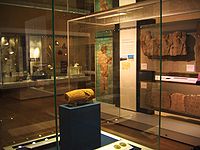 The Cyrus Cylinder has been displayed in the British Museum since its formal acquisition in 1880. It has been loaned three times – twice to Iran, between 7–22 October 1971 in conjunction with the 2,500 year commemorations of the Persian monarchy and again from September–December 2010, and once to Spain
from March–June 2006. Many replicas have been made. Some were distributed by the Shah following the 1971 commemorations, while the British Museum and National Museum of Iran
have sold them commercially.
The British Museum's ownership of the Cyrus Cylinder has been the cause of some controversy in Iran, although the artifact was obtained legally and was not excavated on Iranian soil but on former Ottoman territory
(modern Iraq
). When it was loaned in 1971, the Iranian press campaigned for its transfer to Iranian ownership. The Cylinder was brought back to London without difficulty, but the British Museum's Board of Trustees subsequently decided that it would be "undesirable to make a further loan of the Cylinder to Iran."
In 2005–2006 the British Museum mounted a major exhibition on the Persian Empire, Forgotten Empire: the World of Ancient Persia. It was held in collaboration with the Iranian government, which loaned the British Museum a number of iconic artifacts in exchange for an undertaking that the Cyrus Cylinder would be loaned to National Museum of Iran in return.
In October 2009, the British Museum announced that it was postponing the loan following the June 2009 presidential election
so that it could be "assured that the situation in the country was suitable." In response, the Iranian government threatened to end cooperation with the British Museum if the Cylinder was not loaned within the next two months. The delivery was scheduled for January 2010.
The opening date for the Iranian exhibition was 16 January 2010, but on 11 January the British Museum announced another postponement. Researchers had discovered two fragments in its collections bearing cuneiform inscriptions similar to those of the Cyrus Cylinder. The fragments were identified as coming from two pieces of cuneiform tablets, measuring little more than an inch across, that were inscribed with the same text as that on the Cyrus Cylinder. The British Museum stated that the fragments would be studied and presented at a workshop in London and that "it is intended that the two new pieces should be exhibited for the first time in Tehran, together with the Cylinder itself". The Museum agreed that it would lend the Cylinder and the fragments to the National Museum of Iran in July 2010. However, in February 2010 the Iranian government's Cultural Heritage and Tourism Organization announced that it would be cutting all ties with the British Museum, accusing the Museum of making a "politically motivated" decision to hold on to the Cylinder.
In April 2010, the National Museum of Iran announced that it would be seeking compensation from the British Museum for the "$300,000 showcase" constructed to protect the Cyrus Cylinder in Tehran. Iranian Head of Cultural Heritage, Hamid Baghaei, linked the dispute to deteriorating UK-Iranian diplomatic relations over the presidential election and Iran's pursuit of nuclear technology.
The exhibition prompted some controversy over its symbolism and the form of Ahmadinejad's opening ceremony, which involved the president draping a man dressed as Cyrus with part of the uniform of the pro-government Basij
militia. The Fars News Agency
proclaimed: "Cyrus The Great Becomes A Basij Member". Commentators described the ceremony as part of a new strategy to promote a form of religious nationalism, drawing on Iran's ancient past in a way that had hitherto been highly unusual in the Islamic Republic. Ahmadinejad's invocation of the cylinder as "represent[ing] respect for human beings' greatness and basic rights" was criticized by supporters of the Iranian opposition in the light of the Iranian government's own human rights abuses. The conservative daily newspaper Kayhan
stirred further controversy by arguing that Iran should keep the Cylinder, asking whether it was not true that it belonged to Iran and "that the British government stole this valuable and ancient object of ours." The British Museum responded by pointing out that it had not been stolen but had legally been excavated in Iraq and that "there is no sense that this is anything other than a loan." The Cylinder was duly returned to London in April 2011.
Older translations and transliterations:
Akkadian language
Akkadian is an extinct Semitic language that was spoken in ancient Mesopotamia. The earliest attested Semitic language, it used the cuneiform writing system derived ultimately from ancient Sumerian, an unrelated language isolate...
cuneiform script
Cuneiform script
Cuneiform script )) is one of the earliest known forms of written expression. Emerging in Sumer around the 30th century BC, with predecessors reaching into the late 4th millennium , cuneiform writing began as a system of pictographs...
in the name of the Achaemenid
Achaemenid Empire
The Achaemenid Empire , sometimes known as First Persian Empire and/or Persian Empire, was founded in the 6th century BCE by Cyrus the Great who overthrew the Median confederation...
king Cyrus the Great
Cyrus the Great
Cyrus II of Persia , commonly known as Cyrus the Great, also known as Cyrus the Elder, was the founder of the Achaemenid Empire. Under his rule, the empire embraced all the previous civilized states of the ancient Near East, expanded vastly and eventually conquered most of Southwest Asia and much...
. It dates from the 6th century BC and was discovered in the ruins of Babylon
Babylon
Babylon was an Akkadian city-state of ancient Mesopotamia, the remains of which are found in present-day Al Hillah, Babil Province, Iraq, about 85 kilometers south of Baghdad...
in Mesopotamia
Mesopotamia
Mesopotamia is a toponym for the area of the Tigris–Euphrates river system, largely corresponding to modern-day Iraq, northeastern Syria, southeastern Turkey and southwestern Iran.Widely considered to be the cradle of civilization, Bronze Age Mesopotamia included Sumer and the...
(modern Iraq
Iraq
Iraq ; officially the Republic of Iraq is a country in Western Asia spanning most of the northwestern end of the Zagros mountain range, the eastern part of the Syrian Desert and the northern part of the Arabian Desert....
) in 1879. It is currently in the possession of the British Museum
British Museum
The British Museum is a museum of human history and culture in London. Its collections, which number more than seven million objects, are amongst the largest and most comprehensive in the world and originate from all continents, illustrating and documenting the story of human culture from its...
, which sponsored the expedition that discovered the cylinder. It was created and used as a foundation deposit
Foundation deposit
Foundation deposits are ritual mudbrick lined pits or holes dug at specific points under Ancient Egyptian temples or tombs, which were filled with ceremonial objects, usually amulets, scarabs, food, or ritual miniature tools, and were supposed to prevent the building from falling into...
following the Persian conquest of Babylon
Babylon
Babylon was an Akkadian city-state of ancient Mesopotamia, the remains of which are found in present-day Al Hillah, Babil Province, Iraq, about 85 kilometers south of Baghdad...
in 539 BC, when the Neo-Babylonian Empire
Neo-Babylonian Empire
The Neo-Babylonian Empire or Second Babylonian Empire was a period of Mesopotamian history which began in 626 BC and ended in 539 BC. During the preceding three centuries, Babylonia had been ruled by their fellow Akkadian speakers and northern neighbours, Assyria. Throughout that time Babylonia...
was invaded by Cyrus and incorporated into his Persian Empire.
The text on the Cylinder praises Cyrus the Great, sets out his genealogy and portrays him as a king from a line of kings. The Babylonian king Nabonidus
Nabonidus
Nabonidus was the last king of the Neo-Babylonian Empire, reigning from 556-539 BCE.-Historiography on Nabonidus:...
, (see earlier Cylinder of Nabonidus
Cylinder of Nabonidus
The Nabonidus Cylinder from Sippar is a long text in which king Nabonidus of Babylonia describes how he repaired three temples: the sanctuary of the moon god Sin in Harran, the sanctuary of the warrior goddess Anunitu in Sippar, and the temple of Šamaš in Sippar...
), who was defeated and deposed by Cyrus, is denounced as an impious oppressor of the people of Babylonia and his low-born origins are implicitly contrasted to Cyrus's kingly heritage. The victorious Cyrus is portrayed as having been chosen by the chief Babylonian god Marduk
Marduk
Marduk was the Babylonian name of a late-generation god from ancient Mesopotamia and patron deity of the city of Babylon, who, when Babylon became the political center of the Euphrates valley in the time of Hammurabi , started to...
to restore peace and order to the Babylonians. The text states that Cyrus was welcomed by the people of Babylon as their new ruler and entered the city in peace. It appeals to Marduk to protect and help Cyrus and his son Cambyses
Cambyses
Cambyses can refer to two ancient rulers and two plays:-*Cambyses I, King of Anshan 600 to 559 BCE*Cambyses II, King of Persia 530 to 522 BCE*Cambyses, a tragedy by Thomas Preston...
. It extols Cyrus's efforts as a benefactor of the citizens of Babylonia who improved their lives, repatriated displaced people and restored temples and cult sanctuaries across Mesopotamia
Mesopotamia
Mesopotamia is a toponym for the area of the Tigris–Euphrates river system, largely corresponding to modern-day Iraq, northeastern Syria, southeastern Turkey and southwestern Iran.Widely considered to be the cradle of civilization, Bronze Age Mesopotamia included Sumer and the...
and elsewhere in the region. It concludes with a description of how Cyrus repaired the city wall of Babylon and found a similar inscription placed there by an earlier king.
The Cylinder's text has traditionally been seen by Biblical scholars as corroborative evidence of Cyrus’ policy of the repatriation
The Return to Zion
The Return to Zion is a term that refers to the event written in the biblical books of Ezra-Nehemiah in which the Jews returned to the Land of Israel from the Babylonian exile following the decree by the Persian emperor Cyrus the Great, the conqueror of the Babylonian empire in 538 BC, also known...
of the Jewish people
Jews
The Jews , also known as the Jewish people, are a nation and ethnoreligious group originating in the Israelites or Hebrews of the Ancient Near East. The Jewish ethnicity, nationality, and religion are strongly interrelated, as Judaism is the traditional faith of the Jewish nation...
following their Babylonian captivity
Babylonian captivity
The Babylonian captivity was the period in Jewish history during which the Jews of the ancient Kingdom of Judah were captives in Babylon—conventionally 587–538 BCE....
(an act that the Book of Ezra
Book of Ezra
The Book of Ezra is a book of the Hebrew Bible. Originally combined with the Book of Nehemiah in a single book of Ezra-Nehemiah, the two became separated in the early centuries of the Christian era...
attributes to Cyrus), as the text refers to the restoration of cult sanctuaries and repatriation of deported peoples. This interpretation has been disputed, as the text identifies only Mesopotamian sanctuaries, and makes no mention of Jews, Jerusalem, or Judea. The Cylinder has also been claimed to be an early "human rights charter", though the British Museum and scholars of ancient Near Eastern history reject this view as anachronistic and a misunderstanding of the Cylinder's generic nature. It was adopted as a symbol by the Shah of Iran's pre-1979 government, which put it on display in Tehran
Tehran
Tehran , sometimes spelled Teheran, is the capital of Iran and Tehran Province. With an estimated population of 8,429,807; it is also Iran's largest urban area and city, one of the largest cities in Western Asia, and is the world's 19th largest city.In the 20th century, Tehran was subject to...
in 1971 to commemorate 2,500 years of the Iranian monarchy.
Discovery
Assyrian people
The Assyrian people are a distinct ethnic group whose origins lie in ancient Mesopotamia...
-British
United Kingdom of Great Britain and Ireland
The United Kingdom of Great Britain and Ireland was the formal name of the United Kingdom during the period when what is now the Republic of Ireland formed a part of it....
archaeologist Hormuzd Rassam
Hormuzd Rassam
Hormuzd Rassam , was a native Assyrian Assyriologist, British diplomat and traveller who made a number of important discoveries, including the clay tablets that contained the Epic of Gilgamesh, the world's oldest literature...
discovered the Cyrus Cylinder in March 1879 during a lengthy programme of excavations in Mesopotamia carried out for the British Museum. It had been placed as a foundation deposit
Foundation deposit
Foundation deposits are ritual mudbrick lined pits or holes dug at specific points under Ancient Egyptian temples or tombs, which were filled with ceremonial objects, usually amulets, scarabs, food, or ritual miniature tools, and were supposed to prevent the building from falling into...
in the foundations of the Ésagila
Esagila
The Ésagila, a Sumerian name signifying "É whose top is lofty", was a temple dedicated to Marduk, the protector god of Babylon...
, the city's main temple. Rassam's expedition followed on from an earlier dig carried out in 1850 by the British archaeologist Austen Henry Layard
Austen Henry Layard
Sir Austen Henry Layard GCB, PC was a British traveller, archaeologist, cuneiformist, art historian, draughtsman, collector, author, politician and diplomat, best known as the excavator of Nimrud.-Family:...
, who excavated three mounds in the same area but found little of importance. In 1877, Layard became Britain's ambassador to the Ottoman Empire
Ottoman Empire
The Ottoman EmpireIt was usually referred to as the "Ottoman Empire", the "Turkish Empire", the "Ottoman Caliphate" or more commonly "Turkey" by its contemporaries...
, which ruled Mesopotamia at the time. He helped Rassam, who had been his assistant in the 1850 dig, to obtain a firman (decree) from the Ottoman Sultan
Ottoman Dynasty
The Ottoman Dynasty ruled the Ottoman Empire from 1299 to 1922, beginning with Osman I , though the dynasty was not proclaimed until Orhan Bey declared himself sultan...
Abdul Hamid II
Abdul Hamid II
His Imperial Majesty, The Sultan Abdülhamid II, Emperor of the Ottomans, Caliph of the Faithful was the 34th sultan of the Ottoman Empire...
to continue the earlier excavations. The firman was only valid for a year but a second firman, with much more liberal terms, was issued in 1878. It was granted for two years (through to 15 October 1880) with the promise of an extension to 1882 if required. The Sultan's decree authorised Rassam to "pack and dispatch to England any antiquities [he] found ... provided, however, there were no duplicates." A representative of the Sultan was instructed to be present at the dig to examine the objects as they were uncovered.
With permission secured, Rassam initiated a large-scale excavation at Babylon and other sites on behalf of the Trustees of the British Museum. He undertook the excavations in four distinct phases. In between each phase, he returned to England to bring back his finds and raise more funds for further work. The Cyrus Cylinder was found on the second of his four expeditions to Mesopotamia, which began with his departure from London on 8 October 1878. He arrived in his home town of Mosul
Mosul
Mosul , is a city in northern Iraq and the capital of the Ninawa Governorate, some northwest of Baghdad. The original city stands on the west bank of the Tigris River, opposite the ancient Assyrian city of Nineveh on the east bank, but the metropolitan area has now grown to encompass substantial...
on 16 November and travelled down the Tigris
Tigris
The Tigris River is the eastern member of the two great rivers that define Mesopotamia, the other being the Euphrates. The river flows south from the mountains of southeastern Turkey through Iraq.-Geography:...
to Baghdad
Baghdad
Baghdad is the capital of Iraq, as well as the coterminous Baghdad Governorate. The population of Baghdad in 2011 is approximately 7,216,040...
, which he reached on 30 January 1879. During February and March, he supervised excavations on a number of Babylonian sites, including Babylon itself.
He soon uncovered a number of important buildings including the Ésagila temple. This was a major shrine to the chief Babylonian god Marduk
Marduk
Marduk was the Babylonian name of a late-generation god from ancient Mesopotamia and patron deity of the city of Babylon, who, when Babylon became the political center of the Euphrates valley in the time of Hammurabi , started to...
, although its identity was not fully confirmed until the German archaeologist Robert Koldewey
Robert Koldewey
Robert Johann Koldewey was a German architect, famous for his discovery of the ancient city of Babylon in modern day Iraq. He was born in Blankenburg am Harz in Germany, the duchy of Brunswick, and died in Berlin at the age of 70...
's excavation of 1900. The excavators found a large number of business documents written on clay tablets and, buried in the temple's foundations, the Cyrus Cylinder. Rassam gave conflicting accounts of where his discoveries were made. He wrote in his memoirs, Asshur and the land of Nimrod, that the Cylinder had been found in a mound at the southern end of Babylon near the village of Jumjuma or Jimjima. However, in a letter sent on 20 November 1879 to Samuel Birch
Samuel Birch
Samuel Birch was a British Egyptologist and antiquary.-Biography:Birch was the son of a rector at St Mary Woolnoth, London. He was educated at Merchant Taylors' School. From an early age, his manifest tendency to the study of out-of-the-way subjects well suited his later interest in archaeology...
, the Keeper of Oriental Antiquities at the British Museum, he wrote, "The Cylinder of Cyrus was found at Omran [Tell Amran-ibn-Ali] with about six hundred pieces of inscribed terracottas before I left Baghdad." He left Baghdad on 2 April, returning to Mosul and departing from there on 2 May for a journey to London which lasted until 19 June.
The discovery was announced to the public by Sir Henry Rawlinson, the President of the Royal Asiatic Society
Royal Asiatic Society
The Royal Asiatic Society of Great Britain and Ireland was established, according to its Royal Charter of 11 August 1824, to further "the investigation of subjects connected with and for the encouragement of science, literature and the arts in relation to Asia." From its incorporation the Society...
, at a meeting of the Society on 17 November 1879. He described it as "one of the most interesting historical records in the cuneiform character that has yet been brought to light", though he erroneously described it as coming from the ancient city of Borsippa
Borsippa
Borsippa was an important ancient city of Sumer, built on both sides of a lake about southwest of Babylon on the east bank of the Euphrates. The site of Borsippa is in Babil Governorate, Iraq and now called Birs Nimrud, identifying the site with Nimrod...
rather than Babylon. Rawlinson's "Notes on a newly-discovered Clay Cylinder of Cyrus the Great" were published in the society's journal the following year, including the first partial translation of the text.
Associated fragments
The British Museum announced in January 2010 that two inscribed clay fragments, which had been in the Museum's collection since 1881, had been identified as part of a cuneiform tablet that was inscribed with the same text as the Cyrus Cylinder. The fragments had come from the small site of Dailem near Babylon and the identification was made by Professor Wilfred Lambert, formerly of the University of Birmingham, and Irving Finkel, curator in charge of the Museum's Department of the Middle East.A horse bone bearing cuneiform inscriptions apparently derived from the Cyrus Cylinder has also been discovered in China along with a second bone inscribed with an as yet unknown text. The bones were acquired by the Beijing Palace Museum in 1985. Their origin is unclear, but Irving Finkel has hypothesized that they may reflect a proclamation in another format (perhaps leather or clay), derived from the Cyrus Cylinder's text, though for some reason only one in twenty of the original cuneiform symbols were copied. Finkel suggests that this may indicate that the text (or even the original cylinder itself) was sent around the Persian Empire and was copied to make the bone's inscription at some point.
Description
The Cyrus Cylinder is a barrel-shaped cylinder of baked clay measuring 22.5 centimetres (8.9 in) by 10 centimetres (3.9 in) at its maximum diameter. It was created in several stages around a cone-shaped core of clay within which there are large grey stone inclusions. It was built up with extra layers of clay to give it a cylindrical shape before a fine surface slip of clay was added to add the outer layer, on which the text is inscribed. It was excavated in several fragments, having apparently broken apart in antiquity. Today it exists in two main fragments, known as "A" and "B", which were reunited in 1972.The main body of the Cylinder, discovered by Rassam in 1879, is fragment "A". It underwent restoration in 1961, when it was re-fired and plaster filling was added. The smaller fragment, "B", is a section measuring 8.6 centimetres (3.4 in) by 5.6 centimetres (2.2 in). The latter fragment was acquired by J.B. Nies of Yale University
Yale University
Yale University is a private, Ivy League university located in New Haven, Connecticut, United States. Founded in 1701 in the Colony of Connecticut, the university is the third-oldest institution of higher education in the United States...
from an antiquities dealer. Nies published the text in 1920. The fragment was apparently broken off the main body of the Cylinder during the original excavations in 1879 and was either removed from the excavations or was retrieved from one of Rassam's waste dumps. It was not confirmed as part of the Cylinder until Paul-Richard Berger of the University of Münster
University of Münster
The University of Münster is a public university located in the city of Münster, North Rhine-Westphalia in Germany. The WWU is part of the Deutsche Forschungsgemeinschaft, a society of Germany's leading research universities...
definitively identified it it in 1970. Yale University lent the fragment to the British Museum temporarily (but, in practice, indefinitely) in exchange for "a suitable cuneiform tablet" from the British Museum collection.
Although the Cylinder clearly post-dates Cyrus the Great's conquest of Babylon in 539 BC, the date of its creation is unclear. It is commonly said to date to the early part of Cyrus's reign over Babylon, some time after 539 BC. The British Museum puts the Cylinder's date of origin at between 539–530 BC.
The text
The surviving inscription on the Cyrus Cylinder consists of 45 lines of text written in Akkadian cuneiform script, the first 35 lines of which are on fragment "A" and the remainder of which are on fragment "B." A number of lines at the start and end of the text are too badly damaged for more than a few words to be legible.The text is written in an extremely formulaic style that can be divided into six distinct parts:
- Lines 1–19: an introduction reviling NabonidusNabonidusNabonidus was the last king of the Neo-Babylonian Empire, reigning from 556-539 BCE.-Historiography on Nabonidus:...
, the previous king of Babylon, and associating Cyrus with the god Marduk; - Lines 20–22: detailing Cyrus's royal titles and genealogy, and his peaceful entry to Babylon;
- Lines 22–34: a commendation of Cyrus's policy of restoring Babylon;
- Lines 34–35: a prayer to Marduk on behalf of Cyrus and his son CambysesCambyses II of PersiaCambyses II son of Cyrus the Great , was a king of kings of the Achaemenid Empire. Cambyses's grandfather was Cambyses I, king of Anshan. Following Cyrus the Great's conquest of the Near East and Central Asia, Cambyses II further expanded the empire into Egypt during the Late Period by defeating...
; - Lines 36–37: a declaration that Cyrus has enabled the people to live in peace and has increased the offerings made to the gods;
- Lines 38–45: details of the building activities ordered by Cyrus in Babylon.
The start of the text is partly broken; the surviving content reprimands the character of the deposed Babylonian king Nabonidus
Nabonidus
Nabonidus was the last king of the Neo-Babylonian Empire, reigning from 556-539 BCE.-Historiography on Nabonidus:...
. It lists his alleged crimes, charging him with the desecration of the temples of the gods and the imposition of forced labor
Corvée
Corvée is unfree labour, often unpaid, that is required of people of lower social standing and imposed on them by the state or a superior . The corvée was the earliest and most widespread form of taxation, which can be traced back to the beginning of civilization...
upon the populace. According to the proclamation, as a result of these offenses, the god Marduk abandoned Babylon and sought a more righteous king. Marduk called forth Cyrus to enter Babylon and become its new ruler.
Midway through the text, the writer switches to a first-person narrative
First-person narrative
First-person point of view is a narrative mode where a story is narrated by one character at a time, speaking for and about themselves. First-person narrative may be singular, plural or multiple as well as being an authoritative, reliable or deceptive "voice" and represents point of view in the...
in the voice of Cyrus, addressing the reader directly. A list of his titles is given (in a Mesopotamian rather than Persian style): "I am Cyrus, king of the world, great king, powerful king, king of Babylon, king of Sumer
Sumer
Sumer was a civilization and historical region in southern Mesopotamia, modern Iraq during the Chalcolithic and Early Bronze Age....
and Akkad
Akkad
The Akkadian Empire was an empire centered in the city of Akkad and its surrounding region in Mesopotamia....
, king of the four quarters [of the earth], son of Cambyses, great king, king of Anshan, descendent of Teispes
Teispes of Anshan
Teispes lived from 675-640 BCE. He was the son of Achaemenes and an ancestor of Cyrus the Great. There is evidence that Cyrus I and Ariaramnes were both his sons. Cyrus I is the grandfather of Cyrus the Great, whereas Ariaramnes is great grandfather of Darius the Great...
, great king, king of Anshan, the perpetual seed of kingship, whose reign Bel
Bel (mythology)
Bel , signifying "lord" or "master", is a title rather than a genuine name, applied to various gods in Babylonian religion. The feminine form is Belit 'Lady, Mistress'. Bel is represented in Greek as Belos and in Latin as Belus...
[Markuk] and Nebo
Nabu
Nabu is the Assyrian and Babylonian god of wisdom and writing, worshipped by Babylonians as the son of Marduk and his consort, Sarpanitum, and as the grandson of Ea. Nabu's consort was Tashmetum....
love, and with whose kingship, to their joy, they concern themselves." He describes the pious deeds he performed after his conquest: he restored peace to Babylon and the other cities sacred to Marduk, freeing their inhabitants from their "yoke," and he "brought relief to their dilapidated housing (thus) putting an end to their (main) complaints". He repaired the ruined temples in the cities he conquered, restored their cults, and returned their sacred images as well as their former inhabitants which Narbonidus had taken to Babylon. Near the end of the inscription Cyrus highlights his restoration of Babylon's city wall, saying: "I saw within it an inscription of Ashurbanipal
Ashurbanipal
Ashurbanipal |Ashur]] is creator of an heir"; 685 BC – c. 627 BC), also spelled Assurbanipal or Ashshurbanipal, was an Assyrian king, the son of Esarhaddon and the last great king of the Neo-Assyrian Empire...
, a king who preceded me." The remainder is missing but presumably describes Cyrus's rededication of the gateway mentioned.
A partial transcription by F.H. Weissbach in 1911 was supplanted by a much more complete transcription after the identification of the "B" fragment; this is now available in German and in English. Several editions of the full text of the Cyrus Cylinder are available online, incorporating both "A" and "B" fragments.
A false translation of the text – affirming, among other things, the abolition of slavery and the right to self-determination, a minimum wage and asylum – has been promoted on the Internet and elsewhere. As well as making claims that are not found on the real cylinder, it has been edited, referring to the Zoroastrian divinity Ahura Mazda
Ahura Mazda
Ahura Mazdā is the Avestan name for a divinity of the Old Iranian religion who was proclaimed the uncreated God by Zoroaster, the founder of Zoroastrianism...
rather than the Mesopotamian god Marduk
Marduk
Marduk was the Babylonian name of a late-generation god from ancient Mesopotamia and patron deity of the city of Babylon, who, when Babylon became the political center of the Euphrates valley in the time of Hammurabi , started to...
. The false translation has been widely circulated; alluding to its claim that Cyrus supposedly has stated that "Every country shall decide for itself whether or not it wants my leadership." Iranian Nobel Peace Prize
Nobel Peace Prize
The Nobel Peace Prize is one of the five Nobel Prizes bequeathed by the Swedish industrialist and inventor Alfred Nobel.-Background:According to Nobel's will, the Peace Prize shall be awarded to the person who...
winner Shirin Ebadi
Shirin Ebadi
Shirin Ebadi is an Iranian lawyer, a former judge and human rights activist and founder of Defenders of Human Rights Center in Iran. On 10 October 2003, Ebadi was awarded the Nobel Peace Prize for her significant and pioneering efforts for democracy and human rights, especially women's,...
in her acceptance speech described Cyrus as "the very emperor who proclaimed at the pinnacle of power 2,500 years ago that ... he would not reign over the people if they did not wish it". Similarly, United States President George W. Bush referred in a 2006 speech to Cyrus declaring that his people had "the right to worship God in freedom" – a statement made nowhere in the text of the cylinder.
Mesopotamian and Persian tradition and propaganda
According to the British Museum, the Cyrus Cylinder reflects a long tradition in Mesopotamia where, from as early as the third millennium BC, kings began their reigns with declarations of reforms. Cyrus's declaration stresses his legitimacy as the king, and is a conspicuous statement of his respect for the religious and political traditions of Babylonia. The British Museum and scholars of the period describe it as an instrument of ancient Mesopotamian propaganda.The text is a royal building inscription, a genre which had no equivalent in Old Persian
Old Persian language
The Old Persian language is one of the two directly attested Old Iranian languages . Old Persian appears primarily in the inscriptions, clay tablets, and seals of the Achaemenid era...
literature. It illustrates how Cyrus co-opted local traditions and symbols to legitimize his conquest and control of Babylon. Many elements of the text were drawn from long-standing Mesopotamian themes of legitimizing rule in Babylonia: the preceding king is reprimanded and he is proclaimed to have been abandoned by the gods for his wickedness; the new king has gained power through the divine will of the gods; the new king rights the wrongs of his predecessor, addressing the welfare of the people; the sanctuaries of the gods are rebuilt or restored, offerings to the gods are made or increased and the blessings of the gods are sought; and repairs are made to the whole city, in the manner of earlier rightful kings.
Both continuity and discontinuity are emphasized in the text of the Cylinder. It asserts the virtue of Cyrus as a gods-fearing king of a traditional Mesopotamian type. On the other hand, it constantly discredits Nabonidus, reviling the deposed king's deeds and even his ancestry and portraying him as an impious destroyer of his own people. As Fowler and Hekster note, this "creates a problem for a monarch who chooses to buttress his claim to legitimacy by appropriating the 'symbolic capital' of his predecessors." The Cylinder's reprimand of Nabonidus also discredits Babylonian royal authority by association. It is perhaps for this reason that the Achaemenid rulers made greater use of Assyrian rather than Babylonian royal iconography and tradition in their declarations; the Cylinder refers to the Assyrian king Ashurbanipal
Ashurbanipal
Ashurbanipal |Ashur]] is creator of an heir"; 685 BC – c. 627 BC), also spelled Assurbanipal or Ashshurbanipal, was an Assyrian king, the son of Esarhaddon and the last great king of the Neo-Assyrian Empire...
as "my predecessor", rather than any native Babylonian ruler.
The Cylinder itself is part of a continuous Mesopotamian tradition of depositing a wide variety of symbolic items, including animal sacrifices, stone tablets, terracotta cones, cylinders and figures. Newly crowned kings of Babylon would make public declarations of their own righteousness when beginning their reigns, often in the form of declarations that were deposited in the foundations of public buildings. Some contained messages, while others did not, and they had a number of purposes: elaboration of a building's value, commemoration of the ruler or builder and the magical sanctification of the building, through the invocation of divine protection.
The cylinder was not intended to be seen again after its burial, but the text inscribed on it would have been used for public purposes. Archive copies were kept of important inscriptions and the Cylinder's text may likewise have been copied. In January 2010, the British Museum announced that two cuneiform tablets in its collection had been found to be inscribed with the same text as that on the Cyrus Cylinder, which, according to the Museum, "show that the text of the Cylinder was probably a proclamation that was widely distributed across the Persian Empire."
Similarities with other royal inscriptions
The Cyrus Cylinder bears striking similarities to older Mesopotamian royal inscriptions. Two notable examples are the Cylinder of Marduk-apla-iddina II, who seized the Babylonian throne in 722/1 BC, and the annals of Sargon IISargon II
Sargon II was an Assyrian king. Sargon II became co-regent with Shalmaneser V in 722 BC, and became the sole ruler of the kingdom of Assyria in 722 BC after the death of Shalmaneser V. It is not clear whether he was the son of Tiglath-Pileser III or a usurper unrelated to the royal family...
of Assyria, who conquered Babylon twelve years later. As a conqueror, Marduk-apla-iddina faced many of the same issues of legitimacy that Cyrus did when he conquered Babylon. He declares himself to have been chosen personally by Marduk, who ensured his victory. When he took power, he performed the sacred rites and restored the sacred shrines. He states that he found a royal inscription placed in the temple foundations by an earlier Babylonian king, which he left undisturbed and honored. All of these claims also appear in Cyrus's Cylinder. Twelve years later, the Assyrian king Sargon II
Sargon II
Sargon II was an Assyrian king. Sargon II became co-regent with Shalmaneser V in 722 BC, and became the sole ruler of the kingdom of Assyria in 722 BC after the death of Shalmaneser V. It is not clear whether he was the son of Tiglath-Pileser III or a usurper unrelated to the royal family...
defeated and exiled Marduk-apla-iddina, taking up the kingship of Babylonia. Sargon's annals describe how he took on the duties of a Babylonian sovereign, honouring the gods, maintaining their temples and respecting and upholding the privileges of the urban elite. Again, Cyrus's Cylinder makes exactly the same points. Nabonidus, Cyrus's deposed predecessor as king of Babylon, commissioned foundation texts on clay cylinders – such as the Cylinder of Nabonidus
Cylinder of Nabonidus
The Nabonidus Cylinder from Sippar is a long text in which king Nabonidus of Babylonia describes how he repaired three temples: the sanctuary of the moon god Sin in Harran, the sanctuary of the warrior goddess Anunitu in Sippar, and the temple of Šamaš in Sippar...
, also in the British Museum – that follows the same basic formula.
The text of the Cylinder thus indicates a strong continuity with centuries of Babylonian tradition, as part of an established rhetoric advanced by conquerors. As Kuhrt puts it, the Cylinder:
The familiarity with long-established Babylonian tropes suggests that the Cylinder was authored by the Babylonian priests of Marduk, working at the behest of Cyrus. It can be compared with another work of around the same time, the Verse Account of Nabonidus, in which the former Babylonian ruler is excoriated as the enemy of the priests of Marduk and Cyrus is presented as the liberator of Babylon. Both works make a point of stressing Cyrus's qualifications as a king from a line of kings, in contrast to the non-royal ancestry of Nabonidus, who is described by the Cylinder as merely maţû, "insignificant".
The Verse Account is so similar to the Cyrus Cylinder inscription that the two texts have been dubbed an example of "literary dependence" – not the direct dependence of one upon the other, but mutual dependence upon a common source. This is characterised by the historian Morton Smith
Morton Smith
Morton Smith was an American professor of ancient history at Columbia University. He is best known for his controversial discovery of the Mar Saba letter, a letter attributed to Clement of Alexandria containing excerpts from a Secret Gospel of Mark, during a visit to the monastery at Mar Saba in...
as "the propaganda put out in Babylonia by Cyrus's agents, shortly before Cyrus's conquest, to prepare the way of their lord." This viewpoint has been disputed; as Simon J. Sherwin of the University of Cambridge
University of Cambridge
The University of Cambridge is a public research university located in Cambridge, United Kingdom. It is the second-oldest university in both the United Kingdom and the English-speaking world , and the seventh-oldest globally...
puts it, the Cyrus Cylinder and the Verse Account are "after the event" compositions which reuse existing Mesopotamian literary themes and do not need to be explained as the product of pre-conquest Persian propaganda.
The German historian Hanspeter Schaudig has identified a line on the Cylinder ("He [i.e. Marduk] saved his city Babylon from its oppression") with a line from tablet VI of the Babylonian "Epic of Creation", Enûma Eliš, in which Marduk builds Babylon. Johannes Haubold suggests that reference represents Cyrus's takeover as a moment of ultimate restoration not just of political and religious institutions, but of the cosmic order underpinning the universe.
Analysis of the Cylinder's claims
The Assyriologist Paul-Alain Beaulieu
Paul-Alain Beaulieu
Paul-Alain Beaulieu is a Canadian Assyriologist, a Professor of Near and Middle Eastern Civilizations at the University of Toronto.Beaulieu earned a masters degree from the Université de Montréal in 1980 under the supervision of Marcel Leibovici, and a Ph.D. from Yale University in 1985...
has interpreted Nabonidus's exaltation of the moon god Sin
Sin (mythology)
Sin or Nanna was the god of the moon in Mesopotamian mythology. Nanna is a Sumerian deity, the son of Enlil and Ninlil, and became identified with Semitic Sin. The two chief seats of Nanna's/Sin's worship were Ur in the south of Mesopotamia and Harran in the north.- Name :The original meaning of...
as "an outright usurpation of Marduk's prerogatives". Although the Babylonian king continued to make rich offerings to Marduk, his greater devotion to Sin was unacceptable to the Babylonian priestly elite. Nabonidus came from the unfashionable north of Babylonia, introduced foreign gods and went into a lengthy self-imposed exile which was said to have prevented the celebration of the vital New Year festival. Cyrus's conquest of Babylonia was resisted by Nabonidus and his supporters, as the Battle of Opis
Battle of Opis
The Battle of Opis, fought in September 539 BC, was a major engagement between the armies of Persia under Cyrus the Great and the Neo-Babylonian Empire under Nabonidus during the Persian invasion of Mesopotamia. At the time, Babylonia was the last major power in western Asia that was not yet under...
demonstrated. Briant comments that "it is doubtful that even before the fall of [Babylon] Cyrus was impatiently awaited by a population desperate for a 'liberator'". However, Cyrus's takeover as king does appear to have been welcomed by some of the Babylonian population. The Judaic historian Lisbeth S. Fried says that there is little evidence that the high-ranking priests of Babylonia during the Achaemenid period were Persians and characterises them as Babylonian collaborators.
The inscription goes on to describe Cyrus returning to their original sanctuaries the statues of the gods that Nabonidus had brought to the city before the Persian invasion. This restored the normal cultic order to the satisfaction of the priesthood. It alludes to temples being restored and deported groups being returned to their homelands but does not imply an empire-wide programme of restoration. Instead, it refers to specific areas in the border region between Babylonia and Persia, including sites that had been devastated by earlier Babylonian military campaigns. The Cylinder indicates that Cyrus sought to acquire the loyalty of the ravaged regions by funding reconstruction, the return of temple properties and the repatriation of the displaced populations. However, it is unclear how much actually changed on the ground; there is no archaeological evidence for any rebuilding or repairing of Mesopotamian temples during Cyrus's reign.
The text presents Cyrus as entering Babylon peacefully and being welcomed by the population as a liberator. This presents an implicit contrast with previous conquerors, notably the Assyrian rulers Tukulti-Ninurta I
Tukulti-Ninurta I
Tukulti-Ninurta I was a king of Assyria.He succeeded Shalmaneser I, his father, as king and won a major victory against the Hittites at the Battle of Nihriya in the first half of his reign...
, who invaded and plundered Babylon in the 12th century BC, and Sennacherib
Sennacherib
Sennacherib |Sîn]] has replaced brothers for me"; Aramaic: ) was the son of Sargon II, whom he succeeded on the throne of Assyria .-Rise to power:...
, who did the same thing 150 years before Cyrus conquered the region. The massacre and enslavement of conquered people was common practice and was explicitly highlighted by conquerors in victory statements. The Cyrus Cylinder presents a very different message; Johannes Haubold notes that it portrays Cyrus's takeover as a harmonious moment of convergence between Babylonian and Persian history, not a natural disaster but the salvation of Babylonia.
However, the Cylinder's account of Cyrus's conquest clearly does not tell the whole story, as it suppresses any mention of the earlier conflict between the Persians and the Babylonians; Max Mallowan
Max Mallowan
Sir Max Edgar Lucien Mallowan, CBE was a prominent British archaeologist, specialising in ancient Middle Eastern history, and the second husband of Dame Agatha Christie.-Life and work:...
describes it as a "skilled work of tendentious history". The text omits the Battle of Opis, in which Cyrus's forces defeated and apparently massacred Nabonidus's army. Nor does it explain a two-week gap reported by the Nabonidus Chronicle between the Persian entry into Babylon and the surrender of the Esagila temple. Lisbeth S. Fried suggests that there may have been a siege or stand-off between the Persians and the temple's defenders and priests, about whose fate the Cylinder and Chronicle makes no mention. She speculates that they were killed or expelled by the Persians and replaced by more pro-Persian members of the Babylonian priestly elite. As Walton and Hill put it, the claim of a wholly peaceful takeover acclaimed by the people is "standard conqueror's rhetoric and may obscure other facts". Describing the claim of one's own armies being welcomed as liberators as "one of the great imperial fantasies", Bruce Lincoln, Professor of Divinity at the University of Chicago
University of Chicago
The University of Chicago is a private research university in Chicago, Illinois, USA. It was founded by the American Baptist Education Society with a donation from oil magnate and philanthropist John D. Rockefeller and incorporated in 1890...
, notes that the Babylonian population repeatedly revolted against Persian rule in 522BC, 521BC, 484BC and 482BC (though not against Cyrus or his son Cambeses). The rebels sought to restore national independence and the line of native Babylonian kings – perhaps an indication that they were not as favourably disposed towards the Persians as the Cylinder suggests.
The Persians' policy towards their subject people, as described by the Cylinder, was traditionally viewed as an expression of tolerance, moderation and generosity "on a scale previously unknown." The policies of Cyrus toward subjugated nations have been contrasted to those of the Assyrians and Babylonians, who had treated subject peoples harshly; he permitted the resettling of those who had been previously deported and sponsored the reconstruction of religious buildings. Cyrus was often depicted positively in Western tradition by sources such as the Old Testament of the Bible and the Greek writers Herodotus
Herodotus
Herodotus was an ancient Greek historian who was born in Halicarnassus, Caria and lived in the 5th century BC . He has been called the "Father of History", and was the first historian known to collect his materials systematically, test their accuracy to a certain extent and arrange them in a...
and Xenophon
Xenophon
Xenophon , son of Gryllus, of the deme Erchia of Athens, also known as Xenophon of Athens, was a Greek historian, soldier, mercenary, philosopher and a contemporary and admirer of Socrates...
. The Cyropaedia of Xenophon was particularly influential during the Renaissance
Renaissance
The Renaissance was a cultural movement that spanned roughly the 14th to the 17th century, beginning in Italy in the Late Middle Ages and later spreading to the rest of Europe. The term is also used more loosely to refer to the historical era, but since the changes of the Renaissance were not...
when Cyrus was romanticised as an exemplary model of a virtuous and successful ruler.
Modern historians argue that while Cyrus's behavior was indeed conciliatory, it was driven by the needs of the Persian Empire, and was not an expression of personal tolerance per se. The empire was too large to be centrally directed; Cyrus followed a policy of using existing territorial units to implement a decentralized system of government. The magnanimity shown by Cyrus won him praise and gratitude from those he spared. The policy of toleration described by the Cylinder was thus, as Biblical historian Rainer Albertz puts it, "an expression of conservative support for local regions to serve the political interests of the whole [empire]." Another Biblical historian, Alberto Soggin
Alberto Soggin
Jan Alberto Soggin was a leading Italian Biblical scholar. He took his first degrees in law at the Sapienza University of Rome and in theology at the Waldensian Theological Seminary in Rome...
, comments that it was more "a matter of practicality and economy ... [as] it was simpler, and indeed cost less, to obtain the spontaneous collaboration of their subjects at a local level than to have to impose their sovereignty by force."
Biblical interpretations
The Bible records that some Jews (who were exiled by the Babylonians), returned to their homeland from Babylon, where they had been settled by Nebuchadnezzar, to rebuild the temple following an edict from Cyrus. The Book of EzraBook of Ezra
The Book of Ezra is a book of the Hebrew Bible. Originally combined with the Book of Nehemiah in a single book of Ezra-Nehemiah, the two became separated in the early centuries of the Christian era...
(1–4:5) provides a narrative account of the rebuilding project. Scholars have linked one particular passage from the Cylinder to the Old Testament account:
This passage has often been interpreted as a reference to the benign policy instituted by Cyrus of allowing exiled peoples, such as the Jews, to return to their original homelands The Cylinder's inscription has been linked with the reproduction in the Book of Ezra of two texts that are claimed to be edicts issued by Cyrus concerning the repatriation of the Jews and the reconstruction of the Temple in Jerusalem. The two edicts (one in Hebrew
Hebrew language
Hebrew is a Semitic language of the Afroasiatic language family. Culturally, is it considered by Jews and other religious groups as the language of the Jewish people, though other Jewish languages had originated among diaspora Jews, and the Hebrew language is also used by non-Jewish groups, such...
and one in Aramaic
Aramaic language
Aramaic is a group of languages belonging to the Afroasiatic language phylum. The name of the language is based on the name of Aram, an ancient region in central Syria. Within this family, Aramaic belongs to the Semitic family, and more specifically, is a part of the Northwest Semitic subfamily,...
) are substantially different in content and tone, leading some historians to argue that one or both may be a post hoc fabrication. The question of their authenticity remains unresolved, though it is widely believed that they do reflect some sort of Persian royal policy, albeit perhaps not one that was couched in the terms given in the text of the Biblical edicts.
The dispute over the authenticity of the biblical edicts has prompted interest in this passage from the Cyrus Cylinder, specifically concerning the question of whether it indicates that Cyrus had a general policy of repatriating subject peoples and restoring their sanctuaries. The text of the Cylinder is very specific, listing places in Mesopotamia and the neighboring regions. It does not describe any general release or return of exiled communities but focuses on the return of Babylonian deities to their own home cities. It emphasises the re-establishment of local religious norms, reversing the alleged neglect of Nabonidus – a theme that Amélie Kuhrt describes as "a literary device used to underline the piety of Cyrus as opposed to the blasphemy of Nabonidus." She suggests that Cyrus had simply adopted a policy used by earlier Assyrian rulers of giving privileges to cities in key strategic or politically sensitive regions and that there was no general policy as such. Lester Grabbe, a historian of early Judaism, has written that "the religious policy of the Persians was not that different from the basic practice of the Assyrians and Babylonians before them" in tolerating – but not promoting – local cults, other than their own gods.
Cyrus may have seen Jerusalem, situated in a strategic location between Mesopotamia and Egypt, as worth patronising for political reasons. His Achaemenid successors generally supported indigenous cults in subject territories as an expression of their legitimacy as rulers, thereby currying favour with the cults' devotees. Conversely, the Persian kings could, and did, destroy the shrines of peoples who had rebelled against them, as happened at Miletos in 494 BC following the Ionian Revolt
Ionian Revolt
The Ionian Revolt, and associated revolts in Aeolis, Doris, Cyprus and Caria, were military rebellions by several regions of Asia Minor against Persian rule, lasting from 499 BC to 493 BC...
. The Babylonians had done the same; the Temple of Jerusalem had been razed as the result of a Babylonian invasion prompted by repeated Judean revolts against Babylonian rule. As such, it was clearly in a different category from the local Mesopotamian temples neglected by Nabonidus and restored by Cyrus. The Persians evidently did give permission for its reconstruction, which would have been required given the circumstances of its destruction. However, the Cylinder's text does not describe any general policy of a return of exiles or mention any sanctuary outside Babylonia; the Biblical historian Bob Becking concludes that "it has nothing to do with Judeans, Jews or Jerusalem." Peter Ross Bedford argues that the Cylinder "is thus not a manifesto for a general policy regarding indigenous cults and their worshippers throughout the empire." Kuhrt comments that "the purely Babylonian context of the Cylinder provides no proof" of the historicity of Cyrus's return of the Jewish exiles and the rebuilding of the Temple in Jerusalem, though Becking links this with the lack of any references to the Jews in surviving Achaemenid texts – an indication that the Persians seem not to have regarded them as being of any great importance.
The German scholar Josef Wiesehöfer
Josef Wiesehöfer
Josef Wiesehöfer is a German classical scholar and current professor of Ancient history at the Department of Classics of the University of Kiel...
summarizes the widely held traditional view by noting that "Many scholars have read into [...] sentences [from the text of Cylinder] a confirmation of the Old Testament passages about the steps taken by Cyrus towards the erection of the Jerusalem temple and the repatriation of the Judaeans" and this interpretation was, according to Wiesehöfer, for some scholars a strict belief "that the instructions to this effect were actually provided in these very formulations of the Cyrus Cylinder".
Human rights
The Cylinder gained new prominence in the late 1960s when the last Shah of IranMohammad Reza Pahlavi
Mohammad Rezā Shāh Pahlavi, Shah of Iran, Shah of Persia , ruled Iran from 16 September 1941 until his overthrow by the Iranian Revolution on 11 February 1979...
called it "the world's first charter of human rights
Human rights
Human rights are "commonly understood as inalienable fundamental rights to which a person is inherently entitled simply because she or he is a human being." Human rights are thus conceived as universal and egalitarian . These rights may exist as natural rights or as legal rights, in both national...
". The cylinder was a key symbol of the Shah's political ideology and is still regarded by some commentators as a charter of human rights, despite the disagreement of some historians and scholars.
Pre-revolutionary Iranian government's view
The Cyrus Cylinder was dubbed the "first declaration of human rights" by the pre-1979 Iranian government, a reading prominently advanced by its Shah, Mohammed Reza Pahlavi, in a 1967 book, The White Revolution of Iran. The Shah identified Cyrus as a key figure in government ideology and associated his government with the Achaemenids. He wrote that "the history of our empire began with the famous declaration of Cyrus, which, for its advocacy of humane principles, justice and liberty, must be considered one of the most remarkable documents in the history of mankind." The Shah described Cyrus as the first ruler in history to give his subjects "freedom of opinion and other basic rights". In 1968, the Shah opened the first United Nations Conference on Human Rights in TehranTehran
Tehran , sometimes spelled Teheran, is the capital of Iran and Tehran Province. With an estimated population of 8,429,807; it is also Iran's largest urban area and city, one of the largest cities in Western Asia, and is the world's 19th largest city.In the 20th century, Tehran was subject to...
by saying that the Cyrus Cylinder was the precursor to the modern Universal Declaration of Human Rights
Universal Declaration of Human Rights
The Universal Declaration of Human Rights is a declaration adopted by the United Nations General Assembly . The Declaration arose directly from the experience of the Second World War and represents the first global expression of rights to which all human beings are inherently entitled...
.
In his 1971 Nowruz
Nowruz
Nowrūz is the name of the Iranian New Year in Iranian calendars and the corresponding traditional celebrations. Nowruz is also widely referred to as the Persian New Year....
(New Year) speech, the Shah declared that 1971 would be Cyrus the Great Year, during which a grand commemoration would be held to celebrate 2,500 years of Persian monarchy. It would serve as a showcase for a modern Iran in which the contributions that Iran had made to world civilization would be recognized. The main theme of the commemoration was the centrality of the monarchy within Iran's political system, associating the Shah of Iran with the famous monarchs of Persia's past, and with Cyrus in particular. The Shah looked to the Achaemenid period as "a moment from the national past that could best serve as a model and a slogan for the imperial society he hoped to create."
The Cyrus Cylinder was adopted as the symbol for the commemoration, and Iranian magazines and journals published numerous articles about ancient Persian history. The British Museum loaned the original Cylinder to the Iranian government for the duration of the festivities; it was put on display at the Shahyad Monument (now the Azadi Tower
Azadi Tower
The Azadi Tower , previously known as the Shahyād Āryāmehr , is the symbol of Tehran, the capital of Iran, and marks the entrance to the city.-Construction:...
) in Tehran
Tehran
Tehran , sometimes spelled Teheran, is the capital of Iran and Tehran Province. With an estimated population of 8,429,807; it is also Iran's largest urban area and city, one of the largest cities in Western Asia, and is the world's 19th largest city.In the 20th century, Tehran was subject to...
. The 2,500 year celebrations
2,500 year celebration of Iran's monarchy
The 2,500 year celebration of the Persian Empire consisted of an elaborate set of festivities that took place October 12–16, 1971, on the occasion of the 2,500th anniversary of the founding of the Iranian monarchy by Cyrus the Great...
commenced on October 12, 1971 and culminated a week later with a spectacular parade at the tomb of Cyrus in Pasargadae
Pasargadae
Pasargadae , the capital of Cyrus the Great and also his last resting place, was a city in ancient Persia, and is today an archaeological site and one of Iran's UNESCO World Heritage Sites.-History:...
. On October 14, the shah's sister, Princess Ashraf Pahlavi, presented the United Nations Secretary General U Thant
U Thant
U Thant was a Burmese diplomat and the third Secretary-General of the United Nations, from 1961 to 1971. He was chosen for the post when his predecessor, Dag Hammarskjöld, died in September 1961....
with a replica of the Cylinder. The princess asserted that "the heritage of Cyrus was the heritage of human understanding, tolerance, courage, compassion and, above all, human liberty". The Secretary General accepted the gift, linking the Cylinder with the efforts of the United Nations General Assembly
United Nations General Assembly
For two articles dealing with membership in the General Assembly, see:* General Assembly members* General Assembly observersThe United Nations General Assembly is one of the five principal organs of the United Nations and the only one in which all member nations have equal representation...
to address "the question of Respect for Human Rights in Armed Conflict". Since then the replica Cylinder has been kept at the United Nations Headquarters
United Nations headquarters
The headquarters of the United Nations is a complex in New York City. The complex has served as the official headquarters of the United Nations since its completion in 1952. It is located in the Turtle Bay neighborhood of Manhattan, on spacious grounds overlooking the East River...
in New York City
New York City
New York is the most populous city in the United States and the center of the New York Metropolitan Area, one of the most populous metropolitan areas in the world. New York exerts a significant impact upon global commerce, finance, media, art, fashion, research, technology, education, and...
on the second floor hallway. The United Nations continues to promote the cylinder as "an ancient declaration of human rights."
Scholarly views
While cited by the Shah and others as evidence of respect for human rights, some historians have described such an interpretation as "rather anachronistic" and tendentious. As such, the interpretation of the Cylinder as a "charterCharter
A charter is the grant of authority or rights, stating that the granter formally recognizes the prerogative of the recipient to exercise the rights specified...
of human rights" has been dismissed by some historians as a "misunderstanding" and characterized as political propaganda devised by the Pahlavi regime., likening the comparison of Cyrus as a champion of the UN human rights policy as much of a phantom as the "humane and enlightened Shah of Persia."
Writing in the immediate aftermath of the Shah's commemorations, the British Museum's C.B.F. Walker comments that the "essential character of the Cyrus Cylinder [is not] a general declaration of human rights or religious toleration but simply a building inscription, in the Babylonian and Assyrian tradition, commemorating Cyrus's restoration of the city of Babylon and the worship of Marduk previously neglected by Nabonidus." Two professors with specialisms in the history of the ancient Near East, Bill T. Arnold and Piotr Michalowski, comment: "Generically, it belongs with other foundation deposit inscriptions; it is not an edict of any kind, nor does it provide any unusual human rights declaration as is sometimes claimed." Lloyd Llewellyn-Jones of the University of Edinburgh
University of Edinburgh
The University of Edinburgh, founded in 1583, is a public research university located in Edinburgh, the capital of Scotland, and a UNESCO World Heritage Site. The university is deeply embedded in the fabric of the city, with many of the buildings in the historic Old Town belonging to the university...
notes that "there is nothing in the text" that suggests the concept of human rights. Neil MacGregor comments:
He cautions that while the Cylinder is "clearly linked with the history of Iran," it is "in no real sense an Iranian document: it is part of a much larger history of the ancient Near East, of Mesopotamian kingship, and of the Jewish diaspora."
Some historians, as well as writers on human rights, have supported the interpretation of the Cyrus Cylinder as a human rights charter. W.J. Talbott, an American philosopher, believes the concept of human rights is a 20th century concept but describes Cyrus as "perhaps the earliest known advocate of religious tolerance" and suggests that "ideas that led to the development of human rights are not limited to one cultural tradition." The Iranian lawyer Hirad Abtahi argues that viewing the Cylinder as merely "an instrument of legitimizing royal rule" is unjustified, as Cyrus issued the document and granted those rights when he was at the height of his power, with neither popular opposition nor visible external threat to force his hand. A former Iranian prime minister, Hassan Pirnia
Hassan Pirnia
Hassan Pirnia was a prominent politician of twentieth century Iran. He held a total of twenty-four posts during his political career, serving four times as Prime Minister.His father was Mirza Nasrullah Khan, a Prime Minister during the Qajar era...
, writing in the early 20th century, characterizes the Cylinder as "discuss[ing] human rights in a way unique for the era, dealing with ways to protect the honor, prestige, and religious beliefs of all the nations dependent to Iran in those days."
Exhibition history
Spain
Spain , officially the Kingdom of Spain languages]] under the European Charter for Regional or Minority Languages. In each of these, Spain's official name is as follows:;;;;;;), is a country and member state of the European Union located in southwestern Europe on the Iberian Peninsula...
from March–June 2006. Many replicas have been made. Some were distributed by the Shah following the 1971 commemorations, while the British Museum and National Museum of Iran
National Museum of Iran
The National Museum of Iran is a museum in Tehran, Iran. It is the combination of two museums, the old Muze-ye Irân-e Bâstân , and the modernistic white travertine National Arts Museum , inaugurated in 1972...
have sold them commercially.
The British Museum's ownership of the Cyrus Cylinder has been the cause of some controversy in Iran, although the artifact was obtained legally and was not excavated on Iranian soil but on former Ottoman territory
Ottoman Empire
The Ottoman EmpireIt was usually referred to as the "Ottoman Empire", the "Turkish Empire", the "Ottoman Caliphate" or more commonly "Turkey" by its contemporaries...
(modern Iraq
Iraq
Iraq ; officially the Republic of Iraq is a country in Western Asia spanning most of the northwestern end of the Zagros mountain range, the eastern part of the Syrian Desert and the northern part of the Arabian Desert....
). When it was loaned in 1971, the Iranian press campaigned for its transfer to Iranian ownership. The Cylinder was brought back to London without difficulty, but the British Museum's Board of Trustees subsequently decided that it would be "undesirable to make a further loan of the Cylinder to Iran."
In 2005–2006 the British Museum mounted a major exhibition on the Persian Empire, Forgotten Empire: the World of Ancient Persia. It was held in collaboration with the Iranian government, which loaned the British Museum a number of iconic artifacts in exchange for an undertaking that the Cyrus Cylinder would be loaned to National Museum of Iran in return.
Dispute between Islamic Republic of Iran and the British Museum
In January 2009, the British Museum's Director, Neil MacGregor, agreed to a three-month loan of the Cylinder to the National Museum of Iran to be displayed later in 2009. This followed a 2005 agreement of mutual cooperation in which the National Museum of Iran had lent artifacts to the British Museum and the British Museum had promised a reciprocal loan of the Cylinder. The 2009 agreement was regarded as a "diplomatic breakthrough".In October 2009, the British Museum announced that it was postponing the loan following the June 2009 presidential election
Iranian presidential election, 2009
Iran's tenth presidential election was held on 12 June 2009, with incumbent Mahmoud Ahmadinejad running against three challengers. The next morning the Islamic Republic News Agency, Iran's official news agency, announced that with two-thirds of the votes counted, Ahmadinejad had won the election...
so that it could be "assured that the situation in the country was suitable." In response, the Iranian government threatened to end cooperation with the British Museum if the Cylinder was not loaned within the next two months. The delivery was scheduled for January 2010.
The opening date for the Iranian exhibition was 16 January 2010, but on 11 January the British Museum announced another postponement. Researchers had discovered two fragments in its collections bearing cuneiform inscriptions similar to those of the Cyrus Cylinder. The fragments were identified as coming from two pieces of cuneiform tablets, measuring little more than an inch across, that were inscribed with the same text as that on the Cyrus Cylinder. The British Museum stated that the fragments would be studied and presented at a workshop in London and that "it is intended that the two new pieces should be exhibited for the first time in Tehran, together with the Cylinder itself". The Museum agreed that it would lend the Cylinder and the fragments to the National Museum of Iran in July 2010. However, in February 2010 the Iranian government's Cultural Heritage and Tourism Organization announced that it would be cutting all ties with the British Museum, accusing the Museum of making a "politically motivated" decision to hold on to the Cylinder.
In April 2010, the National Museum of Iran announced that it would be seeking compensation from the British Museum for the "$300,000 showcase" constructed to protect the Cyrus Cylinder in Tehran. Iranian Head of Cultural Heritage, Hamid Baghaei, linked the dispute to deteriorating UK-Iranian diplomatic relations over the presidential election and Iran's pursuit of nuclear technology.
Exhibition in Iran (2010-11)
Having reached agreement with the British Museum for a four-month loan of the Cyrus Cylinder, the National Museum of Iran put the cylinder on display in Tehran in September 2010. It was installed at the National Museum by a joint group of Iranian and British archaeologists and specialists. The exhibition was opened on 12 September 2010 by Iranian president Mahmoud Ahmadinejad.; it was reported that over 48,000 people had visited within the first ten days. By the end of the exhibition on 10 January 2011, about 214,000 people were reported to have visited it.The exhibition prompted some controversy over its symbolism and the form of Ahmadinejad's opening ceremony, which involved the president draping a man dressed as Cyrus with part of the uniform of the pro-government Basij
Basij
The Basij is a paramilitary volunteer militia established in 1979 by order of the Islamic Revolution's leader Ayatollah Khomeini. The force consists of young Iranians who have volunteered, often in exchange for official benefits...
militia. The Fars News Agency
Fars News Agency
Fars News Agency is a news agency in Iran. While it describes itself as "Iran's leading independent news agency", news organizations such as CNN and Reuters describe it as a "semi-official" news agency with ties to the government...
proclaimed: "Cyrus The Great Becomes A Basij Member". Commentators described the ceremony as part of a new strategy to promote a form of religious nationalism, drawing on Iran's ancient past in a way that had hitherto been highly unusual in the Islamic Republic. Ahmadinejad's invocation of the cylinder as "represent[ing] respect for human beings' greatness and basic rights" was criticized by supporters of the Iranian opposition in the light of the Iranian government's own human rights abuses. The conservative daily newspaper Kayhan
Kayhan
Kayhan is an influential newspaper in Iran. Directly under the supervision of the Office of the Supreme Leader, it is regarded to be "the most conservative Iranian newspaper."...
stirred further controversy by arguing that Iran should keep the Cylinder, asking whether it was not true that it belonged to Iran and "that the British government stole this valuable and ancient object of ours." The British Museum responded by pointing out that it had not been stolen but had legally been excavated in Iraq and that "there is no sense that this is anything other than a loan." The Cylinder was duly returned to London in April 2011.
Editions and translations
The latest edition of the Akkadian language text is:- Hanspeter Schaudig, Die Inschriften Nabonids von Babylon und Kyros' des Großen, samt den in ihrem Umfeld entstandenen Tendenzschriften. Textausgabe und Grammatik. (2001 Münster, Ugarit-Verlag) (online with English translation based on Cogan 2003).
Older translations and transliterations:
- Rawlinson, H.C., & Th. G. Pinches, A Selection from the Miscellaneous Inscriptions of Assyria and Babylonia (1884, 1909 London: fragment A only).
- Rogers, Robert William: Cuneiform Parallels to the Old Testament (1912), New York, Eaton & Mains (Online: fragment A only).
- Pritchard, James B.James B. PritchardJames Bennett Pritchard was an American archeologist whose work explicated the interrelationships of the religions of ancient Israel, Canaan, Egypt, Assyria, and Babylon...
(ed.): Ancient Near Eastern Texts Relating to the Old Testament (ANET) (1950, 1955, 1969). Translation by A. L. Oppenheim. (fragment A and B). - P.-R. Berger, "Der Kyros-Zylinder mit dem Susatzfragment BIN II Nr.32 und die akkidischen Personennamen im Danielbuch" in: Zeitschrift für Assyriologie 65 (1975) 192–234
- Mordechai Cogan's translation, in W.H. Hallo and K.L. Younger, The Context of Scripture vol. II, Monumental Inscriptions from the Biblical World (2003, Leiden and Boston) (online with Schaudig's transliteration)
- Brosius, Maria (ed.): The Persian Empire from Cyrus II to Artaxerxes I (2000, London Association of Classical Teachers (LACT) 16, London.
- Irving Finkel's translation at the British MuseumBritish MuseumThe British Museum is a museum of human history and culture in London. Its collections, which number more than seven million objects, are amongst the largest and most comprehensive in the world and originate from all continents, illustrating and documenting the story of human culture from its...
website.