

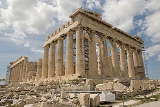
Parthenon

Encyclopedia
The Parthenon is a temple
on the Athenian Acropolis
, Greece, dedicated to the Greek goddess Athena
, whom the people of Athens considered their virgin patron. Its construction began in 447 BC when the Athenian Empire was at the height of its power. It was completed in 438 BC, although decorations of the Parthenon continued until 432 BC. It is the most important surviving building of Classical Greece
, generally considered the culmination of the development of the Doric order
. Its decorative sculptures are considered some of the high points of Greek art
. The Parthenon is regarded as an enduring symbol of Ancient Greece
and of Athenian democracy
and one of the world's greatest cultural monuments. The Greek Ministry of Culture
is currently carrying out a program of selective restoration and reconstruction to ensure the stability of the partially ruined structure.
The Parthenon itself replaced an older temple of Athena, which historians call the Pre-Parthenon or Older Parthenon
, that was destroyed in the Persian invasion
of 480 BC. The temple is archaeoastronomically
aligned to the Pleiades
. Like most Greek temples, the Parthenon was used as a treasury
. For a time, it served as the treasury of the Delian League
, which later became the Athenian Empire. In the 5th century AD, the Parthenon was converted into a Christian church dedicated to the Virgin Mary. After the Ottoman Turk conquest
, it was turned into a mosque in the early 1460s, and it had a minaret
built in it. On 26 September 1687, an Ottoman Turk ammunition dump inside the building was ignited by Venetian
bombardment. The resulting explosion severely damaged the Parthenon and its sculptures. In 1806, Thomas Bruce, 7th Earl of Elgin
removed some of the surviving sculptures, with the Ottoman Turks' permission. These sculptures, now known as the Elgin Marbles
or the Parthenon Marbles, were sold in 1816 to the British Museum
in London, where they are now displayed. The Greek government is committed to the return of the sculptures to Greece, so far with no success.
word "παρθενών" (parthenon), which referred to the "virgin's apartments" in a house and in the Parthenon's case seems to have been used only for a particular room of the temple; it is debated which room this is and how the room acquired its name. The Liddell-Scott-Jones Greek-English Lexicon states that this room was the western cella
of the Parthenon. Jamauri D. Green holds that the parthenon was the room in which the peplos
presented to Athena at the Panathenaic Festival was woven by the arrephoroi
, a group of four young girls chosen to serve Athena each year. Christopher Pelling asserts that Athena Parthenos may have constituted a discrete cult of Athena, intimately connected with, but not identical to, that of Athena Polias. According to this theory, the name of Parthenon means the "temple of the virgin goddess" and refers to the cult of Athena Parthenos that was associated with the temple. The epithet parthénos , whose origin is also unclear, meant "maiden, girl", but also "virgin, unmarried woman" and was especially used for Artemis
, the goddess of wild animals, the hunt, and vegetation, and for Athena, the goddess of strategy and tactics, handicraft, and practical reason. It has also been suggested that the name of the temple alludes to the virgins (parthenoi), whose supreme sacrifice guaranteed the safety of the city.
The first instance in which Parthenon definitely refers to the entire building is in the 4th-century BC orator Demosthenes
. In 5th-century building accounts, the structure is simply called ho naos ("the temple"). The architects Mnesikles and Kallikrates are said to have called the building Hekatompedos ("the hundred footer") in their lost treatise on Athenian architecture, and, in the 4th century and later, the building was referred to as the Hekatompedos or the Hekatompedon as well as the Parthenon; the 1st-century AD writer Plutarch
referred to the building as the Hekatompedon Parthenon.

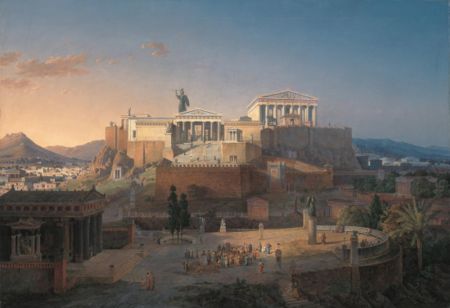 The first endeavor to build a sanctuary for Athena Parthenos on the site of the present Parthenon was begun shortly after the Battle of Marathon
(c. 490–488 BC) upon a muscular limestone
foundation that extended and leveled the southern part of the Acropolis summit. This building was replaced by a hekatompedon (meaning "hundred-footer") and would have stood beside the archaic temple dedicated to the Athena Polias. The Older or Pre-Parthenon
, as it is frequently referred to, was still under construction when the Persians
sacked the city in 480 BC and razed the Acropolis.
In the mid-5th century BC, when the Athenian Acropolis became the seat of the Delian League
and Athens was the greatest cultural centre of its time, Pericles
initiated an ambitious building project that lasted the entire second half of the century. The most important buildings visible on the Acropolis today—the Parthenon, the Propylaia, the Erechtheion and the temple of Athena Nike—were erected during this period. The Parthenon was built under the general supervision of the sculptor Phidias
, who also had charge of the sculptural decoration. The architects, Iktinos
and Kallikrates
, began in 447 BC, and the building was substantially completed by 432, but work on the decorations continued until at least 431. Some of the financial accounts for the Parthenon survive and show that the largest single expense was transporting the stone from Mount Pentelicus, about 16 kilometres from Athens, to the Acropolis. The funds were partly drawn from the treasury of the Delian League, which was moved from the Panhellenic sanctuary at Delos
to the Acropolis in 454 BC.
Although the nearby Temple of Hephaestus
is the most complete surviving example of a Doric order
temple, the Parthenon, in its day, was regarded as the finest. The temple, wrote John Julius Cooper, "Enjoys the reputation of being the most perfect Doric temple ever built. Even in antiquity, its architectural refinements were legendary, especially the subtle correspondence between the curvature of the stylobate
, the taper of the naos walls and the entasis
of the columns." Entasis refers to the slight bulge of the columns as they rise, though the observable effect on the Parthenon is considerably more subtle than on earlier temples with their noticeably cigar-shaped columns. The stylobate is the platform on which the columns stand. As in many other classical Greek temples, it has a slight parabolic upward curvature intended to shed rainwater and reinforce the building against earthquakes. The columns might therefore be supposed to lean outwards, but they actually lean slightly inwards so that if they carried on, they would meet exactly a mile above the centre of the Parthenon; since they are all the same height, the curvature of the outer stylobate edge is transmitted to the architrave
and roof above: "All follow the rule of being built to delicate curves," Gorham Stevens observed when pointing out that, in addition, the west front was built at a slightly higher level than that of the east front. It is not universally agreed what the intended effect of these "optical refinements" was; it may serve as a sort of "reverse optical illusion". As the Greeks may have been aware, two parallel lines appear to bow, or curve outward, when intersected by converging lines. In this case, the ceiling and floor of the temple may seem to bow in the presence of the surrounding angles of the building. Striving for perfection, the designers may have added these curves, compensating for the illusion by creating their own curves, thus negating this effect and allowing the temple to be seen as they intended. It is also suggested that it was to enliven what might have appeared an inert mass in the case of a building without curves, but the comparison ought to be with the Parthenon's more obviously curved predecessors than with a notional rectilinear temple.
Some studies of the Acropolis, including the Parthenon, conclude that many of its proportions approximate the golden ratio
. The Parthenon's facade as well as elements of its facade and elsewhere can be circumscribed by golden rectangles. This view that the golden ratio was employed in the design has been disputed in more recent studies.
Measured at the stylobate, the dimensions of the base of the Parthenon are 69.5 metres by 30.9 metres (228.0 x 101.4 ft). The cella
was 29.8 metres long by 19.2 metres wide (97.8 x 63.0 ft), with internal colonnades in two tiers, structurally necessary to support the roof. On the exterior, the Doric columns measure 1.9 metres (6.2 ft) in diameter and are 10.4 metres (34.1 ft) high. The corner columns are slightly larger in diameter. The Parthenon had 46 outer pillars and 23 inner pillars in total. The stylobate has an upward curvature towards its centre of 60 millimetres (2.36 in) on the east and west ends, and of 110 millimetres (4.33 in) on the sides. The roof was covered with large overlapping marble tiles known as imbrices and tegulae
.
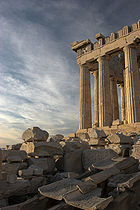 The Parthenon, an octostyle, peripteral Doric temple with Ionic
architectural features, housed the chryselephantine
statue of Athena Parthenos
sculpted by Phidias
and dedicated in 439 or 438 BC. The decorative stonework was originally highly coloured. The temple was dedicated to Athena at that time, though construction continued until almost the beginning of the Peloponnesian War
in 432. By the year 438, the sculptural decoration of the Doric metopes on the frieze above the exterior colonnade, and of the Ionic frieze around the upper portion of the walls of the cella
, had been completed. The richness of the Parthenon's frieze and metope decoration is in agreement with the function of the temple as a treasury. In the opisthodomus (the back room of the cella) were stored the monetary contributions of the Delian League, of which Athens was the leading member.
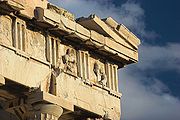 The ninety-two metopes
were carved in high relief, a practice employed until then only in treasuries (buildings used to keep votive gifts to the gods). According to the building records, the metope
sculptures date to the years 446–440 BC. Their design is attributed to the sculptor Kalamis. The metopes of the east side of the Parthenon, above the main entrance, depict the Gigantomachy
(mythical battles between the Olympian gods and the Giants
). The metopes of the west end show Amazonomachy
(mythical battle of the Athenians against the Amazons
). The metopes of the south side show the Thessalian Centauromachy (battle of the Lapiths aided by Theseus
against the half-man, half-horse Centaur
s). Metopes 13–21 are missing, but drawings from 1674 attributed to Jaques Carrey indicate a series of humans; these have been interpreted as scenes from the Lapith
wedding, scenes from the early history of Athens and various myths. On the north side of the Parthenon, the metopes are poorly preserved, but the subject seems to be the sack of Troy
.
The metopes present surviving traces of the Severe Style
in the anatomy of the figures' heads, in the limitation of the corporal movements to the contours and not to the muscles, and in the presence of pronounced veins in the figures of the Centauromachy. Several of the metopes still remain on the building, but, with the exception of those on the northern side, they are severely damaged. Some of them are located at the Acropolis Museum
, others are in the British Museum, and one can be seen at the Louvre
museum.
In March 2011, archaeologists announced that they had discovered five metopes
of the Parthenon in the south wall of the Acropolis, which had been extended when the Acropolis was used as a fortress. According to Eleftherotypia daily, the archaeologists claimed the metopes had been placed there in the 18th century, when the Acropolis wall was being repaired. The experts discovered the metopes, while processing 2250 photos with modern photographic methods, as the white Pentelic marble they are made of differed from the other stone of the wall. It was previously presumed that the missing metopes were destroyed during the Morosini explosion of the Parthenon, in 1687.
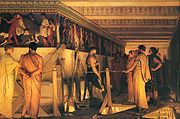 The most characteristic feature in the architecture and decoration of the temple is the Ionic frieze
running around the exterior walls of the cella. The bas-relief frieze was carved in situ; it is dated in 442 BC-438 BC.
One interpretation is that it depicts an idealized version of the Panathenaic procession from the Dipylon Gate in the Kerameikos to the Acropolis
. In this procession held every year, with a special procession taking place every four years, Athenians and foreigners were participating to honour the goddess Athena
, offering sacrifices and a new peplos
(dress woven by selected noble Athenian girls called ergastines).
Joan Breton Connelly
has recently argued for another interpretation of the frieze, in which she attempts to prove that the iconography of the frieze is based on Greek mythology
. This interpretation postulates that the scenes depict the sacrifice of Pandora
, youngest daughter of Erechtheus
, to Athena. This human sacrifice was demanded by Athena to save the city from Eumolpus
, king of Eleusis, who had gathered an army to attack Athens.
, when he visited the Acropolis at the end of the 2nd century AD, only mentioned briefly the sculptures of the pediment
s (gable ends) of the temple, reserving the majority of his description for the gold and ivory statue of the goddess inside.
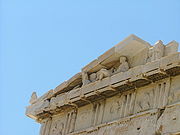 The east pediment narrates the birth of Athena
from the head of her father, Zeus
. According to Greek mythology
, Zeus gave birth to Athena after a terrible headache prompted him to summon Hephaestus
' (the god of fire and the forge) assistance. To alleviate the pain, he ordered Hephaestus to strike him with his forging hammer, and when he did, Zeus's head split open and out popped the goddess Athena in full armour. The sculptural arrangement depicts the moment of Athena's birth.
Unfortunately, the centrepieces of the pediment were destroyed even before Jacques Carrey
created otherwise useful documentary drawings in 1674, so all reconstructions are subject to conjecture and speculation. The main Olympian gods must have stood around Zeus
and Athena
watching the wondrous event, with Hephaestus
and Hera
probably near them. The Carrey drawings are instrumental in reconstructing the sculptural arrangement beyond the center figures to the north and south.
during their competition for the honor of becoming the city's patron. Athena
and Poseidon
appear at the center of the composition, diverging from one another in strong diagonal forms, with the goddess holding the olive tree and the god of the sea raising his trident to strike the earth. At their flanks, they are framed by two active groups of horses pulling chariots, while a crowd of legendary personalities from Athenian mythology fills the space out to the acute corners of the pediment.
The work on the pediments lasted from 438 to 432 BC, and the sculptures of the Parthenon pediments are some of the finest examples of classical Greek art. The figures are sculpted in natural movement with bodies full of vital energy that bursts through their flesh, as the flesh in turn bursts through their thin clothing. The thin chitons
reveal the body
underneath as the focus of the composition. The distinction between gods and humans is blurred in the conceptual interplay between the idealism and naturalism bestowed on the stone by the sculptors. The pediments no longer exist.
sculpture is now lost and known only from copies, vase painting, gems, literary descriptions and coins.
(c. 490–88 BC). This building replaced a hekatompedon (meaning "hundred-footer") and would have stood beside the archaic temple dedicated to Athena Polias. The “older Parthenon”, as it is frequently referred to, was still under construction when the Persians
sacked the city in 480 BC and razed the Acropolis. The existence of the proto-Parthenon and its destruction were known from Herodotus
, and the drums of its columns were plainly visible built into the curtain wall north of the Erechtheum
. Further material evidence of this structure was revealed with the excavations of Patagiotis Kavvadias of 1885–90. The findings of this dig allowed Wilhelm Dörpfeld
, then director of the German Archaeological Institute, to assert that there existed a distinct substructure to the original Parthenon, called Parthenon I by Dörpfeld, not immediately below the present edifice as had been previously assumed. Dörpfeld's observation was that the three steps of the first Parthenon consisted of two steps of Poros limestone, the same as the foundations, and a top step of Karrha limestone that was covered by the lowest step of the Periclean Parthenon. This platform was smaller and slightly to the north of the final Parthenon, indicating that it was built for a wholly different building, now wholly covered over. This picture was somewhat complicated by the publication of the final report on the 1885–90 excavations, indicating that the substructure was contemporary with the Kimonian walls, and implying a later date for the first temple.
If the original Parthenon was indeed destroyed in 480, it invites the question of why the site was left a ruin for thirty-three years. One argument involves the oath sworn by the Greek allies before the Battle of Plataea
in 479 BC declaring that the sanctuaries destroyed by the Persians would not be rebuilt, an oath from which the Athenians were only absolved with the Peace of Callias
in 450. The mundane fact of the cost of reconstructing Athens after the Persian sack is at least as likely a cause. However, the excavations of Bert Hodge Hill led him to propose the existence of a second Parthenon, begun in the period of Kimon after 468 BC. Hill claimed that the Karrha limestone step Dörpfeld thought was the highest of Parthenon I was in fact the lowest of the three steps of Parthenon II, whose stylobate dimensions Hill calculated at 23.51 by 66.888 m (77.1 by 219.4 ).
One difficulty in dating the proto-Parthenon is that at the time of the 1885 excavation the archaeological method of seriation
was not fully developed; the careless digging and refilling of the site led to a loss of much valuable information. An attempt to make sense of the potsherds found on the acropolis came with the two-volume study by Graef and Langlotz published 1925–33. This inspired American archaeologist William Bell Dinsmoor
to attempt to supply limiting dates for the temple platform and the five walls hidden under the re-terracing of the Acropolis. Dinsmoor concluded that the latest possible date for Parthenon I was no earlier 495 BC, contradicting the early date given by Dörpfeld. Further Dinsmoor denied that there were two proto-Parthenons, and that the only pre-Periclean temple was what Dörpfeld referred to as Parthenon II. Dinsmoor and Dörpfeld exchanged views in the American Journal of Archaeology in 1935.
, which was bathed in the sea and to which was presented the peplos
, was an olivewood xoanon
, located at an older altar on the northern side of the Acropolis.
The colossal statue of Athena by Phidias
was not related to any cult and never inspired any recorded religious fervour. It did not seem to have any priestess, altar nor cult name. According to Thucydides
, Pericles
once referred to the statue as a gold reserve, stressing that it "contained forty talents of pure gold and it was all removable". The Athenian statesman thus implies that the metal, obtained from contemporary coinage, could be used again without any impiety.
The Parthenon should then be viewed as a grand setting for the votive statue of Phidias rather than a cult site. It also served as a treasury: the funds of the Delian League
, transferred from Delos to Athens in 454 BC, were housed in one of its rooms.
in Rome. But by that time Athens had been reduced to a provincial city of the Roman Empire
, albeit one with a glorious past. Sometime in the 5th century AD, the great cult image
of Athena was looted by one of the Emperors, and taken to Constantinople
, where it was later destroyed, possibly during the siege of Constantinople during the Fourth Crusade
in 1204 AD.
Shortly after this, the Parthenon was converted to a Christian church. In Byzantine
times it became the Church of the Parthenos Maria (Virgin Mary), or the Church of the Theotokos
(Mother of God). It was the fourth most important pilgrimage in the Eastern Roman Empire after Constantinople, Ephesos and Thessalonica. In 1018, the emperor Basil II
went on a pilgrimage to Athens directly after his final victory over the Bulgarians
for the sole purpose of worshipping at the Parthenon. In medieval Greek accounts it is called the Temple of Theotokos Atheniotissa and often indirectly referred to, as famous without explaining exactly which temple they were referring to, thus establishing that it was indeed well known.
At the time of the Latin occupation
, it became for about 250 years a Roman Catholic church of Our Lady
. The conversion of the temple to a church involved removing the internal columns and some of the walls of the cella
, and the creation of an apse
at the eastern end. This inevitably led to the removal and dispersal of some of the sculptures. Those depicting gods were either possibly re-interpreted according to a Christian theme, or removed and destroyed.
and a portion of the Parthenon was converted into a mosque. The Ottomans were respectful of ancient monuments in their territories and did not willfully destroy the antiquities of Athens, but at the same time made no special effort to protect them. A minaret
was added to the Parthenon, and its base and stairway are still functional, leading up as high as the architrave and hence invisible from the outside. Otherwise, the Ottomans did not further modify the building. European visitors in the 17th century, as well as some representations of the Acropolis hill, testified that the building was largely intact.
Despite the existing tensions the 17th century, Turkish traveler Evliya Çelebi
published one of the most poetic appraisals ever made of its enduring beauty. He concluded with a fervent prayer that the Parthenon, “a work less of human hands than of Heaven itself, should remain standing for all time.” Just a few years later, it was all but annihilated in the worst moment of its history. In the evening of 26 September 1687, a well-armed band of Venetian
invaders surrounded the Acropolis
, intent on capturing these historic heights from the Turks. As the Turks huddled for safety inside the ancient monument, more than 700 Venetian cannonballs found their mark against the marble. But not only Turks sheltered here: So did their stores of gunpowder—until a Venetian volley crashed through the roof and exploded the Turkish magazine. Three hundred perished, and the roofing, columns, and interior rooms were severely damaged.
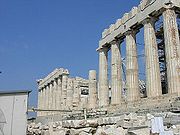
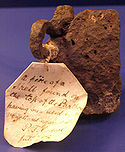 In 1687, the Parthenon suffered its greatest blow when the Venetians
under Francesco Morosini
attacked Athens, and the Ottoman Turks fortified the Acropolis and used the building as a gunpowder magazine
. On 26 September a Venetian mortar, fired from the Hill of Philopappus, blew the magazine up and the building was partly destroyed. Morosini then proceeded to attempt to loot sculptures from the ruin. The internal structures were demolished, whatever was left of the roof collapsed, and some of the pillars, particularly on the southern side, were decapitated. The sculptures suffered heavily. Many fell to the ground, and souvenirs were later made from their pieces. Consequently some sections of the sculptural decoration are known only from the drawings made by Flemish artist Jacques Carrey
in 1674. After this, much of the building fell into disuse and a smaller mosque was erected.
The 18th century was a period of Ottoman Turk stagnation; as a result, many more Europeans found access to Athens, and the picturesque ruins of the Parthenon were much drawn and painted, spurring a rise in philhellenism
and helping to arouse sympathy in Britain and France for Greek independence. Amongst those early travellers and archaeologists were James Stuart and Nicholas Revett
, who were commissioned by the Society of Dilettanti to survey the ruins of classical Athens. What they produced was the first measured drawings of the Parthenon published in 1787 in the second volume of Antiquities of Athens Measured and Delineated. In 1801, the British Ambassador at Constantinople
, the Earl of Elgin
, obtained a firman (edict) from the Sultan
to make casts and drawings of the antiquities on the Acropolis, to demolish recent buildings if this was necessary to view the antiquities, and to remove sculptures from them. Although the existence of the firman is doubtful, as the original document has not been rescued, he took this as permission to collect all the sculptures he could find. He employed local people to detach them from the building itself; a few others he collected from the ground, and some smaller pieces he bought from local people. The detachment of the sculptures caused further irreparable damage to what was left of the building, as some of the frieze blocks were sawn in half to lessen their weight for shipment to England.
, and up the Panathenaic Way to the Parthenon, which is surrounded by a low fence to prevent damage.
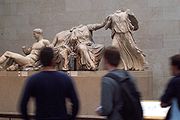 The dispute centres around the Parthenon Marbles removed by the Earl of Elgin, which are in the British Museum
. A few sculptures from the Parthenon are also in the Louvre
in Paris, in Copenhagen
, and elsewhere, but over fifty percent are in the Acropolis Museum
in Athens. A few can still be seen on the building itself. The Greek government has campaigned since 1983 for the British Museum to return the sculptures to Greece
. The British Museum has steadfastly refused to return the sculptures, and successive British governments have been unwilling to force the Museum to do so (which would require legislation). Nevertheless, talks between senior representatives from Greek and British cultural ministries, and their legal advisors took place in London on 4 May 2007. These were the first serious negotiations for several years, and there were hopes that the two sides may move a step closer to a resolution.
. An archaeological committee thoroughly documented every artifact remaining on the site, and architects assisted with computer models to determine their original locations. Particularly important and fragile sculptures were transferred to the Acropolis Museum. A crane was installed for moving marble blocks; the crane was designed to fold away beneath the roofline when not in use. In some cases, prior re-construction was found to be incorrect. These were dismantled, and a careful process of restoration began. Originally, various blocks were held together by elongated iron H pins that were completely coated in lead, which protected the iron from corrosion. Stabilizing pins added in the 19th century were not so coated, and corroded. Since the corrosion product (rust) is expansive, the expansion caused further damage by cracking the marble. All new metalwork uses titanium
, a strong, light, and corrosion resistant material.
The Parthenon will not be restored to a pre-1687 state, but the explosion damage will be mitigated as much as possible, both in the interest of restoring the structural integrity of the edifice (important in this earthquake-prone region) and to restore the aesthetic integrity by filling in chipped sections of column drums and lintels, using precisely sculpted marble
cemented in place. New Pentelic marble is being used from the original quarry. Ultimately, almost all major pieces of marble will be placed in the structure where they originally would have been, supported as needed by modern materials. While the repairs initially show as white against the weathered tan of original surfaces, they will become less prominent as they age.
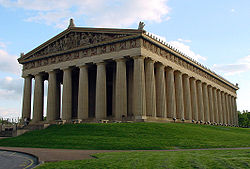
Greek temple
Greek temples were structures built to house deity statues within Greek sanctuaries in Greek paganism. The temples themselves did usually not directly serve a cult purpose, since the sacrifices and rituals dedicated to the respective deity took place outside them...
on the Athenian Acropolis
Acropolis of Athens
The Acropolis of Athens or Citadel of Athens is the best known acropolis in the world. Although there are many other acropoleis in Greece, the significance of the Acropolis of Athens is such that it is commonly known as The Acropolis without qualification...
, Greece, dedicated to the Greek goddess Athena
Athena
In Greek mythology, Athena, Athenê, or Athene , also referred to as Pallas Athena/Athene , is the goddess of wisdom, courage, inspiration, civilization, warfare, strength, strategy, the arts, crafts, justice, and skill. Minerva, Athena's Roman incarnation, embodies similar attributes. Athena is...
, whom the people of Athens considered their virgin patron. Its construction began in 447 BC when the Athenian Empire was at the height of its power. It was completed in 438 BC, although decorations of the Parthenon continued until 432 BC. It is the most important surviving building of Classical Greece
Classical Greece
Classical Greece was a 200 year period in Greek culture lasting from the 5th through 4th centuries BC. This classical period had a powerful influence on the Roman Empire and greatly influenced the foundation of Western civilizations. Much of modern Western politics, artistic thought, such as...
, generally considered the culmination of the development of the Doric order
Doric order
The Doric order was one of the three orders or organizational systems of ancient Greek or classical architecture; the other two canonical orders were the Ionic and the Corinthian.-History:...
. Its decorative sculptures are considered some of the high points of Greek art
Art in Ancient Greece
The arts of ancient Greece have exercised an enormous influence on the culture of many countries all over the world, particularly in the areas of sculpture and architecture. In the West, the art of the Roman Empire was largely derived from Greek models...
. The Parthenon is regarded as an enduring symbol of Ancient Greece
Ancient Greece
Ancient Greece is a civilization belonging to a period of Greek history that lasted from the Archaic period of the 8th to 6th centuries BC to the end of antiquity. Immediately following this period was the beginning of the Early Middle Ages and the Byzantine era. Included in Ancient Greece is the...
and of Athenian democracy
Athenian democracy
Athenian democracy developed in the Greek city-state of Athens, comprising the central city-state of Athens and the surrounding territory of Attica, around 508 BC. Athens is one of the first known democracies. Other Greek cities set up democracies, and even though most followed an Athenian model,...
and one of the world's greatest cultural monuments. The Greek Ministry of Culture
Minister for Culture (Greece)
The Ministry of Culture and Tourism is a government department of Greece entrusted with the preservation of the country's cultural heritage, the arts, as well as sports, through the subordinate General Secretariat for Sport...
is currently carrying out a program of selective restoration and reconstruction to ensure the stability of the partially ruined structure.
The Parthenon itself replaced an older temple of Athena, which historians call the Pre-Parthenon or Older Parthenon
Older Parthenon
The Older Parthenon or Pre‐Parthenon, as it is frequently referred to, constitutes the first endeavour to build a sanctuary for Athena Parthenos on the site of the present Parthenon, Athens, Greece. It was begun shortly after the battle of Marathon upon a massive limestone foundation that extended...
, that was destroyed in the Persian invasion
Greco-Persian Wars
The Greco-Persian Wars were a series of conflicts between the Achaemenid Empire of Persia and city-states of the Hellenic world that started in 499 BC and lasted until 449 BC. The collision between the fractious political world of the Greeks and the enormous empire of the Persians began when Cyrus...
of 480 BC. The temple is archaeoastronomically
Archaeoastronomy
Archaeoastronomy is the study of how people in the past "have understood the phenomena in the sky how they used phenomena in the sky and what role the sky played in their cultures." Clive Ruggles argues it is misleading to consider archaeoastronomy to be the study of ancient astronomy, as modern...
aligned to the Pleiades
Pleiades
Pleiades can refer to:Astronomy and science*Pleiades , an open cluster of stars in the constellation Taurus**Pleiades in folklore and literature, interpretations and traditional meanings of the star cluster among various human cultures...
. Like most Greek temples, the Parthenon was used as a treasury
Treasury
A treasury is either*A government department related to finance and taxation.*A place where currency or precious items is/are kept....
. For a time, it served as the treasury of the Delian League
Delian League
The Delian League, founded in circa 477 BC, was an association of Greek city-states, members numbering between 150 to 173, under the leadership of Athens, whose purpose was to continue fighting the Persian Empire after the Greek victory in the Battle of Plataea at the end of the Greco–Persian Wars...
, which later became the Athenian Empire. In the 5th century AD, the Parthenon was converted into a Christian church dedicated to the Virgin Mary. After the Ottoman Turk conquest
Ottoman Greece
Most of Greece gradually became part of the Ottoman Empire from the 15th century until its declaration of independence in 1821, a historical period also known as Tourkokratia ....
, it was turned into a mosque in the early 1460s, and it had a minaret
Minaret
A minaret مناره , sometimes مئذنه) is a distinctive architectural feature of Islamic mosques, generally a tall spire with an onion-shaped or conical crown, usually either free standing or taller than any associated support structure. The basic form of a minaret includes a base, shaft, and gallery....
built in it. On 26 September 1687, an Ottoman Turk ammunition dump inside the building was ignited by Venetian
Republic of Venice
The Republic of Venice or Venetian Republic was a state originating from the city of Venice in Northeastern Italy. It existed for over a millennium, from the late 7th century until 1797. It was formally known as the Most Serene Republic of Venice and is often referred to as La Serenissima, in...
bombardment. The resulting explosion severely damaged the Parthenon and its sculptures. In 1806, Thomas Bruce, 7th Earl of Elgin
Thomas Bruce, 7th Earl of Elgin
Thomas Bruce, 7th Earl of Elgin and 11th Earl of Kincardine was a Scottish nobleman and diplomat, known for the removal of marble sculptures from the Parthenon in Athens. Elgin was the second son of Charles Bruce, 5th Earl of Elgin and his wife Martha Whyte...
removed some of the surviving sculptures, with the Ottoman Turks' permission. These sculptures, now known as the Elgin Marbles
Elgin Marbles
The Parthenon Marbles, forming a part of the collection known as the Elgin Marbles , are a collection of classical Greek marble sculptures , inscriptions and architectural members that originally were part of the Parthenon and other buildings on the Acropolis of Athens...
or the Parthenon Marbles, were sold in 1816 to the British Museum
British Museum
The British Museum is a museum of human history and culture in London. Its collections, which number more than seven million objects, are amongst the largest and most comprehensive in the world and originate from all continents, illustrating and documenting the story of human culture from its...
in London, where they are now displayed. The Greek government is committed to the return of the sculptures to Greece, so far with no success.
Etymology
The origin of the Parthenon's name is from the GreekGreek language
Greek is an independent branch of the Indo-European family of languages. Native to the southern Balkans, it has the longest documented history of any Indo-European language, spanning 34 centuries of written records. Its writing system has been the Greek alphabet for the majority of its history;...
word "παρθενών" (parthenon), which referred to the "virgin's apartments" in a house and in the Parthenon's case seems to have been used only for a particular room of the temple; it is debated which room this is and how the room acquired its name. The Liddell-Scott-Jones Greek-English Lexicon states that this room was the western cella
Cella
A cella or naos , is the inner chamber of a temple in classical architecture, or a shop facing the street in domestic Roman architecture...
of the Parthenon. Jamauri D. Green holds that the parthenon was the room in which the peplos
Peplos
A peplos is a body-lengthGreek garment worn by women before 500 BC. The peplos is a tubular cloth folded inside-out from the top about halfway down, altering what was the top of the tube to the waist and the bottom of the tube to ankle-length. The garment is then gathered about the waist and the...
presented to Athena at the Panathenaic Festival was woven by the arrephoroi
Arrephoros
An Arrephoros was a girl acolyte in the cult of Athena Polias on the Athenian Acropolis. They were seven to eleven years old. According to Pausanias, two Arrephoroi lived for a year on the Acropolis and concluded their term with a mystery rite called the Arrhephoria: they carried unknown objects...
, a group of four young girls chosen to serve Athena each year. Christopher Pelling asserts that Athena Parthenos may have constituted a discrete cult of Athena, intimately connected with, but not identical to, that of Athena Polias. According to this theory, the name of Parthenon means the "temple of the virgin goddess" and refers to the cult of Athena Parthenos that was associated with the temple. The epithet parthénos , whose origin is also unclear, meant "maiden, girl", but also "virgin, unmarried woman" and was especially used for Artemis
Artemis
Artemis was one of the most widely venerated of the Ancient Greek deities. Her Roman equivalent is Diana. Some scholars believe that the name and indeed the goddess herself was originally pre-Greek. Homer refers to her as Artemis Agrotera, Potnia Theron: "Artemis of the wildland, Mistress of Animals"...
, the goddess of wild animals, the hunt, and vegetation, and for Athena, the goddess of strategy and tactics, handicraft, and practical reason. It has also been suggested that the name of the temple alludes to the virgins (parthenoi), whose supreme sacrifice guaranteed the safety of the city.
The first instance in which Parthenon definitely refers to the entire building is in the 4th-century BC orator Demosthenes
Demosthenes
Demosthenes was a prominent Greek statesman and orator of ancient Athens. His orations constitute a significant expression of contemporary Athenian intellectual prowess and provide an insight into the politics and culture of ancient Greece during the 4th century BC. Demosthenes learned rhetoric by...
. In 5th-century building accounts, the structure is simply called ho naos ("the temple"). The architects Mnesikles and Kallikrates are said to have called the building Hekatompedos ("the hundred footer") in their lost treatise on Athenian architecture, and, in the 4th century and later, the building was referred to as the Hekatompedos or the Hekatompedon as well as the Parthenon; the 1st-century AD writer Plutarch
Plutarch
Plutarch then named, on his becoming a Roman citizen, Lucius Mestrius Plutarchus , c. 46 – 120 AD, was a Greek historian, biographer, essayist, and Middle Platonist known primarily for his Parallel Lives and Moralia...
referred to the building as the Hekatompedon Parthenon.
Architecture
Battle of Marathon
The Battle of Marathon took place in 490 BC, during the first Persian invasion of Greece. It was fought between the citizens of Athens, aided by Plataea, and a Persian force commanded by Datis and Artaphernes. It was the culmination of the first attempt by Persia, under King Darius I, to subjugate...
(c. 490–488 BC) upon a muscular limestone
Limestone
Limestone is a sedimentary rock composed largely of the minerals calcite and aragonite, which are different crystal forms of calcium carbonate . Many limestones are composed from skeletal fragments of marine organisms such as coral or foraminifera....
foundation that extended and leveled the southern part of the Acropolis summit. This building was replaced by a hekatompedon (meaning "hundred-footer") and would have stood beside the archaic temple dedicated to the Athena Polias. The Older or Pre-Parthenon
Older Parthenon
The Older Parthenon or Pre‐Parthenon, as it is frequently referred to, constitutes the first endeavour to build a sanctuary for Athena Parthenos on the site of the present Parthenon, Athens, Greece. It was begun shortly after the battle of Marathon upon a massive limestone foundation that extended...
, as it is frequently referred to, was still under construction when the Persians
Achaemenid Empire
The Achaemenid Empire , sometimes known as First Persian Empire and/or Persian Empire, was founded in the 6th century BCE by Cyrus the Great who overthrew the Median confederation...
sacked the city in 480 BC and razed the Acropolis.
In the mid-5th century BC, when the Athenian Acropolis became the seat of the Delian League
Delian League
The Delian League, founded in circa 477 BC, was an association of Greek city-states, members numbering between 150 to 173, under the leadership of Athens, whose purpose was to continue fighting the Persian Empire after the Greek victory in the Battle of Plataea at the end of the Greco–Persian Wars...
and Athens was the greatest cultural centre of its time, Pericles
Pericles
Pericles was a prominent and influential statesman, orator, and general of Athens during the city's Golden Age—specifically, the time between the Persian and Peloponnesian wars...
initiated an ambitious building project that lasted the entire second half of the century. The most important buildings visible on the Acropolis today—the Parthenon, the Propylaia, the Erechtheion and the temple of Athena Nike—were erected during this period. The Parthenon was built under the general supervision of the sculptor Phidias
Phidias
Phidias or the great Pheidias , was a Greek sculptor, painter and architect, who lived in the 5th century BC, and is commonly regarded as one of the greatest of all sculptors of Classical Greece: Phidias' Statue of Zeus at Olympia was one of the Seven Wonders of the Ancient World...
, who also had charge of the sculptural decoration. The architects, Iktinos
Iktinos
Ictinus was an architect active in the mid 5th century BC. Ancient sources identify Ictinus and Callicrates as co-architects of the Parthenon....
and Kallikrates
Kallikrates
Callicrates was an ancient Greek architect active in the middle of the fifth century BCE. He and Ictinus were architects of the Parthenon . An inscription identifies him as the architect of "the Temple of Nike" in the Sanctuary of Athena Nike on the Acropolis...
, began in 447 BC, and the building was substantially completed by 432, but work on the decorations continued until at least 431. Some of the financial accounts for the Parthenon survive and show that the largest single expense was transporting the stone from Mount Pentelicus, about 16 kilometres from Athens, to the Acropolis. The funds were partly drawn from the treasury of the Delian League, which was moved from the Panhellenic sanctuary at Delos
Delos
The island of Delos , isolated in the centre of the roughly circular ring of islands called the Cyclades, near Mykonos, is one of the most important mythological, historical and archaeological sites in Greece...
to the Acropolis in 454 BC.
Although the nearby Temple of Hephaestus
Temple of Hephaestus
The Temple of Hephaestus, also known as the Hephaisteion or earlier as the Theseion, is the best-preserved ancient Greek temple; it remains standing largely as built. It is a Doric peripteral temple, and is located at the north-west side of the Agora of Athens, on top of the Agoraios Kolonos hill....
is the most complete surviving example of a Doric order
Doric order
The Doric order was one of the three orders or organizational systems of ancient Greek or classical architecture; the other two canonical orders were the Ionic and the Corinthian.-History:...
temple, the Parthenon, in its day, was regarded as the finest. The temple, wrote John Julius Cooper, "Enjoys the reputation of being the most perfect Doric temple ever built. Even in antiquity, its architectural refinements were legendary, especially the subtle correspondence between the curvature of the stylobate
Stylobate
In classical Greek architecture, a stylobate is the top step of the crepidoma, the stepped platform on which colonnades of temple columns are placed...
, the taper of the naos walls and the entasis
Entasis
In architecture, entasis is the application of a convex curve to a surface for aesthetic purposes. Its best-known use is in certain orders of Classical columns that curve slightly as their diameter is decreased from the bottom upwards. In the Hellenistic period some columns with entasis are...
of the columns." Entasis refers to the slight bulge of the columns as they rise, though the observable effect on the Parthenon is considerably more subtle than on earlier temples with their noticeably cigar-shaped columns. The stylobate is the platform on which the columns stand. As in many other classical Greek temples, it has a slight parabolic upward curvature intended to shed rainwater and reinforce the building against earthquakes. The columns might therefore be supposed to lean outwards, but they actually lean slightly inwards so that if they carried on, they would meet exactly a mile above the centre of the Parthenon; since they are all the same height, the curvature of the outer stylobate edge is transmitted to the architrave
Architrave
An architrave is the lintel or beam that rests on the capitals of the columns. It is an architectural element in Classical architecture.-Classical architecture:...
and roof above: "All follow the rule of being built to delicate curves," Gorham Stevens observed when pointing out that, in addition, the west front was built at a slightly higher level than that of the east front. It is not universally agreed what the intended effect of these "optical refinements" was; it may serve as a sort of "reverse optical illusion". As the Greeks may have been aware, two parallel lines appear to bow, or curve outward, when intersected by converging lines. In this case, the ceiling and floor of the temple may seem to bow in the presence of the surrounding angles of the building. Striving for perfection, the designers may have added these curves, compensating for the illusion by creating their own curves, thus negating this effect and allowing the temple to be seen as they intended. It is also suggested that it was to enliven what might have appeared an inert mass in the case of a building without curves, but the comparison ought to be with the Parthenon's more obviously curved predecessors than with a notional rectilinear temple.
Some studies of the Acropolis, including the Parthenon, conclude that many of its proportions approximate the golden ratio
Golden ratio
In mathematics and the arts, two quantities are in the golden ratio if the ratio of the sum of the quantities to the larger quantity is equal to the ratio of the larger quantity to the smaller one. The golden ratio is an irrational mathematical constant, approximately 1.61803398874989...
. The Parthenon's facade as well as elements of its facade and elsewhere can be circumscribed by golden rectangles. This view that the golden ratio was employed in the design has been disputed in more recent studies.
Measured at the stylobate, the dimensions of the base of the Parthenon are 69.5 metres by 30.9 metres (228.0 x 101.4 ft). The cella
Cella
A cella or naos , is the inner chamber of a temple in classical architecture, or a shop facing the street in domestic Roman architecture...
was 29.8 metres long by 19.2 metres wide (97.8 x 63.0 ft), with internal colonnades in two tiers, structurally necessary to support the roof. On the exterior, the Doric columns measure 1.9 metres (6.2 ft) in diameter and are 10.4 metres (34.1 ft) high. The corner columns are slightly larger in diameter. The Parthenon had 46 outer pillars and 23 inner pillars in total. The stylobate has an upward curvature towards its centre of 60 millimetres (2.36 in) on the east and west ends, and of 110 millimetres (4.33 in) on the sides. The roof was covered with large overlapping marble tiles known as imbrices and tegulae
Imbrex and tegula
The imbrex and tegula were overlapping roof tiles used in ancient Greek and Roman architecture as a waterproof and durable roof covering. They were made predominantly of fired clay, but also sometimes of marble, bronze or gilt...
.
Sculpture
Ionic order
The Ionic order forms one of the three orders or organizational systems of classical architecture, the other two canonic orders being the Doric and the Corinthian...
architectural features, housed the chryselephantine
Chryselephantine
Chryselephantine is a term that refers to the sculptural medium of gold and ivory...
statue of Athena Parthenos
Athena Parthenos
Athena Parthenos was the title of a massive chryselephantine sculpture of the Greek goddess Athena made by Phidias and housed in the Parthenon in Athens. Its epithet was an essential character of the goddess herself...
sculpted by Phidias
Phidias
Phidias or the great Pheidias , was a Greek sculptor, painter and architect, who lived in the 5th century BC, and is commonly regarded as one of the greatest of all sculptors of Classical Greece: Phidias' Statue of Zeus at Olympia was one of the Seven Wonders of the Ancient World...
and dedicated in 439 or 438 BC. The decorative stonework was originally highly coloured. The temple was dedicated to Athena at that time, though construction continued until almost the beginning of the Peloponnesian War
Peloponnesian War
The Peloponnesian War, 431 to 404 BC, was an ancient Greek war fought by Athens and its empire against the Peloponnesian League led by Sparta. Historians have traditionally divided the war into three phases...
in 432. By the year 438, the sculptural decoration of the Doric metopes on the frieze above the exterior colonnade, and of the Ionic frieze around the upper portion of the walls of the cella
Cella
A cella or naos , is the inner chamber of a temple in classical architecture, or a shop facing the street in domestic Roman architecture...
, had been completed. The richness of the Parthenon's frieze and metope decoration is in agreement with the function of the temple as a treasury. In the opisthodomus (the back room of the cella) were stored the monetary contributions of the Delian League, of which Athens was the leading member.
Metopes
Metopes of the Parthenon
The Metopes of the Parthenon are a series of marble panels, originally 92 in number, on the outside walls of the Parthenon in Athens, Greece, forming part of the Doric frieze...
were carved in high relief, a practice employed until then only in treasuries (buildings used to keep votive gifts to the gods). According to the building records, the metope
Metope (architecture)
In classical architecture, a metope is a rectangular architectural element that fills the space between two triglyphs in a Doric frieze, which is a decorative band of alternating triglyphs and metopes above the architrave of a building of the Doric order...
sculptures date to the years 446–440 BC. Their design is attributed to the sculptor Kalamis. The metopes of the east side of the Parthenon, above the main entrance, depict the Gigantomachy
Gigantomachy
In Greek mythology, Gigantomachy was the symbolic struggle between the cosmic order of the Olympians led by Zeus and the nether forces of Chaos led by the giant Alcyoneus...
(mythical battles between the Olympian gods and the Giants
Gigantes
In Greek mythology, the Giants were the children of Gaia, who was fertilized by the blood of Uranus, after Uranus was castrated by his son Cronus...
). The metopes of the west end show Amazonomachy
Amazonomachy
An Amazonomachy was a portrayal of legendary battle between Greeks and Amazons...
(mythical battle of the Athenians against the Amazons
Amazons
The Amazons are a nation of all-female warriors in Greek mythology and Classical antiquity. Herodotus placed them in a region bordering Scythia in Sarmatia...
). The metopes of the south side show the Thessalian Centauromachy (battle of the Lapiths aided by Theseus
Theseus
For other uses, see Theseus Theseus was the mythical founder-king of Athens, son of Aethra, and fathered by Aegeus and Poseidon, both of whom Aethra had slept with in one night. Theseus was a founder-hero, like Perseus, Cadmus, or Heracles, all of whom battled and overcame foes that were...
against the half-man, half-horse Centaur
Centaur
In Greek mythology, a centaur or hippocentaur is a member of a composite race of creatures, part human and part horse...
s). Metopes 13–21 are missing, but drawings from 1674 attributed to Jaques Carrey indicate a series of humans; these have been interpreted as scenes from the Lapith
Lapith
The Lapiths are a legendary people of Greek mythology, whose home was in Thessaly, in the valley of the Peneus and on the mountain Pelion.They were an Aeolian tribe. Like the Myrmidons and other Thessalian tribes, the Lapiths were pre-Hellenic in their origins...
wedding, scenes from the early history of Athens and various myths. On the north side of the Parthenon, the metopes are poorly preserved, but the subject seems to be the sack of Troy
Iliou persis
The Iliupersis , also known as The Sack of Troy, is a lost epic of ancient Greek literature. It was one of the Epic Cycle, that is, the "Trojan" cycle, which told the entire history of the Trojan War in epic verse...
.
The metopes present surviving traces of the Severe Style
Severe style
The severe style, or Early Classic style, was the dominant idiom of Greek sculpture in the period ca. 490 to 450 BCE. It marks the breakdown of the canonical forms of archaic art and the transition to the greatly expanded vocabulary and expression of the classical moment of the late 5th century...
in the anatomy of the figures' heads, in the limitation of the corporal movements to the contours and not to the muscles, and in the presence of pronounced veins in the figures of the Centauromachy. Several of the metopes still remain on the building, but, with the exception of those on the northern side, they are severely damaged. Some of them are located at the Acropolis Museum
Acropolis Museum
The Old Acropolis Museum was an archaeological museum located in Athens, Greece on the archeological site of Acropolis. It is built in a niche at the eastern edge of the rock and most of it lies beneath the level of the hilltop, making it largely invisible. It was considered one of the major...
, others are in the British Museum, and one can be seen at the Louvre
Louvre
The Musée du Louvre – in English, the Louvre Museum or simply the Louvre – is one of the world's largest museums, the most visited art museum in the world and a historic monument. A central landmark of Paris, it is located on the Right Bank of the Seine in the 1st arrondissement...
museum.
In March 2011, archaeologists announced that they had discovered five metopes
Metope (architecture)
In classical architecture, a metope is a rectangular architectural element that fills the space between two triglyphs in a Doric frieze, which is a decorative band of alternating triglyphs and metopes above the architrave of a building of the Doric order...
of the Parthenon in the south wall of the Acropolis, which had been extended when the Acropolis was used as a fortress. According to Eleftherotypia daily, the archaeologists claimed the metopes had been placed there in the 18th century, when the Acropolis wall was being repaired. The experts discovered the metopes, while processing 2250 photos with modern photographic methods, as the white Pentelic marble they are made of differed from the other stone of the wall. It was previously presumed that the missing metopes were destroyed during the Morosini explosion of the Parthenon, in 1687.
Frieze
Frieze
thumb|267px|Frieze of the [[Tower of the Winds]], AthensIn architecture the frieze is the wide central section part of an entablature and may be plain in the Ionic or Doric order, or decorated with bas-reliefs. Even when neither columns nor pilasters are expressed, on an astylar wall it lies upon...
running around the exterior walls of the cella. The bas-relief frieze was carved in situ; it is dated in 442 BC-438 BC.
One interpretation is that it depicts an idealized version of the Panathenaic procession from the Dipylon Gate in the Kerameikos to the Acropolis
Acropolis
Acropolis means "high city" in Greek, literally city on the extremity and is usually translated into English as Citadel . For purposes of defense, early people naturally chose elevated ground to build a new settlement, frequently a hill with precipitous sides...
. In this procession held every year, with a special procession taking place every four years, Athenians and foreigners were participating to honour the goddess Athena
Athena
In Greek mythology, Athena, Athenê, or Athene , also referred to as Pallas Athena/Athene , is the goddess of wisdom, courage, inspiration, civilization, warfare, strength, strategy, the arts, crafts, justice, and skill. Minerva, Athena's Roman incarnation, embodies similar attributes. Athena is...
, offering sacrifices and a new peplos
Peplos
A peplos is a body-lengthGreek garment worn by women before 500 BC. The peplos is a tubular cloth folded inside-out from the top about halfway down, altering what was the top of the tube to the waist and the bottom of the tube to ankle-length. The garment is then gathered about the waist and the...
(dress woven by selected noble Athenian girls called ergastines).
Joan Breton Connelly
Joan Breton Connelly
Joan Breton Connelly is an American classical archaeologist and Professor of Classics and Art History at New York University. She is Director of the Yeronisos Island Excavations and Field School in Cyprus. Connelly was awarded a MacArthur Fellowship in 1996...
has recently argued for another interpretation of the frieze, in which she attempts to prove that the iconography of the frieze is based on Greek mythology
Greek mythology
Greek mythology is the body of myths and legends belonging to the ancient Greeks, concerning their gods and heroes, the nature of the world, and the origins and significance of their own cult and ritual practices. They were a part of religion in ancient Greece...
. This interpretation postulates that the scenes depict the sacrifice of Pandora
Pandora
In Greek mythology, Pandora was the first woman. As Hesiod related it, each god helped create her by giving her unique gifts...
, youngest daughter of Erechtheus
Erechtheus
Erechtheus in Greek mythology was the name of an archaic king of Athens, the re-founder of the polis and a double at Athens for Poseidon, as "Poseidon Erechtheus"...
, to Athena. This human sacrifice was demanded by Athena to save the city from Eumolpus
Eumolpus
In Greek mythology, Eumolpus was the son of Poseidon and Chione. According to Apollodorus, Chione, daughter of Boreas and Oreithyia, pregnant with Eumolpus by Poseidon, was frightened of her father's reaction so she threw the baby into the ocean...
, king of Eleusis, who had gathered an army to attack Athens.
Pediments
The 2nd-century traveller PausaniasPausanias (geographer)
Pausanias was a Greek traveler and geographer of the 2nd century AD, who lived in the times of Hadrian, Antoninus Pius and Marcus Aurelius. He is famous for his Description of Greece , a lengthy work that describes ancient Greece from firsthand observations, and is a crucial link between classical...
, when he visited the Acropolis at the end of the 2nd century AD, only mentioned briefly the sculptures of the pediment
Pediment
A pediment is a classical architectural element consisting of the triangular section found above the horizontal structure , typically supported by columns. The gable end of the pediment is surrounded by the cornice moulding...
s (gable ends) of the temple, reserving the majority of his description for the gold and ivory statue of the goddess inside.
East pediment
Athena
In Greek mythology, Athena, Athenê, or Athene , also referred to as Pallas Athena/Athene , is the goddess of wisdom, courage, inspiration, civilization, warfare, strength, strategy, the arts, crafts, justice, and skill. Minerva, Athena's Roman incarnation, embodies similar attributes. Athena is...
from the head of her father, Zeus
Zeus
In the ancient Greek religion, Zeus was the "Father of Gods and men" who ruled the Olympians of Mount Olympus as a father ruled the family. He was the god of sky and thunder in Greek mythology. His Roman counterpart is Jupiter and his Etruscan counterpart is Tinia.Zeus was the child of Cronus...
. According to Greek mythology
Greek mythology
Greek mythology is the body of myths and legends belonging to the ancient Greeks, concerning their gods and heroes, the nature of the world, and the origins and significance of their own cult and ritual practices. They were a part of religion in ancient Greece...
, Zeus gave birth to Athena after a terrible headache prompted him to summon Hephaestus
Hephaestus
Hephaestus was a Greek god whose Roman equivalent was Vulcan. He is the son of Zeus and Hera, the King and Queen of the Gods - or else, according to some accounts, of Hera alone. He was the god of technology, blacksmiths, craftsmen, artisans, sculptors, metals, metallurgy, fire and volcanoes...
' (the god of fire and the forge) assistance. To alleviate the pain, he ordered Hephaestus to strike him with his forging hammer, and when he did, Zeus's head split open and out popped the goddess Athena in full armour. The sculptural arrangement depicts the moment of Athena's birth.
Unfortunately, the centrepieces of the pediment were destroyed even before Jacques Carrey
Jacques Carrey
Jacques Carrey . French painter and draughtsman. An otherwise little noted and unremarkable artist he is now remembered almost exclusively for the series of drawings he made of the Parthenon, Athens, in 1674. Carrey was part of the embassy of Charles Marie François Olier, marquis de Nointel to...
created otherwise useful documentary drawings in 1674, so all reconstructions are subject to conjecture and speculation. The main Olympian gods must have stood around Zeus
Zeus
In the ancient Greek religion, Zeus was the "Father of Gods and men" who ruled the Olympians of Mount Olympus as a father ruled the family. He was the god of sky and thunder in Greek mythology. His Roman counterpart is Jupiter and his Etruscan counterpart is Tinia.Zeus was the child of Cronus...
and Athena
Athena
In Greek mythology, Athena, Athenê, or Athene , also referred to as Pallas Athena/Athene , is the goddess of wisdom, courage, inspiration, civilization, warfare, strength, strategy, the arts, crafts, justice, and skill. Minerva, Athena's Roman incarnation, embodies similar attributes. Athena is...
watching the wondrous event, with Hephaestus
Hephaestus
Hephaestus was a Greek god whose Roman equivalent was Vulcan. He is the son of Zeus and Hera, the King and Queen of the Gods - or else, according to some accounts, of Hera alone. He was the god of technology, blacksmiths, craftsmen, artisans, sculptors, metals, metallurgy, fire and volcanoes...
and Hera
Hera
Hera was the wife and one of three sisters of Zeus in the Olympian pantheon of Greek mythology and religion. Her chief function was as the goddess of women and marriage. Her counterpart in the religion of ancient Rome was Juno. The cow and the peacock were sacred to her...
probably near them. The Carrey drawings are instrumental in reconstructing the sculptural arrangement beyond the center figures to the north and south.
West pediment
The west pediment faced the Propylaia and depicted the contest between Athena and PoseidonPoseidon
Poseidon was the god of the sea, and, as "Earth-Shaker," of the earthquakes in Greek mythology. The name of the sea-god Nethuns in Etruscan was adopted in Latin for Neptune in Roman mythology: both were sea gods analogous to Poseidon...
during their competition for the honor of becoming the city's patron. Athena
Athena
In Greek mythology, Athena, Athenê, or Athene , also referred to as Pallas Athena/Athene , is the goddess of wisdom, courage, inspiration, civilization, warfare, strength, strategy, the arts, crafts, justice, and skill. Minerva, Athena's Roman incarnation, embodies similar attributes. Athena is...
and Poseidon
Poseidon
Poseidon was the god of the sea, and, as "Earth-Shaker," of the earthquakes in Greek mythology. The name of the sea-god Nethuns in Etruscan was adopted in Latin for Neptune in Roman mythology: both were sea gods analogous to Poseidon...
appear at the center of the composition, diverging from one another in strong diagonal forms, with the goddess holding the olive tree and the god of the sea raising his trident to strike the earth. At their flanks, they are framed by two active groups of horses pulling chariots, while a crowd of legendary personalities from Athenian mythology fills the space out to the acute corners of the pediment.
The work on the pediments lasted from 438 to 432 BC, and the sculptures of the Parthenon pediments are some of the finest examples of classical Greek art. The figures are sculpted in natural movement with bodies full of vital energy that bursts through their flesh, as the flesh in turn bursts through their thin clothing. The thin chitons
Chiton (costume)
A chiton was a form of clothing worn by men and women in Ancient Greece, from the Archaic period to the Hellenistic period ....
reveal the body
Body
With regard to living things, a body is the physical body of an individual. "Body" often is used in connection with appearance, health issues and death...
underneath as the focus of the composition. The distinction between gods and humans is blurred in the conceptual interplay between the idealism and naturalism bestowed on the stone by the sculptors. The pediments no longer exist.
Athena Parthenos
The only piece of sculpture from the Parthenon known to be from the hand of Phidias was the statue of Athena housed in the naos. This massive chryselephantineChryselephantine
Chryselephantine is a term that refers to the sculptural medium of gold and ivory...
sculpture is now lost and known only from copies, vase painting, gems, literary descriptions and coins.
Older Parthenon
The first endeavour to create a sanctuary for Athena Parthenos on the site of the present Parthenon was begun shortly after the Battle of MarathonBattle of Marathon
The Battle of Marathon took place in 490 BC, during the first Persian invasion of Greece. It was fought between the citizens of Athens, aided by Plataea, and a Persian force commanded by Datis and Artaphernes. It was the culmination of the first attempt by Persia, under King Darius I, to subjugate...
(c. 490–88 BC). This building replaced a hekatompedon (meaning "hundred-footer") and would have stood beside the archaic temple dedicated to Athena Polias. The “older Parthenon”, as it is frequently referred to, was still under construction when the Persians
Achaemenid Empire
The Achaemenid Empire , sometimes known as First Persian Empire and/or Persian Empire, was founded in the 6th century BCE by Cyrus the Great who overthrew the Median confederation...
sacked the city in 480 BC and razed the Acropolis. The existence of the proto-Parthenon and its destruction were known from Herodotus
Herodotus
Herodotus was an ancient Greek historian who was born in Halicarnassus, Caria and lived in the 5th century BC . He has been called the "Father of History", and was the first historian known to collect his materials systematically, test their accuracy to a certain extent and arrange them in a...
, and the drums of its columns were plainly visible built into the curtain wall north of the Erechtheum
Erechtheum
The Erechtheion is an ancient Greek temple on the north side of the Acropolis of Athens in Greece.-Architecture:The temple as seen today was built between 421 and 406 BC. Its architect may have been Mnesicles, and it derived its name from a shrine dedicated to the legendary Greek hero Erichthonius...
. Further material evidence of this structure was revealed with the excavations of Patagiotis Kavvadias of 1885–90. The findings of this dig allowed Wilhelm Dörpfeld
Wilhelm Dörpfeld
Wilhelm Dörpfeld was a German architect and archaeologist, the pioneer of stratigraphic excavation and precise graphical documentation of archaeological projects...
, then director of the German Archaeological Institute, to assert that there existed a distinct substructure to the original Parthenon, called Parthenon I by Dörpfeld, not immediately below the present edifice as had been previously assumed. Dörpfeld's observation was that the three steps of the first Parthenon consisted of two steps of Poros limestone, the same as the foundations, and a top step of Karrha limestone that was covered by the lowest step of the Periclean Parthenon. This platform was smaller and slightly to the north of the final Parthenon, indicating that it was built for a wholly different building, now wholly covered over. This picture was somewhat complicated by the publication of the final report on the 1885–90 excavations, indicating that the substructure was contemporary with the Kimonian walls, and implying a later date for the first temple.
If the original Parthenon was indeed destroyed in 480, it invites the question of why the site was left a ruin for thirty-three years. One argument involves the oath sworn by the Greek allies before the Battle of Plataea
Battle of Plataea
The Battle of Plataea was the final land battle during the second Persian invasion of Greece. It took place in 479 BC near the city of Plataea in Boeotia, and was fought between an alliance of the Greek city-states, including Sparta, Athens, Corinth and Megara, and the Persian Empire of Xerxes...
in 479 BC declaring that the sanctuaries destroyed by the Persians would not be rebuilt, an oath from which the Athenians were only absolved with the Peace of Callias
Peace of Callias
The Peace of Callias is a purported treaty established around 449 BC between the Delian League and Persia, ending the Persian Wars. The peace was agreed as the first compromise treaty between Achaemenid Persia and a Greek city....
in 450. The mundane fact of the cost of reconstructing Athens after the Persian sack is at least as likely a cause. However, the excavations of Bert Hodge Hill led him to propose the existence of a second Parthenon, begun in the period of Kimon after 468 BC. Hill claimed that the Karrha limestone step Dörpfeld thought was the highest of Parthenon I was in fact the lowest of the three steps of Parthenon II, whose stylobate dimensions Hill calculated at 23.51 by 66.888 m (77.1 by 219.4 ).
One difficulty in dating the proto-Parthenon is that at the time of the 1885 excavation the archaeological method of seriation
Seriation (archaeology)
In archaeology, seriation is a relative dating method in which assemblages or artifacts from numerous sites, in the same culture, are placed in chronological order. Where absolute dating methods, such as carbon dating, cannot be applied, archaeologists have to use relative dating methods to date...
was not fully developed; the careless digging and refilling of the site led to a loss of much valuable information. An attempt to make sense of the potsherds found on the acropolis came with the two-volume study by Graef and Langlotz published 1925–33. This inspired American archaeologist William Bell Dinsmoor
William Bell Dinsmoor
William Bell Dinsmoor, Sr. was an architectural historian of classical Greece and a Columbia University professor of art and archaeology.-Biography:He was born on July 29, 1886 in Windham, New Hampshire....
to attempt to supply limiting dates for the temple platform and the five walls hidden under the re-terracing of the Acropolis. Dinsmoor concluded that the latest possible date for Parthenon I was no earlier 495 BC, contradicting the early date given by Dörpfeld. Further Dinsmoor denied that there were two proto-Parthenons, and that the only pre-Periclean temple was what Dörpfeld referred to as Parthenon II. Dinsmoor and Dörpfeld exchanged views in the American Journal of Archaeology in 1935.
Function
Although the Parthenon is architecturally a temple and is usually called so, it is not really one in the conventional sense of the word. A small shrine has been excavated within the building, on the site of an older sanctuary probably dedicated to Athena as a way to get closer to the god, but the Parthenon never hosted the cult of Athena Polias, patron of Athens: the cult imageCult image
In the practice of religion, a cult image is a human-made object that is venerated for the deity, spirit or daemon that it embodies or represents...
, which was bathed in the sea and to which was presented the peplos
Peplos
A peplos is a body-lengthGreek garment worn by women before 500 BC. The peplos is a tubular cloth folded inside-out from the top about halfway down, altering what was the top of the tube to the waist and the bottom of the tube to ankle-length. The garment is then gathered about the waist and the...
, was an olivewood xoanon
Xoanon
A xoanon was an Archaic wooden cult image of Ancient Greece. Classical Greeks associated such cult objects, whether aniconic or effigy, with the legendary Daedalus. Many such cult images were preserved into historical times, though none have survived to the modern day, except where their image...
, located at an older altar on the northern side of the Acropolis.
The colossal statue of Athena by Phidias
Phidias
Phidias or the great Pheidias , was a Greek sculptor, painter and architect, who lived in the 5th century BC, and is commonly regarded as one of the greatest of all sculptors of Classical Greece: Phidias' Statue of Zeus at Olympia was one of the Seven Wonders of the Ancient World...
was not related to any cult and never inspired any recorded religious fervour. It did not seem to have any priestess, altar nor cult name. According to Thucydides
Thucydides
Thucydides was a Greek historian and author from Alimos. His History of the Peloponnesian War recounts the 5th century BC war between Sparta and Athens to the year 411 BC...
, Pericles
Pericles
Pericles was a prominent and influential statesman, orator, and general of Athens during the city's Golden Age—specifically, the time between the Persian and Peloponnesian wars...
once referred to the statue as a gold reserve, stressing that it "contained forty talents of pure gold and it was all removable". The Athenian statesman thus implies that the metal, obtained from contemporary coinage, could be used again without any impiety.
The Parthenon should then be viewed as a grand setting for the votive statue of Phidias rather than a cult site. It also served as a treasury: the funds of the Delian League
Delian League
The Delian League, founded in circa 477 BC, was an association of Greek city-states, members numbering between 150 to 173, under the leadership of Athens, whose purpose was to continue fighting the Persian Empire after the Greek victory in the Battle of Plataea at the end of the Greco–Persian Wars...
, transferred from Delos to Athens in 454 BC, were housed in one of its rooms.
Christian church
The Parthenon survived as a temple to Athena for close to a thousand years. It was certainly still intact in the 4th century AD, by which time it was already as old as Notre Dame Cathedral in Paris is now, and far older than St. Peter's BasilicaSt. Peter's Basilica
The Papal Basilica of Saint Peter , officially known in Italian as ' and commonly known as Saint Peter's Basilica, is a Late Renaissance church located within the Vatican City. Saint Peter's Basilica has the largest interior of any Christian church in the world...
in Rome. But by that time Athens had been reduced to a provincial city of the Roman Empire
Roman Empire
The Roman Empire was the post-Republican period of the ancient Roman civilization, characterised by an autocratic form of government and large territorial holdings in Europe and around the Mediterranean....
, albeit one with a glorious past. Sometime in the 5th century AD, the great cult image
Cult image
In the practice of religion, a cult image is a human-made object that is venerated for the deity, spirit or daemon that it embodies or represents...
of Athena was looted by one of the Emperors, and taken to Constantinople
Constantinople
Constantinople was the capital of the Roman, Eastern Roman, Byzantine, Latin, and Ottoman Empires. Throughout most of the Middle Ages, Constantinople was Europe's largest and wealthiest city.-Names:...
, where it was later destroyed, possibly during the siege of Constantinople during the Fourth Crusade
Fourth Crusade
The Fourth Crusade was originally intended to conquer Muslim-controlled Jerusalem by means of an invasion through Egypt. Instead, in April 1204, the Crusaders of Western Europe invaded and conquered the Christian city of Constantinople, capital of the Eastern Roman Empire...
in 1204 AD.
Shortly after this, the Parthenon was converted to a Christian church. In Byzantine
Byzantine Empire
The Byzantine Empire was the Eastern Roman Empire during the periods of Late Antiquity and the Middle Ages, centred on the capital of Constantinople. Known simply as the Roman Empire or Romania to its inhabitants and neighbours, the Empire was the direct continuation of the Ancient Roman State...
times it became the Church of the Parthenos Maria (Virgin Mary), or the Church of the Theotokos
Theotokos
Theotokos is the Greek title of Mary, the mother of Jesus used especially in the Eastern Orthodox, Oriental Orthodox, and Eastern Catholic Churches. Its literal English translations include God-bearer and the one who gives birth to God. Less literal translations include Mother of God...
(Mother of God). It was the fourth most important pilgrimage in the Eastern Roman Empire after Constantinople, Ephesos and Thessalonica. In 1018, the emperor Basil II
Basil II
Basil II , known in his time as Basil the Porphyrogenitus and Basil the Young to distinguish him from his ancestor Basil I the Macedonian, was a Byzantine emperor from the Macedonian dynasty who reigned from 10 January 976 to 15 December 1025.The first part of his long reign was dominated...
went on a pilgrimage to Athens directly after his final victory over the Bulgarians
First Bulgarian Empire
The First Bulgarian Empire was a medieval Bulgarian state founded in the north-eastern Balkans in c. 680 by the Bulgars, uniting with seven South Slavic tribes...
for the sole purpose of worshipping at the Parthenon. In medieval Greek accounts it is called the Temple of Theotokos Atheniotissa and often indirectly referred to, as famous without explaining exactly which temple they were referring to, thus establishing that it was indeed well known.
At the time of the Latin occupation
Latin Empire
The Latin Empire or Latin Empire of Constantinople is the name given by historians to the feudal Crusader state founded by the leaders of the Fourth Crusade on lands captured from the Byzantine Empire. It was established after the capture of Constantinople in 1204 and lasted until 1261...
, it became for about 250 years a Roman Catholic church of Our Lady
Blessed Virgin Mary (Roman Catholic)
Roman Catholic veneration of the Blessed Virgin Mary is based on Holy Scripture: In the fullness of time, God sent his son, born of a virgin. The mystery of the incarnation of the Son of God through Mary thus signifies her honour as Mother of God...
. The conversion of the temple to a church involved removing the internal columns and some of the walls of the cella
Cella
A cella or naos , is the inner chamber of a temple in classical architecture, or a shop facing the street in domestic Roman architecture...
, and the creation of an apse
Apse
In architecture, the apse is a semicircular recess covered with a hemispherical vault or semi-dome...
at the eastern end. This inevitably led to the removal and dispersal of some of the sculptures. Those depicting gods were either possibly re-interpreted according to a Christian theme, or removed and destroyed.
Islamic mosque
In 1456, Athens fell to the OttomansOttoman Empire
The Ottoman EmpireIt was usually referred to as the "Ottoman Empire", the "Turkish Empire", the "Ottoman Caliphate" or more commonly "Turkey" by its contemporaries...
and a portion of the Parthenon was converted into a mosque. The Ottomans were respectful of ancient monuments in their territories and did not willfully destroy the antiquities of Athens, but at the same time made no special effort to protect them. A minaret
Minaret
A minaret مناره , sometimes مئذنه) is a distinctive architectural feature of Islamic mosques, generally a tall spire with an onion-shaped or conical crown, usually either free standing or taller than any associated support structure. The basic form of a minaret includes a base, shaft, and gallery....
was added to the Parthenon, and its base and stairway are still functional, leading up as high as the architrave and hence invisible from the outside. Otherwise, the Ottomans did not further modify the building. European visitors in the 17th century, as well as some representations of the Acropolis hill, testified that the building was largely intact.
Despite the existing tensions the 17th century, Turkish traveler Evliya Çelebi
Evliya Çelebi
Evliya Çelebi was an Ottoman traveler who journeyed through the territory of the Ottoman Empire and neighboring lands over a period of forty years.- Life :...
published one of the most poetic appraisals ever made of its enduring beauty. He concluded with a fervent prayer that the Parthenon, “a work less of human hands than of Heaven itself, should remain standing for all time.” Just a few years later, it was all but annihilated in the worst moment of its history. In the evening of 26 September 1687, a well-armed band of Venetian
Republic of Venice
The Republic of Venice or Venetian Republic was a state originating from the city of Venice in Northeastern Italy. It existed for over a millennium, from the late 7th century until 1797. It was formally known as the Most Serene Republic of Venice and is often referred to as La Serenissima, in...
invaders surrounded the Acropolis
Acropolis
Acropolis means "high city" in Greek, literally city on the extremity and is usually translated into English as Citadel . For purposes of defense, early people naturally chose elevated ground to build a new settlement, frequently a hill with precipitous sides...
, intent on capturing these historic heights from the Turks. As the Turks huddled for safety inside the ancient monument, more than 700 Venetian cannonballs found their mark against the marble. But not only Turks sheltered here: So did their stores of gunpowder—until a Venetian volley crashed through the roof and exploded the Turkish magazine. Three hundred perished, and the roofing, columns, and interior rooms were severely damaged.
Destruction
Republic of Venice
The Republic of Venice or Venetian Republic was a state originating from the city of Venice in Northeastern Italy. It existed for over a millennium, from the late 7th century until 1797. It was formally known as the Most Serene Republic of Venice and is often referred to as La Serenissima, in...
under Francesco Morosini
Francesco Morosini
Francesco Morosini was the Doge of Venice from 1688 to 1694, at the height of the Great Turkish War...
attacked Athens, and the Ottoman Turks fortified the Acropolis and used the building as a gunpowder magazine
Gunpowder magazine
A gunpowder magazine is a magazine designed to store the explosive gunpowder in wooden barrels for safety. Gunpowder, until superseded, was a universal explosive used in the military and for civil engineering: both applications required storage magazines...
. On 26 September a Venetian mortar, fired from the Hill of Philopappus, blew the magazine up and the building was partly destroyed. Morosini then proceeded to attempt to loot sculptures from the ruin. The internal structures were demolished, whatever was left of the roof collapsed, and some of the pillars, particularly on the southern side, were decapitated. The sculptures suffered heavily. Many fell to the ground, and souvenirs were later made from their pieces. Consequently some sections of the sculptural decoration are known only from the drawings made by Flemish artist Jacques Carrey
Jacques Carrey
Jacques Carrey . French painter and draughtsman. An otherwise little noted and unremarkable artist he is now remembered almost exclusively for the series of drawings he made of the Parthenon, Athens, in 1674. Carrey was part of the embassy of Charles Marie François Olier, marquis de Nointel to...
in 1674. After this, much of the building fell into disuse and a smaller mosque was erected.
The 18th century was a period of Ottoman Turk stagnation; as a result, many more Europeans found access to Athens, and the picturesque ruins of the Parthenon were much drawn and painted, spurring a rise in philhellenism
Philhellenism
Philhellenism was an intellectual fashion prominent at the turn of the 19th century, that led Europeans like Lord Byron or Charles Nicolas Fabvier to advocate for Greek independence from the Ottoman Empire...
and helping to arouse sympathy in Britain and France for Greek independence. Amongst those early travellers and archaeologists were James Stuart and Nicholas Revett
Nicholas Revett
Nicholas Revett was a Suffolk gentleman and amateur architect and artist.He is best known for his famous work with James Stuart documenting the ruins of ancient Athens. Its illustrations compose 5 folio volumes and include 368 etched and engraved plates, plans and maps drawn at scale...
, who were commissioned by the Society of Dilettanti to survey the ruins of classical Athens. What they produced was the first measured drawings of the Parthenon published in 1787 in the second volume of Antiquities of Athens Measured and Delineated. In 1801, the British Ambassador at Constantinople
Constantinople
Constantinople was the capital of the Roman, Eastern Roman, Byzantine, Latin, and Ottoman Empires. Throughout most of the Middle Ages, Constantinople was Europe's largest and wealthiest city.-Names:...
, the Earl of Elgin
Thomas Bruce, 7th Earl of Elgin
Thomas Bruce, 7th Earl of Elgin and 11th Earl of Kincardine was a Scottish nobleman and diplomat, known for the removal of marble sculptures from the Parthenon in Athens. Elgin was the second son of Charles Bruce, 5th Earl of Elgin and his wife Martha Whyte...
, obtained a firman (edict) from the Sultan
Sultan
Sultan is a title with several historical meanings. Originally, it was an Arabic language abstract noun meaning "strength", "authority", "rulership", and "dictatorship", derived from the masdar سلطة , meaning "authority" or "power". Later, it came to be used as the title of certain rulers who...
to make casts and drawings of the antiquities on the Acropolis, to demolish recent buildings if this was necessary to view the antiquities, and to remove sculptures from them. Although the existence of the firman is doubtful, as the original document has not been rescued, he took this as permission to collect all the sculptures he could find. He employed local people to detach them from the building itself; a few others he collected from the ground, and some smaller pieces he bought from local people. The detachment of the sculptures caused further irreparable damage to what was left of the building, as some of the frieze blocks were sawn in half to lessen their weight for shipment to England.
Independent Greece
When independent Greece gained control of Athens in 1832, the visible section of the minaret was demolished from the Parthenon, and soon all the medieval and Ottoman buildings on the Acropolis were destroyed. However the image of the small mosque within the Parthenon's cella has been preserved in Joly de Lotbinière's photograph, published in Lerebours's Excursions Daguerriennes in 1842: the first photograph of the Acropolis. The area became a historical precinct controlled by the Greek government. Today it attracts millions of tourists every year, who travel up the path at the western end of the Acropolis, through the restored PropylaeaPropylaea
A Propylaea, Propylea or Propylaia is any monumental gateway based on the original Propylaea that serves as the entrance to the Acropolis in Athens...
, and up the Panathenaic Way to the Parthenon, which is surrounded by a low fence to prevent damage.
Dispute over the marbles
British Museum
The British Museum is a museum of human history and culture in London. Its collections, which number more than seven million objects, are amongst the largest and most comprehensive in the world and originate from all continents, illustrating and documenting the story of human culture from its...
. A few sculptures from the Parthenon are also in the Louvre
Louvre
The Musée du Louvre – in English, the Louvre Museum or simply the Louvre – is one of the world's largest museums, the most visited art museum in the world and a historic monument. A central landmark of Paris, it is located on the Right Bank of the Seine in the 1st arrondissement...
in Paris, in Copenhagen
Copenhagen
Copenhagen is the capital and largest city of Denmark, with an urban population of 1,199,224 and a metropolitan population of 1,930,260 . With the completion of the transnational Øresund Bridge in 2000, Copenhagen has become the centre of the increasingly integrating Øresund Region...
, and elsewhere, but over fifty percent are in the Acropolis Museum
Acropolis Museum
The Old Acropolis Museum was an archaeological museum located in Athens, Greece on the archeological site of Acropolis. It is built in a niche at the eastern edge of the rock and most of it lies beneath the level of the hilltop, making it largely invisible. It was considered one of the major...
in Athens. A few can still be seen on the building itself. The Greek government has campaigned since 1983 for the British Museum to return the sculptures to Greece
Greece
Greece , officially the Hellenic Republic , and historically Hellas or the Republic of Greece in English, is a country in southeastern Europe....
. The British Museum has steadfastly refused to return the sculptures, and successive British governments have been unwilling to force the Museum to do so (which would require legislation). Nevertheless, talks between senior representatives from Greek and British cultural ministries, and their legal advisors took place in London on 4 May 2007. These were the first serious negotiations for several years, and there were hopes that the two sides may move a step closer to a resolution.
Reconstruction
In 1975, the Greek government began a concerted effort to restore the Parthenon and other Acropolis structures. After some delay a Committee for the Conservation of the Acropolis Monuments was established in 1983. The project later attracted funding and technical assistance from the European UnionEuropean Union
The European Union is an economic and political union of 27 independent member states which are located primarily in Europe. The EU traces its origins from the European Coal and Steel Community and the European Economic Community , formed by six countries in 1958...
. An archaeological committee thoroughly documented every artifact remaining on the site, and architects assisted with computer models to determine their original locations. Particularly important and fragile sculptures were transferred to the Acropolis Museum. A crane was installed for moving marble blocks; the crane was designed to fold away beneath the roofline when not in use. In some cases, prior re-construction was found to be incorrect. These were dismantled, and a careful process of restoration began. Originally, various blocks were held together by elongated iron H pins that were completely coated in lead, which protected the iron from corrosion. Stabilizing pins added in the 19th century were not so coated, and corroded. Since the corrosion product (rust) is expansive, the expansion caused further damage by cracking the marble. All new metalwork uses titanium
Titanium
Titanium is a chemical element with the symbol Ti and atomic number 22. It has a low density and is a strong, lustrous, corrosion-resistant transition metal with a silver color....
, a strong, light, and corrosion resistant material.
The Parthenon will not be restored to a pre-1687 state, but the explosion damage will be mitigated as much as possible, both in the interest of restoring the structural integrity of the edifice (important in this earthquake-prone region) and to restore the aesthetic integrity by filling in chipped sections of column drums and lintels, using precisely sculpted marble
Marble
Marble is a metamorphic rock composed of recrystallized carbonate minerals, most commonly calcite or dolomite.Geologists use the term "marble" to refer to metamorphosed limestone; however stonemasons use the term more broadly to encompass unmetamorphosed limestone.Marble is commonly used for...
cemented in place. New Pentelic marble is being used from the original quarry. Ultimately, almost all major pieces of marble will be placed in the structure where they originally would have been, supported as needed by modern materials. While the repairs initially show as white against the weathered tan of original surfaces, they will become less prominent as they age.
See also
- New Acropolis MuseumNew Acropolis MuseumThe Acropolis Museum is an archaeological museum focused on the findings of the archaeological site of the Acropolis of Athens. The museum was built to house every artifact found on the rock and on its feet, from the Greek Bronze Age to Roman and Byzantine Greece...
- ErechtheumErechtheumThe Erechtheion is an ancient Greek temple on the north side of the Acropolis of Athens in Greece.-Architecture:The temple as seen today was built between 421 and 406 BC. Its architect may have been Mnesicles, and it derived its name from a shrine dedicated to the legendary Greek hero Erichthonius...
- Greek templeGreek templeGreek temples were structures built to house deity statues within Greek sanctuaries in Greek paganism. The temples themselves did usually not directly serve a cult purpose, since the sacrifices and rituals dedicated to the respective deity took place outside them...
- Ancient Greek architecture
- List of Ancient Greek temples
- Nashville ParthenonParthenon (Nashville)The Parthenon in Nashville, Tennessee is a full-scale replica of the original Parthenon in Athens. It was built in 1897 as part of the Tennessee Centennial Exposition.-Early history:...
– a full scale and polychromePolychromePolychrome is one of the terms used to describe the use of multiple colors in one entity. It has also been defined as "The practice of decorating architectural elements, sculpture, etc., in a variety of colors." Polychromatic light is composed of a number of different wavelengths...
d replica of the original as seen by the ancients - National Monument, EdinburghNational Monument, EdinburghThe National Monument of Scotland, popularly referred to as Scotland's Disgrace, the Pride and Poverty of Scotland or Edinburgh's Shame, is an unfinished building on Calton Hill in Edinburgh...
- Walhalla temple, RegensburgWalhalla templeThe Walhalla temple is a hall of fame that honors laudable and distinguished Germans, famous personalities in German history — politicians, sovereigns, scientists and artists of the German tongue". The hall is housed in a neo-classical building above the Danube River, east of Regensburg, in...
– Exterior modeled on the Parthenon, but interior is a hall of fame for distinguished Germans - List of megalithic sites
External links
- The Acropolis of Athens: The Parthenon (official site with a schedule of its opening hours, tickets and contact information)
- (Hellenic Ministry of Culture) The Acropolis Restoration Project
- The Athenian Acropolis by Livio C. Stecchini (Takes the heterodox view of the date of the proto-Parthenon, but a useful summary of the scholarship.)
- UNESCO World Heritage Centre – Acropolis, Athens
- Metropolitan Government of Nashville and Davidson County – The Parthenon
- Google Sketchup 3D Model of Parthenon (simplistic)
- Parthenon virtual tour Interactive 360° panoramas in high resolution.
- The Friends of the Acropolis
- Illustrated Parthenon Marbles – Dr. Janice Siegel, Department of Classics, Hampden-Sydney CollegeHampden-Sydney CollegeHampden–Sydney College is a liberal arts college for men located in Hampden Sydney, Virginia, United States. Founded in 1775, Hampden–Sydney is the oldest private charter college in the Southern U.S., the last college founded before the American Revolution, and one of only three four-year,...
, Virginia - Parthenon:description, photo album
- A Wikimedia video of the main sights of the Athenian Acropolis
- Secrets of the Parthenon video by Public Broadcasting ServicePublic Broadcasting ServiceThe Public Broadcasting Service is an American non-profit public broadcasting television network with 354 member TV stations in the United States which hold collective ownership. Its headquarters is in Arlington, Virginia....
, on YouTube