
All Topics  
Stele

 
Stele

   Email Print
   Bookmark   Link


Stele


A stele (from Greek
Greek language

Greek is an Indo-European languages native to the southern Balkan peninsula, the language of the Greek people. It forms an independent branch within Indo-European....
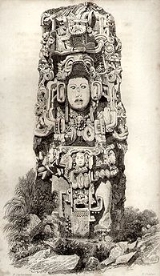
: , stele, ; plural: stelae, , stelai, ; also found: Latinised singular stela and Anglicised plural steles) is a stone or wooden slab, generally taller than it is wide, erected for funerals or commemorative purposes, most usually decorated with the names and titles of the deceased or living — inscribed, carved in relief (bas-relief, sunken-relief, high-relief, and so forth), or painted onto the slab.

ae were also used as territorial markers, as the boundary stelae of Akhenaton at Amarna
Amarna

The site of Amarna is located on the east bank of the Nile River in the modern Egyptian province of Minya Governorate, some 58 km south of the city of al-Minya, 312 km south of the Egyptian capital Cairo and 402 km north of Luxor....
, or to commemorate military victories.


Discussion
Ask a question about 'Stele'
Start a new discussion about 'Stele'
Answer questions from other users
Full Discussion Forum


Recent Posts


Encyclopedia


Copannsouthcatherwood
A stele (from Greek
Greek language

Greek is an Indo-European languages native to the southern Balkan peninsula, the language of the Greek people. It forms an independent branch within Indo-European....
: , stele, ; plural: stelae, , stelai, ; also found: Latinised singular stela and Anglicised plural steles) is a stone or wooden slab, generally taller than it is wide, erected for funerals or commemorative purposes, most usually decorated with the names and titles of the deceased or living — inscribed, carved in relief (bas-relief, sunken-relief, high-relief, and so forth), or painted onto the slab.

History and function

Stelae were also used as territorial markers, as the boundary stelae of Akhenaton at Amarna
Amarna

The site of Amarna is located on the east bank of the Nile River in the modern Egyptian province of Minya Governorate, some 58 km south of the city of al-Minya, 312 km south of the Egyptian capital Cairo and 402 km north of Luxor....
, or to commemorate military victories. They were widely used in the Ancient Near East
Ancient Near East

The Ancient Near East refers to early civilizations within a region roughly corresponding to the modern Middle East: Mesopotamia , Fars Province, Elam and Medes , Anatolia , the Levant , and Ancient Egypt, from the rise of Sumer in the 4th millennium BCE until the region's conquest by Alexander the Great in the 4th century BCE, or covering both th...
, Greece
Greece

Greece , officially the Hellenic Republic , is a country in southeastern Europe, situated on the southern end of the Balkans. It has borders with Albania, Bulgaria and the former Yugoslav Republic of Macedonia to the north, and Turkey to the east....
, Egypt
Egypt

Egypt is a country mainly in North Africa, with the Sinai Peninsula forming a land bridge in Western Asia. Covering an area of about , Egypt borders the Mediterranean Sea to the north, the Gaza Strip and Israel to the northeast, the Red Sea to the east, Sudan to the south and Libya to the west....
, Ethiopia
Ethiopia

Ethiopia , officially the Federal Democratic Republic of Ethiopia, is a landlocked country situated in the Horn of Africa. Ethiopia is bordered by Eritrea to the north, Sudan to the west, Kenya to the south, Somalia to the east and Djibouti to the northeast....
, and, most likely independently, in China
China

China is a Culture of China, an ancient civilization, and, depending on perspective, a national or multinational entity extending over a large area in East Asia....
 and some Buddhist cultures (see the Nestorian Stele
Nestorian Stele

The Nestorian Stele is a Tang Dynasty Stela erected in 781 that celebrates the accomplishments of the Assyrian Church of the East in China, also referred to as the Nestorianism Church ....
), and, more surely independently, by Mesoamerican civilisations, notably the Olmec
Olmec

The Olmec were an ancient Pre-Columbian people living in the tropical lowlands of south-central Mexico, in what are roughly the modern-day Mexican state of Veracruz and Tabasco....
 and Maya. The huge number of stelae surviving from ancient Egypt
Ancient Egypt

Ancient Egypt was an Ancient history civilization in eastern North Africa, concentrated along the lower reaches of the Nile in what is now the modern nation of Egypt....
 and in Central America constitute one of the largest and most significant sources of information on those civilisations. An informative stele of Tiglath-Pileser III is preserved in the British Museum
British Museum

The British Museum is a museum of human history and culture situated in London. Its collections, which number more than 7 million Object , are amongst the largest and most comprehensive in the world and originate from all continents, illustrating and documenting the story of human culture from its beginning to the present....
. Two stelae built into the walls of a church are major documents relating to the Etruscan language
Etruscan language

The Etruscan language was spoken and written by the Etruscan civilization in the ancient region of Etruria and in parts of Lombardy, Veneto, and Emilia-Romagna , in Italy....
.

The erection of steles was popular in China and consisted of rectangular stone tablets usually inscribed with a funerary, commemorative, or edifying text. Although the earliest steles, inspired by Buddhists, date to the first half of the fifth century this visual form did not come into general use until the last years of the fifth century, and this custom prevailed until the end of the sixth century. From then on the design of steles drifted away from pure Buddhist influence and became wordy displays of script mostly eulogistic or commemorative. They were placed in front of tombs to announce the name of the person buried there, often to provide details of the deceased’s life, or were provided to commemorate a particular incident or event and to give details of the purpose of the occasion. Erecting steles at tombs or temples eventually became a widespread social and religious phenomenon.

Thousands of steles, surplus to the original requirements, and no longer associated with the person they were erected for, have been assembled in Xian and the display has become a popular tourist attraction. Hundreds can also be found in selected places in Beijing, such as Dong Yue Miao, the Five Pagoda Temple, and the Bell Tower, again assembled to attract tourists and also as a means of solving the problem faced by local authorities of what to do with them. The long, wordy, and detailed inscriptions on these ste;es are almost impossible to read for most are lightly engraved on white marble in characters only an inch or so in size, thus being difficult to see since the slabs are often ten or more feet tall. Very seldom are the inscriptions are memorable or of any interest.

In 1489, 1512, and 1663 CE
Common Era

Common Era, abbreviated as CE, is a designation for the calendar system most commonly used in the Western world, and also internationally, for numbering the year part of the calendar date....
, the Kaifeng Jews
Kaifeng Jews

The Kaifeng Jews are members of a small History of the Jews in China community that has existed in Kaifeng, in the Henan province of China, for hundreds of years....
 of China left these stone monuments to preserve their origin and history. Despite repeated flooding of the Yellow River
Yellow River

The Yellow River or Huang He / Hwang Ho is the second-longest river in China and the List of rivers by length in the world at 4,845 kilometers ....
, destroying their synagogue time and time again, these stelae survived to tell their tale.

Unfinished standing stone
Standing stone

Standing stones, orthostats, liths or more commonly, megaliths because of their large and cumbersome size, are solitary stones set vertically in the ground and come in many different varieties....
s, set up without inscriptions from Libya
Libya

Libya , officially the Great Socialist People's Libyan Arab Jamahiriya , is a country located in North Africa. Bordering the Mediterranean Sea to the north, Libya lies between Egypt to the east, Sudan to the southeast, Chad and Niger to the south, and Algeria and Tunisia to the west....
 in North Africa to Scotland
Scotland

conventional_long_name = ScotlandAlba|common_name= Scotland|image_flag = Flag of Scotland.svg|flag_width = 130px...
 were monuments of pre-literate Megalith
Megalith

A megalith is a large Rock which has been used to construct a structure or monument, either alone or together with other stones. Megalithic means structures made of such large stones, utilizing an interlocking system without the use of mortar or cement....
ic cultures in the Late Stone Age
Neolithic

The Neolithic period was a period in the development of human technology, beginning about 9500 Before the Christian Era in the Middle East that is traditionally considered the last part of the Stone Age....
. The Pictish stones
Pictish stones

Pictish stones are monumental stelae found in Scotland, mostly north of the Clyde-Forth line. These stones are the most visible remaining evidence of the Picts and are thought to date from the 6th to 9th centuries....
 of Scotland, often intricately carved, date from between the 6th and 9th centuries.

An obelisk
Obelisk

An obelisk An Obelisks is a tall, narrow, four-sided, tapering monument which ends in a pyramid like shape at the top. Ancient obelisks were made of a single piece of stone, a monolith; however, most modern obelisks are made of individual stones, and can even have interior spaces....
 is a specialized kind of stele. The Insular
Insular art

Insular art, also known as the Hiberno-Saxon style, is the style of art produced in the sub-Roman Britain of the British Isles, and the term is also used in relation to the Insular script used at the time....
 high cross
High cross

File:Cloncha cross church.jpgA high cross is a free-standing Christianity cross made of stone and often richly decorated. They were raised primarily in Ireland, Great Britain and Scandinavia during the Early Middle Ages and sometimes later....
es of Ireland
Ireland

Ireland is the List of islands by area in Europe, and the twentieth-largest island in the world. It lies to the north-west of continental Europe and is surrounded by hundreds of islands and islet....
 and Britain
Great Britain

Great Britain is an island lying to the northwest of Continental Europe. It is the List of islands by area, and the largest in Europe. With a population of 58.9 million people it is List of islands by population....
 are specialized stelae. Likewise, the Totem pole
Totem pole

Totem poles are monumental sculptures carved from large trees, usually cedar, but mostly Western Redcedar, by cultures of the Indigenous peoples of the Pacific Northwest Coast of North America....
 of North and South America is a type of stelae. Gravestones with inscribed epitaph
Epitaph

An epitaph is a short text honoring a deceased person, strictly speaking that inscribed on their tombstone or plaque, but also used figuratively....
 are also kinds of stelae.

Most recently, in the Memorial to the Murdered Jews of Europe
Memorial to the Murdered Jews of Europe

The Memorial to the Murdered Jews of Europe , also known as the Holocaust Memorial , is a memorial in Berlin to the Jewish victims of the Holocaust, designed by architect Peter Eisenman and engineer Buro Happold....
 in Berlin
Berlin

Berlin is the Capital of Germany city and one of sixteen States of Germany of Germany. With a population of 3.4 million within its city limits, Berlin is the country's largest city....
, the architect Peter Eisenman
Peter Eisenman

Peter Eisenman is an American architect. Eisenman's fragmented forms are identified with an eclectic group of architects that have been labeled as deconstructivism....
 created a field of some 2,700 blank stelae. The memorial is meant to be read not only as the field, but also as an erasure of data that refer to memory of the Holocaust.

Notable individual stelae

  • Axumite Stele
  • Stele of Naram-Sin
  • Code of Hammurabi
    Code of Hammurabi

    The Code of Hammurabi is a well-preserved ancient law code, created ca. 1760 BC in ancient Babylon. It was enacted by the sixth Babylonian king, Hammurabi....
  • Gwanggaeto Stele
    Gwanggaeto Stele

    The stele of Gwanggaeto the Great of Goguryeo of Goguryeo was erected in 414 by Jangsu of Goguryeo as a memorial to his deceased father. It is one of the major primary sources extant for the history of Goguryeo, one of the Three Kingdoms of Korea, and supplies invaluable historical detail on his reign as well as insights into Goguryeo mytholo...
  • Nestorian Stele
    Nestorian Stele

    The Nestorian Stele is a Tang Dynasty Stela erected in 781 that celebrates the accomplishments of the Assyrian Church of the East in China, also referred to as the Nestorianism Church ....
  • Ukrainian stone stela
  • Lemnos stela
  • Lapis Niger
    Lapis Niger

    The Lapis Niger is a series of Ancient Rome shrines built consecutively around, and on top of, a sacred spot. The name originally referred to a black stone stele with the earliest known Latin inscription....
  • For Israel/Egypt:
    • Merneptah Stele
      Merneptah Stele

      The Merneptah Stele ? also known as the Israel Stele or Victory Stele of Merneptah ? is an inscription by the Ancient Egyptian Pharaoh Merneptah , which appears on the reverse side of a granite stela erected by the Pharaoh Amenhotep III....
    • Mesha Stele
      Mesha Stele

      The Mesha Stele is a black basalt stone, bearing an inscription by the 9th century BC Moabite King Mesha, discovered in 1868 at Dhiban now in Jordan....
  • For Egypt:
    • Rosetta Stone
      Rosetta Stone

      The Rosetta Stone is an Ancient Egyptian Artifact which was instrumental in advancing modern understanding of Egyptian hieroglyphsic writing....
    • Boundary Stelae of Akhenaten
      Boundary Stelae of Akhenaten

      The Boundary Stelae of Akhenaten map out the boundaries of the Ancient Egypt city of Akhetaten, the capital city of Pharaoh Akhenaten.Many of the stelae are heavily eroded, but two of them have been protected and are easily visited....
    • Palermo stone
      Palermo stone

      The Palermo Stone is a large fragment of a stela called the Royal Annals of the Old Kingdom of Ancient Egypt. It contains the clearest inscriptions of the records of the pharaohs of the first dynasty through the fifth dynasty....
    • The Stele of Revealing
      Stèle of Revealing

      The St?le of Revealing refers to an ancient Egyptian funerary artifact of Ankh-af-na-khonsu or Ankh-ef-en-Khons which played a role in the creation of the religion known as Thelema, initiated by Aleister Crowley in 1904 with the writing of The Book of the Law....
  • In the Western Hemisphere:
    • Peru: Raimondi Stela
      Raimondi Stela

      The Raimondi Stela is a major piece of art of the Chav?n culture of the central Andes. The stele is seven feet high, made of highly polished granite, with a lightly incised design which is almost unnoticeable on the actual sculpture....
    • Mexico: Stela C at Tres Zapotes
      Tres Zapotes

      Tres Zapotes is a Mesoamerican archaeological site located in the south-central Gulf of Mexico Lowlands of Mexico in the Papaloapan River plain....
    • Mexico: Izapa Stela 5
      Izapa Stela 5

      Izapa Stela 5 is one of a number of large, carved stelae found in the ancient Mesoamerican site of Izapa, in the Soconusco region of Chiapas, Mexico along the present-day Guatemalan border....
    • Mexico: La Mojarra Stela 1
      La Mojarra Stela 1

      La Mojarra Stela 1 is a Mesoamerican carved monument dating from the 2nd century CE. It was discovered in 1986, pulled from the Acula River near La Mojarra, Veracruz, Mexico, not far from the Tres Zapotes archaeological site....


Gallery


See also

  • Inscription
  • Stele Forest
    Stele Forest

    Stele Forest , aka Xi'an Stele Forest Museum or Xi'an Beilin Museum, is a museum for Stelas and stone sculptures which is located in Xi'an, China....
    , in Xi'an
    Xi'an

    Xi'an , is the Capital of the Shaanxi Provinces of China in the People's Republic of China and a sub-provincial city. As one of the oldest cities in Chinese history, Xi'an is one of the Historical capitals of China because it has been the capital of some of the most important Dynasties in Chinese history in Chinese history, including the Zh...
    , China
  • Runestone
  • Monumental inscription
    Monumental inscription

    A monumental inscription is an inscription, typically carved in stone, on a Headstone, Commemorative plaque, church monument or other monument....
  • Hilarri
    Hilarri

    Hilarri is the name given to disk-shaped funerary steles that are typical of the Basque Country.These funerary steles present a disc-shaped head facing the rising sun on a trapezoidal stand....
     or Basque
    Basque Country (historical territory)

    The Basque Country as a cultural region is a European region in the western Pyrenees that spans the border between France and Spain, on the Atlantic Ocean coast....
     steles
  • Stecci


Bibliography

  • John Boardman ed., The Cambridge Ancient History, Part 1, 2nd Edition, (ISBN-13: 9780521224963 | ISBN-10: 0521224969)
  • Christopher A. Pool, Olmec Archaeology and Early Mesoamerica, Cambridge University Press 2007 (ISBN-13: 9780521783125)
  • Karen E. Till, The New Berlin: Memory, Politics, Place, University of Minnesota Press 2005


Footnotes and references


External links