

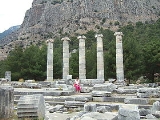
Priene

Encyclopedia
Priene was an ancient Greek
city of Ionia
(and member of the Ionian League
) at the base of an escarpment
of Mycale
, about 6 kilometres (4 mi) north of the then course of the Maeander (now called the Büyük Menderes or "Big Maeander") River, 67 kilometres (41.6 mi) from today's Aydin
, 15 kilometres (9 mi) from today's Söke
and 25 kilometres (15.5 mi) from ancient Miletus
. It was formerly on the sea coast, built overlooking the ocean on steep slopes and terraces extending from sea level to a height of 380 metres (1,246.7 ft) above sea level at the top of the escarpment. Today, after several centuries of changes in the landscape, it is an inland site.
Priene possessed a great deal of famous Hellenistic art and architecture. The city's original position on Mount Mycale has never actually been discovered; however, it is believed that it was a peninsula possessing two harbours. Priene never held a great deal of political importance due to the city's size, as it is believed around 4 to 5 thousand inhabitants occupied the region. The city was arranged into four districts, firstly the political district which consisted of the Bouleterion and the Prytaneion, the cultural district containing the Theatre, the commercial where the Agora was located and finally the religious district which contained sanctuaries dedicated to Zeus and Demeter and most importantly the Temple of Athena.
was constructed according to plan entirely within the 4th century BCE. It was not the original Priene, which had been a port city situated at the then mouth of the Maeander River. This location caused insuperable environmental difficulties for it due to slow aggradation
of the riverbed and progradation
in the direction of the Aegean Sea
. Typically the harbor would silt over and the population find itself living in pest-ridden swamps and marshes. The underlying causes of the problem are that the Maeander flows through a slowly subsiding rift valley creating a drowned coastline and that human use of the previously forested slopes and valley denudes the countryside and accelerates erosion. The sediments are progressively deposited in the trough at the mouth of the river, which migrates westward and more than compensates for the subsidence.
Physical remains of the original Priene have not yet been identified, because, it is supposed, they must be under many feet of sediment, the top of which is currently valuable agricultural land. Knowledge of the average rate of progradation is the basis for estimating the location of the city, which was moved every few centuries to renew its utility as a port. The Greek city (there may have been unknown habitations of other ethnicities, as at Miletus
) was founded by a colony from the ancient Greek city of Thebes
in the vicinity of today's Söke at about 1000 BCE. At about 700 BCE a series of earthquakes provided the opportunity for a move to within 8 kilometres (5 mi) of its 4th century BCE location. At about 500 BCE the city moved again to a few km away at the port of Naulochos.
, Mausolus
(a Caria
n) planned a magnificent new city on the steep slopes of Mycale, where it would be, it was hoped, a permanent deep-water port (similar to the many Greek island cities, which seem to delight in being located on and up seaside escarpments). Construction had begun when the Macedonians took the region from the Persian Empire and Alexander the Great personally assumed responsibility for the move. Both he and Mausolus intended to make Priene a model city. He offered to pay for construction of the Temple of Athena to designs of the noted architect Pytheos
, if it would be dedicated by him, which it was, in 323 BCE; the dedicatory inscription is in the British Museum
. The leading citizens were quick to follow suit: most of the public buildings were constructed at private expense and are inscribed with the names of the donors.
The ruins of the city are generally conceded to be the most spectacular surviving example of an entire ancient Greek city intact except for the ravages of time. It has been studied since at least the 18th century and still is. The city was constructed of marble
from nearby quarries on Mycale and wood for such items as roofs and floors. The public area is laid out in a grid pattern up the steep slopes, drained by a system of channels. The water distribution and sewer systems survive. Foundations, paved streets, stairways, partial door frames, monuments, walls, terraces can be seen everywhere among toppled columns and blocks. No wood has survived. The city extends upward to the base of an escarpment projecting from Mycale. A narrow path leads to the Acropolis
above.
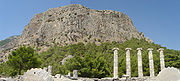 Despite the expectations of the population Priene lasted only a few more centuries as a deep-water port. In the 2nd century CE Pausanias
reports that the Maeander already had silted over the inlet in which Myus
stood and that the population had abandoned it for Miletus
.
While Miletus was apparently still open then, according to recent geoarchaeological research Priene had already lost the port and open connection to the sea in about the 1st century BCE. Very likely, its merchants had preceded the people of Myus to Miletus. By 300 CE the entire Bay of Miletus, except for Lake Bafa, was silted in.
Today Miletus is many miles from the sea and Priene stands at the edge of a fertile plain, now a checkerboard of privately owned fields. A Greek village remained after the population decline and was joined by a Turkish population after the 12th century CE. In the 13th century CE Priene was known as Sampson in Greek after the biblical hero Samson
(Samsun Kale, "Samson's Castle" in Turkish). In 1204, Sabas Asidenos
, a local magnate, established himself as the city's ruler, but soon had to recognize the rule of the Empire of Nicaea
. The area remained under Byzantine
control until the late 13th century.
By 1923 whatever Greek population remained was expelled in the population exchange between Greece and Turkey
and shortly after the Turkish population moved to a more favorable location, which they called Güllü Bahçe, "rose garden", the old Greek settlement partly still in use, today with the name Gelebeç or Kelebeş. The tourist attraction of Priene is accessible from there.
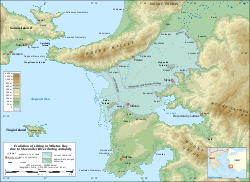 In the 4th century BCE Priene was a deep-water port with two harbors overlooking the Bay of Miletus and somewhat further east the marshes of the Maeander Delta. Between the ocean and steep Mycale
agricultural resources were limited although Priene's territory probably did include a part of the Maeander Valley. Claiming much of Mycale it had borders on the north with Ephesus
and Thebes, a small state on Mycale.
Priene was a small city-state of only 6000 persons living in a constrained location. The population density of its residential district has been estimated at 166 persons per hectare
living in about 33 homes per hectare (13 per acre
) arranged in compact city blocks. The entire space within the walls offered not much more space and privacy: the density was 108 persons per hectare. All the public buildings were within walking distance, except that walking must have been an athletic event due to the vertical components of the distances.
and Alexander the Great. One third of them had indoor toilets, a rarity in a society typically featuring public banks of outdoor seats in urban environments, side by side, an arrangement for which the flowing robes of the ancients were suitably functional. Indoor plumbing requires more extensive water supply and sewage systems. Priene's location was appropriate in that regard; they captured springs and streams on Mycale, brought them in by aqueduct
to cisterns and piped or channeled from there to houses and fountains. Most Greek cities, such as Athens, required visits to the public fountains (the work of domestic servants), but the upper third of Prieneian society had access to indoor water.
The source of Ionian wealth was maritime activity; Ionia had a reputation among the other Greeks for being luxurious, against which practices the intellectuals, such as Heraclitus
often railed.
d equation of wealth with aristocracy
may have applied early in Priene's history, in the 4th century BCE it was a democracy
. State authority resided in a body called the Πριηνείς (Priēneis), "the Prieneian people", who issued all decrees and other public documents in their name. The coins minted at Priene featured the helmeted head of Athena
on the obverse and a meander pattern on the reverse, one coin also displaying a dolphin
and the legend ΠΡΙΗ for ΠΡΙΗΝΕΩΝ (Priēneōn), "of the Prieneians." These symbols express a self-view of the Prieneians as a maritime democracy aligned with Athens
but located in Asia.
The mechanism of democracy was similar to but simpler than that of the Athenians (who had a many times greater population). An assembly of citizens met periodically to render major decisions placed before them. The day-to-day legislative and executive business was conducted by a boulē, or city council, which met in a bouleuterion like a small theatre with a wooden roof. The official head of state was a prytane. He and more specialized magistrate
s were elected periodically. And yet, as at Athens, not all the population was franchised. For example, the property rights and tax responsibilities of a non-Prieneian section of the population living in the countryside, the pedieis, "plainsmen", were defined by law. They were perhaps, an inheritance from the days when Priene was in the valley.
under Aegyptus
, a son of Belus
and grandson of King Codrus
, in the 11th century BCE. After successive attacks by Cimmerians
, Lydians
under Ardys
, and Persians, it survived and prospered under the direction of its "sage," Bias
, during the middle of the 6th century BC. Cyrus
captured it in 545 BC; but it was able to send twelve ships to join the Ionic Revolt (499 BC-494 BC).
Priene was a member of the Athenian dominated Delian League
in the 5th century BC and in 387 BC came under Persian dominance again until Alexander the Great's conquest. Disputes with Samos
, and the troubles after Alexander's death, brought Priene low, and Rome
had to save it from the kings of Pergamon
and Cappadocia
in 155.
Orophernes
, the rebellious brother of the Cappadocian king, who had deposited a treasure there and recovered it by Roman intervention, restored the temple of Athena
as a thank-offering. Under Roman and Byzantine dominion Priene had a prosperous history. It passed into Muslim hands late in the 13th century.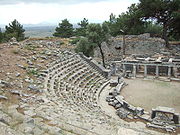
(1895–1899) for the Berlin Museum. The city, as refounded at a new site in the 4th century, was laid out on a rectangular scheme. The steep area faces south, the acropolis rising nearly 200 m (700 ft) behind it. The city was enclosed by a wall 2 m (7 ft) thick with towers at intervals and three principal gates.
On the lower slopes of the acropolis was a sanctuary of Demeter
. The town had six main streets, about 6 m (20 ft) wide, running east and west and fifteen streets about 3 m (10 ft) wide crossing at right angles, all being evenly spaced; and it was thus divided into about 80 insulae. Private houses were apportioned eight to an insula. The systems of water-supply and drainage can easily be discerned. The houses present many analogies with the earliest Pompeian. In the western half of the city, on a high terrace north of the main street and approached by a fine stairway, was the temple of Athena Polias, a hexastyle peripteral structure in the ionic order built by Pytheos
, the architect of the Mausoleum of Maussollos
at Halikarnassos, one of the seven wonders. Under the basis of the statue of Athena were found in 1870 silver tetradrachms of Orophernes, and some jewelry, probably deposited at the time of the Cappadocian restoration. An ancient Priene Synagogue
with a carved image of a menorah has also been discovered.
Around the Agora, the main square crossed by the main street, is a series of halls. The municipal buildings, buleuterion and prytaneion lie north of the Agora, further in the north the Upper Gymnasium with Roman baths, and the well preserved Hellenistic theatre but all, like all the other public structures, more or less in the centre of the plan. Temples of Asclepius
and the Egyptian Gods Isis
, Serapis
and Anubis
have been laid bare. At the lowest point on the south, within the walls, was the large stadium, connected with a gymnasium of Hellenistic times.
See also
Ancient Greece
Ancient Greece is a civilization belonging to a period of Greek history that lasted from the Archaic period of the 8th to 6th centuries BC to the end of antiquity. Immediately following this period was the beginning of the Early Middle Ages and the Byzantine era. Included in Ancient Greece is the...
city of Ionia
Ionia
Ionia is an ancient region of central coastal Anatolia in present-day Turkey, the region nearest İzmir, which was historically Smyrna. It consisted of the northernmost territories of the Ionian League of Greek settlements...
(and member of the Ionian League
Ionian League
The Ionian League , also called the Panionic League, was a confederation formed at the end of the Meliac War in the mid-7th century BC comprising twelve Ionian cities .These were listed by Herodotus as*Miletus, Myus, and...
) at the base of an escarpment
Escarpment
An escarpment is a steep slope or long cliff that occurs from erosion or faulting and separates two relatively level areas of differing elevations.-Description and variants:...
of Mycale
Mycale
Mycale, also Mykale and Mycali , called Samsun Daği and Dilek Daği in modern Turkey, is a mountain on the west coast of central Anatolia in Turkey, north of the mouth of the Maeander and divided from the Greek island of Samos by the 1300 metre wide Samos Strait...
, about 6 kilometres (4 mi) north of the then course of the Maeander (now called the Büyük Menderes or "Big Maeander") River, 67 kilometres (41.6 mi) from today's Aydin
Aydin
Aydın is a city in and the seat of Aydın Province in Turkey's Aegean Region. The city is located at the heart of the lower valley of Büyük Menderes River at a commanding position for the region extending from the uplands of the valley down to the seacoast...
, 15 kilometres (9 mi) from today's Söke
Söke
Söke is a town and a large district of Aydın Province in the Aegean region of western Turkey, south-west of the city of Aydın, near the Aegean coast. It had 68,020 population in 2010.- Geography :...
and 25 kilometres (15.5 mi) from ancient Miletus
Miletus
Miletus was an ancient Greek city on the western coast of Anatolia , near the mouth of the Maeander River in ancient Caria...
. It was formerly on the sea coast, built overlooking the ocean on steep slopes and terraces extending from sea level to a height of 380 metres (1,246.7 ft) above sea level at the top of the escarpment. Today, after several centuries of changes in the landscape, it is an inland site.
Priene possessed a great deal of famous Hellenistic art and architecture. The city's original position on Mount Mycale has never actually been discovered; however, it is believed that it was a peninsula possessing two harbours. Priene never held a great deal of political importance due to the city's size, as it is believed around 4 to 5 thousand inhabitants occupied the region. The city was arranged into four districts, firstly the political district which consisted of the Bouleterion and the Prytaneion, the cultural district containing the Theatre, the commercial where the Agora was located and finally the religious district which contained sanctuaries dedicated to Zeus and Demeter and most importantly the Temple of Athena.
Earliest cities
The city visible on the slopes and escarpment of MycaleMycale
Mycale, also Mykale and Mycali , called Samsun Daği and Dilek Daği in modern Turkey, is a mountain on the west coast of central Anatolia in Turkey, north of the mouth of the Maeander and divided from the Greek island of Samos by the 1300 metre wide Samos Strait...
was constructed according to plan entirely within the 4th century BCE. It was not the original Priene, which had been a port city situated at the then mouth of the Maeander River. This location caused insuperable environmental difficulties for it due to slow aggradation
Aggradation
Aggradation is the term used in geology for the increase in land elevation due to the deposition of sediment. Aggradation occurs in areas in which the supply of sediment is greater than the amount of material that the system is able to transport...
of the riverbed and progradation
Progradation
In sedimentary geology and geomorphology, the term progradation refers to the growth of a river delta farther out into the sea over time. This occurs when the mass balance of sediment into the delta is such that the volume of incoming sediment is greater than the volume of the delta that is lost...
in the direction of the Aegean Sea
Aegean Sea
The Aegean Sea[p] is an elongated embayment of the Mediterranean Sea located between the southern Balkan and Anatolian peninsulas, i.e., between the mainlands of Greece and Turkey. In the north, it is connected to the Marmara Sea and Black Sea by the Dardanelles and Bosporus...
. Typically the harbor would silt over and the population find itself living in pest-ridden swamps and marshes. The underlying causes of the problem are that the Maeander flows through a slowly subsiding rift valley creating a drowned coastline and that human use of the previously forested slopes and valley denudes the countryside and accelerates erosion. The sediments are progressively deposited in the trough at the mouth of the river, which migrates westward and more than compensates for the subsidence.
Physical remains of the original Priene have not yet been identified, because, it is supposed, they must be under many feet of sediment, the top of which is currently valuable agricultural land. Knowledge of the average rate of progradation is the basis for estimating the location of the city, which was moved every few centuries to renew its utility as a port. The Greek city (there may have been unknown habitations of other ethnicities, as at Miletus
Miletus
Miletus was an ancient Greek city on the western coast of Anatolia , near the mouth of the Maeander River in ancient Caria...
) was founded by a colony from the ancient Greek city of Thebes
Thebes, Greece
Thebes is a city in Greece, situated to the north of the Cithaeron range, which divides Boeotia from Attica, and on the southern edge of the Boeotian plain. It played an important role in Greek myth, as the site of the stories of Cadmus, Oedipus, Dionysus and others...
in the vicinity of today's Söke at about 1000 BCE. At about 700 BCE a series of earthquakes provided the opportunity for a move to within 8 kilometres (5 mi) of its 4th century BCE location. At about 500 BCE the city moved again to a few km away at the port of Naulochos.
4th century BCE city
At about 350 BCE the Persian-empire satrapSatrap
Satrap was the name given to the governors of the provinces of the ancient Median and Achaemenid Empires and in several of their successors, such as the Sassanid Empire and the Hellenistic empires....
, Mausolus
Mausolus
Mausolus was ruler of Caria . He took part in the revolt against Artaxerxes Mnemon , conquered a great part of Lycia, Ionia and several Greek islands and cooperated with the Rhodians in the Social War against Athens...
(a Caria
Caria
Caria was a region of western Anatolia extending along the coast from mid-Ionia south to Lycia and east to Phrygia. The Ionian and Dorian Greeks colonized the west of it and joined the Carian population in forming Greek-dominated states there...
n) planned a magnificent new city on the steep slopes of Mycale, where it would be, it was hoped, a permanent deep-water port (similar to the many Greek island cities, which seem to delight in being located on and up seaside escarpments). Construction had begun when the Macedonians took the region from the Persian Empire and Alexander the Great personally assumed responsibility for the move. Both he and Mausolus intended to make Priene a model city. He offered to pay for construction of the Temple of Athena to designs of the noted architect Pytheos
Pythis
Pythius, also known as Pytheos or Pythis, was a Greek architect of the 4th century BCE. He built the Temple of Athena Polias cited by Vitruvius : "Pythius, the celebrated builder of the temple of Minerva at Priene"...
, if it would be dedicated by him, which it was, in 323 BCE; the dedicatory inscription is in the British Museum
British Museum
The British Museum is a museum of human history and culture in London. Its collections, which number more than seven million objects, are amongst the largest and most comprehensive in the world and originate from all continents, illustrating and documenting the story of human culture from its...
. The leading citizens were quick to follow suit: most of the public buildings were constructed at private expense and are inscribed with the names of the donors.
The ruins of the city are generally conceded to be the most spectacular surviving example of an entire ancient Greek city intact except for the ravages of time. It has been studied since at least the 18th century and still is. The city was constructed of marble
Marble
Marble is a metamorphic rock composed of recrystallized carbonate minerals, most commonly calcite or dolomite.Geologists use the term "marble" to refer to metamorphosed limestone; however stonemasons use the term more broadly to encompass unmetamorphosed limestone.Marble is commonly used for...
from nearby quarries on Mycale and wood for such items as roofs and floors. The public area is laid out in a grid pattern up the steep slopes, drained by a system of channels. The water distribution and sewer systems survive. Foundations, paved streets, stairways, partial door frames, monuments, walls, terraces can be seen everywhere among toppled columns and blocks. No wood has survived. The city extends upward to the base of an escarpment projecting from Mycale. A narrow path leads to the Acropolis
Acropolis
Acropolis means "high city" in Greek, literally city on the extremity and is usually translated into English as Citadel . For purposes of defense, early people naturally chose elevated ground to build a new settlement, frequently a hill with precipitous sides...
above.
Later years
Pausanias (geographer)
Pausanias was a Greek traveler and geographer of the 2nd century AD, who lived in the times of Hadrian, Antoninus Pius and Marcus Aurelius. He is famous for his Description of Greece , a lengthy work that describes ancient Greece from firsthand observations, and is a crucial link between classical...
reports that the Maeander already had silted over the inlet in which Myus
Myus
Myus, Caria was an ancient city-state and was one of twelve major settlements formed in the Ionian Confederation, called the Ionian League. The city was said to have been founded by Cyaretus , a son of Codrus. Myus was a small peninsula, it is now however surrounded by land...
stood and that the population had abandoned it for Miletus
Miletus
Miletus was an ancient Greek city on the western coast of Anatolia , near the mouth of the Maeander River in ancient Caria...
.
While Miletus was apparently still open then, according to recent geoarchaeological research Priene had already lost the port and open connection to the sea in about the 1st century BCE. Very likely, its merchants had preceded the people of Myus to Miletus. By 300 CE the entire Bay of Miletus, except for Lake Bafa, was silted in.
Today Miletus is many miles from the sea and Priene stands at the edge of a fertile plain, now a checkerboard of privately owned fields. A Greek village remained after the population decline and was joined by a Turkish population after the 12th century CE. In the 13th century CE Priene was known as Sampson in Greek after the biblical hero Samson
Samson
Samson, Shimshon ; Shamshoun or Sampson is the third to last of the Judges of the ancient Israelites mentioned in the Tanakh ....
(Samsun Kale, "Samson's Castle" in Turkish). In 1204, Sabas Asidenos
Sabas Asidenos
Sabas or Sabbas Asidenos was a powerful local magnate of the region of Sampson in the early 13th century. Following the Fourth Crusade, he established himself as an independent ruler before submitting to the Empire of Nicaea....
, a local magnate, established himself as the city's ruler, but soon had to recognize the rule of the Empire of Nicaea
Empire of Nicaea
The Empire of Nicaea was the largest of the three Byzantine Greek successor states founded by the aristocracy of the Byzantine Empire that fled after Constantinople was occupied by Western European and Venetian forces during the Fourth Crusade...
. The area remained under Byzantine
Byzantine
Byzantine usually refers to the Roman Empire during the Middle Ages.Byzantine may also refer to:* A citizen of the Byzantine Empire, or native Greek during the Middle Ages...
control until the late 13th century.
By 1923 whatever Greek population remained was expelled in the population exchange between Greece and Turkey
Population exchange between Greece and Turkey
The 1923 population exchange between Greece and Turkey was based upon religious identity, and involved the Greek Orthodox citizens of Turkey and the Muslim citizens of Greece...
and shortly after the Turkish population moved to a more favorable location, which they called Güllü Bahçe, "rose garden", the old Greek settlement partly still in use, today with the name Gelebeç or Kelebeş. The tourist attraction of Priene is accessible from there.
Territory
Mycale
Mycale, also Mykale and Mycali , called Samsun Daği and Dilek Daği in modern Turkey, is a mountain on the west coast of central Anatolia in Turkey, north of the mouth of the Maeander and divided from the Greek island of Samos by the 1300 metre wide Samos Strait...
agricultural resources were limited although Priene's territory probably did include a part of the Maeander Valley. Claiming much of Mycale it had borders on the north with Ephesus
Ephesus
Ephesus was an ancient Greek city, and later a major Roman city, on the west coast of Asia Minor, near present-day Selçuk, Izmir Province, Turkey. It was one of the twelve cities of the Ionian League during the Classical Greek era...
and Thebes, a small state on Mycale.
Priene was a small city-state of only 6000 persons living in a constrained location. The population density of its residential district has been estimated at 166 persons per hectare
Hectare
The hectare is a metric unit of area defined as 10,000 square metres , and primarily used in the measurement of land. In 1795, when the metric system was introduced, the are was defined as being 100 square metres and the hectare was thus 100 ares or 1/100 km2...
living in about 33 homes per hectare (13 per acre
Acre
The acre is a unit of area in a number of different systems, including the imperial and U.S. customary systems. The most commonly used acres today are the international acre and, in the United States, the survey acre. The most common use of the acre is to measure tracts of land.The acre is related...
) arranged in compact city blocks. The entire space within the walls offered not much more space and privacy: the density was 108 persons per hectare. All the public buildings were within walking distance, except that walking must have been an athletic event due to the vertical components of the distances.
Society
Priene was a wealthy city, as the plenitude of fine urban homes in marble and the private dedications of public buildings suggests, not to mention the personal attentions of MausolusMausolus
Mausolus was ruler of Caria . He took part in the revolt against Artaxerxes Mnemon , conquered a great part of Lycia, Ionia and several Greek islands and cooperated with the Rhodians in the Social War against Athens...
and Alexander the Great. One third of them had indoor toilets, a rarity in a society typically featuring public banks of outdoor seats in urban environments, side by side, an arrangement for which the flowing robes of the ancients were suitably functional. Indoor plumbing requires more extensive water supply and sewage systems. Priene's location was appropriate in that regard; they captured springs and streams on Mycale, brought them in by aqueduct
Aqueduct
An aqueduct is a water supply or navigable channel constructed to convey water. In modern engineering, the term is used for any system of pipes, ditches, canals, tunnels, and other structures used for this purpose....
to cisterns and piped or channeled from there to houses and fountains. Most Greek cities, such as Athens, required visits to the public fountains (the work of domestic servants), but the upper third of Prieneian society had access to indoor water.
The source of Ionian wealth was maritime activity; Ionia had a reputation among the other Greeks for being luxurious, against which practices the intellectuals, such as Heraclitus
Heraclitus
Heraclitus of Ephesus was a pre-Socratic Greek philosopher, a native of the Greek city Ephesus, Ionia, on the coast of Asia Minor. He was of distinguished parentage. Little is known about his early life and education, but he regarded himself as self-taught and a pioneer of wisdom...
often railed.
Government
Although the stereotypeStereotype
A stereotype is a popular belief about specific social groups or types of individuals. The concepts of "stereotype" and "prejudice" are often confused with many other different meanings...
d equation of wealth with aristocracy
Aristocracy
Aristocracy , is a form of government in which a few elite citizens rule. The term derives from the Greek aristokratia, meaning "rule of the best". In origin in Ancient Greece, it was conceived of as rule by the best qualified citizens, and contrasted with monarchy...
may have applied early in Priene's history, in the 4th century BCE it was a democracy
Democracy
Democracy is generally defined as a form of government in which all adult citizens have an equal say in the decisions that affect their lives. Ideally, this includes equal participation in the proposal, development and passage of legislation into law...
. State authority resided in a body called the Πριηνείς (Priēneis), "the Prieneian people", who issued all decrees and other public documents in their name. The coins minted at Priene featured the helmeted head of Athena
Athena
In Greek mythology, Athena, Athenê, or Athene , also referred to as Pallas Athena/Athene , is the goddess of wisdom, courage, inspiration, civilization, warfare, strength, strategy, the arts, crafts, justice, and skill. Minerva, Athena's Roman incarnation, embodies similar attributes. Athena is...
on the obverse and a meander pattern on the reverse, one coin also displaying a dolphin
Dolphin
Dolphins are marine mammals that are closely related to whales and porpoises. There are almost forty species of dolphin in 17 genera. They vary in size from and , up to and . They are found worldwide, mostly in the shallower seas of the continental shelves, and are carnivores, mostly eating...
and the legend ΠΡΙΗ for ΠΡΙΗΝΕΩΝ (Priēneōn), "of the Prieneians." These symbols express a self-view of the Prieneians as a maritime democracy aligned with Athens
Athens
Athens , is the capital and largest city of Greece. Athens dominates the Attica region and is one of the world's oldest cities, as its recorded history spans around 3,400 years. Classical Athens was a powerful city-state...
but located in Asia.
The mechanism of democracy was similar to but simpler than that of the Athenians (who had a many times greater population). An assembly of citizens met periodically to render major decisions placed before them. The day-to-day legislative and executive business was conducted by a boulē, or city council, which met in a bouleuterion like a small theatre with a wooden roof. The official head of state was a prytane. He and more specialized magistrate
Magistrate
A magistrate is an officer of the state; in modern usage the term usually refers to a judge or prosecutor. This was not always the case; in ancient Rome, a magistratus was one of the highest government officers and possessed both judicial and executive powers. Today, in common law systems, a...
s were elected periodically. And yet, as at Athens, not all the population was franchised. For example, the property rights and tax responsibilities of a non-Prieneian section of the population living in the countryside, the pedieis, "plainsmen", were defined by law. They were perhaps, an inheritance from the days when Priene was in the valley.
History
Although the exact truth is not known, Priene was said to have been first settled by IoniansIonians
The Ionians were one of the four major tribes into which the Classical Greeks considered the population of Hellenes to have been divided...
under Aegyptus
Aegyptus
- Aegyptus, King of Egypt and Arabia :In Greek mythology, Aegyptus is a descendant of the heifer maiden, Io, and the river-god Nilus, and was a king in Egypt. Aegyptos was the son of Belus and Achiroe, a naiad daughter of Nile. Aegyptus fathered fifty sons, who were all but one murdered by the...
, a son of Belus
Belus
Belus or Belos may be:* The classical Latin or Greek rendition of Bel the Semitic honorific**Ba`al as a Semitic deity** Belus , the Greek Zeus Belos and Latin Jupiter Belus as translations of the Babylonian god Bel Marduk...
and grandson of King Codrus
Codrus
Codrus was the last of the semi-mythical Kings of Athens . He was an ancient exemplar of patriotism and self-sacrifice. He was succeeded by his son Medon, who ruled not as king but as the first Archon of Athens....
, in the 11th century BCE. After successive attacks by Cimmerians
Cimmerians
The Cimmerians or Kimmerians were ancient equestrian nomads of Indo-European origin.According to the Greek historian Herodotus, of the 5th century BC, the Cimmerians inhabited the region north of the Caucasus and the Black Sea during the 8th and 7th centuries BC, in what is now Ukraine and Russia...
, Lydians
Lydians
The Lydians were the inhabitants of Lydia, a region in western Anatolia, who spoke the distinctive Lydian language, an Indo-European language of the Anatolian group....
under Ardys
Ardys
Ardys or Ardysus may refer to:*Ardys I, twenty-second king of Lydia*Ardys II, twenty-seventh king of Lydia...
, and Persians, it survived and prospered under the direction of its "sage," Bias
Bias of Priene
Bias , the son of Teutamus and a citizen of Priene was a Greek philosopher. Satyrus puts him as the wisest of all the Seven Sages of Greece. He was renowned for his goodness....
, during the middle of the 6th century BC. Cyrus
Cyrus the Great
Cyrus II of Persia , commonly known as Cyrus the Great, also known as Cyrus the Elder, was the founder of the Achaemenid Empire. Under his rule, the empire embraced all the previous civilized states of the ancient Near East, expanded vastly and eventually conquered most of Southwest Asia and much...
captured it in 545 BC; but it was able to send twelve ships to join the Ionic Revolt (499 BC-494 BC).
Priene was a member of the Athenian dominated Delian League
Delian League
The Delian League, founded in circa 477 BC, was an association of Greek city-states, members numbering between 150 to 173, under the leadership of Athens, whose purpose was to continue fighting the Persian Empire after the Greek victory in the Battle of Plataea at the end of the Greco–Persian Wars...
in the 5th century BC and in 387 BC came under Persian dominance again until Alexander the Great's conquest. Disputes with Samos
Samos Island
Samos is a Greek island in the eastern Aegean Sea, south of Chios, north of Patmos and the Dodecanese, and off the coast of Asia Minor, from which it is separated by the -wide Mycale Strait. It is also a separate regional unit of the North Aegean region, and the only municipality of the regional...
, and the troubles after Alexander's death, brought Priene low, and Rome
Rome
Rome is the capital of Italy and the country's largest and most populated city and comune, with over 2.7 million residents in . The city is located in the central-western portion of the Italian Peninsula, on the Tiber River within the Lazio region of Italy.Rome's history spans two and a half...
had to save it from the kings of Pergamon
Pergamon
Pergamon , or Pergamum, was an ancient Greek city in modern-day Turkey, in Mysia, today located from the Aegean Sea on a promontory on the north side of the river Caicus , that became the capital of the Kingdom of Pergamon during the Hellenistic period, under the Attalid dynasty, 281–133 BC...
and Cappadocia
Cappadocia
Cappadocia is a historical region in Central Anatolia, largely in Nevşehir Province.In the time of Herodotus, the Cappadocians were reported as occupying the whole region from Mount Taurus to the vicinity of the Euxine...
in 155.
Orophernes
Orophernes of Cappadocia
Orophernes Nicephorus was one of the two false sons whom Antiochis imposed upon her husband, Ariarathes IV, king of Cappadocia. On the birth, however, of a real son, named Mithradates , Orophernes, so that he might not set up pretensions to the throne, was sent away into Ionia...
, the rebellious brother of the Cappadocian king, who had deposited a treasure there and recovered it by Roman intervention, restored the temple of Athena
Athena
In Greek mythology, Athena, Athenê, or Athene , also referred to as Pallas Athena/Athene , is the goddess of wisdom, courage, inspiration, civilization, warfare, strength, strategy, the arts, crafts, justice, and skill. Minerva, Athena's Roman incarnation, embodies similar attributes. Athena is...
as a thank-offering. Under Roman and Byzantine dominion Priene had a prosperous history. It passed into Muslim hands late in the 13th century.
Archaeological excavations and current state
The ruins, which lie in successive terraces, were the object of missions sent out by the English Society of Dilettanti in 1765 and 1868, and were thoroughly laid open by Theodor WiegandTheodor Wiegand
Theodor Wiegand was one of the most famous German archaeologists.Wiegand was born in Bendorf, Rhenish Prussia. He studied at Munich, Berlin, and Freiburg. In 1894 he worked under Wilhelm Dörpfeld at the excavation of the Athenian Acropolis...
(1895–1899) for the Berlin Museum. The city, as refounded at a new site in the 4th century, was laid out on a rectangular scheme. The steep area faces south, the acropolis rising nearly 200 m (700 ft) behind it. The city was enclosed by a wall 2 m (7 ft) thick with towers at intervals and three principal gates.
On the lower slopes of the acropolis was a sanctuary of Demeter
Demeter
In Greek mythology, Demeter is the goddess of the harvest, who presided over grains, the fertility of the earth, and the seasons . Her common surnames are Sito as the giver of food or corn/grain and Thesmophoros as a mark of the civilized existence of agricultural society...
. The town had six main streets, about 6 m (20 ft) wide, running east and west and fifteen streets about 3 m (10 ft) wide crossing at right angles, all being evenly spaced; and it was thus divided into about 80 insulae. Private houses were apportioned eight to an insula. The systems of water-supply and drainage can easily be discerned. The houses present many analogies with the earliest Pompeian. In the western half of the city, on a high terrace north of the main street and approached by a fine stairway, was the temple of Athena Polias, a hexastyle peripteral structure in the ionic order built by Pytheos
Pythis
Pythius, also known as Pytheos or Pythis, was a Greek architect of the 4th century BCE. He built the Temple of Athena Polias cited by Vitruvius : "Pythius, the celebrated builder of the temple of Minerva at Priene"...
, the architect of the Mausoleum of Maussollos
Mausoleum of Maussollos
The Mausoleum at Halicarnassus or Tomb of Mausolus was a tomb built between 353 and 350 BC at Halicarnassus for Mausolus, a satrap in the Persian Empire, and Artemisia II of Caria, his wife and sister....
at Halikarnassos, one of the seven wonders. Under the basis of the statue of Athena were found in 1870 silver tetradrachms of Orophernes, and some jewelry, probably deposited at the time of the Cappadocian restoration.
Priene Synagogue
The Priene Synagogue is an ancient synagogue discovered by archaeologists in Priene, Turkey.The synagogue was discovered by archaeologists Theodor Wiegand and Hans Schrader in the western residential area in 1895–98. The synagogue dates to the 2nd century AD and was built into an older Hellenistic...
with a carved image of a menorah has also been discovered.
Around the Agora, the main square crossed by the main street, is a series of halls. The municipal buildings, buleuterion and prytaneion lie north of the Agora, further in the north the Upper Gymnasium with Roman baths, and the well preserved Hellenistic theatre but all, like all the other public structures, more or less in the centre of the plan. Temples of Asclepius
Asclepius
Asclepius is the God of Medicine and Healing in ancient Greek religion. Asclepius represents the healing aspect of the medical arts; his daughters are Hygieia , Iaso , Aceso , Aglæa/Ægle , and Panacea...
and the Egyptian Gods Isis
Isis
Isis or in original more likely Aset is a goddess in Ancient Egyptian religious beliefs, whose worship spread throughout the Greco-Roman world. She was worshipped as the ideal mother and wife as well as the matron of nature and magic...
, Serapis
Serapis
Serapis or Sarapis is a Graeco-Egyptian name of God. Serapis was devised during the 3rd century BC on the orders of Ptolemy I of Egypt as a means to unify the Greeks and Egyptians in his realm. The god was depicted as Greek in appearance, but with Egyptian trappings, and combined iconography...
and Anubis
Anubis
Anubis is the Greek name for a jackal-headed god associated with mummification and the afterlife in ancient Egyptian religion. In the ancient Egyptian language, Anubis is known as Inpu . According to the Akkadian transcription in the Amarna letters, Anubis' name was vocalized as Anapa...
have been laid bare. At the lowest point on the south, within the walls, was the large stadium, connected with a gymnasium of Hellenistic times.
See also
- Society of Dilettanti, Ionian Antiquities (1821), vol. ii.;
- Th. Wiegand and H. Schrader, Priene (1904);
- on inscriptions (360) see Hiller von Gaertringen, Inschriften von Priene (Berlin, 1907), with collection of ancient references to the city.
External links
- Livius Picture Archive: Priene
- Priene and Miletus İnformation
- Priene Miletus and Didyma images
- Many pictures of the ancient city of Priene
- The Theatre at Priene, The Ancient Theatre Archive. Theatre specifications and virtual reality tour of theatre
- Herodotus Project: Extensive B+W photo essay of Priene Turkish language, English subtitles.