
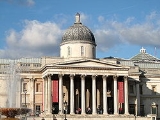
The
National Gallery is an art museum on
Trafalgar SquareTrafalgar Square is a public space and tourist attraction in central London, England, United Kingdom. At its centre is Nelson's Column, which is guarded by four lion statues at its base. There are a number of statues and sculptures in the square, with one plinth displaying changing pieces of...
,
LondonLondon is the capital city of :England and the :United Kingdom, the largest metropolitan area in the United Kingdom, and the largest urban zone in the European Union by most measures. Located on the River Thames, London has been a major settlement for two millennia, its history going back to its...
,
United KingdomThe United Kingdom of Great Britain and Northern IrelandIn the United Kingdom and Dependencies, other languages have been officially recognised as legitimate autochthonous languages under the European Charter for Regional or Minority Languages...
. Founded in 1824, it houses a collection of over 2,300 paintings dating from the mid-13th century to 1900. The gallery is an
exempt charityAn exempt charity is an institution established in England and Wales for charitable purposes which is exempt from registration with, and oversight by, the Charity Commission....
, and a
non-departmental public bodyIn the United Kingdom, a non-departmental public body —often referred to as a quango—is a classification applied by the Cabinet Office, Treasury, Scottish Government and Northern Ireland Executive to certain types of public bodies...
of the
Department for Culture, Media and SportThe Department for Culture, Media and Sport is a department of the United Kingdom government, with responsibility for culture and sport in England, and some aspects of the media throughout the whole UK, such as broadcasting and internet....
. Its collection belongs to the public of the United Kingdom and entry to the main collection (though not some special exhibitions) is free of charge.
Unlike comparable art museums in continental Europe, the National Gallery was not formed by nationalising an existing royal or princely art collection. It came into being when the British government bought 38 paintings from the heirs of
John Julius AngersteinJohn Julius Angerstein , was a London merchant, Lloyd's under-writer, and patron of the fine arts. The imminent prospect that his collection of paintings was about to be sold by his estate, in 1824, galvanized the founding of the National Gallery, London.Angerstein was born in St Petersburg, Russia...
, an insurance broker and patron of the arts, in 1824. After that initial purchase the Gallery was shaped mainly by its early directors, notably Sir
Charles Lock EastlakeSir Charles Lock Eastlake RA was an English painter, gallery director, collector and writer of the early 19th century.-Early life:...
, and by private donations, which comprise two thirds of the collection. The resulting collection is small in size, compared with many European national galleries, but encyclopaedic in scope; most major developments in Western painting "from Giotto to
CézannePaul Cézanne was a French artist and Post-Impressionist painter whose work laid the foundations of the transition from the 19th century conception of artistic endeavour to a new and radically different world of art in the 20th century. Cézanne can be said to form the bridge between late 19th...
" are represented with important works. It used to be claimed that this was one of the few national galleries that had all its works on permanent exhibition, but this is no longer the case.
The present building, the third to house the National Gallery, was designed by
William WilkinsWilliam Wilkins RA was an English architect, classical scholar and archaeologist. He designed the National Gallery and University College in London, and buildings for several Cambridge colleges.-Life:...
from 1832–8. Only the façade onto Trafalgar Square remains essentially unchanged from this time, as the building has been expanded piecemeal throughout its history. Wilkins's building was often criticised for its perceived aesthetic deficiencies and lack of space; the latter problem led to the establishment of the
Tate GalleryThe Tate is an institution that houses the United Kingdom's national collection of British Art, and International Modern and Contemporary Art...
for British art in 1897. The Sainsbury Wing, an extension to the west by
Robert VenturiRobert Charles Venturi, Jr. is an American architect, founding principal of the firm Venturi, Scott Brown and Associates, and one of the major figures in the architecture of the twentieth century...
and
Denise Scott BrownDenise Scott Brown, is an architect, planner, writer, educator, and principal of the firm Venturi, Scott Brown and Associates in Philadelphia...
, is a notable example of
PostmodernistPostmodern architecture began as an international style the first examples of which are generally cited as being from the 1950s, but did not become a movement until the late 1970s and continues to influence present-day architecture...
architecture in Britain. The current Director of the National Gallery is
Nicholas PennyNicholas Penny, FSA is a British art historian. Since Spring 2008 he has been director of the National Gallery in London....
.
The call for a National Gallery
The late 18th century saw the nationalisation of royal or princely art collections across mainland Europe. The Bavarian royal collection (now in the
Alte PinakothekThe Alte Pinakothek is an art museum situated in the Kunstareal in Munich, Germany. It is one of the oldest galleries in the world and houses one of the most famous collections of Old Master paintings...
,
MunichMunich The city's motto is "" . Before 2006, it was "Weltstadt mit Herz" . Its native name, , is derived from the Old High German Munichen, meaning "by the monks' place". The city's name derives from the monks of the Benedictine order who founded the city; hence the monk depicted on the city's coat...
) opened to the public in 1779, that of the
MediciThe House of Medici or Famiglia de' Medici was a political dynasty, banking family and later royal house that first began to gather prominence under Cosimo de' Medici in the Republic of Florence during the late 14th century. The family originated in the Mugello region of the Tuscan countryside,...
in
FlorenceFlorence is the capital city of the Italian region of Tuscany and of the province of Florence. It is the most populous city in Tuscany, with approximately 370,000 inhabitants, expanding to over 1.5 million in the metropolitan area....
around 1789 (as the
UffiziThe Uffizi Gallery , is a museum in Florence, Italy. It is one of the oldest and most famous art museums of the Western world.-History:...
Gallery), and the Museum Français at the
LouvreThe Musée du Louvre – in English, the Louvre Museum or simply the Louvre – is one of the world's largest museums, the most visited art museum in the world and a historic monument. A central landmark of Paris, it is located on the Right Bank of the Seine in the 1st arrondissement...
was formed out of the former French royal collection in 1793.
Great BritainThe former Kingdom of Great Britain, sometimes described as the 'United Kingdom of Great Britain', That the Two Kingdoms of Scotland and England, shall upon the 1st May next ensuing the date hereof, and forever after, be United into One Kingdom by the Name of GREAT BRITAIN. was a sovereign...
, however, did not emulate the continental model, and the British
Royal CollectionThe Royal Collection is the art collection of the British Royal Family. It is property of the monarch as sovereign, but is held in trust for her successors and the nation. It contains over 7,000 paintings, 40,000 watercolours and drawings, and about 150,000 old master prints, as well as historical...
remains in the sovereign's possession today. In 1777 the British government had the opportunity to buy an art collection of international stature, when the descendants of Sir
Robert WalpoleRobert Walpole, 1st Earl of Orford, KG, KB, PC , known before 1742 as Sir Robert Walpole, was a British statesman who is generally regarded as having been the first Prime Minister of Great Britain....
put his collection up for sale. The MP
John WilkesJohn Wilkes was an English radical, journalist and politician.He was first elected Member of Parliament in 1757. In the Middlesex election dispute, he fought for the right of voters—rather than the House of Commons—to determine their representatives...
argued for the government to buy this "invaluable treasure" and suggested that it be housed in "a noble gallery... to be built in the spacious garden of the
British MuseumThe British Museum is a museum of human history and culture in London. Its collections, which number more than seven million objects, are amongst the largest and most comprehensive in the world and originate from all continents, illustrating and documenting the story of human culture from its...
" Nothing came of Wilkes's appeal and 20 years later the collection was bought in its entirety by Catherine the Great; it is now to be found in the State Hermitage Museum in St Petersburg.
A plan to acquire 150 paintings from the
Orléans collectionThe Orleans Collection was a very important collection of over 500 paintings formed by the French prince of the blood Philippe d'Orléans, Duke of Orléans, mostly acquired between about 1700 and his death in 1723...
, which had been brought to London for sale in 1798, also failed, despite the interest of both the King and the Prime Minister,
Pitt the YoungerWilliam Pitt the Younger was a British politician of the late 18th and early 19th centuries. He became the youngest Prime Minister in 1783 at the age of 24 . He left office in 1801, but was Prime Minister again from 1804 until his death in 1806...
. The twenty-five paintings from that collection now in the Gallery, including "NG1", have arrived by a variety of routes. In 1799 the dealer Noel Desenfans offered a ready-made national collection to the British government; he and his partner Sir
Francis BourgeoisSir Peter Francis Bourgeois was an English-Swiss landscape painter and court painter to George III. He lived with his French partner Noel Desenfans and Desenfans's Welsh wife Margaret Morris. The three lived together in a house in Charlotte Street, London...
had assembled it for the king of
PolandThe Polish–Lithuanian Commonwealth was a dualistic state of Poland and Lithuania ruled by a common monarch. It was the largest and one of the most populous countries of 16th- and 17th‑century Europe with some and a multi-ethnic population of 11 million at its peak in the early 17th century...
, before the
Third PartitionThe Third Partition of Poland or Third Partition of the Polish-Lithuanian Commonwealth took place in 1795 as the third and last of three partitions that ended the existence of the Polish-Lithuanian Commonwealth.-Background:...
in 1795 abolished Polish independence. This offer was declined and Bourgeois bequeathed the collection to his old school,
Dulwich CollegeDulwich College is an independent school for boys in Dulwich, southeast London, England. The college was founded in 1619 by Edward Alleyn, a successful Elizabethan actor, with the original purpose of educating 12 poor scholars as the foundation of "God's Gift". It currently has about 1,600 boys,...
, on his death. The collection opened in Britain's first purpose-built public gallery, the
Dulwich Picture GalleryDulwich Picture Gallery is an art gallery in Dulwich, South London. England's first purpose-built public art gallery, it was designed by Regency architect Sir John Soane and opened to the public in 1817. Soane arranged the exhibition spaces as a series of interlinked rooms illuminated naturally...
, in 1814. The Scottish dealer William Buchanan and another collector, Joseph Count Truchsess, both formed art collections expressly as the basis for a future national collection, but their respective offers (made in the same year, 1803) were also declined.
Following the Walpole sale many artists, including
James BarryJames Barry , Irish painter, best remembered for his six part series of paintings entitled The Progress of Human Culture in the Great Room of the Royal Society of Arts...
and
John FlaxmanJohn Flaxman was an English sculptor and draughtsman.-Early life:He was born in York. His father was also named John, after an ancestor who, according to family tradition, had fought for Parliament at the Battle of Naseby, and afterwards settled as a carrier or farmer in Buckinghamshire...
, had made renewed calls for the establishment of a National Gallery, arguing that a British school of painting could only flourish if it had access to the canon of European painting. The
British InstitutionThe British Institution was a private 19th-century society in London formed to exhibit the works of living and dead artists; it was also known as the Pall Mall Picture Galleries or the British Gallery...
, founded in 1805 by a group of aristocratic connoisseurs, attempted to address this situation. The members lent works to exhibitions that changed annually, while an art school was held in the summer months. However, as the paintings that were lent were often mediocre, some artists resented the Institution and saw it as a racket for the gentry to increase the sale prices of their Old Master paintings. One of the Institution's founding members, Sir
George Beaumont, BtSir George Howland Beaumont, 7th Baronet was a British art patron and amateur painter. He played a crucial part in the creation of London's National Gallery by making the first bequest of paintings to that institution....
, would eventually play a major role in the National Gallery's foundation by offering a gift of 16 paintings.
In 1823 another major art collection came on the market, which had been assembled by the recently deceased
John Julius AngersteinJohn Julius Angerstein , was a London merchant, Lloyd's under-writer, and patron of the fine arts. The imminent prospect that his collection of paintings was about to be sold by his estate, in 1824, galvanized the founding of the National Gallery, London.Angerstein was born in St Petersburg, Russia...
. Angerstein was a Russian-born émigré banker based in London; his collection numbered 38 paintings, including works by
RaphaelRaffaello Sanzio da Urbino , better known simply as Raphael, was an Italian painter and architect of the High Renaissance. His work is admired for its clarity of form and ease of composition and for its visual achievement of the Neoplatonic ideal of human grandeur...
and
HogarthWilliam Hogarth was an English painter, printmaker, pictorial satirist, social critic and editorial cartoonist who has been credited with pioneering western sequential art. His work ranged from realistic portraiture to comic strip-like series of pictures called "modern moral subjects"...
's Marriage à-la-mode series. On July 1, 1823
George Agar EllisGeorge James Welbore Agar-Ellis, 1st Baron Dover PC FRS FSA was a British politician and man of letters. He was briefly First Commissioner of Woods and Forests under Lord Grey between 1830 and 1831.-Background and education:...
, a Whig politician, proposed to the House of Commons that it purchase the collection. The appeal was given added impetus by Beaumont's offer, which came with two conditions: that the government buy Angerstein's collection, and that a suitable building was to be found. The unexpected repayment of a war debt by Austria finally moved the government to buy Angerstein's collection, for £57,000.
Foundation and early history
The National Gallery opened to the public on 10 May 1824, housed in Angerstein's former townhouse on No. 100
Pall MallPall Mall is a street in the City of Westminster, London, and parallel to The Mall, from St. James's Street across Waterloo Place to the Haymarket; while Pall Mall East continues into Trafalgar Square. The street is a major thoroughfare in the St James's area of London, and a section of the...
. Angerstein's paintings were joined in 1826 by those from Beaumont's collection, and in 1831 by the Reverend
William Holwell CarrRev. William Holwell Carr, was an English art dealer, art collector and painter.He was born William Holwell in Exeter, Devon the son of Edward Holwell, an apothecary, and educated from 1776 at Exeter College, Oxford, where he graduated BA in 1783, MA in 1784 and BD in 1790, remaining as a Fellow...
's bequest of 35 paintings. Initially the Keeper of Paintings,
William SeguierWilliam Seguier , was a British art dealer, painter, and official functionary in the art world. He was the first Keeper of the National Gallery, London.-Early life:...
, bore the burden of managing the Gallery, but in July 1824 some of this responsibility fell to the newly formed board of trustees.
The National Gallery at Pall Mall was frequently overcrowded and hot and its diminutive size in comparison with the
LouvreThe Musée du Louvre – in English, the Louvre Museum or simply the Louvre – is one of the world's largest museums, the most visited art museum in the world and a historic monument. A central landmark of Paris, it is located on the Right Bank of the Seine in the 1st arrondissement...
in Paris was the cause of national embarrassment. But Agar Ellis, now a trustee of the Gallery, appraised the site for being "in the very gangway of London"; this was seen as necessary for the Gallery to fulfil its social purpose. Subsidence in No. 100 caused the Gallery to move briefly to No. 105 Pall Mall, which the novelist
Anthony TrollopeAnthony Trollope was one of the most successful, prolific and respected English novelists of the Victorian era. Some of his best-loved works, collectively known as the Chronicles of Barsetshire, revolve around the imaginary county of Barsetshire...
described as a "dingy, dull, narrow house, ill-adapted for the exhibition of the treasures it held". This in turn had to be demolished for the opening of a road to
Carlton House TerraceCarlton House Terrace refers to a street in the St. James's district of the City of Westminster in London, England, and in particular to two terraces of white stucco-faced houses on the south side of the street overlooking St. James's Park. These terraces were built in 1827–32 to overall designs by...
.
In 1832 construction began on a new building by
William WilkinsWilliam Wilkins RA was an English architect, classical scholar and archaeologist. He designed the National Gallery and University College in London, and buildings for several Cambridge colleges.-Life:...
on the site of the
King's MewsA Royal Mews is a mews of the British Royal Family. In London the Royal Mews has occupied two main sites, formerly at Charing Cross, and since the 1820s at Buckingham Palace....
in
Charing CrossCharing Cross denotes the junction of Strand, Whitehall and Cockspur Street, just south of Trafalgar Square in central London, England. It is named after the now demolished Eleanor cross that stood there, in what was once the hamlet of Charing. The site of the cross is now occupied by an equestrian...
, in an area that had been transformed over the 1820s into
Trafalgar SquareTrafalgar Square is a public space and tourist attraction in central London, England, United Kingdom. At its centre is Nelson's Column, which is guarded by four lion statues at its base. There are a number of statues and sculptures in the square, with one plinth displaying changing pieces of...
. The location was a significant one, between the wealthy
West EndThe West End of London is an area of central London, containing many of the city's major tourist attractions, shops, businesses, government buildings, and entertainment . Use of the term began in the early 19th century to describe fashionable areas to the west of Charing Cross...
and poorer areas to the east. The argument that the collection could be accessed by people of all social classes outstripped other concerns, such as the pollution of central London or the failings of Wilkins's building, when the prospect of a move to
South KensingtonSouth Kensington is a district in the Royal Borough of Kensington and Chelsea in London. It is a built-up area located 2.4 miles west south-west of Charing Cross....
was mooted in the 1850s. According to the Parliamentary Commission of 1857, "The existence of the pictures is not the end purpose of the collection, but the means only to give the people an ennobling enjoyment".
Growth under Eastlake and his successors
| Directors of the National Gallery |
Sir Charles Lock EastlakeSir Charles Lock Eastlake RA was an English painter, gallery director, collector and writer of the early 19th century.-Early life:...
|
1855–1865 |
| Sir William Boxall Sir William Boxall was an English painter and museum director.He was born in or near Oxford and educated at Abingdon grammar school, before entering the Royal Academy Schools in 1819. Between 1827 and 1845 he made a number of trips to Italy to study the old masters...
|
1866–1874 |
| Sir Frederick William Burton Sir Frederic William Burton RHA was an Irish painter born in Corofin, County Clare. He was the third director of the National Gallery, London.-Artistic career:...
|
1874–1894 |
| Sir Edward Poynter Sir Edward John Poynter, 1st Baronet, PRA was an English painter, designer, and draughtsman who served as President of the Royal Academy.-Life:...
|
1894–1904 |
| Sir Charles Holroyd Sir Charles Holroyd was an English artist and curator.-Early years:Charles Holroyd was born in Leeds...
|
1906–1916 |
| Sir Charles Holmes Sir Charles John Holmes, KCVO was a British painter, art critic and museum director. His writing on art combined theory with practice and he was an expert on the painting techniques of the Old Masters, from whose example he had learned to draw and paint.Holmes was the son of a clergyman, Charles...
|
1916–1928 |
| Sir Augustus Daniel Sir Augustus Moore Daniel was the Director of the National Gallery in London, England, for five years from January 1929 to December 1933.As a young man, Daniel travelled abroad studying the attribution of paintings with Roger Fry...
|
1929–1933 |
Sir Kenneth ClarkKenneth McKenzie Clark, Baron Clark, OM, CH, KCB, FBA was a British author, museum director, broadcaster, and one of the best-known art historians of his generation...
|
1934–1945 |
| Sir Philip Hendy Sir Philip Anstiss Hendy was a British art curator who worked both in Britain and overseas, notably the United States. In 1923 he began his career in art administration as an Assistant Keeper and lecturer at the Wallace Collection in London, despite his having no formal training in art history...
|
1946–1967 |
| Sir Martin Davies |
1968–1973 |
| Sir Michael Levey Sir Michael Vincent Levey, LVO was a British art historian and was director of the National Gallery for thirteen years, from 1973 to 1986.-Biography:...
|
1973–1986 |
| Neil MacGregor Robert Neil MacGregor, OM, FSA is an art historian and museum director. He was the Editor of the Burlington Magazine from 1981 to 1987, the Director of the National Gallery, London, from 1987 to 2002, and was appointed Director of the British Museum in 2002...
|
1987–2002 |
| Dr Charles Saumarez Smith Charles Robert Saumarez Smith CBE is a British art historian. He was Director of the National Portrait Gallery from 1994 to 2002. From 2002 to 2007 he was director of the National Gallery and is currently Secretary and Chief Executive of the Royal Academy of Arts...
|
2002–2007 |
| Dr Nicholas Penny Nicholas Penny, FSA is a British art historian. Since Spring 2008 he has been director of the National Gallery in London....
|
2008– |
15th- and 16th-century Italian paintings were at the core of the National Gallery and for the first 30 years of its existence the Trustees' independent acquisitions were mainly limited to works by
High RenaissanceThe expression High Renaissance, in art history, is a periodizing convention used to denote the apogee of the visual arts in the Italian Renaissance...
masters. Their conservative tastes resulted in several missed opportunities and the management of the Gallery later fell into complete disarray, with no acquisitions being made between 1847 and 1850. A critical
House of CommonsThe House of Commons is the lower house of the Parliament of the United Kingdom, which also comprises the Sovereign and the House of Lords . Both Commons and Lords meet in the Palace of Westminster. The Commons is a democratically elected body, consisting of 650 members , who are known as Members...
Report in 1851 called for the appointment of a director, whose authority would surpass that of the trustees. Many thought the position would go to the German art historian
Gustav Friedrich WaagenGustav Friedrich Waagen was a German art historian.Waagen was born in Hamburg, the son of a painter and nephew of the poet Ludwig Tieck. Having passed through the college of Hirschberg, he volunteered for service in the Napoleonic campaign of 1813-1814, and on his return attended the lectures at...
, whom the Gallery had consulted on previous occasions about the lighting and display of the collections. However, the man preferred for the job by
Queen VictoriaVictoria was the monarch of the United Kingdom of Great Britain and Ireland from 20 June 1837 until her death. From 1 May 1876, she used the additional title of Empress of India....
, Prince Albert and the Prime Minister,
Lord RussellJohn Russell, 1st Earl Russell, KG, GCMG, PC , known as Lord John Russell before 1861, was an English Whig and Liberal politician who served twice as Prime Minister of the United Kingdom in the mid-19th century....
, was the Keeper of Paintings at the Gallery, Sir
Charles Lock EastlakeSir Charles Lock Eastlake RA was an English painter, gallery director, collector and writer of the early 19th century.-Early life:...
, who played an essential role in the foundation of the
Arundel SocietyThe Arundel Society was founded at London in 1849 and named after the Earl of Arundel, the famous collector of the Arundel Marbles and one of the first great English patrons and lovers of the arts...
and knew most of London's leading art experts.
The Baptism of ChristThe Baptism of Christ is a painting by the Italian Renaissance master Piero della Francesca, finished around 1448-1450. It is housed in the National Gallery, London....
by Piero della FrancescaPiero della Francesca was a painter of the Early Renaissance. As testified by Giorgio Vasari in his Lives of the Artists, to contemporaries he was also known as a mathematician and geometer. Nowadays Piero della Francesca is chiefly appreciated for his art. His painting was characterized by its... , one of Eastlake's purchases. |
 Venus, Cupid, Folly and TimeVenus, Cupid, Folly, and Time is an allegorical painting by the Florentine artist Agnolo Bronzino. It is now in the National Gallery, London....
by Agnolo Bronzino, also one of Eastlake's purchases. |
The new director's taste was for the
Northern and Early Italian RenaissanceRenaissance art is the painting, sculpture and decorative arts of that period of European history known as the Renaissance, emerging as a distinct style in Italy in about 1400, in parallel with developments which occurred in philosophy, literature, music and science...
masters or "primitives", who had been neglected by the Gallery's acquisitions policy but were slowly gaining recognition from connoisseurs. Eastlake made annual tours to the continent and to Italy in particular, seeking out appropriate paintings to buy for the Gallery. In all, he bought 148 pictures abroad and 46 in Britain, among the former such seminal works as
Paolo UccelloPaolo Uccello , born Paolo di Dono, was an Italian painter and a mathematician who was notable for his pioneering work on visual perspective in art. Giorgio Vasari in his book Lives of the Artists wrote that Uccello was obsessed by his interest in perspective and would stay up all night in his...
's Battle of San Romano. Eastlake also amassed a private art collection during this period, consisting of paintings that he knew did not interest the trustees. His ultimate aim, however, was for them to enter the National Gallery; this was duly arranged upon his death by his friend and successor as director,
William BoxallSir William Boxall was an English painter and museum director.He was born in or near Oxford and educated at Abingdon grammar school, before entering the Royal Academy Schools in 1819. Between 1827 and 1845 he made a number of trips to Italy to study the old masters...
, and his widow
Lady EastlakeElizabeth, Lady Eastlake , born Elizabeth Rigby, was a British author, art critic and art historian who was the first woman to write regularly for the Quarterly Review...
.
The Gallery's lack of space remained acute in this period. In 1845 a large bequest of British paintings was made by Robert Vernon; there was insufficient room in the Wilkins building so these were displayed first in Vernon's townhouse, 50 Pall Mall, and then at
Marlborough HouseMarlborough House is a mansion in Westminster, London, in Pall Mall just east of St James's Palace. It was built for Sarah Churchill, Duchess of Marlborough, the favourite and confidante of Queen Anne. The Duchess wanted her new house to be "strong, plain and convenient and good"...
. The Gallery was even less well equipped for its next major bequest: over 1,000 works by
J. M. W. TurnerJoseph Mallord William Turner RA was an English Romantic landscape painter, watercolourist and printmaker. Turner was considered a controversial figure in his day, but is now regarded as the artist who elevated landscape painting to an eminence rivalling history painting...
, which he had left to the nation on his death in 1851. These were displayed off-site in
South KensingtonSouth Kensington is a district in the Royal Borough of Kensington and Chelsea in London. It is a built-up area located 2.4 miles west south-west of Charing Cross....
, where they were joined by the Vernon collection. This set a precedent for the display of British art on a different site, which eventually resulted in the creation of the National Gallery of British Art (the
Tate GalleryThe Tate is an institution that houses the United Kingdom's national collection of British Art, and International Modern and Contemporary Art...
) in 1897. Works by artists born after 1790 were moved to the new gallery on
MillbankMillbank is an area of central London in the City of Westminster. Millbank is located by the River Thames, east of Pimlico and south of Westminster...
, which allowed
HogarthWilliam Hogarth was an English painter, printmaker, pictorial satirist, social critic and editorial cartoonist who has been credited with pioneering western sequential art. His work ranged from realistic portraiture to comic strip-like series of pictures called "modern moral subjects"...
,
TurnerJoseph Mallord William Turner RA was an English Romantic landscape painter, watercolourist and printmaker. Turner was considered a controversial figure in his day, but is now regarded as the artist who elevated landscape painting to an eminence rivalling history painting...
and
ConstableJohn Constable was an English Romantic painter. Born in Suffolk, he is known principally for his landscape paintings of Dedham Vale, the area surrounding his home—now known as "Constable Country"—which he invested with an intensity of affection...
to remain in Trafalgar Square. The stipulation in Turner's will that two of his paintings be displayed alongside works by
ClaudeClaude Lorrain, , traditionally just Claude in English Claude Lorrain, , traditionally just Claude in English (also Claude Gellée, his real name, or in French Claude Gellée, , dit le Lorrain) Claude Lorrain, , traditionally just Claude in English (also Claude Gellée, his real name, or in French...
is still honoured in Room 15 of the Gallery, but his bequest has never been adequately displayed in its entirety; today the works are divided between Trafalgar Square and the Clore Gallery, a small purpose-built extension to the Tate completed in 1985.
The third director, Sir
Frederick William BurtonSir Frederic William Burton RHA was an Irish painter born in Corofin, County Clare. He was the third director of the National Gallery, London.-Artistic career:...
, laid the foundations of the collection of 18th-century art and made several outstanding purchases from English private collections. The purchase in 1885 of two paintings from
Blenheim PalaceBlenheim Palace is a monumental country house situated in Woodstock, Oxfordshire, England, residence of the dukes of Marlborough. It is the only non-royal non-episcopal country house in England to hold the title of palace. The palace, one of England's largest houses, was built between...
, Raphael's
Ansidei MadonnaThe Ansidei Madonna is a 1505-1507 painting by the Italian High Renaissance artist Raphael, painted during his Florentine period. It shows the Blessed Virgin Mary sitting on a wooden throne, with the child Christ on her lap...
and Van Dyck's Charles I on Horseback, with a record-setting grant of £87,500 from the Treasury, brought the Gallery's "golden age of collecting" to an end, as its annual purchase grant was suspended for several years thereafter. When the Gallery purchased Holbein's
AmbassadorsThe Ambassadors is a painting by Hans Holbein the Younger in the National Gallery, London. As well as being a double portrait, the painting contains a still life of several meticulously rendered objects, the meaning of which is the cause of much debate...
from
Earl of RadnorWilliam Pleydell-Bouverie, 5th Earl of Radnor PC , styled Viscount Folkestone from 1869 to 1889, was a British Conservative politician...
in 1890, it did so with the aid of private individuals for the first time in its history.
The early 20th century
The agricultural crisis at the turn of the 20th century caused many aristocratic families to sell their paintings, but the British national collections were priced out of the market by American plutocrats. This prompted the foundation of the National Art Collections Fund, a society of subscribers dedicated to stemming the flow of artworks to the United States. Their first acquisition for the National Gallery was
Velázquez'sDiego Rodríguez de Silva y Velázquez was a Spanish painter who was the leading artist in the court of King Philip IV. He was an individualistic artist of the contemporary Baroque period, important as a portrait artist...
Rokeby Venus in 1906, followed by Holbein's Portrait of
Christina of DenmarkChristina of Denmark was a Danish princess who became Duchess-consort of Milan, then Duchess-consort of Lorraine...
in 1909. However, despite the crisis in aristocratic fortunes, the following decade was one of several great bequests from private collectors. In 1909 the industrialist Dr
Ludwig MondDr Ludwig Mond , was a German-born chemist and industrialist who took British nationality.-Education and career:...
gave 42 Italian renaissance paintings, including the
Mond CrucifixionThe Mond Crucifixion is a painting by the Italian renaissance artist Raphael....
by Raphael, to the Gallery. Other bequests of note were those of
George SaltingGeorge Salting was an Australian-born British art collector of pictures and many other categories of art, whose works were left to the National Gallery, London, Victoria & Albert Museum and British Museum.-Early life:...
in 1910,
Austen Henry LayardSir Austen Henry Layard GCB, PC was a British traveller, archaeologist, cuneiformist, art historian, draughtsman, collector, author, politician and diplomat, best known as the excavator of Nimrud.-Family:...
in 1916 and Sir
Hugh LaneSir Hugh Percy Lane is best known for establishing Dublin's Municipal Gallery of Modern Art and for his remarkable contribution to the visual arts in Ireland...
in 1917; the last of these was one of the Gallery's more controversial bequests.
In a rare example of the political protest for which Trafalgar Square is famous occurring in the National Gallery, the Rokeby Venus was damaged on 10 March 1914 by
Mary RichardsonMary Raleigh Richardson was a Canadian suffragette active in the women's suffrage movement in the United Kingdom and later the head of the women's section of British Union of Fascists led by Sir Oswald Mosley....
, a campaigner for
women's suffrageWomen's suffrage or woman suffrage is the right of women to vote and to run for office. The expression is also used for the economic and political reform movement aimed at extending these rights to women and without any restrictions or qualifications such as property ownership, payment of tax, or...
, in protest against the arrest of
Emmeline PankhurstEmmeline Pankhurst was a British political activist and leader of the British suffragette movement which helped women win the right to vote...
the previous day. Later that month another suffragette attacked five
BellinisGiovanni Bellini was an Italian Renaissance painter, probably the best known of the Bellini family of Venetian painters. His father was Jacopo Bellini, his brother was Gentile Bellini, and his brother-in-law was Andrea Mantegna. He is considered to have revolutionized Venetian painting, moving it...
, causing the Gallery to close until the start of the First World War, when the Women's Social and Political Union called for an end to violent acts drawing attention to their plight.
The reception of Impressionist art at the Gallery got off to an exceptionally stormy start. In 1906, Sir Hugh Lane promised 39 paintings, including
RenoirPierre-Auguste Renoir was a French artist who was a leading painter in the development of the Impressionist style. As a celebrator of beauty, and especially feminine sensuality, it has been said that "Renoir is the final representative of a tradition which runs directly from Rubens to...
's Umbrellas, to the National Gallery on his death, unless a suitable building could be built in
Dublin. Although eagerly accepted by the director
Charles HolroydSir Charles Holroyd was an English artist and curator.-Early years:Charles Holroyd was born in Leeds...
, they were received with extreme hostility by the Trustees;
Lord RedesdaleAlgernon Bertram Freeman-Mitford, 1st Baron Redesdale GCVO, KCB , of Batsford Park, Gloucestershire, and Birdhope Craig, Northumberland, was a British diplomat, collector and writer...
wrote that "I would as soon expect to hear of a Mormon service being conducted in St. Paul's Cathedral as to see the exhibition of the works of the modern French Art-rebels in the sacred precincts of Trafalgar Square". Perhaps as a result of such attitudes, Lane amended his will with a codicil that the works should only go to Ireland, but crucially this was never witnessed. Lane died on board the
RMS LusitaniaRMS Lusitania was a British ocean liner designed by Leonard Peskett and built by John Brown and Company of Clydebank, Scotland. The ship entered passenger service with the Cunard Line on 26 August 1907 and continued on the line's heavily-traveled passenger service between Liverpool, England and New...
in 1915, and a dispute began which was not resolved until 1959. Part of the collection is now on permanent loan to Dublin City Gallery ("The Hugh Lane") and other works rotate between London and Dublin every few years.
A fund for the purchase of modern paintings established by
Samuel CourtauldSamuel Courtauld son of Sydney Courtauld and Sarah Lucy Sharpe was an English industrialist who is best remembered as an art collector...
in 1923 bought
Seurat'sGeorges-Pierre Seurat was a French Post-Impressionist painter and draftsman. He is noted for his innovative use of drawing media and for devising a technique of painting known as pointillism...
Bathers at Asnières and other notable modern works for the nation; in 1934 these transferred to the National Gallery from the Tate.
The Gallery in World War II
Shortly before the outbreak of
World War IIWorld War II, or the Second World War , was a global conflict lasting from 1939 to 1945, involving most of the world's nations—including all of the great powers—eventually forming two opposing military alliances: the Allies and the Axis...
the paintings were evacuated to various locations in Wales, including
Penrhyn CastlePenrhyn Castle is a country house in Llandegai, Bangor, Gwynedd, North Wales, in the form of a Norman castle. It was originally a medieval fortified manor house, founded by Ednyfed Fychan. In 1438, Ioan ap Gruffudd was granted a licence to crenellate and he founded the stone castle and added a...
and the university colleges of
BangorBangor University is a university based in the city of Bangor in the county of Gwynedd in North Wales-United Kingdom.It was officially known for most of its history as the University College of North Wales...
and Aberystwyth. In 1940, as the
Battle of FranceIn the Second World War, the Battle of France was the German invasion of France and the Low Countries, beginning on 10 May 1940, which ended the Phoney War. The battle consisted of two main operations. In the first, Fall Gelb , German armoured units pushed through the Ardennes, to cut off and...
raged, a more secure home was sought, and there were discussions about moving the paintings to Canada. This idea was firmly rejected by
Winston ChurchillSir Winston Leonard Spencer-Churchill, was a predominantly Conservative British politician and statesman known for his leadership of the United Kingdom during the Second World War. He is widely regarded as one of the greatest wartime leaders of the century and served as Prime Minister twice...
, who wrote in a telegram to the director
Kenneth ClarkKenneth McKenzie Clark, Baron Clark, OM, CH, KCB, FBA was a British author, museum director, broadcaster, and one of the best-known art historians of his generation...
, “bury them in caves or in cellars, but not a picture shall leave these islands”. Instead a slate quarry at Manod, near
Blaenau FfestiniogBlaenau Ffestiniog is a town in Gwynedd, north-west Wales. It has a population of 5,000, including Llan Ffestiniog, which makes it the third largest town in Gwynedd, behind Caernarfon & Porthmadog. Although the population reached 12,000 at the peak of the slate industry, the population fell due to...
in North Wales, was requisitioned for the Gallery's use. In the seclusion afforded by the paintings' new location, the Keeper (and future director) Martin Davies began to compile scholarly catalogues on the collection, helped by the fact that the Gallery's library was also stored in the quarry. The move to Manod confirmed the importance of storing paintings at a constant temperature and humidity, something the Gallery's conservators had long suspected but had hitherto been unable to prove. This eventually resulted in the first air-conditioned gallery opening in 1949.
For the course of the war
Myra HessDame Myra Hess DBE was a British pianist.She was born in London as Julia Myra Hess, but was best known by her middle name. At the age of five she began to study the piano and two years later entered the Guildhall School of Music, where she graduated as winner of the Gold Medal...
gave daily recitals in the empty building, to raise public morale at a time when every concert hall in London was closed. Exhibitions of work by war artists, including
Paul NashPaul Nash was a British landscape painter, surrealist and war artist, as well as a book-illustrator, writer and designer of applied art. He was the older brother of the artist John Nash.-Early life:...
,
Henry Moore Henry Spencer Moore OM CH FBA was an English sculptor and artist. He was best known for his semi-abstract monumental bronze sculptures which are located around the world as public works of art....
and
Stanley SpencerSir Stanley Spencer was an English painter. Much of his work depicts Biblical scenes, from miracles to Crucifixion, happening not in the Holy Land but in the small Thames-side village where he was born and spent most of his life...
, were held from 1940; the War Artists' Advisory Committee had been set up by Clark in order "to keep artists at work on any pretext". In 1941 a request from an artist to see
Rembrandt's Portrait of Margaretha de Geer (a new acquisition) resulted in the "Picture of the Month" scheme, in which a single painting was removed from Manod and exhibited to the general public in the National Gallery each month. The art critic
Herbert ReadSir Herbert Edward Read, DSO, MC was an English anarchist, poet, and critic of literature and art. He was one of the earliest English writers to take notice of existentialism, and was strongly influenced by proto-existentialist thinker Max Stirner....
, writing that year, called the National Gallery "a defiant outpost of culture right in the middle of a bombed and shattered metropolis". The paintings returned to Trafalgar Square in 1945.
Post-war developments
In the post-war years acquisitions have become increasingly difficult for the National Gallery as the prices for Old Masters – and even more so for the Impressionists and
Post-impressionistsPost-Impressionism is the term coined by the British artist and art critic Roger Fry in 1910 to describe the development of French art since Manet. Fry used the term when he organized the 1910 exhibition Manet and Post-Impressionism...
– have risen beyond its means. Some of the Gallery's most significant purchases in this period would have been impossible without the major public appeals backing them, including The Virgin and Child with St. Anne and St. John the Baptist by
Leonardo da VinciLeonardo di ser Piero da Vinci was an Italian Renaissance polymath: painter, sculptor, architect, musician, scientist, mathematician, engineer, inventor, anatomist, geologist, cartographer, botanist and writer whose genius, perhaps more than that of any other figure, epitomized the Renaissance...
(bought in 1962),
Titian Tiziano Vecelli or Tiziano Vecellio Tiziano Vecelli or Tiziano Vecellio Tiziano Vecelli or Tiziano Vecellio (c. 1488/1490 – 27 August 1576 better known as Titian was an Italian painter, the most important member of the 16th-century Venetian school. He was born in Pieve di Cadore, near...
’s Death of Actaeon (1972). The Gallery's purchase grant from the government was frozen in 1985, but later that year it received an endowment of £50 million from Sir
Paul GettySir John Paul Getty KBE , born Eugene Paul Getty, was a wealthy American-born British philanthropist and book collector. He was the elder son of Jean Paul Getty, Sr...
, enabling many major purchases to be made. Ironically, the institution that posed the biggest threat to the Gallery's acquisitions policy was (and remains) the extremely well endowed
J. Paul Getty MuseumThe J. Paul Getty Museum, a program of the J. Paul Getty Trust, is an art museum. It has two locations, one at the Getty Center in Los Angeles, California, and one at the Getty Villa in Pacific Palisades, Los Angeles, California...
in
CaliforniaCalifornia is a state located on the West Coast of the United States. It is by far the most populous U.S. state, and the third-largest by land area...
, established by Getty's estranged father. Also in 1985
Lord Sainsbury of Preston CandoverJohn Davan Sainsbury, Baron Sainsbury of Preston Candover, KG is the President of J Sainsbury, a British businessman and politician. He sits in the House of Lords as a member of the Conservative Party.-Early and private life:...
and his brothers, the Hon.
Simon SainsburyThe Hon Simon David Davan Sainsbury was a British businessman, philanthropist and art collector.-Early and private life:...
and Sir Timothy Sainsbury, made a donation that enabled the construction of the Sainsbury Wing.
The directorship of
Neil MacGregorRobert Neil MacGregor, OM, FSA is an art historian and museum director. He was the Editor of the Burlington Magazine from 1981 to 1987, the Director of the National Gallery, London, from 1987 to 2002, and was appointed Director of the British Museum in 2002...
saw a major rehang at the Gallery, dispensing with the classification of paintings by national school that had been introduced by Eastlake. The new chronological hang sought to emphasise the interaction between cultures rather than fixed national characteristics, reflecting the change in art historical values since the 19th century. In other respects, however, Victorian tastes were rehabilitated: the building's interiors were no longer considered an embarrassment and were restored, and in 1999 the Gallery accepted a bequest of 26
Italian BaroqueItalian Baroque is a term referring to a stylistic period in Italian history and art which spanned from the late 16th century to the early 18th century.-History:...
paintings from Sir
Denis Mahon. Earlier in the 20th century many considered the Baroque to be beyond the pale: in 1945 the Gallery's trustees declined to buy a Guercino from Mahon's collection for £200. The same painting was valued at £4 m in 2003. Mahon's bequest was made on the condition that the Gallery would never deaccession any of its paintings or charge for admission.
| Associate artists |
| Paula Rego Paula Rego is a painter born in Portugal although she is a naturalised British citizen.-Biography:Rego was born in the Portuguese capital Lisbon, the daughter of an electrical engineer who worked for the Marconi Company. Although this gave her a comfortable middle class home, the family was...
|
1989–1990 |
| Ken Kiff Ken Kiff, RA was a 20th century British painter.Kenneth Kiff studied at the Hornsey School of Art...
|
1991–1993 |
Peter BlakeSir Peter Thomas Blake, KBE, CBE, RDI, RA is an English pop artist, best known for his design of the sleeve for the Beatles' album Sgt. Pepper's Lonely Hearts Club Band. He lives in Chiswick, London, UK.-Career:...
|
1994–1996 |
| Ana Maria Pacheco Ana Maria Pacheco is a Brazilian artist who works in the United Kingdom. Her work is partly inspired by the troubled period of Brazil's history, culminating in the takeover by the military junta in 1964, to which she was an eyewitness...
|
1997–1999 |
| Ron Mueck Ronald "Ron" Mueck is an Australian hyperrealist sculptor working in the United Kingdom.-Early work:Ron Mueck began his career working on the Australian children's television program Shirl's Neighbourhood...
|
2000–2002 |
| John Virtue John Virtue was born in Accrington, Lancashire in 1947 to become an English artist who specialises in monochrome landscapes. He is honorary Professor of Fine Art at the University of Plymouth, and from 2003–2005 was the sixth Associate Artist at London's National Gallery.Virtue trained at the...
|
2003–2005 |
| Alison Watt |
2006–2008 |
| Michael Landy Michael Landy RA is one of the Young British Artists . He is best known for the performance piece installation Break Down , in which he destroyed all his possessions, and for the Art Bin project at the South London Gallery. On 29 May 2008 Landy was elected a member of the Royal Academy of Arts in...
|
2009– |
Since 1989, the gallery has run a scheme that gives a studio to contemporary artists to create work based on the permanent collection. They usually hold the position of associate artist for two years and are given an exhibition in the National Gallery at the end of their tenure.
The respective remits of the National and Tate Galleries, which had long been contested by the two institutions, were more clearly defined in 1996. 1900 was established as the cut-off point for paintings in the National Gallery, and in 1997 more than 60 post-1900 paintings from the collection were given to the Tate on a long-term loan, in return for works by
GauguinEugène Henri Paul Gauguin was a leading French Post-Impressionist artist. He was an important figure in the Symbolist movement as a painter, sculptor, print-maker, ceramist, and writer...
and others. However, future expansion of the National Gallery may yet see the return of 20th-century paintings to its walls.
In the 21st century there have been two large fundraising campaigns at the Gallery: in 2004, to buy Raphael’s
Madonna of the PinksThe Madonna of the Pinks is an early devotional painting usually attributed to Italian Renaissance master Raphael. It is painted in oils on fruitwood and now hangs in the National Gallery, London....
, and in 2008, for Titian's
Diana and ActaeonDiana and Actaeon is a painting by the Italian Renaissance master Titian, finished in 1556–1559, and is considered amongst Titian's greatest works. It portrays the moment in which the goddess Diana meets Actaeon. In 2008–2009, the National Gallery, London and National Gallery of Scotland...
. Diana and Actaeon was bought in tandem with the
National Gallery of ScotlandThe National Gallery of Scotland, in Edinburgh, is the national art gallery of Scotland. An elaborate neoclassical edifice, it stands on The Mound, between the two sections of Edinburgh's Princes Street Gardens...
for £50 m. The two galleries will attempt to buy the pendant piece to the Titian,
Diana and CallistoDiana and Callisto is a painting of 1556–59 by the Venetian artist Titian. It is currently part of the Bridgewater or Sutherland Loan, on display at the National Gallery of Scotland in Edinburgh, with a later version by Titian and his workshop in the Kunsthistorisches Museum in Vienna...
, from the collection of the Duke of Sutherland by 2012. The National Gallery is now largely priced out of the market for Old Master paintings and can only make such acquisitions with the backing of major public appeals; the departing director
Charles Saumarez SmithCharles Robert Saumarez Smith CBE is a British art historian. He was Director of the National Portrait Gallery from 1994 to 2002. From 2002 to 2007 he was director of the National Gallery and is currently Secretary and Chief Executive of the Royal Academy of Arts...
expressed his frustration at this situation in 2007.
Architecture
William Wilkins's building
The first suggestion for a National Gallery on Trafalgar Square came from
John NashJohn Nash was a British architect responsible for much of the layout of Regency London.-Biography:Born in Lambeth, London, the son of a Welsh millwright, Nash trained with the architect Sir Robert Taylor. He established his own practice in 1777, but his career was initially unsuccessful and...
, who envisaged it on the site of the
King's MewsA Royal Mews is a mews of the British Royal Family. In London the Royal Mews has occupied two main sites, formerly at Charing Cross, and since the 1820s at Buckingham Palace....
, while a
ParthenonThe Parthenon is a temple on the Athenian Acropolis, Greece, dedicated to the Greek goddess Athena, whom the people of Athens considered their virgin patron. Its construction began in 447 BC when the Athenian Empire was at the height of its power. It was completed in 438 BC, although...
-like building for the
Royal AcademyThe Royal Academy of Arts is an art institution based in Burlington House on Piccadilly, London. The Royal Academy of Arts has a unique position in being an independent, privately funded institution led by eminent artists and architects whose purpose is to promote the creation, enjoyment and...
would occupy the centre of the square. Economic recession prevented this scheme from being built, but a competition for the Mews site was eventually held in 1831, for which Nash submitted a design with
C. R. CockerellCharles Robert Cockerell was an English architect, archaeologist, and writer.-Life:Charles Robert Cockerell was educated at Westminster School from 1802. From the age of sixteen, he trained in the architectural practice of his father, Samuel Pepys Cockerell...
as his co-architect. Nash's popularity was waning by this time, however, and the commission was awarded to
William WilkinsWilliam Wilkins RA was an English architect, classical scholar and archaeologist. He designed the National Gallery and University College in London, and buildings for several Cambridge colleges.-Life:...
, who was involved in the selection of the site and submitted some drawings at the last moment. Wilkins had hoped to build a "Temple of the Arts, nurturing contemporary art through historical example", but the commission was blighted by parsimony and compromise, and the resulting building was deemed a failure on almost all counts.
The site only allowed for the building to be one room deep, as a workhouse and a barracks lay immediately behind. To exacerbate matters, there was a public right of way through the site to these buildings, which accounts for the access porticoes on the eastern and western sides of the façade. These had to incorporate columns from the demolished Carlton House and their relative shortness result in an elevation that was deemed excessively low, and a far cry from the commanding focal point that was desired for the northern end of the Square. Also recycled are the sculptures on the façade, originally intended for Nash's
Marble ArchMarble Arch is a white Carrara marble monument that now stands on a large traffic island at the junction of Oxford Street, Park Lane, and Edgware Road, almost directly opposite Speakers' Corner in Hyde Park in London, England...
but abandoned due to his financial problems. The eastern half of the building housed the Royal Academy until 1868, which further diminished the space afforded to the Gallery.
The building was the object of public ridicule before it had even been completed, as a version of the design had been leaked to the Literary Gazette in 1833.
Two years before completion, its infamous "pepperpot" elevation appeared on the frontispiece of Contrasts (1836), an influential tract by the
GothicistThe Gothic Revival is an architectural movement that began in the 1740s in England...
A. W. N. PuginAugustus Welby Northmore Pugin was an English architect, designer, and theorist of design, now best remembered for his work in the Gothic Revival style, particularly churches and the Palace of Westminster. Pugin was the father of E. W...
, as an example of the degeneracy of the classical style. Even
William IVWilliam IV was King of the United Kingdom of Great Britain and Ireland and of Hanover from 26 June 1830 until his death...
(in his last recorded utterance) thought the building a "nasty little pokey hole", while
William Makepeace ThackerayWilliam Makepeace Thackeray was an English novelist of the 19th century. He was famous for his satirical works, particularly Vanity Fair, a panoramic portrait of English society.-Biography:...
called it "a little gin shop of a building". The twentieth-century architectural historian Sir
John SummersonSir John Newenham Summerson CH CBE was one of the leading British architectural historians of the 20th century....
echoed these early criticisms when he compared the arrangement of a
domeA dome is a structural element of architecture that resembles the hollow upper half of a sphere. Dome structures made of various materials have a long architectural lineage extending into prehistory....
and two diminutive
turretIn architecture, a turret is a small tower that projects vertically from the wall of a building such as a medieval castle. Turrets were used to provide a projecting defensive position allowing covering fire to the adjacent wall in the days of military fortification...
s on the roofline to "the clock and vases on a mantelpiece, only less useful". Sir
Charles BarrySir Charles Barry FRS was an English architect, best known for his role in the rebuilding of the Palace of Westminster in London during the mid-19th century, but also responsible for numerous other buildings and gardens.- Background and training :Born on 23 May 1795 in Bridge Street, Westminster...
's landscaping of Trafalgar Square, from 1840, included a north terrace so that the building would appear to be raised, thus addressing one of the points of complaint. Opinion on the building had mellowed considerably by 1984, when the
Prince of WalesPrince Charles, Prince of Wales is the heir apparent and eldest son of Queen Elizabeth II and Prince Philip, Duke of Edinburgh. Since 1958 his major title has been His Royal Highness The Prince of Wales. In Scotland he is additionally known as The Duke of Rothesay...
called the Wilkins façade a "much-loved and elegant friend", in contrast to a proposed extension. (See below)
Alteration and expansion (Pennethorne, Barry and Taylor)
The first significant alteration made to the building was the single, long gallery added by Sir
James PennethorneSir James Pennethorne was a notable 19th century English architect and planner, particularly associated with buildings and parks in central London.-Life:...
in 1860-1. Ornately decorated in comparison with the rooms by Wilkins, it nonetheless worsened the cramped conditions inside the building as it was built over the original entrance hall. Unsurprisingly, several attempts were made either to completely remodel the National Gallery (as suggested by Sir
Charles BarrySir Charles Barry FRS was an English architect, best known for his role in the rebuilding of the Palace of Westminster in London during the mid-19th century, but also responsible for numerous other buildings and gardens.- Background and training :Born on 23 May 1795 in Bridge Street, Westminster...
in 1853), or to move it to more capacious premises in
KensingtonKensington is a district of west and central London, England within the Royal Borough of Kensington and Chelsea. An affluent and densely-populated area, its commercial heart is Kensington High Street, and it contains the well-known museum district of South Kensington.To the north, Kensington is...
, where the air was also cleaner. In 1867 Barry’s son
Edward Middleton BarryEdward Middleton Barry was an English architect of the 19th century.-Biography:Edward Barry was the third son of Sir Charles Barry, born in his father's house, 27 Foley Place, London. In infancy he was delicate, and was placed under the care of a confidential servant at Blackheath...
proposed to replace the Wilkins building with a massive classical building with four domes. The scheme was a failure and contemporary critics denounced the exterior as "a strong plagiarism upon
St Paul's CathedralSt Paul's Cathedral, London, is a Church of England cathedral and seat of the Bishop of London. Its dedication to Paul the Apostle dates back to the original church on this site, founded in AD 604. St Paul's sits at the top of Ludgate Hill, the highest point in the City of London, and is the mother...
".
With the demolition of the workhouse, however, Barry was able to build the Gallery's first sequence of grand architectural spaces, from 1872 to 1876. Built to a polychrome
Neo-RenaissanceRenaissance Revival is an all-encompassing designation that covers many 19th century architectural revival styles which were neither Grecian nor Gothic but which instead drew inspiration from a wide range of classicizing Italian modes...
design, the Barry Rooms were arranged on a Greek cross-plan around a huge central octagon. Though it compensated for the underwhelming architecture of the Wilkins building, Barry's new wing was disliked by Gallery staff, who considered its monumental aspect to be in conflict with its function as exhibition space. Also, the decorative programme of the rooms did not take their intended contents into account; the ceiling of the 15th- and 16th-century Italian gallery, for instance, was inscribed with the names of British artists of the 19th century. But despite these failures, the Barry Rooms provided the Gallery with a strong axial groundplan. This was to be followed by all subsequent additions to the Gallery for a century, resulting in a building of clear symmetry.
Pennethorne's gallery was demolished for the next phase of building, a scheme by Sir
John TaylorSir John Taylor, KCB, FRIBA was a British architect...
extending northwards of the main entrance. Its glass-domed entrance vestibule had painted ceiling decorations by the
CraceJohn Dibblee Crace was a distinguished British interior designer who provided decorative schemes for the British Museum, the National Gallery, the Royal Academy, Tyntesfield and Longleat among many other notable buildings....
family firm, who had also worked on the Barry Rooms. A fresco intended for the south wall was never realised, and that space is now taken up by
Frederic, Lord LeightonFrederic Leighton, 1st Baron Leighton PRA , known as Sir Frederic Leighton, Bt, between 1886 and 1896, was an English painter and sculptor. His works depicted historical, biblical and classical subject matter...
’s painting of
CimabueCimabue , also known as Bencivieni di Pepo or in modern Italian, Benvenuto di Giuseppe, was an Italian painter and creator of mosaics from Florence....
's Celebrated Madonna carried in Procession through the Streets of
FlorenceFlorence is the capital city of the Italian region of Tuscany and of the province of Florence. It is the most populous city in Tuscany, with approximately 370,000 inhabitants, expanding to over 1.5 million in the metropolitan area....
(1853–5), lent by the Royal Collection in the 1990s.
The 20th century: modernisation versus restoration
Later additions to the west came more steadily but maintained the coherence of the building by mirroring Barry’s cross-axis plan to the east. The use of dark marble for doorcases was also continued, giving the extensions a degree of internal consistency with the older rooms. The classical style was still in use at the National Gallery in 1929, when a
Beaux-Arts style gallery was built, funded by the art dealer and Trustee
Lord DuveenJoseph Duveen, 1st Baron Duveen , known as Sir Joseph Duveen, Bt, between 1927 and 1933, was a British art dealer, considered one of the most influential art dealers of all time.-Life and career:...
. However, it was not long before the 20th-century reaction against Victorian attitudes became manifest at the Gallery. From 1928 to 1952 the landing floors of Taylor's entrance hall were relaid with a new series of
mosaicMosaic is the art of creating images with an assemblage of small pieces of colored glass, stone, or other materials. It may be a technique of decorative art, an aspect of interior decoration, or of cultural and spiritual significance as in a cathedral...
s by
Boris AnrepBoris Vasilyevich Anrep was a Russian artist, active in Britain, who devoted himself to the art of mosaic....
, who was friendly with the
Bloomsbury GroupThe Bloomsbury Group or Bloomsbury Set was a group of writers, intellectuals, philosophers and artists who held informal discussions in Bloomsbury throughout the 20th century. This English collective of friends and relatives lived, worked or studied near Bloomsbury in London during the first half...
. His mosaics at the National Gallery can be read as a satire on 19th-century conventions for the decoration of public buildings, typified by the elaborate
Frieze of ParnassusThe Frieze of Parnassus is a large sculpted stone frieze encircling the podium, or base, of the Albert Memorial in London, England. The Albert Memorial was constructed in the 1860s in memory of Prince Albert, the husband of Queen Victoria....
on the
Albert MemorialThe Albert Memorial is situated in Kensington Gardens, London, England, directly to the north of the Royal Albert Hall. It was commissioned by Queen Victoria in memory of her beloved husband, Prince Albert who died of typhoid in 1861. The memorial was designed by Sir George Gilbert Scott in the...
. The central mosaic depicting The Awakening of the Muses includes portraits of
Virginia WoolfAdeline Virginia Woolf was an English author, essayist, publisher, and writer of short stories, regarded as one of the foremost modernist literary figures of the twentieth century....
and
Greta GarboGreta Garbo , born Greta Lovisa Gustafsson, was a Swedish film actress. Garbo was an international star and icon during Hollywood's silent and classic periods. Many of Garbo's films were sensational hits, and all but three were profitable...
, subverting the high moral tone of its Victorian forebears. In place of Christianity's seven virtues, Anrep offered his own set of Modern Virtues, including "Humour" and "Open Mind"; the allegorical figures are again portraits of his contemporaries, including Winston Churchill,
Bertrand RussellBertrand Arthur William Russell, 3rd Earl Russell, OM, FRS was a British philosopher, logician, mathematician, historian, and social critic. At various points in his life he considered himself a liberal, a socialist, and a pacifist, but he also admitted that he had never been any of these things...
and
T. S. EliotThomas Stearns "T. S." Eliot OM was a playwright, literary critic, and arguably the most important English-language poet of the 20th century. Although he was born an American he moved to the United Kingdom in 1914 and was naturalised as a British subject in 1927 at age 39.The poem that made his...
.
In the 20th century the Gallery's late Victorian interiors fell out of favour with many commentators. The Crace ceiling decorations in the entrance hall were not to the taste of the director
Charles HolmesSir Charles John Holmes, KCVO was a British painter, art critic and museum director. His writing on art combined theory with practice and he was an expert on the painting techniques of the Old Masters, from whose example he had learned to draw and paint.Holmes was the son of a clergyman, Charles...
, and were obliterated by white paint.
The North Galleries, which opened to the public in 1975, marked the arrival of
modernist architectureModern architecture is generally characterized by simplification of form and creation of ornament from the structure and theme of the building. It is a term applied to an overarching movement, with its exact definition and scope varying widely...
at the National Gallery. In the older rooms, the original classical details were effaced by partitions, daises and suspended roofs, the aim being to create neutral settings that did not distract from contemplation of the paintings themselves. But the Gallery's commitment to modernism was short-lived: by the 1980s Victorian style was no longer considered anathema, and a restoration programme began to restore the nineteenth and early 20th-century interiors to their purported original appearance. This began with the refurbishment of the Barry Rooms in 1985–86. From 1996 to 1999 even the North Galleries, by then considered to "lack a positive architectural character" were remodelled in a classical style, albeit a simplified one.
The Sainsbury Wing and later additions
The most important addition to the building in recent years has been the Sainsbury Wing, designed by the postmodernist architects
Robert VenturiRobert Charles Venturi, Jr. is an American architect, founding principal of the firm Venturi, Scott Brown and Associates, and one of the major figures in the architecture of the twentieth century...
and
Denise Scott BrownDenise Scott Brown, is an architect, planner, writer, educator, and principal of the firm Venturi, Scott Brown and Associates in Philadelphia...
to house the collection of Renaissance paintings, and built in 1991. The building occupies the "Hampton's site" to the west of the main building, where a department store of the same name had stood until its destruction in the
BlitzThe Blitz was the sustained strategic bombing of Britain by Nazi Germany between 7 September 1940 and 10 May 1941, during the Second World War. The city of London was bombed by the Luftwaffe for 76 consecutive nights and many towns and cities across the country followed...
. The Gallery had long sought expansion into this space and in 1982 a competition was held to find a suitable architect; the shortlist included a radical
high-techHigh-tech architecture, also known as Late Modernism or Structural Expressionism, is an architectural style that emerged in the 1970s, incorporating elements of high-tech industry and technology into building design. High-tech architecture appeared as a revamped modernism, an extension of those...
proposal by
Richard RogersRichard George Rogers, Baron Rogers of Riverside CH Kt FRIBA FCSD is a British architect noted for his modernist and functionalist designs....
, among others. The design that won the most votes was by the firm
Ahrends, Burton and KoralekAhrends, Burton and Koralek is an English architectural practice. It was founded in 1961 by Peter Ahrends , Richard Burton , and Paul Koralek after they won first prize in a competition to produce a design for the Berkeley Library at Trinity College, Dublin in 1960...
, who then modified their proposal to include a tower, similar to that of the Rogers scheme. The proposal was dropped after the
Prince of WalesPrince Charles, Prince of Wales is the heir apparent and eldest son of Queen Elizabeth II and Prince Philip, Duke of Edinburgh. Since 1958 his major title has been His Royal Highness The Prince of Wales. In Scotland he is additionally known as The Duke of Rothesay...
compared the design to a "monstrous
carbuncleA carbuncle is an abscess larger than a boil, usually with one or more openings draining pus onto the skin. It is usually caused by bacterial infection, most commonly Staphylococcus aureus. The infection is contagious and may spread to other areas of the body or other people...
on the face of a much-loved and elegant friend", The term "monstrous carbuncle", for a modern building that clashes with its surroundings, has since become commonplace.
One of the conditions of the 1982 competition was that the new wing had to include commercial offices as well as public gallery space. However, in 1985 it became possible to devote the extension entirely to the Gallery's uses, due to a donation of almost £50 million from
Lord SainsburyJohn Davan Sainsbury, Baron Sainsbury of Preston Candover, KG is the President of J Sainsbury, a British businessman and politician. He sits in the House of Lords as a member of the Conservative Party.-Early and private life:...
and his brothers
SimonThe Hon Simon David Davan Sainsbury was a British businessman, philanthropist and art collector.-Early and private life:...
and Sir
Tim SainsburySir Timothy Alan Davan Sainsbury is a politician and businessman in the United Kingdom.-Early life:Sainsbury is the youngest son of Lord Sainsbury and his wife Doreen...
. A closed competition was held, and the schemes produced were noticeably more restrained than in the earlier competition.
In contrast with the rich ornamentation of the main building, the galleries in the Sainsbury Wing are pared-down and intimate, to suit the smaller scale of many of the paintings. The main inspirations for these rooms are Sir
John SoaneSir John Soane, RA was an English architect who specialised in the Neo-Classical style. His architectural works are distinguished by their clean lines, massing of simple form, decisive detailing, careful proportions and skilful use of light sources...
's toplit galleries for the
Dulwich Picture GalleryDulwich Picture Gallery is an art gallery in Dulwich, South London. England's first purpose-built public art gallery, it was designed by Regency architect Sir John Soane and opened to the public in 1817. Soane arranged the exhibition spaces as a series of interlinked rooms illuminated naturally...
and the church interiors of
Filippo BrunelleschiFilippo Brunelleschi was one of the foremost architects and engineers of the Italian Renaissance. He is perhaps most famous for inventing linear perspective and designing the dome of the Florence Cathedral, but his accomplishments also included bronze artwork, architecture , mathematics,...
(the stone dressing is in pietra serena, the grey stone local to Florence). The northernmost galleries align with Barry's central axis, so that there is a single vista down the whole length of the Gallery. This axis is exaggerated by the use of false perspective, as the columns flanking each opening gradually diminish in size until the visitor reaches the focal point of (as of 2009), an altarpiece by
CimaGiovanni Battista Cima, also called Cima da Conegliano was an Italian Renaissance painter.-Biography:Giovanni Battista Cima was born at Conegliano, now part of the province of Treviso, in 1459 or 1460...
of The Incredulity of St Thomas. Venturi's postmodernist approach to architecture is in full evidence at the Sainsbury Wing, with its stylistic quotations from buildings as disparate as the clubhouses on Pall Mall, the
Scala RegiaThe Scala Regia is a flight of steps in the Vatican City and is part of the formal entrance to the Vatican. It was built by Antonio da Sangallo the Younger in the early 16th century, to connect the Vatican Palace to St...
in the Vatican, Victorian warehouses and Ancient Egyptian temples.
Following the pedestrianisation of Trafalgar Square, the Gallery is currently engaged in a masterplan to convert the vacated office space on the ground floor into public space. The plan will also fill in disused courtyards and make use of land acquired from the adjoining National Portrait Gallery in St Martin's Place, which it gave to the National Gallery in exchange for land for its 2000 extension. The first phase, the East Wing Project designed by Jeremy Dixon and
Edward JonesProf. Edward Jones, CBE RIBA is an English architect, born in St Albans in October 1939. He is married to Canadian architect Margot Griffin.-Career:...
, opened to the public in 2004. This provided a new ground level entrance from Trafalgar Square, named in honour of Sir
Paul GettySir John Paul Getty KBE , born Eugene Paul Getty, was a wealthy American-born British philanthropist and book collector. He was the elder son of Jean Paul Getty, Sr...
. The main entrance was also refurbished, and reopened in September 2005. Possible future projects include a "West Wing Project" roughly symmetrical with the East Wing Project, which would provide a future ground level entrance, and the public opening of some small rooms at the far eastern end of the building acquired as part of the swap with the National Portrait Gallery. This might include a new public staircase in the bow on the eastern façade. No timetable has been announced for these additional projects.
Cleaning and attribution controversies
One of the most persistent criticisms of the National Gallery, apart from the perceived inadequacies of the building, has been of its conservation policy. The Gallery's detractors accuse it of having an over-zealous approach to restoration. The first cleaning operation at the National Gallery began in 1844 after Eastlake's appointment as Keeper, and was the subject of attacks in the press after the first three paintings to receive the treatment – a
Rubens, a
CuypAelbert Jacobsz Cuyp was one of the leading Dutch landscape painters of the Dutch Golden Age in the 17th century. The most famous of a family of painters, the pupil of his father Jacob Gerritsz...
and a
VelázquezDiego Rodríguez de Silva y Velázquez was a Spanish painter who was the leading artist in the court of King Philip IV. He was an individualistic artist of the contemporary Baroque period, important as a portrait artist...
– were unveiled to the public in 1846. The Gallery's most virulent critic was J. Morris Moore, who wrote a series of letters to
The TimesThe Times is a British daily national newspaper, first published in London in 1785 under the title The Daily Universal Register . The Times and its sister paper The Sunday Times are published by Times Newspapers Limited, a subsidiary since 1981 of News International...
under the pseudonym "Verax" savaging the institution's recent cleanings. While an 1853 Parliamentary Select Committee set up to investigate the matter cleared the Gallery of any wrongdoing, criticism of its methods has been erupting sporadically ever since from some in the art establishment.
The last major outcry against the use of radical conservation techniques at the National Gallery was in the immediate post-war years, following a restoration campaign by Chief Restorer Helmut Ruhemann while the paintings were in Manod Quarry. When the cleaned pictures were exhibited to the public in 1946 there followed a furore with parallels to that of a century earlier. The principal criticism was that the extensive removal of
varnishVarnish is a transparent, hard, protective finish or film primarily used in wood finishing but also for other materials. Varnish is traditionally a combination of a drying oil, a resin, and a thinner or solvent. Varnish finishes are usually glossy but may be designed to produce satin or semi-gloss...
, which was used in the 19th century to protect the surface of paintings but which darkened and discoloured them with time, may have resulted in the loss of "harmonising" glazes added to the paintings by the artists themselves. The opposition to Ruhemann's techniques was led by
Ernst GombrichSir Ernst Hans Josef Gombrich, OM, CBE was an Austrian-born art historian who became naturalized British citizen in 1947. He spent most of his working life in the United Kingdom...
, a professor at the
Warburg InstituteThe Warburg Institute is a research institution associated with the University of London in central London, England. A member of the School of Advanced Study, its focus is the study of the influence of classical antiquity on all aspects of European civilisation.-History:The Institute was founded by...
who in later correspondence with a restorer described being treated with "offensive superciliousness" by the National Gallery. A 1947 commission concluded that no damage had been done in the recent cleanings.
The National Gallery has also been criticised for misattributing paintings. Kenneth Clark's decision in 1939 to relabel a group of paintings by anonymous artists of the
VenetianVenice is a city in northern Italy which is renowned for the beauty of its setting, its architecture and its artworks. It is the capital of the Veneto region...
school as works by
GiorgioneGiorgione was a Venetian painter of the High Renaissance in Venice, whose career was cut off by his death at a little over thirty. Giorgione is known for the elusive poetic quality of his work, though only about six surviving paintings are acknowledged for certain to be his work...
(a crowd-pulling artist due to the rarity of his paintings) made him unpopular with his staff. More recently, the attribution of a 17th-century painting of Samson and Delilah (bought in 1980) to Rubens has been contested by a group of art historians, who believe that the National Gallery has not admitted the mistake to avoid embarrassing those who were involved in the purchase, many of whom still work for the Gallery.
Collection highlights
- For more articles on individual works, see :Category:Collections of the National Gallery, London
Transport connections
| Service | Station/Stop | Lines/Routes served | Distance from National Gallery |
| London Buses |
Trafalgar Square / Charing Cross Station |
24, 29, 176 |
|
| Trafalgar Square |
6, 9, 13, 15, 23, 139 |
|
| Trafalgar Square / Charing Cross Station |
3, 12, 88, 159, 453 |
|
| Trafalgar Square |
3, 6, 12, 13, 15, 23, 88, 139, 159, 453 |
|
| London Underground |
Charing Cross Charing Cross tube station is a London Underground station at Charing Cross in the City of Westminster with entrances located in Trafalgar Square and The Strand. The station is served by the Northern and Bakerloo lines and provides an interchange with the National Rail network at station... |
|
|
EmbankmentEmbankment is a London Underground station in the City of Westminster, known by various names during its history. It is served by the Circle, District, Northern and Bakerloo lines. On the Northern and Bakerloo lines, the station is between Waterloo and Charing Cross stations; on the Circle and... |
|
0.3 mile walk |
| National Rail |
Charing Cross Charing Cross station may refer to:In London, England:*Charing Cross railway station*Charing Cross tube station **Embankment tube station was previously named Charing CrossIn Glasgow, Scotland:... |
SoutheasternLondon & South Eastern Railway Limited, trading as Southeastern is a train operating company in south-east England. On 1 April 2006 it became the franchisee for the new Integrated Kent Franchise , replacing the publicly owned South Eastern Trains on the former South East Franchise... |
0.2 mile walk |
External links