
All Topics  
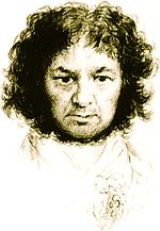
Francisco Goya

 
Francisco Goya

   Email Print
   Bookmark   Link


Francisco Goya


Francisco José de Goya y Lucientes (30 March 1746 – 16 April 1828) was a Spanish painter
Painting

Painting is the practice of applying paint, pigment, color or other medium to a surface . In art, the term describes both the act and the result, which is called a painting....
 and printmaker
Printmaking

Printmaking is the process of making artworks by printing, normally on paper. Except in the case of monotyping, the process is capable of producing multiples of the same piece, which is called a 'print....
. Goya was a court painter to the Spanish Crown and a chronicler of history. He has been regarded both as the last of the Old Master
Old Master

"Old Master" is a term for a European painting of skill who worked before about 1800, or a painting by such a painter. An "old master print" is an original printmaking made by an artist in the same period....
s and as the first of the moderns. The subversive and subjective element in his art, as well as his bold handling of paint, provided a model for the work of later generations of artists, notably Manet
Édouard Manet

?douard Manet , 23 January 1832 – 30 April 1883, was a French Painting. One of the first nineteenth century artists to approach modern-life subjects, he was a pivotal figure in the transition from realism to Impressionism....
 and Picasso
Pablo Picasso

Pablo Diego Jos? Francisco de Paula Juan Nepomuceno Mar?a de los Remedios Cipriano de la Sant?sima Trinidad Ruiz y Picasso was a Spanish people Painting, drawing, and Sculpture....
.

was born in Fuendetodos, Spain
Fuendetodos, Spain

Fuendetodos is a small town in Aragon, located about 44 kilometers south-east of Zaragoza. It has a population of approximately 170, yet has nearly 25,000 visitors each year....
, in the kingdom of Aragón
Aragon

Aragon is an autonomous communities of Spain of Spain. Located in northeastern Spain, the region comprises three provinces of Spain from north to south: Huesca , Zaragoza , and Teruel ....
 in 1746 to José Benito de Goya y Franque and Gracia de Lucientes y Salvador.


Discussion
Ask a question about 'Francisco Goya'
Start a new discussion about 'Francisco Goya'
Answer questions from other users
Full Discussion Forum


Quotations


Fantasy, abandoned by reason, produces impossible monsters; united with it, she is the mother of the arts and the origin of marvels.

I have three masters: Nature, Velazquez and Rembrandt.

Imagination abandoned by reason produces impossible monsters;united with it,she is the mother of the arts and the source of its marvels.


Encyclopedia


Francisco José de Goya y Lucientes (30 March 1746 – 16 April 1828) was a Spanish painter
Painting

Painting is the practice of applying paint, pigment, color or other medium to a surface . In art, the term describes both the act and the result, which is called a painting....
 and printmaker
Printmaking

Printmaking is the process of making artworks by printing, normally on paper. Except in the case of monotyping, the process is capable of producing multiples of the same piece, which is called a 'print....
. Goya was a court painter to the Spanish Crown and a chronicler of history. He has been regarded both as the last of the Old Master
Old Master

"Old Master" is a term for a European painting of skill who worked before about 1800, or a painting by such a painter. An "old master print" is an original printmaking made by an artist in the same period....
s and as the first of the moderns. The subversive and subjective element in his art, as well as his bold handling of paint, provided a model for the work of later generations of artists, notably Manet
Édouard Manet

?douard Manet , 23 January 1832 – 30 April 1883, was a French Painting. One of the first nineteenth century artists to approach modern-life subjects, he was a pivotal figure in the transition from realism to Impressionism....
 and Picasso
Pablo Picasso

Pablo Diego Jos? Francisco de Paula Juan Nepomuceno Mar?a de los Remedios Cipriano de la Sant?sima Trinidad Ruiz y Picasso was a Spanish people Painting, drawing, and Sculpture....
.

Biography


Youth

Goya was born in Fuendetodos, Spain
Fuendetodos, Spain

Fuendetodos is a small town in Aragon, located about 44 kilometers south-east of Zaragoza. It has a population of approximately 170, yet has nearly 25,000 visitors each year....
, in the kingdom of Aragón
Aragon

Aragon is an autonomous communities of Spain of Spain. Located in northeastern Spain, the region comprises three provinces of Spain from north to south: Huesca , Zaragoza , and Teruel ....
 in 1746 to José Benito de Goya y Franque and Gracia de Lucientes y Salvador. He spent his childhood in Fuendetodos, where his family lived in a house bearing the family crest of his mother. His father earned his living as a gilder
Gilding

Gilding is the technique of applying a thin layer of gold to a surface. Gilding is performed through a mechanical process, known as leafing, or using one of many chemical processes....
. About 1749, the family bought a house in the city of Zaragoza
Zaragoza

Zaragoza, also called Saragossa in English language, is the capital city of the Zaragoza and of the Autonomous communities of Spain and former Kingdom of Aragon of Aragon, Spain....
 and some years later moved into it. Goya attended school at Escuelas Pias, where he formed a close friendship with Martin Zapater, and their correspondence over the years became valuable material for biographies of Goya. At age 14, he entered apprenticeship with the painter José Luzán.

He later moved to Madrid where he studied with Anton Raphael Mengs
Anton Raphael Mengs

Anton Raphael Mengs was an German painter, active in Rome, Madrid, and Saxony, who became one of the precursors to Neoclassicism painting....
, a painter who was popular with Spanish royalty. He clashed with his master, and his examinations were unsatisfactory. Goya submitted entries for the Royal Academy of Fine Art
Real Academia de Bellas Artes de San Fernando

The Real Academia de Bellas Artes de San Fernando, located on the Calle de Alcal? in the heart of Madrid, currently functions as a museum and gallery....
 in 1763 and 1766, but was denied entrance.

He then journeyed to Rome, where in 1771 he won second prize in a painting competition organized by the City of Parma
Parma

Parma is a city in the Italian region of Emilia-Romagna famous for its architecture and the fine countryside around it. It is the home of the University of Parma, one of the oldest universities in the world....
. Later that year, he returned to Zaragoza and painted a part of the cupola of the Basilica of the Pillar
Basilica of Our Lady of the Pillar

The Basilica-Cathedral of Our Lady of the Pillar is a Roman Catholic church in the city of Zaragoza, Aragon in Spain. The Basilica venerates Mary the mother of Jesus, under her title Pilar praised as Mother of the Hispanic Peoples by Pope John Paul II....
, frescoes of the oratory of the cloisters of Aula Dei, and the frescoes of the Sobradiel Palace. He studied with Francisco Bayeu y Subías
Francisco Bayeu y Subías

Francisco Bayeu y Subias was a Spain Painting, active in a Neoclassicism style, whose main subjects were religious and historical themes.Born in Zaragoza, he received a broad childhood education....
 and his painting began to show signs of the delicate tonalities for which he became famous.
Francisco De Goya Y Lucientes 023

Maturity and success

Goya married Bayeu's sister Josefa
Josefa Bayeu

Josefa Bayeu was the sister of artist Francisco Bayeu and wife of artist Francisco Goya. The artworks below are by Goya....
 in July 25, 1773. His marriage to Josefa (he nicknamed her "Pepa"), and Francisco Bayeu's membership of the Royal Academy of Fine Art
Real Academia de Bellas Artes de San Fernando

The Real Academia de Bellas Artes de San Fernando, located on the Calle de Alcal? in the heart of Madrid, currently functions as a museum and gallery....
 (from the year 1765) helped him to procure work with the Royal Tapestry Workshop. There, over the course of five years, he designed some 42 patterns, many of which were used to decorate (and insulate) the bare stone walls of El Escorial
El Escorial

El Escorial is an historical residence of the king of Spain. It is one of the Spanish royal sites and functions as a monastery, royal palace, museum and school....
 and the Palacio Real de El Pardo, the newly built residences of the Spanish monarchs. This brought his artistic talents to the attention of the Spanish monarchs who later would give him access to the royal court. He also painted a canvas for the altar of the Church of San Francisco El Grande, which led to his appointment as a member of the Royal Academy of Fine Art
Real Academia de Bellas Artes de San Fernando

The Real Academia de Bellas Artes de San Fernando, located on the Calle de Alcal? in the heart of Madrid, currently functions as a museum and gallery....
.

In 1783, the Count of Floridablanca
José Moñino y Redondo, conde de Floridablanca

Don Jos? Mo?ino y Redondo, Count of Floridablanca , Spain statesman. He was the Reform movement chief minister of King Charles III of Spain, and also served briefly under Charles IV of Spain....
, a favorite of King Carlos III
Charles III of Spain

Charles III was list of Spanish monarchs 1759?88 , King of Kingdom of Naples and Kingdom of Sicily 1735?59 , and Duchy of Parma 1732?35 . He was a proponent of enlightened absolutism....
, commissioned him to paint his portrait. He also became friends with Crown Prince Don Luis, and lived in his house. His circle of patrons grew to include the Duke and Duchess of Osuna, whom he painted, the King and other notable people of the kingdom.

After the death of Charles III in 1788 and revolution in France in 1789, during the reign of Charles IV
Charles IV of Spain

Charles IV was list of Spanish monarchs from December 14, 1788 until his abdication on March 19, 1808....
, Goya reached his peak of popularity with royalty.

Caprichos

After contracting cholera and a high fever in 1792 Goya was left deaf, and he became withdrawn and introspective. During the five years he spent recuperating, he read a great deal about the French Revolution and its philosophy. The bitter series of aquatint
Aquatint

Aquatint is an intaglio printmaking technique, a variant of etching.Intaglio printmaking makes marks on the matrix that are capable of holding ink....
ed etching
Etching

Etching is the process of using strong acid or mordant to cut into the unprotected parts of a metal surface to create a design in intaglio in the metal ....
s that resulted were published in 1799 under the title Caprichos. The dark visions depicted in these prints are partly explained by his caption, "The sleep of reason produces monsters". Yet these are not solely bleak in nature and demonstrate the artist's sharp satirical wit, particularly evident in etchings such as Hunting for Teeth. Additionally, one can discern a thread of the macabre running through Goya's work, even in his earlier tapestry cartoons.

Francisco De Goya Y Lucientes 054

Painter of royalty

In 1786 Goya was appointed painter to Charles III, and in 1789 was made court painter to Charles IV. In 1799 he was appointed First Court Painter with a salary of 50,000 reales and 500 ducats for a coach. He worked on the cupola of the Hermitage of San Antonio de la Florida; he painted the King and the Queen, royal family pictures, portraits of the Prince of the Peace
Manuel de Godoy

Manuel de Godoy y ?lvarez de Faria , was Prime Minister of Spain from 1792 to 1797 and from 1801 to 1808. He received many titles including Prince of the Peace by which he is widely known....
 and many other nobles. His portraits are notable for their disinclination to flatter, and in the case of The Family of Charles IV, the lack of visual diplomacy is remarkable.

Goya received orders from many friends within the Spanish nobility
Spanish nobility

The Spanish nobility are the persons who possess the legal status of nobility, and the system of titles and honours of Spain and of the former kingdoms that constitute it....
. Among those from whom he procured portrait commissions were Pedro de Álcantara Téllez-Girón, 9th Duke of Osuna
Pedro de Álcantara Téllez-Girón, 9th Duke of Osuna

Don Pedro de ?lcantara T?llez-Gir?n y Pacheco, , 9th Duke of Osuna since April 1787, when his father, the 8 Duke, Pedro Zoilo T?llez Gir?n y de Guzm?n , , died was a co-founder of a society for the promotion of national cultural consciousness, known as Sociedad Econ?mica de Amigos del Pa?s, ....
 and his wife María Josefa de la Soledad, 9th Duchess of Osuna
María Josefa de la Soledad, 9th Duchess of Osuna

Do?a Mar?a Josefa Alonso Pimentel de la Soledad, 9th Duchess of Osuna , was a Patronage of artists, writers and scientists. She was born as Countess of Benavente and married Pedro de ?lcantara T?llez-Gir?n, 9th Duke of Osuna in 1771....
, María del Pilar Teresa Cayetana de Silva Alvarez de Toledo, 13th Duchess of Alba (universally known simply as the "Duchess of Alba"), and her husband José Alvarez de Toledo y Gonzaga, 13th Duke of Alba
José Álvarez de Toledo y Gonzaga, 13th Duke of Alba

Don Jos? Mar?a Alvarez de Toledo y Gonzaga, 15th Duke of Medina-Sidonia and 11th Marquis of Villafranca was a patron of the artist Francisco Goya....
, and María Ana de Pontejos y Sandoval, Marchioness of Pontejos.

Later years


As French forces invaded Spain during the Peninsular War
Peninsular War

The Peninsular War or Spanish War of Independence was a contest between First French Empire and the allied powers of Spain, the United Kingdom of Great Britain and Ireland, and Kingdom of Portugal for control of the Iberian Peninsula during the Napoleonic Wars....
 (1808–1814), the new Spanish court received him as had its predecessors.

When Josefa died in 1812, Goya was painting The Charge of the Mamelukes and The Third of May 1808, and preparing the series of prints known as The Disasters of War (Los desastres de la guerra).

King Ferdinand VII came back to Spain but relations with Goya were not cordial. In 1814 Goya was living with his housekeeper Doña Leocadia and her illegitimate daughter, Rosario Weiss
Rosario Weiss

Maria del Rosario Weiss was a student and possibly a daughter of Francisco de Goya. She was officially a daughter of don Isidore Weiss and Dona Leocadia Zorrilla, the latter - a housekeeper in the house of Goya and his lover since the death of the painter's wife Josefa Bayeu in 1812....
; the young woman studied painting with Goya, who may have been her father. . He continued to work incessantly on portraits, pictures of Santa Justa and Santa Rufina, lithographs, pictures of tauromachy, and more. With the idea of isolating himself, he bought a house near Manzanares, which was known as the Quinta del Sordo (roughly, "House of the Deaf Man", titled after its previous owner and not Goya himself). There he made the Black Paintings
Black Paintings

The Black Paintings are a group of paintings by Francisco Goya created in the later years of his life that portray intense, haunting themes....
.

Goya left Spain in May 1824 for Bordeaux, where he settled, and Paris. He returned to Spain in 1826, but despite a warm welcome, he returned to Bordeaux in ill health where he died in 1828 at the age of 82.

Works

Goya painted the Spanish royal family, which included Charles IV of Spain
Charles IV of Spain

Charles IV was list of Spanish monarchs from December 14, 1788 until his abdication on March 19, 1808....
 and Ferdinand VII
Ferdinand VII of Spain

Ferdinand VII was list of Spanish monarchs twice, in 1808, and from 1813 to 1833 . He was also known as 'Ferdinand, the desired'.The eldest surviving son of Charles IV of Spain, king of Spain, and of his wife Maria Louisa of Parma, he was born in the vast palace of El Escorial near Madrid....
. His themes range from merry festivals for tapestry
Tapestry

Tapestry is a form of textile art. It is Weaving by hand on a vertical loom. It is weft-faced weaving, in which all the warp threads are hidden in the completed work, unlike cloth weaving where both the warp and the weft threads may be visible....
, draft cartoons, to scenes of war and corpses. This evolution reflects the darkening of his temper. Modern physicians suspect that the lead in his pigments poisoned him and caused his deafness
Post-lingual hearing impairment

Post-lingual hearing impairment is a hearing impairment where hearing loss is adventitious and develops due to disease or Physical trauma after the acquisition of speech and language, usually after the age of six....
 since 1792. Near the end of his life, he became reclusive and produced frightening and obscure paintings of insanity, madness, and fantasy. The style of these Black Paintings
Black Paintings

The Black Paintings are a group of paintings by Francisco Goya created in the later years of his life that portray intense, haunting themes....
 prefigure the expressionist
Expressionism

Expressionism is the tendency of an artist to distort reality for an emotional effect; it is a subjective art form. Expressionism is exhibited in many art forms, including painting, literature, theatre, film, Expressionist architecture and Expressionism ....
 movement. He often painted himself into the foreground.

The Maja


Two of Goya's best known paintings are The Nude Maja (La maja desnuda)
La Maja Desnuda

La maja desnuda in English The Naked Majo, is an oil painting painting by the Spain painter, Francisco de Goya, that portrays a nude woman reclining on a bed of pillows....
 and The Clothed Maja (La maja vestida
La Maja Vestida

La maja vestida is a painting by Spain Painting Francisco de Goya between 1798 and 1805. It is a clothed version of La maja desnuda and is exhibited next to it in the same room at the Prado Museum in Madrid....
). They depict the same woman in the same pose, naked and clothed, respectively. He painted La maja vestida after outrage in Spanish society over the previous Desnuda. Without a pretense to allegorical or mythological meaning, the painting was "the first totally profane life-size female nude in Western art". He refused to paint clothes on her, and instead created a new painting.

The identity of the Majas is uncertain. The most popularly cited subjects are the Duchess of Alba, with whom Goya is thought to have had an affair, and the mistress of Manuel de Godoy
Manuel de Godoy

Manuel de Godoy y ?lvarez de Faria , was Prime Minister of Spain from 1792 to 1797 and from 1801 to 1808. He received many titles including Prince of the Peace by which he is widely known....
, who subsequently owned the paintings. Neither theory has been verified, and it remains as likely that the paintings represent an idealized composite. In 1808 all Godoy's property was seized by Ferdinand VII after his fall from power and exile, and in 1813 the Inquisition
Inquisition

The term Inquisition can refer to any one of several institutions charged with trying and convicting Christian heresy within the Roman Catholic Church....
 confiscated both works as 'obscene', returning them in 1836.

Darker realms

In a period of convalescence during 1793–1794, Goya completed a set of eleven small pictures painted on tin; the pictures known as Fantasy and Invention mark a significant change in his art. These paintings no longer represent the world of popular carnival, but rather a dark, dramatic realm of fantasy and nightmare. Courtyard with Lunatics is a horrifying and imaginary vision of loneliness, fear and social alienation, a departure from the rather more superficial treatment of mental illness in the works of earlier artists such as Hogarth
William Hogarth

William Hogarth was a major England painting, Printmaking, pictorial satire, Social criticism and editorial cartoonist who has been credited with pioneering western sequential art....
. In this painting, the ground, sealed by masonry blocks and iron gate, is occupied by patients and a single warden. The patients are variously staring, sitting, posturing, wrestling, grimacing or disciplining themselves. The top of the picture vanishes with sunlight, emphasizing the nightmarish scene below.

This picture can be read as an indictment of the widespread punitive treatment of the insane, who were confined with criminals, put in iron manacles, and subjected to physical punishment. And this intention is to be taken into consideration since one of the essential goals of the enlightenment was to reform the prisons and asylums, a subject common in the writings of Voltaire
Voltaire

Fran?ois-Marie Arouet , better known by the pen name Voltaire, was a French Age of Enlightenment writer, essayist, and philosophy known for his wit, philosophical sport, and defense of civil liberty, including freedom of religion and free trade....
 and others. The condemnation of brutality towards prisoners (whether they were criminals or insane) was the subject of many of Goya’s later paintings.

As he completed this painting, Goya was himself undergoing a physical and mental breakdown. It was a few weeks after the French declaration of war on Spain, and Goya’s illness was developing. A contemporary reported, “the noises in his head and deafness aren’t improving, yet his vision is much better and he is back in control of his balance.” His symptoms may indicate a prolonged viral encephalitis or possibly a series of miniature strokes resulting from high blood pressure and affecting hearing and balance centers in the brain. The triad of tinnitus, episodes of imbalance and progressive deafness is also typical of Meniere's Syndrome. Other postmortem diagnostic assessment points toward paranoid dementia due to unknown brain trauma (perhaps due to the unknown illness which he reported). If this is the case, from here on - we see an insidious assault of his faculties, manifesting as paranoid features in his paintings, culminating in his black paintings and especially Saturn Devouring His Sons.

In 1799 Goya published a series of 80 prints titled Caprichos depicting what he called

In The Third of May, 1808: The Execution of the Defenders of Madrid, Goya attempted to "perpetuate by the means of his brush the most notable and heroic actions of our glorious insurrection against the Tyrant of Europe" The painting does not show an incident that Goya witnessed; rather it was meant as more abstract commentary.

Black Paintings and The Disasters

In later life Goya bought a house, called Quinta del Sordo ("Deaf Man's House"), and painted many unusual paintings on canvas and on the walls, including references to witchcraft and war. One of these is the famous work Saturn Devouring His Sons
Saturn Devouring His Son

Saturn Devouring His Son is the name given to a painting by Spanish artist Francisco Goya. It depicts the Greek mythology of Cronus , who, fearing that his children would supplant him, filicide upon their birth....
 (known informally in some circles as Devoration or Saturn Eats His Child), which displays a Greco-Roman
Classical mythology

The terms "classical mythology" and "Greco-Roman mythology" usually refer to the mythology, and the associated polytheism rituals and practices, of Classical Antiquity....
 mythological scene of the god Saturn
Saturn (mythology)

Saturn was a major Roman mythology god of agriculture and harvest. In medieval times he was known as the Roman god of agriculture, justice and strength; he held a sickle in his left hand and a bundle of wheat in his right....
 consuming a child, possibly a reference to Spain's ongoing civil conflicts. Moreover, the painting has been seen as "the most essential to our understanding of the human condition in modern times, just as Michelangelo
Michelangelo

Michelangelo di Lodovico Buonarroti Simoni , commonly known as Michelangelo, was an Italian Renaissance Painting, sculptor, architect, poet, and engineer....
's Sistine
Sistine Chapel ceiling

The Sistine Chapel ceiling, painted by Michelangelo between 1508 and 1512, is one of the most renowned artworks of the Renaissance painting. The ceiling is that of the large Sistine Chapel built within the Vatican City by Pope Sixtus IV, begun in 1477 and finished by 1480....
 ceiling is essential to understanding the tenor of the 16th century"
.

This painting is one of 14 in a series known as the Black Paintings
Black Paintings

The Black Paintings are a group of paintings by Francisco Goya created in the later years of his life that portray intense, haunting themes....
. After his death the wall paintings were transferred to canvas and remain some of the best examples of the later period of Goya's life when, deafened and driven half-mad by what was probably an encephalitis
Encephalitis

Not to be confused with syphilis, although that can cause encephalitis as well.Encephalitis is an Acute inflammation of the brain.Encephalitis with meningitis is known as meningoencephalitis....
 of some kind, he decided to free himself from painterly strictures of the time and paint whatever nightmarish visions came to him. Many of these works are in the Prado museum in Madrid
Madrid

Madrid is the Capital and largest city of Spain. It is the Largest cities of the European Union by population within city limits in the European Union after Greater London and Berlin, and its Madrid metropolitan area is the Largest urban areas of the European Union in the European Union after Paris aire urbaine, Greater London Urban Area, a...
.

In the 1810s, Goya created a set of aquatint prints titled The Disasters of War (Los desastres de la guerra) which depict scenes from the Peninsular War
Peninsular War

The Peninsular War or Spanish War of Independence was a contest between First French Empire and the allied powers of Spain, the United Kingdom of Great Britain and Ireland, and Kingdom of Portugal for control of the Iberian Peninsula during the Napoleonic Wars....
. The scenes are singularly disturbing, sometimes macabre in their depiction of battlefield horror, and represent an outraged conscience in the face of death and destruction. The prints were not published until 1863, 35 years after Goya's death.

Questions of authenticity

Goyabordeaux
The findings of research published since 2003 have raised questions regarding the authenticity of some of Goya's late works. One study claims that the Black Paintings were applied to walls that did not exist in Goya's home before he left for France. In 2008 the Prado Museum reverted the traditional attribution of The Colossus
The Colossus (Goya)

The Colossus is a painting that was at one time attributed to Francisco de Goya, but which is now believed to have been painted by his apprentice Asensio Juli?....
, and expressed doubts over the authenticity of three other paintings attributed to Goya as well. On January 27, 2009, the Prado announced they had come to the conclusion that The Colossus was painted by one of Goya's apprentices and even bore the signature of the painter. Doubts over its authenticity began in 1992 when the painting was cleaned and the curators of the museum noticed that the technique was much poorer than Goya's other masterpieces.

Cinema, drama and opera

Enrique Granados
Enrique Granados

Pantal?on Enrique Costanzo Granados y Campi?a was a Spain Catalonia pianist and composer of european classical music. His music is in a uniquely Spanish style and, as such, representative of musical nationalism....
 composed a piano suite (1911) and later an opera
Opera

Opera is an Performing arts in which singers and musicians perform a dramatic work which combines a text and a musical score. Opera is part of the Western classical music tradition....
 (1916), both called Goyescas
Goyescas

Goyescas is a piano suite written in 1911 in music by Spanish composer Enrique Granados. This piano suite is usually considered Granados's crowning creation and was inspired by the paintings of Francisco Goya, although the piano pieces have not been authoratively associated with any particular paintings....
, inspired by the artist's paintings. Gian Carlo Menotti
Gian Carlo Menotti

Gian Carlo Menotti was an Italy composer and libretto. Although he often referred to himself as an American composer, he kept his Italian citizenship....
 wrote a biographical opera about him titled Goya (1986), commissioned by Plácido Domingo
Plácido Domingo

Jos? Pl?cido Domingo Embil Order of the British Empire , better known as Pl?cido Domingo, is a Spanish tenor, known for his versatile and strong voice, possessing a ringing and dramatic tone throughout its range....
, who created the role; this production has been presented on television
Television

Television is a widely used telecommunication mass-media for transmitting and receiving moving , either monochrome or color, usually accompanied by sound....
. Goya also inspired Michael Nyman
Michael Nyman

Michael Laurence Nyman, Order of the British Empire is an England composer of minimalist music, pianist, libretto and musicologist, perhaps best known for the many movie soundtrack he wrote during his lengthy collaboration with the film director Peter Greenaway, and his multi-platinum The Piano to Jane Campion's The Piano....
's opera Facing Goya
Facing Goya

Facing Goya is a 2000 in music opera in four acts by Michael Nyman on a libretto by Victoria Hardie. It is an expansion of their one-act opera called Vital Statistics from 1987, dealing with such subjects as physiognomy and its practitioners, and also incorporates a musical motif from Nyman's art song, "The Kiss and Other Movem...
 (2000). Goya is the central character in Clive Barker
Clive Barker

Clive Barker is an England author, film director and visual artist best known for his work in both metaphysical fantasy and horror fiction.Barker came to prominence in the mid-1980s with a series of short stories which established him as a leading young horror writer....
's play Colossus (1995).

Several films portray Goya's life. These include a short film, Goya (1948), The Naked Maja
The Naked Maja

The Naked Maja is a Italy-France-USA co-production made by S.G.C., Titanus Films and United Artists. This historical film biographical film of the painter Francisco Goya was directed by Henry Koster and produced by Silvio Clementelli and Goffredo Lombardo....
 (1958), Goya, Historia de una Soledad (1971), Goya in Bordeaux (1999), Volavérunt (1999), Goya : Awakened in a Dream (1999), and Goya's Ghosts
Goya's Ghosts

Goya's Ghosts is a 2006 in film Spanish film directed by Milo? Forman, and produced by Xuxa Producciones and by Saul Zaentz, and written by Milo? Forman and Jean-Claude Carri?re....
 (2006).

In 1988 American musical theatre
Musical theatre

Musical theatre is a form of theatre combining music, songs, spoken dialogue and dance. The emotional content of the piece ? humor, pathos, love, anger ? as well as the story itself, is communicated through the words, music, movement and technical aspects of the entertainment as an integrated whole....
 composer Maury Yeston
Maury Yeston

Maury Yeston is an United States composer, lyricist, educator and musicologist.He is best known for writing the music and lyrics to Broadway theatre musical theatre, including Nine in 1982, and Titanic in 1997, both of which won Tony Awards for best musical and best score....
 released a studio cast album of his own musical, Goya: A Life In Song
Goya: A Life In Song

Goya: A Life in Song is a musical theatre work with music and lyrics by American composer Maury Yeston originally released in 1988 as a concept album....
, in which Plácido Domingo again starred as Goya.

See also

  • List of works by Francisco Goya
    List of works by Francisco Goya

    The following is a list of all of Francisco Goya's works. Besides the blue linked articles, many images can be found in the Wikipedia commons:Goya....
  • History of painting
    History of painting

    The history of painting reaches back in time to artifacts from pre-historic humans, and spans all cultures, that represents a continuous, though disrupted, tradition from Antiquity....
  • Western painting
    Western painting

    The history of Western painting represents a continuous, though disrupted, tradition from classical antiquity. Until the mid 19th century it was primarily concerned with Representational art and Classical antiquity modes of production, after which time more Modern art, Abstract art and Conceptual art forms gained favor....


Sources

  • John J. Ciofalo, The Self-Portraits of Francisco Goya. Cambridge University Press, 2001
  • Goya (a biographical novel) by Lion Feuchtwanger
    Lion Feuchtwanger

    Lion Feuchtwanger was a Germany-Jewish novelist and playwright....
      ISBN 84-7640-883-8
  • Goya by Robert Hughes, 2003, ISBN 1-84343-054-1
  • Goya images, biography and resources


External links

General
  • 164 works by Francisco de Goya


Deafness
  • Goya's Deafness in Art History


Biographies


Works
  • , a Claremont Colleges Digital Library collection from the Pomona College
    Pomona College

    Pomona College is a private university residential college Liberal arts colleges in the United States located in Claremont, California. It has ranked in the top ten of liberal arts colleges nationally according to the U.S....
     Museum of Art


Articles and essays
  • The Sleep of Reason
  • on the Goya's "Don't forget the happiness of Goya!" exhibition in Berlin