
The
Minoan civilization was a
Bronze AgeThe Bronze Age is a period characterized by the use of copper and its alloy bronze as the chief hard materials in the manufacture of some implements and weapons. Chronologically, it stands between the Stone Age and Iron Age...
civilization that arose on the island of
CreteCrete is the largest and most populous of the Greek islands, the fifth largest island in the Mediterranean Sea, and one of the thirteen administrative regions of Greece. It forms a significant part of the economy and cultural heritage of Greece while retaining its own local cultural traits...
and flourished from approximately the 27th century BC to the 15th century BC. It was rediscovered at the beginning of the 20th century through the work of the British archaeologist
Arthur EvansSir Arthur John Evans FRS was a British archaeologist most famous for unearthing the palace of Knossos on the Greek island of Crete and for developing the concept of Minoan civilization from the structures and artifacts found there and elsewhere throughout eastern Mediterranean...
.
Will DurantWilliam James Durant was a prolific American writer, historian, and philosopher. He is best known for The Story of Civilization, 11 volumes written in collaboration with his wife Ariel Durant and published between 1935 and 1975...
referred to it as "the first link in the European chain." The early inhabitants of Crete settled as early as 128,000 BC, during the
Middle PaleolithicThe Middle Paleolithic is the second subdivision of the Paleolithic or Old Stone Age as it is understood in Europe, Africa and Asia. The term Middle Stone Age is used as an equivalent or a synonym for the Middle Paleolithic in African archeology. The Middle Paleolithic and the Middle Stone Age...
age. However, it was not until 5000 BC that the first signs of advanced agriculture appeared.
Overview
What the Minoans called themselves is unknown. The term "Minoan" was coined by
Arthur EvansSir Arthur John Evans FRS was a British archaeologist most famous for unearthing the palace of Knossos on the Greek island of Crete and for developing the concept of Minoan civilization from the structures and artifacts found there and elsewhere throughout eastern Mediterranean...
after the mythic
"king" MinosIn Greek mythology, Minos was a king of Crete, son of Zeus and Europa. Every year he made King Aegeus pick seven men and seven women to go to Daedalus' creation, the labyrinth, to be eaten by The Minotaur. After his death, Minos became a judge of the dead in Hades. The Minoan civilization of Crete...
. Minos was associated in
Greek mythGreek mythology is the body of myths and legends belonging to the ancient Greeks, concerning their gods and heroes, the nature of the world, and the origins and significance of their own cult and ritual practices. They were a part of religion in ancient Greece...
with the
labyrinthIn Greek mythology, the Labyrinth was an elaborate structure designed and built by the legendary artificer Daedalus for King Minos of Crete at Knossos...
, which Evans identified with the site at
KnossosKnossos , also known as Labyrinth, or Knossos Palace, is the largest Bronze Age archaeological site on Crete and probably the ceremonial and political centre of the Minoan civilization and culture. The palace appears as a maze of workrooms, living spaces, and store rooms close to a central square...
. It has sometimes been argued that the
EgyptianAncient Egypt was an ancient civilization of Northeastern Africa, concentrated along the lower reaches of the Nile River in what is now the modern country of Egypt. Egyptian civilization coalesced around 3150 BC with the political unification of Upper and Lower Egypt under the first pharaoh...
place name "Keftiu" (*Káftiu
kftiw) and the
SemiticIn linguistics and ethnology, Semitic was first used to refer to a language family of largely Middle Eastern origin, now called the Semitic languages...
"Kaftor" or "
CaphtorCaphtor is a locality mentioned in the Bible and related literature. The people of Caphtor are called Caphtorites and are named as a division of the ancient Egyptians. Caphtor is also mentioned in ancient inscriptions from Egypt, Mari and Ugarit. Traditional Hebrew sources place Caphtor in the...
" and "Kaptara" in the
MariMari was an ancient Sumerian and Amorite city, located 11 kilometers north-west of the modern town of Abu Kamal on the western bank of Euphrates river, some 120 km southeast of Deir ez-Zor, Syria...
archives refer to the island of Crete; "On the other hand some acknowledged facts about Caphtor/Keftiu can only with difficulty be reconciled with Crete," observes John Strange. In the
OdysseyThe Odyssey is one of two major ancient Greek epic poems attributed to Homer. It is, in part, a sequel to the Iliad, the other work ascribed to Homer. The poem is fundamental to the modern Western canon, and is the second—the Iliad being the first—extant work of Western literature...
, composed centuries after the destruction of the Minoan civilization,
HomerIn the Western classical tradition Homer , is the author of the Iliad and the Odyssey, and is revered as the greatest ancient Greek epic poet. These epics lie at the beginning of the Western canon of literature, and have had an enormous influence on the history of literature.When he lived is...
calls the natives of Crete
EteocretansThe Minoan language was spoken in ancient Crete before it was replaced with the language of the mainland; the relationship between Minoan and Greek is unknown. While attempts have been made to connect it to other languages, Minoan must be considered unclassified until a linguistic affiliation can...
("true Cretans"); these may have been descendants of the Minoans.
Minoan
palaceA palace is a grand residence, especially a royal residence or the home of a head of state or some other high-ranking dignitary, such as a bishop or archbishop. The word itself is derived from the Latin name Palātium, for Palatine Hill, one of the seven hills in Rome. In many parts of Europe, the...
s (anaktora) are the best known building types to have been excavated on the island. They are monumental buildings serving administrative purposes as evidenced by the large
archiveAn archive is a collection of historical records, or the physical place they are located. Archives contain primary source documents that have accumulated over the course of an individual or organization's lifetime, and are kept to show the function of an organization...
s unearthed by archaeologists. Each of the palaces excavated to date has its own unique features, but they also share features which set them apart from other structures. The palaces were often multi-storied, with interior and exterior staircases, light wells, massive
columnA column or pillar in architecture and structural engineering is a vertical structural element that transmits, through compression, the weight of the structure above to other structural elements below. For the purpose of wind or earthquake engineering, columns may be designed to resist lateral forces...
s, storage magazines and courtyards.
It seems that the Minoan people were not
Indo-EuropeanThe Proto-Indo-Europeans were the speakers of the Proto-Indo-European language , a reconstructed prehistoric language of Eurasia.Knowledge of them comes chiefly from the linguistic reconstruction, along with material evidence from archaeology and archaeogenetics...
, and that they were even related to the pre-Greek dwellers of the Greek mainland and Western
AnatoliaAnatolia is a geographic and historical term denoting the westernmost protrusion of Asia, comprising the majority of the Republic of Turkey...
, the so-called
PelasgiansThe name Pelasgians was used by some ancient Greek writers to refer to populations that were either the ancestors of the Greeks or who preceded the Greeks in Greece, "a hold-all term for any ancient, primitive and presumably indigenous people in the Greek world." In general, "Pelasgian" has come...
. However the Minoan civilization was much more advanced and sophisticated than the contemporary Helladic civilization during the bronze-age. The Minoan script (
Linear ALinear A is one of two scripts used in ancient Crete before Mycenaean Greek Linear B; Cretan hieroglyphs is the second script. In Minoan times, before the Mycenaean Greek dominion, Linear A was the official script for the palaces and religious activities, and hieroglyphs were mainly used on seals....
) has not yet been deciphered, but it seems that it represented an
AegeanTyrsenian , named after the Tyrrhenians , is a closely related ancient language family proposed by Helmut Rix , that consists of the extinct Etruscan language of central Italy, the extinct Raetic language of the Alps, and the extinct Lemnian language of the Aegean Sea.-The...
language, unrelated to any Indo-European language. From the neolithic ages
CreteCrete is the largest and most populous of the Greek islands, the fifth largest island in the Mediterranean Sea, and one of the thirteen administrative regions of Greece. It forms a significant part of the economy and cultural heritage of Greece while retaining its own local cultural traits...
stood in the middle of two cultural-streams leading to the west: The forward-Asiatic and the north-African cultural streams. It seems that for many centuries Minoan Crete remained free from any invaders and managed to develop a distinct self-based civilization which was probably the most advanced in the Mediterannean area during the bronze-age.
Chronology and history
Rather than associate absolute calendar dates for the Minoan period, archaeologists use two systems of
relative chronologyChronology is the science of arranging events in their order of occurrence in time, such as the use of a timeline or sequence of events. It is also "the determination of the actual temporal sequence of past events".Chronology is part of periodization...
. The first, created by Evans and modified by later archaeologists, is based on
potteryPottery is the material from which the potteryware is made, of which major types include earthenware, stoneware and porcelain. The place where such wares are made is also called a pottery . Pottery also refers to the art or craft of the potter or the manufacture of pottery...
styles. It divides the Minoan period into three main eras—Early Minoan (EM), Middle Minoan (MM), and Late Minoan (LM). These eras are further subdivided, e.g. Early Minoan I, II, III (EMI, EMII, EMIII). Another dating system, proposed by the Greek archaeologist Nicolas Platon, is based on the development of the architectural complexes known as "palaces" at
KnossosKnossos , also known as Labyrinth, or Knossos Palace, is the largest Bronze Age archaeological site on Crete and probably the ceremonial and political centre of the Minoan civilization and culture. The palace appears as a maze of workrooms, living spaces, and store rooms close to a central square...
,
PhaistosPhaistos , also transliterated as Phaestos, Festos and Phaestus is an ancient city on the island of Crete. Phaistos was located in the south-central portion of the island, about 5.6 kilometres from the Mediterranean Sea. It was inhabited from about 4000 BC. A palace, dating from the Middle Bronze...
,
MaliaMalia could refer to:Places* Malia, Cyprus, a village in Limassol district of southern Cyprus* Malia, Crete, a town on the north coast of Crete, in Greece* Malia Vgethi, a volcano in the northeast Peloponnese, near the village of Kameni Chora, Greece...
, and Kato Zakros, and divides the Minoan period into Prepalatial, Protopalatial, Neopalatial, and Post-palatial periods. The relationship among these systems is given in the accompanying table, with approximate calendar dates drawn from Warren and Hankey (1989).
The
Thera eruptionThe Minoan eruption of Thera, also referred to as the Thera eruption or Santorini eruption, was a major catastrophic volcanic eruption with a Volcanic Explosivity Index of 6 or 7 and a Dense-rock equivalent of , which is estimated to have occurred in the mid second millennium BCE. The eruption...
occurred during a mature phase of the LM IA period. The calendar date of the volcanic eruption is extremely controversial.
Radiocarbon datingRadiocarbon dating is a radiometric dating method that uses the naturally occurring radioisotope carbon-14 to estimate the age of carbon-bearing materials up to about 58,000 to 62,000 years. Raw, i.e. uncalibrated, radiocarbon ages are usually reported in radiocarbon years "Before Present" ,...
has indicated a date in the late 17th century BC; those radiocarbon dates, however, conflict with the estimates of archaeologists who synchronize the eruption with the
Conventional Egyptian chronologyThe Conventional Egyptian chronology represents the scholarly consensus on the chronology of the rulers of ancient Egypt, taking into account well accepted developments during the 20th century but not including any of the major revision proposals that have also been made in that time.All dates are...
and obtain a date of around 1525-1500 BC. See the article on dating the Thera eruption for more discussion. The eruption is often identified as a natural, catastrophic event that lead to its rapid collapse.
History
| Minoan chronology |
| 3650-3000 BC |
EMI |
Prepalatial |
| 2900-2300 BC |
EMII |
| 2300-2160 BC |
EMIII |
| 2160-1900 BC |
MMIA |
| 1900-1800 BC |
MMIB |
Protopalatial (Old Palace Period) |
| 1800-1700 BC |
MMII |
| 1700-1640 BC |
MMIIIA |
Neopalatial (New Palace Period) |
| 1640-1600 BC |
MMIIIB |
| 1600-1480 BC |
LMIA |
| 1480-1425 BC |
LMIB |
| 1425-1390 BC |
LMII |
Postpalatial (At Knossos, Final Palace Period) |
| 1390-1370 BC |
LMIIIA1 |
| 1370-1340 BC |
LMIIIA2 |
| 1340-1190 BC |
LMIIIB |
| 1190-1170 BC |
LMIIIC |
| 1100 BC |
Subminoan |
The oldest evidence of inhabitants on Crete are preceramic
NeolithicThe Neolithic Age, Era, or Period, or New Stone Age, was a period in the development of human technology, beginning about 9500 BC in some parts of the Middle East, and later in other parts of the world. It is traditionally considered as the last part of the Stone Age...
farming community remains that date to approximately 7000 BC. A comparative study of DNA haplogroups of modern Cretan men showed that a male founder group from
AnatoliaAnatolia is a geographic and historical term denoting the westernmost protrusion of Asia, comprising the majority of the Republic of Turkey...
or the
LevantThe Levant or ) is the geographic region and culture zone of the "eastern Mediterranean littoral between Anatolia and Egypt" . The Levant includes most of modern Lebanon, Syria, Jordan, Israel, the Palestinian territories, and sometimes parts of Turkey and Iraq, and corresponds roughly to the...
, is shared with the Greeks. The neolithic population dwelt in open villages. On the shores, there were fishermen's huts, while the fertile
Mesara PlainThe Mesara or Messara Plain is an illuvial plain in southern Crete, stretching about 50 km west-to-east and 7 km north-to-south, making it the largest plain in Crete....
was used for agriculture.
The
Bronze AgeThe Bronze Age is a period characterized by the use of copper and its alloy bronze as the chief hard materials in the manufacture of some implements and weapons. Chronologically, it stands between the Stone Age and Iron Age...
began in
CreteCrete is the largest and most populous of the Greek islands, the fifth largest island in the Mediterranean Sea, and one of the thirteen administrative regions of Greece. It forms a significant part of the economy and cultural heritage of Greece while retaining its own local cultural traits...
around 2700 BC. In the late 3rd Millenium BC, several localities on the island developed into centers of commerce and handwork. This enabled the upper classes to continuously practice leadership activities and to expand their influence. It is likely that the original hierarchies of the local elites were replaced by monarchist power structures - a precondition for the creation of the great palaces. From the Early Bronze Age (3500 BC to 2600 BC), the Minoan civilization on Crete showed a promise of greatness.
At the end of the MMII period (1700 BC) there was a large disturbance in Crete, probably an earthquake, or possibly an invasion from
AnatoliaAnatolia is a geographic and historical term denoting the westernmost protrusion of Asia, comprising the majority of the Republic of Turkey...
. The palaces at Knossos, Phaistos, Malia, and Kato Zakros were destroyed. But with the start of the Neopalatial period, population increased again, the palaces were rebuilt on a larger scale and new settlements were built all over the island. This period (the 17th and 16th centuries BC, MM III / Neopalatial) represents the apex of the Minoan civilization. There was another natural catastrophe around 1600 BC, possibly an eruption of the
Thera volcanoThe Minoan eruption of Thera, also referred to as the Thera eruption or Santorini eruption, was a major catastrophic volcanic eruption with a Volcanic Explosivity Index of 6 or 7 and a Dense-rock equivalent of , which is estimated to have occurred in the mid second millennium BCE. The eruption...
. Even this disaster didn't discourage the Minoans: the palaces were again rebuilt and were made even greater than before.
The influence of the Minoan civilization outside Crete manifests itself in the presence of valuable Minoan handicraft items on the
Greek mainlandGreece , officially the Hellenic Republic , and historically Hellas or the Republic of Greece in English, is a country in southeastern Europe....
. It is likely that the ruling house of Mycenae was connected to the Minoan trade network. After around 1700 BC, the material culture on the Greek mainland achieved a new level due to Minoan influence. Connections between
EgyptAncient Egypt was an ancient civilization of Northeastern Africa, concentrated along the lower reaches of the Nile River in what is now the modern country of Egypt. Egyptian civilization coalesced around 3150 BC with the political unification of Upper and Lower Egypt under the first pharaoh...
and Crete are prominent. Minoan ceramics are found in Egyptian cities and the Minoans imported several items from Egypt, especially
papyrusPapyrus is a thick paper-like material produced from the pith of the papyrus plant, Cyperus papyrus, a wetland sedge that was once abundant in the Nile Delta of Egypt....
, as well as architectural and artistic ideas. The Egyptian
hieroglyphsHieroglyph or hieroglyphics may refer to:*Anatolian hieroglyphs*Chinese character*Cretan hieroglyphs*Cursive hieroglyphs*Dongba script*Egyptian hieroglyphs*Hieroglyphic Luwian*Mayan hieroglyphs...
served as a model for the Minoan pictographic writing, from which the famous
Linear ALinear A is one of two scripts used in ancient Crete before Mycenaean Greek Linear B; Cretan hieroglyphs is the second script. In Minoan times, before the Mycenaean Greek dominion, Linear A was the official script for the palaces and religious activities, and hieroglyphs were mainly used on seals....
and
Linear BLinear B is a syllabic script that was used for writing Mycenaean Greek, an early form of Greek. It pre-dated the Greek alphabet by several centuries and seems to have died out with the fall of Mycenaean civilization...
writing systems later developed.
Around 1450 BC, Minoan culture experienced a turning point due to a natural catastrophe, possibly an earthquake. Another eruption of the
TheraThe Minoan eruption of Thera, also referred to as the Thera eruption or Santorini eruption, was a major catastrophic volcanic eruption with a Volcanic Explosivity Index of 6 or 7 and a Dense-rock equivalent of , which is estimated to have occurred in the mid second millennium BCE. The eruption...
volcano has been linked to this downfall, but its dating and implications remain controversial. Several important palaces in locations such as Mallia, Tylissos, Phaistos, Hagia Triade as well as the living quarters of Knossos were destroyed. The palace in Knossos seems to have remained largely intact. This resulted in the Dynasty in Knossos being able to spread its influence over large parts of Crete, until it was overrun by
Mycenaean GreeksMycenaean Greece was a cultural period of Bronze Age Greece taking its name from the archaeological site of Mycenae in northeastern Argolis, in the Peloponnese of southern Greece. Athens, Pylos, Thebes, and Tiryns are also important Mycenaean sites...
.
The Minoan palace sites were occupied by the Myceneans around 1420 BC (1375 BC according to other sources), who adapted the
Linear ALinear A is one of two scripts used in ancient Crete before Mycenaean Greek Linear B; Cretan hieroglyphs is the second script. In Minoan times, before the Mycenaean Greek dominion, Linear A was the official script for the palaces and religious activities, and hieroglyphs were mainly used on seals....
Minoan script to the needs of their own
Mycenaean languageMycenaean Greek is the most ancient attested form of the Greek language, spoken on the Greek mainland, Crete and Cyprus in the 16th to 12th centuries BC, before the hypothesised Dorian invasion which was often cited as the terminus post quem for the coming of the Greek language to Greece...
, a form of
GreekAncient Greek is the stage of the Greek language in the periods spanning the times c. 9th–6th centuries BC, , c. 5th–4th centuries BC , and the c. 3rd century BC – 6th century AD of ancient Greece and the ancient world; being predated in the 2nd millennium BC by Mycenaean Greek...
, which was written in
Linear BLinear B is a syllabic script that was used for writing Mycenaean Greek, an early form of Greek. It pre-dated the Greek alphabet by several centuries and seems to have died out with the fall of Mycenaean civilization...
. The first such archive anywhere is in the LMII-era "Room of the Chariot Tablets". The Myceneans generally tended to adapt, rather than destroy, Minoan culture, religion and art, and they continued to operate the economic system and bureaucracy of the Minoans.
During LMIIIA:1,
Amenhotep IIIAmenhotep III also known as Amenhotep the Magnificent was the ninth pharaoh of the Eighteenth dynasty. According to different authors, he ruled Egypt from June 1386 to 1349 BC or June 1388 BC to December 1351 BC/1350 BC after his father Thutmose IV died...
at Kom el-Hatan took note of
k-f-t-w (Kaftor) as one of the "Secret Lands of the North of
AsiaAsia is the world's largest and most populous continent, located primarily in the eastern and northern hemispheres. It covers 8.7% of the Earth's total surface area and with approximately 3.879 billion people, it hosts 60% of the world's current human population...
". Also mentioned are Cretan cities such as
Ἀμνισός (Amnisos),
Φαιστός (Phaistos),
Κυδωνία (Kydonia) and
Kνωσσός (Knossos) and some toponyms reconstructed as belonging to the Cyclades or the Greek mainland. If the values of these Egyptian names are accurate, then this
PharaohPharaoh is a title used in many modern discussions of the ancient Egyptian rulers of all periods. The title originates in the term "pr-aa" which means "great house" and describes the royal palace...
did not privilege LMIII Knossos above the other states in the region.
After about a century of partial recovery, most Cretan cities and palaces went into decline in the 13th century BC (LHIIIB/LMIIIB). The last
Linear ALinear A is one of two scripts used in ancient Crete before Mycenaean Greek Linear B; Cretan hieroglyphs is the second script. In Minoan times, before the Mycenaean Greek dominion, Linear A was the official script for the palaces and religious activities, and hieroglyphs were mainly used on seals....
archives date to LMIIIA (contemporary with LHIIIA).
Knossos remained an administrative center until 1200 BC; the last of the Minoan sites was the defensive mountain site of
KarfiKarfi, Crete, is a little-visited archaeological site high in the Dikti Mountains that is akin to Machu Picchu for the Minoan civilization...
, a refuge site which displays vestiges of Minoan civilization almost into the
Iron AgeThe Iron Age is the archaeological period generally occurring after the Bronze Age, marked by the prevalent use of iron. The early period of the age is characterized by the widespread use of iron or steel. The adoption of such material coincided with other changes in society, including differing...
.
Geography
Crete is a mountainous island with natural harbours. There are signs of earthquake damage at many Minoan sites and clear signs of both uplifting of land and submersion of coastal sites due to
tectonicTectonics is a field of study within geology concerned generally with the structures within the lithosphere of the Earth and particularly with the forces and movements that have operated in a region to create these structures.Tectonics is concerned with the orogenies and tectonic development of...
processes all along the coasts.
HomerIn the Western classical tradition Homer , is the author of the Iliad and the Odyssey, and is revered as the greatest ancient Greek epic poet. These epics lie at the beginning of the Western canon of literature, and have had an enormous influence on the history of literature.When he lived is...
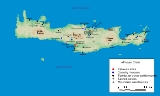
recorded a tradition that Crete had 90 cities. To judge from the palace sites the island was probably divided into at least eight political units during the height of the Minoan period. The north is thought to have been governed from Knossos, the south from
PhaistosPhaistos , also transliterated as Phaestos, Festos and Phaestus is an ancient city on the island of Crete. Phaistos was located in the south-central portion of the island, about 5.6 kilometres from the Mediterranean Sea. It was inhabited from about 4000 BC. A palace, dating from the Middle Bronze...
, the central eastern part from
MaliaMalia is a coastal town and a former municipality in the Heraklion peripheral unit, Crete, Greece. Since the 2011 local government reform it is part of the municipality Hersonissos, of which it is a municipal unit. It lies 34 km east of Heraklion, the Cretan capital city. The town was the...
, and the eastern tip from Kato Zakros and the west from
ChaniaChaniá , , also transliterated Chania, Hania, and Xania, older form Chanea and Venetian Canea, Ottoman Turkish خانيه Hanya) is the second largest city of Crete and the capital of the Chania peripheral unit...
. Smaller palaces have been found in other places.
Some of the major Minoan archaeological sites are:
- Palaces
- Knossos
Knossos , also known as Labyrinth, or Knossos Palace, is the largest Bronze Age archaeological site on Crete and probably the ceremonial and political centre of the Minoan civilization and culture. The palace appears as a maze of workrooms, living spaces, and store rooms close to a central square...
- the largest Bronze Age archaeological site on Crete; was purchased for excavations by Evans on March 16, 1900.
- Phaistos
Phaistos , also transliterated as Phaestos, Festos and Phaestus is an ancient city on the island of Crete. Phaistos was located in the south-central portion of the island, about 5.6 kilometres from the Mediterranean Sea. It was inhabited from about 4000 BC. A palace, dating from the Middle Bronze...
- the second largest palatial building on the island, excavated by the Italian school shortly after Knossos
- Malia
Malia is a coastal town and a former municipality in the Heraklion peripheral unit, Crete, Greece. Since the 2011 local government reform it is part of the municipality Hersonissos, of which it is a municipal unit. It lies 34 km east of Heraklion, the Cretan capital city. The town was the...
- the subject of French excavations, a palatial centre which affords a look into the development of the palaces in the protopalatial period
- Kato Zakros - a palatial site excavated by Greek archaeologists in the far east of the island. This is also referred to as "Zakro" in archaeological literature.
- Galatas
The "Palace" at Galatas is a Minoan archaeological site discovered discovered and excavated in the early 1990s. The site is located on the island of Crete south of Heraklion, near the villages of Galatás and Arkalochori. From the site there are fine views towards southern Crete...
- the most recently confirmed palatial site
- Agia Triada - an administrative centre close to Phaistos
- Gournia
Gournia is the site of a Minoan palacecomplex on the island of Crete, Greece, excavated in the early 20th century by theAmerican archaeologist, Harriet Boyd-Hawes. Gournia lies in the municipality of Ierapetrain the prefecture of Lasithi.-External links:...
- a town site excavated in the first quarter of the 20th century by the American School
- Pyrgos - an early Minoan site on the south of the island
- Vasiliki
Vasiliki is the name of a village in the municipality of Ierapetra, in the prefecture of Lasithi, on Crete, and the name of the nearby Minoan archeological site. The site took its name from the village.-Geography:...
- an early Minoan site towards the east of the island which gives its name to a distinctive ceramic ware
- Fournu Korfi
Fournou Korifi is the archaeological site of a Minoan settlement on southern Crete.-Geography:Fournou Korifi was built at the top of a steep hill, with excellent views of the coast.-Archaeology:Fournou Korifi was first excavated in 1967 by Peter Warren....
- a site on the south of the island
- Pseira
Pseira is an islet in the Gulf of Mirabello in northeastern Crete with the archaeological remains of Minoan and Mycenean civilisation.-Exploration:...
- island town with ritual sites
- Mount Juktas
A mountain in north-central Crete, Mount Juktas was an important religious site for the Minoan Civilization. Located a few kilometers from the palaces of Knossos and Fourni and the "megaron" at Vathypetro, Mount Juktas was the site of an important peak sanctuary in the Minoan world...
- the greatest of the Minoan peak sanctuaries because of its association with the palace of Knossos
- Arkalochori
Arkalochori is a former municipality in the Heraklion peripheral unit, Crete, Greece. Since the 2011 local government reform it is part of the municipality Minoa Pediada, of which it is a municipal unit. It lies on the western edge of the Minoa Pediada plain, west of the Lasithi plateau, in...
- the find site of the famous Arkalochori AxeThe bronze Arkalochori Axe is a second millennium BC Minoan votive double axe excavated by Spyridon Marinatos in 1934 in the Arkalochori cave on Crete which is believed to be part of a religious ritual. It is inscribed with fifteen symbols...
- Karfi
Karfi, Crete, is a little-visited archaeological site high in the Dikti Mountains that is akin to Machu Picchu for the Minoan civilization...
- a refuge site from the late Minoan period, one of the last of the Minoan sites
- Akrotiri
Akrotiri is the name of an excavation site of a Minoan Bronze Age settlement on the Greek island of Santorini, associated with the Minoan civilization due to inscriptions in Linear A, and close similarities in artifact and fresco styles. The excavation is named for a modern Greek village situated...
- settlement on the island of SantoriniSantorini , officially Thira , is an island located in the southern Aegean Sea, about southeast from Greece's mainland. It is the largest island of a small, circular archipelago which bears the same name and is the remnant of a volcanic caldera...
(Thera), near the site of the Thera EruptionThe Minoan eruption of Thera, also referred to as the Thera eruption or Santorini eruption, was a major catastrophic volcanic eruption with a Volcanic Explosivity Index of 6 or 7 and a Dense-rock equivalent of , which is estimated to have occurred in the mid second millennium BCE. The eruption...
- Zominthos
Zominthos is a small plateau in the northern foothills of Mount Ida , οn the island of Crete. Zominthos is roughly 7.5 kilometers west of the village of Anogia, on the path from Knossos to Idaion Andron, the great sanctuary cave near the peak of Ida...
- a mountainous city in the northern foothills of Mount IdaIn Greek mythology, two sacred mountains are called Mount Ida, the "Mountain of the Goddess": Mount Ida in Crete; and Mount Ida in the ancient Troad region of western Anatolia which was also known as the Phrygian Ida in classical antiquity and is the mountain that is mentioned in the Iliad of...
Minoans beyond Crete
Minoans were traders, and their cultural contacts reached far beyond the island of Crete — to
Egypt'sEgypt , officially the Arab Republic of Egypt, Arabic: , is a country mainly in North Africa, with the Sinai Peninsula forming a land bridge in Southwest Asia. Egypt is thus a transcontinental country, and a major power in Africa, the Mediterranean Basin, the Middle East and the Muslim world...
Old KingdomOld Kingdom is the name given to the period in the 3rd millennium BC when Egypt attained its first continuous peak of civilization in complexity and achievement – the first of three so-called "Kingdom" periods, which mark the high points of civilization in the lower Nile Valley .The term itself was...
, to copper-bearing
CyprusCyprus , officially the Republic of Cyprus , is a Eurasian island country, member of the European Union, in the Eastern Mediterranean, east of Greece, south of Turkey, west of Syria and north of Egypt. It is the third largest island in the Mediterranean Sea.The earliest known human activity on the...
,
CanaanCanaan is a historical region roughly corresponding to modern-day Israel, Palestine, Lebanon, and the western parts of Jordan...
, and the
LevantThe Levant or ) is the geographic region and culture zone of the "eastern Mediterranean littoral between Anatolia and Egypt" . The Levant includes most of modern Lebanon, Syria, Jordan, Israel, the Palestinian territories, and sometimes parts of Turkey and Iraq, and corresponds roughly to the...
ine coasts beyond, and to
AnatoliaAnatolia is a geographic and historical term denoting the westernmost protrusion of Asia, comprising the majority of the Republic of Turkey...
. In late 2009, Minoan-style frescoes and other Minoan-style artifacts were discovered during excavations of the
CanaanCanaan is a historical region roughly corresponding to modern-day Israel, Palestine, Lebanon, and the western parts of Jordan...
ite palace at
Tel KabriTel Kabri is an archaeological site on the grounds of Kibbutz Kabri, near the city of Nahariya, Israel.Tel Kabri is notable for its Minoan-style frescoes, the only such frescoes ever discovered in Israel....
,
IsraelThe State of Israel is a parliamentary republic located in the Middle East, along the eastern shore of the Mediterranean Sea...
, leading archaeologists to conclude that the Minoan influence was the strongest foreign influence on that Caananite city state. These are the only Minoan remains ever found in
IsraelThe State of Israel is a parliamentary republic located in the Middle East, along the eastern shore of the Mediterranean Sea...
.
Minoan techniques and styles in ceramics also provided models, of fluctuating influence, for
Helladic GreeceHelladic is a modern archaeological term meant to identify a sequence of periods characterizing the culture of mainland ancient Greece during the Bronze Age. The term is commonly used in archaeology and art history...
. Along with the familiar example of
TheraSantorini , officially Thira , is an island located in the southern Aegean Sea, about southeast from Greece's mainland. It is the largest island of a small, circular archipelago which bears the same name and is the remnant of a volcanic caldera...
, Minoan "colonies" can be found first at
KastriKastri , older form Kastrion may refer to several places in Greece:*Kastri, Evrymenes, a village in the Ioannina prefecture, also known as Kastri Vassilopoulou*Kastri, Thesprotia, a village in the Thesprotia prefecture...
on Cythera, an island close to the Greek mainland that came under Minoan influence in the mid-third millennium (EMII) and remained Minoan in culture for a thousand years, until Mycenaean occupation in the 13th century. The use of the term "colony", however, like "thalassocracy", has been criticized in recent years. The Minoan strata there replace a mainland-derived culture in the Early Bronze Age, the earliest Minoan settlement outside Crete. The
CycladesThe Cyclades is a Greek island group in the Aegean Sea, south-east of the mainland of Greece; and a former administrative prefecture of Greece. They are one of the island groups which constitute the Aegean archipelago. The name refers to the islands around the sacred island of Delos...
were in the Minoan cultural orbit, and, closer to Crete, the islands of
KarpathosKarpathos is the second largest of the Greek Dodecanese islands, in the southeastern Aegean Sea. Together with the neighboring smaller Saria Island it forms the municipality Karpathos, which is part of the Karpathos peripheral unit. From its remote position Karpathos has preserved many...
,
SarosSaros, Şaroş or Sáros may refer to:* Saros , an 18-year period, across which lunar and solar eclipses repeat* Saros , an American band* Saros , descendants of free slaves from Sierra Leone who migrated to Nigeria...
and
KasosKasos is a Greek island municipality in the Dodecanese. It is the southernmost island in the Aegean Sea, and is part of the Karpathos peripheral unit. As of 2001, its population was 990. The island has been called in , .-Geography:...
, also contained Minoan colonies, or settlements of Minoan traders, from the Middle Bronze Age (MMI-II); most of them were abandoned in LMI, but Minoan Karpathos recovered and continued with a Minoan culture until the end of the Bronze Age. Other supposed Minoan colonies, such as that hypothesised by
Adolf FurtwänglerAdolf Furtwängler was a famous German archaeologist, teacher, art historian and museum director. He was the father of the conductor Wilhelm Furtwängler and grandfather of the German archaeologist Andreas Furtwängler....
for
AeginaAegina is one of the Saronic Islands of Greece in the Saronic Gulf, from Athens. Tradition derives the name from Aegina, the mother of Aeacus, who was born in and ruled the island. During ancient times, Aegina was a rival to Athens, the great sea power of the era.-Municipality:The municipality...
, were later dismissed. There was a Minoan colony at
IalysosIalysos , is a town and a former municipality on the island of Rhodes, in the Dodecanese, Greece. Since the 2011 local government reform it is part of the municipality Rhodes, of which it is a municipal unit. It is the second-largest town on the island of Rhodes...
on
RhodesRhodes is an island in Greece, located in the eastern Aegean Sea. It is the largest of the Dodecanese islands in terms of both land area and population, with a population of 117,007, and also the island group's historical capital. Administratively the island forms a separate municipality within...
.
Minoan cultural influence indicates an orbit that extended not only throughout the
CycladesThe Cyclades is a Greek island group in the Aegean Sea, south-east of the mainland of Greece; and a former administrative prefecture of Greece. They are one of the island groups which constitute the Aegean archipelago. The name refers to the islands around the sacred island of Delos...
(so-called
Minoanisation), but in locations such as Egypt and Cyprus. Paintings from the 15th century BC, in
Thebes, EgyptThebes is the Greek name for a city in Ancient Egypt located about 800 km south of the Mediterranean, on the east bank of the river Nile within the modern city of Luxor. The Theban Necropolis is situated nearby on the west bank of the Nile.-History:...
depict a number of individuals that are Minoan in appearance bearing gifts. Inscriptions record these people as coming from
Keftiu, or the "islands in the midst of the sea", and may refer to gift-bringing merchants or officials from Crete.
Certain locations within Crete emphasize it as an "outward looking" society. The Neopalatial site of Kato Zakros, for instance, is located within 100 metres of the modern shore-line, situated within a bay. Its large number of workshops and the richness of its site materials indicate a potential 'entrepôt' for import and export. Such activities are elaborated in artistic representations of the sea, including the 'Flotilla' fresco from room 5, in the west house at Akrotiri.
Society and culture
The Minoans were primarily a mercantile people engaged in overseas trade. Their culture, from 1700 BC onward, shows a high degree of organization.
Many historians and archaeologists believe that the Minoans were involved in the Bronze Age's important
tinTin is a chemical element with the symbol Sn and atomic number 50. It is a main group metal in group 14 of the periodic table. Tin shows chemical similarity to both neighboring group 14 elements, germanium and lead and has two possible oxidation states, +2 and the slightly more stable +4...
trade: tin, alloyed with
copperCopper is a chemical element with the symbol Cu and atomic number 29. It is a ductile metal with very high thermal and electrical conductivity. Pure copper is soft and malleable; an exposed surface has a reddish-orange tarnish...
apparently from
CyprusCyprus , officially the Republic of Cyprus , is a Eurasian island country, member of the European Union, in the Eastern Mediterranean, east of Greece, south of Turkey, west of Syria and north of Egypt. It is the third largest island in the Mediterranean Sea.The earliest known human activity on the...
, was used to make
bronzeBronze is a metal alloy consisting primarily of copper, usually with tin as the main additive. It is hard and brittle, and it was particularly significant in antiquity, so much so that the Bronze Age was named after the metal...
. The decline of Minoan civilization and the decline in use of bronze tools in favor of iron ones seem to be correlated.
The Minoan trade in
saffronSaffron is a spice derived from the flower of Crocus sativus, commonly known as the saffron crocus. Crocus is a genus in the family Iridaceae. Each saffron crocus grows to and bears up to four flowers, each with three vivid crimson stigmas, which are each the distal end of a carpel...
, the stigma of a mutated
crocusCrocus is a genus in the iris family comprising about 80 species of perennials growing from corms. Many are cultivated for their flowers appearing in autumn, winter, or spring...
which originated in the Aegean basin as a natural chromosome mutation, has left fewer material remains: a fresco of saffron-gatherers at
SantoriniSantorini , officially Thira , is an island located in the southern Aegean Sea, about southeast from Greece's mainland. It is the largest island of a small, circular archipelago which bears the same name and is the remnant of a volcanic caldera...
is well-known. This inherited trade pre-dated Minoan civilization: a sense of its rewards may be gained by comparing its value to
frankincenseFrankincense, also called olibanum , is an aromatic resin obtained from trees of the genus Boswellia, particularly Boswellia sacra, B. carteri, B. thurifera, B. frereana, and B. bhaw-dajiana...
, or later, to
pepperBlack pepper is a flowering vine in the family Piperaceae, cultivated for its fruit, which is usually dried and used as a spice and seasoning. The fruit, known as a peppercorn when dried, is approximately in diameter, dark red when fully mature, and, like all drupes, contains a single seed...
. Archaeologists tend to emphasize the more durable items of trade: ceramics, copper, and tin, and dramatic luxury finds of
goldGold is a chemical element with the symbol Au and an atomic number of 79. Gold is a dense, soft, shiny, malleable and ductile metal. Pure gold has a bright yellow color and luster traditionally considered attractive, which it maintains without oxidizing in air or water. Chemically, gold is a...
and
silverSilver is a metallic chemical element with the chemical symbol Ag and atomic number 47. A soft, white, lustrous transition metal, it has the highest electrical conductivity of any element and the highest thermal conductivity of any metal...
.
Objects of Minoan manufacture suggest there was a network of trade with mainland
GreeceGreece , officially the Hellenic Republic , and historically Hellas or the Republic of Greece in English, is a country in southeastern Europe....
(notably
MycenaeMycenae is an archaeological site in Greece, located about 90 km south-west of Athens, in the north-eastern Peloponnese. Argos is 11 km to the south; Corinth, 48 km to the north...
),
CyprusCyprus , officially the Republic of Cyprus , is a Eurasian island country, member of the European Union, in the Eastern Mediterranean, east of Greece, south of Turkey, west of Syria and north of Egypt. It is the third largest island in the Mediterranean Sea.The earliest known human activity on the...
,
SyriaSyria , officially the Syrian Arab Republic , is a country in Western Asia, bordering Lebanon and the Mediterranean Sea to the West, Turkey to the north, Iraq to the east, Jordan to the south, and Israel to the southwest....
,
AnatoliaAnatolia is a geographic and historical term denoting the westernmost protrusion of Asia, comprising the majority of the Republic of Turkey...
,
EgyptEgypt , officially the Arab Republic of Egypt, Arabic: , is a country mainly in North Africa, with the Sinai Peninsula forming a land bridge in Southwest Asia. Egypt is thus a transcontinental country, and a major power in Africa, the Mediterranean Basin, the Middle East and the Muslim world...
,
MesopotamiaMesopotamia is a toponym for the area of the Tigris–Euphrates river system, largely corresponding to modern-day Iraq, northeastern Syria, southeastern Turkey and southwestern Iran.Widely considered to be the cradle of civilization, Bronze Age Mesopotamia included Sumer and the...
, and westward as far as the coast of
SpainSpain , officially the Kingdom of Spain languages]] under the European Charter for Regional or Minority Languages. In each of these, Spain's official name is as follows:;;;;;;), is a country and member state of the European Union located in southwestern Europe on the Iberian Peninsula...
.
Minoan men wore
loinclothA loincloth is a one-piece male garment, sometimes kept in place by a belt, which covers the genitals and, at least partially, the buttocks.-History and types:Loincloths are being and have been worn:*in societies where no other clothing is needed or wanted...
s and
kiltThe kilt is a knee-length garment with pleats at the rear, originating in the traditional dress of men and boys in the Scottish Highlands of the 16th century. Since the 19th century it has become associated with the wider culture of Scotland in general, or with Celtic heritage even more broadly...
s. Women wore
robeA robe is a loose-fitting outer garment. A robe is distinguished from a cape or cloak by the fact that it usually has sleeves. The English word robe derives from Middle English robe , borrowed from Old French robe , itself taken from the Frankish word *rouba , and is related to the word rob...
s that had short sleeves and layered flounced skirts. These were open to the navel allowing their breasts to be left exposed, perhaps during ceremonial occasions. Women also had the option of wearing a strapless fitted
bodiceA bodice, historically, is an article of clothing for women, covering the body from the neck to the waist. In modern usage it typically refers to a specific type of upper garment common in Europe during the 16th to the 18th century, or to the upper portion of a modern dress to distinguish it from...
. The patterns on emphasized
symmetricalSymmetry generally conveys two primary meanings. The first is an imprecise sense of harmonious or aesthetically pleasing proportionality and balance; such that it reflects beauty or perfection...
geometric designs. It must be remembered that other forms of dress may have been worn of which we have no record.
The
Minoan religionThe religion of the Bronze Age Minoan civilization was a type of polytheism within the larger group of religions of the Ancient Near East. As a prehistoric religion, interpretation of possible cult practice and mythology is based on evidence recovered archaeologically.Postulated Minoan sacred...
focused on female deities, with females officiating. The statues of
priestA priest is a person authorized to perform the sacred rites of a religion, especially as a mediatory agent between humans and deities. They also have the authority or power to administer religious rites; in particular, rites of sacrifice to, and propitiation of, a deity or deities...
esses in Minoan culture and frescoes showing men and women participating in the same sports such as
bull-leapingBull-leaping is a motif of Middle Bronze Age figurative art, notably of Minoan Crete, but also found in Hittite Anatolia, the Levant, Bactria and the Indus Valley. It is often interpreted as a depiction of a ritual performed in connection with bull worship...
, lead some archaeologists to believe that men and women held equal social status. Inheritance is thought to have been matrilineal. The frescos include many depictions of people, with the genders distinguished by colour: the men's skin is reddish-brown, the women's white.
Concentration of wealth played a large role in the structure of society. Multiroom constructions were discovered in even the ‘poor’ areas of town, revealing a social equality and even distribution of wealth.
Language and writing
Knowledge of the spoken and written language of the Minoans is scant, due to the small number of records found. Around 3000clay tablets have been found with the various Cretan scripts. Clay tablets seem to have been used from around 3000 BC or earlier. Two clay cups from Knossos have been found with remnants of ink; and inkwells, similar to the animal-shaped inkstands from Mesopotamia, have also been found.
Sometimes, the Minoan language is referred to as
EteocretanThe Minoan language was spoken in ancient Crete before it was replaced with the language of the mainland; the relationship between Minoan and Greek is unknown. While attempts have been made to connect it to other languages, Minoan must be considered unclassified until a linguistic affiliation can...
, but this presents confusion between the language written in
Linear A scriptsLinear A is one of two scripts used in ancient Crete before Mycenaean Greek Linear B; Cretan hieroglyphs is the second script. In Minoan times, before the Mycenaean Greek dominion, Linear A was the official script for the palaces and religious activities, and hieroglyphs were mainly used on seals....
and the language written in a
EuboeanThe origins of the alphabet are unknown, but there are several theories as to how it developed. One popular proposal — the Proto-Sinaitic theory — is that the history of the alphabet began in Ancient Egypt, more than a millennium into the history of writing...
-derived alphabet after the
Greek Dark AgesThe Greek Dark Age or Ages also known as Geometric or Homeric Age are terms which have regularly been used to refer to the period of Greek history from the presumed Dorian invasion and end of the Mycenaean Palatial civilization around 1200 BC, to the first signs of the Greek city-states in the 9th...
. While the Eteocretan language is believed to be a descendant of Minoan, there is not enough source material in either language to allow conclusions.
The earliest writing found on Crete is
Cretan hieroglyphicCretan hieroglyphs are hieroglyphs found on artifacts of Bronze Age Minoan Crete . Symbol inventories have been compiled by Evans , Meijer , Olivier/Godart...
system. It is not known whether this language is Minoan, and scholars often debate its origin. These hieroglyphs are often associated with the Egyptians but also appear related to several other writings from the Mesopotamian region. The hieroglyphs came into use from MMI and were in parallel use with the emerging Linear A from the 18th century BC (MM II) and disappeared during the 17th century BCE (MM III).
In the Mycenean period, Linear A was replaced by Linear B, recording a very archaic version of the
Greek languageGreek is an independent branch of the Indo-European family of languages. Native to the southern Balkans, it has the longest documented history of any Indo-European language, spanning 34 centuries of written records. Its writing system has been the Greek alphabet for the majority of its history;...
. Linear B was successfully deciphered by
Michael VentrisMichael George Francis Ventris, OBE was an English architect and classical scholar who, along with John Chadwick, was responsible for the decipherment of Linear B.Ventris was educated in Switzerland and at Stowe School...
in 1952, but the earlier scripts remain a mystery. The overwhelming majority of tablets are written in the
Linear BLinear B is a syllabic script that was used for writing Mycenaean Greek, an early form of Greek. It pre-dated the Greek alphabet by several centuries and seems to have died out with the fall of Mycenaean civilization...
script, apparently being inventories of goods or resources. Others are inscriptions on religious objects associated with cult. Because most of these inscriptions are concise economic records rather than dedicatory inscriptions, the translation of Minoan remains a challenge.
Unless Eteocretan truly is its descendant, it is perhaps during the
Greek Dark AgesThe Greek Dark Age or Ages also known as Geometric or Homeric Age are terms which have regularly been used to refer to the period of Greek history from the presumed Dorian invasion and end of the Mycenaean Palatial civilization around 1200 BC, to the first signs of the Greek city-states in the 9th...
, a time of economic and socio-political collapse, that the Minoan language became extinct.
Art
The collection of Minoan art is in the museum at
HeraklionHeraklion, or Heraclion is the largest city and the administrative capital of the island of Crete, Greece. It is the 4th largest city in Greece....
, near Knossos on the north shore of Crete. Minoan art, with other remains of
material cultureIn the social sciences, material culture is a term that refers to the relationship between artifacts and social relations. Studying a culture's relationship to materiality is a lens through which social and cultural attitudes can be discussed...
, especially the sequence of ceramic styles, has allowed archaeologists to define the three phases of Minoan culture (EM, MM, LM) discussed above.
Since wood and textiles have vanished through decomposition, the best preserved, and so most easily learned from, surviving examples of Minoan art are
Minoan potteryMinoan pottery is more than a useful tool for dating the mute Minoan civilization. Its restless sequence of rapidly maturing artistic styles reveal something of Minoan patrons' pleasure in novelty while they assist archaeologists to assign relative dates to the strata of their sites...
, the palace architecture with its
frescoFresco is any of several related mural painting types, executed on plaster on walls or ceilings. The word fresco comes from the Greek word affresca which derives from the Latin word for "fresh". Frescoes first developed in the ancient world and continued to be popular through the Renaissance...
s that include landscapes,
stone carvingStone carving is an ancient activity where pieces of rough natural stone are shaped by the controlled removal of stone. Owing to the permanence of the material, evidence can be found that even the earliest societies indulged in some form of stone work....
s, and intricately carved
seal stonesMinoan seal-stones are gemstones, or near-gem-quality stones produced in the Minoan civilization. They were found in quantity at specific sites, for example the Citadel of Mycenae....
.
Pottery
In the Early Minoan period ceramics were characterized by linear patterns of
spiralIn mathematics, a spiral is a curve which emanates from a central point, getting progressively farther away as it revolves around the point.-Spiral or helix:...
s,
triangleA triangle is one of the basic shapes of geometry: a polygon with three corners or vertices and three sides or edges which are line segments. A triangle with vertices A, B, and C is denoted ....
s, curved lines,
crossA cross is a geometrical figure consisting of two lines or bars perpendicular to each other, dividing one or two of the lines in half. The lines usually run vertically and horizontally; if they run obliquely, the design is technically termed a saltire, although the arms of a saltire need not meet...
es,
fishboneFishbone is a U.S. alternative rock band formed in 1979 in Los Angeles, California, which plays a fusion of ska, punk rock, funk, hard rock and soul. Critics have noted of the band: "Fishbone was one of the most distinctive and eclectic alternative rock bands of the late '80s...
motifs, and like. In the Middle Minoan period naturalistic designs such as
fishFish are a paraphyletic group of organisms that consist of all gill-bearing aquatic vertebrate animals that lack limbs with digits. Included in this definition are the living hagfish, lampreys, and cartilaginous and bony fish, as well as various extinct related groups...
,
squidSquid are cephalopods of the order Teuthida, which comprises around 300 species. Like all other cephalopods, squid have a distinct head, bilateral symmetry, a mantle, and arms. Squid, like cuttlefish, have eight arms arranged in pairs and two, usually longer, tentacles...
,
birdBirds are feathered, winged, bipedal, endothermic , egg-laying, vertebrate animals. Around 10,000 living species and 188 families makes them the most speciose class of tetrapod vertebrates. They inhabit ecosystems across the globe, from the Arctic to the Antarctic. Extant birds range in size from...
s, and lilies were common. In the Late Minoan period, flowers and animals were still the most characteristic, but the variability had increased. The 'palace style' of the region around Knossos is characterised by a strong geometric simplification of
naturalisticNaturalism in art refers to the depiction of realistic objects in a natural setting. The Realism movement of the 19th century advocated naturalism in reaction to the stylized and idealized depictions of subjects in Romanticism, but many painters have adopted a similar approach over the centuries...
shapes and
monochromaticMonochrome describes paintings, drawings, design, or photographs in one color or shades of one color. A monochromatic object or image has colors in shades of limited colors or hues. Images using only shades of grey are called grayscale or black-and-white...
paintings. Very noteworthy are the similarities between Late Minoan and
MycenaeanMycenaean Greece was a cultural period of Bronze Age Greece taking its name from the archaeological site of Mycenae in northeastern Argolis, in the Peloponnese of southern Greece. Athens, Pylos, Thebes, and Tiryns are also important Mycenaean sites...
art. Frescoes were the main form of art during these time of the Minoan culture.
Religion
The Minoans seem to have worshipped primarily goddesses, which has sometimes been described as a "
matriarchal religionThe concept of a Matriarchal religion is a concept forwarded in second-wave feminism since the 1970s, based on the notion of a historical matriarchy first developed in the 19th century by J. J...
". Although there is some evidence of male gods, depictions of Minoan goddesses vastly outnumber depictions of anything that could be considered a Minoan god. While some of these depictions of women are speculated to be images of worshippers and priestesses officiating at religious ceremonies, as opposed to the deity herself, there still seem to be several goddesses including a
Mother GoddessMother goddess is a term used to refer to a goddess who represents motherhood, fertility, creation or embodies the bounty of the Earth. When equated with the Earth or the natural world such goddesses are sometimes referred to as Mother Earth or as the Earth Mother.Many different goddesses have...
of
fertilityFertility rites are religious rituals that reenact, either actually or symbolically, sexual acts and/or reproductive processes: 'sexual intoxication is a typical component of the...rites of the various functional gods who control reproduction, whether of man, beast, cattle, or grains of seed'..They...
, a Mistress of the Animals, a protectress of
citiesA city is a relatively large and permanent settlement. Although there is no agreement on how a city is distinguished from a town within general English language meanings, many cities have a particular administrative, legal, or historical status based on local law.For example, in the U.S...
, the
householdA home is a place of residence or refuge. When it refers to a building, it is usually a place in which an individual or a family can rest and store personal property. Most modern-day households contain sanitary facilities and a means of preparing food. Animals have their own homes as well, either...
, the
harvestHarvest is the process of gathering mature crops from the fields. Reaping is the cutting of grain or pulse for harvest, typically using a scythe, sickle, or reaper...
, and the
underworldThe Underworld is a region which is thought to be under the surface of the earth in some religions and in mythologies. It could be a place where the souls of the recently departed go, and in some traditions it is identified with Hell or the realm of death...
, and more. Some have argued that these are all aspects of a single
Great GoddessGreat Goddess refers to the concept of an almighty goddess, or to the concept of a mother goddess, including:*Great Goddess, anglicized form of the Latin Magna Dea*Great Goddess, anglicized form of the Sanskrit Mahadevi, the Shakti sum of all goddesses...
. They are often represented by
serpentsSerpent in Latin means: Rory Collins :&, in turn, from the Biblical Hebrew word of: "saraf" with root letters of: which refers to something burning-as, the pain of poisonous snake's bite was likened to internal burning.This word is commonly used in a specifically mythic or religious context,...
, birds, poppies, and a somewhat vague shape of an animal upon the head.
A major festive celebration was exemplified in the famous athletic
Minoan bull danceBull-leaping is a motif of Middle Bronze Age figurative art, notably of Minoan Crete, but also found in Hittite Anatolia, the Levant, Bactria and the Indus Valley. It is often interpreted as a depiction of a ritual performed in connection with bull worship...
, represented at large in the frescoes of Knossos and inscribed in miniature seals.
The Minoan horn-topped altars, since
EvansSir Arthur John Evans FRS was a British archaeologist most famous for unearthing the palace of Knossos on the Greek island of Crete and for developing the concept of Minoan civilization from the structures and artifacts found there and elsewhere throughout eastern Mediterranean...
' time conventionally called "
Horns of Consecration"Horns of Consecration" is an expression coined by Sir Arthur Evans to describe the symbol, ubiquitous in Minoan civilization, that represents the horns of the sacred bull: Sir Arthur Evans concluded, after noting numerous examples in Minoan and Mycenaean contexts, that the Horns of Consecration...
" are represented in seal impressions, and survive in examples as far afield as Cyprus.
Minoan sacred symbols include the
bullThe worship of the Sacred Bull throughout the ancient world is most familiar to the Western world in the biblical episode of the idol of the Golden Calf. The Golden Calf after being made by the Hebrew people in the wilderness of Sinai, were rejected and destroyed by Moses and his tribe after his...
and its horns of consecration, the
labrysLabrys is the term for a symmetrical doubleheaded axe originally from Crete in Greece, one of the oldest symbols of Greek civilization; to the Romans, it was known as a bipennis....
(double-headed axe), the
pillarA column or pillar in architecture and structural engineering is a vertical structural element that transmits, through compression, the weight of the structure above to other structural elements below. For the purpose of wind or earthquake engineering, columns may be designed to resist lateral forces...
, the serpent, the sun-disk, and the
treeA tree is a perennial woody plant. It is most often defined as a woody plant that has many secondary branches supported clear of the ground on a single main stem or trunk with clear apical dominance. A minimum height specification at maturity is cited by some authors, varying from 3 m to...
. However, recently a completely different interpretation of these symbols, focusing on apiculture instead of religious significance, has been suggested.
Evidence that suggests the Minoans may have performed human sacrifice has been found at three sites: (1)
AnemospiliaAnemospilia is the archaeological site of an ancient Minoan temple on Crete.-Geography:The temple is located on the northern end of Mount Juktas. Modern Heraklion can be seen from the site. The site is in the country side near Arkhanes, about 7 kilometers from Knossos on the Island of Crete. It...
, in a MMII building near Mt. Juktas, interpreted as a temple, (2) an EMII sanctuary complex at
Fournou KorifiFournou Korifi is the archaeological site of a Minoan settlement on southern Crete.-Geography:Fournou Korifi was built at the top of a steep hill, with excellent views of the coast.-Archaeology:Fournou Korifi was first excavated in 1967 by Peter Warren....
in south central Crete, and (3)
KnossosKnossos , also known as Labyrinth, or Knossos Palace, is the largest Bronze Age archaeological site on Crete and probably the ceremonial and political centre of the Minoan civilization and culture. The palace appears as a maze of workrooms, living spaces, and store rooms close to a central square...
, in an LMIB building known as the "North House. (
explanation of abbreviations)
Like much of the archaeology of the Bronze Age, burial remains constitute much of the material and archaeological evidence for the period. By the end of the Second Palace Period Minoan burial practice is dominated by two broad forms: 'Circular Tombs', or
Tholoi, (located in South Crete) and 'House Tombs', (located in the north and the east). Of course, there are many trends and patterns within Minoan mortuary practice that do not conform to this simple breakdown. Over all, inhumation was the most popular form of burial, cremation does not seem to have been a popular means of burial in Bronze Age Crete. Throughout this period there is a trend towards individual burials, with some distinguished exceptions. These include the much-debated Chrysolakkos complex, Mallia, consisting of a number of buildings forming a complex. This is located in the centre of Mallia's burial area and may have been the focus for burial rituals, or the 'crypt' for a notable family.
Warfare and "The Minoan Peace"
Though the vision created by
Arthur EvansSir Arthur John Evans FRS was a British archaeologist most famous for unearthing the palace of Knossos on the Greek island of Crete and for developing the concept of Minoan civilization from the structures and artifacts found there and elsewhere throughout eastern Mediterranean...
of a
pax Minoica, a "Minoan peace", has been criticised in recent years, it is generally assumed there was little internal armed conflict in Minoan Crete itself, until the following Mycenaean period. As with much of Minoan Crete, however, it is hard to draw any obvious conclusions from the evidence. However, new excavations keep sustaining interest and documenting the impact around the Aegean.
Despite having found ruined watchtowers and fortification walls, Evans argued that there was little evidence for ancient Minoan fortifications. But as S. Alexiou has pointed out (in
Kretologia 8), a number of sites, especially Early and Middle Minoan sites such as Aghia Photia, are built on hilltops or are otherwise fortified. As Lucia Nixon said, "...we may have been over-influenced by the lack of what we might think of as solid fortifications to assess the archaeological evidence properly. As in so many other instances, we may not have been looking for evidence in the right places, and therefore we may not end with a correct assessment of the Minoans and their ability to avoid war.".
Chester Starr points out in "Minoan Flower Lovers" (Hagg-Marinatos eds. Minoan Thalassocracy) that
Shang ChinaThe Shang Dynasty or Yin Dynasty was, according to traditional sources, the second Chinese dynasty, after the Xia. They ruled in the northeastern regions of the area known as "China proper" in the Yellow River valley...
and the
MayaThe Maya is a Mesoamerican civilization, noted for the only known fully developed written language of the pre-Columbian Americas, as well as for its art, architecture, and mathematical and astronomical systems. Initially established during the Pre-Classic period The Maya is a Mesoamerican...
both had unfortified centers and yet still engaged in frontier struggles, so that itself cannot be enough to definitively show the Minoans were a peaceful civilization unparalleled in history.
In 1998, however, when Minoan archaeologists met in a conference in Belgium to discuss the possibility that the idea of Pax Minoica was outdated, the evidence for Minoan war proved to be scanty.
Archaeologist Jan Driessen, for example, said the Minoans frequently show 'weapons' in their art, but only in ritual contexts, and that "The construction of fortified sites is often assumed to reflect a threat of warfare, but such fortified centres were multifunctional; they were also often the embodiment or material expression of the central places of the territories at the same time as being monuments glorifying and merging leading power" (Driessen 1999, p. 16).
On the other hand, Stella Chryssoulaki's work on the small outposts or 'guard-houses' in the east of the island represent possible elements of a defensive system. Claims that they produced no weapons are erroneous; type A Minoan swords (as found in palaces of Mallia and Zarkos) were the finest in all of the Aegean (See Sanders, AJA 65, 67, Hoeckmann, JRGZM 27, or Rehak and Younger, AJA 102).
Keith Branigan claimed that 95% of so-called Minoan weapons possessed hafting (hilts, handles) that would have prevented their use as weapons (Branigan, 1999); more recent experimental testing of accurate replicas has shown this to be incorrect as these weapons were capable of cutting flesh down to the bone (and scoring the bone's surface) without any damage to the weapons themselves. Archaeologist Paul Rehak maintains that Minoan figure-eight shields could not have been used for fighting or even hunting, since they were too cumbersome (Rehak, 1999). And archaeologist Jan Driessen says the Minoans frequently show 'weapons' in their art, but only in ritual contexts (Driessen 1999). Finally, archaeologist Cheryl Floyd concludes that Minoan "weapons" were merely tools used for mundane tasks such as meat-processing (Floyd, 1999). However, this theory is thrown into question by evidence of "rapiers nearly three feet in length" dated to the Middle Minoan period.
About Minoan warfare, Branigan concludes that "The quantity of weaponry, the impressive fortifications, and the aggressive looking long-boats all suggested an era of intensified hostilities. But on closer inspection there are grounds for thinking that all three key elements are bound up as much with status statements, display, and fashion as with aggression.... Warfare such as there was in the southern Aegean EBA early Bronze Age was either personalized and perhaps ritualized (in Crete) or small-scale, intermittent and essentially an economic activity (in the Cyclades and the Argolid/Attica) " (1999, p. 92). Archaeologist Krzyszkowska concurs: "The stark fact is that for the prehistoric Aegean we have no direct evidence for war and warfare per se" (Krzyszkowska, 1999).
Furthermore, no evidence exists for a Minoan army, or for Minoan domination of peoples outside Crete. Few signs of warfare appear in Minoan art. "Although a few archaeologists see war scenes in a few pieces of Minoan art, others interpret even these scenes as festivals, sacred dance, or sports events" (Studebaker, 2004, p. 27). Although armed warriors are depicted being stabbed in the throat with swords, violence may occur in the context of ritual or blood sport.
Although on the Mainland of Greece at the time of the Shaft Graves at Mycenae, there is little evidence for major fortifications among the Mycenaeans there (the famous citadels post-date the destruction of almost all Neopalatial Cretan sites), the constant warmongering of other contemporaries of the ancient Minoans – the Egyptians and Hittites, for example – is well documented.
Architecture
The Minoan cities were connected with stone-paved
roadA road is a thoroughfare, route, or way on land between two places, which typically has been paved or otherwise improved to allow travel by some conveyance, including a horse, cart, or motor vehicle. Roads consist of one, or sometimes two, roadways each with one or more lanes and also any...
s, formed from blocks cut with bronze
sawA saw is a tool that uses a hard blade or wire with an abrasive edge to cut through softer materials. The cutting edge of a saw is either a serrated blade or an abrasive...
s. Streets were drained and water and
sewerA sanitary sewer is a separate underground carriage system specifically for transporting sewage from houses and commercial buildings to treatment or disposal. Sanitary sewers serving industrial areas also carry industrial wastewater...
facilities were available to the upper class, through
clayClay is a general term including many combinations of one or more clay minerals with traces of metal oxides and organic matter. Geologic clay deposits are mostly composed of phyllosilicate minerals containing variable amounts of water trapped in the mineral structure.- Formation :Clay minerals...
pipes.
Minoan buildings often had flat tiled roofs;
plasterPlaster is a building material used for coating walls and ceilings. Plaster starts as a dry powder similar to mortar or cement and like those materials it is mixed with water to form a paste which liberates heat and then hardens. Unlike mortar and cement, plaster remains quite soft after setting,...
, wood, or
flagstoneFlagstone, is a generic flat stone, usually used for paving slabs or walkways, patios, fences and roofing. It may be used for memorials, headstones, facades and other constructions. The name derives from Middle English flagge meaning turf, perhaps from Old Norse flaga meaning slab.Flagstone is a...
floorA floor is the walking surface of a room or vehicle. Floors vary from simple dirt in a cave to many-layered surfaces using modern technology...
s, and stood two to three stories high. Typically the lower
wallA wall is a usually solid structure that defines and sometimes protects an area. Most commonly, a wall delineates a building and supports its superstructure, separates space in buildings into rooms, or protects or delineates a space in the open air...
s were constructed of stone and
rubbleRubble is broken stone, of irregular size, shape and texture. This word is closely connected in derivation with "rubbish", which was formerly also applied to what we now call "rubble". Rubble naturally found in the soil is known also as brash...
, and the upper walls of
mudbrickA mudbrick is a firefree brick, made of a mixture of clay, mud, sand, and water mixed with a binding material such as rice husks or straw. They use a stiff mixture and let them dry in the sun for 25 days....
. Ceiling timbers held up the roofs.
The materials used in constructing the villas and palaces varied, and could include sandstone, gypsum, or limestone. Equally, building techniques could also vary between different constructions; some palaces used ashlar masonry while others used roughly hewn megalithic blocks.
Palaces
The first palaces were constructed at the end of the Early Minoan period in the third millennium BC (
MaliaMalia could refer to:Places* Malia, Cyprus, a village in Limassol district of southern Cyprus* Malia, Crete, a town on the north coast of Crete, in Greece* Malia Vgethi, a volcano in the northeast Peloponnese, near the village of Kameni Chora, Greece...
). While it was formerly believed that the foundation of the first palaces was synchronous and dated to the Middle Minoan at around 2000 BC (the date of the first palace at Knossos), scholars now think that palaces were built over a longer period in different locations, in response to local developments. The main older palaces are Knossos, Malia, and Phaistos. Some of the elements recorded in the Middle Minoan 'palaces' (Knossos, Phaistos and Mallia, for example) have precedents in earlier styles of construction in the Early Minoan period. These include the indented western court, and the special treatment given to the western façade. An example of this is seen at the "House on the Hill" at Vasiliki, dated to the Early Minoan II period.
The palaces fulfilled a plethora of functions: they served as centres of
governmentGovernment refers to the legislators, administrators, and arbitrators in the administrative bureaucracy who control a state at a given time, and to the system of government by which they are organized...
, administrative offices,
shrineA shrine is a holy or sacred place, which is dedicated to a specific deity, ancestor, hero, martyr, saint, daemon or similar figure of awe and respect, at which they are venerated or worshipped. Shrines often contain idols, relics, or other such objects associated with the figure being venerated....
s, workshops, and storage spaces (e.g., for grain). These distinctions might have seemed artificial to Minoans.
The use of the term 'palace' for the older palaces, meaning a dynastic residence and seat of power, has recently come under criticism (see
PalaceA palace is a grand residence, especially a royal residence or the home of a head of state or some other high-ranking dignitary, such as a bishop or archbishop. The word itself is derived from the Latin name Palātium, for Palatine Hill, one of the seven hills in Rome. In many parts of Europe, the...
), and the term 'court building' has been proposed instead. However, the original term is probably too well entrenched to be replaced. Architectural features such as
ashlarAshlar is prepared stone work of any type of stone. Masonry using such stones laid in parallel courses is known as ashlar masonry, whereas masonry using irregularly shaped stones is known as rubble masonry. Ashlar blocks are rectangular cuboid blocks that are masonry sculpted to have square edges...
masonry, orthostats, columns, open courts, staircases (implying upper stories), and the presence of diverse basins have been used to define palatial architecture.
Often the conventions of better-known, younger palaces have been used to reconstruct older ones, but this practice may be obscuring fundamental functional differences. Most older palaces had only one story and no representative façades. They were U-shaped, with a big central court, and generally were smaller than later palaces. Late palaces are characterised by multi-storey buildings. The west façades had sandstone ashlar masonry. Knossos is the best-known example. See
KnossosKnossos , also known as Labyrinth, or Knossos Palace, is the largest Bronze Age archaeological site on Crete and probably the ceremonial and political centre of the Minoan civilization and culture. The palace appears as a maze of workrooms, living spaces, and store rooms close to a central square...
. Further building conventions could include storage magazines, a north-south orientation, a pillar room, a Minoan Hall system, a western court, and pier-and-door entrance ways. Palatial architecture in the First Palace Period is identified by its 'square within a square' style, whilst later, Second Palace Period constructions incorporated more internal divisions and corridors.
It's a common architectural standard among the Middle Minoan 'palaces' that they are aligned with their surrounding topography. The MM palatial structure of Phaistos appears to align with Mount Ida, whilst Knossos is aligned with Juktas. These are oriented along a north-south axis. One suggested reason for this is the ritual significance of the mountain, where a number of Peak Sanctuaries (spaces for public ritual) have been excavated (i.e., Petsophas). The material record for these sites show clusters of clay figurines and evidence of animal sacrifice.
Columns
One of the most notable contributions of Minoans to architecture is their unique column, which was wider at the top than the bottom. It is called an 'inverted' column because most Greek columns are wider at the bottom, creating an illusion of greater height. The columns were also made of wood as opposed to stone, and were generally painted red. They were mounted on a simple stone base and were topped with a pillow-like, round piece as a capital.
Villas
A number of compounds interpreted as 'Villas' have been excavated in Crete. These structures share many features with the central Palaces (i.e., a conspicuous western façade, storage facilities, and a 'Minoan Hall') of the Neopalatial era, and may indicate either that they performed a similar rôle, or that they were artistic imitations, suggesting that their occupants were familiar with palatial culture. These villas are often richly decorated (see the frescos of Haghia Triadha Villa A).
Agriculture and subsistence
The Minoans raised cattle, sheep,
pigA pig is any of the animals in the genus Sus, within the Suidae family of even-toed ungulates. Pigs include the domestic pig, its ancestor the wild boar, and several other wild relatives...
s, and
goatThe domestic goat is a subspecies of goat domesticated from the wild goat of southwest Asia and Eastern Europe. The goat is a member of the Bovidae family and is closely related to the sheep as both are in the goat-antelope subfamily Caprinae. There are over three hundred distinct breeds of...
s, and grew
wheatWheat is a cereal grain, originally from the Levant region of the Near East, but now cultivated worldwide. In 2007 world production of wheat was 607 million tons, making it the third most-produced cereal after maize and rice...
,
barleyBarley is a major cereal grain, a member of the grass family. It serves as a major animal fodder, as a base malt for beer and certain distilled beverages, and as a component of various health foods...
, vetch, and
chickpeaThe chickpea is a legume of the family Fabaceae, subfamily Faboideae...
s, they also cultivated
grapeA grape is a non-climacteric fruit, specifically a berry, that grows on the perennial and deciduous woody vines of the genus Vitis. Grapes can be eaten raw or they can be used for making jam, juice, jelly, vinegar, wine, grape seed extracts, raisins, molasses and grape seed oil. Grapes are also...
s,
figFicus is a genus of about 850 species of woody trees, shrubs, vines, epiphytes, and hemiepiphyte in the family Moraceae. Collectively known as fig trees or figs, they are native throughout the tropics with a few species extending into the semi-warm temperate zone. The Common Fig Ficus is a genus of...
s, and
oliveThe olive , Olea europaea), is a species of a small tree in the family Oleaceae, native to the coastal areas of the eastern Mediterranean Basin as well as northern Iran at the south end of the Caspian Sea.Its fruit, also called the olive, is of major agricultural importance in the...
s, and grew
poppiesA poppy is one of a group of a flowering plants in the poppy family, many of which are grown in gardens for their colorful flowers. Poppies are sometimes used for symbolic reasons, such as in remembrance of soldiers who have died during wartime....
, for poppyseed and, perhaps, opium. The Minoans also domesticated
beeBees are flying insects closely related to wasps and ants, and are known for their role in pollination and for producing honey and beeswax. Bees are a monophyletic lineage within the superfamily Apoidea, presently classified by the unranked taxon name Anthophila...
s.
Crops including lettuce, celery, asparagus and carrots grow wild in Crete, while some produce was native, such as pears, quinces, and olive trees. They also imported date palm trees, and cats (used for hunting purposes) from Egypt and adopted
pomegranateThe pomegranate , Punica granatum, is a fruit-bearing deciduous shrub or small tree growing between five and eight meters tall.Native to the area of modern day Iran, the pomegranate has been cultivated in the Caucasus since ancient times. From there it spread to Asian areas such as the Caucasus as...
s and
quinceThe quince , or Cydonia oblonga, is the sole member of the genus Cydonia and native to warm-temperate southwest Asia in the Caucasus region...
s from the Near East, although not
lemonThe lemon is both a small evergreen tree native to Asia, and the tree's ellipsoidal yellow fruit. The fruit is used for culinary and non-culinary purposes throughout the world – primarily for its juice, though the pulp and rind are also used, mainly in cooking and baking...
s and
orangesAn orange—specifically, the sweet orange—is the citrus Citrus × sinensis and its fruit. It is the most commonly grown tree fruit in the world....
as is often imagined.
They developed Mediterranean polyculture, the practice of growing more than one crop at a time, and as a result of their more varied and healthy diet, the population increased. This method of farming would theoretically maintain the fertility of the soil, as well as offering protection against low yields in any single crop. Furthermore, Linear B tablets indicate the importance of orchard farming (i.e., figs, olives and grapes) in processing crops for "secondary products". Olive oil in the Cretan diet (or more largely, the Mediterranean diet) is comparable to butter in the Northern diet. The process of fermenting wine from grapes is likely to have been a concern of the "Palace" economies, whereby such prestige goods would have been both important trade commodities as well as culturally meaningful items of consumption. Equally, it is likely that the consumption of exotic or expensive products would have played a role in the presentation and articulation of political and economic power.
Farmers used wooden plows, bound by leather to wooden handles, and pulled by pairs of
donkeyThe donkey or ass, Equus africanus asinus, is a domesticated member of the Equidae or horse family. The wild ancestor of the donkey is the African Wild Ass, E...
s or
oxAn ox , also known as a bullock in Australia, New Zealand and India, is a bovine trained as a draft animal. Oxen are commonly castrated adult male cattle; castration makes the animals more tractable...
en.
The importance of marine resources in the
Cretan dietCretan cuisine is the traditional cuisine of the Mediterranean island of Crete.The core of the cuisine consists of food derived from natural sources, whereas food of animal origin was more peripheral in nature. In general, people consumed seasonal products, available in the wider local area, which...
is equally important to consider: the prevalence of edible molluscs in site material, and the artistic representations of marine fish and animals, including the distinctive "Octopus" stirrup jar (LM IIIC), indicate an appreciation and occasional use of fish within the economy. However, doubt remains over the functional significance of these resources in the wider Cretan diet, especially in relation to grain, olives and animal produce. Indeed, the intensification of agricultural activity is indicated by the construction of terraces and dams at Pseira in the Late Minoan period.
The Cretan diet consisted of wild animals roaming the island. Cretans ate wild deer and boar along with the meats made available to them by their livestock. Wild game can no longer be found on Crete.
Not all plants and flora would have a purely functional or economic utility. Artistic depictions often show scenes of lily gathering and performances within 'green' spaces. The fresco known as the "Sacred Grove" at Knossos, for instance, depicts a number of female figures facing towards the left-hand-side of the scene, flanked by a copse of trees. Some scholars have suggested that these depictions represent the performance of 'harvest festivals' or ceremonies, as a means to honour the continued fertility of the soil. Further artistic depictions of farming scenes are observed on the Second Palace Period "Harvester Vase" (an egg-shaped
rhyton, or pouring vessel), where 27 male figures, led by another, each carry hoes. This suggests the importance of farming as an artistic motif.
Much debate has been animated by the discovery of storage magazines within the palace compounds. At the second 'palace' at Phaistos, for instance, a range of rooms in the western side of the structure have been identified as a magazine block. Within these storage areas have been recovered numerous jars, jugs and vessels, indicating the role of the complex as a potential re-distribution centre of agricultural produce. Several possibilities may be suggested, including a model where all economic and agricultural produce was controlled by the Palace and re-distributed by it. At sites such as Knossos, where the town had developed to a considerable size, there is evidence of craft specialisation, indicating workshops. The Palace of Kato Zakro, for instance, indicates workshops that were integrated into the structure of the palace. Such evidence contributes to the idea that the Minoan palatial system developed through economic intensification, where greater agricultural surplus could support a population of administrators, craftsmen and religious practitioners. The number of domestic, or sleeping, chambers at the Palaces indicate that they could have supported a large population of individuals who were removed from manual labour.
Evolution of agricultural tools in Minoan Crete
Originally the tools were made of wood or bone, and bound together to the handle with leather straps. During the
Bronze AgeThe Bronze Age is a period characterized by the use of copper and its alloy bronze as the chief hard materials in the manufacture of some implements and weapons. Chronologically, it stands between the Stone Age and Iron Age...
the tools were upgraded to
bronzeBronze is a metal alloy consisting primarily of copper, usually with tin as the main additive. It is hard and brittle, and it was particularly significant in antiquity, so much so that the Bronze Age was named after the metal...
, with wooden handles. Due to its circular hole the tool would spin around on its handle, so the Minoans invented oval shaped holes in their tools with oval shapped handles, this stopped the tools from being able to spin.
Tools List:
- Double Adze
An adze is a tool used for smoothing or carving rough-cut wood in hand woodworking. Generally, the user stands astride a board or log and swings the adze downwards towards his feet, chipping off pieces of wood, moving backwards as they go and leaving a relatively smooth surface behind...
- Double Axe
The axe, or ax, is an implement that has been used for millennia to shape, split and cut wood; to harvest timber; as a weapon; and as a ceremonial or heraldic symbol...
- Single-Bladed Axe
The axe, or ax, is an implement that has been used for millennia to shape, split and cut wood; to harvest timber; as a weapon; and as a ceremonial or heraldic symbol...
- Axe
The axe, or ax, is an implement that has been used for millennia to shape, split and cut wood; to harvest timber; as a weapon; and as a ceremonial or heraldic symbol...
-AdzeAn adze is a tool used for smoothing or carving rough-cut wood in hand woodworking. Generally, the user stands astride a board or log and swings the adze downwards towards his feet, chipping off pieces of wood, moving backwards as they go and leaving a relatively smooth surface behind...
- Sickle
A sickle is a hand-held agricultural tool with a variously curved blade typically used for harvesting grain crops or cutting succulent forage chiefly for feeding livestock . Sickles have also been used as weapons, either in their original form or in various derivations.The diversity of sickles that...
- Chisel
A chisel is a tool with a characteristically shaped cutting edge of blade on its end, for carving or cutting a hard material such as wood, stone, or metal. The handle and blade of some types of chisel are made of metal or wood with a sharp edge in it.In use, the chisel is forced into the material...
Minoan demise theories
The Minoan eruption on the island of
TheraSantorini , officially Thira , is an island located in the southern Aegean Sea, about southeast from Greece's mainland. It is the largest island of a small, circular archipelago which bears the same name and is the remnant of a volcanic caldera...
(present-day
SantoriniSantorini , officially Thira , is an island located in the southern Aegean Sea, about southeast from Greece's mainland. It is the largest island of a small, circular archipelago which bears the same name and is the remnant of a volcanic caldera...
about 100 km distant from Crete) occurred during the LM IA period. This eruption was among the largest volcanic explosions in the history of civilization, ejecting approximately 60 km
3 of material and rating a 6 on the
Volcanic Explosivity IndexThe Volcanic Explosivity Index was devised by Chris Newhall of the U.S. Geological Survey and Stephen Self at the University of Hawaii in 1982 to provide a relative measure of the explosiveness of volcanic eruptions....
. The eruption devastated the nearby Minoan settlement at
AkrotiriAkrotiri is the name of an excavation site of a Minoan Bronze Age settlement on the Greek island of Santorini, associated with the Minoan civilization due to inscriptions in Linear A, and close similarities in artifact and fresco styles. The excavation is named for a modern Greek village situated...
on Santorini, which was entombed in a layer of
pumicePumice is a textural term for a volcanic rock that is a solidified frothy lava typically created when super-heated, highly pressurized rock is violently ejected from a volcano. It can be formed when lava and water are mixed. This unusual formation is due to the simultaneous actions of rapid...
. Also, it has been suggested that the eruption and its effect on the Minoan civilization was the origin of the
AtlantisAtlantis is a legendary island first mentioned in Plato's dialogues Timaeus and Critias, written about 360 BC....
myth, via Egyptian historical accounts.
It's further believed that the eruption severely affected the Minoan culture on Crete, although the precise extent of the impact has been debated. Early theories proposed that ashfall from Thera on the eastern half of Crete choked off plant life, causing starvation of the local population. However, after more thorough field examinations, this theory has lost credibility, as it has been determined that no more than 5 millimetre (0.196850393700787 in) of ash fell anywhere on Crete. Recent studies indicate, based on archaeological evidence found on Crete, that a massive
tsunamiA tsunami is a series of water waves caused by the displacement of a large volume of a body of water, typically an ocean or a large lake...
, generated by the Theran eruption, devastated the coastal areas of Crete and destroyed many Minoan coastal settlements. The LM IIIA (Late Minoan) period is marked by its affluence (i.e., wealthy tombs, burials and art) and the ubiquity of Knossian ceramic styles. However, by LM IIIB the importance of Knossos as a regional centre, and its material 'wealth', seem to have declined.
Significant Minoan remains have been found above the Late Minoan I era Thera ash layer, implying that the Thera eruption did not cause the immediate downfall of the Minoans. As the Minoans were a sea power and depended on their naval and merchant ships for their livelihood, the Thera eruption caused significant economic hardship to the Minoans. Whether these effects were enough to trigger the downfall of the Minoan civilization is under intense debate. The
MycenaeanMycenaean Greece was a cultural period of Bronze Age Greece taking its name from the archaeological site of Mycenae in northeastern Argolis, in the Peloponnese of southern Greece. Athens, Pylos, Thebes, and Tiryns are also important Mycenaean sites...
conquest of the Minoans occurred in Late Minoan II period. The Mycenaeans were a military civilization. Using their functional navy and a well equipped army they were capable of an invasion. There is evidence of Mycenaean weaponry being found in burials on Crete. This demonstrates Mycenaean military influence. Not many years after the eruption, and many archaeologists speculate that the eruption induced a crisis in Minoan civilization, which allowed the Mycenaeans to conquer them easily.
Sinclair Hood writes that the destruction of the Minoans was most likely due to an invading force. Although the demise of the flourishing civilization was aided by the erupting volcano on Thera, the ultimate end came from outside conquerors. Archaeological evidence leads to the fact the destruction of the island appears to be due to fire damage. Hood notes that the palace at Knossos appears to have experienced less damage than other sites along the island of Crete. Because natural disasters do not choose targets, it is most likely that the destruction was a product of invaders, for invaders would have seen the usefulness of a palace center like Knossos.
Several authors have noted evidence for exceedance of
carrying capacityThe carrying capacity of a biological species in an environment is the maximum population size of the species that the environment can sustain indefinitely, given the food, habitat, water and other necessities available in the environment...
by the Minoan civilization. For example, archaeological recovery at
KnossosKnossos , also known as Labyrinth, or Knossos Palace, is the largest Bronze Age archaeological site on Crete and probably the ceremonial and political centre of the Minoan civilization and culture. The palace appears as a maze of workrooms, living spaces, and store rooms close to a central square...
provides clear proof of
deforestationDeforestation is the removal of a forest or stand of trees where the land is thereafter converted to a nonforest use. Examples of deforestation include conversion of forestland to farms, ranches, or urban use....
of this part of Crete near late stages of Minoan development.
See also
- Linear A
Linear A is one of two scripts used in ancient Crete before Mycenaean Greek Linear B; Cretan hieroglyphs is the second script. In Minoan times, before the Mycenaean Greek dominion, Linear A was the official script for the palaces and religious activities, and hieroglyphs were mainly used on seals....
- Peak sanctuaries
Minoan Peak sanctuaries are widespread throughout the island of Crete . Most scholars agree that peak sanctuaries were used for religious rites. In all peak sanctuaries, human and animal clay figurines have been found. Clay body parts, also called votive body parts, are also found in most peak...
- Sacred caves
Sacred caves and peak sanctuaries are characteristic holy places of ancient Minoan Crete. Most scholars agree that sacred caves were used by the Minoans for religious rites. While all peak sanctuaries have clay human figurines, only Idaeon and Psychro have them among the sacred caves...
- Philistines
Philistines , Pleshet or Peleset, were a people who occupied the southern coast of Canaan at the beginning of the Iron Age . According to the Bible, they ruled the five city-states of Gaza, Askelon, Ashdod, Ekron and Gath, from the Wadi Gaza in the south to the Yarqon River in the north, but with...
- Atlantis
- Phaistos Disc
The Phaistos Disc is a disk of fired clay from the Minoan palace of Phaistos on the Greek island of Crete, possibly dating to the middle or late Minoan Bronze Age . It is about 15 cm in diameter and covered on both sides with a spiral of stamped symbols...
- Hyksos
The Hyksos were an Asiatic people who took over the eastern Nile Delta during the twelfth dynasty, initiating the Second Intermediate Period of ancient Egypt....
- Herakleion Archaeological Museum
- Cretan diet
Cretan cuisine is the traditional cuisine of the Mediterranean island of Crete.The core of the cuisine consists of food derived from natural sources, whereas food of animal origin was more peripheral in nature. In general, people consumed seasonal products, available in the wider local area, which...
- Bull-Leaping Fresco
The Bull-Leaping Fresco is a 78.2 cm high stucco fresco of bull-leaping from the Middle Minoan III to Late Minoan B period , though there is also a view that it is a later work, of 1425 BC, which would put it in the New Palace period-History:It was found on a wall on the east side of the...
External links