
All Topics  
Athena

 
Athena

   Email Print
   Bookmark   Link


Athena


In Greek mythology
Greek mythology

Greek mythology is the body of myths and legends belonging to the Ancient Greece concerning their List of Greek mythological figures#Immortals and Greek hero cult, Cosmology#Metaphysical cosmology, and the origins and significance of their own cult and ritual practices....
, Athena (also called Athene, Attic
Attic Greek

Attic Greek is the prestige dialect of Ancient Greek that was spoken in Attica, which includes Athens. Of the ancient dialects, it is the most similar to later Greek, and is the standard form of the language studied in courses of "Ancient Greek"....
: , Athenâ, or , Ath?ne; Doric
Doric Greek

Doric or Dorian was a ancient Greek dialects of ancient Greek Greek language. Its variants were spoken in the southern and eastern Peloponnese, Crete, Rhodes, some islands in the southern Aegean Sea, some cities on the coasts of Asia Minor, Southern Italy, Sicily, Epirus and Macedon....
: , Asána; Latin: Minerva
Minerva

Minerva was the Roman mythology name of Greek goddess Athena. She was considered to be the virgin goddess of warriors, poetry, medicine, wisdom, commerce, weaving,crafts, and the inventor of music....
) is the shrewd companion of heroes
Hero (disambiguation)

A hero is a person who performs extraordinary deeds for the benefit of others.Hero may also refer to:...
 and the goddess
Goddess

A goddess is a female deity. Often deities are part of a polytheism system that includes several deities in a pantheon .Common associations of goddesses are the Earth goddess, the Mother Goddess, Love goddess, and the hearth goddess, reflecting historical gender roles....
 of heroic
Hero (disambiguation)

A hero is a person who performs extraordinary deeds for the benefit of others.Hero may also refer to:...
 endeavour
Endeavour

Endeavour or endeavor may refer to:...
. She is the virgin patron of Athens
Athens

Athens , the Capital and largest city of Greece, dominates the Attica periphery; as one of the List of cities by time of continuous habitation, its recorded history spans around 3,400 years....
, which built the Parthenon
Parthenon

The Parthenon is a Greek temple of the Greek gods Athena, built in the 5th century BC on the Acropolis of Athens. It is the most important surviving building of Classical Greece, generally considered to be the culmination of the development of the Doric order....
 to worship her.

na's cult dates back to early times as the patron of Athens. Her persona persisted so much that many myths about her changed to adapt to cultural changes over the Ancient Greek eras.


Discussion
Ask a question about 'Athena'
Start a new discussion about 'Athena'
Answer questions from other users
Full Discussion Forum


Recent Posts


Encyclopedia


In Greek mythology
Greek mythology

Greek mythology is the body of myths and legends belonging to the Ancient Greece concerning their List of Greek mythological figures#Immortals and Greek hero cult, Cosmology#Metaphysical cosmology, and the origins and significance of their own cult and ritual practices....
, Athena (also called Athene, Attic
Attic Greek

Attic Greek is the prestige dialect of Ancient Greek that was spoken in Attica, which includes Athens. Of the ancient dialects, it is the most similar to later Greek, and is the standard form of the language studied in courses of "Ancient Greek"....
: , Athenâ, or , Ath?ne; Doric
Doric Greek

Doric or Dorian was a ancient Greek dialects of ancient Greek Greek language. Its variants were spoken in the southern and eastern Peloponnese, Crete, Rhodes, some islands in the southern Aegean Sea, some cities on the coasts of Asia Minor, Southern Italy, Sicily, Epirus and Macedon....
: , Asána; Latin: Minerva
Minerva

Minerva was the Roman mythology name of Greek goddess Athena. She was considered to be the virgin goddess of warriors, poetry, medicine, wisdom, commerce, weaving,crafts, and the inventor of music....
) is the shrewd companion of heroes
Hero (disambiguation)

A hero is a person who performs extraordinary deeds for the benefit of others.Hero may also refer to:...
 and the goddess
Goddess

A goddess is a female deity. Often deities are part of a polytheism system that includes several deities in a pantheon .Common associations of goddesses are the Earth goddess, the Mother Goddess, Love goddess, and the hearth goddess, reflecting historical gender roles....
 of heroic
Hero (disambiguation)

A hero is a person who performs extraordinary deeds for the benefit of others.Hero may also refer to:...
 endeavour
Endeavour

Endeavour or endeavor may refer to:...
. She is the virgin patron of Athens
Athens

Athens , the Capital and largest city of Greece, dominates the Attica periphery; as one of the List of cities by time of continuous habitation, its recorded history spans around 3,400 years....
, which built the Parthenon
Parthenon

The Parthenon is a Greek temple of the Greek gods Athena, built in the 5th century BC on the Acropolis of Athens. It is the most important surviving building of Classical Greece, generally considered to be the culmination of the development of the Doric order....
 to worship her.

Overview

Athena's cult dates back to early times as the patron of Athens. Her persona persisted so much that many myths about her changed to adapt to cultural changes over the Ancient Greek eras. The Greek philosopher, Plato
Plato

Plato , was a Classical Greece Greeks philosopher, mathematician, writer of philosophical dialogues, and founder of the Platonic Academy in Ancient Athens, the first institution of higher learning in the western world....
 (429–347 BC), identified her with the Libya
Libya

Libya , officially the Great Socialist People's Libyan Arab Jamahiriya , is a country located in North Africa. Bordering the Mediterranean Sea to the north, Libya lies between Egypt to the east, Sudan to the southeast, Chad and Niger to the south, and Algeria and Tunisia to the west....
n deity, Neith
Neith

In Ancient Egyptian religion, Neith was an early goddess in the Egyptian pantheon. She was the patron Deities#Egyptian mythology of Sais, Egypt, where her cult was centered in the Western Nile Delta of Egypt and attested as early as the First Dynasty.....
, the war-goddess and huntress deity of the Egyptians since the ancient predynastic period, also identified with weaving
Weaving

Weaving is the textile arts in which two distinct sets of yarn, called the Warp and the filling or weft , are interlaced with each other to form a textile....
. Athena became the goddess of wisdom
Wisdom

Wisdom is knowledge, understanding, experience, discretion, and Intuition , along with a capacity to apply these qualities well towards finding solutions to problems....
 as philosophy became a part of the cult in the later fifth century and Classical Greece. She was the patroness of weaving
Weaving

Weaving is the textile arts in which two distinct sets of yarn, called the Warp and the filling or weft , are interlaced with each other to form a textile....
 and other crafts (Athena Ergane), and led battles as the disciplined side of war
War

...
 (Athena Promachos). The metalwork of weapons fell under her patronage. Athena's wisdom includes the cunning intelligence (metis
Metis

Metis meant "cunningness" or "craft, skill" in Ancient Greek.Metis may also refer to:* Metis , a Titaness and the first wife of Zeus...
) of such figures as Odysseus
Odysseus

Odysseus or Ulysses , in Greek mythology , was a legendary Greeks king of Ithaca and the hero of Homer's Epic poetry, the Odyssey. Odysseus also plays a key role in Homer's Iliad and other works in the Epic Cycle....
.

head on her aegis
Aegis

"Aegis" is a large collar or cape worn in ancient times to display the protection provided by a high religious authority or, it is the holder of a protective shield signifying the same, such as a bag-like garment that contained a shield....
, as the huge serpent who guards the golden fleece regurgitates Jason; a winged lioness adorns the helment; cup by Douris, Classical Greece, early fifth century BCE (Vatican Museum)]] She appears attended by an owl
Owl

The Strigiformes are an order of bird of prey, comprising 200 species. Most are solitary, and Nocturnal animal, with some exceptions . Owls mostly hunt small mammals, insects, and other birds, though a few species specialize in hunting fish....
, often accompanied by the goddess of victory, Nike
Nike (mythology)

In Greek mythology, Nike , was a goddess who personified triumph throughout the ages of the ancient Greek culture. The Roman equivalent was Victoria ....
, whom in established icons she offers upon her extended hand. Athena wears a breastplate of either goatskin or snake skin called the Aegis
Aegis

"Aegis" is a large collar or cape worn in ancient times to display the protection provided by a high religious authority or, it is the holder of a protective shield signifying the same, such as a bag-like garment that contained a shield....
, which later myths say her father, Zeus
Zeus

Zeus in Greek mythology is the king of the gods, the ruler of Mount Olympus and the god of the sky father and List of thunder gods. His symbols are the thunderbolt, eagle, bull , and oak....
, gave to her, although in other older cultural contexts she already carries this association. Visually, she often appears helmeted and with a shield bearing the Gorgon
Gorgon

In Greek mythology, the Gorgon was a vicious monster with sharp fangs. She was a protective deity from early religious concepts. Her power was so strong that one attempting to look upon her, would be turned to stone, therefore, such images were put upon items from temples to wine kraters for protection....
 head, the hallmark of the early goddess cult in Greece and positioned highest in the apex of the front facade of the Parthenon. Later sources say Perseus
Perseus

Perseus , the legendary founder of Mycenae and of the Mycenae there, was the first of the mythic heroes of Greek mythology whose exploits in defeating various archaic monsters provided the founding myths in the cult of the Twelve Olympians....
 gave her the shield as a votive gift. A serpent
Serpent

Serpent is a synonym for snake.Serpent and similar can also mean:* Serpent , the name given to a snake in a religious or mythological context...
 often accompanies this goddess at the base of the staff
Staff

Staff may refer to:* Staff , a stick or pole to assist with walking, or sometimes used as a weapon* Staff , artificial stone product used as ornament...
 of her lance
Lance

The term lance has become a catchall for a variety of different pole weapons based on the spear. The name is derived from lancea, Ancient Rome auxiliaries' javelin, although according to the Oxford English Dictionary, the word may be of Iberian language origin....
. The sea, ships, horses, and chariots associate with her, but with less frequency. The image to the right shows a winged lioness on her helmet, an image associated with warrior
Warrior

According to the Random House Dictionary, the term warrior has two meanings. The first Literal and figurative language use refers to "a person engaged or experienced in warfare." The second Literal and figurative language use refers to "a person who shows or has shown great vigor, courage, or aggressiveness, as in politics or athletics...
 deities in many early cultures, including Egypt.

Athena, an armed warrior goddess, appears in Greek mythology as a helper of many heroes, including Odysseus
Odysseus

Odysseus or Ulysses , in Greek mythology , was a legendary Greeks king of Ithaca and the hero of Homer's Epic poetry, the Odyssey. Odysseus also plays a key role in Homer's Iliad and other works in the Epic Cycle....
, Jason
Jason

Jason was a late ancient Greece Greek mythology figure, famous as the leader of the Argonauts and their quest for the Golden Fleece. He was the son of Aeson, the rightful king of Iolcus....
, and Heracles
Heracles

In Greek mythology, Heracles or Herakles meaning "glory of Hera", or "Glorious through Hera" Alcides or Alcaeus " was a hero, the son of Zeus and Alcmene, foster son of Amphitryon and great-grandson of Perseus....
. In Classical Greek myths she never consorts with a lover, earning the title Athena Parthenos ("Athena the virgin"), hence the name of her most famous temple, the Parthenon
Parthenon

The Parthenon is a Greek temple of the Greek gods Athena, built in the 5th century BC on the Acropolis of Athens. It is the most important surviving building of Classical Greece, generally considered to be the culmination of the development of the Doric order....
, on the Acropolis in Athens
Athens

Athens , the Capital and largest city of Greece, dominates the Attica periphery; as one of the List of cities by time of continuous habitation, its recorded history spans around 3,400 years....
. A remnant of archaic myth depicts her as the adoptive mother of Erechtheus
Erechtheus

Erechtheus in Greek mythology was the name of an archaic king of Athens, the re-founder of the polis and a double at Athens for Poseidon, as "Poseidon Erechtheus"....
/Erichthonius
Erichthonius of Athens

King Erichthonius was a mythological early ruler of ancient Athens, Greece. He was, according to some Greek mythology, autochthonous and raised by the goddess Athena....
 by the foiled rape by Hephaestus
Hephaestus

Hephaestus was a Greek god whose Roman equivalent was Vulcan . He was the god of technology, blacksmiths, craftsmen, artisans, sculpture, metals, metallurgy, Fire and volcanoes....
. Other variants relate that the serpent who accompanied Athena, also called Erichthonius, was born to Gaia
Gaia (mythology)

Gaia Gaia is a Greek primordial gods and chthonic deity in the Ancient Greek Pantheon and considered a Mother Goddess or Great Goddess....
, Earth when the rape failed and the semen landed on Gaia, impregnating her. After the birth, Gaia gave him to Athena.

In her role as a protector of the city, many people throughout the Greek world worshiped Athena as Athena Polias ("Athena of the city"). Athens
Athens

Athens , the Capital and largest city of Greece, dominates the Attica periphery; as one of the List of cities by time of continuous habitation, its recorded history spans around 3,400 years....
 and Athena bear etymologically connected names.

Mythology


Birth

In The Greek Myths (8.a, ff.), Robert Graves notes early myths about the birth of Athena which describe her as a goddess from Libya
Libya

Libya , officially the Great Socialist People's Libyan Arab Jamahiriya , is a country located in North Africa. Bordering the Mediterranean Sea to the north, Libya lies between Egypt to the east, Sudan to the southeast, Chad and Niger to the south, and Algeria and Tunisia to the west....
, whose worship came to the Greeks from Crete
Crete

Crete is the largest of the Greek islands and the List of islands in the Mediterranean largest island in the Mediterranean Sea at 8,336 km? ....
 after arriving there as early as 4,000 BC. According to Graves, Hesiod (c. 700 BC) relates that Athena was a parthenogenous
Parthenogenesis

Parthenogenesis is an asexual form of reproduction found in females where growth and development of embryos or seeds occurs without fertilization by a male....
 daughter of Metis, wisdom or knowledge, a Titan who ruled the fourth day and the planet Mercury. Other variants relate that although Metis was of an earlier generation of the Titans, Zeus became her consort when his cult gained dominance. In order to avoid a prophecy made when that change occurred, that any offspring of his union with Metis would be greater than he, Zeus swallowed Metis to prevent her from having offspring, but she already was pregnant with Athena. Metis gave birth to Athena and nurtured her inside Zeus until Athena burst forth from his forehead fully armed with weapons given by her mother.

Late Classical Greek myths most commonly describe Athena as the "daughter" of Zeus, born from his head after he swallowed her pregnant mother. She famously wields the thunderbolt
Thunderbolt

A thunderbolt is a traditional expression for a discharge of lightning or a symbolic representation thereof. In its original usage the word may also have been a description of meteors, although this is not currently the case....
 and the Aegis
Aegis

"Aegis" is a large collar or cape worn in ancient times to display the protection provided by a high religious authority or, it is the holder of a protective shield signifying the same, such as a bag-like garment that contained a shield....
, which she and Zeus share exclusively.

The Olympian version


Although at Mycenaean Knossos
Knossos

Knossos , also known as the Knossos Palace is the largest Bronze Age archaeological site on Crete and probably the ceremonial and political center of the Minoan civilization and culture....
 Athena appears before Zeus does —in Linear B
Linear B

Linear B is a script that was used for writing Mycenaean language, an early form of Greek language. It predated the Greek alphabet by several centuries and seems to have died out with the fall of Mycenaean Greece civilization....
, as a-ta-na po-ti-ni-ja, "Mistress Athena"— in the Classical Olympian pantheon, Athena instead appears as the favorite daughter of Zeus, born fully armed from his forehead after he swallowed her mother, Metis
Metis (mythology)

In Greek mythology, Metis was of the Titan generation and, like several primordial figures, an Oceanid, in the sense that M?tis was born of Oceanus and Tethys , of an earlier age than Zeus and his siblings....
. The story of her birth comes in several versions. In the one most commonly cited, Zeus lay with Metis, the goddess of crafty thought and wisdom, but he immediately feared the consequences. Prophecy claimed that Metis would bear children more powerful than the sire, even Zeus himself. In order to forestall these dire consequences, after lying with Metis, Zeus "put her away inside his own belly;" he "swallowed her down all of a sudden." He was too late: Metis already conceived.

Labrys
Eventually Zeus experienced great pain; Prometheus
Prometheus

In Greek mythology, Prometheus is a Titan known for his wily intelligence, who stole fire from Zeus and gave it to human beings for their use....
, Hephaestus
Hephaestus

Hephaestus was a Greek god whose Roman equivalent was Vulcan . He was the god of technology, blacksmiths, craftsmen, artisans, sculpture, metals, metallurgy, Fire and volcanoes....
, Hermes
Hermes

Hermes is the messenger of the gods in Greek mythology. An Twelve Olympians, he is also the patron of boundaries and of the travelers who cross them, of shepherds and cowherds, of thieves and road travelers, of orators and wit, of literature and poets, of athletics, of weights and measures, of invention, of general commerce, and of the cunni...
, or Palaemon
Palaemon

Palaemon may refer to*Palaemon , a genus of shrimp*An alternative name for the Greek hero Herakles*An alternative name for the Greek hero Melicertes...
 (depending on the sources examined) cleaved Zeus's head with the double-headed Minoan
Minoan civilization

The Minoan civilization was a Bronze Age civilization which arose on the island of Crete. The Minoan culture flourished from approximately 27th century BC to 1450 BC; afterwards, Mycenaean Greece culture became dominant at Minoan sites in Crete....
 axe
Axe

The axe, or ax, is an implement that has been used for Millennium to shape, split and cut wood, harvest Lumber, as a weapon and a ceremony or Heraldry symbol....
, the labrys
Labrys

Labrys is the term for a symmetrical doubleheaded axe, known to the Classical Greeks as pelekus or sagaris, and to the Romans as a bipennis....
. Athena leaped from Zeus's head, fully grown and armed — with a shout, "and pealed to the broad sky her clarion cry of war. And Ouranos trembled to hear, and Mother Gaia..." (Pindar
Pindar

Pindar , was an Ancient Greek Lyric poetry poet.Of the canonical nine lyric poets of ancient Greece, Pindar is the one whose work is by far the best preserved, and critics in antiquity tended to regard him as the greatest....
, Seventh Olympian Ode). Plato attributes the cult of Athena to the Minoan culture of Crete
Crete

Crete is the largest of the Greek islands and the List of islands in the Mediterranean largest island in the Mediterranean Sea at 8,336 km? ....
, introduced from Libya during the dawn of Greek culture.

Classical myths thereafter note that Hera
Hera

In the Twelve Olympians of classical Greek Mythology, Hera or Here was the wife and older sister of Zeus. Her chief function was as goddess of women and marriage....
 was so annoyed at Zeus producing a child —apparently on his own— that she caused herself to conceive and bear Hephaestus
Hephaestus

Hephaestus was a Greek god whose Roman equivalent was Vulcan . He was the god of technology, blacksmiths, craftsmen, artisans, sculpture, metals, metallurgy, Fire and volcanoes....
 by herself
Parthenogenesis

Parthenogenesis is an asexual form of reproduction found in females where growth and development of embryos or seeds occurs without fertilization by a male....
. After the appearance of this variant Metis thereafter never bore any more children and Zeus persisted as supreme ruler of Mount Olympus.

Other origin tales

Fragments attributed by the Christian Eusebius of Caesarea
Eusebius of Caesarea

Eusebius of Caesarea became the bishop of Caesarea Maritima c 314. He is often referred to as the Father of Church History because of his work in recording the history of the early Christianity church, especially Chronicon and Church_History_....
 to the semi-legendary Phoenicia
Phoenicia

Phoenicia was an ancient civilization centered in the north of ancient Canaan, with its heartland along the coastal regions of modern day Lebanon, extending to parts of Israel, Syria and the Palestinian territories....
n historian Sanchuniathon
Sanchuniathon

Sanchuniathon is the purported Phoenician author of three lost works originally in the Phoenician language, surviving only in partial paraphrase and summary of a Greek language translation by Philo of Byblos, according to the Christian bishop Eusebius of Caesarea....
, which Eusebius thought had been written before the Trojan war
Trojan War

In Greek mythology, the Trojan War was waged against the city of Troy by the Achaeans after Paris of Troy stole Helen from her husband Menelaus, the king of Sparta....
, make Athena instead, the daughter of Cronus
Cronus

Cronus or Kronos, , was the leader and the youngest of the first generation of Titan , divine descendants of Gaia , the earth, and Uranus , the sky....
, a king of Byblos
Byblos

Byblos is the Greek language name of the Phoenician city Gebal . It is a Mediterranean city in the Mount Lebanon Governorate of present-day Lebanon under the current Arabic language name of Jbeil and was also referred to as Gibelet during the Crusades....
 who visited 'the inhabitable world' and bequeathed Attica
Attica

Attica is a Peripheries of Greece in Greece, containing Athens, the capital of Greece. Attica is subdivided into the prefectures of Greece of Athens Prefecture, Piraeus Prefecture, East Attica and West Attica....
 to Athena. Sanchuniathon's account would make Athena the sister of Zeus and Hera, not Zeus' daughter.

Pallas Athena

The major competing tradition regarding Athena's parentage involves some of her more mysterious epithet
Epithet

An epithet is a descriptive word or phrase accompanying or occurring in place of the name of a person or thing, which has become a fixed formula....
s: Pallas, as in Ancient Greek (also Pallantias) and Tritogeneia (also Trito, Tritonis, Tritoneia, Tritogenes). A separate entity named Pallas
Pallas (disambiguation)

Pallas may refer to:...
 is invoked —whether Athena's father, sister, foster-sister, companion, or opponent in battle. In every case, Athena kills Pallas, accidentally, and thereby gains the name for herself.

When Pallas is Athena's father the events, including her birth, are located near a body of water named Triton or Tritonis
Lake Tritonis

File:Herodotus world map-en.svgLake Tritonis is a large body of fresh water in northern Africa that was described in many ancient texts. Classical-era Greek writers placed the lake in what today is southern Tunisia....
, the result of an etymology of Tritogeneia from Tritonis. When Pallas is Athena's sister or foster-sister, Athena's father or foster-father is Triton
Triton (mythology)

Triton is a mythological Greek mythology, the messenger of the deep. He is the son of Poseidon, god of the sea, and Amphitrite, goddess of the sea....
, the son and herald of Poseidon
Poseidon

In Greek mythology, Poseidon was the god of the sea and, as "Earth-Shaker," of earthquakes. The name of the god Nethuns in Etruscan mythology was adopted in Latin for Neptune in Roman mythology: both were sea gods analogous to Poseidon....
. But Athena may be called the daughter of Poseidon and a nymph named Tritonis, without involving Pallas. Likewise, Pallas may be Athena's father or opponent, without involving Triton. On this topic, Walter Burkert says "she is the Pallas of Athens, Pallas Athenaie, just as Hera of Argos is Here Argeie. For the Athenians, Burkert notes, Athena was simply "the Goddess", he thea, certainly an ancient title.

Athena Parthenos: Virgin Athena


Athena never had a consort or lover and thus, also was known as Athena Parthenos
Athena Parthenos

Athena Parthenos was the title of a massive chryselephantine sculpture of the Greek mythology goddess Athena by Phidias. It was named after an epithet for the goddess herself, and was housed in the Parthenon in Athens....
, "Virgin Athena." Her most famous temple, the Parthenon
Parthenon

The Parthenon is a Greek temple of the Greek gods Athena, built in the 5th century BC on the Acropolis of Athens. It is the most important surviving building of Classical Greece, generally considered to be the culmination of the development of the Doric order....
, on the Acropolis in Athens
Athens

Athens , the Capital and largest city of Greece, dominates the Attica periphery; as one of the List of cities by time of continuous habitation, its recorded history spans around 3,400 years....
 takes its name from this title. It was not merely an observation of her virginity, but a recognition of her role as enforcer of rules of sexual modesty and ritual mystery. This role is expressed in a number of stories about Athena. Marinus
Marinus

Marinus may refer to:*Marinus , a crater on the Moon*Marinus , for people named Marinus*Marinus of Tyre , Phoenician geographer, cartographer and mathematician...
 reports that when Christians removed the statue of the Goddess from the Parthenon
Parthenon

The Parthenon is a Greek temple of the Greek gods Athena, built in the 5th century BC on the Acropolis of Athens. It is the most important surviving building of Classical Greece, generally considered to be the culmination of the development of the Doric order....
, a beautiful woman appeared in a dream to Proclus
Proclus

Proclus Lycaeus , called "The Successor" or "Diadochos" , was a Greek philosophy Neoplatonist philosophy, one of the last major Classical philosophers ....
, a devotee of Athena, and announced that the "Athenian Lady" wished to dwell with him.

Erichthonius
Hephaestus
Hephaestus

Hephaestus was a Greek god whose Roman equivalent was Vulcan . He was the god of technology, blacksmiths, craftsmen, artisans, sculpture, metals, metallurgy, Fire and volcanoes....
 attempted to rape
Rape

Rape, also referred to as sexual assault, is an assault by a person involving sexual intercourse with or sexual penetration of another person without that person's consent....
 Athena, but she eluded him. His semen
Semen

Semen is an organic fluid, also known as seminal fluid, that usually contains spermatozoon....
 fell on the ground, and Erichthonius
Erichthonius of Athens

King Erichthonius was a mythological early ruler of ancient Athens, Greece. He was, according to some Greek mythology, autochthonous and raised by the goddess Athena....
 was born from the Earth, Gaia
Gaia (mythology)

Gaia Gaia is a Greek primordial gods and chthonic deity in the Ancient Greek Pantheon and considered a Mother Goddess or Great Goddess....
. Athena then raised the baby as a foster mother.

Athena put the infant Erichthonius in a small box (cista) which she entrusted to the care of three sisters, Herse
Herse

Herse is a figure in Greek mythology, daughter of Cecrops , sister to Aglauros and Pandrosos. According to Apollodorus, when Hephaestus unsuccessfully attempted to rape Athena, she wiped his semen off her leg with wool and threw it on the ground, impregnating Gaia ....
, Pandrosus
Pandrosus

Pandrosus was a figure in Greek mythology, and a daughter of Cecrops . According to Apollodorus, Hephaestus attempted to rape Athena but was unsuccessful....
, and Aglaulus
Aglaulus

Aglaulus or Agraulos is a name attributed to three figures in Greek mythology.*Aglaulus, daughter of Actaeus, king of Athens. She married Cecrops I and became the mother of Erysichthon, Aglaulus, daughter of Cecrops , Herse, and Pandrosus....
 of Athens. The goddess did not tell them what the box contained, but warned them not to open it until she returned. One or two sisters opened the cista to reveal Erichthonius, in the form (or embrace) of a serpent
Serpent (symbolism)

Serpent is a word of Latin origin that is commonly used in a specifically mythology or religion context, signifying a snake that is to be regarded not as a mundane natural phenomenon nor as an object of scientific zoology, but as the bearer of some symbolic value....
. The serpent, or insanity induced by the sight, drove Herse and Pandrosus to throw themselves off the Acropolis. Jane Harrison (Prolegomena) finds this to be a simple cautionary tale directed at young girls carrying the cista in the Thesmophoria
Thesmophoria

Thesmophoria was a festival held in Ancient Greece cities in honor of the goddesses Demeter and her daughter Persephone. The name derives from thesmoi, or laws by which men must work the land....
 rituals, to discourage them from opening it outside the proper context.

Another version of the myth of the Athenian maidens is told in Metamorphoses
Metamorphoses (poem)

The Metamorphoses by the Ancient Rome poet Ovid is a Narrative poetry in fifteen books that describes the Creation myth and history of the world....
 by the Roman poet Ovid
Ovid

Publius Ovidius Naso was a Roman Empire poet known as Ovid to the English language-speaking world, who wrote about love, seduction, and Roman mythology transformation....
 (43 BC – 17 AD); in this late variant Hermes
Hermes

Hermes is the messenger of the gods in Greek mythology. An Twelve Olympians, he is also the patron of boundaries and of the travelers who cross them, of shepherds and cowherds, of thieves and road travelers, of orators and wit, of literature and poets, of athletics, of weights and measures, of invention, of general commerce, and of the cunni...
 falls in love with Herse. Herse, Aglaulus, and Pandrosus go to the temple to offer sacrifices to Athena. Hermes demands help from Aglaulus to seduce Herse. Aglaulus demands money in exchange. Hermes gives her the money the sisters had already offered to Athena. As punishment for Aglaulus's greed, Athena asks the goddess Envy to make Aglaulus jealous of Herse. When Hermes arrives to seduce Herse, Aglaulus stands in his way instead of helping him as she had agreed. He turns her to stone.

With this mythic origin, Erichthonius became the founder-king of Athens
King of Athens

Before the Athenian democracy, the tyrants, and the archons, the city-state of Athens was ruled by monarch. Most of these are probably mythologyical or only semi-historical....
, where many beneficial changes to Athenian culture were ascribed to him. During this time, Athena frequently protected him.

Medusa and Tiresias
In a late myth, Medusa
Medusa

In Greek mythology, Medusa was a gorgon, a chthonic female monster; gazing upon her would turn onlookers to stone. She was beheaded by the hero Perseus, who thereafter used her head as a weapon until giving it to the goddess Athena to place on her Aegis....
, unlike her two sister-Gorgons, came to be thought of by the Classical Greeks during the fifth century as mortal and extremely beautiful, but she had sex with —or was raped by— Poseidon in a temple of Athena. Upon discovering the desecration of her temple, Athena changed Medusa's form to match that of her sister Gorgons as punishment. Medusa's hair turned into snakes, her lower body was transformed also, and meeting her gaze would turn any living creature to stone. In the earliest of myths there is but one Gorgon
Gorgon

In Greek mythology, the Gorgon was a vicious monster with sharp fangs. She was a protective deity from early religious concepts. Her power was so strong that one attempting to look upon her, would be turned to stone, therefore, such images were put upon items from temples to wine kraters for protection....
 and the only snakes were two wrapped around her waist as a belt.

In one version of the Tiresias
Tiresias

In Greek mythology, Tiresias was a blind prophet of Thebes , famous for being transformed into a woman for seven years. He was the son of the shepherd Everes and the nymph Chariclo; Tiresias participated in fully seven generations at Thebes, beginning as advisor to Cadmus himself....
 myth, Tiresias stumbled upon Athena bathing, and was blinded by her nakedness. To compensate him for his loss, she sent serpents to lick his ears, which gave him the gift of prophecy.

Lady of Athens

Athena competed with Poseidon
Poseidon

In Greek mythology, Poseidon was the god of the sea and, as "Earth-Shaker," of earthquakes. The name of the god Nethuns in Etruscan mythology was adopted in Latin for Neptune in Roman mythology: both were sea gods analogous to Poseidon....
 to be the patron deity of Athens, which was yet unnamed, in a version of one founding myth
Founding myth

A national myth is an inspiring narrative or anecdote about a nation's past. Such myths often serve as an important national symbol and affirm a set of national values....
. They agreed that each would give the Athenians one gift and that the Athenians would choose the gift they preferred. Poseidon struck the ground with his trident
Trident

A trident , also called a leister or gig, is a three-tine spear. It is used for spear fishing and was formerly also a military weapon....
 and a spring sprang up; this gave them a means of trade and water —Athens at its height was a significant sea power, defeating the Persian
Persian Empire

The 'Persian Empire' was a series of successive Iranian or Persianization empires that ruled over the Iranian plateau, the original Persian homeland, and beyond in Southwest Asia, South Asia, Central Asia and the Caucasus....
 fleet at the Battle of Salamis
Battle of Salamis

The Battle of Salamis , was a naval battle fought between an Alliance of Greece city-states and the Achaemenid Empire of Persia in September 480 BC in the straits between the mainland and Salamis Island, an island in the Saronic Gulf near Athens....
— but the water was salty and not very good for drinking. (In an alternate version, Poseidon offered the first horse to the citizens, but horses also are associated with Athena in some myths.) Athena, however, offered them the first domesticated olive tree
Olive Tree

The Olive Tree was a denomination used for several successive centre-left List of political parties in Italy from 1995 to 2007.The historical leader and ideologue of these coalitions was Romano Prodi, Professor of Economics and former left-wing politics Christian Democracy , who invented the name and the symbol of The Olive Tree with Artur...
. The Athenians (or their king, Cecrops
Cecrops

This name may refer to two Greek mythology King of Athens Athens:* Cecrops I* Cecrops IIIt more often refers to Cecrops I, who was the better known....
) accepted the olive tree and with it the patronage of Athena, for the olive tree brought wood, oil, and food. Robert Graves
Robert Graves

Robert Ranke Graves was an England poet, translator and novelist. During his long life, he produced more than 140 works. He was the son of the Anglo-Irish writer Alfred Perceval Graves and Amalie von Ranke, a niece of the famous German historian Leopold von Ranke....
 was of the opinion that "Poseidon's attempts to take possession of certain cities are political myths" which reflect the conflict between matriarchical and patriarchical religions. Athena also was the patron goddess of several other Greek cities, notably, Sparta
Sparta

Sparta was a city-state in ancient Greece, situated on the Eurotas River in the southern part of the Peloponnese. From circa 650 BC it rose to become the dominant military power in the region and as such was recognized as the overall leader of the combined Greek forces during the Greco-Persian Wars....
.

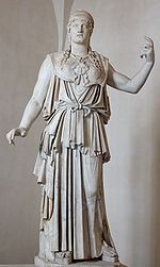
Athena Type Velletri


Counselor

Later myths of the Classical Greeks relate that Athena guided Perseus in his quest to behead Medusa. She instructed Heracles
Heracles

In Greek mythology, Heracles or Herakles meaning "glory of Hera", or "Glorious through Hera" Alcides or Alcaeus " was a hero, the son of Zeus and Alcmene, foster son of Amphitryon and great-grandson of Perseus....
 to skin the Nemean Lion
Nemean Lion

The Nemean lion was a vicious monster in Greek mythology that lived in Nemea. He was eventually killed by Heracles. The lion was usually considered the offspring of Typhon and Echidna , but it was also said to have fallen from the moon, offspring of Zeus and Selene....
 by using its own claws to cut through its thick hide. She also helped Heracles to defeat the Stymphalian Birds
Stymphalian birds

In Greek mythology, the Stymphalian birds were man-eating birds with wings of brass and sharp metallic feathers they could launch at their victims, and were pets of Ares, the god of war....
, and to navigate the underworld so as to capture Cerberos.

In another late story, it is said that Odysseus
Odysseus

Odysseus or Ulysses , in Greek mythology , was a legendary Greeks king of Ithaca and the hero of Homer's Epic poetry, the Odyssey. Odysseus also plays a key role in Homer's Iliad and other works in the Epic Cycle....
' cunning and shrewd nature quickly won Athena's favour. In the realistic epic mode, however, she largely is confined to aiding him only from afar, as by implanting thoughts in his head during his journey home from Troy. It is not until he washes up on the shore of an island where Nausicaa
Nausicaa

In ancient Greek mythology, Nausicaa is the daughter of King Alcinous of the Phaeacians and Queen Arete in Homer's Odyssey , Book Six. Her name means, in Greek, "burner of ships"....
 is washing her clothes that Athena arrives personally to provide more tangible assistance. She appears in Nausicaa's dreams to ensure that the princess rescues Odysseus and plays a role in his eventual escort to Ithaca.

Athena appears in disguise to Odysseus upon his arrival, initially lying and telling him that Penelope, his wife, has remarried and that he is believed to be dead; but Odysseus lies back to her, employing skillful prevarications to protect himself. Impressed by his resolve and shrewdness, she reveals herself and tells him what he needs to know in order to win back his kingdom. She disguises him as an elderly man or beggar so that he cannot be noticed by the suitors or Penelope, and helps him to defeat the suitors. She also plays a role in ending the resultant feud against the suitors' relatives.

Roman fable of Arachne

The fable
Fable

A fable is a succinct story, in prose or verse, that features animals, plants, inanimate, or nature which are anthropomorphized , and that illustrates a moral lesson , which may at the end be expressed explicitly in a pithy maxim ....
 of Arachne
Arachne

In Greco-Roman mythology, Arachne was a great mortal weaver who boasted that her skill was greater than that of Minerva, the Latin parallel of Pallas Athena, goddess of crafts....
 is a late Roman addition to Classical Greek mythology
Greek mythology

Greek mythology is the body of myths and legends belonging to the Ancient Greece concerning their List of Greek mythological figures#Immortals and Greek hero cult, Cosmology#Metaphysical cosmology, and the origins and significance of their own cult and ritual practices....
, that, of course, does not appear in the myth repertory of the Attic vase-painters. Arachne's name simply means spider (a?????). Arachne was the daughter of a famous dyer in Tyrian purple
Tyrian purple

Tyrian purple , also known as royal purple, imperial purple or imperial dye, is a purple-red dye which was first produced by the ancient Phoenicians in the city of Tyre, Lebanon....
 in Hypaipa of Lydia
Lydia

Lydia was an Iron Age kingdom of western Asia Minor located generally east of ancient Ionia in the modern Turkey provinces of Manisa Province and inland Izmir Province....
. She became so conceited of her skill as a weaver that she began claiming that her skill was greater than that of Athena herself.

Athena gave Arachne a chance to redeem herself by assuming the form of an old woman and warning Arachne not to offend the deities. Arachne scoffed and wished for a weaving contest, so she could prove her skill.

Athena wove the scene of her victory over Poseidon
Poseidon

In Greek mythology, Poseidon was the god of the sea and, as "Earth-Shaker," of earthquakes. The name of the god Nethuns in Etruscan mythology was adopted in Latin for Neptune in Roman mythology: both were sea gods analogous to Poseidon....
 that had inspired her patronage of Athens. According to the Latin narrative, Arachne's tapestry featured twenty-one episodes of the infidelity of the deities: Zeus
Zeus

Zeus in Greek mythology is the king of the gods, the ruler of Mount Olympus and the god of the sky father and List of thunder gods. His symbols are the thunderbolt, eagle, bull , and oak....
 being unfaithful with Leda
Leda (mythology)

In Greek mythology, Leda was daughter of the Aetolian king Thestius, and wife of the king Tyndareus, of Sparta. Her myth gave rise to the popular motif in Renaissance and later art of Leda and the Swan....
, with Europa, with Danaë
Danaë

File:Danae gold shower Louvre CA925.jpgIn Greek mythology, Dana? was a daughter of King Acrisius of Argos and Eurydice of Argos . She was the mother of Perseus by Zeus....
.

Athena admitted that Arachne's work was flawless, but was outraged at Arachne's disrespectful choice of subjects that displayed the failings and transgressions of the deities. Finally, losing her temper, Athena destroyed Arachne's tapestry and loom, striking it with her shuttle, Arachne realized her folly and hanged herself. In Ovid's telling, Athena took pity on Arachne who was changed into a spider.

The fable suggests that the origin of weaving lay in imitation of spiders and that it was considered to have been perfected first in Asia Minor
Anatolia

Anatolia or Asia Minor is a region of Western Asia, comprising most of the modern Republic of Turkey. It is a geographic region bounded by the Black Sea to the north, the Caucasus to the northeast, the Aegean Sea to the west, the Mediterranean Sea to the south, and the Iranian plateau to the east and southeast....
.

Cult and attributes

Athena Ciste
Athena's epithet
Epithet

An epithet is a descriptive word or phrase accompanying or occurring in place of the name of a person or thing, which has become a fixed formula....
s include , Atrytone (= the unwearying), , Parthénos (= virgin), and , Promachos (the First Fighter, i. e. she who fights in front).

In poetry from Homer, an oral tradition of the eighth or seventh century BC, onward, Athena's most common epithet
Epithets in Homer

A characteristic of Homer's style is an epithet, as in "rosy-fingered dawn" or "swift-footed Achilles." These epithets were metric stop-gaps as well as mnemonic devices for the aoidos ? both, signs of the deep oral tradition that preceded the written codification of the Iliad and Odyssey....
 is glaukopis (??a???p??), which usually is translated as, bright-eyed or with gleaming eyes. The word is a combination of glaukos (??a????, meaning gleaming, silvery, and later, bluish-green or gray) and ops (??, eye, or sometimes, face). It is interesting to note that glaux (??a??, "owl") is from the same root, presumably because of the bird's own distinctive eyes. The bird which sees well in the night is closely associated with the goddess of wisdom
Wisdom

Wisdom is knowledge, understanding, experience, discretion, and Intuition , along with a capacity to apply these qualities well towards finding solutions to problems....
: in archaic images, Athena is frequently depicted with an owl perched on her head. The olive
Olive

The Olive is a species of small tree in the family Oleaceae, native to the coastal areas of the eastern Mediterranean region, from Lebanon, Syria and the maritime parts of Turkey and northern Iran at the south end of the Caspian Sea....
 tree is likewise sacred to her. In earlier times, Athena may well have been a bird goddess
Bird goddess

The term Bird goddess was coined by Marija Gimbutas with relation to Neolithic Europe. The Vinca culture, in particular, had a bird goddess. Griffen even claims to have discovered a sign for the bird goddess in the Vinca signs....
, similar to the unknown goddess depicted with owls, wings, and bird talons on the Burney relief
Burney Relief

The Burney Relief, named after a former owner, is the common term for an early 2nd millennium BC Mesopotamian terracotta relief of a winged, nude goddess-like figure with eagle's talons, flanked by owls, and perched upon supine lionesses....
, a Mesopotamian terracotta relief of the early second millennium BC.

Other epithets include: Aethyta under which she was worshiped in Megara
Megara

Megara is an ancient city in Attica, Greece. It lies in the northern section of the Isthmus of Corinth opposite the island of Salamis Island, which belonged to Megara in archaic times, before being taken by Athens....
. The word aithyia signifies a diver, and figuratively, a ship, so the name must reference Athena teaching the art of shipbuilding or navigation. In a temple at Phrixa in Elis
Elis

Elis, or Eleia is an ancient district, that corresponds with the modern Elis Prefecture. It is in southern Greece on the Peloponnesos peninsula, bounded on the north by Achaea, east by Arcadia, south by Messenia, and west by the Ionian Sea....
, which was reportedly built by Clymenus, she was known as Cydonia.

Epithets

In the Iliad
ILiad

The iLiad is an electronic handheld device, or e-book device, which can be used for document reading and editing. Like the Sony Reader or Amazon Kindle, the iLiad makes use of an electronic paper display....
 (4.514), the Homeric Hymns
Homeric Hymns

The thirty-three anonymous Homeric Hymns celebrating individual gods are a collection of ancient Greek language hymns, "Homeric" in the sense that they employ the same epic meter? dactylic hexameter? as the Iliad and Odyssey, use many similar formulas and are couched in the same dialect....
, and in Hesiod
Hesiod

Hesiod was a Greek language oral poet, his date is uncertain but leading scholars agree that Hesiod lived in the latter half of the Eighth-century BCE....
's Theogony
Theogony

The Theogony is a poem by Hesiod describing the origins and genealogy of the polytheism of the ancient Greeks, composed circa 700 BC....
, Athena is given the curious epithet Tritogeneia. The meaning of this term is unclear. It seems to mean "Triton
Triton (mythology)

Triton is a mythological Greek mythology, the messenger of the deep. He is the son of Poseidon, god of the sea, and Amphitrite, goddess of the sea....
-born", perhaps indicating that the sea-deity was her parent according to some early myths, or, less likely, that she was born near Lake Triton in Africa
Africa

Africa is the world's second-largest and second most-populous continent, after Asia. At about 30.2 million km? including adjacent islands, it covers 6% of the Earth's total surface area and 20.4% of the total land area....
. This is the same location noted in The Greek Myths (8.a ff.), by Robert Graves
Robert Graves

Robert Ranke Graves was an England poet, translator and novelist. During his long life, he produced more than 140 works. He was the son of the Anglo-Irish writer Alfred Perceval Graves and Amalie von Ranke, a niece of the famous German historian Leopold von Ranke....
 as the possible location from which the worship of Neith
Neith

In Ancient Egyptian religion, Neith was an early goddess in the Egyptian pantheon. She was the patron Deities#Egyptian mythology of Sais, Egypt, where her cult was centered in the Western Nile Delta of Egypt and attested as early as the First Dynasty.....
 was imported into Crete and then into Greece as the warrior goddess Athena at a very early date, perhaps as early as 3,500 BC.

Another possible meaning may be triple-born or third-born, which may refer to a triad or to her status as the third daughter of Zeus or the fact she was born from Metis, Zeus, and herself; various legends list her as being the first child after Artemis and Apollo, though other legends identify her as Zeus' first child. The latter would have to be drawn from Classical myths, however, rather than earlier ones.

In her role as judge at Orestes'
Orestes (mythology)

In Greek mythology, Orestes was the son of Clytemnestra and Agamemnon. He is the subject of several Ancient Greek theatre and of various legends connected with his madness and purification....
 trial on the murder of his mother, Clytemnestra
Clytemnestra

Clytemnestra was the wife of Agamemnon, king of the Ancient Greece kingdom of Mycenae or Argos. In the Oresteia by Aeschylus, she was a femme fatale who murdered her husband, Agamemnon—said by Euripides to be her second husband—and his concubine Cassandra....
 (which he won), Athena won the epithet Athena Areia.

Other epithets were Ageleia
Ageleia

Ageleia or Ageleis was an epithet of the Greek mythology Athena, of somewhat obscure definition, mostly playing off the meaning of the Greek words ago , the verb for leading or doing, and leia , a noun meaning "plunder" or "spoils", particularly herds of cattle....
 and Itonia
Itonia

Itonia, Itonias or Itonis was an epithet of the Greek mythology Athena worshiped widely in Thessaly and elsewhere. The name was derived from the town of Iton in the south of Phthiotis....
.

Ac
Athena was given many other cult titles. She had the epithet Athena Ergane as the patron of craftsmen and artisans. With the epithet Athena Parthenos
Athena Parthenos

Athena Parthenos was the title of a massive chryselephantine sculpture of the Greek mythology goddess Athena by Phidias. It was named after an epithet for the goddess herself, and was housed in the Parthenon in Athens....
("virgin"), Athena was worshiped on the Classical period Acropolis
Acropolis

Acropolis literally means city on the edge . For purposes of defense, early settlers naturally chose elevated ground, frequently a hill with precipitous sides....
, especially in the festivals of the Panathenaea and Pamboeotia
Pamboeotia

Pamboeotia was a major festive panegyris of all the Boeotians, celebrated probably annually, which the grammarians compare with the Panathenaea of the Atticans, and the Panionia of the Ionians....
. With the epithet
Athena Promachos she led in battle. With the epithet Athena Polias ("of the city"), Athena was the protector of Athens and its Acropolis, but also of many other cities, including Argos
Argos

Argos is a city in Greece in the Peloponnese near Nafplion, which was its historic harbour, named for Nauplius ....
, Sparta
Sparta

Sparta was a city-state in ancient Greece, situated on the Eurotas River in the southern part of the Peloponnese. From circa 650 BC it rose to become the dominant military power in the region and as such was recognized as the overall leader of the combined Greek forces during the Greco-Persian Wars....
, Gortyn
Gortyn

Gortyn or Gortyna is an archaeological site on the Mediterranean island of Crete, 45 km away from the modern capital Heraklion. Gortyn, the Ancient Rome capital of Crete, was first inhabited around 3200 BC, and was a flourishing Minoan civilization town between 1600-1100 BC....
, Lindos
Lindos

Lindos is a town and an Archeology site on the east coast of the Greece island of Rhodes, in the Dodecanese in southeastern Aegean Sea Sea. It is about 55km south of the town of Rhodes and its fine beaches make it a popular tourist and holiday destination....
, and Larisa.

She was given the epithet
Athena Hippeia
Hippeia

Hippeia or Hippea is the name of two characters in Greek mythology.Athena Hippeia Athena Hippeia is Athena as a goddess of horses....
or Athena Hippia, horse as the inventor of the chariot
Chariot

The chariot is the earliest and simplest type of carriage, used in both peace and war as the chief vehicle of many ancient peoples. Chariots were built in Mesopotamia by the Mesopotamians as early as 3000 BC and in China during the 2nd millennium BC....
, and was worshipped under this title at Athens, Tegea
Tegea

Tegea was a settlement in ancient Greece, and it is also a municipality in modern Arcadia, Greece, with its seat in the village Stadio.Ancient Tegea was an important religious center of ancient Greece, containing the Temple of Athena Alea....
 and Olympia
Olympia, Greece

Olympia , a sanctuary of ancient Greece in Elis, is known for having been the site of the Olympic Games in classical times, comparable in importance to the Pythian Games held in Delphi....
. As Athena Hippeia she was given an alternative parentage: Poseidon
Poseidon

In Greek mythology, Poseidon was the god of the sea and, as "Earth-Shaker," of earthquakes. The name of the god Nethuns in Etruscan mythology was adopted in Latin for Neptune in Roman mythology: both were sea gods analogous to Poseidon....
 and Polyphe, daughter of Oceanus
Oceanus

Oceanus was believed to be the World Ocean in classical antiquity, which the Ancient Rome and Ancient Greece considered to be an enormous river encircling the world....
.. In each of these cities her temple frequently was the major temple on the acropolis.

Athena often was equated with Aphaea
Aphaea

Aphaea was a Greek mythology who was worshipped exclusively at a single sanctuary on the island of Aegina in the Saronic Gulf. She originated as early as the 14th century BCE as a local deity associated with fertility and the agricultural cycle Under Athenian hegemony, however, she came to be identified with the goddesses Athena and Artemi...
, a local goddess of the island of Aegina
Aegina

Aegina is one of the Greek islands of Greece in the Saronic Gulf, 17 miles from Athens. Tradition derives the name from Aegina, the mother of Aeacus, who was born in and ruled the island....
, located near Athens
Athens

Athens , the Capital and largest city of Greece, dominates the Attica periphery; as one of the List of cities by time of continuous habitation, its recorded history spans around 3,400 years....
, once Aegina was under Athenian's power. The Greek historian Plutarch
Plutarch

Lucius Mestrius Plutarchus , c. AD 46 ? 120 ? commonly known in English as Plutarch ? was a Ancient Rome historian , biographer, essayist, and Middle Platonism....
 (46 AD–120 AD) also refers to an instance during the Parthenon's construction of her being called
Athena Hygieia
Hygieia

In Greek mythology, Hygieia or Hygeia was a daughter of Asclepius. She was the goddess of health, cleanliness and sanitation and afterwards, the moon....
("healer"):

In classical times the Plynteria
Plynteria

Plynteria was a festival of ancient Greece celebrated at Athens every year, on the 22nd of Thargelion, in honor of Athena Polias, with the heroine Aglaulus, daughter of Cecrops , whose temple stood on the Acropolis....
, or “Feast of Adorning”, was observed every May, it was a festival lasting five days. During this period the Priestesses of Athena, or “Plyntrides”, performed a cleansing ritual within “the Erecththeum”, the personal sanctuary of the goddess. Here Athena's statue was undressed, her clothes washed, and body purified.

In Arcadia
Arcadia

Arcadia, Arkad?a , or Arcady is a region of Greece in the Peloponnesus. It takes its name from the mythological character Arcas....
, she was assimilated with the ancient goddess Alea and worshiped as Athena Alea
Athena Alea

Alea was an epithet of the Greek mythology Athena, prominent in Arcadian mythology, under which she was worshiped at Alea, Greece, Mantineia and Tegea....
.

In Classical art

Pallasgiustiniani
Attalusicorrected

Classically, Athena is portrayed wearing full armor, with her helmet raised high on the forehead to reveal the image of Nike
Nike (mythology)

In Greek mythology, Nike , was a goddess who personified triumph throughout the ages of the ancient Greek culture. The Roman equivalent was Victoria ....
. Her shield bears at its centre the
gorgoneion, the head of the gorgon
Gorgon

In Greek mythology, the Gorgon was a vicious monster with sharp fangs. She was a protective deity from early religious concepts. Her power was so strong that one attempting to look upon her, would be turned to stone, therefore, such images were put upon items from temples to wine kraters for protection....
, as does her aegis. It is in this standing posture that she was depicted in Phidias
Phidias

Phidias or Pheidias; ; circa 480 BC 430 BC), was a Hellenic civilization sculptor, painter and architect, who lived in the Classical Greece, in the 5th century BC, and is commonly regarded as one of the greatest of all Classical sculptors....
's famous lost gold and ivory
Chryselephantine

Chryselephantine is the technical term given to a type of cult statue that enjoyed high status in Ancient Greece.Chryselephantine statues were built around a wooden frame, with thin carved slabs of ivory attached, representing the flesh, and sheets of gold leaf representing the garments, armour, hair, and other details....
 statue of her, 36 m tall, the
Athena Parthenos
Athena Parthenos

Athena Parthenos was the title of a massive chryselephantine sculpture of the Greek mythology goddess Athena by Phidias. It was named after an epithet for the goddess herself, and was housed in the Parthenon in Athens....
in the Parthenon
Parthenon

The Parthenon is a Greek temple of the Greek gods Athena, built in the 5th century BC on the Acropolis of Athens. It is the most important surviving building of Classical Greece, generally considered to be the culmination of the development of the Doric order....
. Athena also often is depicted with an owl
Owl

The Strigiformes are an order of bird of prey, comprising 200 species. Most are solitary, and Nocturnal animal, with some exceptions . Owls mostly hunt small mammals, insects, and other birds, though a few species specialize in hunting fish....
 sitting on one of her shoulders. The
Mourning Athena
Mourning Athena

Mourning Athena is a Greece relief sculpture dating circa c450 BC. It is one of the first Greek statues to portray human emotion as a significant part of the subject....
is a relief sculpture that dates around 460 BC and portrays a weary Athena resting on a staff. In earlier, archaic portraits of Athena in Black-figure pottery
Black-figure pottery

The black-figure pottery technique is a style of ancient Pottery of Ancient Greece painting in which the decoration appears as black silhouettes on a red background....
, the goddess retains some of her Minoan-Mycenaean character, such as great bird wings although this is not true of archaic sculpture such as those of Aphaean Athena, where Athena has subsumed an earlier, invisibly numinous —
Aphaea
Aphaea

Aphaea was a Greek mythology who was worshipped exclusively at a single sanctuary on the island of Aegina in the Saronic Gulf. She originated as early as the 14th century BCE as a local deity associated with fertility and the agricultural cycle Under Athenian hegemony, however, she came to be identified with the goddesses Athena and Artemi...
— goddess with Cretan connections in her mythos.

Other commonly received and repeated types of Athena in sculpture may be found in this list.

Apart from her attributes, there seems to be a relative consensus in late sculpture from the Classical period, the fifth century onward, as to what Athena looked like. Most noticeable in the face is perhaps the full round strong chin with a high nose that has a high bridge as a natural extension of the forehead. The eyes typically are somewhat deeply set. The unsmiling lips are usually full, but the mouth is fairly narrow, usually just slightly wider than the nose. The neck is somewhat long. The net result is a serene, serious, somewhat aloof beauty.

Name, etymology, and origin

Athena had a special relationship with Athens
Athens

Athens , the Capital and largest city of Greece, dominates the Attica periphery; as one of the List of cities by time of continuous habitation, its recorded history spans around 3,400 years....
, as is shown by the etymological connection of the names of the goddess and the city. Athena was said to have won a contest with Poseidon
Poseidon

In Greek mythology, Poseidon was the god of the sea and, as "Earth-Shaker," of earthquakes. The name of the god Nethuns in Etruscan mythology was adopted in Latin for Neptune in Roman mythology: both were sea gods analogous to Poseidon....
, god of the Sea, over the city of Athens.

In Classical myths Zeus had decided that, in order to settle the feud, whoever gave the city the most useful gift would win ownership and patronage of the city. Poseidon gave the city a fountain of flowing water, but it was salty and was not much help to the people. Athena planted the first olive tree, which provided the people with food, firewood, and shade. She showed how to crush olives to make oil, that could then be used in a variety of ways. Athena's gift was the most useful, and she won patronage of the city. Athens was then named in her honor. The citizens of Athens built a statue of Athena as a temple to the goddess, which had piercing eyes, a helmet on her head, attired with an aegis or cuirass
Cuirass

Cuirass , the plate armour, is formed of a single piece of metal or other rigid material or composed of two or more pieces, which covers the front of the wearer's person....
, and an extremely long spear. It also had a crystal shield with the head of the Gorgon on it. A large snake accompanied her and she held the goddess of victory in her hand.

Athena is associated with Athens
Athens

Athens , the Capital and largest city of Greece, dominates the Attica periphery; as one of the List of cities by time of continuous habitation, its recorded history spans around 3,400 years....
, a plural name because it was the place where she presided over her sisterhood, the
Athenai, in earliest times: "[Mycenae] was the city where the Goddess was called Mykene, and Mycenae is named in the plural for the sisterhood of females who tended her there. At Thebes she was called Thebe, and the city again a plural, Thebae (or Thebes, where the "s" is the plural formation). Similarly, at Athens she was called Athena, and the city Athenae (or Athens, again a plural)." Whether her name is attested in Eteocretan or not will have to wait for decipherment of Linear A
Linear A

Linear A is one of two linear scripts used in ancient Crete before Mycenaean Greek language Linear B. In Minoan Civilization times, before the Greek Mycenaean dominion, Linear A was the official script for the palaces and the cult and Cretan Hieroglyphs were mainly used on seals....
.

Günther Neumann has suggested that Athena's name is possibly of Lydian
Lydian

Lydian may refer to:* Lydian language, an ancient Anatolian language* Lydian script* Lydian mode, one of the modes derived from ancient Greek music...
 origin; it may be a compound word derived in part from Tyrrhenian "ati", meaning
mother and the name of the Hurrian goddess "Hannahannah
Hannahannah

Hurrian Mother Goddess Hannahannah . Hannahannah may have been related to or influenced by the pre-Sumerian Goddess Inanna, although the similarity in name to the Bible Hannah , mother of Samuel ; the Canaan Anath, and the Christian St Anne are coincidental, the name Hannah in Hebrew having a different etymology deriving from a native root....
" shortened in various places to "Ana" . In Mycenaean Greek, at Knossos
Knossos

Knossos , also known as the Knossos Palace is the largest Bronze Age archaeological site on Crete and probably the ceremonial and political center of the Minoan civilization and culture....
 a single inscription
A-ta-na po-ti-ni-ja /Athana potniya/ appears in the Linear B
Linear B

Linear B is a script that was used for writing Mycenaean language, an early form of Greek language. It predated the Greek alphabet by several centuries and seems to have died out with the fall of Mycenaean Greece civilization....
 tablets from the Late Minoan II-era "Room of the Chariot Tablets"; these comprise the earliest Linear B archive anywhere. Although
Athana potniya often is translated Mistress Athena, it literally means "the potnia of At(h)ana", which perhaps, means the Lady of Athens; Any connection to the city of Athens in the Knossos inscription is uncertain. We also find A-ta-no-dju-wa-ja /Athana diwya/, the final part being the Linear B spelling of what we know from Ancient Greek as Diwia (Mycenaean di-u-ja or di-wi-ja): divine Athena also was a weaver and the deity of crafts. (see dyeus
Dyeus

*Dyeus is the reconstructed chief deity of the Proto-Indo-Europeans pantheon . He was the god of the daylight sky, and his position may have mirrored the position of the patriarch or monarch in Proto-Indo-European society....
).

In his dialogue
Cratylus
Cratylus (dialogue)

Cratylus is the name of a dialogue by Plato. Most modern scholars agree that it was written mostly during Plato's so-called middle period....
, the Greek philosopher Plato
Plato

Plato , was a Classical Greece Greeks philosopher, mathematician, writer of philosophical dialogues, and founder of the Platonic Academy in Ancient Athens, the first institution of higher learning in the western world....
, 428/427 BC – 348/347 BC, gives the etymology of Athena's name, based on the view of the ancient Athenians:

Thus for Plato her name was to be derived from Greek ??e???a, Atheonóa —which the later Greeks rationalised as from the deity's (theos) mind (nous).

The Greek historian, Herodotus
Herodotus

Herodotus of Halicarnassus was a Greeks historian who lived in the 5th century BC and is regarded as the "Father of History" in Western culture....
 (c. 484–425 BC), noted that the Egyptian citizens of Sais
SAIS

SAIS can refer to:* Paul H. Nitze School of Advanced International Studies, part of The Johns Hopkins University.* Scottish Avalanche Information Service...
 in Egypt worshipped a goddess whose Egyptian name was Neith
Neith

In Ancient Egyptian religion, Neith was an early goddess in the Egyptian pantheon. She was the patron Deities#Egyptian mythology of Sais, Egypt, where her cult was centered in the Western Nile Delta of Egypt and attested as early as the First Dynasty.....
; and they identified her with Athena. (Timaeus
Timaeus (dialogue)

Timaeus is a theoretical treatise of Plato in the form of a Socratic dialogue, written circa 360 Before Christ. The work puts forward speculation on the nature of the physical world....
 21e), (Histories
Histories (Herodotus)

The Histories of Herodotus of Halicarnassus is considered the first work of history in Western literature. Written about 440 BC in the Ionic dialect of classical Greek, The Histories tells the story of the Greco-Persian Wars between the Achaemenid Empire and the Polis in the 5th century BC....
 2:170–175).

Some authors believe that, in early times, Athena was either an owl
Owl

The Strigiformes are an order of bird of prey, comprising 200 species. Most are solitary, and Nocturnal animal, with some exceptions . Owls mostly hunt small mammals, insects, and other birds, though a few species specialize in hunting fish....
 herself or a bird goddess
Bird goddess

The term Bird goddess was coined by Marija Gimbutas with relation to Neolithic Europe. The Vinca culture, in particular, had a bird goddess. Griffen even claims to have discovered a sign for the bird goddess in the Vinca signs....
 in general: in Book 3 of the Odyssey
Odyssey

The Odyssey is one of two major ancient Hellenic civilization epic poetrys attributed to Homer. It is, in part, a sequel to the Iliad, the other work traditionally ascribed to Homer....
, she takes the form of a sea-eagle
Sea eagle (bird)

A sea eagle is any of the bird of prey in the genus Haliaeetus in the bird of prey family Accipitridae.Sea-eagles vary in size, from the Sanford's Fish-eagle averaging 2?2.7 kg to the huge Steller's Sea-eagle weighing up to 9 kg....
. These authors argue that she dropped her prophylactic owl-mask before she lost her wings. "Athena, by the time she appears in art," Jane Ellen Harrison had remarked, "has completely shed her animal form, has reduced the shapes she once wore of snake and bird to attributes, but occasionally in black-figure vase-paintings she still appears with wings." Some authors claim that her tasselled aegis
Aegis

"Aegis" is a large collar or cape worn in ancient times to display the protection provided by a high religious authority or, it is the holder of a protective shield signifying the same, such as a bag-like garment that contained a shield....
 may be the remnants of wings. Others believe that it is scaly, indicating that it is snakeskin.

In post-classical culture

Athena (Minerva) is the subject of the $50 1915-S Panama-Pacific commemorative coin
Commemorative coin

Commemorative coins are coins that were issued to commemorate some particular event or issue. Most world commemorative coins were issued from the 1960s onward, although there are numerous examples of commemorative coins of earlier date....
. At 2.5 troy oz (78 g) gold, this is the largest (by weight
Weight

In the physical sciences, weight is a measurement of the gravitational force acting on an object. Near the surface of the Earth, the Earth's gravity is approximately constant; this means that an object's weight is roughly proportional to its mass....
) coin ever produced by the U.S. Mint
United States Mint

The United States Mint primarily produces circulating currency for the United States to conduct its trade and commerce. The main Mint facility is located in Philadelphia, Pennsylvania, and branch mint are located in Denver, Colorado; San Francisco, California; and West Point, New York....
. This was the first $50 coin issued by the U.S. Mint and no higher was produced until the production of the $100 platinum coins in 1997. Of course, in terms of face-value in adjusted dollars, the 1915 is the highest denomination ever issued by the U.S. Mint.

For over a century a full-scale replica of the Parthenon
Parthenon (Nashville)

The Parthenon in Nashville, Tennessee is a full-scale replica of the original Parthenon in Athens. It was built in 1897 as part of the Tennessee Centennial and International Exposition....
 has stood in Nashville, Tennessee
Nashville, Tennessee

Nashville is the Capital of the U.S. state of Tennessee and the county seat of Davidson County, Tennessee. It is the second most populous city in the state after Memphis, Tennessee....
, which is known as the Athens of the South. In 1990, a gilded 41 feet (12.5 m) tall replica of Phidias' statue
Athena Parthenos

Athena Parthenos was the title of a massive chryselephantine sculpture of the Greek mythology goddess Athena by Phidias. It was named after an epithet for the goddess herself, and was housed in the Parthenon in Athens....
 of Athena Parthenos was added. The state seal of California
Seal of California

The Great Seal of the State of California was adopted at the California U.S. state Constitutional Convention of 1849 and redesigned in 1937. The seal features the Roman goddess Minerva, the goddess of wisdom and war; a Brown bear feeding on grape vines, representing California's wine production; a sheaf of grain, representing agriculture;...
 features an image of Athena (or Minerva) kneeling next to a brown grizzly bear.

Athena is the symbol of the Darmstadt University of Technology
Darmstadt University of Technology

The Darmstadt University of Technology, whose official name is "Technische Universit?t Darmstadt", in Darmstadt, Germany plays a significant role among German universities....
, Germany.

The title character in Edgar Allan Poe
Edgar Allan Poe

Edgar Allan Poe was an American poet, Short story writer, Editing and Literary criticism, and is considered part of the American Romanticism. Best known for his tales of Mystery and the macabre, Poe was one of the earliest American practitioners of the short story and is considered the inventor of the Detective fiction genre....
's "The Raven
The Raven

"The Raven" is a narrative poetry by the United States writer Edgar Allan Poe, first published in January 1845. It is noted for its musicality, stylized language, and supernatural atmosphere....
" famously sits upon "a Bust of Pallas".

She is the symbol of the United States Women's Navy and was depicted on their Unit Crest. A medal awarded to women who served in the Women Army Auxiliary Corps from 10 July 1942 to 31 August 1943, and to the Women Army Corps from 1 September 1943 to 2 September 1945 featured Athena on the front.

Athena's Helmet is the central feature on the United States Military Academy
United States Military Academy

The United States Military Academy at West Point is a four-year coeducational United States Service academies located at West Point, New York, New York....
 .

Athena is reported as a source of influence for feminist theologians such as Carol P. Christ
Carol P. Christ

Carol P. Christ is a teacher and author and holds a Ph.D. from Yale University. She is the author of the widely reprinted essay "Why Women Need the Goddess," , which argues in favor of the concept of there having been an ancient religion of a supreme Goddess....
.

Pallas Athena is the tutelary goddess of the international social fraternity Phi Delta Theta
Phi Delta Theta

Phi Delta Theta is an international Fraternities and sororities founded in 1848 and headquartered at Miami University in Oxford, Ohio. Phi Delta Theta, Beta Theta Pi, and Sigma Chi form the Miami Triad....
. Her owl is also a symbol of the fraternity.

The goddess also holds a special place in the traditions at Bryn Mawr College
Bryn Mawr College

'Bryn Mawr College' is a highly selective Women's colleges in the United States Liberal arts colleges in the United States located in Bryn Mawr, Pennsylvania, a community in Lower Merion Township, Pennsylvania, Pennsylvania, ten miles west of Philadelphia, Pennsylvania....
 in Pennsylvania. A statue of Athena (a replica of the original bronze one in the archaeology library) resides in the Great Hall. It is traditional at exam time for students to leave offerings to the goddess with a note asking for good luck, or to repent for accidentally breaking any of the college's numerous other traditions. Athena's owl also serves as the mascot of the college.

A statue of the seated skeptical thinker Ernest Renan
Ernest Renan

Ernest Renan was a France philosopher and writer, deeply attached to his native province of Brittany. He is best known for his influential historical works on early Christianity and his political theory theories....
, shown to the left, caused great controversy when it was installed in Tréguier, Brittany
Brittany

Brittany is a former independent Celtic nations monarchy and duchy, now incorporated into France. It is also, more generally, the name of the cultural area whose limits correspond to the historic province and independent duchy....
. Renan's 1862 biography of Jesus had denied his divinity, and he had written the addressed to the goddess Athena. The statue was placed next to the cathedral. Renan's head was turned away from the building, while Athena, beside him, was depicted raising her arm, which has been interpreted by some to indicate a challenge to the church. The installation was accompanied by a mass protest from local Roman Catholics and a religious service against the growth of skepticism
Skepticism

In ordinary usage, skepticism or scepticism refers to:* an attitude of doubt or a disposition to incredulity either in general or toward a particular object;...
 and secularism
Secularism

Secularism is the assertion that governmental practices or institutions should exist separately from religion and/or religious beliefs.In one sense, secularism may assert the right to be free from religious rule and teachings, and freedom from the government imposition of religion upon the people, within a state that is neutral on matters...
.

See also

  • Athena has been used numerous times as a symbol of a republic by different countries. A recent sample is the 60 Years of the Second Republic commemorative coin
    Euro gold and silver commemorative coins (Austria)

    Euro gold and silver commemorative coins are special euro coins Mint and issued by member states of the Eurozone. They are minted mainly in gold and silver, although other precious metals are also used on rare occasions....
     issued by Austria in 2005. Athena is depicted in the obverse of the coin, representing the Austrian Republic.
  • Palladium (mythology)
    Palladium (mythology)

    In Greek mythology and Roman mythology, a palladium or palladion was an Cult image of great antiquity on which the safety of a city was said to depend....


Footnotes


Ancient sources

  • Augustine, De civitate dei xviii.8–9
  • Cicero, De natura deorum iii.21.53, 23.59
  • Eusebius, Chronicon 30.21–26, 42.11–14
  • Lactantius, Divinae institutions i.17.12–13, 18.22–23
  • Livy, Ad urbe condita libri vii.3.7
  • Lucan, Bellum civile ix.350


Modern sources

  • Burkert, Walter
    Walter Burkert

    Walter Burkert , a scholar of Greek mythology and Cult , is an emeritus professor of classics at the University of Zurich, Switzerland, and also has taught in the United Kingdom and the United States....
    , 1985. Greek Religion (Harvard).
  • Graves, Robert
    Robert Graves

    Robert Ranke Graves was an England poet, translator and novelist. During his long life, he produced more than 140 works. He was the son of the Anglo-Irish writer Alfred Perceval Graves and Amalie von Ranke, a niece of the famous German historian Leopold von Ranke....
    , (1955) 1960. The Greek Myths revised edition.
  • Kerenyi, Karl
    Karl Kerényi

    One of the founders of modern studies in Greek mythology, K?roly Ker?nyi was born in Temesv?r, Hungary , and then lived in Hungary....
    , 1951. The Gods of the Greeks (Thames and Hudson).
  • Harrison, Jane Ellen
    Jane Ellen Harrison

    Jane Ellen Harrison was a ground-breaking United Kingdom of Great Britain and Ireland classics scholar, linguistics and feminist. Harrison is one of the founders, with Karl Kerenyi and Walter Burkert, of modern studies in Greek mythology....
    , 1903. Prolegomena to the Study of Greek Religion.
  • Palaima, Thomas, 2004. "Appendix One: Linear B Sources." In Trzaskoma, Stephen, et al., eds., Anthology of Classical Myth: Primary Sources in Translation (Hackett).
  • Ruck, Carl A.P. and Danny Staples, 1994. The World of Classical Myth: Gods and Goddesses, Heroines and Heroes (Durham, NC).
  • Telenius, Seppo Sakari
    Seppo Telenius

    Seppo Sakari Telenius is a Finland writer and historian. He studied political history and social history at the University of Helsinki . His varied body of works includes novels, short stories, poems, local history books as well as essays....
    , 2005 and 2006. Athena-Artemis.
  • Trahman, C.R., 1952. "Odysseus' Lies ('Odyssey', Books 13-19)" in Phoenix, Vol. 6, No. 2 (Classical Association of Canada), pp. 31-43.
  • Ventris, Michael
    Michael Ventris

    Michael George Francis Ventris was an England architect and classical scholar who, along with John Chadwick, was responsible for the decipherment of Linear B....
     and John Chadwick
    John Chadwick

    John Chadwick was an England Linguistics and Classics scholar most famous for his role in deciphering Linear B, along with Michael Ventris....
    , 1973. Documents in Mycenaean Greek (Cambridge).


External links

  • —Extracts of classical texts
  • —Repertory of main Athena types and post-Renaissance depictions
  • —Another, more extensive repertory of Greek and Roman types