
Home      Discussion      Topics      Dictionary      Almanac
Signup       Login
William Hogarth

William Hogarth

Overview
William Hogarth was an English painter
Painting
Painting is the practice of applying paint, pigment, color or other medium to a surface . The application of the medium is commonly applied to the base with a brush but other objects can be used. In art, the term painting describes both the act and the result of the action. However, painting is...

, printmaker
Printmaking
Printmaking is the process of making artworks by printing, normally on paper. Printmaking normally covers only the process of creating prints with an element of originality, rather than just being a photographic reproduction of a painting. Except in the case of monotyping, the process is capable...

, pictorial satirist
Satire
Satire is primarily a literary genre or form, although in practice it can also be found in the graphic and performing arts. In satire, vices, follies, abuses, and shortcomings are held up to ridicule, ideally with the intent of shaming individuals, and society itself, into improvement...

, social critic
Social criticism
The term social criticism locates the reasons for malicious conditions of the society in flawed social structures. People adhering to a social critics aim at practical solutions by specific measures, often consensual reform but sometimes also by powerful revolution.- European roots :Religious...

 and editorial cartoonist
Cartoonist
A cartoonist is a person who specializes in drawing cartoons. This work is usually humorous, mainly created for entertainment, political commentary or advertising...

 who has been credited with pioneering western sequential art
Sequential art
Sequential art refers to the art form of using a train of images deployed in sequence to graphic storytelling or convey information. The best-known example of sequential art is comics, which are a printed arrangement of art and balloons, especially comic books and comic strips.The term is rarely...

. His work ranged from realistic
Realism (visual arts)
Realism in the visual arts is a style that depicts the actuality of what the eyes can see. The term is used in different senses in art history; it may mean the same as illusionism, the representation of subjects with visual mimesis or verisimilitude, or may mean an emphasis on the actuality of...

 portraiture to comic strip
Comic strip
A comic strip is a sequence of drawings arranged in interrelated panels to display brief humor or form a narrative, often serialized, with text in balloons and captions....

-like series of pictures called "modern moral subjects". Knowledge of his work is so pervasive that satirical political illustrations in this style are often referred to as "Hogarthian."
Discussion
Ask a question about 'William Hogarth'
Start a new discussion about 'William Hogarth'
Answer questions from other users
Full Discussion Forum
 
Unanswered Questions
Quotations

I turned my thoughts to a still more novel mode..to compose pictures on canvas similar to representations on the stage...my picture is my stage,and men and women my players exhibited in a 'dumb' show.

Encyclopedia
William Hogarth was an English painter
Painting
Painting is the practice of applying paint, pigment, color or other medium to a surface . The application of the medium is commonly applied to the base with a brush but other objects can be used. In art, the term painting describes both the act and the result of the action. However, painting is...

, printmaker
Printmaking
Printmaking is the process of making artworks by printing, normally on paper. Printmaking normally covers only the process of creating prints with an element of originality, rather than just being a photographic reproduction of a painting. Except in the case of monotyping, the process is capable...

, pictorial satirist
Satire
Satire is primarily a literary genre or form, although in practice it can also be found in the graphic and performing arts. In satire, vices, follies, abuses, and shortcomings are held up to ridicule, ideally with the intent of shaming individuals, and society itself, into improvement...

, social critic
Social criticism
The term social criticism locates the reasons for malicious conditions of the society in flawed social structures. People adhering to a social critics aim at practical solutions by specific measures, often consensual reform but sometimes also by powerful revolution.- European roots :Religious...

 and editorial cartoonist
Cartoonist
A cartoonist is a person who specializes in drawing cartoons. This work is usually humorous, mainly created for entertainment, political commentary or advertising...

 who has been credited with pioneering western sequential art
Sequential art
Sequential art refers to the art form of using a train of images deployed in sequence to graphic storytelling or convey information. The best-known example of sequential art is comics, which are a printed arrangement of art and balloons, especially comic books and comic strips.The term is rarely...

. His work ranged from realistic
Realism (visual arts)
Realism in the visual arts is a style that depicts the actuality of what the eyes can see. The term is used in different senses in art history; it may mean the same as illusionism, the representation of subjects with visual mimesis or verisimilitude, or may mean an emphasis on the actuality of...

 portraiture to comic strip
Comic strip
A comic strip is a sequence of drawings arranged in interrelated panels to display brief humor or form a narrative, often serialized, with text in balloons and captions....

-like series of pictures called "modern moral subjects". Knowledge of his work is so pervasive that satirical political illustrations in this style are often referred to as "Hogarthian."

Early life


William Hogarth was born at Bartholomew Close in London to Richard Hogarth, a poor Latin
Latin
Latin is an Italic language originally spoken in Latium and Ancient Rome. It, along with most European languages, is a descendant of the ancient Proto-Indo-European language. Although it is considered a dead language, a number of scholars and members of the Christian clergy speak it fluently, and...

 school teacher and textbook writer, and Anne Gibbons. In his youth he was apprenticed to the engraver Ellis Gamble in Leicester Fields, where he learned to engrave trade card
Trade card
Trade card describes small cards, similar to the visiting cards exchanged in social circles, that businesses would distribute to clients and potential customers. Trade cards first became popular at the beginning of the 17th century in London...

s and similar products. Young Hogarth also took a lively interest in the street life of the metropolis and the London fairs, and amused himself by sketching the characters he saw. Around the same time, his father, who had opened an unsuccessful Latin-speaking coffee house at St John's Gate, was imprisoned for debt in Fleet Prison
Fleet Prison
Fleet Prison was a notorious London prison by the side of the Fleet River in London. The prison was built in 1197 and was in use until 1844. It was demolished in 1846.- History :...

 for five years. Hogarth never spoke of his father's imprisonment.

He became a member of the Rose and Crown Club
Rose and Crown Club
The Rose and Crown Club was a club for artists, collectors and connoisseurs of art in early 18th-century London, England.-History:The Rose and Crown Club "for Eminent Artificers of this Nation" was formed by 1704, when the engraver George Vertue was admitted; while it lasted, the club was among...

, with Peter Tillemans
Peter Tillemans
Peter Tillemans was a Flemish painter, best known for his works on sporting and topographical subjects. Alongside John Wootton and James Seymour, he was one of the founders of the English school of sporting painting....

, George Vertue
George Vertue
George Vertue was an English engraver and antiquary, whose notebooks on British art of the first half of the 18th century are a valuable source for the period.-Life:...

, Michael Dahl
Michael Dahl
Michael Dahl was a Swedish portrait painter, who lived and worked in London for the larger part of his life....

, and other artists and connoisseurs.

Career


By April 1720 Hogarth was an engraver in his own right, at first engraving coats of arms, shop bills, and designing plates for booksellers.

In 1727, he was hired by Joshua Morris, a tapestry worker, to prepare a design for the Element of Earth. Morris heard that he was "an engraver, and no painter", and consequently declined the work when completed. Hogarth accordingly sued him for the money in the Westminster Court, where the case was decided in his favour on 28 May 1728. In 1757 he was appointed Serjeant Painter
Serjeant Painter
The Serjeant Painter was an honorable and lucrative position with the British monarchy. It carried with it the prerogative of painting and gilding all of the King's residences, coaches, banners, etc. and it grossed over £ 1,000 in a good year by the 18th century...

 to the King.

Early works


Early satirical works included an Emblematical Print on the South Sea Scheme
Emblematical Print on the South Sea Scheme
Emblematical Print on the South Sea Scheme is an early print by William Hogarth, created in 1721 and widely published from 1724. It caricatures the financial speculation, corruption and credulity that caused the South Sea Bubble in England in 1720–1.-Background:The South Sea Company was a British...

(c.1721), about the disastrous stock market crash of 1720 known as the South Sea Bubble, in which many English people lost a great deal of money. In the bottom left corner, he shows Protestant, Catholic
Catholic
The word catholic comes from the Greek phrase , meaning "on the whole," "according to the whole" or "in general", and is a combination of the Greek words meaning "about" and meaning "whole"...

, and Jewish figures gambling, while in the middle there is a huge machine, like a merry-go-round, which people are boarding. At the top is a goat, written below which is "Who'l Ride". The people are scattered around the picture with a sense of disorder, while the progress of the well dressed people towards the ride in the middle shows the foolishness of the crowd in buying stock in the South Sea Company, which spent more time issuing stock than anything else.

Other early works include The Lottery (1724); The Mystery of Masonry brought to Light by the Gormogons (1724); A Just View of the British Stage
A Just View of the British Stage
A Just View of the British Stage or Three Heads are Better than One is a 1724 engraving by English artist William Hogarth. It is a satirical view of the management of British plays and mocks the subjects as degenerate...

(1724); some book illustrations; and the small print, Masquerades and Operas (1724). The latter is a satire on contemporary follies, such as the masquerades
Masquerade ball
A masquerade ball is an event which the participants attend in costume wearing a mask. - History :...

 of the Swiss impresario John James Heidegger
John James Heidegger
John James Heidegger was a Swiss count and leading impresario of masquerades in the early part of the 18th century....

, the popular Italian opera singers
Opera
Opera is an art form in which singers and musicians perform a dramatic work combining text and musical score, usually in a theatrical setting. Opera incorporates many of the elements of spoken theatre, such as acting, scenery, and costumes and sometimes includes dance...

, John Rich
John Rich (producer)
John Rich was an important director and theatre manager in 18th century London. He opened the New Theatre at Lincoln's Inn Fields and then the Theatre Royal, Covent Garden and began putting on ever more lavish productions...

's pantomimes at Lincoln's Inn Fields
Lincoln's Inn Fields
Lincoln's Inn Fields is the largest public square in London, UK. It was laid out in the 1630s under the initiative of the speculative builder and contractor William Newton, "the first in a long series of entrepreneurs who took a hand in developing London", as Sir Nikolaus Pevsner observes...

, and the exaggerated popularity of Lord Burlington
Richard Boyle, 3rd Earl of Burlington
Richard Boyle, 3rd Earl of Burlington and 4th Earl of Cork PC , born in Yorkshire, England, was the son of Charles Boyle, 2nd Earl of Burlington and 3rd Earl of Cork...

's protégé, the architect and painter William Kent
William Kent
William Kent , born in Bridlington, Yorkshire, was an eminent English architect, landscape architect and furniture designer of the early 18th century.He was baptised as William Cant.-Education:...

. He continued that theme in 1727, with the Large Masquerade Ticket. In 1726 Hogarth prepared twelve large engravings for Samuel Butler's Hudibras
Hudibras
Hudibras is an English mock heroic narrative poem from the 17th century written by Samuel Butler.-Purpose:The work is a satirical polemic upon Roundheads, Puritans, Presbyterians and many of the other factions involved in the English Civil War...

. These he himself valued highly, and are among his best book illustrations.

In the following years he turned his attention to the production of small "conversation pieces" (i.e., groups in oil of full-length portraits from 12 to 15 in. high). Among his efforts in oil between 1728 and 1732 were The Fountaine Family (c.1730), The Assembly at Wanstead House, The House of Commons examining Bambridge, and several pictures of the chief actors in John Gay
John Gay
John Gay was an English poet and dramatist and member of the Scriblerus Club. He is best remembered for The Beggar's Opera , set to music by Johann Christoph Pepusch...

's popular The Beggar's Opera
The Beggar's Opera
The Beggar's Opera is a ballad opera in three acts written in 1728 by John Gay with music arranged by Johann Christoph Pepusch. It is one of the watershed plays in Augustan drama and is the only example of the once thriving genre of satirical ballad opera to remain popular today...

.

One of his masterpieces of this period is the depiction of an amateur performance of John Dryden
John Dryden
John Dryden was an influential English poet, literary critic, translator, and playwright who dominated the literary life of Restoration England to such a point that the period came to be known in literary circles as the Age of Dryden.Walter Scott called him "Glorious John." He was made Poet...

's The Indian Emperor, or The Conquest of Mexico (1732–1735) at the home of John Conduitt
John Conduitt
John Conduitt was a British Member of Parliament and Master of the Mint.-Early life, education and family:Conduitt was the son of Leonard and Sarah Conduitt, and was baptized at St Paul's, Covent Garden, London, on 8 March 1688. He was admitted to St Peter's College Westminster School as a King's...

, master of the mint, in St George's Street, Hanover Square
Hanover Square, London
Hanover Square, London, is a square in Mayfair, London W1, England, situated to the south west of Oxford Circus, the major junction where Oxford Street meets Regent Street....

.

Hogarth's other works in the 1730s include A Midnight Modern Conversation (1733), Southwark Fair (1733), The Sleeping Congregation (1736), Before and After (1736), Scholars at a Lecture (1736), The Company of Undertakers (Consultation of Quacks) (1736), The Distrest Poet
The Distrest Poet
The Distrest Poet is an oil painting produced sometime around 1736 by the British artist William Hogarth. Reproduced as an etching and engraving, it was published in 1741 from a third state plate produced in 1740. The scene was probably inspired by Alexander Pope's satirical poem The Dunciad...

(1736), The Four Times of the Day (1738), and Strolling Actresses Dressing in a Barn
Strolling Actresses Dressing in a Barn
Strolling Actresses Dressing in a Barn is a painting from 1738 by William Hogarth reproduced as an engraving and issued with Four Times of the Day as a five print set in the same year. It depicts a company of actresses preparing for their final performance before the troupe is disbanded as a result...

(1738). He may also have printed Burlington Gate (1731), evoked by Alexander Pope
Alexander Pope
Alexander Pope was an 18th-century English poet, best known for his satirical verse and for his translation of Homer. He is the third-most frequently quoted writer in The Oxford Dictionary of Quotations, after Shakespeare and Tennyson...

's Epistle to Lord Burlington
Richard Boyle, 3rd Earl of Burlington
Richard Boyle, 3rd Earl of Burlington and 4th Earl of Cork PC , born in Yorkshire, England, was the son of Charles Boyle, 2nd Earl of Burlington and 3rd Earl of Cork...

, and defending Lord Chandos, who is therein satirized. This print gave great offence, and was suppressed (some modern authorities no longer attribute this to Hogarth).

Harlot's and Rake's Progresses


In 1731, he completed the earliest of the series of moral works which first gave him recognition as a great and original genius. This was A Harlot's Progress
A Harlot's Progress
A Harlot's Progress is a series of six paintings and engravings by William Hogarth. The series shows the story of a young woman, Mary Hackabout, who arrives in London from the country and becomes a prostitute...

, first as paintings, (now lost), and then published as engravings. In its six scenes, the miserable fate of a country girl who began a prostitution career in town is traced out remorselessly from its starting point, the meeting of a bawd, to its shameful and degraded end, the whore's death of venereal disease and the following merciless funeral ceremony. The series was an immediate success, and was followed in 1735 by the sequel A Rake's Progress
A Rake's Progress
A Rake's Progress is a series of eight paintings by 18th century English artist William Hogarth. The canvases were produced in 1732–33 then engraved and published in print form in 1735...

showing in eight pictures the reckless life of Tom Rakewell, the son of a rich merchant, who wastes all his money on luxurious living, whoring, and gambling, and ultimately finishes his life in Bedlam
Bethlem Royal Hospital
The Bethlem Royal Hospital is a psychiatric hospital located in London, United Kingdom and part of the South London and Maudsley NHS Foundation Trust. Although no longer based at its original location, it is recognised as the world's first and oldest institution to specialise in mental illnesses....

. The original paintings of A Harlot's Progress were destroyed in the fire at Fonthill Abbey
Fonthill Abbey
Fonthill Abbey — also known as Beckford's Folly — was a large Gothic revival country house built around the turn of the 19th century at Fonthill Gifford in Wiltshire, England, at the direction of William Thomas Beckford and architect James Wyatt...

 in 1755; A Rake's Progress is displayed in the gallery room at Sir John Soane's Museum, London.

Marriage à-la-mode


In 1743–1745 Hogarth painted the six pictures of Marriage à-la-mode (National Gallery, London
National Gallery, London
The National Gallery is an art museum on Trafalgar Square, London, United Kingdom. Founded in 1824, it houses a collection of over 2,300 paintings dating from the mid-13th century to 1900. The gallery is an exempt charity, and a non-departmental public body of the Department for Culture, Media...

), a pointed skewering of upper class 18th century society. This moralistic warning shows the miserable tragedy of an ill-considered marriage for money. This is regarded by many as his finest project, certainly the best piece of his serially planned story cycles.

Marital ethics were the topic of much debate in 18th century Britain. Frequent marriages of convenience and their attendant unhappiness came in for particular criticism, with a variety of authors taking the view that love was a much sounder basis for marriage. Hogarth here painted a satire – a genre that by definition has a moral point to convey – of a conventional marriage within the English upper class. All the paintings were engraved and the series achieved wide circulation in print form. The series, which are set in a Classical interior, shows the story of the fashionable marriage of the son of bankrupt Earl Squanderfield to the daughter of a wealthy but miser
Miser
A miser, cheapskate, snipe-snout, penny pincher, piker, scrooge, skinflint or tightwad is a person who is reluctant to spend money, sometimes to the point of forgoing even basic comforts and some necessities...

ly city merchant, starting with the signing of a marriage contract at the Earl's mansion and ending with the murder
Murder
Murder is the unlawful killing, with malice aforethought, of another human being, and generally this state of mind distinguishes murder from other forms of unlawful homicide...

 of the son by his wife's lover and the suicide
Suicide
Suicide is the act of intentionally causing one's own death. Suicide is often committed out of despair or attributed to some underlying mental disorder, such as depression, bipolar disorder, schizophrenia, alcoholism, or drug abuse...

 of the daughter after her lover is hanged at Tyburn
Tyburn, London
Tyburn was a village in the county of Middlesex close to the current location of Marble Arch in present-day London. It took its name from the Tyburn or Teo Bourne 'boundary stream', a tributary of the River Thames which is now completely covered over between its source and its outfall into the...

 for murdering her husband.

William Makepeace Thackeray
William Makepeace Thackeray was an English novelist of the 19th century. He was famous for his satirical works, particularly Vanity Fair, a panoramic portrait of English society.-Biography:...

 wrote:
This famous set of pictures contains the most important and highly wrought of the Hogarth comedies. The care and method with which the moral grounds of these pictures are laid is as remarkable as the wit and skill of the observing and dexterous artist. He has to describe the negotiations for a marriage pending between the daughter of a rich citizen Alderman and young Lord Viscount Squanderfield, the dissipated son of a gouty old Earl ... The dismal end is known. My lord draws upon the counselor, who kills him, and is apprehended while endeavouring to escape. My lady goes back perforce to the Alderman of the City, and faints upon reading Counsellor Silvertongue’s dying speech at Tyburn (place of execution in old London), where the counselor has been executed for sending his lordship out of the world. Moral: don’t listen to evil silver-tongued counselors; don’t marry a man for his rank, or a woman for her money; don’t frequent foolish auctions and masquerade balls unknown to your husband; don’t have wicked companions abroad and neglect your wife, otherwise you will be run through the body, and ruin will ensue, and disgrace, and Tyburn.

Industry and Idleness


In the twelve prints of Industry and Idleness
Industry and Idleness
Industry and Idleness is the title of a series of 12 plot-linked engravings created by William Hogarth in 1747, intending to illustrate to working children the possible rewards of hard work and diligent application and the sure disasters attending a lack of both...

(1747) Hogarth shows the progression in the lives of two apprentices, one of whom is dedicated and hard working, the other idle
Idle
Idle is a term which generally refers to a lack of motion and/or energy.- Uses :In describing a person or machine, idle means the act of nothing or no work...

 which leads to crime
Crime
Crime is the breach of rules or laws for which some governing authority can ultimately prescribe a conviction...

 and his execution. This shows the work ethic of Protestant
Protestantism
Protestantism is one of the three major groupings within Christianity. It is a movement that began in Germany in the early 16th century as a reaction against medieval Roman Catholic doctrines and practices, especially in regards to salvation, justification, and ecclesiology.The doctrines of the...

 England, where those who work hard get rewarded, such as the industrious apprentice who becomes Sheriff (plate 8), Alderman
Alderman
An alderman is a member of a municipal assembly or council in many jurisdictions founded upon English law. The term may be titular, denoting a high-ranking member of a borough or county council, a council member chosen by the elected members themselves rather than by popular vote, or a council...

 (plate 10), and finally the Lord Mayor
Sheriffs of the City of London
There are two Sheriffs of the City of London. The sheriffs are elected annually by the Liverymen of the Livery Companies, and it is a requirement for a Lord Mayor of the City of London to previously have served as a Sheriff. Sheriffs have only nominal duties now, but previously had large judicial...

 of London in the last plate in the series. The idle apprentice, who begins with being "at play in the church yard" (plate 3), holes up "in a Garrett with a Common Prostitute" after turning highwayman
Highwayman
A highwayman was a thief and brigand who preyed on travellers. This type of outlaw, usually, travelled and robbed by horse, as compared to a footpad who traveled and robbed on foot. Mounted robbers were widely considered to be socially superior to footpads...

 (plate 7) and "executed at Tyburn
Tyburn, London
Tyburn was a village in the county of Middlesex close to the current location of Marble Arch in present-day London. It took its name from the Tyburn or Teo Bourne 'boundary stream', a tributary of the River Thames which is now completely covered over between its source and its outfall into the...

" (plate 11). The idle apprentice is sent to the gallows
Gallows
A gallows is a frame, typically wooden, used for execution by hanging, or by means to torture before execution, as was used when being hanged, drawn and quartered...

 by the industrious apprentice himself.

Beer Street and Gin Lane


Later important prints include his pictorial warning of the unpleasant consequences of alcoholism
Alcoholism
Alcoholism is a broad term for problems with alcohol, and is generally used to mean compulsive and uncontrolled consumption of alcoholic beverages, usually to the detriment of the drinker's health, personal relationships, and social standing...

 in Beer Street and Gin Lane
Beer Street and Gin Lane
Beer Street and Gin Lane are two prints issued in 1751 by English artist William Hogarth in support of what would become the Gin Act. Designed to be viewed alongside each other, they depict the evils of the consumption of gin as a contrast to the merits of drinking beer...

 (1751) Hogarth engraved Beer Street to show a happy city drinking the 'good' beverage of English beer
Beer
Beer is the world's most widely consumed andprobably oldest alcoholic beverage; it is the third most popular drink overall, after water and tea. It is produced by the brewing and fermentation of sugars, mainly derived from malted cereal grains, most commonly malted barley and malted wheat...

, versus Gin Lane which showed the effects of drinking gin
Gin
Gin is a spirit which derives its predominant flavour from juniper berries . Although several different styles of gin have existed since its origins, it is broadly differentiated into two basic legal categories...

 which, as a harder liquor, caused more problems for society. People are shown as healthy, happy and prosperous in Beer Street, while in Gin Lane they are scrawny, lazy and careless. The woman at the front of Gin Lane who lets her baby fall to its death, echoes the tale of Judith Dufour who strangled her baby so she could sell its clothes for gin money. The prints were published in support of what would become the Gin Act 1751
Gin Act 1751
The Sale of Spirits Act 1750 was an Act of the Parliament of Great Britain which was enacted in order to reduce the consumption of spirits, a popular pastime that was regarded as one of the primary causes of crime in London...

.

Hogarth's friend, the magistrate Henry Fielding
Henry Fielding
Henry Fielding was an English novelist and dramatist known for his rich earthy humour and satirical prowess, and as the author of the novel Tom Jones....

, may have enlisted Hogarth to help with propaganda for a Gin Act: Beer Street and Gin Lane were issued shortly after his work An Enquiry into the Causes of the Late Increase of Robbers, and Related Writings and addressed the same issues.

The Four Stages of Cruelty


Other prints were his outcry against inhumanity in The Four Stages of Cruelty
The Four Stages of Cruelty
The Four Stages of Cruelty is a series of four printed engravings published by English artist William Hogarth in 1751. Each print depicts a different stage in the life of the fictional Tom Nero....

(published 21 February 1751), in which Hogarth depicts the cruel treatment of animals which he saw around him, and suggests what will happen to people who carry on in this manner. In the first picture there are scenes of torture of dogs, cats and other animals. The second shows one of the characters from the first painting, Tom Nero, has now become a coach driver, and his cruelty to his horse has caused it to break its leg. In the third painting Tom is shown as a murderer, with the woman he killed lying on the ground, while in the fourth, titled Reward of Cruelty, the murderer is shown being dissected by scientists after his execution. The method of execution, and the dissection, reflect the 1752 Act of Parliament
Act of Parliament
An Act of Parliament is a statute enacted as primary legislation by a national or sub-national parliament. In the Republic of Ireland the term Act of the Oireachtas is used, and in the United States the term Act of Congress is used.In Commonwealth countries, the term is used both in a narrow...

  allowing for the dissection of executed criminals who had been convicted for murder.

Portraits


Hogarth was also a popular portrait painter. In 1746 he painted actor David Garrick
David Garrick
David Garrick was an English actor, playwright, theatre manager and producer who influenced nearly all aspects of theatrical practice throughout the 18th century and was a pupil and friend of Dr Samuel Johnson...

 as Richard III
Richard III (play)
Richard III is a history play by William Shakespeare, believed to have been written in approximately 1591. It depicts the Machiavellian rise to power and subsequent short reign of Richard III of England. The play is grouped among the histories in the First Folio and is most often classified...

, for which he was paid £200, “which was more,” he wrote, “than any English artist ever received for a single portrait.” In the same year a sketch of Simon Fraser, 11th Lord Lovat
Simon Fraser, 11th Lord Lovat
Simon Fraser, 11th Lord Lovat , was a Scottish Jacobite and Chief of Clan Fraser, who was famous for his violent feuding and his changes of allegiance. In 1715, he had been a supporter of the House of Hanover, but in 1745 he changed sides and supported the Stuart claim on the crown of Scotland...

, afterwards beheaded on Tower Hill, had an exceptional success. Hogarth's truthful, vivid full-length portrait of his friend, the philanthropic Captain Coram (1740; formerly Thomas Coram Foundation for Children
Thomas Coram Foundation for Children
The Thomas Coram Foundation for Children is a large children's charity in London which uses the working name Coram ....

, now Foundling Museum
Foundling Museum
The Foundling Museum in London tells the story of the Foundling Hospital, Britain's first home for abandoned children. The museum houses the nationally important Foundling Hospital Art Collection as well as the Gerald Coke Handel Collection, the world's greatest privately amassed collection of...

), and his unfinished oil sketch of The Shrimp Girl
The Shrimp Girl
The Shrimp Girl is a painting by the English artist William Hogarth. It was painted around 1740–45, and is held by the National Gallery, London....

(National Gallery, London
National Gallery, London
The National Gallery is an art museum on Trafalgar Square, London, United Kingdom. Founded in 1824, it houses a collection of over 2,300 paintings dating from the mid-13th century to 1900. The gallery is an exempt charity, and a non-departmental public body of the Department for Culture, Media...

) may be called masterpieces of British painting.

Historical subjects


During a long period of his life, Hogarth tried to achieve the status of history painter, but had no great success in this field.

Biblical scenes


Examples of his history pictures are The Pool of Bethesda and The Good Samaritan, executed in 1736–1737 for St Bartholomew's Hospital
St Bartholomew's Hospital
St Bartholomew's Hospital, also known as Barts, is a hospital in Smithfield in the City of London, England.-Early history:It was founded in 1123 by Raherus or Rahere , a favourite courtier of King Henry I...

; Moses brought before Pharaoh's Daughter, painted for the Foundling Hospital
Foundling Hospital
The Foundling Hospital in London, England was founded in 1741 by the philanthropic sea captain Thomas Coram. It was a children's home established for the "education and maintenance of exposed and deserted young children." The word "hospital" was used in a more general sense than it is today, simply...

 (1747, formerly at the Thomas Coram Foundation for Children
Thomas Coram Foundation for Children
The Thomas Coram Foundation for Children is a large children's charity in London which uses the working name Coram ....

, now in the Foundling Museum
Foundling Museum
The Foundling Museum in London tells the story of the Foundling Hospital, Britain's first home for abandoned children. The museum houses the nationally important Foundling Hospital Art Collection as well as the Gerald Coke Handel Collection, the world's greatest privately amassed collection of...

); Paul before Felix (1748) at Lincoln's Inn
Lincoln's Inn
The Honourable Society of Lincoln's Inn is one of four Inns of Court in London to which barristers of England and Wales belong and where they are called to the Bar. The other three are Middle Temple, Inner Temple and Gray's Inn. Although Lincoln's Inn is able to trace its official records beyond...

; and his altarpiece for St. Mary Redcliffe, Bristol
Bristol
Bristol is a city, unitary authority area and ceremonial county in South West England, with an estimated population of 433,100 for the unitary authority in 2009, and a surrounding Larger Urban Zone with an estimated 1,070,000 residents in 2007...

 (1756).

The Gate of Calais


The Gate of Calais
The Gate of Calais
The Gate of Calais or O, the Roast Beef of Old England is a 1748 painting by William Hogarth, reproduced as a print from an engraving the next year. Hogarth produced the painting directly after his return from France, where he had been arrested as a spy while sketching in Calais...

(1748; now in Tate Britain
Tate Britain
Tate Britain is an art gallery situated on Millbank in London, and part of the Tate gallery network in Britain, with Tate Modern, Tate Liverpool and Tate St Ives. It is the oldest gallery in the network, opening in 1897. It houses a substantial collection of the works of J. M. W. Turner.-History:It...

) was produced soon after his return from a visit to France. Horace Walpole wrote that Hogarth had run a great risk to go there since the peace of Aix-la-Chapelle
Treaty of Aix-la-Chapelle (1748)
The Treaty of Aix-la-Chapelle of 1748 ended the War of the Austrian Succession following a congress assembled at the Imperial Free City of Aachen—Aix-la-Chapelle in French—in the west of the Holy Roman Empire, on 24 April 1748...

,
he went to France, and was so imprudent as to be taking a sketch of the drawbridge at Calais
Calais
Calais is a town in Northern France in the department of Pas-de-Calais, of which it is a sub-prefecture. Although Calais is by far the largest city in Pas-de-Calais, the department's capital is its third-largest city of Arras....

. He was seized and carried to the governor, where he was forced to prove his vocation by producing several caricatures of the French; particularly a scene of the shore, with an immense piece of beef landing for the lion d'argent, the English inn at Calais, and several hungry friars following it. They were much diverted with his drawings, and dismissed him.

Back home, he immediately executed a painting of the subject in which he unkindly represented his enemies, the Frenchmen
French people
The French are a nation that share a common French culture and speak the French language as a mother tongue. Historically, the French population are descended from peoples of Celtic, Latin and Germanic origin, and are today a mixture of several ethnic groups...

, as cringing, emaciated and superstitious people, while an enormous sirloin of beef arrives, destined for the English inn as a symbol of British prosperity and superiority. He claimed to have painted himself into the picture in the left corner sketching the gate, with a "soldier's hand upon my shoulder", running him in.

Other later works


Notable Hogarth engravings in the 1740s includeThe Enraged Musician
The Enraged Musician
The Enraged Musician is a 1741 etching and engraving by English artist William Hogarth which depicts a comic scene of a violinist driven to distraction by the cacophony outside his window...

(1741), the six prints of Marriage à-la-mode (1745; executed by French artists under Hogarth's inspection), and The Stage Coach or The Country Inn Yard (1747).

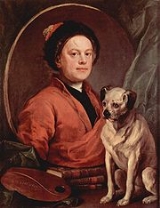
In 1745 Hogarth painted a self-portrait with his pug dog (now also in Tate Britain
Tate Britain
Tate Britain is an art gallery situated on Millbank in London, and part of the Tate gallery network in Britain, with Tate Modern, Tate Liverpool and Tate St Ives. It is the oldest gallery in the network, opening in 1897. It houses a substantial collection of the works of J. M. W. Turner.-History:It...

), which shows him as a learned artist supported by volumes of Shakespeare
William Shakespeare
William Shakespeare was an English poet and playwright, widely regarded as the greatest writer in the English language and the world's pre-eminent dramatist. He is often called England's national poet and the "Bard of Avon"...

, Milton
John Milton
John Milton was an English poet, polemicist, a scholarly man of letters, and a civil servant for the Commonwealth of England under Oliver Cromwell...

 and Swift
Jonathan Swift
Jonathan Swift was an Irish satirist, essayist, political pamphleteer , poet and cleric who became Dean of St...

. In 1749, he represented the somewhat disorderly English troops on their March of the Guards to Finchley (formerly located in Thomas Coram Foundation for Children
Thomas Coram Foundation for Children
The Thomas Coram Foundation for Children is a large children's charity in London which uses the working name Coram ....

, now Foundling Museum
Foundling Museum
The Foundling Museum in London tells the story of the Foundling Hospital, Britain's first home for abandoned children. The museum houses the nationally important Foundling Hospital Art Collection as well as the Gerald Coke Handel Collection, the world's greatest privately amassed collection of...

).

Others were his ingenious Satire on False Perspective
Satire on False Perspective
Satire on False Perspective is the title of an engraving produced by William Hogarth in 1754 for his friend John Joshua Kirby's pamphlet on linear perspective.The intent of the work is clearly given by the subtitle:-Summary:...

(1753); his satire on canvassing in his Election
Humours of an Election
The Humours of an Election is a series of four oil paintings and later engravings by William Hogarth that illustrate the election of a member of parliament in Oxfordshire in 1754. The oil paintings were created in 1755...

series (1755–1758; now in Sir John Soane's Museum); his ridicule of the English passion for cockfight
Cockfight
A cockfight is a blood sport between two roosters , held in a ring called a cockpit. Cockfighting is now illegal throughout all states in the United States, Brazil, Australia and in most of Europe. It is still legal in several U.S. territories....

ing in The Cockpit (1759); his attack on Methodism
Methodism
Methodism is a movement of Protestant Christianity represented by a number of denominations and organizations, claiming a total of approximately seventy million adherents worldwide. The movement traces its roots to John Wesley's evangelistic revival movement within Anglicanism. His younger brother...

 in Credulity, Superstition, and Fanaticism
Credulity, Superstition, and Fanaticism
Credulity, Superstition and Fanaticism is a satirical print by English artist William Hogarth. It ridicules secular and religious credulity, and lampoons the exaggerated religious "enthusiasm" of the Methodist movement. The print was originally engraved in 1759, with the title Enthusiasm...

(1762); his political anti-war satire in The Times, plate I (1762); and his pessimistic view of all things in Tailpiece, or The Bathos (1764).

Writing


Hogarth wrote and published his ideas of artistic design in his book The Analysis of Beauty
The Analysis of Beauty
The Analysis of Beauty is a book written by William Hogarth and published in 1753, which describes Hogarth's theories of visual beauty and grace in a manner accessible to the common man of his day....

(1753). In it, he professes to define the principles of beauty and grace which he, a real child of Rococo
Rococo
Rococo , also referred to as "Late Baroque", is an 18th-century style which developed as Baroque artists gave up their symmetry and became increasingly ornate, florid, and playful...

, saw realized in serpentine lines (the Line of Beauty
Line of Beauty
The Line of Beauty is a term and a theory in art or aesthetics used to describe an S-shaped curved line appearing within an object, as the boundary line of an object, or as a virtual boundary line formed by the composition of several objects...

).

Painter and engraver of modern moral subjects


Hogarth lived in an age when artwork became increasingly commercialized and viewed in shop windows, tavern
Tavern
A tavern is a place of business where people gather to drink alcoholic beverages and be served food, and in some cases, where travelers receive lodging....

s and public buildings and sold in printshop
Old master print
An old master print is a work of art produced by a printing process within the Western tradition . A date of about 1830 is usually taken as marking the end of the period whose prints are covered by this term. The main techniques concerned are woodcut, engraving and etching, although there are...

s. Old hierarchies broke down, and new forms began to flourish: the ballad opera
Ballad opera
The term ballad opera is used to refer to a genre of English stage entertainment originating in the 18th century and continuing to develop in the following century and later. There are many types of ballad opera...

, the bourgeois tragedy
Bourgeois tragedy
Bourgeois Tragedy is a form of tragedy that developed in 18th century Europe. It was a fruit of the enlightenment and the emergence of the bourgeois class and its ideals...

, and especially, a new form of fiction
Fiction
Fiction is the form of any narrative or informative work that deals, in part or in whole, with information or events that are not factual, but rather, imaginary—that is, invented by the author. Although fiction describes a major branch of literary work, it may also refer to theatrical,...

 called the novel
Novel
A novel is a book of long narrative in literary prose. The genre has historical roots both in the fields of the medieval and early modern romance and in the tradition of the novella. The latter supplied the present generic term in the late 18th century....

 with which authors such as Henry Fielding
Henry Fielding
Henry Fielding was an English novelist and dramatist known for his rich earthy humour and satirical prowess, and as the author of the novel Tom Jones....

 had great success. Therefore, by that time, Hogarth hit on a new idea: "painting and engraving modern moral subjects ... to treat my subjects as a dramatic writer; my picture was my stage", as he himself remarked in his manuscript notes.

He drew from the highly moralizing Protestant tradition of Dutch genre painting
Genre painting
Genre works, also called genre scenes or genre views, are pictorial representations in any of various media that represent scenes or events from everyday life, such as markets, domestic settings, interiors, parties, inn scenes, and street scenes. Such representations may be realistic, imagined, or...

, and the very vigorous satirical traditions of the English broadsheet
Broadsheet
Broadsheet is the largest of the various newspaper formats and is characterized by long vertical pages . The term derives from types of popular prints usually just of a single sheet, sold on the streets and containing various types of material, from ballads to political satire. The first broadsheet...

 and other types of popular print. In England the fine arts had little comedy in them before Hogarth. His prints were expensive, and remained so until early 19th-century reprints brought them to a wider audience.

Parodic borrowings from the Old Masters


When analysing the work of the artist as a whole, Ronald Paulson
Ronald Paulson
Ronald Paulson , is an American professor of English, a specialist in English 18th-century art and culture, and English artist William Hogarth.-Education:...

 says, "In A Harlot's Progress
A Harlot's Progress
A Harlot's Progress is a series of six paintings and engravings by William Hogarth. The series shows the story of a young woman, Mary Hackabout, who arrives in London from the country and becomes a prostitute...

, every single plate but one is based on Dürer
Albrecht Dürer
Albrecht Dürer was a German painter, printmaker, engraver, mathematician, and theorist from Nuremberg. His prints established his reputation across Europe when he was still in his twenties, and he has been conventionally regarded as the greatest artist of the Northern Renaissance ever since...

's images of the story of the Virgin and the story of the Passion
Passion (Christianity)
The Passion is the Christian theological term used for the events and suffering – physical, spiritual, and mental – of Jesus in the hours before and including his trial and execution by crucifixion...

." In other works, he parodies Leonardo da Vinci
Leonardo da Vinci
Leonardo di ser Piero da Vinci was an Italian Renaissance polymath: painter, sculptor, architect, musician, scientist, mathematician, engineer, inventor, anatomist, geologist, cartographer, botanist and writer whose genius, perhaps more than that of any other figure, epitomized the Renaissance...

's Last Supper
The Last Supper (Leonardo)
The Last Supper is a 15th century mural painting in Milan created by Leonardo da Vinci for his patron Duke Ludovico Sforza and his duchess Beatrice d'Este...

. According to Paulson, Hogarth is subverting the religious establishment and the orthodox belief in an immanent God
God
God is the English name given to a singular being in theistic and deistic religions who is either the sole deity in monotheism, or a single deity in polytheism....

 who intervenes in the lives of people and produces miracle
Miracle
A miracle often denotes an event attributed to divine intervention. Alternatively, it may be an event attributed to a miracle worker, saint, or religious leader. A miracle is sometimes thought of as a perceptible interruption of the laws of nature. Others suggest that a god may work with the laws...

s. Indeed, Hogarth was a Deist, a believer in a God who created the universe but takes no direct hand in the lives of his creations. Thus, as a "comic history painter", he often poked fun at the old-fashioned, "beaten" subjects of religious art in his paintings and prints. Hogarth also rejected Lord Shaftesbury's then current ideal of the classical Greek male in favour of the living, breathing female. He said, "Who but a bigot, even to the antiques
Antiques
An antique is an old collectible item. It is collected or desirable because of its age , beauty, rarity, condition, utility, personal emotional connection, and/or other unique features...

, will say that he has not seen faces and necks, hands and arms in living women, that even the Grecian Venus doth but coarsely imitate."

Personal life


On 23 March 1729 Hogarth married Jane Thornhill, daughter of artist Sir James Thornhill
James Thornhill
Sir James Thornhill was an English painter of historical subjects, in the Italian baroque tradition.-Life:...

.

Hogarth was initiated as a Freemason some time before 1728 in the Lodge at the Hand and Apple Tree Tavern, Little Queen Street, and later belonged to the Carrier Stone Lodge and the Grand Stewards' Lodge; the latter still possesses the 'Hogarth Jewel' which Hogarth designed for the Lodge's Master to wear. Today the original is in storage and a replica is worn by the Master of the Lodge. Freemasonry was a theme in some of Hogarth's work, most notably 'Night', the fourth in the quartet of paintings (later released as engravings) collectively entitled the Four Times of the Day
Four Times of the Day
Four Times of the Day is a series of four paintings by English artist William Hogarth. Completed in 1736, they were reproduced as a series of four engravings published in 1738. They are humorous depictions of life in the streets of London, the vagaries of fashion, and the interactions between the...

.

The Hogarths had no children, although they fostered foundling children. (He was a founding Governor of the Foundling Hospital
Foundling Hospital
The Foundling Hospital in London, England was founded in 1741 by the philanthropic sea captain Thomas Coram. It was a children's home established for the "education and maintenance of exposed and deserted young children." The word "hospital" was used in a more general sense than it is today, simply...

.)

Hogarth died in London on 26 October 1764 and was buried at St. Nicholas's Churchyard, Chiswick Mall, Chiswick
Chiswick
Chiswick is a large suburb of west London, England and part of the London Borough of Hounslow. It is located on a meander of the River Thames, west of Charing Cross and is one of 35 major centres identified in the London Plan. It was historically an ancient parish in the county of Middlesex, with...

, London. His friend, actor David Garrick
David Garrick
David Garrick was an English actor, playwright, theatre manager and producer who influenced nearly all aspects of theatrical practice throughout the 18th century and was a pupil and friend of Dr Samuel Johnson...

, composed the following inscription for his tombstone:

Farewell great Painter of Mankind
Who reach'd the noblest point of Art
Whose pictur'd Morals charm the Mind
And through the Eye correct the Heart.

If Genius fire thee, Reader, stay,
If Nature touch thee, drop a Tear:
If neither move thee, turn away,
For Hogarth's honour'd dust lies here.

Influence and reputation


Hogarth's work were a direct influence on John Collier
John Collier (caricaturist)
John Collier was an English caricaturist and satirical poet known by the pseudonym of Tim Bobbin, or Timothy Bobbin. Collier styled himself as the Lancashire Hogarth....

, who was known as the "Lancashire Hogarth". The spread of Hogarth's prints throughout Europe, together with the depiction of popular scenes from his prints in faked Hogarth prints, influenced Continental book illustration through the 18th and early 19th century, especially in Germany and France. Hogarth's influence lives on today as artists continue to draw inspiration from the artist.

Hogarth's paintings and prints have provided the subject matter for several other works. For example, Gavin Gordon
Gavin Gordon (composer)
Gavin Gordon was a Scottish bass singer, actor and composer, best known for his 1935 Hogarthian ballet The Rake's Progress.-Biography:Gavin Gordon was born in Ayr, Scotland in 1901, as Gavin Muspratt Gordon Brown...

's 1935 ballet The Rake's Progress
The Rake's Progress (ballet)
The Rake's Progress is a short 1935 ballet, based on the drawings of William Hogarth, with music by Gavin Gordon , choreography by Ninette de Valois, and set design by Rex Whistler....

, to choreography by Ninette de Valois
Ninette de Valois
Dame Ninette de Valois, OM, CH, DBE, FRAD, FISTD was an Irish-born British dancer, teacher, choreographer and director of classical ballet...

, was based directly on Hogarth's series of paintings of that title. Igor Stravinsky
Igor Stravinsky
Igor Fyodorovich Stravinsky ; 6 April 1971) was a Russian, later naturalized French, and then naturalized American composer, pianist, and conductor....

's 1951 opera
Opera
Opera is an art form in which singers and musicians perform a dramatic work combining text and musical score, usually in a theatrical setting. Opera incorporates many of the elements of spoken theatre, such as acting, scenery, and costumes and sometimes includes dance...

 The Rake's Progress
The Rake's Progress
The Rake's Progress is an opera in three acts and an epilogue by Igor Stravinsky. The libretto, written by W. H. Auden and Chester Kallman, is based loosely on the eight paintings and engravings A Rake's Progress of William Hogarth, which Stravinsky had seen on May 2, 1947, in a Chicago...

, with libretto by W. H. Auden
W. H. Auden
Wystan Hugh Auden , who published as W. H. Auden, was an Anglo-American poet,The first definition of "Anglo-American" in the OED is: "Of, belonging to, or involving both England and America." See also the definition "English in origin or birth, American by settlement or citizenship" in See also...

, was less literally inspired by the same series. Russell Banks
Russell Banks
Russell Banks is an American writer of fiction and poetry.- Biography :Russell Banks was born in Newton, Massachusetts on March 28, 1940. He attended the University of North Carolina at Chapel Hill. He lives in upstate New York, and has been named a New York State Author. He is also...

' short story "Indisposed" is a fictional account of Hogarth's infidelity as told from the viewpoint of his wife, Jane. Hogarth's engravings also inspired the BBC radio
BBC Radio
BBC Radio is a service of the British Broadcasting Corporation which has operated in the United Kingdom under the terms of a Royal Charter since 1927. For a history of BBC radio prior to 1927 see British Broadcasting Company...

 play "The Midnight House" by Jonathan Hall, based on the M.R. James ghost story "The Mezzotint" and first broadcast on BBC Radio 4
BBC Radio 4
BBC Radio 4 is a British domestic radio station, operated and owned by the BBC, that broadcasts a wide variety of spoken-word programmes, including news, drama, comedy, science and history. It replaced the BBC Home Service in 1967. The station controller is currently Gwyneth Williams, and the...

 in 2006.

Hogarth's House
Hogarth's House
Hogarth's House is the former country home of the 18th century English artist William Hogarth in Chiswick. The House now belongs to the London Borough of Hounslow and is open to visitors free of charge...

 in Chiswick
Chiswick
Chiswick is a large suburb of west London, England and part of the London Borough of Hounslow. It is located on a meander of the River Thames, west of Charing Cross and is one of 35 major centres identified in the London Plan. It was historically an ancient parish in the county of Middlesex, with...

, west London, is now a museum; it abuts one of London's best known road junctions – the Hogarth Roundabout
Hogarth Roundabout
The Hogarth Roundabout is one of London's best known road junctions. It is situated at the junction of the A316 Great Chertsey Road and the A4 Great West Road.The Hogarth Roundabout is named after William Hogarth who lived in nearby Hogarth's House...

.

Hogarth is played by Toby Jones
Toby Jones
Toby Edward Heslewood Jones is an English actor.-Early life:Jones was born in Hammersmith, London, the son of actors Jennifer and Freddie Jones...

 in the 2006 television film A Harlot's Progress
A Harlot's Progress (film)
A Harlot's Progress is a 2006 British television film directed by Justin Hardy and starring Zoe Tapper, Toby Jones, Sophie Thompson and Richard Wilson. The story is based on the series of paintings entitled A Harlot's Progress by William Hogarth. Hogarth's work is inspired by his interactions with...

.

Gallery


External links