
All Topics  
Rembrandt

 
Rembrandt

   Email Print
   Bookmark   Link


Rembrandt


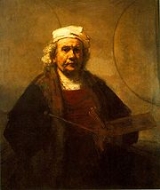
Rembrandt Harmenszoon van Rijn (July 15, 1606 – October 4, 1669) was a Dutch
Netherlands

The Netherlands is a country that is part of the Kingdom of the Netherlands. It is a parliamentary democratic constitutional monarchy. The Netherlands is located in North-West Europe, and bordered by the North Sea to the north and west, Belgium to the south, and Germany to the east....
 painter
Painting

Painting is the practice of applying paint, pigment, color or other medium to a surface . In art, the term describes both the act and the result, which is called a painting....
 and etcher
Etching

Etching is the process of using strong acid or mordant to cut into the unprotected parts of a metal surface to create a design in intaglio in the metal ....
. He is generally considered one of the greatest painters and printmakers in European art history and the most important in Dutch history
History of the Netherlands

The historical period sets in with the Roman Empire, as the parts south of the Rhine were included in the Roman province of Gallia Belgica, and later of Germania Inferior....
. His contributions to art came in a period that historians call the Dutch Golden Age
Dutch Golden Age

The Golden Age was a period in Netherlands history, roughly spanning the 17th century, in which Dutch trade, science, and art were among the most acclaimed in the world....
.

Having achieved youthful success as a portrait painter, his later years were marked by personal tragedy and financial hardship.


Discussion
Ask a question about 'Rembrandt'
Start a new discussion about 'Rembrandt'
Answer questions from other users
Full Discussion Forum


Recent Posts


Encyclopedia


Rembrandt Harmenszoon van Rijn (July 15, 1606 – October 4, 1669) was a Dutch
Netherlands

The Netherlands is a country that is part of the Kingdom of the Netherlands. It is a parliamentary democratic constitutional monarchy. The Netherlands is located in North-West Europe, and bordered by the North Sea to the north and west, Belgium to the south, and Germany to the east....
 painter
Painting

Painting is the practice of applying paint, pigment, color or other medium to a surface . In art, the term describes both the act and the result, which is called a painting....
 and etcher
Etching

Etching is the process of using strong acid or mordant to cut into the unprotected parts of a metal surface to create a design in intaglio in the metal ....
. He is generally considered one of the greatest painters and printmakers in European art history and the most important in Dutch history
History of the Netherlands

The historical period sets in with the Roman Empire, as the parts south of the Rhine were included in the Roman province of Gallia Belgica, and later of Germania Inferior....
. His contributions to art came in a period that historians call the Dutch Golden Age
Dutch Golden Age

The Golden Age was a period in Netherlands history, roughly spanning the 17th century, in which Dutch trade, science, and art were among the most acclaimed in the world....
.

Having achieved youthful success as a portrait painter, his later years were marked by personal tragedy and financial hardship. Yet his drawings and paintings were popular throughout his lifetime, his reputation as an artist remained high and for twenty years he taught nearly every important Dutch painter. Rembrandt's greatest creative triumphs are exemplified especially in his portrait
Portrait painting

Portrait painting is a Hierarchy of genres in painting, where the intent is to depict the visual appearance of the subject. Beside human beings, animals, pets and even inanimate objects can be chosen as the subject for a portrait....
s of his contemporaries, self-portrait
Self-portrait

A self-portrait is a representation of an artist, drawn, painted, photographed, or sculpted by the artist. Although self-portraits have been made by artists since the earliest times, it is not until the Early Renaissance in the mid 1400s that artists can be frequently identified depicting themselves as either the main subject, or as importa...
s and illustrations of scenes from the Bible
Bible

The Bible is the central religious text of Judaism and Christianity. The exact Books of the Bible is dependent on the religious traditions of specific denominations....
. The self-portraits form a unique and intimate biography, in which the artist surveyed himself without vanity and with the utmost sincerity.

In both painting and printmaking he exhibited a complete knowledge of classical iconography
Iconography

Iconography is the branch of art history which studies the identification, description, and the interpretation of the content of images. The word iconography literally means "image writing", and comes from the Ancient Greek e???? and ??afe?? ....
, which he molded to fit the requirements of his own experience; thus, the depiction of a biblical scene was informed by Rembrandt's knowledge of the specific text, his assimilation of classical composition, and his observations of the Jewish population of Amsterdam
Amsterdam

Amsterdam is the Capital of the Netherlands and List of cities in the Netherlands with over 100,000 people of the Netherlands, located in the Provinces of the Netherlands of North Holland in the west of the country....
. Because of his empathy for the human condition, he has been called "one of the great prophets of civilization."

Life

Rembrandt Harmenszoon van Rijn was born on July 15, 1606 in Leiden
Leiden

Media:Nl-Leiden.ogg is a city and municipality in the province of South Holland in the Netherlands and has 118,000 inhabitants. It forms a single urban area with Oegstgeest, Leiderdorp, Voorschoten, Valkenburg, Rijnsburg and Katwijk, with 254,000 inhabitants....
, the Netherlands
Netherlands

The Netherlands is a country that is part of the Kingdom of the Netherlands. It is a parliamentary democratic constitutional monarchy. The Netherlands is located in North-West Europe, and bordered by the North Sea to the north and west, Belgium to the south, and Germany to the east....
. He was the ninth child born to Harmen Gerritszoon van Rijn and Neeltgen Willemsdochter van Zuytbrouck. His family was quite well-to-do; his father was a miller and his mother was a baker's daughter. As a boy he attended Latin
Latin

Latin is an Italic language, historically spoken in Latium and Ancient Rome. Through the Military history of the Roman Empire, Latin spread throughout the Mediterranean and a large part of Europe....
 school and was enrolled at the University of Leiden, although according to a contemporary he had a greater inclination towards painting; he was soon apprenticed to a Leiden history painter, Jacob van Swanenburgh, with whom he spent three years. After a brief but important apprenticeship of six months with the famous painter Pieter Lastman
Pieter Lastman

Pieter Lastman was a Dutch painter . Lastman is important as a painter of history pieces and because his pupils included Rembrandt and Jan Lievens....
 in Amsterdam
Amsterdam

Amsterdam is the Capital of the Netherlands and List of cities in the Netherlands with over 100,000 people of the Netherlands, located in the Provinces of the Netherlands of North Holland in the west of the country....
, Rembrandt opened a studio in Leiden in 1624 or 1625, which he shared with friend and colleague Jan Lievens
Jan Lievens

Jan Lievens was a Netherlands painter, usually associated with Rembrandt, working in a similar style....
. In 1627, Rembrandt began to accept students, among them Gerrit Dou.

In 1629 Rembrandt was discovered by the statesman Constantijn Huygens
Constantijn Huygens

Constantijn Huygens was a The Netherlands poet and composer, Secretary to two Princes, and the father of the scientist Christiaan Huygens. He is often considered a member of what is known as the Muiderkring, a group of leading intellectuals gathered around Pieter Corneliszoon Hooft, who met regularly at the castle of Muiden near Amsterdam....
, the father of Christiaan Huygens
Christiaan Huygens

Christiaan Huygens was a prominent Netherlands mathematics, astronomer, physics, and horology. His work included early telescopic studies, investigations and inventions related to time keeping, and studies of both optics and centrifugal force....
 (a famous Dutch mathematician and physicist), who procured for Rembrandt important commissions from the court of The Hague. As a result of this connection, Prince Frederik Hendrik continued to purchase paintings from Rembrandt until 1646.

At the end of 1631, Rembrandt moved to Amsterdam, then rapidly expanding as the new business capital of the Netherlands, and began to practice as a professional portraitist for the first time, with great success. He initially stayed with an art dealer, Hendrick van Uylenburg, and in 1634, married Hendrick's cousin, Saskia van Uylenburg
Saskia van Uylenburg

Saskia van Uylenburgh was the daughter of a Frisian mayor and became the wife of the Netherlands painter Rembrandt, the son of a well-to-do miller from Leiden....
. Saskia came from a good family: her father had been lawyer and burgemeester (mayor) of Leeuwarden
Leeuwarden

Leeuwarden is the capital city of the Netherlands province of Friesland. It is situated in the north of the country....
. When Saskia, as the youngest daughter, became an orphan, she lived with an older sister in Het Bildt
Het Bildt

Het Bildt is a municipality in the province of Friesland in the northern Netherlands; its capital is Sint Annaparochie. As of 1 November 2006 it had a population of 10,975....
. They were married in the local church of St. Annaparochie without the presence of his relatives. In the same year, Rembrandt became a burgess of Amsterdam and a member of the local guild of painters. He also acquired a number of students, among them Ferdinand Bol
Ferdinand Bol

Ferdinand Bol was a The Netherlands artist, etcher, and draftsman. Although his surviving work is rare, it displays Rembrandt's influence; like his master, Bol favored historical subjects, portraits, numerous self-portraits, and single figures in exotic finery....
 and Govert Flinck
Govert Flinck

Govert Teuniszoon Flinck was a the Netherlands Painting of the Dutch Golden Age....
.
Saskia
In 1635 Rembrandt and Saskia moved into their own house, renting in fashionable Nieuwe Doelenstraat. In 1639, they moved to a prominent house (now the Rembrandt House Museum
Rembrandt House Museum

The Rembrandt House Museum is a house in Jodenbreestraat in Amsterdam, The Netherlands, where Rembrandt lived and painted for a number of years....
) in the Jodenbreestraat
Jodenbreestraat

The Jodenbreestraat is a street in the centre of Amsterdam, The Netherlands. The street runs from the Sint Antoniesluis sluice gates to the Mr....
 in what was becoming the Jew
Jew

A Jew is a member of the Jewish people, an ethnoreligious group that traces its ancestry to the Israelites or Hebrews of the Ancient Near East....
ish quarter; the mortgage to finance the 13,000 guilder
Guilder

Guilder is the English language translation of the Dutch language gulden ? from Old Dutch for 'golden'. The guilder originated as a gold coin but has been a common name for a silver or base metal coin for some centuries....
 purchase would be a primary cause for later financial difficulties. He should easily have been able to pay it off with his large income, but it appears his spending always kept pace with his income, and he may have made some unsuccessful investments. It was there that Rembrandt frequently sought his Jewish neighbors to model for his Old Testament
Old Testament

In Western Christianity, the Old Testament refers to the books that form the first of the two-part Christianity Bible Biblical canon. These works correspond to the Hebrew Bible , with some variations and additions....
 scenes. Although they were by now affluent, the couple suffered several personal setbacks; their son Rumbartus died two months after his birth in 1635 and their daughter Cornelia died at just 3 weeks of age in 1638. In 1640, they had a second daughter, also named Cornelia, who died after living barely over a month. Only their fourth child, Titus
Titus van Rijn

Titus van Rijn was the fourth and only surviving child of Rembrandt and Saskia van Uylenburgh. Titus is best known as a figure or model in his father's paintings and studies....
, who was born in 1641, survived into adulthood. Saskia died in 1642 soon after Titus's birth, probably from tuberculosis
Tuberculosis

Tuberculosis is a common and often deadly infectious disease caused by mycobacterium, mainly Mycobacterium tuberculosis . Tuberculosis usually attacks the lungs but can also affect the central nervous system, the lymphatic system, the circulatory system, the genitourinary system, the gastrointestinal system, bones, joints, and even the...
. Rembrandt's drawings of her on her sick and death bed are among his most moving works.

During Saskia's illness, Geertje Dircx
Geertje Dircx

Geertje Dircx was a model and lover of Rembrandt and the wetnurse to his son Titus van Rijn. Rembrandt imprisoned her, when she reneged on her promises to him....
 was hired as Titus' caretaker and nurse and probably also became Rembrandt's lover. She would later charge Rembrandt with breach of promise and was awarded alimony of 200 guilders a year. Rembrandt worked to have her committed for twelve years to an asylum or poorhouse (called a "bridewell") at Gouda
Gouda

Gouda is a city and municipality in the western Netherlands, in the province of South Holland. Gouda, which was granted City rights in the Netherlands in 1272, is famous for its Gouda cheese, smoking pipes and its 15th century city hall....
, after learning Geertje had pawned jewelry that had once belonged to Saskia, and which Rembrandt had given her.

In the late 1640s Rembrandt began a relationship with the much younger Hendrickje Stoffels
Hendrickje Stoffels

Hendrickje Stoffels was a model and partner of Rembrandt....
, who had initially been his maid. In 1654 they had a daughter, Cornelia, bringing Hendrickje a summons from the Reformed church
Dutch Reformed Church

Dutch Reformed Church was one of many branches of churches established during the Protestant Reformation in Europe in the sixteenth century. While the Dutch Reformed Church was based in the Netherlands, other churches holding similar theological views were founded in France, Switzerland, Germany, Hungary, England, and Scotland....
 to answer the charge "that she had committed the acts of a whore with Rembrandt the painter". She admitted this and was banned from receiving communion. Rembrandt was not summoned to appear for the Church council because he was not a member of the Reformed church. The two were considered legally wed under common law, but Rembrandt had not married Henrickje, so as not to lose access to a trust set up for Titus in his mother's will.
Rembrandt Harmensz
Rembrandt lived beyond his means, buying art (including bidding up his own work), prints (often used in his paintings) and rarities, which probably caused a court arrangement to avoid his bankruptcy
Bankruptcy

Bankruptcy is a legally declared inability or impairment of ability of an individual or organization to pay its creditors. Creditors may file a bankruptcy petition against a debtor in an effort to recoup a portion of what they are owed or initiate a restructuring....
 in 1656, by selling most of his paintings and large collection of antiquities. The sale list survives and gives us a good insight into his collections, which apart from Old Master
Old Master

"Old Master" is a term for a European painting of skill who worked before about 1800, or a painting by such a painter. An "old master print" is an original printmaking made by an artist in the same period....
 paintings and drawings included busts of the Roman Emperors, suits of Japanese armour among many objects from Asia, and collections of natural history and minerals; the prices realized in the sales in 1657 and 1658 were disappointing. He also had to sell his house and his printing-press and move to more modest accommodation on the Rozengracht in 1660. The authorities and his creditors were generally accommodating to him, except for the Amsterdam painters' guild, who introduced a new rule that no one in Rembrandt's circumstances could trade as a painter. To get round this, Hendrickje and Titus set up a business as art-dealers in 1660, with Rembrandt as an employee.

In 1661 he (or rather the new business) was contracted to complete work for the newly built city hall, but only after Govert Flinck
Govert Flinck

Govert Teuniszoon Flinck was a the Netherlands Painting of the Dutch Golden Age....
, the artist previously commissioned, died without beginning to paint. The resulting work, The Conspiracy of Claudius Civilis
The Conspiracy of Claudius Civilis

The Conspiracy of Claudius Civilis is a 1661-62 oil painting by the Dutch Golden Age painting Rembrandt, which was originally the largest he ever painted, at around five by five metres in the shape of a lunette....
, was rejected and returned to the painter; the surviving fragment is only a fraction of the whole work. It was around this time that Rembrandt took on his last apprentice, Aert de Gelder
Aert de Gelder

Aert de Gelder was one of Rembrandt?s last pupils while in Amsterdam, studying in his studio from 1661 to 1663. He was not only one of the most talented of Rembrandt?s pupils, but also one of his most devoted followers, for he was the only Dutch artist to paint in the tradition of Rembrandt's late style into the 18th century....
. In 1662 he was still fulfilling major commissions for portraits and other works. When Cosimo III de' Medici, Grand Duke of Tuscany
Cosimo III de' Medici, Grand Duke of Tuscany

Cosimo III de' Medici, Grand Duke of Tuscany was Grand Duke of Tuscany from 1670 to 1723 and the husband of Marguerite Louise d'Orl?ans....
 visited Amsterdam in 1667, he visited Rembrandt at his house.

Rembrandt outlived both Hendrickje, who died in 1663, and Titus, who died in 1668, leaving a baby daughter. Rembrandt died within a year of his son, on October 4, 1669 in Amsterdam, and was buried in an unmarked grave in the Westerkerk
Westerkerk

File:Amsterdam west kerk2.jpgThe Westerkerk is a Protestant Church in the Netherlands church in Amsterdam, built in 1620-1631 after a design by Hendrick de Keyser....
.

Works

In a letter to Huyghens, Rembrandt offered the only surviving explanation of what he sought to achieve through his art: the greatest and most natural movement, translated from die meeste ende di naetuereelste beweechgelickheijt. The word "beweechgelickhijt" is also argued to mean "emotion" or "motive." Whether this refers to objectives, material or otherwise is open to interpretation; either way, Rembrandt seamlessly melded the earthly and spiritual as has no other painter in Western art.

Earlier 20th century connoisseurs claimed Rembrandt had produced over 600 painting
Painting

Painting is the practice of applying paint, pigment, color or other medium to a surface . In art, the term describes both the act and the result, which is called a painting....
s, nearly 400 etching
Etching

Etching is the process of using strong acid or mordant to cut into the unprotected parts of a metal surface to create a design in intaglio in the metal ....
s and 2,000 drawings. More recent scholarship, from the 1960s to the present day (led by the Rembrandt Research Project), often controversially, have winnowed his oeuvre to nearer 300 paintings. His prints
Old master print

An old master print is a work of art produced by a printing process within the Western tradition . A date of about 1830 is usually taken as marking the end of the period whose prints are covered by this term....
, traditionally all called etching
Etching

Etching is the process of using strong acid or mordant to cut into the unprotected parts of a metal surface to create a design in intaglio in the metal ....
s, although many are produced in whole or part by engraving
Engraving

Engraving is the practice of incising a design onto a hard, usually flat surface, by cutting grooves into it. The result may be a decorated object in itself, as when silver, gold, steel, or glass engraving are engraved, or may provide an intaglio printing plate, of copper or another metal, for printing images on paper as prints or illustra...
 and sometimes drypoint
Drypoint

Drypoint is a printmaking technique of the intaglio family, in which an image is incised into a plate with a hard-pointed "needle" of sharp metal or diamond point....
, have a much more stable total of slightly under 300. It is likely he made many more drawings in his lifetime than 2,000, but those extant are more rare than presumed.

At one time about ninety paintings were counted as Rembrandt self-portraits, but it is now known that he had his students copy his own self-portraits as part of their training. Modern scholarship has reduced the autograph count to over forty paintings, as well as a few drawings and thirty-one etching
Etching

Etching is the process of using strong acid or mordant to cut into the unprotected parts of a metal surface to create a design in intaglio in the metal ....
s, which include many of the most remarkable images of the group. Many show him posing in quasi-historical fancy dress, or pulling faces at himself. His oil paintings trace the progress from an uncertain young man, through the dapper and very successful portrait-painter of the 1630s, to the troubled but massively powerful portraits of his old age. Together they give a remarkably clear picture of the man, his appearance and his psychological make-up, as revealed by his richly-weathered face.

Among the more prominent characteristics of his work are his use of chiaroscuro
Chiaroscuro

Chiaroscuro is a term in art for a contrast between light and dark. The term is usually applied to bold contrasts affecting a whole composition, but is also more technically used by artists and art historians for the use of effects representing contrasts of light, not necessarily strong, to achieve a sense of volume in modeling three-di...
, the theatrical employment of light and shadow derived from Caravaggio
Caravaggio

Michelangelo Merisi da Caravaggio, was an Italian people artist active in Rome, Naples, Malta and Sicily between 1593 and 1610, considered the first great representative of the Baroque school of painting....
, or, more likely, from the Dutch Caravaggisti
Utrecht School

Utrecht Caravaggism refers to those Baroque artists, all distinctly influenced by the art of Caravaggio, who were active mostly in the Netherlands city of Utrecht during the early part of the seventeenth century....
, but adapted for very personal means. Also notable are his dramatic and lively presentation of subjects, devoid of the rigid formality that his contemporaries often displayed, and a deeply felt compassion for mankind, irrespective of wealth and age. His immediate family — his wife Saskia, his son Titus and his common-law wife Hendrickje — often figured prominently in his paintings, many of which had mythical
Mythology

The word mythology refers to a body of folklore/myths/legends that a particular culture believes to be true and that often use the supernatural to interpret natural events and to explain the nature of the universe and humanity....
, biblical
Bible

The Bible is the central religious text of Judaism and Christianity. The exact Books of the Bible is dependent on the religious traditions of specific denominations....
 or historical themes.

Periods, themes and styles

Rembrandt Abduction of Europa
Throughout his career Rembrandt took as his primary subjects the themes of portraiture, landscape and narrative painting. For the last, he was especially praised by his contemporaries, who extolled him as a masterful interpreter of biblical stories for his skill in representing emotions and attention to detail. Stylistically, his paintings progressed from the early 'smooth' manner, characterized by fine technique in the portrayal of illusionistic form, to the late 'rough' treatment of richly variegated paint surfaces, which allowed for an illusionism of form suggested by the tactile quality of the paint itself.

A parallel development may be seen in his skill as a printmaker. In the etchings of his maturity, particularly from the late 1640s onward, the freedom and breadth of his drawings and paintings found expression in the print medium as well. The works encompass a wide range of subject matter and technique, sometimes leaving large areas of white paper to suggest space, at other times employing complex webs of line to produce rich dark tones.

It was during Rembrandt's Leiden period (1625-1631) that Lastman's influence was most prominent. It is also likely that at this time Lievens had a strong impact on his work as well. Paintings were rather small, but rich in details (for example, in costumes and jewelry). Religious and allegorical
Allegory

Allegory is generally treated as a figure of rhetoric, but an allegory does not have to be expressed in language: it may be addressed to the eye, and is often found in realistic painting, sculpture or some other form of Mimesis, or representative art....
 themes were favored, as were tronies, half-length figures not intended as specific portraits. In 1626 Rembrandt produced his first etchings, the wide dissemination of which would largely account for his international fame. In 1629 he completed Judas Repentant, Returning the Pieces of Silver and The Artist in His Studio, works that evidence his interest in the handling of light and variety of paint application, and constitute the first major progress in his development as a painter. During his early years in Amsterdam (1632-1636), Rembrandt began to paint dramatic biblical and mythological scenes in high contrast and of large format (The Blinding of Samson, 1636, Belshazzar's Feast
Belshazzar's Feast (Rembrandt)

Belshazzar's Feast is a painting by Rembrandt van Rijn created in about 1635. The source for the painting is the story of Belshazzar and the The writing on the wall in the Old Testament Book of Daniel....
, c. 1635 Danaë
Danaë (Rembrandt)

Dana? is Rembrandt's painting from the collection of Pierre Crozat which from the 18th century resides in the Hermitage Museum, St. Petersburg....
, 1636), seeking to emulate the baroque style of Rubens. With the occasional help of assistants in Uylenburgh's workshop, he painted numerous portrait commissions both small (Jacob de Gheyn III
Jacob de Gheyn III (painting)

Jacob de Gheyn III, also known as Jacob III de Gheyn, is a 1632 oil painting by Rembrandt. The portrait is of Netherlands engraving Jacob de Gheyn III and is part of a pair....
) and large (Portrait of the Shipbuilder Jan Rijcksen and his Wife, 1633, Anatomy Lesson of Dr. Nicolaes Tulp
Anatomy Lesson of Dr. Nicolaes Tulp

The Anatomy Lesson of Dr. Nicolaes Tulp is a 1632 oil painting by Rembrandt housed in the Mauritshuis museum in The Hague, the Netherlands....
, 1632).

By the late 1630s, Rembrandt had produced a few paintings and many etchings of landscapes. Often these landscapes highlighted natural drama, featuring uprooted trees and ominous skies (Cottages before a Stormy Sky, c. 1641, The Three Trees, 1643). From 1640 his work became less exuberant and more sober in tone, possibly reflecting personal tragedy. Biblical scenes were now derived more often from the New Testament
New Testament

The New Testament is the name given to the second major division of the Christianity Bible, the first such division being the much longer Old Testament....
 than the Old Testament
Old Testament

In Western Christianity, the Old Testament refers to the books that form the first of the two-part Christianity Bible Biblical canon. These works correspond to the Hebrew Bible , with some variations and additions....
, as had been the case before. In 1642 he painted the The Night Watch
Night Watch (painting)

The Night Watch redirects here. For other uses of the phrase, please see Night WatchNight Watch or The Night Watch is the common name of one of the most famous works by Netherlands painter Rembrandt Harmenszoon van Rijn....
, his largest work and the most notable of the important group portrait commissions which he received in this period, and through which he sought to find solutions to compositional and narrative problems that had been attempted in previous works.

In the decade following the Night Watch, Rembrandt's paintings varied greatly in size, subject, and style. The previous tendency to create dramatic effects primarily by strong contrasts of light and shadow gave way to the use of frontal lighting and larger and more saturated areas of color. Simultaneously, figures came to be placed parallel to the picture plane. These changes can be seen as a move toward a classical mode of composition and, considering the more expressive use of brushwork as well, may indicate a familiarity with Venetian art (Susanna and the Elders, 1637-47). At the same time, there was a marked decrease in painted works in favor of etchings and drawings of landscapes. In these graphic works natural drama eventually made way for quiet Dutch rural scenes. In the 1650s, Rembrandt's style changed again. Paintings increased in size, colours became richer and brush strokes more pronounced. With these changes, Rembrandt distanced himself from earlier work and current fashion, which increasingly inclined toward fine, detailed works. His singular approach to paint application may have been suggested in part by familiarity with the work of Titian
Titian

File:Tizian 090.jpg Tiziano Vecelli or Tiziano Vecellio, born 1473/1490 , died 27 August 1576, better known as Titian , was the leading painter of the 16th-century Venice school of the Italian Renaissance....
, and could be seen in the context of the then current discussion of 'finish' and surface quality of paintings. Contemporary accounts sometimes remark disapprovingly of the coarseness of Rembrandt's brushwork, and the artist himself was said to have dissuaded visitors from looking too closely at his paintings. The tactile manipulation of paint may hearken to medieval procedures, when mimetic effects of rendering informed a painting's surface. The end result is a richly varied handling of paint, deeply layered and often apparently haphazard, which suggests form and space in both an illusionistic and highly individual manner.

In later years, biblical themes were still depicted often, but emphasis shifted from dramatic group scenes to intimate portrait-like figures (James the Apostle, 1661). In his last years, Rembrandt painted his most deeply reflective self-portraits (from 1652 to 1669 he painted fifteen), and several moving images of both men and women (The Jewish Bride
The Jewish Bride

The Jewish Bride is a painting by Rembrandt, executed around 1667.The painting gained its current name in the early 19th century, when an Amsterdam art collector identified the subject as that of a Jewish father bestowing a necklace upon his daughter on her wedding day....
, ca. 1666)--- in love, in life, and before God .

Etchings

Rembrandt produced etchings for most of his career, from 1626 to 1660, when he was forced to sell his printing-press and virtually abandoned etching. Only the troubled year of 1649 produced no dated work. He took easily to etching and, though he also learned to use a burin
Burin

Burin from the French language burin meaning "cold chisel" has two specialised meanings for types of tools in English, one meaning a steel cutting tool which is the essential tool of engraving, and the other, in archaeology, meaning a special type of lithic flake with a chisel-like edge which was probably also used for engraving, or fo...
 and partly engraved
Engraving

Engraving is the practice of incising a design onto a hard, usually flat surface, by cutting grooves into it. The result may be a decorated object in itself, as when silver, gold, steel, or glass engraving are engraved, or may provide an intaglio printing plate, of copper or another metal, for printing images on paper as prints or illustra...
 many plates, the freedom of etching technique was fundamental to his work. He was very closely involved in the whole process of printmaking, and must have printed at least early examples of his etchings himself. At first he used a style based on drawing, but soon moved to one based on painting, using a mass of lines and numerous bitings with the acid to achieve different strengths of line. Towards the end of the 1630s, he reacted against this manner and moved to a simpler style, with fewer bitings. He worked on the so-called Hundred Guilder Print in stages throughout the 1640s, and it was the "critical work in the middle of his career", from which his final etching style began to emerge. Although the print only survives in two states
State (printmaking)

A state, in printmaking, is a different form of a print, caused by a deliberate and permanent change to a matrix such as a copper plate or woodblock ....
, the first very rare, evidence of much reworking can be seen underneath the final print and many drawings survive for elements of it. In the mature works of the 1650s, Rembrandt was more ready to improvise on the plate and large prints typically survive in several states, up to eleven, often radically changed. He now uses hatching
Hatching

Hatching is an artistic technique used to create tonal or shading effects by drawing closely spaced parallel lines. When lines are placed at an angle to one another, it is called cross-hatching....
 to create his dark areas, which often take up much of the plate. He also experimented with the effects of printing on different kinds of paper, including Japanese paper, which he used frequently, and on vellum
Vellum

Vellum is mammal skin prepared for writing or printing on single pages, scrolls, Codex or books. It is generally thin, smooth and durable, although there are great variations depending on preparation, the quality of the skin, and the type of animal....
. He began to use "surface tone," leaving a thin film of ink on parts of the plate instead of wiping it completely clean to print each impression. He made more use of drypoint
Drypoint

Drypoint is a printmaking technique of the intaglio family, in which an image is incised into a plate with a hard-pointed "needle" of sharp metal or diamond point....
, exploiting, especially in landscapes, the rich fuzzy burr that this technique gives to the first few impressions.

His prints have similar subjects to his paintings, although the twenty-seven self-portraits are relatively more common, and portraits of other people less so. There are forty-six landscapes, mostly small, which largely set the course for the graphic treatment of landscape until the end of the 19th century. One third of his etchings are of religious subjects, many treated with a homely simplicity, whilst others are his most monumental prints. A few erotic, or just obscene, compositions have no equivalent in his paintings. He owned, until forced to sell it, a magnificent collection of prints by other artists, and many borrowings and influences in his work can be traced to artists as diverse as Mantegna, Raphael
Raphael

Raphael Sanzio, usually known by his first name alone was an Italy Painting and architect of the High Renaissance, celebrated for the perfection and grace of his paintings and drawings....
, Hercules Segers, and Giovanni Benedetto Castiglione
Giovanni Benedetto Castiglione

Giovanni Benedetto Castiglione , was an Italy Baroque artist, painter, printmaker and draftsman, of the Genoa school. He is best known now for his elaborate engravings, and as the inventor of the printmaking technique of monotyping....
.

Museum collections

In the Netherlands, the most notable collection of Rembrandt's work is at Amsterdam's Rijksmuseum, including De Nachtwacht (The Night Watch
Night Watch (painting)

The Night Watch redirects here. For other uses of the phrase, please see Night WatchNight Watch or The Night Watch is the common name of one of the most famous works by Netherlands painter Rembrandt Harmenszoon van Rijn....
) and De Joodse bruid (The Jewish Bride). Many of his self-portraits are held in The Hague
The Hague

The Hague is the third largest city in the Netherlands after Amsterdam and Rotterdam, with a population of 475,904 and an area of approximately 100 km?....
's Mauritshuis
Mauritshuis

The Royal Picture Gallery Mauritshuis is an art museum in The Hague, the Netherlands. Previously the residence of count John Maurice of Nassau, it now has a large art collection, including paintings by Dutch painters such as Johannes Vermeer, Rembrandt van Rijn, Jan Steen, Paulus Potter and Frans Hals and works of the German painter Hans Hol...
. His home, preserved as the Rembrandt House Museum
Rembrandt House Museum

The Rembrandt House Museum is a house in Jodenbreestraat in Amsterdam, The Netherlands, where Rembrandt lived and painted for a number of years....
 in Amsterdam, displays many examples of his etching
Etching

Etching is the process of using strong acid or mordant to cut into the unprotected parts of a metal surface to create a design in intaglio in the metal ....
s; all major print room
Print Room

The Print Room at Windsor Castle is a print room which is an office in the Royal Collection Department of the Royal Household of the Monarch of the United Kingdom....
s have the majority of these, although a number exist in only a handful of impressions (copies). The best collections of his paintings in other countries can be found in the National Gallery, London
National Gallery, London

The National Gallery in London, founded in 1824, houses a rich collection of over 2,300 paintings dating from the mid-13th century to 1900 in its home on Trafalgar Square....
, Gemäldegalerie, Berlin
Gemäldegalerie, Berlin

The Gem?ldegalerie is an art museum in Berlin, Germany. It holds one of the world's leading collections of European art from the 13th to the 18th centuries....
, Hermitage Museum
Hermitage Museum

The State Hermitage Museum in Saint Petersburg, Russia is one of the largest museums in the world, with 3 million works of art , and one of the oldest art gallery and museums of human history and culture in the world....
, St. Petersburg
Saint Petersburg

Saint Petersburg is a types of inhabited localities in Russia and a federal subjects of Russia of Russia located on the Neva River at the head of the Gulf of Finland on the Baltic Sea....
, Gemäldegalerie Alte Meister
Gemäldegalerie Alte Meister

The Gem?ldegalerie Alte Meister in Dresden features numerous major works of art history. Therefore it belongs to the world?s mostrenowned collection ....
 in Dresden, New York City
New York City

The City of New York is the List of United States cities by population in the United States, while the New York metropolitan area ranks among the List of urban areas by population....
, Washington, D.C.
Washington, D.C.

Washington, D.C. , formally the District of Columbia and commonly referred to as Washington, the District, or simply D.C., is the Capital of the United States, founded on July 16, 1790....
, The Louvre and Kassel
Kassel

Kassel is a city situated along the Fulda River in northern Hessen, Germany, one of the two sources of the Weser river . It is the administrative seat of the Kassel and of the Kassel of the same name....
. In addition, a number of Rembrandt paintings have been associated with Southern California individuals and institutions
Rembrandt in Southern California

Rembrandt in Southern California is a virtual exhibition of paintings by Rembrandt on view in the "greater museum of Southern California." This collaboration was launched online in November 2008 by the Hammer Museum, the J....
.

Selected works

  • Jacob de Gheyn III
    Jacob de Gheyn III (painting)

    Jacob de Gheyn III, also known as Jacob III de Gheyn, is a 1632 oil painting by Rembrandt. The portrait is of Netherlands engraving Jacob de Gheyn III and is part of a pair....
     (1632) - Dulwich Picture Gallery
    Dulwich Picture Gallery

    Dulwich Picture Gallery is an art gallery in Dulwich, London. It was built by John Soane as the world's first purpose-built public art gallery and opened in 1817....
    , London
    London

    London is the capital of both England and the United Kingdom, and the most populous municipality in the European Union. An important settlement for two millennia, History of London goes back to its founding by the Roman Empire....
    , England
  • Andromeda Chained to the Rocks
    Andromeda Chained to the Rocks

    Andromeda Chained to the Rock was painted by Rembrandt in 1631. Currently this work resides in Mauritshuis, in The Hague.Andromeda represents Rembrandt's first full length mythological female nude and is taken from a story in Ovid's Metamorphoses....
     (1631) - Mauritshuis
    Mauritshuis

    The Royal Picture Gallery Mauritshuis is an art museum in The Hague, the Netherlands. Previously the residence of count John Maurice of Nassau, it now has a large art collection, including paintings by Dutch painters such as Johannes Vermeer, Rembrandt van Rijn, Jan Steen, Paulus Potter and Frans Hals and works of the German painter Hans Hol...
    , The Hague
    The Hague

    The Hague is the third largest city in the Netherlands after Amsterdam and Rotterdam, with a population of 475,904 and an area of approximately 100 km?....
     
  • Anatomy Lesson of Dr. Nicolaes Tulp
    Anatomy Lesson of Dr. Nicolaes Tulp

    The Anatomy Lesson of Dr. Nicolaes Tulp is a 1632 oil painting by Rembrandt housed in the Mauritshuis museum in The Hague, the Netherlands....
     (1631) - Mauritshuis
    Mauritshuis

    The Royal Picture Gallery Mauritshuis is an art museum in The Hague, the Netherlands. Previously the residence of count John Maurice of Nassau, it now has a large art collection, including paintings by Dutch painters such as Johannes Vermeer, Rembrandt van Rijn, Jan Steen, Paulus Potter and Frans Hals and works of the German painter Hans Hol...
    , The Hague
    The Hague

    The Hague is the third largest city in the Netherlands after Amsterdam and Rotterdam, with a population of 475,904 and an area of approximately 100 km?....
     
  • Artemisia
    Artemisia (Rembrandt)

    Artemisia Receiving Mausolus' Ashes is a painting by the Netherlands master Rembrandt Harmenszoon van Rijn. It is housed in the Museo del Prado of Madrid, Spain....
     (1634) - Oil on canvas, 142 x 152 cm, Museo del Prado
    Museo del Prado

    The Museo del Prado is a museum and art gallery located in Madrid, the capital of Spain. It features one of the world's finest collections of European art, from the 12th century to the early 19th century, based on the former Spanish Royal Collection....
    , Madrid
    Madrid

    Madrid is the Capital and largest city of Spain. It is the Largest cities of the European Union by population within city limits in the European Union after Greater London and Berlin, and its Madrid metropolitan area is the Largest urban areas of the European Union in the European Union after Paris aire urbaine, Greater London Urban Area, a...
  • Descent from the Cross (1634) - Oil on canvas, 158 x 117 cm, looted from the Landgrave
    Landgrave

    Landgrave was a title only used in the Holy Roman Empire and later on by its former territories. The title refers to a count who had feudal duty directly to the Holy Roman Emperor....
     of Hesse-Kassel
    Hesse-Kassel

    The Landgraviate of Hessen-Kassel or Hesse-Cassel was a Reichsfrei principality of the Holy Roman Empire that came into existence when the Landgraviate of Hesse was divided in 1567 upon the death of Philip I, Landgrave of Hesse....
     (or Hesse-Cassel), Germany in 1806, currently Hermitage Museum
    Hermitage Museum

    The State Hermitage Museum in Saint Petersburg, Russia is one of the largest museums in the world, with 3 million works of art , and one of the oldest art gallery and museums of human history and culture in the world....
    , St. Petersburg
  • Belshazzar's Feast
    Belshazzar's Feast (Rembrandt)

    Belshazzar's Feast is a painting by Rembrandt van Rijn created in about 1635. The source for the painting is the story of Belshazzar and the The writing on the wall in the Old Testament Book of Daniel....
     (1635) -National Gallery
    National Gallery, London

    The National Gallery in London, founded in 1824, houses a rich collection of over 2,300 paintings dating from the mid-13th century to 1900 in its home on Trafalgar Square....
    , London
    London

    London is the capital of both England and the United Kingdom, and the most populous municipality in the European Union. An important settlement for two millennia, History of London goes back to its founding by the Roman Empire....
     
  • The Prodigal Son in the Tavern
    The Prodigal Son in the Tavern

    The Prodigal Son in the Tavern is a painting by the Netherlands master Rembrandt Harmenszoon van Rijn. It is housed in the Gem?ldegalerie Alte Meister of Dresden, Germany....
     (c. 1635) - Oil on canvas, 161 x 131 cmGemäldegalerie, Dresden
    Dresden

    Dresden is the capital city of the Germany Federal Free state of Saxony. It is situated in a valley on the River Elbe. The Dresden conurbation is part of the Saxon triangle metropolitan area....
     
  • Danaë (1636) - State Hermitage Museum, St. Petersburg
  • The Night Watch
    Night Watch (painting)

    The Night Watch redirects here. For other uses of the phrase, please see Night WatchNight Watch or The Night Watch is the common name of one of the most famous works by Netherlands painter Rembrandt Harmenszoon van Rijn....
    , formally The Militia Company of Captain Frans Banning Cocq (1642) - Rijksmuseum
    Rijksmuseum

    The Rijksmuseum Amsterdam or Rijksmuseum is a Netherlands national museum in Amsterdam, located on the Museumplein. The museum is dedicated to arts, crafts, and history....
    , Amsterdam
    Amsterdam

    Amsterdam is the Capital of the Netherlands and List of cities in the Netherlands with over 100,000 people of the Netherlands, located in the Provinces of the Netherlands of North Holland in the west of the country....
     
  • Christ Healing the Sick (Etching
    Etching

    Etching is the process of using strong acid or mordant to cut into the unprotected parts of a metal surface to create a design in intaglio in the metal ....
     c. 1643, also known as The Hundred Guilders Print) , nicknamed for the huge sum paid for it
  • The Mill
    The Mill (Rembrandt)

    The Mill is a painting by Netherlands baroque artist Rembrandt. It is in the permanent collection of the National Gallery of Art in Washington DC....
     (1645/48) - The National Gallery of Art, Washington, D.C.
  • Susanna and the Elders (1647) - Oil on panel, 76 x 91 cm, Gemäldegalerie, Berlin
  • Aristotle contemplating a bust of Homer
    Aristotle Contemplating a Bust of Homer

    File:Rembrandt Harmensz. van Rijn 013.jpgAristotle Contemplating a Bust of Homer is a painting by Rembrandt van Rijn. It was painted in 1653, as a commission from Don Antonio Ruffo, from Messina in Sicily, who did not know the particular topic, and currently resides in the Metropolitan Museum of Art, by which it was purchased for $2.3 m...
     (1653) - Metropolitan Museum of Art, New York
  • Bathsheba at Her Bath
    Bathsheba at Her Bath

    Bathsheba at Her Bath is an oil painting of Bathsheba by Rembrandt Harmenszoon van Rijn from 1654. The model was Rembrandt's partner Hendrickje Stoffels....
     (1654) - Louvre
    Louvre

    The Louvre Museum , located in Paris, is a historic monument, and a national museum of France. It is a central landmark, located on the Rive Droite of the Seine in the 1st arrondissement of Paris ....
    , Paris
    Paris

    Paris is the Capital of France and the country's largest city. It is situated on the river Seine, in northern France, at the heart of the ?le-de-France Regions of France ....
     
  • Selfportrait (1658) - Frick Collection, New York
  • The Three Crosses (1660) Etching, fourth state.
  • Ahasuerus and Haman at the feast of Esther
    Ahasuerus and Haman at the feast of Esther

    The painting Ahasveros and Haman at the Feast of Esther is one of the few works of Rembrandt van Rijn whose complete provenance is known. The origin of the painting can be traced back to 1662, two years after its completion....
     - Pushkin Museum
    Pushkin Museum

    The Pushkin Museum of Fine Arts is the largest museum of European art in Moscow, located in Volkhonka street, just opposite the Cathedral of Christ the Saviour ....
    , Moscow
    Moscow

    Moscow is the capital and the largest types of inhabited localities in Russia of the Russian Federation. It is also the largest European cities and metropolitan areas, with the Moscow metropolitan area ranking among the largest urban areas in the world....
     
  • Conspiracy of Claudius Civilis (1661) - Nationalmuseum, Stockholm
    Stockholm

    is the capital and largest city of Sweden. It is the site of the national Swedish Government of Sweden, the Parliament of Sweden, and the official residence of the Swedish Monarchy of Sweden....
    ) (Claudius Civilis
    Gaius Julius Civilis

    Gaius Julius Civilis was the leader of the Batavian rebellion against the Romans in 69. By his nomen, it can be told that he was made a Roman citizen by either Augustus or Caligula....
     led a Dutch revolt against the Romans
    Ancient Rome

    Ancient Rome was a civilization that grew out of a small agricultural community founded on the Italian Peninsula as early as the 10th century BC....
    ) (most of the cut up painting is lost, only the central part still exists)
  • Syndics of the Drapers' Guild (Dutch De Staalmeesters, 1662) - Rijksmuseum, Amsterdam
  • The Jewish Bride
    The Jewish Bride

    The Jewish Bride is a painting by Rembrandt, executed around 1667.The painting gained its current name in the early 19th century, when an Amsterdam art collector identified the subject as that of a Jewish father bestowing a necklace upon his daughter on her wedding day....
     (1664) - Rijksmuseum, Amsterdam


Night Watch


Rembrandt painted The Militia Company of Captain Frans Banning Cocq between 1640 and 1642. This picture was called the Nacht Wacht by the Dutch and the Night Watch by Sir Joshua Reynolds
Joshua Reynolds

Sir Joshua Reynolds Royal Academy Royal Society Royal Society of Arts was an important and influential 18th century English Painting, specialising in portraits and promoting the "Grand Style" in painting which depended on idealisation of the imperfect....
 because, upon its discovery, the picture was so dimmed and defaced by time that it was almost indistinguishable and it looked quite like a night scene. After it was cleaned, it was discovered to represent broad day — a party of musketeer
Musketeer

A musketeer was an early modern type of infantry soldier equipped with a musket. Musketeers were an important part of early modern armies, particularly in Europe....
s stepping from a gloomy courtyard into the blinding sunlight.

The piece was commissioned for the new hall of the Kloveniersdoelen, the musketeer branch of the civic militia. Rembrandt departed from convention, which ordered that such genre pieces should be stately and formal, rather a line-up than an action scene. Instead he showed the militia readying themselves to embark on a mission (what kind of mission, an ordinary patrol or some special event, is a matter of debate). Contrary to years of speculation, the work was hailed as a success from the beginning. Parts of the canvas were cut off (approximately 20% from the left hand side was removed) to make the painting fit on the designated wall when it was moved to Amsterdam town hall in 1715. However, the Rijksmueum contains a smaller reproduction of the work in what is understood to be its original form; the four, foremost figures occupy the painting's centre. The painting now hangs in the Rijksmuseum, Amsterdam, where it occupies the entire rear wall of the largest gallery.

Expert assessments

In 1968 the Rembrandt Research Project was started under the sponsorship of the Netherlands Organization for the Advancement of Scientific Research; it was initially expected to last a highly optimistic ten years. Art historians teamed up with experts from other fields to reassess the authenticity of works attributed to Rembrandt, using all methods available, including state-of-the-art technical diagnostics, and to compile a complete new catalogue raisonné
Catalogue raisonné

A catalogue raisonn? is a monograph giving a comprehensive catalogue of Visual arts by an artist. It normally provides the following:* Photographs of every work discussed...
 of his paintings. As a result of their findings, many paintings that were previously attributed to Rembrandt have been removed from their list, although others have been added back. Many of those removed are now thought to be the work of his students.

One example of activity is The Polish Rider, in New York's Frick Collection
Frick Collection

The Frick Collection is an art museum located in Manhattan, New York City, United States. It is housed in the former residence of steel magnate Henry Clay Frick, which was designed by Carrere and Hastings and constructed in 1913-1914....
. Its authenticity had been questioned years before by several scholars, led by Julius Held. Many, including Dr. Josua Bruyn of the Foundation Rembrandt Research Project, attributed the painting to one of Rembrandt's closest and most talented pupils, Willem Drost
Willem Drost

Willem Drost was a Netherlands Baroque Painting and printmaker.He was born in what was then known as the Dutch Republic of the Netherlands. Although he lived and painted at a time when Dutch artists had their greatest impact on the development of European art, Drost is a painter about whom very little is known....
, about whom little is known. The Frick Museum itself never changed its own attribution, the label still reading "Rembrandt" and not "attributed to" or "school of". More recent opinion has shifted in favor of the Frick, with Simon Schama
Simon Schama

Simon Michael Schama, Order of the British Empire is a British professor of history and art history at Columbia University. His many works on history and art include Landscape and Memory, Dead Certainties, Rembrandt's Eyes, and his history of the French Revolution, Citizens ....
 in his 1999 book Rembrandt's Eyes, and a Rembrandt Project scholar, Ernst van de Wetering (Melbourne Symposium, 1997) both arguing for attribution to the master. Many scholars feel that the execution is uneven, and favour different attributions for different parts of the work.

Another painting, Pilate Washing His Hands, is also of questionable attribution. Critical opinion of this picture has varied since 1905, when Wilhelm von Bode described it as "a somewhat abnormal work" by Rembrandt. Scholars have since dated the painting to the 1660s and assigned it to an anonymous pupil, possibly Arent de Gelder. The composition bears superficial resemblance to mature works by Rembrandt but lacks the master's command of illumination and modeling.

The attribution and re-attribution work is ongoing. In 2005 four oil paintings previously attributed to Rembrandt's students were reclassified as the work of Rembrandt himself: Study of an Old Man in Profile and Study of an Old Man with a Beard from a US private collection, Study of a Weeping Woman, owned by the Detroit Institute of Arts
Detroit Institute of Arts

The Detroit Institute of Arts , originally named the Detroit Museum of Art, has one of the largest, most significant art collections in the United States....
, and Portrait of an Elderly Woman in a White Bonnet, painted in 1640.

Rembrandt's own studio practice is a major factor in the difficulty of attribution, since, like many masters before him, he encouraged his students to copy his paintings, sometimes finishing or retouching them to be sold as originals, and sometimes selling them as authorized copies. Additionally, his style proved easy enough for his most talented students to emulate. Further complicating matters is the uneven quality of some of Rembrandt's own work, and his frequent stylistic evolutions and experiments. As well, there were later imitations of his work, and restorations which so seriously damaged the original works that they are no longer recognizable. It is highly likely that there will never be universal agreement as to what does and what does not constitute a genuine Rembrandt.

Name and Signature

"Rembrandt" is a modification of the spelling of the artist's first name that he introduced in 1633. Roughly speaking, his earliest signatures (ca. 1625) consisted of an initial "R", or the monogram "RH" (for Rembrant Harmenszoon; i.e. "son of Harmen"), and starting in 1629, "RHL" (the "L" stood, presumably, for Leiden). In 1632, he used this monogram early in the year, then added his patronymic to it, "RHL-van Rijn", but replaced this form in that same year and began using his first name alone with its original spelling, "Rembrant". In 1633 he added a "d", and maintained this form consistently from then on, proving that this minor change had a meaning for him (whatever it might have been). This change is purely visual; it does not change the way his name is pronounced. Curiously enough, despite the large number of paintings and etchings signed with this modified first name, most of their documents that mentioned him during his lifetime retained the original "Rembrant" spelling. (Note: the rough chronology of signature forms above applies to the paintings, and to a lesser degree to the etchings; from 1632, presumably, there is only one etching signed "RHL-v. Rijn," the large-format "Raising of Lazarus," B 73). His practice of signing his work with his first name, later followed by Vincent van Gogh
Vincent van Gogh

Vincent Willem van Gogh was a Dutch people Post-Impressionism artist. Some of his paintings are now among the world's best known, most popular and expensive works of art....
, was probably inspired by Raphael
Raphael

Raphael Sanzio, usually known by his first name alone was an Italy Painting and architect of the High Renaissance, celebrated for the perfection and grace of his paintings and drawings....
, Leonardo da Vinci
Leonardo da Vinci

Leonardo di ser Piero da Vinci was an Italy polymath, being a scientist, mathematician, engineer, inventor, anatomist, Painting, sculptor, architect, botanist, musician and writer....
 and Michelangelo
Michelangelo

Michelangelo di Lodovico Buonarroti Simoni , commonly known as Michelangelo, was an Italian Renaissance Painting, sculptor, architect, poet, and engineer....
 who, then as now, were referred to by their first names alone.

Optical theory

An article published in 2004, by Margaret S. Livingstone, professor of neurobiology
Neurobiology

Neurobiology is the study of cell s of the nervous system and the organization of these cells into functional biological neural network that process information and mediate behavior....
 at Harvard Medical School
Harvard Medical School

Harvard Medical School is one of the graduate schools of Harvard University and currently the #1 medical school in America, as ranked by U.S. News and World Report....
, suggests that Rembrandt, whose eye
Eye

Eyes are Organ that detect light, and send signals along the optic nerve to the visual system and other areas of the brain. Complex optical systems with resolving power have come in ten fundamentally different forms, and 96% of animal species possess a complex optical system....
s failed to align correctly, suffered from stereo blindness. This conclusion was made after studying 36 of Rembrandt's self-portraits. Because he could not form a normal binocular vision
Binocular vision

Binocular vision is Visual perception in which both eyes are used together. The word binocular comes from two Latin roots, bini for double, and oculus for eye....
, his brain
Brain

The brain is the center of the nervous system in all vertebrate, and most invertebrate, animals. Some primitive animals such as cnidarian and echinoderm have a decentralized nervous system without a brain, while sponges lack any nervous system at all....
 automatically switched to one eye for many visual tasks. This disability could have helped him to flatten images he saw, and then put it onto the two-dimensional canvas
Canvas

Canvas is an extremely heavy-duty plain weave cloth used for making sails, tents, marquees, backpacks, and other functions where sturdiness is required....
. In Livingstone's words, this could have been a gift to a great painter like him, "Art teachers often instruct students to close one eye in order to flatten what they see. Therefore, stereo blindness might not be a handicap
Disability

Disability is a lack of ability relative to a personal or group standard or norm. In reality there is often simply a spectrum of ability. Disability may involve physical impairment such as sense impairment, cognitive impairment or intellectual impairment, mental disorder , or various types of chronic disease....
 — and might even be an asset — for some artists." However, among Rembrandt's greatest talents was an ability to create the illusion of full volume, the perception of which requires healthy stereoptic vision.

Gallery


Self-portraits


Other works


Further reading

  • Catalogue raisonné
    Catalogue raisonné

    A catalogue raisonn? is a monograph giving a comprehensive catalogue of Visual arts by an artist. It normally provides the following:* Photographs of every work discussed...
    : Stichting Foundation Rembrandt Research Project:
    • A Corpus of Rembrandt Paintings - Volume I, which deals with works from Rembrandt’s early years in Leiden (1629-1631), 1982
    • A Corpus of Rembrandt Paintings - Volume II: 1631-1634. Bruyn, J., Haak, B. (et al.), Band 2, 1986, ISBN 978-90-247-3339-2
    • A Corpus of Rembrandt Paintings - Volume III, 1635-1642. Bruyn, J., Haak, B., Levie, S.H., van Thiel, P.J.J., van de Wetering, E. (Ed. Hrsg.), Band 3, 1990, ISBN 978-90-247-3781-9
    • A Corpus of Rembrandt Paintings - Volume IV. Ernst van de Wetering, Karin Groen et al. Springer, Dordrecht, the Netherlands (NL). ISBN 1-4020-3280-3. p. 692. (Self-Portraits)
  • Rembrandt. Images and metaphors, Christian Tumpel (editor), Haus Books London 2006 ISBN 13: 978-1-904950-92-9*Van De Wetering, Ernst (2004) (2nd paperback printing). The Painter At Work. University of California Press,Berkley and Los Angeles. University of California Press, London, England. By arrangement with Amsterdam University Press. ISBN O-520-22668-2.


External links

Site has good images of many of his etchings Over 600 paintings, including former and disputed attributions, divided into categories. Good images of almost all of Rembrandt's etchings. c400 images. : Lots of high-resolution scans of his paintings A play by Jim Grover
Jim Grover

James or Jim Grover may refer to:* Jim Grover , famous instructor in World War II combatives and defensive shooting tactics* Jim Grover , English dramatist...
 on art ownership, seen through the eyes of a Rembrandt double portrait. A Themed collection . Information about Rembrandt's name and signatures.