
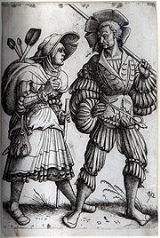
All Topics  
Etching

 
Etching

   Email Print
   Bookmark   Link


Etching


For other uses of etch or etching, see Etching (disambiguation)
Etching (disambiguation)

Etching may refer to* Etching, a printmaking technique in art* Etching , a glass decoration technique* Industrial etching* Etching , a process in producing microelectronics...
, for the history of the method, see old master prints.


Etching is the process of using strong acid
Acid

An acid is traditionally considered any chemical compound that, when dissolved in water, gives a solution with a hydrogen ion Activity greater than in pure water, i.e....
 or mordant
Mordant

A mordant is a substance used to set dyes on fabrics by forming an insoluble compound with the dye. It may be used for dyeing fabrics, or for intensifying stains in cell or tissue preparations....
 to cut into the unprotected parts of a metal
Metal

In chemistry, a metal is a chemical element whose atoms readily lose electrons to form positive ions , and form metallic bonds between other metal atoms and ionic bonds between nonmetal atoms....
 surface to create a design in intaglio
Intaglio

Intaglio may refer to:*Intaglio , a printmaking technique with an incised image*Intaglio , a similar effect in jewelry*Intaglio , a similar effect in burial mounds...
 in the metal (the original process—in modern manufacturing other chemicals may be used on other types of material). As an intaglio
Intaglio (printmaking)

Intaglio is a family of printmaking techniques in which the image is incised into a surface, known as the matrix or plate. Normally, copper or zinc plates are used as a surface, and the incisions are created by etching, engraving, drypoint, aquatint or mezzotint....
 method of printmaking
Printmaking

Printmaking is the process of making artworks by printing, normally on paper. Except in the case of monotyping, the process is capable of producing multiples of the same piece, which is called a 'print....
 it is, along with engraving
Engraving

Engraving is the practice of incising a design onto a hard, usually flat surface, by cutting grooves into it. The result may be a decorated object in itself, as when silver, gold, steel, or glass engraving are engraved, or may provide an intaglio printing plate, of copper or another metal, for printing images on paper as prints or illustra...
, the most important technique for old master print
Old master print

An old master print is a work of art produced by a printing process within the Western tradition . A date of about 1830 is usually taken as marking the end of the period whose prints are covered by this term....
s, and remains widely used today.

ure etching, a metal (usually copper, zinc or steel) plate is covered with a waxy ground which is resistant to acid.


Discussion
Ask a question about 'Etching'
Start a new discussion about 'Etching'
Answer questions from other users
Full Discussion Forum


Encyclopedia


For other uses of etch or etching, see Etching (disambiguation)
Etching (disambiguation)

Etching may refer to* Etching, a printmaking technique in art* Etching , a glass decoration technique* Industrial etching* Etching , a process in producing microelectronics...
, for the history of the method, see old master prints.


Etching is the process of using strong acid
Acid

An acid is traditionally considered any chemical compound that, when dissolved in water, gives a solution with a hydrogen ion Activity greater than in pure water, i.e....
 or mordant
Mordant

A mordant is a substance used to set dyes on fabrics by forming an insoluble compound with the dye. It may be used for dyeing fabrics, or for intensifying stains in cell or tissue preparations....
 to cut into the unprotected parts of a metal
Metal

In chemistry, a metal is a chemical element whose atoms readily lose electrons to form positive ions , and form metallic bonds between other metal atoms and ionic bonds between nonmetal atoms....
 surface to create a design in intaglio
Intaglio

Intaglio may refer to:*Intaglio , a printmaking technique with an incised image*Intaglio , a similar effect in jewelry*Intaglio , a similar effect in burial mounds...
 in the metal (the original process—in modern manufacturing other chemicals may be used on other types of material). As an intaglio
Intaglio (printmaking)

Intaglio is a family of printmaking techniques in which the image is incised into a surface, known as the matrix or plate. Normally, copper or zinc plates are used as a surface, and the incisions are created by etching, engraving, drypoint, aquatint or mezzotint....
 method of printmaking
Printmaking

Printmaking is the process of making artworks by printing, normally on paper. Except in the case of monotyping, the process is capable of producing multiples of the same piece, which is called a 'print....
 it is, along with engraving
Engraving

Engraving is the practice of incising a design onto a hard, usually flat surface, by cutting grooves into it. The result may be a decorated object in itself, as when silver, gold, steel, or glass engraving are engraved, or may provide an intaglio printing plate, of copper or another metal, for printing images on paper as prints or illustra...
, the most important technique for old master print
Old master print

An old master print is a work of art produced by a printing process within the Western tradition . A date of about 1830 is usually taken as marking the end of the period whose prints are covered by this term....
s, and remains widely used today.

Basic method

In pure etching, a metal (usually copper, zinc or steel) plate is covered with a waxy ground which is resistant to acid. The artist then scratches off the ground with a pointed etching needle where he/she wants a line to appear in the finished piece, so exposing the bare metal. The échoppe, a tool with a slanted oval section is also used for "swelling" lines. The plate is then dipped in a bath of acid, technically called the mordant
Mordant

A mordant is a substance used to set dyes on fabrics by forming an insoluble compound with the dye. It may be used for dyeing fabrics, or for intensifying stains in cell or tissue preparations....
 (French
French language

French is a Romance language spoken around the world by around 80 million people as first language, by 190 million as second language, and by about another 200 million people as an acquired tongue, with significant speakers in 54 countries....
 for "biting"), or has acid washed over it. The acid "bites" into the metal, where it is exposed, leaving behind lines sunk into the plate. The remaining ground is then cleaned off the plate. The plate is inked all over, and then the ink wiped off the surface, leaving only the ink in the etched lines.

The plate is then put through a high-pressure printing press
Printing press

A printing press is a mechanical device for applying pressure to an inked surface resting upon a medium , thereby transferring an image. The mechanical systems involved were first assembled in Germany by the goldsmith Johannes Gutenberg around 1439, based on existing screw-presses used to press cloth, grapes etc., and possibly to print wood...
 together with a sheet of paper (often moistened to soften it). The paper picks up the ink from the etched lines, making a print. The process can be repeated many times; typically several hundred impressions (copies) could be printed before the plate shows much sign of wear. The work on the plate can also be added to by repeating the whole process; this creates an etching which exists in more than one state
State (printmaking)

A state, in printmaking, is a different form of a print, caused by a deliberate and permanent change to a matrix such as a copper plate or woodblock ....
.

Etching has often been combined with other intaglio
Intaglio

Intaglio may refer to:*Intaglio , a printmaking technique with an incised image*Intaglio , a similar effect in jewelry*Intaglio , a similar effect in burial mounds...
 techniques such as engraving (e.g. Rembrandt
Rembrandt

Rembrandt Harmenszoon van Rijn was a Netherlands Painting and etching. He is generally considered one of the greatest painters and printmakers in European art history and the most important in History of the Netherlands....
) or aquatint (e.g. Goya).

History


Origin

Etching by goldsmith
Goldsmith

A goldsmith is a metalworker who specializes in working with gold and other precious metals. Since ancient times the techniques of a Goldsmith have evolved very little in order to produce items of jewelry of quality standards....
s and other metal-workers in order to decorate metal items such as guns, armour, cups and plates has been known in Europe since the Middle Ages
Middle Ages

File:Karl 1 mit papst gelasius gregor1 sacramentar v karl d kahlen.jpgThe Middle Ages of European history are a period in history which lasted for roughly a millennium, commonly dated from the fall of the Roman Empire in the 5th century to the beginning of the Early Modern Period in the 16th century, marked by the division of Western Christi...
 at least, and may go back to antiquity. The elaborate decoration of armour, in Germany anyway, was an art probably imported from Italy around the end of the 15th century—little earlier than the birth of etching as a printmaking technique. The process as applied to printmaking is believed to have been invented by Daniel Hopfer
Daniel Hopfer

Daniel Hopfer was a Germany artist who is widely believed to have been the first to use etching in printmaking, at the end of the fifteenth century....
 (circa 1470-1536) of Augsburg, Germany. Hopfer was a craftsman who decorated armour in this way, and applied the method to printmaking, using iron plates (many of which still exist). Apart from his prints, there are two proven examples of his work on armour: a shield from 1536 now in the Real Armeria of Madrid and a sword in the Germanisches Nationalmuseum
Germanisches Nationalmuseum

The Germanisches Nationalmuseum, founded in Nuremberg, Germany, in 1852, houses a significant collection of items relating to German culture and art extending from prehistoric times through to the present day....
 of Nuremberg. An Augsburg horse armour in the German Historical Museum, Berlin
Berlin

Berlin is the Capital of Germany city and one of sixteen States of Germany of Germany. With a population of 3.4 million within its city limits, Berlin is the country's largest city....
, dating to between 1512 and 1515, is decorated with motifs from Hopfer's etchings and woodcut
Woodcut

Woodcut - formally known as Xylography - is a relief printing artistic technique in printmaking in which an image is carved into the surface of a block of wood, with the printing parts remaining level with the surface while the non-printing parts are removed, typically with gouges....
s, but this is no evidence that Hopfer himself worked on it, as his decorative prints were largely produced as patterns for other craftsmen in various media. The switch to copper plates was probably made in Italy, and thereafter etching soon came to challenge engraving
Engraving

Engraving is the practice of incising a design onto a hard, usually flat surface, by cutting grooves into it. The result may be a decorated object in itself, as when silver, gold, steel, or glass engraving are engraved, or may provide an intaglio printing plate, of copper or another metal, for printing images on paper as prints or illustra...
 as the most popular medium for artists in printmaking
Printmaking

Printmaking is the process of making artworks by printing, normally on paper. Except in the case of monotyping, the process is capable of producing multiples of the same piece, which is called a 'print....
. Its great advantage was that, unlike engraving which requires special skill in metalworking, etching is relatively easy to learn for an artist trained in drawing.

Callot's innovations: échoppe, hard ground, stopping-out

Jacques Callot
Jacques Callot

Jacques Callot was a baroque printmaker and drawing from the Duchy of Lorraine . He is an important figure in the development of the old master print....
 (1592-1635) from Nancy
Nancy

Nancy is a city in the Meurthe-et-Moselle Departments of France in northeastern France.The city is the capital of the department. The metropolitan area of Nancy had a population of 410,509 inhabitants at the 1999 census, 103,602 of whom lived in the city of Nancy proper ....
 in Lorraine (now part of France) made important technical advances in etching technique. He developed the échoppe, a type of etching-needle with a slanting oval section at the end, which enabled etchers to create a swelling line, as engravers were able to do. He also seems to have been responsible for an improved, harder, recipe for the etching ground, using lute
Lute

Lute can refer generally to any plucked string instrument with a neck and a deep round back, or more specifically to an instrument from the family of European lutes....
-makers' varnish rather than a wax-based formula. This enabled lines to be more deeply bitten, prolonging the life of the plate in printing, and also greatly reducing the risk of "foul-biting", where acid gets through the ground to the plate where it is not intended to, producing spots or blotches on the image. Previously the risk of foul-biting had always been at the back of an etcher's mind, preventing him from investing too much time on a single plate that risked being ruined in the biting process. Now etchers could do the highly detailed work that was previously the monopoly of engravers, and Callot made full use of the new possibilities.

He also made more extensive and sophisticated use of multiple "stoppings-out" than previous etchers had done. This is the technique of letting the acid bite lightly over the whole plate, then stopping-out those parts of the work which the artist wishes to keep light in tone by covering them with ground before bathing the plate in acid again. He achieved unprecedented subtlety in effects of distance and light and shade by careful control of this process. Most of his prints were relatively small—up to about six inches or 15 cm on their longest dimension, but packed with detail.

One of his followers, the Parisian Abraham Bosse
Abraham Bosse

Abraham Bosse was a French artist, mainly as a printmaker in etching, but also in watercolor painting....
, spread Callot's innovations all over Europe with the first published manual of etching, which was translated into Italian, Dutch, German and English.

The 17th century was the great age of etching, with Rembrandt
Rembrandt

Rembrandt Harmenszoon van Rijn was a Netherlands Painting and etching. He is generally considered one of the greatest painters and printmakers in European art history and the most important in History of the Netherlands....
, Giovanni Benedetto Castiglione
Giovanni Benedetto Castiglione

Giovanni Benedetto Castiglione , was an Italy Baroque artist, painter, printmaker and draftsman, of the Genoa school. He is best known now for his elaborate engravings, and as the inventor of the printmaking technique of monotyping....
 and many other masters. In the 18th Piranesi, Tiepolo and Daniel Chodowiecki
Daniel Chodowiecki

Daniel Niklaus Chodowiecki was a Poland-Germany painter and printmaker with Huguenot ancestry, who is most famous as an etcher. He spent most of his life in Berlin, and became the director of the Berlin Academy of Art....
 were the best of a smaller number of fine etchers. In the 19th and early-20th century the Etching revival
Etching revival

The Etching Revival is the name given by at the time, and by art historians, to the renaissance of etching as an original form of printmaking during a period of time stretching approximately from 1850 to 1930....
 produced a host of lesser artists, but no really major figures. Etching is still widely practiced today.

Variants: aquatint, soft-ground and relief etching

  • Aquatint
    Aquatint

    Aquatint is an intaglio printmaking technique, a variant of etching.Intaglio printmaking makes marks on the matrix that are capable of holding ink....
     uses acid-resistant resin to achieve tonal effects.
  • Soft-ground etching uses a special softer ground. The artist places a piece of paper (or cloth etc in modern uses) over the ground and draws on it. The print resembles a drawing.
  • Relief etching. Invented by William Blake
    William Blake

    William Blake was an English people English poetry, Painting, and printmaker. Largely unrecognized during his lifetime, Blake is now considered a seminal figure in the history of both poetry and the visual arts of the Romanticism....
     in about 1788; from 1880-1950 a photo-mechanical ("line-block") variant was the dominant form of commercial printing for images. A similar process to etching, but printed as a relief print
    Relief print

    A relief print is an image created by a printmaking process, such as woodcut, where the areas of the matrix that are to show printed black are on the original surface; the parts of the matrix that are to be blank having been cut away, or otherwise removed....
    , so it is the "white" background areas which are exposed to the acid, and the areas to print "black" which are covered with ground. Blake's exact technique remains controversial. He used the technique to print texts and images together.


Modern technique in detail

A waxy acid-resist, known as a ground, is applied to a metal plate, most often copper
Copper

Copper is a chemical element with the symbol Cu and atomic number 29.It is a ductile metal with very high thermal and electrical conductivity....
 or zinc
Zinc

Zinc is a metallic chemical element with the symbol Zn and atomic number 30. It is a first-row transition metal of the group 12 element of the periodic table....
 but steel
Steel

Steel is an alloy consisting mostly of iron, with a carbon content between 0.2% and 2.14% by weight , depending on grade. Carbon is the most cost-effective alloying material for iron, but various other alloying elements are used such as manganese, chromium, vanadium, and tungsten....
 plate is another medium with different qualities. There are two common types of ground: hard ground and soft ground.

Hard ground can be applied in two ways. Solid hard ground comes in a hard waxy block. To apply hard ground of this variety, the plate to be etched is placed upon a hot-plate (set at 70 degrees C), a kind of metal worktop that is heated up. The plate heats up and the ground is applied by hand, melting onto the plate as it is applied. The ground is spread over the plate as evenly as possible using a roller. Once applied the etching plate is removed from the hot-plate and allowed to cool which hardens the ground.

After the ground has hardened the artist "smokes" the plate, classically with 3 beeswax tapers, applying the flame to the plate to darken the ground and make it easier to see what parts of the plate are exposed. Smoking not only darkens the plate but adds a small amount of wax. Afterwards the artist uses a sharp tool to scratch into the ground, exposing the metal.

The second way to apply hard ground is by liquid hard ground. This comes in a can and is applied with a brush upon the plate to be etched. Exposed to air the hard ground will harden. Some printmakers use bitumen as hard ground, although often bitumen is used to protect steel plates from rust and copper plates from aging.

Soft ground also comes in liquid form and is allowed to dry but it does not dry hard like hard ground and is impressionable. After the soft ground has dried the printmaker may apply materials such as leaves, objects, hand prints and so on which will penetrate the soft ground and expose the plate underneath.

The ground can also be applied in a fine mist, using powdered rosin or spraypaint. This process is called aquatint, and allows for the creation of tones, shadows, and solid areas of color.

The design is then drawn (in reverse) with an etching-needle or échoppe. An "echoppe" point can be made from an ordinary tempered steel etching needle, by grinding the point back on a carborundum stone, at a 45–60 degree angle. The "echoppe" works on the same principle that makes a fountain pen's line more attractive than a biro's: The slight swelling variation caused by the natural movement of the hand "warms up" the line, and although hardly noticeable in any individual line, has a very attractive overall effect on the finished plate. It can be drawn with in the same way as an ordinary needle

The plate is then completely submerged in an acid that eats away at the exposed metal. Ferric chloride may be used for etching copper or zinc plates, whereas nitric acid may be used for etching zinc or steel plates. Typical solutions are 2 parts FeCl3 to 2 parts water and 1 part nitric to 3 parts water. The strength of the acid determines the speed of the etching process.

  • The etching process is known as biting (see also spit-biting below).
  • The waxy resist prevents the acid
    Acid

    An acid is traditionally considered any chemical compound that, when dissolved in water, gives a solution with a hydrogen ion Activity greater than in pure water, i.e....
     from biting the parts of the plate which have been covered.
  • The longer the plate remains in the acid the deeper the "bites" become.


Etching Landscape
During the etching process the printmaker uses a bird feather or similar item to wave away bubbles and detritus produced by the dissolving process, from the surface of the plate, or the plate may be periodically lifted from the acid bath. If a bubble is allowed to remain on the plate then it will stop the acid biting into the plate where the bubble touches it. Zinc produces more bubbles much more rapidly than copper and steel and some artists use this to produce interesting round bubble-like circles within their prints for a Milky Way effect.

The detritus is powdery dissolved metal that fills the etched grooves and can also block the acid from biting evenly into the exposed plate surfaces. Another way to remove detritus from a plate is to place the plate to be etched face down within the acid upon plasticine balls or marbles, although the drawback of this technique is the exposure to bubbles and the inability to remove them readily.

For aquatinting a printmaker will often use a test strip of metal about a centimetre to three centimetres wide. The strip will be dipped into the acid for a specific number of minutes or seconds. The metal strip will then be removed and the acid washed off with water. Part of the strip will be covered in ground and then the strip is redipped into the acid and the process repeated. The ground will then be removed from the strip and the strip inked up and printed. This will show the printmaker the different degrees or depths of the etch, and therefore the strength of the ink color, based upon how long the plate is left in the acid.

The plate is removed from the acid and washed over with water to remove the acid. The ground is removed with a solvent such as turpentine
Turpentine

Turpentine is a fluid obtained by the distillation of resin obtained from trees, mainly pine trees. It is composed of terpenes, mainly the monoterpenes alpha-Pinene and beta-Pinene....
. Turpentine is often removed from the plate using methylated spirits since turpentine is greasy and can affect the application of ink and the printing of the plate.

Spit-biting is a process whereby the printmaker will apply acid to a plate with a brush in certain areas of the plate. The plate may be aquatinted for this purpose or exposed directly to the acid. The process is known as "spit"-biting due to the use of saliva once used as a medium to dilute the acid, although gum arabic or water are now commonly used.

A piece of matte board, a plastic "card", or a wad of cloth is often used to push the ink into the incised lines. The surface is wiped clean with a piece of stiff fabric known as tarlatan and then either wiped with newsprint
Newsprint

Newsprint is low-cost, Preservation paper most commonly used to print newspapers, plus other publications and advertising material. It usually has an off-white cast and distinctive feel....
 paper; some printmakers prefer to use the blade part of their hand or palm at the base of their thumb. The wiping leaves ink in the incisions. You may also use a folded piece of organza silk to do the final wipe. If copper or zinc plates are used plate surface is left very clean and therefore white in the print. If steel plate is used then the plate's natural tooth gives the print a grey background similar to the effects of aquatinting. As a result steel plates do not need aquatinting as gradual exposure of the plate via successive dips into acid will produce the same result.

A damp piece of paper is placed over the plate and it is run through the press.

Non-toxic etching

Growing concerns about the health effects of acids and solvents led to the development of less toxic etching methods in the late 20th century. An early innovation was the use of floor wax as a hard ground for coating the plate. Others, such as printmakers Mark Zaffron and Keith Howard, developed systems using acrylic polymers as a ground and ferric chloride for etching. The polymers are removed with sodium carbonate (washing soda) solution, rather than solvents. When used for etching, ferric chloride does not produce a corrosive gas, as acids do, thus eliminating another danger of traditional etching.

The traditional aquatint, which uses either powdered rosin or enamel spray paint, is replaced with an airbrush application of the acrylic polymer hard ground. Again, no solvents are needed beyond the soda ash solution, though a ventilation hood is needed due to acrylic particulates from the air brush spray.

The traditional soft ground, requiring solvents for removal from the plate, is replaced with water-based relief printing ink. The ink receives impressions like traditional soft ground, resists the ferric chloride etchant, yet can be cleaned up with warm water and either soda ash solution or ammonia. Etching is a form of art which is taught in many ways.

Photo-etching


Light sensitive polymer plates allow for photorealistic etchings. A photo-sensitive coating is applied to the plate by either the plate supplier or the artist. Light is projected onto the plate as a negative image to expose it. Photopolymer plates are either washed in hot water or under other chemicals according to the plate manufacturers' instructions. Areas of the photo-etch image may be stopped-out before etching to exclude them from the final image on the plate, or removed or lightened by scraping and burnishing once the plate has been etched. Once the photo-etching process is complete, the plate can be worked further as a normal intaglio plate, using drypoint, further etching, engraving, etc. The final result is an intaglio plate which is printed like any other.

Types of metal plates

Copper was always the traditional metal, and is still preferred, for etching, as it bites evenly, holds texture well, and does not distort the colour of the ink when wiped. Zinc is cheaper than copper, so preferable for beginners, but it does not bite as cleanly as copper, and it alters some colours of ink. Steel is growing in popularity as an etching substrate. Prices of copper and zinc have steered steel to an acceptable alternative. Line quality of steel is less fine than copper but finer than zinc. Steel has a natural and rich aquatint. Steel is virtually impossible to reclaim though the price and availability make it still more cost effective.

Industrial uses

Etching is also used in the manufacturing of printed circuit board
Printed circuit board

A printed circuit board, or PCB, is used to mechanically support and electrically connect electronic components using Conductor pathways, or signal traces, industrial etchinged from copper sheets laminated onto a non-conductive substrate....
s and semiconductor device
Semiconductor device

Semiconductor devices are electronic components that exploit the electronics properties of semiconductor materials, principally silicon, germanium, and gallium arsenide....
s (see Etching (microfabrication)
Etching (microfabrication)

Etching is used in microfabrication to chemically remove layers from the surface of a wafer during manufacturing. Etching is a critically important process module, and every wafer undergoes many etching steps before it is complete....
 ), on glass
Etching (glass)

Etching refers to the technique of creating art on the surface of glass by applying acidic, caustic, or abrasive substances. Traditionally this was done after the glass was blown or cast....
, and in the preparation of metallic specimens for microscopic observation.

Controlling the acid's effects


Hard grounds
There are many ways for the printmaker to control the acid's effects. Most typically, the surface of the plate is covered in a hard, wax
Wax

Wax has traditionally referred to a substance that is secreted by bees and used by them in constructing their honeycombs.It is an imprecisely defined term generally understood to be a substance with properties similar to beeswax, namely...
y 'ground' that resists acid. The printmaker then scratches through the ground with a sharp point, exposing lines of metal that are attacked by the acid.

Aquatint
Aquatint
Aquatint

Aquatint is an intaglio printmaking technique, a variant of etching.Intaglio printmaking makes marks on the matrix that are capable of holding ink....
 is a variation in which particulate resin is evenly distributed on the plate, then heated to form a screen ground of uniform but less than perfect density. After etching, any exposed surface will result in a roughened (i.e. darkened) surface. Areas that are to be light in the final print are protected by varnishing between acid baths. Successive turns of varnishing and placing the plate in acid create areas of tone difficult or impossible to achieve by drawing through a wax ground.

Carbograph
This is an etching technique invented in 2006 by the U.S. printmaker Rand Huebsch. Tiny particles of carborundum grit are mixed into the acid-resistant ground, which is brushed onto the bare metal as usual and allowed to dry. When that mixture has dried, the metal stylus is used on the plate and thereby removes some of the grit particles, so that minuscule areas of copper are exposed to the acid and etched; they will eventually hold the ink for the printing process. Thus the image on paper has a texture similar to that of a charcoal drawing.

Printing


Printing the plate is done by covering the surface with ink
Ink

An ink is a liquid containing various pigments and/or dyes used for coloring a surface to produce an , writing, or design. Ink is used for drawing and/or writing with a pen, brush or quill....
, then rubbing the ink off the surface with tarlatan cloth or newsprint, leaving ink in the roughened areas and lines. Damp paper is placed on the plate, and both are run through a printing press
Printing press

A printing press is a mechanical device for applying pressure to an inked surface resting upon a medium , thereby transferring an image. The mechanical systems involved were first assembled in Germany by the goldsmith Johannes Gutenberg around 1439, based on existing screw-presses used to press cloth, grapes etc., and possibly to print wood...
; the pressure forces the paper into contact with the ink, transferring the image (
c.f., chine-collé
Chine-collé

Chine-coll? is a special technique in printmaking in which the image is transferred to a surface that is bonded to a heavier support in the printing process....
). Unfortunately, the pressure also subtly degrades the image in the plate, smoothing the roughened areas and closing the lines; a copper
Copper

Copper is a chemical element with the symbol Cu and atomic number 29.It is a ductile metal with very high thermal and electrical conductivity....
 plate is good for, at most, a few hundred printings of a strongly etched imaged before the degradation is considered too great by the artist. At that point, the artist can manually restore the plate by re-etching it, essentially putting ground back on and retracing their lines; alternately, plates can be electro-plated
Electroplating

Electroplating is a plating process that uses electrical direct current to redox cations of a desired material from a solution and coat a electrical conductivity object with a thin layer of the material, such as a metal....
 before printing with a harder metal to preserve the surface. Zinc
Zinc

Zinc is a metallic chemical element with the symbol Zn and atomic number 30. It is a first-row transition metal of the group 12 element of the periodic table....
 is also used, because as a softer metal, etching times are shorter; however, that softness also leads to faster degradation of the image in the press.

Faults


Faux-bite or "over-biting" is common in etching, and is the effect of minuscule amounts of acid leaking through the ground to create minor pitting and burning on the surface. This incidental roughening may be removed by smoothing and polishing the surface, but artists often leave faux-bite, or deliberately court it by handling the plate roughly, because it is viewed as a desirable mark of the process.

"Etchings" cliché

The phrase "Want to come up and see my etchings?" is a romantic cliché in which a man entices a woman to come back to his place with an offer to look at something artistic. This was referenced in a James Thurber
James Thurber

James Grover Thurber was an United States author, cartoonist and celebrated wit.Thurber was best known for his contributions to The New Yorker magazine....
 cartoon where a man tells a woman in a building lobby: "You wait here- I'll bring the etchings down". Also in Dashiell Hammett
Dashiell Hammett

Samuel Dashiell Hammett was an United States author of hardboiled detective fiction novels and short stories. Among the enduring characters he created are Sam Spade , Nick and Nora Charles , and the Continental Op ....
's 1934 novel The Thin Man
The Thin Man

The Thin Man is a hardboiled detective novel by Dashiell Hammett. Although he never wrote a sequel, the book became the basis for a successful film series which also began in 1934 with The Thin Man and starred William Powell and Myrna Loy....
, where the narrator answers his wife asking him about a lady he had wandered off with, "She just wanted to show me some French etchings."

See also

  • Old master prints for the history of the method
  • Electroetching
    Electroetching

    Electroetching is an etching process that involves the use of chemicals, along with the employment of Direct current and is done by applying electrochemical etching solution to a material layer, preferably a metal layer, on a workpiece, in the presence of a current....


External links