
All Topics  
Palmyra

 
Palmyra

   Email Print
   Bookmark   Link


Palmyra


Palmyra was in ancient times an important city of central Syria
Syria

Syria , officially the Syrian Arab Republic , is an Arab-majority country in Southwest Asia, bordering Lebanon and the Mediterranean Sea to the west, Israel to the southwest, Jordan to the south, Iraq to the east, and Turkey to the north....
, located in an oasis
Oasis

In geography, an oasis or cienega is an isolated area of vegetation in a desert, typically surrounding a spring or similar water source. Oases also provide habitat for animals and even humans if the area is big enough....
 215 km northeast of Damascus
Damascus

Damascus is the capital and largest city of Syria. It is List of oldest continuously inhabited cities and its current population is estimated at about 4,000,000....
 and 120 km southwest of the Euphrates
Euphrates

The Euphrates is the western of the two great rivers that define Mesopotamia which flows from Anatolia....
. It has long been a vital caravan city for travellers crossing the Syrian desert
Syrian Desert

The Syrian Desert , also known as the Syro-Arabian desert is a combination of steppe and true desert that is located in the northern Arabian Peninsula....
 and was known as the Bride of the Desert. The earliest documented reference to the city by its Semitic name Tadmor, Tadmur or Tudmur (which means "the town that repels" in Amorite and "the indomitable town" in Aramaic.) is recorded in Babylonian tablets found in Mari
Mari, Syria

Mari was an ancient Sumerian and Amorite city, located 11 kilometers north-west of the modern town of Abu Kamal on the western bank of Euphrates river, some 120 km southeast of Deir ez-Zor, Syria....
.

Though the ancient site fell into disuse after the 16th century, it is still known as Tadmor in Arabic, and there is a newer town next to the ruins of the same name.


Discussion
Ask a question about 'Palmyra'
Start a new discussion about 'Palmyra'
Answer questions from other users
Full Discussion Forum


Recent Posts


Encyclopedia


Palmyra was in ancient times an important city of central Syria
Syria

Syria , officially the Syrian Arab Republic , is an Arab-majority country in Southwest Asia, bordering Lebanon and the Mediterranean Sea to the west, Israel to the southwest, Jordan to the south, Iraq to the east, and Turkey to the north....
, located in an oasis
Oasis

In geography, an oasis or cienega is an isolated area of vegetation in a desert, typically surrounding a spring or similar water source. Oases also provide habitat for animals and even humans if the area is big enough....
 215 km northeast of Damascus
Damascus

Damascus is the capital and largest city of Syria. It is List of oldest continuously inhabited cities and its current population is estimated at about 4,000,000....
 and 120 km southwest of the Euphrates
Euphrates

The Euphrates is the western of the two great rivers that define Mesopotamia which flows from Anatolia....
. It has long been a vital caravan city for travellers crossing the Syrian desert
Syrian Desert

The Syrian Desert , also known as the Syro-Arabian desert is a combination of steppe and true desert that is located in the northern Arabian Peninsula....
 and was known as the Bride of the Desert. The earliest documented reference to the city by its Semitic name Tadmor, Tadmur or Tudmur (which means "the town that repels" in Amorite and "the indomitable town" in Aramaic.) is recorded in Babylonian tablets found in Mari
Mari, Syria

Mari was an ancient Sumerian and Amorite city, located 11 kilometers north-west of the modern town of Abu Kamal on the western bank of Euphrates river, some 120 km southeast of Deir ez-Zor, Syria....
.

Though the ancient site fell into disuse after the 16th century, it is still known as Tadmor in Arabic, and there is a newer town next to the ruins of the same name. The Palmyrenes constructed a series of large-scale monuments containing funerary art
Funerary art

Funerary art is any work of art forming or placed in a repository for the remains of the death. Tomb is a general term for the repository, while grave goods are objects—other than the primary human remains—which have been placed inside....
 such as limestone slabs with human busts representing the deceased.

History


Ancient

Palmyracloseup
In the mid-first century, Palmyra, a wealthy and elegant city located along the caravan routes linking Persia with the Mediterranean ports of Roman Syria and Phoenicia
Phoenicia

Phoenicia was an ancient civilization centered in the north of ancient Canaan, with its heartland along the coastal regions of modern day Lebanon, extending to parts of Israel, Syria and the Palestinian territories....
, came under Roman control. During the following period of great prosperity, the Aramaean
Aramaeans

The Aramaeans were a West Semitic semi-nomadic and pastoralist people who lived in upper Mesopotamia and Aram . Aramaeans never had a unified empire; they were divided into independent kingdoms all across the Near East....
 inhabitants of Palmyra adopted customs and modes of dress from both the Iran
Iran

Iran , officially the Islamic Republic of Iran and formerly known internationally as Persian Empire until 1935, is a country in Central Eurasia, located on the northeastern shore of the Persian Gulf and the southern shore of the Caspian Sea....
ian Parthian world to the east and the Graeco-Roman west.

Tadmor is mentioned in the Hebrew Bible
Hebrew Bible

The term Hebrew Bible is a generic reference to those books of the Bible originally written mostly in Biblical Hebrew with some Biblical Aramaic....
 (Second Book of Chronicles
Books of Chronicles

LocationIn the masoretic text, Chronicles is part of the third part of the Tanakh, namely Ketuvim . In most printed versions it is the last book in Ketuvim ....
 8:4) as a desert city built (or fortified) by the King Solomon
Solomon

Solomon is a figure described in the Hebrew Bible and the Qur'an. The biblical accounts identify Solomon as the son of David. He is also called Jedidiah in the Tanakh , and is described as the third king of the United Monarchy, and the final king before the northern Kingdom of Israel and the southern Kingdom of Judah split; following th...
 of Judea
Judea

Judea or Jud?a is the name given to the mountainous southern part of the historic Land of Israel , an area now divided between Israel and the West Bank ....
, the son of David.

In the First Book of Kings
Books of Kings

The Books of Kings are a part of Judaism's Tanakh, the Hebrew Bible. They were originally written in Hebrew language and were later included by Christianity as part of the Old Testament....
 (9:18) is mentioned the city of ??? Tamor or Tamar, also built by Solomon
Solomon

Solomon is a figure described in the Hebrew Bible and the Qur'an. The biblical accounts identify Solomon as the son of David. He is also called Jedidiah in the Tanakh , and is described as the third king of the United Monarchy, and the final king before the northern Kingdom of Israel and the southern Kingdom of Judah split; following th...
. But it is traditionally read (see Qere) as Tadmor, and several citations in the tractates
Tract (literature)

A tract is a literature, and in current usage, usually religious in nature. The notion of what constitutes a tract has changed over time. By the early part of the twenty-first century, these meant small pamphlets used for religious and political purposes, though far more often the former....
 of the Talmud
Talmud

The Talmud is a record of rabbinic discussions pertaining to Halakha, Jewish ethics, customs, and history. It is a central text of mainstream Judaism....
 and of the Midrash
Midrash

Midrash is a Hebrew language term referring to the not exact, but comparative method of exegesis of Biblical texts, which is one of four methods cumulatively called Pardes ....
 refer to that city in the Syrian desert (sometimes interchanging the letters "d" and "t" - "Tatmor" instead of "Tadmor"). Some modern scholars wrote that it could refer to a place near the Dead Sea
Dead Sea

For the Brian Keene book of the same name, see Dead Sea The Dead Sea is a salt lake between Israel and the West Bank to the west, and Jordan to the east....
.

Tadmor is also mentioned as built by Solomon in Flavius Josephus Antiquities of the Jews - Book VIII, along with the Greek name of Palmyra.

Tadmor is the name of Palmyra in modern Hebrew. The exact etymology of the name "Palmyra" in this case is unknown, although some scholars believe it was related to the palm trees in the area. Others, however, believe it may have come out of an incorrect translation of the name "Tadmor" (cf. Colledge, Seyrig, Starcky, and others).

The city was first mentioned in the archives of Mari
Mari, Syria

Mari was an ancient Sumerian and Amorite city, located 11 kilometers north-west of the modern town of Abu Kamal on the western bank of Euphrates river, some 120 km southeast of Deir ez-Zor, Syria....
 in the 2nd millennium BC. It was another trading city in the extensive trade network that linked Mesopotamia and northern Syria. Terry Jones
Terry Jones

Terence Graham Parry Jones is a Wales comedian, screenwriter and actor, film director, children's author, popular historian, political commentator and TV documentary host....
 and Alan Ereira
Alan Ereira

Alan Ereira is an award-winning UK author and television documentary filmmaker....
 write in Terry Jones' Barbarians, p. 183:

Greco-Roman and Persian periods

When the Seleucids took control of Syria in 323 BC, the city was left to itself and it became independent. The city flourished as a caravan halt in the 1st century BC. In 41 BC, the Romans under Mark Antony
Mark Antony

Marcus Antonius , known in English as Marc Antony, was a Roman Republic politician and General. He was an important supporter and the best friend of Julius Caesar as a military commander and administrator, being Caesar's second cousin, once removed, by his mother Julia Antonia....
 tried to occupy Palmyra but failed as the Palmyrans escaped to the other side of the Euphrates. The Palmyrans had received intelligence of the Roman approach. This proves that at that time Palmyra was still a nomadic settlement and its valuables could be removed at short notice. Jones and Erieira note that Palmyran merchants owned ships in Italian waters and controlled the Indian silk trade. "Palmyra became one of the richest cities of the Near East.""The Palmyrans had really pulled off a great trick, they were the only people who managed to live alongside Rome without being Romanized. They simply pretended to be Romans."
Palmyraancientavenue
the Scene of the Theater in Palmyra
Palmyrawoman
Palmyra was made part of the Roman province
Roman province

In Ancient Rome, a province was the basic, and until the Tetrarchy , largest territorial and administrative unit of the empire's territorial possessions outside of the Italia ....
 of Syria
Syria (Roman province)

Syria was a Roman province, annexed in 64 BC by Pompey, as a consequence of his military presence after pursuing victory in the Third Mithridatic War....
 during the reign of Tiberius
Tiberius

Tiberius Julius Caesar Augustus, born Tiberius Claudius Nero , was the second Roman Emperor, from the death of Augustus in AD 14 until his own death in 37....
 (14–37). It steadily grew in importance as a trade route linking Persia, India, China, and the Roman empire. In 129, Hadrian
Hadrian

Publius Aelius Hadrianus , as emperor Imperator Caesar Divi Traiani filius Traianus Hadrianus Augustus, and Divus Hadrianus after his apotheosis, known as Hadrian in English language, was Roman Emperor of Roman Empire from AD 117 to 138, as well as a Stoicism and Epicureanism philosopher....
 visited the city and was so enthralled by it that he proclaimed it a free city and renamed it Palmyra Hadriana. Beginning in 212, Palmyra's trade diminished as the Sassanids occupied the mouth of the Tigris
Tigris

The Tigris is the eastern member of the two great rivers that define Mesopotamia, along with the Euphrates, which flows from the mountains of southeastern Turkey through Iraq....
 and the Euphrates
Euphrates

The Euphrates is the western of the two great rivers that define Mesopotamia which flows from Anatolia....
. Septimius Odaenathus
Odaenathus

Lucius Septimius Odaenathus, or Odenatus...
, a Prince of Palmyra, was appointed by Valerian
Valerian (emperor)

Publius Licinius Valerianus , commonly known in English language as Valerian or Valerian I, was the Roman Emperor from 253 to 260....
 as the governor of the province of Syria. After Valerian was captured by the Sassanids and died in captivity in Bishapur
Bishapur

Bishapur is an ancient city situated south of modern Faliyan, Iran on the ancient road between Persis and Elam. The road linked the Sassanid capitals Istakhr and Ctesiphon....
, Odaenathus
Odaenathus

Lucius Septimius Odaenathus, or Odenatus...
 campaigned as far as Ctesiphon
Ctesiphon

Ctesiphon was one of the great cities of the Persian Empire, located on the east bank of the Tigris.Ctesiphon was an imperial capital of the Arsacids and of their successors, the Sassanids....
 (near modern-day Baghdad
Baghdad

Baghdad is the Capital of Iraq and of Baghdad Governorate, with which it is also coterminous. With a municipal population estimated at 6.5 million, it is the largest city in Iraq, and the second largest city in the Arab World....
) for revenge, invading the city twice. When Odaenathus was assassinated by his nephew Maconius, his wife Septimia Zenobia
Zenobia

Zenobia was a Roman Syrian queen who lived in the 3rd century. She was a Queen regnant of the Palmyrene Empire and the second wife of King Septimius Odaenathus....
 took power, ruling Palmyra on the behalf of her son, Vabalathus. Zenobia rebelled against Roman authority with the help of Cassius Longinus and took over Bosra
Bosra

Bosra is an ancient city administratively belonging to the Daraa Governorate in southern Syria. It is a major archaeological site and has been declared a UNESCO World Heritage Site....
 and lands as far to the west as Egypt
Egypt

Egypt is a country mainly in North Africa, with the Sinai Peninsula forming a land bridge in Western Asia. Covering an area of about , Egypt borders the Mediterranean Sea to the north, the Gaza Strip and Israel to the northeast, the Red Sea to the east, Sudan to the south and Libya to the west....
, establishing the short-lived Palmyrene Empire
Palmyrene Empire

The Palmyrene Empire was a splinter empire that broke off the Roman Empire during the Crisis of the Third Century. It encompassed the Roman provinces of Syria , Syria Palaestina, Aegyptus and large parts of Asia Minor....
. Next, she attempted to take Antioch
Antioch

Antioch on the Orontes was an ancient city on the eastern side of the Orontes River. It is near the modern city of Antakya, Turkey.Founded near the end of the 4th century BC by Seleucus I Nicator, one of Alexander the Great's generals, Antioch eventually rivaled Alexandria as the chief city of the nearer East and was a cradle of gentile hi...
 to the north. In 272, the Roman Emperor Aurelian
Aurelian

Lucius Domitius Aurelianus , known in English as Aurelian, Roman Emperor , was the second of several highly successful "soldier-emperors" who helped the Roman Empire regain its power during the latter part of the third century and the beginning of the fourth....
 finally retaliated and captured her and brought her back to Rome. He paraded her in golden chains but allowed her to retire to a villa in Tibur
Tivoli, Italy

Tivoli, the classical Tibur, is an ancient Italy town in Lazio, about 30 km from Rome, at the falls of the Aniene river, where it issues from the Sabine hills....
, where she took an active part in society for years. This rebellion greatly disturbed Rome, and so Palmyra was forced by the empire to become a military base for the Roman legions. Diocletian
Diocletian

Gaius Aurelius Valerius Diocletianus , born Diocles and commonly known as Diocletian , was Roman Emperor from November 20, 284 to May 1, 305....
 expanded it to harbor even more legions and walled it in to try and save it from the Sassanid threat. The Byzantine
Byzantine Empire

Byzantine Empire and Eastern Roman Empire are conventional names used to describe the Roman Empire during the Middle Ages, centered on its capital of Constantinople....
 period only resulted in the building of a few churches and much of the city was in ruin.

Islamic rule

The city was captured by the Muslim Arabs under Khalid ibn Walid in 634. Palmyra was kept intact. After the year 800 and the civil wars which followed the fall of the Umayyad caliphs, people started abandoning the city. At the time of the Crusades
Crusades

The Crusades were a series of religious war waged by much of Christian Europe against external and internal opponents. Crusades were fought mainly against Muslims, though campaigns were also directed against Paganism Slavic peoples, Jews, Eastern Orthodox Church, Mongols, Catharism, Hussites, Waldensians, Old Prussians, and political enemi...
, Palmyra was under the Burid
Burid dynasty

The Burid dynasty was a Turkish dynasty which ruled over Damascus in the early 12th century. The first Burid ruler, Toghtekin of Damascus, began as a servant to the Seljuk Turks ruler of Damascus, Duqaq of Damascus....
 emirs of Damascus, then under Tughtekin, Mohammed the son of Shirkuh
Shirkuh

Asad ad-Din Shirkuh bin Shadhi He was originally from a Kurdish people village in Armenia near the town of Dvin. He was the son of Shadhi ibn Marwan, a Kurdish ruler, and was the brother of Najm ad-Din Ayyub, the ancestor of the Ayyubid dynasty....
, and finally under the emirs of Homs
Homs

Hims Hims did not emerge into the light of history until the 1st century BCE at the time of Seleucids. It later became the capital of a kingdom ruled by the Royal Family of Emesa who gave the city its name....
. In 1132 the Burids had the Temple of Ba'al turned into a fortress. In the 13th century the city was handed over to the Mamluk sultan Baybars. In 1401, it was sacked by Tamerlan, but it recovered quickly, so that in the 15th century it was described as boasting "vast gardens, flourishing trades and bizarre monuments" by Ibn Fadlallah al-Omari.

In the 16th century, Qala'at ibn Maan castle
Fakhreddin Almaani Castle

Fakhr-al-Din al-Maani Castle was built by the Druze prince Fakhreddine, after he extended the Mount Lebanon Governorate to reach the city of Palmyra during the 16th century....
 was built on top of a mountain overlooking the oasis by Fakhr ad-Din al-Maan II, a Lebanese prince who tried to control the Syrian Desert. The castle was surrounded by a moat, with access only available through a drawbridge. It is possible that earlier fortifications existed on the hill well before then.

The city declined under Ottoman rule, reducing to no more than an oasis village with a small garrison. In the 17th century its location was rediscovered by western travellers, beginning to be studied by European and American archaeologists starting from the 19th centuries. The villagers who had settled in the Temple of Ba'al were dislodged in 1929 by the French authority.

Main sights


City remains

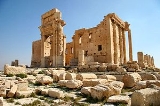
The most striking building in Palmyra is the huge temple of Ba'al 34°32'50.55"N 38°16'26.72"E, considered "the most important religious building of the first century AD in the Middle East". It originated as a Hellenistic temple, of which only fragments of stones survives. The central shrine (cella) was added in the early 1st century AD, followed by a large double colonnaded portico in Corynthian style. The west portico and the entrance (propylaeum) date from the 2nd century. The temple measures 205 x 210 m.

Starting from the temple, a colonnaded street, corresponding to the ancient decumanus, leads to the rest of the ancient city. It has a monumental arch 34°32'59.68"N 38°16'15.66"E (dating to reign of Septimius Severus
Septimius Severus

Lucius Septimius Severus was a Roman Empire general, and Roman Emperor from April 14 193 to 211. He was born in what is now the Libyan part of Rome's historic Africa Province, making him the first emperor to be born in the Roman province of Africa Province....
, early 3rd century AD) with rich decorations. Next were a temple of Nabu
Nabu

Nabu is the Babylonian god of wisdom and writing, worshipped by Babylonians as the son of Marduk and his consort, Sarpanitum, and as the grandson of Ea ....
, of which little remains today apart the podium, and the so-called baths of Diocletian
Diocletian

Gaius Aurelius Valerius Diocletianus , born Diocles and commonly known as Diocletian , was Roman Emperor from November 20, 284 to May 1, 305....
.

The second most noteworthy remain in Palmyra is the theater 34°33'2.11"N 38°16'7.78"E, today having 9 rows of seating, but most likely having up to 12 with the addition of wooden structures. It has been dated to the early 1st century AD. Behind the theater were a small Senate, where the local nobility discussed laws and political decisions, and the so-called "Tariff Court", which an inscription led to think to be a custom for caravans' payments. Nearby is the large agora
Agora

The Agora was an open "place of assembly" in ancient Ancient Greece city-states. Early in Greek history , free-born male land-owners who were citizens would gather in the agora for military duty or to hear statements of the ruling king or council....
 34°33'1.82"N 38°16'2.01"E (measuring 48 x 71 m), with remains of a banquet room (triclinium
Triclinium

A triclinium is a formal dining room in a Ancient Rome building. The word is adopted from the Greek language t?????????, triklinion, from t??-, tri- and ?????, kline, a couch....
); the agoras entrance was decorated with statues of Septimius Severus and his family.

The first section of the excavations ends with a largely restored
tetrapylon ("Four columns"), a platform with four sets each with four columns (only one of the originals in Egyptian granite still visible). A transverse streets leads to the Diocletian's Camp, built by the Governor of Syria Sosianus Hierocles, with the remains of the large central principia (Hall housing the legions' standards). Nearby are the Temple of the Syrian goddess Allat
Allat

Al-Lat was a pre-Islamic Arabian goddess who was one of the three chief goddesses of Mecca. She is mentioned in the Qur'an ,Descriptions...
 (2nd century AD), the Damascus Gate and the Temple of Ba'al-Shamin, erected in 17 AD and later expanded under the reign of Odenathus. Remains include a notable portico leading to the
cella.

Funerary art

Outside the ancient walls, the Palmyrenes constructed a series of large-scale funerary monuments, which now form the so-called Valley of the Tombs, a 1 km long necropolis
Necropolis

A necropolis is a large cemetery or burial place . Apart from the occasional application of the word to modern cemeteries outside large towns, the term...
, with a series of large structures with rich decorations. These tombs, some of which were below ground, had interior walls that were cut away or constructed to form burial compartments in which the deceased, extended at full length, was placed. Limestone slabs with human busts (in Roman and Parthian Iranian fashions) in high relief sealed the rectangular openings of the compartments.

These reliefs represented the "personality" or "soul" of the person interred and formed part of the wall decoration inside the tomb chamber. A banquet scene as depicted on this relief would have been displayed in a family tomb rather than that of an individual.

Further excavations

Archaeological teams from various countries have been working on-and-off on different parts of the site. In May 2005, a Polish team excavating at the Lat temple discovered a highly-detailed stone statue of the winged goddess of victory Nike
Nike (mythology)

In Greek mythology, Nike , was a goddess who personified triumph throughout the ages of the ancient Greek culture. The Roman equivalent was Victoria ....
.

Recently, archaeologists in central Syria have unearthed the remnants of a 1,200-year-old church believed to be the largest ever discovered in Syria, at an excavation site in the ancient town of Palmyra. The church is the fourth to be discovered in Palmyra. Officials described the church as the biggest of its kind to be found so far — it's base measuring an impressive 51 by 30 yards. The church columns were estimated to be 20 feet tall, with the height of the wooden ceiling more than 49 feet. A small amphitheater was found in the church's courtyard where the experts believe some Christian rituals were practiced.

Palmyrapanoramazoom

See also

  • Zenobia
    Zenobia

    Zenobia was a Roman Syrian queen who lived in the 3rd century. She was a Queen regnant of the Palmyrene Empire and the second wife of King Septimius Odaenathus....
  • Tadmor Prison
    Tadmor Prison

    Tadmor prison is located in Palmyra in the deserts of eastern Syria approximately 200 kilometers northeast of Damascus .The structures were originally built as military barracks by the French Mandate of Syria forces and is known for harsh conditions, extensive human rights abuse, torture and summary executions....
  • Tamara
    Tamara

    Tamara may refer to:People:* Tamara * Saint Tamara of Georgia, Queen of Georgia Films and stage plays:* Tamara , an American horror film* Tamara , a Hungarian film...
  • Palmyrene Empire
    Palmyrene Empire

    The Palmyrene Empire was a splinter empire that broke off the Roman Empire during the Crisis of the Third Century. It encompassed the Roman provinces of Syria , Syria Palaestina, Aegyptus and large parts of Asia Minor....


Sources


External links


Information


Photography

  • made in 2003 about Palmyra
  • dated spring 2005
  • Gallery of pictures of
  • - 360 degree interactive imaging