

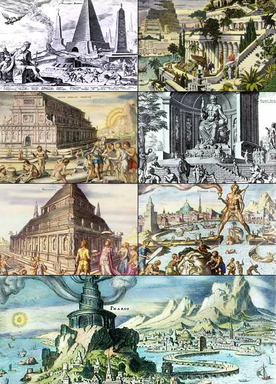
Seven Wonders of the Ancient World

Encyclopedia

Classical antiquity
Classical antiquity is a broad term for a long period of cultural history centered on the Mediterranean Sea, comprising the interlocking civilizations of ancient Greece and ancient Rome, collectively known as the Greco-Roman world...
listed by various authors in guidebooks popular among the ancient Hellenic
Ancient Greece
Ancient Greece is a civilization belonging to a period of Greek history that lasted from the Archaic period of the 8th to 6th centuries BC to the end of antiquity. Immediately following this period was the beginning of the Early Middle Ages and the Byzantine era. Included in Ancient Greece is the...
tourists, particularly in the 1st and 2nd centuries BC. The most prominent of these, the versions by Antipater of Sidon
Antipater of Sidon
Antipater of Sidon , Antipatros or Antipatros Sidonios in the Anthologies, was a Greek poet in the second half of the 2nd century BC....
and an observer identified as Philon of Byzantium, comprise seven works located around the eastern Mediterranean rim. The original list inspired innumerable versions
Wonders of the World
Various lists of the Wonders of the World have been compiled from antiquity to the present day, to catalogue the world's most spectacular natural wonders and manmade structures....
through the ages, often listing seven entries. Of the original Seven Wonders, only one—the Great Pyramid of Giza
Great Pyramid of Giza
The Great Pyramid of Giza is the oldest and largest of the three pyramids in the Giza Necropolis bordering what is now El Giza, Egypt. It is the oldest of the Seven Wonders of the Ancient World, and the only one to remain largely intact...
, the oldest of the ancient wonders—remains relatively intact.
Background
The Greek conquest of much of the known world in the 4th century BC gave Hellenistic travellers access to the civilizationCivilization
Civilization is a sometimes controversial term that has been used in several related ways. Primarily, the term has been used to refer to the material and instrumental side of human cultures that are complex in terms of technology, science, and division of labor. Such civilizations are generally...
s of the Egyptians
Ancient Egypt
Ancient Egypt was an ancient civilization of Northeastern Africa, concentrated along the lower reaches of the Nile River in what is now the modern country of Egypt. Egyptian civilization coalesced around 3150 BC with the political unification of Upper and Lower Egypt under the first pharaoh...
, Persians, and Babylonia
Babylonia
Babylonia was an ancient cultural region in central-southern Mesopotamia , with Babylon as its capital. Babylonia emerged as a major power when Hammurabi Babylonia was an ancient cultural region in central-southern Mesopotamia (present-day Iraq), with Babylon as its capital. Babylonia emerged as...
ns. Impressed and captivated by the landmarks and marvels of the various lands, these travellers began to list what they saw. Such a list of these places made it easier to remember them. Indeed, instead of "wonders", the ancient Greeks spoke of "theamata", which means "sights", in other words "things to be seen". (Τὰ ἑπτὰ θεάματα τῆς οἰκουμένης [γῆς] ) Later, the word for "wonder" ("thaumata") was used, and this is also the case in modern Greek (Επτά θαύματα του αρχαίου κόσμου). Hence, the list was meant to be the Ancient World's counterpart of a travel guidebook.
Each person had his own version of the list, but the best known and earliest surviving was from a poem by Greek-speaking epigrammist Antipater of Sidon from around 140 BC. He named seven sites on his list, but was primarily in praise of the Temple of Artemis at Ephesus:
Another 2nd century BC observer, who claimed to be the mathematician Philon of Byzantium, wrote a short account entitled The Seven Sights of the World. However, the incomplete surviving manuscript only covered six of the supposedly seven places, which agreed with Antipater's list.
Earlier and later lists by the historian Herodotus
Herodotus
Herodotus was an ancient Greek historian who was born in Halicarnassus, Caria and lived in the 5th century BC . He has been called the "Father of History", and was the first historian known to collect his materials systematically, test their accuracy to a certain extent and arrange them in a...
(484 BC–ca. 425 BC) and the architect Callimachus
Callimachus
Callimachus was a native of the Greek colony of Cyrene, Libya. He was a noted poet, critic and scholar at the Library of Alexandria and enjoyed the patronage of the Egyptian–Greek Pharaohs Ptolemy II Philadelphus and Ptolemy III Euergetes...
of Cyrene
Cyrene, Libya
Cyrene was an ancient Greek colony and then a Roman city in present-day Shahhat, Libya, the oldest and most important of the five Greek cities in the region. It gave eastern Libya the classical name Cyrenaica that it has retained to modern times.Cyrene lies in a lush valley in the Jebel Akhdar...
(ca. 305–240 BC), housed at the Museum of Alexandria, survived only as references.
The Colossus of Rhodes was the last of the seven to be completed, after 280 BC, and the first to be destroyed, by an earthquake in 226/225 BC. Hence, all seven existed at the same time for a period of less than 60 years.
Antipater had an earlier version which replaced Lighthouse of Alexandria with the Walls of Babylon. Lists which preceded the construction of Colossus of Rhodes completed their seven entries with the inclusion of the Ishtar Gate
Ishtar Gate
The Ishtar Gate was the eighth gate to the inner city of Babylon. It was constructed in about 575 BC by order of King Nebuchadnezzar II on the north side of the city....
.
Scope
It is thought that the limitation of the lists to seven entries was attributed to the special magical meaning of the number. Geographically, the list covered only the sculptural and architectural monuments of the Mediterranean and Middle Eastern regionsMiddle East
The Middle East is a region that encompasses Western Asia and Northern Africa. It is often used as a synonym for Near East, in opposition to Far East...
, then thought to encompass the "known" world for the Greeks. Hence, extant sites beyond this realm were not considered as part of contemporary accounts.
The primary accounts, coming from Hellenistic writers, also heavily influenced the places included in the wonders list. Five of the seven entries are a celebration of Greek accomplishments in the arts and architecture (the exceptions being the Pyramids of Giza and the Hanging Gardens of Babylon).
The Seven Ancient Wonders
| Wonder | Date of construction | Builder | Date of destruction | Cause of destruction | Modern location |
|---|---|---|---|---|---|
| Great Pyramid of Giza Great Pyramid of Giza The Great Pyramid of Giza is the oldest and largest of the three pyramids in the Giza Necropolis bordering what is now El Giza, Egypt. It is the oldest of the Seven Wonders of the Ancient World, and the only one to remain largely intact... |
2584–2561 BC | Egyptians Ancient Egypt Ancient Egypt was an ancient civilization of Northeastern Africa, concentrated along the lower reaches of the Nile River in what is now the modern country of Egypt. Egyptian civilization coalesced around 3150 BC with the political unification of Upper and Lower Egypt under the first pharaoh... |
Still in existence | Still in existence | Giza Necropolis, Egypt Egypt Egypt , officially the Arab Republic of Egypt, Arabic: , is a country mainly in North Africa, with the Sinai Peninsula forming a land bridge in Southwest Asia. Egypt is thus a transcontinental country, and a major power in Africa, the Mediterranean Basin, the Middle East and the Muslim world... |
| Hanging Gardens of Babylon Hanging Gardens of Babylon The Hanging Gardens of Babylon were considered to be one of the greatest Seven Wonders of the Ancient World, and the only one of the Wonders which may in fact have been legendary. They were purportedly built in the ancient city-state of Babylon, near present-day Al Hillah, Babil, in Iraq... |
Around 600 BC (possibly legendary) | Babylonia Babylonia Babylonia was an ancient cultural region in central-southern Mesopotamia , with Babylon as its capital. Babylonia emerged as a major power when Hammurabi Babylonia was an ancient cultural region in central-southern Mesopotamia (present-day Iraq), with Babylon as its capital. Babylonia emerged as... ns |
After 1st century BC | Earthquakes | Al Hillah, Babil Province, Iraq Iraq Iraq ; officially the Republic of Iraq is a country in Western Asia spanning most of the northwestern end of the Zagros mountain range, the eastern part of the Syrian Desert and the northern part of the Arabian Desert.... , or Kouyunjik, Nineveh Nineveh Nineveh was an ancient Assyrian city on the eastern bank of the Tigris River, and capital of the Neo Assyrian Empire. Its ruins are across the river from the modern-day major city of Mosul, in the Ninawa Governorate of Iraq.... Province, Iraq Iraq Iraq ; officially the Republic of Iraq is a country in Western Asia spanning most of the northwestern end of the Zagros mountain range, the eastern part of the Syrian Desert and the northern part of the Arabian Desert.... |
| Temple of Artemis at Ephesus | c. 550 BC | Lydia Lydia Lydia was an Iron Age kingdom of western Asia Minor located generally east of ancient Ionia in the modern Turkish provinces of Manisa and inland İzmir. Its population spoke an Anatolian language known as Lydian.... ns, Persians Achaemenid Empire The Achaemenid Empire , sometimes known as First Persian Empire and/or Persian Empire, was founded in the 6th century BCE by Cyrus the Great who overthrew the Median confederation... , Greeks Ancient Greece Ancient Greece is a civilization belonging to a period of Greek history that lasted from the Archaic period of the 8th to 6th centuries BC to the end of antiquity. Immediately following this period was the beginning of the Early Middle Ages and the Byzantine era. Included in Ancient Greece is the... |
356 BC (by Herostratus) AD 262 (by the Goths) |
Arson Arson Arson is the crime of intentionally or maliciously setting fire to structures or wildland areas. It may be distinguished from other causes such as spontaneous combustion and natural wildfires... by Herostratus Herostratus Herostratus was a young man and arsonist; seeking notoriety, he burned down the Temple of Artemis in ancient Greece.-Occurrence:On July 21, 356 BC, Herostratus set fire to the Temple of Artemis at Ephesus in what is now Turkey... , Plundering |
near Selçuk Selçuk Selçuk is the central town of Selçuk district, İzmir Province in Turkey, 2 km northeast of Ephesus.Its original Greek name, Agios Theológos referred to John the Theologian. Under the Ottoman Empire, it was known as Ayasoluk... , Izmir Province Izmir Province İzmir Province is a province of Turkey in western Anatolia on the Aegean coast, whose capital is the city of İzmir. On the west it is surrounded by the Aegean sea, and it encloses the Gulf of İzmir. Its area is 11,973 km.2, population 3.948.848 . The population was 3,370,866 in 2000... , Turkey Turkey Turkey , known officially as the Republic of Turkey , is a Eurasian country located in Western Asia and in East Thrace in Southeastern Europe... |
| Statue of Zeus at Olympia Statue of Zeus at Olympia The Statue of Zeus at Olympia was made by the Greek sculptor Phidias, circa 432 BC on the site where it was erected in the Temple of Zeus, Olympia, Greece. It was one of the Seven Wonders of the Ancient World.-Description:... |
466–456 BC (Temple) 435 BC (Statue) | Greeks Ancient Greece Ancient Greece is a civilization belonging to a period of Greek history that lasted from the Archaic period of the 8th to 6th centuries BC to the end of antiquity. Immediately following this period was the beginning of the Early Middle Ages and the Byzantine era. Included in Ancient Greece is the... |
5th–6th centuries AD | Fire Fire Fire is the rapid oxidation of a material in the chemical process of combustion, releasing heat, light, and various reaction products. Slower oxidative processes like rusting or digestion are not included by this definition.... |
Olympia Olympia, Greece Olympia , a sanctuary of ancient Greece in Elis, is known for having been the site of the Olympic Games in classical times, comparable in importance to the Pythian Games held in Delphi. Both games were held every Olympiad , the Olympic Games dating back possibly further than 776 BC... , Greece Greece Greece , officially the Hellenic Republic , and historically Hellas or the Republic of Greece in English, is a country in southeastern Europe.... |
| Mausoleum of Halicarnassus | 351 BC | Carians Carians The Carians were the ancient inhabitants of Caria in southwest Anatolia.-Historical accounts:It is not clear when the Carians enter into history. The definition is dependent on corresponding Caria and the Carians to the "Karkiya" or "Karkisa" mentioned in the Hittite records... , Persians Seleucid Empire The Seleucid Empire was a Greek-Macedonian state that was created out of the eastern conquests of Alexander the Great. At the height of its power, it included central Anatolia, the Levant, Mesopotamia, Persia, today's Turkmenistan, Pamir and parts of Pakistan.The Seleucid Empire was a major centre... , Greeks Ancient Greece Ancient Greece is a civilization belonging to a period of Greek history that lasted from the Archaic period of the 8th to 6th centuries BC to the end of antiquity. Immediately following this period was the beginning of the Early Middle Ages and the Byzantine era. Included in Ancient Greece is the... |
by AD 1494 | The original structure was destroyed by flood. | Bodrum Bodrum Bodrum is a port city in Muğla Province, in the southwestern Aegean Region of Turkey. It is located on the southern coast of Bodrum Peninsula, at a point that checks the entry into the Gulf of Gökova. The site was called Halicarnassus of Caria in ancient times and was famous for housing the... , Turkey Turkey Turkey , known officially as the Republic of Turkey , is a Eurasian country located in Western Asia and in East Thrace in Southeastern Europe... |
| Colossus of Rhodes Colossus of Rhodes The Colossus of Rhodes was a statue of the Greek Titan Helios, erected in the city of Rhodes on the Greek island of Rhodes by Chares of Lindos between 292 and 280 BC. It is considered one of the Seven Wonders of the Ancient World. It was constructed to celebrate Rhodes' victory over the ruler of... |
292–280 BC | Greeks Greeks The Greeks, also known as the Hellenes , are a nation and ethnic group native to Greece, Cyprus and neighboring regions. They also form a significant diaspora, with Greek communities established around the world.... |
226 BC | Earthquake 226 BC Rhodes earthquake The Rhodes earthquake of 226 BC, which affected the island of Rhodes, Greece, is famous for having toppled the large statue known as the Colossus of Rhodes. Following the earthquake, the statue lay in place for nearly 8 centuries before being sold off by invaders... |
Rhodes, Greece Greece Greece , officially the Hellenic Republic , and historically Hellas or the Republic of Greece in English, is a country in southeastern Europe.... |
| Lighthouse of Alexandria Lighthouse of Alexandria The Lighthouse of Alexandria, also known as the Pharos of Alexandria , was a tower built between 280 and 247 BC on the island of Pharos at Alexandria, Egypt... |
c. 280 BC | Macedonian Empire Ptolemaic Egypt Ptolemaic Egypt began when Ptolemy I Soter invaded Egypt and declared himself Pharaoh of Egypt in 305 BC and ended with the death of queen Cleopatra VII of Egypt and the Roman conquest in 30 BC. The Ptolemaic Kingdom was a powerful Hellenistic state, extending from southern Syria in the east, to... , (Macedonians Ancient Macedonians The Macedonians originated from inhabitants of the northeastern part of the Greek peninsula, in the alluvial plain around the rivers Haliacmon and lower Axios... , Greeks) |
AD 1303–1480 | Earthquake 1303 Crete earthquake The 1303 Crete earthquake occurred at about dawn on 8 August. It had an estimated magnitude of about 8 and triggered a major tsunami that caused severe damage and loss of life on Crete and at Alexandria.-Tectonic setting:... |
Alexandria Alexandria Alexandria is the second-largest city of Egypt, with a population of 4.1 million, extending about along the coast of the Mediterranean Sea in the north central part of the country; it is also the largest city lying directly on the Mediterranean coast. It is Egypt's largest seaport, serving... , Egypt Egypt Egypt , officially the Arab Republic of Egypt, Arabic: , is a country mainly in North Africa, with the Sinai Peninsula forming a land bridge in Southwest Asia. Egypt is thus a transcontinental country, and a major power in Africa, the Mediterranean Basin, the Middle East and the Muslim world... |
Arts and architecture
The seven wonders on Antipater's list won praises for their notable features, ranging from superlatives of the highest or largest of their types, to the artistry with which they were executed. Their architectural and artistic features were imitated throughout the Hellenistic world and beyond.The Greek influence in Roman culture, and the revival of Greco-Roman artistic styles during the Renaissance caught the imagination of European artists and travellers. Paintings and sculptures alluding to Antipater's list were made, while adventurers flocked to the actual sites to personally witness the wonders. Legends circulated to further complement the superlatives of the wonders.
Modern lists
Of Antipater's wonders, the only one that has survived to the present day is the Great Pyramid of Giza. The existence of the Hanging Gardens has not been proven, although theories abound. Records and archaeology confirm the existence of the other five wonders. The Temple of Artemis and the Statue of Zeus were destroyed by fire, while the Lighthouse of Alexandria, Colossus, and tomb of Mausolus were destroyed by earthquakes. Among the artifactsArtifact (archaeology)
An artifact or artefact is "something made or given shape by man, such as a tool or a work of art, esp an object of archaeological interest"...
to have survived are sculptures from the tomb of Mausolus and the Temple of Artemis in the British Museum
British Museum
The British Museum is a museum of human history and culture in London. Its collections, which number more than seven million objects, are amongst the largest and most comprehensive in the world and originate from all continents, illustrating and documenting the story of human culture from its...
in London.
Still, the listing of seven of the most marvellous architectural and artistic human achievements continued beyond the Ancient Greek times to the Roman Empire, the Middle Ages, the Renaissance and to the modern age. The Roman poet Martial
Martial
Marcus Valerius Martialis , was a Latin poet from Hispania best known for his twelve books of Epigrams, published in Rome between AD 86 and 103, during the reigns of the emperors Domitian, Nerva and Trajan...
and the Christian bishop Gregory of Tours
Gregory of Tours
Saint Gregory of Tours was a Gallo-Roman historian and Bishop of Tours, which made him a leading prelate of Gaul. He was born Georgius Florentius, later adding the name Gregorius in honour of his maternal great-grandfather...
had their versions. Reflecting the rise of Christianity and the factor of time, nature and the hand of man overcoming Antipater's seven wonders, Roman and Christian sites began to figure on the list, including the Colosseum
Colosseum
The Colosseum, or the Coliseum, originally the Flavian Amphitheatre , is an elliptical amphitheatre in the centre of the city of Rome, Italy, the largest ever built in the Roman Empire...
, Noah's Ark
Noah's Ark
Noah's Ark is a vessel appearing in the Book of Genesis and the Quran . These narratives describe the construction of the ark by Noah at God's command to save himself, his family, and the world's animals from the worldwide deluge of the Great Flood.In the narrative of the ark, God sees the...
and Solomon's Temple
Solomon's Temple
Solomon's Temple, also known as the First Temple, was the main temple in ancient Jerusalem, on the Temple Mount , before its destruction by Nebuchadnezzar II after the Siege of Jerusalem of 587 BCE....
. In the 6th century, a list of seven wonders was compiled by Gregory, Bishop of Tours
Gregory of Tours
Saint Gregory of Tours was a Gallo-Roman historian and Bishop of Tours, which made him a leading prelate of Gaul. He was born Georgius Florentius, later adding the name Gregorius in honour of his maternal great-grandfather...
. The list included the Temple of Solomon, the Pharos of Alexandria and Noah's Ark
Noah's Ark
Noah's Ark is a vessel appearing in the Book of Genesis and the Quran . These narratives describe the construction of the ark by Noah at God's command to save himself, his family, and the world's animals from the worldwide deluge of the Great Flood.In the narrative of the ark, God sees the...
.
Modern historians, working on the premise that the original Seven Ancient Wonders List was limited in its geographic scope, also had their versions to encompass sites beyond the Hellenistic realm—from the Seven Wonders of the Ancient World to the Seven Wonders of the World. Indeed, the "seven wonders" label has spawned innumerable versions among international organizations, publications and individuals based on different themes—works of nature, engineering masterpieces, constructions of the Middle Ages, etc. Its purpose has also changed from just a simple travel guidebook or a compendium of curious places to list of sites that entail and defense.
See also
- Wonders of the WorldWonders of the WorldVarious lists of the Wonders of the World have been compiled from antiquity to the present day, to catalogue the world's most spectacular natural wonders and manmade structures....
, about similar lists made throughout the ages. - Eighth Wonder of the WorldEighth Wonder of the WorldEighth Wonder of the World is a term sometimes used to describe things in comparison to the Seven Wonders of the World, the widely-known list of seven remarkable constructions of classical antiquity.-Natural places:...
, about attempted additions to the famous ancient list. - New Seven Wonders of the WorldNew Seven Wonders of the WorldNew7Wonders of the World was an initiative started in 2001 by the Swiss corporation New7Wonders Foundation to choose Wonders of the World from a selection of 200 existing monuments. A popularity poll was led by Canadian-Swiss Bernard Weber and organized by the New7Wonders Foundation based in...
, a list created after a global voting procedure.
Further reading
- D'Epiro, Peter, and Mary Desmond Pinkowish, "What Are the Seven Wonders of the World? and 100 Other Great Cultural Lists". Anchor. December 1, 1998. ISBN 0-385-49062-3
- "The Seven Wonders of the World, a History of Modern Imagination" written by John & Elizabeth Romer in 1995
- "The Seven Wonders of the Ancient World" edited by Peter Clayton and Martin Price in 1988
- Johann Conrad Orelli (ed.) Philonis Byzantini Libellus de septem orbis spectaculis. 1816. The original travel guide by Pseudo-Philo
External links
- "Eternal wonder of humanity's first great achievements", by Jonathan Glancey in The GuardianThe GuardianThe Guardian, formerly known as The Manchester Guardian , is a British national daily newspaper in the Berliner format...
, March 10, 2007 - "Seven Ancient Wonders of the World" on The History Channel website. Also includes links to Medieval, Modern & Natural Wonders.
- The Seven Wonders of the Ancient World — a look from a professor of civil engineering at the American University in DubaiAmerican University in DubaiThe American University in Dubai is a private, non-sectarian institution of higher learning in Dubai, United Arab Emirates, founded in 1995. AUD was founded in 1995 as a branch campus of the American InterContinental University in Atlanta, Georgia, but turned into a private, non-sectarian...
. Includes a map of the locations. - Livius.org: Seven Wonders of the Ancient World – website by a Dutch historian.
- Parkin, Tim, Researching Ancient Wonders: A Research Guide, from the University of Canterbury, New Zealand. – a collection of books and Internet resources with information on seven ancient wonders.
- Seven Wonders Suite for Orchestra — A symphonic suite inspired by the seven ancient monuments by UK composer Stuart Mitchell — The Prague Symphony Orchestra