


The Great Exhibition

Encyclopedia

Hyde Park, London
Hyde Park is one of the largest parks in central London, United Kingdom, and one of the Royal Parks of London, famous for its Speakers' Corner.The park is divided in two by the Serpentine...
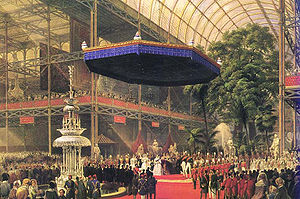
, London, from 1 May to 15 October 1851. It was the first in a series of World's Fair exhibitions of culture
Culture
Culture is a term that has many different inter-related meanings. For example, in 1952, Alfred Kroeber and Clyde Kluckhohn compiled a list of 164 definitions of "culture" in Culture: A Critical Review of Concepts and Definitions...
and industry
Industry
Industry refers to the production of an economic good or service within an economy.-Industrial sectors:There are four key industrial economic sectors: the primary sector, largely raw material extraction industries such as mining and farming; the secondary sector, involving refining, construction,...
that were to become a popular 19th-century feature. The Great Exhibition was organized by Henry Cole
Henry Cole
Sir Henry Cole was an English civil servant and inventor who facilitated many innovations in commerce and education in 19th century Britain...
and Prince Albert, the spouse of the reigning monarch, Queen Victoria. It was attended by numerous notable figures of the time, including Charles Darwin
Charles Darwin
Charles Robert Darwin FRS was an English naturalist. He established that all species of life have descended over time from common ancestry, and proposed the scientific theory that this branching pattern of evolution resulted from a process that he called natural selection.He published his theory...
, Samuel Colt
Samuel Colt
Samuel Colt was an American inventor and industrialist. He was the founder of Colt's Patent Fire-Arms Manufacturing Company , and is widely credited with popularizing the revolver. Colt's innovative contributions to the weapons industry have been described by arms historian James E...
, members of the Orléanist
House of Orleans
Orléans is the name used by several branches of the Royal House of France, all descended in the legitimate male line from the dynasty's founder, Hugh Capet. It became a tradition during France's ancien régime for the duchy of Orléans to be granted as an appanage to a younger son of the king...
Royal Family
Royal family
A royal family is the extended family of a king or queen regnant. The term imperial family appropriately describes the extended family of an emperor or empress, while the terms "ducal family", "grand ducal family" or "princely family" are more appropriate to describe the relatives of a reigning...
and the writers Charlotte Brontë
Charlotte Brontë
Charlotte Brontë was an English novelist and poet, the eldest of the three Brontë sisters who survived into adulthood, whose novels are English literature standards...
, Lewis Carroll
Lewis Carroll
Charles Lutwidge Dodgson , better known by the pseudonym Lewis Carroll , was an English author, mathematician, logician, Anglican deacon and photographer. His most famous writings are Alice's Adventures in Wonderland and its sequel Through the Looking-Glass, as well as the poems "The Hunting of the...
, and George Eliot
George Eliot
Mary Anne Evans , better known by her pen name George Eliot, was an English novelist, journalist and translator, and one of the leading writers of the Victorian era...
.
Background
The Great Exhibition of the Works of Industry of all Nations was organized by Prince Albert, Henry ColeHenry Cole
Sir Henry Cole was an English civil servant and inventor who facilitated many innovations in commerce and education in 19th century Britain...
, Francis Henry, George Wallis
George Wallis
George Wallis, FSA, , artist, museum curator and art educator, was the first Keeper of Fine Art Collection at South Kensington Museum .-Early years:...
, Charles Dilke
Sir Charles Dilke, 1st Baronet
Sir Charles Wentworth Dilke, 1st Baronet , English Whig politician, son of Charles Wentworth Dilke, proprietor and editor of The Athenaeum, was born in London, and was educated at Westminster School and Trinity Hall, Cambridge...
and other members of the Royal Society for the Encouragement of Arts, Manufactures and Commerce
Royal Society of Arts
The Royal Society for the encouragement of Arts, Manufacturers and Commerce is a British multi-disciplinary institution, based in London. The name Royal Society of Arts is frequently used for brevity...
as a celebration of modern industrial
Industry
Industry refers to the production of an economic good or service within an economy.-Industrial sectors:There are four key industrial economic sectors: the primary sector, largely raw material extraction industries such as mining and farming; the secondary sector, involving refining, construction,...
technology and design. It was arguably a response to the highly successful French Industrial Exposition of 1844
French Industrial Exposition of 1844
The French Industrial Exposition of 1844, held in a temporary structure on the Champs-Élysées in Paris, was one in a series of eleven French national industrial expositions held to encourage improvements in progressive agriculture and in technology, that had their origins in 1798...
: indeed, its prime motive was for "Great Britain [to make] clear to the world its role as industrial leader." Prince Albert, Queen Victoria's consort, was an enthusiastic promoter of the self-financing exhibition; the government was persuaded to form the Royal Commission for the Exhibition of 1851
Royal Commission for the Exhibition of 1851
Royal Commission for the Exhibition of 1851 is an institution founded in 1850 to administer the international exhibition of 1851, officially called the Great Exhibition of the Works of Industry of all Nations, held in The Crystal Palace in London, England...
to establish the viability of hosting such an exhibition. Queen Victoria and her family visited three times. Although the Great Exhibition was a platform on which countries from around the world could display their achievements, Great Britain sought to prove its own superiority. The English exhibits at the Great Exhibition "held the lead in almost every field where strength, durability, utility and quality were concerned, whether in iron and steel, machinery or textiles." Great Britain also sought to provide the world with the hope of a better future. Europe had just struggled through "two difficult decades of political and social upheaval," and now Great Britain hoped to show that technology, particularly its own, was the key to a better future.
Forgan says of the Exhibition that "Large, piled-up ‘trophy’ exhibits in the central avenue revealed the organizers’ priorities; they generally put art or colonial raw materials in the most prestigious place. Technology and moving machinery were popular, especially working exhibits." He also notes that visitors "could watch the entire process of cotton production from spinning to finished cloth. Scientific instruments were found in class X, and included electric telegraphs, microscopes, air pumps and barometers, as well as musical, horological and surgical instruments."
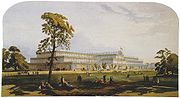
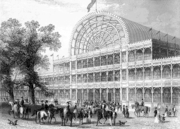
A special building, nicknamed The Crystal Palace
The Crystal Palace
The Crystal Palace was a cast-iron and glass building originally erected in Hyde Park, London, England, to house the Great Exhibition of 1851. More than 14,000 exhibitors from around the world gathered in the Palace's of exhibition space to display examples of the latest technology developed in...
, or "The Great Shalimar" was built to house the show. It was designed by Joseph Paxton
Joseph Paxton
Sir Joseph Paxton was an English gardener and architect, best known for designing The Crystal Palace.-Early life:...
with support from structural engineer
Structural engineer
Structural engineers analyze, design, plan, and research structural components and structural systems to achieve design goals and ensure the safety and comfort of users or occupants...
Charles Fox, the committee overseeing its construction including Isambard Kingdom Brunel
Isambard Kingdom Brunel
Isambard Kingdom Brunel, FRS , was a British civil engineer who built bridges and dockyards including the construction of the first major British railway, the Great Western Railway; a series of steamships, including the first propeller-driven transatlantic steamship; and numerous important bridges...
, and went from its organisation to the grand opening in just nine months. The building was architecturally adventurous, drawing on Paxton's experience designing greenhouse
Greenhouse
A greenhouse is a building in which plants are grown. These structures range in size from small sheds to very large buildings...
s for the sixth Duke of Devonshire
William Cavendish, 6th Duke of Devonshire
William George Spencer Cavendish, 6th Duke of Devonshire KG, PC , styled Marquess of Hartington until 1811, was a British peer, courtier and Whig politician...
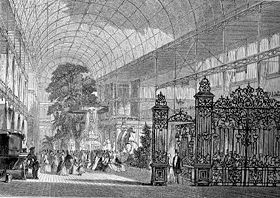
. It took the form of a massive glass house, 1851 feet (about 564 metres) long by 454 feet (about 138 metres) wide and was constructed from cast iron
Cast iron
Cast iron is derived from pig iron, and while it usually refers to gray iron, it also identifies a large group of ferrous alloys which solidify with a eutectic. The color of a fractured surface can be used to identify an alloy. White cast iron is named after its white surface when fractured, due...
-frame components and glass
Glass
Glass is an amorphous solid material. Glasses are typically brittle and optically transparent.The most familiar type of glass, used for centuries in windows and drinking vessels, is soda-lime glass, composed of about 75% silica plus Na2O, CaO, and several minor additives...
made almost exclusively in Birmingham
Birmingham
Birmingham is a city and metropolitan borough in the West Midlands of England. It is the most populous British city outside the capital London, with a population of 1,036,900 , and lies at the heart of the West Midlands conurbation, the second most populous urban area in the United Kingdom with a...
and Smethwick
Smethwick
Smethwick is a town in the Metropolitan Borough of Sandwell, in the West Midlands of England. It is situated on the edge of the city of Birmingham, within the historic boundaries of Staffordshire, Worcestershire and Warwickshire....
. From the interior, the building's large size was emphasized with trees and statues; this served, not only to add beauty to the spectacle, but also to demonstrate man's triumph over nature. The Crystal Palace was an enormous success, considered an architectural marvel, but also an engineering triumph that showed the importance of the Exhibition itself. The building was later moved and re-erected in an enlarged form at Sydenham
Sydenham
Sydenham is an area and electoral ward in the London Borough of Lewisham; although some streets towards Crystal Palace Park, Forest Hill and Penge are outside the ward and in the London Borough of Bromley, and some streets off Sydenham Hill are in the London Borough of Southwark. Sydenham was in...
in south London, an area that was renamed Crystal Palace
Crystal Palace, London
Crystal Palace is a residential area in south London, England named from the former local landmark, The Crystal Palace, which occupied the area from 1854 to 1936. The area is located approximately 8 miles south east of Charing Cross, and offers impressive views over the capital...
. It was destroyed by fire on 30 November 1936.
Six million people—equivalent to a third of the entire population of Britain at the time—visited the exhibition. The Great Exhibition made a surplus of £186,000 (£ as of ),, which was used to found the Victoria and Albert Museum
Victoria and Albert Museum
The Victoria and Albert Museum , set in the Brompton district of The Royal Borough of Kensington and Chelsea, London, England, is the world's largest museum of decorative arts and design, housing a permanent collection of over 4.5 million objects...
, the Science Museum
Science Museum (London)
The Science Museum is one of the three major museums on Exhibition Road, South Kensington, London in the Royal Borough of Kensington and Chelsea. It is part of the National Museum of Science and Industry. The museum is a major London tourist attraction....
and the Natural History Museum
Natural History Museum
The Natural History Museum is one of three large museums on Exhibition Road, South Kensington, London, England . Its main frontage is on Cromwell Road...
. They were all built in the area to the south of the exhibition, nicknamed Albertopolis
Albertopolis
Albertopolis is the area centred on South Kensington, Kensington & Chelsea, London, England, between Cromwell Road and Kensington Gore, which contains a large number of educational and cultural sites, including:*Imperial College London...
, alongside the Imperial Institute
Commonwealth Institute
The Commonwealth Institute was an educational charity connected with the Commonwealth of Nations, and the name of a building in West London formerly owned by the Institute...
. The remaining surplus was used to set up an educational trust to provide grants and scholarships for industrial research; it continues to do so today.
The Exhibition caused controversy as its opening approached. Some conservatives feared that the mass of visitors might become a revolutionary mob, whilst radicals such as Karl Marx
Karl Marx
Karl Heinrich Marx was a German philosopher, economist, sociologist, historian, journalist, and revolutionary socialist. His ideas played a significant role in the development of social science and the socialist political movement...
saw the exhibition as an emblem of the capitalist
Capitalism
Capitalism is an economic system that became dominant in the Western world following the demise of feudalism. There is no consensus on the precise definition nor on how the term should be used as a historical category...
fetishism of commodities. King Ernest Augustus I of Hanover, shortly before his death, wrote to Lord Strangford about it:
The folly and absurdity of the Queen in allowing this trumpery must strike every sensible and well-thinking mind, and I am astonished the ministers themselves do not insist on her at least going to OsborneOsborne HouseOsborne House is a former royal residence in East Cowes, Isle of Wight, UK. The house was built between 1845 and 1851 for Queen Victoria and Prince Albert as a summer home and rural retreat....
during the Exhibition, as no human being can possibly answer for what may occur on the occasion. The idea ... must shock every honest and well-meaning Englishman. But it seems everything is conspiring to lower us in the eyes of Europe.
In modern times, the Great Exhibition is a symbol of the Victorian Age, and its thick catalogue, illustrated with steel engravings, is a primary source for High Victorian design. A memorial to the exhibition, crowned with a statue of Prince Albert
Prince Albert
Prince Albert was the husband and consort of Queen Victoria.Prince Albert may also refer to:-Royalty:*Prince Albert Edward or Edward VII of the United Kingdom , son of Albert and Victoria...
, is located behind the Royal Albert Hall
Royal Albert Hall
The Royal Albert Hall is a concert hall situated on the northern edge of the South Kensington area, in the City of Westminster, London, England, best known for holding the annual summer Proms concerts since 1941....
. It is inscribed with statistics from the exhibition, including the number of visitors and exhibitors (British and foreign), and the profit made.
Notable exhibits
Exhibits came, not only from throughout Britain, but also its expanding imperial colonies, such as AustraliaAustralia
Australia , officially the Commonwealth of Australia, is a country in the Southern Hemisphere comprising the mainland of the Australian continent, the island of Tasmania, and numerous smaller islands in the Indian and Pacific Oceans. It is the world's sixth-largest country by total area...
, India
India
India , officially the Republic of India , is a country in South Asia. It is the seventh-largest country by geographical area, the second-most populous country with over 1.2 billion people, and the most populous democracy in the world...
and New Zealand
New Zealand
New Zealand is an island country in the south-western Pacific Ocean comprising two main landmasses and numerous smaller islands. The country is situated some east of Australia across the Tasman Sea, and roughly south of the Pacific island nations of New Caledonia, Fiji, and Tonga...
, and foreign countries, such as Denmark
Denmark
Denmark is a Scandinavian country in Northern Europe. The countries of Denmark and Greenland, as well as the Faroe Islands, constitute the Kingdom of Denmark . It is the southernmost of the Nordic countries, southwest of Sweden and south of Norway, and bordered to the south by Germany. Denmark...
, France
France
The French Republic , The French Republic , The French Republic , (commonly known as France , is a unitary semi-presidential republic in Western Europe with several overseas territories and islands located on other continents and in the Indian, Pacific, and Atlantic oceans. Metropolitan France...
and Switzerland
Switzerland
Switzerland name of one of the Swiss cantons. ; ; ; or ), in its full name the Swiss Confederation , is a federal republic consisting of 26 cantons, with Bern as the seat of the federal authorities. The country is situated in Western Europe,Or Central Europe depending on the definition....
. Numbering 13,000 in total, they included a Jacquard loom
Jacquard loom
The Jacquard loom is a mechanical loom, invented by Joseph Marie Jacquard in 1801, that simplifies the process of manufacturing textiles with complex patterns such as brocade, damask and matelasse. The loom is controlled by punched cards with punched holes, each row of which corresponds to one row...
, an envelope machine, kitchen appliances, steel-making displays and a reaping machine that was sent from the United States
United States
The United States of America is a federal constitutional republic comprising fifty states and a federal district...
.
- The Koh-i-NoorKoh-i-NoorThe Kōh-i Nūr which means "Mountain of Light" in Persian, also spelled Koh-i-noor, Koh-e Noor or Koh-i-Nur, is a 105 carat diamond that was once the largest known diamond in the world. The Kōh-i Nūr originated in the state of Andhra Pradesh in India along with its double, the Darya-ye Noor...
, the world's biggest known diamondDiamondIn mineralogy, diamond is an allotrope of carbon, where the carbon atoms are arranged in a variation of the face-centered cubic crystal structure called a diamond lattice. Diamond is less stable than graphite, but the conversion rate from diamond to graphite is negligible at ambient conditions...
at the time of the Great Exhibition. - The early 8th-century Tara BroochTara BroochThe Tara Brooch is a Celtic brooch of about 700 AD generally considered to be the most impressive of over 50 elaborate Irish brooches to have been discovered...
, discovered only in 1850, the finest Irish penannular brooch, was exhibited by the Dublin jeweller George Waterhouse along with a display of his fashionable Celtic RevivalCeltic RevivalCeltic Revival covers a variety of movements and trends, mostly in the 19th and 20th centuries, which drew on the traditions of Celtic literature and Celtic art, or in fact more often what art historians call Insular art...
jewellery. - Alfred Charles HobbsAlfred Charles HobbsAlfred Charles Hobbs was an American locksmith.He was born in Boston, Massachusetts in 1812 and married Charlotte F. and had a child: Alfred J. Hobbs...
used the exhibition to demonstrate the inadequacy of several respected lockLock (device)A lock is a mechanical or electronic fastening device that is released by a physical object or secret information , or combination of more than one of these....
s of the day. - Frederick BakewellFrederick BakewellFrederick Collier Bakewell was an English physicist who improved on the concept of the facsimile machine introduced by Alexander Bain in 1842 and demonstrated a working laboratory version at the 1851 World's Fair in London.-Biography:Born in Wakefield, West Yorkshire, he eventually moved to...
demonstrated a precursor to today's faxFaxFax , sometimes called telecopying, is the telephonic transmission of scanned printed material , normally to a telephone number connected to a printer or other output device...
machine. - Mathew BradyMathew BradyMathew B. Brady was one of the most celebrated 19th century American photographers, best known for his portraits of celebrities and his documentation of the American Civil War...
was awarded a medal for his daguerreotypeDaguerreotypeThe daguerreotype was the first commercially successful photographic process. The image is a direct positive made in the camera on a silvered copper plate....
s. - William Chamberlin, Jr. of Sussex exhibited what may have been the world's first voting machineVoting machineVoting machines are the total combination of mechanical, electromechanical, or electronic equipment , that is used to define ballots; to cast and count votes; to report or display election results; and to maintain and produce any audit trail information...
, which counted votes automatically and employed an interlocking system to prevent over-voting. - Firearms manufacturer Samuel ColtSamuel ColtSamuel Colt was an American inventor and industrialist. He was the founder of Colt's Patent Fire-Arms Manufacturing Company , and is widely credited with popularizing the revolver. Colt's innovative contributions to the weapons industry have been described by arms historian James E...
demonstrated his prototype for the 1851 Colt Navy and also his older WalkerWalker ColtThe Colt Walker is a single action revolver with a revolving cylinder holding six charges of black powder behind six bullets. It was designed in 1846 as a collaboration between Captain Samuel Hamilton Walker and American firearms inventor Samuel Colt....
and Dragoon revolvers. - The Tempest PrognosticatorTempest PrognosticatorThe Tempest Prognosticator, also known as the Leech Barometer, is a 19th century invention by George Merryweather in which leeches are used in a barometer. The twelve leeches are kept in small bottles inside the device; when they become agitated by an approaching storm they attempt to climb out of...
, a barometerBarometerA barometer is a scientific instrument used in meteorology to measure atmospheric pressure. Pressure tendency can forecast short term changes in the weather...
using leechLeechLeeches are segmented worms that belong to the phylum Annelida and comprise the subclass Hirudinea. Like other oligochaetes such as earthworms, leeches share a clitellum and are hermaphrodites. Nevertheless, they differ from other oligochaetes in significant ways...
es, was demonstrated at the Great Exhibition. - The America's CupAmerica's CupThe America’s Cup is a trophy awarded to the winner of the America's Cup match races between two yachts. One yacht, known as the defender, represents the yacht club that currently holds the America's Cup and the second yacht, known as the challenger, represents the yacht club that is challenging...
yachting event began with a race held in conjunction with the Great Exhibition. - George JenningsGeorge JenningsGeorge Jennings was an English sanitary engineer and plumber who invented the first public toilets.Josiah George Jennings was born on 10 November 1810 in Eling, at the edge of the New Forest in Hampshire. He was the eldest of seven children of Jonas Joseph Jennings and Mary Dimmock...
designed the first public conveniences in the Retiring Rooms of the Crystal Palace, for which he charged one penny. - Gold ornaments and silver enameled handicrafts fabricated by the Khudabadi Sindhi SwarankarKhudabadi Sindhi SwarankarThe Khudabadi Sindhi Swarankar is a Kshatriya Hindu cultural group of India, historically associated with the city of Khudabad as well as city of Hyderabad of Sindh region of modern Pakistan prior to the Partition of India...
from SindhSindhSindh historically referred to as Ba'ab-ul-Islam , is one of the four provinces of Pakistan and historically is home to the Sindhi people. It is also locally known as the "Mehran". Though Muslims form the largest religious group in Sindh, a good number of Christians, Zoroastrians and Hindus can...
. - C.C. Hornung of Copenhagen, Denmark, showed his single-cast ironframe for a pianoPianoThe piano is a musical instrument played by means of a keyboard. It is one of the most popular instruments in the world. Widely used in classical and jazz music for solo performances, ensemble use, chamber music and accompaniment, the piano is also very popular as an aid to composing and rehearsal...
, the first made in Europe.
Admission fees
Admission prices to the Crystal Palace varied according to the date of visitation, with ticket prices decreasing as the parliamentary season drew to an end and London traditionally emptied of wealthy individuals. Prices varied from three guineas (£ as of ),(two for a woman) per day, £1 per day, five shillings per day, down to one shilling (£ as of ), per day. The one-shilling ticket proved most successful amongst the industrial classes, with four and a half million shillings (£ as of ),being taken from attendees in this manner. 2,500 tickets were printed for the opening day, all of which were bought.Further reading
- Auerbach, Jeffrey A. The Great Exhibition of 1851: A Nation on Display, Yale University Press, 1999.
- Gibbs-Smith, Charles HarvardCharles Harvard Gibbs-SmithCharles Harvard Gibbs-Smith was a British polymath historian of aeronautics and aviation. His obituary in the Times described him as "the recognised authority on the early development of flying in Europe and America" Richard P...
. The Great Exhibition of 1851, London: HMSO. First edition 1951, second edition 1981. - Greenhalgh, Paul. Ephemeral Vistas: The Expositions Universelles, Great Exhibitions and World's Fairs, 1851–1939, Manchester University Press, 1988.
- Leapman, Michael. The World for a Shilling: How the Great Exhibition of 1851 Shaped a Nation, Headline Books, 2001.
- Dickinson's Comprehensive Pictures of the Great Exhibition of 1851, Dickinson Brothers, London, 1854.
External links
- 1851 map Map of London showing the site of the Great Exhibition in Hyde Park. MAPCO
- "Memorials of the Great Exhibition" (cartoon) Cartoon series from Punch Magazine
- Charlotte Bronte's account of a visit to the Great Exhibition mytimemachine.co.uk
- Great Exhibition Collection in the National Art Library Victoria and Albert MuseumVictoria and Albert MuseumThe Victoria and Albert Museum , set in the Brompton district of The Royal Borough of Kensington and Chelsea, London, England, is the world's largest museum of decorative arts and design, housing a permanent collection of over 4.5 million objects...
- "In Our Time" BBC radio programme discussing the Great Exhibition and its impact. Originally broadcast 27 Apr 2006
- Royal Engineers Museum Royal Engineers and the Great Exhibition