


Roman Navy

Encyclopedia
The Roman Navy comprised the naval forces of the Ancient Roman state. Although the navy was instrumental in the Roman conquest of the Mediterranean basin, it never enjoyed the prestige of the Roman legion
s. Throughout their history, the Romans remained a primarily land-based people, and relied on their more nautically inclined subjects, such as the Greeks
and the Egyptians
, to build and man their ships. Partly because of this, the navy was never wholly embraced by the Roman state, and deemed somewhat "un-Roman". In Antiquity, navies and trading fleets did not have the logistical autonomy that modern ships and fleets possess. Unlike modern naval forces, the Roman navy even at its height never existed as an autonomous service, but operated as an adjunct to the Roman army
.
During the course of the First Punic War
, the Roman navy was massively expanded and played a vital role in the Roman victory and the Roman Republic
's eventual ascension to hegemony in the Mediterranean Sea. In the course of the first half of the 2nd century BC, Rome went on to destroy Carthage and subdue the Hellenistic
kingdoms of the eastern Mediterranean, achieving complete mastery of the inland sea, which they called Mare Nostrum
. The Roman fleets were again prominent in the 1st century BC in the wars against the pirates, and in the civil wars that brought down the Republic, whose campaigns ranged across the Mediterranean. In 31 BC, the great naval Battle of Actium
ended the civil wars
culminating in the final victory of Augustus
and the establishment of the Roman Empire
.
During the Imperial period, the Mediterranean became a peaceful "Roman lake"; in the absence of a maritime enemy, the navy was reduced mostly to patrol and transport duties.
On the fringes of the Empire however, in new conquests or, increasingly, in defense against barbarian invasions, the Roman fleets were still engaged in warfare. The decline of the Empire in the 3rd century took a heavy toll on the navy, which was reduced to a shadow of its former self, both in size and in combat ability. As successive waves of the Völkerwanderung crashed on the land frontiers of the battered Empire, the navy could only play a secondary role. In the early 5th century, the Roman frontiers were breached, and barbarian kingdoms appeared on the shores of the western Mediterranean. One of them, the Vandal Kingdom
, raised a navy of its own and raided the shores of the Mediterranean, even sacking Rome
, while the diminished Roman fleets were incapable of offering any resistance. The Western Roman Empire collapsed in the late 5th century. The subsequent Roman Navy of the enduring Eastern Roman Empire
is called by historians the Byzantine Navy
.
in 394 BC, but at any rate, the Roman fleet, if it existed, was negligible. The traditional birth date of the Roman navy is set at ca. 311 BC, when, after the conquest of Campania
, two new officials, the duumviri navales classis ornandae reficiendaeque causa, were tasked with the maintenance of a fleet. As a result, the Republic acquired its first fleet, consisting of 20 ships, most likely trireme
s, with each duumvir commanding a squadron of 10 ships. However, the Republic continued to rely mostly on her legions for expansion in Italy; the navy was most likely geared towards combating piracy and lacked experience in naval warfare, being easily defeated in 282 BC by the Tarentines
.
This situation continued until the First Punic War
: the main task of the Roman fleet was patrolling along the Italian coast and rivers, protecting seaborne trade from piracy. Whenever larger tasks had to be undertaken, such as the naval blockade of a besieged city, the Romans called on the allied Greek cities of southern Italy, the socii navales, to provide ships and crews. It is possible that the supervision of these maritime allies was one of the duties of the four new praetor
es classici, who were established in 267 BC.
in 265 BC. This led to the outbreak of hostilities with Carthage
, which would last until 241 BC. At the time, the Punic city was the unchallenged master of the western Mediterranean, possessing a long maritime and naval experience and a large fleet. Although Rome had relied on her legions for the conquest of Italy, operations in Sicily had to be supported by a fleet, and the ships available by Rome's allies were clearly insufficient. Thus in 261 BC, the Roman Senate set out to construct a fleet of 100 quinquereme
s and 20 triremes. According to Polybius
, the Romans seized a shipwrecked Carthaginian quinquereme, and used it as a blueprint for their own ships. The new fleets were commanded by the annually elected Roman magistrates, but naval expertise was provided by the lower officers, who continued to be provided by the socii, mostly Greeks. This practice was continued until well into the Empire, something also attested by the direct adoption of numerous Greek naval terms.
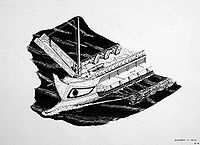 Despite the massive buildup, the Roman crews remained inferior in naval experience to the Carthaginians, and could not hope to match them in naval tactics
, which required great maneuverability and experience. They therefore employed a novel weapon which transformed sea warfare to their advantage. They equipped their ships with the corvus
, possibly developed earlier by the Syracusans against the Athenians
. This was a long plank with a spike for hooking onto enemy ships. Using it as a boarding bridge, marines were able to board
an enemy ship, transforming sea combat into a version of land combat, where the Roman legionaries had the upper hand. However, it is believed that the corvus weight made the ships unstable, and could capsize a ship in rough seas.
Although the first sea engagement of the war, the Battle of the Lipari Islands
in 260 BC, was a defeat for Rome, the forces involved were relatively small. Through the use of the corvus, the fledgling Roman navy under Gaius Duilius
won its first major engagement later that year at the Battle of Mylae
. During the course of the war, Rome continued to be victorious at sea: victories at Sulci
(258 BC) and Tyndaris
(257 BC) were followed by the massive
Battle of Cape Ecnomus
, where the Roman fleet under the consuls Marcus Atilius Regulus
and Lucius Manlius
inflicted a severe defeat on the Carthaginians. This string of successes allowed Rome to push the war further across the sea to Africa and Carthage itself. Continued Roman success also meant that their navy gained significant experience, although it also suffered a number of catastrophic losses due to storms, while conversely, the Carthaginian navy suffered from attrition.
The Battle of Drepana
in 249 BC resulted in the only major Carthaginian sea victory, forcing the Romans to equip a new fleet from donations by private citizens. In the last battle of the war, at Aegates Islands
in 241 BC, the Romans under Gaius Lutatius Catulus
displayed superior seamanship to the Carthaginians, notably using their rams rather than the now-abandoned corvus to achieve victory.
n pirates in the Adriatic. The Illyrian Wars
marked Rome's first involvement with the affairs of the Balkan peninsula. Initially, in 229 BC, a fleet of 200 warships was sent against Queen Teuta, and swiftly expelled the Illyrian garrisons from the Greek coastal cities of modern-day Albania
. Ten years later, the Romans sent another expedition in the area against Demetrius of Pharos
, who had rebuilt the Illyrian navy and engaged in piracy up into the Aegean. Demetrius was supported by Philip V of Macedon
, who had grown anxious at the expansion of Roman power in Illyria. The Romans were again quickly victorious and expanded their Illyrian protectorate, but the beginning of the Second Punic War
(218–201 BC) forced them to divert their resources westwards for the next decades.
Due to Rome's command of the seas, Hannibal, Carthage's great general, was forced to eschew a sea-borne invasion, instead choosing to bring the war over land to the Italian peninsula. Unlike the first war, the navy played little role on either side in this war. The only naval encounters occurred in the first years of the war, at Lilybaeum
(218 BC) and the Ebro River
(217 BC), both resulting Roman victories. Despite an overall numerical parity, for the remainder of the war the Carthaginians did not seriously challenge Roman supremacy. The Roman fleet was hence engaged primarily with raiding the shores of Africa and guarding Italy, a task which included the interception of Carthaginian convoys of supplies and reinforcements for Hannibal's army, as well as keeping an eye on a potential intervention by Carthage's ally, Philip V. The only major action in which the Roman fleet was involved was the siege of Syracuse in 214-212 BC with 130 ships under Marcus Claudius Marcellus
. The siege is remembered for the ingenious inventions of Archimedes
, such as mirrors that burned ships or the so-called "Claw of Archimedes
", which kept the besieging army at bay for two years. A fleet of 160 vessels was assembled to support Scipio Africanus
' army in Africa in 202 BC, and, should his expedition fail, evacuate his men. In the event, Scipio achieved a decisive victory at Zama
, and the subsequent peace stripped Carthage of its fleet.
, when, in 214 BC, a fleet under Marcus Valerius Laevinus had successfully thwarted Philip V from invading Illyria with his newly-built fleet. The rest of the war was carried out mostly by Rome's allies, the Aetolian League
and later the Kingdom of Pergamon, but a combined Roman-Pergamene fleet of ca. 60 ships patrolled the Aegean until the war's end in 205 BC. In this conflict, Rome, still embroiled in the Punic War, was not interested in expanding her possessions, but rather in thwarting the growth of Philip's power in Greece. The war ended in an effective stalemate, and was renewed in 201 BC, when Philip V invaded Asia Minor
. A naval battle
off Chios
ended in a costly victory for the Pergamene-Rhodian
alliance, but the Macedonian fleet lost many warships, including its flagship, a deceres. Soon after, Pergamon and Rhodes appealed to Rome for help, and the Republic was drawn into the Second Macedonian War
. In view of the massive Roman naval superiority, the war was fought on land, with the Macedonian fleet, already weakened at Chios, not daring to venture out of its anchorage at Demetrias
. After the crushing Roman victory at Cynoscephalae
, the terms imposed on Macedon were harsh, and included the complete disbandment of her navy.
Almost immediately following the defeat of Macedon
, Rome became embroiled in a war
with the Seleucid Empire
. This war too was decided mainly on land, although the combined Roman-Rhodian navy also achieved victories over the Seleucids at Myonessus
and Eurymedon
. These victories, which were invariably concluded with the imposition of peace treaties that prohibited the maintenance of anything but token naval forces, spelled the disappearance of the Hellenistic royal navies, leaving Rome and her allies unchallenged at sea. Coupled with the final destruction of Carthage
, and the end of Macedon's independence
, by the latter half of the 2nd century BC, Roman control over all of what was later to be dubbed mare nostrum
("our sea") had been established. Subsequently, the Roman navy was drastically reduced, depending on its Greek allies to supply ships and crews as needed.
 In the absence of a strong naval presence however, piracy
flourished throughout the Mediterranean, especially in Cilicia
, but also in Crete
and other places, further reinforced by money and warships supplied by King Mithridates VI of Pontus
, who hoped to enlist their aid in his wars
against Rome. In the First Mithridatic War
(89–85 BC), Sulla had to requisition ships wherever he could find them to counter Mithridates' fleet. Despite the makeshift nature of the Roman fleet however, in 86 BC Lucullus
defeated the Pontic navy at Tenedos
.
Immediately after the end of the war, a permanent force of ca. 100 vessels was established in the Aegean from the contributions of Rome's allied maritime states. Although sufficient to guard against Mithridates, this force was totally inadequate against the pirates, whose power grew rapidly. Over the next decade, the pirates defeated several Roman commanders, and raided unhindered even to the shores of Italy, reaching Rome's harbor, Ostia
. According to the account of Plutarch
, "the ships of the pirates numbered more than a thousand, and the cities captured by them four hundred." Their activity posed a growing threat for the Roman economy, and a challenge to Roman power: several prominent Romans, including two praetor
s with their retinue and the young Julius Caesar
, were captured and held for ransom
. Perhaps most important of all, the pirates disrupted Rome's vital lifeline, namely the massive shipments of grain
and other produce from Africa and Egypt that were needed to sustain the city's population.
The resulting grain shortages were a major political issue, and popular discontent threatened to become explosive. In 74 BC, with the outbreak of the Third Mithridatic War
, Marcus Antonius
(the father of Mark Antony
) was appointed praetor with extraordinary imperium
against the pirate threat, but signally failed in his task: he was defeated off Crete in 72 BC, and died shortly after. Finally, in 67 BC the Lex Gabinia
was passed in the Plebeian Council
, vesting Pompey
with unprecedented powers and authorizing him to move against them. In a massive and concerted campaign, Pompey cleared the seas from the pirates in only three months. Afterwards, the fleet was reduced again to policing duties against intermittent piracy.
's Gallic Wars
, when the maritime tribe of the Veneti
rebelled against Rome. Against the Veneti, the Romans were at a disadvantage, since they did not know the coast, and were inexperienced in fighting in the open sea with its tides and currents. Furthermore, the Veneti ships were superior to the light Roman galleys. They were built of oak
and had no oars, being thus more resistant to ramming
. In addition, their greater height gave them an advantage in both missile exchanges and boarding actions. In the event, when the two fleets encountered each other in Quiberon Bay
, Caesar's men resorted to the use of hooks on long poles, which cut the halyard
s supporting the Veneti sails. Immobile, the Veneti ships were easy prey for the legionaries who boarded them. Having thus established his control of the English Channel
, in the next years Caesar used this newly-built fleet to carry out two invasions of Britain
.
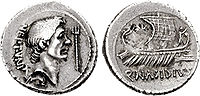 The last major campaigns of the Roman navy in the Mediterranean until the late 3rd century AD would be in the civil wars
that ended the Republic. In the East, the Republican faction quickly established its control, and Rhodes, the last independent maritime power in the Aegean, was subdued by Gaius Cassius Longinus
in 43 BC, after its fleet was defeated off Kos
. In the West, against the triumvirs
stood Sextus Pompeius
, who had been given command of the Italian fleet by the Senate in 43 BC. He took control of Sicily
and made it his base, blockading Italy and stopping the politically crucial supply of grain from Africa to Rome. After suffering a defeat from Sextus in 42 BC, Octavian initiated massive naval armaments, aided by his closest associate, Marcus Agrippa: ships were built at Ravenna and Ostia, the new artificial harbor of Portus Julius
built at Cumae
, and soldiers and rowers levied, including over 20,000 manumitted slaves. Finally, Octavian and Agrippa defeated Sextus in the Battle of Naulochus
in 36 BC, putting an end to all Pompeian resistance.
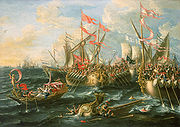 Octavian's power was further enhanced after his victory against the combined fleets of Mark Antony
and Cleopatra, Queen of Egypt
, in the Battle of Actium
in 31 BC, where Antony had assembled 500 ships against Octavian's 400 ships. This last naval battle of the Roman Republic definitively established Octavian as the sole ruler over Rome and the Mediterranean world. In the aftermath of his victory, he formalized the Fleet's structure, establishing several key harbors in the Mediterranean (see below). The now fully professional navy had its main duties consist of protecting against piracy, escorting troops and patrolling the river frontiers of Europe. It remained however engaged in active warfare in the periphery of the Empire.
and after the conquest of Egypt
there were increasing demands from the Roman economy to extend the trade lanes to India. The Arabian control of all sea routes to India was an obstacle. One of the first naval operations under princeps Augustus was therefore the preparation for a campaign on the Arabian peninsula. Aelius Gallus
, the prefect of Egypt ordered the construction of 130 transports and subsequently carried 10,000 soldiers to Arabia. But the following march through the desert towards Yemen
failed and the plans for control of the Arabian peninsula
had to be abandoned.
At the other end of the Empire, in Germania
, the navy played an important role in the supply and transport of the legion
s. In 15 BC an independent fleet was installed at the Lake Constance
. Later, the generals Drusus
and Tiberius
used the Navy extensively, when they tried to extend the Roman frontier to the Elbe
. In 12 BC Drusus
ordered the construction of a fleet of 1,000 ships and sailed them along the Rhine into the North Sea
. The Frisii
and Chauci
had nothing to oppose the superior numbers, tactics and technology of the Romans. When these entered the river mouths of Weser and Ems, the local tribes had to surrender.
In 5 BC the Roman knowledge concerning the North and Baltic Sea was fairly extended during a campaign by Tiberius
, reaching as far as the Elbe
: Plinius describes how Roman naval formations came past Heligoland
and set sail to the north-eastern coast of Denmark, and Augustus himself boasts in his Res Gestae
: "My fleet sailed from the mouth of the Rhine eastward as far as the lands of the Cimbri to which, up to that time, no Roman had ever penetrated either by land or by sea...". The multiple naval operations north of Germania had to be abandoned after the battle of the Teutoburg Forest
in the year 9 AD.
carried out several fleet operations along the rivers Rhine and Ems, without permanent results due to grim Germanic resistance and a disastrous storm. By 28, the Romans lost further control of the Rhine mouth in a succession of Frisian insurgencies. From 43 to 85, the Roman navy played an important role in the Roman conquest of Britain
. The classis Germanica rendered outstanding services in multitudinous landing operations. In 46, a naval expedition made a push deep into the Black Sea
region and even travelled on the Tanais. In 47 a revolt by the Chauci
, who took to piratical activities along the Gallic coast, was subdued by Gnaeus Domitius Corbulo
. By 57 an expeditionary corps reached Chersonesos (see Charax, Crimea
).
It seems that under Nero
, the navy obtained strategically important positions for trading with India; but there was no known fleet in the Red Sea
. Possibly, parts of the Alexandria
n fleet were operating as escorts for the Indian trade. In the Jewish revolt
, from 66 to 70, the Romans were forced to fight Jewish ships, operating from a harbour in the area of modern Tel Aviv
, on Israel
's Mediterranean coast. In the meantime several flotilla engagements on the Sea of Galilee
took place.
In 68, as his reign became increasingly insecure, Nero raised legio I Adiutrix
from sailors of the praetorian fleets. After Nero's overthrow, in 69, the "Year of the four emperors
", the praetorian fleets supported Emperor Otho
against the usurper Vitellius
, and after his eventual victory, Vespasian
formed another legion, legio II Adiutrix
, from their ranks. Only in the Pontus
did Anicetus, the commander of the Classis Pontica, support Vitellius. He burned the fleet, and sought refuge with the Iberian
tribes, engaging in piracy. After a new fleet was built, this revolt was subdued.
of Gaius Julius Civilis
(69-70), the rebels got hold of a squadron of the Rhine fleet by treachery, and the conflict featured frequent use of the Roman Rhine flotilla. In the last phase of the war, the British fleet and legio XIV
were brought in from Britain to attack the Batavian coast, but the Cananefates, allies of the Batavians, were able to destroy or capture a large part of the fleet. In the meantime, the new Roman commander, Quintus Petillius Cerialis
, advanced north and constructed a new fleet. Civilis attempted only a short encounter with his own fleet, but could not hinder the superior Roman force from landing and ravaging the island of the Batavians
, leading to the negotiation of a peace soon after.
In the years 82 to 85, the Romans under Gnaeus Julius Agricola
launched a campaign against the Caledonians
in modern Scotland
. In this context the Roman navy significantly escalated activities on the eastern Scottish coast. Simultaneously multiple expeditions and reconnaissance trips were launched. During these the Romans would capture the Orkney Islands
(Orcades) for a short period of time and obtained information about the Shetland Islands
. There is some speculation about a Roman landing in Ireland, based on Tacitus reports about Agricola contemplating the island's conquest, but no conclusive evidence to support this theory has been found.
Under the Five Good Emperors the navy operated mainly on the rivers; so it played an important role during Trajan
's conquest of Dacia
and temporarily an independent fleet for the Euphrates
and Tigris
rivers was founded. Also during the wars against the Marcomanni confederation
under Marcus Aurelius several combats took place on the Danube
and the Tisza
.
Under the aegis of the Severan dynasty
, the only known military operations of the navy were carried out under Septimius Severus
, using naval assistance on his campaigns along the Euphrates
and Tigris
, as well as in Scotland
. Thereby Roman ships reached inter alia the Persian Gulf
and the top of the British Isles
.
" ushered a period of internal turmoil, and the same period saw a renewed series of seaborne assaults, which the imperial fleets proved unable to stem. In the West, Picts
and Irish ships raided Britain, while the Saxons
raided the North Sea, forcing the Romans to abandon Frisia
. In the East, the Goths and other tribes from modern Ukraine raided in great numbers over the Black Sea. These invasions began during the rule of Trebonianus Gallus
, when for the first time Germanic
tribes built up their own powerful fleet in the Black Sea. Via two surprise attacks (256) on Roman naval bases in the Caucasus
and near the Danube
, numerous ships fell into the hands of the Germans, whereupon the raids were extended as far as the Aegean Sea
; Byzantium
, Athens
, Sparta
and other towns were plundered and the responsible provincial fleets were heavily debilitated. It was not until the attackers made a tactical error, that their onrush could be stopped.
In 267–270 another, much fiercer series of attacks took place. A fleet composed of Heruli
and other tribes raided the coasts of Thrace
and the Pontus
. Defeated off Byzantium
by general Venerianus, the barbarians fled into the Aegean, and ravaged many islands and coastal cities, including Athens
and Corinth
. As they retreated northwards over land, they were defeated by Emperor Gallienus
at Nestos. However, this was merely the prelude to an even larger invasion that was launched in 268/269: several tribes banded together (the Historia Augusta mentions Scythians, Greuthungi
, Tervingi, Gepids, Peucini, Celts and Heruli
) and allegedly 2,000 ships and 325,000 men strong, raided the Thracian shore, attacked Byzantium and continued raiding the Aegean as far as Crete
, while the main force approached Thessalonica. Emperor Claudius II
however was able to defeat them at the Battle of Naissus
, ending the Gothic threat for the time being.
Barbarian raids also increased along the Rhine frontier and in the North Sea
. Eutropius mentions that during the 280s, the sea along the coasts of the provinces of Belgica and Armorica was "infested with Franks and Saxons". To counter them, Maximian
appointed Carausius
as commander of the British Fleet
. However, Carausius rose up in late 286 and seceded from the Empire
with Britannia and parts of the northern Gallic coast. With a single blow Roman control of the channel and the North Sea was lost, and emperor Maximinus
was forced to create a completely new Northern Fleet, but in lack of training it was almost immediately destroyed in a storm. Only in 293, under Caesar
Constantius Chlorus
did Rome regain the Gallic coast. A new fleet was constructed in order to cross the Channel, and in 296, with a concentric attack on Londinium
the insurgent province was retaken.
is held to have strengthened the navy, and increased its manpower from 46,000 to 64,000 men, the old standing fleets had all but vanished, and in the civil wars that ended the Tetrarchy
, the opposing sides had to mobilize the resources and commandeered the ships of the Eastern Mediterranean port cities. These conflicts thus brought about a renewal of naval activity, culminating in the Battle of the Hellespont
in 324 between the forces of Constantine I
under Caesar Crispus
and the fleet of Licinius
, which was the only major naval confrontation of the 4th century. Vegetius
, writing at the end of the 4th century, testifies to the disappearance of the old praetorian fleets in Italy, but comments on the continued activity of the Danube fleet. In the 5th century, only the eastern half of the Empire could field an effective fleet, as it could draw upon the maritime resources of Greece and the Levant. Although the Notitia Dignitatum
still mentions several naval units for the Western Empire
, these were apparently too depleted to be able to carry out much more than patrol duties. At any rate, the rise of the naval power of the Vandal Kingdom
under Geiseric in North Africa, and its raids in the Western Mediterranean, were practically uncontested. Although there is some evidence of West Roman naval activity in the first half of the 5th century, this is mostly confined to troop transports and minor landing operations. The historian Priscus
and Sidonius Apollinaris
affirm in their writings that by the mid-5th century, the Western Empire essentially lacked a war navy. Matters became even worse after the disastrous failure of the fleets mobilized against the Vandals in 460 and 468, under the emperors Majorian
and Anthemius
.
For the West, there would be no recovery, as the last Western Emperor, Romulus Augustulus, was deposed in 476. In the East however, the classical naval tradition survived, and in the 6th century, a standing navy was reformed. The East Roman (Byzantine) navy
would remain a formidable force in the Mediterranean until the 11th century.
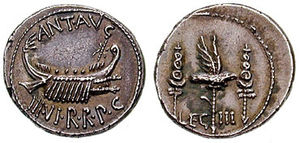 The bulk of a galley's crew was formed by the rowers, the remiges (sing. remex) or eretai (sing. eretēs) in Greek. Despite popular perceptions, the Roman fleet, and ancient fleets in general, relied throughout their existence on rowers of free status, and not on galley slave
s. Slaves were employed only in times of pressing manpower demands or extreme emergency, and even then, they were freed first. In Imperial times, non-citizen freeborn provincials (peregrini
), chiefly from nations with a maritime background such as Greeks, Phoenicians, Syrians and Egyptians, formed the bulk of the fleets' crews.
During the early Principate, a ship's crew, regardless of its size, was organized as a centuria
. Crewmen could sign on as marines, rowers/seamen, craftsmen and various other jobs, though all personnel serving in the imperial fleet were classed as milites ("soldiers"), regardless of their function; only when differentiation with the army was required, were the adjectives classiarius or classicus added. Along with several other instances of prevalence of army terminology, this testifies to the lower social status of naval personnel, considered inferior to the auxiliaries
and the legionaries. Emperor Claudius
first gave legal privileges to the navy's crewmen, enabling them to receive Roman citizenship
after their period of service. This period was initially set at a minimum of 26 years (one year more than the legions), and was later expanded to 28. Upon honorable discharge (honesta missio), the sailors received a sizable cash payment as well.
As in the army, the ship's centuria was headed by a centurion
with an optio
as his deputy, while a beneficiarius supervised a small administrative staff. Among the crew were also a number of principales (junior officers) and immunes
(specialists exempt from certain duties). Some of these positions, mostly administrative, were identical to those of the army auxiliaries, while some (mostly of Greek provenance) were peculiar to the fleet. An inscription from the island of Cos
, dated to the First Mithridatic War
, provides us with a list of a ship's officers, the nautae: the gubernator (kybernētēs in Greek) was the helmsman or pilot, the celeusta (keleustēs in Greek) supervised the rowers, a proreta (prōreus in Greek) was the look-out stationed at the bow, a pentacontarchos was apparently a junior officer, and an iatros (Lat. medicus), the ship's doctor.
Each ship was commanded by a trierarch
us, whose exact relationship with the ship's centurion is unclear. Squadrons, most likely of ten ships each, were put under a nauarchus
, who often appears to have risen from the ranks of the trierarchi. The post of nauarchus archigubernes or nauarchus princeps appeared later in the Imperial period, and functioned either as a commander of several squadrons or as an executive officer under a civilian admiral, equivalent to the legionary primus pilus
. All these were professional officers, usually peregrini, who had a status equal to an auxiliary centurion (and were thus increasingly called centuriones [classiarii] after ca. 70 AD). Until the reign of Antoninus Pius
, their careers were restricted to the fleet. Only in the 3rd century were these officers equated to the legionary centurions in status and pay, and could henceforth be transferred to a similar position in the legions.
or promagistrate
, usually of consular
or praetor
ian rank. In the Punic Wars for instance, one consul would usually command the fleet, and another the army. In the subsequent wars in the Eastern Mediterranean, praetors would assume the command of the fleet. However, since these men were political appointees, the actual handling of the fleets and of separate squadrons was entrusted to their more experienced legates and subordinates. It was therefore during the Punic Wars that the separate position of praefectus classis ("fleet prefect") first appeared.
Initially subordinate to the magistrate in command, after the fleet's reorganization by Augustus, the praefectus classis became a procurator
ial position in charge of each of the permanent fleets. These posts were initially filled either from among the equestrian
class, or, especially under Claudius
, from the Emperor's freedmen, thus securing imperial control over the fleets. From the period of the Flavian emperors
, the status of the praefectura was raised, and only equestrians with military experience who had gone through the militia equestri were appointed. Nevertheless, the prefects remained largely political appointees, and despite their military experience, usually in command of army auxiliary units, their knowledge of naval matters was minimal, forcing them to rely on their professional subordinates. The difference in importance of the fleets they commanded was also reflected by the rank and the corresponding pay of the commanders. The prefects of the two praetorian fleets were ranked procuratores ducenarii, meaning they earned 200,000 sesterces annually, the prefects of the Classis Germanica, the Classis Britannica and later the Classis Pontica were centenarii (i.e. earning 100,000 sesterces), while the other fleet prefects were sexagenarii (i.e. they received 60,000 sesterces).
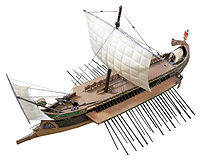 The generic Roman term for an oar-driven galley warship was "long ship" (Latin: navis longa, Greek: naus makra), as opposed to the sail-driven navis oneraria, a merchant vessel, or the minor craft (navigia minora) like the scapha.
The navy consisted of a wide variety of different classes of warships, from heavy polyremes to light raiding and scouting vessels. Unlike the rich Hellenistic Successor kingdoms
in the East however, the Romans did not rely on heavy warships, with quinquereme
s (Gk. pentērēs), and to a lesser extent quadriremes (Gk. tetrērēs) and trireme
s (Gk. triērēs) providing the mainstay of the Roman fleets from the Punic Wars to the end of the Civil Wars. The heaviest vessel mentioned in Roman fleets during this period was the hexareme, of which a few were used as flagships. Lighter vessels such as the liburnians
and the hemiolia
, both swift types invented by pirates, were also adopted as scouts and light transport vessels.
During the final confrontation between Octavian and Mark Antony, Octavian's fleet was composed of quinqueremes, together with some "sixes" and many triremes and liburnians, while Antony, who had the resources of Ptolemaic Egypt
to draw upon, fielded a fleet also mostly composed of quinquiremes, but with a sizeable complement of heavier warships, ranging from "sixes" to "tens" (Gk. dekērēs). Later historical tradition made much of the prevalence of lighter and swifter vessels in Octavian's fleet, with Vegetius
even explicitly ascribing Octavian's victory to the liburnians.
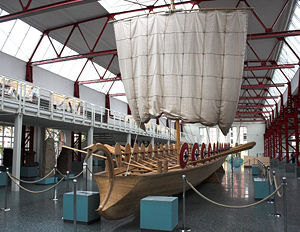 This prominence of lighter craft in the historical narrative is perhaps best explained in light of subsequent developments. After Actium, the operational landscape had changed: for the remainder of the Principate, no opponent existed to challenge Roman naval hegemony, and no massed naval confrontation was likely. The tasks at hand for the Roman navy were now the policing of the Mediterranean waterways and the border rivers, suppression of piracy, and escort duties for the grain shipments to Rome and for imperial army expeditions. Lighter ships were far better suited to these tasks, and after the reorganization of the fleet following Actium, the largest ship kept in service was a hexareme, the flagship of the Classis Misenensis
. The bulk of the fleets was composed of the lighter triremes and liburnians (Latin: liburna, Greek: libyrnis), with the latter apparently providing the majority of the provincial fleets. In time, the term "liburnian" came to mean "warship" in a generic sense.
In addition, there were smaller oared vessels, such as the navis actuaria, with 30 oars (15 on each bank), a ship primarily used for transport in coastal and fluvial operations, for which its shallow draught and flat keel were ideal. In late Antiquity, it was succeeded in this role by the navis lusoria
("playful ship"), which was extensively used for patrols and raids by the legionary flotillas in the Rhine and Danube frontiers.
Roman ships were commonly named after gods (Mars
, Iuppiter
, Minerva
, Isis
), mythological heroes (Hercules
), geographical maritime features such as Rhenus or Oceanus
, concepts such as Harmony, Peace, Loyalty, Victory (Concordia, Pax, Fides, Victoria) or after important events (Dacicus for the Trajan's Dacian Wars or Salamina for the Battle of Salamis
). They were distinguished by their figurehead (insigne or parasemum), and, during the Civil Wars at least, by the paint schemes on their turrets, which varied according to each fleet.
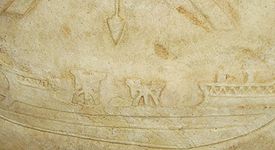 In Classical Antiquity, a ship's main weapon was the ram (rostra, hence the name navis rostrata for a warship), which was used to sink or immobilize an enemy ship by holing its hull. Its use, however, required a skilled and experienced crew and a fast and agile ship like a trireme or quinquereme. In the Hellenistic period, the larger navies came instead to rely on greater vessels. This had several advantages: the heavier and sturdier construction lessened the effects of ramming, and the greater space and stability of the vessels allowed the transport not only of more marines, but also the placement of deck-mounted ballista
e and catapult
s. Although the ram continued to be a standard feature of all warships and ramming the standard mode of attack, these developments transformed the role of a warship: from the old "manned missile", designed to sink enemy ships, they became mobile artillery platforms, which engaged in missile exchange and boarding actions
. The Romans in particular, being initially inexperienced at sea combat, relied upon boarding actions through the use of the corvus. Although it brought them some decisive victories, it was discontinued because it tended to unbalance the quinqueremes in high seas; two Roman fleets are recorded to have been lost during storms in the First Punic War
.
During the Civil Wars, a number of technical innovations, which are attributed to Agrippa, took place: the harpax
, a catapult-fired grappling hook
, which was used to clamp onto an enemy ship, reel it in and board it, in a much more efficient way than with the old corvus, and the use of collapsible fighting towers placed one apiece bow and stern, which were used to provide the boarders with supporting fire.
), which remained operative until the reign of Claudius. However, the bulk of the fleet was soon subdivided into two praetorian fleets at Misenum and Ravenna
, supplemented by a growing number of minor ones in the provinces, which were often created on an ad hoc basis for specific campaigns. This organizational structure was maintained almost unchanged until the 4th century.
The two major fleets were stationed in Italy and acted as a central naval reserve, directly available to the Emperor (hence the designation "praetorian"). In the absence of any naval threat, their duties mostly involved patrolling and transport duties. These were not confined to the waters around Italy, but throughout the Mediterranean. There is epigraphic evidence for the presence of sailors of the two praetorian fleets at Piraeus and Syria. These two fleets were:
The various provincial fleets were smaller than the praetorian fleets and composed mostly of lighter vessels. Nevertheless, it was these fleets that saw action, in full campaigns or raids on the periphery of the Empire.
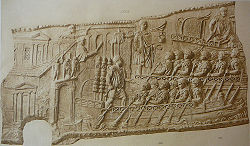
In addition, there is significant archaeological evidence for naval activity by certain legions, which in all likelihood operated their own squadrons: legio XXII Primigenia
in the Upper Rhine and Main rivers, legio X Fretensis
in the Jordan River and the Sea of Galilee
, and several legionary squadrons in the Danube frontier.
is the Notitia Dignitatum
, which corresponds to the situation of the 390s for the Eastern Empire and the 420s for the Western Empire. Notable in the Notitia is the large number of smaller squadrons that have been created, most of these fluvial and of a local operational role.
The Classis Histrica, the successor of the Classis Pannonica and the Classis Moesica was active in the Upper Danube, with bases at Mursa in Pannonia II, Florentia in Pannonia Valeria
, Arruntum in Pannonia I, Viminacium
in Moesia I and Aegetae in Dacia ripensis
. Smaller fleets are also attested on the tributaries of the Danube: the Classis Arlapensis et Maginensis (based at Arelape
and Comagena
) and the Classis Lauriacensis (based at Lauriacum
) in Pannonia I, the Classis Stradensis et Germensis, based at Margo in Moesia I, and the Classis Ratianensis, in Dacia ripensis. The naval units were complemented by port garrisons and marine units, drawn from the army. In the Danube frontier these were:
In the West, and in particular in Gaul
, several fluvial fleets had been established. These came under the command of the magister peditum of the West, and were:
It is notable that, with the exception of the praetorian fleets (whose retention in the list does not necessarily signify an active status), the old fleets of the Principate are missing. The Classis Britannica vanishes under that name after the mid-3rd century; its remnants were later subsumed in the Saxon Shore
system. The Mauretanian and African fleets had been disbanded or taken over by the Vandals
, while the absence of the Classis Germanica is most probably due to the collapse of the Rhine frontier
after the Crossing of the Rhine
by the barbarians in winter 405-406.
As far as the East is concerned, we know from legal sources that the Classis Alexandrina and the Classis Seleucena continued to operate, and that in ca. 400 a Classis Carpathia was detached from the Syrian fleet and based at the Aegean island of Karpathos
. A fleet is known to have been stationed at Constantinople itself, but no further details are known about it.
Roman legion
A Roman legion normally indicates the basic ancient Roman army unit recruited specifically from Roman citizens. The organization of legions varied greatly over time but they were typically composed of perhaps 5,000 soldiers, divided into maniples and later into "cohorts"...
s. Throughout their history, the Romans remained a primarily land-based people, and relied on their more nautically inclined subjects, such as the Greeks
Greeks
The Greeks, also known as the Hellenes , are a nation and ethnic group native to Greece, Cyprus and neighboring regions. They also form a significant diaspora, with Greek communities established around the world....
and the Egyptians
Egyptians
Egyptians are nation an ethnic group made up of Mediterranean North Africans, the indigenous people of Egypt.Egyptian identity is closely tied to geography. The population of Egypt is concentrated in the lower Nile Valley, the small strip of cultivable land stretching from the First Cataract to...
, to build and man their ships. Partly because of this, the navy was never wholly embraced by the Roman state, and deemed somewhat "un-Roman". In Antiquity, navies and trading fleets did not have the logistical autonomy that modern ships and fleets possess. Unlike modern naval forces, the Roman navy even at its height never existed as an autonomous service, but operated as an adjunct to the Roman army
Roman army
The Roman army is the generic term for the terrestrial armed forces deployed by the kingdom of Rome , the Roman Republic , the Roman Empire and its successor, the Byzantine empire...
.
During the course of the First Punic War
First Punic War
The First Punic War was the first of three wars fought between Ancient Carthage and the Roman Republic. For 23 years, the two powers struggled for supremacy in the western Mediterranean Sea, primarily on the Mediterranean island of Sicily and its surrounding waters but also to a lesser extent in...
, the Roman navy was massively expanded and played a vital role in the Roman victory and the Roman Republic
Roman Republic
The Roman Republic was the period of the ancient Roman civilization where the government operated as a republic. It began with the overthrow of the Roman monarchy, traditionally dated around 508 BC, and its replacement by a government headed by two consuls, elected annually by the citizens and...
's eventual ascension to hegemony in the Mediterranean Sea. In the course of the first half of the 2nd century BC, Rome went on to destroy Carthage and subdue the Hellenistic
Hellenistic civilization
Hellenistic civilization represents the zenith of Greek influence in the ancient world from 323 BCE to about 146 BCE...
kingdoms of the eastern Mediterranean, achieving complete mastery of the inland sea, which they called Mare Nostrum
Mare Nostrum
Mare Nostrum may refer to:*Mare Nostrum, the Roman term for the Mediterranean Sea, adopted by Italian nationalists and fascists.*Mare Nostrum , a Spanish-language novel by Vicente Blasco Ibáñez...
. The Roman fleets were again prominent in the 1st century BC in the wars against the pirates, and in the civil wars that brought down the Republic, whose campaigns ranged across the Mediterranean. In 31 BC, the great naval Battle of Actium
Battle of Actium
The Battle of Actium was the decisive confrontation of the Final War of the Roman Republic. It was fought between the forces of Octavian and the combined forces of Mark Antony and Cleopatra VII. The battle took place on 2 September 31 BC, on the Ionian Sea near the city of Actium, at the Roman...
ended the civil wars
Final war of the Roman Republic
The final war of the Roman Republic, also known as Antony's civil war or the war between Antony and Octavian, was the last of the Roman civil wars of the republic, fought between Cleopatra and Octavian...
culminating in the final victory of Augustus
Augustus
Augustus ;23 September 63 BC – 19 August AD 14) is considered the first emperor of the Roman Empire, which he ruled alone from 27 BC until his death in 14 AD.The dates of his rule are contemporary dates; Augustus lived under two calendars, the Roman Republican until 45 BC, and the Julian...
and the establishment of the Roman Empire
Roman Empire
The Roman Empire was the post-Republican period of the ancient Roman civilization, characterised by an autocratic form of government and large territorial holdings in Europe and around the Mediterranean....
.
During the Imperial period, the Mediterranean became a peaceful "Roman lake"; in the absence of a maritime enemy, the navy was reduced mostly to patrol and transport duties.
On the fringes of the Empire however, in new conquests or, increasingly, in defense against barbarian invasions, the Roman fleets were still engaged in warfare. The decline of the Empire in the 3rd century took a heavy toll on the navy, which was reduced to a shadow of its former self, both in size and in combat ability. As successive waves of the Völkerwanderung crashed on the land frontiers of the battered Empire, the navy could only play a secondary role. In the early 5th century, the Roman frontiers were breached, and barbarian kingdoms appeared on the shores of the western Mediterranean. One of them, the Vandal Kingdom
Vandal Kingdom
The Vandal Kingdom was a kingdom in North Africa established by the Vandals, an East Germanic tribe of Scandinavian origin. Having crossed the Rhine in 407, the Vandals settled in southern Spain, modern day Andalusia, until pushed out by the Visigoths...
, raised a navy of its own and raided the shores of the Mediterranean, even sacking Rome
Sack of Rome (455)
The sack of 455 was the second of three barbarian sacks of Rome; it was executed by the Vandals, who were then at war with the usurping Western Roman Emperor Petronius Maximus....
, while the diminished Roman fleets were incapable of offering any resistance. The Western Roman Empire collapsed in the late 5th century. The subsequent Roman Navy of the enduring Eastern Roman Empire
Byzantine Empire
The Byzantine Empire was the Eastern Roman Empire during the periods of Late Antiquity and the Middle Ages, centred on the capital of Constantinople. Known simply as the Roman Empire or Romania to its inhabitants and neighbours, the Empire was the direct continuation of the Ancient Roman State...
is called by historians the Byzantine Navy
Byzantine navy
The Byzantine navy was the naval force of the East Roman or Byzantine Empire. Like the empire it served, it was a direct continuation from its imperial Roman predecessor, but played a far greater role in the defense and survival of the state then its earlier iterations...
.
Early Republic
The exact origins of the Roman fleet are obscure. A traditionally agricultural and land-based society, the Romans rarely ventured out to sea, unlike their Etruscan neighbours. There is evidence of Roman warships in the early 4th century BC, such as mention of a warship that carried an embassy to DelphiDelphi
Delphi is both an archaeological site and a modern town in Greece on the south-western spur of Mount Parnassus in the valley of Phocis.In Greek mythology, Delphi was the site of the Delphic oracle, the most important oracle in the classical Greek world, and a major site for the worship of the god...
in 394 BC, but at any rate, the Roman fleet, if it existed, was negligible. The traditional birth date of the Roman navy is set at ca. 311 BC, when, after the conquest of Campania
Campania
Campania is a region in southern Italy. The region has a population of around 5.8 million people, making it the second-most-populous region of Italy; its total area of 13,590 km² makes it the most densely populated region in the country...
, two new officials, the duumviri navales classis ornandae reficiendaeque causa, were tasked with the maintenance of a fleet. As a result, the Republic acquired its first fleet, consisting of 20 ships, most likely trireme
Trireme
A trireme was a type of galley, a Hellenistic-era warship that was used by the ancient maritime civilizations of the Mediterranean, especially the Phoenicians, ancient Greeks and Romans.The trireme derives its name from its three rows of oars on each side, manned with one man per oar...
s, with each duumvir commanding a squadron of 10 ships. However, the Republic continued to rely mostly on her legions for expansion in Italy; the navy was most likely geared towards combating piracy and lacked experience in naval warfare, being easily defeated in 282 BC by the Tarentines
Taranto
Taranto is a coastal city in Apulia, Southern Italy. It is the capital of the Province of Taranto and is an important commercial port as well as the main Italian naval base....
.
This situation continued until the First Punic War
First Punic War
The First Punic War was the first of three wars fought between Ancient Carthage and the Roman Republic. For 23 years, the two powers struggled for supremacy in the western Mediterranean Sea, primarily on the Mediterranean island of Sicily and its surrounding waters but also to a lesser extent in...
: the main task of the Roman fleet was patrolling along the Italian coast and rivers, protecting seaborne trade from piracy. Whenever larger tasks had to be undertaken, such as the naval blockade of a besieged city, the Romans called on the allied Greek cities of southern Italy, the socii navales, to provide ships and crews. It is possible that the supervision of these maritime allies was one of the duties of the four new praetor
Praetor
Praetor was a title granted by the government of Ancient Rome to men acting in one of two official capacities: the commander of an army, usually in the field, or the named commander before mustering the army; and an elected magistratus assigned varied duties...
es classici, who were established in 267 BC.
First Punic War
The first Roman expedition outside mainland Italy was against the island of SicilySicily
Sicily is a region of Italy, and is the largest island in the Mediterranean Sea. Along with the surrounding minor islands, it constitutes an autonomous region of Italy, the Regione Autonoma Siciliana Sicily has a rich and unique culture, especially with regard to the arts, music, literature,...
in 265 BC. This led to the outbreak of hostilities with Carthage
Carthage
Carthage , implying it was a 'new Tyre') is a major urban centre that has existed for nearly 3,000 years on the Gulf of Tunis, developing from a Phoenician colony of the 1st millennium BC...
, which would last until 241 BC. At the time, the Punic city was the unchallenged master of the western Mediterranean, possessing a long maritime and naval experience and a large fleet. Although Rome had relied on her legions for the conquest of Italy, operations in Sicily had to be supported by a fleet, and the ships available by Rome's allies were clearly insufficient. Thus in 261 BC, the Roman Senate set out to construct a fleet of 100 quinquereme
Quinquereme
From the 4th century BC on, new types of oared warships appeared in the Mediterranean Sea, superseding the trireme and transforming naval warfare. Ships became increasingly bigger and heavier, including some of the largest wooden ships ever constructed...
s and 20 triremes. According to Polybius
Polybius
Polybius , Greek ) was a Greek historian of the Hellenistic Period noted for his work, The Histories, which covered the period of 220–146 BC in detail. The work describes in part the rise of the Roman Republic and its gradual domination over Greece...
, the Romans seized a shipwrecked Carthaginian quinquereme, and used it as a blueprint for their own ships. The new fleets were commanded by the annually elected Roman magistrates, but naval expertise was provided by the lower officers, who continued to be provided by the socii, mostly Greeks. This practice was continued until well into the Empire, something also attested by the direct adoption of numerous Greek naval terms.
Naval tactics in the Age of Galleys
Naval tactics in the age of galleys were used from antiquity to the early 17th century when sailing ships replaced oared galleys.-Weapons in the age of galleys:Throughout antiquity and the Middle Ages until the 16th century, the weapons relied on were:...
, which required great maneuverability and experience. They therefore employed a novel weapon which transformed sea warfare to their advantage. They equipped their ships with the corvus
Corvus (weapon)
The corvus or harpago was a Roman military boarding device used in naval warfare during the First Punic War against Carthage....
, possibly developed earlier by the Syracusans against the Athenians
Athens
Athens , is the capital and largest city of Greece. Athens dominates the Attica region and is one of the world's oldest cities, as its recorded history spans around 3,400 years. Classical Athens was a powerful city-state...
. This was a long plank with a spike for hooking onto enemy ships. Using it as a boarding bridge, marines were able to board
Boarding (attack)
Boarding, in its simplest sense, refers to the insertion on to a ship's deck of individuals. However, when it is classified as an attack, in most contexts, it refers to the forcible insertion of personnel that are not members of the crew by another party without the consent of the captain or crew...
an enemy ship, transforming sea combat into a version of land combat, where the Roman legionaries had the upper hand. However, it is believed that the corvus weight made the ships unstable, and could capsize a ship in rough seas.
Although the first sea engagement of the war, the Battle of the Lipari Islands
Battle of the Lipari Islands
The Battle of the Lipari Islands or Lipara was the first encounter between the fleets of Carthage and the Roman Republic during the First Punic War...
in 260 BC, was a defeat for Rome, the forces involved were relatively small. Through the use of the corvus, the fledgling Roman navy under Gaius Duilius
Gaius Duilius
Gaius Duilius was a Roman politician and admiral involved in the First Punic War.Not much is known about his family background or early career, since he was a novus homo, meaning not belonging to a traditional family of Roman aristocrats. He managed, nevertheless, to be elected consul for the year...
won its first major engagement later that year at the Battle of Mylae
Battle of Mylae
The Battle of Mylae took place in 260 BC during the First Punic War and was the first real naval battle between Carthage and the Roman Republic. This battle was key in the Roman victory of Mylae as well as Sicily itself...
. During the course of the war, Rome continued to be victorious at sea: victories at Sulci
Battle of Sulci
The Battle of Sulci was a naval battle fought in 258 BC between the Roman and Carthaginian navies on the coast near the town of Sulci, Sardinia. It was a minor Roman victory, obtained by consul Gaius Sulpicius Paterculus. The battle was small-scale and the Carthaginian loss was negligible....
(258 BC) and Tyndaris
Battle of Tyndaris
The Battle of Tyndaris was a naval battle of the First Punic War, which took place off Tyndaris in 257 BC. Tyndaris was a Sicilian town founded as a Greek colony in 396 BC located on the high ground overlooking the Tyrrhenian Sea in the Gulf of Patti. Hiero II, the tyrant of Syracuse, allowed...
(257 BC) were followed by the massive
Largest naval battle in history
The title of "largest naval battle in history" is disputed between adherents of criteria which include the numbers of personnel and/or vessels involved in the battle, and the total tonnage of the vessels involved...
Battle of Cape Ecnomus
Battle of Cape Ecnomus
The Battle of Cape Ecnomus was a naval battle, fought off Cape Ecnomus , between the fleets of Carthage and the Roman Republic, during the First Punic War...
, where the Roman fleet under the consuls Marcus Atilius Regulus
Marcus Atilius Regulus
Marcus Atilius Regulus , a general and consul in the ninth year of the First Punic War...
and Lucius Manlius
Lucius Manlius Vulso Longus
Lucius Manlius Vulso Longus was a patrician who became one of the Roman consuls in both 256 and 250 BC. The term for being consul was one year. Two consuls ruled at a time and one could serve up to two terms. It was the consuls’ job to govern provinces, lead armies in major wars, and run the Senate...
inflicted a severe defeat on the Carthaginians. This string of successes allowed Rome to push the war further across the sea to Africa and Carthage itself. Continued Roman success also meant that their navy gained significant experience, although it also suffered a number of catastrophic losses due to storms, while conversely, the Carthaginian navy suffered from attrition.
The Battle of Drepana
Battle of Drepana
The naval Battle of Drepana took place in 249 BC during the First Punic War near modern Trapani, western Sicily between the fleets of Carthage and the Roman Republic.-Prelude:...
in 249 BC resulted in the only major Carthaginian sea victory, forcing the Romans to equip a new fleet from donations by private citizens. In the last battle of the war, at Aegates Islands
Battle of the Aegates Islands
The Battle of the Aegates Islands or Aegusa was the final naval battle fought between the fleets of Carthage and the Roman Republic during the First Punic War...
in 241 BC, the Romans under Gaius Lutatius Catulus
Gaius Lutatius Catulus
Gaius Lutatius Catulus was a Roman statesman and naval commander in the First Punic War.He was elected as a consul in 242 BC, a novus homo. During his consulship he supervised the construction of a new Roman fleet. This fleet was funded by donations from wealthy citizens, since the public treasury...
displayed superior seamanship to the Carthaginians, notably using their rams rather than the now-abandoned corvus to achieve victory.
Illyria and the Second Punic War
After the Roman victory, the balance of naval power in the Western Mediterranean had shifted from Carthage to Rome. This ensured Carthaginian acquiescence to the conquest of Sardinia and Corsica, and also enabled Rome to deal decisively with the threat posed by the IllyriaIllyria
In classical antiquity, Illyria was a region in the western part of the Balkan Peninsula inhabited by the Illyrians....
n pirates in the Adriatic. The Illyrian Wars
Illyrian Wars
Illyrian Wars were a set of conflicts of 229 BC, 219 BC and 168 BC when Rome overran the Illyrian settlements and suppressed the piracy that had made the Adriatic unsafe for Italian commerce. There were three campaigns, the first against Teuta, the second against Demetrius of Pharos and the third...
marked Rome's first involvement with the affairs of the Balkan peninsula. Initially, in 229 BC, a fleet of 200 warships was sent against Queen Teuta, and swiftly expelled the Illyrian garrisons from the Greek coastal cities of modern-day Albania
Albania
Albania , officially known as the Republic of Albania , is a country in Southeastern Europe, in the Balkans region. It is bordered by Montenegro to the northwest, Kosovo to the northeast, the Republic of Macedonia to the east and Greece to the south and southeast. It has a coast on the Adriatic Sea...
. Ten years later, the Romans sent another expedition in the area against Demetrius of Pharos
Demetrius of Pharos
Demetrius of Pharos was a ruler of Pharos involved in the First Illyrian War, after which he ruled a portion of the Illyrian Adriatic coast on behalf of the Romans, as a Client king....
, who had rebuilt the Illyrian navy and engaged in piracy up into the Aegean. Demetrius was supported by Philip V of Macedon
Philip V of Macedon
Philip V was King of Macedon from 221 BC to 179 BC. Philip's reign was principally marked by an unsuccessful struggle with the emerging power of Rome. Philip was attractive and charismatic as a young man...
, who had grown anxious at the expansion of Roman power in Illyria. The Romans were again quickly victorious and expanded their Illyrian protectorate, but the beginning of the Second Punic War
Second Punic War
The Second Punic War, also referred to as The Hannibalic War and The War Against Hannibal, lasted from 218 to 201 BC and involved combatants in the western and eastern Mediterranean. This was the second major war between Carthage and the Roman Republic, with the participation of the Berbers on...
(218–201 BC) forced them to divert their resources westwards for the next decades.
Due to Rome's command of the seas, Hannibal, Carthage's great general, was forced to eschew a sea-borne invasion, instead choosing to bring the war over land to the Italian peninsula. Unlike the first war, the navy played little role on either side in this war. The only naval encounters occurred in the first years of the war, at Lilybaeum
Battle of Lilybaeum
The Battle of Lilybaeum was the first naval clash between the navies of Carthage and Rome during the Second Punic War. The Carthaginians had sent 35 quinqueremes to raid Sicily, starting with Lilybaeum...
(218 BC) and the Ebro River
Battle of Ebro River
Battle of Ebro River was a naval battle fought between a Carthaginian fleet of approximately 40 quinqueremes under the command of Himilco and a Roman fleet of 55 ships under Gnaeus Cornelius Scipio Calvus near the mouth of Ebro River in the spring of 217 BC...
(217 BC), both resulting Roman victories. Despite an overall numerical parity, for the remainder of the war the Carthaginians did not seriously challenge Roman supremacy. The Roman fleet was hence engaged primarily with raiding the shores of Africa and guarding Italy, a task which included the interception of Carthaginian convoys of supplies and reinforcements for Hannibal's army, as well as keeping an eye on a potential intervention by Carthage's ally, Philip V. The only major action in which the Roman fleet was involved was the siege of Syracuse in 214-212 BC with 130 ships under Marcus Claudius Marcellus
Marcus Claudius Marcellus
Marcus Claudius Marcellus , five times elected as consul of the Roman Republic, was an important Roman military leader during the Gallic War of 225 BC and the Second Punic War...
. The siege is remembered for the ingenious inventions of Archimedes
Archimedes
Archimedes of Syracuse was a Greek mathematician, physicist, engineer, inventor, and astronomer. Although few details of his life are known, he is regarded as one of the leading scientists in classical antiquity. Among his advances in physics are the foundations of hydrostatics, statics and an...
, such as mirrors that burned ships or the so-called "Claw of Archimedes
Claw of Archimedes
The Claw of Archimedes was an ancient weapon devised by Archimedes to defend the seaward portion of Syracuse's city wall against amphibious assault...
", which kept the besieging army at bay for two years. A fleet of 160 vessels was assembled to support Scipio Africanus
Scipio Africanus
Publius Cornelius Scipio Africanus , also known as Scipio Africanus and Scipio the Elder, was a general in the Second Punic War and statesman of the Roman Republic...
' army in Africa in 202 BC, and, should his expedition fail, evacuate his men. In the event, Scipio achieved a decisive victory at Zama
Battle of Zama
The Battle of Zama, fought around October 19, 202 BC, marked the final and decisive end of the Second Punic War. A Roman army led by Publius Cornelius Scipio Africanus defeated a Carthaginian force led by the legendary commander Hannibal...
, and the subsequent peace stripped Carthage of its fleet.
Operations in the East
Rome was now the undisputed mistress of the Western Mediterranean, and turned her gaze from defeated Carthage to the Hellenistic world. Small Roman forces had already been engaged in the First Macedonian WarFirst Macedonian War
The First Macedonian War was fought by Rome, allied with the Aetolian League and Attalus I of Pergamon, against Philip V of Macedon, contemporaneously with the Second Punic War against Carthage...
, when, in 214 BC, a fleet under Marcus Valerius Laevinus had successfully thwarted Philip V from invading Illyria with his newly-built fleet. The rest of the war was carried out mostly by Rome's allies, the Aetolian League
Aetolian League
The Aetolian League was a confederation of tribal communities and cities in ancient Greece centered on Aetolia in central Greece. It was established, probably during the early Hellenistic era, in opposition to Macedon and the Achaean League. Two annual meetings were held in Thermika and Panaetolika...
and later the Kingdom of Pergamon, but a combined Roman-Pergamene fleet of ca. 60 ships patrolled the Aegean until the war's end in 205 BC. In this conflict, Rome, still embroiled in the Punic War, was not interested in expanding her possessions, but rather in thwarting the growth of Philip's power in Greece. The war ended in an effective stalemate, and was renewed in 201 BC, when Philip V invaded Asia Minor
Asia Minor
Asia Minor is a geographical location at the westernmost protrusion of Asia, also called Anatolia, and corresponds to the western two thirds of the Asian part of Turkey...
. A naval battle
Battle of Chios
The Battle of Chios was fought between the fleet of Philip V of Macedon against the combined fleet of Rhodes, Pergamum, Byzantium and Cyzicus....
off Chios
Chios
Chios is the fifth largest of the Greek islands, situated in the Aegean Sea, seven kilometres off the Asia Minor coast. The island is separated from Turkey by the Chios Strait. The island is noted for its strong merchant shipping community, its unique mastic gum and its medieval villages...
ended in a costly victory for the Pergamene-Rhodian
Rhodes
Rhodes is an island in Greece, located in the eastern Aegean Sea. It is the largest of the Dodecanese islands in terms of both land area and population, with a population of 117,007, and also the island group's historical capital. Administratively the island forms a separate municipality within...
alliance, but the Macedonian fleet lost many warships, including its flagship, a deceres. Soon after, Pergamon and Rhodes appealed to Rome for help, and the Republic was drawn into the Second Macedonian War
Second Macedonian War
The Second Macedonian War was fought between Macedon, led by Philip V of Macedon, and Rome, allied with Pergamon and Rhodes. The result was the defeat of Philip who was forced to abandon all his possessions in Greece...
. In view of the massive Roman naval superiority, the war was fought on land, with the Macedonian fleet, already weakened at Chios, not daring to venture out of its anchorage at Demetrias
Demetrias
Demetrias was an ancient Greek city in Magnesia , near the modern city of Volos. It was founded by Demetrius Poliorcetes, one of the successors of Alexander the Great.-External links:*...
. After the crushing Roman victory at Cynoscephalae
Battle of Cynoscephalae
The Battle of Cynoscephalae was an encounter battle fought in Thessaly in 197 BC between the Roman army, led by Titus Quinctius Flamininus, and the Antigonid dynasty of Macedon, led by Philip V.- Prelude :...
, the terms imposed on Macedon were harsh, and included the complete disbandment of her navy.
Almost immediately following the defeat of Macedon
Macedon
Macedonia or Macedon was an ancient kingdom, centered in the northeastern part of the Greek peninsula, bordered by Epirus to the west, Paeonia to the north, the region of Thrace to the east and Thessaly to the south....
, Rome became embroiled in a war
Roman-Syrian War
The Roman–Syrian War , also known as War of Antiochos or Syrian War, was a military conflict between two coalitions led by the Roman Republic and the Seleucid Empire under Antiochus the Great...
with the Seleucid Empire
Seleucid Empire
The Seleucid Empire was a Greek-Macedonian state that was created out of the eastern conquests of Alexander the Great. At the height of its power, it included central Anatolia, the Levant, Mesopotamia, Persia, today's Turkmenistan, Pamir and parts of Pakistan.The Seleucid Empire was a major centre...
. This war too was decided mainly on land, although the combined Roman-Rhodian navy also achieved victories over the Seleucids at Myonessus
Battle of Myonessus
The naval Battle of Myonessus was fought in 190 BC during the war of Rome against Antiochus III the Great for the domination over Greece, between a Seleucid Empire fleet and a Roman plus Rhodian fleet. The Romans were victorious.The account of Appian:...
and Eurymedon
Battle of the Eurymedon (190 BC)
The Battle of the Eurymedon was fought in 190 BC between a Seleucid fleet and the navy of the city state of Rhodes, who were allied with the Roman Republic. The Seleucids were led by the famous Carthaginian general Hannibal, who had gone into exile in the events following the Battle of Zama...
. These victories, which were invariably concluded with the imposition of peace treaties that prohibited the maintenance of anything but token naval forces, spelled the disappearance of the Hellenistic royal navies, leaving Rome and her allies unchallenged at sea. Coupled with the final destruction of Carthage
Third Punic War
The Third Punic War was the third and last of the Punic Wars fought between the former Phoenician colony of Carthage, and the Roman Republic...
, and the end of Macedon's independence
Third Macedonian War
The Third Macedonian War was a war fought between Rome and King Perseus of Macedon. In 179 BC King Philip V of Macedon died and his talented and ambitious son, Perseus, took his throne. Perseus married Laodike, daughter of King Seleucus IV Keraunos of Asia, and increased the size of his army...
, by the latter half of the 2nd century BC, Roman control over all of what was later to be dubbed mare nostrum
Mare Nostrum
Mare Nostrum may refer to:*Mare Nostrum, the Roman term for the Mediterranean Sea, adopted by Italian nationalists and fascists.*Mare Nostrum , a Spanish-language novel by Vicente Blasco Ibáñez...
("our sea") had been established. Subsequently, the Roman navy was drastically reduced, depending on its Greek allies to supply ships and crews as needed.
Mithridates and the pirate threat
Cilician pirates
The Cilician pirates dominated the Mediterranean Sea from the 2nd century BC up until their speedy suppression by Pompey . Although there were notorious pirate strongholds in Cilicia, Cilician had long been a term for pirates.-Rise of piracy:...
flourished throughout the Mediterranean, especially in Cilicia
Cilicia
In antiquity, Cilicia was the south coastal region of Asia Minor, south of the central Anatolian plateau. It existed as a political entity from Hittite times into the Byzantine empire...
, but also in Crete
Crete
Crete is the largest and most populous of the Greek islands, the fifth largest island in the Mediterranean Sea, and one of the thirteen administrative regions of Greece. It forms a significant part of the economy and cultural heritage of Greece while retaining its own local cultural traits...
and other places, further reinforced by money and warships supplied by King Mithridates VI of Pontus
Mithridates VI of Pontus
Mithridates VI or Mithradates VI Mithradates , from Old Persian Mithradatha, "gift of Mithra"; 134 BC – 63 BC, also known as Mithradates the Great and Eupator Dionysius, was king of Pontus and Armenia Minor in northern Anatolia from about 120 BC to 63 BC...
, who hoped to enlist their aid in his wars
Mithridatic Wars
There were three Mithridatic Wars between Rome and the Kingdom of Pontus in the 1st century BC. They are named for Mithridates VI who was King of Pontus at the time....
against Rome. In the First Mithridatic War
First Mithridatic War
The First Mithridatic War was a war challenging Rome's expanding Empire and rule over the Greek world. In this conflict, the Kingdom of Pontus and many Greek cities rebelling against Rome were led by Mithridates VI of Pontus against the Roman Republic and the Kingdom of Bithynia...
(89–85 BC), Sulla had to requisition ships wherever he could find them to counter Mithridates' fleet. Despite the makeshift nature of the Roman fleet however, in 86 BC Lucullus
Lucullus
Lucius Licinius Lucullus , was an optimate politician of the late Roman Republic, closely connected with Sulla Felix...
defeated the Pontic navy at Tenedos
Battle of Tenedos
The Battle of Tenedos was fought in 86 BC between the fleets of Rome and Pontus. The Romans were led by Lucius Licinius Lucullus, and they were victorious....
.
Immediately after the end of the war, a permanent force of ca. 100 vessels was established in the Aegean from the contributions of Rome's allied maritime states. Although sufficient to guard against Mithridates, this force was totally inadequate against the pirates, whose power grew rapidly. Over the next decade, the pirates defeated several Roman commanders, and raided unhindered even to the shores of Italy, reaching Rome's harbor, Ostia
Ostia Antica
Ostia Antica is a large archeological site, close to the modern suburb of Ostia , that was the location of the harbour city of ancient Rome, which is approximately 30 km to the northeast. "Ostia" in Latin means "mouth". At the mouth of the River Tiber, Ostia was Rome's seaport, but, due to...
. According to the account of Plutarch
Plutarch
Plutarch then named, on his becoming a Roman citizen, Lucius Mestrius Plutarchus , c. 46 – 120 AD, was a Greek historian, biographer, essayist, and Middle Platonist known primarily for his Parallel Lives and Moralia...
, "the ships of the pirates numbered more than a thousand, and the cities captured by them four hundred." Their activity posed a growing threat for the Roman economy, and a challenge to Roman power: several prominent Romans, including two praetor
Praetor
Praetor was a title granted by the government of Ancient Rome to men acting in one of two official capacities: the commander of an army, usually in the field, or the named commander before mustering the army; and an elected magistratus assigned varied duties...
s with their retinue and the young Julius Caesar
Julius Caesar
Gaius Julius Caesar was a Roman general and statesman and a distinguished writer of Latin prose. He played a critical role in the gradual transformation of the Roman Republic into the Roman Empire....
, were captured and held for ransom
Ransom
Ransom is the practice of holding a prisoner or item to extort money or property to secure their release, or it can refer to the sum of money involved.In an early German law, a similar concept was called bad influence...
. Perhaps most important of all, the pirates disrupted Rome's vital lifeline, namely the massive shipments of grain
Grain supply to the city of Rome
In classical antiquity, the grain supply to the city of Rome could not be met entirely from the surrounding countryside, which was taken up by the villas and parks of the aristocracy and which produced mainly fruit, vegetables and other perishable goods...
and other produce from Africa and Egypt that were needed to sustain the city's population.
The resulting grain shortages were a major political issue, and popular discontent threatened to become explosive. In 74 BC, with the outbreak of the Third Mithridatic War
Third Mithridatic War
The Third Mithridatic War was the last and longest of three Mithridatic Wars fought between Mithridates VI of Pontus and his allies and the Roman Republic...
, Marcus Antonius
Marcus Antonius Creticus
Marcus Antonius Creticus was a Roman politician, member of the Antonius family. Creticus was son of Marcus Antonius Orator and by his marriage to Julia Antonia he had three sons: Triumvir Marcus Antonius, Gaius Antonius and Lucius Antonius.He was elected praetor in 74 BC and received an...
(the father of Mark Antony
Mark Antony
Marcus Antonius , known in English as Mark Antony, was a Roman politician and general. As a military commander and administrator, he was an important supporter and loyal friend of his mother's cousin Julius Caesar...
) was appointed praetor with extraordinary imperium
Imperium
Imperium is a Latin word which, in a broad sense, translates roughly as 'power to command'. In ancient Rome, different kinds of power or authority were distinguished by different terms. Imperium, referred to the sovereignty of the state over the individual...
against the pirate threat, but signally failed in his task: he was defeated off Crete in 72 BC, and died shortly after. Finally, in 67 BC the Lex Gabinia
Lex Gabinia
In the law of ancient Rome, the Lex Gabinia of 67 BC granted Pompeius Magnus extraordinary proconsular powers in any province within 50 miles of the Mediterranean Sea...
was passed in the Plebeian Council
Plebeian Council
The Concilium Plebis — known in English as the Plebeian Council or People's Assembly — was the principal popular assembly of the ancient Roman Republic. It functioned as a legislative assembly, through which the plebeians could pass laws, elect magistrates, and try judicial cases. The Plebeian...
, vesting Pompey
Pompey
Gnaeus Pompeius Magnus, also known as Pompey or Pompey the Great , was a military and political leader of the late Roman Republic...
with unprecedented powers and authorizing him to move against them. In a massive and concerted campaign, Pompey cleared the seas from the pirates in only three months. Afterwards, the fleet was reduced again to policing duties against intermittent piracy.
Caesar and the Civil Wars
In 56 BC, for the first time a Roman fleet engaged in battle outside the Mediterranean. This occurred during Julius CaesarJulius Caesar
Gaius Julius Caesar was a Roman general and statesman and a distinguished writer of Latin prose. He played a critical role in the gradual transformation of the Roman Republic into the Roman Empire....
's Gallic Wars
Gallic Wars
The Gallic Wars were a series of military campaigns waged by the Roman proconsul Julius Caesar against several Gallic tribes. They lasted from 58 BC to 51 BC. The Gallic Wars culminated in the decisive Battle of Alesia in 52 BC, in which a complete Roman victory resulted in the expansion of the...
, when the maritime tribe of the Veneti
Veneti (Gaul)
The Veneti were a seafaring Celtic people who lived in the Brittany peninsula , which in Roman times formed part of an area called Armorica...
rebelled against Rome. Against the Veneti, the Romans were at a disadvantage, since they did not know the coast, and were inexperienced in fighting in the open sea with its tides and currents. Furthermore, the Veneti ships were superior to the light Roman galleys. They were built of oak
Oak
An oak is a tree or shrub in the genus Quercus , of which about 600 species exist. "Oak" may also appear in the names of species in related genera, notably Lithocarpus...
and had no oars, being thus more resistant to ramming
Ramming
In warfare, ramming is a technique that was used in air, sea and land combat. The term originated from battering ram, a siege weapon used to bring down fortifications by hitting it with the force of the ram's momentum...
. In addition, their greater height gave them an advantage in both missile exchanges and boarding actions. In the event, when the two fleets encountered each other in Quiberon Bay
Quiberon Bay
The Baie de Quiberon is an area of sheltered water on the south coast of Brittany. The bay is in the Morbihan département.-Geography:The bay is roughly triangular in shape, open to the south with the Gulf of Morbihan to the north-east and the narrow peninsular of Presqu'île de Quiberon providing...
, Caesar's men resorted to the use of hooks on long poles, which cut the halyard
Halyard
In sailing, a halyard or halliard is a line that is used to hoist a sail, a flag or a yard. The term halyard comes from the phrase, 'to haul yards'...
s supporting the Veneti sails. Immobile, the Veneti ships were easy prey for the legionaries who boarded them. Having thus established his control of the English Channel
English Channel
The English Channel , often referred to simply as the Channel, is an arm of the Atlantic Ocean that separates southern England from northern France, and joins the North Sea to the Atlantic. It is about long and varies in width from at its widest to in the Strait of Dover...
, in the next years Caesar used this newly-built fleet to carry out two invasions of Britain
Caesar's invasions of Britain
In his Gallic Wars, Julius Caesar invaded Britain twice, in 55 and 54 BC. The first invasion, made late in summer, was either intended as a full invasion or a reconnaissance-in-force expedition...
.
Roman civil wars
There were several Roman civil wars, especially during the late Republic. The most famous of these are the war in the 40s BC between Julius Caesar and the optimate faction of the senatorial elite initially led by Pompey and the subsequent war between Caesar's successors, Octavian and Mark Antony in...
that ended the Republic. In the East, the Republican faction quickly established its control, and Rhodes, the last independent maritime power in the Aegean, was subdued by Gaius Cassius Longinus
Gaius Cassius Longinus
Gaius Cassius Longinus was a Roman senator, a leading instigator of the plot to kill Julius Caesar, and the brother in-law of Marcus Junius Brutus.-Early life:...
in 43 BC, after its fleet was defeated off Kos
Kos
Kos or Cos is a Greek island in the south Sporades group of the Dodecanese, next to the Gulf of Gökova/Cos. It measures by , and is from the coast of Bodrum, Turkey and the ancient region of Caria. Administratively the island forms a separate municipality within the Kos peripheral unit, which is...
. In the West, against the triumvirs
Second Triumvirate
The Second Triumvirate is the name historians give to the official political alliance of Octavius , Marcus Aemilius Lepidus, and Mark Antony, formed on 26 November 43 BC with the enactment of the Lex Titia, the adoption of which marked the end of the Roman Republic...
stood Sextus Pompeius
Sextus Pompeius
Sextus Pompeius Magnus Pius, in English Sextus Pompey , was a Roman general from the late Republic . He was the last focus of opposition to the Second Triumvirate...
, who had been given command of the Italian fleet by the Senate in 43 BC. He took control of Sicily
Sicilian revolt
The Sicilian revolt was a revolution against the Second Triumvirate of the Roman Republic which occurred between 44 BC and 36 BC. The revolt was led by Sextus Pompeius, and ended in a Triumvirate victory.- Context :...
and made it his base, blockading Italy and stopping the politically crucial supply of grain from Africa to Rome. After suffering a defeat from Sextus in 42 BC, Octavian initiated massive naval armaments, aided by his closest associate, Marcus Agrippa: ships were built at Ravenna and Ostia, the new artificial harbor of Portus Julius
Portus Julius
Portus Julius was the home port for the Roman western imperial fleet, the classis Misenensis, named for nearby Cape Miseno...
built at Cumae
Cumae
Cumae is an ancient Greek settlement lying to the northwest of Naples in the Italian region of Campania. Cumae was the first Greek colony on the mainland of Italy , and the seat of the Cumaean Sibyl...
, and soldiers and rowers levied, including over 20,000 manumitted slaves. Finally, Octavian and Agrippa defeated Sextus in the Battle of Naulochus
Battle of Naulochus
The naval Battle of Naulochus was fought on 3 September 36 BC between the fleets of Sextus Pompeius and Marcus Vipsanius Agrippa, off Naulochus, Sicily...
in 36 BC, putting an end to all Pompeian resistance.
Mark Antony
Marcus Antonius , known in English as Mark Antony, was a Roman politician and general. As a military commander and administrator, he was an important supporter and loyal friend of his mother's cousin Julius Caesar...
and Cleopatra, Queen of Egypt
Ptolemaic Egypt
Ptolemaic Egypt began when Ptolemy I Soter invaded Egypt and declared himself Pharaoh of Egypt in 305 BC and ended with the death of queen Cleopatra VII of Egypt and the Roman conquest in 30 BC. The Ptolemaic Kingdom was a powerful Hellenistic state, extending from southern Syria in the east, to...
, in the Battle of Actium
Battle of Actium
The Battle of Actium was the decisive confrontation of the Final War of the Roman Republic. It was fought between the forces of Octavian and the combined forces of Mark Antony and Cleopatra VII. The battle took place on 2 September 31 BC, on the Ionian Sea near the city of Actium, at the Roman...
in 31 BC, where Antony had assembled 500 ships against Octavian's 400 ships. This last naval battle of the Roman Republic definitively established Octavian as the sole ruler over Rome and the Mediterranean world. In the aftermath of his victory, he formalized the Fleet's structure, establishing several key harbors in the Mediterranean (see below). The now fully professional navy had its main duties consist of protecting against piracy, escorting troops and patrolling the river frontiers of Europe. It remained however engaged in active warfare in the periphery of the Empire.
Operations under Augustus
Under AugustusAugustus
Augustus ;23 September 63 BC – 19 August AD 14) is considered the first emperor of the Roman Empire, which he ruled alone from 27 BC until his death in 14 AD.The dates of his rule are contemporary dates; Augustus lived under two calendars, the Roman Republican until 45 BC, and the Julian...
and after the conquest of Egypt
Egypt
Egypt , officially the Arab Republic of Egypt, Arabic: , is a country mainly in North Africa, with the Sinai Peninsula forming a land bridge in Southwest Asia. Egypt is thus a transcontinental country, and a major power in Africa, the Mediterranean Basin, the Middle East and the Muslim world...
there were increasing demands from the Roman economy to extend the trade lanes to India. The Arabian control of all sea routes to India was an obstacle. One of the first naval operations under princeps Augustus was therefore the preparation for a campaign on the Arabian peninsula. Aelius Gallus
Aelius Gallus
Gaius Aelius Gallus was a Roman prefect of Egypt from 26 - 24 BC. He is primarily known for a disastrous expedition he undertook to Arabia Felix under orders of Augustus.-Life:...
, the prefect of Egypt ordered the construction of 130 transports and subsequently carried 10,000 soldiers to Arabia. But the following march through the desert towards Yemen
Yemen
The Republic of Yemen , commonly known as Yemen , is a country located in the Middle East, occupying the southwestern to southern end of the Arabian Peninsula. It is bordered by Saudi Arabia to the north, the Red Sea to the west, and Oman to the east....
failed and the plans for control of the Arabian peninsula
Arabian Peninsula
The Arabian Peninsula is a land mass situated north-east of Africa. Also known as Arabia or the Arabian subcontinent, it is the world's largest peninsula and covers 3,237,500 km2...
had to be abandoned.
At the other end of the Empire, in Germania
Germania
Germania was the Greek and Roman geographical term for the geographical regions inhabited by mainly by peoples considered to be Germani. It was most often used to refer especially to the east of the Rhine and north of the Danube...
, the navy played an important role in the supply and transport of the legion
Roman legion
A Roman legion normally indicates the basic ancient Roman army unit recruited specifically from Roman citizens. The organization of legions varied greatly over time but they were typically composed of perhaps 5,000 soldiers, divided into maniples and later into "cohorts"...
s. In 15 BC an independent fleet was installed at the Lake Constance
Lake Constance
Lake Constance is a lake on the Rhine at the northern foot of the Alps, and consists of three bodies of water: the Obersee , the Untersee , and a connecting stretch of the Rhine, called the Seerhein.The lake is situated in Germany, Switzerland and Austria near the Alps...
. Later, the generals Drusus
Nero Claudius Drusus
Nero Claudius Drusus Germanicus , born Decimus Claudius Drusus also called Drusus, Drusus I, Nero Drusus, or Drusus the Elder was a Roman politician and military commander. He was a fully patrician Claudian on his father's side but his maternal grandmother was from a plebeian family...
and Tiberius
Tiberius
Tiberius , was Roman Emperor from 14 AD to 37 AD. Tiberius was by birth a Claudian, son of Tiberius Claudius Nero and Livia Drusilla. His mother divorced Nero and married Augustus in 39 BC, making him a step-son of Octavian...
used the Navy extensively, when they tried to extend the Roman frontier to the Elbe
Elbe
The Elbe is one of the major rivers of Central Europe. It rises in the Krkonoše Mountains of the northwestern Czech Republic before traversing much of Bohemia , then Germany and flowing into the North Sea at Cuxhaven, 110 km northwest of Hamburg...
. In 12 BC Drusus
Nero Claudius Drusus
Nero Claudius Drusus Germanicus , born Decimus Claudius Drusus also called Drusus, Drusus I, Nero Drusus, or Drusus the Elder was a Roman politician and military commander. He was a fully patrician Claudian on his father's side but his maternal grandmother was from a plebeian family...
ordered the construction of a fleet of 1,000 ships and sailed them along the Rhine into the North Sea
North Sea
In the southwest, beyond the Straits of Dover, the North Sea becomes the English Channel connecting to the Atlantic Ocean. In the east, it connects to the Baltic Sea via the Skagerrak and Kattegat, narrow straits that separate Denmark from Norway and Sweden respectively...
. The Frisii
Frisii
The Frisii were an ancient Germanic tribe living in the low-lying region between the Zuiderzee and the River Ems. In the Germanic pre-Migration Period the Frisii and the related Chauci, Saxons, and Angles inhabited the Continental European coast from the Zuyder Zee to south Jutland...
and Chauci
Chauci
The Chauci were an ancient Germanic tribe living in the low-lying region between the Rivers Ems and Elbe, on both sides of the Weser and ranging as far inland as the upper Weser. Along the coast they lived on artificial hills called terpen, built high enough to remain dry during the highest tide...
had nothing to oppose the superior numbers, tactics and technology of the Romans. When these entered the river mouths of Weser and Ems, the local tribes had to surrender.
In 5 BC the Roman knowledge concerning the North and Baltic Sea was fairly extended during a campaign by Tiberius
Tiberius
Tiberius , was Roman Emperor from 14 AD to 37 AD. Tiberius was by birth a Claudian, son of Tiberius Claudius Nero and Livia Drusilla. His mother divorced Nero and married Augustus in 39 BC, making him a step-son of Octavian...
, reaching as far as the Elbe
Elbe
The Elbe is one of the major rivers of Central Europe. It rises in the Krkonoše Mountains of the northwestern Czech Republic before traversing much of Bohemia , then Germany and flowing into the North Sea at Cuxhaven, 110 km northwest of Hamburg...
: Plinius describes how Roman naval formations came past Heligoland
Heligoland
Heligoland is a small German archipelago in the North Sea.Formerly Danish and British possessions, the islands are located in the Heligoland Bight in the south-eastern corner of the North Sea...
and set sail to the north-eastern coast of Denmark, and Augustus himself boasts in his Res Gestae
Res Gestae Divi Augusti
Res Gestae Divi Augusti, is the funerary inscription of the first Roman emperor, Augustus, giving a first-person record of his life and accomplishments. The Res Gestae is especially significant because it gives an insight into the image Augustus portrayed to the Roman people...
: "My fleet sailed from the mouth of the Rhine eastward as far as the lands of the Cimbri to which, up to that time, no Roman had ever penetrated either by land or by sea...". The multiple naval operations north of Germania had to be abandoned after the battle of the Teutoburg Forest
Battle of the Teutoburg Forest
The Battle of the Teutoburg Forest took place in 9 CE, when an alliance of Germanic tribes led by Arminius of the Cherusci ambushed and decisively destroyed three Roman legions, along with their auxiliaries, led by Publius Quinctilius Varus.Despite numerous successful campaigns and raids by the...
in the year 9 AD.
Julio-Claudian dynasty
In the years 15 and 16, GermanicusGermanicus
Germanicus Julius Caesar , commonly known as Germanicus, was a member of the Julio-Claudian dynasty and a prominent general of the early Roman Empire. He was born in Rome, Italia, and was named either Nero Claudius Drusus after his father or Tiberius Claudius Nero after his uncle...
carried out several fleet operations along the rivers Rhine and Ems, without permanent results due to grim Germanic resistance and a disastrous storm. By 28, the Romans lost further control of the Rhine mouth in a succession of Frisian insurgencies. From 43 to 85, the Roman navy played an important role in the Roman conquest of Britain
Roman conquest of Britain
The Roman conquest of Britain was a gradual process, beginning effectively in AD 43 under Emperor Claudius, whose general Aulus Plautius served as first governor of Britannia. Great Britain had already frequently been the target of invasions, planned and actual, by forces of the Roman Republic and...
. The classis Germanica rendered outstanding services in multitudinous landing operations. In 46, a naval expedition made a push deep into the Black Sea
Black Sea
The Black Sea is bounded by Europe, Anatolia and the Caucasus and is ultimately connected to the Atlantic Ocean via the Mediterranean and the Aegean seas and various straits. The Bosphorus strait connects it to the Sea of Marmara, and the strait of the Dardanelles connects that sea to the Aegean...
region and even travelled on the Tanais. In 47 a revolt by the Chauci
Chauci
The Chauci were an ancient Germanic tribe living in the low-lying region between the Rivers Ems and Elbe, on both sides of the Weser and ranging as far inland as the upper Weser. Along the coast they lived on artificial hills called terpen, built high enough to remain dry during the highest tide...
, who took to piratical activities along the Gallic coast, was subdued by Gnaeus Domitius Corbulo
Gnaeus Domitius Corbulo
Gnaeus Domitius Corbulo was a Roman general and a brother-in-law of the emperor Caligula.-Descent:Corbulo was born in Italy into a senatorial family...
. By 57 an expeditionary corps reached Chersonesos (see Charax, Crimea
Charax, Crimea
Charax is the largest Roman military settlement excavated in the Crimea. It was sited on a four-hectare area at the western ridge of Ai-Todor, close to the modern tourist attraction of Swallow's Nest.-The Camp:...
).
It seems that under Nero
Nero
Nero , was Roman Emperor from 54 to 68, and the last in the Julio-Claudian dynasty. Nero was adopted by his great-uncle Claudius to become his heir and successor, and succeeded to the throne in 54 following Claudius' death....
, the navy obtained strategically important positions for trading with India; but there was no known fleet in the Red Sea
Red Sea
The Red Sea is a seawater inlet of the Indian Ocean, lying between Africa and Asia. The connection to the ocean is in the south through the Bab el Mandeb strait and the Gulf of Aden. In the north, there is the Sinai Peninsula, the Gulf of Aqaba, and the Gulf of Suez...
. Possibly, parts of the Alexandria
Alexandria
Alexandria is the second-largest city of Egypt, with a population of 4.1 million, extending about along the coast of the Mediterranean Sea in the north central part of the country; it is also the largest city lying directly on the Mediterranean coast. It is Egypt's largest seaport, serving...
n fleet were operating as escorts for the Indian trade. In the Jewish revolt
First Jewish-Roman War
The First Jewish–Roman War , sometimes called The Great Revolt , was the first of three major rebellions by the Jews of Judaea Province , against the Roman Empire...
, from 66 to 70, the Romans were forced to fight Jewish ships, operating from a harbour in the area of modern Tel Aviv
Tel Aviv
Tel Aviv , officially Tel Aviv-Yafo , is the second most populous city in Israel, with a population of 404,400 on a land area of . The city is located on the Israeli Mediterranean coastline in west-central Israel. It is the largest and most populous city in the metropolitan area of Gush Dan, with...
, on Israel
Israel
The State of Israel is a parliamentary republic located in the Middle East, along the eastern shore of the Mediterranean Sea...
's Mediterranean coast. In the meantime several flotilla engagements on the Sea of Galilee
Sea of Galilee
The Sea of Galilee, also Kinneret, Lake of Gennesaret, or Lake Tiberias , is the largest freshwater lake in Israel, and it is approximately in circumference, about long, and wide. The lake has a total area of , and a maximum depth of approximately 43 m...
took place.
In 68, as his reign became increasingly insecure, Nero raised legio I Adiutrix
Legio I Adiutrix
Legio prima Adiutrix , was a Roman legion formed in 68, possibly by Galba under orders of Nero. The last record mentioning the Adiutrix is in 344, when it was stationed at Brigetio , in the Roman province of Pannonia...
from sailors of the praetorian fleets. After Nero's overthrow, in 69, the "Year of the four emperors
Year of the Four Emperors
The Year of the Four Emperors was a year in the history of the Roman Empire, AD 69, in which four emperors ruled in a remarkable succession. These four emperors were Galba, Otho, Vitellius, and Vespasian....
", the praetorian fleets supported Emperor Otho
Otho
Otho , was Roman Emperor for three months, from 15 January to 16 April 69. He was the second emperor of the Year of the four emperors.- Birth and lineage :...
against the usurper Vitellius
Vitellius
Vitellius , was Roman Emperor for eight months, from 16 April to 22 December 69. Vitellius was acclaimed Emperor following the quick succession of the previous emperors Galba and Otho, in a year of civil war known as the Year of the Four Emperors...
, and after his eventual victory, Vespasian
Vespasian
Vespasian , was Roman Emperor from 69 AD to 79 AD. Vespasian was the founder of the Flavian dynasty, which ruled the Empire for a quarter century. Vespasian was descended from a family of equestrians, who rose into the senatorial rank under the Emperors of the Julio-Claudian dynasty...
formed another legion, legio II Adiutrix
Legio II Adiutrix
Legio secunda Adiutrix , was a Roman legion levied by emperor Vespasian in 70, from Roman navy marines of the classis Ravennatis. There are still records of II Adiutrix in the Rhine border in the beginning of the 4th century...
, from their ranks. Only in the Pontus
Pontus
Pontus or Pontos is a historical Greek designation for a region on the southern coast of the Black Sea, located in modern-day northeastern Turkey. The name was applied to the coastal region in antiquity by the Greeks who colonized the area, and derived from the Greek name of the Black Sea: Πόντος...
did Anicetus, the commander of the Classis Pontica, support Vitellius. He burned the fleet, and sought refuge with the Iberian
Caucasian Iberia
Iberia , also known as Iveria , was a name given by the ancient Greeks and Romans to the ancient Georgian kingdom of Kartli , corresponding roughly to the eastern and southern parts of the present day Georgia...
tribes, engaging in piracy. After a new fleet was built, this revolt was subdued.
Flavian, Antonine and Severan dynasties
During the Batavian rebellionBatavian rebellion
The Revolt of the Batavi took place in the Roman province of Germania Inferior between 69 and 70 AD. It was an uprising against Roman rule by the Batavians and other tribes in the province and in Gaul...
of Gaius Julius Civilis
Gaius Julius Civilis
Gaius Julius Civilis was the leader of the Batavian rebellion against the Romans in 69. By his nomen, it can be told that he was made a Roman citizen by either Augustus or Caligula....
(69-70), the rebels got hold of a squadron of the Rhine fleet by treachery, and the conflict featured frequent use of the Roman Rhine flotilla. In the last phase of the war, the British fleet and legio XIV
Legio XIV Gemina
Legio quarta decima Gemina was a legion of the Roman Empire, levied by Julius Caesar in late 58 B.C. The cognomen Gemina suggests that the legion resulted from fusion of two previous ones, one of them being the Fourteenth legion that fought in the Battle of Alesia, the other being the Martia ...
were brought in from Britain to attack the Batavian coast, but the Cananefates, allies of the Batavians, were able to destroy or capture a large part of the fleet. In the meantime, the new Roman commander, Quintus Petillius Cerialis
Quintus Petillius Cerialis
Quintus Petilius Cerialis Caesius Rufus was a Roman general and administrator who served in Britain during Boudica's rebellion and who went on to participate in the civil wars after the death of Nero. He later defeated the rebellion of Julius Civilis and returned to Britain as its governor.His...
, advanced north and constructed a new fleet. Civilis attempted only a short encounter with his own fleet, but could not hinder the superior Roman force from landing and ravaging the island of the Batavians
Betuwe
The Betuwe is an area in the Netherlands in the province of Gelderland...
, leading to the negotiation of a peace soon after.
In the years 82 to 85, the Romans under Gnaeus Julius Agricola
Gnaeus Julius Agricola
Gnaeus Julius Agricola was a Roman general responsible for much of the Roman conquest of Britain. His biography, the De vita et moribus Iulii Agricolae, was the first published work of his son-in-law, the historian Tacitus, and is the source for most of what is known about him.Born to a noted...
launched a campaign against the Caledonians
Caledonians
The Caledonians , or Caledonian Confederacy, is a name given by historians to a group of indigenous peoples of what is now Scotland during the Iron Age and Roman eras. The Romans referred to their territory as Caledonia and initially included them as Britons, but later distinguished as the Picts...
in modern Scotland
Scotland
Scotland is a country that is part of the United Kingdom. Occupying the northern third of the island of Great Britain, it shares a border with England to the south and is bounded by the North Sea to the east, the Atlantic Ocean to the north and west, and the North Channel and Irish Sea to the...
. In this context the Roman navy significantly escalated activities on the eastern Scottish coast. Simultaneously multiple expeditions and reconnaissance trips were launched. During these the Romans would capture the Orkney Islands
Orkney Islands
Orkney also known as the Orkney Islands , is an archipelago in northern Scotland, situated north of the coast of Caithness...
(Orcades) for a short period of time and obtained information about the Shetland Islands
Shetland Islands
Shetland is a subarctic archipelago of Scotland that lies north and east of mainland Great Britain. The islands lie some to the northeast of Orkney and southeast of the Faroe Islands and form part of the division between the Atlantic Ocean to the west and the North Sea to the east. The total...
. There is some speculation about a Roman landing in Ireland, based on Tacitus reports about Agricola contemplating the island's conquest, but no conclusive evidence to support this theory has been found.
Under the Five Good Emperors the navy operated mainly on the rivers; so it played an important role during Trajan
Trajan
Trajan , was Roman Emperor from 98 to 117 AD. Born into a non-patrician family in the province of Hispania Baetica, in Spain Trajan rose to prominence during the reign of emperor Domitian. Serving as a legatus legionis in Hispania Tarraconensis, in Spain, in 89 Trajan supported the emperor against...
's conquest of Dacia
Dacia
In ancient geography, especially in Roman sources, Dacia was the land inhabited by the Dacians or Getae as they were known by the Greeks—the branch of the Thracians north of the Haemus range...
and temporarily an independent fleet for the Euphrates
Euphrates
The Euphrates is the longest and one of the most historically important rivers of Western Asia. Together with the Tigris, it is one of the two defining rivers of Mesopotamia...
and Tigris
Tigris
The Tigris River is the eastern member of the two great rivers that define Mesopotamia, the other being the Euphrates. The river flows south from the mountains of southeastern Turkey through Iraq.-Geography:...
rivers was founded. Also during the wars against the Marcomanni confederation
Marcomannic Wars
The Marcomannic Wars were a series of wars lasting over a dozen years from about AD 166 until 180. These wars pitted the Roman Empire against the Marcomanni, Quadi and other Germanic peoples, along both sides of the upper and middle Danube...
under Marcus Aurelius several combats took place on the Danube
Danube
The Danube is a river in the Central Europe and the Europe's second longest river after the Volga. It is classified as an international waterway....
and the Tisza
Tisza
The Tisza or Tisa is one of the main rivers of Central Europe. It rises in Ukraine, and is formed near Rakhiv by the junction of headwaters White Tisa, whose source is in the Chornohora mountains and Black Tisa, which springs in the Gorgany range...
.
Under the aegis of the Severan dynasty
Severan dynasty
The Severan dynasty was a Roman imperial dynasty, which ruled the Roman Empire between 193 and 235. The dynasty was founded by the Roman general Septimius Severus, who rose to power during the civil war of 193, known as the Year of the Five Emperors....
, the only known military operations of the navy were carried out under Septimius Severus
Septimius Severus
Septimius Severus , also known as Severus, was Roman Emperor from 193 to 211. Severus was born in Leptis Magna in the province of Africa. As a young man he advanced through the customary succession of offices under the reigns of Marcus Aurelius and Commodus. Severus seized power after the death of...
, using naval assistance on his campaigns along the Euphrates
Euphrates
The Euphrates is the longest and one of the most historically important rivers of Western Asia. Together with the Tigris, it is one of the two defining rivers of Mesopotamia...
and Tigris
Tigris
The Tigris River is the eastern member of the two great rivers that define Mesopotamia, the other being the Euphrates. The river flows south from the mountains of southeastern Turkey through Iraq.-Geography:...
, as well as in Scotland
Scotland
Scotland is a country that is part of the United Kingdom. Occupying the northern third of the island of Great Britain, it shares a border with England to the south and is bounded by the North Sea to the east, the Atlantic Ocean to the north and west, and the North Channel and Irish Sea to the...
. Thereby Roman ships reached inter alia the Persian Gulf
Persian Gulf
The Persian Gulf, in Southwest Asia, is an extension of the Indian Ocean located between Iran and the Arabian Peninsula.The Persian Gulf was the focus of the 1980–1988 Iran-Iraq War, in which each side attacked the other's oil tankers...
and the top of the British Isles
British Isles
The British Isles are a group of islands off the northwest coast of continental Europe that include the islands of Great Britain and Ireland and over six thousand smaller isles. There are two sovereign states located on the islands: the United Kingdom of Great Britain and Northern Ireland and...
.
3rd century crisis
As the 3rd century dawned, the Roman Empire was at its peak. In the Mediterranean, peace had reigned for over two centuries, as piracy had been wiped out and no outside naval threats occurred. As a result, complacency had set in: naval tactics and technology were neglected, and the Roman naval system had become moribund. After 230 however and for fifty years, the situation changed dramatically. The so-called "Crisis of the Third CenturyCrisis of the Third Century
The Crisis of the Third Century was a period in which the Roman Empire nearly collapsed under the combined pressures of invasion, civil war, plague, and economic depression...
" ushered a period of internal turmoil, and the same period saw a renewed series of seaborne assaults, which the imperial fleets proved unable to stem. In the West, Picts
Picts
The Picts were a group of Late Iron Age and Early Mediaeval people living in what is now eastern and northern Scotland. There is an association with the distribution of brochs, place names beginning 'Pit-', for instance Pitlochry, and Pictish stones. They are recorded from before the Roman conquest...
and Irish ships raided Britain, while the Saxons
Saxons
The Saxons were a confederation of Germanic tribes originating on the North German plain. The Saxons earliest known area of settlement is Northern Albingia, an area approximately that of modern Holstein...
raided the North Sea, forcing the Romans to abandon Frisia
Frisia
Frisia is a coastal region along the southeastern corner of the North Sea, i.e. the German Bight. Frisia is the traditional homeland of the Frisians, a Germanic people who speak Frisian, a language group closely related to the English language...
. In the East, the Goths and other tribes from modern Ukraine raided in great numbers over the Black Sea. These invasions began during the rule of Trebonianus Gallus
Trebonianus Gallus
Trebonianus Gallus , also known as Gallus, was Roman Emperor from 251 to 253, in a joint rule with his son Volusianus.-Early life:Gallus was born in Italy, in a family with respected ancestry of Etruscan senatorial background. He had two children in his marriage with Afinia Gemina Baebiana: Gaius...
, when for the first time Germanic
Germanic peoples
The Germanic peoples are an Indo-European ethno-linguistic group of Northern European origin, identified by their use of the Indo-European Germanic languages which diversified out of Proto-Germanic during the Pre-Roman Iron Age.Originating about 1800 BCE from the Corded Ware Culture on the North...
tribes built up their own powerful fleet in the Black Sea. Via two surprise attacks (256) on Roman naval bases in the Caucasus
Caucasus
The Caucasus, also Caucas or Caucasia , is a geopolitical region at the border of Europe and Asia, and situated between the Black and the Caspian sea...
and near the Danube
Danube
The Danube is a river in the Central Europe and the Europe's second longest river after the Volga. It is classified as an international waterway....
, numerous ships fell into the hands of the Germans, whereupon the raids were extended as far as the Aegean Sea
Aegean Sea
The Aegean Sea[p] is an elongated embayment of the Mediterranean Sea located between the southern Balkan and Anatolian peninsulas, i.e., between the mainlands of Greece and Turkey. In the north, it is connected to the Marmara Sea and Black Sea by the Dardanelles and Bosporus...
; Byzantium
Byzantium
Byzantium was an ancient Greek city, founded by Greek colonists from Megara in 667 BC and named after their king Byzas . The name Byzantium is a Latinization of the original name Byzantion...
, Athens
Athens
Athens , is the capital and largest city of Greece. Athens dominates the Attica region and is one of the world's oldest cities, as its recorded history spans around 3,400 years. Classical Athens was a powerful city-state...
, Sparta
Sparta
Sparta or Lacedaemon, was a prominent city-state in ancient Greece, situated on the banks of the River Eurotas in Laconia, in south-eastern Peloponnese. It emerged as a political entity around the 10th century BC, when the invading Dorians subjugated the local, non-Dorian population. From c...
and other towns were plundered and the responsible provincial fleets were heavily debilitated. It was not until the attackers made a tactical error, that their onrush could be stopped.
In 267–270 another, much fiercer series of attacks took place. A fleet composed of Heruli
Heruli
The Heruli were an East Germanic tribe who are famous for their naval exploits. Migrating from Northern Europe to the Black Sea in the third century They were part of the...
and other tribes raided the coasts of Thrace
Thrace
Thrace is a historical and geographic area in southeast Europe. As a geographical concept, Thrace designates a region bounded by the Balkan Mountains on the north, Rhodope Mountains and the Aegean Sea on the south, and by the Black Sea and the Sea of Marmara on the east...
and the Pontus
Pontus
Pontus or Pontos is a historical Greek designation for a region on the southern coast of the Black Sea, located in modern-day northeastern Turkey. The name was applied to the coastal region in antiquity by the Greeks who colonized the area, and derived from the Greek name of the Black Sea: Πόντος...
. Defeated off Byzantium
Byzantium
Byzantium was an ancient Greek city, founded by Greek colonists from Megara in 667 BC and named after their king Byzas . The name Byzantium is a Latinization of the original name Byzantion...
by general Venerianus, the barbarians fled into the Aegean, and ravaged many islands and coastal cities, including Athens
Athens
Athens , is the capital and largest city of Greece. Athens dominates the Attica region and is one of the world's oldest cities, as its recorded history spans around 3,400 years. Classical Athens was a powerful city-state...
and Corinth
Corinth
Corinth is a city and former municipality in Corinthia, Peloponnese, Greece. Since the 2011 local government reform it is part of the municipality Corinth, of which it is the seat and a municipal unit...
. As they retreated northwards over land, they were defeated by Emperor Gallienus
Gallienus
Gallienus was Roman Emperor with his father Valerian from 253 to 260, and alone from 260 to 268. He took control of the Empire at a time when it was undergoing great crisis...
at Nestos. However, this was merely the prelude to an even larger invasion that was launched in 268/269: several tribes banded together (the Historia Augusta mentions Scythians, Greuthungi
Greuthungi
The Greuthungs, Greuthungi, or Greutungi were a Gothic people of the Black Sea steppes in the third and fourth centuries. They had close contacts with the Thervingi, another Gothic people from west of the river Dnestr. They may be the same people as the later Ostrogoths.-Etymology:"Greuthungi" may...
, Tervingi, Gepids, Peucini, Celts and Heruli
Heruli
The Heruli were an East Germanic tribe who are famous for their naval exploits. Migrating from Northern Europe to the Black Sea in the third century They were part of the...
) and allegedly 2,000 ships and 325,000 men strong, raided the Thracian shore, attacked Byzantium and continued raiding the Aegean as far as Crete
Crete
Crete is the largest and most populous of the Greek islands, the fifth largest island in the Mediterranean Sea, and one of the thirteen administrative regions of Greece. It forms a significant part of the economy and cultural heritage of Greece while retaining its own local cultural traits...
, while the main force approached Thessalonica. Emperor Claudius II
Claudius II
Claudius II , commonly known as Claudius Gothicus, was Roman Emperor from 268 to 270. During his reign he fought successfully against the Alamanni and scored a crushing victory against the Goths at the Battle of Naissus. He died after succumbing to a smallpox plague that ravaged the provinces of...
however was able to defeat them at the Battle of Naissus
Battle of Naissus
The Battle of Naissus was the defeat of a Gothic coalition by the Roman Empire under Emperor Gallienus near Naissus...
, ending the Gothic threat for the time being.
Barbarian raids also increased along the Rhine frontier and in the North Sea
North Sea
In the southwest, beyond the Straits of Dover, the North Sea becomes the English Channel connecting to the Atlantic Ocean. In the east, it connects to the Baltic Sea via the Skagerrak and Kattegat, narrow straits that separate Denmark from Norway and Sweden respectively...
. Eutropius mentions that during the 280s, the sea along the coasts of the provinces of Belgica and Armorica was "infested with Franks and Saxons". To counter them, Maximian
Maximian
Maximian was Roman Emperor from 286 to 305. He was Caesar from 285 to 286, then Augustus from 286 to 305. He shared the latter title with his co-emperor and superior, Diocletian, whose political brain complemented Maximian's military brawn. Maximian established his residence at Trier but spent...
appointed Carausius
Carausius
Marcus Aurelius Mausaeus Valerius Carausius was a military commander of the Roman Empire in the 3rd century. He was a Menapian from Belgic Gaul, who usurped power in 286, declaring himself emperor in Britain and northern Gaul. He did this only 13 years after the Gallic Empire of the Batavian...
as commander of the British Fleet
Classis Britannica
The Classis Britannica was a provincial naval fleet of the navy of ancient Rome. Its purpose was to control the English Channel and the waters around the Roman province of Britannia...
. However, Carausius rose up in late 286 and seceded from the Empire
Carausian Revolt
The Carausian Revolt was an episode in Roman history, during which a Roman naval commander, Carausius, declared himself emperor over Britain and northern Gaul. His Gallic territories were retaken by the western Caesar, Constantius Chlorus, in 293, after which Carausius was assassinated by his...
with Britannia and parts of the northern Gallic coast. With a single blow Roman control of the channel and the North Sea was lost, and emperor Maximinus
Maximinus
Maximinus II , also known as Maximinus Daia or Maximinus Daza, was Roman Emperor from 308 to 313. He was born of Dacian peasant stock to the half sister of the emperor Galerius near their family lands around Felix Romuliana; a rural area then in the Danubian region of Moesia, now Eastern Serbia.He...
was forced to create a completely new Northern Fleet, but in lack of training it was almost immediately destroyed in a storm. Only in 293, under Caesar
Caesar (title)
Caesar is a title of imperial character. It derives from the cognomen of Julius Caesar, the Roman dictator...
Constantius Chlorus
Constantius Chlorus
Constantius I , commonly known as Constantius Chlorus, was Roman Emperor from 293 to 306. He was the father of Constantine the Great and founder of the Constantinian dynasty. As Caesar he defeated the usurper Allectus in Britain and campaigned extensively along the Rhine frontier, defeating the...
did Rome regain the Gallic coast. A new fleet was constructed in order to cross the Channel, and in 296, with a concentric attack on Londinium
Londinium
The city of London was established by the Romans around AD 43. It served as a major imperial commercial centre until its abandonment during the 5th century.-Origins and language:...
the insurgent province was retaken.
Late Antiquity
By the end of the 3rd century, the Roman navy had declined dramatically. Although Emperor DiocletianDiocletian
Diocletian |latinized]] upon his accession to Diocletian . c. 22 December 244 – 3 December 311), was a Roman Emperor from 284 to 305....
is held to have strengthened the navy, and increased its manpower from 46,000 to 64,000 men, the old standing fleets had all but vanished, and in the civil wars that ended the Tetrarchy
Tetrarchy
The term Tetrarchy describes any system of government where power is divided among four individuals, but usually refers to the tetrarchy instituted by Roman Emperor Diocletian in 293, marking the end of the Crisis of the Third Century and the recovery of the Roman Empire...
, the opposing sides had to mobilize the resources and commandeered the ships of the Eastern Mediterranean port cities. These conflicts thus brought about a renewal of naval activity, culminating in the Battle of the Hellespont
Battle of the Hellespont
The Battle of the Hellespont, consisting of two separate naval clashes, was fought in 324 between a Constantinian fleet, led by the eldest son of Constantine I, Crispus; and a larger fleet under Licinius' admiral, Abantus...
in 324 between the forces of Constantine I
Constantine I
Constantine the Great , also known as Constantine I or Saint Constantine, was Roman Emperor from 306 to 337. Well known for being the first Roman emperor to convert to Christianity, Constantine and co-Emperor Licinius issued the Edict of Milan in 313, which proclaimed religious tolerance of all...
under Caesar Crispus
Crispus
Flavius Julius Crispus , also known as Flavius Claudius Crispus and Flavius Valerius Crispus, was a Caesar of the Roman Empire. He was the first-born son of Constantine I and Minervina.-Birth:...
and the fleet of Licinius
Licinius
Licinius I , was Roman Emperor from 308 to 324. Co-author of the Edict of Milan that granted official toleration to Christians in the Roman Empire, for the majority of his reign he was the rival of Constantine I...
, which was the only major naval confrontation of the 4th century. Vegetius
Vegetius
Publius Flavius Vegetius Renatus, commonly referred to simply as Vegetius, was a writer of the Later Roman Empire. Nothing is known of his life or station beyond what he tells us in his two surviving works: Epitoma rei militaris , and the lesser-known Digesta Artis Mulomedicinae, a guide to...
, writing at the end of the 4th century, testifies to the disappearance of the old praetorian fleets in Italy, but comments on the continued activity of the Danube fleet. In the 5th century, only the eastern half of the Empire could field an effective fleet, as it could draw upon the maritime resources of Greece and the Levant. Although the Notitia Dignitatum
Notitia Dignitatum
The Notitia Dignitatum is a unique document of the Roman imperial chanceries. One of the very few surviving documents of Roman government, it details the administrative organisation of the eastern and western empires, listing several thousand offices from the imperial court down to the provincial...
still mentions several naval units for the Western Empire
Western Roman Empire
The Western Roman Empire was the western half of the Roman Empire after its division by Diocletian in 285; the other half of the Roman Empire was the Eastern Roman Empire, commonly referred to today as the Byzantine Empire....
, these were apparently too depleted to be able to carry out much more than patrol duties. At any rate, the rise of the naval power of the Vandal Kingdom
Vandal Kingdom
The Vandal Kingdom was a kingdom in North Africa established by the Vandals, an East Germanic tribe of Scandinavian origin. Having crossed the Rhine in 407, the Vandals settled in southern Spain, modern day Andalusia, until pushed out by the Visigoths...
under Geiseric in North Africa, and its raids in the Western Mediterranean, were practically uncontested. Although there is some evidence of West Roman naval activity in the first half of the 5th century, this is mostly confined to troop transports and minor landing operations. The historian Priscus
Priscus
Priscus of Panium was a late Roman diplomat, sophist and historian from Rumelifeneri living in the Roman Empire during the 5th century. He accompanied Maximinus, the ambassador of Theodosius II, to the court of Attila in 448...
and Sidonius Apollinaris
Sidonius Apollinaris
Gaius Sollius Apollinaris Sidonius or Saint Sidonius Apollinaris was a poet, diplomat, and bishop. Sidonius is "the single most important surviving author from fifth-century Gaul" according to Eric Goldberg...
affirm in their writings that by the mid-5th century, the Western Empire essentially lacked a war navy. Matters became even worse after the disastrous failure of the fleets mobilized against the Vandals in 460 and 468, under the emperors Majorian
Majorian
Majorian , was the Western Roman Emperor from 457 to 461.A prominent general of the Late Roman army, Majorian deposed Emperor Avitus in 457 and succeeded him. Majorian was one of the last emperors to make a concerted effort to restore the Western Roman Empire...
and Anthemius
Anthemius
Procopius Anthemius was Western Roman Emperor from 467 to 472. Perhaps the last capable Western Roman Emperor, Anthemius attempted to solve the two primary military challenges facing the remains of the Western Roman Empire: the resurgent Visigoths, under Euric, whose domain straddled the Pyrenees;...
.
For the West, there would be no recovery, as the last Western Emperor, Romulus Augustulus, was deposed in 476. In the East however, the classical naval tradition survived, and in the 6th century, a standing navy was reformed. The East Roman (Byzantine) navy
Byzantine navy
The Byzantine navy was the naval force of the East Roman or Byzantine Empire. Like the empire it served, it was a direct continuation from its imperial Roman predecessor, but played a far greater role in the defense and survival of the state then its earlier iterations...
would remain a formidable force in the Mediterranean until the 11th century.
Crews
Galley slave
A galley slave was a slave rowing in a galley. The expression has two distinct meanings: it can refer either to a convicted criminal sentenced to work at the oar , or to a kind of human chattel, often a prisoner of war, assigned to his duty of rowing.-Antiquity:Contrary to the popular image of the...
s. Slaves were employed only in times of pressing manpower demands or extreme emergency, and even then, they were freed first. In Imperial times, non-citizen freeborn provincials (peregrini
Peregrinus (Roman)
Peregrinus was the term used during the early Roman empire, from 30 BC to 212 AD, to denote a free provincial subject of the Empire who was not a Roman citizen. Peregrini constituted the vast majority of the Empire's inhabitants in the 1st and 2nd centuries AD...
), chiefly from nations with a maritime background such as Greeks, Phoenicians, Syrians and Egyptians, formed the bulk of the fleets' crews.
During the early Principate, a ship's crew, regardless of its size, was organized as a centuria
Centuria
Centuria is a Latin substantive from the stem centum , denoting units consisting of 100 men. It also denotes a Roman unit of land area: 1 centuria = 100 heredia...
. Crewmen could sign on as marines, rowers/seamen, craftsmen and various other jobs, though all personnel serving in the imperial fleet were classed as milites ("soldiers"), regardless of their function; only when differentiation with the army was required, were the adjectives classiarius or classicus added. Along with several other instances of prevalence of army terminology, this testifies to the lower social status of naval personnel, considered inferior to the auxiliaries
Auxiliaries (Roman military)
Auxiliaries formed the standing non-citizen corps of the Roman army of the Principate , alongside the citizen legions...
and the legionaries. Emperor Claudius
Claudius
Claudius , was Roman Emperor from 41 to 54. A member of the Julio-Claudian dynasty, he was the son of Drusus and Antonia Minor. He was born at Lugdunum in Gaul and was the first Roman Emperor to be born outside Italy...
first gave legal privileges to the navy's crewmen, enabling them to receive Roman citizenship
Roman citizenship
Citizenship in ancient Rome was a privileged political and legal status afforded to certain free-born individuals with respect to laws, property, and governance....
after their period of service. This period was initially set at a minimum of 26 years (one year more than the legions), and was later expanded to 28. Upon honorable discharge (honesta missio), the sailors received a sizable cash payment as well.
As in the army, the ship's centuria was headed by a centurion
Centurion
A centurion was a professional officer of the Roman army .Centurion may also refer to:-Military:* Centurion tank, British battle tank* HMS Centurion, name of several ships and a shore base of the British Royal Navy...
with an optio
Optio
An optio , sometimes anglicized option , was a soldier in the Roman army who held a position similar to that of an executive officer in modern armies...
as his deputy, while a beneficiarius supervised a small administrative staff. Among the crew were also a number of principales (junior officers) and immunes
Immunes
Ancient Rome's military was highly advanced for its time, divided into multiple units to maximize efficiency and power. One such unit was the immune class. By definition, the immunes were legionary soldiers who possessed specialized skills, qualifying them to perform duties atypical of a Roman...
(specialists exempt from certain duties). Some of these positions, mostly administrative, were identical to those of the army auxiliaries, while some (mostly of Greek provenance) were peculiar to the fleet. An inscription from the island of Cos
Cos
-Maths, science and technology:* Cosine, a trigonometric function* COS cells, a cell line used by biologists* Carbonyl sulfide, a chemical compound* Class of service , a 3 bit field within a layer two Ethernet frame header defined by IEEE 802.1p...
, dated to the First Mithridatic War
First Mithridatic War
The First Mithridatic War was a war challenging Rome's expanding Empire and rule over the Greek world. In this conflict, the Kingdom of Pontus and many Greek cities rebelling against Rome were led by Mithridates VI of Pontus against the Roman Republic and the Kingdom of Bithynia...
, provides us with a list of a ship's officers, the nautae: the gubernator (kybernētēs in Greek) was the helmsman or pilot, the celeusta (keleustēs in Greek) supervised the rowers, a proreta (prōreus in Greek) was the look-out stationed at the bow, a pentacontarchos was apparently a junior officer, and an iatros (Lat. medicus), the ship's doctor.
Each ship was commanded by a trierarch
Trierarch
Trierarch was the title of officers who commanded a trireme in the classical Greek world. In Athens and a few other states this officer was also required to pay for the outfitting and maintenance of the ship. Trierarchs thus had to be men of considerable means, since the expenses incurred could...
us, whose exact relationship with the ship's centurion is unclear. Squadrons, most likely of ten ships each, were put under a nauarchus
Navarch
Navarch is a Greek word meaning "leader of the ships", which in some states became the title of an office equivalent to that of a modern admiral.- Historical usage :...
, who often appears to have risen from the ranks of the trierarchi. The post of nauarchus archigubernes or nauarchus princeps appeared later in the Imperial period, and functioned either as a commander of several squadrons or as an executive officer under a civilian admiral, equivalent to the legionary primus pilus
Primus Pilus
The Primus pilus was the senior centurion of a Roman legion.-Historical role:In the late Roman republic, the cohort , became the basic tactical unit of the legions. The cohort was composed of five to eight centuries each led by a centurion assisted by an optio, a soldier who could read and write...
. All these were professional officers, usually peregrini, who had a status equal to an auxiliary centurion (and were thus increasingly called centuriones [classiarii] after ca. 70 AD). Until the reign of Antoninus Pius
Antoninus Pius
Antoninus Pius , also known as Antoninus, was Roman Emperor from 138 to 161. He was a member of the Nerva-Antonine dynasty and the Aurelii. He did not possess the sobriquet "Pius" until after his accession to the throne...
, their careers were restricted to the fleet. Only in the 3rd century were these officers equated to the legionary centurions in status and pay, and could henceforth be transferred to a similar position in the legions.
High Command
During the Republic, command of a fleet was given to a serving magistrateMagistrate
A magistrate is an officer of the state; in modern usage the term usually refers to a judge or prosecutor. This was not always the case; in ancient Rome, a magistratus was one of the highest government officers and possessed both judicial and executive powers. Today, in common law systems, a...
or promagistrate
Promagistrate
A promagistrate is a person who acts in and with the authority and capacity of a magistrate, but without holding a magisterial office. A legal innovation of the Roman Republic, the promagistracy was invented in order to provide Rome with governors of overseas territories instead of having to elect...
, usually of consular
Roman consul
A consul served in the highest elected political office of the Roman Republic.Each year, two consuls were elected together, to serve for a one-year term. Each consul was given veto power over his colleague and the officials would alternate each month...
or praetor
Praetor
Praetor was a title granted by the government of Ancient Rome to men acting in one of two official capacities: the commander of an army, usually in the field, or the named commander before mustering the army; and an elected magistratus assigned varied duties...
ian rank. In the Punic Wars for instance, one consul would usually command the fleet, and another the army. In the subsequent wars in the Eastern Mediterranean, praetors would assume the command of the fleet. However, since these men were political appointees, the actual handling of the fleets and of separate squadrons was entrusted to their more experienced legates and subordinates. It was therefore during the Punic Wars that the separate position of praefectus classis ("fleet prefect") first appeared.
Initially subordinate to the magistrate in command, after the fleet's reorganization by Augustus, the praefectus classis became a procurator
Procurator (Roman)
A procurator was the title of various officials of the Roman Empire, posts mostly filled by equites . A procurator Augusti was the governor of the smaller imperial provinces...
ial position in charge of each of the permanent fleets. These posts were initially filled either from among the equestrian
Equestrian (Roman)
The Roman equestrian order constituted the lower of the two aristocratic classes of ancient Rome, ranking below the patricians , a hereditary caste that monopolised political power during the regal era and during the early Republic . A member of the equestrian order was known as an eques...
class, or, especially under Claudius
Claudius
Claudius , was Roman Emperor from 41 to 54. A member of the Julio-Claudian dynasty, he was the son of Drusus and Antonia Minor. He was born at Lugdunum in Gaul and was the first Roman Emperor to be born outside Italy...
, from the Emperor's freedmen, thus securing imperial control over the fleets. From the period of the Flavian emperors
Flavian dynasty
The Flavian dynasty was a Roman Imperial Dynasty, which ruled the Roman Empire between 69 and 96 AD, encompassing the reigns of Vespasian , and his two sons Titus and Domitian . The Flavians rose to power during the civil war of 69, known as the Year of the Four Emperors...
, the status of the praefectura was raised, and only equestrians with military experience who had gone through the militia equestri were appointed. Nevertheless, the prefects remained largely political appointees, and despite their military experience, usually in command of army auxiliary units, their knowledge of naval matters was minimal, forcing them to rely on their professional subordinates. The difference in importance of the fleets they commanded was also reflected by the rank and the corresponding pay of the commanders. The prefects of the two praetorian fleets were ranked procuratores ducenarii, meaning they earned 200,000 sesterces annually, the prefects of the Classis Germanica, the Classis Britannica and later the Classis Pontica were centenarii (i.e. earning 100,000 sesterces), while the other fleet prefects were sexagenarii (i.e. they received 60,000 sesterces).
Ship types
The navy consisted of a wide variety of different classes of warships, from heavy polyremes to light raiding and scouting vessels. Unlike the rich Hellenistic Successor kingdoms
Diadochi
The Diadochi were the rival generals, family and friends of Alexander the Great who fought for the control of Alexander's empire after his death in 323 BC...
in the East however, the Romans did not rely on heavy warships, with quinquereme
Quinquereme
From the 4th century BC on, new types of oared warships appeared in the Mediterranean Sea, superseding the trireme and transforming naval warfare. Ships became increasingly bigger and heavier, including some of the largest wooden ships ever constructed...
s (Gk. pentērēs), and to a lesser extent quadriremes (Gk. tetrērēs) and trireme
Trireme
A trireme was a type of galley, a Hellenistic-era warship that was used by the ancient maritime civilizations of the Mediterranean, especially the Phoenicians, ancient Greeks and Romans.The trireme derives its name from its three rows of oars on each side, manned with one man per oar...
s (Gk. triērēs) providing the mainstay of the Roman fleets from the Punic Wars to the end of the Civil Wars. The heaviest vessel mentioned in Roman fleets during this period was the hexareme, of which a few were used as flagships. Lighter vessels such as the liburnians
Liburnians
The Liburnians were an ancient Illyrian tribe inhabiting the district called Liburnia, a coastal region of the northeastern Adriatic between the rivers Arsia and Titius in what is now Croatia....
and the hemiolia
Hemiolia
Hemiolis can refer to:* Hemiola, a musical pattern* A type of galley developed in the 4th century BC...
, both swift types invented by pirates, were also adopted as scouts and light transport vessels.
During the final confrontation between Octavian and Mark Antony, Octavian's fleet was composed of quinqueremes, together with some "sixes" and many triremes and liburnians, while Antony, who had the resources of Ptolemaic Egypt
Ptolemaic Egypt
Ptolemaic Egypt began when Ptolemy I Soter invaded Egypt and declared himself Pharaoh of Egypt in 305 BC and ended with the death of queen Cleopatra VII of Egypt and the Roman conquest in 30 BC. The Ptolemaic Kingdom was a powerful Hellenistic state, extending from southern Syria in the east, to...
to draw upon, fielded a fleet also mostly composed of quinquiremes, but with a sizeable complement of heavier warships, ranging from "sixes" to "tens" (Gk. dekērēs). Later historical tradition made much of the prevalence of lighter and swifter vessels in Octavian's fleet, with Vegetius
Vegetius
Publius Flavius Vegetius Renatus, commonly referred to simply as Vegetius, was a writer of the Later Roman Empire. Nothing is known of his life or station beyond what he tells us in his two surviving works: Epitoma rei militaris , and the lesser-known Digesta Artis Mulomedicinae, a guide to...
even explicitly ascribing Octavian's victory to the liburnians.
Classis Misenensis
The classis Misenensis , later awarded the honorifics praetoria and Pia Vindex, was the senior fleet of the imperial Roman Navy.- History :...
. The bulk of the fleets was composed of the lighter triremes and liburnians (Latin: liburna, Greek: libyrnis), with the latter apparently providing the majority of the provincial fleets. In time, the term "liburnian" came to mean "warship" in a generic sense.
In addition, there were smaller oared vessels, such as the navis actuaria, with 30 oars (15 on each bank), a ship primarily used for transport in coastal and fluvial operations, for which its shallow draught and flat keel were ideal. In late Antiquity, it was succeeded in this role by the navis lusoria
Navis lusoria
A navis lusoria is a type of a small military vessel of the late Roman Empire that served as a troop transport. It was powered by about thirty soldier-oarsmen and an auxiliary sail. Nimble, graceful, and of shallow draft, such a vessel was used on northern rivers close to the Limes Germanicus, the...
("playful ship"), which was extensively used for patrols and raids by the legionary flotillas in the Rhine and Danube frontiers.
Roman ships were commonly named after gods (Mars
Mars (mythology)
Mars was the Roman god of war and also an agricultural guardian, a combination characteristic of early Rome. He was second in importance only to Jupiter, and he was the most prominent of the military gods worshipped by the Roman legions...
, Iuppiter
Jupiter (mythology)
In ancient Roman religion and myth, Jupiter or Jove is the king of the gods, and the god of the sky and thunder. He is the equivalent of Zeus in the Greek pantheon....
, Minerva
Minerva
Minerva was the Roman goddess whom Romans from the 2nd century BC onwards equated with the Greek goddess Athena. She was the virgin goddess of poetry, medicine, wisdom, commerce, weaving, crafts, magic...
, Isis
Isis
Isis or in original more likely Aset is a goddess in Ancient Egyptian religious beliefs, whose worship spread throughout the Greco-Roman world. She was worshipped as the ideal mother and wife as well as the matron of nature and magic...
), mythological heroes (Hercules
Hercules
Hercules is the Roman name for Greek demigod Heracles, son of Zeus , and the mortal Alcmene...
), geographical maritime features such as Rhenus or Oceanus
Oceanus
Oceanus ; , Ōkeanós) was a pseudo-geographical feature in classical antiquity, believed by the ancient Greeks and Romans to be the world-ocean, an enormous river encircling the world....
, concepts such as Harmony, Peace, Loyalty, Victory (Concordia, Pax, Fides, Victoria) or after important events (Dacicus for the Trajan's Dacian Wars or Salamina for the Battle of Salamis
Battle of Salamis
The Battle of Salamis was fought between an Alliance of Greek city-states and the Persian Empire in September 480 BCE, in the straits between the mainland and Salamis, an island in the Saronic Gulf near Athens...
). They were distinguished by their figurehead (insigne or parasemum), and, during the Civil Wars at least, by the paint schemes on their turrets, which varied according to each fleet.
Armament and tactics
Ballista
The ballista , plural ballistae, was an ancient missile weapon which launched a large projectile at a distant target....
e and catapult
Catapult
A catapult is a device used to throw or hurl a projectile a great distance without the aid of explosive devices—particularly various types of ancient and medieval siege engines. Although the catapult has been used since ancient times, it has proven to be one of the most effective mechanisms during...
s. Although the ram continued to be a standard feature of all warships and ramming the standard mode of attack, these developments transformed the role of a warship: from the old "manned missile", designed to sink enemy ships, they became mobile artillery platforms, which engaged in missile exchange and boarding actions
Boarding (attack)
Boarding, in its simplest sense, refers to the insertion on to a ship's deck of individuals. However, when it is classified as an attack, in most contexts, it refers to the forcible insertion of personnel that are not members of the crew by another party without the consent of the captain or crew...
. The Romans in particular, being initially inexperienced at sea combat, relied upon boarding actions through the use of the corvus. Although it brought them some decisive victories, it was discontinued because it tended to unbalance the quinqueremes in high seas; two Roman fleets are recorded to have been lost during storms in the First Punic War
First Punic War
The First Punic War was the first of three wars fought between Ancient Carthage and the Roman Republic. For 23 years, the two powers struggled for supremacy in the western Mediterranean Sea, primarily on the Mediterranean island of Sicily and its surrounding waters but also to a lesser extent in...
.
During the Civil Wars, a number of technical innovations, which are attributed to Agrippa, took place: the harpax
Harpax
The harpax or harpago was a Roman catapult-shot grapnel created by Marcus Vipsanius Agrippa for use against Sextus Pompey during the naval battles of the Sicilian revolt...
, a catapult-fired grappling hook
Grappling hook
A grappling hook is an anchor with multiple hooks , attached to a rope; it is thrown, dropped, sunk, projected, or fastened directly by hand to where at least one hook may catch and hold. Generally, grappling hooks are used to temporarily secure one end of a rope. They may also be used to dredge...
, which was used to clamp onto an enemy ship, reel it in and board it, in a much more efficient way than with the old corvus, and the use of collapsible fighting towers placed one apiece bow and stern, which were used to provide the boarders with supporting fire.
Principate period
After the end of the civil wars, Augustus reduced and reorganized the Roman armed forces, including the navy. A large part of the fleet of Mark Antony was burned, and the rest was withdrawn to a new base at Forum Iulii (modern FréjusFréjus
Fréjus is a commune in the Var department in the Provence-Alpes-Côte d'Azur region in southeastern France.It neighbours Saint-Raphaël, effectively forming one town...
), which remained operative until the reign of Claudius. However, the bulk of the fleet was soon subdivided into two praetorian fleets at Misenum and Ravenna
Ravenna
Ravenna is the capital city of the Province of Ravenna in the Emilia-Romagna region of Italy and the second largest comune in Italy by land area, although, at , it is little more than half the size of the largest comune, Rome...
, supplemented by a growing number of minor ones in the provinces, which were often created on an ad hoc basis for specific campaigns. This organizational structure was maintained almost unchanged until the 4th century.
Praetorian fleets
The two major fleets were stationed in Italy and acted as a central naval reserve, directly available to the Emperor (hence the designation "praetorian"). In the absence of any naval threat, their duties mostly involved patrolling and transport duties. These were not confined to the waters around Italy, but throughout the Mediterranean. There is epigraphic evidence for the presence of sailors of the two praetorian fleets at Piraeus and Syria. These two fleets were:
- The Classis MisenensisClassis MisenensisThe classis Misenensis , later awarded the honorifics praetoria and Pia Vindex, was the senior fleet of the imperial Roman Navy.- History :...
, established in 27 BC and based at Portus JuliusPortus JuliusPortus Julius was the home port for the Roman western imperial fleet, the classis Misenensis, named for nearby Cape Miseno...
. Later Classis praetoria Misenesis Pia Vindex. Detachments of the fleet served at secondary bases, such as OstiaOstia AnticaOstia Antica is a large archeological site, close to the modern suburb of Ostia , that was the location of the harbour city of ancient Rome, which is approximately 30 km to the northeast. "Ostia" in Latin means "mouth". At the mouth of the River Tiber, Ostia was Rome's seaport, but, due to...
, Puteoli, Centumcellae and other harbors.
- The Classis Ravennas, established in 27 BC and based at RavennaRavennaRavenna is the capital city of the Province of Ravenna in the Emilia-Romagna region of Italy and the second largest comune in Italy by land area, although, at , it is little more than half the size of the largest comune, Rome...
. Later Classis praetoria Ravennatis Pia Vindex.
Provincial fleets
The various provincial fleets were smaller than the praetorian fleets and composed mostly of lighter vessels. Nevertheless, it was these fleets that saw action, in full campaigns or raids on the periphery of the Empire.
- The Classis Africana Commodiana Herculea, established by CommodusCommodusCommodus , was Roman Emperor from 180 to 192. He also ruled as co-emperor with his father Marcus Aurelius from 177 until his father's death in 180. His name changed throughout his reign; see changes of name for earlier and later forms. His accession as emperor was the first time a son had succeeded...
in 186 to secure the grain shipments (annonaGrain supply to the city of RomeIn classical antiquity, the grain supply to the city of Rome could not be met entirely from the surrounding countryside, which was taken up by the villas and parks of the aristocracy and which produced mainly fruit, vegetables and other perishable goods...
) from North Africa to Italy, after the model of the Classis Alexandrina.
- The Classis Alexandrina, based in AlexandriaAlexandriaAlexandria is the second-largest city of Egypt, with a population of 4.1 million, extending about along the coast of the Mediterranean Sea in the north central part of the country; it is also the largest city lying directly on the Mediterranean coast. It is Egypt's largest seaport, serving...
, it controlled the eastern part of the Mediterranean sea. It was founded by Caesar Augustus around 30 BC, probably from ships that fought at the battle of ActiumBattle of ActiumThe Battle of Actium was the decisive confrontation of the Final War of the Roman Republic. It was fought between the forces of Octavian and the combined forces of Mark Antony and Cleopatra VII. The battle took place on 2 September 31 BC, on the Ionian Sea near the city of Actium, at the Roman...
and manned mostly by Greeks of the Nile DeltaNile DeltaThe Nile Delta is the delta formed in Northern Egypt where the Nile River spreads out and drains into the Mediterranean Sea. It is one of the world's largest river deltas—from Alexandria in the west to Port Said in the east, it covers some 240 km of Mediterranean coastline—and is a rich...
. Having supported emperor VespasianVespasianVespasian , was Roman Emperor from 69 AD to 79 AD. Vespasian was the founder of the Flavian dynasty, which ruled the Empire for a quarter century. Vespasian was descended from a family of equestrians, who rose into the senatorial rank under the Emperors of the Julio-Claudian dynasty...
in the civil war of 69Year of the Four EmperorsThe Year of the Four Emperors was a year in the history of the Roman Empire, AD 69, in which four emperors ruled in a remarkable succession. These four emperors were Galba, Otho, Vitellius, and Vespasian....
, it was awarded of the cognomenCognomenThe cognomen nōmen "name") was the third name of a citizen of Ancient Rome, under Roman naming conventions. The cognomen started as a nickname, but lost that purpose when it became hereditary. Hereditary cognomina were used to augment the second name in order to identify a particular branch within...
Augusta. The fleet was responsible chiefly for the escort of the grain shipments to Rome (and later Constantinople), and also apparently operated the Nile river patrol.
- The Classis BritannicaClassis BritannicaThe Classis Britannica was a provincial naval fleet of the navy of ancient Rome. Its purpose was to control the English Channel and the waters around the Roman province of Britannia...
, established in 40 or 43 AD at Gesoriacum (Boulogne-sur-MerBoulogne-sur-Mer-Road:* Metropolitan bus services are operated by the TCRB* Coach services to Calais and Dunkerque* A16 motorway-Rail:* The main railway station is Gare de Boulogne-Ville and located in the south of the city....
). It participated in the Roman invasion of Britain and the subsequent campaigns in the island. The fleet was probably based at RutupiaeRutupiaeRichborough Castle contains the ruined remains of a Roman Saxon Shore Fort. It situated in Richborough near Sandwich, Kent.The site has many phases of Roman remains, collectively known as Richborough Fort or Richborough Roman Fort, still visible today and under the care of English Heritage.Rutupiæ ...
(RichboroughRichboroughRichborough is a settlement north of Sandwich on the east coast of the county of Kent, England. Richborough lies close to the Isle of Thanet....
) until 85 AD, when it was transferred to Dubris (DoverDoverDover is a town and major ferry port in the home county of Kent, in South East England. It faces France across the narrowest part of the English Channel, and lies south-east of Canterbury; east of Kent's administrative capital Maidstone; and north-east along the coastline from Dungeness and Hastings...
). Other bases were Portus LemanisPortus LemanisPortus Lemanis was the name of an ancient Roman fort, settlement and port in southern Kent. The modern village of Lympne derives its name from the ancient port.-History:...
(LympneLympneLympne is a village situated on the former sea cliffs above the Romney Marsh in Kent. It lies approximately west of Folkestone, 2 miles west of Hythe and east of Ashford....
) and AnderitumAnderitumAnderitum is a commonly cited spelling of a Saxon Shore Fort actually spelled Anderidos, in the Roman province of Britannia. It is located at in eastern Pevensey in the English county of East Sussex and was later converted into a medieval castle known as Pevensey Castle.-Roman fort:It was built by...
(PevenseyPevenseyPevensey is a village and civil parish in the Wealden district of East Sussex, England. The main village is located 5 miles north-east of Eastbourne, one mile inland from Pevensey Bay. The settlement of Pevensey Bay forms part of the parish.-Geography:The village of Pevensey is located on...
), while Gesoriacum on the Gallic coast likely remained active. During the 2nd-3rd centuries, the fleet was chiefly employed in transport of supplies and men across the English Channel. The Classis Britannica disappears (at least under that name) from the mid-3rd century, and the sites occupied by it were soon incorporated into the Saxon ShoreSaxon ShoreSaxon Shore could refer to one of the following:* Saxon Shore, a military command of the Late Roman Empire, encompassing southern Britain and the coasts of northern France...
system.
- The Classis Germanica was established in 12 BC by DrususDrususDrusus was a cognomen in Ancient Rome originating with the Livii. Under the Republic, it was the intellectual property and diagnostic of the Livii Drusi. Under the empire and owing to the influence of an empress, Livia Drusilla, the name was used for a branch of the Claudii into which she had...
at Castra Vetera. It controlled the Rhine river, and was mainly a fluvial fleet, although it also operated in the North SeaNorth SeaIn the southwest, beyond the Straits of Dover, the North Sea becomes the English Channel connecting to the Atlantic Ocean. In the east, it connects to the Baltic Sea via the Skagerrak and Kattegat, narrow straits that separate Denmark from Norway and Sweden respectively...
. It is noteworthy that the Romans' initial lack of experience with the tides of the ocean left Drusus' fleet stranded on the Zuyder Zee. After ca. 30 AD, the fleet moved its main base to the castrum of Alteburg, some 4 km south of Colonia AgrippinensisCologneCologne is Germany's fourth-largest city , and is the largest city both in the Germany Federal State of North Rhine-Westphalia and within the Rhine-Ruhr Metropolitan Area, one of the major European metropolitan areas with more than ten million inhabitants.Cologne is located on both sides of the...
(modern Cologne). Later granted the honorifics Augusta Pia Fidelis Domitiana following the suppression of the Revolt of Saturninus.
- The Classis nova Libyca, first mentioned in 180, based most likely at PtolemaisPtolemaisPtolemais, an Ancient Greek place name and feminine personal name, may refer to:Places*Acre, Israel, once named Antiochia Ptolemais after Ptolemy I Soter*Crocodilopolis, an Egyptian city renamed Ptolemais Euergetis by Ptolemy III Euergetes...
on the CyrenaicaCyrenaicaCyrenaica is the eastern coastal region of Libya.Also known as Pentapolis in antiquity, it was part of the Creta et Cyrenaica province during the Roman period, later divided in Libia Pentapolis and Libia Sicca...
.
- The Classis Mauretanica, based at Caesarea Mauretaniae (modern CherchellCherchellCherchell is a seaport town in the Province of Tipaza, Algeria, 55 miles west of Algiers. It is the district seat of Cherchell District. As of 1998, it had a population of 24,400.-Ancient history:...
), it controlled the African coasts of the western Mediterranean sea. Established on a permanent basis after the raids by the Moors in the early 170s.
- The Classis Moesica was established sometime between 20 BC and 10 AD. It was based in NoviodunumIsacceaIsaccea is a small town in Tulcea County, in Dobruja, Romania, on the right bank of the Danube, 35 km north-west of Tulcea. According to the 2002 census, it has a population 5,374....
and controlled the Lower Danube from the Iron Gates to the northwestern Black SeaBlack SeaThe Black Sea is bounded by Europe, Anatolia and the Caucasus and is ultimately connected to the Atlantic Ocean via the Mediterranean and the Aegean seas and various straits. The Bosphorus strait connects it to the Sea of Marmara, and the strait of the Dardanelles connects that sea to the Aegean...
as far as the CrimeaCrimeaCrimea , or the Autonomous Republic of Crimea , is a sub-national unit, an autonomous republic, of Ukraine. It is located on the northern coast of the Black Sea, occupying a peninsula of the same name...
. The honorific Flavia, awarded to it and to the Classis pannonica, may indicate its reorganization by VespasianVespasianVespasian , was Roman Emperor from 69 AD to 79 AD. Vespasian was the founder of the Flavian dynasty, which ruled the Empire for a quarter century. Vespasian was descended from a family of equestrians, who rose into the senatorial rank under the Emperors of the Julio-Claudian dynasty...
.
- The Classis Pannonica, a fluvial fleet controlling the Upper Danube from Castra Regina in RaetiaRaetiaRaetia was a province of the Roman Empire, named after the Rhaetian people. It was bounded on the west by the country of the Helvetii, on the east by Noricum, on the north by Vindelicia, on the west by Cisalpine Gaul and on south by Venetia et Histria...
(modern RegensburgRegensburgRegensburg is a city in Bavaria, Germany, located at the confluence of the Danube and Regen rivers, at the northernmost bend in the Danube. To the east lies the Bavarian Forest. Regensburg is the capital of the Bavarian administrative region Upper Palatinate...
) to SingidunumSingidunumSingidunum is the name for the ancient city in Serbia which became Belgrade, the capital of Serbia. It was recorded that a Celtic tribe Scordisci settled the area in the 3rd century BC following the Gallic invasion of the Balkans. The Roman Empire conquered the area in 75 BC and later garrisoned...
in MoesiaMoesiaMoesia was an ancient region and later Roman province situated in the Balkans, along the south bank of the Danube River. It included territories of modern-day Southern Serbia , Northern Republic of Macedonia, Northern Bulgaria, Romanian Dobrudja, Southern Moldova, and Budjak .-History:In ancient...
(modern BelgradeBelgradeBelgrade is the capital and largest city of Serbia. It is located at the confluence of the Sava and Danube rivers, where the Pannonian Plain meets the Balkans. According to official results of Census 2011, the city has a population of 1,639,121. It is one of the 15 largest cities in Europe...
). Its exact date of establishment is unknown. Some trace it to Augustus' campaigns in Pannonia in ca. 35 BC, but it was certainly in existence by 45 AD. Its main base was probably Taurunum (modern ZemunZemunZemun is a historical town and one of the 17 municipalities which constitute the City of Belgrade, the capital of Serbia...
) at the confluence of the river Sava with the Danube. Under the Flavian dynastyFlavian dynastyThe Flavian dynasty was a Roman Imperial Dynasty, which ruled the Roman Empire between 69 and 96 AD, encompassing the reigns of Vespasian , and his two sons Titus and Domitian . The Flavians rose to power during the civil war of 69, known as the Year of the Four Emperors...
, it received the cognomen Flavia.
- The Classis Perinthia, established after the annexation of ThraceThraceThrace is a historical and geographic area in southeast Europe. As a geographical concept, Thrace designates a region bounded by the Balkan Mountains on the north, Rhodope Mountains and the Aegean Sea on the south, and by the Black Sea and the Sea of Marmara on the east...
in 46 AD and based in Perinthus. Probably based on the indigenous navy, it operated in the Propontis and the ThraciaThraciaThracia is a Web-Based computer game created and developed by an exclusively Romanian team, part of Infotrend Consulting, and launched in 2009. At the time, it was the first endeavor of its kind. All browser games were text based, made up mostly of static content...
n coast. Probably united with the Classis Pontica at a later stage.
- The Classis Pontica, founded in 64 AD from the PonticPontusPontus or Pontos is a historical Greek designation for a region on the southern coast of the Black Sea, located in modern-day northeastern Turkey. The name was applied to the coastal region in antiquity by the Greeks who colonized the area, and derived from the Greek name of the Black Sea: Πόντος...
royal fleet, and based in TrapezusTrapezusTrapezus, Trapezounta, and Trapezounta can refer to:*Trabzon, an ancient settlement on the Black Sea in Turkey.*Trapezus, a city in the province Arcadia in Greece...
, although on occasion it was moved to ByzantiumByzantiumByzantium was an ancient Greek city, founded by Greek colonists from Megara in 667 BC and named after their king Byzas . The name Byzantium is a Latinization of the original name Byzantion...
(in ca. 70), and in 170, to CyzicusCyzicusCyzicus was an ancient town of Mysia in Anatolia in the current Balıkesir Province of Turkey. It was located on the shoreward side of the present Kapıdağ Peninsula , a tombolo which is said to have originally been an island in the Sea of Marmara only to be connected to the mainland in historic...
. This fleet was used to guard the southern and eastern Black SeaBlack SeaThe Black Sea is bounded by Europe, Anatolia and the Caucasus and is ultimately connected to the Atlantic Ocean via the Mediterranean and the Aegean seas and various straits. The Bosphorus strait connects it to the Sea of Marmara, and the strait of the Dardanelles connects that sea to the Aegean...
, and the entrance of the BosporusBosporusThe Bosphorus or Bosporus , also known as the Istanbul Strait , is a strait that forms part of the boundary between Europe and Asia. It is one of the Turkish Straits, along with the Dardanelles...
. According to the historian JosephusJosephusTitus Flavius Josephus , also called Joseph ben Matityahu , was a 1st-century Romano-Jewish historian and hagiographer of priestly and royal ancestry who recorded Jewish history, with special emphasis on the 1st century AD and the First Jewish–Roman War, which resulted in the Destruction of...
, in the latter half of the 1st century, it numbered 40 warships and 3,000 men.
- The Classis Syriaca, established probably under VespasianVespasianVespasian , was Roman Emperor from 69 AD to 79 AD. Vespasian was the founder of the Flavian dynasty, which ruled the Empire for a quarter century. Vespasian was descended from a family of equestrians, who rose into the senatorial rank under the Emperors of the Julio-Claudian dynasty...
, and based in Seleucia Pieria (hence the alternative name Classis Seleucena) in SyriaSyria (Roman province)Syria was a Roman province, annexed in 64 BC by Pompey, as a consequence of his military presence after pursuing victory in the Third Mithridatic War. It remained under Roman, and subsequently Byzantine, rule for seven centuries, until 637 when it fell to the Islamic conquests.- Principate :The...
. This fleet controlled the Eastern Mediterranean and the Aegean seaAegean SeaThe Aegean Sea[p] is an elongated embayment of the Mediterranean Sea located between the southern Balkan and Anatolian peninsulas, i.e., between the mainlands of Greece and Turkey. In the north, it is connected to the Marmara Sea and Black Sea by the Dardanelles and Bosporus...
.
In addition, there is significant archaeological evidence for naval activity by certain legions, which in all likelihood operated their own squadrons: legio XXII Primigenia
Legio XXII Primigenia
Legio XXII Primigenia was a Roman legion levied by Roman Emperor Caligula in 39, for his campaigns in Germania. There are still records of the XXII Primigenia in Mogontiacum from the end of 3rd century...
in the Upper Rhine and Main rivers, legio X Fretensis
Legio X Fretensis
Legio X Fretensis was a Roman legion levied by Augustus Caesar in 41/40 BC to fight during the period of civil war that started the dissolution of the Roman Republic...
in the Jordan River and the Sea of Galilee
Sea of Galilee
The Sea of Galilee, also Kinneret, Lake of Gennesaret, or Lake Tiberias , is the largest freshwater lake in Israel, and it is approximately in circumference, about long, and wide. The lake has a total area of , and a maximum depth of approximately 43 m...
, and several legionary squadrons in the Danube frontier.
Dominate period
Our main source for the structure of the late Roman militaryLate Roman army
The Late Roman army is the term used to denote the military forces of the Roman Empire from the accession of Emperor Diocletian in 284 until the Empire's definitive division into Eastern and Western halves in 395. A few decades afterwards, the Western army disintegrated as the Western empire...
is the Notitia Dignitatum
Notitia Dignitatum
The Notitia Dignitatum is a unique document of the Roman imperial chanceries. One of the very few surviving documents of Roman government, it details the administrative organisation of the eastern and western empires, listing several thousand offices from the imperial court down to the provincial...
, which corresponds to the situation of the 390s for the Eastern Empire and the 420s for the Western Empire. Notable in the Notitia is the large number of smaller squadrons that have been created, most of these fluvial and of a local operational role.
Fleets of the Danube frontier
The Classis Histrica, the successor of the Classis Pannonica and the Classis Moesica was active in the Upper Danube, with bases at Mursa in Pannonia II, Florentia in Pannonia Valeria
Pannonia Valeria
The Pannonia Valeria or simply Valeria was one of the provinces of the Roman Empire. It was formed in the year 296, during the reign of emperor Diocletian. The capital of the province was Sopianae . Pannonia Valeria included parts of present-day Hungary and Croatia.-External links:*...
, Arruntum in Pannonia I, Viminacium
Viminacium
Viminacium was a major city and military camp of the Roman province of Moesia , and the capital of Moesia Superior. The archeological site occupies a total of 450 hectares. Viminacium is located 12 km from Kostolac, was devastated by Huns in the 5th century, but rebuilt by Justinian...
in Moesia I and Aegetae in Dacia ripensis
Dacia Ripensis
Dacia Ripensis was the name of a Roman province first established by Aurelian circa 283 AD, south of the Danube River, after he withdrew from Dacia Traiana.-History:...
. Smaller fleets are also attested on the tributaries of the Danube: the Classis Arlapensis et Maginensis (based at Arelape
Pöchlarn
Pöchlarn is a town in the district of Melk in the Austrian state of Lower Austria. Painter and writer Oskar Kokoschka was born here in 1886.- People :* Rüdiger von Bechelaren* Oskar Kokoschka* Johann Rasch* Ursula Strauss, actress...
and Comagena
Comagena
Comagena was a fortified Roman camp on the Danube, on the site of the modern town of Tulln an der Donau in Austria. Built as a defensive work along the Norican frontier, it originally housed an ala of up to 500 cavalry troops...
) and the Classis Lauriacensis (based at Lauriacum
Enns (city)
Enns is a city in the Austrian state of Upper Austria, located 281 m above sea level on the river Enns, which forms the border with the state of Lower Austria....
) in Pannonia I, the Classis Stradensis et Germensis, based at Margo in Moesia I, and the Classis Ratianensis, in Dacia ripensis. The naval units were complemented by port garrisons and marine units, drawn from the army. In the Danube frontier these were:
- In Pannonia I and Noricum ripensis, naval detachments (milites liburnarii) of the legio XIV GeminaLegio XIV GeminaLegio quarta decima Gemina was a legion of the Roman Empire, levied by Julius Caesar in late 58 B.C. The cognomen Gemina suggests that the legion resulted from fusion of two previous ones, one of them being the Fourteenth legion that fought in the Battle of Alesia, the other being the Martia ...
and the legio X GeminaLegio X GeminaLegio decima Gemina , was one of the four legions used by Julius Caesar in 58 BC, for his invasion of Gaul. There are still records of the X Gemina in Vienna in the beginning of the 5th century. The legion symbol was a bull...
at CarnuntumCarnuntumCarnuntum was a Roman army camp on the Danube in the Noricum province and after the 1st century the capital of the Upper Pannonia province...
and Arrabonae, and of the legio II ItalicaLegio II ItalicaLegio secunda Italica , was a Roman legion levied by emperor Marcus Aurelius in 165 together with I Italica at a time when the Roman Empire was fighting both in Germania and in Parthia. There are still records of the II Italica in Noricum in the beginning of the 5th century...
at Ioviacum.
- In Pannonia II, the I Flavia Augusta (at SirmiumSirmiumSirmium was a city in ancient Roman Pannonia. Firstly mentioned in the 4th century BC and originally inhabited by the Illyrians and Celts, it was conquered by the Romans in the 1st century BC and subsequently became the capital of the Roman province of Lower Pannonia. In 294 AD, Sirmium was...
) and the II Flavia are listed under their prefects.
- In Moesia II, two units of sailors (milites nauclarii) at Appiaria and Altinum.
- In Scythia MinorScythia MinorScythia Minor, "Lesser Scythia" was in ancient times the region surrounded by the Danube at the north and west and the Black Sea at the east, corresponding to today's Dobruja, with a part in Romania and a part in Bulgaria....
, marines (muscularii) of legio II HerculiaLegio II HerculiaLegio II Herculia was a Roman legion, levied by Emperor Diocletian , possibly together with I Iovia, to guard the newly created province of Scythia Minor. It was stationed at Capidava...
at Inplateypegiis and sailors (nauclarii) at Flaviana.
Fleets in Western Europe
In the West, and in particular in Gaul
Roman Gaul
Roman Gaul consisted of an area of provincial rule in the Roman Empire, in modern day France, Belgium, Luxembourg, and western Germany. Roman control of the area lasted for less than 500 years....
, several fluvial fleets had been established. These came under the command of the magister peditum of the West, and were:
- The Classis Anderetianorum, based at Parisii (Paris) and operating in the SeineSeineThe Seine is a -long river and an important commercial waterway within the Paris Basin in the north of France. It rises at Saint-Seine near Dijon in northeastern France in the Langres plateau, flowing through Paris and into the English Channel at Le Havre . It is navigable by ocean-going vessels...
and OiseOise RiverThe River Oise is a right tributary of the River Seine, flowing for 302 km in Belgium and France. Its source is in the Belgian province Hainaut, south of the town Chimay. It crosses the border with France after about 20 km. It flows into the Seine in Conflans-Sainte-Honorine, near Paris...
rivers.
- The Classis Ararica, based at Caballodunum (Chalon-sur-SaôneChalon-sur-SaôneChalon-sur-Saône is a commune in the Saône-et-Loire department in the region of Bourgogne in eastern France.It is a sub-prefecture of the department. It is the largest city in the department; however, the department capital is the smaller city of Mâcon....
) and operating in the SaôneSaôneThe Saône is a river of eastern France. It is a right tributary of the River Rhône. Rising at Vioménil in the Vosges department, it joins the Rhône in Lyon....
River.
- A Classis barcariorum, composed of small vessels, at Eburodunum (modern Yverdon-les-BainsYverdon-les-BainsYverdon-les-Bains is a municipality in the district of Jura-Nord vaudois of the canton of Vaud in Switzerland. It is the seat of the district...
) at Lake NeuchâtelLake NeuchâtelLake Neuchâtel is a lake in Romandy, Switzerland . The lake lies mainly in the canton of Neuchâtel, but is also shared by the cantons of Vaud, of Fribourg, and of Bern....
.
- The Classis Comensis at Lake ComoLake ComoLake Como is a lake of glacial origin in Lombardy, Italy. It has an area of 146 km², making it the third largest lake in Italy, after Lake Garda and Lake Maggiore...
.
- The old praetorian fleets, the Classis Misenatis and the Classis Ravennatis are still listed, albeit with no distinction indicating any higher importance than the other fleets.
- The Classis fluminis Rhodani, based at Arelate and operating in the Rhône RiverRhône RiverThe Rhone is one of the major rivers of Europe, rising in Switzerland and running from there through southeastern France. At Arles, near its mouth on the Mediterranean Sea, the river divides into two branches, known as the Great Rhone and the Little Rhone...
. It was complemented with a marine detachment (milites muscularii) based at Marseilles.
- The Classis Sambrica, based at Locus Quartensis (unknown location) and operating in the Somme RiverSomme RiverThe Somme is a river in Picardy, northern France. The name Somme comes from a Celtic word meaning tranquility. The department Somme was named after this river....
and the Channel. It came under the command of the dux Beligae Secundae.
- The Classis Venetum, based at AquileiaAquileiaAquileia is an ancient Roman city in what is now Italy, at the head of the Adriatic at the edge of the lagoons, about 10 km from the sea, on the river Natiso , the course of which has changed somewhat since Roman times...
and operating in the northern Adriatic Sea. This fleet may have been established to ensure communications with the imperial capitals in the Po ValleyPo ValleyThe Po Valley, Po Plain, Plain of the Po, or Padan Plain is a major geographical feature of Italy. It extends approximately in an east-west direction, with an area of 46,000 km² including its Venetic extension not actually related to the Po River basin; it runs from the Western Alps to the...
(RavennaRavennaRavenna is the capital city of the Province of Ravenna in the Emilia-Romagna region of Italy and the second largest comune in Italy by land area, although, at , it is little more than half the size of the largest comune, Rome...
and MilanMilanMilan is the second-largest city in Italy and the capital city of the region of Lombardy and of the province of Milan. The city proper has a population of about 1.3 million, while its urban area, roughly coinciding with its administrative province and the bordering Province of Monza and Brianza ,...
) and with DalmatiaDalmatia (Roman province)Dalmatia was an ancient Roman province. Its name is probably derived from the name of an Illyrian tribe called the Dalmatae which lived in the area of the eastern Adriatic coast in Classical antiquity....
.
It is notable that, with the exception of the praetorian fleets (whose retention in the list does not necessarily signify an active status), the old fleets of the Principate are missing. The Classis Britannica vanishes under that name after the mid-3rd century; its remnants were later subsumed in the Saxon Shore
Saxon Shore
Saxon Shore could refer to one of the following:* Saxon Shore, a military command of the Late Roman Empire, encompassing southern Britain and the coasts of northern France...
system. The Mauretanian and African fleets had been disbanded or taken over by the Vandals
Vandals
The Vandals were an East Germanic tribe that entered the late Roman Empire during the 5th century. The Vandals under king Genseric entered Africa in 429 and by 439 established a kingdom which included the Roman Africa province, besides the islands of Sicily, Corsica, Sardinia and the Balearics....
, while the absence of the Classis Germanica is most probably due to the collapse of the Rhine frontier
Limes Germanicus
The Limes Germanicus was a line of frontier fortifications that bounded the ancient Roman provinces of Germania Inferior, Germania Superior and Raetia, dividing the Roman Empire and the unsubdued Germanic tribes from the years 83 to about 260 AD...
after the Crossing of the Rhine
Crossing of the Rhine
31 December 406, is the often-repeated date of the crossing of the Rhine by a mixed group of barbarians that included Vandals, Alans and Suebi...
by the barbarians in winter 405-406.
Fleets in the Eastern Mediterranean
As far as the East is concerned, we know from legal sources that the Classis Alexandrina and the Classis Seleucena continued to operate, and that in ca. 400 a Classis Carpathia was detached from the Syrian fleet and based at the Aegean island of Karpathos
Karpathos
Karpathos is the second largest of the Greek Dodecanese islands, in the southeastern Aegean Sea. Together with the neighboring smaller Saria Island it forms the municipality Karpathos, which is part of the Karpathos peripheral unit. From its remote position Karpathos has preserved many...
. A fleet is known to have been stationed at Constantinople itself, but no further details are known about it.
Ports
Major Roman ports were:- Misenum
- Classis, near RavennaRavennaRavenna is the capital city of the Province of Ravenna in the Emilia-Romagna region of Italy and the second largest comune in Italy by land area, although, at , it is little more than half the size of the largest comune, Rome...
- AlexandriaAlexandriaAlexandria is the second-largest city of Egypt, with a population of 4.1 million, extending about along the coast of the Mediterranean Sea in the north central part of the country; it is also the largest city lying directly on the Mediterranean coast. It is Egypt's largest seaport, serving...
- Leptis MagnaLeptis MagnaLeptis Magna also known as Lectis Magna , also called Lpqy, Neapolis, Lebida or Lebda to modern-day residents of Libya, was a prominent city of the Roman Empire. Its ruins are located in Khoms, Libya, east of Tripoli, on the coast where the Wadi Lebda meets the sea...
- Ostia
- Port of MainzPort of MainzThe Port of Mainz is the port of Mainz, Germany. Lying on the western bank of the Rhine river, it has a long history reaching back through the Middle Ages to Roman times...
(Mogontiacum, river navy on the Rhine)
See also
- Nemi shipsNemi shipsThe Nemi Ships were ships built by the Roman emperor Caligula in the 1st century AD at Lake Nemi. Although the purpose of the ships is only speculated on, the larger ship was essentially an elaborate floating palace, which contained quantities of marble, mosaic floors, heating and plumbing such as...
- Caligula's Giant ShipCaligula's Giant ShipCaligula's "Giant Ship", also known as the 'round ship', was a very large barge whose ruins were found during the construction of Rome's Leonardo da Vinci International Airport in Fiumicino, Italy...
- Classis Flavia MoesicaClassis Flavia MoesicaClassis Flavia Moesica was the Roman navy on the Danube river near the Black sea.-Characteristics:This navy of the Roman Empire was stationed in eastern Europe, controlling the limes in Dacia...
External links
The Imperial fleet of Misenum- The Classis Britannica
- The Roman Fleet, Roman-Empire.net
- The Roman Navy: Masters of the Mediterranean, HistoryNet.com
- Galleria Navale on Navigare Necesse Est
- Port of Claudius, the museum of Roman merchant ships found in Fiumicino (Rome)
- Diana Nemorensis, Caligula's ships in the lake of Nemi.
- Römisch-Germanisches Zentralmuseum Mainz: The Fleets and Roman Border Policy
- Forum Navis Romana