

Gallic Wars

Encyclopedia
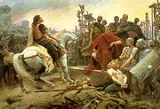
The Gallic Wars were a series of military campaign
s waged by the Roman
proconsul
Julius Caesar
against several Gallic tribes
. They lasted from 58 BC to 51 BC. The Gallic Wars culminated in the decisive Battle of Alesia
in 52 BC, in which a complete Roman victory resulted in the expansion of the Roman Republic
over the whole of Gaul
. The wars paved the way for Julius Caesar to become the sole ruler of the Roman Republic.
Although Caesar portrayed this invasion as being a defensive preemptive action, most historians agree that the wars were fought primarily to boost Caesar's political career and to pay off his massive debts. Still, Gaul was of significant military importance to the Romans, as they had been attacked several times by native tribes both indigenous to Gaul and further to the north. Conquering Gaul allowed Rome to secure the natural border of the river Rhine.
This military campaign is described by Julius Caesar himself in his book Commentarii de Bello Gallico
, which is the most important historical source of the conflict. This book is also a masterwork of political propaganda, as Caesar was keenly interested in manipulating his readers in Rome to support him.
ship in Rome. Due to the costs of consulship, he was heavily in debt. However, as a member of the First Triumvirate
—the political alliance composed of himself, Marcus Licinius Crassus
, and Pompey
—Caesar had secured the governorship of two provinces, Cisalpine Gaul
and Illyricum
. When the governor of Transalpine Gaul, Metellus Celer, died unexpectedly, this province was also awarded to Caesar. Caesar's governorships were extended to a five-year period, a novel idea at the time.
Caesar had initially four veteran
legions under his direct command: Legio VII
, Legio VIII
, Legio IX Hispana
, and Legio X
. As he had been governor of Hispania Ulterior
in 61 BC and had campaigned successfully with them against the Lusitanians
, Caesar knew personally most (perhaps even all) of these legions. Caesar also had the legal authority to levy additional legions and auxiliary units
as he saw fit.
His ambition was to conquer and plunder some territories to get himself out of debt, and it is likely Gaul was not his initial target. It is likely he was planning a campaign against the kingdom of Dacia
located in the Balkans.
The countries of Gaul were civilized and wealthy. Most had contact with Roman merchants and some, particularly those that were governed by Republics such as the Aedui
and Helvetii
had enjoyed stable political alliances with Rome in the past.
The Romans respected and feared the Gallic tribes. Only fifty years before, in 109 BC, Italy had been invaded from the north and saved only after several bloody and costly battles by Gaius Marius
. About 62 BC, when a Roman client state, the Arverni
, conspired with the Sequani
and the Suebi
nation east of the Rhine to attack the Aedui, a strong Roman ally, Rome turned a blind eye. They didn’t appear to be concerned about a conflict between non-client, client and allied states. By the end of the campaign, the non-client Suebi
under the leadership of the belligerent Ariovistus
, stood triumphant over both the Aedui and their coconspirators. Fearing another mass migration akin to the devastating Cimbrian War
, Rome, now keenly invested in the defense of Gaul, was irrevocably drawn into war.
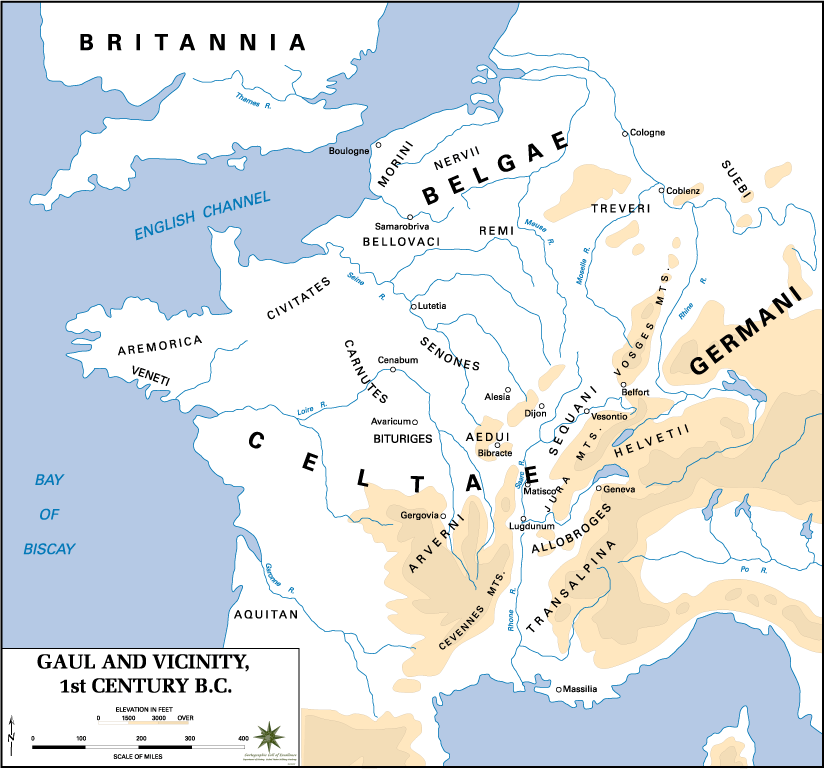
were well on their way in the planning and provisioning for a mass migration under the leadership of Orgetorix
. The reasons for their migration are mentioned by Caesar in separate passages as either harassment by the Germanic tribes, or not being able to in turn raid for plunder themselves due to their situation in hilly and mountainous territory.
During this time the Romans in Gallia Narbonensis
were also gaining and taking political advantages and fomenting trade disputes.
Via council and parley, the Helvetic chieftain Orgetorix made negotiations with the ambitious Sequani
and the Roman dominated Aedui
.
The Sequani were beginning to resent and regret the abundances of unruly Germanic warbands and their huge encampments of dependents. The Aedui were loath to obey the Roman spur any longer than they must and they were keen to revisit their former days at council.
The parley for the trek was successful and Orgetorix was granted passage, and with the trek ratified by council, an army was called up and provisioned for.
During this process, Orgetorix had also succeeded in making a personal alliance with the Sequanii chieftain Casticus
and the Aedui chieftain Dumnorix
through marital arrangements and host exchange of family members. For three whole years the Helvetii planned and prepared themselves, and emissaries were sent out to various Gallic tribes assuring safe passages and alliances.
Orgetorix's Gallic rivals alleged that these political successes and displays of diplomacy were intended to benefit Orgetorix alone and their claims were made more convincing by Roman intrigues and impositions. Again the accord was strained as the Aedui were brought to bay by their "protective" overlords.
In 58 BC Orgetorix's ambitions were declared a ruse for personal power and this rumor was celebrated among the enemies of the Helvetii, especially those of Roman clientele. This succeeded in causing confusion and feuds among the tribes, based mainly on the merits of Orgetorix versus his vices.
There was an effort to seize him at council, however he was protected by his retinue and bodyguards.
During the preceding seasons he had called up a sizeable force of men-at-arms and vassals said to have numbered 10,000 men, this in addition to his armed entourage.
Orgetorix was able to escape capture by his rivals and the councils labored at length to resolve the confusions and disputes; however, Orgetorix was murdered or slain during a dispute within his own encampment.
With many conflicts of interest settled, the Helvetii once again returned to their long planned migration to safer pastures among the Santones tribe on the Atlantic seaboard.
Caesar dated their departure to the 28th of March, and mentions that they burned all their towns and their villages so as to discourage thoughts among undecided client tribes or enemies to occupy their vacated realm.
The Helvetii retained and armed their client tribes: the Rauraci, the Tulingi
, the Latovici, and the Boii
from whom they had hired a contingent of horsemen.
There were two available routes for them: the first one was the difficult and dangerous Pas de l'Ecluse, located between the Jura mountains
and the Rhône River
. The second, easier one would lead them to the town of Geneva
, where the Lake Geneva
flows into the Rhone River and where a bridge allowed passage over the river. These lands belonged to the Allobroges
, a tribe which had been subdued by Rome, and were under the control of the Roman republic.
Meanwhile, Caesar was in Rome, and only a single legion was in Transalpine Gaul, the endangered province. As he was informed of these developments, he immediately hurried to Geneva and ordered a levy of several auxiliary units and the destruction of the bridge. The Helvetii sent an embassy under the new leadership of Nammeius and Verucloetius, to negotiate a peaceful passage, promising to do no harm. Caesar stalled the negotiations while his troops fortified their positions behind the river with a sixteen foot high rampart
and a parallel trench
lined with ballistas; his legionaries were backed by mercenary archers and slingers and Caesar had also hired and/or conscripted a contingent of Gallic horseman from the Remi.
 As the embassy returned, Caesar officially refused their request and warned them that any forceful attempt to cross the river would be opposed. Several attempts were quickly beaten off. The Helvetii turned back and entered negotiations with the Sequani to let them pass in a peaceful manner.
Leaving his single legion under the command of his second-in-command Titus Labienus
, Caesar hurried to Cisalpine Gaul. Upon arrival, he took command of the three legions which were in Aquileia and enrolled two new legions, the Legio XI
and the Legio XII
. At the head of these five legions, he went the quickest way through the Alps, crossing territories of several hostile tribes and fighting several skirmishes en route.
Meanwhile, the Helvetii had already crossed the territories of the Sequani, and were busy pillaging the lands of the Aedui, Ambarri
, and Allobroges. These tribes were unable to oppose them, and as Roman allies asked for Caesar's help. Caesar obliged them and surprised the Helvetii as they were crossing the river Arar (modern Saône River). Three quarters of the Helvetii had already crossed, but one quarter, the Tigurine (a Helvetian clan), was still on the east bank. Three legions, under Caesar's command, surprised and defeated the Tigurine in the Battle of the Arar. The remaining Tigurini fled to neighboring woods.
After the battle, the Romans built a bridge over the Saône to pursue the remaining Helvetii. The Helvetii sent an embassy led by Divico
, but the negotiations failed. For a fortnight, the Romans maintained their pursuit until they ran into supply troubles. Caesar in the meantime sent 4,000 Roman and allied Aedui cavalry to track the Helvetii but they were severely beaten by only 500 Helvetii cavalry. Apparently Dumnorix was doing everything in his power to delay the supplies. Accordingly, the Romans stopped their pursuit and headed for the Aedui town of Bibracte
. The tables were turned, and the Helvetii began to pursue the Romans, harassing their rear guard. Caesar chose a nearby hill to offer battle and the Roman legions stood to face their enemies.
In the ensuing Battle of Bibracte
, the Celts and Romans fought for the better part of the day in a hotly contested battle with the Romans eventually gaining victory after hours of hard fighting. Caesar writes that "the contest long and vigorously carried on with doubtful success." The defeated Helvetii offered their surrender which Caesar accepted. However, 6,000 men of the Helvetian clan of the Verbigeni fled to avoid capture. Upon Caesar's orders, other Gallic tribes captured and returned these fugitives, who were executed. Those who had surrendered were ordered back to their homeland to rebuild it, and the necessary supplies were organized to feed them, as they were far too useful as a buffer
between the Romans and other northern tribes, such as the Germans, to let them migrate elsewhere. In the captured Helvetian camp a census written in Greek was found and studied: of a grand total of 368,000 Helvetii, of which 92,000 were able-bodied men, only 110,000 survivors were left to return home.
, chieftain of the Suebi tribe and King of the Germans, resumed the tribe’s migration from eastern Germany to the Marne and Rhine region. Despite the fact that this migration encroached on Sequani
land, the Sequani sought Ariovistus’ allegiance against the Aedui
and in 61 BC, the Sequani rewarded Ariovistus with land following his victory in the Battle of Magetobriga. Ariovistus settled the land with 120,000 of his people. When 24,000 Harudes joined his cause, Ariovistus demanded that the Sequani give him more land to accommodate the Harudes people. This demand 'concerned' Rome
because if the Sequani conceded, Ariovistus would be in a position to take all of the Sequani land and attack the rest of Gaul.
Following Caesar’s victory over the Helvetti, the majority of the Gallic tribes congratulated Caesar and sought to meet with him in a general assembly. Diviciacus
, the head of the Aeduan government and spokesmen for the Gallic delegation, expressed concern over Ariovistus’ conquests and the hostages he had taken. Diviciacus demanded that Caesar defeat Ariovistus and remove the threat of a Germanic invasion otherwise they would have to seek refuge in a new land. Not only did Caesar have a responsibility to protect the longstanding allegiance of the Aedui, but this proposition presented an opportunity to expand Rome’s borders, strengthen the loyalty within Caesar’s army and establish him as the commander of Rome’s troops abroad.
The Senate had declared Ariovistus a “king and friend of the Roman people” in 59 BC so Caesar could not declare war on the Suebi tribe. Caesar said that he could not ignore the pain the Aedui had suffered and delivered an ultimatum to Ariovistus demanding that no German cross the Rhine, the return of Aedui hostages and the protection of the Aedui and other friends of Rome. Although Ariovistus assured Caesar that the Aedui hostages would be safe as long as they continued their yearly tribute, he took the position that he and the Romans are both conquerors and that Rome had no jurisdiction over his actions. With the attack of the Harudes on the Aedui and the report that a hundred clans of Suebi were trying to cross the Rhine into Gaul, Caesar had the justification he needed to wage war against Ariovistus in 58 BC.
Caesar, learning that Ariovistus intended to seize Vesontio, the largest town of the Sequani, commenced marching his troops toward Vesontio. Some of Caesar’s officers held their posts for political reasons only and had no war experience. Consequently they suffered from poor morale which threatened Caesar’s campaign. Caesar challenged the officers and their legions saying that the only legion he could trust was the 10th. With their pride on the line, the other legions followed the 10th’s lead determined not to be out done. Consequently, Caesar arrived in Vesontio before Ariovistus.
Ariovistus sent emissaries to Caesar requesting a meeting. They met under a truce at a knoll in the plain. The truce was violated when Caesar learned that German horsemen were edging towards the knoll and throwing stones at his mounted escort. Two days later, Ariovistus requested another meeting. Hesitant to send senior officials, Caesar dispatched Valerius Procillus, his trusted friend and Caius Mettius, a merchant who had successfully traded with Ariovistus. Insulted, Ariovistus threw the envoys in chains. Ariovistus marched for two days and made camp two miles behind Caesar thus cutting off Caesar’s communication and supply lines with the allied tribes. Unable to entice Ariovistus into battle, Caesar ordered a second smaller camp to be built near Ariovistus’ position. After the camp was completed Caesar again challenged Ariovistus and was rewarded when Ariovistus attacked the smaller camp and was repulsed.
The next morning Caesar assembled his allied troops in front of the second camp and advanced his legions in triplex acies (three lines of troops) towards Ariovistus. Each of Caesar’s five legates and his quaestor were given command of a legion. Caesar lined up on the right flank. Ariovistus countered by lining up his seven tribal formations. Caesar was victorious in the battle that ensued due in large part to the charge made by Publius Crassus
. As the Germans began to drive back the Roman left flank, Crassus led his cavalry in a charge to restore balance and ordered up the cohorts of the third line. As a result, the whole German line broke and began to flee. Most of Ariovistus’ hundred and twenty thousand men were killed. He and what remained of his troops escaped and crossed the Rhine never to engage Rome in battle again. The Suebi camped near the Rhine returned home. Caesar was victorious.
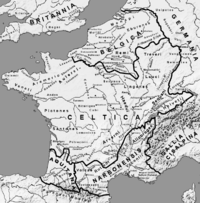
, who inhabited the area roughly bounded by modern-day Belgium
and had recently attacked a tribe allied with Rome. His army suffered a surprise attack in the battle of the Sabis
while it was making camp near the river Sambre
and came close to being defeated.
The swiftness of Boduognatus' sudden massed attack, the speed of his allied native footmen ( Atrebates and Virumandui) together with the ferocity and skill at arms of his heavily armed Nerviians had completely routed Caesar's skirmishers and cavalry, overwhelmed his front and very nearly succeeded in taking the Roman camp and capturing Caesar himself. Caesar admits to losing all of his standards and most his centurions dead or felled by wounds. He himself was forced to take up a shield and personally rally his forces which were then threatened with envelopment and massacre. The strong stand by the adjoining X legion and the prompt arrival of the reinforcements enabled Caesar to regroup, redeploy and eventually envelop the Nervii once the Atrebates and Viromandui were stopped, worn down and put to flight.
Caesar remarked that the warlike Nervii refused to yield their ground even after the Atrebates and Virumandui had been put into disarray. When finally surrounded by Roman reinforcements the Nerviians continued fighting as a pitiless hail of missiles rained down on them from the many archers and peltasts Caesar had brought from overseas. The peltasts, slingers and archers were brought for the specific purpose of confounding the Gallic proclivity for shield wall tactics, mass attack and/or individual close combat.
The Nervii were especially renowned for skills at warfare. They ruled and subsisted by warfare and by taxing their dependent and client tribes while adhering to a heroic hoplitic tradition. These Gallic conventions were something Caesar exploited as often as he could.
Together with Caesar's prudent and unabashed use of fixed projectile weapons like the 'scorpian' and light ballista, the archers and peltasts took a heavy toll on the densely packed Nervii who themselves shunned all projectile weapons but the lance. It is recorded in Caesar's war commentaries that as the battle raged, the Nervii caught Roman javelins in flight and hurled them back at legionnaires and that although all were eventually slain, not one of the Nervii was seen to flee. As the grim fighting wore on, the Nervii refused to yield and mounds of the fallen formed ramparts and Boduognatus' fighters fought from atop these hills of dead, clashing with the pressing Roman ranks again and again.
The skill with which the veteran Roman legions executed their well practiced 'pilum' barrage and gladius and scutum counter-attacks together with the prudent use of missile weapons was instrumental in defeating the skillful and daring Nervii and associated Belgae.
The Belgae suffered heavy losses and eventually surrendered when faced with the destruction of their towns. The Nervii were severely mauled and forced to flee; thereby all former client tribes surrendered to Caesar or likewise fled. Their absence gave Caesar control of most of what is now Belgium.
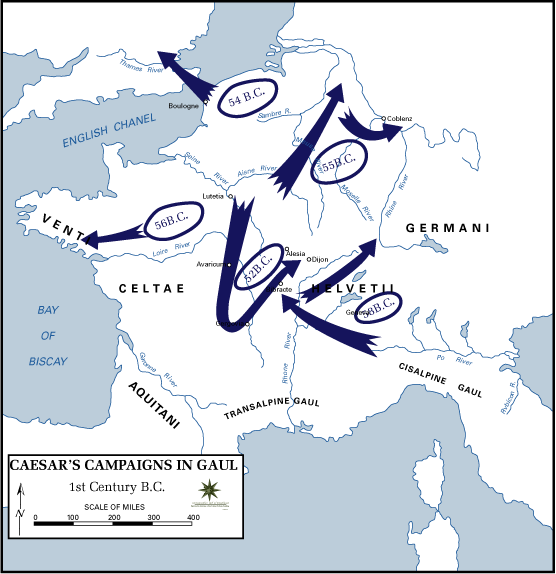
The following year, 56 BC, Caesar turned his attention to the tribes of the Atlantic seaboard, notably the Veneti
tribe in Armorica
(modern Brittany
), who had assembled a confederacy of anti-Roman tribes. The Veneti were a seafaring people and had built a sailing fleet in the Gulf of Morbihan
, requiring the Romans to build galleys and undertake an unconventional land and sea campaign. Eventually Caesar was able to subdue these tribes after a protracted land and sea campaign.
Caesar took his forces across the Rhine in 55 BC in a punitive expedition
against the Germans, though the Suebi
, against whom the expedition was mounted, were never engaged in battle. That same year, he then crossed the English Channel
with two legions on his ships to mount a similar expedition against the Britons. The British adventure nearly ended in disaster when bad weather wrecked much of his fleet and the unfamiliar sight of massed chariot
s caused confusion among his forces. Caesar did manage to secure a promise of hostages, though only two of them were actually sent. He withdrew but returned in 54 BC with a much larger force that successfully defeated the powerful Catuvellauni
and forced them to pay tribute to Rome. The expeditions had little lasting effect, but were great propaganda victories for Caesar, keeping him in the public eye at home.
The campaigns of 55 BC and early 54 BC have caused controversy for many centuries. They were controversial even at the time among Caesar's contemporaries, and especially among his political opponents, who decried them as a costly exercise in personal aggrandizement. In modern times, commentators have been sharply divided between critics of Caesar's nakedly imperialist agenda and defenders of the benefits that the expansion of Roman power subsequently wrought in Gaul.
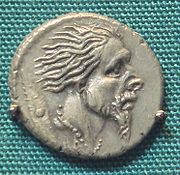 Discontent among the subjugated Gauls prompted a major uprising in the winter of 54–53 BC, when the Eburones
of north-eastern Gaul rose in arms under their leader Ambiorix
. Fifteen Roman cohort
s were wiped out at Atuatuca Tungrorum (modern Tongeren in Belgium) and a garrison commanded by Quintus Tullius Cicero
narrowly survived after being relieved by Caesar in the nick of time. The rest of 53 BC was occupied with a punitive campaign against the Eburones and their allies, who were said to have been all but exterminated by the Romans.
The uprising was, however, merely the prelude to a much bigger campaign led by Vercingetorix
, chief of the Arverni
tribe of central Gaul, who successfully united many Gallic tribes and states under his leadership. Recognizing that the Romans had an upper hand on the battlefield due to their panoply and training, he declined to give battle against them and instead fought a "scorched earth
" campaign to deprive them of supplies. Caesar hurriedly returned from Italy to take charge of the campaign, pursuing the Gauls and capturing the town of Avaricum
(modern city of Bourges) but suffering a defeat at Gergovia. Vercingetorix, instead of staying mobile and in the open, chose to hold out at Alesia
(see Battle of Alesia
). Caesar successfully besieged him and beat off a huge Gallic relief force who ran out of food and had to disperse. This effectively marked the end of the Gallic Wars, although mopping-up actions took place throughout 51 BC. A number of lesser rebellions took place subsequently, but Roman control of Gaul wasn't seriously challenged again until the 2nd century AD.
in Latin, which is one of the best surviving examples of unadorned Latin
prose. It has consequently been a subject of intense study for Latinists, and is one of the classic prose sources traditionally used as a standard teaching texts in modern Latin education.
The Gallic Wars have become a popular setting in modern historical fiction
, especially that of France
and Italy
. Claude Cueni wrote a semi-historical novel "The Caesar's Druid" about a fictional Celtic druid
, servant of Caesar and recorder of Caesar's campaigns. Similarly, Norman Spinrad
's The Druid King
follows the campaigns from Vercingetorix
's perspective. In addition, the comic Astérix
is set shortly after the Gallic Wars, where the titular character's village is the last holdout in Gaul against Caesar's legions.
The historical novel Caesar
by Colleen McCullough
gave a thorough, popular account of the Gallic Wars.
Military campaign
In the military sciences, the term military campaign applies to large scale, long duration, significant military strategy plan incorporating a series of inter-related military operations or battles forming a distinct part of a larger conflict often called a war...
s waged by the Roman
Roman Republic
The Roman Republic was the period of the ancient Roman civilization where the government operated as a republic. It began with the overthrow of the Roman monarchy, traditionally dated around 508 BC, and its replacement by a government headed by two consuls, elected annually by the citizens and...
proconsul
Proconsul
A proconsul was a governor of a province in the Roman Republic appointed for one year by the senate. In modern usage, the title has been used for a person from one country ruling another country or bluntly interfering in another country's internal affairs.-Ancient Rome:In the Roman Republic, a...
Julius Caesar
Julius Caesar
Gaius Julius Caesar was a Roman general and statesman and a distinguished writer of Latin prose. He played a critical role in the gradual transformation of the Roman Republic into the Roman Empire....
against several Gallic tribes
Gaul
Gaul was a region of Western Europe during the Iron Age and Roman era, encompassing present day France, Luxembourg and Belgium, most of Switzerland, the western part of Northern Italy, as well as the parts of the Netherlands and Germany on the left bank of the Rhine. The Gauls were the speakers of...
. They lasted from 58 BC to 51 BC. The Gallic Wars culminated in the decisive Battle of Alesia
Battle of Alesia
The Battle of Alesia or Siege of Alesia took place in September, 52 BC around the Gallic oppidum of Alesia, a major town centre and hill fort of the Mandubii tribe...
in 52 BC, in which a complete Roman victory resulted in the expansion of the Roman Republic
Roman Republic
The Roman Republic was the period of the ancient Roman civilization where the government operated as a republic. It began with the overthrow of the Roman monarchy, traditionally dated around 508 BC, and its replacement by a government headed by two consuls, elected annually by the citizens and...
over the whole of Gaul
Gaul
Gaul was a region of Western Europe during the Iron Age and Roman era, encompassing present day France, Luxembourg and Belgium, most of Switzerland, the western part of Northern Italy, as well as the parts of the Netherlands and Germany on the left bank of the Rhine. The Gauls were the speakers of...
. The wars paved the way for Julius Caesar to become the sole ruler of the Roman Republic.
Although Caesar portrayed this invasion as being a defensive preemptive action, most historians agree that the wars were fought primarily to boost Caesar's political career and to pay off his massive debts. Still, Gaul was of significant military importance to the Romans, as they had been attacked several times by native tribes both indigenous to Gaul and further to the north. Conquering Gaul allowed Rome to secure the natural border of the river Rhine.
This military campaign is described by Julius Caesar himself in his book Commentarii de Bello Gallico
Commentarii de Bello Gallico
Commentarii de Bello Gallico is Julius Caesar's firsthand account of the Gallic Wars, written as a third-person narrative. In it Caesar describes the battles and intrigues that took place in the nine years he spent fighting local armies in Gaul that opposed Roman domination.The "Gaul" that Caesar...
, which is the most important historical source of the conflict. This book is also a masterwork of political propaganda, as Caesar was keenly interested in manipulating his readers in Rome to support him.
Political background
In 58 BC, Gaius Julius Caesar ended his consulConsul
Consul was the highest elected office of the Roman Republic and an appointive office under the Empire. The title was also used in other city states and also revived in modern states, notably in the First French Republic...
ship in Rome. Due to the costs of consulship, he was heavily in debt. However, as a member of the First Triumvirate
First Triumvirate
The First Triumvirate was the political alliance of Gaius Julius Caesar, Marcus Licinius Crassus, and Gnaeus Pompeius Magnus. Unlike the Second Triumvirate, the First Triumvirate had no official status whatsoever; its overwhelming power in the Roman Republic was strictly unofficial influence, and...
—the political alliance composed of himself, Marcus Licinius Crassus
Marcus Licinius Crassus
Marcus Licinius Crassus was a Roman general and politician who commanded the right wing of Sulla's army at the Battle of the Colline Gate, suppressed the slave revolt led by Spartacus, provided political and financial support to Julius Caesar and entered into the political alliance known as the...
, and Pompey
Pompey
Gnaeus Pompeius Magnus, also known as Pompey or Pompey the Great , was a military and political leader of the late Roman Republic...
—Caesar had secured the governorship of two provinces, Cisalpine Gaul
Cisalpine Gaul
Cisalpine Gaul, in Latin: Gallia Cisalpina or Citerior, also called Gallia Togata, was a Roman province until 41 BC when it was merged into Roman Italy.It bore the name Gallia, because the great body of its inhabitants, after the expulsion of the Etruscans, consisted of Gauls or Celts...
and Illyricum
Illyricum (Roman province)
The Roman province of Illyricum or Illyris Romana or Illyris Barbara or Illyria Barbara replaced most of the region of Illyria. It stretched from the Drilon river in modern north Albania to Istria in the west and to the Sava river in the north. Salona functioned as its capital...
. When the governor of Transalpine Gaul, Metellus Celer, died unexpectedly, this province was also awarded to Caesar. Caesar's governorships were extended to a five-year period, a novel idea at the time.
Caesar had initially four veteran
Veteran
A veteran is a person who has had long service or experience in a particular occupation or field; " A veteran of ..."...
legions under his direct command: Legio VII
Legio VII Claudia
Legio septima Claudia Pia Fidelis was a Roman legion. Its emblem, like that of all Caesar's legions, was the bull, together with the lion....
, Legio VIII
Legio VIII Augusta
Legio octava Augusta was a Roman legion created by Pompey in 65 BC, along with the 6th, 7th & 9th, and continuing in service to Rome for at least 400 years thereafter....
, Legio IX Hispana
Legio IX Hispana
Legio Nona Hispana was a Roman legion, which operated from the first century BCE until mid 2nd century CE. The Spanish Legion's disappearance has raised speculations over its fate, largely of its alleged destruction in Scotland in about 117 CE, though some scholars believe it was destroyed in the...
, and Legio X
Legio X Equestris
Legio X Equestris , a Roman legion, was levied by Julius Caesar in 61 BC when he was the Governor of Hispania Ulterior. The Tenth was the first legion levied personally by Caesar, and was consistently his most trusted...
. As he had been governor of Hispania Ulterior
Hispania Ulterior
During the Roman Republic, Hispania Ulterior was a region of Hispania roughly located in Baetica and in the Guadalquivir valley of modern Spain and extending to all of Lusitania and Gallaecia...
in 61 BC and had campaigned successfully with them against the Lusitanians
Lusitanians
The Lusitanians were an Indo-European people living in the Western Iberian Peninsula long before it became the Roman province of Lusitania . They spoke the Lusitanian language which might have been Celtic. The modern Portuguese people see the Lusitanians as their ancestors...
, Caesar knew personally most (perhaps even all) of these legions. Caesar also had the legal authority to levy additional legions and auxiliary units
Auxiliaries (Roman military)
Auxiliaries formed the standing non-citizen corps of the Roman army of the Principate , alongside the citizen legions...
as he saw fit.
His ambition was to conquer and plunder some territories to get himself out of debt, and it is likely Gaul was not his initial target. It is likely he was planning a campaign against the kingdom of Dacia
Dacia
In ancient geography, especially in Roman sources, Dacia was the land inhabited by the Dacians or Getae as they were known by the Greeks—the branch of the Thracians north of the Haemus range...
located in the Balkans.
The countries of Gaul were civilized and wealthy. Most had contact with Roman merchants and some, particularly those that were governed by Republics such as the Aedui
Aedui
Aedui, Haedui or Hedui , were a Gallic people of Gallia Lugdunensis, who inhabited the country between the Arar and Liger , in today's France. Their territory thus included the greater part of the modern departments of Saône-et-Loire, Côte-d'Or and Nièvre.-Geography:The country of the Aedui is...
and Helvetii
Helvetii
The Helvetii were a Celtic tribe or tribal confederation occupying most of the Swiss plateau at the time of their contact with the Roman Republic in the 1st century BC...
had enjoyed stable political alliances with Rome in the past.
The Romans respected and feared the Gallic tribes. Only fifty years before, in 109 BC, Italy had been invaded from the north and saved only after several bloody and costly battles by Gaius Marius
Gaius Marius
Gaius Marius was a Roman general and statesman. He was elected consul an unprecedented seven times during his career. He was also noted for his dramatic reforms of Roman armies, authorizing recruitment of landless citizens, eliminating the manipular military formations, and reorganizing the...
. About 62 BC, when a Roman client state, the Arverni
Arverni
The Arverni were a Gallic tribe living in what is now the Auvergne region of France during the last centuries BC. One of the most powerful tribes in ancient Gaul, they opposed the Romans on several occasions...
, conspired with the Sequani
Sequani
Sequani, in ancient geography, were a Gallic people who occupied the upper river basin of the Arar , the valley of the Doubs and the Jura Mountains, their territory corresponding to Franche-Comté and part of Burgundy.-Etymology:...
and the Suebi
Suebi
The Suebi or Suevi were a group of Germanic peoples who were first mentioned by Julius Caesar in connection with Ariovistus' campaign, c...
nation east of the Rhine to attack the Aedui, a strong Roman ally, Rome turned a blind eye. They didn’t appear to be concerned about a conflict between non-client, client and allied states. By the end of the campaign, the non-client Suebi
Suebi
The Suebi or Suevi were a group of Germanic peoples who were first mentioned by Julius Caesar in connection with Ariovistus' campaign, c...
under the leadership of the belligerent Ariovistus
Ariovistus
Ariovistus was a leader of the Suebi and other allied Germanic peoples in the second quarter of the 1st century BC. He and his followers took part in a war in Gaul, assisting the Arverni and Sequani to defeat their rivals the Aedui, after which they settled in large numbers in conquered Gallic...
, stood triumphant over both the Aedui and their coconspirators. Fearing another mass migration akin to the devastating Cimbrian War
Cimbrian War
The Cimbrian War was fought between the Roman Republic and the Proto-Germanic tribes of the Cimbri and the Teutons , who migrated from northern Europe into Roman controlled territory, and clashed with Rome and her allies...
, Rome, now keenly invested in the defense of Gaul, was irrevocably drawn into war.
Course
Beginning of the war—campaign against the Helvetii
By 61 BC, the HelvetiiHelvetii
The Helvetii were a Celtic tribe or tribal confederation occupying most of the Swiss plateau at the time of their contact with the Roman Republic in the 1st century BC...
were well on their way in the planning and provisioning for a mass migration under the leadership of Orgetorix
Orgetorix
Orgetorix was a wealthy aristocrat among the Helvetii, a Celtic-speaking people residing in what is now Switzerland during the consulship of Julius Caesar of the Roman Republic. In 61 BC he convinced the Helvetians to attempt to migrate from Helvetian territory to south-western Gaul...
. The reasons for their migration are mentioned by Caesar in separate passages as either harassment by the Germanic tribes, or not being able to in turn raid for plunder themselves due to their situation in hilly and mountainous territory.
During this time the Romans in Gallia Narbonensis
Gallia Narbonensis
Gallia Narbonensis was a Roman province located in what is now Languedoc and Provence, in southern France. It was also known as Gallia Transalpina , which was originally a designation for that part of Gaul lying across the Alps from Italia and it contained a western region known as Septimania...
were also gaining and taking political advantages and fomenting trade disputes.
Via council and parley, the Helvetic chieftain Orgetorix made negotiations with the ambitious Sequani
Sequani
Sequani, in ancient geography, were a Gallic people who occupied the upper river basin of the Arar , the valley of the Doubs and the Jura Mountains, their territory corresponding to Franche-Comté and part of Burgundy.-Etymology:...
and the Roman dominated Aedui
Aedui
Aedui, Haedui or Hedui , were a Gallic people of Gallia Lugdunensis, who inhabited the country between the Arar and Liger , in today's France. Their territory thus included the greater part of the modern departments of Saône-et-Loire, Côte-d'Or and Nièvre.-Geography:The country of the Aedui is...
.
The Sequani were beginning to resent and regret the abundances of unruly Germanic warbands and their huge encampments of dependents. The Aedui were loath to obey the Roman spur any longer than they must and they were keen to revisit their former days at council.
The parley for the trek was successful and Orgetorix was granted passage, and with the trek ratified by council, an army was called up and provisioned for.
During this process, Orgetorix had also succeeded in making a personal alliance with the Sequanii chieftain Casticus
Casticus
Casticus was a nobleman of the Sequani of eastern Gaul. His father, Catamantaloedes, had previously been the ruler of the tribe, and had been recognised as a "friend" by the Roman Senate....
and the Aedui chieftain Dumnorix
Dumnorix
Dumnorix was a chieftain of the Aedui, a Celtic tribe in Gaul in the 1st century B.C. He was strongly against alliance with the Romans, particularly Julius Caesar, who sparred with him on several occasions...
through marital arrangements and host exchange of family members. For three whole years the Helvetii planned and prepared themselves, and emissaries were sent out to various Gallic tribes assuring safe passages and alliances.
Orgetorix's Gallic rivals alleged that these political successes and displays of diplomacy were intended to benefit Orgetorix alone and their claims were made more convincing by Roman intrigues and impositions. Again the accord was strained as the Aedui were brought to bay by their "protective" overlords.
In 58 BC Orgetorix's ambitions were declared a ruse for personal power and this rumor was celebrated among the enemies of the Helvetii, especially those of Roman clientele. This succeeded in causing confusion and feuds among the tribes, based mainly on the merits of Orgetorix versus his vices.
There was an effort to seize him at council, however he was protected by his retinue and bodyguards.
During the preceding seasons he had called up a sizeable force of men-at-arms and vassals said to have numbered 10,000 men, this in addition to his armed entourage.
Orgetorix was able to escape capture by his rivals and the councils labored at length to resolve the confusions and disputes; however, Orgetorix was murdered or slain during a dispute within his own encampment.
With many conflicts of interest settled, the Helvetii once again returned to their long planned migration to safer pastures among the Santones tribe on the Atlantic seaboard.
Caesar dated their departure to the 28th of March, and mentions that they burned all their towns and their villages so as to discourage thoughts among undecided client tribes or enemies to occupy their vacated realm.
The Helvetii retained and armed their client tribes: the Rauraci, the Tulingi
Tulingi
The Tulingi were a small tribe closely allied to the Celtic Helvetii in the time of Julius Caesar's conquest of Gaul. Their location is unknown; their language and descent are uncertain. From their close cooperation with the Helvetii it can be deduced that they were probably neighbours of the latter...
, the Latovici, and the Boii
Boii
The Boii were one of the most prominent ancient Celtic tribes of the later Iron Age, attested at various times in Cisalpine Gaul , Pannonia , in and around Bohemia, and Transalpine Gaul...
from whom they had hired a contingent of horsemen.
There were two available routes for them: the first one was the difficult and dangerous Pas de l'Ecluse, located between the Jura mountains
Jura mountains
The Jura Mountains are a small mountain range located north of the Alps, separating the Rhine and Rhone rivers and forming part of the watershed of each...
and the Rhône River
Rhône River
The Rhone is one of the major rivers of Europe, rising in Switzerland and running from there through southeastern France. At Arles, near its mouth on the Mediterranean Sea, the river divides into two branches, known as the Great Rhone and the Little Rhone...
. The second, easier one would lead them to the town of Geneva
Geneva
Geneva In the national languages of Switzerland the city is known as Genf , Ginevra and Genevra is the second-most-populous city in Switzerland and is the most populous city of Romandie, the French-speaking part of Switzerland...
, where the Lake Geneva
Lake Geneva
Lake Geneva or Lake Léman is a lake in Switzerland and France. It is one of the largest lakes in Western Europe. 59.53 % of it comes under the jurisdiction of Switzerland , and 40.47 % under France...
flows into the Rhone River and where a bridge allowed passage over the river. These lands belonged to the Allobroges
Allobroges
The Allobroges were a Celtic tribe of ancient Gaul, located between the Rhône River and the Lake of Geneva in what later became Savoy, Dauphiné, and Vivarais. Their cities were in the areas of modern-day Annecy, Chambéry and Grenoble, the modern of Isère, and modern Switzerland...
, a tribe which had been subdued by Rome, and were under the control of the Roman republic.
Meanwhile, Caesar was in Rome, and only a single legion was in Transalpine Gaul, the endangered province. As he was informed of these developments, he immediately hurried to Geneva and ordered a levy of several auxiliary units and the destruction of the bridge. The Helvetii sent an embassy under the new leadership of Nammeius and Verucloetius, to negotiate a peaceful passage, promising to do no harm. Caesar stalled the negotiations while his troops fortified their positions behind the river with a sixteen foot high rampart
Defensive wall
A defensive wall is a fortification used to protect a city or settlement from potential aggressors. In ancient to modern times, they were used to enclose settlements...
and a parallel trench
Ditch
A ditch is usually defined as a small to moderate depression created to channel water.In Anglo-Saxon, the word dïc already existed and was pronounced 'deek' in northern England and 'deetch' in the south. The origins of the word lie in digging a trench and forming the upcast soil into a bank...
lined with ballistas; his legionaries were backed by mercenary archers and slingers and Caesar had also hired and/or conscripted a contingent of Gallic horseman from the Remi.
Leaving his single legion under the command of his second-in-command Titus Labienus
Titus Labienus
Titus Atius Labienus was a professional Roman soldier in the late Roman Republic. He served as Tribune of the Plebs in 63 BC, and is remembered as one of Julius Caesar's lieutenants, mentioned frequently in the accounts of his military campaigns...
, Caesar hurried to Cisalpine Gaul. Upon arrival, he took command of the three legions which were in Aquileia and enrolled two new legions, the Legio XI
Legio XI Claudia
Legio undecima Claudia was a Roman legion. XI Claudia dates back to the two legions recruited by Julius Caesar to invade Gallia in 58 BC, and it existed at least until early 5th century, guarding lower Danube in Durostorum...
and the Legio XII
Legio XII Fulminata
Legio duodecima Fulminata , also known as Paterna, Victrix, Antiqua, Certa Constans, and Galliena, was a Roman legion, levied by Julius Caesar in 58 BC and which accompanied him during the Gallic wars until 49 BC. The unit was still guarding the Euphrates River crossing near Melitene at the...
. At the head of these five legions, he went the quickest way through the Alps, crossing territories of several hostile tribes and fighting several skirmishes en route.
Meanwhile, the Helvetii had already crossed the territories of the Sequani, and were busy pillaging the lands of the Aedui, Ambarri
Ambarri
The Ambarri were a Gallic people, whom Julius Caesar calls close allies and kinsmen of the Aedui. If the reading Aedui Ambarri in the passage referred to is correct, the Ambarri were Aedui. They are not mentioned among the clientes of the Aedui. The Ambarri were a Gallic people, whom Julius Caesar...
, and Allobroges. These tribes were unable to oppose them, and as Roman allies asked for Caesar's help. Caesar obliged them and surprised the Helvetii as they were crossing the river Arar (modern Saône River). Three quarters of the Helvetii had already crossed, but one quarter, the Tigurine (a Helvetian clan), was still on the east bank. Three legions, under Caesar's command, surprised and defeated the Tigurine in the Battle of the Arar. The remaining Tigurini fled to neighboring woods.
After the battle, the Romans built a bridge over the Saône to pursue the remaining Helvetii. The Helvetii sent an embassy led by Divico
Divico
Divico was a Celtic king and the leader of the Gaul tribe of the Tigurini. He led the Tigurini across the Rhine to invade Gaul in 109 BCE towards the Roman region of Province. He defeated a Roman army under Lucius Cassius Longinus near Agen in 107 BCE....
, but the negotiations failed. For a fortnight, the Romans maintained their pursuit until they ran into supply troubles. Caesar in the meantime sent 4,000 Roman and allied Aedui cavalry to track the Helvetii but they were severely beaten by only 500 Helvetii cavalry. Apparently Dumnorix was doing everything in his power to delay the supplies. Accordingly, the Romans stopped their pursuit and headed for the Aedui town of Bibracte
Bibracte
Bibracte, a Gaulish oppidum or fortified city, was the capital of the Aedui and one of the most important hillforts in Gaul. It was situated near modern Autun in Burgundy, France. The material culture of the Aedui corresponded to the Late Iron Age La Tène culture,In 58 BC, at the Battle of...
. The tables were turned, and the Helvetii began to pursue the Romans, harassing their rear guard. Caesar chose a nearby hill to offer battle and the Roman legions stood to face their enemies.
In the ensuing Battle of Bibracte
Battle of Bibracte
The Battle of Bibracte was fought between the Helvetii and six Roman legions, under the command of Gaius Julius Caesar. It was the second major battle of the Gallic Wars....
, the Celts and Romans fought for the better part of the day in a hotly contested battle with the Romans eventually gaining victory after hours of hard fighting. Caesar writes that "the contest long and vigorously carried on with doubtful success." The defeated Helvetii offered their surrender which Caesar accepted. However, 6,000 men of the Helvetian clan of the Verbigeni fled to avoid capture. Upon Caesar's orders, other Gallic tribes captured and returned these fugitives, who were executed. Those who had surrendered were ordered back to their homeland to rebuild it, and the necessary supplies were organized to feed them, as they were far too useful as a buffer
Buffer state
A buffer state is a country lying between two rival or potentially hostile greater powers, which by its sheer existence is thought to prevent conflict between them. Buffer states, when authentically independent, typically pursue a neutralist foreign policy, which distinguishes them from satellite...
between the Romans and other northern tribes, such as the Germans, to let them migrate elsewhere. In the captured Helvetian camp a census written in Greek was found and studied: of a grand total of 368,000 Helvetii, of which 92,000 were able-bodied men, only 110,000 survivors were left to return home.
| Tribe | Population Census |
|---|---|
| Helvetii | 263,000 |
| Tulingi | 36,000 |
| Latobrigi | 14,000 |
| Rauraci | 23,000 |
| Boii | 32,000 |
| Total | 368,000 |
| Combatants | 92,000 |
Campaign against the Suebi
In 71 BC, AriovistusAriovistus
Ariovistus was a leader of the Suebi and other allied Germanic peoples in the second quarter of the 1st century BC. He and his followers took part in a war in Gaul, assisting the Arverni and Sequani to defeat their rivals the Aedui, after which they settled in large numbers in conquered Gallic...
, chieftain of the Suebi tribe and King of the Germans, resumed the tribe’s migration from eastern Germany to the Marne and Rhine region. Despite the fact that this migration encroached on Sequani
Sequani
Sequani, in ancient geography, were a Gallic people who occupied the upper river basin of the Arar , the valley of the Doubs and the Jura Mountains, their territory corresponding to Franche-Comté and part of Burgundy.-Etymology:...
land, the Sequani sought Ariovistus’ allegiance against the Aedui
Aedui
Aedui, Haedui or Hedui , were a Gallic people of Gallia Lugdunensis, who inhabited the country between the Arar and Liger , in today's France. Their territory thus included the greater part of the modern departments of Saône-et-Loire, Côte-d'Or and Nièvre.-Geography:The country of the Aedui is...
and in 61 BC, the Sequani rewarded Ariovistus with land following his victory in the Battle of Magetobriga. Ariovistus settled the land with 120,000 of his people. When 24,000 Harudes joined his cause, Ariovistus demanded that the Sequani give him more land to accommodate the Harudes people. This demand 'concerned' Rome
Rome
Rome is the capital of Italy and the country's largest and most populated city and comune, with over 2.7 million residents in . The city is located in the central-western portion of the Italian Peninsula, on the Tiber River within the Lazio region of Italy.Rome's history spans two and a half...
because if the Sequani conceded, Ariovistus would be in a position to take all of the Sequani land and attack the rest of Gaul.
Following Caesar’s victory over the Helvetti, the majority of the Gallic tribes congratulated Caesar and sought to meet with him in a general assembly. Diviciacus
Diviciacus
Diviciacus or Divitiacus is the name of two Gaulish noblemen of the 1st century BC:*Diviciacus, king of the Suessiones*Diviciacus, druid and magistrate of the Aedui...
, the head of the Aeduan government and spokesmen for the Gallic delegation, expressed concern over Ariovistus’ conquests and the hostages he had taken. Diviciacus demanded that Caesar defeat Ariovistus and remove the threat of a Germanic invasion otherwise they would have to seek refuge in a new land. Not only did Caesar have a responsibility to protect the longstanding allegiance of the Aedui, but this proposition presented an opportunity to expand Rome’s borders, strengthen the loyalty within Caesar’s army and establish him as the commander of Rome’s troops abroad.
The Senate had declared Ariovistus a “king and friend of the Roman people” in 59 BC so Caesar could not declare war on the Suebi tribe. Caesar said that he could not ignore the pain the Aedui had suffered and delivered an ultimatum to Ariovistus demanding that no German cross the Rhine, the return of Aedui hostages and the protection of the Aedui and other friends of Rome. Although Ariovistus assured Caesar that the Aedui hostages would be safe as long as they continued their yearly tribute, he took the position that he and the Romans are both conquerors and that Rome had no jurisdiction over his actions. With the attack of the Harudes on the Aedui and the report that a hundred clans of Suebi were trying to cross the Rhine into Gaul, Caesar had the justification he needed to wage war against Ariovistus in 58 BC.
Caesar, learning that Ariovistus intended to seize Vesontio, the largest town of the Sequani, commenced marching his troops toward Vesontio. Some of Caesar’s officers held their posts for political reasons only and had no war experience. Consequently they suffered from poor morale which threatened Caesar’s campaign. Caesar challenged the officers and their legions saying that the only legion he could trust was the 10th. With their pride on the line, the other legions followed the 10th’s lead determined not to be out done. Consequently, Caesar arrived in Vesontio before Ariovistus.
Ariovistus sent emissaries to Caesar requesting a meeting. They met under a truce at a knoll in the plain. The truce was violated when Caesar learned that German horsemen were edging towards the knoll and throwing stones at his mounted escort. Two days later, Ariovistus requested another meeting. Hesitant to send senior officials, Caesar dispatched Valerius Procillus, his trusted friend and Caius Mettius, a merchant who had successfully traded with Ariovistus. Insulted, Ariovistus threw the envoys in chains. Ariovistus marched for two days and made camp two miles behind Caesar thus cutting off Caesar’s communication and supply lines with the allied tribes. Unable to entice Ariovistus into battle, Caesar ordered a second smaller camp to be built near Ariovistus’ position. After the camp was completed Caesar again challenged Ariovistus and was rewarded when Ariovistus attacked the smaller camp and was repulsed.
The next morning Caesar assembled his allied troops in front of the second camp and advanced his legions in triplex acies (three lines of troops) towards Ariovistus. Each of Caesar’s five legates and his quaestor were given command of a legion. Caesar lined up on the right flank. Ariovistus countered by lining up his seven tribal formations. Caesar was victorious in the battle that ensued due in large part to the charge made by Publius Crassus
Publius Crassus
In Roman literary sources, Publius Crassus may refer to several ancient Romans of the gens Licinia, including:*Publius Licinius Crassus Dives In Roman literary sources, Publius Crassus may refer to several ancient Romans of the gens Licinia, including:*Publius Licinius Crassus Dives (consul 205...
. As the Germans began to drive back the Roman left flank, Crassus led his cavalry in a charge to restore balance and ordered up the cohorts of the third line. As a result, the whole German line broke and began to flee. Most of Ariovistus’ hundred and twenty thousand men were killed. He and what remained of his troops escaped and crossed the Rhine never to engage Rome in battle again. The Suebi camped near the Rhine returned home. Caesar was victorious.
Campaign against the Belgae
In 57 BC Caesar once again intervened in an intra-Gallic conflict, marching against the BelgaeBelgae
The Belgae were a group of tribes living in northern Gaul, on the west bank of the Rhine, in the 3rd century BC, and later also in Britain, and possibly even Ireland...
, who inhabited the area roughly bounded by modern-day Belgium
Belgium
Belgium , officially the Kingdom of Belgium, is a federal state in Western Europe. It is a founding member of the European Union and hosts the EU's headquarters, and those of several other major international organisations such as NATO.Belgium is also a member of, or affiliated to, many...
and had recently attacked a tribe allied with Rome. His army suffered a surprise attack in the battle of the Sabis
Battle of the Sabis
The Battle of the Sabis, also known as the Battle of the Sambre or the Battle against the Nervians , was fought in 57 BC in the area known today as Wallonia, between the legions of the Roman Republic and an association of Belgic tribes, principally the Nervii...
while it was making camp near the river Sambre
Sambre
The Sambre is a river in northern France and Wallonia, southern Belgium, left tributary of the Meuse River. The ancient Romans called the river Sabis.-Course:...
and came close to being defeated.
The swiftness of Boduognatus' sudden massed attack, the speed of his allied native footmen ( Atrebates and Virumandui) together with the ferocity and skill at arms of his heavily armed Nerviians had completely routed Caesar's skirmishers and cavalry, overwhelmed his front and very nearly succeeded in taking the Roman camp and capturing Caesar himself. Caesar admits to losing all of his standards and most his centurions dead or felled by wounds. He himself was forced to take up a shield and personally rally his forces which were then threatened with envelopment and massacre. The strong stand by the adjoining X legion and the prompt arrival of the reinforcements enabled Caesar to regroup, redeploy and eventually envelop the Nervii once the Atrebates and Viromandui were stopped, worn down and put to flight.
Caesar remarked that the warlike Nervii refused to yield their ground even after the Atrebates and Virumandui had been put into disarray. When finally surrounded by Roman reinforcements the Nerviians continued fighting as a pitiless hail of missiles rained down on them from the many archers and peltasts Caesar had brought from overseas. The peltasts, slingers and archers were brought for the specific purpose of confounding the Gallic proclivity for shield wall tactics, mass attack and/or individual close combat.
The Nervii were especially renowned for skills at warfare. They ruled and subsisted by warfare and by taxing their dependent and client tribes while adhering to a heroic hoplitic tradition. These Gallic conventions were something Caesar exploited as often as he could.
Together with Caesar's prudent and unabashed use of fixed projectile weapons like the 'scorpian' and light ballista, the archers and peltasts took a heavy toll on the densely packed Nervii who themselves shunned all projectile weapons but the lance. It is recorded in Caesar's war commentaries that as the battle raged, the Nervii caught Roman javelins in flight and hurled them back at legionnaires and that although all were eventually slain, not one of the Nervii was seen to flee. As the grim fighting wore on, the Nervii refused to yield and mounds of the fallen formed ramparts and Boduognatus' fighters fought from atop these hills of dead, clashing with the pressing Roman ranks again and again.
The skill with which the veteran Roman legions executed their well practiced 'pilum' barrage and gladius and scutum counter-attacks together with the prudent use of missile weapons was instrumental in defeating the skillful and daring Nervii and associated Belgae.
The Belgae suffered heavy losses and eventually surrendered when faced with the destruction of their towns. The Nervii were severely mauled and forced to flee; thereby all former client tribes surrendered to Caesar or likewise fled. Their absence gave Caesar control of most of what is now Belgium.
Punitive expeditions
The following year, 56 BC, Caesar turned his attention to the tribes of the Atlantic seaboard, notably the Veneti
Veneti (Gaul)
The Veneti were a seafaring Celtic people who lived in the Brittany peninsula , which in Roman times formed part of an area called Armorica...
tribe in Armorica
Armorica
Armorica or Aremorica is the name given in ancient times to the part of Gaul that includes the Brittany peninsula and the territory between the Seine and Loire rivers, extending inland to an indeterminate point and down the Atlantic coast...
(modern Brittany
Brittany
Brittany is a cultural and administrative region in the north-west of France. Previously a kingdom and then a duchy, Brittany was united to the Kingdom of France in 1532 as a province. Brittany has also been referred to as Less, Lesser or Little Britain...
), who had assembled a confederacy of anti-Roman tribes. The Veneti were a seafaring people and had built a sailing fleet in the Gulf of Morbihan
Gulf of Morbihan
The Gulf of Morbihan is a natural harbour on the coast of the Département of Morbihan in the south of Brittany, France. This English name is taken from the French version: le golfe du Morbihan...
, requiring the Romans to build galleys and undertake an unconventional land and sea campaign. Eventually Caesar was able to subdue these tribes after a protracted land and sea campaign.
Caesar took his forces across the Rhine in 55 BC in a punitive expedition
Punitive expedition
A punitive expedition is a military journey undertaken to punish a state or any group of persons outside the borders of the punishing state. It is usually undertaken in response to perceived disobedient or morally wrong behavior, but may be also be a covered revenge...
against the Germans, though the Suebi
Suebi
The Suebi or Suevi were a group of Germanic peoples who were first mentioned by Julius Caesar in connection with Ariovistus' campaign, c...
, against whom the expedition was mounted, were never engaged in battle. That same year, he then crossed the English Channel
English Channel
The English Channel , often referred to simply as the Channel, is an arm of the Atlantic Ocean that separates southern England from northern France, and joins the North Sea to the Atlantic. It is about long and varies in width from at its widest to in the Strait of Dover...
with two legions on his ships to mount a similar expedition against the Britons. The British adventure nearly ended in disaster when bad weather wrecked much of his fleet and the unfamiliar sight of massed chariot
Chariot
The chariot is a type of horse carriage used in both peace and war as the chief vehicle of many ancient peoples. Ox carts, proto-chariots, were built by the Proto-Indo-Europeans and also built in Mesopotamia as early as 3000 BC. The original horse chariot was a fast, light, open, two wheeled...
s caused confusion among his forces. Caesar did manage to secure a promise of hostages, though only two of them were actually sent. He withdrew but returned in 54 BC with a much larger force that successfully defeated the powerful Catuvellauni
Catuvellauni
The Catuvellauni were a tribe or state of south-eastern Britain before the Roman conquest.The fortunes of the Catuvellauni and their kings before the conquest can be traced through numismatic evidence and scattered references in classical histories. They are mentioned by Dio Cassius, who implies...
and forced them to pay tribute to Rome. The expeditions had little lasting effect, but were great propaganda victories for Caesar, keeping him in the public eye at home.
The campaigns of 55 BC and early 54 BC have caused controversy for many centuries. They were controversial even at the time among Caesar's contemporaries, and especially among his political opponents, who decried them as a costly exercise in personal aggrandizement. In modern times, commentators have been sharply divided between critics of Caesar's nakedly imperialist agenda and defenders of the benefits that the expansion of Roman power subsequently wrought in Gaul.
Consolidation and Gallic offensives
Eburones
The Eburones , were a Belgic people who lived in the northeast of Gaul, near the river Meuse and the modern provinces of Belgian and Dutch Limburg, in the period immediately before it was conquered by Rome. They played a major role in Julius Caesar's account of his "Gallic Wars", as the most...
of north-eastern Gaul rose in arms under their leader Ambiorix
Ambiorix
Ambiorix was, together with Catuvolcus, prince of the Eburones, leader of a Belgic tribe of north-eastern Gaul , where modern Belgium is located...
. Fifteen Roman cohort
Cohort (military unit)
A cohort was the basic tactical unit of a Roman legion following the reforms of Gaius Marius in 107 BC.-Legionary cohort:...
s were wiped out at Atuatuca Tungrorum (modern Tongeren in Belgium) and a garrison commanded by Quintus Tullius Cicero
Quintus Tullius Cicero
Quintus Tullius Cicero was the younger brother of the celebrated orator, philosopher and statesman Marcus Tullius Cicero. He was born into a family of the equestrian order, as the son of a wealthy landowner in Arpinum, some 100 kilometres south-east of Rome.- Biography :Cicero's well-to-do father...
narrowly survived after being relieved by Caesar in the nick of time. The rest of 53 BC was occupied with a punitive campaign against the Eburones and their allies, who were said to have been all but exterminated by the Romans.
The uprising was, however, merely the prelude to a much bigger campaign led by Vercingetorix
Vercingetorix
Vercingetorix was the chieftain of the Arverni tribe, who united the Gauls in an ultimately unsuccessful revolt against Roman forces during the last phase of Julius Caesar's Gallic Wars....
, chief of the Arverni
Arverni
The Arverni were a Gallic tribe living in what is now the Auvergne region of France during the last centuries BC. One of the most powerful tribes in ancient Gaul, they opposed the Romans on several occasions...
tribe of central Gaul, who successfully united many Gallic tribes and states under his leadership. Recognizing that the Romans had an upper hand on the battlefield due to their panoply and training, he declined to give battle against them and instead fought a "scorched earth
Scorched earth
A scorched earth policy is a military strategy or operational method which involves destroying anything that might be useful to the enemy while advancing through or withdrawing from an area...
" campaign to deprive them of supplies. Caesar hurriedly returned from Italy to take charge of the campaign, pursuing the Gauls and capturing the town of Avaricum
Avaricum
Avaricum was an oppidum in ancient Gaul, near what is now the city of Bourges. Avaricum, situated in the lands of the Bituriges, was the largest and best-fortified town within their territory, situated on very fertile lands...
(modern city of Bourges) but suffering a defeat at Gergovia. Vercingetorix, instead of staying mobile and in the open, chose to hold out at Alesia
Alesia (city)
thumb|200px|Vercingetorix Memorial in Alesia thumb|200px|right|The [[fortification]]s built by Caesar in AlesiaInset: cross shows location of Alesia in Gaul...
(see Battle of Alesia
Battle of Alesia
The Battle of Alesia or Siege of Alesia took place in September, 52 BC around the Gallic oppidum of Alesia, a major town centre and hill fort of the Mandubii tribe...
). Caesar successfully besieged him and beat off a huge Gallic relief force who ran out of food and had to disperse. This effectively marked the end of the Gallic Wars, although mopping-up actions took place throughout 51 BC. A number of lesser rebellions took place subsequently, but Roman control of Gaul wasn't seriously challenged again until the 2nd century AD.
The Gallic Wars in literature and culture
The primary historical source for the Gallic Wars is Caesar's Commentarii de Bello GallicoCommentarii de Bello Gallico
Commentarii de Bello Gallico is Julius Caesar's firsthand account of the Gallic Wars, written as a third-person narrative. In it Caesar describes the battles and intrigues that took place in the nine years he spent fighting local armies in Gaul that opposed Roman domination.The "Gaul" that Caesar...
in Latin, which is one of the best surviving examples of unadorned Latin
Latin
Latin is an Italic language originally spoken in Latium and Ancient Rome. It, along with most European languages, is a descendant of the ancient Proto-Indo-European language. Although it is considered a dead language, a number of scholars and members of the Christian clergy speak it fluently, and...
prose. It has consequently been a subject of intense study for Latinists, and is one of the classic prose sources traditionally used as a standard teaching texts in modern Latin education.
The Gallic Wars have become a popular setting in modern historical fiction
Historical fiction
Historical fiction tells a story that is set in the past. That setting is usually real and drawn from history, and often contains actual historical persons, but the principal characters tend to be fictional...
, especially that of France
France
The French Republic , The French Republic , The French Republic , (commonly known as France , is a unitary semi-presidential republic in Western Europe with several overseas territories and islands located on other continents and in the Indian, Pacific, and Atlantic oceans. Metropolitan France...
and Italy
Italy
Italy , officially the Italian Republic languages]] under the European Charter for Regional or Minority Languages. In each of these, Italy's official name is as follows:;;;;;;;;), is a unitary parliamentary republic in South-Central Europe. To the north it borders France, Switzerland, Austria and...
. Claude Cueni wrote a semi-historical novel "The Caesar's Druid" about a fictional Celtic druid
Druid
A druid was a member of the priestly class in Britain, Ireland, and Gaul, and possibly other parts of Celtic western Europe, during the Iron Age....
, servant of Caesar and recorder of Caesar's campaigns. Similarly, Norman Spinrad
Norman Spinrad
Norman Richard Spinrad is an American science fiction author.Born in New York City, Spinrad is a graduate of the Bronx High School of Science. In 1957 he entered City College of New York and graduated in 1961 with a Bachelor of Science degree as a pre-law major. In 1966 he moved to San Francisco,...
's The Druid King
The Druid King
The Druid King is a historical novel by American novelist Norman Spinrad. The novel is set during the Gallic Campaigns by Julius Caesar. The main protagonist of the novel is Vercingetorix and the plot follows his rise to power to become king of the Gauls and his eventual surrender to Caesar at the...
follows the campaigns from Vercingetorix
Vercingetorix
Vercingetorix was the chieftain of the Arverni tribe, who united the Gauls in an ultimately unsuccessful revolt against Roman forces during the last phase of Julius Caesar's Gallic Wars....
's perspective. In addition, the comic Astérix
Asterix
Asterix or The Adventures of Asterix is a series of French comic books written by René Goscinny and illustrated by Albert Uderzo . The series first appeared in French in the magazine Pilote on October 29, 1959...
is set shortly after the Gallic Wars, where the titular character's village is the last holdout in Gaul against Caesar's legions.
The historical novel Caesar
Caesar (novel)
Caesar: Let the Dice Fly is the fifth historical novel in Colleen McCullough's Masters of Rome series.-Plot summary:The novel opens in 54 BC, with Caesar in the middle of his epochal Gallic campaigns, having just invaded Britannia...
by Colleen McCullough
Colleen McCullough
Colleen McCullough-Robinson, , is an internationally acclaimed Australian author.-Life:McCullough was born in Wellington, in outback central west New South Wales, in 1937 to James and Laurie McCullough. Her mother was a New Zealander of part-Māori descent. During her childhood, her family moved...
gave a thorough, popular account of the Gallic Wars.