

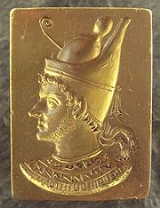
Ptolemaic Egypt

Encyclopedia
Ptolemaic Egypt began when Ptolemy I Soter
invaded Egypt and declared himself Pharaoh
of Egypt
in 305 BC
and ended with the death of queen Cleopatra VII of Egypt
and the Roman conquest
in 30 BC
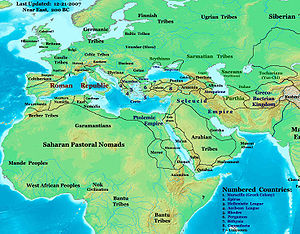
. The Ptolemaic Kingdom
was a powerful Hellenistic
state, extending from southern Syria
in the east, to Cyrene
to the west, and south to the frontier with Nubia
. Alexandria
became the capital city and a center of Greek
culture and trade. To gain recognition by the native Egyptian populace, they named themselves as the successors to the Pharaohs. The later Ptolemies took on Egyptian traditions, had themselves portrayed on public monuments in Egyptian style and dress, and participated in Egyptian religious life. Hellenistic culture continued to thrive in Egypt well after the Muslim conquest
. The Ptolemies faced rebellions of native Egyptians often caused by an unwanted regime and were involved in foreign and civil wars that led to the decline of the kingdom and its annexation by Rome.
The era of Ptolemaic reign in Egypt is one of the most well documented time periods of the Hellenistic Era; a wealth of papyri written by Greeks and Egyptians of the time have been discovered in Egypt.
Alexander the Great conquered Egypt with little resistance from the Persians. He was welcomed by the Egyptians
as a deliverer. He visited Memphis
, and went on pilgrimage to the oracle
of Amun
at the Oasis of Siwa. The oracle declared him to be the son of Amun-Re. He conciliated the Egyptians by the respect which he showed for their religion. While Macedonians commanded military garrisons, including at Memphis and Pelusium
, Alexander left the civil administration in local control; initially there were two, later one governor
. Alexander founded a new Greek city, Alexandria
, to be a major commercial port
. This city, where Alexander was buried, grew, quickly becoming as well Egypt's administrative capital and an intellectual centre.
in 323 BC
, a succession crisis
erupted among his generals. Initially, Perdiccas
ruled the empire as regent for Alexander's half-brother Arrhidaeus, who became Philip III of Macedon
, and then as regent for both Philip III and Alexander's infant son Alexander IV of Macedon
, who had not been born at the time of his father's death. Perdiccas appointed Ptolemy
, one of Alexander's closest companions, to be satrap
of Egypt. Ptolemy ruled Egypt from 323 BC
, nominally in the name of the joint kings Philip III and Alexander IV. However, as Alexander the Great's empire disintegrated, Ptolemy soon established himself as ruler in his own right. Ptolemy successfully defended Egypt against an invasion by Perdiccas in 321 BC
, and consolidated his position in Egypt and the surrounding areas during the Wars of the Diadochi (322 BC
-301 BC
). In 305 BC
, Ptolemy took the title of King. As Ptolemy I Soter
("Saviour"), he founded the Ptolemaic dynasty
that was to rule Egypt for nearly 300 years.
 All the male rulers of the dynasty took the name "Ptolemy", while princesses and queens preferred the names Cleopatra and Berenice
. Ptolemy II instituted a new practice of brother-sister marriage when he married his full sister, Arsinoe II
. They became, in effect, co-rulers, and both took the epithet Philadelphus ("Brother-Loving" and "Sister-Loving"). The notion that this was based on Egyptian precedent has been popular in the literature but has no historical basis. This custom made Ptolemaic politics confusingly incestuous, and the later Ptolemies were increasingly feeble. The only Ptolemaic Queens to officially rule on their own were Berenice III
and Berenice IV
. Cleopatra V
did co-rule, but it was with another female, Berenice IV. Cleopatra VII officially co-ruled with Ptolemy XIII Theos Philopator
, Ptolemy XIV
, and Ptolemy XV, but effectively, she ruled Egypt alone.
The early Ptolemies did not disturb the religion or the customs of the Egyptians
, and indeed built magnificent new temples
for the Egyptian gods and soon adopted the outward display of the Pharaohs of old. During the reign of Ptolemies II and III thousands of Greek veterans were rewarded with grants of farm lands, and Greeks were planted in colonies and garrisons or settled themselves in the villages throughout the country. Upper Egypt, farthest from the centre of government, was less immediately affected, though Ptolemy I established the Greek colony of Ptolemais Hermiou
to be its capital, but within a century Greek
influence had spread through the country and intermarriage had produced a large Greco-Egyptian educated class. Nevertheless, the Greeks always remained a privileged minority in Ptolemaic Egypt. They lived under Greek law, received a Greek education, were tried in Greek courts, and were citizens of Greek cities, just as they had been in Greece
. The Egyptians were rarely admitted to the higher levels of Greek culture, in which most Egyptians were not in any case interested.
A large factor in the prosperity of the Ptolemaic Empire in Egypt came from the exploitation of the regions resources, both natural and human. The Nile valley was rich with resources available at the Ptolemies disposal, and there was a large Egyptian population available to be utilized for labor. Two of the most valuable resources for the Greeks in Ptolemaic Egypt were grain and papyrus, the writing paper of the time period.
The Museum was a research centre supported by the king. It was located in the royal sector of the city. The scholars were housed in the same sector and funded by the Ptolemaic rulers. They had access to the Library. The chief librarian served also as the crown prince's tutor. For the first hundred and fifty years of its existence this library and research centre drew the top Greek scholars. This was a key academic, literary and scientific centre.
The Greeks
now formed the new upper classes in Egypt
, replacing the old native aristocracy. In general, the Ptolemies undertook changes that went far beyond any other measures that earlier foreign rulers had imposed. They used the religion and traditions to increase their own power and wealth. Although they established a prosperous kingdom, enhanced with fine buildings, the native population enjoyed few benefits, and there were frequent uprisings. These expressions of nationalism reached a peak in the reign of Ptolemy IV Philopator
(221–205 BC) when others gained control over one district and ruled as a line of native "pharaohs." This was only curtailed nineteen years later when Ptolemy V Epiphanes
(205–181 BC) succeeded in subduing them, but the underlying grievances continued and there were riots again later in the dynasty.
Family conflicts affected the later years of the dynasty when Ptolemy VIII Euergetes II fought his brother Ptolemy VI Philometor
and briefly seized the throne. The struggle was continued by his sister and niece (who both became his wives) until they finally issued an Amnesty Decree in 118 BC.
were given land grants and brought their families encouraging tens of thousands of Greeks
to settle the country making themselves the new ruling class. Early Greek settlers did little to hide their disdain for the Egyptian population which surrounded them, people they thought to be barbaric. Despite this initial disdain, later generations of the Greek population were more open to intermarriage with the Egyptian population, particularly in the settlements farthest away from Alexandria.
Native Egyptians
continued having a role in Egypt, yet a small one in the Ptolemaic government mostly in lower posts and outnumbered the foreigners. During the reign of the Ptolemaic Pharaohs, many Jews
were imported from neighboring Palestine by the hundred thousands for being renowned fighters, given that their homeland was on the frontier between Egypt and the Seleucid Empire and established an important presence in Alexandria. Other foreign groups settled during this time even Galatian
mercernaries, also fierce and skilled warriors, were first invited in the reign of Ptolemy II Philadelphus in 276 BCE. The Galatians are thought to have been resettled in the Faiyum region. Other Celts from Gaul and eastern Europe subsequently served in the armies of the Ptolemaic Dynasty. Even the royal bodyguard of Cleopatra VII contained a company of 300 Gallic warriors, a contingent given to her by Gaius Julius Caesar
in 48 BCE.
; after a generation or two immigrants from Israel forgot their Semitic speech. Their Hebrew scriptures they knew only in the Greek translation, which was named the Septuagint because, according to the legend, the translation had been made by the Seventy Translators under Ptolemy II. Since the Seventy Translators were held to have been themselves miraculously inspired, there was no need for the Egyptian Jews to concern themselves with the original Hebrew. As a matter of fact, the translation of the Old Testament
was made, bit by bit, in Egypt during the last three centuries before the Christian era. According to the first form of the legend, it was not the Old Testament as a whole, but only the five books of the Law which were translated by the Seventy Translators.
, following the death of Cleopatra VII, the Roman Empire
declared that Egypt was a province (Aegyptus), and that it was to be governed by a prefect selected by the Emperor from the Equestrian
and not a governor from the Senatorial order, to prevent interference by the Roman Senate
. The main Roman interest in Egypt was always the reliable delivery of grain to the city of Rome. To this end the Roman administration made no change to the Ptolemaic system of government, although Romans replaced Greeks in the highest offices. But Greeks continued to staff most of the administrative offices and Greek remained the language of government except at the highest levels. Unlike the Greeks, the Romans did not settle in Egypt in large numbers. Culture, education and civic life largely remained Greek throughout the Roman period. The Romans, like the Ptolemies, respected and protected Egyptian religion and customs, although the cult of the Roman state and of the Emperor was gradually introduced.
In his lifetime Strabo
made extensive travels to among others Egypt
and Ethiopia.
Ptolemy I Soter
Ptolemy I Soter I , also known as Ptolemy Lagides, c. 367 BC – c. 283 BC, was a Macedonian general under Alexander the Great, who became ruler of Egypt and founder of both the Ptolemaic Kingdom and the Ptolemaic Dynasty...
invaded Egypt and declared himself Pharaoh
Pharaoh
Pharaoh is a title used in many modern discussions of the ancient Egyptian rulers of all periods. The title originates in the term "pr-aa" which means "great house" and describes the royal palace...
of Egypt
Egypt
Egypt , officially the Arab Republic of Egypt, Arabic: , is a country mainly in North Africa, with the Sinai Peninsula forming a land bridge in Southwest Asia. Egypt is thus a transcontinental country, and a major power in Africa, the Mediterranean Basin, the Middle East and the Muslim world...
in 305 BC
305 BC
Year 305 BC was a year of the pre-Julian Roman calendar. At the time, it was known as the Year of the Consulship of Megellus and Augurinus...
and ended with the death of queen Cleopatra VII of Egypt
Egypt
Egypt , officially the Arab Republic of Egypt, Arabic: , is a country mainly in North Africa, with the Sinai Peninsula forming a land bridge in Southwest Asia. Egypt is thus a transcontinental country, and a major power in Africa, the Mediterranean Basin, the Middle East and the Muslim world...
and the Roman conquest
Aegyptus (Roman province)
The Roman province of Egypt was established in 30 BC after Octavian defeated his rival Mark Antony, deposed his lover Queen Cleopatra VII and annexed the Ptolemaic kingdom of Egypt to the Roman Empire. The province encompassed most of modern-day Egypt except for the Sinai Peninsula...
in 30 BC
30 BC
Year 30 BC was either a common year starting on Wednesday, Thursday or Friday or a leap year starting on Thursday of the Julian calendar and a common year starting on Wednesday of the Proleptic Julian calendar...
. The Ptolemaic Kingdom
Ptolemaic Kingdom
The Ptolemaic Kingdom in and around Egypt began following Alexander the Great's conquest in 332 BC and ended with the death of Cleopatra VII and the Roman conquest in 30 BC. It was founded when Ptolemy I Soter declared himself Pharaoh of Egypt, creating a powerful Hellenistic state stretching from...
was a powerful Hellenistic
Hellenistic civilization
Hellenistic civilization represents the zenith of Greek influence in the ancient world from 323 BCE to about 146 BCE...
state, extending from southern Syria
Syria
Syria , officially the Syrian Arab Republic , is a country in Western Asia, bordering Lebanon and the Mediterranean Sea to the West, Turkey to the north, Iraq to the east, Jordan to the south, and Israel to the southwest....
in the east, to Cyrene
Cyrene, Libya
Cyrene was an ancient Greek colony and then a Roman city in present-day Shahhat, Libya, the oldest and most important of the five Greek cities in the region. It gave eastern Libya the classical name Cyrenaica that it has retained to modern times.Cyrene lies in a lush valley in the Jebel Akhdar...
to the west, and south to the frontier with Nubia
Nubia
Nubia is a region along the Nile river, which is located in northern Sudan and southern Egypt.There were a number of small Nubian kingdoms throughout the Middle Ages, the last of which collapsed in 1504, when Nubia became divided between Egypt and the Sennar sultanate resulting in the Arabization...
. Alexandria
Alexandria
Alexandria is the second-largest city of Egypt, with a population of 4.1 million, extending about along the coast of the Mediterranean Sea in the north central part of the country; it is also the largest city lying directly on the Mediterranean coast. It is Egypt's largest seaport, serving...
became the capital city and a center of Greek
Hellenistic Greece
In the context of Ancient Greek art, architecture, and culture, Hellenistic Greece corresponds to the period between the death of Alexander the Great in 323 BC and the annexation of the classical Greek heartlands by Rome in 146 BC...
culture and trade. To gain recognition by the native Egyptian populace, they named themselves as the successors to the Pharaohs. The later Ptolemies took on Egyptian traditions, had themselves portrayed on public monuments in Egyptian style and dress, and participated in Egyptian religious life. Hellenistic culture continued to thrive in Egypt well after the Muslim conquest
Muslim conquest of Egypt
At the commencement of the Muslims conquest of Egypt, Egypt was part of the Byzantine Empire with its capital in Constantinople. However, it had been occupied just a decade before by the Persian Empire under Khosrau II...
. The Ptolemies faced rebellions of native Egyptians often caused by an unwanted regime and were involved in foreign and civil wars that led to the decline of the kingdom and its annexation by Rome.
The era of Ptolemaic reign in Egypt is one of the most well documented time periods of the Hellenistic Era; a wealth of papyri written by Greeks and Egyptians of the time have been discovered in Egypt.
Alexander the Great
In 332 BC332 BC
Year 332 BC was a year of the pre-Julian Roman calendar. At the time, it was known as the Year of the Consulship of Calvinus and Arvina...
Alexander the Great conquered Egypt with little resistance from the Persians. He was welcomed by the Egyptians
Egyptians
Egyptians are nation an ethnic group made up of Mediterranean North Africans, the indigenous people of Egypt.Egyptian identity is closely tied to geography. The population of Egypt is concentrated in the lower Nile Valley, the small strip of cultivable land stretching from the First Cataract to...
as a deliverer. He visited Memphis
Memphis, Egypt
Memphis was the ancient capital of Aneb-Hetch, the first nome of Lower Egypt. Its ruins are located near the town of Helwan, south of Cairo.According to legend related by Manetho, the city was founded by the pharaoh Menes around 3000 BC. Capital of Egypt during the Old Kingdom, it remained an...
, and went on pilgrimage to the oracle
Oracle
In Classical Antiquity, an oracle was a person or agency considered to be a source of wise counsel or prophetic predictions or precognition of the future, inspired by the gods. As such it is a form of divination....
of Amun
Amun
Amun, reconstructed Egyptian Yamānu , was a god in Egyptian mythology who in the form of Amun-Ra became the focus of the most complex system of theology in Ancient Egypt...
at the Oasis of Siwa. The oracle declared him to be the son of Amun-Re. He conciliated the Egyptians by the respect which he showed for their religion. While Macedonians commanded military garrisons, including at Memphis and Pelusium
Pelusium
Pelusium was a city in the eastern extremes of Egypt's Nile Delta, 30 km to the southeast of the modern Port Said. Alternative names include Sena and Per-Amun , Pelousion , Sin , Seyân , and Tell el-Farama...
, Alexander left the civil administration in local control; initially there were two, later one governor
Governor
A governor is a governing official, usually the executive of a non-sovereign level of government, ranking under the head of state...
. Alexander founded a new Greek city, Alexandria
Alexandria
Alexandria is the second-largest city of Egypt, with a population of 4.1 million, extending about along the coast of the Mediterranean Sea in the north central part of the country; it is also the largest city lying directly on the Mediterranean coast. It is Egypt's largest seaport, serving...
, to be a major commercial port
Port
A port is a location on a coast or shore containing one or more harbors where ships can dock and transfer people or cargo to or from land....
. This city, where Alexander was buried, grew, quickly becoming as well Egypt's administrative capital and an intellectual centre.
Ptolemaic Kingdom
Following Alexander's death in BabylonBabylon
Babylon was an Akkadian city-state of ancient Mesopotamia, the remains of which are found in present-day Al Hillah, Babil Province, Iraq, about 85 kilometers south of Baghdad...
in 323 BC
323 BC
Year 323 BC was a year of the pre-Julian Roman calendar. At the time, it was known as the Year of the Consulship of Longus and Cerretanus...
, a succession crisis
Diadochi
The Diadochi were the rival generals, family and friends of Alexander the Great who fought for the control of Alexander's empire after his death in 323 BC...
erupted among his generals. Initially, Perdiccas
Perdiccas
Perdiccas was one of Alexander the Great's generals. After Alexander's death in 323 BC he became regent of all Alexander's empire.Arrian tells us he was son of Orontes, a descendant of the independent princes of the Macedonian province of Orestis...
ruled the empire as regent for Alexander's half-brother Arrhidaeus, who became Philip III of Macedon
Philip III of Macedon
Philip III Arrhidaeus was the king of Macedonia from after June 11, 323 BC until his death. He was a son of King Philip II of Macedonia by Philinna of Larissa, allegedly a Thessalian dancer, and a half-brother of Alexander the Great...
, and then as regent for both Philip III and Alexander's infant son Alexander IV of Macedon
Alexander IV of Macedon
Alexander IV Aegus was the son of Alexander the Great and Princess Roxana of Bactria.-Birth:...
, who had not been born at the time of his father's death. Perdiccas appointed Ptolemy
Ptolemy I Soter
Ptolemy I Soter I , also known as Ptolemy Lagides, c. 367 BC – c. 283 BC, was a Macedonian general under Alexander the Great, who became ruler of Egypt and founder of both the Ptolemaic Kingdom and the Ptolemaic Dynasty...
, one of Alexander's closest companions, to be satrap
Satrap
Satrap was the name given to the governors of the provinces of the ancient Median and Achaemenid Empires and in several of their successors, such as the Sassanid Empire and the Hellenistic empires....
of Egypt. Ptolemy ruled Egypt from 323 BC
323 BC
Year 323 BC was a year of the pre-Julian Roman calendar. At the time, it was known as the Year of the Consulship of Longus and Cerretanus...
, nominally in the name of the joint kings Philip III and Alexander IV. However, as Alexander the Great's empire disintegrated, Ptolemy soon established himself as ruler in his own right. Ptolemy successfully defended Egypt against an invasion by Perdiccas in 321 BC
321 BC
Year 321 BC was a year of the pre-Julian Roman calendar. At the time, it was known as the Year of the Consulship of Calvinus and Caudinus...
, and consolidated his position in Egypt and the surrounding areas during the Wars of the Diadochi (322 BC
322 BC
Year 322 BC was a year of the pre-Julian Roman calendar. At the time, it was known as the Year of the Consulship of Rullianus and Curvus...
-301 BC
301 BC
Year 301 BC was a year of the pre-Julian Roman calendar. At the time, it was known as the Year of the Dictatorship of Corvus...
). In 305 BC
305 BC
Year 305 BC was a year of the pre-Julian Roman calendar. At the time, it was known as the Year of the Consulship of Megellus and Augurinus...
, Ptolemy took the title of King. As Ptolemy I Soter
Ptolemy I Soter
Ptolemy I Soter I , also known as Ptolemy Lagides, c. 367 BC – c. 283 BC, was a Macedonian general under Alexander the Great, who became ruler of Egypt and founder of both the Ptolemaic Kingdom and the Ptolemaic Dynasty...
("Saviour"), he founded the Ptolemaic dynasty
Ptolemaic dynasty
The Ptolemaic dynasty, was a Macedonian Greek royal family which ruled the Ptolemaic Empire in Egypt during the Hellenistic period. Their rule lasted for 275 years, from 305 BC to 30 BC...
that was to rule Egypt for nearly 300 years.
Berenice
Berenice or Berenike is the Ancient Macedonian form for Attic Greek Φερενίκη , meaning "bearer of victory", from φέρω "to bear" + νίκη "victory". Berenika priestess of Demeter in Lete ca. 350 BC is the oldest epigraphical evidence. The name also has the form Bernice...
. Ptolemy II instituted a new practice of brother-sister marriage when he married his full sister, Arsinoe II
Arsinoe II of Egypt
For other uses see, ArsinoeArsinoë II was a Ptolemaic Greek Princess of Ancient Egypt and through marriage was of Queen Thrace, Asia Minor and Macedonia as wife of King Lysimachus and later co-ruler of Egypt with her brother-husband Ptolemy II Philadelphus For other uses see, ArsinoeArsinoë II...
. They became, in effect, co-rulers, and both took the epithet Philadelphus ("Brother-Loving" and "Sister-Loving"). The notion that this was based on Egyptian precedent has been popular in the literature but has no historical basis. This custom made Ptolemaic politics confusingly incestuous, and the later Ptolemies were increasingly feeble. The only Ptolemaic Queens to officially rule on their own were Berenice III
Berenice III of Egypt
Berenice III , sometimes called Cleopatra Berenice, ruled as queen of Egypt from 81 to 80 BC, and possibly from 101 to 88 BC jointly with her uncle/husband Ptolemy X Alexander I....
and Berenice IV
Berenice IV of Egypt
Berenice IV Epiphaneia born and died in Alexandria, Egypt. She was a Greek Princess of the Ptolemaic dynasty. Berenice was the daughter of Ptolemy XII Auletes and probably Cleopatra V Tryphaena, sister of the famous Cleopatra VII , Arsinoe IV, Ptolemy XIII and Ptolemy XIV. Berenice loved...
. Cleopatra V
Cleopatra V of Egypt
Cleopatra V Tryphaena of Egypt was a Ptolemaic Queen of Egypt. She is the only surely attested wife of Ptolemy XII.-Descent and marriage:...
did co-rule, but it was with another female, Berenice IV. Cleopatra VII officially co-ruled with Ptolemy XIII Theos Philopator
Ptolemy XIII Theos Philopator
Ptolemy XIII Theos Philopator was one of the last members of the Ptolemaic dynasty of Egypt.- Co-ruler of Egypt, inner turmoil :...
, Ptolemy XIV
Ptolemy XIV of Egypt
Ptolemy XIV , was a son of Ptolemy XII of Egypt and one of the last members of the Ptolemaic dynasty of Egypt. Following the death of his older brother Ptolemy XIII of Egypt on January 13, 47 BC, he was proclaimed Pharaoh and co-ruler by their older sister and remaining Pharaoh, Cleopatra VII of...
, and Ptolemy XV, but effectively, she ruled Egypt alone.
The early Ptolemies did not disturb the religion or the customs of the Egyptians
Egyptians
Egyptians are nation an ethnic group made up of Mediterranean North Africans, the indigenous people of Egypt.Egyptian identity is closely tied to geography. The population of Egypt is concentrated in the lower Nile Valley, the small strip of cultivable land stretching from the First Cataract to...
, and indeed built magnificent new temples
Egyptian temple
Egyptian temples were built for the official worship of the gods and commemoration of pharaohs in Ancient Egypt and in regions under Egyptian control. These temples were seen as houses for the gods or kings to whom they were dedicated...
for the Egyptian gods and soon adopted the outward display of the Pharaohs of old. During the reign of Ptolemies II and III thousands of Greek veterans were rewarded with grants of farm lands, and Greeks were planted in colonies and garrisons or settled themselves in the villages throughout the country. Upper Egypt, farthest from the centre of government, was less immediately affected, though Ptolemy I established the Greek colony of Ptolemais Hermiou
Ptolemais Hermiou
Ptolemais Hermiou was a city in Greco-Roman Egypt, established on the west bank of the Nile by Ptolemy I Soter to be the capital of Upper Egypt. Today, the city of Al Manshah in the Sohag Governorate is located where the ancient city used to be....
to be its capital, but within a century Greek
Greeks
The Greeks, also known as the Hellenes , are a nation and ethnic group native to Greece, Cyprus and neighboring regions. They also form a significant diaspora, with Greek communities established around the world....
influence had spread through the country and intermarriage had produced a large Greco-Egyptian educated class. Nevertheless, the Greeks always remained a privileged minority in Ptolemaic Egypt. They lived under Greek law, received a Greek education, were tried in Greek courts, and were citizens of Greek cities, just as they had been in Greece
Ancient Greece
Ancient Greece is a civilization belonging to a period of Greek history that lasted from the Archaic period of the 8th to 6th centuries BC to the end of antiquity. Immediately following this period was the beginning of the Early Middle Ages and the Byzantine era. Included in Ancient Greece is the...
. The Egyptians were rarely admitted to the higher levels of Greek culture, in which most Egyptians were not in any case interested.
A large factor in the prosperity of the Ptolemaic Empire in Egypt came from the exploitation of the regions resources, both natural and human. The Nile valley was rich with resources available at the Ptolemies disposal, and there was a large Egyptian population available to be utilized for labor. Two of the most valuable resources for the Greeks in Ptolemaic Egypt were grain and papyrus, the writing paper of the time period.
Effect of Ptolemaic Rule
Ptolemy I, perhaps with advice from Demetrius of Phalerum, founded the Museum and Library of AlexandriaLibrary of Alexandria
The Royal Library of Alexandria, or Ancient Library of Alexandria, in Alexandria, Egypt, was the largest and most significant great library of the ancient world. It flourished under the patronage of the Ptolemaic dynasty and functioned as a major center of scholarship from its construction in the...
The Museum was a research centre supported by the king. It was located in the royal sector of the city. The scholars were housed in the same sector and funded by the Ptolemaic rulers. They had access to the Library. The chief librarian served also as the crown prince's tutor. For the first hundred and fifty years of its existence this library and research centre drew the top Greek scholars. This was a key academic, literary and scientific centre.
The Greeks
Greeks
The Greeks, also known as the Hellenes , are a nation and ethnic group native to Greece, Cyprus and neighboring regions. They also form a significant diaspora, with Greek communities established around the world....
now formed the new upper classes in Egypt
Egypt
Egypt , officially the Arab Republic of Egypt, Arabic: , is a country mainly in North Africa, with the Sinai Peninsula forming a land bridge in Southwest Asia. Egypt is thus a transcontinental country, and a major power in Africa, the Mediterranean Basin, the Middle East and the Muslim world...
, replacing the old native aristocracy. In general, the Ptolemies undertook changes that went far beyond any other measures that earlier foreign rulers had imposed. They used the religion and traditions to increase their own power and wealth. Although they established a prosperous kingdom, enhanced with fine buildings, the native population enjoyed few benefits, and there were frequent uprisings. These expressions of nationalism reached a peak in the reign of Ptolemy IV Philopator
Ptolemy IV Philopator
Ptolemy IV Philopator , son of Ptolemy III and Berenice II of Egypt was the fourth Pharaoh of Ptolemaic Egypt...
(221–205 BC) when others gained control over one district and ruled as a line of native "pharaohs." This was only curtailed nineteen years later when Ptolemy V Epiphanes
Ptolemy V Epiphanes
Ptolemy V Epiphanes , son of Ptolemy IV Philopator and Arsinoe III of Egypt, was the fifth ruler of the Ptolemaic dynasty. He became ruler at the age of five, and under a series of regents the kingdom was paralyzed.-Regency infighting:Ptolemy Epiphanes was only a small boy when his father, Ptolemy...
(205–181 BC) succeeded in subduing them, but the underlying grievances continued and there were riots again later in the dynasty.
Family conflicts affected the later years of the dynasty when Ptolemy VIII Euergetes II fought his brother Ptolemy VI Philometor
Ptolemy VI Philometor
Ptolemy VI Philometor was a king of Egypt from the Ptolemaic period. He reigned from 180 to 145 BC....
and briefly seized the throne. The struggle was continued by his sister and niece (who both became his wives) until they finally issued an Amnesty Decree in 118 BC.
Demographics
The Ptolemaic kingdom was ethnically diverse. During this period, Greek troops under Ptolemy I SoterPtolemy I Soter
Ptolemy I Soter I , also known as Ptolemy Lagides, c. 367 BC – c. 283 BC, was a Macedonian general under Alexander the Great, who became ruler of Egypt and founder of both the Ptolemaic Kingdom and the Ptolemaic Dynasty...
were given land grants and brought their families encouraging tens of thousands of Greeks
Greeks
The Greeks, also known as the Hellenes , are a nation and ethnic group native to Greece, Cyprus and neighboring regions. They also form a significant diaspora, with Greek communities established around the world....
to settle the country making themselves the new ruling class. Early Greek settlers did little to hide their disdain for the Egyptian population which surrounded them, people they thought to be barbaric. Despite this initial disdain, later generations of the Greek population were more open to intermarriage with the Egyptian population, particularly in the settlements farthest away from Alexandria.
Native Egyptians
Egyptians
Egyptians are nation an ethnic group made up of Mediterranean North Africans, the indigenous people of Egypt.Egyptian identity is closely tied to geography. The population of Egypt is concentrated in the lower Nile Valley, the small strip of cultivable land stretching from the First Cataract to...
continued having a role in Egypt, yet a small one in the Ptolemaic government mostly in lower posts and outnumbered the foreigners. During the reign of the Ptolemaic Pharaohs, many Jews
Jews
The Jews , also known as the Jewish people, are a nation and ethnoreligious group originating in the Israelites or Hebrews of the Ancient Near East. The Jewish ethnicity, nationality, and religion are strongly interrelated, as Judaism is the traditional faith of the Jewish nation...
were imported from neighboring Palestine by the hundred thousands for being renowned fighters, given that their homeland was on the frontier between Egypt and the Seleucid Empire and established an important presence in Alexandria. Other foreign groups settled during this time even Galatian
Galatian
Galatian may refer to:*of or relating to Galatia or its people*Galatian language...
mercernaries, also fierce and skilled warriors, were first invited in the reign of Ptolemy II Philadelphus in 276 BCE. The Galatians are thought to have been resettled in the Faiyum region. Other Celts from Gaul and eastern Europe subsequently served in the armies of the Ptolemaic Dynasty. Even the royal bodyguard of Cleopatra VII contained a company of 300 Gallic warriors, a contingent given to her by Gaius Julius Caesar
Julius Caesar
Gaius Julius Caesar was a Roman general and statesman and a distinguished writer of Latin prose. He played a critical role in the gradual transformation of the Roman Republic into the Roman Empire....
in 48 BCE.
Jews under the Ptolemies
The language of the Egyptian Jewish people was GreekGreek language
Greek is an independent branch of the Indo-European family of languages. Native to the southern Balkans, it has the longest documented history of any Indo-European language, spanning 34 centuries of written records. Its writing system has been the Greek alphabet for the majority of its history;...
; after a generation or two immigrants from Israel forgot their Semitic speech. Their Hebrew scriptures they knew only in the Greek translation, which was named the Septuagint because, according to the legend, the translation had been made by the Seventy Translators under Ptolemy II. Since the Seventy Translators were held to have been themselves miraculously inspired, there was no need for the Egyptian Jews to concern themselves with the original Hebrew. As a matter of fact, the translation of the Old Testament
Old Testament
The Old Testament, of which Christians hold different views, is a Christian term for the religious writings of ancient Israel held sacred and inspired by Christians which overlaps with the 24-book canon of the Masoretic Text of Judaism...
was made, bit by bit, in Egypt during the last three centuries before the Christian era. According to the first form of the legend, it was not the Old Testament as a whole, but only the five books of the Law which were translated by the Seventy Translators.
Roman Egypt
In 30 BC30 BC
Year 30 BC was either a common year starting on Wednesday, Thursday or Friday or a leap year starting on Thursday of the Julian calendar and a common year starting on Wednesday of the Proleptic Julian calendar...
, following the death of Cleopatra VII, the Roman Empire
Roman Empire
The Roman Empire was the post-Republican period of the ancient Roman civilization, characterised by an autocratic form of government and large territorial holdings in Europe and around the Mediterranean....
declared that Egypt was a province (Aegyptus), and that it was to be governed by a prefect selected by the Emperor from the Equestrian
Equestrian (Roman)
The Roman equestrian order constituted the lower of the two aristocratic classes of ancient Rome, ranking below the patricians , a hereditary caste that monopolised political power during the regal era and during the early Republic . A member of the equestrian order was known as an eques...
and not a governor from the Senatorial order, to prevent interference by the Roman Senate
Roman Senate
The Senate of the Roman Republic was a political institution in the ancient Roman Republic, however, it was not an elected body, but one whose members were appointed by the consuls, and later by the censors. After a magistrate served his term in office, it usually was followed with automatic...
. The main Roman interest in Egypt was always the reliable delivery of grain to the city of Rome. To this end the Roman administration made no change to the Ptolemaic system of government, although Romans replaced Greeks in the highest offices. But Greeks continued to staff most of the administrative offices and Greek remained the language of government except at the highest levels. Unlike the Greeks, the Romans did not settle in Egypt in large numbers. Culture, education and civic life largely remained Greek throughout the Roman period. The Romans, like the Ptolemies, respected and protected Egyptian religion and customs, although the cult of the Roman state and of the Emperor was gradually introduced.
Agriculture
The early Ptolemies increased cultivatable land through irrigation and introduced crops such as cotton and better wine-producing grapes. They also increased the availability of luxury goods through foreign trade. They enriched themselves and absorbed Egyptian culture. Ptolemy and his descendants adopted Egyptian royal trappings and added Egypt's religion to their own, worshiping Egyptian gods and building temples to them, and even being mummified and buried in sarcophagi covered with hieroglyphs.In his lifetime Strabo
Strabo
Strabo, also written Strabon was a Greek historian, geographer and philosopher.-Life:Strabo was born to an affluent family from Amaseia in Pontus , a city which he said was situated the approximate equivalent of 75 km from the Black Sea...
made extensive travels to among others Egypt
Egypt
Egypt , officially the Arab Republic of Egypt, Arabic: , is a country mainly in North Africa, with the Sinai Peninsula forming a land bridge in Southwest Asia. Egypt is thus a transcontinental country, and a major power in Africa, the Mediterranean Basin, the Middle East and the Muslim world...
and Ethiopia.
