

Po Valley

Encyclopedia

Italy
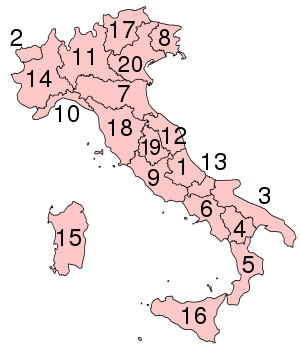
Italy , officially the Italian Republic languages]] under the European Charter for Regional or Minority Languages. In each of these, Italy's official name is as follows:;;;;;;;;), is a unitary parliamentary republic in South-Central Europe. To the north it borders France, Switzerland, Austria and...
. It extends approximately 650 km (403.9 mi) in an east-west direction, with an area of 46,000 km² (17,756 mi²) including its Venetic
Venetian Plain
The Venetian Plain, or Venetian-Friulan Plain is a major geographical feature of Italy. It extends approximately from river Adige to river Isonzo, in an southwest-to-northeast direction, including almost all the flatlands of Veneto and Friuli...
extension not actually related to the Po River
Po River
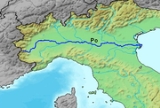
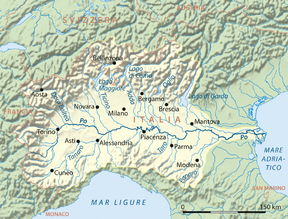
The Po |Ligurian]]: Bodincus or Bodencus) is a river that flows either or – considering the length of the Maira, a right bank tributary – eastward across northern Italy, from a spring seeping from a stony hillside at Pian del Re, a flat place at the head of the Val Po under the northwest face...
basin; it runs from the Western Alps
Alps
The Alps is one of the great mountain range systems of Europe, stretching from Austria and Slovenia in the east through Italy, Switzerland, Liechtenstein and Germany to France in the west....
to the Adriatic Sea
Adriatic Sea
The Adriatic Sea is a body of water separating the Italian Peninsula from the Balkan peninsula, and the system of the Apennine Mountains from that of the Dinaric Alps and adjacent ranges...
. The flatlands of Veneto
Veneto
Veneto is one of the 20 regions of Italy. Its population is about 5 million, ranking 5th in Italy.Veneto had been for more than a millennium an independent state, the Republic of Venice, until it was eventually annexed by Italy in 1866 after brief Austrian and French rule...
and Friuli
Friuli
Friuli is an area of northeastern Italy with its own particular cultural and historical identity. It comprises the major part of the autonomous region Friuli-Venezia Giulia, i.e. the province of Udine, Pordenone, Gorizia, excluding Trieste...
are often considered apart since they do not drain into the Po, but they effectively combine into an unbroken plain.
The plain is the surface of an in-filled system of ancient canyons (the "Apennine Foredeep") extending from the Apennines in the south to the Alps
Alps
The Alps is one of the great mountain range systems of Europe, stretching from Austria and Slovenia in the east through Italy, Switzerland, Liechtenstein and Germany to France in the west....
in the north, including the northern Adriatic. In addition to the Po and its affluents the contemporary surface may include the Savio, Lamone and Reno to the south; the Adige
Adige
The Adige is a river with its source in the Alpine province of South Tyrol near the Italian border with Austria and Switzerland. At in length, it is the second longest river in Italy, after the River Po with ....
, Brenta, Piave and Tagliamento to the north, which are part of Venetian Plain
Venetian Plain
The Venetian Plain, or Venetian-Friulan Plain is a major geographical feature of Italy. It extends approximately from river Adige to river Isonzo, in an southwest-to-northeast direction, including almost all the flatlands of Veneto and Friuli...
. among the many streams that empty into the north Adriatic from the west and north.
Geo-political definitions of the valley depend on the defining authority. The Po Basin Water Board (), authorized in 1989 by Law no. 183/89 to oversee "protection of lands, water rehabilitation, the use and management of hydro resources for the rational economic and social development, and protection of related environment" within the Po basin, has authority in several administrative regions of north Italy, including the plain north of the Adriatic and the territory south of the lower Po, as shown in the regional depiction included with this article. The law defines the Po basin as "the territory from which rainwater or snow and glacier melt flows on the surface, gathers in streams of water either directly or via tributaries...". The United Nations Environment Program includes the Alps and Apennines as far as the sources of the tributaries of the Po but excludes Veneto and that portion of Emilia-Romana south of the lower Po; that is, it includes the region drained by the Po but only the Po and its tributaries.
The altitude of the valley through which the Po flows exclusive of its tributaries varies from approximately 4 m (13.1 ft) below sea level in the Polesine
Polesine
Polesine is a geographic and historic area in the north-east of Italy corresponding nowadays with the province of Rovigo; it is a strip of land about 100-km long and 18-km wide located between the lower courses of the Adige and the Po rivers.- Geography :...
subregion (the delta
River delta
A delta is a landform that is formed at the mouth of a river where that river flows into an ocean, sea, estuary, lake, reservoir, flat arid area, or another river. Deltas are formed from the deposition of the sediment carried by the river as the flow leaves the mouth of the river...
around Ferrara
Ferrara
Ferrara is a city and comune in Emilia-Romagna, northern Italy, capital city of the Province of Ferrara. It is situated 50 km north-northeast of Bologna, on the Po di Volano, a branch channel of the main stream of the Po River, located 5 km north...
) to about 2100 m (6,889.8 ft) at the river's origin in the southern Piedmont
Piedmont
Piedmont is one of the 20 regions of Italy. It has an area of 25,402 square kilometres and a population of about 4.4 million. The capital of Piedmont is Turin. The main local language is Piedmontese. Occitan is also spoken by a minority in the Occitan Valleys situated in the Provinces of...
ese province of Cuneo
Province of Cuneo
ayr is a province in the southwest of the Piedmont region of Italy. To the west it borders on the French region of Provence-Alpes-Côte d'Azur ....
, also known as the Provincia granda. The valley is crossed by a number of affluents
Tributary
A tributary or affluent is a stream or river that flows into a main stem river or a lake. A tributary does not flow directly into a sea or ocean...
running down from the Alps in the north and from the Apennines
Apennine mountains
The Apennines or Apennine Mountains or Greek oros but just as often used alone as a noun. The ancient Greeks and Romans typically but not always used "mountain" in the singular to mean one or a range; thus, "the Apennine mountain" refers to the entire chain and is translated "the Apennine...
in the south. The Po's major affluents include the Tanaro, Scrivia
Scrivia
The Scrivia is a right tributary of the Po River, in northern Italy. It runs through Liguria, Piedmont, and Lombardy....
, Trebbia
Trebbia
The Trebbia is a river predominantly of Liguria and Emilia Romagna in northern Italy. It is one of the four main right-bank tributaries of the river Po, the other three being the Tanaro, the Secchia and the Panaro...
, Panaro
Panaro
The Panaro is an Italian river and the final right-hand tributary to the Po, discounting the Cavo Napoleonico canal. It runs right across Emilia-Romagna in a north-easterly direction: from its source close to the Apennine watershed, where Emilia-Romagna meets Tuscany, to its outlet where the Po...
and Secchia in the south, Dora Riparia
Dora Riparia
The Dora Riparia is an Italian river, a left-hand tributary of the Po. It is 125 km long, with a 1,231 km² drainage basin. It originates in the Cottian Alps, close to the Col de Montgenèvre in France, where it is called the Piccola Dora...
, Dora Baltea
Dora Baltea
Dora Baltea or Doire Baltée , is a river in northern Italy. It is a left-hand tributary of the Po River, and is about 160 km long...
, Sesia
Sesia
Sesia may refer to:* Sesia River, in northwest Italy* Sesia , a district during the First French Empire, named after the river* Sesia, a genus of moths* The Valsesia, the river’s valley...
, Ticino
Ticino River
The river Ticino is a left-bank tributary of the Po River. It has given its name to the Swiss canton through which its upper portion flows.-The course:...
(draining Lake Maggiore
Lake Maggiore
Lake Maggiore is a large lake located on the south side of the Alps. It is the second largest of Italy and largest of southern Switzerland. Lake Maggiore is the most westerly of the three great prealpine lakes of Italy, it extends for about 70 km between Locarno and Arona.The climate is mild...
), Adda
Adda River
The Adda is a river in North Italy, a tributary of the Po. It rises in the Alps near the border with Switzerland and flows through Lake Como. The Adda joins the Po a few kilometres upstream of Cremona. It is 313 kilometres long...
(draining Lake Como
Lake Como
Lake Como is a lake of glacial origin in Lombardy, Italy. It has an area of 146 km², making it the third largest lake in Italy, after Lake Garda and Lake Maggiore...
), Oglio
Oglio
The Oglio is a left-side tributary of the Po River in Lombardy, Italy. It is 280 km long....
(draining Lake Iseo
Lake Iseo
Lake Iseo or Lago d'Iseo or Sebino is the fourth largest lake in Lombardy, Italy, fed by the Oglio river.It is in the north of the country in the Val Camonica area, near the cities of Brescia and Bergamo. The lake is almost equally divided between the Provinces of Bergamo and Brescia...
) and Mincio
Mincio
Mincio is a river in the Lombardy region of northern Italy.Called the Sarca River before entering Lake Garda, it flows from there about 65 km past Mantua into the Po River....
(draining Lake Garda
Lake Garda
Lake Garda is the largest lake in Italy. It is located in Northern Italy, about half-way between Brescia and Verona, and between Venice and Milan. Glaciers formed this alpine region at the end of the last ice age...
and called Sarca
Sarca
The Sarca is a river springing from the Adamello-Presanella mountains in the Italian Alps and flowing into Lake Garda in Northern Italy. As an emissary of the lake it becomes known as the Mincio....
in its upper reaches) in the north.
Geology
The Po Valley and the Adriatic overlay a system of deeply buried ancient canyons surviving from the tectonic collision of an offshore land mass, Tyrrhenis, with the mainland, an incident within the collision of the African and Eurasian plates. Since the MessinianMessinian
The Messinian is in the geologic timescale the last age or uppermost stage of the Miocene. It spans the time between 7.246 ± 0.005 Ma and 5.332 ± 0.005 Ma...
(7-5 mya) the system has been filling with sediment mainly from the older Apennines but also from the Alps. The shoreline of the Adriatic depends on a balance between the sedimentation rate and isostatic
Isostasy
Isostasy is a term used in geology to refer to the state of gravitational equilibrium between the earth's lithosphere and asthenosphere such that the tectonic plates "float" at an elevation which depends on their thickness and density. This concept is invoked to explain how different topographic...
factors. Until about 1950 the Po delta was prograding into the Adriatic. After that time due to human alteration of geologic factors, such as the sedimentation rate, the delta has been degrading and the coastline subsiding, resulting in ongoing contemporaneous crises in the city of Venice
Venice
Venice is a city in northern Italy which is renowned for the beauty of its setting, its architecture and its artworks. It is the capital of the Veneto region...
, where much irreplaceable art and architecture is likely to be lost due to soaring sea level in the next centuries. Where the land surface now dips below sea level the river must run at a relative elevation between dikes.
Geography
Syncline
In structural geology, a syncline is a fold, with younger layers closer to the center of the structure. A synclinorium is a large syncline with superimposed smaller folds. Synclines are typically a downward fold, termed a synformal syncline In structural geology, a syncline is a fold, with younger...
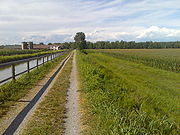
, or dip in the crust due to compression at the edges. Regardless of whether this concept accurately describes its geology, the valley is manifestly a sediment-filled trough, or virtual syncline, continuous with the deeps of the Adriatic Sea
Adriatic Sea
The Adriatic Sea is a body of water separating the Italian Peninsula from the Balkan peninsula, and the system of the Apennine Mountains from that of the Dinaric Alps and adjacent ranges...
. The surface terrain is therefore divided into two overall types of landform
Landform
A landform or physical feature in the earth sciences and geology sub-fields, comprises a geomorphological unit, and is largely defined by its surface form and location in the landscape, as part of the terrain, and as such, is typically an element of topography...
: the plain, or flat surface of the fill, and the anticline
Anticline
In structural geology, an anticline is a fold that is convex up and has its oldest beds at its core. The term is not to be confused with antiform, which is a purely descriptive term for any fold that is convex up. Therefore if age relationships In structural geology, an anticline is a fold that is...
at the edges, taking the form of hilly country in which the outcrop
Outcrop
An outcrop is a visible exposure of bedrock or ancient superficial deposits on the surface of the Earth. -Features:Outcrops do not cover the majority of the Earth's land surface because in most places the bedrock or superficial deposits are covered by a mantle of soil and vegetation and cannot be...
s of the original rock are visible along with alluvial fan
Alluvial fan
An alluvial fan is a fan-shaped deposit formed where a fast flowing stream flattens, slows, and spreads typically at the exit of a canyon onto a flatter plain. A convergence of neighboring alluvial fans into a single apron of deposits against a slope is called a bajada, or compound alluvial...
s formed from the outwash of the more severe anticlinal terrain; that is, the Apennines and the Alps.
The valley is broadly divided into an upper, drier part, often not particularly suited for agriculture, and a lower, very fertile, and well irrigated section, known in Lombardy
Lombardy
Lombardy is one of the 20 regions of Italy. The capital is Milan. One-sixth of Italy's population lives in Lombardy and about one fifth of Italy's GDP is produced in this region, making it the most populous and richest region in the country and one of the richest in the whole of Europe...
and western Emilia
Emilia (region of Italy)
Emilia is a historical region of northern Italy which approximately corresponds to the western and north-eastern portions of today’s Emilia-Romagna region...
as la Bassa, "the low (plain)". The upper areas of the Po valley take local names which reflect in their meanings their being modestly suited for farming. So we have the Piedmontese vaude and baragge, the Lombard brughiere and Groane, or, exiting from the Po valley proper, the Friuli
Friuli
Friuli is an area of northeastern Italy with its own particular cultural and historical identity. It comprises the major part of the autonomous region Friuli-Venezia Giulia, i.e. the province of Udine, Pordenone, Gorizia, excluding Trieste...
an magredi, areas remote from easily reachable water tables and covered with dense woods or dry soils.
This specific meaning for "lower plain" derive from a geologic feature called the fontanili ("spring") line or zone, a band of springs around the Val Po, heaviest on the north, on the lowermost slopes of the anticline. It varies from a few kilometres to as much as 50 km (31.1 mi) wide. The fontanili line is the outcrop, or intersection, of the anticline's water table
Water table
The water table is the level at which the submarine pressure is far from atmospheric pressure. It may be conveniently visualized as the 'surface' of the subsurface materials that are saturated with groundwater in a given vicinity. However, saturated conditions may extend above the water table as...
with the surface at the edge of the bassa. The rock above the line is porous. Surface water in the intermittent streams of the mountains tends to disappear below ground only to spring out again in the spring zone. The spring zone is often called "the middle valley."
Surface runoff water (the Po and its affluents) is not of much value to the valley's dense population for drinking and other immediate uses, being unreliable, often destructive and heavily polluted by sewage and fertilizers. Its main anthropic value is for hydro-electric power, irrigation and industrial transport. The cost of purifying it for human consumption makes that process less feasible. The fresh drinking water comes from hundreds of thousands of wells concentrated especially in the fontanili zone. The major settlements therefore are also in that zone, which has become the center of economic development and industry
Industry
Industry refers to the production of an economic good or service within an economy.-Industrial sectors:There are four key industrial economic sectors: the primary sector, largely raw material extraction industries such as mining and farming; the secondary sector, involving refining, construction,...
in Italy, and now is an almost continuous megalopolis
Megalopolis (city type)
A megalopolis is typically defined as a chain of roughly adjacent metropolitan areas. The term was used by Oswald Spengler in his 1918 book, The Decline of the West, and Lewis Mumford in his 1938 book, The Culture of Cities, which described it as the first stage in urban overdevelopment and...
stretching from Turin
Turin
Turin is a city and major business and cultural centre in northern Italy, capital of the Piedmont region, located mainly on the left bank of the Po River and surrounded by the Alpine arch. The population of the city proper is 909,193 while the population of the urban area is estimated by Eurostat...
to Trieste
Trieste
Trieste is a city and seaport in northeastern Italy. It is situated towards the end of a narrow strip of land lying between the Adriatic Sea and Italy's border with Slovenia, which lies almost immediately south and east of the city...
.
The bassa Padana was settled and farmed earliest, in Etruscan and Roman times, and has been completely devoted to agriculture since the Middle Ages
Middle Ages
The Middle Ages is a periodization of European history from the 5th century to the 15th century. The Middle Ages follows the fall of the Western Roman Empire in 476 and precedes the Early Modern Era. It is the middle period of a three-period division of Western history: Classic, Medieval and Modern...
, when efforts from monastic orders, feudal lords and free communes
Medieval commune
Medieval communes in the European Middle Ages had sworn allegiances of mutual defense among the citizens of a town or city. They took many forms, and varied widely in organization and makeup. Communes are first recorded in the late 11th and early 12th centuries, thereafter becoming a widespread...
converged. The older and smaller cities deriving from ancient times are still located there.
Climate
The Po Valley has a mild continental climateContinental climate
Continental climate is a climate characterized by important annual variation in temperature due to the lack of significant bodies of water nearby...
and a humid subtropical climate
Humid subtropical climate
A humid subtropical climate is a climate zone characterized by hot, humid summers and mild to cool winters...
, depending on the part of the valley one is referring to. Winters are not long, but foggy, damp and chilly, with sudden bursts of frost from the Siberian anticyclone
Siberian High
The Siberian High is a massive collection of cold or very cold dry air that accumulates on the Eurasian terrain for much of the year. It reaches its greatest size and strength in the winter, when the air temperature near the center of the high-pressure cell or anticyclone is often lower than...
; the urban heat effect
Urban heat island
An urban heat island is a metropolitan area which is significantly warmer than its surrounding rural areas. The phenomenon was first investigated and described by Luke Howard in the 1810s, although he was not the one to name the phenomenon. The temperature difference usually is larger at night...
has made them less foggy and cold than before. Snow was once commonplace, but is now decreased; prolonged winter droughts increasingly deny sufficient moisture to the soil. Spring and autumn are well marked and pleasant, while summer can be quite oppressive, hot and humid, with sudden violent hail
Hail
Hail is a form of solid precipitation. It consists of balls or irregular lumps of ice, each of which is referred to as a hail stone. Hail stones on Earth consist mostly of water ice and measure between and in diameter, with the larger stones coming from severe thunderstorms...
storms and, sometimes, what amounts to minor tornado
Tornado
A tornado is a violent, dangerous, rotating column of air that is in contact with both the surface of the earth and a cumulonimbus cloud or, in rare cases, the base of a cumulus cloud. They are often referred to as a twister or a cyclone, although the word cyclone is used in meteorology in a wider...
es. Both winter and summer are more extreme in the lower parts along the Po River, while the great lakes moderate the local climate around them. Wind is quite rare; only sudden bursts of foehn or thunderstorms manage to sweep the air clean. The almost enclosed nature of the Padan basin, indeed, added to the crushing weight of road traffic, makes it prone to a high level of pollution, especially in winter when cold air clings to the soil.
Prehistory and antiquity
Cities are more recent by the Po than in Southern Italy or Greece. The first known inhabitants of the thick forests and swamps in ancient times were the LiguriansLigures
The Ligures were an ancient people who gave their name to Liguria, a region of north-western Italy.-Classical sources:...
, a race of pre-Indo-European stock. After the progressive immigration of Indo-European
Proto-Indo-Europeans
The Proto-Indo-Europeans were the speakers of the Proto-Indo-European language , a reconstructed prehistoric language of Eurasia.Knowledge of them comes chiefly from the linguistic reconstruction, along with material evidence from archaeology and archaeogenetics...
peoples of Celtic stock, known as the Insubres
Insubres
The Insubres were a Gaulish population settled in Insubria, in what is now Lombardy . They were the founders of Milan . Though ethnically Celtic at the time of Roman conquest , they were most likely the result of the fusion of pre-existing Ligurian, Celtic and "Italic" population strata with Gaulish...
(hence the name of Insubria
Insubria
Insubria is a historical-geographical region which corresponds to the area inhabited in Classical antiquity by the Insubres. Secondarily the name can refer to the Duchy of Milan...
sometimes given to northwestern Lombardy
Lombardy
Lombardy is one of the 20 regions of Italy. The capital is Milan. One-sixth of Italy's population lives in Lombardy and about one fifth of Italy's GDP is produced in this region, making it the most populous and richest region in the country and one of the richest in the whole of Europe...
), in the 7th century BC the southern and central regions were conquered and colonized here and there by another non-Indoeuropean people, the Etruscans, who left some city names such as Parma
Parma
Parma is a city in the Italian region of Emilia-Romagna famous for its ham, its cheese, its architecture and the fine countryside around it. This is the home of the University of Parma, one of the oldest universities in the world....
, Ravenna
Ravenna
Ravenna is the capital city of the Province of Ravenna in the Emilia-Romagna region of Italy and the second largest comune in Italy by land area, although, at , it is little more than half the size of the largest comune, Rome...
or Felsina, the ancient name of Bologna
Bologna
Bologna is the capital city of Emilia-Romagna, in the Po Valley of Northern Italy. The city lies between the Po River and the Apennine Mountains, more specifically, between the Reno River and the Savena River. Bologna is a lively and cosmopolitan Italian college city, with spectacular history,...
, as part of their cultural heritage. The Etruscan domination left significant marks and introduced urban civilization, but was short-lived. As the 5th century BC dawned, a Celt
Celt
The Celts were a diverse group of tribal societies in Iron Age and Roman-era Europe who spoke Celtic languages.The earliest archaeological culture commonly accepted as Celtic, or rather Proto-Celtic, was the central European Hallstatt culture , named for the rich grave finds in Hallstatt, Austria....
ic horde
Nomadic pastoralism
Nomadic pastoralism is a form of agriculture where livestock are herded in order to find fresh pastures on which to graze following an irregular pattern of movement - in contrast with transhumance where seasonal pastures are fix. The herded livestock may include cattle, yaks, sheep, goats,...
swarmed through the easy passes of the Western Alps and conquered most of the Po Valley, apart Veneto
Veneto
Veneto is one of the 20 regions of Italy. Its population is about 5 million, ranking 5th in Italy.Veneto had been for more than a millennium an independent state, the Republic of Venice, until it was eventually annexed by Italy in 1866 after brief Austrian and French rule...
which had its inhabitants, the Venetics
Adriatic Veneti
The Veneti were an ancient people who inhabited north-eastern Italy, in an area corresponding to the modern-day region of the Veneto....
likely of a distinct stock and in time already influenced by both Etruscans and Greeks
Greeks
The Greeks, also known as the Hellenes , are a nation and ethnic group native to Greece, Cyprus and neighboring regions. They also form a significant diaspora, with Greek communities established around the world....
.
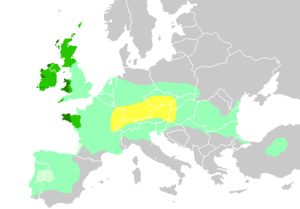
Boii
The Boii were one of the most prominent ancient Celtic tribes of the later Iron Age, attested at various times in Cisalpine Gaul , Pannonia , in and around Bohemia, and Transalpine Gaul...
(from whom Bologna
Bologna
Bologna is the capital city of Emilia-Romagna, in the Po Valley of Northern Italy. The city lies between the Po River and the Apennine Mountains, more specifically, between the Reno River and the Savena River. Bologna is a lively and cosmopolitan Italian college city, with spectacular history,...
, Bononia, is name), the Taurini
Taurini
The Taurini were an ancient Celto-Ligurian Alpine people, who occupied the upper valley of the river Po, in the centre of modern Piedmont.In 218 BC, they were attacked by Hannibal since his allies were the Insubres. The Taurini and the Insubres had a long-standing feud. Their chief town was...
(whence the name of Turin
Turin
Turin is a city and major business and cultural centre in northern Italy, capital of the Piedmont region, located mainly on the left bank of the Po River and surrounded by the Alpine arch. The population of the city proper is 909,193 while the population of the urban area is estimated by Eurostat...
), the Cenomani
Cenomani (Cisalpine Gaul)
The Cenomani , was an ancient tribe of the Cisalpine Gauls, who occupied the tract north of the Padus , between the Insubres on the west and the Veneti on the east. Their territory appears to have extended from the river Addua to the Athesis...
and the previous Insubres
Insubres
The Insubres were a Gaulish population settled in Insubria, in what is now Lombardy . They were the founders of Milan . Though ethnically Celtic at the time of Roman conquest , they were most likely the result of the fusion of pre-existing Ligurian, Celtic and "Italic" population strata with Gaulish...
dwelled mostly into the plains, in time absorbing the Alpine populations. A warlike people, they even raided and burnt Rome
Rome
Rome is the capital of Italy and the country's largest and most populated city and comune, with over 2.7 million residents in . The city is located in the central-western portion of the Italian Peninsula, on the Tiber River within the Lazio region of Italy.Rome's history spans two and a half...
itself in 390 BC under a leader named Brennus
Brennus
Brennus is the name of two Gaulish chieftains famous in ancient history:* Brennus , chieftain of the Senones, a Gallic tribe originating from the modern areas of France known as Seine-et-Marne, Loiret, and Yonne; in 387 BC, in the Battle of the Allia, he led an army of Cisalpine Gauls in their...
. Roman revenge took time, but was total and definitive: Celticity, while leaving significant traces in the substratum of Gallo-Italic languages
Gallo-Italic languages
The Gallo-Italic or Gallo-Italian is a linguistic set of Romance languages. In accordance with a source such as Ethnologue is a subset of the Gallo-Romance languages, which also include French and Occitan, among others; in accordance with the major Italian linguists and dialectologists The...
and in the ethnic composition of Northern Italy
Northern Italy
Northern Italy is a wide cultural, historical and geographical definition, without any administrative usage, used to indicate the northern part of the Italian state, also referred as Settentrione or Alta Italia...
, was cancelled from northern Italy and replaced by Latin language and culture. This happened after the Romans
Roman Republic
The Roman Republic was the period of the ancient Roman civilization where the government operated as a republic. It began with the overthrow of the Roman monarchy, traditionally dated around 508 BC, and its replacement by a government headed by two consuls, elected annually by the citizens and...
defeated the Gauls
Gauls
The Gauls were a Celtic people living in Gaul, the region roughly corresponding to what is now France, Belgium, Switzerland and Northern Italy, from the Iron Age through the Roman period. They mostly spoke the Continental Celtic language called Gaulish....
at the Battle of Clastidium
Battle of Clastidium
The Battle of Clastidium was fought in 222 BC between a Roman Republican army led by the Roman consul Marcus Claudius Marcellus and the Insubres led by Viridomarus. The Romans won the battle, and in the process, Marcellus earned the Spolia opima, one of the highest honors in ancient Rome, by...
and later subdued them for good after Hannibal's final defeat at Zama
Battle of Zama
The Battle of Zama, fought around October 19, 202 BC, marked the final and decisive end of the Second Punic War. A Roman army led by Publius Cornelius Scipio Africanus defeated a Carthaginian force led by the legendary commander Hannibal...
. By 196 BC Rome was master of the woody plains and soon took over the role of the Etruscans, dotting the region with bustling colonies, clearing the land, fighting the last rebel tribes and gradually imposing its civilization.
The centuries of Roman domination decided forever the main aspect of the Po Valley. Cities dotted the areas at the foothills of the Alps and Apennines in two stretches; in the south along the via Aemilia
Via Aemilia
The Via Aemilia was a trunk Roman road in the north Italian plain, running from Ariminum , on the Adriatic coast, to Placentia on the river Padus . It was completed in 187 BC...
, in the north along a Milan
Milan
Milan is the second-largest city in Italy and the capital city of the region of Lombardy and of the province of Milan. The city proper has a population of about 1.3 million, while its urban area, roughly coinciding with its administrative province and the bordering Province of Monza and Brianza ,...
-Aquileia
Aquileia
Aquileia is an ancient Roman city in what is now Italy, at the head of the Adriatic at the edge of the lagoons, about 10 km from the sea, on the river Natiso , the course of which has changed somewhat since Roman times...
route. Julius Caesar
Julius Caesar
Gaius Julius Caesar was a Roman general and statesman and a distinguished writer of Latin prose. He played a critical role in the gradual transformation of the Roman Republic into the Roman Empire....
granted Roman citizenship
Roman citizenship
Citizenship in ancient Rome was a privileged political and legal status afforded to certain free-born individuals with respect to laws, property, and governance....
to these lands, whence he recruited many of his bravest troops. The Po Valley for a time hosted the capital of the Western Roman Empire
Western Roman Empire
The Western Roman Empire was the western half of the Roman Empire after its division by Diocletian in 285; the other half of the Roman Empire was the Eastern Roman Empire, commonly referred to today as the Byzantine Empire....
, in Mediolanum
Milan
Milan is the second-largest city in Italy and the capital city of the region of Lombardy and of the province of Milan. The city proper has a population of about 1.3 million, while its urban area, roughly coinciding with its administrative province and the bordering Province of Monza and Brianza ,...
from 286 to 403, and then in Ravenna
Ravenna
Ravenna is the capital city of the Province of Ravenna in the Emilia-Romagna region of Italy and the second largest comune in Italy by land area, although, at , it is little more than half the size of the largest comune, Rome...
till the end. It was attacked in the 3rd century by Germanic
Germanic peoples
The Germanic peoples are an Indo-European ethno-linguistic group of Northern European origin, identified by their use of the Indo-European Germanic languages which diversified out of Proto-Germanic during the Pre-Roman Iron Age.Originating about 1800 BCE from the Corded Ware Culture on the North...
tribes bursting out from the Alps and sacked two centuries later by Attila the Hun
Attila the Hun
Attila , more frequently referred to as Attila the Hun, was the ruler of the Huns from 434 until his death in 453. He was leader of the Hunnic Empire, which stretched from the Ural River to the Rhine River and from the Danube River to the Baltic Sea. During his reign he was one of the most feared...
, till its final conquest first by Odoacer
Odoacer
Flavius Odoacer , also known as Flavius Odovacer, was the first King of Italy. His reign is commonly seen as marking the end of the Western Roman Empire. Though the real power in Italy was in his hands, he represented himself as the client of Julius Nepos and, after Nepos' death in 480, of the...
, then at the hands of the Ostrogoths of king Theoderic the Great in the final years of the 5th century.
Middle Ages
The Gothic War and Justinian's plaguePlague of Justinian
The Plague of Justinian was a pandemic that afflicted the Eastern Roman Empire , including its capital Constantinople, in 541–542 AD. It was one of the greatest plagues in history. The most commonly accepted cause of the pandemic is bubonic plague, which later became infamous for either causing or...
devastated the Padan population. In this scenario of desolation, from which many people had fled to the mountains for safety (making them fairly populated till the 20th century) came the Germanic
Germanic peoples
The Germanic peoples are an Indo-European ethno-linguistic group of Northern European origin, identified by their use of the Indo-European Germanic languages which diversified out of Proto-Germanic during the Pre-Roman Iron Age.Originating about 1800 BCE from the Corded Ware Culture on the North...
Lombards
Lombards
The Lombards , also referred to as Longobards, were a Germanic tribe of Scandinavian origin, who from 568 to 774 ruled a Kingdom in Italy...
, a warrior people who gave their name to almost the whole of the Po valley: Lombardy
Lombardy
Lombardy is one of the 20 regions of Italy. The capital is Milan. One-sixth of Italy's population lives in Lombardy and about one fifth of Italy's GDP is produced in this region, making it the most populous and richest region in the country and one of the richest in the whole of Europe...
. In the Middle Ages the term was used to indicate all of northern Italy. The Lombards divided their domain in duchies
Duchy
A duchy is a territory, fief, or domain ruled by a duke or duchess.Some duchies were sovereign in areas that would become unified realms only during the Modern era . In contrast, others were subordinate districts of those kingdoms that unified either partially or completely during the Medieval era...
, often contending for the throne; Turin
Turin
Turin is a city and major business and cultural centre in northern Italy, capital of the Piedmont region, located mainly on the left bank of the Po River and surrounded by the Alpine arch. The population of the city proper is 909,193 while the population of the urban area is estimated by Eurostat...
and Friuli, in the extreme west and east end respectively, seem to have been the most powerful, whereas the capital soon shifted from Verona
Verona
Verona ; German Bern, Dietrichsbern or Welschbern) is a city in the Veneto, northern Italy, with approx. 265,000 inhabitants and one of the seven chef-lieus of the region. It is the second largest city municipality in the region and the third of North-Eastern Italy. The metropolitan area of Verona...
to Pavia
Pavia
Pavia , the ancient Ticinum, is a town and comune of south-western Lombardy, northern Italy, 35 km south of Milan on the lower Ticino river near its confluence with the Po. It is the capital of the province of Pavia. It has a population of c. 71,000...
. Monza
Monza
Monza is a city and comune on the river Lambro, a tributary of the Po, in the Lombardy region of Italy some 15 km north-northeast of Milan. It is the capital of the Province of Monza and Brianza. It is best known for its Grand Prix motor racing circuit, the Autodromo Nazionale Monza.On June...
also was an important town in that time, more so than ruined Milan
Milan
Milan is the second-largest city in Italy and the capital city of the region of Lombardy and of the province of Milan. The city proper has a population of about 1.3 million, while its urban area, roughly coinciding with its administrative province and the bordering Province of Monza and Brianza ,...
. The Lombards' harsh, caste
Caste
Caste is an elaborate and complex social system that combines elements of endogamy, occupation, culture, social class, tribal affiliation and political power. It should not be confused with race or social class, e.g. members of different castes in one society may belong to the same race, as in India...
-like rule over the natives softened somewhat with their conversion from Arianism
Arianism
Arianism is the theological teaching attributed to Arius , a Christian presbyter from Alexandria, Egypt, concerning the relationship of the entities of the Trinity and the precise nature of the Son of God as being a subordinate entity to God the Father...
to Catholicism
Catholicism
Catholicism is a broad term for the body of the Catholic faith, its theologies and doctrines, its liturgical, ethical, spiritual, and behavioral characteristics, as well as a religious people as a whole....
.
The Lombard kingdom was overthrown in 774 by Charlemagne
Charlemagne
Charlemagne was King of the Franks from 768 and Emperor of the Romans from 800 to his death in 814. He expanded the Frankish kingdom into an empire that incorporated much of Western and Central Europe. During his reign, he conquered Italy and was crowned by Pope Leo III on 25 December 800...
and his Frankish
Franks
The Franks were a confederation of Germanic tribes first attested in the third century AD as living north and east of the Lower Rhine River. From the third to fifth centuries some Franks raided Roman territory while other Franks joined the Roman troops in Gaul. Only the Salian Franks formed a...
armies, becoming a prized part of the Carolingian Empire
Carolingian Empire
Carolingian Empire is a historiographical term which has been used to refer to the realm of the Franks under the Carolingian dynasty in the Early Middle Ages. This dynasty is seen as the founders of France and Germany, and its beginning date is based on the crowning of Charlemagne, or Charles the...
. After the chaotic feudal dissolution of the empire and much fighting among pretenders to the imperial crown, Otto I of Saxony
Saxony
The Free State of Saxony is a landlocked state of Germany, contingent with Brandenburg, Saxony Anhalt, Thuringia, Bavaria, the Czech Republic and Poland. It is the tenth-largest German state in area, with of Germany's sixteen states....
set the stage for the following phase of the region's history by adding the Po Valley to the Holy Roman Empire
Holy Roman Empire
The Holy Roman Empire was a realm that existed from 962 to 1806 in Central Europe.It was ruled by the Holy Roman Emperor. Its character changed during the Middle Ages and the Early Modern period, when the power of the emperor gradually weakened in favour of the princes...
of the Germanic nation in 962. In Veneto
Veneto
Veneto is one of the 20 regions of Italy. Its population is about 5 million, ranking 5th in Italy.Veneto had been for more than a millennium an independent state, the Republic of Venice, until it was eventually annexed by Italy in 1866 after brief Austrian and French rule...
, the lagoon capital of Venice
Venice
Venice is a city in northern Italy which is renowned for the beauty of its setting, its architecture and its artworks. It is the capital of the Veneto region...
, emerged a great sea power in alliance with its old master, the Byzantine Empire
Byzantine Empire
The Byzantine Empire was the Eastern Roman Empire during the periods of Late Antiquity and the Middle Ages, centred on the capital of Constantinople. Known simply as the Roman Empire or Romania to its inhabitants and neighbours, the Empire was the direct continuation of the Ancient Roman State...
. In time the Comuni emerged, as towns thrived in commerce. Soon Milan
Milan
Milan is the second-largest city in Italy and the capital city of the region of Lombardy and of the province of Milan. The city proper has a population of about 1.3 million, while its urban area, roughly coinciding with its administrative province and the bordering Province of Monza and Brianza ,...
became the most powerful city of the central plain of Lombardy proper, and despite being razed in 1162, it was a Milan-driven Lombard League
Lombard League
The Lombard League was an alliance formed around 1167, which at its apex included most of the cities of northern Italy , including, among others, Crema, Cremona, Mantua, Piacenza, Bergamo, Brescia, Milan, Genoa, Bologna, Padua, Modena, Reggio Emilia, Treviso, Venice, Vercelli, Vicenza, Verona,...
with Papal benediction that defeated emperor Frederick Barbarossa at the Battle of Legnano
Battle of Legnano
The Battle of Legnano was fought on May 29, 1176, between the forces of the Holy Roman Empire, led by Emperor Frederick Barbarossa, and the Lombard League.-The Lombard League:...
in 1176.
Further civil wars escalated in the Guelph-Ghibelline
Guelphs and Ghibellines
The Guelphs and Ghibellines were factions supporting the Pope and the Holy Roman Emperor, respectively, in central and northern Italy. During the 12th and 13th centuries, the split between these two parties was a particularly important aspect of the internal policy of the Italian city-states...
reciprocate bloodbath of the 13th and 14th century. The Signorie came from spent out Communal institutions. With Venice
Venice
Venice is a city in northern Italy which is renowned for the beauty of its setting, its architecture and its artworks. It is the capital of the Veneto region...
's expansion on the eastern mainland in the first half of the 15th century and Milan
Milan
Milan is the second-largest city in Italy and the capital city of the region of Lombardy and of the province of Milan. The city proper has a population of about 1.3 million, while its urban area, roughly coinciding with its administrative province and the bordering Province of Monza and Brianza ,...
's supremacy in the center and west the region (not significantly diminished by the Black Death
Black Death
The Black Death was one of the most devastating pandemics in human history, peaking in Europe between 1348 and 1350. Of several competing theories, the dominant explanation for the Black Death is the plague theory, which attributes the outbreak to the bacterium Yersinia pestis. Thought to have...
of 1348) reached unprecedented peaks of prosperity. Vast areas were irrigated and cultivated with the most modern techniques available. The population averaged some 50 people per square kilometer, a very high standard for those times.
Early modern
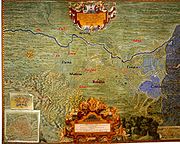
Italian Wars
The Italian Wars, often referred to as the Great Italian Wars or the Great Wars of Italy and sometimes as the Habsburg–Valois Wars, were a series of conflicts from 1494 to 1559 that involved, at various times, most of the city-states of Italy, the Papal States, most of the major states of Western...
began between France
France
The French Republic , The French Republic , The French Republic , (commonly known as France , is a unitary semi-presidential republic in Western Europe with several overseas territories and islands located on other continents and in the Indian, Pacific, and Atlantic oceans. Metropolitan France...
and Spain
Spain
Spain , officially the Kingdom of Spain languages]] under the European Charter for Regional or Minority Languages. In each of these, Spain's official name is as follows:;;;;;;), is a country and member state of the European Union located in southwestern Europe on the Iberian Peninsula...
, which lasted for decades. "", the desperate Italians said, "France or Spain, provided we have something to eat". Land changed hands frequently. Even Switzerland
Switzerland
Switzerland name of one of the Swiss cantons. ; ; ; or ), in its full name the Swiss Confederation , is a federal republic consisting of 26 cantons, with Bern as the seat of the federal authorities. The country is situated in Western Europe,Or Central Europe depending on the definition....
received some Italian-speaking lands in the north (Canton Ticino, not technically a part of the Padan region), and the Venetian
Republic of Venice
The Republic of Venice or Venetian Republic was a state originating from the city of Venice in Northeastern Italy. It existed for over a millennium, from the late 7th century until 1797. It was formally known as the Most Serene Republic of Venice and is often referred to as La Serenissima, in...
domain was invaded, forcing Venice
Venice
Venice is a city in northern Italy which is renowned for the beauty of its setting, its architecture and its artworks. It is the capital of the Veneto region...
into neutrality as an independent power. In the end, Spain prevailed with Charles V
Charles V, Holy Roman Emperor
Charles V was ruler of the Holy Roman Empire from 1519 and, as Charles I, of the Spanish Empire from 1516 until his voluntary retirement and abdication in favor of his younger brother Ferdinand I and his son Philip II in 1556.As...
's victory over Francis I of France
Francis I of France
Francis I was King of France from 1515 until his death. During his reign, huge cultural changes took place in France and he has been called France's original Renaissance monarch...
at the Battle of Pavia
Battle of Pavia
The Battle of Pavia, fought on the morning of 24 February 1525, was the decisive engagement of the Italian War of 1521–26.A Spanish-Imperial army under the nominal command of Charles de Lannoy attacked the French army under the personal command of Francis I of France in the great hunting preserve...
in 1525.
The Spanish
Spain
Spain , officially the Kingdom of Spain languages]] under the European Charter for Regional or Minority Languages. In each of these, Spain's official name is as follows:;;;;;;), is a country and member state of the European Union located in southwestern Europe on the Iberian Peninsula...
domination was oppressive, adding its burden to the Counterreformation imposed by the archbishopric of Milan; Protestantism
Protestantism
Protestantism is one of the three major groupings within Christianity. It is a movement that began in Germany in the early 16th century as a reaction against medieval Roman Catholic doctrines and practices, especially in regards to salvation, justification, and ecclesiology.The doctrines of the...
was prevented from making inroads in the area. Burning at the stake became common practice during witchhunts, especially in the neighboring Alpine lands. During this bleak period, however, Lombard industry
Industry
Industry refers to the production of an economic good or service within an economy.-Industrial sectors:There are four key industrial economic sectors: the primary sector, largely raw material extraction industries such as mining and farming; the secondary sector, involving refining, construction,...
recovered, especially the textile
Textile
A textile or cloth is a flexible woven material consisting of a network of natural or artificial fibres often referred to as thread or yarn. Yarn is produced by spinning raw fibres of wool, flax, cotton, or other material to produce long strands...
branch, its pillar.
When the War of Spanish Succession traded Milan
Milan
Milan is the second-largest city in Italy and the capital city of the region of Lombardy and of the province of Milan. The city proper has a population of about 1.3 million, while its urban area, roughly coinciding with its administrative province and the bordering Province of Monza and Brianza ,...
to Austria
Austria
Austria , officially the Republic of Austria , is a landlocked country of roughly 8.4 million people in Central Europe. It is bordered by the Czech Republic and Germany to the north, Slovakia and Hungary to the east, Slovenia and Italy to the south, and Switzerland and Liechtenstein to the...
, government and administration improved significantly. Though the peasantry began a century-long plunge into misery, cities prospered and grew.
When Napoleon I
Napoleon I
Napoleon Bonaparte was a French military and political leader during the latter stages of the French Revolution.As Napoleon I, he was Emperor of the French from 1804 to 1815...
entered the Po Valley during some of his brightest campaigns (1796 and 1800, culminating in the historical Battle of Marengo), he found an advanced country and made it into his Kingdom of Italy
Kingdom of Italy (Napoleonic)
The Kingdom of Italy was a state founded in Northern Italy by Napoleon, fully influenced by revolutionary France, that ended with his defeat and fall.-Constitutional statutes:...
. With Napoleon's final defeat the Austrians came back, but they were no more welcome: the inhabitants of the region had discovered they were capable and ready to rule themselves as well as any foreign master, and in the west Piedmont
Piedmont
Piedmont is one of the 20 regions of Italy. It has an area of 25,402 square kilometres and a population of about 4.4 million. The capital of Piedmont is Turin. The main local language is Piedmontese. Occitan is also spoken by a minority in the Occitan Valleys situated in the Provinces of...
, ruled by the Italianized Savoy dynasty who had emerged from its Alpine domains in the 16th century, was to serve as a springboard for Italian unification.
Late modern and contemporary
The Risorgimento, after an unsuccessful start in 1848 and 1849, triumphed ten years later in LombardyLombardy
Lombardy is one of the 20 regions of Italy. The capital is Milan. One-sixth of Italy's population lives in Lombardy and about one fifth of Italy's GDP is produced in this region, making it the most populous and richest region in the country and one of the richest in the whole of Europe...
, which was conquered by a Franco-Piedmontese army. In 1866 Veneto
Veneto
Veneto is one of the 20 regions of Italy. Its population is about 5 million, ranking 5th in Italy.Veneto had been for more than a millennium an independent state, the Republic of Venice, until it was eventually annexed by Italy in 1866 after brief Austrian and French rule...
joined young Italy, thanks to Prussia
Prussia
Prussia was a German kingdom and historic state originating out of the Duchy of Prussia and the Margraviate of Brandenburg. For centuries, the House of Hohenzollern ruled Prussia, successfully expanding its size by way of an unusually well-organized and effective army. Prussia shaped the history...
's defeat of Austria
Austria
Austria , officially the Republic of Austria , is a landlocked country of roughly 8.4 million people in Central Europe. It is bordered by the Czech Republic and Germany to the north, Slovakia and Hungary to the east, Slovenia and Italy to the south, and Switzerland and Liechtenstein to the...
. Poverty in the countryside increased emigration to the Americas
Americas
The Americas, or America , are lands in the Western hemisphere, also known as the New World. In English, the plural form the Americas is often used to refer to the landmasses of North America and South America with their associated islands and regions, while the singular form America is primarily...
, a phenomenon which subsided in the central region towards the end of the 19th century, but persisted in Veneto
Veneto
Veneto is one of the 20 regions of Italy. Its population is about 5 million, ranking 5th in Italy.Veneto had been for more than a millennium an independent state, the Republic of Venice, until it was eventually annexed by Italy in 1866 after brief Austrian and French rule...
well into the 20th century. Industry grew rapidly, thanks to an abundance of water and literate manpower.
The World Wars did not significantly damage the area, despite the destruction caused by Allied
Allies of World War II
The Allies of World War II were the countries that opposed the Axis powers during the Second World War . Former Axis states contributing to the Allied victory are not considered Allied states...
aerial bombing
Strategic bombing
Strategic bombing is a military strategy used in a total war with the goal of defeating an enemy nation-state by destroying its economic ability and public will to wage war rather than destroying its land or naval forces...
of many cities and heavy frontline fighting in Romagna
Romagna
Romagna is an Italian historical region that approximately corresponds to the south-eastern portion of present-day Emilia-Romagna. Traditionally, it is limited by the Apennines to the south-west, the Adriatic to the east, and the rivers Reno and Sillaro to the north and west...
. The Resistance
Italian resistance movement
The Italian resistance is the umbrella term for the various partisan forces formed by pro-Allied Italians during World War II...
protected the main industries, which the Third Reich was using for war production, preventing their destruction: on the 25th of April, 1945 a general insurrection in the wake of the German defeat was a huge success. Most cities and towns, notably Milan and Turin, were freed by the partisans days before the Allies arrived.
After the war the Padan area took the lead in the economic miracle
Italian economic miracle
The Italian economic miracle is the name often used by historians, economists and mass media to designate the prolonged period of sustained economic growth in Italy comprised between the end of World War II and the late 1960s, and in particular the years 1950-63...
of the 1950s and 60s. It tended to polarize politically. Emilia-Romagna
Emilia-Romagna
Emilia–Romagna is an administrative region of Northern Italy comprising the two historic regions of Emilia and Romagna. The capital is Bologna; it has an area of and about 4.4 million inhabitants....
, south of the Po, was mostly Communist
Italian Communist Party
The Italian Communist Party was a communist political party in Italy.The PCI was founded as Communist Party of Italy on 21 January 1921 in Livorno, by seceding from the Italian Socialist Party . Amadeo Bordiga and Antonio Gramsci led the split. Outlawed during the Fascist regime, the party played...
and today still is strongly leftist. It is rich and productive thanks to a tightly knit net of cooperatives. Veneto
Veneto
Veneto is one of the 20 regions of Italy. Its population is about 5 million, ranking 5th in Italy.Veneto had been for more than a millennium an independent state, the Republic of Venice, until it was eventually annexed by Italy in 1866 after brief Austrian and French rule...
, traditionally poor, remained staunchly Catholic
Roman Catholic Church
The Catholic Church, also known as the Roman Catholic Church, is the world's largest Christian church, with over a billion members. Led by the Pope, it defines its mission as spreading the gospel of Jesus Christ, administering the sacraments and exercising charity...
in politics but changed unrecognizably in the 70s, later becoming one of the richest areas of Italy (the pillar of the productive Nordest). Lombardy
Lombardy
Lombardy is one of the 20 regions of Italy. The capital is Milan. One-sixth of Italy's population lives in Lombardy and about one fifth of Italy's GDP is produced in this region, making it the most populous and richest region in the country and one of the richest in the whole of Europe...
saw a prevalence of Catholic views (Christian Democracy
Christian Democracy
Christian democracy is a political ideology that seeks to apply Christian principles to public policy. It emerged in nineteenth-century Europe under the influence of conservatism and Catholic social teaching...
), Piedmont
Piedmont
Piedmont is one of the 20 regions of Italy. It has an area of 25,402 square kilometres and a population of about 4.4 million. The capital of Piedmont is Turin. The main local language is Piedmontese. Occitan is also spoken by a minority in the Occitan Valleys situated in the Provinces of...
of leftist forces especially in the zone around Turin
Turin
Turin is a city and major business and cultural centre in northern Italy, capital of the Piedmont region, located mainly on the left bank of the Po River and surrounded by the Alpine arch. The population of the city proper is 909,193 while the population of the urban area is estimated by Eurostat...
. In recent times, while Emilia-Romagna
Emilia-Romagna
Emilia–Romagna is an administrative region of Northern Italy comprising the two historic regions of Emilia and Romagna. The capital is Bologna; it has an area of and about 4.4 million inhabitants....
(whence former Prime Minister
Prime minister of Italy
The Prime Minister of Italy is the head of government of the Italian Republic...
Romano Prodi
Romano Prodi
Romano Prodi is an Italian politician and statesman. He served as the Prime Minister of Italy, from 17 May 1996 to 21 October 1998 and from 17 May 2006 to 8 May 2008...
) has remained firmly center-left, the remaining regions have become increasingly rightist, following the lead of the Milanese
Milanese
Milanese is the central variety of the Western Lombard language spoken in the city and province of Milan....
Silvio Berlusconi
Silvio Berlusconi
Silvio Berlusconi , also known as Il Cavaliere – from knighthood to the Order of Merit for Labour which he received in 1977 – is an Italian politician and businessman who served three terms as Prime Minister of Italy, from 1994 to 1995, 2001 to 2006, and 2008 to 2011. Berlusconi is also the...
. Since 1989, Lega Nord, a federation of Northern regionalist parties, has promoted either secession
Secession
Secession is the act of withdrawing from an organization, union, or especially a political entity. Threats of secession also can be a strategy for achieving more limited goals.-Secession theory:...
or larger autonomy for the Padan area which they call Padania
Padania
Padania is an alternative name for the Po Valley in Italy. The term was sparingly used until the early 1990s, when Lega Nord, a political party in Italy, proposed Padania as a possible denomination for an autonomous Northern Italy...
.