

Aetolian League

Encyclopedia
Ancient Greece
Ancient Greece is a civilization belonging to a period of Greek history that lasted from the Archaic period of the 8th to 6th centuries BC to the end of antiquity. Immediately following this period was the beginning of the Early Middle Ages and the Byzantine era. Included in Ancient Greece is the...
centered on Aetolia
Aetolia
Aetolia is a mountainous region of Greece on the north coast of the Gulf of Corinth, forming the eastern part of the modern prefecture of Aetolia-Acarnania.-Geography:...
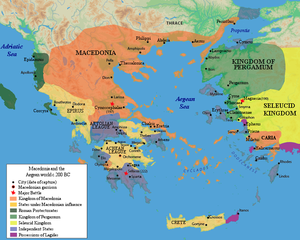
in central Greece. It was established, probably during the early Hellenistic era, in opposition to Macedon
Macedon
Macedonia or Macedon was an ancient kingdom, centered in the northeastern part of the Greek peninsula, bordered by Epirus to the west, Paeonia to the north, the region of Thrace to the east and Thessaly to the south....
and the Achaean League
Achaean League
The Achaean League was a Hellenistic era confederation of Greek city states on the northern and central Peloponnese, which existed between 280 BC and 146 BC...
. Two annual meetings were held in Thermika
Thermos (Aetolia)
Thermos was an ancient Greek sanctuary, which served as the regular meeting place of the Aetolian League...
and Panaetolika. It occupied Delphi
Delphi
Delphi is both an archaeological site and a modern town in Greece on the south-western spur of Mount Parnassus in the valley of Phocis.In Greek mythology, Delphi was the site of the Delphic oracle, the most important oracle in the classical Greek world, and a major site for the worship of the god...
from 290 BC
290 BC
Year 290 BC was a year of the pre-Julian Roman calendar. At the time it was known as the Year of the Consulship of Rufinus and Dentatus...
and gained territory steadily until, by the end of the 3rd century BC, it controlled the whole of central Greece outside Attica
Attica
Attica is a historical region of Greece, containing Athens, the current capital of Greece. The historical region is centered on the Attic peninsula, which projects into the Aegean Sea...
. At its height, the league's territory included Locris
Locris
Locris was a region of ancient Greece, the homeland of the Locrians, made up of three distinct districts.-Locrian tribe:...
, Malis, Dolopes, part of Thessaly
Thessaly
Thessaly is a traditional geographical region and an administrative region of Greece, comprising most of the ancient region of the same name. Before the Greek Dark Ages, Thessaly was known as Aeolia, and appears thus in Homer's Odyssey....
, Phocis
Phocis
Phocis is one of the regional units of Greece. It is part of the administrative region of Central Greece. It stretches from the western mountainsides of Parnassus on the east to the mountain range of Vardousia on the west, upon the Gulf of Corinth...
, and Acarnania
Acarnania
Acarnania is a region of west-central Greece that lies along the Ionian Sea, west of Aetolia, with the Achelous River for a boundary, and north of the gulf of Calydon, which is the entrance to the Gulf of Corinth. Today it forms the western part of the prefecture of Aetolia-Acarnania. The capital...
. In the latter part of its power, certain Mediterranean city-states joined the Aitolian League such as Kydonia on Crete
Crete
Crete is the largest and most populous of the Greek islands, the fifth largest island in the Mediterranean Sea, and one of the thirteen administrative regions of Greece. It forms a significant part of the economy and cultural heritage of Greece while retaining its own local cultural traits...
.
The Aetolians were not highly regarded by other Greeks, who considered them to be semi-barbaric and reckless. However, their league had a complex political and administrative structure, and their armies were easily a match for the other Greek powers. According to Scholten, the Aetolian League consisted of elites at the top, but was fundamentally a society of farmers and herders. The league had a federal structure consisting of a federal council in which the level of representation was proportional to the size of a community's contribution to the league's army, a popular assembly of all citizens which met twice a year, and an inner council equivalent to a federal government. It could raise armies and conduct foreign policy on a common basis. It also implemented economic standardization, levying taxes, using a common currency and adopting a uniform system of weights and measures.
Origins of the League
It is uncertain when the League was founded. It has been suggested that it may have been founded by EpaminondasEpaminondas
Epaminondas , or Epameinondas, was a Theban general and statesman of the 4th century BC who transformed the Ancient Greek city-state of Thebes, leading it out of Spartan subjugation into a preeminent position in Greek politics...
. Grainger believes it was founded much later - around the time of the rise of Philip II of Macedon
Philip II of Macedon
Philip II of Macedon "friend" + ἵππος "horse" — transliterated ; 382 – 336 BC), was a king of Macedon from 359 BC until his assassination in 336 BC. He was the father of Alexander the Great and Philip III.-Biography:...
. After Philip's victory of Chaeronea Aetolia was granted Naupaktos which the Aetolians garrisoned - a level of organization that suggests some formal government rather than the loose alliance of earlier times.
Alliance with Rome
The league was the first Greek ally of the Roman RepublicRoman Republic
The Roman Republic was the period of the ancient Roman civilization where the government operated as a republic. It began with the overthrow of the Roman monarchy, traditionally dated around 508 BC, and its replacement by a government headed by two consuls, elected annually by the citizens and...
, siding with the Romans during the First Macedonian War
First Macedonian War
The First Macedonian War was fought by Rome, allied with the Aetolian League and Attalus I of Pergamon, against Philip V of Macedon, contemporaneously with the Second Punic War against Carthage...
, and helping to defeat Philip V of Macedon
Philip V of Macedon
Philip V was King of Macedon from 221 BC to 179 BC. Philip's reign was principally marked by an unsuccessful struggle with the emerging power of Rome. Philip was attractive and charismatic as a young man...
at the Battle of Cynoscephalae
Battle of Cynoscephalae
The Battle of Cynoscephalae was an encounter battle fought in Thessaly in 197 BC between the Roman army, led by Titus Quinctius Flamininus, and the Antigonid dynasty of Macedon, led by Philip V.- Prelude :...
in 197 BC
197 BC
Year 197 BC was a year of the pre-Julian Roman calendar. At the time it was known as the Year of the Consulship of Cethegus and Rufus...
, during the Second Macedonian War
Second Macedonian War
The Second Macedonian War was fought between Macedon, led by Philip V of Macedon, and Rome, allied with Pergamon and Rhodes. The result was the defeat of Philip who was forced to abandon all his possessions in Greece...
. However, it grew increasingly hostile to Roman involvement in Greek affairs and only a few years later sided with Antiochus III, the anti-Roman king of the Seleucid Empire
Seleucid Empire
The Seleucid Empire was a Greek-Macedonian state that was created out of the eastern conquests of Alexander the Great. At the height of its power, it included central Anatolia, the Levant, Mesopotamia, Persia, today's Turkmenistan, Pamir and parts of Pakistan.The Seleucid Empire was a major centre...
, during the Roman-Syrian War
Roman-Syrian War
The Roman–Syrian War , also known as War of Antiochos or Syrian War, was a military conflict between two coalitions led by the Roman Republic and the Seleucid Empire under Antiochus the Great...
. The defeat of Antiochus in 189 BC
189 BC
Year 189 BC was a year of the pre-Julian Roman calendar. At the time it was known as the Year of the Consulship of Nobilior and Vulso...
robbed the league of its principal foreign ally and made it impossible to stand alone in continued opposition to Rome. The league was forced to sign a peace treaty with Rome that made it a subject ally of the republic. Although it continued to exist in name, the power of the league was broken by the treaty and it never again constituted a significant political or military force.
A Pirate State?
The Aetolian League acquired a reputation for piracy and brigandage. Though there is some recognition that Polybius was to an extent following an Achaean bias in his portrayal of the League thus, many modern historians have accepted this portrayal as in the main justified. For example, Walbank is explicit in seeing the Aetolians as systematically using piracy to supplement their income because of the meager resources of their region while Will simply assumes the truth of the charge. Grainger devotes a whole chapter to examining Aetolian involvement in piracy along with the charges that the Aetolians were temple robbers. He finds it hard to credit that Aetolia was involved in piracy given that Aetolia lacked a fleet of even the basic sort. Further by contrast with more general historians, those that have made specific studies of piracy and brigandage barely mention Aetolia. He lists the times that the Aetolians were accused of temple robbery and argues that the weight of these accusations should take into account that these are usually made by political opponents of the League and refer to occasions that were already some way in the past when the accusations were made.Sources
- John D. Grainger (1999) The League of the Aitolians (Google Books).
- C. Michael Hogan, Cydonia, Modern Antiquarian, January 23, 2008 http://www.themodernantiquarian.com/site/10881/cydonia.html#fieldnotes
- Krzysztof Kęciek (2002) "Kynoskefalaj 197 p.n.e" Serie Historic Battles Published in Warsaw by Bellona.
- Joseph B. Scholten (2000) The Politics of Plunder:Aitolians and Their Koinon in the Early Hellenistic Era (Google Books).
- Willis Mason West (1902) Ancient History to the Death of Charlemagne, Allyn and Bacon.