

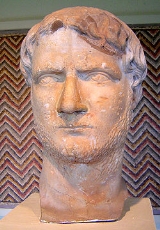
Gallienus

Encyclopedia
Roman Emperor
The Roman emperor was the ruler of the Roman State during the imperial period . The Romans had no single term for the office although at any given time, a given title was associated with the emperor...
with his father Valerian
Valerian (emperor)
Valerian , also known as Valerian the Elder, was Roman Emperor from 253 to 260. He was taken captive by Persian king Shapur I after the Battle of Edessa, becoming the only Roman Emperor who was captured as a prisoner of war, resulting in wide-ranging instability across the Empire.-Origins and rise...
from 253 to 260, and alone from 260 to 268. He took control of the Empire at a time when it was undergoing great crisis
Crisis of the Third Century
The Crisis of the Third Century was a period in which the Roman Empire nearly collapsed under the combined pressures of invasion, civil war, plague, and economic depression...
. His record in dealing with those crises is mixed, as he won a number of military victories but was unable to keep much of his realm from seceding.
Rise to power
Based on the testimony of John MalalasJohn Malalas
John Malalas or Ioannes Malalas was a Greek chronicler from Antioch. Malalas is probably a Syriac word for "rhetor", "orator"; it is first applied to him by John of Damascus .-Life:Malalas was educated in Antioch, and probably was a jurist there, but moved to...
and the Epitome de Caesaribus that Gallienus was about 50 years old at the time of his death, it is generally considered he was born around 218, son of Valerian
Valerian (emperor)
Valerian , also known as Valerian the Elder, was Roman Emperor from 253 to 260. He was taken captive by Persian king Shapur I after the Battle of Edessa, becoming the only Roman Emperor who was captured as a prisoner of war, resulting in wide-ranging instability across the Empire.-Origins and rise...
and Mariniana
Mariniana
Egnatia Mariniana probably was the wife of Roman Emperor Valerian and mother of Emperor Gallienus and Valerianus Minor.Several coins bearing the legend DIVAE MARINIANAE date back to the beginning of the reign of Valerian and Gallienus...
, a woman possibly of senatorial rank and possibly a daughter of Egnatius Victor Marinianus
Egnatius Victor Marinianus
Egnatius Victor Marinianus was a Roman soldier and politician.He was Legatus of Arabia Petraea and Moesia Superior.He might have been the father of Egnatia Mariniana, wife of Valerianus and mother of Gallienus. Other sources, however, make her the daughter of Lucius Egnatius Victor, which makes him...
, and brother of Valerianus Minor
Valerianus Minor
Valerianus Minor was the son of the Roman Emperor Valerian I. He was probably killed by usurpers, some time between the assassination of his father in 260 AD and that of his brother Gallienus in 268 AD. Not much else is known about him....
. Inscriptions on coins connect him with Falerii
Falerii
Falerii was one of the twelve chief cities of Etruria, situated about 1.5 km west of the ancient Via Flaminia, around 50 kilometers north of Rome.- History :According to legend, it was of Argive origin...
in Etruria
Etruria
Etruria—usually referred to in Greek and Latin source texts as Tyrrhenia—was a region of Central Italy, an area that covered part of what now are Tuscany, Latium, Emilia-Romagna, and Umbria. A particularly noteworthy work dealing with Etruscan locations is D. H...
and this may well have been his birthplace; it has yielded many inscriptions relating to his mother's family, the Egnatii.
He married to Cornelia Salonina
Cornelia Salonina
Julia Cornelia Salonina was an Augusta, wife of Roman Emperor Gallienus and mother of Valerian II, Saloninus, and Marinianus.-Early life:...
about ten years before his accession to the throne. She was the mother of three princes, Valerian II
Valerian II
Publius Licinius Cornelius Valerianus , also known as Valerian II, was the eldest son of Roman Emperor Gallienus and Augusta Cornelia Salonina who was of Greek origin and grandson of the Emperor Valerian I who was of a noble and traditional senatorial family.Shortly after his acclamation as Emperor...
(who died in 258), Saloninus
Saloninus
Publius Licinius Cornelius Saloninus Valerianus was Roman Emperor in 259 or 260.-Early life:Saloninus was born around the year 242. His father was the later emperor Gallienus, his mother Cornelia Salonina, a Greek from Bithynia...
(who, after becoming co-emperor, died in 260 by the hand of his general Postumus), and Marinianus
Marinianus
Publius Licinius Egnatius Marinianus was the third and youngest son of Roman Emperor Gallienus and Augusta Cornelia Salonina.Gallienus appointed him together with Paternus as Consul in early 268...
(killed in 268, shortly after his father was assassinated).
When his father Valerian
Valerian (emperor)
Valerian , also known as Valerian the Elder, was Roman Emperor from 253 to 260. He was taken captive by Persian king Shapur I after the Battle of Edessa, becoming the only Roman Emperor who was captured as a prisoner of war, resulting in wide-ranging instability across the Empire.-Origins and rise...
was proclaimed Emperor on 22 October 253, he asked the Senate
Roman Senate
The Senate of the Roman Republic was a political institution in the ancient Roman Republic, however, it was not an elected body, but one whose members were appointed by the consuls, and later by the censors. After a magistrate served his term in office, it usually was followed with automatic...
to ratify Gallienus' elevation to Caesar and Augustus
Augustus (honorific)
Augustus , Latin for "majestic," "the increaser," or "venerable", was an Ancient Roman title, which was first held by Gaius Julius Caesar Augustus , and subsequently came to be considered one of the titles of what are now known as the Roman Emperors...
, in order to share the power between two persons. He was also designated Consul Ordinarius
Roman consul
A consul served in the highest elected political office of the Roman Republic.Each year, two consuls were elected together, to serve for a one-year term. Each consul was given veto power over his colleague and the officials would alternate each month...
for 254.
As Marcus Aurelius and his adopted brother Lucius Verus had done a hundred years before them, Gallienus and his father divided the Empire; Valerian struck for the East to stem the Persian threat and Gallienus remained in Italy to repel the Germanic tribes on the Rhine and Danube
Danube
The Danube is a river in the Central Europe and the Europe's second longest river after the Volga. It is classified as an international waterway....
. This policy made sense not simply because the unhappy fates of several Emperors previous to this duo had made it clear that one man simply could not rule a state this size; equally, a 'barbarian' enemy suing for peace in this time tended to demand that they be allowed to apply to the 'chief' or 'king' of the victorious side. Therefore, an Emperor had to be available to negotiate if such a situation arose
Early reign and Ingenuus' revolt
While spending most of his time in the provinces of the Rhine area (Germania InferiorGermania Inferior
Germania Inferior was a Roman province located on the left bank of the Rhine, in today's Luxembourg, southern Netherlands, parts of Belgium, and North Rhine-Westphalia left of the Rhine....
, Germania Superior
Germania Superior
Germania Superior , so called for the reason that it lay upstream of Germania Inferior, was a province of the Roman Empire. It comprised an area of western Switzerland, the French Jura and Alsace regions, and southwestern Germany...
, Raetia
Raetia
Raetia was a province of the Roman Empire, named after the Rhaetian people. It was bounded on the west by the country of the Helvetii, on the east by Noricum, on the north by Vindelicia, on the west by Cisalpine Gaul and on south by Venetia et Histria...
, Noricum
Noricum
Noricum, in ancient geography, was a Celtic kingdom stretching over the area of today's Austria and a part of Slovenia. It became a province of the Roman Empire...
), it is almost certain that, during 253 to 258, Gallienus visited the Danube
Danube
The Danube is a river in the Central Europe and the Europe's second longest river after the Volga. It is classified as an international waterway....
area and Illyricum
Illyricum (Roman province)
The Roman province of Illyricum or Illyris Romana or Illyris Barbara or Illyria Barbara replaced most of the region of Illyria. It stretched from the Drilon river in modern north Albania to Istria in the west and to the Sava river in the north. Salona functioned as its capital...
. According to Eutropius and Aurelius Victor, he was particularly energetic and successful in keeping off the Germanic invaders from the German provinces and Gaul, after the weakness caused by Valerian's march on Italy against Aemilianus
Aemilianus
Aemilianus , also known as Aemilian, was Roman Emperor for three months in 253.Commander of the Moesian troops, he obtained an important victory against the invading Goths and was, for this reason, acclaimed Emperor by his army...
in 253. Indeed, according to numismatic evidence, it seems that he won many victories there and a victory in Roman Dacia
Roman Dacia
The Roman province of Dacia on the Balkans included the modern Romanian regions of Transylvania, Banat and Oltenia, and temporarily Muntenia and southern Moldova, but not the nearby regions of Moesia...
might also be dated to that period. Even the hostile Latin tradition attributes him success at this time.
In 255 and 257 he was made Consul again; this perhaps indicates that he briefly visited Rome on those occasions, although no record has been left of it. During his Danube sojourn (Drinkwater suggests in 255 or 256) he proclaimed his elder son Valerian II
Valerian II
Publius Licinius Cornelius Valerianus , also known as Valerian II, was the eldest son of Roman Emperor Gallienus and Augusta Cornelia Salonina who was of Greek origin and grandson of the Emperor Valerian I who was of a noble and traditional senatorial family.Shortly after his acclamation as Emperor...
Caesar and thus official heir to himself and Valerian I; the boy probably now joined Gallienus on campaign and when Gallienus moved west to the Rhine provinces in 257 remained behind on the Danube as the personification of Imperial authority.
However, somewhere between 258 and 260 (the exact date is unclear), Gallienus had to face the first major revolt in his reign. Ingenuus
Ingenuus
Ingenuus was a Roman military commander, the imperial legate in Pannonia, who became a usurper to the throne of the emperor Gallienus when he led a brief and unsuccessful revolt in the year 260. Appointed by Gallienus himself, Ingenuus served him well by repulsing a Sarmatian invasion and securing...
, governor of at least one of the Pannonias, took advantage of Valerian's distraction with the ongoing invasion of Shapur in the East and the preoccupation of Gallienus with his problems in the West and declared himself emperor. Valerian II had apparently died on the Danube, most likely in 258, and Ingenuus may have been responsible – or wrongly held responsible – for that calamity. According to another view, Valerian's disaster and capture at the battle of Edessa
Battle of Edessa
The Battle of Edessa took place between the armies of the Roman Empire under the command of Emperor Valerian and Sassanid forces under Shahanshah Shapur I in 259...
was the trigger for the subsequent revolts of Ingenuus, Regalianus
Regalianus
P. C Regalianus was a Dacian general who turned against the Roman Empire and became himself emperor for a brief period, being murdered by the hands who raised him to power.-Career:...
and Postumus
Postumus
Marcus Cassianius Latinius Postumus was a Roman emperor of Batavian origin. He usurped power from Gallienus in 260 and formed the so-called Gallic Empire...
. In any case, Gallienus reacted with great speed. First, he left his son Saloninus
Saloninus
Publius Licinius Cornelius Saloninus Valerianus was Roman Emperor in 259 or 260.-Early life:Saloninus was born around the year 242. His father was the later emperor Gallienus, his mother Cornelia Salonina, a Greek from Bithynia...
as Caesar at Cologne
Cologne
Cologne is Germany's fourth-largest city , and is the largest city both in the Germany Federal State of North Rhine-Westphalia and within the Rhine-Ruhr Metropolitan Area, one of the major European metropolitan areas with more than ten million inhabitants.Cologne is located on both sides of the...
, under the supervision of Albanus (or Silvanus) and the military leadership of Postumus. Then he hastily crossed through the Balkans
Balkans
The Balkans is a geopolitical and cultural region of southeastern Europe...
, taking with him the new cavalry corps (comitatus) under the command of Aureolus
Aureolus
For the Frankish ruler of Aragon, see Aureolus of Aragon.Manius Acilius Aureolus was a Roman military commander and would-be usurper. He was one of the so-called Thirty Tyrants who populated the reign of the Emperor Gallienus...
and defeated the usurper at Mursa or Sirmium
Sirmium
Sirmium was a city in ancient Roman Pannonia. Firstly mentioned in the 4th century BC and originally inhabited by the Illyrians and Celts, it was conquered by the Romans in the 1st century BC and subsequently became the capital of the Roman province of Lower Pannonia. In 294 AD, Sirmium was...
. The victory must be attributed mainly to the cavalry and its brilliant commander. Ingenuus was killed by his own guards or committed suicide by drowning himself after the fall of his capital, Sirmium.
Invasion of the Alamanni
A major invasion of the Alamanni and other Germanic tribes occurred somewhere between 258 and 260 (it is hard to fix the precise date of these events). The reason probably was the vacuum left by the withdrawal of troops for supporting Gallienus in the campaign against Ingenuus.First Franks broke through the lower Rhine, invading Gaul. A band of them reach as far as southern Spain, sacking Tarraco (modern Tarragona
Tarragona
Tarragona is a city located in the south of Catalonia on the north-east of Spain, by the Mediterranean. It is the capital of the Spanish province of the same name and the capital of the Catalan comarca Tarragonès. In the medieval and modern times it was the capital of the Vegueria of Tarragona...
). Then Alamanni broke in, probably through Agri Decumates
Agri Decumates
The agri decumates or decumates agri were a region of the Roman Empire's province of Germania superior , covering the Black Forest area between the Main river and the sources of Danube and Rhine rivers, presently in Southwestern Germany...
(an area between the upper Rhine and the upper Danube), probably followed by the Juthungi
Juthungi
The Juthungi were a Germanic tribe in the region north of the rivers Danube and Altmühl in the modern German state of Bavaria....
. After devastating Germania Superior and Raetia (parts of southern France
France
The French Republic , The French Republic , The French Republic , (commonly known as France , is a unitary semi-presidential republic in Western Europe with several overseas territories and islands located on other continents and in the Indian, Pacific, and Atlantic oceans. Metropolitan France...
and Switzerland
Switzerland
Switzerland name of one of the Swiss cantons. ; ; ; or ), in its full name the Swiss Confederation , is a federal republic consisting of 26 cantons, with Bern as the seat of the federal authorities. The country is situated in Western Europe,Or Central Europe depending on the definition....
), they entered Italy. It was the first invasion of the peninsula, apart from its remotest northern regions, since the days of Hannibal, 500 years before. When invaders reached the outskirts of Rome, they were repelled by an improvised army assembled by the Senate. That army consisted of local troops (probably praetorian guards) and the strongest of the civilian population. On their retreat through the northern Italy, they were intercepted by the Gallienus' army near present day Milan
Milan
Milan is the second-largest city in Italy and the capital city of the region of Lombardy and of the province of Milan. The city proper has a population of about 1.3 million, while its urban area, roughly coinciding with its administrative province and the bordering Province of Monza and Brianza ,...
and defeated in the battle of Mediolanum
Battle of Mediolanum
The Battle of Mediolanum took place in 259, between the Alamannic Germans and the Roman legions under the command of Emperor Gallienus.-Background:...
. He had advanced from Gaul, after dealing with the Franks or came from the Balkans. Juthungi managed to cross the Alps with their booty and captives from Italy but, in any case, the victory at the battle of Mediolanum was decisive. Alamanni didn't bother the Empire for the next 10 years.
An historian in the 19th century suggested that the initiative of the Senate gave rise to the jealousy and suspicion of Gallienus, thus contributing in the exclusion of senators from military commands.
Regalianus' revolt
At some time before or after the Alamannic invasion, RegalianusRegalianus
P. C Regalianus was a Dacian general who turned against the Roman Empire and became himself emperor for a brief period, being murdered by the hands who raised him to power.-Career:...
, a military commander of Illyricum
Illyricum (Roman province)
The Roman province of Illyricum or Illyris Romana or Illyris Barbara or Illyria Barbara replaced most of the region of Illyria. It stretched from the Drilon river in modern north Albania to Istria in the west and to the Sava river in the north. Salona functioned as its capital...
was proclaimed Emperor. The reasons for his usurpation are unclear and Historia Augusta, the almost sole resource for the events, does not provide a credible story. It is possible that the usurpation can be attributed to the discontent of the civilian and military provincials, when they felt that the defense of the province was neglected.
Nevertheless, it seems that Regalianus held power for some six months and issued coins bearing his image. After some success against the Sarmatians
Sarmatians
The Iron Age Sarmatians were an Iranian people in Classical Antiquity, flourishing from about the 5th century BC to the 4th century AD....
, his revolt was put down by the invasion of Roxolani into Pannonia
Pannonia
Pannonia was an ancient province of the Roman Empire bounded north and east by the Danube, coterminous westward with Noricum and upper Italy, and southward with Dalmatia and upper Moesia....
and Regalianus himself was killed when the invaders took the important city of Sirmium
Sirmium
Sirmium was a city in ancient Roman Pannonia. Firstly mentioned in the 4th century BC and originally inhabited by the Illyrians and Celts, it was conquered by the Romans in the 1st century BC and subsequently became the capital of the Roman province of Lower Pannonia. In 294 AD, Sirmium was...
. There is a suggestion that Gallienus invited Roxolani against Regalianus but other historians dismiss the accusation. It is also suggested that the invasion was finally checked by Gallienus near Verona
Verona
Verona ; German Bern, Dietrichsbern or Welschbern) is a city in the Veneto, northern Italy, with approx. 265,000 inhabitants and one of the seven chef-lieus of the region. It is the second largest city municipality in the region and the third of North-Eastern Italy. The metropolitan area of Verona...
and he directed the restoration of the province, probably in person.
Postumus' revolt
One more consequence of the catastrophe at the battle of Edessa was that Gallienus lost control over the two provinces of Germania, Britain, Spain and a large part of Gaul, when another general, PostumusPostumus
Marcus Cassianius Latinius Postumus was a Roman emperor of Batavian origin. He usurped power from Gallienus in 260 and formed the so-called Gallic Empire...
, had declared his own realm (typically known today as the Gallic Empire
Gallic Empire
The Gallic Empire is the modern name for a breakaway realm that existed from 260 to 274. It originated during the Roman Empire's Crisis of the Third Century....
). The revolt partially coincided with that of Macrianus in the East.
The circumstances of the usurpation were, once more, dramatic. In Cologne, Gallienus son, Saloninus, and his supervisor Silvanus were installed by Gallienus in 258. Postumus, a general in command of the troops on the banks of the Rhine, took possession of the booty which some raiders were carrying, after defeating them. Instead of returning it to the original owners, he preferred to distribute it amongst his soldiers. When these news reached Silvanus, he demanded that the spoil be sent to him. Postumus made a show of submission but, as expected, his soldiers mutinied and proclaimed him Emperor. Under his command, they besieged Cologne and, after some weeks, the defenders of the city opened the gates and handed Saloninus and Silvanus to Postumus who had them killed. Again, the dating of the events is not safe but perhaps all these happened just before the end of 260. After their death, Postumus claimed the consulship for himself and one of his associates, Honoratianus but, according to D.S. Potter, he never tried to unseat Gallienus or invade Italy.
On the news of the killing of his son, the enraged Gallienus started gathering forces to face the usurper. However, the invasion of the Macriani forced him to dispatch Aureolus with a large force against them, leaving him with insufficient troops. He suffered some initial defeats before the victorious army of Aureolus joined him again. Postumus was defeated and the pursuit was entrusted to Aureolus. The latter deliberately allowed Postumus to escape and gather new forces. Gallienus returned in 263 or 265 and, as even Historia Augusta admits, was entirely successful, finally besieging Postumus in an unnamed Gallic city; however, during the siege, he was severely wounded by an arrow and had to leave the field. Then there was a standstill until the end of Gallienus reign. The Gallic Empire
Gallic Empire
The Gallic Empire is the modern name for a breakaway realm that existed from 260 to 274. It originated during the Roman Empire's Crisis of the Third Century....
remained independent until 274.
Capture of Valerian, Macrianus' revolt
On the Eastern part of the Empire, Valerian was confronted with serious troubles. A band of "Scythians" set a naval raid against Pontus, in the northern part of modern Turkey.After they ravaged the province, they moved to the south, into Cappadocia
Cappadocia (Roman province)
Cappadocia was a province of the Roman empire in Anatolia , with its capital at Caesarea. It was established in 17 AD by the emperor Tiberius , following the death of Cappadocia's last king, Archelaus. It was an imperial province, meaning that its governor was directly appointed by the emperor...
. Valerian led troops to intercept them but failed, perhaps because of a plague that gravely weakened his army and the contemporary Iranian invasion of northern Mesopotamia
Mesopotamia
Mesopotamia is a toponym for the area of the Tigris–Euphrates river system, largely corresponding to modern-day Iraq, northeastern Syria, southeastern Turkey and southwestern Iran.Widely considered to be the cradle of civilization, Bronze Age Mesopotamia included Sumer and the...
by Shapur I
Shapur I
Shapur I or also known as Shapur I the Great was the second Sassanid King of the Second Persian Empire. The dates of his reign are commonly given as 240/42 - 270/72, but it is likely that he also reigned as co-regent prior to his father's death in 242 .-Early years:Shapur was the son of Ardashir I...
, ruler of the Sassanid Empire
Sassanid Empire
The Sassanid Empire , known to its inhabitants as Ērānshahr and Ērān in Middle Persian and resulting in the New Persian terms Iranshahr and Iran , was the last pre-Islamic Persian Empire, ruled by the Sasanian Dynasty from 224 to 651...
. In 259 or 260, during the battle of Edessa
Battle of Edessa
The Battle of Edessa took place between the armies of the Roman Empire under the command of Emperor Valerian and Sassanid forces under Shahanshah Shapur I in 259...
, Valerian was taken prisoner by Shapur. After its victory, Shapur's army raided Cilicia
Cilicia
In antiquity, Cilicia was the south coastal region of Asia Minor, south of the central Anatolian plateau. It existed as a political entity from Hittite times into the Byzantine empire...
and Cappadocia
Cappadocia
Cappadocia is a historical region in Central Anatolia, largely in Nevşehir Province.In the time of Herodotus, the Cappadocians were reported as occupying the whole region from Mount Taurus to the vicinity of the Euxine...
(in present day Turkey
Turkey
Turkey , known officially as the Republic of Turkey , is a Eurasian country located in Western Asia and in East Thrace in Southeastern Europe...
) sacking, as Shapur's inscriptions claim, 36 cities. It took a rally by an officer Callistus
Balista
Balista or Ballista , also known in the sources with the probably wrong name of "Callistus", was one of the Thirty Tyrants of the Historia Augusta, and supported the rebellion of the Macriani against Emperor Gallienus....
(Ballista), a fiscal official named Fulvius Macrianus
Macrianus Major
Fulvius Macrianus , also called Macrianus Major, was a Roman usurper. He was one of Valerian's fiscal officers. More precisely, sources refer to him as being in charge of the whole state accounts or, in the language of a later age, as Count of the Treasury and the person in charge of markets and...
, the remains of the Eastern Roman legions and one Odenathus
Odaenathus
Lucius Septimius Odaenathus, Odenathus or Odenatus , the Latinized form of the Syriac Odainath, was a ruler of Palmyra, Syria and later of the short lived Palmyrene Empire, in the second half of the 3rd century, who succeeded in recovering the Roman East from the Persians and restoring it to the...
and his Palmyrene
Palmyra
Palmyra was an ancient city in Syria. In the age of antiquity, it was an important city of central Syria, located in an oasis 215 km northeast of Damascus and 180 km southwest of the Euphrates at Deir ez-Zor. It had long been a vital caravan city for travellers crossing the Syrian desert...
horsemen to turn the tide against Shapur. In 261 Gallienus became Consul for the fourth time.
The Persians were driven back but then Macrianus proclaimed his two sons Quietus
Quietus
Titus Fulvius Iunius Quietus was a Roman usurper against Roman Emperor Gallienus.Quietus was the son of Fulvius Macrianus and a noblewoman, possibly named Iunia...
and Macrianus
Macrianus Minor
Titus Fulvius Iunius Macrianus , also known as Macrianus Minor, was a Roman usurper. He was the son of Fulvius Macrianus, also known as Macrianus Major.- Career :...
(sometimes wrongly spelled Macrinus) as emperors towards the end of the summer of that year. Coins struck for them in major cities of the East show the acknowledgement of the usurpation. The two Macriani left Quietus, Ballista, and, presumably, Odenathus to deal with the Persians while they invaded Europe with an army of 30,000 men, according to the Historia Augusta. At first they met no opposition. The Pannonian legions joined the invaders, being resentful of the absence of Gallienus. However, the latter sent his successful commander Aureolus against the rebels. The decisive battle was fought in the spring or early summer of 261, most likely in Illyricum, although Zonaras locates it in Pannonia. In any case, the army of the usurpers surrendered and their two leaders were killed.
In the aftermath of the battle, the rebellion of Postumus had already started, therefore Gallienus had no time to deal with the rest of the usurpers, namely Ballista and Quietus. He came to an agreement with Odenathus who had just returned from his victorious Persian expedition. The latter received the title of dux Romanorum and besieged the usurpers who were based at Emesa. Eventually, the people of Emesa killed Quietus and Odenathus arrested and executed Ballista about November 261.
Aemilianus' revolt
In 261, the mint in AlexandriaAlexandria
Alexandria is the second-largest city of Egypt, with a population of 4.1 million, extending about along the coast of the Mediterranean Sea in the north central part of the country; it is also the largest city lying directly on the Mediterranean coast. It is Egypt's largest seaport, serving...
started again to issue coins for Gallienus. This shows that, after suppressing the revolt of Macriani, Egypt had returned to Gallienus' control; however, in spring of 262, the city is reported to be rent by civil tumult, as a result of a new usurpation. This time, the rebel was the prefect of Egypt, Lucius Mussius Aemilianus
Mussius Aemilianus
Lucius Mussius Aemilianus was a Roman usurper.Mussius Aemilianus probably was of Italian stock. He was an officer in the Roman army under Philip the Arab and Valerian. Under the latter he became praefect of Egypt. He supported the rebellion of the Macriani against Gallienus...
who had already given support to the revolt of Macriani. The correspondence of bishop Dionysius of Alexandria provides a colourful commentary on the sombre background of invasion, civil war, plague and famine that characterized this age.
Gallienus, knowing that he could not afford the loss of control on the vital Egyptian granaries, sent his general Theodotus against Aemilianus. The expedition was probably naval. The decisive battle probably took place near Thebes and the result was a clear defeat of Aemilianus. In the aftermath, Gallienus became Consul three more times in 262, 264 and 266.
Herulian invasions, Aureolus' revolt, conspiracy and death
In the years 267–269, Goths and other barbarians invaded the BalkansBalkans
The Balkans is a geopolitical and cultural region of southeastern Europe...
in great numbers. Sources are extremely confused on the dating of these invasions, the participants, and their targets. Modern historians are even not able to tell with enough certainty whether there were two or more of these invasions or a single prolonged one. It seems that, at first, a major naval expedition was led by Heruli
Heruli
The Heruli were an East Germanic tribe who are famous for their naval exploits. Migrating from Northern Europe to the Black Sea in the third century They were part of the...
, starting from northern Black Sea
Black Sea
The Black Sea is bounded by Europe, Anatolia and the Caucasus and is ultimately connected to the Atlantic Ocean via the Mediterranean and the Aegean seas and various straits. The Bosphorus strait connects it to the Sea of Marmara, and the strait of the Dardanelles connects that sea to the Aegean...
and leading in the ravaging of many cities of Greece (among them, Athens
Athens
Athens , is the capital and largest city of Greece. Athens dominates the Attica region and is one of the world's oldest cities, as its recorded history spans around 3,400 years. Classical Athens was a powerful city-state...
and Sparta
Sparta
Sparta or Lacedaemon, was a prominent city-state in ancient Greece, situated on the banks of the River Eurotas in Laconia, in south-eastern Peloponnese. It emerged as a political entity around the 10th century BC, when the invading Dorians subjugated the local, non-Dorian population. From c...
).
Then another, even more numerous, army of invaders started a second naval invasion of the Balkans. Romans defeated the barbarians on sea at first, then a battle in Thrace
Thrace
Thrace is a historical and geographic area in southeast Europe. As a geographical concept, Thrace designates a region bounded by the Balkan Mountains on the north, Rhodope Mountains and the Aegean Sea on the south, and by the Black Sea and the Sea of Marmara on the east...
was won by Gallienus's army and the Emperor kept pursuing the invaders. According to some historians, he was the leader of the army who won the great Battle of Naissus
Battle of Naissus
The Battle of Naissus was the defeat of a Gothic coalition by the Roman Empire under Emperor Gallienus near Naissus...
, while the majority believes that the victory must be attributed to his successor Claudius II
Claudius II
Claudius II , commonly known as Claudius Gothicus, was Roman Emperor from 268 to 270. During his reign he fought successfully against the Alamanni and scored a crushing victory against the Goths at the Battle of Naissus. He died after succumbing to a smallpox plague that ravaged the provinces of...
.
In 268, at some time before or soon after the battle of Naissus, Gallienus' authority was challenged by Aureolus
Aureolus
For the Frankish ruler of Aragon, see Aureolus of Aragon.Manius Acilius Aureolus was a Roman military commander and would-be usurper. He was one of the so-called Thirty Tyrants who populated the reign of the Emperor Gallienus...
, commander of the cavalry stationed in Mediolanum
Mediolanum
Mediolanum, the ancient Milan, was an important Celtic and then Roman centre of northern Italy. This article charts the history of the city from its settlement by the Insubres around 600 BC, through its conquest by the Romans and its development into a key centre of Western Christianity and capital...
(Milan
Milan
Milan is the second-largest city in Italy and the capital city of the region of Lombardy and of the province of Milan. The city proper has a population of about 1.3 million, while its urban area, roughly coinciding with its administrative province and the bordering Province of Monza and Brianza ,...
), who was supposed to keep an eye on Postumus
Postumus
Marcus Cassianius Latinius Postumus was a Roman emperor of Batavian origin. He usurped power from Gallienus in 260 and formed the so-called Gallic Empire...
. Instead, he acted as Postumus deputy until the very last days of his revolt, when he seems to have assumed the purple for himself. The decisive battle took place at what is now Pontirolo Nuovo
Pontirolo Nuovo
Pontirolo Nuovo is a comune in the Province of Bergamo in the Italian region of Lombardy, located about 40 km northeast of Milan and about 18 km norheast of Bergamo...
near Milan. Aureolus was clearly defeated and driven back to Milan. Then Gallienus laid siege to the city, but he was murdered during the siege. There are different accounts of the murder but the sources agree on the fact that most of Gallienus' officials wanted him dead. According to the Historia Augusta, an unreliable source compiled long after the events it describes, a conspiracy was led by the commander of the guard Aurelius Heraclianus and one Marcianus.
Cecropius, commander of the Dalmatians, spread the word that Aureolus was leaving the city, and Gallienus left his tent without his bodyguard, only to be struck down by Cecropius. One version has Claudius selected as Emperor by the conspirators, another chosen by Gallienus on his death bed; the Historia Augusta was concerned to substantiate the descent of the Constantinian dynasty
Constantinian dynasty
The Constantinian dynasty is an informal name for the ruling family of the Roman Empire from Constantius Chlorus to the death of Julian in 363. It is named after its most famous member, Constantine the Great who became the sole ruler of the empire in 324...
from Claudius, and this may explain its accounts which do not involve Claudius in the murder. The other sources (Zosimus
Zosimus
Zosimus was a Byzantine historian, who lived in Constantinople during the reign of the Byzantine Emperor Anastasius I . According to Photius, he was a comes, and held the office of "advocate" of the imperial treasury.- Historia Nova :...
i.40 and Zonaras
Joannes Zonaras
Ioannes Zonaras was a Byzantine chronicler and theologian, who lived at Constantinople.Under Emperor Alexios I Komnenos he held the offices of head justice and private secretary to the emperor, but after Alexios' death, he retired to the monastery of St Glykeria, where he spent the rest of his...
xii.25), report that the conspiracy was organized by Heraclianus, Claudius and Aurelian.
According to Aurelius Victor and Zonaras, on hearing the news of Gallienus' death, the Senate at Rome ordered the execution of his family (including his brother Valerianus and son Marinianus) and their supporters, just before receiving a message from Claudius to spare their lives and deify his predecessor.

Legacy
Gallienus has not been dealt with well by ancient historians, partly due to the secession of Gaul and PalmyraPalmyrene Empire
The Palmyrene Empire was a splinter empire, that broke off of the Roman Empire during the Crisis of the Third Century. It encompassed the Roman provinces of Syria Palaestina, Egypt and large parts of Asia Minor....
and his inability to get them back. According to the modern scholar Pat Southern, however, some historians now see him in a more positive light. Gallienus was the father of some useful reforms. His contribution to military history was the first commissioning of a cavalry
Cavalry
Cavalry or horsemen were soldiers or warriors who fought mounted on horseback. Cavalry were historically the third oldest and the most mobile of the combat arms...
only unit which could be dispatched anywhere within the Empire within short order. This reform arguably created a precedent for the future emperors Diocletian
Diocletian
Diocletian |latinized]] upon his accession to Diocletian . c. 22 December 244 – 3 December 311), was a Roman Emperor from 284 to 305....
and Constantine I
Constantine I
Constantine the Great , also known as Constantine I or Saint Constantine, was Roman Emperor from 306 to 337. Well known for being the first Roman emperor to convert to Christianity, Constantine and co-Emperor Licinius issued the Edict of Milan in 313, which proclaimed religious tolerance of all...
.
The biographer Aurelius Victor
Aurelius Victor
Sextus Aurelius Victor was a historian and politician of the Roman Empire.Aurelius Victor was the author of a History of Rome from Augustus to Julian , published ca. 361. Julian honoured him and appointed him prefect of Pannonia Secunda...
also reports that Gallienus forbade senators
Roman Senate
The Senate of the Roman Republic was a political institution in the ancient Roman Republic, however, it was not an elected body, but one whose members were appointed by the consuls, and later by the censors. After a magistrate served his term in office, it usually was followed with automatic...
from becoming military commanders. This policy undermined senatorial power, as more reliable equestrian commanders rose to prominence. In Southern's opinion, these reforms and the decline in senatorial influence not only helped Aurelian
Aurelian
Aurelian , was Roman Emperor from 270 to 275. During his reign, he defeated the Alamanni after a devastating war. He also defeated the Goths, Vandals, Juthungi, Sarmatians, and Carpi. Aurelian restored the Empire's eastern provinces after his conquest of the Palmyrene Empire in 273. The following...
to salvage the Empire, but they also make Gallienus one of the emperors most responsible for the creation of the dominate
Dominate
The Dominate was the "despotic" latter phase of government in the ancient Roman Empire from the conclusion of the Third Century Crisis of 235–284 until the formal date of the collapse of the Western Empire in AD 476. It followed the period known as the Principate...
, along with Septimius Severus
Septimius Severus
Septimius Severus , also known as Severus, was Roman Emperor from 193 to 211. Severus was born in Leptis Magna in the province of Africa. As a young man he advanced through the customary succession of offices under the reigns of Marcus Aurelius and Commodus. Severus seized power after the death of...
, Diocletian and Constantine I.
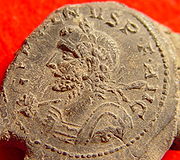
In portraying himself with the attributes of the gods on his coinage, Gallienus began the final separation of the Emperor from his subjects. A late bust of Gallienus (see above) shows him of largely blank face and gazing heavenward as seen on the famous stone head of Constantine I
Constantine I
Constantine the Great , also known as Constantine I or Saint Constantine, was Roman Emperor from 306 to 337. Well known for being the first Roman emperor to convert to Christianity, Constantine and co-Emperor Licinius issued the Edict of Milan in 313, which proclaimed religious tolerance of all...
. One of the last rulers of Rome to be theoretically called "Princeps" or First Citizen, Gallienus' shrewd self-promotion assisted in paving the way for those who would be addressed with the words "Dominus et Deus" (Lord and God).
In popular culture
Gallienus was played by Franco Cobianchi in the 1964 film The Magnificent GladiatorThe Magnificent Gladiator
Il magnifico gladiatore is a 1964 film about a hero named "Attalus" , who is captured by Roman soldiers on the frontier during the reign of Gallienus...
.
Primary Sources
- Aurelius VictorAurelius VictorSextus Aurelius Victor was a historian and politician of the Roman Empire.Aurelius Victor was the author of a History of Rome from Augustus to Julian , published ca. 361. Julian honoured him and appointed him prefect of Pannonia Secunda...
, Epitome de Caesaribus - Eutropius, Breviarium ab urbe condita
- Historia Augusta (Augustan History)Augustan HistoryThe Augustan History is a late Roman collection of biographies, in Latin, of the Roman Emperors, their junior colleagues and usurpers of the period 117 to 284...
, The Two Gallieni - Joannes ZonarasJoannes ZonarasIoannes Zonaras was a Byzantine chronicler and theologian, who lived at Constantinople.Under Emperor Alexios I Komnenos he held the offices of head justice and private secretary to the emperor, but after Alexios' death, he retired to the monastery of St Glykeria, where he spent the rest of his...
, Epitome Historiarum, extract: Zonaras: Alexander Severus to Diocletian: 222–284 - ZosimusZosimusZosimus was a Byzantine historian, who lived in Constantinople during the reign of the Byzantine Emperor Anastasius I . According to Photius, he was a comes, and held the office of "advocate" of the imperial treasury.- Historia Nova :...
, Historia Nova
Secondary Sources
- Lukas de Blois. The policy of the emperor Gallienus, Brill, Leiden, 1976, ISBN 9004045082
- Bray, John. Gallienus : A Study in Reformist and Sexual Politics, Wakefield Press, Kent Town, 1997, ISBN 1-862-54337-2
- Drinkwater, John F. The Gallic Empire. Separatism and Continuity in the North-Western Provinces of the Roman Empire A.D. 260–274. Franz Steiner Verlag, Wiesbaden, 1987. ISBN 3-515-04806-5
- Lissner, Ivar. "Power and Folly; The Story of the Caesars". Jonathan Cape Ltd., London, 1958.
- Potter, David S. The Roman Empire at Bay AD 180–395, Routledge, Oxon, 2004. ISBN 0-415-10058-5
- Southern, Pat. The Roman Empire from Severus to Constantine, Routledge, London and New York, 2001.
- Syme, Ronald. Ammianus and the Historia Augusta, The Clarendon Press, Oxford, 1968.
- Syme, Ronald. Historia Augusta Papers, The Clarendon press, Oxford, 1983. ISBN 0-19-814853-4
- Watson, Alaric. Aurelian and the Third Century, Routledge, Oxon, 1999. ISBN 0-415-30187-4
External links
- "Valerian and Gallienus", at De Imperatoribus Romanis.
- Download an Excel list of all Gallienus bronze and billon coins incl. hoard coins not in RIC etc.