
All Topics  
Belgrade

 
Belgrade

   Email Print
   Bookmark   Link


Belgrade


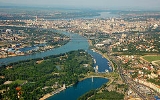
Belgrade is the capital and largest city of Serbia
Serbia

Serbia , officially the Republic of Serbia , is a country in Central Europe and Balkans Europe, covering the southern part of the Pannonian Plain and the central part of the Balkans....
. The city lies on two international waterways, at the confluence of the Sava
Sava River

The Sava is a river in southern Europe, a right side tributary of Danube at Belgrade. It is 945 km long and drains 95,719 km? of surface area....
 and Danube
Danube

The Danube is the longest river in the European Union and Europe's second longest river after the Volga.The river originates in the Black Forest in Germany as the much smaller Brigach and Breg River rivers which join at the eponymously named German town Donaueschingen, after which it is known as the Danube and flows eastwards for a distance...
 rivers, where the Pannonian Plain
Pannonian Plain

The Pannonian Plain is a large plain in Central Europe that remained when the Pliocene Pannonian Sea dried out. It is a geomorphology subsystem of the Alpide belt....
 meets the Balkan Peninsula. With a population of 1,630,000 (official estimate 2007), Belgrade is the largest city in the territory of the former Yugoslavia, second largest city on the Danube
Danube

The Danube is the longest river in the European Union and Europe's second longest river after the Volga.The river originates in the Black Forest in Germany as the much smaller Brigach and Breg River rivers which join at the eponymously named German town Donaueschingen, after which it is known as the Danube and flows eastwards for a distance...
 river and the fourth largest in Southeastern Europe, after Istanbul
Istanbul

Istanbul is the largest city in Turkey, List of metropolitan areas in Europe by population, and List of cities proper by population in the world with a population of 12.6 million....
, Athens
Athens

Athens , the Capital and largest city of Greece, dominates the Attica periphery; as one of the List of cities by time of continuous habitation, its recorded history spans around 3,400 years....
, and Bucharest
Bucharest

Bucharest is the capital city, industrial and commercial centre of Romania. It is the largest city in Romania, located in the southeast of the country, at , and lies on the banks of the D?mbovita River....
.

One of the oldest cities of Europe
Europe

Europe is, conventionally, one of the world's seven continents. Comprising the westernmost peninsula of Eurasia, Europe is generally divided from Asia to its east by the water divide of the Ural Mountains, the Ural , the Caspian Sea, and by the Caucasus Mountains to the southeast....
, with archeological finds tracing settlements as early as 6th millennium BC, Belgrade's wider city area was the birthplace of the largest prehistoric culture
Vinca culture

The Vinca culture was an early culture of Europe , stretching around the course of Danube in what today is Serbia, Hungary, Croatia, Bosnia and Herzegovina, Romania, Bulgaria, and the Republic of Macedonia, although traces of it can be found all around the Balkans, parts of Central Europe and Asia Minor....
 of Europe
Europe

Europe is, conventionally, one of the world's seven continents. Comprising the westernmost peninsula of Eurasia, Europe is generally divided from Asia to its east by the water divide of the Ural Mountains, the Ural , the Caspian Sea, and by the Caucasus Mountains to the southeast....
, the Vinca culture
Vinca culture

The Vinca culture was an early culture of Europe , stretching around the course of Danube in what today is Serbia, Hungary, Croatia, Bosnia and Herzegovina, Romania, Bulgaria, and the Republic of Macedonia, although traces of it can be found all around the Balkans, parts of Central Europe and Asia Minor....
.


Discussion
Ask a question about 'Belgrade'
Start a new discussion about 'Belgrade'
Answer questions from other users
Full Discussion Forum


Timeline

488   The Gepids capture Belgrade.

504   The Ostrogoths sack Belgrade.

878   First mentioning of Belgrade.

1154   Belgrade is rebuilt by Byzantine emperor Manuel I Comnenus.

1182   Béla III of Hungary sacks the city of Belgrade.

1284   Stefan Dragutin, king of Serbia, receives Belgrade, Syrmia, and other territories from Hungary when his son marries the king of Hungary's cousin.

1440   Murad II lays siege to Belgrade. The city is heavily damaged, but the defenders' use of artillery prevents the Turks from capturing the city.

1521   Capture of Belgrade by the Ottoman army of Suleiman I after a brave resistan

1594   Banat Rebellion of Serbs against Ottoman rule ends with the public burning of St Sava's bones in Belgrade, Serbia

1688   Austria occupies Belgrade.


Encyclopedia


Belgrade is the capital and largest city of Serbia
Serbia

Serbia , officially the Republic of Serbia , is a country in Central Europe and Balkans Europe, covering the southern part of the Pannonian Plain and the central part of the Balkans....
. The city lies on two international waterways, at the confluence of the Sava
Sava River

The Sava is a river in southern Europe, a right side tributary of Danube at Belgrade. It is 945 km long and drains 95,719 km? of surface area....
 and Danube
Danube

The Danube is the longest river in the European Union and Europe's second longest river after the Volga.The river originates in the Black Forest in Germany as the much smaller Brigach and Breg River rivers which join at the eponymously named German town Donaueschingen, after which it is known as the Danube and flows eastwards for a distance...
 rivers, where the Pannonian Plain
Pannonian Plain

The Pannonian Plain is a large plain in Central Europe that remained when the Pliocene Pannonian Sea dried out. It is a geomorphology subsystem of the Alpide belt....
 meets the Balkan Peninsula. With a population of 1,630,000 (official estimate 2007), Belgrade is the largest city in the territory of the former Yugoslavia, second largest city on the Danube
Danube

The Danube is the longest river in the European Union and Europe's second longest river after the Volga.The river originates in the Black Forest in Germany as the much smaller Brigach and Breg River rivers which join at the eponymously named German town Donaueschingen, after which it is known as the Danube and flows eastwards for a distance...
 river and the fourth largest in Southeastern Europe, after Istanbul
Istanbul

Istanbul is the largest city in Turkey, List of metropolitan areas in Europe by population, and List of cities proper by population in the world with a population of 12.6 million....
, Athens
Athens

Athens , the Capital and largest city of Greece, dominates the Attica periphery; as one of the List of cities by time of continuous habitation, its recorded history spans around 3,400 years....
, and Bucharest
Bucharest

Bucharest is the capital city, industrial and commercial centre of Romania. It is the largest city in Romania, located in the southeast of the country, at , and lies on the banks of the D?mbovita River....
.

One of the oldest cities of Europe
Europe

Europe is, conventionally, one of the world's seven continents. Comprising the westernmost peninsula of Eurasia, Europe is generally divided from Asia to its east by the water divide of the Ural Mountains, the Ural , the Caspian Sea, and by the Caucasus Mountains to the southeast....
, with archeological finds tracing settlements as early as 6th millennium BC, Belgrade's wider city area was the birthplace of the largest prehistoric culture
Vinca culture

The Vinca culture was an early culture of Europe , stretching around the course of Danube in what today is Serbia, Hungary, Croatia, Bosnia and Herzegovina, Romania, Bulgaria, and the Republic of Macedonia, although traces of it can be found all around the Balkans, parts of Central Europe and Asia Minor....
 of Europe
Europe

Europe is, conventionally, one of the world's seven continents. Comprising the westernmost peninsula of Eurasia, Europe is generally divided from Asia to its east by the water divide of the Ural Mountains, the Ural , the Caspian Sea, and by the Caucasus Mountains to the southeast....
, the Vinca culture
Vinca culture

The Vinca culture was an early culture of Europe , stretching around the course of Danube in what today is Serbia, Hungary, Croatia, Bosnia and Herzegovina, Romania, Bulgaria, and the Republic of Macedonia, although traces of it can be found all around the Balkans, parts of Central Europe and Asia Minor....
. The city was discovered by the Greeks
Greeks

The Greeks , also known as Hellenes, are a nation and ethnic group native to Greece, Cyprus and neighbouring regions, who can also be found in Greek diaspora communities around the world....
, founded and named by the Celts (White City, name it still bears), awarded city rights by the Romans
Roman Empire

The Roman Empire was the Roman Republic phase of the Ancient Rome, characterised by an autocracy form of government and large territorial holdings in Europe and around the Mediterranean....
 before it was permanently settled by White Serbs
White Serbs

White Serbs is the name of the proto-Serbs. According to several Serbian and Greek works they were a Polabian Slavs, that lived in White Serbia, situated around the Lusatian Mountains , east of river Elbe in the Early Middle Ages....
 from the 600s onwards. As a strategic key, the city was battled over in 140 separate wars since the ancient period by countless armies of the East
East

East is a Direction in geography. It is one of the four cardinal directions or compass points, opposite of west and at right angles to north and south....
 and West
West

West is most commonly a noun, adjective, or adverb indicating Direction or geography.West is one of the four cardinal directions or compass points....
. In medieval times, it was in the possession of Byzantine
Byzantine Empire

Byzantine Empire and Eastern Roman Empire are conventional names used to describe the Roman Empire during the Middle Ages, centered on its capital of Constantinople....
, Frankish, Bulgarian
First Bulgarian Empire

The First Bulgarian Empire was a medieval Bulgarian state founded in AD 632 in the lands near the Danube Delta and disintegrated in AD 1018 after its annexation to the Byzantine Empire....
, Hungarian
Kingdom of Hungary in the Middle Ages

This article deals with the history of the Kingdom of Hungary from the 10th century to c. 1526.Note that, although strictly speaking a "monarchy" arose only in AD 1000 and a Hungarian state or principality only in the late 9th century, this text also describes its early development after the year 896 when the Magyars arrived in the Carpathian Bas...
 and Serbian
Serbian Despotate

The Serbian Despotate was among the last Serbs states to be conquered by the Ottoman Empire. As the Battle of Kosovo in 1389 is generally considered as the end of the medieval Serbian state, Despotovina, the successor of the Serbian Empire and the state of prince Lazar of Serbia survived for 70 more years, experiencing a cultural and politic...
 rulers. In 1521 Belgrade was conquered by the Ottomans
Ottoman Empire

The Ottoman Empire , also known by its contemporaries as the Turkish Empire or Turkey , was an empire that lasted from 1299?1923. It was Treaty of Lausanne by the Republic of Turkey, which was officially proclaimed on October 29, 1923....
 and became the seat of the Pashaluk of Belgrade, as the principal city of Ottoman Europe and among the largest European cities. Frequently passing from Ottoman
Ottoman

A term used to refer to the citizens of the Ottoman Empire after 1839, when the Tanzimat edict starting a period of reforms was declared . The term was started to be used more commonly especially after the empire officially became a constitutional monarchy in 1876....
 to Austrian rule, the status of Serbian capital would be regained only in 1841, after the Serbian revolution
Serbian revolution

Serbian revolution or Revolutionary Serbia refers to the R?volution nationale and social revolution of the Serbs between 1804 and 1817, during which Serbia managed to fully emancipate from the Ottoman Empire and exist as a sovereign European nation-state....
. Northern Belgrade
Zemun

Zemun is an List of Belgrade neighborhoods and one of the 17 municipalities which constitute the Belgrade, the capital of Serbia....
, though, remained an Austrian outpost until the breakup of Austria-Hungary
Austria-Hungary

Austria-Hungary, also known as the Austro-Hungarian Empire, the Dual Monarchy or the Kaiserlich und k?niglich Monarchy was a state in Central Europe ruled by the House of Habsburg, constitutionally a personal union between the crowns of the Austrian Empire and the Kingdom of Hungary....
 in 1918. The united city then became the capital of several incarnations of Yugoslavia
Yugoslavia

File:LocationYugoslavia2.pngYugoslavia is a term that describes three political entities that existed successively on the Balkan Peninsula in Europe, during most of the 20th century....
, up to 2006, when Serbia became an independent state again.

Belgrade has the status of a separate territorial unit in Serbia, with its own autonomous city government. Its territory is divided into 17 municipalities
Belgrade

Belgrade is the capital and largest city of Serbia. The city lies on international waterway, at the confluence of the Sava River and Danube rivers, where the Pannonian Plain meets the Balkan Peninsula....
, each having its own local council. It covers 3.6% of the territory of Serbia, and 24% of the country's population lives in the city. Belgrade is the central economic hub of Serbia, and the capital of Serbian culture
Serbian culture

Serbian culture refers to the culture of Serbia as well as the culture of Serbs in other parts of the former Yugoslavia and elsewhere in the world....
, education
Education in Serbia

Education in Serbia is regulated by the Ministry of Education ....
 and science.

Geography


Belgrade lies above sea level
Sea level

Mean sea level is the average height of the sea, with reference to a suitable reference surface. Defining the reference level , however, involves complex measurement, and accurately determining MSL can prove difficult....
 and is located at confluence
Confluence

Confluence may refer to:* Confluence , the point where two or more bodies of water meet and merge* Deformation , the streamline air flow convergence of a fluid air parcel...
 of the Danube
Danube

The Danube is the longest river in the European Union and Europe's second longest river after the Volga.The river originates in the Black Forest in Germany as the much smaller Brigach and Breg River rivers which join at the eponymously named German town Donaueschingen, after which it is known as the Danube and flows eastwards for a distance...
 and Sava rivers, at coordinates
Geographic coordinate system

A geographic coordinate system enables every location on the Earth to be specified in three coordinates, using mainly a Spherical coordinates#Spherical coordinates....
 44°49'14" North, 20°27'44" East. The historical core of Belgrade, today's Kalemegdan
Kalemegdan

Kalemegdan is a fortress and park in an urban area List of Belgrade neighborhoods of Belgrade, the capital of Serbia. It is located in Belgrade's municipality of Stari Grad, Belgrade....
, is on the right bank of the rivers. Since the 19th century, the city has been expanding to the south and east, and after World War II, New Belgrade
Novi Beograd

Novi Beograd or New Belgrade is one of Subdivisions of Belgrade that constitute the Belgrade, the capital of Serbia....
 was built on the Sava's left bank, merging Belgrade with Zemun
Zemun

Zemun is an List of Belgrade neighborhoods and one of the 17 municipalities which constitute the Belgrade, the capital of Serbia....
. Smaller, chiefly residential communities across the Danube, like Krnjaca
Krnjaca

Krnjaca is an List of Belgrade neighborhoods of Belgrade, the capital of Serbia. It is located in Belgrade's municipality of Palilula Belgrade....
 and Ovca
Ovca

Ovca is a List of Belgrade neighborhoods of Belgrade, the capital of Serbia. It is located in the Belgrade's municipality of Palilula, Belgrade....
, also merged with the city. The city has an urban area of , while together with its metropolitan area it covers . Throughout history, Belgrade has been a major crossroad between the West
Western world

The term Western world, the West or the Occident can have multiple meanings dependent on its context . Accordingly, the basic definition of what constitutes "the West" varies, expanding and contracting over time, in relation to various historical circumstances....
 and the Orient
The Orient

The Orient is a term which simply means the "east". It originated in Southwest Asia to describe that part of the world. It is now used in the Western world to describe East Asia....
.

On the right bank of the Sava, central Belgrade has hilly terrain, while the highest point of Belgrade proper is Torlak hill at . The mountains of Avala
Avala

Avala is the mountain overlooking the city of Belgrade, the capital of Serbia. Nicknamed one of two "Belgrade mountains" , it is situated in the south-eastern corner of the city and provides a great panoramic view to Belgrade, Vojvodina and ?umadija, as the surrounding area on all sides is mostly a lowlands....
  and Kosmaj
Kosmaj

Kosmaj is the mountain south of Belgrade, the capital of Serbia. With 626 meters it is the highest point of the entire Belgrade City area and nicknamed one of two "Belgrade mountains" ....
  lie south of the city. Across the Sava and Danube, the land is mostly flat, consisting of alluvial plain
Alluvial plain

An alluvial plain is a relatively flat landform created by the deposition of sediment over a long period of time by one or more rivers coming from highland regions, from which Alluvium soil forms....
s and loessial
Loam

Loam is soil composed of sand, silt, and clay in relatively even concentration , considered ideal for gardening and agricultural uses. Loam soils generally contain more nutrients and humus than sandy soils, have better infiltration and drainage than silty soils, and are easier to tillage than clay soils....
 plateau
Plateau

In geology and earth science, a plateau, also called a high plateau or tableland, is an area of highland , usually consisting of relatively flat terrain....
s.

Climate


Belgrade has a moderate continental climate
Continental climate

Continental climate is a climate that is characterized by winter temperatures cold enough to support a fixed period of snow cover each year, and relatively moderate precipitation occurring mostly in summer, although east coast areas may show an even distribution of precipitation....
. The year-round average temperature is , while the hottest month is July, with an average temperature of . There are, on average, 31 days a year when the temperature is above 30 °C, and 95 days when the temperature is above 25 °C. Belgrade receives about 700 millimetres (27.56 in) of precipitation a year. The average annual number of sunny hours is 2,096. The sunniest months are July and August, with an average of about 10 sunny hours a day, while December and January are the gloomiest, with an average of 2–2.3 sunny hours a day. The highest officially recorded temperature in Belgrade was +43.1 °C, while on the other end, the lowest temperature was -26.2 °C on January 10, 1893.

History


Ancient city

The Neolithic
Neolithic

The Neolithic period was a period in the development of human technology, beginning about 9500 Before the Christian Era in the Middle East that is traditionally considered the last part of the Stone Age....
 Starcevo
Starcevo-Körös

The Starcevo culture, also called Starcevo-K?r?s culture or Starcevo-K?r?s-Cris culture was a widespread early Neolithic archaeological culture from Eastern Europe and the Balkans....
 and Vinca culture
Vinca culture

The Vinca culture was an early culture of Europe , stretching around the course of Danube in what today is Serbia, Hungary, Croatia, Bosnia and Herzegovina, Romania, Bulgaria, and the Republic of Macedonia, although traces of it can be found all around the Balkans, parts of Central Europe and Asia Minor....
s existed in or near Belgrade and dominated the Balkans
Balkans

The Balkans is the historical name of a geographic subregion of southeastern Europe. The region takes its name from the Balkan Mountains, which run through the centre of Bulgaria into eastern Serbia....
 (as well as parts of Central Europe
Central Europe

Central Europe is the region lying between the variously and vaguely defined areas of Eastern Europe and Western Europe Europe. In addition, Northern Europe, Southern Europe and Southeastern Europe may variously delimit or overlap into Central Europe....
 and Asia Minor) about 7,000 years ago. Some scholars believe that the prehistoric Vinca signs represent the earliest known form of alphabet
Alphabet

An alphabet is a standardized set of letter basic written symbols each of which roughly represents a phoneme, a spoken language, either as it exists now or as it was in the past....
. Many centuries later, the Greek Argonauts
Argonauts

In Greek mythology, the Argonauts were a band of heroes who, in the years before the Trojan War, accompanied Jason to Colchis in his quest to find the Golden Fleece....
 have discovered the river Sava in ancient Belgrade (which they named Cauliac) while sailing from the Black Sea
Black Sea

The Black Sea is an inland sea sea bounded by southeastern Europe, the Caucasus and the Anatolia and is ultimately connected to the Atlantic Ocean via the Mediterranean Sea and Aegean Seas and various straits....
 upstream (Appolonius). Settled in the fourth century BC by a Celt
Celt

Celts , is a modern term used to describe any of the European peoples who spoke, or speak, a Celtic languages. The term is also used in a wider sense to describe the Modern Celts of those peoples, notably those who participate in a Celtic culture....
ic tribe, the Scordisci
Scordisci

The Scordisci were an ancient tribe centred in what would beceome the Roman Province of lower Pannonia, at the confluence of the Sava , Drava and Danube rivers ....
, the city's recorded name was Singidun, before becoming the romanized
Roman Empire

The Roman Empire was the Roman Republic phase of the Ancient Rome, characterised by an autocracy form of government and large territorial holdings in Europe and around the Mediterranean....
 Singidunum
Singidunum

Singidunum was an ancient Roman city, first settled by the Celts Scordisci tribe in the 3rd century BC, and later garrisoned and fortified by the Ancient Rome who romanized the name....
 in the first century AD. In the mid 2nd century, the city was proclaimed a municipium
Municipium

A municipium belonged to the second highest Social class of Ancient Rome cities, being inferior in status to the colonia . The first municipium was Tusculum....
 by the Roman authorities, evolving into a full fledged colonia
Colonia (Roman)

A Roman colonia was originally a Roman Empire outpost established in conquered territory to secure it. Eventually, however, the term came to denote the highest status of Roman city....
 (highest class Roman city) by the end of the century. The first Christian
Christian

A Christian is a person who adheres to Christianity, a Monotheism#Christian view religion centered on the life and teachings of Jesus and interpreted by Christians to have been prophesied in the Hebrew Bible/Old Testament....
 Emperor of Rome
Roman Emperor

The Roman Emperor was the ruler of the Roman Empire during the imperial period . The Romans had no single term for the office: Latin language titles such as imperator , Augustus , Caesar and princeps were all associated with it....
  was born in modern Serbia
Serbia

Serbia , officially the Republic of Serbia , is a country in Central Europe and Balkans Europe, covering the southern part of the Pannonian Plain and the central part of the Balkans....
: Constantine I
Constantine I

Flavius Valerius Aurelius Constantinus , commonly known in English_language as Constantine I, Constantine the Great, or Saint Constantine , was Roman Emperor from 306, and the undisputed holder of that office from 324 until his death in 337....
 known as Constantine the Great (Naissus
Niš

Ni? is a city in Ni?ava District, Serbia situated at 43.3? N 21.9? E, on the Ni?ava River. With more than 250,000 inhabitants it is the largest city of South Serbia and third-largest city in the country, after Belgrade and Novi Sad....
, 280 A.D.) and a Roman Emperor was born in Belgrade, Jovian
Jovian

Flavius Iovianus, anglicized to Jovian, was a soldier elected Roman Emperor by the army on 27 June 363 upon the death of Emperor Julian the Apostate during his Sassanid Empire campaign....
, the restorer of Christianity
Christianity

Christianity is a Monotheistic religion #Christian view religion centered on the life and teachings of Jesus as New Testament view on Jesus' life....
, Flavius Iovianus, (Singidunum
Singidunum

Singidunum was an ancient Roman city, first settled by the Celts Scordisci tribe in the 3rd century BC, and later garrisoned and fortified by the Ancient Rome who romanized the name....
, 332 A.D.) Jovian reestablished Christianity as the official religion of the Roman Empire
Roman Empire

The Roman Empire was the Roman Republic phase of the Ancient Rome, characterised by an autocracy form of government and large territorial holdings in Europe and around the Mediterranean....
, ending the brief revival of traditional Roman religions
Religion in ancient Rome

Ancient Roman religion encompasses the collection of beliefs and rituals practised in ancient Rome in the form of cult practices. It is therefore the practical counterpart of Roman mythology....
 under his predecessor Julian the Apostate
Julian the Apostate

Flavius Claudius Julianus, known also as Julian or Julian the Apostate , was Roman Emperor of the Constantinian dynasty. He was the last non-Christian Roman Emperor, and expended much energy during his reign attempting to supplant the growing power of Christianity within the empire with officially revived Religion in ancient Rom...
. In 395 AD, the site passed to the Eastern Roman or Byzantine Empire
Byzantine Empire

Byzantine Empire and Eastern Roman Empire are conventional names used to describe the Roman Empire during the Middle Ages, centered on its capital of Constantinople....
. Across the Sava from Singidunum was the Celtic city of Taurunum (Zemun)
Zemun

Zemun is an List of Belgrade neighborhoods and one of the 17 municipalities which constitute the Belgrade, the capital of Serbia....
, that through Roman and Byzantine times shared a common fate with its "twin brother" (the two cities were connected by a bridge).

Middle Ages

Singidunum was occupied and often ravaged by successive invasions of Huns
Huns

The Huns were a confederation of Central Asian Eurasian nomads or semi-nomads, who had established an empire in Eurasia. The Huns may have stimulated the Migration Period, a contributing factor in the collapse of the Roman Empire....
, Sarmatians
Sarmatians

The Sarmatians, Sarmat? or Sauromat? were a people of Ancient Iranian peoples origin. Mentioned by Classics authors, they migrated from Central Asia to the Ural Mountains around fifth century B.C....
, Gepids, Ostrogoths and Avars
Eurasian Avars

The 'Avars' were a highly organized and powerful Turkic confederation. They were ruled by a khagan, who was surrounded by a tight-knit retinue of nomad warriors, an organization characteristic of Turkic peoples groups....
 before the arrival of the Slav
Slavic peoples

The Slavic Peoples are a linguistic branch of Indo-European peoples, living mainly in eastern Europe. From the early 6th century they spread from their original homeland to inhabit most of eastern Central Europe, Eastern Europe and the Balkans....
s around 630 AD. It served as the center of the Gepidean Kingdom in the early 500s, before being taken by the Avars. When the Avars
Avars

Avars may refer to:* Eurasian Avars, a nomadic people who invaded Europe in the 6th Century AD* Uar * Caucasian Avars, a modern people of the Caucasus...
 were finally destroyed in the 9th century by the Frankish Kingdom, it fell back to Byzantine rule, whilst Taurunum became part of the Frankish realm (and was renamed to Malevilla). At the same time (around 878), the first record of the Slavic
Slavic languages

File:Slavic europe.svgThe Slavic languages , a group of closely related languages of the Slavic peoples and a subgroup of Indo-European languages, have speakers in most of Eastern Europe, in much of the Balkans, in parts of Central Europe, and in the northern part of Asia....
 name Beligrad has appeared, during the rule of the First Bulgarian Empire
First Bulgarian Empire

The First Bulgarian Empire was a medieval Bulgarian state founded in AD 632 in the lands near the Danube Delta and disintegrated in AD 1018 after its annexation to the Byzantine Empire....
. For about four centuries, the city remained a battleground between the Byzantine Empire
Byzantine Empire

Byzantine Empire and Eastern Roman Empire are conventional names used to describe the Roman Empire during the Middle Ages, centered on its capital of Constantinople....
, the Kingdom of Hungary
Kingdom of Hungary

The Kingdom of Hungary , which existed from 1000 to 1918, and then from 1920 to 1946, was a considerable state in Central Europe....
 and the First Bulgarian Empire
First Bulgarian Empire

The First Bulgarian Empire was a medieval Bulgarian state founded in AD 632 in the lands near the Danube Delta and disintegrated in AD 1018 after its annexation to the Byzantine Empire....
. The city hosted the armies of the First
First Crusade

The First Crusade was launched in 1095 by Pope Urban II with the primary goal of responding to the appeal from Byzantine Emperor Alexius I. The Emperor requested that western volunteers come to their aid and repel the Seljuk Turks in Anatolia, Modern day Turkey....
 and the Second Crusade
Second Crusade

The Second Crusade was the second major crusade launched from Europe, called in 1145 in response to the fall of the County of Edessa the previous year....
; while passing through during the Third Crusade
Third Crusade

The Third Crusade , also known as the Kings' Crusade, was an attempt by European leaders to reconquer the Holy Land from Saladin .After the failure of the Second Crusade, the Zengid dynasty controlled a unified Syria and engaged in a conflict with the Fatimid dynasty rulers of Egypt, which ultimately resulted in the unification of Egy...
, Frederick Barbarossa and his 190,000 crusaders
Third Crusade

The Third Crusade , also known as the Kings' Crusade, was an attempt by European leaders to reconquer the Holy Land from Saladin .After the failure of the Second Crusade, the Zengid dynasty controlled a unified Syria and engaged in a conflict with the Fatimid dynasty rulers of Egypt, which ultimately resulted in the unification of Egy...
 saw Belgrade in ruins. Capital of the Kingdom of Syrmia since 1284, the first Serbian king
List of Serbian monarchs

This is a list of Serbian monarchs.Notes:*Entries bounded within parentheses are for reference only; for instance, the Roman numerals keep counts of Stefans and Lazars....
 to rule over Belgrade was Dragutin, who received it as a gift from his father-in-law
Father-in-law

A father-in-law is a spouse's father.See also* Affinity * Marriage* Mother-in-law...
, the Hungarian king Stephen V
Stephen V of Hungary

Stephen V , King of Hungary 1246-1272)....
. Following the Battle of Maritsa
Battle of Maritsa

The Battle of Maritsa or Battle of Chernomen took place at the Maritsa near the village of Ormenio on September 26, 1371 between the forces of the Ottoman Empire sultan Murad I's lieutenant Lala Shahin Pasha and the Serbs numbering some 70,000 men under the command of the Serbs king of Prilep Vuka?in Mrnjavcevic and his brother desp...
 in 1371, and the Battle of Kosovo
Battle of Kosovo

The Battle of Kosovo was fought on Vidovdan between the Serbian Empire, her allies, and the Ottoman Empire, in a Gazimestan about 5 kilometers northwest of Pristina....
 in 1389, the Serbian Empire
Serbian Empire

The Serbian Empire was a medieval empire in the Balkans that emerged from the medieval Serbian kingdom in the 14th century. The Serbian Empire existed from 1346 to 1371....
 began to crumble as the Ottoman Empire
Ottoman Empire

The Ottoman Empire , also known by its contemporaries as the Turkish Empire or Turkey , was an empire that lasted from 1299?1923. It was Treaty of Lausanne by the Republic of Turkey, which was officially proclaimed on October 29, 1923....
 conquered its southern territory. The north, however, resisted through the Serbian Despotate
Serbian Despotate

The Serbian Despotate was among the last Serbs states to be conquered by the Ottoman Empire. As the Battle of Kosovo in 1389 is generally considered as the end of the medieval Serbian state, Despotovina, the successor of the Serbian Empire and the state of prince Lazar of Serbia survived for 70 more years, experiencing a cultural and politic...
, which had Belgrade as its capital. The city flourished under despot
Despotism

Despotism is a form of government by a single authority, either an autocracy or oligarchy, which rules with absolute political power. In its classical form, a despotism is a state where a single individual wields all the power and authority embodying the state, and everyone else is a subsidiary person....
 Stefan Lazarevic
Stefan Lazarevic

Stefan Lazarevic was a Serbian Despot . He was the son and heir to Prince Lazar , who died at the Battle of Kosovo against the Ottoman Empire in 1389, and Princess Milica of Serbia from the subordinate branch of the Nemanjic dynasty....
, son of the famous Serbian ruler Lazar Hrebeljanovic. Lazarevic built a castle with a citadel and towers, of which only the Despot's tower
Despot Stefan Tower

The Despot Stefan Tower is a structure in Belgrade, Serbia, built ca.1405, a couple of years after the city became the capital of Serbian Despotate under Despot Stefan....
 and the west wall remain. He also refortified the city's ancient walls, allowing the Despotate to resist the Ottomans for almost 70 years. During this time, Belgrade was a haven for the many Balkan peoples fleeing from Ottoman rule, and is thought to have had a population of some 40–50,000.

In 1427, Stefan's successor Đurad Brankovic had to return Belgrade to the Hungarians
Kingdom of Hungary

The Kingdom of Hungary , which existed from 1000 to 1918, and then from 1920 to 1946, was a considerable state in Central Europe....
, and the capital was moved to Smederevo
Smederevo Fortress

Smederevo Fortress , in Smederevo, Serbia, was a medieval fortified city and temporary capital of Serbia. It was built by Despotes ?urad Brankovic in the first half of the 15th century, during the era of the Serbian Despotate....
. During his reign, the Ottomans captured most of the Serbian Despotate
Serbian Despotate

The Serbian Despotate was among the last Serbs states to be conquered by the Ottoman Empire. As the Battle of Kosovo in 1389 is generally considered as the end of the medieval Serbian state, Despotovina, the successor of the Serbian Empire and the state of prince Lazar of Serbia survived for 70 more years, experiencing a cultural and politic...
, unsuccessfully besieging Belgrade first in 1440 and again in 1456. As it presented an obstacle to their further advance into Central Europe
Central Europe

Central Europe is the region lying between the variously and vaguely defined areas of Eastern Europe and Western Europe Europe. In addition, Northern Europe, Southern Europe and Southeastern Europe may variously delimit or overlap into Central Europe....
, over 100,000 Ottoman solders have launched the famous Siege of Belgrade
Siege of Belgrade

The 'Siege of Belgrade' occurred from July 4 to July 22, 1456. After the fall of Constantinople in 1453, Ottoman Empire sultan Mehmed II was rallying his resources in order to subjugate the Kingdom of Hungary....
, where the Christian
Christendom

Christendom usually refers to Christianity as a territorial phenomenon. It can also refer to the part of the world in which Christianity prevails....
 army under John Hunyadi
John Hunyadi

John Hunyadi , nicknamed the White Knight, was a Rulers of Transylvania of Transylvania , captain-general and regent of the Kingdom of Hungary, with a distinguished military career....
 successfully defended the city from the Ottomans, wounding the Sultan Mehmed II
Mehmed II

Mehmed II , was Sultan of the Ottoman Empire for a short time from 1444 to September 1446, and later from February 1451 to 1481. At the age of 21, he Fall of Constantinople, bringing an end to the medieval Byzantine Empire....
 This battle "decided the fate of Christendom"; the noon bell
Noon bell

During the Siege of N?ndorfeh?rv?r in 1456, Hungarians noblemen John Hunyadi and Mih?ly Szil?gyi defended the city against the onslaught of the Ottoman Empire Sultan Mehmed II....
 ordered by Pope Callixtus III
Pope Callixtus III

Pope Calixtus III , n? Alfonso de Borja, was Pope from April 8, 1455 to his death in 1458....
 commemorates the victory throughout the Christian world to this day.

Turkish conquest / Austrian invasions

Fortress Belgrade
It wasn't until August 28, 1521 (7 decades after the last siege), that the fort was finally captured by Sultan Suleyman the Magnificent and his 250,000 soldiers; subsequently, most of the city was razed to the ground and its entire Christian population (including Serbs, Hungarians, Greeks, Armenians etc) was deported to Istanbul
Istanbul

Istanbul is the largest city in Turkey, List of metropolitan areas in Europe by population, and List of cities proper by population in the world with a population of 12.6 million....
, to the area since known as the Belgrade forest. Belgrade was made the seat of the district (Sanjak
Sanjak

Sanjaks were administrative divisions of the Ottoman Empire. Sanjak, and the variant spellings sandjak, sanjaq, and sinjaq, are English transliterations of the Turkish language word sancak, meaning district, banner or flag....
), attracting new inhabitants—Turks
Turkic peoples

The Turkic peoples are Eurasian peoples residing in northern, central and western Eurasia, and who mostly speak languages belonging to the Turkic languages....
, Armenians
Armenians

The Armenians are a nation and ethnic group originating in the Caucasus and in the Armenian Highlands. A large concentration of them has remained there, especially in Armenia, but many of them are also scattered elsewhere throughout the world ....
, Greeks
Greeks

The Greeks , also known as Hellenes, are a nation and ethnic group native to Greece, Cyprus and neighbouring regions, who can also be found in Greek diaspora communities around the world....
, Ragusan
Republic of Ragusa

The Republic of Ragusa, or Republic of Dubrovnik, was a maritime republic centred on the city of Dubrovnik, known also as Ragusa , in Dalmatia, from the 14th century Anno Domini until 1808....
 traders, and others, and there was peace for the next 150 years. The city became the second largest Ottoman
Ottoman Turks

The Ottoman Turks were the subdivision of the Ottoman Muslim Millet that dominated the ruling class of the Ottoman Empire. Reliable information about the early history of the Ottomans is scarce....
 town in Europe
Europe

Europe is, conventionally, one of the world's seven continents. Comprising the westernmost peninsula of Eurasia, Europe is generally divided from Asia to its east by the water divide of the Ural Mountains, the Ural , the Caspian Sea, and by the Caucasus Mountains to the southeast....
 at over 100,000 people, surpassed only by Constantinople
Constantinople

Constantinople was the empire capital of the Roman Empire , the Byzantine Empire , the Latin Empire , and the Ottoman Empire . Strategically located between the Golden Horn and the Sea of Marmara at the point where Europe meets Asia, Byzantine Constantinople had been the capital of a Christendom empire, successor to ancient ancient Greece...
. Turkish rule also introduced Ottoman architecture to Belgrade and many mosque
Mosque

A mosque is a place of worship for followers of Islam. Muslims often refer to the mosque by its Arabic name, masjid, ? . The word "mosque" in English refers to all types of buildings dedicated for Islamic worship, although there is a distinction in Arabic between the smaller, privately owned mosque and the larger, "collective" mosque ,...
s were built, increasing the city's Oriental
Oriental

Oriental means generally "eastern". It is a traditional designation for anything belonging to the Eastern world or "East" , and especially of its Eastern culture to include the peoples....
 influences. In 1594, a major Serb rebellion was crushed by the Turks. Further on, Albania
Albania

Albania , officially the Republic of Albania , is a country in Balkans. It is bordered by Greece to the south-east, Montenegro to the north, Kosovo to the northeast, and the Republic of Macedonia to the east....
n- born Grand vizier
Grand Vizier

Grand Vizier, in Turkish language Sadr-i Azam or Serdar-i Ekrem , deriving from the Arabic language word wazir 'vizier' , was the greatest minister of the Sultan, with absolute power of attorney and, in principle, dismissable only by the Sultan himself....
 Sinan Pasha
Sinan Pasha

Sinan Pasha was an Albania born Ottoman Empire Military of the Ottoman Empire and statesman....
 ordered the relic
Relic

A relic is an object or a personal item of Religion significance, carefully preserved with an air of veneration as a tangible memorial. Relics are an important aspect of some forms of Buddhism, Christianity, Hinduism, shamanism, and many other religions....
s of Saint Sava
Saint Sava

Saint Archbishop Sava , originally the prince Rastko Nemanjic , is the first Archbishop of Serbia , the most important saint in the Serbian Orthodox Church and important cultural and political worker of that time....
 to be publicly torched on the Vracar plateau
Vracar plateau

The Vracar plateau is a plateau with an absolute height of 134 meters above the sea level, in Belgrade, Serbia.The dominant position in Belgrade's cityscape made the plateau a natural location for the first meteorology observatory in Serbia, Belgrade Meteorological Station, built in 1891....
; more recently, the Temple of Saint Sava
Temple of Saint Sava

The Temple of Saint Sava is an Orthodox church in Belgrade, the capital of Serbia, one of the largest in the world. The church is dedicated to Saint Sava, founder of the Serbian Orthodox Church and an important figure in History of Medieval Serbia....
 was built to commemorate this event. In retaliation for the rebellion, most of the city's population was deported to Istanbul
Istanbul

Istanbul is the largest city in Turkey, List of metropolitan areas in Europe by population, and List of cities proper by population in the world with a population of 12.6 million....
; the Belgrade Forest is, centuries on, still named after those Serbian refugees.

Occupied by Austria
Habsburg Monarchy

The Habsburg Monarchy covered the territories ruled by the junior Austria branch of the House of Habsburg , and then by the successor House of Habsburg-Lorraine , between 1526 and 1867/1918....
 three times (1688–1690, 1717–1739, 1789–1791), headed by the Holy Roman Princes
Holy Roman Empire

The Holy Roman Empire was a union of territories in Central Europe during the Middle Ages and the Early modern Europe under a Holy Roman Emperor....
 Maximilian of Bavaria and Eugene of Savoy, respectively, Belgrade was quickly recaptured and substantially razed each time by the Ottomans. During this period, the city was affected by the two Great Serbian Migrations
Great Serbian Migrations

The term Great Serb Migrations refers to the two large migrations of Serbs from the Ottoman Empire to the Habsburg Monarchy:*First Serbian Migration in 1690 under Patriarch Arsenije III Carnojevic...
, in which hundreds of thousands of Serbs, led by their patriarchs
Patriarch of Serbia

This is a list of the Archbishops and Patriarchs of Pec and the Serbs from the creation of the church as an archdiocese in 1219 to today's Patriarchate....
, retreated together with the Austrians into the Habsburg Empire, settling in today's Vojvodina
Vojvodina

The Autonomous Province of Vojvodina is an Subdivisions of Serbia in Serbia, containing about 27% of its total population according to the 2002 Census....
 and Slavonia
Slavonia

Slavonia is a geographical and historical region in eastern Croatia. It is a fertile agricultural and forested lowland bounded, in part, by the Drava river in the north, the Sava river in the south, and the Danube river in the east....
.

Serbian capital


During the First Serbian Uprising
First Serbian Uprising

The First Serbian Uprising was the first stage of the Serbian revolution which lasted for nine years and approximately nine months , during which Serbia perceived itself as an independent state for the first time after 400 years of History of Ottoman Serbia and short-lasting Treaty of Belgrade....
, the Serbian revolutionaries held the city from January 8, 1807 until 1813, when it was retaken by the Ottomans. After the Second Serbian Uprising
Second Serbian Uprising

The Second Serbian Uprising was a second phase of the Serbian revolution against the Ottoman Empire, which erupted shortly after the re-annexation of the country to the Ottoman Empire, in 1813....
 in 1815, Serbia reached semi-independence, which was formally recognized by the Porte
Porte

Ottoman Porte used to refer to the Divan of the Ottoman Empire where government policies were established....
 in 1830. In 1841, Prince Mihailo Obrenovic moved the capital from Kragujevac
Kragujevac

Kragujevac is the fourth largest city in Serbia after Belgrade, Novi Sad and Ni?, the main city of the ?umadija region and the administrative centre of ?umadija District....
 to Belgrade.

With the Principality's full independence in 1878, and its transformation into the Kingdom of Serbia
Kingdom of Serbia

The Kingdom of Serbia was created when Prince Milan Obrenovic, ruler of the Principality of Serbia, was crowned King in 1882. The Principality of Serbia was ruled by the Karadjordjevic dynasty from 1817 onwards ....
 in 1882, Belgrade once again became a key city in the Balkans, and developed rapidly. Nevertheless, conditions in Serbia as a whole remained those of an overwhelmingly agrarian country, even with the opening of a railway to Niš
Niš

Ni? is a city in Ni?ava District, Serbia situated at 43.3? N 21.9? E, on the Ni?ava River. With more than 250,000 inhabitants it is the largest city of South Serbia and third-largest city in the country, after Belgrade and Novi Sad....
, Serbia's second city, and in 1900 the capital had only 69,100 inhabitants. Yet by 1905 the population had grown to more than 80,000, and by the outbreak of World War I
World War I

World War I, or the First World War , was a global military conflict which involved the Great powers, organized into two opposing military alliances: the Allies of World War I and the Central Powers....
 in 1914, it had surpassed the 100,000 citizens, not counting Zemun
Zemun

Zemun is an List of Belgrade neighborhoods and one of the 17 municipalities which constitute the Belgrade, the capital of Serbia....
 which then belonged to Austria-Hungary
Austria-Hungary

Austria-Hungary, also known as the Austro-Hungarian Empire, the Dual Monarchy or the Kaiserlich und k?niglich Monarchy was a state in Central Europe ruled by the House of Habsburg, constitutionally a personal union between the crowns of the Austrian Empire and the Kingdom of Hungary....
.

The first-ever projection of motion pictures in the Balkans
Balkans

The Balkans is the historical name of a geographic subregion of southeastern Europe. The region takes its name from the Balkan Mountains, which run through the centre of Bulgaria into eastern Serbia....
 and Central Europe
Central Europe

Central Europe is the region lying between the variously and vaguely defined areas of Eastern Europe and Western Europe Europe. In addition, Northern Europe, Southern Europe and Southeastern Europe may variously delimit or overlap into Central Europe....
 was held in Belgrade in June 1896 by Andre Carr, a representative of the Lumičre brothers. He shot the first motion pictures of Belgrade in the next year; however, they have not been preserved.

World War I / Unified city


Gavrilo Princip
Gavrilo Princip

Gavrilo Princip was a Yugoslav nationalist associated with the freedom movement Young Bosnia. Princip Assassination of Archduke Franz Ferdinand Archduke Franz Ferdinand of Austria and his Sophie, Duchess of Hohenberg in Sarajevo on June 28, 1914....
's assassination of Archduke Franz Ferdinand of Austria and his wife Sophie, Duchess of Hohenberg, in Sarajevo
Sarajevo

Sarajevo is the Capital and largest urban center of Bosnia and Herzegovina, with a population of 304,065 people in the four municipalities that make up the city proper, and an estimated urban area population of 419,030 people in the Sarajevo Canton ....
 on June 28, 1914 triggered World War I
World War I

World War I, or the First World War , was a global military conflict which involved the Great powers, organized into two opposing military alliances: the Allies of World War I and the Central Powers....
. Most of the subsequent Balkan offensives occurred near Belgrade. Austro-Hungarian
Austro-Hungarian Navy

The Austro-Hungarian Navy was the naval force of the Austro-Hungarian Empire. The official name in German was the Kaiserliche und K?nigliche Kriegsmarine ....
 monitors
Monitor (warship)

A monitor was a type of relatively small warship which was neither fast nor strongly armoured but carried disproportionately large guns and was used by some navies from the 1860s until the end of the World War II....
 shelled Belgrade on July 29, 1914, and it was taken by the Austro-Hungarian Army
Austro-Hungarian Army

The Austro-Hungarian Army was the ground force of the Austria Hungary Dual Monarchy . It was composed of the joint army , the Austrian Landwehr , and the Hungarian Honv?ds?g ....
 under General Oskar Potiorek
Oskar Potiorek

Oskar Potiorek was an Austria-Hungaryn general who served as the Austria-Hungary between 1911 and 1914. Potiorek was a co-passenger in the car carrying Archduke Franz Ferdinand of Austria and his wife Countess Sophie Chotek when they were Assassination in Sarajevo on 28 June, 1914, in an event which is seen as the start of World War I....
 on November 30. On December 15, it was re-taken by Serbian troops
Serbian Campaign (World War I)

The Serbian Campaign was fought from August 1914, when Austria-Hungary invaded Kingdom of Serbia at the outset of World War I, until the end of the war in 1918....
 under Marshal Radomir Putnik
Radomir Putnik

Radomir Putnik, also known as Vojvoda Putnik, was a Serbian Field Marshal and Chief of staff in the Balkan Wars and the World War I, and took part in all wars that Serbia waged from 1876 to 1917....
. After a prolonged battle which destroyed much of the city, between October 6 and October 9, 1915, Belgrade fell to German
German Army

The German Army is the land component of the armed forces of the Federal Republic of Germany. Traditionally the German military forces have been composed of the Army, the Deutsche Marine, and an Luftwaffe after World War I....
 and Austro-Hungarian troops commanded by Field Marshal August von Mackensen on October 9, 1915. The city was liberated by Serbian and French troops
French Army

The French Army, officially the Arm?e de Terre , is the Army component of the Military of France and its largest. As of 2007, the army employs 134,000 regular soldiers, 15,500 reservists, and 25,750 civilians....
 on November 5, 1918, under the command of Marshal Louis Franchet d'Espérey
Louis Franchet d'Esperey

Louis F?lix Marie Fran?ois Franchet d'Esp?rey was a France general during World War I....
 of France
France

France , officially the French Republic , is a country whose Metropolitan France is located in Western Europe and that also comprises various Overseas departments and territories of France....
 and Crown Prince Alexander of Serbia
Alexander I of Yugoslavia

Alexander I also called Alexander I Karadordevic or Alexander the Unifier...
. Decimated as the front-line city, for a while it was Subotica
Subotica

Subotica is a city and municipality in northern Serbia, in the Autonomous Province of Vojvodina. It is located at 46.07? North, 19.68? East, about 10 km from the border with Hungary....
 that was the largest city in the Kingdom
Kingdom of Yugoslavia

The Kingdom of Yugoslavia was a monarchy stretching from the Western Balkans to Central Europe which existed during the often-tumultuous interwar era of 1918?1941....
; still, Belgrade grew rapidly, retrieving its position by the early 1920s.

After the war, Belgrade became the capital of the new Kingdom of Serbs, Croats and Slovenes, renamed the Kingdom of Yugoslavia
Kingdom of Yugoslavia

The Kingdom of Yugoslavia was a monarchy stretching from the Western Balkans to Central Europe which existed during the often-tumultuous interwar era of 1918?1941....
 in 1929. The Kingdom was split into banovinas
Subdivisions of the Kingdom of Yugoslavia

The Country subdivision of the Kingdom of Yugoslavia existed successively in three different forms. From 1918 to 1922, the kingdom maintained the pre-World War I subdivisions of Yugoslavia's predecessor states....
, and Belgrade, together with Zemun
Zemun

Zemun is an List of Belgrade neighborhoods and one of the 17 municipalities which constitute the Belgrade, the capital of Serbia....
 and Pancevo
Pancevo

Pancevo is a city and municipality located in Serbia at 44.87? North, 20.66? East, 15 km northeast from Belgrade. In 2002, the city had a total population of 77,087, while Pancevo municipality had 127,162 inhabitants....
, formed a separate administrative unit.

During this period, the city experienced faster growth and significant modernisation. Belgrade's population grew to 239,000 by 1931 (incorporating the town of Zemun
Zemun

Zemun is an List of Belgrade neighborhoods and one of the 17 municipalities which constitute the Belgrade, the capital of Serbia....
, formerly in Austria-Hungary), and 320,000 by 1940. The population growth rate between 1921 and 1948 averaged 4.08% a year. In 1927, Belgrade's first airport opened, and in 1929, its first radio station began broadcasting. The Pancevo Bridge
Pancevo Bridge

Pancevo Bridge or colloquially Pancevac is currently the only bridge over the Danube in Belgrade, the capital of Serbia. It was named after the town of Pancevo, which is connected to Belgrade by the road continuing from the bridge....
, which crosses the Danube, was opened in 1935.

World War II

On March 25, 1941, the government of regent
Regent

A regent, from the Latin regens "reigning", is a person selected to act as head of state because the ruler is a minor, not present or debilitated....
 Crown Prince Paul
Prince Paul of Yugoslavia

Prince Paul of Yugoslavia also known as Prince Paul Karadordevic of the Serbian, later Yugoslav Royal House of Karadordevic was regent of the Kingdom of Yugoslavia for King Peter II of Yugoslavia, who was the eldest son of his first cousin Alexander of Yugoslavia....
 signed the Tripartite Pact
Tripartite Pact

The Tripartite Treaty also refers to a 1906 treaty concerning the Nile river The Tripartite Pact, also called the Three-Power Pact, Axis Pact, Three-way Pact or Tripartite Treaty was a pact signed in Berlin, Germany on September 27, 1940 by Saburo Kurusu of Imperial Japan, Adolf Hitler of Nazi Germany, and Gale...
, joining the Axis powers in an effort to stay out of the Second World War. This was immediately followed by mass protests in Belgrade and a military coup d'état
Coup d'état

A coup d??tat , often simply called a coup, is the sudden unconstitutional overthrow of a government by a part of the state establishment – usually the military – to replace the branch of the stricken government, either with another civil government or with a military government....
 led by Air Force commander General Dušan Simovic
Dušan Simovic

Du?an T. Simovic was a Serbian military leader who served as General of the Army of the Kingdom of Yugoslavia and as Prime Minister of Yugoslavia....
, who proclaimed King Peter II
Peter II of Yugoslavia

Peter II , was the third and last King of the Kingdom of Yugoslavia, previously known as the Kingdom of Serbs, Croats and Slovenes before 1929....
 to be of age to rule the realm. Consequently, the city was heavily bombed
Bombing of Belgrade in World War II

The city of Belgrade was bombed during two campaigns in World War II, the first undertaken by the History of the Luftwaffe during World War II in 1941, and the latter by Strategic bombing during World War II in 1944....
 by the Luftwaffe
Luftwaffe

is a generic German term for an air force. It is also the official name for two of the four historic German air forces, the Wehrmacht air arm founded in 1933 and disbanded in 1946; and the current Bundeswehr air arm founded in 1956....
 on April 6, 1941, and 24,000 people were killed. Yugoslavia
Yugoslavia

File:LocationYugoslavia2.pngYugoslavia is a term that describes three political entities that existed successively on the Balkan Peninsula in Europe, during most of the 20th century....
 was then invaded
Invasion of Yugoslavia

The Invasion of Yugoslavia , also known as the April War , was the Axis powers' attack on Kingdom of Yugoslavia on April 6, 1941 during World War II....
 by German
Nazi Germany

Nazi Germany and the Third Reich are the colloquial English names for Germany under the regime of Adolf Hitler and the Nazi Party , which established a Totalitarianism dictatorship that existed from 1933 to 1945....
, Italian
Fascist Italy

Fascist Italy may refer to two different states:*Kingdom of Italy *Italian Social Republic It may also refer to* Italian fascism, the political movement which ruled Italy from 1922 to 1943, or...
, Hungarian
Hungary between the two world wars

This article is about the history of Kingdom of Hungary from October 1918 to November 1940....
, and Bulgarian
Military history of Bulgaria during World War II

The military history of Bulgaria during World War II encompasses an initial period of neutral country until 1 March 1941, a period of alliance with the Axis Powers until 9 September 1944 and a period of alignment with the Allies of World War II until the end of the war....
 forces, and suburbs as far east as Zemun
Zemun

Zemun is an List of Belgrade neighborhoods and one of the 17 municipalities which constitute the Belgrade, the capital of Serbia....
, in the Belgrade metropolitan area, were incorporated into a Nazi puppet state
Puppet state

The term puppet state describes a nominal sovereignty controlled effectively by a foreign power.. The term refers to a government controlled by the government of another country like a puppeteer controls the strings of a marionette....
, the Independent State of Croatia
Independent State of Croatia

The Independent State of Croatia was a puppet state of Nazi Germany. It was established on April 10, 1941, after the Kingdom of Yugoslavia was attacked by the Axis forces....
. Belgrade became the seat of another puppet government
Nedic's Serbia

Serbia or Military Administration in Serbia was established by Nazi Germany in 1941, after several months of occupation in the Kingdom of Yugoslavia by the Axis Powers in World War II....
, headed by General Milan Nedic
Milan Nedic

Milan Nedic was a Serbs general and politician, he was the chief of the general staff of the Yugoslav Army, minister of war in the Royal Yugoslav Government and the president of a led a Nazi-backed puppet government in Serbia during World War II....
.

During the summer and fall of 1941, in reprisal for guerrilla attacks, Germans carried out several massacres of Belgrade citizens; in particular, members of the Jewish community were subject to mass shootings at the order of General Franz Böhme
Franz Böhme

Franz Friedrich B?hme was a general in the Wehrmacht, serving as Commander of the German Twentieth Mountain Army and Commander-in-Chief in Norway....
, the German Military Governor of Serbia. Böhme rigorously enforced the rule that for every German killed, 100 Serbs or Jews would be shot.

Belgrade was bombed
Bombing of Belgrade in World War II

The city of Belgrade was bombed during two campaigns in World War II, the first undertaken by the History of the Luftwaffe during World War II in 1941, and the latter by Strategic bombing during World War II in 1944....
 by the Allies
Allies of World War II

The Allies of World War II were the countries officially opposed to the Axis powers of World War II during the World War II. Within the ranks of the Allies powers, the British Empire, the Soviet Union, and the United States of America were known as "The Big Three"....
 on April 16, 1944, killing about 1,600 people. Both this and the earlier Luftwaffe bombing fell on the Orthodox Christian
Eastern Orthodox Church

The Eastern Orthodox Church is the second largest single Christian communion in the world with an estimated 225 million members worldwide. It is considered by its adherents to be the Four Marks of the Church established by Jesus Christ and his Apostles nearly 2000 years ago....
 Easter
Easter

Easter is the most important religious feast in the Christianity liturgical year.Christians believe that Jesus was Resurrection of Jesus from the dead three days after his Crucifixion of Jesus, and celebrate this resurrection on Easter Day or Easter Sunday , two days after Good Friday....
. Most of the city remained under German occupation until October 20, 1944, when it was liberated by Communist
Communism

Communism is a socioeconomic structure and political ideology that promotes the establishment of an egalitarianism, classlessness, stateless society based on common ownership and control of the means of production and property in general....
 Yugoslav Partisans
Partisans (Yugoslavia)

The Yugoslav Partisans, or simply the Partisans, were a communist-led World War II resistance movement engaged in the fight against Axis forces and their Collaboration during World War II in Socialist Federal Republic of Yugoslavia during the Yugoslav People's Liberation War from 1941 to 1945....
 and the Red Army
Red Army

The Red Army was the armed force first organized by the Bolsheviks during the Russian Civil War in 1918 and, in 1922, became the army of the Soviet Union....
. On November 29, 1945, Marshal Josip Broz Tito
Josip Broz Tito

Josip Broz Tito, original name Josip Broz was the leader of the Socialist Federal Republic of Yugoslavia from 1945 until his death in 1980. During World War II, Tito organized the anti-fascist resistance movement known as the People's Liberation Movement led by Yugoslav Partisans....
 proclaimed the Federal People's Republic of Yugoslavia in Belgrade (later to be renamed to Socialist Federal Republic of Yugoslavia
Socialist Federal Republic of Yugoslavia

The Socialist Federal Republic of Yugoslavia and in Slovene language: Socialisticna Federativna Republika Jugoslavija The Slovene language name also uses this Gaj?s Latin alphabet version with a slight difference in spelling....
 on April 7, 1963).

Communist Yugoslavia

During the post-war period, Belgrade grew rapidly as the capital of the renewed Yugoslavia, developing as a major industrial centre. In 1958, Belgrade's first television station began broadcasting. In 1961, the conference of Non-Aligned Countries
Non-Aligned Movement

The Non-Aligned Movement is an international organization of states considering themselves not formally aligned with or against any major power bloc....
 was held in Belgrade under Tito's chairmanship. In 1968, major student protests against Tito led to several street clashes between students and the police, ending with Tito's famous saying, "Students are right!". In March 1972, Belgrade was at the centre of the last major outbreak of smallpox in Europe
1972 outbreak of smallpox in Yugoslavia

The 1972 outbreak of smallpox in Yugoslavia was the last major outbreak of smallpox in Europe. It was centred in Kosovo and Belgrade, Serbia . A Muslim pilgrim had contracted the smallpox virus in the Middle East....
, which, through enforced quarantine and mass vaccination, was contained by late May.

Post-communist history

Belgrade Kalemegdan&pobednik
On March 9, 1991, massive demonstrations led by Vuk Draškovic
Vuk Draškovic

Vuk Dra?kovic , leader of the Serbian Renewal Movement, is a Serbian politician who served as the Deputy Prime Minister of Yugoslavia and the Ministry of Foreign Affairs of Serbia....
  were held in the city against Slobodan Miloševic
Slobodan Miloševic

Slobodan Milo?evic, whose last/family name sometimes is transliteration as Miloshevich was President of Serbia and of President of Yugoslavia....
. According to various media outlets, there were between 100,000 and 150,000 people on the streets. Two people were killed, 203 injured and 108 arrested during the protests, and later that day tanks were deployed onto the streets to restore order. Further protests were held in Belgrade from November 1996 to February 1997 against the same government after alleged electoral fraud at local elections. These protests brought Zoran Đindic
Zoran Đindic

Zoran ?indic, Doctor of Philosophy was a Serbian prime minister, mayor of Belgrade, long-time opposition politician and a philosopher by profession....
 to power, the first mayor of Belgrade since World War II
World War II

World War II, or the Second World War , was a global military conflict which involved a Participants in World War II, including all of the great powers, organised into two opposing military alliances: the Allies of World War II and the Axis powers....
 who did not belong to the League of Communists of Yugoslavia
League of Communists of Yugoslavia

League of Communists of Yugoslavia , before 1952 the Communist Party of Yugoslavia , was a major Communist party in Yugoslavia. The party was founded as an opposition party in the Kingdom of Serbs, Croats and Slovenes in 1919....
 or its later offshoot, the Socialist Party of Serbia
Socialist Party of Serbia

The Socialist Party of Serbia is a Left-wing nationalism political party in Serbia....
.

The NATO bombing
Operation Allied Force

The NATO bombing of Yugoslavia was NATO's military operation against the Federal Republic of Yugoslavia. The strikes lasted from March 24, 1999 to June 11, 1999....
 during the Kosovo War
Kosovo War

Kosovo War occurred after the Rambouillet Agreement failed in February 1999. The term Kosovo War or Kosovo Conflict is used to describe two sequential and at times parallel armed conflicts in Kosovo:...
 in 1999 caused substantial damage to the city. Among the sites bombed were the buildings of several ministries, the RTS
Radio Television of Serbia

Radio Television of Serbia is the public broadcasting in Serbia. It broadcasts and produces a variety of news, drama, and sports programming through radio, television and the Internet....
 building, which killed 16 technicians
NATO bombing of RTS

The NATO bombing of the Serb Radio and Television headquarters occurred on 23 April 1999, during the Kosovo War, when NATO destroyed the headquarters of Radio Television of Serbia network in Belgrade....
, several hospitals, the Jugoslavija Hotel, the Central Committee building
Ušce Tower

U?ce Tower is the tallest building in Belgrade, Serbia. It was the tallest building in the Balkans until the construction of the Avaz Twist Tower in Sarajevo, Bosnia and Herzegovina....
, the Avala TV Tower
Avala TV Tower

File:Avala TV Tower, old picture.jpgThe Avala TV Tower was a 202.87 metre tall telecommunication tower located on Avala mountain near Belgrade, Serbia....
, and the Chinese embassy
NATO Bombing of the Chinese embassy in Belgrade

On May 7, 1999 in Operation Allied Force, NATO bombs hit the People's Republic of China Embassy in Belgrade, killing three PRC citizens and outraging the PRC public....
.

After the elections in 2000
Federal Republic of Yugoslavia presidential election, 2000

Presidential elections were held in Yugoslavia on 24 September 2000. They were won by Vojislav Ko?tunica of the Democratic Opposition of Serbia, who beat Slobodan Milo?evic in the first round of voting....
, Belgrade was the site of major street protests, with over half a million people on the streets (800,000 by police estimates, over 1,000,000 according to Misha Glenny
Misha Glenny

Misha Glenny is a British journalist and specialist on Southeastern Europe....
). These demonstrations resulted in the ousting of president Miloševic.

Names through history

Belgrade has had many different names throughout history, and in nearly all languages the name translates as "the white city". Serbian name Beograd is a compound of beo (“white, light”) and grad “town, city”), and etymologically corresponds to several other city names spread throughout the Slavdom: Belgorod
Belgorod

Belgorod is a city in western Russia, situated on the Seversky Donets river just 40 km north from the Ukrainian border, at . It is the administrative center of Belgorod Oblast....
, Bialogard
Bialogard

Bialogard is a town in Middle Pomerania, northwestern Poland with 24,399 inhabitants . The capital of Bialogard County in the West Pomeranian Voivodeship since 1999, the town was previously in Koszalin Voivodeship ....
, Biograd etc.

Government and politics

Belgrade is a separate territorial unit in Serbia, with its own autonomous city government. The current mayor is Dragan Đilas
Dragan Đilas

Dragan ?ilas is a Serbian politician and businessman. He's the current mayor of Belgrade of Belgrade. He is a member of the Democratic Party ....
 of the Democratic Party
Democratic Party (Serbia)

The Democratic Party is the main center-left political party in Serbia. It claims continuity of the Democratic Party .It is the largest political party in Serbia in terms of sitting National Assembly of Serbia, and in what respects the international arena, the Democratic Party is a member of the Socialist International and Party of Europea...
. The first mayor to be democratically
Democracy

Democracy is a form of government in which power is held directly or indirectly by citizens under a free electoral system. It is derived from the Greek language d?????at?a , "popular government" which was coined from d???? , "people" and ???t?? , "rule, strength" in the middle of the 5th-4th century BC to denote the political syst...
 elected after World War II
World War II

World War II, or the Second World War , was a global military conflict which involved a Participants in World War II, including all of the great powers, organised into two opposing military alliances: the Allies of World War II and the Axis powers....
 was Dr. Zoran Đindic
Zoran Đindic

Zoran ?indic, Doctor of Philosophy was a Serbian prime minister, mayor of Belgrade, long-time opposition politician and a philosopher by profession....
, in 1996. Mayors were also elected democratically prior to the war.

The Civic Assembly of Belgrade has 110 councilors who are elected for four-year terms. The current majority parties are the same as in the Parliament of Serbia (Democratic Party
Democratic Party (Serbia)

The Democratic Party is the main center-left political party in Serbia. It claims continuity of the Democratic Party .It is the largest political party in Serbia in terms of sitting National Assembly of Serbia, and in what respects the international arena, the Democratic Party is a member of the Socialist International and Party of Europea...
-G17 Plus
G17 Plus

G17 Plus is a liberal conservative political party in Serbia.The G17+ was originally formed as a non-governmental organization in 1997 by a group of 17 free market economists....
 and Socialist Party of Serbia
Socialist Party of Serbia

The Socialist Party of Serbia is a Left-wing nationalism political party in Serbia....
-Party of United Pensioners of Serbia
Party of United Pensioners of Serbia

Party of United Pensioners of Serbia is a political party in Serbia. Party leader is Jovan Krkobabic. PUPS took part in Serbian parliamentary election, 2007 in coalition with Social Democratic Party and won no seats....
 with the support of Liberal Democratic Party), and in similar proportions, with the Serbian Radical Party
Serbian Radical Party

The Serbian Radical Party is an ultra-nationalist right-wing political party in Serbia founded in 1991. The party was active in the Republika Srpska and the Republic of Serbian Krajina in the early 1990s....
 and the Democratic Party of Serbia
Democratic Party of Serbia

The Democratic Party of Serbia is a center right, national conservative political party in Serbia. It claims heritage of the old Democratic Party ....
-New Serbia
New Serbia

New Serbia is a moderate nationalist political party in Serbia. It was created in 1997 by a number of dissidents from the Serbian Renewal Movement....
 in opposition.

As the capital city Belgrade also seats the National Assembly
National Assembly of Serbia

The Unicameralism parliament of Serbia is known as the National Assembly of the Republic of Serbia . The Parliament's Speaker is Slavica ?ukic Dejanovic since 25 June 2008....
, Government
Government of Serbia

The Government of Serbia is the main element of the executive branch of government in Serbia....
 and its agencies and hosts 64 foreign embassies.

Municipalities

The city is divided into 17 municipalities.

Most of the municipalities are situated on the southern side of the Danube
Danube

The Danube is the longest river in the European Union and Europe's second longest river after the Volga.The river originates in the Black Forest in Germany as the much smaller Brigach and Breg River rivers which join at the eponymously named German town Donaueschingen, after which it is known as the Danube and flows eastwards for a distance...
 and Sava rivers, in the Šumadija
Šumadija

?umadija is a geographical region in Serbia. The area was heavily forested, hence the name . The city of Kragujevac is the center of the region, and the administrative center of the ?umadija District in Central Serbia....
 region. Three municipalities (Zemun
Zemun

Zemun is an List of Belgrade neighborhoods and one of the 17 municipalities which constitute the Belgrade, the capital of Serbia....
, Novi Beograd
Novi Beograd

Novi Beograd or New Belgrade is one of Subdivisions of Belgrade that constitute the Belgrade, the capital of Serbia....
, and Surcin
Surcin

Surcin is a List of Belgrade neighborhoods and one of 17 municipalities which constitute the Belgrade, the capital of Serbia. The most important feature is the Belgrade Nikola Tesla Airport which is located in this Belgrade's youngest municipality, as it split from the municipality of Zemun in 2003....
) are on the northern bank of the Sava, in the Syrmia
Syrmia

Syrmia is a fertile region of the Pannonian Plain in Europe, between the Danube and Sava rivers. It is divided between Serbia in the east and Croatia in the west....
 region, and the municipality of Palilula, spanning the Danube, is in both the Šumadija and Banat
Banat

The Banat is a geographical and Historical regions of Central Europe currently divided between three countries: the eastern part lies in Romania , the western part in Serbia , and a small northern part in Hungary ....
 regions.

Demographics

According to the Census 2002, the main population groups according to nationality in Belgrade are Serbs
Serbs

Serbs are a South Slavs people living in the Balkans and Central Europe, mainly in Serbia, Montenegro, Bosnia-Herzegovina, and, to a lesser extent, in Croatia....
 (1,417 187), Yugoslavs
Yugoslavs

Yugoslavs is a national designation used by some people across the former Yugoslavia and by some of its diasporans, which continues to be used in some of its successor countries....
 (22,161), Montenegrins
Montenegrins

group=Montenegrins|pop=800,000|region1=|pop1=267,669 198,414 |ref1=|region2=|pop2=69,049 ca. 200,000 |ref2=|region3=|pop3=30,000:...
 (21,190), Roma (19,191), Croats
Croats

Croats are a South Slavs nation mostly living in Croatia, Bosnia and Herzegovina and nearby countries. There are around 5 million Croats living in the southern Central Europe region, along the east bank of the Adriatic Sea and an estimated 9 million throughout the world....
 (10,381), Macedonians
Macedonians (ethnic group)

The Macedonians also referred to as Macedonian Slavs are a South Slavs people who are primarily associated with the Republic of Macedonia....
 (8,372), and Muslims by nationality
Muslims by nationality

Muslims by nationality was a term used in Socialist Federal Republic of Yugoslavia as an official designation of nationality of Slavic Muslims....
 (4,617). Recent polls (2007) show that Belgrade's population has increased by 400,000 in just five years since the last official Census was undertaken.

As of August 2, 2008, the city's Institute for Informatics and Statistics has registered 1,542,773 eligible voters, which confirms that Belgrade's population has risen dramatically since the 2002 Census, as the number of the registered voters has almost surpassed the entire population of the city six years before. The official estimate for the end of 2007, according to the City's Institute for Informatics and Statistics, was 1,630,000.

Belgrade is home to many ethnicities from all over the former Yugoslavia. Many people came to the city as economic migrants from smaller towns and the countryside, while thousands arrived as refugees from Croatia
Croatia

Croatia , officially the Republic of Croatia , is a Central European country at the crossroads of Pannonian Plain, Balkans, and the Mediterranean Sea....
, Bosnia-Herzegovina
Bosnia and Herzegovina

Bosnia and Herzegovina is a country on the Balkans peninsula of South Eastern Europe with an area of 51,129 square kilometres . Bordered by Croatia to the north, west and south, Serbia to the east, and Montenegro to the south, Bosnia and Herzegovina is Landlocked#Nearly landlocked, except for 26 kilometres of the Adriatic Sea coas...
 and Kosovo
Kosovo

Kosovo is a disputed region in the Balkans. Its majority is governed by the partially-recognised Republic of Kosovo . Serbia does not recognise the secession of Kosovo and considers it a United Nations-governed entity within its sovereign territory, the Autonomous Province of Kosovo and Metohija that was re-created by Slobodan M...
, as a result of the Yugoslav wars
Yugoslav wars

The Yugoslav Wars were a series of violent conflicts in the territory of the former Socialist Federal Republic of Yugoslavia that took place between 1991 and 2001....
 of the 1990s. Between 10,000 and 20,000 Chinese
Han Chinese

Han Chinese are an ethnic group native to China and, by most modern definitions, the largest single ethnic group in the Earth.Han Chinese constitute about 92 percent of the population of the People's Republic of China , 98 percent of the population of the Republic of China , 75 percent of the population of Singapore, and about 19 percent...
 are estimated to live in Belgrade; they began immigrating in the mid-1990s
1990s

The 1990s or Nineties was the decade that ran from January 1, 1990 to December 31, 1999. During this time, the widespread adoption of personal computers, the Internet, and the increased economic productivity led to the equity market booms around the world, and caused an influx of wealth to the United States, Canada, Europe, and Asia....
. Blok 70 in New Belgrade
Novi Beograd

Novi Beograd or New Belgrade is one of Subdivisions of Belgrade that constitute the Belgrade, the capital of Serbia....
 is known locally as the Chinese quarter. Belgrade is also reported to have many Indonesian Indonesia
Indonesia

The Republic of Indonesia , is a transcontinental country in Southeast Asia and Oceania. Comprising Islands of Indonesia, it is the world's largest Archipelago state....
n people. Many Middle Easterners, mainly from Syria
Syria

Syria , officially the Syrian Arab Republic , is an Arab-majority country in Southwest Asia, bordering Lebanon and the Mediterranean Sea to the west, Israel to the southwest, Jordan to the south, Iraq to the east, and Turkey to the north....
, Iran
Iran

Iran , officially the Islamic Republic of Iran and formerly known internationally as Persian Empire until 1935, is a country in Central Eurasia, located on the northeastern shore of the Persian Gulf and the southern shore of the Caspian Sea....
, Jordan
Jordan

Jordan , officially the Hashemite Kingdom of Jordan, is an Arab country in Southwest Asia spanning the southern part of the Syrian Desert down to the Gulf of Aqaba....
 and Iraq
Iraq

Iraq , officially the Republic of Iraq , is a country in Western Asia spanning most of the northwestern end of the Zagros Mountains, the eastern part of the Syrian Desert and the northern part of the Arabian Desert....
, arrived in order to pursue their studies during the 1970s and 1980s, and have remained and started families in the city. Afghani and Iraqi Kurdish refugees are among some of the recent arrivals from the Middle East.

Although there are several historic religious communities in Belgrade, the religious makeup of the city is relatively homogenous. The Serbian Orthodox
Serbian Orthodox Church

The Serbian Orthodox Church or the Church of Serbia is one of the autocephalyEastern Orthodox Church organization, ranking sixth in order of seniority after Orthodox Church of Constantinople, Greek Church of Alexandria, Church of Antioch, Orthodox Church of Jerusalem, and Russian Orthodox Church....
 community is by far the largest, with 1,429,170 adherents. There are also 20,366 Muslims
Islam

Islam is a Monotheism, Abrahamic religion originating with the teachings of the Prophets of Islam Muhammad, a 7th century Arab religious and political figure....
, 16,305 Roman Catholics
Roman Catholic Church

The Roman Catholic Church, officially known as the Catholic Church is the world's largest Christianity Ecclesia , representing over half of all Christians and one-sixth of the world population....
, and 3,796 Protestants
Protestantism

Protestantism is a movement within Christianity that originated in the sixteenth-century Protestant Reformation. It is considered to be one of the three principal traditions of Christianity, together with Roman Catholicism and Eastern Orthodoxy....
. There used to be a significant Jewish
Judaism

Judaism is a set of beliefs and practices originating in the Hebrew Bible , as later further explored and explained in the Talmud and other texts....
 community, but following the Nazi occupation
History of Serbia

One of the first Serbian states, Ra?ka , was founded in the first half of the 7th century on Byzantine territory by the Unknown Archont, the founder of the House of Vlastimirovic; it evolved into the Serbian Empire under the House of Nemanjic....
, and many Jews' subsequent emigration to Israel
Israel

Israel officially the State of Israel , is a country in the Middle East located on the eastern shore of the Mediterranean Sea. It borders Lebanon in the north, Syria in the northeast, Jordan in the east, and Egypt on the southwest, and contains geographically diverse features within its relatively small area....
, their numbers have fallen to a mere 515.

Economy

Belgrade is the most economically developed
Economy of Serbia

Serbia has an economy based mostly on various Service , which account for about 63% of the GDP . In the late 1980s, at the beginning of the process of economic transition from the planned economy to the free market, Serbia's economy had a favorable position, but it was gravely impacted by UN economic sanctions 1992-1995, as well as excessive...
 part of Serbia, and is home to the country's National Bank
National Bank of Serbia

National Bank of Serbia is the central bank of the Serbia and as such its main responsibilities are the protection of price stability and maintenance of financial stability....
. Many notable companies are based in Belgrade, including Jat Airways
Jat Airways

Jat Airways is the flag carrier airline of Serbia and the former national carrier of Yugoslavia, based in Belgrade. It operates scheduled domestic, regional and international services to 33 destinations in Europe, North Africa and the Middle East, as well as charters and wet leases....
, Telekom Srbija
Telekom Srbija

Telekom Srbija is a telecommunications company based in Serbia, with its headquarters in Belgrade. The company provides a range of fixed line, mobile communications, and Internet communications services in Serbia, Bosnia and Herzegovina and Montenegro....
, Telenor Serbia
Telenor Serbia

Telenor Serbia , subsidiary of Norway company Telenor, is the second largest Serbian mobile network operator.According to its most recent annual financial report submitted to Serbian Economic Register Agency, the company has 1,102 employees and it posted an annual profit of Serbian dinar 6,459,361,000 for the calendar year...
, Delta Holding
Delta Holding

Delta Holding is the fourth largest company in Serbia. The company was founded in Belgrade. Delta Holding performs a variety of services, such as import-export, banking, insurance, retail, wholesale, etc....
, regional centers for Société Générale
Société Générale

Soci?t? G?n?rale is one of the main European financial services companies and also maintains extensive activities in others parts of the world....
, Asus
ASUS

ASUSTeK Computer Incorporated , a Taiwanese multinational company, produces motherboards, graphics cards, optical drives, PDAs, computer monitors, notebook computers, Server , computer networking devices, mobile phones, computer cases, Electronic component, and computer cooling systems....
, Intel, Motorola
Motorola

Motorola, Inc. is an United States, multinational, Fortune 100, telecommunications company based in Schaumburg, Illinois. It is a manufacturer of wireless telephone handsets, also designing and selling wireless network infrastructure equipment such as cellular transmission base stations and signal amplifiers....
, Kraft Foods
Kraft Foods

Kraft Foods, Inc. is the second-largest food and beverage company headquartered in the United States and the third largest in the world .The Philip Morris Company , acquired Kraft for $12.9 billion in 1988, eventually merging it with another food subsidiary, General Foods, which it had acquired in 1985....
  , Carlsberg
Carlsberg

The Carlsberg Group is a Denmark brewing company founded in 1847 by J. C. Jacobsen after the name of his son Carl Jacobsen. The headquarters are in Copenhagen, Denmark....
  , Microsoft
Microsoft

Microsoft Corporation is a multinational corporation computer technology corporation that develops, manufactures, licenses, and supports a wide range of computer software products for computing devices....
, OMV
OMV

OMV is Austria's largest petroleum-producing, oil refinery and gas station operating company with important activities in other Central European countries....
, Unilever
Unilever

Unilever is a multi-national corporation, formed of United Kingdom-Netherlands parentage that owns many of the world's consumer product brand names in foods, beverages, cleaning agents and personal care products....
, Zepter
Zepter International

Zepter International is a direct sales company primarily active in Central Europe and Eastern Europe. It was founded in Linz, Austria by Serbian entrepreneur Milan Jankovic alias Philip Zepter....
, Japan Tobacco
Japan Tobacco

, JT for short, is a cigarette manufacturing company. It is part of the Nikkei 225 index....
 and many others.

The troubled transition from the former Yugoslavia to the Federal Republic
Federal Republic of Yugoslavia

The Federal Republic of Yugoslavia or FRY was a federal state consisting of the republics of Republic of Serbia and Republic of Montenegro from the former Socialist Federal Republic of Yugoslavia , created after the other four republics broke away from Yugoslavia amid rising ethnic tensions....
 during the early 1990s left Belgrade, like the rest of the country, severely affected by an internationally imposed trade embargo. The hyperinflation
Hyperinflation

File:Bundesarchiv Bild 102-00104, Inflation, Tapezieren mit Geldscheinen.jpgIn economics, hyperinflation is inflation that is very high or "out of control", a condition in which prices increase rapidly as a currency loses its value....
 of the Yugoslav dinar
Yugoslav dinar

The dinar was the currency of the three Yugoslavia states: the Kingdom of Yugoslavia , the Socialist Federal Republic of Yugoslavia and the Federal Republic of Yugoslavia....
, the highest inflation ever recorded in the world, decimated the city's economy. Yugoslavia overcame the problems of inflation in the mid 1990s, and Belgrade has been growing strongly ever since. Today, over 30% of Serbia's GDP is generated by the city, which also has over 30% of Serbia's employed population. The average monthly income per capita is 47.500 RSD (€572, $903). According to the Eurostat
Eurostat

Eurostat is the statistical arm of the European Commission, producing data for the European Union and promoting harmonisation of statistical methods across the Member States of the European Union, with a seat in Luxembourg....
 methodology, and contrasting sharply to the Balkan region, 53% of the city's households own a computer. According to the same survey, 39.1% of Belgrade's households have an internet connection; these figures are above those of the regional capitals such as Sofia
Sofia

Sofia , is the Capital and largest city of the Bulgaria, with 2,5 million people living in the Capital Municipality. It is located in western Bulgaria, at the foot of the mountain massif Vitosha, and is the administrative, cultural, economic, and educational centre of the country....
, Bucharest
Bucharest

Bucharest is the capital city, industrial and commercial centre of Romania. It is the largest city in Romania, located in the southeast of the country, at , and lies on the banks of the D?mbovita River....
 and Athens
Athens

Athens , the Capital and largest city of Greece, dominates the Attica periphery; as one of the List of cities by time of continuous habitation, its recorded history spans around 3,400 years....
.

Culture

Serbia Beograd Sanu   Feb 2006
Belgrade hosts many annual cultural events, including FEST
FEST (Belgrade)

FEST is annual film festival held in Belgrade, Serbia since 1971. The festival is usually held in the first quarter of the year.It was the only film festival in socialist countries that attracted big Hollywood stars such as Jack Nicholson, Kirk Douglas, Robert De Niro and directors like Milo? Forman, Francis Ford Coppola, etc....
 (Belgrade Film Festival), BITEF
Bitef

BITEF, Belgrade International Theatre Festival, is one of the theatre festival that takes place in Belgrade, Serbia, each year.Founded in 1967, BITEF has continually followed and supported the latest theater trends....
 (Belgrade Theatre Festival), BELEF (Belgrade Summer Festival), BEMUS
BEMUS

Belgrade Music Festival, also known as Bemus, is a classical music festival held during October in Belgrade, Serbia. Funded by the city's Assembly, the festival was first organised in 1969 and is the oldest such event in Serbia....
 (Belgrade Music Festival), Belgrade Book Fair
Belgrade Book Fair

The Belgrade Book Fair is an annual trade fair held in Belgrade, Serbia.The 51st Belgrade Book Fair was held from October 24 to October 30 2006, and featured over 800 exhibitors, of which over 300 were international exhibitors from 21 different countries....
, and the Belgrade Beer Festival. The Nobel prize
Nobel Prize in Literature

The Nobel Prize in Literature is awarded annually, since 1901, to an author from any country who has, in the words from the will of Alfred Nobel, produced "in the field of literature the most outstanding work in an ideal direction" ....
 winning author Ivo Andric
Ivo Andric

Ivo Andric was a Yugoslavs novelist, short story writer, and the 1961 winner of the Nobel Prize for Literature from Bosnia and Herzegovina. His novels, e.g....
 wrote his most famous work, The Bridge on the Drina
The Bridge on the Drina

The Bridge on the Drina is a novel written by the Bosnia Herzegovina-born writer Ivo Andric, who is of Bosnian Croat ethnicity and wrote mainly in Serbian language....
, in Belgrade. Other prominent Belgrade authors include Branislav Nušic
Branislav Nušic

Branislav Nu?ic was a Serbian novelist, playwright, satirist, essayist and founder of modern rhetoric in Serbia. He also worked as a journalist and a civil servant....
, Miloš Crnjanski
Miloš Crnjanski

Milo? Crnjanski was a leading poet of the expressionist wing of Serbian modernism, author, and a diplomat. In 20th century Serbian literature, Milo? Crnjanski was one of authors who spoke loudest, but he also remained silent for the longest time....
, Borislav Pekic
Borislav Pekic

Borislav Pekic was a Serbs writer. He was born in 1930, to a prominent family in Montenegro, at that time part of the Kingdom of Yugoslavia. From 1945 until his immigration to London in 1971, he lived in Belgrade....
, Milorad Pavic
Milorad Pavic (writer)

Milorad Pavic is a noted Serbian poet, prose writer, translator, and literary historian.Pavic has written five novels that have been translated into English language: Dictionary of the Khazars: A Lexicon Novel, Landscape Painted With Tea, Inner Side of the Wind, Last Love in Constantinople and Unique Item as well as m...
 and Meša Selimovic
Meša Selimovic

Mehmed "Me?a" Selimovic was a Bosnians writer, one of the greatest 20th century novelists of Literature of Bosnia and Herzegovina and Serbian literature....
. Most of Serbia's film industry
Cinema of Serbia

Serbia has been home to many internationally acclaimed films and directors....
 is based in Belgrade; the 1995 Palme d'Or
Palme d'Or

The Palme d'Or is the highest prize awarded to competing films at the Cannes Film Festival. It was introduced in 1955 by the organising committee....
 winning Underground
Underground (film)

Underground is a 1995 award-winning film directed by Emir Kusturica with a screenplay by Du?an Kovacevic.It is also known by the Subtitle Once Upon a Time There Was a Country , which was the title of the 5-hour mini-series shown on Serbian Radio Television of Serbia television....
, directed by Emir Kusturica
Emir Kusturica

Emir Kusturica, Ordre des Arts et des Lettres is a filmmaker, actor and musician of Bosnian ancestry living in Serbia. He has converted to the Serbian Orthodox Church faith and considers himself to be Serb....
, was produced in the city.

The city was one of the main centres of the Yugoslav New Wave
Yugoslav New Wave

New Wave in Yugoslavia was the New Wave music scene of the Socialist Federal Republic of Yugoslavia. As its counterparts, The British and the US New Wave, from which the main influences came from, the Yugoslav scene was also closely related to Punk rock, Ska, Reggae, Two Tone, Power pop, Mod Revival etc....
 in the 1980s: VIS Idoli
VIS Idoli

Idoli were a Yugoslav New Wave band from Belgrade, SR Serbia. They are considered to be one of the greatest and most influential SFR Yugoslav pop and rock scene bands and their 1982 album Odbrana i poslednji dani was voted by the critics as the greatest Yugoslav rock album....
, Ekatarina Velika
Ekatarina Velika

Ekatarina Velika was a rock group from Belgrade, Serbia and one of the most successful and influential music acts coming out of former Yugoslavia....
 and Šarlo Akrobata
Šarlo Akrobata

?arlo Akrobata were a seminal Yugoslav rock band often categorized as late punk rock or New Wave music, with a particularly arty attitude. Short-lived but extremely influential, in addition to being one of the most important acts of the Yugoslav New Wave, the three piece left an indelible mark on the entire music scene of former Yugoslavia....
 were all from Belgrade. Other notable Belgrade rock acts include Riblja Corba
Riblja Corba

Riblja Corba is a Serbian and SFRY rock band. Their presence on the scene has lasted from 1978 to today. They reached their peak of popularity in the 1980s, but it has declined in the 1990s, partly due to controversial political attitudes of the band's leader Bora ?ordevic....
, Bajaga i Instruktori
Bajaga i Instruktori

Bajaga i Instruktori are a highly popular rock band from Serbia. The group was founded in Belgrade in 1984 by composer, lyricist and guitarist Momcilo Bajagic, and continue to record music today....
 and others. Today, it is the centre of the Serbian hip hop scene, with acts such as Beogradski Sindikat
Beogradski Sindikat

ime= Beogradski sindikat|slika =...
, Škabo
Škabo

?kabo is a rapper, beatmaker and producer from Belgrade, Serbia. He has released two albums as a member of Beogradski Sindikat, two solo albums and one album together with his wife, under the name PKS ....
, Marcelo
Marcelo

Marcelo Vieira da Silva J?nior, or simply Marcelo , is a Brazilian Football Midfielder #Wingback who currently plays for Spanish team Real Madrid C.F....
, and most of the Bassivity Music stable hailing from or living in the city. There are numerous theatres, the most prominent of which are National Theatre
National Theatre in Belgrade

The National Theatre was founded in the latter half of the 19th century. It is located on Republic Square, in Belgrade, Serbia.History ...
, Theatre on Terazije, Yugoslav Drama Theatre
Yugoslav drama theatre

Yugoslav drama theatre is a theatre in Belgrade, Serbia. The theatre was established in 1947 with an intention of consolidating actors and writers from all over the Socialist Federal Republic of Yugoslavia....
, Zvezdara Theatre, and Atelier 212. The Serbian Academy of Sciences and Arts
Serbian Academy of Sciences and Arts

The Serbian Academy of Sciences and Arts is the most prominent academic institution in Serbia....
 is also based in Belgrade, as well as the National Library of Serbia
National Library of Serbia

The National Library of Serbia is the national library of Serbia, located in the city of Belgrade, ....
. Belgrade's two opera houses are: National Theatre
National Theatre in Belgrade

The National Theatre was founded in the latter half of the 19th century. It is located on Republic Square, in Belgrade, Serbia.History ...
 and Madlenijanum Opera House
Zemun

Zemun is an List of Belgrade neighborhoods and one of the 17 municipalities which constitute the Belgrade, the capital of Serbia....
.

There are many foreign cultural institutions in Belgrade, including Instituto Cervantes
Instituto Cervantes

The Cervantes Institute is a worldwide non-profit organization created by the Spanish government in 1991. It is named after Miguel de Cervantes , the author of Don Quixote and perhaps the most important figure in the history of Spanish literature....
, Goethe-Institut
Goethe-Institut

The Goethe-Institut is a non-profit Germany culture institution operational worldwide, promoting the study of the German language abroad and encouraging international cultural exchange and relations....
 and the Centre Culturel Franįais, which are all located on Prince Michael Street. Other cultural centres in Belgrade are American Corner, the Austrian Cultural Forum (Österreichischen Kulturforums), the British Council, and Russian Center for Science and Culture (?????????? ????? ????? ? ????????), the Confucius Institute, the Canadian Cultural Center, the Italian Cultural Institute, Italian Cultural Institute (Istituto Italiano di Cultura), the Hellenic House and the Culture Center of Islamic Republic of Iran.

Following the victory of Serbia's representative Marija Šerifovic
Marija Šerifovic

Marija ?erifovic is a Serbian singer and the winner of the Eurovision Song Contest 2007. ?erifovic was born in Kragujevac, Serbia and she is the daughter of Verica ?erifovic, also a notable singer....
 at the Eurovision Song Contest
Eurovision Song Contest

The Eurovision Song Contest is an annual competition held among active member countries of the European Broadcasting Union .Each member country submits a song to be performed on live television and then casts votes for the other countries' songs to determine the most popular song in the competition....
 2007
Eurovision Song Contest 2007

The Eurovision Song Contest 2007 was the 52nd edition of the Eurovision Song Contest. It was won by Serbia and was held at the Hartwall Areena in Helsinki, Finland from 10 May to 12 May....
, Belgrade hosted the Eurovision Song Contest 2008
Eurovision Song Contest 2008

The Eurovision Song Contest 2008 was the 53rd edition of the Eurovision Song Contest, which was hosted by Serbia. The semi-finals were held on 20 May and 22 May, and the final was held on 24 May 2008 in the capital, Belgrade....
.

Museums

The most prominent museum in Belgrade is the National Museum
National Museum of Serbia

The National Museum in Belgrade, Serbia was founded in 1844. It is on Republic Square. Since it was founded, its collections have grown drastically....
, founded in 1844; it houses a collection of more than 400,000 exhibits, (over 5600 paintings and 8400 drawings and prints) including many foreign masterpieces and the famous Miroslavljevo Jevandelje
Miroslav's Gospel

Miroslav Gospels is a 362-page illuminated manuscript Gospel Book on parchment, with very rich decorations. It is one of the oldest surviving documents written in Serbian language, along with the Chronicle of the Priest of Duklja....
 (Miroslav's Gospel). The Military Museum
Military Museum (Belgrade)

The Military Museum in Belgrade was founded in 1878. The museum has over 3000 ancient and modern items. These include Ancient Rome swords and helmets, Greece helmets and daggers, Serbian heavy knight's armor, axes, shields, helmets, crossbows, armoured gloves, as well as Western medieval weapons....
 houses a wide range of more than 25,000 military exhibits dating as far back as to the Roman period
Roman Empire

The Roman Empire was the Roman Republic phase of the Ancient Rome, characterised by an autocracy form of government and large territorial holdings in Europe and around the Mediterranean....
, as well as parts of a F-117 stealth aircraft shot down by Yugoslav forces. The Museum of Aviation in Belgrade has more than 200 aircraft, of which about 50 are on display, and a few of which are the only surviving examples of their type, such as the Fiat G.50
Fiat G.50

The FIAT G.50 Freccia was an Italy fighter aircraft of World War II. It was the first Italian low-wing monoplane fighter with enclosed cockpit and retractable landing gear to go into production ....
. This museum also displays parts of shot down US
United States

The United States of America is a Federal government constitutional republic comprising U.S. state and a federal district. The country is situated mostly in central North America, where its Contiguous United States and Washington, D.C., the Capital districts and territories, lie between the Pacific Ocean and Atlantic Oceans, Borders of the U...
 and NATO
NATO

The North Atlantic Treaty Organization , also called the Atlantic Alliance, is a military alliance established by the signing of the North Atlantic Treaty on 4 April 1949....
 aircraft, such as the F117 and F16
F16

F16, F 16 or F-16 may refer to :* F-16 Fighting Falcon, a 1974 American multirole jet fighter aircraft* F 16 Uppsala, a Swedish air force base...
 The Ethnographic Museum, established in 1901, contains more than 150,000 items showcasing the rural and urban culture of the Balkans, particularly the countries of the former Yugoslavia. The Museum of Contemporary Art
Museum of Contemporary Art (Belgrade)

Museum of Contemporary Art in Belgrade is the art institution which collects and displays work produced since in 1900 in Serbia and former Yugoslavia....
 has a collection of around 8,540 works of art produced in Yugoslavia
Yugoslavia

File:LocationYugoslavia2.pngYugoslavia is a term that describes three political entities that existed successively on the Balkan Peninsula in Europe, during most of the 20th century....
 since 1900. The Nikola Tesla Museum
Nikola Tesla Museum

The Nikola Tesla Museum is located in the central area of Belgrade and has more than 160,000 original documents, over 2,000 books and journals, over 1,200 historical technical exhibits, over 1,500 photographs and photo plates of original, technical objects, instruments and apparatus, and over 1,000 plans and drawings....
, founded in 1952, preserves the personal items of Nikola Tesla
Nikola Tesla

Nikola Tesla was an inventor and a mechanical engineer and electrical engineer. Tesla was born in the village of Smiljan near the town of Gospic, in Croatia ....
, the inventor after whom the Tesla unit
Tesla (unit)

The tesla is the SI derived unit of magnetic flux density B . The tesla is equal to one weber per square metre and was defined in 1960 in honor of inventor, scientist and electrical engineer Nikola Tesla....
 was named. It holds around 160,000 original documents and around 5,700 other items. The last of the major Belgrade museums is the Museum of Vuk and Dositej, which showcases the lives, work and legacy of Vuk Stefanovic Karadžic
Vuk Stefanovic Karadžic

Vuk Stefanovic Karad?ic was a Serbs linguistics and major reformer of the Serbian language....
 and Dositej Obradovic
Dositej Obradovic

Dositej Dimitrije Obradovic was a Serbian author, philosopher and linguist. As one of the most influential proponents of Serbian national and cultural Renaissance, he was advocating ideas of European Age of Enlightenment and Rationalism; yet his writings bear clear evidence that he never lost his religion....
, the 19th century reformer of the Serbian literary language and the first Serbian Minister of Education, respectively. Belgrade also houses the Museum of African Art
Museum of African Art, Serbia

The Museum of African Art is a museum located in the urban neighborhood of Senjak in Belgrade, the capital city of Serbia. The museum was founded in 1977 and represents the only museum in the country dedicated to the arts and culture of Africa....
, founded in 1977, which has the large collection of art from West Africa
West Africa

West Africa or Western Africa is the westernmost region of the African continent. Geopolitically, the United Nations subregion of Western Africa includes the following 16 countries distributed over an area of approximately 5 million square km:...
.

With around 95,000 copies of national and international films, the Yugoslav Film Archive
Yugoslav Film Archive

Yugoslav Film Archive is a film library located in Belgrade. It is a member of the International Federation of Film Archives and was the national film library of the former Yugoslavia and currently of the Republic of Serbia....
 is the largest in the region and amongst the 10 largest archives in the world. The institution also operates the Museum of Yugoslav Film Archive, with movie theatre and exhibition hall. The archive's long-standing storage problems were finally solved in 2007, when a new modern depository was opened.

Museum of the City of Belgrade

The Museum of the City of Belgrade was founded in 1903.The most important item in the collections is the Belgrade Gospel, printed in 1542 and the first book printed in Belgrade....
 will move in new building in Nemanjina Street
Nemanjina Street

Nemanjina Street is a very important thoroughfare in downtown Belgrade, Serbia, in the Savski Venac municipality. After the completion of the construction of the Railway station in 1884, it became one of the city's main communicational links....
 in downtown. Museum has interesting exhibits such Belgrade Gospel (1503) , full plate armour from Battle of Kosovo
Battle of Kosovo

The Battle of Kosovo was fought on Vidovdan between the Serbian Empire, her allies, and the Ottoman Empire, in a Gazimestan about 5 kilometers northwest of Pristina....
 and various paintings and graphics. A new Museum of Science and Technology will begin construction in late 2008.

Architecture


Belgrade has wildly varying architecture
Architecture

The term architecture can refer to a process, a profession or documentation.As a process, architecture is the activity of designing and construction buildings and other physical structures by a person or a computer, primarily to provide shelter....
, from the centre of Zemun
Zemun

Zemun is an List of Belgrade neighborhoods and one of the 17 municipalities which constitute the Belgrade, the capital of Serbia....
, typical of a Central Europe
Central Europe

Central Europe is the region lying between the variously and vaguely defined areas of Eastern Europe and Western Europe Europe. In addition, Northern Europe, Southern Europe and Southeastern Europe may variously delimit or overlap into Central Europe....
an town, to the more modern architecture and spacious layout of New Belgrade
Novi Beograd

Novi Beograd or New Belgrade is one of Subdivisions of Belgrade that constitute the Belgrade, the capital of Serbia....
. The oldest architecture is found in Kalemegdan park. Outside of Kalemegdan, the oldest buildings date only from 19th century, due to its geographic position and frequent wars and destructions. The oldest public structure in Belgrade is a nondescript Turkish turbe
Turbe

Image:Istanbul - S?leymaniye camii - T?rbe di Roxellana - Foto G. Dall'Orto 28-5-2006.jpgA typical t?rbe mausoleum is located in the grounds of a mosque or complex, often endowed by the deceased....
, while the oldest house is a modest clay house on Dorcol
Dorcol

Dorcol is an List of Belgrade neighborhoods of Belgrade, the capital of Serbia. It is located in Belgrade's municipality of Stari Grad, Belgrade....
, from late 18th century. Western influence began in the 19th century, when the city completely transformed from an oriental town to the contemporary architecture of the time, with influences from neoclassicism
Neoclassicism

Neoclassicism is the name given to quite distinct Cultural movement in the Decorative art and visual arts, literature, theatre, music, and architecture that draw upon Western classical art and culture ....
, romanticism
Romanticism

Romanticism is a complex artistic, literary, and intellectual movement that originated in the second half of the 18th century in Western Europe, and gained strength during the Industrial Revolution....
 and academic art
Academic art

Academic art is a style of painting and sculpture produced under the influence of European academy or universities.Specifically, academic art is the art and artists influenced by the standards of the French Acad?mie des beaux-arts, which practiced under the movements of Neoclassicism and Romanticism, and the art that followed these two mo...
. Serbian architects took over the development from the foreign builders in the late 19th century, producing the National Theatre
National Theatre in Belgrade

The National Theatre was founded in the latter half of the 19th century. It is located on Republic Square, in Belgrade, Serbia.History ...
, Old Palace, Cathedral Church
Saborna Crkva

The Saborna Crkva Sv. Arhangela Mihaila is a Serbian Orthodox Church church in the centre of Belgrade, Serbia. It is one of the most important place of worship in the country....
 and later, in the early 20th century, the National Assembly
National Assembly of Serbia

The Unicameralism parliament of Serbia is known as the National Assembly of the Republic of Serbia . The Parliament's Speaker is Slavica ?ukic Dejanovic since 25 June 2008....
 and National Museum
National Museum of Serbia

The National Museum in Belgrade, Serbia was founded in 1844. It is on Republic Square. Since it was founded, its collections have grown drastically....
, influenced by art nouveau
Art Nouveau

Art Nouveau is an international Art movement and style of art, architecture and applied art?especially the decorative arts?that peaked in popularity at Fin de si?cle of the 20th century ....
. Elements of Neo-Byzantine architecture
Neo-Byzantine architecture

Neo-Byzantine architecture is an Revivalism , most frequently seen in religious, institutional and public buildings. It emerged in 1840s in Western Europe and peaked in the last quarter of 19th century in the Russian Empire; an isolated Neo-Byzantine school was active in Yugoslavia between World War I and World War II....
 are present in buildings such as Vuk's Foundation, old Post Office in Kosovska street, and sacral architecture, such as St. Mark's Church (based on the Gracanica monastery
Gracanica monastery

Gracanica is a Serbian Orthodox monastery located in Kosovo. It was founded by the Serbian king Stefan Milutin in 1321. On July 13, 2006 it was placed on UNESCO's World Heritage List under the name of Medieval Monuments in Kosovo as an extension of the Visoki Decani site which was overall placed on the List of World Heritage Sites in danger....
), and the Temple of Saint Sava
Temple of Saint Sava

The Temple of Saint Sava is an Orthodox church in Belgrade, the capital of Serbia, one of the largest in the world. The church is dedicated to Saint Sava, founder of the Serbian Orthodox Church and an important figure in History of Medieval Serbia....
.

During the period of Communist rule, much housing was built quickly and cheaply to house the huge influx of people from the countryside following World War II, sometimes resulting in the brutalist architecture
Brutalist architecture

Brutalist architecture is a style of architecture which flourished from the 1950s to the mid 1970s, spawned from the Modern architecture movement....
 of the blokovi
Blokovi

Blokovi is the semi-formal plural name for a group of List of Belgrade neighborhoodss in City of Belgrade's municipality of Novi Beograd.The neighborhood is located in the southeastern urbanized section of the Novi Beograd municipality, on the left bank of the Sava river, across the islands of Ada Medica and Ada Ciganlija....
 (blocks) of New Belgrade; a socrealism trend briefly ruled, resulting in buildings like the Trade Union Hall. However, in the mid-1950s, the modernist
Modernism

Modernism, in its broadest definition, is modern thought, character, or practice. More specifically, the term describes both a set of cultural tendencies and an array of associated cultural movements, originally arising from wide-scale and far-reaching changes to Western culture in the late nineteenth and early twentieth century....
 trends took over, and still dominate the Belgrade architecture.

Tourism

The historic areas and buildings of Belgrade are among the city's premier attractions. They include Skadarlija
Skadarlija

Skadarlija is a vintage street, an List of Belgrade neighborhoods and former municipality of Belgrade, the capital of Serbia. It is located in the Belgrade municipality of Stari Grad, Belgrade and generally considered the main bohemian quarter of Belgrade, styled as the Belgrade Montmartre....
, the National Museum
National Museum of Serbia

The National Museum in Belgrade, Serbia was founded in 1844. It is on Republic Square. Since it was founded, its collections have grown drastically....
 and adjacent National Theatre
National Theatre in Belgrade

The National Theatre was founded in the latter half of the 19th century. It is located on Republic Square, in Belgrade, Serbia.History ...
, Zemun
Zemun

Zemun is an List of Belgrade neighborhoods and one of the 17 municipalities which constitute the Belgrade, the capital of Serbia....
, Nikola Pašic Square
Nikola Pašic Square

Trg Nikole Pa?ica or Nikola Pa?ic Square is one of the central town squares and an List of Belgrade neighborhoods of Belgrade, the capital of Serbia....
, Terazije
Terazije

Terazije is the central square and an List of Belgrade neighborhoods of Belgrade, the capital of Serbia. It is located in the Belgrade's municipality of Stari Grad, Belgrade....
, Students' Square
Studentski Trg

Studentski Trg or Students Square is one of the central town squares and an List of Belgrade neighborhoods of Belgrade, the capital of Serbia....
, the Kalemegdan Fortress
Kalemegdan

Kalemegdan is a fortress and park in an urban area List of Belgrade neighborhoods of Belgrade, the capital of Serbia. It is located in Belgrade's municipality of Stari Grad, Belgrade....
, Knez Mihailova Street
Knez Mihailova

Prince Michael Street is the main walking street in Belgrade, the capital of Serbia. It is a pedestrian zone and shopping center, protected by law as one of the oldest and most valuable landmarks of the city....
, the Parliament, the Temple of Saint Sava
Temple of Saint Sava

The Temple of Saint Sava is an Orthodox church in Belgrade, the capital of Serbia, one of the largest in the world. The church is dedicated to Saint Sava, founder of the Serbian Orthodox Church and an important figure in History of Medieval Serbia....
, and the Old Palace
The Old Palace

The Old Palace , the Royal Palace of the House of Obrenovic of Serbia, presently housing the City Assembly of Belgrade, is located at the corner of Kralja Milana and Dragoslava Jovanovica streets in Belgrade, Serbia....
. On top of this, there are many parks, monuments, museums, cafés, restaurants and shops on both sides of the river. The hilltop Avala Monument
Monument to the Unknown Hero

The Monument to the Unknown Hero is located atop Avala in Serbia, south-east of the capital, Belgrade, and was designed by the Croatian sculptor Ivan Me?trovic....
 offers views over the city. Josip Broz Tito
Josip Broz Tito

Josip Broz Tito, original name Josip Broz was the leader of the Socialist Federal Republic of Yugoslavia from 1945 until his death in 1980. During World War II, Tito organized the anti-fascist resistance movement known as the People's Liberation Movement led by Yugoslav Partisans....
's mausoleum, called Kuca Cveca
Kuca Cveca

House of Flowers , is the mausoleum of the leader of the Socialist Federal Republic of Yugoslavia, Josip Broz Tito, who died on May 4 1980. It is located in Dedinje, Belgrade, Serbia....
 (The House of Flowers), and the nearby Topcider
Topcider

Topcider is a forest park and an List of Belgrade neighborhoods of Belgrade, the capital of Serbia. It is divided between in the municipalities of Cukarica, Rakovica, Belgrade and Savski Venac....
 and Košutnjak
Košutnjak

Ko?utnjak is a park-forest and List of Belgrade neighborhoods of Belgrade, the capital of Serbia. It is divided between in the municipalities of Cukarica and Rakovica, Belgrade ....
 parks are also popular, especially among visitors from the former Yugoslavia
Socialist Federal Republic of Yugoslavia

The Socialist Federal Republic of Yugoslavia and in Slovene language: Socialisticna Federativna Republika Jugoslavija The Slovene language name also uses this Gaj?s Latin alphabet version with a slight difference in spelling....
.

There is also Beli Dvor
Beli Dvor

Beli dvor is a mansion located in Belgrade, Serbia. The mansion is part of the Royal Compound, a real estate of royal residences and parklands located in Dedinje, an exclusive area of Belgrade....
 or 'White Palace',house of Royal family Karadjordjevic ,open for visitors. The palace has many valuable works from Rembrandt
Rembrandt

Rembrandt Harmenszoon van Rijn was a Netherlands Painting and etching. He is generally considered one of the greatest painters and printmakers in European art history and the most important in History of the Netherlands....
, Nicolas Poussin
Nicolas Poussin

Nicolas Poussin was a French Painting in the Classicism style. His work predominantly features clarity, logic, and order, and favors line over color....
, Sebastien Bourdon
Sébastien Bourdon

'S?bastien Bourdon' was a France painter and engraver, the son of a Protestant painter on glass at Montpellier; his chef d'?uvre is The Crucifixion of St....
, Paolo Veronese
Paolo Veronese

Paolo Veronese was an Italian painter of the Renaissance in Venice, famous for paintings such as The Wedding at Cana and The Feast in the House of Levi....
, Antonio Canaletto, Biagio d'Antonio
Biagio d'Antonio

File:Biagio d'Antonio, Betrothal.jpgBiagio d?Antonio, also Biagio Tucci , was an Italian Renaissance painting whose style was influenced by Fra Filippo Lippi, Andrea Verrocchio and Ghirlandaio....
, Giuseppe Crespi
Giuseppe Crespi

]]Giuseppe Maria Crespi , nicknamed Lo Spagnuolo was an Italy late Baroque painter of the Bolognese School . His eclectic output includes religious paintings and portraits, but he is now most famous for his Genre workss....
, Franz Xaver Winterhalter, Ivan Mestrovic, and others. 'White Palace' is open for visitors.

Ada Ciganlija
Ada Ciganlija

Ada Ciganlija or colloquially just Ada is a ait, artificially turned into a peninsula, in the Sava River's course through central Belgrade, the capital of Serbia....
 is a former island on the Sava river
Sava River

The Sava is a river in southern Europe, a right side tributary of Danube at Belgrade. It is 945 km long and drains 95,719 km? of surface area....
, and Belgrade's biggest sports and recreational complex. Today it is connected with the shore, creating an artificial lake on the river. It is the most popular destination for Belgraders during the city's hot summers. There are 7 kilometres of long beaches and sports facilities for various sports including golf
Golf

Golf is a sport in which players using many types of Golf club including wood , iron , and putter , attempt to hit golf ball into each hole on a golf course in the lowest possible number of strokes....
, football
Football (soccer)

Association football, more commonly known as football or soccer, is a team sport played between two teams of eleven players, and is widely considered to be the most popular sport in the world....
, basketball
Basketball

Basketball is a team sport in which two teams of five active players each try to score points against one another by propelling a basketball through a 10 feet  high hoop under organized rules....
, volleyball
Volleyball

Volleyball is an Olympic Games team sport in which two teams of 6 active players are separated by a net. Each team tries to score points by grounding a ball on the other team's court under organized rules....
, rugby union
Rugby union

Rugby union is a competitive outdoor contact sport, played with an oval ball, by two teams of 15 players. It is one of the two main codes of rugby football, the other being rugby league....
, baseball
Baseball

Baseball is a bat-and-ball sport played between two team sport of nine players each. The goal of baseball is to score run by hitting a thrown Baseball with a baseball bat and touching a series of four markers called base arranged at the corners of a ninety-foot square, or diamond. Players on one team take turns hitting against...
, and tennis
Tennis

Tennis is a sport played between two players or between two teams of two players each . Each player uses a strung racquet to strike a hollow rubber Tennis ball covered with felt over a net into the opponent's tennis court....
. During summer there are between 200,000 and 300,000 bathers daily. Clubs work 24 hours a day, organising live music and overnight beach parties. Extreme sports are available, such as bungee jumping
Bungee jumping

Bungee jumping is an activity that involves jumping from a tall structure while connected to a large elastic cord. The tall structure is usually a fixed object, such as a building, bridge or crane; but it is also possible to jump from a movable object, such as a Hot air balloon or helicopter, that has the ability to hover over one spot o...
, water skiing
Water skiing

Water skiing is a sport where an individual is pulled behind a motor boat or a Cable skiing on a body of water wearing one or more skis. The surface area of the ski keeps the person skimming on the surface of the water allowing the skier to stand upright while holding the tow rope....
 and paintball
Paintball

Paintball is a game in which players eliminate opponents by hitting them with pellets containing paint , usually shot from a carbon dioxide or compressed-gas powered paintball gun ....
ing. There are numerous tracks on the island, where it is possible to ride a bike, go for a walk or go jogging. Apart from Ada, Belgrade has total of 16 islands on the rivers, many still unused. Among them, the Great War Island
Great War Island

Great War Island or Veliko ratno ostrvo is a river island in Serbia, located at the mouth of the Sava river into the Danube. Though uninhabited, it is part of the Belgrade City proper, the capital of Serbia, and belongs to the municipality of Zemun....
 at the confluence of Sava, stands out as an oasis of unshattered wildlife (especially birds). These areas, along with nearby Small War Island, are protected by the city's government as a nature preserve.


Nightlife

Belgrade has a reputation for offering a vibrant nightlife, and many clubs that are open until dawn can be found throughout the city. The most recognizable nightlife features of Belgrade are the barges (splavovi) spread along the banks of the Sava and Danube Rivers.

Many weekend visitors—particularly from Bosnia-Herzegovina
Bosnia and Herzegovina

Bosnia and Herzegovina is a country on the Balkans peninsula of South Eastern Europe with an area of 51,129 square kilometres . Bordered by Croatia to the north, west and south, Serbia to the east, and Montenegro to the south, Bosnia and Herzegovina is Landlocked#Nearly landlocked, except for 26 kilometres of the Adriatic Sea coas...
, Croatia
Croatia

Croatia , officially the Republic of Croatia , is a Central European country at the crossroads of Pannonian Plain, Balkans, and the Mediterranean Sea....
 and Slovenia
Slovenia

Slovenia , officially the Republic of Slovenia , is a country in southern Central Europe bordering Italy to the west, the Adriatic Sea to the southwest, Croatia to the south and east, Hungary to the northeast, and Austria to the north....
—prefer Belgrade nightlife to that of their own capitals, due to a perceived friendly atmosphere, great clubs and bars, cheap drinks, the lack of language difficulties, and the lack of restrictive night life regulation. Famous alternative clubs include Akademija and the famed KST (Klub studenata tehnike) located in the basement of the University of Belgrade
University of Belgrade

The University of Belgrade is the oldest and most important institution of higher education in all of Serbia. Founded in 1808 as the Great Academy in Serbian revolution, by 1838 it merged with the Kragujevac-based Lycee into a single university....
's Faculty of Electrical Engineering. One of the most famous sites for alternative cultural happenings in the city is the SKC (Student Cultural Centre), located right across from Belgrade's highrise landmark, the Beogradanka
Beogradanka

Beogradanka , officially Belgrade Palace is a modern high-rise building in downtown Belgrade, the capital of Serbia. It is 101m tall....
. Concerts featuring famous local and foreign bands are often held at the centre. SKC is also the site of various art exhibitions, as well as public debates and discussions.

A more traditional Serbian nightlife experience, accompanied by traditional music known as Starogradska (roughly translated as Old Town Music), typical of northern Serbia's urban environments, is most prominent in Skadarlija
Skadarlija

Skadarlija is a vintage street, an List of Belgrade neighborhoods and former municipality of Belgrade, the capital of Serbia. It is located in the Belgrade municipality of Stari Grad, Belgrade and generally considered the main bohemian quarter of Belgrade, styled as the Belgrade Montmartre....
, the city's old bohemian
Bohemianism

The term bohemian, of French origin, was first used in the English language in the nineteenth century to describe the untraditional lifestyles of marginalized and impoverished artists, writers, musicians, and actors in major European cities....
 neighbourhood where the poets and artists of Belgrade gathered in the nineteenth century and early twentieth century. Skadar Street (the centre of Skadarlija) and the surrounding neighbourhood are lined with some of Belgrade's best and oldest traditional restaurants (called kafana
Kafana

Kafana is a term for bistro in some South Slavic languages that focuses on serving alcoholic beverages and sometimes has a live band. The word itself comes from kafa and its basic coffee & alcohol concept has Turkey origins....
s in Serbian), which date back to that period. At one end of the neighborhood stands Belgrade's oldest beer brewery, founded in the first half of the nineteenth century. One of the city's oldest kafanas is the Znak pitanja.

British Times
Times

The Times is a UK daily newspaper. Times may also refer to:In newspapers:*The Times , a Chicago newspaper group*The Times *The Times , Louisiana...
 proclaimed that it is Europe's best nightlife in buzzing Belgrade. Enjoy the finest nightclubs, bars and restaurants in Europe's new capital of cool

Sport

There are around a thousand sports facilities in Belgrade, many of which are capable of serving all levels of sporting events. Belgrade has hosted several relatively major sporting events recently, including Eurobasket 2005
Eurobasket 2005

The EuroBasket 2005 was held in Serbia and Montenegro between 16 September and 25 September, 2005. Greece national basketball team won the gold medal by defeating Germany national basketball team, while France national basketball team won the bronze medal over Spain national basketball team....
, the 2005 European Volleyball Championship
2005 European Volleyball Championship

The European Volleyball Championship was the first continental volleyball competition hosted by two nations – Serbia and Montenegro and Italy, namely in their respective capitals, Belgrade and Rome....
, the 2006 European Water Polo Championship
European Water Polo Championship

The European Water Polo Championship is a sport for national water polo teams, currently held biannually and organized by the Ligue Europ?enne de Natation , the governing Europe aquatics federation....
, and the European Youth Olympic Festival
European Youth Olympic Festival

European Youth Olympic Festival, known by its initials EYOF, is a biennial multi-sport event for youth athletes from the 48 member countries of the association of European Olympic Committees....
 2007. Belgrade will be the host city of the 2009 Summer Universiade
Universiade

The Universiade is an International multi-sport event, organized for university athletes by the International University Sports Federation . The name is a combination of the words "University" and "Olympiad"....
 chosen over the cities of Monterrey
Monterrey

Monterrey is the capital city of the northeastern Mexico state of Nuevo Le?n and a Monterrey of the same name. Also known as "Sultana del Norte" , Monterrey is an important industrial and business center....
 and Poznan
Poznan

Poznan is a city in west-central Poland with over 567,882 inhabitants . Located on the Warta River, it is one of the oldest cities in Poland, making it an important historical centre and a vibrant centre of trade, industry, and education....
.

The city launched two unsuccessful candidate bids to organize the Summer Olympic: for the 1992 Summer Olympics
1992 Summer Olympics

The 1992 Summer Olympic Games, officially known as the Games of the XXV Olympiad, were an international multi-sport event celebrated in Barcelona, Catalonia, Spain in 1992....
 Belgrade was eliminated in the third round of International Olympic Committee
International Olympic Committee

The International Olympic Committee is an organization based in Lausanne, Switzerland, created by Pierre de Coubertin and Demetrios Vikelas on June 23, 1894....
 voting, with the games going to Barcelona
Barcelona

Barcelona is the capital and most populous city of the Autonomous communities of Spain of Catalonia and the second largest city in Spain, with a population of 1,615,908 in 2008, while the population of the Metropolitan Area was 3,161,081....
. The 1996 Summer Olympics
1996 Summer Olympics

The 1996 Summer Olympics, officially known as the Games of the XXVI Olympiad and unofficially known as the Centennial Olympics, were an international multi-sport event which was celebrated in 1996 in Atlanta, Georgia, United States....
 ultimately went to Atlanta
Atlanta, Georgia

Atlanta is the Capital and most populous city in Georgia , as well as the 33rd largest city in the United States of America with a population of 519,145....
.

The city is home to Serbia's two biggest and most successful football
Football (soccer)

Association football, more commonly known as football or soccer, is a team sport played between two teams of eleven players, and is widely considered to be the most popular sport in the world....
 clubs, Red Star Belgrade
Red Star Belgrade

Red Star Belgrade is a association football club from Belgrade, Serbia. The club is sometimes known worldwide by translations of its Serbian name, FK Crvena zvezda....
 and FK Partizan
FK Partizan

Fudbalski klub Partizan is a professional football club based in Belgrade, Serbia. Being a household name in European football it holds records such as playing in the first UEFA Champions League match in 1955, becoming the first Eastern European club to play in the UEFA Champions League final in 1966, and becoming the first club from Serbia...
, as well as a few other first league clubs. The two major stadiums in Belgrade are the Marakana (Red Star Stadium) and the Partizan Stadium
Partizan Stadium

Partizan Stadium is the football and track-and-field stadium in Belgrade owned by FK Partizan. It carried the name Yugoslav People's Army Stadium for a long time and was the site of Youth Day parade....
. Belgrade Arena
Belgrade Arena

The Belgrade Arena is one of the largest European multi functional indoor sport arenas located in Belgrade, Serbia. It is designed as a universal hall for many sports events, including basketball, Team handball, volleyball, tennis, Athletics and is also a hall for cultural events and other programs....
 is used for basketball matches, and in May 2008 it was the venue of Eurovision Song Contest 2008
Eurovision Song Contest 2008

The Eurovision Song Contest 2008 was the 53rd edition of the Eurovision Song Contest, which was hosted by Serbia. The semi-finals were held on 20 May and 22 May, and the final was held on 24 May 2008 in the capital, Belgrade....
. Along with Pionir Hall
Pionir Hall

Pionir Hall is a sports arena in Belgrade, Serbia, located in the Belgrade's municipality of Palilula Belgrade. Capacity of the arena is 7,000 seats....
 for KK Partizan
KK Partizan

Ko?arka?ki Klub Partizan is a professional basketball club from Belgrade, Serbia. KK Partizan currently participates in the Adriatic League, Euroleague and the Sinalco Superleague....
 and KK Crvena zvezda
KK Crvena zvezda

Ko?arka?ki klub Crvena zvezda is a professional basketball Sports club based in Belgrade, Serbia. Its name Crvena zvezda means Red Star and it's part of the Red Star Belgrade sports society ....
. while the Tašmajdan Sports Centre
Tašmajdan Sports Centre

Ta?majdan Sports and Recreation Center is a sporting and recreational complex situated in the city of Belgrade, Serbia, which was founded by the Assembly of the City of Belgrade in 1958....
 is used for water polo
Water polo

Water polo is a team water sport. It is the oldest continuous Olympic team sport. The playing team consists of six field players and one goalkeeper with a maximum of six substitutes....
 matches.

Media

Belgrade is the most important media hub in Serbia. The city is home to the main headquarters of the national broadcaster Radio Television Serbia - RTS
Radio Television of Serbia

Radio Television of Serbia is the public broadcasting in Serbia. It broadcasts and produces a variety of news, drama, and sports programming through radio, television and the Internet....
, which is a public service broadcaster. The RTS record label, PGP RTS, is also based in Belgrade. The most popular commercial broadcaster is RTV Pink
RTV Pink

RTV Pink or Radio-Television Pink is a popular, privately-owned, national TV network in Serbia. Pink is the leading commercial station in the Serbian television broadcast market....
, a Serbian media multinational, known for its popular entertainment programs, which are considered by many to be sensationalist and of low quality. The most popular commercial "alternative" broadcaster is B92
B92

B92 is a broadcaster with national coverage headquartered in Belgrade, Serbia. The network's key demographic is chiefly urban and young audience....
, another media company, which has its own TV station, radio station, and music and book publishing arms, as well as the most popular website on the Serbian internet. Other TV stations broadcasting from Belgrade include Košava
TV Košava

TV Ko?ava is a Serbian television station with national licence. It broadcast across Serbia in time-sharing with children's channel Happy TV....
, Avala
TV Avala

TV Avala is a Serbian television network with national frequency. Registered as a limited liabilty company, the station was given a national TV frequency in Serbia in April 2006....
, FOX Televizija and others which only cover the greater Belgrade municipal area, such as Studio B
Studio B

Studio B is an United States news/Talk show television program on the Fox News Channel, hosted by Shepard Smith....
. Numerous specialised channels are also available: SOS channel (sport), Metropolis (music), Art TV
Art TV

Art TV is a privately-owned television station in Serbia. Self-financed, without subscriptions or other subsidizing, it was established in 1991 and began broadcasting on July 31, 1992....
 (art), Cinemania (film), and Happy TV
Happy TV

Happy TV is a Serbian television station with national license which primarily shows animated programming. It broadcast across Serbia in time-sharing with channel TV Ko?ava....
 (children's programs).

High-circulation daily newspapers published in Belgrade include Politika
Politika

Politika is a Serbian newspaper. It is considered the Serbian newspaper of record and is the oldest daily in the Balkans, having been founded on 25 January, 1904 by Vladislav Ribnikar....
, Blic
Blic (newspaper)

Blic is one of the highest circulation dailies in Serbia. It is a tabloid owned by Ringier AG group from Switzerland. In recent years, it has gone through a slight format change to include more in-depth coverage but it's still, as its name aptly suggest, a paper devoted to quick, concise, attention-grabbing news form....
, Vecernje novosti
Vecernje novosti

Vecernje novosti is a Belgrade-based daily. Founded as evening paper in 1953 during Free Territory of Trieste it quickly grew into a high-circulation daily....
, Glas javnosti
Glas javnosti

Glas javnosti is a daily newspaper published in Belgrade.Its first issue appeared on April 20, 1998, published by a group of journalists from Blic daily who, led by Manojlo Vukotic, left to form their own newspaper....
, Press (newspaper)
Press (newspaper)

Press is a daily tabloid published in Belgrade.The Press owners control the paper through an entity named Press Publishing Group d.o.o....
 and Sportski žurnal
Sportski žurnal

Sportski ?urnal is a Belgrade-based sports daily. Each day, about half of its pages are devoted to football , whereas the rest deal with, in order of importance, basketball, volleyball, waterpolo, team handball, tennis, auto racing, skiing, boxing, etc....
. Other dailies published in the city are Danas
Danas

Danas is a daily newspaper published in Serbia; its name in Serbian language means today.Danas was established in mid-1997 after a group of discontented journalists from the Na?a borba newspaper walked out after getting into a conflict with the paper's new private majority owner....
, and Kurir
Kurir

Kurir is a high-circulation daily tabloid published in Belgrade. Its first issue appeared at the news stands on May 6 2003.Kurirs tone is abrasive, direct and irreverent....
. Novi Plamen
Novi Plamen

Novi Plamen is a left-wing magazine aimed at audiences on the territory of the former SFR Yugoslavia. It is published by the Demokratska misao publishing company based in Zagreb and largely sold on kiosks, and its editors-in-chief are Filip Erceg, Mladen Jakopovic and Professor Goran Markovic....
 is currently the most left-wing magazine. A new free distribution daily, 24 sata
24 sata (Serbia)

24 sata is a Free daily newspaper published in Belgrade by the Ringier group since October 2006. It has circulation figures of around 150,000....
, was founded in the autumn of 2006.

Education

Belgrade has two state universities and several private institutions for higher education. The Belgrade Higher School
Belgrade Higher School

File:Belgrade University Buildings.jpgThe Higher School was the highest ranking educational institution in Serbia between 1808 and 1905, as the first Higher School , The Belgrade Lyceum , and the second Higher school ....
, founded in 1808, was the earliest location of higher education in Serbia and all of the Balkans
Balkans

The Balkans is the historical name of a geographic subregion of southeastern Europe. The region takes its name from the Balkan Mountains, which run through the centre of Bulgaria into eastern Serbia....
. The Lyceum
Lyceum

A Lyceum can be*an educational institution , or*a public hall used for cultural events like concerts.*Mount Lyceum . The holy mount of the Arcadians....
 followed in 1841, when it was moved from Kragujevac
Kragujevac

Kragujevac is the fourth largest city in Serbia after Belgrade, Novi Sad and Ni?, the main city of the ?umadija region and the administrative centre of ?umadija District....
 to Belgrade, merging with the Great School into the precursor of the University of Belgrade
University of Belgrade

The University of Belgrade is the oldest and most important institution of higher education in all of Serbia. Founded in 1808 as the Great Academy in Serbian revolution, by 1838 it merged with the Kragujevac-based Lycee into a single university....
, one of the oldest educational institutions in the country (the oldest higher education facility, the Teacher's College in Subotica
Subotica

Subotica is a city and municipality in northern Serbia, in the Autonomous Province of Vojvodina. It is located at 46.07? North, 19.68? East, about 10 km from the border with Hungary....
, dates from 1689). More than 90,000 students study at the University. The University of Belgrade's Law School
University of Belgrade Faculty of Law

The University of Belgrade Faculty of Law is one of the first-tier educational institutions of the University of Belgrade, Serbia. The building is located in the heart of the old part of Belgrade, in the urban neighborhood of Palilula, Belgrade, contiguously to the city park Tasmajdan, on Bulevar kralja Aleksandra, the longest street within...
 is the one of the foremost institutions for legal education in Southeastern Europe.

There are also 195 primary (elementary) schools and 85 secondary schools. Of the primary schools, there are 162 regular, 14 special, 15 art and 4 adult schools. The secondary school system has 51 vocational schools, 21 gymnasiums, 8 art schools and 5 special schools. The 230,000 pupils are managed by 22,000 employees in over 500 buildings, covering around 1,100,000 m˛.

Transportation

Belgrade has an extensive public transport system based on bus
Bus

A bus is a road vehicle designed to carry passengers. A bus can generally seat a maximum of anywhere from 8 to 200 passengers; many more passengers than a minivan....
es (118 urban lines and more than 300 suburban lines), tram
Tram

A tram, tramcar, trolley, trolley car, or streetcar is a railroad car, of lighter weight and construction than a train, designed for the transport of passengers within, close to, or between villages, towns and/or cities, on tracks running primarily on streets....
s (12 lines), and trolleybus
Trolleybus

A trolleybus is an electric bus that draws its electricity from a network of charged overhead wires using spring loaded trolley poles. Two poles are needed, so that one can draw down the live current to power the motor and the other can complete the circuit by carrying the neutral current back to the network....
es (8 lines). It is run by GSP Beograd and SP Lasta, in cooperation with private companies on various bus routes. Belgrade also has a commuter rail
Regional rail

Commuter rail or suburban rail is a passenger rail transport service between a city center, and outer suburbs and commuter towns or other locations that draw large numbers of commuting?people who travel on a daily basis....
 network, Beovoz
Beovoz

File:Vukov spomenik Beovoz envi.pngBeovoz is the regional rail network that provides mass-transit service in the city of Belgrade, Serbia, similar to Paris's RER and Toronto's GO Transit....
, now run by city government. The main railway station connects Belgrade with other European capitals and many towns in Serbia. Travel by coach
Coach (vehicle)

In British English and Australian English, the term coach is used to refer to a large motor vehicle for conveying passengers. To differentiate from other types of bus, a coach has a luggage hold separate from the passenger cabin....
 is also popular, and the capital is well-served with daily connections to every town in the country. The motorway
Motorway

Motorway is a term for both a type of road and a classification or designation. Motorways are high capacity roads designed to carry fast motor traffic safely....
 system provides for easy access to Novi Sad
Novi Sad

Novi Sad is the capital city of the northern Subdivisions of Serbia of Vojvodina, and the administrative centre of the South Backa District.According to the 2002 Census, Novi Sad is Serbia's second city, after Belgrade, with around 300,000 inhabitants....
 and Budapest
Budapest

Budapest is the Capitals of Hungary of Hungary. As the largest city of Hungary, it serves as the country's principal political, cultural, commerce, Industry, and transportation center and is considered an important hub in Central Europe....
, the capital of Hungary
Hungary

Hungary , officially in English the Republic of Hungary , is a landlocked country in the Carpathian Basin of Central Europe, bordered by Austria, Slovakia, Ukraine, Romania, Serbia, Croatia, and Slovenia....
, in the north; Niš
Niš

Ni? is a city in Ni?ava District, Serbia situated at 43.3? N 21.9? E, on the Ni?ava River. With more than 250,000 inhabitants it is the largest city of South Serbia and third-largest city in the country, after Belgrade and Novi Sad....
 to the south; and Zagreb
Zagreb

Zagreb is the Capital and the largest city of Croatia. Zagreb is the Culture of Croatia, Croatian Academy of Sciences and Arts, Cinema of Croatia, Economy of Croatia and Government of Croatia center of the Croatia....
, to the west. Situated at the confluence of two major rivers, the Danube and the Sava, Belgrade has not many bridges—the two main ones are Branko's bridge
Branko's Bridge

Branko's bridge is the second-largest bridge of Belgrade, Serbia, across Sava river, connecting the city center with New Belgrade.The bridge was built in 1957 after World War II, replacing the former chain-stayed King Alexander I bridge that was opened on December 16, 1934 and blown up in 1941....
 and Gazela
Gazela Bridge

Gazela is the most important bridge in Belgrade, Serbia, across the Sava river. It is a part of the city highway and it lies on European route E75, on the highway passing through the wider city center, connecting Belgrade with Ni? to the south, and Novi Sad to the north....
, both of which connect the core of the city to New Belgrade
Novi Beograd

Novi Beograd or New Belgrade is one of Subdivisions of Belgrade that constitute the Belgrade, the capital of Serbia....
. New Ada Bridge
Ada Bridge

Construction of a new bridge over Sava, which will cross over the tip of Ada Ciganlija island, started in 2008 and be completed by 2011, significantly reducing traffic passing through the city centre....
 is currently under construction. The Port of Belgrade
Port of Belgrade

Port of Belgrade is a cargo port on the Danube in Belgrade, Serbia. It is located in the center of Belgrade, near Pancevo Bridge . The port also manages the passenger terminal on the nearby Sava River....
 is on the Danube, and allows the city to receive goods by river. The city is also served by Belgrade Nikola Tesla Airport
Belgrade Nikola Tesla Airport

Belgrade Nikola Tesla Airport is Serbia's busiest airport, also known as Surcin , after a nearby Belgrade suburb.Named after Nikola Tesla, the airport is situated 12 km west of central Belgrade, in the Municipality of Surcin, surrounded by Vojvodina's fertile lowlands....
 (IATA
IATA airport code

An IATA airport code, also known an IATA location identifier, IATA station code or simply a location identifier, is a three-letter code designating many airports around the world, defined by the International Air Transport Association ....
: BEG), 12 kilometres west of the city centre, near Surcin
Surcin

Surcin is a List of Belgrade neighborhoods and one of 17 municipalities which constitute the Belgrade, the capital of Serbia. The most important feature is the Belgrade Nikola Tesla Airport which is located in this Belgrade's youngest municipality, as it split from the municipality of Zemun in 2003....
. At its peak in 1986, almost 3 million passengers travelled through the airport, though that number dwindled to a trickle in the 1990s. Following renewed growth in 2000, the number of passengers reached approximately 2 million in 2004 and 2005. In 2006, 2 million passengers passed through the airport by mid-November, while during the 2007 the figure peaked at 2,5 million customers.

With the city's expansion and a substantial increase in the number of vehicles, congestion has become a major problem; this is expected to be alleviated by the construction of a bypass
Belgrade bypass

Belgrade City Road Bypass or simply Belgrade Bypass is a beltway, currently under construction, around the city of Belgrade, the capital city of Serbia....
 connecting the E70
E70 in Serbia

The part of the European route E70 in Serbia spans approximately . It crosses the country from east to west, starting at Batrovci border crossing with Croatia and ending with Vatin border crossing with Romania....
 and E75
E75 in Serbia

The part of the European route E75 in Serbia spans approximately . It crosses the country from north to south, starting at Horgo? border crossing with Hungary and ending with Pre?evo border crossing with Republic of Macedonia....
 highways. Further, an "inner magistral semi-ring" is planned, including a new bridge across the Sava river, which is expected to ease commuting
Commuting

Commuting is regular travel between one's place of residence and place of work or full time study. Institutions that have few dormitory or near-campus student housing are called commuter schools in the United States....
 within the city and unload the Gazela and Branko's bridge. Belgrade is going to start the construction of three new bridges in 2008, one over the Sava river, and two over the Danube
Danube

The Danube is the longest river in the European Union and Europe's second longest river after the Volga.The river originates in the Black Forest in Germany as the much smaller Brigach and Breg River rivers which join at the eponymously named German town Donaueschingen, after which it is known as the Danube and flows eastwards for a distance...
 river. Two additional bridges are planned, both over the Danube.

Beovoz


Beovoz
Beovoz

File:Vukov spomenik Beovoz envi.pngBeovoz is the regional rail network that provides mass-transit service in the city of Belgrade, Serbia, similar to Paris's RER and Toronto's GO Transit....
 is the suburban/commuter railway
Regional rail

Commuter rail or suburban rail is a passenger rail transport service between a city center, and outer suburbs and commuter towns or other locations that draw large numbers of commuting?people who travel on a daily basis....
 network that provides mass-transit service in the city, similar to Paris
Paris

Paris is the Capital of France and the country's largest city. It is situated on the river Seine, in northern France, at the heart of the ?le-de-France Regions of France ....
's RER
RER

The RER is a rapid transit system in France serving Paris and its suburbs. The RER is an integration of a modern city-centre subway and a pre-existing set of regional rail lines....
 and Toronto
Toronto

Toronto is the List of the 100 largest municipalities in Canada by population in Canada and the Provinces and territories of Canada Provincial and territorial capitals of Canada of Ontario....
's GO Transit
GO Transit

GO Transit is the interregional public transport serving the conurbation in Ontario, Canada referred to by Metrolinx as the "Greater Toronto and Hamilton Area" and extending to several communities beyond it....
. The main usage of today's system is to connect the suburbs with downtown. Beovoz is operated by Serbian Railways
Serbian Railways

Serbian Railways is the national railway carrier of Serbia. Today network is 4,347 km long, with 32% electrified railways....
. Belgrade suburban railway system connects suburbs and nearby cities to the west, north and south of the city. It began operation in 1992 and currently has 5 lines with 41 stations divided in two zones. Stations in the city center are built underground, out of which station Vukov spomenik is the deepest at 40 meters.

International cooperation and honours

These are the official sister cities of Belgrade:

Country City County / District / Region / State Date
United Kingdom
United Kingdom

The United Kingdom of Great Britain and Northern Ireland, commonly known as the United Kingdom , the UK or Britain,is a sovereign state located off the northwestern coast of continental Europe....
Coventry
Coventry

Coventry is a City status in the United Kingdom and metropolitan borough in the county of West Midlands in England. With a population of 303,475 at the United Kingdom Census 2001 , Coventry is the 9th largest city in England and the 11th largest in the United Kingdom....
England
England

native_name =|conventional_long_name = England|common_name = England|image_flag = Flag of England.svg|image_coat = England COA.svg|symbol_type = Royal Coat of Arms...
1957
United States
United States

The United States of America is a Federal government constitutional republic comprising U.S. state and a federal district. The country is situated mostly in central North America, where its Contiguous United States and Washington, D.C., the Capital districts and territories, lie between the Pacific Ocean and Atlantic Oceans, Borders of the U...
Chicago
Chicago

Chicago is the largest city in the U.S. state of Illinois and the Midwestern United States, as well as the List of United States cities by population city in the United States with more than 2.8 million residents....
Illinois
Illinois

The State of Illinois is a U.S. state of the United States, the 21st to be admitted to the United States. Illinois is the most populous and demographically diverse Midwestern United States state and the fifth most populous state in the nation....
2005
Pakistan
Pakistan

Pakistan , officially the Islamic Republic of Pakistan, is a country located in South Asia and borders Central Asia and the Middle East. It has a 1,046 kilometre coastline along the Arabian Sea and Gulf of Oman in the south, and is bordered by Afghanistan and Iran in the west, India in the east and People's Republic of China in th...
Lahore
Lahore

is the capital of the Pakistani Subdivisions of Pakistan of Punjab and is the List of most populated metropolitan areas in Pakistan city in Pakistan after Karachi....
Punjab
Punjab (Pakistan)

The Punjab...
2007
Israel
Israel

Israel officially the State of Israel , is a country in the Middle East located on the eastern shore of the Mediterranean Sea. It borders Lebanon in the north, Syria in the northeast, Jordan in the east, and Egypt on the southwest, and contains geographically diverse features within its relatively small area....
Tel Aviv
Tel Aviv

Tel Aviv-Yafo , usually Tel Aviv, is the List of largest cities and second largest cities by country List of cities in Israel in Israel, with an estimated population of 390,100....
Tel Aviv
Tel Aviv District

The Tel Aviv District is one of Districts of Israel of Israel with a population of 1.2 million residents. It is 99.0% Jewish and 1.0% Arab . The district's capital is Tel Aviv and the metropolitan area created by the Tel Aviv district and its neighboring cities is named Gush Dan....
1990
Austria
Austria

Austria , officially the Republic of Austria , is a landlocked country in Central Europe. It borders both Germany and the Czech Republic to the north, Slovakia and Hungary to the east, Slovenia and Italy to the south, and Switzerland and Liechtenstein to the west....
Vienna
Vienna

Vienna is the Capital of Republic of Austria and also one of the nine states of Austria. Vienna is Austria's primary city, with a population of about 1.7 million...
Vienna 2003
Slovenia
Slovenia

Slovenia , officially the Republic of Slovenia , is a country in southern Central Europe bordering Italy to the west, the Adriatic Sea to the southwest, Croatia to the south and east, Hungary to the northeast, and Austria to the north....
Ljubljana
Ljubljana

Ljubljana is the capital city of Slovenia and its largest town. It is located in the center of the country and is a mid-sized city of some 270,000 inhabitants....
Ljubljana 2009


Some of the city's municipalities are also twinned to small cities or districts of other big cities, for details see their respective articles.

Other similar forms of cooperation and city friendship:

Country City County / District / Region / State Date Form
Greece
Greece

Greece , officially the Hellenic Republic , is a country in southeastern Europe, situated on the southern end of the Balkans. It has borders with Albania, Bulgaria and the former Yugoslav Republic of Macedonia to the north, and Turkey to the east....
Athens
Athens

Athens , the Capital and largest city of Greece, dominates the Attica periphery; as one of the List of cities by time of continuous habitation, its recorded history spans around 3,400 years....
Attica
Attica

Attica is a Peripheries of Greece in Greece, containing Athens, the capital of Greece. Attica is subdivided into the prefectures of Greece of Athens Prefecture, Piraeus Prefecture, East Attica and West Attica....
1966 Agreement on Friendship and Cooperation
Bosnia and Herzegovina

Bosnia and Herzegovina is a country on the Balkans peninsula of South Eastern Europe with an area of 51,129 square kilometres . Bordered by Croatia to the north, west and south, Serbia to the east, and Montenegro to the south, Bosnia and Herzegovina is Landlocked#Nearly landlocked, except for 26 kilometres of the Adriatic Sea coas...
Banja Luka
Banja Luka

Banja Luka or Banjaluka is the second largest city in Bosnia and Herzegovina. It is the largest and most developed city in the Republika Srpska entity of Bosnia and Herzegovina, and has traditionally been the center of the Bosanska Krajina region located in the northwestern part of the country....
Republika Srpska
Republika Srpska

Republika Srpska is one of the two Political divisions of Bosnia and Herzegovina which represent a lower level of governance in the state of Bosnia and Herzegovina; the other entity is the Federation of Bosnia and Herzegovina....
2005 Agreement on Cooperation
China
People's Republic of China

The People's Republic of China , commonly known as China, is the largest country in East Asia and the List of countries by population in the world with over 1.3 billion people, approximately a fifth of the world's population....
Beijing
Beijing

is a metropolis in northern China and the Capital of the People's Republic of China. It is one of the four municipality of China, which are equivalent to province in China's Political divisions of China....
  1980 Agreement on Cooperation
Germany
Germany

Germany , officially the Federal Republic of Germany , is a country in Central Europe. It is bordered to the north by the North Sea, Denmark, and the Baltic Sea; to the east by Poland and the Czech Republic; to the south by Austria and Switzerland; and to the west by France, Luxembourg, Belgium, and the Netherlands....
Berlin
Berlin

Berlin is the Capital of Germany city and one of sixteen States of Germany of Germany. With a population of 3.4 million within its city limits, Berlin is the country's largest city....
Berlin 1978 Agreement on Cooperation and Friendship
Germany
Germany

Germany , officially the Federal Republic of Germany , is a country in Central Europe. It is bordered to the north by the North Sea, Denmark, and the Baltic Sea; to the east by Poland and the Czech Republic; to the south by Austria and Switzerland; and to the west by France, Luxembourg, Belgium, and the Netherlands....
Düsseldorf
Düsseldorf

D?sseldorf is the capital city of the Germany state of North Rhine-Westphalia. It is an economic centre of Germany. The city is situated on the River Rhine and has a high population density - the Rhine-Ruhr metropolitan area has over 10 million inhabitants alone....
North Rhine-Westphalia

North Rhine - Westphalia is the westernmost and - in terms of population and economic output - the largest States of Germany of Germany. North Rhine - Westphalia has over 18 million inhabitants, contributes about 22% of Germany's gross domestic product and comprises a land area of 34,083 km? ....
2004 Agreement on Cooperation
Cuba
Cuba

The Republic of Cuba is a country in the Caribbean. It consists of the island of Cuba , the island of Isla de la Juventud, and several adjacent small islands....
Havana
Havana

Havana is the capital city, major port, and leading commercial centre of Cuba. The city is one of the 14 Provinces of Cuba. The city/province has 2.1 million inhabitants, and the urban area over 3.5 million, making Havana the largest city in both Cuba and the Caribbean....
Havana 2007 Agreement on Fraternization
Ukraine
Ukraine

Ukraine is a country in Eastern Europe. It is bordered by Russia to the east; Belarus to the north; Poland, Slovakia, and Hungary to the west; Romania and Moldova to the southwest; and the Black Sea and Sea of Azov to the south....
Kiev
Kiev

Kiev, also known as Kyiv , is the Capital and the largest city of Ukraine, located in the north central part of the country on the Dnieper River....
Kiev 2002 Agreement on Cooperation
Spain
Spain

Spain or the Kingdom of Spain , is a country located in Southern Europe on the Iberian Peninsula.The Spanish constitution does not establish any official denomination of the country, even though Espa?a , Estado espa?ol and Naci?n espa?ola are used interchangeably....
Madrid
Madrid

Madrid is the Capital and largest city of Spain. It is the Largest cities of the European Union by population within city limits in the European Union after Greater London and Berlin, and its Madrid metropolitan area is the Largest urban areas of the European Union in the European Union after Paris aire urbaine, Greater London Urban Area, a...
Comunidad de Madrid 2001 Agreement on Cooperation
Italy
Italy

Italy , officially the Italian Republic , is a country located on the Italian Peninsula in Southern Europe and on the two largest islands in the Mediterranean Sea, Sicily and Sardinia....
Milan
Milan

Milan is the second largest city of Italy, located in the plains of Lombardy. It is the capital in the Province of Milan, as well as the Regions of Italy capital of Lombardy....
Lombardy
Lombardy

Lombardy is one of the 20 regions of Italy. The capital is Milan. One-sixth of Italy's population lives in Lombardy and about one fifth of Italy's GDP is produced in this region....
2000 Memorandum of Agreement, City to City Programme
Russia
Russia

Russia , or the Russian Federation , is a list of countries spanning more than one continent country extending over much of northern Eurasia....
Moscow
Moscow

Moscow is the capital and the largest types of inhabited localities in Russia of the Russian Federation. It is also the largest European cities and metropolitan areas, with the Moscow metropolitan area ranking among the largest urban areas in the world....
Central Federal District

Central Federal District is one of the seven Federal districts of Russia of Russia.The word "Central" is of political and historical meaning; actually the district is situated in the extreme West of Russia....
2002 Programme of Cooperation
Italy
Italy

Italy , officially the Italian Republic , is a country located on the Italian Peninsula in Southern Europe and on the two largest islands in the Mediterranean Sea, Sicily and Sardinia....
Rome
Rome

Rome is the capital city of Italy and Lazio, and is Italy's largest and most populous city, with 2,724,347 residents in an urban area of some ....
Lazio 1971 Agreement on Friendship and Cooperation


Letters of Intent signed with capital cities of former Yugoslavia
Yugoslavia

File:LocationYugoslavia2.pngYugoslavia is a term that describes three political entities that existed successively on the Balkan Peninsula in Europe, during most of the 20th century....
:
Ljubljana
Ljubljana

Ljubljana is the capital city of Slovenia and its largest town. It is located in the center of the country and is a mid-sized city of some 270,000 inhabitants....
, Slovenia
Slovenia

Slovenia , officially the Republic of Slovenia , is a country in southern Central Europe bordering Italy to the west, the Adriatic Sea to the southwest, Croatia to the south and east, Hungary to the northeast, and Austria to the north....
 (Letter of Intent, October 2003) (Signed together with Zagreb) Skopje
Skopje

Skopje is the Capital of and List of cities in the Republic of Macedonia by population in the Republic of Macedonia, with more than a quarter of the population of the country, as well as its political, cultural, economic, and academic centre....
, Republic of Macedonia
Republic of Macedonia

The Republic of Macedonia , , often referred to simply as Macedonia, is a landlocked country on the Balkans in southeastern Europe. It is bordered by Serbia to the north, Bulgaria to the east, Greece to the south and Albania to the west....
 (Letter of Intent, June 2006) Zagreb
Zagreb

Zagreb is the Capital and the largest city of Croatia. Zagreb is the Culture of Croatia, Croatian Academy of Sciences and Arts, Cinema of Croatia, Economy of Croatia and Government of Croatia center of the Croatia....
, Croatia
Croatia

Croatia , officially the Republic of Croatia , is a Central European country at the crossroads of Pannonian Plain, Balkans, and the Mediterranean Sea....
 (Letter of Intent, October 2003) (Signed together with Ljubljana) Podgorica
Podgorica

Podgorica is the Capital and largest city of Montenegro. It is at , above sea level.A census in 2003 put the city's population at 136,473. Its favourable position, at the confluence of the Ribnica River and Moraca River rivers and the meeting point of the fertile Zeta Plain and Bjelopavlici Valley has encouraged settlement....
, Montenegro
Montenegro

Montenegro , Montenegrin language/Serbian language: ???? ????, Crna Gora , ) is a country located in Balkans. It has a coast on the Adriatic Sea to the south and is bordered by Croatia to the west, Bosnia and Herzegovina to the northwest, Serbia to the north, Kosovo to the east and Albania to the south....
 (2006)


The City of Belgrade has received various domestic and international honours, including the French
France

France , officially the French Republic , is a country whose Metropolitan France is located in Western Europe and that also comprises various Overseas departments and territories of France....
 Légion d'honneur
Légion d'honneur

The L?gion d'honneur or Ordre national de la L?gion d'honneur is a France order established by Napoleon I of France, First Consul of the French First Republic, on May 19, 1802....
 in 1920, the Czechoslovak
Czechoslovakia

Czechoslovakia was a sovereign state in Central Europe that existed from October 1918 until 1992 . On January 1, 1993, Czechoslovakia dissolution of Czechoslovakia into the Czech Republic and Slovakia....
 War Cross, the Serbia
Serbia

Serbia , officially the Republic of Serbia , is a country in Central Europe and Balkans Europe, covering the southern part of the Pannonian Plain and the central part of the Balkans....
n Karadorde's Star with Swords
Karadorde's Star with Swords

Order of the Karadorde's Star with Swords is the decoration established in Serbia in 1904 by Peter I of Serbia. It has four degrees.The military version was established 28 May 1915....
 and the former Yugoslavian
Socialist Federal Republic of Yugoslavia

The Socialist Federal Republic of Yugoslavia and in Slovene language: Socialisticna Federativna Republika Jugoslavija The Slovene language name also uses this Gaj?s Latin alphabet version with a slight difference in spelling....
 Order of the National Hero (proclaimed on October 20, 1974, the anniversary of the overthrow of Nazi German
Nazi Germany

Nazi Germany and the Third Reich are the colloquial English names for Germany under the regime of Adolf Hitler and the Nazi Party , which established a Totalitarianism dictatorship that existed from 1933 to 1945....
 occupation during World War II
World War II

World War II, or the Second World War , was a global military conflict which involved a Participants in World War II, including all of the great powers, organised into two opposing military alliances: the Allies of World War II and the Axis powers....
). In 2006, Financial Times
Financial Times

The Financial Times is a United Kingdom international business newspaper. It is a morning daily newspaper published in London and is printed at 24 sites....
 magazine
Foreign Direct Investment
FDi magazine

fDi Magazine is an English language-language bi-monthly news and foreign direct investment publication owned by The Financial Times Business Group and edited in London....
awarded Belgrade the title of City of the Future of Southern Europe.

Belgrade photo gallery


See also

  • List of notable Belgraders
  • Singidunum
    Singidunum

    Singidunum was an ancient Roman city, first settled by the Celts Scordisci tribe in the 3rd century BC, and later garrisoned and fortified by the Ancient Rome who romanized the name....
  • Kalemegdan
    Kalemegdan

    Kalemegdan is a fortress and park in an urban area List of Belgrade neighborhoods of Belgrade, the capital of Serbia. It is located in Belgrade's municipality of Stari Grad, Belgrade....


Further reading


External links

  • , Institute of Public Health of Belgrade