All Topics  
Ramming


   Email Print
   Bookmark   Link


Ramming


In warfare, ramming is a technique that was used in the air, sea and land combat. The term originated from battering ram
Battering ram

A battering ram is a siege engine originating in ancient history to break open fortification walls or doors.In its simplest form, a battering ram is just a large, heavy log carried by several people and propelled with force against an obstacle; the momentum of the ram would be sufficient to damage the target if the log were massive enough a...
, which is a siege weapon used to bring down fortifications by hitting it with force, of which the momentum of the ram being sufficient to damage the target. Thus, in warfare ramming refers to hitting a target by running oneself into the target.

Today, hand-held battering rams are one tool among many used by law enforcement and military personnel for door breaching
Door breaching

Door breaching is a process used by military, police, or emergency services to force open a closed and/or locked door. A wide range of methods are available, one or more of which may be used in any given situation....
.


Discussion
Ask a question about 'Ramming'
Start a new discussion about 'Ramming'
Answer questions from other users
Full Discussion Forum


Encyclopedia


In warfare, ramming is a technique that was used in the air, sea and land combat. The term originated from battering ram
Battering ram

A battering ram is a siege engine originating in ancient history to break open fortification walls or doors.In its simplest form, a battering ram is just a large, heavy log carried by several people and propelled with force against an obstacle; the momentum of the ram would be sufficient to damage the target if the log were massive enough a...
, which is a siege weapon used to bring down fortifications by hitting it with force, of which the momentum of the ram being sufficient to damage the target. Thus, in warfare ramming refers to hitting a target by running oneself into the target.

Today, hand-held battering rams are one tool among many used by law enforcement and military personnel for door breaching
Door breaching

Door breaching is a process used by military, police, or emergency services to force open a closed and/or locked door. A wide range of methods are available, one or more of which may be used in any given situation....
. Forcible entry
Forcible entry

Forcible entry is defined by Mirriam-Webster's Dictionary of Law as the unlawful taking of possession of real property by force or threats of force or unlawful entry into or onto another's property, especially when accompanied by force....
 by criminals has been implemented using such methods as vehicles rammed into buildings.

History

Already in 750 BCE
Common Era

Common Era, abbreviated as CE, is a designation for the calendar system most commonly used in the Western world, and also internationally, for numbering the year part of the calendar date....
 the main striking force of the Assyria
Assyria

Assyria was a political state centered on the Upper Tigris river, in Mesopotamia , that came to rule regional empires a number of times in history....
n army was the corps of horse-drawn, two-wheeled chariots. Their mission was to smash their way through the ranks of enemy infantry. As siege weapons they used battering rams. The Chinese
History of China

China civilization originated in various city-states along the Yellow River valley in the Neolithic era. The written history of China begins with the Shang Dynasty ....
 had been using the ram for warship
Warship

A warship is a ship that is built and primarily intended for combat. Warships are usually built in a completely different way than cargo ship....
s since the Spring and Autumn Period
Spring and Autumn Period

The Spring and Autumn Period was a period in Chinese history, which roughly corresponds to the first half of the Eastern Zhou dynasty . Its name comes from the Spring and Autumn Annals, a chronicle of the state of Lu between 722 BC and 481 BC, which tradition associates with Confucius....
 (722 BC-481 BC), as recorded in the Yue Jue Shu (Lost Records of the State of Yue
Yue (state)

Yue was a state in China which existed during the Spring and Autumn Period and the Warring States Period, in the modern province of Zhejiang. During the Spring and Autumn Period, its capital was in Guiji , near the modern city of Shaoxing....
), compiled and edited in 52 AD by Yuan Kang during the Han Dynasty
Han Dynasty

The Han Dynasty followed the Qin Dynasty and preceded the Three Kingdoms in China. The Han Dynasty was ruled by the family known as the Liu clan who had peasant origins....
. The ancient Greeks
Ancient Greece

The term Ancient Greece refers to the period of History of Greece lasting from the Greek Dark Ages ca. 1100 BC and the Dorian invasion, to 146 BC and the Roman Republic conquest of Greece after the Battle of Corinth ....
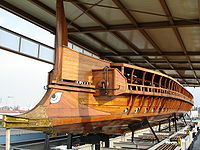
 used their trireme
Trireme

File:Romtrireme.jpgThe trireme is a class of warships used by the ancient civilizations of the Mediterranean, especially the Phoenicians, ancient Greece and ancient Rome....
 vessels for ramming as well.

Air warfare


Ramming in air combat is a last-ditch tactic that was used when all else had failed. The ramming pilot could use his entire aircraft as a ram or he could try to destroy the enemy's controls using the propeller or wing to chop into the enemy's tail or wing. Ramming took place when a pilot ran out of ammunition yet was still eager to destroy an enemy, or when his plane had already been damaged beyond saving. Most ramming occurred when the attacker's aircraft was economically, strategically or tactically less valuable than the enemy's, such as by pilots flying obsolescent aircraft against superior ones or by single-engine aircraft against multiple-engine bombers. Defenders rammed more often than invaders.

A ramming attack was not considered suicidal in the same manner as kamikaze
Kamikaze

The were suicide attacks by military aviation from the Empire of Japan against Allies Of World War II shipping, in the closing stages of the Pacific War of World War II, to destroy as many warships as possible....
 attacks — the ramming pilot stands a chance of surviving, though it was very risky. Sometimes the ramming aircraft itself could survive to make a controlled landing, though most were lost due to combat damage or the pilot bailing out. Ramming was used in air warfare in the first half of the 20th century, in both World War
World war

A world war is a war affecting the majority of the world's most powerful and populous nations. World wars span several continents, and last for multiple years....
s and in the interwar period. In the jet age, as air combat speeds increased, instances of ramming became rare. It was too risky.

Technique

Three types of ramming attacks were made:
  • Using the propeller to go in from behind and chop off the controls in the tail of the enemy aircraft. This was the most difficult to perform, but it had the best chance of survival.
  • Using the wing to cut off the wing or tail of the enemy aircraft. Some Soviet aircraft like the Polikarpov I-16
    Polikarpov I-16

    The Polikarpov I-16 was a USSR fighter aircraft of revolutionary design; it was the world's first cantilever-winged monoplane fighter with retractable landing gear....
     had wings strengthened for this purpose.
  • Direct ramming was the easiest to perform, but also the most dangerous.


Early science fiction

Presaging the 20th century air warfare ramming actions, Jules Verne
Jules Verne

Jules Gabriel Verne was a France author who helped pioneer the science fiction genre. He is best known for his novels Journey to the Center of the Earth , From the Earth to the Moon , Twenty Thousand Leagues Under the Sea , and Around the World in Eighty Days ....
 imagined an apparent aerial attack made by a heavy flying machine with a prominent ram prow against a nearly defenseless lighter-than-air craft in his science fiction work Robur the Conqueror
Robur the Conqueror

Robur-the-Conqueror is a science fiction novel by Jules Verne, published in 1886. It is also known as The Clipper of the Clouds. It has a sequel, Master of the World , which was published in 1904....
, published in 1886. H. G. Wells, writing in 1899 in his novel The Sleeper Awakes
The Sleeper Awakes

The Sleeper Awakes is a dystopian novel by H. G. Wells about a man who sleeps for two hundred and three years, waking up in a completely transformed London, where, because of compound interest on his deposit account, he has become the richest man in the world....
, has his main character, Graham, ram one of the enemy's aeroplanes with his flying apparatus, causing it to fall out of the sky. A second enemy machine ceases its attack, afraid of being rammed in turn.

World War I

Nesterov Taran
The first known instance of ramming in air warfare was made over Zhovkva
Zhovkva

Zhovkva is a city in the Lviv Oblast of western Ukraine, north of Lviv. It is the Capital city of the Zhovkivskyi Raion . The current estimated population is 13,500....
 by the Russian pilot, Pyotr Nesterov
Pyotr Nesterov

Pyotr Nesterov was a Russian pilot, an aircraft technical designer and an aerobatics pioneer....
 on September 8, 1914, against an Austria
Austria

Austria , officially the Republic of Austria , is a landlocked country in Central Europe. It borders both Germany and the Czech Republic to the north, Slovakia and Hungary to the east, Slovenia and Italy to the south, and Switzerland and Liechtenstein to the west....
n plane. That incident was fatal to both parties.

Spanish Civil War

Ramming was used in the Spanish Civil War
Spanish Civil War

The Spanish Civil War was a major conflict in Spain that started after an attempted coup d'?tat by a group of Spanish Army generals, supported by the conservative Spanish Confederation of the Autonomous Right , Carlist groups and the fascistic Falange, against the government of the Second Spanish Republic, then under the leadership of pr...
. On the night of November 27-28, 1937 Soviet pilot Evgeny Stepanov flying a Polikarpov I-15
Polikarpov I-15

The Polikarpov I-15 was a Soviet biplane fighter aircraft of the 1930s. Nicknamed Chaika because of its gull wing upper wings, it was operated in large numbers by the Soviet Air Force, and together with the Polikarpov I-16 monoplane, was one of the standard fighters of the Spanish Republic during the Spanish Civil War....
 shot down one SM.81 bomber near Barcelona and emptied the rest of his bullets into another. The second SM.81 continued to fly, so Stepanov resorted to using the left leg of his Chaikas undercarriage to ram the bomber, downing the plane.

World War II


Poland
The first taran attack in World War II
World War II

World War II, or the Second World War , was a global military conflict which involved a Participants in World War II, including all of the great powers, organised into two opposing military alliances: the Allies of World War II and the Axis powers....
 was carried out by the Polish
Polish Air Force

Polish Air Force is the air force branch of the Polish Armed Forces. Until 1 July 2004 it was officially known as Wojska Lotnicze i Obrony Powietrznej ....
 pilot, Lt. Col. Leopold Pamula with his damaged PZL P.11
PZL P.11

The PZL P.11 was a Poland fighter aircraft, designed in the early 1930s by PZL in Warsaw. It was briefly considered to be the most advanced fighter aircraft design in the world....
c on September 1, 1939, over Lomianki near Warsaw
Warsaw

Warsaw is the Capital and World's largest cities of Poland. It is located on the Vistula River roughly from both the Baltic Sea coast and the Carpathian Mountains....
. (
Taran is also a Polish
Polish language

Polish , an official language of Poland, has the largest number of speakers of any West Slavic languages. Polish-speakers use the language in a uniform manner through most of Poland, and it has a regular orthography....
 word.)

Soviet Union
In World War II, ramming became a legendary technique of VVS
Soviet Air Force

The Soviet Air Force, also known under the abbreviation VVS, transliterated from Russian : ???, ??????-????????? ???? , was the official designation of one of the air forces of the Soviet Union....
 pilots against the Luftwaffe
Luftwaffe

is a generic German term for an air force. It is also the official name for two of the four historic German air forces, the Wehrmacht air arm founded in 1933 and disbanded in 1946; and the current Bundeswehr air arm founded in 1956....
, especially in the early days of the hostilities in the war's Eastern Front
Eastern Front (World War II)

The Eastern Front of World War II was a Theatre between the German Reich and the Soviet Union which encompassed Central Europe and eastern Europe from 22 June 1941 to 9 May 1945....
. In the first year of the war, most available Soviet machines were considerably inferior to the German ones and the
taran was sometimes perceived as the only way to guarantee the destruction of the enemy. Trading an outdated fighter for a technologically advanced bomber was considered economically sound. In some cases, pilots who were heavily wounded or in damaged aircraft decided to perform a suicidal taran attack against air, ground or naval targets. In this instance, taran becomes more like an unpremeditated kamikaze
Kamikaze

The were suicide attacks by military aviation from the Empire of Japan against Allies Of World War II shipping, in the closing stages of the Pacific War of World War II, to destroy as many warships as possible....
 attack (see Nikolai Gastello
Nikolai Gastello

Nikolai Frantsevich Gastello , Russian aviator, Hero of the Soviet Union. He is one of the best known Soviet war heroes, being the first Soviet pilot to conduct a "fire taran" - a suicide attack by an aircraft on a ground target....
).

Nine rammings took place on the very first day of the German invasion of the Soviet Union
Operation Barbarossa

Operation Barbarossa was the code name for Nazi Germany's invasion of the Soviet Union during World War II that commenced on 22 June 1941. Over 4.5 million troops of the Axis powers invaded the USSR along a 2,900 kilometer front ....
, one within the first hour. At 04:25 hours on June 22, 1941 Lt. I. I. Ivanov drove his Polikarpov I-16
Polikarpov I-16

The Polikarpov I-16 was a USSR fighter aircraft of revolutionary design; it was the world's first cantilever-winged monoplane fighter with retractable landing gear....
 into the tail of an invading Heinkel He 111
Heinkel He 111

The Heinkel He 111 was a German aircraft designed by G?nter brothers in the early 1930s in violation of the Treaty of Versailles. Often described as a "Wolf in sheep's clothing", it masqueraded as a transport aircraft, but its purpose was to provide the Luftwaffe with a fast medium bomber....
. Ivanov didn't survive but was posthumously awarded the gold star, Hero of the Soviet Union
Hero of the Soviet Union

The title Hero of the Soviet Union was the highest distinction in the Soviet Union, awarded personally or collectively for heroic feats in service to the Soviet state and society....
. The Soviets eventually developed tactics that gave attacking pilots at least a small chance of survival, including targeting an ememy planes tail, rudder, and other horizontal control surfaces with their planes propeller. A few planes were even equipped with special steel propellers for such attacks. Lieutenant Boris Kobzan survived a record four ramming attacks in the war. Alexander Khlobystov made three. Seventeen other Soviet pilots were credited with two successful ramming attacks. About 200 taran attacks were made by Soviets between the beginning of Operation Barbarossa and the middle of 1943, when enough modern aircraft had been produced to make the tactic obsolete (even if Russian fighter pilots were still trained to perform it). However, Evgeny Stepanov stated in an interview that more than 580 taran attacks were made by VVS pilots in WWII.

United Kingdom
On 18 August 1940, RAFVR Sergeant
Sergeant

Sergeant is a Military rank used in some form by most militaries, police forces, and other uniformed organizations around the world. Its origins are the Latin serviens, "one who serves", through the French term Sergent....
 Bruce Hancock of No.6 SFTS used his Anson
Anson

Anson may refer to:...
 aircraft to ram a Heinkel He.111P; there were no survivors.

On 15 September 1940, Flight Sergeant
Flight Sergeant

Flight Sergeant is a senior non-commissioned officer rank in the United Kingdom Royal Air Force and several other air forces which have adopted all or part of the RAF rank structure....
 Ray Holmes
Ray Holmes

Raymond Towers "Ray" Holmes was a United Kingdom Fighter aircraft aviator who was feted as a war hero who saved Buckingham Palace from being severely damaged by Germany bombing during the Battle of Britain....
 of No. 504 Squadron RAF
No. 504 Squadron RAF

No. 504 Squadron was formed on 26 March 1928 as one of the Special Reserve Squadrons of the Auxiliary Air Force or AAF. It was integrated into the AAF proper in 1936....
 used his Hawker Hurricane
Hawker Hurricane

The Hawker Hurricane is a United Kingdom single-seat fighter aircraft that was designed and predominantly built by Hawker Aircraft. Some production of the Hurricane was carried out in Canada by the Canada Car and Foundry....
 to destroy a Dornier Do-17 bomber over London by ramming but at the loss of his own aircraft (and almost his own life) in one of the defining moments of the Battle of Britain
Battle of Britain

The Battle of Britain is the name given to the sustained strategic effort by the Luftwaffe during the summer and autumn of 1940 to gain air superiority over the Royal Air Force , especially RAF Fighter Command....
. Holmes, making a head-on attack, found his guns inoperative. He flew his plane into the top-side of the German bomber, cutting off the rear tail section with his wing and causing the bomber to dive out of control. The German crew were killed in the crash, while the injured Holmes bailed out of his plane and survived. As the R.A.F. did not practice ramming as an air combat tactic, this was considered an impromptu manoeuvre, and an act of selfless courage.

Kingdom of Yugoslavia

On April 6 1941, the first day of Invasion of Yugoslavia
Invasion of Yugoslavia

The Invasion of Yugoslavia , also known as the April War , was the Axis powers' attack on Kingdom of Yugoslavia on April 6, 1941 during World War II....
 36th group of the 5th fighter regiment of the Yugoslav Royal Air Force
Yugoslav Royal Air Force

The Yugoslav Royal Air Force or Jugoslovensko Kraljevsko Ratno Vazduhoplovstvo in Serbian language & Croatian language: Jugoslavensko Kraljevsko Ratno Zrakoplovstvo, slovene language: Jugoslovansko Kraljevo Vojno Letalstvo, was formed upon the creation of the Kingdom of Serbs, Croats and Slovenes in 1918 an existed until Royal Y...
, equipped with obsolete Hawker Fury
Hawker Fury

The Hawker Fury was a United Kingdom biplane fighter aircraft used by the Royal Air Force in the 1930s. It was originally named the Hornet and was the counterpart to the Hawker Hart light bomber....
 biplanes scrambled to defend their airfield, Režanovacka Kosa, from a strafing attack by aprox. 30 Bf-109 and Bf-110s. In the ensuing uneven dogfight at least three Yugoslav pilots: Captain Konstantin Jermakov, Captain Vojislav Popovic and Lieutenant Milorad Tanasic rammed a German fighter each with fatal results on both sides.

Japan
The Japanese also practiced ramming, both by individual initiative and by policy. Individual initiative was involved in the bringing down of a lone B-17 Flying Fortress
B-17 Flying Fortress

The Boeing B-17 Flying Fortress is a four-engine heavy bomber aircraft developed for the United States Army Air Corps . Competing against Douglas Aircraft Company and Glenn L....
 
The Flying Swede on May 8, 1942 by a Nakajima Ki-43
Nakajima Ki-43

The Nakajima Aircraft Company Ki-43 Hayabusa was a single-engined land-based fighter used by the Imperial Japanese Army Air Force in World War II....
 fighter plane. After three of the Japanese fighters had each made two attack passes without decisive results, the bomber's pilot, Major Robert N. Keatts, made for the shelter of a nearby rain squall. Loath to let the bomber escape, Sgt. Tadao Oda executed a head-on ramming attack, known as
tai-atari, or "body-bashing". Both aircraft were destroyed with no survivors. Sergeant Oda was posthumously promoted to lieutenant for his sacrifice.

Starting in August 1944, several Japanese pilots flying Kawasaki Ki-45
Kawasaki Ki-45

The Kawasaki Heavy Industries Ki-45 Toryu was a two-seat, twin-engined fighter used by the Imperial Japanese Army in World War II. The army gave it the designation "Type 2 two-seat fighter"; the Allied codename was Nick....
 and other fighters engaging B-29 Superfortress
B-29 Superfortress

The Boeing B-29 Superfortress was a four-engine Fixed-wing aircraft#Propeller aircraft heavy bomber that was flown by the United States Military in World War II and the Korean War, and by other nations afterwards....
es found that ramming the very heavy bomber was a practical tactic. From that experience, in November 1944 a "Special Attack Unit" was formed using Kawasaki Ki-61
Kawasaki Ki-61

The Kawasaki Heavy Industries Ki-61 Hien was a Japanese World War II fighter aircraft used by the Imperial Japanese Army Air Force. The Allied code name assigned by the United States Department of War was "Tony"....
s that had been stripped of most of their weapons and armor so as to quickly achieve high altitude. Three successful, surviving ramming pilots were the first recipients of the
Bukosho, Japan's equivalent to the Victoria Cross
Victoria Cross

The Victoria Cross is the highest military decoration which is, or has been, awarded for valour "in the face of the enemy" to members of the armed forces of various Commonwealth of Nations countries, and previous British Empire territories....
 or Medal of Honor
Medal of Honor

The Medal of Honor is the highest Awards and decorations of the United States military awarded by the United States government. It is bestowed on a member of the United States armed forces who distinguishes himself "conspicuously by gallantry and intrepidity at the risk of his life above and beyond the call of duty while engaged in an action...
, an award which had been inaugurated on 7 December 1944 as an Imperial Edict by Emperor
Emperor

An emperor is a monarch, usually the sovereign ruler of an empire or another type of imperial realm. Empress is the female equivalent. As a title, "empress" may indicate the wife of an emperor or a woman who rules in her own right ....
 Hirohito
Hirohito

, also known as , was the 124th Emperor of Japan of Japan according to the traditional order, reigning from 25 December 1926 until his death in 1989....
. Membership in the Special Attack Unit was seen as a final assignment; the pilots were expected to perform ramming attacks until death or serious injury stopped their service.

Bulgaria
Several rammings were performed by Bulgaria
Bulgaria

The state of Bulgaria , Scientific transliteration Balgarija, officially the Republic of Bulgaria has played a significant role in the Balkans in south-eastern Europe for over fourteen centuries....
n fighter pilots defending Sofia
Sofia

Sofia , is the Capital and largest city of the Bulgaria, with 2,5 million people living in the Capital Municipality. It is located in western Bulgaria, at the foot of the mountain massif Vitosha, and is the administrative, cultural, economic, and educational centre of the country....
 against Allied bombers in 1943 and 1944. The first one to do so was Senior Lieutenant (posthumously elevated to Captain) Dimitar Spisarevsky on December 20, 1943.

Germany

Late in World War II
World War II

World War II, or the Second World War , was a global military conflict which involved a Participants in World War II, including all of the great powers, organised into two opposing military alliances: the Allies of World War II and the Axis powers....
, Sonderkommando Elbe
Sonderkommando Elbe

Sonderkommando Elbe was the name of a World War II History of the Luftwaffe during World War II task force assigned to bring down Allied bombers by ramming German aircraft into the bombers....
 used ramming to try and regain control of the air. Although some pilots succeeded in destroying bombers, Allied numbers were not significantly reduced.

Cold War


In the 1960 U-2 incident, Soviet pilot Igor Mentyukov was scrambled with orders to ram the intruding Lockheed U-2
Lockheed U-2

The Lockheed Corporation U-2, nicknamed "Dragon Lady", is a single-engine, high-altitude aircraft flown by the United States Air Force and previously flown by the Central Intelligence Agency....
, using his unarmed Sukhoi Su-9
Sukhoi Su-9

The Sukhoi Su-9 was a single-engine, all-weather, missile-armed interceptor aircraft developed by the Soviet Union....
 which had been modified for higher altitude flight. In 1996, Mentyukov claimed that contact with his aircraft's slipstream downed Gary Powers
Gary Powers

Francis Gary Powers was an American Aviator whose Central Intelligence Agency Lockheed U-2 was shot down while over the Soviet Union, causing the 1960 U-2 incident....
, however, Sergei Khrushchev asserted in 2000 that Mentyukov failed even to gain visual contact.

Vietnam War

During the Vietnam War
Vietnam War

The Vietnam War, also known as the Second Indochina Wars, the Vietnam Conflict, or often in Vietnam the American War occurred in Vietnam, Laos and Cambodia from 1959 to April 30, 1975....
, Vu Xuan Thieu, a North Vietnam pilot, is said to have rammed his Mig-21 into an American B-52, accounting for the second loss of a B-52 to an enemy interceptor (the first one was shot down by Pham Tuan). Thieu subsequently crashed, however, the reason for his crash is disputed. He might have been downed by the fireball of the destroyed B-52.

post-1980

In 1981 a Soviet Su-15 fighter jet rammed an Iranian CL-44 reconnaissance
Reconnaissance

Reconnaissance is a military and medical term denoting exploration conducted to gain information. Militarily, its shorthand Australian, Canadian, and British form is recce , its American usage form is recon ....
 plane which intruded USSR airspace, resulting in the crash of both aircraft. There have been at least three other Soviet ramming attacks between the early 1970s and 1988.

See also kinetic projectile.

Ground warfare

(See Battering ram
Battering ram

A battering ram is a siege engine originating in ancient history to break open fortification walls or doors.In its simplest form, a battering ram is just a large, heavy log carried by several people and propelled with force against an obstacle; the momentum of the ram would be sufficient to damage the target if the log were massive enough a...
.)

Sea warfare

The ram was commonly used in antiquity, and was an important part of the armament of the galleys of Imperial Rome. Its first recorded use in modern times between major warships, however, was in the American Civil War
American Civil War

The American Civil War , also known as the War Between the States and several Naming the American Civil War, was a civil war in the United States....
, at the battle of Hampton Roads
Hampton Roads

Hampton Roads is the name of both a body of water and the region of land areas which surround it in southeastern Virginia in the United States. Hampton Roads is notable for its year-round ice-free harbor, for United States Navy, U.S....
, when the armoured Confederate
Confederate States of America

The Confederate States of America formed as the government set up from 1861 to 1865 by eleven Southern United States U.S. state of the United States of America that had declared their secession from the U.S....
 warship
Virginia
CSS Virginia

CSS Virginia was a steam-powered Floating battery design ironclad warship of the Confederate States Navy during the American Civil War .She was one of the participants in the Battle of Hampton Roads in March, 1862 opposite the USS Monitor....
 rammed the Union
Union (American Civil War)

During the American Civil War, the Union was a name used to refer to the Federal government of the United States of the United States, which was supported by the twenty-three states which were not part of the secession attempt by the 11 states that formed the Confederate States of America....
 frigate
Cumberland
USS Cumberland (1842)

The first USS Cumberland was a 50-gun sailing frigate of the United States Navy. She was the first ship sunk by the ironclad CSS Virginia....
, sinking her almost immediately.

Another significant success of the ram in wartime was at the battle of Lissa
Lissa

Lissa is:* the old Venetian name for the Adriatic Vis * the German name for the town of Leszno in Poland when it had a Moravian college and a gymnasium...
, between Italy
Italy

Italy , officially the Italian Republic , is a country located on the Italian Peninsula in Southern Europe and on the two largest islands in the Mediterranean Sea, Sicily and Sardinia....
 and Austria
Austria

Austria , officially the Republic of Austria , is a landlocked country in Central Europe. It borders both Germany and the Czech Republic to the north, Slovakia and Hungary to the east, Slovenia and Italy to the south, and Switzerland and Liechtenstein to the west....
. The Italian ironclad
Re d'Italia had been damaged aft by gunfire, and had no rudder. Lying helpless in the water, she was struck amidships by the Austrian Ferdinand Max, the flagship of the Austrian Commander-in-Chief Admiral Tegetthoff
Wilhelm von Tegetthoff

Wilhelm Freiherr von Tegetthoff was an Austrian admiral. Considered one of the prominent naval commanders of the 19th century, Tegetthoff was known for his innovative tactics as well as his inspirational leadership....
. The Austrian ship retreated unharmed as the Italian vessel rolled over and sank.

During the War of the Pacific
War of the Pacific

The War of the Pacific, occurring from 1879-1883, was a conflict between Chile and the joint forces of Bolivia and Peru. Also known as the "Sodium nitrate War", the war arose from disputes over the control of territory that contained substantial mineral-rich deposits....
, the Peruvian ironclad Huáscar
Huáscar (ship)

Hu?scar is a 19th century small armoured turret ship of a type similar to a monitor warship type. She was built in Britain for Peru and played a significant role in the War of the Pacific against Chile before being captured and commissioned with the Chilean Navy....
 repeatedly rammed the Chilean corvette Esmeralda
Esmeralda (ship)

Esmeralda may refer to one of several ships in Spanish Navy history:* Frigate Esmeralda, launched in Cartagena in 1753.* Frigate Esmeralda, launched in Cartagena in 1773....
, sinking the wooden steam- and wind-powered ship.

During World War I, HMS Dreadnought
HMS Dreadnought (1906)

The sixth HMS Dreadnought of the Royal Navy was a battleship that revolutionised naval power when she entered service in 1906. Dreadnought represented such a marked advance in naval technology that her name came to be associated with an entire generation of battleships, the "dreadnoughts", as well as the class of ships named af...
 rammed and sunk German submarine .

In World War II, naval ships often rammed other vessels, though this was often due to circumstances, as it could cause considerable damage to the attacking ship. The damage that lightly constructed destroyer
Destroyer

In navy terminology, a destroyer is a fast and maneuverable yet long-endurance warship intended to escort larger vessels in a Naval fleet, convoy or battle group and defend them against smaller, short-range but powerful attackers ....
s took from the tactic led to it being officially discouraged by the Royal Navy
Royal Navy

The Royal Navy of the United Kingdom is the oldest of the British Armed Forces . From the mid-18th century until well into the 20th century, it was the most powerful navy in the world, playing a key part in establishing the British Empire as the dominant world power from 1815 until the early 1940s....
 from early 1943, after the HMS
Hesperus
HMS Hesperus (H57)

HMS Hesperus was an G and H class destroyer destroyer of the Royal Navy....
 was dry-docked for three months following sinking
U-357 in December 1942 and HMS Harvester was torpedoed and sunk following damaging her propellers during the ramming of U-444 in March 1943.

During anti-submarine action, ramming was an alternative if the destroyer was too close to the surfaced submarine for her main guns to fire into the water. The tactic was used by the famous British anti-submarine specialist, captain Frederic John Walker
Frederic John Walker

Captain Frederic John Walker, Order of the Bath, Distinguished Service Order Medal bar, Royal Navy was a United Kingdom Royal Navy officer noted for his exploits during World War II....
 from December 1941 to the end of the war.

Superannuated British destroyer HMS
Campbeltown
HMS Campbeltown (I42)

HMS Campbeltown was a Town class destroyer destroyer of the Royal Navy during the Second World War. She was originally an United States destroyer, the USS Buchanan , but like many other obsolete US Navy destroyers, she was transferred to the Royal Navy in 1940 as part of the Destroyers for Bases Agreement....
 was disguised as a German ship for the purpose of ramming the lock gates of the U-boat base at St. Nazaire on 28 March 1942. A large explosive time bomb
Time bomb

A time bomb is an improvised explosive device with a timer so that it can be set to detonate any given time....
 charge in the bow of the ship exploded the next day, putting the dock out of commission for five years.

PT-109
Motor Torpedo Boat PT-109

United States Ship PT-109 was a PT boat last commanded by then-Lieutenant John F. Kennedy in the Pacific Ocean theater of World War II during World War II....
 was rammed and crushed by a Japanese destroyer, though the incident was at night and the PT-boat was idling to avoid detection, making it doubtful the destroyer's actions were intentional.

HMS
Glowworm
HMS Glowworm (H92)

HMS Glowworm was a G and H class destroyer destroyer of the Royal Navy. She entered service in the interwar period and initially served in the Mediterranean....
 rammed the German cruiser
Admiral Hipper
German cruiser Admiral Hipper

The German cruiser Admiral Hipper was the lead ship of the Admiral Hipper class cruiser heavy cruisers which served with the Kriegsmarine of Germany during World War II....
 in a famous act of desperation.

In 1988 two US naval ships, destroyer
Caron
USS Caron (DD-970)

USS Caron was a , named for Hospital Corpsman Third Class Wayne M. Caron , who was killed in action during the Vietnam War, and posthumously awarded the Medal of Honor....
 and cruiser
Yorktown
USS Yorktown (CG-48)

USS Yorktown was a in the United States Navy from 1984 to 2004, named for the American Revolutionary War Battle of Yorktown ....
, were lightly rammed by Soviet Mirka II
Mirka class frigate

The Mirka Class was the Nato reporting name for a class of light frigates built for the Soviet Navy in the mid-late 1960's. The Soviet Designation was Storozhevoi Korabl Project 35 and Project 35-M ....
 class light frigate (FFL 824) and Krivak I
Krivak class frigate

The Krivak class were a series of frigates built for the Soviet Navy. The Soviet designation was Project 1135 Burevestnik .These ships were designed as a successor to the Riga class frigate....
 class frigate
Bezzavetny (FFG 811) inside contested Soviet territorial waters in the Black Sea, near the port of Foros
Foros

Foros is a resort town in Crimea, Ukraine. It is located at around ....
. None of the ships involved suffered significant damage.

During the "Cod Wars" between Britain and Iceland, unarmed fishing trawlers found themselves opposed by Icelandic Coastguard vessels and converted trawlers. As well as Royal Navy
Royal Navy

The Royal Navy of the United Kingdom is the oldest of the British Armed Forces . From the mid-18th century until well into the 20th century, it was the most powerful navy in the world, playing a key part in establishing the British Empire as the dominant world power from 1815 until the early 1940s....
 coastguard vessels, Britain sent large, ocean-going tugs
Tugboat

A tugboat, or tug, is a boat used to maneuver, primarily by towing or pushing, other ships in harbors, over the open sea or through rivers and canals....
 and lightships to protect them and there were numerous ramming incidents against both sides, sometimes with very serious consequences.

External links