

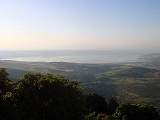
Sea of Galilee

Encyclopedia
The Sea of Galilee, also Kinneret, Lake of Gennesaret, or Lake Tiberias ' onMouseout='HidePop("20744")' href="/topics/Judeo-Aramaic_language">Judeo-Aramaic
: יַמּא דטבריא), is the largest freshwater
lake
in Israel
, and it is approximately 53 km (32.9 mi) in circumference, about 21 km (13 mi) long, and 13 km (8.1 mi) wide. The lake has a total area of 166 km² (64.1 sq mi), and a maximum depth of approximately 43 m (141 feet). At 214 metres (702.1 ft) below sea level, it is the lowest freshwater lake on Earth and the second-lowest lake in the world (after the Dead Sea
, a saltwater lake). The lake is fed partly by underground springs although its main source is the Jordan River which flows through it from north to south.
, the valley caused by the separation of the African
and Arabian Plate
s. Consequently the area is subject to earthquake
s and, in the past, volcanic
activity. This is evident by the abundant basalt
and other igneous rocks that define the geology of the Galilee region.
as Sea of Galilee or Sea of Tiberias . Sea of Tiberias is also the name by which the lake is mentioned in Roman texts and in the Jerusalem Talmud
, which was written in a dialect of Judeo-Aramaic, and this is the name adopted in Arabic: (بحيرة طبريا). The Babylonian Talmud, as well as Josephus Flavius mention the lake by the name "Sea of Ginnosar" after a small fertile plain that lies on its western side. This name, in the form Lake of Gennesaret
(Luke
) or Sea of Gennesaret appears in Christian religious texts. The name common in Hebrew today is borrowed from the Hebrew Bible
, where the lake is called the "Sea of Chinnereth" (or spelled as "Kinnereth") . This name was also found in the scripts of Ugarit
, in the Aqhat Epic. A variant of this name is Sea of Chinneroth.
The name may originate from the Hebrew word kinnor
("harp" or "lyre")), in view of the shape of the lake, perhaps from a name of a fruit called in Biblical Hebrew kinar, and is thought to be the fruit of Ziziphus spina-christi
.
 The Sea of Galilee lies on the ancient Via Maris
, which linked Egypt
with the northern empires. The Greeks
, Hasmonean
s, and Romans
founded flourishing towns and settlements on the land-locked lake including Gadara, Hippos
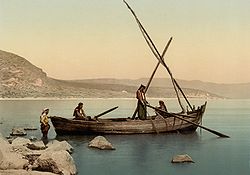
and Tiberias. The first-century historian Flavius Josephus was so impressed by the area that he wrote, "One may call this place the ambition of Nature." Josephus also reported a thriving fishing industry at this time, with 230 boats regularly working in the lake.
Much of the ministry of Jesus
occurred on the shores of Lake Galilee. In those days, there was a continuous ribbon development of settlements and villages around the lake and plenty of trade and ferrying by boat. The Synoptic gospels
of Mark
(1:14-20), Matthew
(4:18-22), and Luke
(5:1-11) describe how Jesus recruited four of his apostles from the shores of Lake Galilee: the fishermen Simon
and his brother Andrew
and the brothers John
and James
. One of Jesus' famous teaching episodes, the Sermon on the Mount
, is supposed to have been given on a hill overlooking the lake. Many of his miracles are also said to have occurred here including his walking on water, calming the storm
, the disciples and the boatload of fish, and his feeding five thousand people
(in Tabgha
).
In 135 CE the second Jewish revolt against the Romans
was put down. The Romans responded by banning all Jews from Jerusalem. The center of Jewish culture and learning shifted to the region of the Kinneret, particularly the city of Tiberias. It was in this region that the so-called "Jerusalem Talmud
" is thought to have been compiled.
In the time of the Byzantine Empire
, the lake's significance in Jesus' life made it a major destination for Christian pilgrims
. This led to the growth of a full-fledged tourist industry, complete with package tours and plenty of comfortable inns.
The lake's importance declined when the Byzantines lost control and the area came under the control of the Umayyad Caliphate and subsequent Islamic empires. Apart from Tiberias, the major towns and cities in the area were gradually abandoned. The palace Khirbat al-Minya
was built by the lake during the reign of the Umayyad caliph al-Walid I (705-715 CE). In 1187, Saladin
defeated the armies of the Crusades
at the Battle of Hattin
, largely because he was able to cut the Crusaders off from the valuable fresh water of the Sea of Galilee.
), Kvutzat Kinneret. The settlement trained Jewish immigrants in farming and agriculture. Later, Kinneret pioneers established Kibbutz Degania Alef. The Kinneret is considered the cradle of the kibbutz culture of early Zionism
and the birthplace of Naomi Shemer
and the burial site of Rachel - two of the most prominent Israeli poets.
In 1917, the British defeated Ottoman Turkish forces and took control of Palestine, while France took control of Syria. In the carve-up of the Ottoman territories between Britain and France, it was agreed that Britain would retain control of Palestine, while France would control Syria. However, the allies had to fix the border between the British Mandate for Palestine and the French Mandate of Syria
. The boundary was defined in broad terms by the Franco-British Boundary Agreement
of December 1920, which drew it across the middle of the lake. However, the commission established by the 1920 treaty redrew the boundary. The Zionist movement pressured the French and British to assign as many water sources as possible to Palestine
during the demarcating negotiations. The High Commissioner of Palestine, Herbert Samuel
, had sought full control of the Sea of Galilee. The negotiations led to the inclusion into the Palestine territory of the whole Sea of Galilee, both sides of the Jordan river, Lake Hula, Dan spring, and part of the Yarmouk
. The final border approved in 1923 followed a 10-meter wide strip along the lake's northeastern shore, cutting Syria
off from the lake.
The British and French Agreement provided that existing rights over the use of the waters of the Jordan by the inhabitants of Syria would be maintained; the Government of Syria would have the right to erect a new pier at Semakh on Lake Tiberias or jointly use the existing pier; persons or goods passing between the landing-stage on the Lake of Tiberias and Semakh would not be subject to customs regulations, and the Syrian government would have access to the said landing-stage; the inhabitants of Syria and Lebanon would have the same fishing and navigation rights on Lakes Huleh, Tiberias and River Jordan while the Government of Palestine would be responsible for policing of lakes.
On May 15, 1948, Syria invaded the State of Israel, capturing some Israeli kibbutzim near the Sea of Galilee. By the end of the war, Israel had recaptured the eastern shore.
In 1964, Syria
attempted construction of a Headwater Diversion Plan
that would have blocked the flow of water into the Sea of Galilee, sharply reducing the water flow into the lake. This project and Israel's attempt to block these efforts in 1965 were factors which played into regional tensions culminating in the 1967 Six-Day War
. During the war, Israel captured the Golan Heights, which contain some of the sources of water for the Sea of Galilee. Under the terms of the Israel–Jordan peace treaty, Israel also supplies 50 million cubic metres of water annually from the lake to Jordan
.
Increasing water demand and dry winters have resulted in stress on the lake and a decreasing water line, at times to dangerously low levels. The Sea of Galilee is at risk of becoming irreversibly salinized by the salt water springs under the lake that are limited by the weight of the freshwater on top of them.
The Israeli government monitors water levels on a daily basis, and the daily level of the Sea of Galilee is published at www.water.gov.il.
is the Kinneret's most important economic activity with the entire region being a popular holiday destination. The many historical and spiritual sites around the lake, especially its main town Tiberias, are visited by millions of local and foreign tourists annually. The Sea of Galilee attracts many Christian pilgrims
, because, according to the New Testament
, many of the miracles of Jesus
occurred on its shores—including his walking on water, calming the storm
, and feeding five thousand people
in Tabgha
.
In April 2011, Israel unveiled a 40 miles (64.4 km) hiking trail in the Galilee
for Christian pilgrims, called the "Jesus Trail
". It includes a network of footpaths, roads and bicycle paths linking sites central to the lives of Jesus
and his disciples. It ends at Capernaum
on the shores of the Sea of Galilee, where Jesus espoused his teachings. Another key attraction is the site where the Kinneret's water flows into the Jordan River, to which thousands of pilgrims from all over the world come to be baptized every year.
Tourists also partake in the building of rafts on Lavnun Beach, called Rafsodia. Here many different age groups work together to build a raft with their bare hands and then sail that raft across the Kinneret. Other economic activities include fishing in the lake and agriculture
, particularly banana
s, in the fertile belt of land surrounding it.
. Fauna include zooplankton
, benthos
and a number of fish species such as Acanthobrama terraesanctae
. Fish caught commercially include Tristramella simonis
and notably Tilapia
, locally called "St. Peter’s Fish". In 2005, 300 short tons (267.9 LT) of tilapia were caught by local fishermen. This dropped to 8 short tons (7.1 LT) in 2009 due to overfishing.
However, low water levels in drought years have stressed the lake's ecology. This may have been aggravated by over-abstraction of water for either the National Water Carrier to supply other parts of Israel or, since 1994, for the supply of water to Jordan (see "Water use" section above). Droughts of the early and mid-1990s dried out the marshy northern margin of the lake. A fish species that is unique to the lake, Tristramella sacra
, used to spawn
in the marsh and has not been seen since the 1990s droughts. Conservationists fear this species may have become extinct
.
Judeo-Aramaic language
Judæo-Aramaic is a collective term used to describe several Hebrew-influenced Aramaic and Neo-Aramaic languages.-Early use:Aramaic, like Hebrew, is a Northwest Semitic language, and the two share many features. From the 7th century BCE, Aramaic became the lingua franca of the Middle East...
: יַמּא דטבריא), is the largest freshwater
Freshwater
Fresh water is naturally occurring water on the Earth's surface in ice sheets, ice caps, glaciers, bogs, ponds, lakes, rivers and streams, and underground as groundwater in aquifers and underground streams. Fresh water is generally characterized by having low concentrations of dissolved salts and...
lake
Lake
A lake is a body of relatively still fresh or salt water of considerable size, localized in a basin, that is surrounded by land. Lakes are inland and not part of the ocean and therefore are distinct from lagoons, and are larger and deeper than ponds. Lakes can be contrasted with rivers or streams,...
in Israel
Israel
The State of Israel is a parliamentary republic located in the Middle East, along the eastern shore of the Mediterranean Sea...
, and it is approximately 53 km (32.9 mi) in circumference, about 21 km (13 mi) long, and 13 km (8.1 mi) wide. The lake has a total area of 166 km² (64.1 sq mi), and a maximum depth of approximately 43 m (141 feet). At 214 metres (702.1 ft) below sea level, it is the lowest freshwater lake on Earth and the second-lowest lake in the world (after the Dead Sea
Dead Sea
The Dead Sea , also called the Salt Sea, is a salt lake bordering Jordan to the east and Israel and the West Bank to the west. Its surface and shores are below sea level, the lowest elevation on the Earth's surface. The Dead Sea is deep, the deepest hypersaline lake in the world...
, a saltwater lake). The lake is fed partly by underground springs although its main source is the Jordan River which flows through it from north to south.
Geography
The Sea of Galilee (Kinneret) is situated in northeast Israel, near the Golan Heights, in the Jordan Great Rift ValleyGreat Rift Valley
The Great Rift Valley is a name given in the late 19th century by British explorer John Walter Gregory to the continuous geographic trench, approximately in length, that runs from northern Syria in Southwest Asia to central Mozambique in South East Africa...
, the valley caused by the separation of the African
African Plate
The African Plate is a tectonic plate which includes the continent of Africa, as well as oceanic crust which lies between the continent and various surrounding ocean ridges.-Boundaries:...
and Arabian Plate
Arabian Plate
The Arabian Plate is one of three tectonic plates which have been moving northward over millions of years and colliding with the Eurasian Plate...
s. Consequently the area is subject to earthquake
Earthquake
An earthquake is the result of a sudden release of energy in the Earth's crust that creates seismic waves. The seismicity, seismism or seismic activity of an area refers to the frequency, type and size of earthquakes experienced over a period of time...
s and, in the past, volcanic
Volcano
2. Bedrock3. Conduit 4. Base5. Sill6. Dike7. Layers of ash emitted by the volcano8. Flank| 9. Layers of lava emitted by the volcano10. Throat11. Parasitic cone12. Lava flow13. Vent14. Crater15...
activity. This is evident by the abundant basalt
Basalt
Basalt is a common extrusive volcanic rock. It is usually grey to black and fine-grained due to rapid cooling of lava at the surface of a planet. It may be porphyritic containing larger crystals in a fine matrix, or vesicular, or frothy scoria. Unweathered basalt is black or grey...
and other igneous rocks that define the geology of the Galilee region.
Etymology
The lake often appears on maps and in the New TestamentNew Testament
The New Testament is the second major division of the Christian biblical canon, the first such division being the much longer Old Testament....
as Sea of Galilee or Sea of Tiberias . Sea of Tiberias is also the name by which the lake is mentioned in Roman texts and in the Jerusalem Talmud
Jerusalem Talmud
The Jerusalem Talmud, talmud meaning "instruction", "learning", , is a collection of Rabbinic notes on the 2nd-century Mishnah which was compiled in the Land of Israel during the 4th-5th century. The voluminous text is also known as the Palestinian Talmud or Talmud de-Eretz Yisrael...
, which was written in a dialect of Judeo-Aramaic, and this is the name adopted in Arabic: (بحيرة طبريا). The Babylonian Talmud, as well as Josephus Flavius mention the lake by the name "Sea of Ginnosar" after a small fertile plain that lies on its western side. This name, in the form Lake of Gennesaret
Gennesaret
Gennesaret was a town alloted to the tribe of Naphtali, called "Kinnereth" , sometimes in the plural form "Kinneroth" . In later times the name was gradually changed to Genezareth, Genezar and Gennesaret...
(Luke
Gospel of Luke
The Gospel According to Luke , commonly shortened to the Gospel of Luke or simply Luke, is the third and longest of the four canonical Gospels. This synoptic gospel is an account of the life and ministry of Jesus of Nazareth. It details his story from the events of his birth to his Ascension.The...
) or Sea of Gennesaret appears in Christian religious texts. The name common in Hebrew today is borrowed from the Hebrew Bible
Hebrew Bible
The Hebrew Bible is a term used by biblical scholars outside of Judaism to refer to the Tanakh , a canonical collection of Jewish texts, and the common textual antecedent of the several canonical editions of the Christian Old Testament...
, where the lake is called the "Sea of Chinnereth" (or spelled as "Kinnereth") . This name was also found in the scripts of Ugarit
Ugarit
Ugarit was an ancient port city in the eastern Mediterranean at the Ras Shamra headland near Latakia, Syria. It is located near Minet el-Beida in northern Syria. It is some seven miles north of Laodicea ad Mare and approximately fifty miles east of Cyprus...
, in the Aqhat Epic. A variant of this name is Sea of Chinneroth.
The name may originate from the Hebrew word kinnor
Kinnor
Kinnor is the Hebrew name for an ancient Israelite lyre mentioned in the Bible and commonly translated as harp.-History:The identification of the instrument is uncertain, but a few historians of musical instruments say it is similar to the Greek cithara, Though the Kinnura is a better...
("harp" or "lyre")), in view of the shape of the lake, perhaps from a name of a fruit called in Biblical Hebrew kinar, and is thought to be the fruit of Ziziphus spina-christi
Ziziphus spina-christi
Ziziphus spina-christi, the Christ's Thorn Jujube is an evergreen tree native to northern and tropical Africa and southern and Western Asia...
.
Antiquity
Via Maris
Via Maris is the modern name for an ancient trade route, dating from the early Bronze Age, linking Egypt with the northern empires of Syria, Anatolia and Mesopotamia — modern day Iran, Iraq, Turkey and Syria....
, which linked Egypt
Egypt
Egypt , officially the Arab Republic of Egypt, Arabic: , is a country mainly in North Africa, with the Sinai Peninsula forming a land bridge in Southwest Asia. Egypt is thus a transcontinental country, and a major power in Africa, the Mediterranean Basin, the Middle East and the Muslim world...
with the northern empires. The Greeks
Greeks
The Greeks, also known as the Hellenes , are a nation and ethnic group native to Greece, Cyprus and neighboring regions. They also form a significant diaspora, with Greek communities established around the world....
, Hasmonean
Hasmonean
The Hasmonean dynasty , was the ruling dynasty of Judea and surrounding regions during classical antiquity. Between c. 140 and c. 116 BCE, the dynasty ruled semi-autonomously from the Seleucids in the region of Judea...
s, and Romans
Roman Empire
The Roman Empire was the post-Republican period of the ancient Roman civilization, characterised by an autocratic form of government and large territorial holdings in Europe and around the Mediterranean....
founded flourishing towns and settlements on the land-locked lake including Gadara, Hippos
Hippos
Hippos is an archaeological site in Israel, located on a hill overlooking the Sea of Galilee. Between the 3rd century BC and the 7th century AD, Hippos was the site of a Greco-Roman city. Besides the fortified city itself, Hippos controlled two port facilities on the lake and an area of the...
and Tiberias. The first-century historian Flavius Josephus was so impressed by the area that he wrote, "One may call this place the ambition of Nature." Josephus also reported a thriving fishing industry at this time, with 230 boats regularly working in the lake.
Much of the ministry of Jesus
Ministry of Jesus
In the Christian gospels, the Ministry of Jesus begins with his Baptism in the countryside of Judea, near the River Jordan and ends in Jerusalem, following the Last Supper with his disciples. The Gospel of Luke states that Jesus was "about 30 years of age" at the start of his ministry...
occurred on the shores of Lake Galilee. In those days, there was a continuous ribbon development of settlements and villages around the lake and plenty of trade and ferrying by boat. The Synoptic gospels
Synoptic Gospels
The gospels of Matthew, Mark, and Luke are known as the Synoptic Gospels because they include many of the same stories, often in the same sequence, and sometimes exactly the same wording. This degree of parallelism in content, narrative arrangement, language, and sentence structures can only be...
of Mark
Gospel of Mark
The Gospel According to Mark , commonly shortened to the Gospel of Mark or simply Mark, is the second book of the New Testament. This canonical account of the life of Jesus of Nazareth is one of the three synoptic gospels. It was thought to be an epitome, which accounts for its place as the second...
(1:14-20), Matthew
Gospel of Matthew
The Gospel According to Matthew is one of the four canonical gospels, one of the three synoptic gospels, and the first book of the New Testament. It tells of the life, ministry, death, and resurrection of Jesus of Nazareth...
(4:18-22), and Luke
Gospel of Luke
The Gospel According to Luke , commonly shortened to the Gospel of Luke or simply Luke, is the third and longest of the four canonical Gospels. This synoptic gospel is an account of the life and ministry of Jesus of Nazareth. It details his story from the events of his birth to his Ascension.The...
(5:1-11) describe how Jesus recruited four of his apostles from the shores of Lake Galilee: the fishermen Simon
Saint Peter
Saint Peter or Simon Peter was an early Christian leader, who is featured prominently in the New Testament Gospels and the Acts of the Apostles. The son of John or of Jonah and from the village of Bethsaida in the province of Galilee, his brother Andrew was also an apostle...
and his brother Andrew
Saint Andrew
Saint Andrew , called in the Orthodox tradition Prōtoklētos, or the First-called, is a Christian Apostle and the brother of Saint Peter. The name "Andrew" , like other Greek names, appears to have been common among the Jews from the 3rd or 2nd century BC. No Hebrew or Aramaic name is recorded for him...
and the brothers John
John the Apostle
John the Apostle, John the Apostle, John the Apostle, (Aramaic Yoħanna, (c. 6 - c. 100) was one of the Twelve Apostles of Jesus. He was the son of Zebedee and Salome, and brother of James, another of the Twelve Apostles...
and James
Saint James the Great
James, son of Zebedee was one of the Twelve Apostles of Jesus. He was a son of Zebedee and Salome, and brother of John the Apostle...
. One of Jesus' famous teaching episodes, the Sermon on the Mount
Sermon on the Mount
The Sermon on the Mount is a collection of sayings and teachings of Jesus, which emphasizes his moral teaching found in the Gospel of Matthew...
, is supposed to have been given on a hill overlooking the lake. Many of his miracles are also said to have occurred here including his walking on water, calming the storm
Calming the storm
thumb|240px|[[The Storm on the Sea of Galilee]] by [[Rembrandt]], 1632.Calming the storm is one of the miracles of Jesus in the Gospels, namely in Mark 4:35-41, Luke 8:22-25 and Matthew 8:23-27....
, the disciples and the boatload of fish, and his feeding five thousand people
Feeding the multitude
Feeding the multitude is the combined term used to refer to two separate miracles of Jesus in the Gospels.The First Miracle, "The Feeding of the 5,000" is the only miracle which is present in all four canonical Gospels...
(in Tabgha
Tabgha
Tabgha is an area situated on the north-western shore of the Sea of Galilee in Israel. It is the traditional site of the miracle of the multiplication of the loaves and fishes and the fourth resurrection appearance of Jesus in Christianity. Until 1948, it was the site of an Arab village.The...
).
In 135 CE the second Jewish revolt against the Romans
Bar Kokhba's revolt
The Bar Kokhba revolt 132–136 CE; or mered bar kokhba) against the Roman Empire, was the third major rebellion by the Jews of Judaea Province being the last of the Jewish-Roman Wars. Simon bar Kokhba, the commander of the revolt, was acclaimed as a Messiah, a heroic figure who could restore Israel...
was put down. The Romans responded by banning all Jews from Jerusalem. The center of Jewish culture and learning shifted to the region of the Kinneret, particularly the city of Tiberias. It was in this region that the so-called "Jerusalem Talmud
Jerusalem Talmud
The Jerusalem Talmud, talmud meaning "instruction", "learning", , is a collection of Rabbinic notes on the 2nd-century Mishnah which was compiled in the Land of Israel during the 4th-5th century. The voluminous text is also known as the Palestinian Talmud or Talmud de-Eretz Yisrael...
" is thought to have been compiled.
In the time of the Byzantine Empire
Byzantine Empire
The Byzantine Empire was the Eastern Roman Empire during the periods of Late Antiquity and the Middle Ages, centred on the capital of Constantinople. Known simply as the Roman Empire or Romania to its inhabitants and neighbours, the Empire was the direct continuation of the Ancient Roman State...
, the lake's significance in Jesus' life made it a major destination for Christian pilgrims
Christian pilgrimage
Christian pilgrimage was first made to sites connected with the ministry of Jesus. Surviving descriptions of Christian pilgrimages to the Holy Land and Jerusalem date from the 4th century, when pilgrimage was encouraged by church fathers like Saint Jerome and established by Helena, the mother of...
. This led to the growth of a full-fledged tourist industry, complete with package tours and plenty of comfortable inns.
The lake's importance declined when the Byzantines lost control and the area came under the control of the Umayyad Caliphate and subsequent Islamic empires. Apart from Tiberias, the major towns and cities in the area were gradually abandoned. The palace Khirbat al-Minya
Khirbat al-Minya
Khirbat al-Minya is an Umayyad-built palace in the eastern Galilee, Israel, located about west of the northern end of the Lake Tiberias...
was built by the lake during the reign of the Umayyad caliph al-Walid I (705-715 CE). In 1187, Saladin
Saladin
Ṣalāḥ ad-Dīn Yūsuf ibn Ayyūb , better known in the Western world as Saladin, was an Arabized Kurdish Muslim, who became the first Sultan of Egypt and Syria, and founded the Ayyubid dynasty. He led Muslim and Arab opposition to the Franks and other European Crusaders in the Levant...
defeated the armies of the Crusades
Crusades
The Crusades were a series of religious wars, blessed by the Pope and the Catholic Church with the main goal of restoring Christian access to the holy places in and near Jerusalem...
at the Battle of Hattin
Battle of Hattin
The Battle of Hattin took place on Saturday, July 4, 1187, between the Crusader Kingdom of Jerusalem and the forces of the Ayyubid dynasty....
, largely because he was able to cut the Crusaders off from the valuable fresh water of the Sea of Galilee.
Modern era
In 1909, Jewish pioneers established the first cooperative farming village (kibbutzKibbutz
A kibbutz is a collective community in Israel that was traditionally based on agriculture. Today, farming has been partly supplanted by other economic branches, including industrial plants and high-tech enterprises. Kibbutzim began as utopian communities, a combination of socialism and Zionism...
), Kvutzat Kinneret. The settlement trained Jewish immigrants in farming and agriculture. Later, Kinneret pioneers established Kibbutz Degania Alef. The Kinneret is considered the cradle of the kibbutz culture of early Zionism
Zionism
Zionism is a Jewish political movement that, in its broadest sense, has supported the self-determination of the Jewish people in a sovereign Jewish national homeland. Since the establishment of the State of Israel, the Zionist movement continues primarily to advocate on behalf of the Jewish state...
and the birthplace of Naomi Shemer
Naomi Shemer
Naomi Shemer was a leading Israeli songwriter hailed as the "first lady of Israeli song and poetry."-Biography:Naomi Sapir was born on Kvutzat Kinneret, a kibbutz her parents had helped found, on the shores of the Sea of Galilee. In the 1950s she served in the Israeli Defense Force's Nahal...
and the burial site of Rachel - two of the most prominent Israeli poets.
In 1917, the British defeated Ottoman Turkish forces and took control of Palestine, while France took control of Syria. In the carve-up of the Ottoman territories between Britain and France, it was agreed that Britain would retain control of Palestine, while France would control Syria. However, the allies had to fix the border between the British Mandate for Palestine and the French Mandate of Syria
French Mandate of Syria
Officially the French Mandate for Syria and the Lebanon was a League of Nations mandate founded after the First World War and the partitioning of the Ottoman Empire...
. The boundary was defined in broad terms by the Franco-British Boundary Agreement
Franco-British Boundary Agreement (1920)
The Franco-British Boundary Agreement of 1920, properly called the Franco-British Convention on Certain Points Connected with the Mandates for Syria and the Lebanon, Palestine and Mesopotamia, was an agreement signed between the British and French governments in Paris, on 23 December 1920...
of December 1920, which drew it across the middle of the lake. However, the commission established by the 1920 treaty redrew the boundary. The Zionist movement pressured the French and British to assign as many water sources as possible to Palestine
Palestine
Palestine is a conventional name, among others, used to describe the geographic region between the Mediterranean Sea and the Jordan River, and various adjoining lands....
during the demarcating negotiations. The High Commissioner of Palestine, Herbert Samuel
Herbert Samuel, 1st Viscount Samuel
Herbert Louis Samuel, 1st Viscount Samuel GCB OM GBE PC was a British politician and diplomat.-Early years:...
, had sought full control of the Sea of Galilee. The negotiations led to the inclusion into the Palestine territory of the whole Sea of Galilee, both sides of the Jordan river, Lake Hula, Dan spring, and part of the Yarmouk
Yarmouk River
The Yarmouk River is the largest tributary of the Jordan River. It drains much of the Hauran Plateau. It is one of three main tributaries which enter the Jordan between the Sea of Galilee and the Dead Sea. To the south, are the Jabbok/Zarqa and the Arnon/Wadi Mujib) rivers...
. The final border approved in 1923 followed a 10-meter wide strip along the lake's northeastern shore, cutting Syria
Syria
Syria , officially the Syrian Arab Republic , is a country in Western Asia, bordering Lebanon and the Mediterranean Sea to the West, Turkey to the north, Iraq to the east, Jordan to the south, and Israel to the southwest....
off from the lake.
The British and French Agreement provided that existing rights over the use of the waters of the Jordan by the inhabitants of Syria would be maintained; the Government of Syria would have the right to erect a new pier at Semakh on Lake Tiberias or jointly use the existing pier; persons or goods passing between the landing-stage on the Lake of Tiberias and Semakh would not be subject to customs regulations, and the Syrian government would have access to the said landing-stage; the inhabitants of Syria and Lebanon would have the same fishing and navigation rights on Lakes Huleh, Tiberias and River Jordan while the Government of Palestine would be responsible for policing of lakes.
On May 15, 1948, Syria invaded the State of Israel, capturing some Israeli kibbutzim near the Sea of Galilee. By the end of the war, Israel had recaptured the eastern shore.
Water use
Israel's National Water Carrier, built in 1964, transports water from the lake to the population centers of Israel, and is the source of much of the country's drinking water.In 1964, Syria
Syria
Syria , officially the Syrian Arab Republic , is a country in Western Asia, bordering Lebanon and the Mediterranean Sea to the West, Turkey to the north, Iraq to the east, Jordan to the south, and Israel to the southwest....
attempted construction of a Headwater Diversion Plan
Headwater Diversion Plan
The Headwater Diversion Plan was an Arab League plan to divert two of the three sources of the Jordan River, and prevent them from flowing into the Sea of Galilee, in order to thwart Israel's plans to use the water of the Hasbani and Banias in its National Water Carrier project for out of Basin...
that would have blocked the flow of water into the Sea of Galilee, sharply reducing the water flow into the lake. This project and Israel's attempt to block these efforts in 1965 were factors which played into regional tensions culminating in the 1967 Six-Day War
Six-Day War
The Six-Day War , also known as the June War, 1967 Arab-Israeli War, or Third Arab-Israeli War, was fought between June 5 and 10, 1967, by Israel and the neighboring states of Egypt , Jordan, and Syria...
. During the war, Israel captured the Golan Heights, which contain some of the sources of water for the Sea of Galilee. Under the terms of the Israel–Jordan peace treaty, Israel also supplies 50 million cubic metres of water annually from the lake to Jordan
Jordan
Jordan , officially the Hashemite Kingdom of Jordan , Al-Mamlaka al-Urduniyya al-Hashemiyya) is a kingdom on the East Bank of the River Jordan. The country borders Saudi Arabia to the east and south-east, Iraq to the north-east, Syria to the north and the West Bank and Israel to the west, sharing...
.
Increasing water demand and dry winters have resulted in stress on the lake and a decreasing water line, at times to dangerously low levels. The Sea of Galilee is at risk of becoming irreversibly salinized by the salt water springs under the lake that are limited by the weight of the freshwater on top of them.
The Israeli government monitors water levels on a daily basis, and the daily level of the Sea of Galilee is published at www.water.gov.il.
Tourism
Today, tourismTourism in Israel
Tourism in Israel is one of the country's major sources of income, with 3.45 million tourist arrivals in 2010. Israel offers a plethora of historical and religious sites, beach resorts, archaeological tourism, heritage tourism and ecotourism. Israel has the highest number of museums per capita in...
is the Kinneret's most important economic activity with the entire region being a popular holiday destination. The many historical and spiritual sites around the lake, especially its main town Tiberias, are visited by millions of local and foreign tourists annually. The Sea of Galilee attracts many Christian pilgrims
Christian pilgrimage
Christian pilgrimage was first made to sites connected with the ministry of Jesus. Surviving descriptions of Christian pilgrimages to the Holy Land and Jerusalem date from the 4th century, when pilgrimage was encouraged by church fathers like Saint Jerome and established by Helena, the mother of...
, because, according to the New Testament
New Testament
The New Testament is the second major division of the Christian biblical canon, the first such division being the much longer Old Testament....
, many of the miracles of Jesus
Miracles of Jesus
The miracles of Jesus are the supernatural deeds of Jesus, as recorded in Gospels, in the course of his ministry. According to the Gospel of John, only some of these were recorded. states that "Jesus did many other things as well...
occurred on its shores—including his walking on water, calming the storm
Calming the storm
thumb|240px|[[The Storm on the Sea of Galilee]] by [[Rembrandt]], 1632.Calming the storm is one of the miracles of Jesus in the Gospels, namely in Mark 4:35-41, Luke 8:22-25 and Matthew 8:23-27....
, and feeding five thousand people
Feeding the multitude
Feeding the multitude is the combined term used to refer to two separate miracles of Jesus in the Gospels.The First Miracle, "The Feeding of the 5,000" is the only miracle which is present in all four canonical Gospels...
in Tabgha
Tabgha
Tabgha is an area situated on the north-western shore of the Sea of Galilee in Israel. It is the traditional site of the miracle of the multiplication of the loaves and fishes and the fourth resurrection appearance of Jesus in Christianity. Until 1948, it was the site of an Arab village.The...
.
In April 2011, Israel unveiled a 40 miles (64.4 km) hiking trail in the Galilee
Galilee
Galilee , is a large region in northern Israel which overlaps with much of the administrative North District of the country. Traditionally divided into Upper Galilee , Lower Galilee , and Western Galilee , extending from Dan to the north, at the base of Mount Hermon, along Mount Lebanon to the...
for Christian pilgrims, called the "Jesus Trail
Jesus Trail
The Jesus Trail is a hiking and pilgrimage route in the Galilee region of Israel that traces the route Jesus may have walked, connecting many sites from his life and ministry...
". It includes a network of footpaths, roads and bicycle paths linking sites central to the lives of Jesus
Jesus
Jesus of Nazareth , commonly referred to as Jesus Christ or simply as Jesus or Christ, is the central figure of Christianity...
and his disciples. It ends at Capernaum
Capernaum
Capernaum was a fishing village in the time of the Hasmoneans. Located on the northern shore of the Sea of Galilee. It had a population of about 1,500. Archaeological excavations have revealed two ancient synagogues built one over the other...
on the shores of the Sea of Galilee, where Jesus espoused his teachings. Another key attraction is the site where the Kinneret's water flows into the Jordan River, to which thousands of pilgrims from all over the world come to be baptized every year.
Tourists also partake in the building of rafts on Lavnun Beach, called Rafsodia. Here many different age groups work together to build a raft with their bare hands and then sail that raft across the Kinneret. Other economic activities include fishing in the lake and agriculture
Agriculture in Israel
Agriculture in Israel is a highly developed industry: Israel is a major exporter of fresh produce and a world-leader in agricultural technologies despite the fact that the geography of Israel is not naturally conducive to agriculture. More than half of the land area is desert, and the climate and...
, particularly banana
Banana
Banana is the common name for herbaceous plants of the genus Musa and for the fruit they produce. Bananas come in a variety of sizes and colors when ripe, including yellow, purple, and red....
s, in the fertile belt of land surrounding it.
Fauna and flora
The warm waters of the Sea of Galilee support various flora and fauna, which have supported a significant commercial fishery for more than two millennia. Local flora include various reeds along most of the shoreline as well as phytoplanktonPhytoplankton
Phytoplankton are the autotrophic component of the plankton community. The name comes from the Greek words φυτόν , meaning "plant", and πλαγκτός , meaning "wanderer" or "drifter". Most phytoplankton are too small to be individually seen with the unaided eye...
. Fauna include zooplankton
Zooplankton
Zooplankton are heterotrophic plankton. Plankton are organisms drifting in oceans, seas, and bodies of fresh water. The word "zooplankton" is derived from the Greek zoon , meaning "animal", and , meaning "wanderer" or "drifter"...
, benthos
Benthos
Benthos is the community of organisms which live on, in, or near the seabed, also known as the benthic zone. This community lives in or near marine sedimentary environments, from tidal pools along the foreshore, out to the continental shelf, and then down to the abyssal depths.Many organisms...
and a number of fish species such as Acanthobrama terraesanctae
Acanthobrama terraesanctae
Acanthobrama terraesanctae is a species of ray-finned fish in the Cyprinidae family.It is found only in Israel.Its natural habitat is freshwater lakes....
. Fish caught commercially include Tristramella simonis
Tristramella simonis
Tristramella simonis is a species of cichlid fish. It is common in the Sea of Galilee in Israel, and may also occur in a tributary of the Jordan River in Syria. It is the only member of the genus Tristramella that certainly remains extant. Of the other three species, two are certainly extinct and a...
and notably Tilapia
Tilapia
Tilapia , is the common name for nearly a hundred species of cichlid fish from the tilapiine cichlid tribe. Tilapia inhabit a variety of fresh water habitats, including shallow streams, ponds, rivers and lakes. Historically, they have been of major importance in artisan fishing in Africa and the...
, locally called "St. Peter’s Fish". In 2005, 300 short tons (267.9 LT) of tilapia were caught by local fishermen. This dropped to 8 short tons (7.1 LT) in 2009 due to overfishing.
However, low water levels in drought years have stressed the lake's ecology. This may have been aggravated by over-abstraction of water for either the National Water Carrier to supply other parts of Israel or, since 1994, for the supply of water to Jordan (see "Water use" section above). Droughts of the early and mid-1990s dried out the marshy northern margin of the lake. A fish species that is unique to the lake, Tristramella sacra
Tristramella sacra
Tristramella sacra is a species of cichlid fish that is endemic to the Sea of Galilee in Israel. It has not been recorded since 1990, despite searches both of the lake and in local markets, and may therefore be extinct....
, used to spawn
Spawn (biology)
Spawn refers to the eggs and sperm released or deposited, usually into water, by aquatic animals. As a verb, spawn refers to the process of releasing the eggs and sperm, also called spawning...
in the marsh and has not been seen since the 1990s droughts. Conservationists fear this species may have become extinct
Extinction
In biology and ecology, extinction is the end of an organism or of a group of organisms , normally a species. The moment of extinction is generally considered to be the death of the last individual of the species, although the capacity to breed and recover may have been lost before this point...
.
See also
- The Sea of Galilee BoatThe Sea of Galilee BoatThe Sea of Galilee Boat also known as the was an ancient fishing boat from the 1st century CE , discovered in 1986 on the north-west shore of the Sea of Galilee in Israel...
- Miracles of JesusMiracles of JesusThe miracles of Jesus are the supernatural deeds of Jesus, as recorded in Gospels, in the course of his ministry. According to the Gospel of John, only some of these were recorded. states that "Jesus did many other things as well...
- Tiberias
- GalileeGalileeGalilee , is a large region in northern Israel which overlaps with much of the administrative North District of the country. Traditionally divided into Upper Galilee , Lower Galilee , and Western Galilee , extending from Dan to the north, at the base of Mount Hermon, along Mount Lebanon to the...
- Tourism in IsraelTourism in IsraelTourism in Israel is one of the country's major sources of income, with 3.45 million tourist arrivals in 2010. Israel offers a plethora of historical and religious sites, beach resorts, archaeological tourism, heritage tourism and ecotourism. Israel has the highest number of museums per capita in...
External links
- Israel Bans Fishing in Sea of Galilee
- World Lakes Database entry for Sea of Galilee
- Bibleplaces.com: Sea of Galilee
- Sea of Galilee photos
- Peace Mural of the Sea of Galilee in the Chapel of the Good Shephard - Ramallah
- Updated elevation of the Kinneret's level (Hebrew). Elevation (meters below sea level) is shown on the line following the date line.
- Virtual Map of Israel: Kinneret