

Byzantine navy

Encyclopedia
The Byzantine navy was the naval force
of the East Roman or Byzantine Empire
. Like the empire it served, it was a direct continuation from its imperial Roman predecessor
, but played a far greater role in the defense and survival of the state then its earlier iterations. While the fleets of the unified Roman Empire faced few great naval threats, operating as a policing force vastly inferior in power and prestige to the legions
, the sea became vital to the very existence of the empire in the east, which several historians have called a "maritime empire".
The first threat to Roman hegemony in the Mediterranean was posed by the Vandals
in the 5th century, but their threat was ended by the wars of Justinian I
in the 6th century. The re-establishment of a permanently maintained fleet and the introduction of the dromon
galley in the same period also marks the point when the Byzantine navy began departing from its late Roman roots and developing its own characteristic identity. This process would be furthered with the onset of the Muslim conquests
in the 7th century. Following the loss of the Levant
and later Africa, the Mediterranean Sea
was transformed from a "Roman lake" into a battleground between Byzantines and Arabs. In this struggle, the Byzantine fleets were critical, not only for the defense of the Empire's far-flung possessions around the Mediterranean basin, but also in the repulsion of seaborne attacks against the imperial capital of Constantinople
itself. Through the use of the newly invented "Greek fire
", the Byzantine navy's best-known and feared secret weapon, Constantinople was saved from several sieges
and numerous naval engagements were won for the Byzantines.
Initially, the defense of the Byzantine coasts and the approaches to Constantinople was borne by the great fleet of the Karabisianoi
. Progressively however it was split up into several regional (thematic) fleets, while a central Imperial Fleet was maintained at Constantinople, guarding the city and forming the core of naval expeditions. By the late 8th century, the Byzantine navy, a well-organized and maintained force, was again the dominant maritime power in the Mediterranean. The antagonism with the Muslim navies continued with alternating success, but in the 10th century, the Byzantines were able to recover a position of supremacy in the Eastern Mediterranean.
During the 11th century, the navy, like the Empire itself, began to decline. Faced with new naval challenges from the West, the Byzantines were increasingly forced to rely on the navies of Italian city-states like Venice
and Genoa
, with disastrous effects on Byzantium's economy and sovereignty. A period of recovery under the Komnenians
was followed by another period of decline, which culminated in the disastrous dissolution of the Empire by the Fourth Crusade
in 1204. After the Empire was restored in 1261, several emperors of the Palaiologan dynasty
tried to revive the navy, but their efforts had only a temporary effect. By the mid-14th century, the Byzantine fleet, which once could put hundreds of warships to sea, was limited to a few dozen at best, and control of the Aegean
passed definitively to the Italian and Ottoman
navies. The diminished navy, however, continued to be active until the fall of the Byzantine Empire
to the Ottomans in 1453.
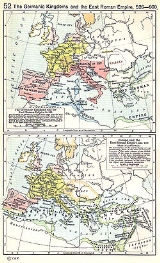
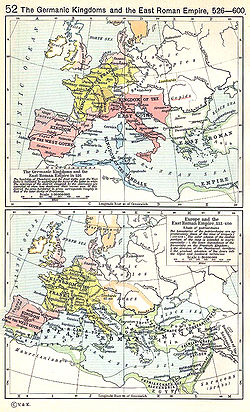 The Byzantine navy, like the Eastern Roman or Byzantine Empire itself, was a continuation of the Roman Empire
and its institutions. After the Battle of Actium
in 31 BC, in the absence of any external threat in the Mediterranean, the Roman navy performed mostly policing and escort duties. Massive sea battles, like those fought in the Punic Wars
, no longer occurred, and the Roman fleets were composed of relatively small vessels, best suited to their new tasks. By the early 4th century, the permanent Roman fleets had dwindled, so that when the fleets of the rival emperors Constantine the Great and Licinius
clashed in 324 AD
, they were composed to a great extent of newly built or commandeered ships from the port cities of the Eastern Mediterranean. The civil wars of the 4th and early 5th centuries, however, did spur a revival of naval activity, with fleets mostly employed to transport armies. Considerable naval forces continued to be employed in the Western Mediterranean throughout the first quarter of the fifth century, especially from North Africa, but Rome's mastery of the Mediterranean was challenged when Africa was overrun by the Vandals
over a period of fifteen years.
The new Vandalic Kingdom of Carthage
, under the capable king Geiseric, immediately launched raids against the coasts of Italy and Greece, even sacking and plundering
Rome in 455. The Vandal raids continued unabated over the next two decades, despite repeated Roman attempts to defeat them. The Western Empire was impotent, its navy having dwindled to almost nothing, but the eastern emperors could still call upon the resources and naval expertise of the eastern Mediterranean. A first Eastern expedition in 448, however, went no further than Sicily, and in 460, the Vandals attacked and destroyed a Western Roman invasion fleet at Cartagena
in Spain. Finally, in 468, a huge Eastern expedition was assembled under Basiliscus
, reputedly numbering 1,113 ships and 100,000 men, but it failed disastrously. About 600 ships were lost to fire ship
s, and the financial cost of 130,000 pounds of gold and 700 pounds of silver nearly bankrupted the Empire. This forced the Romans to come to terms with Geiseric and sign a peace treaty. After Geiseric's death in 477, however, the Vandal threat receded.
of Theodoric
flared up, the Emperor Anastasius I
(491–518) is reported to have sent a fleet of 100 warships to raid the coasts of Italy. In 513, the general Vitalian
revolted against Emperor Anastasius I
. The rebels assembled a fleet of 200 ships which, despite some initial successes, were destroyed by admiral Marinus, who employed an incendiary substance (possibly an early form of "Greek fire
") to defeat them.
In 533, taking advantage of the absence of the Vandal fleet, sent to suppress a revolt in Sardinia
, an army of 15,000 under Belisarius
was transported to Africa by an invasion fleet of 92 dromon
s and 500 transports, beginning the Vandalic War
, the first of the wars of reconquest of Emperor Justinian I
(527–565). These were largely amphibious operations, made possible by the control of the Mediterranean waterways, and the fleet played a vital role in carrying supplies and reinforcements to the widely dispersed Byzantine expeditionary forces and garrisons. This fact was not lost on the Byzantines' enemies. Already in the 520s, Theodoric had planned to build a massive fleet directed against the Byzantines and the Vandals, but his death in 526 limited the extent to which these plans were realized. In 535, the Gothic War began with a double-pronged Byzantine offensive, with a fleet again carrying Belisarius' army to Sicily and then Italy, and another army invading Dalmatia
. Byzantine control of the sea was of great strategic importance, allowing the smaller Byzantine army to successfully occupy the peninsula by 540.
In 541 however, the new Ostrogoth king, Totila
, created a fleet of 400 warships with which to deny the seas around Italy to the Empire. Two Byzantine fleets were destroyed near Naples in 542, and in 546, Belisarius personally commanded 200 ships against the Gothic fleet that blockaded the mouths of the Tiber
, in an unsuccessful effort to relieve Rome
. In 550, Totila invaded Sicily, and over the next year, his 300-ship fleet captured Sardinia
and Corsica
, and raided Corfu
and the coast of Epirus
. However, a defeat in a sea battle off Sena Gallica marked the beginning of the final Imperial ascendancy. With the final conquest of Italy and southern Spain
under Justinian, the Mediterranean once again became a "Roman lake".
Despite the subsequent loss of much of Italy to the Lombards
, the Byzantines maintained control of the seas—as the Lombards rarely ventured to sea—and were thus able to retain several coastal strips of Italian territory for centuries. The only major naval action of the next 80 years occurred during the Siege of Constantinople
by the Sassanid Persians
, Avars
and Slavs in 626. During that siege, the Slavs' fleet of monoxyla was intercepted by the Byzantine fleet and destroyed, denying the Persian army
passage across the Bosporus
and eventually forcing the Avars to retreat.
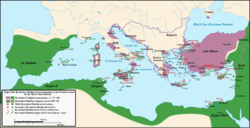 During the 640s, the Muslim conquest of Syria
and Egypt
created a new threat to Byzantium. Not only did the Arabs conquer significant recruiting and revenue-producing areas, but, after the utility of a strong navy was demonstrated by the short-lived Byzantine recapture of Alexandria
in 644, they took to creating a navy of their own. In this effort the new Muslim elite, which came from the inland-oriented northern part of the Arabian peninsula
, largely relied on the resources and manpower of the conquered Levant
(especially the Copts of Egypt), which until a few years previously had provided ships and crews for the Byzantines. There is, however, evidence that in the new naval bases in Palestine shipwrights from Persia and Iraq were also employed. The lack of illustrations earlier than the 14th century means that nothing is known about the specifics of the early Muslim warships, although it is usually assumed that their naval efforts drew upon the existing Mediterranean maritime tradition. Given a largely shared nautical nomenclature, and the centuries-long interaction between the two cultures, Byzantine and Arab ships shared many similarities. This similarity also extended to tactics and general fleet organization; translations of Byzantine military manuals
were available to the Arab admirals.
After seizing Cyprus
in 649 and raiding Rhodes, Crete and Sicily, the young Arab navy decisively defeated the Byzantines under the personal command of Emperor Constans II
(641–668) in the Battle of the Masts of 655. This catastrophic Byzantine defeat opened up the Mediterranean to the Arabs, and began a centuries-long series of naval conflicts over the control of the Mediterranean waterways. From the reign of Muawiyah I
(661–680), raids intensified, as preparations were made for a great assault on Constantinople itself. In the long first Arab siege of Constantinople, the Byzantine fleet proved instrumental to the survival of the Empire: the Arab fleets were defeated through the use of its newly developed secret weapon, "Greek fire
". The Muslim advance in Asia Minor and the Aegean was halted, and an agreement to a thirty-year truce concluded soon after.
In the 680s, Justinian II
(685–695 and 705–711) paid attention to the needs of the navy, strengthening it by the resettlement of over 18,500 Mardaites
along the southern coasts of the Empire, where they were employed as marines and rowers. Nevertheless, the Arab naval threat intensified as they gradually took control
of North Africa
in the 680s and 690s. The last Byzantine stronghold, Carthage
, fell in 698, although a Byzantine naval expedition managed to briefly retake it
. The Arab governor Musa bin Nusair
built a new city and naval base at Tunis
, and 1,000 Coptic shipwrights were brought to construct a new fleet, which would challenge Byzantine control of the western Mediterranean. Thus, from the early 8th century on, Muslim raids unfolded unceasingly against Byzantine holdings in the Western Mediterranean, especially Sicily. In addition, the new fleet would allow the Muslims to complete their conquest of the Maghreb
and to successfully invade and capture
most of Visigoth Spain.
 The Byzantines were unable to respond effectively to the Muslim advance in Africa, because the two decades between 695 and 715 were a period of great domestic turmoil. They did react with raids of their own in the East, such as the one in 709 against Egypt which captured the local admiral, but they also were aware of a coming onslaught: as Caliph al-Walid I (705–715) readied his forces for a renewed assault against Constantinople, Emperor Anastasios II
(713–715) prepared the capital, and mounted an unsuccessful preemptive strike against the Muslim naval preparations. Anastasios was soon overthrown by Theodosius III (715–717), who in turn was replaced, just as the Muslim army was advancing through Anatolia, by Leo III the Isaurian
(717–741). It was Leo III who faced the second and final Arab siege of Constantinople. The use of Greek fire, which devastated the Arab fleet, was again instrumental in the Byzantine victory, while a harsh winter and Bulgar
attacks further sapped the besiegers' strength.
In the aftermath of the siege, the retreating remains of the Arab fleet were decimated in a storm, and Byzantine forces launched a counteroffensive, with a fleet sacking Laodicea
and an army driving the Arabs from Asia Minor. For the next three decades, naval warfare featured constant raids from both sides, with the Byzantines launching repeated attacks against the Muslim naval bases in Syria (Latakia
), and Egypt (Damietta
and Tinnis). In 727, a revolt of the thematic fleets, largely motivated by resentment against the Emperor's iconoclasm, was put down by the imperial fleet through use of Greek fire. Despite the losses this entailed, some 390 warships were reportedly sent to attack Damietta in 739, and in 747, aided for the first time by ships from the Italian city-states
, the Byzantines decisively defeated the combined Syrian and Alexandrian fleets off Cyprus, breaking the naval power of the Umayyad Caliphate.
The Byzantines followed this up with the destruction of the North African flotillas, and coupled their successes at sea with severe trading limitations imposed on Muslim traders. Given the Empire's new ability to control the waterways, this strangled Muslim maritime trade. With the collapse of the Umayyad state shortly thereafter and the increasing fragmentation of the Muslim world, the Byzantine navy was left as the sole organized naval force in the Mediterranean. Thus, during the latter half of the 8th century, the Byzantines enjoyed a second period of complete naval superiority. During this time, to stand watch on the coasts of Syria, guarding against a raid by the Byzantine fleet, was deemed by the Muslims more pious an act than a night of prayer in the Kaaba
. These successes enabled Emperor Constantine V
(741–775) to shift the fleet from the Mediterranean to the Black Sea during his campaigns against the Bulgars
in the 760s. In 763, a fleet of 800 ships carrying 9,600 cavalry and some infantry sailed to Anchialus, where he scored a significant victory
, but in 766, a second fleet, allegedly of 2,600 ships, again bound for Anchialus, sank en route. At the same time however, the Isaurian emperors undermined Byzantium's naval strength: with the Arab threat gone for the moment, and with the largely iconodule naval themes staunchly opposed to their iconoclastic policies, the emperors reduced the navy's size and downgraded the naval themes.
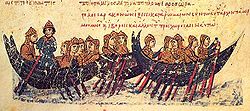 The Byzantine naval predominance lasted until the early 9th century, when a succession of disasters at the hands of the resurgent Muslim fleets spelled its end and inaugurated an era that would represent the zenith of Muslim ascendancy. Already in 790, the Byzantines suffered a major defeat in the Gulf of Antalya
, and raids against Cyprus and Crete recommenced during the reign of Harun al-Rashid
(786–809). Around the Mediterranean, new powers were rising, foremost amongst them the Carolingian Empire
, while in 803, the Pax Nicephori
recognized the de facto independence of Byzantine Venice
, which was further entrenched by the repulsion of a Byzantine attack in 809. At the same time, in Ifriqiya
, the new Aghlabid
dynasty was established, which immediately engaged in raids throughout the central Mediterranean.
The Byzantines, on the other hand, were weakened by a series of catastrophic defeats against the Bulgars, followed in 820 by the revolt of Thomas the Slav
, which attracted the support of a large part of the Byzantine armed forces, including the thematic fleets. Despite its suppression, the revolt had severely depleted the Empire's defenses. As a result, Crete
fell between 824 and 827 to a band of Andalusian
exiles. Three successive Byzantine recovery attempts failed over the next few years, and the island became a base for Muslim piratical activity in the Aegean, radically upsetting the balance of power in the region. Despite some Byzantine successes over the Cretan corsairs, and the razing
of Damietta
by a Byzantine fleet of 85 ships in 853, Arab naval power in the Levant was steadily reviving under Abbasid rule.
The situation was even worse in the West. A critical blow was inflicted on the Empire in 827, as the Aghlabids began the slow conquest of Sicily
, aided by the defection of the Byzantine commander Euphemios and the island's thematic fleet. In 838, the Muslims crossed over into Italy, taking Taranto
and Brindisi
, followed soon by Bari
. Venetian operations against them were unsuccessful, and throughout the 840s, the Arabs were freely raiding Italy and the Adriatic, even attacking Rome
in 846. Attacks by the Lombards and Lothair I
failed to dislodge the Muslims from Italy, while two large-scale Byzantine attempts to recover Sicily were heavily defeated in 840 and 859. By 850, the Muslim fleets, together with large numbers of independent ghazi raiders, had emerged as the major power of the Mediterranean, putting the Byzantines and the Christians in general on the defensive.
The same period, when a battered Byzantium defended itself against enemies on all fronts, also saw the emergence of a new, unexpected threat: the Rus'
made their first appearance in Byzantine history with a raid against Paphlagonia in the 830s, followed by a major expedition in 860.
(867–1056), and marked the noontide of the Byzantine state.
 The ascension of Emperor Basil I
(867–886) heralded this revival, as he embarked on an aggressive foreign policy. Continuing the policies of his predecessor, Michael III
(842–867), he showed great care to the fleet, and as a result, successive victories followed. In 867, a fleet under the droungarios tou plōïmou Niketas Ooryphas relieved Dalmatia
from Arab attacks and reestablished Byzantine presence in the area. A few years later, he twice heavily defeated the Cretan pirates, temporarily securing the Aegean. Cyprus also was temporarily recovered and Bari
occupied. At the same time, however, the Muslim presence in Cilicia
was strengthened, and Tarsos became a major base for land and seaborne attacks against Byzantine territory, especially under the famed emir Yazaman al-Khadim (882–891).
In the West, the Muslims continued to make steady advances, as the local Byzantine forces proved inadequate: the Empire was forced to rely on the aid of their nominal Italian subjects, and had to resort to the transfer of the eastern fleets to Italy to achieve any progress. Following the fall of Enna
in 855, the Byzantines were confined to the eastern shore of Sicily, and under increasing pressure. A relief expedition in 868 achieved little. Syracuse was attacked again in 869, and in 870, Malta
fell to the Aghlabids. Muslim corsairs raided the Adriatic, and although they were driven out of Apulia
, in the early 880s they established bases along the western Italian coast, from where they would not be completely dislodged until 915. In 878, Syracuse, the main Byzantine stronghold in Sicily, was attacked again and fell, largely because the Imperial Fleet was occupied with transporting marble
for the construction of the Nea Ekklesia
, Basil's new church. In 880, Ooryphas' successor, the droungarios Nasar
, scored a significant victory in a night battle over the Tunisians who were raiding the Ionian Islands
. He then proceeded to raid Sicily, carrying off much booty, before defeating another Muslim fleet off Punta Stilo. At the same time, another Byzantine squadron scored a significant victory at Naples. These successes allowed a short-lived Byzantine counteroffensive to develop in the West in the 870s and 880s under Nikephoros Phokas the Elder
, expanding the Byzantine foothold in Apulia
and Calabria
and forming the thema of Longobardia, which would later evolve into the Catepanate of Italy. A heavy defeat off Milazzo
in 888, however, signaled the virtual disappearance of major Byzantine naval activity in the seas around Italy for the next century.
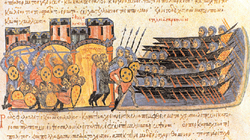 Despite the successes under Basil, during the reign of his successor Leo VI the Wise
(886–912), the Empire again faced serious threats. In the north, a war broke out against the Bulgarian Tsar Simeon
, and a part of the Imperial Fleet was used in 895 to ferry an army of Magyars across the Danube to raid Bulgaria. The Bulgarian war produced several costly defeats, while at the same time the Arab naval threat reached new heights, with successive raids devastating the shores of Byzantium's naval heartland, the Aegean Sea. In 891 or 893, the Arab fleet sacked the island of Samos
and took its stratēgos prisoner, and in 898, the eunuch admiral Raghib carried off 3,000 Byzantine sailors of the Kibyrrhaiotai as prisoners. These losses denuded Byzantine defenses, opening the Aegean up to raids by the Syrian fleets. The first heavy blow came in 901, when the renegade Damian of Tyre plundered Demetrias
, while in the next year, Taormina
, the Empire's last outpost in Sicily, fell to the Muslims. The greatest disaster, however, came in 904, when another renegade, Leo of Tripoli
, raided the Aegean. His fleet penetrated even into the Dardanelles
, before proceeding to sack
the Empire's second city, Thessalonica
, all while the Empire's fleet remained passive in the face of the Arabs' superior numbers. It is no surprise that a defensive and cautious mindset is prevalent in the emperor's contemporary instructions on naval warfare (Naumachica).
The most distinguished Byzantine admiral of the period was Himerios
, the logothetēs tou dromou
. Appointed admiral in 904, he was unable to prevent the sack of Thessalonica, but he scored a first victory in 906, and in 910, he led a successful attack on Laodicea in Syria. The city was sacked and its hinterland plundered and ravaged without the loss of any ships. A year later, however, a huge expedition of 112 dromons and 75 pamphyloi with 43,000 men, that had sailed under Himerios against the Emirate of Crete
, not only failed to recover the island, but on its return voyage, it was ambushed and comprehensively defeated by Leo of Tripoli off Chios.
The tide began to turn again after 920. Coincidentally or not, the same year witnessed the ascension of an admiral, Romanos Lekapenos
(920–944), to the imperial throne, for the second (after Tiberios Apsimaros
) and last time in the Empire's history. Finally, in 923, the decisive defeat of Leo of Tripoli off Lemnos
, coupled with the death of Damian during a siege of a Byzantine fortress in the next year, marked the beginning of the Byzantine resurgence.
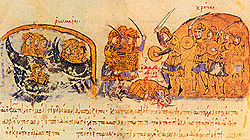 The Empire's growing might was displayed in 942, when Emperor Romanos I dispatched a squadron to the Tyrrhenian Sea
. Using Greek fire, the squadron destroyed a fleet of Muslim corsairs from Fraxinetum. In 949, however, another expedition of about 100 ships, launched by Constantine VII
(945–959) against the Emirate of Crete, ended in disaster, due to the incompetence of its commander, Constantine Gongyles
. A renewed offensive in Italy in 951–952 was defeated by the Aghlabids, but another expedition in 956 and the loss of a Tunisian fleet in a storm in 958 temporarily stabilized the situation in the peninsula. Following a revolt by the island's Greeks, in 963–965 a Byzantine expeditionary force recovered Taormina, but a heavy Byzantine defeat by the Fatimids at the Straits of Messina in 965 curbed Byzantine naval activity in the West. The seas of Italy were left to the local Byzantine forces and the various Italian states until after 1025, when Byzantium again actively intervened in southern Italy and Sicily.
In the East, in 956 the stratēgos Basil Hexamilites inflicted a crushing defeat on the Tarsos fleet, opening the way for another grand expedition to recover Crete. It was entrusted to Nikephoros Phokas
, who in 960 set out with a fleet of 100 dromons, 200 chelandia, and 308 transports, carrying an overall force of 77,000 men, to subdue the island. The conquest of Crete removed the direct threat to the Aegean, Byzantium's naval heartland, while Phokas' subsequent operations led to the recovery of Cilicia
(in 963), Cyprus (in 968), and the northern Syrian coast (in 969). These conquests removed the threat of the once mighty Muslim Syrian fleets, effectively re-establishing Byzantine dominance in the Eastern Mediterranean, so that Nikephoros Phokas could boast to Liutprand of Cremona
with the words "I alone command the sea". A few raids and naval clashes occurred as antagonism with the Fatimids mounted in the late 990s, but peaceful relations were restored soon after, and the Eastern Mediterranean remained relatively calm for several decades to come.
During the same period, the Byzantine fleet was active in the Black Sea as well: a Rus' fleet that was threatening Constantinople in 941 was destroyed by 15 hastily assembled old ships equipped with Greek fire, and the navy played an important role in the Rus'–Byzantine War of 970–971, when John I Tzimiskes
(969–976) sent 300 ships to blockade the Kievan Rus'
from retreating over the Danube.
, and was defeated in the next year. Another Rus' attack in 1043 was beaten back with ease, and with the exception of a short-lived attempt to recover Sicily under George Maniakes, no major naval expeditions were undertaken either. Inevitably, this long period of peace and prosperity led to complacency and neglect of the military. Already in the reign of Basil II
(976–1025), the defense of the Adriatic was entrusted to the Venetians. Under Constantine IX (1042–1055), both the army and navy were reduced as military service was increasingly commuted in favor of cash payments, resulting in an increased dependency upon foreign mercenaries. The large thematic fleets declined and were replaced by small squadrons subject to the local military commanders, geared more towards the suppression of piracy than towards confronting a major maritime foe.
By the last quarter of the 11th century, the Byzantine navy was a shadow of its former self, having declined through neglect, the incompetence of its officers, and lack of funds. Kekaumenos
, writing in ca. 1078, laments that "on the pretext of reasonable patrols, [the Byzantine ships] are doing nothing else but ferrying wheat, barley, pulse, cheese, wine, meat, olive oil, a great deal of money, and anything else" from the islands and coasts of the Aegean, while they "flee [the enemy] before they have even caught sight of them, and thus become an embarrassment to the Romans". By the time Kekaumenos wrote, new and powerful adversaries had risen. In the West, the Norman
Kingdom of Sicily
, which had expelled the Byzantines from Southern Italy and had conquered Sicily, was now casting its eye on the Byzantine Adriatic coasts and beyond. In the East, the disastrous Battle of Manzikert
in 1071 had resulted in the loss of Asia Minor, the Empire's military and economic heartland, to the Seljuk Turks, who by 1081 had established their capital at Nicaea
, barely a hundred miles south of Constantinople. Soon after, Turkish as well as Christian pirates appeared in the Aegean. The Byzantine thematic fleets, which once policed the seas, were by then so depleted by neglect and the successive civil wars that they were incapable of responding effectively.
, landed unopposed in Epirus and laid siege
to Dyrrhachium, starting a decade of war which consumed the scant resources of the embattled Empire. The new emperor, Alexios I Komnenos
(1081–1118), was forced to call upon the assistance of the Venetians, who in the 1070s had already asserted their control of the Adriatic and Dalmatia against the Normans. In 1082, in exchange for their help, he granted them major trading concessions. This treaty, and subsequent extensions of these privileges, practically rendered the Byzantines hostage to the Venetians (and later also the Genoese and the Pisans). Historian John Birkenmeier notes that:
Alexios inevitably realized the importance of having his own fleet, and despite his preoccupation with land operations, he took steps to re-establish the navy's strength. His efforts bore some success, especially in countering the attempts by Turkish emirs like Tzachas of Smyrna to launch fleets
in the Aegean. The fleet under John Doukas
was subsequently used to suppress revolts in Crete and Cyprus. With the aid of the Crusaders
, Alexios was able to regain the coasts of Western Anatolia and expand his influence eastwards: in 1104, a Byzantine squadron of 10 ships captured Laodicea
and other coastal towns as far as Tripoli
. By 1118, Alexios was able to pass on a small navy to his successor, John II Komnenos
(1118–1143). Like his father, John II concentrated on the army and regular land-based campaigns, but he took care to maintain the navy's strength and provisioning system. In 1122, however, John refused in to renew the trading privileges that Alexios had granted to the Venetians. In retaliation, the Venetians plundered several Byzantine islands, and, with the Byzantine fleet unable to confront them, John was forced to renew the treaty in 1125. Evidently the Byzantine navy at this point was not sufficiently powerful for John to successfully confront Venice, especially since there were other pressing demands on the Empire's resources. Not long after this incident, John II, acting on the advice of his finance minister John of Poutze, is reported to have cut funding to the fleet and transferred it to the army, equipping ships on an ad hoc basis only.
(1143–1180), who used it extensively as a powerful tool of foreign policy in his relations with the Latin and Muslim states of the Eastern Mediterranean. During the early years of his reign, the Byzantine naval forces were still weak: in 1147, the fleet of Roger II of Sicily
under George of Antioch
was able to raid Corfu
, the Ionian islands
and into the Aegean almost unopposed. In the next year, with Venetian aid, an army accompanied by a very large fleet (allegedly 500 warships and 1,000 transports) was sent to recapture Corfu and the Ionian Islands from the Normans. In retaliation, a Norman fleet of 40 ships reached Constantinople itself, demonstrating in the Bosporus
off the Great Palace
and raiding its suburbs. On its return voyage however it was attacked and destroyed by a Byzantine or Venetian fleet.
In 1155, a Byzantine squadron of 10 ships in support of Norman rebel Robert III of Loritello
arrived at Ancona
, launching the last Byzantine bid to regain Southern Italy. Despite initial successes and reinforcements under megas doux
Alexios Komnenos Bryennios, the expedition was ultimately defeated in 1156, and 4 Byzantine ships were captured. By 1169, the efforts of Manuel had evidently borne fruit, as a large and purely Byzantine fleet of about 150 galleys, 20 large transports and 60 horse transports
under megas doux Andronikos Kontostephanos
was sent to invade Egypt
in cooperation with the ruler of the Crusader
Kingdom of Jerusalem
. The invasion failed however, and the Byzantines lost half the fleet in a storm on the way back.
Following the Empire-wide seizure and imprisonment of all Venetians in March 1171, the Byzantine fleet was strong enough to deter an outright attack by the Venetians, who sailed to Chios
and settled for negotiations. Manuel sent a fleet of 150 ships under Kontostephanos to confront them there and employed delaying tactics, until, weakened by disease, the Venetians began to withdraw and were pursued by Kontostephanos' fleet. It was a remarkable reversal of fortunes, compared with the humiliation of 1125. In 1177, another fleet of 70 galleys and 80 auxiliary ships under Kontostephanos, destined for Egypt, returned home after appearing off Acre
, as Count Philip of Flanders and many important nobles of the Kingdom of Jerusalem refused to participate in the campaign. However, by the end of Manuel's reign, the strains of constant warfare on all fronts and the Emperor's various grandiose projects had become evident: the historian Nicetas Choniates
attributes the rise of piracy in the latter years of Manuel's reign to the diversion of the funds intended for the maintenance of the fleet for other needs of the imperial treasury.
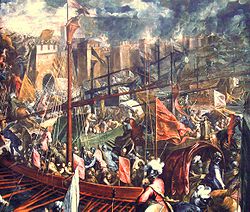 After the death of Manuel I and the subsequent demise of the Komnenian dynasty in 1185, the navy declined swiftly. The maintenance of galleys and the upkeep of proficient crews were very expensive, and neglect led to a rapid deterioration of the fleet. Already by 1182 the Byzantines had to pay Venetian mercenaries to crew some of their galleys, but in the 1180s, as the bulk of the Komnenian naval establishment persisted, expeditions of 70–100 ships are still recorded in contemporary sources.
Thus Emperor Andronikos I
(1183–1185) could still gather 100 warships in 1185 to resist and later defeat a Norman fleet in the Sea of Marmara
. However, the subsequent peace treaty included a clause which required Sicily
to furnish a fleet for the Empire. This, together with a similar agreement made by Isaac II Angelos
(1185–1195 and 1203–1204) with Venice the next year, in which the Republic would provide 40–100 galleys at six months' notice in exchange for favorable trading concessions, is a telling indication that the Byzantine government was aware of the inadequacy of its own naval establishment. In 1186, with his brother Alexios III
(1195–1203) being held captive in Acre
, Isaac II sent 80 galleys to liberate him, but the fleet was destroyed off Cyprus by the Norman pirate Margaritus of Brindisi
. Later in the same year, another Byzantine fleet of 70 ships was sent by Isaac II to recapture Cyprus from Isaac Komnenos
, but it was also defeated by Margaritus.
The decline accelerated during the 1190s. According to Choniates, the then megas doux, Michael Stryphnos, sold off the equipment of the warships for his own profit, so that by 1196, there were only about 30 galleys left. The Byzantines were thus helpless as Genoese, Pisans and Venetians operated freely in the Aegean during the later 1190s, raiding at will and imposing their terms on the Empire. During this period, the Byzantines came to rely on hiring Western privateers to fight for them. By the time the Fourth Crusade
arrived at Constantinople in 1203, there were allegedly only 20 ships left, so decayed that during the siege
, 17 were employed, without success, as fireships against the Venetian fleet.
.jpg) After the Fourth Crusade
After the Fourth Crusade
, the Byzantine Empire was partitioned
between the Crusaders, while three Greek successor states were set up, the Despotate of Epirus
, the Empire of Trebizond
, and the Empire of Nicaea
, each claiming the Byzantine imperial title. The former did not maintain a fleet, the Trebizondian navy was minuscule and mostly used for patrols and transporting troops, while the Nicaeans initially followed a policy of consolidation and used their fleet for coastal defense. Under John III Vatatzes (1222–1254), a more energetic foreign policy was pursued, and in 1225, the Nicaean fleet was able to occupy the islands of Lesbos
, Chios
, Samos
, and Icaria
. It was, however, no match for the Venetians: attempting to blockade Constantinople
in 1235, the Nicaean navy was defeated by a far smaller Venetian force, and in another similar attempt in 1241, the Nicaeans were again routed. Nicaean efforts during the 1230s to support a local rebellion in Crete against Venice were also only partially successful, with the last Nicaean troops being forced to leave the island in 1236. Aware of the weakness of his navy, in March 1261 the Emperor Michael VIII Palaiologos
(1259–1282) concluded the Treaty of Nymphaeum
with the Genoese, securing their aid against Venice at sea, in return for commercial privileges.
Following the recapture of Constantinople a few months later however, Michael VIII was able to focus his attention on building up his own fleet. In the early 1260s, the Byzantine navy was still weak, and depended still greatly on Genoese aid. Even so, the allies were not able to stand up to Venice in a direct confrontation, as evidenced by the defeat
of a combined Byzantine–Genoese fleet of 48 ships by a much smaller Venetian fleet in 1263. Taking advantage of the ongoing Venetian–Genoese war
however, by 1270 Michael's efforts had produced a strong navy of 80 ships, with several Latin privateers sailing under imperial colors. In the same year, a fleet of 24 galleys besieged the town of Oreos
in Negroponte (Euboea
), and defeated a Latin fleet of 20 galleys. This marked the first successful independent Byzantine naval operation and the beginning of an organized naval campaign in the Aegean that would continue throughout the 1270s and would result in the recapture, albeit briefly, of many islands from the Latins.
This revival did not last long. Following the death of Charles of Anjou in 1285 and the end of the threat of an invasion from Italy, Michael's successor Andronikos II Palaiologos
(1282–1328) assumed that, by relying on the naval strength of his Genoese allies, he could do without the maintenance of a fleet, with its particularly heavy expenditure. Andronikos therefore disbanded the navy, and instead hired 50–60 Genoese galleys in 1291. Andronikos' cutbacks of military expenditure, which were extended to the army as well, aroused considerable opposition and criticism from contemporary scholars and officials almost from the outset. The results were quick to follow: during Andronikos' long reign, the Turks gradually took permanent possession of the Aegean coasts of Anatolia, with the Empire unable to reverse the situation, while in 1296 and 1297, a Venetian fleet attacked Constantinople and raided its suburbs at will. The historian Nikephoros Gregoras commented on these events that "if they [the Byzantines] still possessed a navy the Latins would never have behaved in this presumptuous fashion towards them, nor would the Turks ever have set eyes upon the sands of the [Aegean] sea shore...".
After 1305, the Emperor belatedly tried to rebuild the navy by constructing 20 ships, but this effort came to naught. His grandson and heir Andronikos III Palaiologos
(1328–1341) actively tried to rebuild the navy's strength, personally leading it in expeditions against Latin holdings in the Aegean, but his efforts failed to stem the overall decline. After his reign, the highest number of warships ever mentioned to be in the Byzantine navy rarely exceeded ten, but with impressment of merchant vessels, fleets of 100–200 ships could still occasionally be assembled.
The navy was very active during the civil war of 1341–1347
, in which its commander, the megas doux Alexios Apokaukos
, played a prominent role. Following the civil war, Emperor John VI Kantakouzenos
(1347–1354) tried to restore the navy and merchant fleet, as a means of both reducing the Empire's dependency on the Genoese
colony of Galata
, and of securing the control of the Dardanelles against passage by the Turks. To that end, he enlisted the aid of the Venetians, but in March 1349, his newly built fleet of 9 fair-sized ships and about 100 smaller vessels was caught in a storm off the southern shore of Constantinople. The inexperienced crews panicked, and the ships were either sunk or captured by the Genoese. In 1351, Kantakouzenos participated with only 14 ships in the war of Venice and Aragon
against Genoa, but was soon defeated and forced to sign an unfavorable peace.
Kantakouzenos was the last emperor who had the means to try to restore the navy, as the Empire, weakened by civil wars and territorial losses, went into terminal decline. It is characteristic that in his 1418 pamphlet to the despotēs Theodore Palaiologos
, the scholar Gemistos Plethon advises against the maintenance of a navy, on the grounds that resources were insufficient to adequately maintain both it and an effective army. During the brief usurpation of John VII
in 1390, Manuel II
(1391–1425) was able to gather only 5 galleys and 4 smaller vessels (including some from the Knights of Rhodes) to recapture Constantinople and rescue his father John V
. Six years later, Manuel promised to arm 10 ships to assist the Crusade of Nicopolis; twenty years later, he personally commanded 4 galleys and 2 other vessels carrying some infantry and cavalry, and saved the island of Thasos
from an invasion. Likewise, in 1421, 10 Byzantine warships were engaged in support of the Ottoman pretender Mustafa against Sultan Murad II
.
The last recorded Byzantine naval victory occurred in 1427 in a battle
off the Echinades
Islands, when the Emperor John VIII Palaiologos
(1425–1448) defeated the superior fleet of Carlo I Tocco
, Count of Cephalonia
and Despot of Epirus, forcing him to relinquish all his holdings in the Morea to the Byzantines. The last appearance of the Byzantine navy was in the final Ottoman siege of 1453, when a mixed fleet of Byzantine, Genoese and Venetian ships (varying numbers are provided by the sources, ranging from 10 to 39 vessels) defended Constantinople against the Ottoman fleet. During the siege, on 20 April 1453, the last naval engagement in Byzantine history took place, when three Genoese galleys escorting a Byzantine transport fought their way through the huge Ottoman blockade fleet and into the Golden Horn
.
Under Emperor Diocletian
(284–305), the navy's strength reportedly increased from 46,000 men to 64,000 men, a figure that represents the numerical peak of the late Roman navy. The Danube
Fleet (Classis Histrica) with its attendant legionary flotillas is still well attested in the Notitia Dignitatum
, and its increased activity is commented upon by Vegetius
. In the West, several fluvial fleets are mentioned, but the old standing praetorian fleets had all but vanished, and even the remaining western provincial fleets appear to have been seriously understrength and incapable of countering any significant barbarian attack. In the East, the Syrian and Alexandrian fleets are known from legal sources to have still existed in ca. 400 AD, while a fleet is known to have been stationed at Constantinople itself, perhaps created out of the remnants of the praetorian fleets. Its size, however, is unknown, and it does not appear in the Notitia.
For operations in the Mediterranean during the 5th century, fleets appear to have been assembled on an ad hoc basis and then disbanded. The first permanent Byzantine fleet can be traced to the early 6th century and the revolt of Vitalian in 513–515, when Anastasius I created a fleet to counter the rebels' own. This fleet was retained, and under Justinian I and his successors it was developed into a professional and well-maintained force. Because of the absence of any naval threat, however, the navy of the late 6th century was relatively small, with several small flotillas in the Danube and two main fleets maintained at Ravenna and Constantinople. Additional flotillas must have been stationed at the other great maritime and commercial centers of the Empire: at Alexandria, providing the escort to the annual grain fleet to Constantinople, and at Carthage, controlling the western Mediterranean. Justinian also stationed troops and ships at the more remote outposts of the Empire, at Septem (Ceuta
), Cherson in the Crimea
, and Aelana (Eilat) in the Gulf of Aqaba
. The long-established naval tradition and infrastructure of those areas made the maintenance of the fleet easier, and, in the event of a naval expedition, a large fleet could be quickly and inexpensively assembled by impressing the numerous merchant vessels.
, each thema maintained its own, locally levied forces. Following a series of revolts by thematic forces, under Constantine V
the larger early themes were progressively broken up, while a central imperial army, the tagmata
, was created, stationed at or near Constantinople, serving as a central reserve that henceforth formed the core of campaigning armies.
A similar process was followed in the fleet, which was organized along similar lines. In the second half of the 7th century, the fleet of the Karabisianoi
was created. The exact date is unknown, with suggestions ranging from the 650s/660s, in response to the Battle of the Masts, or following the first Arab siege of Constantinople in 672–678. Its origin is also unknown: it was recruited possibly from the remainders of the old quaestura exercitus
or the army of the Illyricum
. It was headed by a stratēgos (stratēgos tōn karabōn/karabisianōn, "general of the ships/seafarers"), and included the southern coast of Asia Minor from Miletus
to the frontier with the Caliphate
near Seleucia
in Cilicia
, the Aegean islands and the imperial holdings in southern Greece. Its headquarters was initially perhaps at Samos, with a subordinate command under a droungarios at Cibyrrha in Pamphylia
. As its name suggests, it comprised most of the Empire's standing navy, and faced the principal maritime threat, the Arab fleets of Egypt and Syria.
The Karabisianoi however proved inadequate and were replaced in the early 8th century by a more complex system composed of three elements, which with minor altrations survived until the 11th century: a central imperial fleet based at Constantinople, a small number of large regional naval commands, either maritime themata or independent commands termed "drungariates", and a greater number of local squadrons charged with purely defensive and police tasks and subordinate to the local provincial governors. Unlike the earlier Roman navy, where the provincial fleets were decidedly inferior in numbers and included only lighter vessels than the central fleets, the Byzantine regional fleets were probably formidable formations in their own right.
The capital's navy played a central role in the repulsion of the Arab sieges of Constantinople, but it is unclear whether the Imperial Fleet (βασιλικόν πλόιμον, basilikon ploïmon) of later times existed as a separate command in the 7th or 8th centuries. As its chief, the droungarios tou ploïmou, is first attested in the Taktikon Uspensky
of 842/843, and as there is little evidence for major fleets operating from Constantinople during the 8th century, Hélène Ahrweiler
dates its creation to the early 9th century. Thereafter, the Imperial Fleet formed the main central reserve and the core of various expeditionary fleets.
The first and for a long time only maritime theme (θέμα ναυτικόν, thema nautikon) was the Theme of the Cibyrrhaeots
. It was created from the Karabisianoi fleet, and assigned to the administration and defense of the southern coasts of Asia Minor. The exact date of its creation is unclear, with one view proposing ca. 719 and another ca. 727. Its stratēgos, first mentioned in 734, was based at Attaleia
. His principal lieutenants were the katepanō
of the Mardaites
, an ek prosōpou (representative) at Syllaeum and droungarioi of Attaleia and Kos
. Being located closest to the Muslim Levant
, it remained the Empire's principal naval fleet for centuries, until it was reduced with the decline of the Arab naval threat. The fleet is last mentioned in 1043, and thereafter the theme became a purely civilian province.
The Cibyrrhaeots were complemented by two independent naval commands in the Aegean, each headed by a droungarios: the Aigaio Pelagos ("Aegean Sea"), covering the northern half of the Aegean and the Dardanelles
and Marmara Sea, and the command variously known as the Dodekanesos ("Twelve Islands") and Kolpos ("Gulf"), which was based at Samos
and comprised the southern Aegean including the Cyclades
. Unlike the other droungarioi who headed subordinate commands, these two circumscriptions were completely independent, and their droungarioi exercised both civil and military authority over them. Eventually they were raised to full maritime themes, the Theme of the Aegean Sea
ca. 843, while the eastern parts of the Dodekanesos/Kolpos drungariate formed the Theme of Samos
(θέμα Σάμου, thema Samou) in the late 9th century. It comprised it the Ionia
n coast, and its capital was at Smyrna
.
Some "land" themata also maintained sizeable squadrons, usually placed under a tourmarchēs (mentioned collectively as tourmarchai tōn ploimatōn in the Taktikon Uspensky). They played an intermediate role between the large thematic fleets and the central Imperial Fleet: they were permanent squadrons with professional crews (taxatoi), maintained by resources from the imperial treasury and not the province they were stationed in, but subordinate to the local thematic stratēgos and charged mainly with local defense and police duties. These were:
Isolated regions of particular importance for the control of the major sealanes were covered by separate officials with the title of archon
, who in some cases may have commanded detachments of the Imperial Fleet. Such archontes are known for Chios
, Malta
, the Euboic Gulf, and possibly Vagenetia and "Bulgaria" (whose area of control is identified by Ahrweiler with the mouths of the Danube
). These vanished by the end of the 9th century, either succumbing to Arab attacks or being reformed or incorporated into themes.
, the navy reached 34,200 oarsmen and perhaps as many as 8,000 marines. The central Imperial Fleet totaled some 19,600 oarsmen and 4,000 marines under the command of the droungarios of the basilikon plōimon. These four thousand marines were professional soldiers, first recruited as a corps by Basil I
in the 870s. They were a great asset to the Imperial Fleet, for whereas previously it had depended on thematic and tagmatic soldiers for its marines, the new force provided a more reliable, better trained and immediately available force at the Emperor's disposal. The high status of these marines is illustrated by the fact that they were considered to belong to the imperial tagmata
, and were organized along similar lines. The Aegean thematic fleet numbered 2,610 oarsmen and 400 marines, the Cibyrrhaeot fleet stood at 5,710 oarsmen and 1,000 marines, the Samian
fleet at 3,980 oarsmen and 600 marines, and finally, the Theme of Hellas furnished 2,300 oarsmen with a portion of its 2,000 thematic soldiers doubling as marines.
The following table contains estimates, by Warren T. Treadgold, of the number of oarsmen over the entire history of the Byzantine navy:
Contrary to popular perception, galley slave
s were not used as oarsmen, either by the Byzantines or the Arabs, or by their Roman and Greek predecessors. Throughout the existence of the Empire, Byzantine crews consisted of mostly lower-class freeborn men, who were professional soldiers, legally obliged to perform military service (strateia) in return for pay or land estates. In the first half of the 10th century, the latter were calculated to be of the value of 2–3 lb (0.90718474–1.4 kg) of gold for sailors and marines. Use was however made of prisoners of war and foreigners as well. Alongside the Mardaites, who formed a significant part of the fleet's crews, an enigmatic group known as the Toulmatzoi (possibly Dalmatians) appears in the Cretan expeditions, as well as many Rus', who were given the right to serve in the Byzantine armed forces in a series of 10th-century treaties.
In his De Ceremoniis
, Constantine Porphyrogennetos gives the fleet lists for the expeditions against Crete of 911 and 949. These references have sparked a considerable debate as to their interpretation: thus the numbers given for the entire Imperial Fleet in 949 can be interpreted as either 100, 150 or 250 ships, depending on the reading of the Greek text. The precise meaning of the term ousia is also a subject of confusion: traditionally, it is held to have been a standard complement of 108 men, and that more than one could be present aboard a single ship. In the context of the De Ceremoniis however, it can also be read simply as "unit" or "ship". The number of 150 seems more compatible with the numbers recorded elsewhere, and is accepted by most scholars, although they differ as to the composition of the fleet. Makrypoulias interprets the number as 8 pamphyloi, 100 ousiakoi and 42 dromōnes proper, the latter including the two imperial vessels and the ten ships of the Stenon squadron. As for the total size of the Byzantine navy in this period, Warren Treadgold extrapolates a total, including the naval themes, of ca. 240 warships, a number which was increased to 307 for the Cretan expedition of 960–961. According to Treadgold, the latter number probably represents the approximate standing strength of the entire Byzantine navy (including the smaller flotillas) in the 9th and 10th centuries. It is however noteworthy that a significant drop in the numbers of ships and men attached to the thematic fleets is evident between 911 and 949. This drop, which reduced the size of thematic fleets from a third to a quarter of the total navy, was partly due to the increased use of the lighter ousiakos type instead of the heavier dromōn, and partly due to financial and manpower difficulties. It is also indicative of a general trend that would lead to the complete disappearance of the provincial fleets by the late 11th century.
(corresponding to "Rear Admirals"). Until the mid-9th century, the governors of the themes of the Aegean and Samos are also recorded as droungarioi, since their commands were split off from the original Karabisianoi fleet, but they were then raised to the rank of stratēgos. The commander of the Imperial Fleet however remained known as the droungarios tou basilikou ploïmou (later with the prefix megas, "grand"). His title is still found in the Komnenian era, albeit as commander of the imperial escort squadron, and survived until the Palaiologan era, being listed in the 14th-century Book of Offices of Pseudo-Kodinos
. The office of a deputy called topotērētēs is also mentioned for the Imperial Fleet, but his role is unclear from the sources. He may have held a post similar to that of a Port Admiral. Although some of these senior officers were professional seamen, having risen from the ranks, most fleet commanders were high court officials, who would have relied on their more experienced professional subordinates for nautical expertise.
Since the admirals also doubled as governors of their themes, they were assisted by a prōtonotarios ("chief secretary/notary/scribe") who headed the civilian administration of the theme. Further staff officers were the chartoularios in charge of the fleet administration, the prōtomandatōr ("chief messenger"), who acted as chief of staff, and a number of staff komētes ("counts", sing. komēs), including a komēs tēs hetaireias, who commanded the bodyguard (hetaireia
) of the admiral. Squadrons of three or five ships were commanded by a komēs or droungarokomēs, and each ship's captain was called kentarchos ("centurion"), although literary sources also used more archaic terms like nauarchos
or even triērarchos
.
Each ship's crew, depending on its size, was composed of one to three ousiai. Under the captain, there was the bandophoros ("banner bearer"), who acted as executive officer, two helmsmen called prōtokaraboi ("heads of the ship"), sometimes also referred to archaically as kybernētes, and a bow officer, the prōreus. In actual terms, there would have been several of each kind upon each ship, working in shifts. Most of these rose from the ranks, and there are references in the De Administrando Imperio
to first oarsmen (prōtelatai) who rose to become prōtokaraboi in the imperial barges, and later assumed still higher offices, with emperor Romanos Lekapenos being the most successful of them. There were also a number of specialists on board, such as the two bow oarsmen and the siphōnatores, who worked the siphons used for discharging the Greek fire
. A boukinatōr ("trumpeter") is also recorded in the sources, who conveyed orders to the rowers (kōpēlatai or elatai). Since the marine infantry were organized as regular army units, their ranks followed those of the army
.
. The first known occupant of the office was Alexios' brother-in-law John Doukas
, ca. 1092. The megas droungarios of the fleet, once the overall naval commander, was subordinated to him, acting now as his principal aide. The megas doux was also appointed as overall governor of southern Greece, the old themata of Hellas and the Peloponnese, which were divided into districts (oria) that supplied the fleet. Under John II, the Aegean islands also became responsible for the maintenance, crewing and provision of warships, and contemporary sources took pride in the fact that the great fleets of Manuel's reign were crewed by "native Romans", although use continued to be made of mercenaries and allied squadrons. However, the fact that the fleet was now exclusively built and based around Constantinople, and that provincial fleets were not reconstituted, did have its drawbacks, as outlying areas, in particular Greece, were left vulnerable to attack.
, although we lack specific details about it. Under John III and Theodore II
(1254–1258), the navy had two main strategic areas of operations: the Aegean, entailing operations against the Greek islands (chiefly Rhodes
) as well as the transport and supply of armies fighting in the Balkans, and the Sea of Marmara, where the Nicaeans aimed to interdict Latin shipping and threaten Constantinople. Smyrna
provided the main shipyard and base for the Aegean, with a secondary one at Stadeia
, while the main base for operations in the Marmara Sea was Holkos, near Lampsakos across the Gallipoli peninsula.
, who were men of mixed Greek-Latin descent living around the capital; and colonists from Laconia
, called Lakōnes (Λάκωνες, "Laconians") or Tzakōnes
(Τζάκωνες), were used as marines, forming the bulk of Byzantine naval manpower in the 1260s and 1270s. Michael also set the rowers, called Prosalentai or Prosēlontes, apart as a separate corps. All these groups received small grants of land to cultivate in exchange for their service, and were settled together in small colonies. The Prosalentai were settled near the sea throughout the northern Aegean, while the Gasmouloi and Tzakōnes were settled mostly around Constantinople and in Thrace
. These corps remained extant, albeit in a diminished form, throughout the last centuries of the Empire (the last mention of the Prosalentai is in 1361, and of the Gasmouloi as late as 1422). Throughout the Palaiologan period, the fleet's main base was the harbor of Kontoskalion on the Marmara shore of Constantinople, dredged and refortified by Michael VIII. Among the provincial naval centers, probably the most important was Monemvasia
in the Peloponnese.
At the same time, Michael and his successors continued the well-established practice of using foreigners in the fleet. Alongside the mistrusted Italian city-states, with whom alliances shifted regularly, mercenaries were increasingly employed in the last centuries of the Empire, often rewarded for their services with fiefs. Most of these mercenaries, like Giovanni de lo Cavo (lord of Anafi
and Rhodes
), Andrea Moresco (successor of de lo Cavo in Rhodes) and Benedetto Zaccaria
(lord of Phocaea
), were Genoese, the Byzantines' major ally in the period. Under Michael VIII for instance, for the first time a foreigner, the Italian privateer Licario
, became megas doux and was given Euboea
as a fief. In 1303, another high rank, that of amēralēs
( or ) was introduced along with the mercenaries of the Catalan Company
. The office appears to have become established in imperial hierarchy, coming after the megas doux and the megas droungarios, although only two holders are known, both from 1303–1305.
(δρόμων) and other similar ship types. Apparently an evolution of the light liburnian galleys of the imperial Roman fleets, the term first appears in the late 5th century, and was commonly used for a specific kind of war-galley by the 6th. The term dromōn itself comes from the Greek root δρομ-(άω), "to run", thus meaning "runner", and 6th-century authors like Procopius
are explicit in their references to the speed of these vessels. During the next few centuries, as the naval struggle with the Arabs intensified, heavier versions with two or possibly even three banks of oars evolved. Eventually, the term was used in the general sense of "warship", and was often used interchangeably with another Byzantine term for a large warship, chelandion
.gif", event)' onMouseout='HidePop("41693")' href="/topics/Courser_(horse)">courser
"), which first appeared during the 8th century.
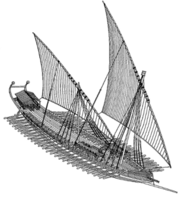 The appearance and evolution of medieval warships is a matter of debate and conjecture: until recently, no remains of an oared warship from either ancient or early medieval times had been found, and information had to be gathered by analyzing literary evidence, crude artistic depictions and the remains of a few merchant vessels. Only in 2005–2006 did archaeological digs for the Marmaray project in the location of the Harbor of Theodosius (modern Yenikapi) uncover the remains of over 20 Byzantine ships from the 6th to 10th centuries, including galleys.
The accepted view is that the main developments which differentiated the early dromons from the liburnians, and that henceforth characterized Mediterranean galleys, were the adoption of a full deck
(katastrōma), the abandonment of the rams
on the bow in favor of an above-water spur, and the gradual introduction of lateen
sails. The exact reasons for the abandonment of the ram are unclear. Depictions of upward-pointing beaks in the 4th-century Vatican Vergil manuscript may well illustrate that the ram had already been replaced by a spur in late Roman galleys. One possibility is that the change occurred because of the gradual evolution of the ancient shell-first mortise and tenon
hull
construction method, against which rams had been designed, into the skeleton-first method, which produced a stronger and more flexible hull, less susceptible to ram attacks. Certainly by the early 7th century, the ram's original function had been forgotten, if we judge by Isidore of Seville
's comments that they were used to protect against collision with underwater rocks. As for the lateen sail, various authors have in the past suggested that it was introduced into the Mediterranean by the Arabs, possibly with an ultimate origin in India
. However, the discovery of new depictions and literary references in recent decades has led scholars to antedate the appearance of the lateen sail in the Levant to the late Hellenistic or early Roman period. Not only the triangular, but also the quadrilateral version were known, used for centuries (mostly on smaller craft) in parallel with square sails. Belisarius' invasion fleet of 533 was apparently at least partly fitted with lateen sails, making it probable that by the time the lateen had become the standard rig for the dromon, with the traditional square sail gradually falling from use in medieval navigation.
The dromons that Procopius describes were single-banked ships of probably 50 oars, arranged with 25 oars on each side. Again unlike Hellenistic vessels, which used an outrigger
, these extended directly from the hull. In the later bireme
dromons of the 9th and 10th centuries, the two oar banks (elasiai) were divided by the deck, with the first oar bank was situated below, whilst the second oar bank was situated above deck; these rowers were expected to fight alongside the marines in boarding operations. Makrypoulias suggests 25 oarsmen beneath and 35 on the deck on either side for a dromon of 120 rowers. The overall length of these ships was probably about 32 meters. Although most contemporary vessels had a single mast (histos or katartion), the larger bireme dromons probably needed at least two masts in order to maneuver effectively, assuming that a single lateen sail for a ship this size would have reached unmanageable dimensions. The ship was steered by means of two quarter rudder
s at the stern
(prymnē), which also housed a tent (skēnē) that covered the captain's berth (krab(b)at(t)os). The prow (prōra) featured an elevated forecastle (pseudopation), below which the siphon for the discharge of Greek fire projected, although secondary siphons could also be carried amidships on either side. A pavesade (kastellōma), on which marines could hang their shields, ran around the sides of the ship, providing protection to the deck crew. Larger ships also had wooden castles (xylokastra) on either side between the masts, similar to those attested for the Roman liburnians, providing archers with elevated firing platforms. The bow spur (peronion) was intended to ride over an enemy ship's oars, breaking them and rendering it helpless against missile fire and boarding actions.
as a transport ship or its crewing with "picked crews" (from , "all tribes"); and the dromōn proper, crewed by two ousiai. In the De Ceremoniis, the heavy dromōn is said to have an even larger crew of 230 rowers and 70 marines; Pryor considers them as supernumerary crews being carried aboard, while Makrypoulis suggests that the extra men correspond to a second rower on each of the upper-bank oars. A smaller, single-bank ship, the monērēs (μονήρης, "single-banked") or galea (γαλέα, from which the term "galley" derives), with ca. 60 men as crew, was used for scouting missions but also in the wings of the battle line. The galea in particular seems to have been strongly associated with the Mardaites, and Christos Makrypoulias even suggests that the ship was exclusively used by them. Three-banked ("trireme") dromons are described in a 9th century work dedicated to the parakoimōmenos
Basil Lekapenos
. However, this treatise, which survives only in fragments, draws heavily upon references on the appearance and construction of a Classical trireme
, and must therefore be used with care when trying to apply it to the warships of the middle Byzantine period. The existence of trireme vessels is, however, attested in the Fatimid navy in the 11th and 12th centuries, and references made by Leo VI to large Arab ships in the 10th century may also indicate trireme galleys.
For cargo transport, the Byzantines usually commandeered ordinary merchantmen as transport ships (phortēgoi) or supply ships (skeuophora). These appear to have been mostly sailing vessels, rather than oared. The Byzantines and Arabs also employed horse-transports
(hippagōga), which were either sailing ships or galleys, the latter certainly modified to accommodate the horses. Given that the chelandia appear originally to have been oared horse-transports, this would imply differences in construction between thechelandion and the dromōn proper, terms which otherwise are often used indiscriminately in literary sources. While the dromōn was developed exclusively as a war galley, the chelandion would have had to have a special compartment amidships to accommodate a row of horses, increasing its beam
and hold
depth. In addition, Byzantine sources refer to the sandalos or sandalion (σάνδαλος, σανδάλιον), which was a boat carried along by the bigger ships. The kind described in the De Ceremoniis had a single mast, four oars and a rudder.
's description of the Byzantine fleet in 1169, where "dromons" are classed as very large transports, and the warships with two oar banks are set apart from them, may thus indeed indicate the adoption of the new bireme galley types by the Byzantines. From the 13th century on, the term "dromon" fell into gradual disuse and was replaced by katergon (κάτεργον, meaning something like "detailed to/owing a service"), a late-11th century term which originally applied to the crews, who were drawn from populations detailed to military service. During the latter period of the Byzantine Empire, Byzantine ships were based on Western models: the term katergon is used indiscriminately for both Byzantine and Latin ships, and the horse-carrying chelandion was replaced by the Western taride (itself deriving from Arabic ṭarrīda, adopted as tareta, ταρέτα, in Greek). A similar process is seen in surviving sources from Angevin
Sicily, where the term chelandre was replaced by the taride, although for a time both continued to be used. No construction differences are mentioned between the two, with both terms referring to horse-carrying vessels (usserii) capable of carrying from 20 to 40 horses.
The bireme Italian-style galleys remained the mainstay of Mediterranean fleets until the late 13th century, although again, contemporary descriptions provide little detail on their construction. From that point on, the galleys universally became trireme ships, i.e. with three men on a single bank located above deck, each rowing a different oar; the so-called alla sensile system. The Venetians also developed the so-called "great galley", which was an enlarged galley capable of carrying more cargo for trade.
Little is known on particular Byzantine ships during the period. The accounts of the 1437 journey by sea of the Byzantine delegation to the Council of Florence
, by the Byzantine cleric Sylvester Syropoulos and the Greek-Venetian captain Michael of Rhodes, mention that most of the ships were Venetian or Papal, but also record that Emperor John VIII traveled on an "imperial ship". It is unclear whether that ship was Byzantine or had been hired, and its type is not mentioned. It is, however, recorded as having been faster than the Venetian great merchant galleys accompanying it, possibly indicating that it was a light war galley. Michael of Rhodes also wrote a treatise on shipbuilding, which provided construction instructions and illustrations of the main vessels, both galleys and sailing ships, used by Venice and the other maritime states of the region in the first half of the 15th century.
. Despite their sometimes antiquarian terminology, these texts form the basis of our knowledge on Byzantine naval affairs. The main surviving texts are the chapters on sea combat (peri naumachias) in the Tactica of Leo the Wise and Nikephoros Ouranos
(both drawing extensively from the 6th century Naumachiai of Syrianos Magistros and other earlier works), complemented by relevant passages in the De administrando imperio of Constantine Porphyrogennetos and other works by Byzantine and Arab writers.
to the Cretan expeditions. It is for these reasons that Nikephoros Ouranos emphasizes the need to have available "men with accurate knowledge and experience of the sea [...], which winds cause it to swell and which blow from the land. They should know both the hidden rocks in the sea, and the places which have no depth, and the land along which one sails and the islands adjacent to it, the harbors and the distance such harbors are the one from the other. They should know both the countries and the water supplies."
Medieval Mediterranean naval warfare was therefore essentially coastal and amphibious in nature, carried out to seize coastal territory or islands, and not to exercise "sea control" as it is understood today. Furthermore, following the abandonment of the ram, the only truly "ship-killing" weapon available prior to the advent of gunpowder and explosive shells, sea combat became, in the words of John Pryor, "more unpredictable. No longer could any power hope to have such an advantage in weaponry or the skill of crews that success could be expected." It is no surprise therefore that the Byzantine manuals emphasize cautious tactics, with the priority given to the preservation of one's own fleet, and the acquisition of accurate intelligence. Emphasis was placed on achieving tactical surprise and, conversely, on avoiding being caught unprepared by the enemy. Ideally, battle was to be given only when assured of superiority by virtue of numbers or tactical disposition. Importance is also laid on matching one's forces and tactics to the prospective enemy: Leo VI, for instance, contrasted the Arabs with their heavy and slow ships (koumbaria), to the small and fast craft (akatia, chiefly monoxyla), of the Slavs and Rus'.
On campaign, following the assembly of the various squadrons at fortified bases (aplēkta
) along the coast, the fleet consisted of the main body, composed of the oared warships, and the baggage train (touldon) of sailing vessels and oared transports, which would be sent away in the event of battle. The battle fleet was divided into squadrons, and orders were transmitted from ship to ship through signal flags (kamelaukia) and lanterns.
On the approach to and during an actual battle, a well-ordered formation was critical: if a fleet fell into disorder, its ships would be unable to lend support to each other and probably would be defeated. Fleets that failed to keep an ordered formation or that could not order themselves into an appropriate counter-formation (antiparataxis) to match that of the enemy, often avoided, or broke off from battle. Tactical maneuvers were therefore intended to disrupt the enemy formation, including the use of various stratagems, such as dividing one's force and carrying out flanking maneuvers, feigning retreat or hiding a reserve in ambush. Indeed, Leo VI openly advised against direct confrontation and advocates the use of stratagems instead. According to Leo VI, a crescent formation seems to have been the norm, with the flagship in the center and the heavier ships at the horns of the formation, in order to turn the enemy's flanks. A range of variants and other tactics and counter-tactics was available, depending on the circumstances.
Once the fleets were close enough, exchanges of missiles began, ranging from combustible projectiles to arrows and javelins. The aim was not to sink ships, but to deplete the ranks of the enemy crews before the boarding actions
, which decided the outcome. Once the enemy strength was judged to have been reduced sufficiently, the fleets closed in, the ships grappled each other, and the marines and upper bank oarsmen boarded the enemy vessel and engaged in hand-to-hand combat.
 Unlike the warships of Antiquity, Byzantine and Arab ships did not feature rams
, and the primary means of ship-to-ship combat were boarding actions and missile fire, as well as the use of inflammable materials such as Greek fire. Despite the fearsome reputation of the latter, it was only effective under certain circumstances, and not the decisive anti-ship weapon that the ram had been in the hands of experienced crews.
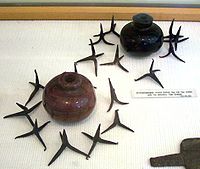
Like their Roman predecessors, Byzantine and Muslim ships were equipped with small catapult
s (mangana) and ballista
e (toxoballistrai) that launched stones, arrows, javelins, pots of Greek fire or other incendiary liquids, caltrop
s (triboloi) and even containers full of lime to choke the enemy or, as Emperor Leo VI somewhat implausibly suggests, scorpions and snakes. Marines and the upper-bank oarsmen were heavily armored in preparation for battle (Leo referred to them as "cataphracts") and armed with close-combat arms such as lances and swords, while the other sailors wore padded felt jackets (neurika) for protection and fought with bows and crossbows. The importance and volume of missile fire during sea combat can be gauged from the fleet manifests for the Cretan expeditions of the 10th century, which mention 10,000 caltrops, 50 bows and 10,000 arrows, 20 hand-carried ballistrai with 200 bolts called myai ("flies") and 100 javelins per dromon.
From the 12th century on, the crossbow
(called , tzangra in Greek) became increasingly important in Mediterranean warfare, remaining the most deadly weapon available until the advent of fully rigged ships with gunpowder artillery. The Byzantines made infrequent use of the weapon, chiefly in sieges, although its use is recorded in some sea battles. Cannon
s were introduced in the latter half of the 14th century, but they were rarely used by the Byzantines, who only had a few artillery pieces for the defense of the land walls of Constantinople. Unlike the Venetians and Genoese, there is no indication that the Byzantines ever mounted any on ships.
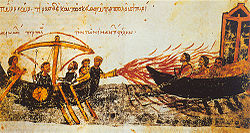 "Greek fire" was the name given by Western Europeans to the flammable concoction used by the Byzantines, so called because the Europeans viewed the Byzantines as Greeks
. The Byzantines themselves used various descriptive names for it, but the most common was "liquid fire" . Although the use of incendiary chemicals by the Byzantines has been attested to since the early 6th century, the actual substance known as Greek fire is believed to have been created in 673 and is attributed to an engineer from Syria, named Kallinikos. The most common method of deployment was to emit the formula through a large bronze tube () onto enemy ships. Alternatively, it could be launched in jars fired from catapults; pivoting crane
s () are also mentioned as a method of pouring combustibles onto enemy ships. Usually the mixture would be stored in heated, pressurized barrels and projected through the tube by some sort of pump while the operators were sheltered behind large iron shields. A portable version () also existed, reputedly invented by Leo VI, making it the direct analogue to a modern flamethrower
. The means of its production was kept a state secret, and its components are only roughly guessed or described through secondary sources like Anna Komnene
, so that its exact composition remains to this day unknown. In its effect, the Greek fire must have been rather similar to napalm
. Contemporary sources make clear that it could not be extinguished by water, but rather floated and burned on top of it; sand could extinguish it by depriving it of oxygen, and several authors also mention strong vinegar and old urine as being able to extinguish it, presumably by some sort of chemical reaction. Consequently, felt or hides soaked in vinegar were used to provide protection against it.
Despite the somewhat exaggerated accounts of Byzantine writers, it was by no means a "wonder weapon", and did not avert some serious defeats. Given its limited range, and the need for a calm sea and favorable wind conditions, its usability was limited. Nevertheless, in favorable circumstances and against an unprepared enemy, its great destructive ability and psychological impact could prove decisive, as displayed repeatedly against the Rus'. Greek fire continued to be mentioned during the 12th century, but the Byzantines failed to use it against the Fourth Crusade, possibly because they had lost access to the areas (the Caucasus
and the eastern coast of the Black Sea) where the primary ingredients were to be found. The Arabs fielded their own "liquid fire" after 835, but it is unknown if they used the Byzantine formula, possibly obtained through espionage or through the defection of stratēgos Euphemios in 827, or whether they independently created a version of their own. A 12th-century treatise prepared by Mardi bin Ali al-Tarsusi
for Saladin
records a version of Greek fire, called "naft" (from naphtha
), which had a petroleum
base, with sulfur and various resins added.
. In addition, shipping was always the quickest and cheapest way of transport, and the Empire's major urban and commercial centers, as well as most of its fertile areas, lay close to the sea. Coupled with the threat posed by the Arabs in the 7th to 10th centuries, this necessitated the maintenance of a strong fleet. The navy was perhaps at its most significant in the successful defense of Constantinople from the two Arab sieges, which ultimately saved the Empire. Throughout the period however, naval operations were an essential part of the Byzantine effort against the Arabs in a game of raids and counter-raids that continued up to the late 10th century.
On the other hand, the nature and limitations of the maritime technology of the age meant that the neither the Byzantines nor any of their opponents could develop a true thalassocracy
. Galley fleets were confined to coastal operations, and were not able to play a truly independent role. Furthermore, as the alternation of Byzantine victories and defeats against the Arabs illustrates, no side was able to permanently gain the upper hand. Although the Byzantines pulled off a number of spectacular successes, such as Nasar's remarkable night-time victory in 880 (one of a handful of similar engagements in the Middle Ages), these victories were balanced off by similarly disastrous losses. Reports of mutinies by oarsmen in Byzantine fleets also reveal that conditions were often far from the ideal prescribed in the manuals. Combined with the traditional predominance of the great Anatolia
n land-holders in the higher military and civil offices
, all this meant that, as in the Roman Empire, the navy, even at its height, was still regarded largely as an adjunct to the land forces. This fact is clearly illustrated by the relatively lowly positions its admirals held in the imperial hierarchy.
It is clear nevertheless that the gradual decline of the indigenous Byzantine naval power in the 10th and 11th centuries, when it was eclipsed by the Italian city-states, chiefly Venice and later Genoa, was of great long-term significance for the fate of the Empire. The sack of the Fourth Crusade, which shattered the foundations of the Byzantine state, was due in large part to the absolute defenselessness of the Empire at sea. This process was initiated by Byzantium itself in the 9th century, when the Italians were increasingly employed by the Empire to compensate for its own naval weakness in the West. The Italian republics also profited from their role as intermediaries in the trade between the Empire and Western Europe, marginalizing the Byzantine merchant marine, which in turn had adverse effects on the availability of Byzantine naval forces. Inevitably however, as the Italian republics slowly moved away from the Byzantine orbit, they began pursuing their own policies, and from the late 11th century on, they turned from protection of the Empire to exploitation and sometimes outright plunder, heralding the eventual financial and political subjugation of Byzantium to their interests. The absence of a strong navy was certainly keenly felt by the Byzantines at the time, as the comments of Kekaumenos illustrate. Strong and energetic emperors like Manuel Komnenos, and later Michael VIII Palaiologos, could revive Byzantine naval power, but even after landing heavy strokes against the Venetians, they merely replaced them with the Genoese and the Pisans. Trade thus remained in Latin hands, its profits continued to be siphoned off from the Empire, and after their deaths, their achievements quickly evaporated. After 1204, and with the brief exception of Michael VIII's reign, the fortunes of the now small Byzantine navy were more or less tied to the shifting alliances with the Italian maritime republics.
When viewing the entire course of Byzantine history, the waxing and waning of the navy's strength closely mirrors the fluctuation of the Empire's fortunes. It is this apparent interrelation that led the French Byzantinologist Louis Bréhier
to remark: "The epochs of [Byzantium's] dominion are those in which it held control of the sea, and it was when it lost it, that its reverses began."
Navy
A navy is the branch of a nation's armed forces principally designated for naval and amphibious warfare; namely, lake- or ocean-borne combat operations and related functions...
of the East Roman or Byzantine Empire
Byzantine Empire
The Byzantine Empire was the Eastern Roman Empire during the periods of Late Antiquity and the Middle Ages, centred on the capital of Constantinople. Known simply as the Roman Empire or Romania to its inhabitants and neighbours, the Empire was the direct continuation of the Ancient Roman State...
. Like the empire it served, it was a direct continuation from its imperial Roman predecessor
Roman Navy
The Roman Navy comprised the naval forces of the Ancient Roman state. Although the navy was instrumental in the Roman conquest of the Mediterranean basin, it never enjoyed the prestige of the Roman legions...
, but played a far greater role in the defense and survival of the state then its earlier iterations. While the fleets of the unified Roman Empire faced few great naval threats, operating as a policing force vastly inferior in power and prestige to the legions
Roman legion
A Roman legion normally indicates the basic ancient Roman army unit recruited specifically from Roman citizens. The organization of legions varied greatly over time but they were typically composed of perhaps 5,000 soldiers, divided into maniples and later into "cohorts"...
, the sea became vital to the very existence of the empire in the east, which several historians have called a "maritime empire".
The first threat to Roman hegemony in the Mediterranean was posed by the Vandals
Vandals
The Vandals were an East Germanic tribe that entered the late Roman Empire during the 5th century. The Vandals under king Genseric entered Africa in 429 and by 439 established a kingdom which included the Roman Africa province, besides the islands of Sicily, Corsica, Sardinia and the Balearics....
in the 5th century, but their threat was ended by the wars of Justinian I
Justinian I
Justinian I ; , ; 483– 13 or 14 November 565), commonly known as Justinian the Great, was Byzantine Emperor from 527 to 565. During his reign, Justinian sought to revive the Empire's greatness and reconquer the lost western half of the classical Roman Empire.One of the most important figures of...
in the 6th century. The re-establishment of a permanently maintained fleet and the introduction of the dromon
Dromon
The dromon was a type of galley and the most important warship of the Byzantine navy from the 6th to 12th centuries AD...
galley in the same period also marks the point when the Byzantine navy began departing from its late Roman roots and developing its own characteristic identity. This process would be furthered with the onset of the Muslim conquests
Muslim conquests
Muslim conquests also referred to as the Islamic conquests or Arab conquests, began with the Islamic prophet Muhammad. He established a new unified polity in the Arabian Peninsula which under the subsequent Rashidun and Umayyad Caliphates saw a century of rapid expansion of Muslim power.They...
in the 7th century. Following the loss of the Levant
Levant
The Levant or ) is the geographic region and culture zone of the "eastern Mediterranean littoral between Anatolia and Egypt" . The Levant includes most of modern Lebanon, Syria, Jordan, Israel, the Palestinian territories, and sometimes parts of Turkey and Iraq, and corresponds roughly to the...
and later Africa, the Mediterranean Sea
Mediterranean Sea
The Mediterranean Sea is a sea connected to the Atlantic Ocean surrounded by the Mediterranean region and almost completely enclosed by land: on the north by Anatolia and Europe, on the south by North Africa, and on the east by the Levant...
was transformed from a "Roman lake" into a battleground between Byzantines and Arabs. In this struggle, the Byzantine fleets were critical, not only for the defense of the Empire's far-flung possessions around the Mediterranean basin, but also in the repulsion of seaborne attacks against the imperial capital of Constantinople
Constantinople
Constantinople was the capital of the Roman, Eastern Roman, Byzantine, Latin, and Ottoman Empires. Throughout most of the Middle Ages, Constantinople was Europe's largest and wealthiest city.-Names:...
itself. Through the use of the newly invented "Greek fire
Greek fire
Greek fire was an incendiary weapon used by the Byzantine Empire. The Byzantines typically used it in naval battles to great effect as it could continue burning while floating on water....
", the Byzantine navy's best-known and feared secret weapon, Constantinople was saved from several sieges
Sieges of Constantinople
There were several sieges of Constantinople during the history of the Byzantine Empire. Two of them resulted in the capture of Constantinople from Byzantine rule: in 1204 by Crusaders, and in 1453 by the Ottoman Empire under Mehmed II....
and numerous naval engagements were won for the Byzantines.
Initially, the defense of the Byzantine coasts and the approaches to Constantinople was borne by the great fleet of the Karabisianoi
Karabisianoi
The Karabisianoi , sometimes anglicized as the Carabisians, were the mainstay of the Byzantine navy from the mid-7th century until the early 8th century. The name derives from the Greek karabos or karabis for "ship", and literally means "people of the ships, sea-men"...
. Progressively however it was split up into several regional (thematic) fleets, while a central Imperial Fleet was maintained at Constantinople, guarding the city and forming the core of naval expeditions. By the late 8th century, the Byzantine navy, a well-organized and maintained force, was again the dominant maritime power in the Mediterranean. The antagonism with the Muslim navies continued with alternating success, but in the 10th century, the Byzantines were able to recover a position of supremacy in the Eastern Mediterranean.
During the 11th century, the navy, like the Empire itself, began to decline. Faced with new naval challenges from the West, the Byzantines were increasingly forced to rely on the navies of Italian city-states like Venice
Republic of Venice
The Republic of Venice or Venetian Republic was a state originating from the city of Venice in Northeastern Italy. It existed for over a millennium, from the late 7th century until 1797. It was formally known as the Most Serene Republic of Venice and is often referred to as La Serenissima, in...
and Genoa
Republic of Genoa
The Most Serene Republic of Genoa |Ligurian]]: Repúbrica de Zêna) was an independent state from 1005 to 1797 in Liguria on the northwestern Italian coast, as well as Corsica from 1347 to 1768, and numerous other territories throughout the Mediterranean....
, with disastrous effects on Byzantium's economy and sovereignty. A period of recovery under the Komnenians
Komnenian restoration
The Komnenian restoration is the term used by historians to describe the military, financial and territorial recovery of the Byzantine Empire under the Komnenian dynasty, from the accession of Alexios I Komnenos in 1081, to the death of Manuel I Komnenos in 1180. The Komnenian restoration is also...
was followed by another period of decline, which culminated in the disastrous dissolution of the Empire by the Fourth Crusade
Fourth Crusade
The Fourth Crusade was originally intended to conquer Muslim-controlled Jerusalem by means of an invasion through Egypt. Instead, in April 1204, the Crusaders of Western Europe invaded and conquered the Christian city of Constantinople, capital of the Eastern Roman Empire...
in 1204. After the Empire was restored in 1261, several emperors of the Palaiologan dynasty
Byzantium under the Palaiologoi
The Byzantine Empire or Byzantium, the term conventionally used since the 19th century to describe the Greek-speaking Roman Empire of the Middle Ages, was ruled by the Palaiologoi dynasty in the period c...
tried to revive the navy, but their efforts had only a temporary effect. By the mid-14th century, the Byzantine fleet, which once could put hundreds of warships to sea, was limited to a few dozen at best, and control of the Aegean
Aegean Sea
The Aegean Sea[p] is an elongated embayment of the Mediterranean Sea located between the southern Balkan and Anatolian peninsulas, i.e., between the mainlands of Greece and Turkey. In the north, it is connected to the Marmara Sea and Black Sea by the Dardanelles and Bosporus...
passed definitively to the Italian and Ottoman
Ottoman Empire
The Ottoman EmpireIt was usually referred to as the "Ottoman Empire", the "Turkish Empire", the "Ottoman Caliphate" or more commonly "Turkey" by its contemporaries...
navies. The diminished navy, however, continued to be active until the fall of the Byzantine Empire
Fall of Constantinople
The Fall of Constantinople was the capture of the capital of the Byzantine Empire, which occurred after a siege by the Ottoman Empire, under the command of Ottoman Sultan Mehmed II, against the defending army commanded by Byzantine Emperor Constantine XI...
to the Ottomans in 1453.
Civil wars and barbarian invasions: the 4th and 5th centuries
Roman Empire
The Roman Empire was the post-Republican period of the ancient Roman civilization, characterised by an autocratic form of government and large territorial holdings in Europe and around the Mediterranean....
and its institutions. After the Battle of Actium
Battle of Actium
The Battle of Actium was the decisive confrontation of the Final War of the Roman Republic. It was fought between the forces of Octavian and the combined forces of Mark Antony and Cleopatra VII. The battle took place on 2 September 31 BC, on the Ionian Sea near the city of Actium, at the Roman...
in 31 BC, in the absence of any external threat in the Mediterranean, the Roman navy performed mostly policing and escort duties. Massive sea battles, like those fought in the Punic Wars
Punic Wars
The Punic Wars were a series of three wars fought between Rome and Carthage from 264 B.C.E. to 146 B.C.E. At the time, they were probably the largest wars that had ever taken place...
, no longer occurred, and the Roman fleets were composed of relatively small vessels, best suited to their new tasks. By the early 4th century, the permanent Roman fleets had dwindled, so that when the fleets of the rival emperors Constantine the Great and Licinius
Licinius
Licinius I , was Roman Emperor from 308 to 324. Co-author of the Edict of Milan that granted official toleration to Christians in the Roman Empire, for the majority of his reign he was the rival of Constantine I...
clashed in 324 AD
Battle of the Hellespont
The Battle of the Hellespont, consisting of two separate naval clashes, was fought in 324 between a Constantinian fleet, led by the eldest son of Constantine I, Crispus; and a larger fleet under Licinius' admiral, Abantus...
, they were composed to a great extent of newly built or commandeered ships from the port cities of the Eastern Mediterranean. The civil wars of the 4th and early 5th centuries, however, did spur a revival of naval activity, with fleets mostly employed to transport armies. Considerable naval forces continued to be employed in the Western Mediterranean throughout the first quarter of the fifth century, especially from North Africa, but Rome's mastery of the Mediterranean was challenged when Africa was overrun by the Vandals
Vandals
The Vandals were an East Germanic tribe that entered the late Roman Empire during the 5th century. The Vandals under king Genseric entered Africa in 429 and by 439 established a kingdom which included the Roman Africa province, besides the islands of Sicily, Corsica, Sardinia and the Balearics....
over a period of fifteen years.
The new Vandalic Kingdom of Carthage
Carthage
Carthage , implying it was a 'new Tyre') is a major urban centre that has existed for nearly 3,000 years on the Gulf of Tunis, developing from a Phoenician colony of the 1st millennium BC...
, under the capable king Geiseric, immediately launched raids against the coasts of Italy and Greece, even sacking and plundering
Sack of Rome (455)
The sack of 455 was the second of three barbarian sacks of Rome; it was executed by the Vandals, who were then at war with the usurping Western Roman Emperor Petronius Maximus....
Rome in 455. The Vandal raids continued unabated over the next two decades, despite repeated Roman attempts to defeat them. The Western Empire was impotent, its navy having dwindled to almost nothing, but the eastern emperors could still call upon the resources and naval expertise of the eastern Mediterranean. A first Eastern expedition in 448, however, went no further than Sicily, and in 460, the Vandals attacked and destroyed a Western Roman invasion fleet at Cartagena
Cartagena, Spain
Cartagena is a Spanish city and a major naval station located in the Region of Murcia, by the Mediterranean coast, south-eastern Spain. As of January 2011, it has a population of 218,210 inhabitants being the Region’s second largest municipality and the country’s 6th non-Province capital...
in Spain. Finally, in 468, a huge Eastern expedition was assembled under Basiliscus
Basiliscus
Basiliscus was Eastern Roman Emperor from 475 to 476. A member of the House of Leo, he came to power when Emperor Zeno had been forced out of Constantinople by a revolt....
, reputedly numbering 1,113 ships and 100,000 men, but it failed disastrously. About 600 ships were lost to fire ship
Fire ship
A fire ship, used in the days of wooden rowed or sailing ships, was a ship filled with combustibles, deliberately set on fire and steered into an enemy fleet, in order to destroy ships, or to create panic and make the enemy break formation. Ships used as fire ships were usually old and worn out or...
s, and the financial cost of 130,000 pounds of gold and 700 pounds of silver nearly bankrupted the Empire. This forced the Romans to come to terms with Geiseric and sign a peace treaty. After Geiseric's death in 477, however, the Vandal threat receded.
Sixth century – Justinian restores Roman control over the Mediterranean
The 6th century marked the rebirth of Roman naval power. In 508, as antagonism with the Ostrogothic KingdomOstrogothic Kingdom
The Kingdom established by the Ostrogoths in Italy and neighbouring areas lasted from 493 to 553. In Italy the Ostrogoths replaced Odoacer, the de facto ruler of Italy who had deposed the last emperor of the Western Roman Empire in 476. The Gothic kingdom reached its zenith under the rule of its...
of Theodoric
Theodoric the Great
Theodoric the Great was king of the Ostrogoths , ruler of Italy , regent of the Visigoths , and a viceroy of the Eastern Roman Empire...
flared up, the Emperor Anastasius I
Anastasius I (emperor)
Anastasius I was Byzantine Emperor from 491 to 518. During his reign the Roman eastern frontier underwent extensive re-fortification, including the construction of Dara, a stronghold intended to counter the Persian fortress of Nisibis....
(491–518) is reported to have sent a fleet of 100 warships to raid the coasts of Italy. In 513, the general Vitalian
Vitalian (general)
Vitalian was an East Roman general. Rebelling in 513 against Emperor Anastasius I, he won over large parts of the army and people of Thrace. Successive rapprochements with Anastasius failed, and the revolt continued until it was finally defeated in 515. Vitalian then went into hiding until...
revolted against Emperor Anastasius I
Anastasius I (emperor)
Anastasius I was Byzantine Emperor from 491 to 518. During his reign the Roman eastern frontier underwent extensive re-fortification, including the construction of Dara, a stronghold intended to counter the Persian fortress of Nisibis....
. The rebels assembled a fleet of 200 ships which, despite some initial successes, were destroyed by admiral Marinus, who employed an incendiary substance (possibly an early form of "Greek fire
Greek fire
Greek fire was an incendiary weapon used by the Byzantine Empire. The Byzantines typically used it in naval battles to great effect as it could continue burning while floating on water....
") to defeat them.
In 533, taking advantage of the absence of the Vandal fleet, sent to suppress a revolt in Sardinia
Sardinia
Sardinia is the second-largest island in the Mediterranean Sea . It is an autonomous region of Italy, and the nearest land masses are the French island of Corsica, the Italian Peninsula, Sicily, Tunisia and the Spanish Balearic Islands.The name Sardinia is from the pre-Roman noun *sard[],...
, an army of 15,000 under Belisarius
Belisarius
Flavius Belisarius was a general of the Byzantine Empire. He was instrumental to Emperor Justinian's ambitious project of reconquering much of the Mediterranean territory of the former Western Roman Empire, which had been lost less than a century previously....
was transported to Africa by an invasion fleet of 92 dromon
Dromon
The dromon was a type of galley and the most important warship of the Byzantine navy from the 6th to 12th centuries AD...
s and 500 transports, beginning the Vandalic War
Vandalic War
The Vandalic War was a war fought in North Africa, in the areas of modern Tunisia and eastern Algeria, in 533-534, between the forces of the Eastern Roman Empire and the Vandal Kingdom of Carthage...
, the first of the wars of reconquest of Emperor Justinian I
Justinian I
Justinian I ; , ; 483– 13 or 14 November 565), commonly known as Justinian the Great, was Byzantine Emperor from 527 to 565. During his reign, Justinian sought to revive the Empire's greatness and reconquer the lost western half of the classical Roman Empire.One of the most important figures of...
(527–565). These were largely amphibious operations, made possible by the control of the Mediterranean waterways, and the fleet played a vital role in carrying supplies and reinforcements to the widely dispersed Byzantine expeditionary forces and garrisons. This fact was not lost on the Byzantines' enemies. Already in the 520s, Theodoric had planned to build a massive fleet directed against the Byzantines and the Vandals, but his death in 526 limited the extent to which these plans were realized. In 535, the Gothic War began with a double-pronged Byzantine offensive, with a fleet again carrying Belisarius' army to Sicily and then Italy, and another army invading Dalmatia
Dalmatia
Dalmatia is a historical region on the eastern coast of the Adriatic Sea. It stretches from the island of Rab in the northwest to the Bay of Kotor in the southeast. The hinterland, the Dalmatian Zagora, ranges from fifty kilometers in width in the north to just a few kilometers in the south....
. Byzantine control of the sea was of great strategic importance, allowing the smaller Byzantine army to successfully occupy the peninsula by 540.
In 541 however, the new Ostrogoth king, Totila
Totila
Totila, original name Baduila was King of the Ostrogoths from 541 to 552 AD. A skilled military and political leader, Totila reversed the tide of Gothic War, recovering by 543 almost all the territories in Italy that the Eastern Roman Empire had captured from his Kingdom in 540.A relative of...
, created a fleet of 400 warships with which to deny the seas around Italy to the Empire. Two Byzantine fleets were destroyed near Naples in 542, and in 546, Belisarius personally commanded 200 ships against the Gothic fleet that blockaded the mouths of the Tiber
Tiber
The Tiber is the third-longest river in Italy, rising in the Apennine Mountains in Emilia-Romagna and flowing through Umbria and Lazio to the Tyrrhenian Sea. It drains a basin estimated at...
, in an unsuccessful effort to relieve Rome
Sack of Rome (546)
The Sack of Rome in 546 was carried out by the Gothic king Totila during the Gothic War of 535–554 between the Ostrogoths and the East Romans . Totila was based at Tivoli and, in pursuit of his quest to reconquer the region of Latium, he moved against Rome...
. In 550, Totila invaded Sicily, and over the next year, his 300-ship fleet captured Sardinia
Sardinia
Sardinia is the second-largest island in the Mediterranean Sea . It is an autonomous region of Italy, and the nearest land masses are the French island of Corsica, the Italian Peninsula, Sicily, Tunisia and the Spanish Balearic Islands.The name Sardinia is from the pre-Roman noun *sard[],...
and Corsica
Corsica
Corsica is an island in the Mediterranean Sea. It is located west of Italy, southeast of the French mainland, and north of the island of Sardinia....
, and raided Corfu
Corfu
Corfu is a Greek island in the Ionian Sea. It is the second largest of the Ionian Islands, and, including its small satellite islands, forms the edge of the northwestern frontier of Greece. The island is part of the Corfu regional unit, and is administered as a single municipality. The...
and the coast of Epirus
Epirus
The name Epirus, from the Greek "Ήπειρος" meaning continent may refer to:-Geographical:* Epirus - a historical and geographical region of the southwestern Balkans, straddling modern Greece and Albania...
. However, a defeat in a sea battle off Sena Gallica marked the beginning of the final Imperial ascendancy. With the final conquest of Italy and southern Spain
Spania
Spania was a province of the Roman Empire from 552 until 624 in the south of the Iberian Peninsula and the Balearic Islands. It was a part of the conquests of Roman Emperor Justinian I in an effort to restore the western half of the Empire....
under Justinian, the Mediterranean once again became a "Roman lake".
Despite the subsequent loss of much of Italy to the Lombards
Lombards
The Lombards , also referred to as Longobards, were a Germanic tribe of Scandinavian origin, who from 568 to 774 ruled a Kingdom in Italy...
, the Byzantines maintained control of the seas—as the Lombards rarely ventured to sea—and were thus able to retain several coastal strips of Italian territory for centuries. The only major naval action of the next 80 years occurred during the Siege of Constantinople
Siege of Constantinople (626)
The Siege of Constantinople in 626 by the Avars, aided by large numbers of allied Slavs and the Sassanid Persians, ended in a strategic victory for the Byzantines...
by the Sassanid Persians
Sassanid Empire
The Sassanid Empire , known to its inhabitants as Ērānshahr and Ērān in Middle Persian and resulting in the New Persian terms Iranshahr and Iran , was the last pre-Islamic Persian Empire, ruled by the Sasanian Dynasty from 224 to 651...
, Avars
Eurasian Avars
The Eurasian Avars or Ancient Avars were a highly organized nomadic confederacy of mixed origins. They were ruled by a khagan, who was surrounded by a tight-knit entourage of nomad warriors, an organization characteristic of Turko-Mongol groups...
and Slavs in 626. During that siege, the Slavs' fleet of monoxyla was intercepted by the Byzantine fleet and destroyed, denying the Persian army
Sassanid army
The birth of the Sassanid army dates back to the rise of Ardashir I , the founder of the Sassanid dynasty, to the throne. Ardashir aimed at the revival of the Persian Empire, and to further this aim, he reformed the military by forming a standing army which was under his personal command and whose...
passage across the Bosporus
Bosporus
The Bosphorus or Bosporus , also known as the Istanbul Strait , is a strait that forms part of the boundary between Europe and Asia. It is one of the Turkish Straits, along with the Dardanelles...
and eventually forcing the Avars to retreat.
Emergence of the Arab naval threat
Syria
Syria , officially the Syrian Arab Republic , is a country in Western Asia, bordering Lebanon and the Mediterranean Sea to the West, Turkey to the north, Iraq to the east, Jordan to the south, and Israel to the southwest....
and Egypt
Egypt
Egypt , officially the Arab Republic of Egypt, Arabic: , is a country mainly in North Africa, with the Sinai Peninsula forming a land bridge in Southwest Asia. Egypt is thus a transcontinental country, and a major power in Africa, the Mediterranean Basin, the Middle East and the Muslim world...
created a new threat to Byzantium. Not only did the Arabs conquer significant recruiting and revenue-producing areas, but, after the utility of a strong navy was demonstrated by the short-lived Byzantine recapture of Alexandria
Alexandria
Alexandria is the second-largest city of Egypt, with a population of 4.1 million, extending about along the coast of the Mediterranean Sea in the north central part of the country; it is also the largest city lying directly on the Mediterranean coast. It is Egypt's largest seaport, serving...
in 644, they took to creating a navy of their own. In this effort the new Muslim elite, which came from the inland-oriented northern part of the Arabian peninsula
Arabian Peninsula
The Arabian Peninsula is a land mass situated north-east of Africa. Also known as Arabia or the Arabian subcontinent, it is the world's largest peninsula and covers 3,237,500 km2...
, largely relied on the resources and manpower of the conquered Levant
Levant
The Levant or ) is the geographic region and culture zone of the "eastern Mediterranean littoral between Anatolia and Egypt" . The Levant includes most of modern Lebanon, Syria, Jordan, Israel, the Palestinian territories, and sometimes parts of Turkey and Iraq, and corresponds roughly to the...
(especially the Copts of Egypt), which until a few years previously had provided ships and crews for the Byzantines. There is, however, evidence that in the new naval bases in Palestine shipwrights from Persia and Iraq were also employed. The lack of illustrations earlier than the 14th century means that nothing is known about the specifics of the early Muslim warships, although it is usually assumed that their naval efforts drew upon the existing Mediterranean maritime tradition. Given a largely shared nautical nomenclature, and the centuries-long interaction between the two cultures, Byzantine and Arab ships shared many similarities. This similarity also extended to tactics and general fleet organization; translations of Byzantine military manuals
Byzantine military manuals
This article lists and briefly discusses the most important of a large number of treatises on military science produced in the Byzantine Empire.- Background :...
were available to the Arab admirals.
After seizing Cyprus
Cyprus
Cyprus , officially the Republic of Cyprus , is a Eurasian island country, member of the European Union, in the Eastern Mediterranean, east of Greece, south of Turkey, west of Syria and north of Egypt. It is the third largest island in the Mediterranean Sea.The earliest known human activity on the...
in 649 and raiding Rhodes, Crete and Sicily, the young Arab navy decisively defeated the Byzantines under the personal command of Emperor Constans II
Constans II
Constans II , also called Constantine the Bearded , was Byzantine emperor from 641 to 668. He also was the last emperor to become consul in 642, becoming the last Roman consul in history....
(641–668) in the Battle of the Masts of 655. This catastrophic Byzantine defeat opened up the Mediterranean to the Arabs, and began a centuries-long series of naval conflicts over the control of the Mediterranean waterways. From the reign of Muawiyah I
Muawiyah I
Muawiyah I was the first Caliph of the Umayyad Dynasty. After the conquest of Mecca by the Muslims, Muawiyah's family converted to Islam. Muawiyah is brother-in-law to Muhammad who married his sister Ramlah bint Abi-Sufyan in 1AH...
(661–680), raids intensified, as preparations were made for a great assault on Constantinople itself. In the long first Arab siege of Constantinople, the Byzantine fleet proved instrumental to the survival of the Empire: the Arab fleets were defeated through the use of its newly developed secret weapon, "Greek fire
Greek fire
Greek fire was an incendiary weapon used by the Byzantine Empire. The Byzantines typically used it in naval battles to great effect as it could continue burning while floating on water....
". The Muslim advance in Asia Minor and the Aegean was halted, and an agreement to a thirty-year truce concluded soon after.
In the 680s, Justinian II
Justinian II
Justinian II , surnamed the Rhinotmetos or Rhinotmetus , was the last Byzantine Emperor of the Heraclian Dynasty, reigning from 685 to 695 and again from 705 to 711...
(685–695 and 705–711) paid attention to the needs of the navy, strengthening it by the resettlement of over 18,500 Mardaites
Mardaites
The Mardaites inhabited the highland regions of southern Anatolia, Isauria, Syria, and Lebanon. Their origins are little known, but they may have been of Armenian origin...
along the southern coasts of the Empire, where they were employed as marines and rowers. Nevertheless, the Arab naval threat intensified as they gradually took control
Umayyad conquest of North Africa
The Umayyad conquest of North Africa continued the century of rapid Arab Muslim expansion following the death of Muhammad in 632 CE. By 640 the Arabs controlled Mesopotamia, had invaded Armenia, and were concluding their conquest of Byzantine Syria. Damascus was the seat of the Umayyad caliphate....
of North Africa
Exarchate of Africa
The Exarchate of Africa or of Carthage, after its capital, was the name of an administrative division of the Eastern Roman Empire encompassing its possessions on the Western Mediterranean, ruled by an exarch, or viceroy...
in the 680s and 690s. The last Byzantine stronghold, Carthage
Carthage
Carthage , implying it was a 'new Tyre') is a major urban centre that has existed for nearly 3,000 years on the Gulf of Tunis, developing from a Phoenician colony of the 1st millennium BC...
, fell in 698, although a Byzantine naval expedition managed to briefly retake it
Battle of Carthage (698)
The Battle of Carthage was fought in 698 AD between a Byzantine expeditionary force and the armies of the Umayyad Caliphate. Having lost Carthage to the Muslims, Emperor Leontius sent the navy under the command of John the Patrician and the droungarios Tiberius Apsimarus. They entered the harbor...
. The Arab governor Musa bin Nusair
Musa bin Nusair
Musa bin Nusayr al-Balawi was a balawi who served as a governor and general under the Umayad caliph Al-Walid I. He had ruled over the Muslim provinces of North Africa , and directed the islamic opening of the Visigothic kingdom in Hispania....
built a new city and naval base at Tunis
Tunis
Tunis is the capital of both the Tunisian Republic and the Tunis Governorate. It is Tunisia's largest city, with a population of 728,453 as of 2004; the greater metropolitan area holds some 2,412,500 inhabitants....
, and 1,000 Coptic shipwrights were brought to construct a new fleet, which would challenge Byzantine control of the western Mediterranean. Thus, from the early 8th century on, Muslim raids unfolded unceasingly against Byzantine holdings in the Western Mediterranean, especially Sicily. In addition, the new fleet would allow the Muslims to complete their conquest of the Maghreb
Maghreb
The Maghreb is the region of Northwest Africa, west of Egypt. It includes five countries: Morocco, Algeria, Tunisia, Libya, and Mauritania and the disputed territory of Western Sahara...
and to successfully invade and capture
Umayyad conquest of Hispania
The Umayyad conquest of Hispania is the initial Islamic Ummayad Caliphate's conquest, between 711 and 718, of the Christian Visigothic Kingdom of Hispania, centered in the Iberian Peninsula, which was known to them under the Arabic name al-Andalus....
most of Visigoth Spain.
Byzantine counter-offensive
Anastasios II (emperor)
Artemius Anastasius , known in English as Anastasios II or Anastasius II, , was Byzantine emperor from 713 to 715....
(713–715) prepared the capital, and mounted an unsuccessful preemptive strike against the Muslim naval preparations. Anastasios was soon overthrown by Theodosius III (715–717), who in turn was replaced, just as the Muslim army was advancing through Anatolia, by Leo III the Isaurian
Leo III the Isaurian
Leo III the Isaurian or the Syrian , was Byzantine emperor from 717 until his death in 741...
(717–741). It was Leo III who faced the second and final Arab siege of Constantinople. The use of Greek fire, which devastated the Arab fleet, was again instrumental in the Byzantine victory, while a harsh winter and Bulgar
First Bulgarian Empire
The First Bulgarian Empire was a medieval Bulgarian state founded in the north-eastern Balkans in c. 680 by the Bulgars, uniting with seven South Slavic tribes...
attacks further sapped the besiegers' strength.
In the aftermath of the siege, the retreating remains of the Arab fleet were decimated in a storm, and Byzantine forces launched a counteroffensive, with a fleet sacking Laodicea
Latakia
Latakia, or Latakiyah , is the principal port city of Syria, as well as the capital of the Latakia Governorate. In addition to serving as a port, the city is a manufacturing center for surrounding agricultural towns and villages...
and an army driving the Arabs from Asia Minor. For the next three decades, naval warfare featured constant raids from both sides, with the Byzantines launching repeated attacks against the Muslim naval bases in Syria (Latakia
Latakia
Latakia, or Latakiyah , is the principal port city of Syria, as well as the capital of the Latakia Governorate. In addition to serving as a port, the city is a manufacturing center for surrounding agricultural towns and villages...
), and Egypt (Damietta
Damietta
Damietta , also known as Damiata, or Domyat, is a port and the capital of the Damietta Governorate in Egypt. It is located at the intersection between the Mediterranean Sea and the Nile, about north of Cairo.-History:...
and Tinnis). In 727, a revolt of the thematic fleets, largely motivated by resentment against the Emperor's iconoclasm, was put down by the imperial fleet through use of Greek fire. Despite the losses this entailed, some 390 warships were reportedly sent to attack Damietta in 739, and in 747, aided for the first time by ships from the Italian city-states
Italian city-states
The Italian city-states were a political phenomenon of small independent states mostly in the central and northern Italian peninsula between the 10th and 15th centuries....
, the Byzantines decisively defeated the combined Syrian and Alexandrian fleets off Cyprus, breaking the naval power of the Umayyad Caliphate.
The Byzantines followed this up with the destruction of the North African flotillas, and coupled their successes at sea with severe trading limitations imposed on Muslim traders. Given the Empire's new ability to control the waterways, this strangled Muslim maritime trade. With the collapse of the Umayyad state shortly thereafter and the increasing fragmentation of the Muslim world, the Byzantine navy was left as the sole organized naval force in the Mediterranean. Thus, during the latter half of the 8th century, the Byzantines enjoyed a second period of complete naval superiority. During this time, to stand watch on the coasts of Syria, guarding against a raid by the Byzantine fleet, was deemed by the Muslims more pious an act than a night of prayer in the Kaaba
Kaaba
The Kaaba is a cuboid-shaped building in Mecca, Saudi Arabia, and is the most sacred site in Islam. The Qur'an states that the Kaaba was constructed by Abraham, or Ibraheem, in Arabic, and his son Ishmael, or Ismaeel, as said in Arabic, after he had settled in Arabia. The building has a mosque...
. These successes enabled Emperor Constantine V
Constantine V
Constantine V was Byzantine emperor from 741 to 775; ); .-Early life:...
(741–775) to shift the fleet from the Mediterranean to the Black Sea during his campaigns against the Bulgars
First Bulgarian Empire
The First Bulgarian Empire was a medieval Bulgarian state founded in the north-eastern Balkans in c. 680 by the Bulgars, uniting with seven South Slavic tribes...
in the 760s. In 763, a fleet of 800 ships carrying 9,600 cavalry and some infantry sailed to Anchialus, where he scored a significant victory
Battle of Anchialus (763)
The battle of Anchialus occurred in 763, near the town of Pomorie on the Bulgarian Black Sea Coast . The result was a Byzantine victory.- Origins of the conflict :...
, but in 766, a second fleet, allegedly of 2,600 ships, again bound for Anchialus, sank en route. At the same time however, the Isaurian emperors undermined Byzantium's naval strength: with the Arab threat gone for the moment, and with the largely iconodule naval themes staunchly opposed to their iconoclastic policies, the emperors reduced the navy's size and downgraded the naval themes.
Renewed Muslim ascendancy
Gulf of Antalya
The Gulf of Antalya is a large bay of the northern Levantine Sea, in the eastern Mediterranean Sea south of Antalya province, Turkey. It includes some of the main seaside resorts of Turkey, also known as the "Turkish riviera"....
, and raids against Cyprus and Crete recommenced during the reign of Harun al-Rashid
Harun al-Rashid
Hārūn al-Rashīd was the fifth Arab Abbasid Caliph in Iraq. He was born in Rey, Iran, close to modern Tehran. His birth date remains a point of discussion, though, as various sources give the dates from 763 to 766)....
(786–809). Around the Mediterranean, new powers were rising, foremost amongst them the Carolingian Empire
Carolingian Empire
Carolingian Empire is a historiographical term which has been used to refer to the realm of the Franks under the Carolingian dynasty in the Early Middle Ages. This dynasty is seen as the founders of France and Germany, and its beginning date is based on the crowning of Charlemagne, or Charles the...
, while in 803, the Pax Nicephori
Pax Nicephori
Pax Nicephori is a term used to refer to both a 803 peace treaty allegedly concluded between the Frankish ruler Charlemagne and Nikephoros I, emperor of Byzantium, and the outcome of negotiations that took place between the same parties, but were concluded by different emperors, between 811 and 814...
recognized the de facto independence of Byzantine Venice
Republic of Venice
The Republic of Venice or Venetian Republic was a state originating from the city of Venice in Northeastern Italy. It existed for over a millennium, from the late 7th century until 1797. It was formally known as the Most Serene Republic of Venice and is often referred to as La Serenissima, in...
, which was further entrenched by the repulsion of a Byzantine attack in 809. At the same time, in Ifriqiya
Ifriqiya
In medieval history, Ifriqiya or Ifriqiyah was the area comprising the coastal regions of what are today western Libya, Tunisia, and eastern Algeria. This area included what had been the Roman province of Africa, whose name it inherited....
, the new Aghlabid
Aghlabid
The Aghlabids were a dynasty of emirs, members of the Arab tribe of Bani Tamim, who ruled Ifriqiya, nominally on behalf of the Abbasid Caliph, for about a century, until overthrown by the new power of the Fatimid.-History:...
dynasty was established, which immediately engaged in raids throughout the central Mediterranean.
The Byzantines, on the other hand, were weakened by a series of catastrophic defeats against the Bulgars, followed in 820 by the revolt of Thomas the Slav
Thomas the Slav
Thomas the Slav was a 9th-century Byzantine military commander, most notable for leading a wide-scale revolt against Emperor Michael II the Amorian in 820–823....
, which attracted the support of a large part of the Byzantine armed forces, including the thematic fleets. Despite its suppression, the revolt had severely depleted the Empire's defenses. As a result, Crete
Crete
Crete is the largest and most populous of the Greek islands, the fifth largest island in the Mediterranean Sea, and one of the thirteen administrative regions of Greece. It forms a significant part of the economy and cultural heritage of Greece while retaining its own local cultural traits...
fell between 824 and 827 to a band of Andalusian
Al-Andalus
Al-Andalus was the Arabic name given to a nation and territorial region also commonly referred to as Moorish Iberia. The name describes parts of the Iberian Peninsula and Septimania governed by Muslims , at various times in the period between 711 and 1492, although the territorial boundaries...
exiles. Three successive Byzantine recovery attempts failed over the next few years, and the island became a base for Muslim piratical activity in the Aegean, radically upsetting the balance of power in the region. Despite some Byzantine successes over the Cretan corsairs, and the razing
Sack of Damietta (853)
The Sack of Damietta in 853 was a major success for the Byzantine Empire. On 22 May 853, the Byzantine navy attacked the port city of Damietta on the Nile Delta, whose garrison was absent at the time...
of Damietta
Damietta
Damietta , also known as Damiata, or Domyat, is a port and the capital of the Damietta Governorate in Egypt. It is located at the intersection between the Mediterranean Sea and the Nile, about north of Cairo.-History:...
by a Byzantine fleet of 85 ships in 853, Arab naval power in the Levant was steadily reviving under Abbasid rule.
The situation was even worse in the West. A critical blow was inflicted on the Empire in 827, as the Aghlabids began the slow conquest of Sicily
History of Islam in southern Italy
The history of Islam in southern Italy begins with the Islamic conquest and subsequent rule of Sicily and Malta, a process that started in the 9th century. Islamic rule over Sicily was effective from 902, and the complete rule of the island lasted from 965 until 1061...
, aided by the defection of the Byzantine commander Euphemios and the island's thematic fleet. In 838, the Muslims crossed over into Italy, taking Taranto
Taranto
Taranto is a coastal city in Apulia, Southern Italy. It is the capital of the Province of Taranto and is an important commercial port as well as the main Italian naval base....
and Brindisi
Brindisi
Brindisi is a city in the Apulia region of Italy, the capital of the province of Brindisi, off the coast of the Adriatic Sea.Historically, the city has played an important role in commerce and culture, due to its position on the Italian Peninsula and its natural port on the Adriatic Sea. The city...
, followed soon by Bari
Emirate of Bari
The Emirate of Bari was a short-lived Saracen state centred on the south Italian city of Bari from 847 to 871. It was the most lasting episode in the history of Islam in peninsular southern Italy....
. Venetian operations against them were unsuccessful, and throughout the 840s, the Arabs were freely raiding Italy and the Adriatic, even attacking Rome
Sack of Rome (846)
In 846 Arab raiders plundered the environs of Rome, including the Vatican, sacking Old St. Peter's and St. Paul's-Outside-the-Walls, but were prevented from entering the city itself by the Aurelian Wall...
in 846. Attacks by the Lombards and Lothair I
Lothair I
Lothair I or Lothar I was the Emperor of the Romans , co-ruling with his father until 840, and the King of Bavaria , Italy and Middle Francia...
failed to dislodge the Muslims from Italy, while two large-scale Byzantine attempts to recover Sicily were heavily defeated in 840 and 859. By 850, the Muslim fleets, together with large numbers of independent ghazi raiders, had emerged as the major power of the Mediterranean, putting the Byzantines and the Christians in general on the defensive.
The same period, when a battered Byzantium defended itself against enemies on all fronts, also saw the emergence of a new, unexpected threat: the Rus'
Rus' (people)
The Rus' were a group of Varangians . According to the Primary Chronicle of Rus, compiled in about 1113 AD, the Rus had relocated from the Baltic region , first to Northeastern Europe, creating an early polity which finally came under the leadership of Rurik...
made their first appearance in Byzantine history with a raid against Paphlagonia in the 830s, followed by a major expedition in 860.
Byzantine Reconquest – Era of the Macedonian dynasty
During the course of the later 9th and the 10th century, as the Caliphate fractured into smaller states and Arab power became weakened, the Byzantines launched a series of successful campaigns against them. This "Byzantine Reconquest" was overseen by the able sovereigns of the Macedonian dynastyMacedonian dynasty
The Macedonian dynasty ruled the Byzantine Empire from 867 to 1056, following the Amorian dynasty. During this period, the Byzantine state reached its greatest expanse since the Muslim conquests, and the Macedonian Renaissance in letters and arts began. The dynasty was named after its founder,...
(867–1056), and marked the noontide of the Byzantine state.
Reign of Basil I
Basil I
Basil I, called the Macedonian was a Byzantine emperor of probable Armenian descent who reigned from 867 to 886. Born a simple peasant in the Byzantine theme of Macedonia, he rose in the imperial court, and usurped the imperial throne from Emperor Michael III...
(867–886) heralded this revival, as he embarked on an aggressive foreign policy. Continuing the policies of his predecessor, Michael III
Michael III
Michael III , , Byzantine Emperor from 842 to 867. Michael III was the third and traditionally last member of the Amorian-Phrygian Dynasty...
(842–867), he showed great care to the fleet, and as a result, successive victories followed. In 867, a fleet under the droungarios tou plōïmou Niketas Ooryphas relieved Dalmatia
Dalmatia
Dalmatia is a historical region on the eastern coast of the Adriatic Sea. It stretches from the island of Rab in the northwest to the Bay of Kotor in the southeast. The hinterland, the Dalmatian Zagora, ranges from fifty kilometers in width in the north to just a few kilometers in the south....
from Arab attacks and reestablished Byzantine presence in the area. A few years later, he twice heavily defeated the Cretan pirates, temporarily securing the Aegean. Cyprus also was temporarily recovered and Bari
Bari
Bari is the capital city of the province of Bari and of the Apulia region, on the Adriatic Sea, in Italy. It is the second most important economic centre of mainland Southern Italy after Naples, and is well known as a port and university city, as well as the city of Saint Nicholas...
occupied. At the same time, however, the Muslim presence in Cilicia
Cilicia
In antiquity, Cilicia was the south coastal region of Asia Minor, south of the central Anatolian plateau. It existed as a political entity from Hittite times into the Byzantine empire...
was strengthened, and Tarsos became a major base for land and seaborne attacks against Byzantine territory, especially under the famed emir Yazaman al-Khadim (882–891).
In the West, the Muslims continued to make steady advances, as the local Byzantine forces proved inadequate: the Empire was forced to rely on the aid of their nominal Italian subjects, and had to resort to the transfer of the eastern fleets to Italy to achieve any progress. Following the fall of Enna
Enna
Enna is a city and comune located roughly at the center of Sicily, southern Italy, in the province of Enna, towering above the surrounding countryside...
in 855, the Byzantines were confined to the eastern shore of Sicily, and under increasing pressure. A relief expedition in 868 achieved little. Syracuse was attacked again in 869, and in 870, Malta
Malta
Malta , officially known as the Republic of Malta , is a Southern European country consisting of an archipelago situated in the centre of the Mediterranean, south of Sicily, east of Tunisia and north of Libya, with Gibraltar to the west and Alexandria to the east.Malta covers just over in...
fell to the Aghlabids. Muslim corsairs raided the Adriatic, and although they were driven out of Apulia
Apulia
Apulia is a region in Southern Italy bordering the Adriatic Sea in the east, the Ionian Sea to the southeast, and the Strait of Òtranto and Gulf of Taranto in the south. Its most southern portion, known as Salento peninsula, forms a high heel on the "boot" of Italy. The region comprises , and...
, in the early 880s they established bases along the western Italian coast, from where they would not be completely dislodged until 915. In 878, Syracuse, the main Byzantine stronghold in Sicily, was attacked again and fell, largely because the Imperial Fleet was occupied with transporting marble
Marble
Marble is a metamorphic rock composed of recrystallized carbonate minerals, most commonly calcite or dolomite.Geologists use the term "marble" to refer to metamorphosed limestone; however stonemasons use the term more broadly to encompass unmetamorphosed limestone.Marble is commonly used for...
for the construction of the Nea Ekklesia
Nea Ekklesia
The Nea Ekklēsia was a church built by Byzantine Emperor Basil I the Macedonian in Constantinople between the years 876–80. It was the first monumental church built in the Byzantine capital after the Hagia Sophia in the 6th century, and marks the beginning of middle period of Byzantine...
, Basil's new church. In 880, Ooryphas' successor, the droungarios Nasar
Nasar
Nasar , originally baptized Basil , was a distinguished Byzantine military leader in the Byzantine–Arab conflicts of the latter half of the 9th century....
, scored a significant victory in a night battle over the Tunisians who were raiding the Ionian Islands
Ionian Islands
The Ionian Islands are a group of islands in Greece. They are traditionally called the Heptanese, i.e...
. He then proceeded to raid Sicily, carrying off much booty, before defeating another Muslim fleet off Punta Stilo. At the same time, another Byzantine squadron scored a significant victory at Naples. These successes allowed a short-lived Byzantine counteroffensive to develop in the West in the 870s and 880s under Nikephoros Phokas the Elder
Nikephoros Phokas the Elder
Nikephoros Phokas the Elder was one of the great generals in the service of the Eastern Roman Emperor Basil I.Descended from the Phokas family, one of the large land-holding families of Anatolia, Nikephoros Phokas rose to the positions of patrikios and domestikos ton scholon. He succeeded in...
, expanding the Byzantine foothold in Apulia
Apulia
Apulia is a region in Southern Italy bordering the Adriatic Sea in the east, the Ionian Sea to the southeast, and the Strait of Òtranto and Gulf of Taranto in the south. Its most southern portion, known as Salento peninsula, forms a high heel on the "boot" of Italy. The region comprises , and...
and Calabria
Calabria
Calabria , in antiquity known as Bruttium, is a region in southern Italy, south of Naples, located at the "toe" of the Italian Peninsula. The capital city of Calabria is Catanzaro....
and forming the thema of Longobardia, which would later evolve into the Catepanate of Italy. A heavy defeat off Milazzo
Milazzo
Milazzo is a town and comune in the province of Messina, Sicily, Italy.The city is situated between two bays, one of Milazzo and the east to the west of Patti, in a strategic place in the north-eastern Sicily.Located 43 km from the provincial capital, is part of the metropolitan area of the Strait...
in 888, however, signaled the virtual disappearance of major Byzantine naval activity in the seas around Italy for the next century.
Arab raids during the reign of Leo VI
Leo VI the Wise
Leo VI, surnamed the Wise or the Philosopher , was Byzantine emperor from 886 to 912. The second ruler of the Macedonian dynasty , he was very well-read, leading to his surname...
(886–912), the Empire again faced serious threats. In the north, a war broke out against the Bulgarian Tsar Simeon
Simeon I of Bulgaria
Simeon I the Great ruled over Bulgaria from 893 to 927, during the First Bulgarian Empire. Simeon's successful campaigns against the Byzantines, Magyars and Serbs led Bulgaria to its greatest territorial expansion ever, making it the most powerful state in contemporary Eastern Europe...
, and a part of the Imperial Fleet was used in 895 to ferry an army of Magyars across the Danube to raid Bulgaria. The Bulgarian war produced several costly defeats, while at the same time the Arab naval threat reached new heights, with successive raids devastating the shores of Byzantium's naval heartland, the Aegean Sea. In 891 or 893, the Arab fleet sacked the island of Samos
Samoš
Samoš is a village in Serbia. It is situated in the Kovačica municipality, in the South Banat District, Vojvodina province. The village has a Serb ethnic majority and its population numbering 1,247 people .-See also:...
and took its stratēgos prisoner, and in 898, the eunuch admiral Raghib carried off 3,000 Byzantine sailors of the Kibyrrhaiotai as prisoners. These losses denuded Byzantine defenses, opening the Aegean up to raids by the Syrian fleets. The first heavy blow came in 901, when the renegade Damian of Tyre plundered Demetrias
Demetrias
Demetrias was an ancient Greek city in Magnesia , near the modern city of Volos. It was founded by Demetrius Poliorcetes, one of the successors of Alexander the Great.-External links:*...
, while in the next year, Taormina
Taormina
Taormina is a comune and small town on the east coast of the island of Sicily, Italy, in the Province of Messina, about midway between Messina and Catania. Taormina has been a very popular tourist destination since the 19th century...
, the Empire's last outpost in Sicily, fell to the Muslims. The greatest disaster, however, came in 904, when another renegade, Leo of Tripoli
Leo of Tripoli
Leo of Tripoli was a Greek renegade and pirate serving Arab interests in the early tenth century. Born in the Byzantine Empire to Christian parents, he later converted to Islam and took employment with his former captors as an admiral....
, raided the Aegean. His fleet penetrated even into the Dardanelles
Dardanelles
The Dardanelles , formerly known as the Hellespont, is a narrow strait in northwestern Turkey connecting the Aegean Sea to the Sea of Marmara. It is one of the Turkish Straits, along with its counterpart the Bosphorus. It is located at approximately...
, before proceeding to sack
Sack of Thessalonica (904)
The Sack of Thessalonica in 904 by Saracen pirates was one of the worst disasters to befall the Byzantine Empire in the 10th century. A Muslim fleet, led by the renegade Leo of Tripoli, and with the imperial capital of Constantinople as its initial target, sailed from Syria...
the Empire's second city, Thessalonica
Thessaloniki
Thessaloniki , historically also known as Thessalonica, Salonika or Salonica, is the second-largest city in Greece and the capital of the region of Central Macedonia as well as the capital of the Decentralized Administration of Macedonia and Thrace...
, all while the Empire's fleet remained passive in the face of the Arabs' superior numbers. It is no surprise that a defensive and cautious mindset is prevalent in the emperor's contemporary instructions on naval warfare (Naumachica).
The most distinguished Byzantine admiral of the period was Himerios
Himerios (admiral)
Himerios , also Himerius, was a Byzantine administrator and admiral of the early 10th century, best known as the commander of the Byzantine navy during its struggles with the resurgent Muslim navies in the period 900–912.-Life:...
, the logothetēs tou dromou
Logothetes tou dromou
The logothetēs tou dromou , in English usually rendered as Logothete of the Course/Drome/Dromos or Postal Logothete, was the head of the department of the Dromos, the Public Post , and one of the most senior ministers of the Byzantine Empire.- History and functions :The exact origin and date of...
. Appointed admiral in 904, he was unable to prevent the sack of Thessalonica, but he scored a first victory in 906, and in 910, he led a successful attack on Laodicea in Syria. The city was sacked and its hinterland plundered and ravaged without the loss of any ships. A year later, however, a huge expedition of 112 dromons and 75 pamphyloi with 43,000 men, that had sailed under Himerios against the Emirate of Crete
Emirate of Crete
The Emirate of Crete was a Muslim state that existed on the Mediterranean island of Crete from the late 820s to the Byzantine reconquest of the island in 961....
, not only failed to recover the island, but on its return voyage, it was ambushed and comprehensively defeated by Leo of Tripoli off Chios.
The tide began to turn again after 920. Coincidentally or not, the same year witnessed the ascension of an admiral, Romanos Lekapenos
Romanos I
Romanos I Lekapenos was Byzantine Emperor from 920 until his deposition on December 16, 944.-Origin:...
(920–944), to the imperial throne, for the second (after Tiberios Apsimaros
Tiberios III
Tiberios III was Byzantine emperor from 698 to 21 August 705. Although his rule was considered generally successful, especially in containing the Arab threat to the east, he was overthrown by the former emperor Justinian II and subsequently executed.-Rise to power:Tiberius was a Germanic naval...
) and last time in the Empire's history. Finally, in 923, the decisive defeat of Leo of Tripoli off Lemnos
Lemnos
Lemnos is an island of Greece in the northern part of the Aegean Sea. Administratively the island forms a separate municipality within the Lemnos peripheral unit, which is part of the North Aegean Periphery. The principal town of the island and seat of the municipality is Myrina...
, coupled with the death of Damian during a siege of a Byzantine fortress in the next year, marked the beginning of the Byzantine resurgence.
Recovery of Crete and the northern Levant
Tyrrhenian Sea
The Tyrrhenian Sea is part of the Mediterranean Sea off the western coast of Italy.-Geography:The sea is bounded by Corsica and Sardinia , Tuscany, Lazio, Campania, Basilicata and Calabria and Sicily ....
. Using Greek fire, the squadron destroyed a fleet of Muslim corsairs from Fraxinetum. In 949, however, another expedition of about 100 ships, launched by Constantine VII
Constantine VII
Constantine VII Porphyrogennetos or Porphyrogenitus, "the Purple-born" was the fourth Emperor of the Macedonian dynasty of the Byzantine Empire, reigning from 913 to 959...
(945–959) against the Emirate of Crete, ended in disaster, due to the incompetence of its commander, Constantine Gongyles
Constantine Gongyles
Constantine Gongyles was a Byzantine eunuch and court official who led a failed expedition against the Emirate of Crete in 949.Nothing is known of Constantine's early life, except that he came from Paphlagonia. The Life of St...
. A renewed offensive in Italy in 951–952 was defeated by the Aghlabids, but another expedition in 956 and the loss of a Tunisian fleet in a storm in 958 temporarily stabilized the situation in the peninsula. Following a revolt by the island's Greeks, in 963–965 a Byzantine expeditionary force recovered Taormina, but a heavy Byzantine defeat by the Fatimids at the Straits of Messina in 965 curbed Byzantine naval activity in the West. The seas of Italy were left to the local Byzantine forces and the various Italian states until after 1025, when Byzantium again actively intervened in southern Italy and Sicily.
In the East, in 956 the stratēgos Basil Hexamilites inflicted a crushing defeat on the Tarsos fleet, opening the way for another grand expedition to recover Crete. It was entrusted to Nikephoros Phokas
Nikephoros II
Nikephoros II Phokas was a Byzantine Emperor whose brilliant military exploits contributed to the resurgence of Byzantine Empire in the tenth century.-Early exploits:...
, who in 960 set out with a fleet of 100 dromons, 200 chelandia, and 308 transports, carrying an overall force of 77,000 men, to subdue the island. The conquest of Crete removed the direct threat to the Aegean, Byzantium's naval heartland, while Phokas' subsequent operations led to the recovery of Cilicia
Cilicia
In antiquity, Cilicia was the south coastal region of Asia Minor, south of the central Anatolian plateau. It existed as a political entity from Hittite times into the Byzantine empire...
(in 963), Cyprus (in 968), and the northern Syrian coast (in 969). These conquests removed the threat of the once mighty Muslim Syrian fleets, effectively re-establishing Byzantine dominance in the Eastern Mediterranean, so that Nikephoros Phokas could boast to Liutprand of Cremona
Liutprand of Cremona
Liutprand, also Liudprand, Liuprand, Lioutio, Liucius, Liuzo, and Lioutsios was a Lombard historian and author, and Bishop of Cremona....
with the words "I alone command the sea". A few raids and naval clashes occurred as antagonism with the Fatimids mounted in the late 990s, but peaceful relations were restored soon after, and the Eastern Mediterranean remained relatively calm for several decades to come.
During the same period, the Byzantine fleet was active in the Black Sea as well: a Rus' fleet that was threatening Constantinople in 941 was destroyed by 15 hastily assembled old ships equipped with Greek fire, and the navy played an important role in the Rus'–Byzantine War of 970–971, when John I Tzimiskes
John I Tzimiskes
John I Tzimiskes or Tzimisces, was Byzantine Emperor from December 11, 969 to January 10, 976. A brilliant and intuitive general, John's short reign saw the expansion of the empire's borders and the strengthening of Byzantium itself.- Background :...
(969–976) sent 300 ships to blockade the Kievan Rus'
Kievan Rus'
Kievan Rus was a medieval polity in Eastern Europe, from the late 9th to the mid 13th century, when it disintegrated under the pressure of the Mongol invasion of 1237–1240....
from retreating over the Danube.
Decline during the 11th century
Throughout most of the 11th century, the Byzantine navy faced few challenges. The Muslim threat had receded, as their navies declined and relations between the Fatimids, especially, and the Empire were largely peaceful. The last Arab raid against imperial territory was recorded in 1035 in the CycladesCyclades
The Cyclades is a Greek island group in the Aegean Sea, south-east of the mainland of Greece; and a former administrative prefecture of Greece. They are one of the island groups which constitute the Aegean archipelago. The name refers to the islands around the sacred island of Delos...
, and was defeated in the next year. Another Rus' attack in 1043 was beaten back with ease, and with the exception of a short-lived attempt to recover Sicily under George Maniakes, no major naval expeditions were undertaken either. Inevitably, this long period of peace and prosperity led to complacency and neglect of the military. Already in the reign of Basil II
Basil II
Basil II , known in his time as Basil the Porphyrogenitus and Basil the Young to distinguish him from his ancestor Basil I the Macedonian, was a Byzantine emperor from the Macedonian dynasty who reigned from 10 January 976 to 15 December 1025.The first part of his long reign was dominated...
(976–1025), the defense of the Adriatic was entrusted to the Venetians. Under Constantine IX (1042–1055), both the army and navy were reduced as military service was increasingly commuted in favor of cash payments, resulting in an increased dependency upon foreign mercenaries. The large thematic fleets declined and were replaced by small squadrons subject to the local military commanders, geared more towards the suppression of piracy than towards confronting a major maritime foe.
By the last quarter of the 11th century, the Byzantine navy was a shadow of its former self, having declined through neglect, the incompetence of its officers, and lack of funds. Kekaumenos
Kekaumenos
Kekaumenos is the family name of the otherwise anonymous Byzantine author of the Strategikon, a manual on military and household affairs composed c. 1078. He was apparently of Graeco-Armenian origin and the grandson of the doux of Hellas...
, writing in ca. 1078, laments that "on the pretext of reasonable patrols, [the Byzantine ships] are doing nothing else but ferrying wheat, barley, pulse, cheese, wine, meat, olive oil, a great deal of money, and anything else" from the islands and coasts of the Aegean, while they "flee [the enemy] before they have even caught sight of them, and thus become an embarrassment to the Romans". By the time Kekaumenos wrote, new and powerful adversaries had risen. In the West, the Norman
Normans
The Normans were the people who gave their name to Normandy, a region in northern France. They were descended from Norse Viking conquerors of the territory and the native population of Frankish and Gallo-Roman stock...
Kingdom of Sicily
Kingdom of Sicily
The Kingdom of Sicily was a state that existed in the south of Italy from its founding by Roger II in 1130 until 1816. It was a successor state of the County of Sicily, which had been founded in 1071 during the Norman conquest of southern Italy...
, which had expelled the Byzantines from Southern Italy and had conquered Sicily, was now casting its eye on the Byzantine Adriatic coasts and beyond. In the East, the disastrous Battle of Manzikert
Battle of Manzikert
The Battle of Manzikert , was fought between the Byzantine Empire and Seljuq Turks led by Alp Arslan on August 26, 1071 near Manzikert...
in 1071 had resulted in the loss of Asia Minor, the Empire's military and economic heartland, to the Seljuk Turks, who by 1081 had established their capital at Nicaea
Iznik
İznik is a city in Turkey which is primarily known as the site of the First and Second Councils of Nicaea, the first and seventh Ecumenical councils in the early history of the Church, the Nicene Creed, and as the capital city of the Empire of Nicaea...
, barely a hundred miles south of Constantinople. Soon after, Turkish as well as Christian pirates appeared in the Aegean. The Byzantine thematic fleets, which once policed the seas, were by then so depleted by neglect and the successive civil wars that they were incapable of responding effectively.
Attempts at recovery under Alexios I and John II
At this point, the sorry state of the Byzantine fleet had dire consequences. The Norman invasion could not be forestalled, and their army seized CorfuCorfu
Corfu is a Greek island in the Ionian Sea. It is the second largest of the Ionian Islands, and, including its small satellite islands, forms the edge of the northwestern frontier of Greece. The island is part of the Corfu regional unit, and is administered as a single municipality. The...
, landed unopposed in Epirus and laid siege
Battle of Dyrrhachium (1081)
The Battle of Dyrrhachium took place on October 18, 1081 between the Byzantine Empire, led by the Emperor Alexius I Comnenus, and the Normans of southern Italy under Robert Guiscard, Duke of Apulia and Calabria...
to Dyrrhachium, starting a decade of war which consumed the scant resources of the embattled Empire. The new emperor, Alexios I Komnenos
Alexios I Komnenos
Alexios I Komnenos, Latinized as Alexius I Comnenus , was Byzantine emperor from 1081 to 1118, and although he was not the founder of the Komnenian dynasty, it was during his reign that the Komnenos family came to full power. The title 'Nobilissimus' was given to senior army commanders,...
(1081–1118), was forced to call upon the assistance of the Venetians, who in the 1070s had already asserted their control of the Adriatic and Dalmatia against the Normans. In 1082, in exchange for their help, he granted them major trading concessions. This treaty, and subsequent extensions of these privileges, practically rendered the Byzantines hostage to the Venetians (and later also the Genoese and the Pisans). Historian John Birkenmeier notes that:
"Byzantium's lack of a navy [...] meant that Venice could regularly extort economic privileges, determine whether invaders [...] entered the Empire, and parry any Byzantine attempts to restrict Venetian commercial or naval activity."In the clashes with the Normans through the 1080s, the only effective Byzantine naval force was a squadron commanded, and possibly maintained, by Michael Maurex, a veteran naval commander of previous decades. Together with the Venetians, he initially prevailed over the Norman fleet, but the joint fleet was caught off guard and defeated by the Normans off Corfu in 1084.
Alexios inevitably realized the importance of having his own fleet, and despite his preoccupation with land operations, he took steps to re-establish the navy's strength. His efforts bore some success, especially in countering the attempts by Turkish emirs like Tzachas of Smyrna to launch fleets
Seljuk Campaigns in the Aegean
The Seljuk campaigns in the Aegean refer to the ground and naval actions conducted by the Seljuk Turks, chiefly under the leadership of Tzachas of Smyrna against the Byzantine Empire. A fierce opponent, Chaka Bey won the first Turkish naval victory against Byzantium and captured a few Aegean...
in the Aegean. The fleet under John Doukas
John Doukas (megas doux)
John Doukas was a member of the Doukas family, a relative of the Emperor Alexios I Komnenos and a senior military figure of his reign. As governor of Dyrrhachium he secured the imperial possessions in the western Balkans against the Serbs...
was subsequently used to suppress revolts in Crete and Cyprus. With the aid of the Crusaders
First Crusade
The First Crusade was a military expedition by Western Christianity to regain the Holy Lands taken in the Muslim conquest of the Levant, ultimately resulting in the recapture of Jerusalem...
, Alexios was able to regain the coasts of Western Anatolia and expand his influence eastwards: in 1104, a Byzantine squadron of 10 ships captured Laodicea
Latakia
Latakia, or Latakiyah , is the principal port city of Syria, as well as the capital of the Latakia Governorate. In addition to serving as a port, the city is a manufacturing center for surrounding agricultural towns and villages...
and other coastal towns as far as Tripoli
Tripoli, Lebanon
Tripoli is the largest city in northern Lebanon and the second-largest city in Lebanon. Situated 85 km north of the capital Beirut, Tripoli is the capital of the North Governorate and the Tripoli District. Geographically located on the east of the Mediterranean, the city's history dates back...
. By 1118, Alexios was able to pass on a small navy to his successor, John II Komnenos
John II Komnenos
John II Komnenos was Byzantine Emperor from 1118 to 1143. Also known as Kaloïōannēs , he was the eldest son of Emperor Alexios I Komnenos and Irene Doukaina...
(1118–1143). Like his father, John II concentrated on the army and regular land-based campaigns, but he took care to maintain the navy's strength and provisioning system. In 1122, however, John refused in to renew the trading privileges that Alexios had granted to the Venetians. In retaliation, the Venetians plundered several Byzantine islands, and, with the Byzantine fleet unable to confront them, John was forced to renew the treaty in 1125. Evidently the Byzantine navy at this point was not sufficiently powerful for John to successfully confront Venice, especially since there were other pressing demands on the Empire's resources. Not long after this incident, John II, acting on the advice of his finance minister John of Poutze, is reported to have cut funding to the fleet and transferred it to the army, equipping ships on an ad hoc basis only.
Naval expeditions of Manuel I
The navy enjoyed a major comeback under the ambitious emperor Manuel I KomnenosManuel I Komnenos
Manuel I Komnenos was a Byzantine Emperor of the 12th century who reigned over a crucial turning point in the history of Byzantium and the Mediterranean....
(1143–1180), who used it extensively as a powerful tool of foreign policy in his relations with the Latin and Muslim states of the Eastern Mediterranean. During the early years of his reign, the Byzantine naval forces were still weak: in 1147, the fleet of Roger II of Sicily
Roger II of Sicily
Roger II was King of Sicily, son of Roger I of Sicily and successor to his brother Simon. He began his rule as Count of Sicily in 1105, later became Duke of Apulia and Calabria , then King of Sicily...
under George of Antioch
George of Antioch
George of Antioch was the first true ammiratus ammiratorum, successor of the great Christodulus. George was a Greek Melchite, born in Antioch, whence he moved with his father, Michael, and mother to Tunisia. His parents found employment under the Zirid Sultan, Tamim ibn Muizz...
was able to raid Corfu
Corfu
Corfu is a Greek island in the Ionian Sea. It is the second largest of the Ionian Islands, and, including its small satellite islands, forms the edge of the northwestern frontier of Greece. The island is part of the Corfu regional unit, and is administered as a single municipality. The...
, the Ionian islands
Ionian Islands
The Ionian Islands are a group of islands in Greece. They are traditionally called the Heptanese, i.e...
and into the Aegean almost unopposed. In the next year, with Venetian aid, an army accompanied by a very large fleet (allegedly 500 warships and 1,000 transports) was sent to recapture Corfu and the Ionian Islands from the Normans. In retaliation, a Norman fleet of 40 ships reached Constantinople itself, demonstrating in the Bosporus
Bosporus
The Bosphorus or Bosporus , also known as the Istanbul Strait , is a strait that forms part of the boundary between Europe and Asia. It is one of the Turkish Straits, along with the Dardanelles...
off the Great Palace
Great Palace of Constantinople
The Great Palace of Constantinople — also known as the Sacred Palace — was the large Imperial Byzantine palace complex located in the south-eastern end of the peninsula now known as "Old Istanbul", modern Turkey...
and raiding its suburbs. On its return voyage however it was attacked and destroyed by a Byzantine or Venetian fleet.
In 1155, a Byzantine squadron of 10 ships in support of Norman rebel Robert III of Loritello
Robert III of Loritello
Robert II of Bassunvilla was the count of Conversano and Loritello . His family had a long history in Vassonville, near Dieppe....
arrived at Ancona
Ancona
Ancona is a city and a seaport in the Marche region, in central Italy, with a population of 101,909 . Ancona is the capital of the province of Ancona and of the region....
, launching the last Byzantine bid to regain Southern Italy. Despite initial successes and reinforcements under megas doux
Megas Doux
The megas doux was one of the highest positions in the hierarchy of the later Byzantine Empire, denoting the commander-in-chief of the Byzantine navy. It is sometimes also given by the half-Latinizations megaduke or megadux...
Alexios Komnenos Bryennios, the expedition was ultimately defeated in 1156, and 4 Byzantine ships were captured. By 1169, the efforts of Manuel had evidently borne fruit, as a large and purely Byzantine fleet of about 150 galleys, 20 large transports and 60 horse transports
Horse transports in the Middle Ages
Horse transports in the Middle Ages were boats used for effective means of transporting horses over long distances, whether for war or general transport...
under megas doux Andronikos Kontostephanos
Andronikos Kontostephanos
Andronikos Kontostephanos, Latinized Andronicus Contostephanus was a major figure in the Byzantine Empire during the reign of Manuel I Komnenos; he was a general, admiral, politician and a leading aristocrat...
was sent to invade Egypt
Crusader invasions of Egypt
The Crusader invasion of Egypt was a series of campaigns undertaken by the Kingdom of Jerusalem to strengthen its position in the Levant by taking advantage of the weakness of Fatimid Egypt....
in cooperation with the ruler of the Crusader
Crusader states
The Crusader states were a number of mostly 12th- and 13th-century feudal states created by Western European crusaders in Asia Minor, Greece and the Holy Land , and during the Northern Crusades in the eastern Baltic area...
Kingdom of Jerusalem
Kingdom of Jerusalem
The Kingdom of Jerusalem was a Catholic kingdom established in the Levant in 1099 after the First Crusade. The kingdom lasted nearly two hundred years, from 1099 until 1291 when the last remaining possession, Acre, was destroyed by the Mamluks, but its history is divided into two distinct periods....
. The invasion failed however, and the Byzantines lost half the fleet in a storm on the way back.
Following the Empire-wide seizure and imprisonment of all Venetians in March 1171, the Byzantine fleet was strong enough to deter an outright attack by the Venetians, who sailed to Chios
Chios
Chios is the fifth largest of the Greek islands, situated in the Aegean Sea, seven kilometres off the Asia Minor coast. The island is separated from Turkey by the Chios Strait. The island is noted for its strong merchant shipping community, its unique mastic gum and its medieval villages...
and settled for negotiations. Manuel sent a fleet of 150 ships under Kontostephanos to confront them there and employed delaying tactics, until, weakened by disease, the Venetians began to withdraw and were pursued by Kontostephanos' fleet. It was a remarkable reversal of fortunes, compared with the humiliation of 1125. In 1177, another fleet of 70 galleys and 80 auxiliary ships under Kontostephanos, destined for Egypt, returned home after appearing off Acre
Acre
The acre is a unit of area in a number of different systems, including the imperial and U.S. customary systems. The most commonly used acres today are the international acre and, in the United States, the survey acre. The most common use of the acre is to measure tracts of land.The acre is related...
, as Count Philip of Flanders and many important nobles of the Kingdom of Jerusalem refused to participate in the campaign. However, by the end of Manuel's reign, the strains of constant warfare on all fronts and the Emperor's various grandiose projects had become evident: the historian Nicetas Choniates
Nicetas Choniates
Nicetas or Niketas Choniates , sometimes called Acominatos, was a Greek historian – like his brother Michael Acominatus, whom he accompanied from their birthplace Chonae to Constantinople...
attributes the rise of piracy in the latter years of Manuel's reign to the diversion of the funds intended for the maintenance of the fleet for other needs of the imperial treasury.
Angeloi Dynasty
Thus Emperor Andronikos I
Andronikos I Komnenos
Andronikos I Komnenos was Byzantine Emperor from 1183 to 1185). He was the son of Isaac Komnenos and grandson of Emperor Alexios I Komnenos.-Early years:...
(1183–1185) could still gather 100 warships in 1185 to resist and later defeat a Norman fleet in the Sea of Marmara
Sea of Marmara
The Sea of Marmara , also known as the Sea of Marmora or the Marmara Sea, and in the context of classical antiquity as the Propontis , is the inland sea that connects the Black Sea to the Aegean Sea, thus separating Turkey's Asian and European parts. The Bosphorus strait connects it to the Black...
. However, the subsequent peace treaty included a clause which required Sicily
Kingdom of Sicily
The Kingdom of Sicily was a state that existed in the south of Italy from its founding by Roger II in 1130 until 1816. It was a successor state of the County of Sicily, which had been founded in 1071 during the Norman conquest of southern Italy...
to furnish a fleet for the Empire. This, together with a similar agreement made by Isaac II Angelos
Isaac II Angelos
Isaac II Angelos was Byzantine emperor from 1185 to 1195, and again from 1203 to 1204....
(1185–1195 and 1203–1204) with Venice the next year, in which the Republic would provide 40–100 galleys at six months' notice in exchange for favorable trading concessions, is a telling indication that the Byzantine government was aware of the inadequacy of its own naval establishment. In 1186, with his brother Alexios III
Alexios III Angelos
Alexios III Angelos was Byzantine Emperor from 1195 to 1203.- Early life:Alexios III Angelos was the second son of Andronikos Angelos and Euphrosyne Kastamonitissa. Andronicus was himself a son of Theodora Komnene, the youngest daughter of Emperor Alexios I Komnenos and Irene Doukaina. Thus...
(1195–1203) being held captive in Acre
Acre
The acre is a unit of area in a number of different systems, including the imperial and U.S. customary systems. The most commonly used acres today are the international acre and, in the United States, the survey acre. The most common use of the acre is to measure tracts of land.The acre is related...
, Isaac II sent 80 galleys to liberate him, but the fleet was destroyed off Cyprus by the Norman pirate Margaritus of Brindisi
Margaritus of Brindisi
Margaritus of Brindisi , called the new Neptune, was the last great ammiratus ammiratorum of Sicily...
. Later in the same year, another Byzantine fleet of 70 ships was sent by Isaac II to recapture Cyprus from Isaac Komnenos
Isaac Komnenos of Cyprus
Isaac Komnenos or Comnenus , was the ruler of Cyprus from 1184 to 1191, before Richard I's conquest during the Third Crusade.-Family:He was a minor member of the Komnenos family. He was son of an unnamed Doukas Kamateros and Irene Komnene...
, but it was also defeated by Margaritus.
The decline accelerated during the 1190s. According to Choniates, the then megas doux, Michael Stryphnos, sold off the equipment of the warships for his own profit, so that by 1196, there were only about 30 galleys left. The Byzantines were thus helpless as Genoese, Pisans and Venetians operated freely in the Aegean during the later 1190s, raiding at will and imposing their terms on the Empire. During this period, the Byzantines came to rely on hiring Western privateers to fight for them. By the time the Fourth Crusade
Fourth Crusade
The Fourth Crusade was originally intended to conquer Muslim-controlled Jerusalem by means of an invasion through Egypt. Instead, in April 1204, the Crusaders of Western Europe invaded and conquered the Christian city of Constantinople, capital of the Eastern Roman Empire...
arrived at Constantinople in 1203, there were allegedly only 20 ships left, so decayed that during the siege
Siege of Constantinople (1203)
The Siege of Constantinople in 1203 was a Crusader siege of the capital of the Byzantine Empire, in support of the deposed emperor Isaac II Angelos and his son Alexios IV Angelos.- The siege :...
, 17 were employed, without success, as fireships against the Venetian fleet.
Nicaea and the Palaiologan period
Fourth Crusade
The Fourth Crusade was originally intended to conquer Muslim-controlled Jerusalem by means of an invasion through Egypt. Instead, in April 1204, the Crusaders of Western Europe invaded and conquered the Christian city of Constantinople, capital of the Eastern Roman Empire...
, the Byzantine Empire was partitioned
Frangokratia
The Frankokratia or Frangokratia , also known as Latinokratia is the period in Greek history after the Fourth Crusade , when a number of Western European Crusader states were established in Greece, on the territory of the dissolved Byzantine Empire .The term derives from the fact that Orthodox...
between the Crusaders, while three Greek successor states were set up, the Despotate of Epirus
Despotate of Epirus
The Despotate or Principality of Epirus was one of the Byzantine Greek successor states of the Byzantine Empire that emerged in the aftermath of the Fourth Crusade in 1204. It claimed to be the legitimate successor of the Byzantine Empire, along with the Empire of Nicaea, and the Empire of Trebizond...
, the Empire of Trebizond
Empire of Trebizond
The Empire of Trebizond, founded in April 1204, was one of three Byzantine successor states of the Byzantine Empire. However, the creation of the Empire of Trebizond was not directly related to the capture of Constantinople by the Fourth Crusade, rather it had broken away from the Byzantine Empire...
, and the Empire of Nicaea
Empire of Nicaea
The Empire of Nicaea was the largest of the three Byzantine Greek successor states founded by the aristocracy of the Byzantine Empire that fled after Constantinople was occupied by Western European and Venetian forces during the Fourth Crusade...
, each claiming the Byzantine imperial title. The former did not maintain a fleet, the Trebizondian navy was minuscule and mostly used for patrols and transporting troops, while the Nicaeans initially followed a policy of consolidation and used their fleet for coastal defense. Under John III Vatatzes (1222–1254), a more energetic foreign policy was pursued, and in 1225, the Nicaean fleet was able to occupy the islands of Lesbos
Lesbos Island
Lesbos is a Greek island located in the northeastern Aegean Sea. It has an area of with 320 kilometres of coastline, making it the third largest Greek island. It is separated from Turkey by the narrow Mytilini Strait....
, Chios
Chios
Chios is the fifth largest of the Greek islands, situated in the Aegean Sea, seven kilometres off the Asia Minor coast. The island is separated from Turkey by the Chios Strait. The island is noted for its strong merchant shipping community, its unique mastic gum and its medieval villages...
, Samos
Samos Island
Samos is a Greek island in the eastern Aegean Sea, south of Chios, north of Patmos and the Dodecanese, and off the coast of Asia Minor, from which it is separated by the -wide Mycale Strait. It is also a separate regional unit of the North Aegean region, and the only municipality of the regional...
, and Icaria
Icaria
Icaria, also spelled Ikaria , is a Greek island in the Aegean Sea, 10 nautical miles southwest of Samos. It derived its name from Icarus, the son of Daedalus in Greek mythology, who fell into the sea nearby. Administratively the island forms a separate municipality within the Ikaria peripheral...
. It was, however, no match for the Venetians: attempting to blockade Constantinople
Siege of Constantinople (1235)
The Siege of Constantinople was a joint Bulgarian-Nicaean siege on the capital of the Latin Empire. Latin emperor John of Brienne was besieged by the Nicaean emperor John III Doukas Vatatzes and Tsar Ivan Asen II of Bulgaria. The siege remained unsuccessful.-Prelude:After Robert of Courtenay died...
in 1235, the Nicaean navy was defeated by a far smaller Venetian force, and in another similar attempt in 1241, the Nicaeans were again routed. Nicaean efforts during the 1230s to support a local rebellion in Crete against Venice were also only partially successful, with the last Nicaean troops being forced to leave the island in 1236. Aware of the weakness of his navy, in March 1261 the Emperor Michael VIII Palaiologos
Michael VIII Palaiologos
Michael VIII Palaiologos or Palaeologus reigned as Byzantine Emperor 1259–1282. Michael VIII was the founder of the Palaiologan dynasty that would rule the Byzantine Empire until the Fall of Constantinople in 1453...
(1259–1282) concluded the Treaty of Nymphaeum
Treaty of Nymphaeum (1261)
The Treaty of Nymphaeum was a trade and defense pact signed between the Empire of Nicaea and the Republic of Genoa in Nymphaion in March of 1261...
with the Genoese, securing their aid against Venice at sea, in return for commercial privileges.
Following the recapture of Constantinople a few months later however, Michael VIII was able to focus his attention on building up his own fleet. In the early 1260s, the Byzantine navy was still weak, and depended still greatly on Genoese aid. Even so, the allies were not able to stand up to Venice in a direct confrontation, as evidenced by the defeat
Battle of Settepozzi
The Battle of Settepozzi was fought sometime in May–July 1263 off Settepozzi between a Genoese-Byzantine fleet and a smaller Venetian fleet...
of a combined Byzantine–Genoese fleet of 48 ships by a much smaller Venetian fleet in 1263. Taking advantage of the ongoing Venetian–Genoese war
War of Saint Sabas
The War of Saint Sabas or San Saba was a conflict between the Mediterranean maritime republics of Genoa and Venice .The war began when the Venetians were evicted from Tyre in 1256 and war grew out of a dispute concerning land in Acre then...
however, by 1270 Michael's efforts had produced a strong navy of 80 ships, with several Latin privateers sailing under imperial colors. In the same year, a fleet of 24 galleys besieged the town of Oreos
Oreoi
Oreoi is a village and a former municipality in Euboea, Greece. Since the 2011 local government reform it is part of the municipality Istiaia-Aidipsos, of which it is a municipal unit. Population 3,392 . It is the home of a large marble statue of a bull from a funerary monument of the 4th century...
in Negroponte (Euboea
Euboea
Euboea is the second largest Greek island in area and population, after Crete. The narrow Euripus Strait separates it from Boeotia in mainland Greece. In general outline it is a long and narrow, seahorse-shaped island; it is about long, and varies in breadth from to...
), and defeated a Latin fleet of 20 galleys. This marked the first successful independent Byzantine naval operation and the beginning of an organized naval campaign in the Aegean that would continue throughout the 1270s and would result in the recapture, albeit briefly, of many islands from the Latins.
This revival did not last long. Following the death of Charles of Anjou in 1285 and the end of the threat of an invasion from Italy, Michael's successor Andronikos II Palaiologos
Andronikos II Palaiologos
Andronikos II Palaiologos , Latinized as Andronicus II Palaeologus, was Byzantine emperor from 1282 to 1328. He was the eldest surviving son of Michael VIII Palaiologos and Theodora Doukaina Vatatzina, grandniece of John III Doukas Vatatzes...
(1282–1328) assumed that, by relying on the naval strength of his Genoese allies, he could do without the maintenance of a fleet, with its particularly heavy expenditure. Andronikos therefore disbanded the navy, and instead hired 50–60 Genoese galleys in 1291. Andronikos' cutbacks of military expenditure, which were extended to the army as well, aroused considerable opposition and criticism from contemporary scholars and officials almost from the outset. The results were quick to follow: during Andronikos' long reign, the Turks gradually took permanent possession of the Aegean coasts of Anatolia, with the Empire unable to reverse the situation, while in 1296 and 1297, a Venetian fleet attacked Constantinople and raided its suburbs at will. The historian Nikephoros Gregoras commented on these events that "if they [the Byzantines] still possessed a navy the Latins would never have behaved in this presumptuous fashion towards them, nor would the Turks ever have set eyes upon the sands of the [Aegean] sea shore...".
After 1305, the Emperor belatedly tried to rebuild the navy by constructing 20 ships, but this effort came to naught. His grandson and heir Andronikos III Palaiologos
Andronikos III Palaiologos
Andronikos III Palaiologos, Latinized as Andronicus III Palaeologus was Byzantine emperor from 1328 to 1341, after being rival emperor since 1321. Andronikos III was the son of Michael IX Palaiologos and Rita of Armenia...
(1328–1341) actively tried to rebuild the navy's strength, personally leading it in expeditions against Latin holdings in the Aegean, but his efforts failed to stem the overall decline. After his reign, the highest number of warships ever mentioned to be in the Byzantine navy rarely exceeded ten, but with impressment of merchant vessels, fleets of 100–200 ships could still occasionally be assembled.
The navy was very active during the civil war of 1341–1347
Byzantine civil war of 1341–1347
The Byzantine civil war of 1341–1347 was a conflict between supporters of designated regent John VI Kantakouzenos and guardians acting for John V Palaiologos, Emperor Andronikos III's nine-year-old son, in the persons of the Empress-dowager Anna of Savoy, the Patriarch of Constantinople John XIV...
, in which its commander, the megas doux Alexios Apokaukos
Alexios Apokaukos
Alexios Apokaukos was a leading Byzantine statesman and high-ranking military officer during the reigns of emperors Andronikos III Palaiologos and John V Palaiologos...
, played a prominent role. Following the civil war, Emperor John VI Kantakouzenos
John VI Kantakouzenos
John VI Kantakouzenos or Cantacuzenus was the Byzantine emperor from 1347 to 1354.-Early life:Born in Constantinople, John Kantakouzenos was the son of a Michael Kantakouzenos, governor of the Morea. Through his mother Theodora Palaiologina Angelina, he was a descendant of the reigning house of...
(1347–1354) tried to restore the navy and merchant fleet, as a means of both reducing the Empire's dependency on the Genoese
Republic of Genoa
The Most Serene Republic of Genoa |Ligurian]]: Repúbrica de Zêna) was an independent state from 1005 to 1797 in Liguria on the northwestern Italian coast, as well as Corsica from 1347 to 1768, and numerous other territories throughout the Mediterranean....
colony of Galata
Galata
Galata or Galatae is a neighbourhood in the Beyoğlu district on the European side of Istanbul, the largest city of Turkey. Galata is located at the northern shore of the Golden Horn, the inlet which separates it from the historic peninsula of old Constantinople. The Golden Horn is crossed by...
, and of securing the control of the Dardanelles against passage by the Turks. To that end, he enlisted the aid of the Venetians, but in March 1349, his newly built fleet of 9 fair-sized ships and about 100 smaller vessels was caught in a storm off the southern shore of Constantinople. The inexperienced crews panicked, and the ships were either sunk or captured by the Genoese. In 1351, Kantakouzenos participated with only 14 ships in the war of Venice and Aragon
Kingdom of Aragon
The Kingdom of Aragon was a medieval and early modern kingdom in the Iberian Peninsula, corresponding to the modern-day autonomous community of Aragon, in Spain...
against Genoa, but was soon defeated and forced to sign an unfavorable peace.
Kantakouzenos was the last emperor who had the means to try to restore the navy, as the Empire, weakened by civil wars and territorial losses, went into terminal decline. It is characteristic that in his 1418 pamphlet to the despotēs Theodore Palaiologos
Theodore II Palaiologos, Lord of Morea
Theodore II Palaiologos or Palaeologus was Despot in Morea from 1407 to 1443.-Life:...
, the scholar Gemistos Plethon advises against the maintenance of a navy, on the grounds that resources were insufficient to adequately maintain both it and an effective army. During the brief usurpation of John VII
John VII Palaiologos
John VII Palaiologos was Byzantine Emperor for five months in 1390.-Life:...
in 1390, Manuel II
Manuel II Palaiologos
Manuel II Palaiologos or Palaeologus was Byzantine Emperor from 1391 to 1425.-Life:...
(1391–1425) was able to gather only 5 galleys and 4 smaller vessels (including some from the Knights of Rhodes) to recapture Constantinople and rescue his father John V
John V Palaiologos
John V Palaiologos was a Byzantine emperor, who succeeded his father in 1341, at age nine.-Biography:...
. Six years later, Manuel promised to arm 10 ships to assist the Crusade of Nicopolis; twenty years later, he personally commanded 4 galleys and 2 other vessels carrying some infantry and cavalry, and saved the island of Thasos
Thasos
Thasos or Thassos is a Greek island in the northern Aegean Sea, close to the coast of Thrace and the plain of the river Nestos but geographically part of Macedonia. It is the northernmost Greek island, and 12th largest by area...
from an invasion. Likewise, in 1421, 10 Byzantine warships were engaged in support of the Ottoman pretender Mustafa against Sultan Murad II
Murad II
Murad II Kodja was the Sultan of the Ottoman Empire from 1421 to 1451 ....
.
The last recorded Byzantine naval victory occurred in 1427 in a battle
Battle of the Echinades (1427)
The Battle of the Echinades was fought in 1427 among the Echinades islands off western Greece between the fleets of Carlo I Tocco and the Byzantine Empire...
off the Echinades
Echinades
thumb|300px|The EchinadesThe Echinades are a group of islands in the Ionian Islands, off the coast of Acarnania, Greece...
Islands, when the Emperor John VIII Palaiologos
John VIII Palaiologos
John VIII Palaiologos or Palaeologus , was the penultimate reigning Byzantine Emperor, ruling from 1425 to 1448.-Life:John VIII Palaiologos was the eldest son of Manuel II Palaiologos and Helena Dragaš, the daughter of the Serbian prince Constantine Dragaš...
(1425–1448) defeated the superior fleet of Carlo I Tocco
Carlo I Tocco
Carlo I Tocco was the ruler of Epirus from 1411 until his death on July 4, 1429.-Life:Carlo I was the son of Count Leonardo I Tocco of Cephalonia and Leukas by Maddalena de' Buondelmonti, sister of Esau de' Buondelmonti of Epirus...
, Count of Cephalonia
County palatine of Cephalonia and Zakynthos
The County palatine of Cephalonia and Zakynthos existed from 1185 until 1479, as part of the Kingdom of Sicily.The title and the right to rule the Ionian islands of Cephalonia and Zakynthos was originally given to Margaritus of Brindisi for his services to William II, king of Sicily, in...
and Despot of Epirus, forcing him to relinquish all his holdings in the Morea to the Byzantines. The last appearance of the Byzantine navy was in the final Ottoman siege of 1453, when a mixed fleet of Byzantine, Genoese and Venetian ships (varying numbers are provided by the sources, ranging from 10 to 39 vessels) defended Constantinople against the Ottoman fleet. During the siege, on 20 April 1453, the last naval engagement in Byzantine history took place, when three Genoese galleys escorting a Byzantine transport fought their way through the huge Ottoman blockade fleet and into the Golden Horn
Golden Horn
The Golden Horn is a historic inlet of the Bosphorus dividing the city of Istanbul and forming the natural harbor that has sheltered Greek, Roman, Byzantine, Ottoman and other ships for thousands of...
.
Early period (4th – mid-7th centuries)
Very little is known about the organization of the Roman fleets of late Antiquity, from the gradual break-up of the large provincial fleets into smaller squadrons in the 3rd century to the formation of a new navy at the onset of the Muslim conquests. Despite the evidence of considerable naval activity in this period, earlier scholars believed that the Roman navy had all but vanished by the 4th century, but more recent work has altered this picture towards a transformation into a mainly fluvial and coastal force, designed for close co-operation with the army.Under Emperor Diocletian
Diocletian
Diocletian |latinized]] upon his accession to Diocletian . c. 22 December 244 – 3 December 311), was a Roman Emperor from 284 to 305....
(284–305), the navy's strength reportedly increased from 46,000 men to 64,000 men, a figure that represents the numerical peak of the late Roman navy. The Danube
Danube
The Danube is a river in the Central Europe and the Europe's second longest river after the Volga. It is classified as an international waterway....
Fleet (Classis Histrica) with its attendant legionary flotillas is still well attested in the Notitia Dignitatum
Notitia Dignitatum
The Notitia Dignitatum is a unique document of the Roman imperial chanceries. One of the very few surviving documents of Roman government, it details the administrative organisation of the eastern and western empires, listing several thousand offices from the imperial court down to the provincial...
, and its increased activity is commented upon by Vegetius
Vegetius
Publius Flavius Vegetius Renatus, commonly referred to simply as Vegetius, was a writer of the Later Roman Empire. Nothing is known of his life or station beyond what he tells us in his two surviving works: Epitoma rei militaris , and the lesser-known Digesta Artis Mulomedicinae, a guide to...
. In the West, several fluvial fleets are mentioned, but the old standing praetorian fleets had all but vanished, and even the remaining western provincial fleets appear to have been seriously understrength and incapable of countering any significant barbarian attack. In the East, the Syrian and Alexandrian fleets are known from legal sources to have still existed in ca. 400 AD, while a fleet is known to have been stationed at Constantinople itself, perhaps created out of the remnants of the praetorian fleets. Its size, however, is unknown, and it does not appear in the Notitia.
For operations in the Mediterranean during the 5th century, fleets appear to have been assembled on an ad hoc basis and then disbanded. The first permanent Byzantine fleet can be traced to the early 6th century and the revolt of Vitalian in 513–515, when Anastasius I created a fleet to counter the rebels' own. This fleet was retained, and under Justinian I and his successors it was developed into a professional and well-maintained force. Because of the absence of any naval threat, however, the navy of the late 6th century was relatively small, with several small flotillas in the Danube and two main fleets maintained at Ravenna and Constantinople. Additional flotillas must have been stationed at the other great maritime and commercial centers of the Empire: at Alexandria, providing the escort to the annual grain fleet to Constantinople, and at Carthage, controlling the western Mediterranean. Justinian also stationed troops and ships at the more remote outposts of the Empire, at Septem (Ceuta
Ceuta
Ceuta is an autonomous city of Spain and an exclave located on the north coast of North Africa surrounded by Morocco. Separated from the Iberian peninsula by the Strait of Gibraltar, Ceuta lies on the border of the Mediterranean Sea and the Atlantic Ocean. Ceuta along with the other Spanish...
), Cherson in the Crimea
Crimea
Crimea , or the Autonomous Republic of Crimea , is a sub-national unit, an autonomous republic, of Ukraine. It is located on the northern coast of the Black Sea, occupying a peninsula of the same name...
, and Aelana (Eilat) in the Gulf of Aqaba
Gulf of Aqaba
The Gulf of Aqaba is a large gulf located at the northern tip of the Red Sea. In pre twentieth-century and modern sources it is often named the Gulf of Eilat, as Eilat is its predominant Israeli city ....
. The long-established naval tradition and infrastructure of those areas made the maintenance of the fleet easier, and, in the event of a naval expedition, a large fleet could be quickly and inexpensively assembled by impressing the numerous merchant vessels.
Fleet organization
In response to the Arab conquests during the 7th century, the whole administrative and military system of the Empire was reformed, and the thematic system established. According to this, the Empire was divided into several themata, which were regional civil and military administrations. Under the command of a stratēgosStrategos
Strategos, plural strategoi, is used in Greek to mean "general". In the Hellenistic and Byzantine Empires the term was also used to describe a military governor...
, each thema maintained its own, locally levied forces. Following a series of revolts by thematic forces, under Constantine V
Constantine V
Constantine V was Byzantine emperor from 741 to 775; ); .-Early life:...
the larger early themes were progressively broken up, while a central imperial army, the tagmata
Tagma (military)
The tagma is a term for a military unit of battalion or regiment size. The best-known and most technical use of the term however refers to the elite regiments formed by Byzantine emperor Constantine V and comprising the central army of the Byzantine Empire in the 8th–11th centuries.-History and...
, was created, stationed at or near Constantinople, serving as a central reserve that henceforth formed the core of campaigning armies.
A similar process was followed in the fleet, which was organized along similar lines. In the second half of the 7th century, the fleet of the Karabisianoi
Karabisianoi
The Karabisianoi , sometimes anglicized as the Carabisians, were the mainstay of the Byzantine navy from the mid-7th century until the early 8th century. The name derives from the Greek karabos or karabis for "ship", and literally means "people of the ships, sea-men"...
was created. The exact date is unknown, with suggestions ranging from the 650s/660s, in response to the Battle of the Masts, or following the first Arab siege of Constantinople in 672–678. Its origin is also unknown: it was recruited possibly from the remainders of the old quaestura exercitus
Quaestura exercitus
The quaestura exercitus was a peculiar administrative district of the Eastern Roman Empire with a seat in Odessus established by Emperor Justinian I The quaestura exercitus was a peculiar administrative district of the Eastern Roman Empire with a seat in Odessus established by Emperor Justinian I...
or the army of the Illyricum
Praetorian prefecture of Illyricum
The praetorian prefecture of Illyricum was one of four praetorian prefectures into which the Late Roman Empire was divided.The administrative centre of the prefecture was Sirmium , and, after 379, Thessalonica...
. It was headed by a stratēgos (stratēgos tōn karabōn/karabisianōn, "general of the ships/seafarers"), and included the southern coast of Asia Minor from Miletus
Miletus
Miletus was an ancient Greek city on the western coast of Anatolia , near the mouth of the Maeander River in ancient Caria...
to the frontier with the Caliphate
Caliphate
The term caliphate, "dominion of a caliph " , refers to the first system of government established in Islam and represented the political unity of the Muslim Ummah...
near Seleucia
Silifke
-Antiquity:Located a few miles from the mouth of the Calycadnus River, Seleucia was founded by Seleucus I Nicator in the early 3rd century BCE, one of several cities he named after himself. It is probable that there were already towns called Olbia and Hyria and that Seleucus I merely united them...
in Cilicia
Cilicia
In antiquity, Cilicia was the south coastal region of Asia Minor, south of the central Anatolian plateau. It existed as a political entity from Hittite times into the Byzantine empire...
, the Aegean islands and the imperial holdings in southern Greece. Its headquarters was initially perhaps at Samos, with a subordinate command under a droungarios at Cibyrrha in Pamphylia
Pamphylia
In ancient geography, Pamphylia was the region in the south of Asia Minor, between Lycia and Cilicia, extending from the Mediterranean to Mount Taurus . It was bounded on the north by Pisidia and was therefore a country of small extent, having a coast-line of only about 75 miles with a breadth of...
. As its name suggests, it comprised most of the Empire's standing navy, and faced the principal maritime threat, the Arab fleets of Egypt and Syria.
The Karabisianoi however proved inadequate and were replaced in the early 8th century by a more complex system composed of three elements, which with minor altrations survived until the 11th century: a central imperial fleet based at Constantinople, a small number of large regional naval commands, either maritime themata or independent commands termed "drungariates", and a greater number of local squadrons charged with purely defensive and police tasks and subordinate to the local provincial governors. Unlike the earlier Roman navy, where the provincial fleets were decidedly inferior in numbers and included only lighter vessels than the central fleets, the Byzantine regional fleets were probably formidable formations in their own right.
The capital's navy played a central role in the repulsion of the Arab sieges of Constantinople, but it is unclear whether the Imperial Fleet (βασιλικόν πλόιμον, basilikon ploïmon) of later times existed as a separate command in the 7th or 8th centuries. As its chief, the droungarios tou ploïmou, is first attested in the Taktikon Uspensky
Taktikon Uspensky
The Taktikon Uspensky or Uspenskij is the conventional name of a mid-9th century Greek list of the civil, military and ecclesiastical offices of the Byzantine Empire and their precedence at the imperial court. Nicolas Oikonomides has dated it to 842/843, making it the first of a series of such...
of 842/843, and as there is little evidence for major fleets operating from Constantinople during the 8th century, Hélène Ahrweiler
Helene Ahrweiler
Helene Ahrweiler, née Glykatzi is an eminent Greek university professor and Byzantinologist. She is also a UNICEF Goodwill Ambassador for Greece. In the 2008 show Great Greeks, she was named amongst the 100 greatest Greeks of all time.- Life :...
dates its creation to the early 9th century. Thereafter, the Imperial Fleet formed the main central reserve and the core of various expeditionary fleets.
The first and for a long time only maritime theme (θέμα ναυτικόν, thema nautikon) was the Theme of the Cibyrrhaeots
Cibyrrhaeot Theme
The Cibyrrhaeot Theme, more properly the Theme of the Cibyrrhaeots , was a Byzantine theme encompassing the southern coast of Asia Minor from the early 8th to the late 12th centuries...
. It was created from the Karabisianoi fleet, and assigned to the administration and defense of the southern coasts of Asia Minor. The exact date of its creation is unclear, with one view proposing ca. 719 and another ca. 727. Its stratēgos, first mentioned in 734, was based at Attaleia
Antalya
Antalya is a city on the Mediterranean coast of southwestern Turkey. With a population 1,001,318 as of 2010. It is the eighth most populous city in Turkey and country's biggest international sea resort.- History :...
. His principal lieutenants were the katepanō
Katepano
The katepánō was a senior Byzantine military rank and office. The word was Latinized as capetanus/catepan, and its meaning seems to have merged with that of the Italian "capitaneus"...
of the Mardaites
Mardaites
The Mardaites inhabited the highland regions of southern Anatolia, Isauria, Syria, and Lebanon. Their origins are little known, but they may have been of Armenian origin...
, an ek prosōpou (representative) at Syllaeum and droungarioi of Attaleia and Kos
Kos
Kos or Cos is a Greek island in the south Sporades group of the Dodecanese, next to the Gulf of Gökova/Cos. It measures by , and is from the coast of Bodrum, Turkey and the ancient region of Caria. Administratively the island forms a separate municipality within the Kos peripheral unit, which is...
. Being located closest to the Muslim Levant
Levant
The Levant or ) is the geographic region and culture zone of the "eastern Mediterranean littoral between Anatolia and Egypt" . The Levant includes most of modern Lebanon, Syria, Jordan, Israel, the Palestinian territories, and sometimes parts of Turkey and Iraq, and corresponds roughly to the...
, it remained the Empire's principal naval fleet for centuries, until it was reduced with the decline of the Arab naval threat. The fleet is last mentioned in 1043, and thereafter the theme became a purely civilian province.
The Cibyrrhaeots were complemented by two independent naval commands in the Aegean, each headed by a droungarios: the Aigaio Pelagos ("Aegean Sea"), covering the northern half of the Aegean and the Dardanelles
Dardanelles
The Dardanelles , formerly known as the Hellespont, is a narrow strait in northwestern Turkey connecting the Aegean Sea to the Sea of Marmara. It is one of the Turkish Straits, along with its counterpart the Bosphorus. It is located at approximately...
and Marmara Sea, and the command variously known as the Dodekanesos ("Twelve Islands") and Kolpos ("Gulf"), which was based at Samos
Samoš
Samoš is a village in Serbia. It is situated in the Kovačica municipality, in the South Banat District, Vojvodina province. The village has a Serb ethnic majority and its population numbering 1,247 people .-See also:...
and comprised the southern Aegean including the Cyclades
Cyclades
The Cyclades is a Greek island group in the Aegean Sea, south-east of the mainland of Greece; and a former administrative prefecture of Greece. They are one of the island groups which constitute the Aegean archipelago. The name refers to the islands around the sacred island of Delos...
. Unlike the other droungarioi who headed subordinate commands, these two circumscriptions were completely independent, and their droungarioi exercised both civil and military authority over them. Eventually they were raised to full maritime themes, the Theme of the Aegean Sea
Aegean Sea (theme)
The Theme of the Aegean Sea was a Byzantine province in the northern Aegean Sea, established in the mid-9th century. As one of the Byzantine Empire's three dedicated naval themes , it served chiefly to provide ships and troops for the Byzantine navy, but also served as a civil administrative...
ca. 843, while the eastern parts of the Dodekanesos/Kolpos drungariate formed the Theme of Samos
Samos (theme)
The Theme of Samos was a Byzantine military-civilian province, located in the eastern Aegean Sea, established in the late 9th century. As one of the Byzantine Empire's three dedicated naval themes , it served chiefly to provide ships and troops for the Byzantine navy.-History:The dates of...
(θέμα Σάμου, thema Samou) in the late 9th century. It comprised it the Ionia
Ionia
Ionia is an ancient region of central coastal Anatolia in present-day Turkey, the region nearest İzmir, which was historically Smyrna. It consisted of the northernmost territories of the Ionian League of Greek settlements...
n coast, and its capital was at Smyrna
Smyrna
Smyrna was an ancient city located at a central and strategic point on the Aegean coast of Anatolia. Thanks to its advantageous port conditions, its ease of defence and its good inland connections, Smyrna rose to prominence. The ancient city is located at two sites within modern İzmir, Turkey...
.
Some "land" themata also maintained sizeable squadrons, usually placed under a tourmarchēs (mentioned collectively as tourmarchai tōn ploimatōn in the Taktikon Uspensky). They played an intermediate role between the large thematic fleets and the central Imperial Fleet: they were permanent squadrons with professional crews (taxatoi), maintained by resources from the imperial treasury and not the province they were stationed in, but subordinate to the local thematic stratēgos and charged mainly with local defense and police duties. These were:
- The Theme of Hellas , founded in ca. 686–689 by Justinian IIJustinian IIJustinian II , surnamed the Rhinotmetos or Rhinotmetus , was the last Byzantine Emperor of the Heraclian Dynasty, reigning from 685 to 695 and again from 705 to 711...
, encompassed the imperial possessions of southern GreeceGreeceGreece , officially the Hellenic Republic , and historically Hellas or the Republic of Greece in English, is a country in southeastern Europe....
with capital at CorinthCorinthCorinth is a city and former municipality in Corinthia, Peloponnese, Greece. Since the 2011 local government reform it is part of the municipality Corinth, of which it is the seat and a municipal unit...
. Justinian settled 6,500 Mardaites there, who provided oarsmen and garrisons. While not exclusively a naval theme, it maintained its own fleet. It was split in 809 into the Theme of the Peloponnese and the new Theme of Hellas, covering Central GreeceCentral GreeceContinental Greece or Central Greece , colloquially known as Roúmeli , is a geographical region of Greece. Its territory is divided into the administrative regions of Central Greece, Attica, and part of West Greece...
and ThessalyThessalyThessaly is a traditional geographical region and an administrative region of Greece, comprising most of the ancient region of the same name. Before the Greek Dark Ages, Thessaly was known as Aeolia, and appears thus in Homer's Odyssey....
, which also retained smaller fleets. - The Theme of SicilySicily (theme)The Theme of Sicily was a Byzantine military-civilian province existing from the late 7th to the 10th century, encompassing the island of Sicily and the region of Calabria in the Italian mainland...
(θέμα Σικελίας, thema Sikelias) was responsible for SicilySicilySicily is a region of Italy, and is the largest island in the Mediterranean Sea. Along with the surrounding minor islands, it constitutes an autonomous region of Italy, the Regione Autonoma Siciliana Sicily has a rich and unique culture, especially with regard to the arts, music, literature,...
and the imperial possessions in southwestern Italy (CalabriaCalabriaCalabria , in antiquity known as Bruttium, is a region in southern Italy, south of Naples, located at the "toe" of the Italian Peninsula. The capital city of Calabria is Catanzaro....
). Once the bastion of Byzantine naval strength in the West, by the late 9th century it had greatly diminished in strength, and disappeared after the final loss of Taormina in 902. Distinct tourmarchai are attested for Sicily proper and Calabria. - The Theme of Cephallenia (θέμα Κεφαλληνίας, thema Kephallēnias), controlling the Ionian IslandsIonian IslandsThe Ionian Islands are a group of islands in Greece. They are traditionally called the Heptanese, i.e...
, was established in the mid- to late 8th century, to protect imperial communications with Italy and defend the Ionian SeaIonian SeaThe Ionian Sea , is an arm of the Mediterranean Sea, south of the Adriatic Sea. It is bounded by southern Italy including Calabria, Sicily and the Salento peninsula to the west, southern Albania to the north, and a large number of Greek islands, including Corfu, Zante, Kephalonia, Ithaka, and...
from Arab raids. The new imperial possessions in ApuliaApuliaApulia is a region in Southern Italy bordering the Adriatic Sea in the east, the Ionian Sea to the southeast, and the Strait of Òtranto and Gulf of Taranto in the south. Its most southern portion, known as Salento peninsula, forms a high heel on the "boot" of Italy. The region comprises , and...
were added to it in the 870s, before they were made into a separate thema (that of Longobardia) in about 910. - The Theme of PaphlagoniaPaphlagonia (theme)The Theme of Paphlagonia was a military-civilian province of the Byzantine Empire in the namesake region along the northern coast of Anatolia, in modern Turkey.-History:...
(θέμα Παφλαγονίας, thema Paphlagonias) and the Theme of ChaldiaChaldiaChaldia was a historical region located in the Black Sea coast of Asia Minor . Its name was derived from a people called the Chaldoi that inhabited the region in Antiquity. Chaldia was used throughout the Byzantine period and was established as a formal theme, known as the Theme of Chaldia , in...
were split off from the Armeniac ThemeArmeniac ThemeThe Armeniac Theme , more properly the Theme of the Armeniacs was a Byzantine theme located in northeastern Asia Minor .-History:...
in ca. 819 by emperor Leo VLeo V the ArmenianLeo V the Armenian was emperor of the Byzantine Empire from 813 to 820. A senior general, he forced his predecessor, Michael I Rangabe, to abdicate and assumed the throne. He ended the decade-long war with the Bulgars, and initiated the second period of Byzantine Iconoclasm...
and provided with their own naval squadrons, possibly as a defense against Rus' raids.
Isolated regions of particular importance for the control of the major sealanes were covered by separate officials with the title of archon
Archon
Archon is a Greek word that means "ruler" or "lord", frequently used as the title of a specific public office. It is the masculine present participle of the verb stem ἀρχ-, meaning "to rule", derived from the same root as monarch, hierarchy, and anarchy.- Ancient Greece :In ancient Greece the...
, who in some cases may have commanded detachments of the Imperial Fleet. Such archontes are known for Chios
Chios
Chios is the fifth largest of the Greek islands, situated in the Aegean Sea, seven kilometres off the Asia Minor coast. The island is separated from Turkey by the Chios Strait. The island is noted for its strong merchant shipping community, its unique mastic gum and its medieval villages...
, Malta
Malta
Malta , officially known as the Republic of Malta , is a Southern European country consisting of an archipelago situated in the centre of the Mediterranean, south of Sicily, east of Tunisia and north of Libya, with Gibraltar to the west and Alexandria to the east.Malta covers just over in...
, the Euboic Gulf, and possibly Vagenetia and "Bulgaria" (whose area of control is identified by Ahrweiler with the mouths of the Danube
Danube
The Danube is a river in the Central Europe and the Europe's second longest river after the Volga. It is classified as an international waterway....
). These vanished by the end of the 9th century, either succumbing to Arab attacks or being reformed or incorporated into themes.
Manpower and size
Just as with its land counterpart, the exact size of the Byzantine navy and its units is a matter of considerable debate, owing to the scantness and ambiguous nature of the primary sources. One exception are the numbers for the late 9th and early 10th century, for which we possess a more detailed breakdown, dated to the Cretan expedition of 911. These lists reveal that during the reign of Leo VI the WiseLeo VI the Wise
Leo VI, surnamed the Wise or the Philosopher , was Byzantine emperor from 886 to 912. The second ruler of the Macedonian dynasty , he was very well-read, leading to his surname...
, the navy reached 34,200 oarsmen and perhaps as many as 8,000 marines. The central Imperial Fleet totaled some 19,600 oarsmen and 4,000 marines under the command of the droungarios of the basilikon plōimon. These four thousand marines were professional soldiers, first recruited as a corps by Basil I
Basil I
Basil I, called the Macedonian was a Byzantine emperor of probable Armenian descent who reigned from 867 to 886. Born a simple peasant in the Byzantine theme of Macedonia, he rose in the imperial court, and usurped the imperial throne from Emperor Michael III...
in the 870s. They were a great asset to the Imperial Fleet, for whereas previously it had depended on thematic and tagmatic soldiers for its marines, the new force provided a more reliable, better trained and immediately available force at the Emperor's disposal. The high status of these marines is illustrated by the fact that they were considered to belong to the imperial tagmata
Tagma (military)
The tagma is a term for a military unit of battalion or regiment size. The best-known and most technical use of the term however refers to the elite regiments formed by Byzantine emperor Constantine V and comprising the central army of the Byzantine Empire in the 8th–11th centuries.-History and...
, and were organized along similar lines. The Aegean thematic fleet numbered 2,610 oarsmen and 400 marines, the Cibyrrhaeot fleet stood at 5,710 oarsmen and 1,000 marines, the Samian
Samos Island
Samos is a Greek island in the eastern Aegean Sea, south of Chios, north of Patmos and the Dodecanese, and off the coast of Asia Minor, from which it is separated by the -wide Mycale Strait. It is also a separate regional unit of the North Aegean region, and the only municipality of the regional...
fleet at 3,980 oarsmen and 600 marines, and finally, the Theme of Hellas furnished 2,300 oarsmen with a portion of its 2,000 thematic soldiers doubling as marines.
The following table contains estimates, by Warren T. Treadgold, of the number of oarsmen over the entire history of the Byzantine navy:
| Year | 300 | 457 | 518 | 540 | 775 | 842 | 959 | 1025 | 1321 |
|---|---|---|---|---|---|---|---|---|---|
| Rowers | 32,000 | 32,000 | 30,000 | 30,000 | 18,500 | 14,600 | 34,200 | 34,200 | 3,080 |
Contrary to popular perception, galley slave
Galley slave
A galley slave was a slave rowing in a galley. The expression has two distinct meanings: it can refer either to a convicted criminal sentenced to work at the oar , or to a kind of human chattel, often a prisoner of war, assigned to his duty of rowing.-Antiquity:Contrary to the popular image of the...
s were not used as oarsmen, either by the Byzantines or the Arabs, or by their Roman and Greek predecessors. Throughout the existence of the Empire, Byzantine crews consisted of mostly lower-class freeborn men, who were professional soldiers, legally obliged to perform military service (strateia) in return for pay or land estates. In the first half of the 10th century, the latter were calculated to be of the value of 2–3 lb (0.90718474–1.4 kg) of gold for sailors and marines. Use was however made of prisoners of war and foreigners as well. Alongside the Mardaites, who formed a significant part of the fleet's crews, an enigmatic group known as the Toulmatzoi (possibly Dalmatians) appears in the Cretan expeditions, as well as many Rus', who were given the right to serve in the Byzantine armed forces in a series of 10th-century treaties.
In his De Ceremoniis
De Ceremoniis
De Ceremoniis is the Latin title of a description of ceremonial protocol at the court of the Eastern Roman emperor in Constantinople. It is sometimes called De ceremoniis aulae byzantinae...
, Constantine Porphyrogennetos gives the fleet lists for the expeditions against Crete of 911 and 949. These references have sparked a considerable debate as to their interpretation: thus the numbers given for the entire Imperial Fleet in 949 can be interpreted as either 100, 150 or 250 ships, depending on the reading of the Greek text. The precise meaning of the term ousia is also a subject of confusion: traditionally, it is held to have been a standard complement of 108 men, and that more than one could be present aboard a single ship. In the context of the De Ceremoniis however, it can also be read simply as "unit" or "ship". The number of 150 seems more compatible with the numbers recorded elsewhere, and is accepted by most scholars, although they differ as to the composition of the fleet. Makrypoulias interprets the number as 8 pamphyloi, 100 ousiakoi and 42 dromōnes proper, the latter including the two imperial vessels and the ten ships of the Stenon squadron. As for the total size of the Byzantine navy in this period, Warren Treadgold extrapolates a total, including the naval themes, of ca. 240 warships, a number which was increased to 307 for the Cretan expedition of 960–961. According to Treadgold, the latter number probably represents the approximate standing strength of the entire Byzantine navy (including the smaller flotillas) in the 9th and 10th centuries. It is however noteworthy that a significant drop in the numbers of ships and men attached to the thematic fleets is evident between 911 and 949. This drop, which reduced the size of thematic fleets from a third to a quarter of the total navy, was partly due to the increased use of the lighter ousiakos type instead of the heavier dromōn, and partly due to financial and manpower difficulties. It is also indicative of a general trend that would lead to the complete disappearance of the provincial fleets by the late 11th century.
Rank structure
Although naval themes were organized much the same way as their land counterparts, there is some confusion in the Byzantine sources as to the exact rank structure. The usual term for admiral was stratēgos, the same term used for the generals that governed the land themata. Under the stratēgos were two or three tourmarchai (effectively "Vice Admirals"), in turn overseeing a number of droungarioiDrungarios
A droungarios, also spelled drungarios or, in its English form, drungary, was a military rank of the late Roman and Byzantine Empires, signifying the commander of a droungos.-Late Roman and Byzantine army:...
(corresponding to "Rear Admirals"). Until the mid-9th century, the governors of the themes of the Aegean and Samos are also recorded as droungarioi, since their commands were split off from the original Karabisianoi fleet, but they were then raised to the rank of stratēgos. The commander of the Imperial Fleet however remained known as the droungarios tou basilikou ploïmou (later with the prefix megas, "grand"). His title is still found in the Komnenian era, albeit as commander of the imperial escort squadron, and survived until the Palaiologan era, being listed in the 14th-century Book of Offices of Pseudo-Kodinos
George Codinus
George Kodinos or Codinus , also Pseudo-Kodinos, kouropalates in the Byzantine court, is the reputed 14th-century author of three extant works in late Byzantine literature....
. The office of a deputy called topotērētēs is also mentioned for the Imperial Fleet, but his role is unclear from the sources. He may have held a post similar to that of a Port Admiral. Although some of these senior officers were professional seamen, having risen from the ranks, most fleet commanders were high court officials, who would have relied on their more experienced professional subordinates for nautical expertise.
Since the admirals also doubled as governors of their themes, they were assisted by a prōtonotarios ("chief secretary/notary/scribe") who headed the civilian administration of the theme. Further staff officers were the chartoularios in charge of the fleet administration, the prōtomandatōr ("chief messenger"), who acted as chief of staff, and a number of staff komētes ("counts", sing. komēs), including a komēs tēs hetaireias, who commanded the bodyguard (hetaireia
Hetaireia
The Hetaireia or Hetaeria was a term used to describe a corps of bodyguards of the Byzantine Empire. Its name means "the Company", echoing the ancient Macedonian Companion cavalry. The imperial Hetaireia, composed chiefly of foreigners, formed part of the Byzantine imperial guard alongside the...
) of the admiral. Squadrons of three or five ships were commanded by a komēs or droungarokomēs, and each ship's captain was called kentarchos ("centurion"), although literary sources also used more archaic terms like nauarchos
Navarch
Navarch is a Greek word meaning "leader of the ships", which in some states became the title of an office equivalent to that of a modern admiral.- Historical usage :...
or even triērarchos
Trierarch
Trierarch was the title of officers who commanded a trireme in the classical Greek world. In Athens and a few other states this officer was also required to pay for the outfitting and maintenance of the ship. Trierarchs thus had to be men of considerable means, since the expenses incurred could...
.
Each ship's crew, depending on its size, was composed of one to three ousiai. Under the captain, there was the bandophoros ("banner bearer"), who acted as executive officer, two helmsmen called prōtokaraboi ("heads of the ship"), sometimes also referred to archaically as kybernētes, and a bow officer, the prōreus. In actual terms, there would have been several of each kind upon each ship, working in shifts. Most of these rose from the ranks, and there are references in the De Administrando Imperio
De Administrando Imperio
De Administrando Imperio is the Latin title of a Greek work written by the 10th-century Eastern Roman Emperor Constantine VII. The Greek title of the work is...
to first oarsmen (prōtelatai) who rose to become prōtokaraboi in the imperial barges, and later assumed still higher offices, with emperor Romanos Lekapenos being the most successful of them. There were also a number of specialists on board, such as the two bow oarsmen and the siphōnatores, who worked the siphons used for discharging the Greek fire
Greek fire
Greek fire was an incendiary weapon used by the Byzantine Empire. The Byzantines typically used it in naval battles to great effect as it could continue burning while floating on water....
. A boukinatōr ("trumpeter") is also recorded in the sources, who conveyed orders to the rowers (kōpēlatai or elatai). Since the marine infantry were organized as regular army units, their ranks followed those of the army
Byzantine army
The Byzantine army was the primary military body of the Byzantine armed forces, serving alongside the Byzantine navy. A direct descendant of the Roman army, the Byzantine army maintained a similar level of discipline, strategic prowess and organization...
.
Reforms of the Komnenoi
After the decline of the navy in the 11th century, Alexios I rebuilt it on different lines. Since the thematic fleets had all but vanished, their remnants were amalgamated into a unified imperial fleet, under the new office of the megas douxMegas Doux
The megas doux was one of the highest positions in the hierarchy of the later Byzantine Empire, denoting the commander-in-chief of the Byzantine navy. It is sometimes also given by the half-Latinizations megaduke or megadux...
. The first known occupant of the office was Alexios' brother-in-law John Doukas
John Doukas (megas doux)
John Doukas was a member of the Doukas family, a relative of the Emperor Alexios I Komnenos and a senior military figure of his reign. As governor of Dyrrhachium he secured the imperial possessions in the western Balkans against the Serbs...
, ca. 1092. The megas droungarios of the fleet, once the overall naval commander, was subordinated to him, acting now as his principal aide. The megas doux was also appointed as overall governor of southern Greece, the old themata of Hellas and the Peloponnese, which were divided into districts (oria) that supplied the fleet. Under John II, the Aegean islands also became responsible for the maintenance, crewing and provision of warships, and contemporary sources took pride in the fact that the great fleets of Manuel's reign were crewed by "native Romans", although use continued to be made of mercenaries and allied squadrons. However, the fact that the fleet was now exclusively built and based around Constantinople, and that provincial fleets were not reconstituted, did have its drawbacks, as outlying areas, in particular Greece, were left vulnerable to attack.
Nicaean navy
With the decline of the Byzantine fleet in the latter 12th century, the Empire increasingly relied on the fleets of Venice and Genoa. Following the sack of 1204 however, sources suggest the presence of a relatively strong fleet already under the first Nicaean emperor, Theodore I LaskarisTheodore I Laskaris
Theodoros I Komnenos Laskaris was emperor of Nicaea .-Family:Theodore Laskaris was born to the Laskaris, a noble but not particularly renowned Byzantine family of Constantinople. He was the son of Manuel Laskaris and wife Ioanna Karatzaina . He had four older brothers: Manuel Laskaris Theodoros...
, although we lack specific details about it. Under John III and Theodore II
Theodore II Laskaris
Theodore II Doukas Laskaris or Ducas Lascaris was emperor of Nicaea, 1254–1258.-Life:Theodore II Doukas Laskaris was the only son of Emperor John III Doukas Vatatzes and Eirene Laskarina, the daughter of Emperor Theodore I Laskaris and Anna Angelina, a daughter of Emperor Alexios III Angelos and...
(1254–1258), the navy had two main strategic areas of operations: the Aegean, entailing operations against the Greek islands (chiefly Rhodes
Rhodes
Rhodes is an island in Greece, located in the eastern Aegean Sea. It is the largest of the Dodecanese islands in terms of both land area and population, with a population of 117,007, and also the island group's historical capital. Administratively the island forms a separate municipality within...
) as well as the transport and supply of armies fighting in the Balkans, and the Sea of Marmara, where the Nicaeans aimed to interdict Latin shipping and threaten Constantinople. Smyrna
Smyrna
Smyrna was an ancient city located at a central and strategic point on the Aegean coast of Anatolia. Thanks to its advantageous port conditions, its ease of defence and its good inland connections, Smyrna rose to prominence. The ancient city is located at two sites within modern İzmir, Turkey...
provided the main shipyard and base for the Aegean, with a secondary one at Stadeia
Datça
Datça is a district of Muğla Province in south-west Turkey, and the center town of the district. The center is situated midway through the peninsula which carries the same name as the district and the town .-Geography:...
, while the main base for operations in the Marmara Sea was Holkos, near Lampsakos across the Gallipoli peninsula.
Palaiologan navy
Despite their efforts, the Nicaean emperors failed to successfully challenge the Venetian domination of the seas, and were forced to turn to the Genoese for aid. After regaining Constantinople in 1261 however, Michael VIII initiated a great effort to lessen this dependence by building a "national" navy, forming a number of new corps to this purpose: the GasmouloiGasmouloi
The Gasmouloi or Vasmouloi were the descendants of mixed Byzantine Greek and "Latin" unions during the last centuries of the Byzantine Empire...
, who were men of mixed Greek-Latin descent living around the capital; and colonists from Laconia
Laconia
Laconia , also known as Lacedaemonia, is one of the regional units of Greece. It is part of the region of Peloponnese. It is situated in the southeastern part of the Peloponnese peninsula. Its administrative capital is Sparti...
, called Lakōnes (Λάκωνες, "Laconians") or Tzakōnes
Tsakonians
Tsakonians ; are a native Greek population group, speakers of the Tsakonian dialect, or more broadly, inhabitants of Tsakonia in the eastern Peloponnese and followers of certain Tsakonian cultural traditions, such as the Tsakonian dance....
(Τζάκωνες), were used as marines, forming the bulk of Byzantine naval manpower in the 1260s and 1270s. Michael also set the rowers, called Prosalentai or Prosēlontes, apart as a separate corps. All these groups received small grants of land to cultivate in exchange for their service, and were settled together in small colonies. The Prosalentai were settled near the sea throughout the northern Aegean, while the Gasmouloi and Tzakōnes were settled mostly around Constantinople and in Thrace
Thrace
Thrace is a historical and geographic area in southeast Europe. As a geographical concept, Thrace designates a region bounded by the Balkan Mountains on the north, Rhodope Mountains and the Aegean Sea on the south, and by the Black Sea and the Sea of Marmara on the east...
. These corps remained extant, albeit in a diminished form, throughout the last centuries of the Empire (the last mention of the Prosalentai is in 1361, and of the Gasmouloi as late as 1422). Throughout the Palaiologan period, the fleet's main base was the harbor of Kontoskalion on the Marmara shore of Constantinople, dredged and refortified by Michael VIII. Among the provincial naval centers, probably the most important was Monemvasia
Monemvasia
Monemvasia is a town and a municipality in Laconia, Greece. The town is located on a small peninsula off the east coast of the Peloponnese. The peninsula is linked to the mainland by a short causeway 200m in length. Its area consists mostly of a large plateau some 100 metres above sea level, up to...
in the Peloponnese.
At the same time, Michael and his successors continued the well-established practice of using foreigners in the fleet. Alongside the mistrusted Italian city-states, with whom alliances shifted regularly, mercenaries were increasingly employed in the last centuries of the Empire, often rewarded for their services with fiefs. Most of these mercenaries, like Giovanni de lo Cavo (lord of Anafi
Anafi
Anafi is a Greek island community in the Cyclades. In 2001, it had a population of 273 inhabitants. Its land area is 40.370 km². It lies east of the island of Thíra...
and Rhodes
Rhodes
Rhodes is an island in Greece, located in the eastern Aegean Sea. It is the largest of the Dodecanese islands in terms of both land area and population, with a population of 117,007, and also the island group's historical capital. Administratively the island forms a separate municipality within...
), Andrea Moresco (successor of de lo Cavo in Rhodes) and Benedetto Zaccaria
Benedetto I Zaccaria
Benedetto I Zaccaria was an Italian admiral of the Republic of Genoa. He was the Lord of Phocaea and first Lord of Chios , and the founder of Zaccaria fortunes in Byzantine and Latin Greece...
(lord of Phocaea
Phocaea
Phocaea, or Phokaia, was an ancient Ionian Greek city on the western coast of Anatolia. Greek colonists from Phocaea founded the colony of Massalia in 600 BC, Emporion in 575 BC and Elea in 540 BC.-Geography:Phocaea was the northernmost...
), were Genoese, the Byzantines' major ally in the period. Under Michael VIII for instance, for the first time a foreigner, the Italian privateer Licario
Licario
Licario, called Ikarios by the Greek chroniclers, was a Byzantine admiral of Italian origin in the 13th century. At odds with the barons of his native Euboea, he entered the service of the Byzantine emperor Michael VIII Palaiologos , and reconquered many of the Aegean islands for him in the 1270s...
, became megas doux and was given Euboea
Euboea
Euboea is the second largest Greek island in area and population, after Crete. The narrow Euripus Strait separates it from Boeotia in mainland Greece. In general outline it is a long and narrow, seahorse-shaped island; it is about long, and varies in breadth from to...
as a fief. In 1303, another high rank, that of amēralēs
Admiral
Admiral is the rank, or part of the name of the ranks, of the highest naval officers. It is usually considered a full admiral and above vice admiral and below admiral of the fleet . It is usually abbreviated to "Adm" or "ADM"...
( or ) was introduced along with the mercenaries of the Catalan Company
Catalan Company
The Catalan Company of the East , officially the Magnas Societas Catalanorum, sometimes called the Grand Company and widely known as the Catalan Company, was a free company of mercenaries founded by Roger de Flor in the early 14th-century...
. The office appears to have become established in imperial hierarchy, coming after the megas doux and the megas droungarios, although only two holders are known, both from 1303–1305.
Dromons and their derivatives
The primary warship of the Byzantine navy until the 12th century was the dromonDromon
The dromon was a type of galley and the most important warship of the Byzantine navy from the 6th to 12th centuries AD...
(δρόμων) and other similar ship types. Apparently an evolution of the light liburnian galleys of the imperial Roman fleets, the term first appears in the late 5th century, and was commonly used for a specific kind of war-galley by the 6th. The term dromōn itself comes from the Greek root δρομ-(άω), "to run", thus meaning "runner", and 6th-century authors like Procopius
Procopius
Procopius of Caesarea was a prominent Byzantine scholar from Palestine. Accompanying the general Belisarius in the wars of the Emperor Justinian I, he became the principal historian of the 6th century, writing the Wars of Justinian, the Buildings of Justinian and the celebrated Secret History...
are explicit in their references to the speed of these vessels. During the next few centuries, as the naval struggle with the Arabs intensified, heavier versions with two or possibly even three banks of oars evolved. Eventually, the term was used in the general sense of "warship", and was often used interchangeably with another Byzantine term for a large warship, chelandion
Chelandion
Chelandion was a Byzantine galley warship, a variant of the dromōn that also functioned as a cargo transport.Its name derives from the Greek word kelēs, "courser", and first appeared during the early 8th century...
.gif", event)' onMouseout='HidePop("41693")' href="/topics/Courser_(horse)">courser
Courser (horse)
A courser is a swift and strong horse, frequently used during the Middle Ages as a warhorse. It was ridden by knights and men-at-arms.Coursers are commonly believed to be named for their running gait,...
"), which first appeared during the 8th century.
Evolution and features
The accepted view is that the main developments which differentiated the early dromons from the liburnians, and that henceforth characterized Mediterranean galleys, were the adoption of a full deck
Deck (ship)
A deck is a permanent covering over a compartment or a hull of a ship. On a boat or ship, the primary deck is the horizontal structure which forms the 'roof' for the hull, which both strengthens the hull and serves as the primary working surface...
(katastrōma), the abandonment of the rams
Ramming
In warfare, ramming is a technique that was used in air, sea and land combat. The term originated from battering ram, a siege weapon used to bring down fortifications by hitting it with the force of the ram's momentum...
on the bow in favor of an above-water spur, and the gradual introduction of lateen
Lateen
A lateen or latin-rig is a triangular sail set on a long yard mounted at an angle on the mast, and running in a fore-and-aft direction....
sails. The exact reasons for the abandonment of the ram are unclear. Depictions of upward-pointing beaks in the 4th-century Vatican Vergil manuscript may well illustrate that the ram had already been replaced by a spur in late Roman galleys. One possibility is that the change occurred because of the gradual evolution of the ancient shell-first mortise and tenon
Mortise and tenon
The mortise and tenon joint has been used for thousands of years by woodworkers around the world to join pieces of wood, mainly when the adjoining pieces connect at an angle of 90°. In its basic form it is both simple and strong. Although there are many joint variations, the basic mortise and tenon...
hull
Hull (watercraft)
A hull is the watertight body of a ship or boat. Above the hull is the superstructure and/or deckhouse, where present. The line where the hull meets the water surface is called the waterline.The structure of the hull varies depending on the vessel type...
construction method, against which rams had been designed, into the skeleton-first method, which produced a stronger and more flexible hull, less susceptible to ram attacks. Certainly by the early 7th century, the ram's original function had been forgotten, if we judge by Isidore of Seville
Isidore of Seville
Saint Isidore of Seville served as Archbishop of Seville for more than three decades and is considered, as the historian Montalembert put it in an oft-quoted phrase, "le dernier savant du monde ancien"...
's comments that they were used to protect against collision with underwater rocks. As for the lateen sail, various authors have in the past suggested that it was introduced into the Mediterranean by the Arabs, possibly with an ultimate origin in India
India
India , officially the Republic of India , is a country in South Asia. It is the seventh-largest country by geographical area, the second-most populous country with over 1.2 billion people, and the most populous democracy in the world...
. However, the discovery of new depictions and literary references in recent decades has led scholars to antedate the appearance of the lateen sail in the Levant to the late Hellenistic or early Roman period. Not only the triangular, but also the quadrilateral version were known, used for centuries (mostly on smaller craft) in parallel with square sails. Belisarius' invasion fleet of 533 was apparently at least partly fitted with lateen sails, making it probable that by the time the lateen had become the standard rig for the dromon, with the traditional square sail gradually falling from use in medieval navigation.
The dromons that Procopius describes were single-banked ships of probably 50 oars, arranged with 25 oars on each side. Again unlike Hellenistic vessels, which used an outrigger
Outrigger
An outrigger is a part of a boat's rigging which is rigid and extends beyond the side or gunwale of a boat.In an outrigger canoe and in sailboats such as the proa, an outrigger is a thin, long, solid, hull used to stabilise an inherently unstable main hull. The outrigger is positioned rigidly and...
, these extended directly from the hull. In the later bireme
Bireme
A bireme is an ancient Hellenistic-era warship with two decks of oars, probably invented by the Phoenicians. It typically was about long with a maximum beam width of around . It was modified from the penteconter, a ship that had only one set of oars on each side, the bireme having two sets of oars...
dromons of the 9th and 10th centuries, the two oar banks (elasiai) were divided by the deck, with the first oar bank was situated below, whilst the second oar bank was situated above deck; these rowers were expected to fight alongside the marines in boarding operations. Makrypoulias suggests 25 oarsmen beneath and 35 on the deck on either side for a dromon of 120 rowers. The overall length of these ships was probably about 32 meters. Although most contemporary vessels had a single mast (histos or katartion), the larger bireme dromons probably needed at least two masts in order to maneuver effectively, assuming that a single lateen sail for a ship this size would have reached unmanageable dimensions. The ship was steered by means of two quarter rudder
Rudder
A rudder is a device used to steer a ship, boat, submarine, hovercraft, aircraft or other conveyance that moves through a medium . On an aircraft the rudder is used primarily to counter adverse yaw and p-factor and is not the primary control used to turn the airplane...
s at the stern
Stern
The stern is the rear or aft-most part of a ship or boat, technically defined as the area built up over the sternpost, extending upwards from the counter rail to the taffrail. The stern lies opposite of the bow, the foremost part of a ship. Originally, the term only referred to the aft port section...
(prymnē), which also housed a tent (skēnē) that covered the captain's berth (krab(b)at(t)os). The prow (prōra) featured an elevated forecastle (pseudopation), below which the siphon for the discharge of Greek fire projected, although secondary siphons could also be carried amidships on either side. A pavesade (kastellōma), on which marines could hang their shields, ran around the sides of the ship, providing protection to the deck crew. Larger ships also had wooden castles (xylokastra) on either side between the masts, similar to those attested for the Roman liburnians, providing archers with elevated firing platforms. The bow spur (peronion) was intended to ride over an enemy ship's oars, breaking them and rendering it helpless against missile fire and boarding actions.
Ship types
By the 10th century, there were three main classes of bireme (two oar-banks) warships of the general dromon type, as detailed in the inventories for the Cretan expeditions of 911 and 949: the [chelandion] ousiakon , so named because it was manned by an ousia of 108; the [chelandion] pamphylon ([χελάνδιον] πάμφυλον), crewed with up to 120–160 men, its name either implying an origin in the region of PamphyliaPamphylia
In ancient geography, Pamphylia was the region in the south of Asia Minor, between Lycia and Cilicia, extending from the Mediterranean to Mount Taurus . It was bounded on the north by Pisidia and was therefore a country of small extent, having a coast-line of only about 75 miles with a breadth of...
as a transport ship or its crewing with "picked crews" (from , "all tribes"); and the dromōn proper, crewed by two ousiai. In the De Ceremoniis, the heavy dromōn is said to have an even larger crew of 230 rowers and 70 marines; Pryor considers them as supernumerary crews being carried aboard, while Makrypoulis suggests that the extra men correspond to a second rower on each of the upper-bank oars. A smaller, single-bank ship, the monērēs (μονήρης, "single-banked") or galea (γαλέα, from which the term "galley" derives), with ca. 60 men as crew, was used for scouting missions but also in the wings of the battle line. The galea in particular seems to have been strongly associated with the Mardaites, and Christos Makrypoulias even suggests that the ship was exclusively used by them. Three-banked ("trireme") dromons are described in a 9th century work dedicated to the parakoimōmenos
Parakoimomenos
The parakoimōmenos was a Byzantine court position, usually reserved for eunuchs. Many of its holders, especially in the 9th and 10th centuries, functioned as the Byzantine Empire's chief ministers.-History and functions:...
Basil Lekapenos
Basil Lekapenos
Basil Lekapenos was the chief administrator of the Byzantine Empire from 945 until 985.An illegitimate son of the emperor Romanos I Lekapenos, he was castrated when young....
. However, this treatise, which survives only in fragments, draws heavily upon references on the appearance and construction of a Classical trireme
Trireme
A trireme was a type of galley, a Hellenistic-era warship that was used by the ancient maritime civilizations of the Mediterranean, especially the Phoenicians, ancient Greeks and Romans.The trireme derives its name from its three rows of oars on each side, manned with one man per oar...
, and must therefore be used with care when trying to apply it to the warships of the middle Byzantine period. The existence of trireme vessels is, however, attested in the Fatimid navy in the 11th and 12th centuries, and references made by Leo VI to large Arab ships in the 10th century may also indicate trireme galleys.
For cargo transport, the Byzantines usually commandeered ordinary merchantmen as transport ships (phortēgoi) or supply ships (skeuophora). These appear to have been mostly sailing vessels, rather than oared. The Byzantines and Arabs also employed horse-transports
Horse transports in the Middle Ages
Horse transports in the Middle Ages were boats used for effective means of transporting horses over long distances, whether for war or general transport...
(hippagōga), which were either sailing ships or galleys, the latter certainly modified to accommodate the horses. Given that the chelandia appear originally to have been oared horse-transports, this would imply differences in construction between thechelandion and the dromōn proper, terms which otherwise are often used indiscriminately in literary sources. While the dromōn was developed exclusively as a war galley, the chelandion would have had to have a special compartment amidships to accommodate a row of horses, increasing its beam
Beam (nautical)
The beam of a ship is its width at the widest point. Generally speaking, the wider the beam of a ship , the more initial stability it has, at expense of reserve stability in the event of a capsize, where more energy is required to right the vessel from its inverted position...
and hold
Hold (ship)
thumb|right|120px|View of the hold of a container shipA ship's hold is a space for carrying cargo. Cargo in holds may be either packaged in crates, bales, etc., or unpackaged . Access to holds is by a large hatch at the top...
depth. In addition, Byzantine sources refer to the sandalos or sandalion (σάνδαλος, σανδάλιον), which was a boat carried along by the bigger ships. The kind described in the De Ceremoniis had a single mast, four oars and a rudder.
Western designs of the last centuries
The exact period when the dromon was superseded by galea-derived ships of Italian origin is uncertain. The term continued in use until the late 12th century, although Byzantine writers were indiscriminate in their use of it. Contemporary Western writers used the term to denote large ships, usually transports, and there is evidence to support the idea that this usage had also spread to the Byzantines. William of TyreWilliam of Tyre
William of Tyre was a medieval prelate and chronicler. As archbishop of Tyre, he is sometimes known as William II to distinguish him from a predecessor, William of Malines...
's description of the Byzantine fleet in 1169, where "dromons" are classed as very large transports, and the warships with two oar banks are set apart from them, may thus indeed indicate the adoption of the new bireme galley types by the Byzantines. From the 13th century on, the term "dromon" fell into gradual disuse and was replaced by katergon (κάτεργον, meaning something like "detailed to/owing a service"), a late-11th century term which originally applied to the crews, who were drawn from populations detailed to military service. During the latter period of the Byzantine Empire, Byzantine ships were based on Western models: the term katergon is used indiscriminately for both Byzantine and Latin ships, and the horse-carrying chelandion was replaced by the Western taride (itself deriving from Arabic ṭarrīda, adopted as tareta, ταρέτα, in Greek). A similar process is seen in surviving sources from Angevin
Capetian House of Anjou
The Capetian House of Anjou, also known as the House of Anjou-Sicily and House of Anjou-Naples, was a royal house and cadet branch of the direct House of Capet. Founded by Charles I of Sicily, a son of Louis VIII of France, the Capetian king first ruled the Kingdom of Sicily during the 13th century...
Sicily, where the term chelandre was replaced by the taride, although for a time both continued to be used. No construction differences are mentioned between the two, with both terms referring to horse-carrying vessels (usserii) capable of carrying from 20 to 40 horses.
The bireme Italian-style galleys remained the mainstay of Mediterranean fleets until the late 13th century, although again, contemporary descriptions provide little detail on their construction. From that point on, the galleys universally became trireme ships, i.e. with three men on a single bank located above deck, each rowing a different oar; the so-called alla sensile system. The Venetians also developed the so-called "great galley", which was an enlarged galley capable of carrying more cargo for trade.
Little is known on particular Byzantine ships during the period. The accounts of the 1437 journey by sea of the Byzantine delegation to the Council of Florence
Council of Florence
The Council of Florence was an Ecumenical Council of the Roman Catholic Church. It began in 1431 in Basel, Switzerland, and became known as the Council of Ferrara after its transfer to Ferrara was decreed by Pope Eugene IV, to convene in 1438...
, by the Byzantine cleric Sylvester Syropoulos and the Greek-Venetian captain Michael of Rhodes, mention that most of the ships were Venetian or Papal, but also record that Emperor John VIII traveled on an "imperial ship". It is unclear whether that ship was Byzantine or had been hired, and its type is not mentioned. It is, however, recorded as having been faster than the Venetian great merchant galleys accompanying it, possibly indicating that it was a light war galley. Michael of Rhodes also wrote a treatise on shipbuilding, which provided construction instructions and illustrations of the main vessels, both galleys and sailing ships, used by Venice and the other maritime states of the region in the first half of the 15th century.
Tactics and weapons
The Byzantines took care to codify, preserve and pass on the lessons of warfare at land and sea from past experience, through the use of military manualsByzantine military manuals
This article lists and briefly discusses the most important of a large number of treatises on military science produced in the Byzantine Empire.- Background :...
. Despite their sometimes antiquarian terminology, these texts form the basis of our knowledge on Byzantine naval affairs. The main surviving texts are the chapters on sea combat (peri naumachias) in the Tactica of Leo the Wise and Nikephoros Ouranos
Nikephoros Ouranos
Nikephoros Ouranos was a high-ranking Byzantine official and general during the reign of Emperor Basil II. One of the emperor's closest associates, he was active in Europe in the wars against the Bulgarians, scoring a major victory at Spercheios, and against the Arabs in Syria, where he held...
(both drawing extensively from the 6th century Naumachiai of Syrianos Magistros and other earlier works), complemented by relevant passages in the De administrando imperio of Constantine Porphyrogennetos and other works by Byzantine and Arab writers.
Naval strategy, logistics and tactics
When examining ancient and medieval naval operations, it is necessary to first understand the technological limitations of galley fleets. Galleys did not handle well in rough waters and could be swamped by waves, which would be catastrophic in the open sea; history is replete with instances where galley fleets were sunk by bad weather (e.g. the Roman losses during the First Punic War). The sailing season was therefore usually restricted from mid-spring to September. The maintainable cruising speed of a galley, even when using sails, was limited, as were the amount of supplies it could carry. Water in particular, being essentially a galley's "fuel" supply, was of critical importance. With consumption levels estimated at 8 liters a day for every oarsman, its availability was a decisive operational factor in the often water-scarce and sun-baked coasts of the Eastern Mediterranean. Smaller dromons are estimated to have been able to carry about 4 days' worth of water. Effectively, this meant that fleets composed of galleys were confined to coastal routes, and had to make frequent landfall to replenish their supplies and rest their crews. This is well attested in Byzantine overseas endeavors, from Belisarius' campaign against the VandalsVandalic War
The Vandalic War was a war fought in North Africa, in the areas of modern Tunisia and eastern Algeria, in 533-534, between the forces of the Eastern Roman Empire and the Vandal Kingdom of Carthage...
to the Cretan expeditions. It is for these reasons that Nikephoros Ouranos emphasizes the need to have available "men with accurate knowledge and experience of the sea [...], which winds cause it to swell and which blow from the land. They should know both the hidden rocks in the sea, and the places which have no depth, and the land along which one sails and the islands adjacent to it, the harbors and the distance such harbors are the one from the other. They should know both the countries and the water supplies."
Medieval Mediterranean naval warfare was therefore essentially coastal and amphibious in nature, carried out to seize coastal territory or islands, and not to exercise "sea control" as it is understood today. Furthermore, following the abandonment of the ram, the only truly "ship-killing" weapon available prior to the advent of gunpowder and explosive shells, sea combat became, in the words of John Pryor, "more unpredictable. No longer could any power hope to have such an advantage in weaponry or the skill of crews that success could be expected." It is no surprise therefore that the Byzantine manuals emphasize cautious tactics, with the priority given to the preservation of one's own fleet, and the acquisition of accurate intelligence. Emphasis was placed on achieving tactical surprise and, conversely, on avoiding being caught unprepared by the enemy. Ideally, battle was to be given only when assured of superiority by virtue of numbers or tactical disposition. Importance is also laid on matching one's forces and tactics to the prospective enemy: Leo VI, for instance, contrasted the Arabs with their heavy and slow ships (koumbaria), to the small and fast craft (akatia, chiefly monoxyla), of the Slavs and Rus'.
On campaign, following the assembly of the various squadrons at fortified bases (aplēkta
Aplekton
Aplekton was a Byzantine term used in the 10th–14th centuries for a fortified army base and later in the Palaiologan period for the obligation of billeting soldiers....
) along the coast, the fleet consisted of the main body, composed of the oared warships, and the baggage train (touldon) of sailing vessels and oared transports, which would be sent away in the event of battle. The battle fleet was divided into squadrons, and orders were transmitted from ship to ship through signal flags (kamelaukia) and lanterns.
On the approach to and during an actual battle, a well-ordered formation was critical: if a fleet fell into disorder, its ships would be unable to lend support to each other and probably would be defeated. Fleets that failed to keep an ordered formation or that could not order themselves into an appropriate counter-formation (antiparataxis) to match that of the enemy, often avoided, or broke off from battle. Tactical maneuvers were therefore intended to disrupt the enemy formation, including the use of various stratagems, such as dividing one's force and carrying out flanking maneuvers, feigning retreat or hiding a reserve in ambush. Indeed, Leo VI openly advised against direct confrontation and advocates the use of stratagems instead. According to Leo VI, a crescent formation seems to have been the norm, with the flagship in the center and the heavier ships at the horns of the formation, in order to turn the enemy's flanks. A range of variants and other tactics and counter-tactics was available, depending on the circumstances.
Once the fleets were close enough, exchanges of missiles began, ranging from combustible projectiles to arrows and javelins. The aim was not to sink ships, but to deplete the ranks of the enemy crews before the boarding actions
Boarding (attack)
Boarding, in its simplest sense, refers to the insertion on to a ship's deck of individuals. However, when it is classified as an attack, in most contexts, it refers to the forcible insertion of personnel that are not members of the crew by another party without the consent of the captain or crew...
, which decided the outcome. Once the enemy strength was judged to have been reduced sufficiently, the fleets closed in, the ships grappled each other, and the marines and upper bank oarsmen boarded the enemy vessel and engaged in hand-to-hand combat.
Armament
Ramming
In warfare, ramming is a technique that was used in air, sea and land combat. The term originated from battering ram, a siege weapon used to bring down fortifications by hitting it with the force of the ram's momentum...
, and the primary means of ship-to-ship combat were boarding actions and missile fire, as well as the use of inflammable materials such as Greek fire. Despite the fearsome reputation of the latter, it was only effective under certain circumstances, and not the decisive anti-ship weapon that the ram had been in the hands of experienced crews.
Like their Roman predecessors, Byzantine and Muslim ships were equipped with small catapult
Catapult
A catapult is a device used to throw or hurl a projectile a great distance without the aid of explosive devices—particularly various types of ancient and medieval siege engines. Although the catapult has been used since ancient times, it has proven to be one of the most effective mechanisms during...
s (mangana) and ballista
Ballista
The ballista , plural ballistae, was an ancient missile weapon which launched a large projectile at a distant target....
e (toxoballistrai) that launched stones, arrows, javelins, pots of Greek fire or other incendiary liquids, caltrop
Caltrop
A caltrop is an antipersonnel weapon made up of two or more sharp nails or spines arranged in such a manner that one of them always points upward from a stable base...
s (triboloi) and even containers full of lime to choke the enemy or, as Emperor Leo VI somewhat implausibly suggests, scorpions and snakes. Marines and the upper-bank oarsmen were heavily armored in preparation for battle (Leo referred to them as "cataphracts") and armed with close-combat arms such as lances and swords, while the other sailors wore padded felt jackets (neurika) for protection and fought with bows and crossbows. The importance and volume of missile fire during sea combat can be gauged from the fleet manifests for the Cretan expeditions of the 10th century, which mention 10,000 caltrops, 50 bows and 10,000 arrows, 20 hand-carried ballistrai with 200 bolts called myai ("flies") and 100 javelins per dromon.
From the 12th century on, the crossbow
Crossbow
A crossbow is a weapon consisting of a bow mounted on a stock that shoots projectiles, often called bolts or quarrels. The medieval crossbow was called by many names, most of which derived from the word ballista, a torsion engine resembling a crossbow in appearance.Historically, crossbows played a...
(called , tzangra in Greek) became increasingly important in Mediterranean warfare, remaining the most deadly weapon available until the advent of fully rigged ships with gunpowder artillery. The Byzantines made infrequent use of the weapon, chiefly in sieges, although its use is recorded in some sea battles. Cannon
Cannon
A cannon is any piece of artillery that uses gunpowder or other usually explosive-based propellents to launch a projectile. Cannon vary in caliber, range, mobility, rate of fire, angle of fire, and firepower; different forms of cannon combine and balance these attributes in varying degrees,...
s were introduced in the latter half of the 14th century, but they were rarely used by the Byzantines, who only had a few artillery pieces for the defense of the land walls of Constantinople. Unlike the Venetians and Genoese, there is no indication that the Byzantines ever mounted any on ships.
Greek fire
Greeks
The Greeks, also known as the Hellenes , are a nation and ethnic group native to Greece, Cyprus and neighboring regions. They also form a significant diaspora, with Greek communities established around the world....
. The Byzantines themselves used various descriptive names for it, but the most common was "liquid fire" . Although the use of incendiary chemicals by the Byzantines has been attested to since the early 6th century, the actual substance known as Greek fire is believed to have been created in 673 and is attributed to an engineer from Syria, named Kallinikos. The most common method of deployment was to emit the formula through a large bronze tube () onto enemy ships. Alternatively, it could be launched in jars fired from catapults; pivoting crane
Crane (machine)
A crane is a type of machine, generally equipped with a hoist, wire ropes or chains, and sheaves, that can be used both to lift and lower materials and to move them horizontally. It uses one or more simple machines to create mechanical advantage and thus move loads beyond the normal capability of...
s () are also mentioned as a method of pouring combustibles onto enemy ships. Usually the mixture would be stored in heated, pressurized barrels and projected through the tube by some sort of pump while the operators were sheltered behind large iron shields. A portable version () also existed, reputedly invented by Leo VI, making it the direct analogue to a modern flamethrower
Flamethrower
A flamethrower is a mechanical device designed to project a long controllable stream of fire.Some flamethrowers project a stream of ignited flammable liquid; some project a long gas flame. Most military flamethrowers use liquids, but commercial flamethrowers tend to use high-pressure propane and...
. The means of its production was kept a state secret, and its components are only roughly guessed or described through secondary sources like Anna Komnene
Anna Komnene
Anna Komnene, Latinized as Comnena was a Greek princess and scholar and the daughter of Emperor Alexios I Komnenos of Byzantium and Irene Doukaina...
, so that its exact composition remains to this day unknown. In its effect, the Greek fire must have been rather similar to napalm
Napalm
Napalm is a thickening/gelling agent generally mixed with gasoline or a similar fuel for use in an incendiary device, primarily as an anti-personnel weapon...
. Contemporary sources make clear that it could not be extinguished by water, but rather floated and burned on top of it; sand could extinguish it by depriving it of oxygen, and several authors also mention strong vinegar and old urine as being able to extinguish it, presumably by some sort of chemical reaction. Consequently, felt or hides soaked in vinegar were used to provide protection against it.
Despite the somewhat exaggerated accounts of Byzantine writers, it was by no means a "wonder weapon", and did not avert some serious defeats. Given its limited range, and the need for a calm sea and favorable wind conditions, its usability was limited. Nevertheless, in favorable circumstances and against an unprepared enemy, its great destructive ability and psychological impact could prove decisive, as displayed repeatedly against the Rus'. Greek fire continued to be mentioned during the 12th century, but the Byzantines failed to use it against the Fourth Crusade, possibly because they had lost access to the areas (the Caucasus
Caucasus
The Caucasus, also Caucas or Caucasia , is a geopolitical region at the border of Europe and Asia, and situated between the Black and the Caspian sea...
and the eastern coast of the Black Sea) where the primary ingredients were to be found. The Arabs fielded their own "liquid fire" after 835, but it is unknown if they used the Byzantine formula, possibly obtained through espionage or through the defection of stratēgos Euphemios in 827, or whether they independently created a version of their own. A 12th-century treatise prepared by Mardi bin Ali al-Tarsusi
Mardi bin Ali al-Tarsusi
Mardi bin Ali al-Tarsusi was a 12th century Ayyubid writer and expert on military matters. He wrote a number of treatises, including a military manual for Saladin in 1187...
for Saladin
Saladin
Ṣalāḥ ad-Dīn Yūsuf ibn Ayyūb , better known in the Western world as Saladin, was an Arabized Kurdish Muslim, who became the first Sultan of Egypt and Syria, and founded the Ayyubid dynasty. He led Muslim and Arab opposition to the Franks and other European Crusaders in the Levant...
records a version of Greek fire, called "naft" (from naphtha
Naphtha
Naphtha normally refers to a number of different flammable liquid mixtures of hydrocarbons, i.e., a component of natural gas condensate or a distillation product from petroleum, coal tar or peat boiling in a certain range and containing certain hydrocarbons. It is a broad term covering among the...
), which had a petroleum
Petroleum
Petroleum or crude oil is a naturally occurring, flammable liquid consisting of a complex mixture of hydrocarbons of various molecular weights and other liquid organic compounds, that are found in geologic formations beneath the Earth's surface. Petroleum is recovered mostly through oil drilling...
base, with sulfur and various resins added.
Role of the navy in Byzantine history
It is not easy to assess the importance of the Byzantine navy to the Empire's history. On one hand, the Empire, throughout its life, had to defend a long coastline, often with little hinterlandHinterland
The hinterland is the land or district behind a coast or the shoreline of a river. Specifically, by the doctrine of the hinterland, the word is applied to the inland region lying behind a port, claimed by the state that owns the coast. The area from which products are delivered to a port for...
. In addition, shipping was always the quickest and cheapest way of transport, and the Empire's major urban and commercial centers, as well as most of its fertile areas, lay close to the sea. Coupled with the threat posed by the Arabs in the 7th to 10th centuries, this necessitated the maintenance of a strong fleet. The navy was perhaps at its most significant in the successful defense of Constantinople from the two Arab sieges, which ultimately saved the Empire. Throughout the period however, naval operations were an essential part of the Byzantine effort against the Arabs in a game of raids and counter-raids that continued up to the late 10th century.
On the other hand, the nature and limitations of the maritime technology of the age meant that the neither the Byzantines nor any of their opponents could develop a true thalassocracy
Thalassocracy
The term thalassocracy refers to a state with primarily maritime realms—an empire at sea, such as Athens or the Phoenician network of merchant cities...
. Galley fleets were confined to coastal operations, and were not able to play a truly independent role. Furthermore, as the alternation of Byzantine victories and defeats against the Arabs illustrates, no side was able to permanently gain the upper hand. Although the Byzantines pulled off a number of spectacular successes, such as Nasar's remarkable night-time victory in 880 (one of a handful of similar engagements in the Middle Ages), these victories were balanced off by similarly disastrous losses. Reports of mutinies by oarsmen in Byzantine fleets also reveal that conditions were often far from the ideal prescribed in the manuals. Combined with the traditional predominance of the great Anatolia
Anatolia
Anatolia is a geographic and historical term denoting the westernmost protrusion of Asia, comprising the majority of the Republic of Turkey...
n land-holders in the higher military and civil offices
Byzantine aristocracy and bureaucracy
The Byzantine Empire had a complex system of aristocracy and bureaucracy, which was inherited from the Roman Empire. At the apex of the pyramid stood the Emperor, sole ruler and divinely ordained, but beneath him a multitude of officials and court functionaries operated the administrative...
, all this meant that, as in the Roman Empire, the navy, even at its height, was still regarded largely as an adjunct to the land forces. This fact is clearly illustrated by the relatively lowly positions its admirals held in the imperial hierarchy.
It is clear nevertheless that the gradual decline of the indigenous Byzantine naval power in the 10th and 11th centuries, when it was eclipsed by the Italian city-states, chiefly Venice and later Genoa, was of great long-term significance for the fate of the Empire. The sack of the Fourth Crusade, which shattered the foundations of the Byzantine state, was due in large part to the absolute defenselessness of the Empire at sea. This process was initiated by Byzantium itself in the 9th century, when the Italians were increasingly employed by the Empire to compensate for its own naval weakness in the West. The Italian republics also profited from their role as intermediaries in the trade between the Empire and Western Europe, marginalizing the Byzantine merchant marine, which in turn had adverse effects on the availability of Byzantine naval forces. Inevitably however, as the Italian republics slowly moved away from the Byzantine orbit, they began pursuing their own policies, and from the late 11th century on, they turned from protection of the Empire to exploitation and sometimes outright plunder, heralding the eventual financial and political subjugation of Byzantium to their interests. The absence of a strong navy was certainly keenly felt by the Byzantines at the time, as the comments of Kekaumenos illustrate. Strong and energetic emperors like Manuel Komnenos, and later Michael VIII Palaiologos, could revive Byzantine naval power, but even after landing heavy strokes against the Venetians, they merely replaced them with the Genoese and the Pisans. Trade thus remained in Latin hands, its profits continued to be siphoned off from the Empire, and after their deaths, their achievements quickly evaporated. After 1204, and with the brief exception of Michael VIII's reign, the fortunes of the now small Byzantine navy were more or less tied to the shifting alliances with the Italian maritime republics.
When viewing the entire course of Byzantine history, the waxing and waning of the navy's strength closely mirrors the fluctuation of the Empire's fortunes. It is this apparent interrelation that led the French Byzantinologist Louis Bréhier
Louis Bréhier
Louis René Bréhier was a French historian who specialized in Byzantine studies. He was a native of Brest, and was brother to philosopher Emile Bréhier ....
to remark: "The epochs of [Byzantium's] dominion are those in which it held control of the sea, and it was when it lost it, that its reverses began."