


Third Mithridatic War

Encyclopedia
The Third Mithridatic War (73
-63 BC
) was the last and longest of three Mithridatic Wars
fought between Mithridates VI of Pontus
and his allies and the Roman Republic
. The war ended in defeat for Mithridates, ending the menace of his Pontic Kingdom
and resulted in the Kingdom of Armenia becoming an allied client state of Rome.
of 83-81 BC, which was comparatively brief. There it can be seen how the long piracy wars were a development out of the First Mithridatic War
and especially of the alliance between Mithridates VI and Sertorius, which in joining those two threats into a unity much larger than its parts had the serious potential of overturning Roman power.
to deal with the Pontic threat. The only other possible general for such an important command, Pompey
, was in Gaul
, marching to Hispania
to help crush the revolt led by Sertorius.
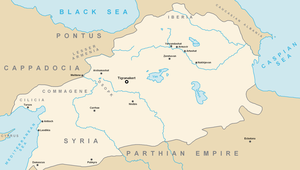 Upon his arrival, Lucullus met up with several legions which had been campaigning in Asia Minor.
In 69 BC
Lucullus
led a campaign into Armenia against Tigranes
II, Mithridates' son-in-law and ally, to whom Mithridates had fled after Cabeira. He began a siege of the new Armenian imperial capital of Tigranocerta in the Arzenene district. Tigranes
returned from mopping up a Seleukid rebellion in Syria with his main host, and sought battle with the Romans. Lucullus' army annihilated the Armenian host, despite odds of about more than two to one against him. This was the famous battle of Tigranocerta
. It was fought on the same (pre-Julian) calendar date as the Roman disaster at Arausio 36 years earlier, the day before the Nones of October according to the reckoning of the time (or October 6), which is Julian October 16, 69 BC. Tigranes
then retired to the northern regions of his kingdom to gather another army and defend his hereditary capital of Artaxata. Meanwhile, Lucullus moved off south-eastwards to the kingdom of the Kurds (Korduene) on the frontiers of the Armenia
n and Parthia
n empires. During the winter of 69-68 BC both sides opened negotiations with the Parthian king, Arsakes XVI, who was presently defending himself against a major onslaught from his rival Frahates III coming from Bactria
and the far east.
In the summer of 68 BC
Lucullus marched against Tigranes
and crossed the Anti-Taurus range heading for the old Armenian capital Artaxata. Once again Tigranes
was provoked to attack and in a major battle at the Aratsani River Lucullus was heavily defeated by the Armenian army. Soon he left this campaign and when winter came on early in the Armenian tablelands, his troops mutinied, refusing to go further, and he was forced to withdraw southwards back into Arzenene. From there he proceeded back down through Korduene into old Assyria
and in the late autumn and early winter besieged and took Nisibis
, the main Armenia
n fortress city in Northern Mesopotamia.
During the winter of 68-67 BC at Nisibis
, his authority over his army was more seriously undermined by the efforts of his young brother-in-law Publius Clodius Pulcher
, apparently acting in the interests and pay of Pompey the Great
, who was eager to succeed Lucullus in the eastern command. After mutiny spread in the legions with the troops refusing to obey Lucullus' commands, the senate sent Pompey to succeed Lucullus. This lull allowed Mithridates and Tigranes to retake part of their respective kingdoms.
now refused to receive him into his dominions, Mithridates resolved to plunge into the heart of Colchis
, and thence make his way to his own dominions in the Cimmerian Bosporus. Pompey now marched against Tigranes, whose kingdom and authority were now severely weakened. Tigranes then sued for peace and met with Pompey to plead a cessation of hostilities. The Armenian Kingdom now became an allied client state of Rome.
In 65 BC, Pompey had set out in pursuit of Mithridates meeting opposition from the tribal Caucasian and after advancing as far as Phasis in Colchis, where he met his Servilius, the admiral of his Euxine fleet. Pompey now retook his steps, and spent the winter at Pontus, which he declared would become a Roman province.
His eldest son, Machares
, now king of Cimmerian Bosporus, whose kingdom had been reorganized by the Romans, was unwilling to aid his father. Mithridates had Machares murdered and took the throne of the Bosporan Kingdom, intent on retaking Pontus from the Romans. His younger son, Pharnaces II, backed by a disgruntled and war weary populace, led a rebellion against his father. This betrayal, after the decisive defeat in battle, hurt Mithridates more than any other and seeing his loss of authority he attempted suicide
by poison. The attempt failed as he had gained immunity to various poisons from taking tiny doses of all available poisons throughout his life to guard against assassination. According to Appian's Roman History, he then ordered his Gallic bodyguard and friend, Bituitus, to kill him by the sword:
Mithridates body was buried in Sinope, the capital of Pontus, on the orders of Pompey himself.
- ed. René Henry Photius Bibliotheque Tome IV: Codices 223-229 (Association Guillaume Budé, Paris, 1965), pp. 48–99: Greek text with French translation
- ed. K. Müller FHG III, 525: Greek text with Latin translation
- ed. F. Jacoby FGrH no.434: Greek text, detailed commentary in German
- ed. K. Müller FHG III, 602ff.
- ed. F. Jacoby FGrH no.257
- English translations and commentary by William Hansen, Phlegon of Tralles' Book of Marvels (University of Exeter Press, 1996)
RE = Real-Encyclopädie der classischen Altertumswissenschaft, eds. Pauly, Wissowa, Kroll
Major studies.
I. Introduction. Klio, 9 (1909), 400-412
II. Das Kriegsjahr 69. Klio, 10 (1910), 72-115
III. Das Kriegsjahr 68. Klio, 10 (1910), 192-231
Shorter articles.
73 BC
Year 73 BC was a year of the pre-Julian Roman calendar. At the time it was known as the Year of the Consulship of Lucullus and Longinus...
-63 BC
63 BC
Year 63 BC was a year of the pre-Julian Roman calendar. At the time it was known as the Year of the Consulship of Cicero and Hibrida...
) was the last and longest of three Mithridatic Wars
Mithridatic Wars
There were three Mithridatic Wars between Rome and the Kingdom of Pontus in the 1st century BC. They are named for Mithridates VI who was King of Pontus at the time....
fought between Mithridates VI of Pontus
Mithridates VI of Pontus
Mithridates VI or Mithradates VI Mithradates , from Old Persian Mithradatha, "gift of Mithra"; 134 BC – 63 BC, also known as Mithradates the Great and Eupator Dionysius, was king of Pontus and Armenia Minor in northern Anatolia from about 120 BC to 63 BC...
and his allies and the Roman Republic
Roman Republic
The Roman Republic was the period of the ancient Roman civilization where the government operated as a republic. It began with the overthrow of the Roman monarchy, traditionally dated around 508 BC, and its replacement by a government headed by two consuls, elected annually by the citizens and...
. The war ended in defeat for Mithridates, ending the menace of his Pontic Kingdom
Kingdom of Pontus
The Kingdom of Pontus or Pontic Empire was a state of Persian origin on the southern coast of the Black Sea. It was founded by Mithridates I in 291 BC and lasted until its conquest by the Roman Republic in 63 BC...
and resulted in the Kingdom of Armenia becoming an allied client state of Rome.
Prior to War
The period between the Second and Third wars of Rome and the Pontic Kingdom is discussed under the Second Mithridatic WarSecond Mithridatic War
The Second Mithridatic War was one of three wars fought between Pontus and the Roman Republic. The second Mithridatic war was fought between King Mithridates VI of Pontus and the Roman general Lucius Licinius Murena....
of 83-81 BC, which was comparatively brief. There it can be seen how the long piracy wars were a development out of the First Mithridatic War
First Mithridatic War
The First Mithridatic War was a war challenging Rome's expanding Empire and rule over the Greek world. In this conflict, the Kingdom of Pontus and many Greek cities rebelling against Rome were led by Mithridates VI of Pontus against the Roman Republic and the Kingdom of Bithynia...
and especially of the alliance between Mithridates VI and Sertorius, which in joining those two threats into a unity much larger than its parts had the serious potential of overturning Roman power.
Forces and initial deployments, 74-73 BC
Having launched an attack at the same time as a revolt by Sertorius swept through the Spanish provinces, Mithridates was initially virtually unopposed. The Senate responded by sending the consul Lucius Licinius LucullusLucullus
Lucius Licinius Lucullus , was an optimate politician of the late Roman Republic, closely connected with Sulla Felix...
to deal with the Pontic threat. The only other possible general for such an important command, Pompey
Pompey
Gnaeus Pompeius Magnus, also known as Pompey or Pompey the Great , was a military and political leader of the late Roman Republic...
, was in Gaul
Gaul
Gaul was a region of Western Europe during the Iron Age and Roman era, encompassing present day France, Luxembourg and Belgium, most of Switzerland, the western part of Northern Italy, as well as the parts of the Netherlands and Germany on the left bank of the Rhine. The Gauls were the speakers of...
, marching to Hispania
Hispania
Another theory holds that the name derives from Ezpanna, the Basque word for "border" or "edge", thus meaning the farthest area or place. Isidore of Sevilla considered Hispania derived from Hispalis....
to help crush the revolt led by Sertorius.
Lucullus in command
In 69 BC
69 BC
Year 69 BC was a year of the pre-Julian Roman calendar. At the time it was known as the Year of the Consulship of Hortalus and Metellus...
Lucullus
Lucullus
Lucius Licinius Lucullus , was an optimate politician of the late Roman Republic, closely connected with Sulla Felix...
led a campaign into Armenia against Tigranes
Tigranes
Tigranes was the name of a number of historical figures, primarily kings of Armenia.The earliest Tigranes is mentioned in the Cyropaedia and in Armenian historical sources. He was an Armenian king from the Orontid Dynasty and an ally of Cyrus the Great. One of his sons was also named Tigranes...
II, Mithridates' son-in-law and ally, to whom Mithridates had fled after Cabeira. He began a siege of the new Armenian imperial capital of Tigranocerta in the Arzenene district. Tigranes
Tigranes
Tigranes was the name of a number of historical figures, primarily kings of Armenia.The earliest Tigranes is mentioned in the Cyropaedia and in Armenian historical sources. He was an Armenian king from the Orontid Dynasty and an ally of Cyrus the Great. One of his sons was also named Tigranes...
returned from mopping up a Seleukid rebellion in Syria with his main host, and sought battle with the Romans. Lucullus' army annihilated the Armenian host, despite odds of about more than two to one against him. This was the famous battle of Tigranocerta
Battle of Tigranocerta
The Battle of Tigranocerta was fought on October 6, 69 BC between the forces of the Roman Republic and the army of the Kingdom of Armenia led by King Tigranes the Great. The Roman force was led by Consul Lucius Licinius Lucullus, and Tigranes was defeated...
. It was fought on the same (pre-Julian) calendar date as the Roman disaster at Arausio 36 years earlier, the day before the Nones of October according to the reckoning of the time (or October 6), which is Julian October 16, 69 BC. Tigranes
Tigranes
Tigranes was the name of a number of historical figures, primarily kings of Armenia.The earliest Tigranes is mentioned in the Cyropaedia and in Armenian historical sources. He was an Armenian king from the Orontid Dynasty and an ally of Cyrus the Great. One of his sons was also named Tigranes...
then retired to the northern regions of his kingdom to gather another army and defend his hereditary capital of Artaxata. Meanwhile, Lucullus moved off south-eastwards to the kingdom of the Kurds (Korduene) on the frontiers of the Armenia
Armenia
Armenia , officially the Republic of Armenia , is a landlocked mountainous country in the Caucasus region of Eurasia...
n and Parthia
Parthia
Parthia is a region of north-eastern Iran, best known for having been the political and cultural base of the Arsacid dynasty, rulers of the Parthian Empire....
n empires. During the winter of 69-68 BC both sides opened negotiations with the Parthian king, Arsakes XVI, who was presently defending himself against a major onslaught from his rival Frahates III coming from Bactria
Bactria
Bactria and also appears in the Zend Avesta as Bukhdi. It is the ancient name of a historical region located between south of the Amu Darya and west of the Indus River...
and the far east.
In the summer of 68 BC
68 BC
Year 68 BC was a year of the pre-Julian Roman calendar. At the time it was known as the Year of the Consulship of Metellus/Vatia and Rex...
Lucullus marched against Tigranes
Tigranes
Tigranes was the name of a number of historical figures, primarily kings of Armenia.The earliest Tigranes is mentioned in the Cyropaedia and in Armenian historical sources. He was an Armenian king from the Orontid Dynasty and an ally of Cyrus the Great. One of his sons was also named Tigranes...
and crossed the Anti-Taurus range heading for the old Armenian capital Artaxata. Once again Tigranes
Tigranes
Tigranes was the name of a number of historical figures, primarily kings of Armenia.The earliest Tigranes is mentioned in the Cyropaedia and in Armenian historical sources. He was an Armenian king from the Orontid Dynasty and an ally of Cyrus the Great. One of his sons was also named Tigranes...
was provoked to attack and in a major battle at the Aratsani River Lucullus was heavily defeated by the Armenian army. Soon he left this campaign and when winter came on early in the Armenian tablelands, his troops mutinied, refusing to go further, and he was forced to withdraw southwards back into Arzenene. From there he proceeded back down through Korduene into old Assyria
Assyria
Assyria was a Semitic Akkadian kingdom, extant as a nation state from the mid–23rd century BC to 608 BC centred on the Upper Tigris river, in northern Mesopotamia , that came to rule regional empires a number of times through history. It was named for its original capital, the ancient city of Assur...
and in the late autumn and early winter besieged and took Nisibis
Nisibis
Nusaybin Nisêbîn) is a city in Mardin Province, Turkey, populated mainly by Kurds. Earlier Arameans, Arabs, and Armenians lived in the city. The population of the city is 83,832 as of 2009.-Ancient Period:...
, the main Armenia
Armenia
Armenia , officially the Republic of Armenia , is a landlocked mountainous country in the Caucasus region of Eurasia...
n fortress city in Northern Mesopotamia.
During the winter of 68-67 BC at Nisibis
Nisibis
Nusaybin Nisêbîn) is a city in Mardin Province, Turkey, populated mainly by Kurds. Earlier Arameans, Arabs, and Armenians lived in the city. The population of the city is 83,832 as of 2009.-Ancient Period:...
, his authority over his army was more seriously undermined by the efforts of his young brother-in-law Publius Clodius Pulcher
Publius Clodius Pulcher
Publius Clodius Pulcher was a Roman politician known for his popularist tactics...
, apparently acting in the interests and pay of Pompey the Great
Pompey
Gnaeus Pompeius Magnus, also known as Pompey or Pompey the Great , was a military and political leader of the late Roman Republic...
, who was eager to succeed Lucullus in the eastern command. After mutiny spread in the legions with the troops refusing to obey Lucullus' commands, the senate sent Pompey to succeed Lucullus. This lull allowed Mithridates and Tigranes to retake part of their respective kingdoms.
Pompey in Command
On the approach of Pompey, Mithridates retreated towards Armenia but was defeated. As Tigranes the GreatTigranes the Great
Tigranes the Great was emperor of Armenia under whom the country became, for a short time, the strongest state east of the Roman Republic. He was a member of the Artaxiad Royal House...
now refused to receive him into his dominions, Mithridates resolved to plunge into the heart of Colchis
Colchis
In ancient geography, Colchis or Kolkhis was an ancient Georgian state kingdom and region in Western Georgia, which played an important role in the ethnic and cultural formation of the Georgian nation.The Kingdom of Colchis contributed significantly to the development of medieval Georgian...
, and thence make his way to his own dominions in the Cimmerian Bosporus. Pompey now marched against Tigranes, whose kingdom and authority were now severely weakened. Tigranes then sued for peace and met with Pompey to plead a cessation of hostilities. The Armenian Kingdom now became an allied client state of Rome.
In 65 BC, Pompey had set out in pursuit of Mithridates meeting opposition from the tribal Caucasian and after advancing as far as Phasis in Colchis, where he met his Servilius, the admiral of his Euxine fleet. Pompey now retook his steps, and spent the winter at Pontus, which he declared would become a Roman province.
Complete Roman Victory
After his defeat by Pompey in 65 BC, Mithridates VI fled with a small army from Colchis (modern Georgia) over the Caucausus Mountains to Crimea and attempted to raise yet another army to take on the Romans but failed to do so. In 63, he withdrew to the citadel in Panticapaeum.His eldest son, Machares
Machares
Machares was a Pontian prince and son of King Mithridates VI of Pontus and Queen Laodice. He was made by his father ruler of the Bosporan Kingdom after Mithridates, for the second time, reduced that country, after the short war with the Roman Murena, in 80 BC....
, now king of Cimmerian Bosporus, whose kingdom had been reorganized by the Romans, was unwilling to aid his father. Mithridates had Machares murdered and took the throne of the Bosporan Kingdom, intent on retaking Pontus from the Romans. His younger son, Pharnaces II, backed by a disgruntled and war weary populace, led a rebellion against his father. This betrayal, after the decisive defeat in battle, hurt Mithridates more than any other and seeing his loss of authority he attempted suicide
Suicide
Suicide is the act of intentionally causing one's own death. Suicide is often committed out of despair or attributed to some underlying mental disorder, such as depression, bipolar disorder, schizophrenia, alcoholism, or drug abuse...
by poison. The attempt failed as he had gained immunity to various poisons from taking tiny doses of all available poisons throughout his life to guard against assassination. According to Appian's Roman History, he then ordered his Gallic bodyguard and friend, Bituitus, to kill him by the sword:
Mithridates body was buried in Sinope, the capital of Pontus, on the orders of Pompey himself.
Ancient sources
- FHG = Karl MüllerKarl Wilhelm Ludwig MüllerKarl Wilhelm Ludwig Müller is best known for his still-useful Didot editions of fragmentary Greek authors, especially the monumental five-volume Fragmenta Historicorum Graecorum , which is not yet completely superseded by the series Die Fragmente der griechischen Historiker begun by Felix...
(ed.) Fragmenta Historicorum Graecorum - FGrH = Felix JacobyFelix JacobyFelix Jacoby was a German classicist and philologist. He is best known among classicists for his highly important work Fragmente der griechischen Historiker, a collection of text fragments of ancient Greek historians...
(ed. & critical commentary) , Die Fragmente der griechischen Historiker (commenced 1923)
- Memnon of Herakleia Pontike, 9th century epitome in the ΒΙΒΛΙΟΘΗΚΗ of Photius of Byzantium (codex 224)
- ed. René Henry Photius Bibliotheque Tome IV: Codices 223-229 (Association Guillaume Budé, Paris, 1965), pp. 48–99: Greek text with French translation
- ed. K. Müller FHG III, 525: Greek text with Latin translation
- ed. F. Jacoby FGrH no.434: Greek text, detailed commentary in German
- Phlegon of Tralles fragmenta
- ed. K. Müller FHG III, 602ff.
- ed. F. Jacoby FGrH no.257
- English translations and commentary by William Hansen, Phlegon of Tralles' Book of Marvels (University of Exeter Press, 1996)
Modern works
AbbreviationsRE = Real-Encyclopädie der classischen Altertumswissenschaft, eds. Pauly, Wissowa, Kroll
Major studies.
- Eckhardt, Kurt. "Die armenischen Feldzüge des Lukullus",
I. Introduction. Klio, 9 (1909), 400-412
II. Das Kriegsjahr 69. Klio, 10 (1910), 72-115
III. Das Kriegsjahr 68. Klio, 10 (1910), 192-231
- Holmes, T. RiceT. Rice HolmesThomas Rice Edward Holmes , who usually published as T. Rice Holmes or T.R.E. Holmes, was a scholar best known for his extensive and "fundamental" work on Julius Caesar and his Gallic War commentaries....
: The Roman Republic and the Founder of the Empire, vol.I (1923), 398-436 - Gelzer, Matthias: "L. Licinius Lucullus cos.74", RE vol.XIII (1926), s. v. Licinius (104), colls.376-414.
- Magie, David: Roman Rule in Asia Minor, to the End of the Third Century after Christ 2 vols. (Princeton University Press, 1950)
- Van Ooteghem, J: Lucius Licinius Lucullus, (Brussels, 1959)
- Keaveney, Arthur: Lucullus. A Life. (London/New York: Routledge, 1992). ISBN 0-415-03219-9.
Shorter articles.
- Anderson, J G C: "Pompey's Campaign against Mithradates", JRS 12 (1922), 99ff.
- Downey, Glanville: "Q. Marcius Rex at Antioch", Classical Philology 32 (1937), 144-151
- Bennett, William H: "The Death of Sertorius and the Coin", Historia, 10 (1961), 459-72
- McGing, B C: "The Date of the outbreak of the Third Mithridatic War", Phoenix, 38 (1984), 12-18
- Williams, Richard S: "The Appointment of Glabrio (COS.67) to the Eastern Command", Phoenix 38 (1984), 221-234
- Tatum, W J: "Lucullus and Clodius at Nisibis (Plutarch, Lucullus 33-34)", Athenaeum, 79 (1991)