
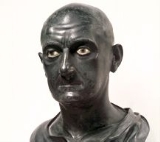
All Topics  
Polybius


   Email Print
   Bookmark   Link


Polybius


Polybius (ca. 203–120 BC, Greek
Greek language

Greek is an Indo-European languages native to the southern Balkan peninsula, the language of the Greek people. It forms an independent branch within Indo-European....
 ) was a Greek historian of the Hellenistic Period
Hellenistic period

The Hellenistic period describes the era which followed the conquests of Alexander the Great. During this time, Greek cultural influence and power was at its zenith in Europe and Asia....
 noted for his book called The Histories
The Histories (Polybius)

Polybius? The Histories were originally written in 40 volumes, only the first five of which are extant in their entirety. The bulk of the work, except for the 40th volume, which was the index volume, is passed down to us through collections of excerpts kept in libraries in Byzantium, for the most part....
 covering in detail the period of 220–146 BC. He is also renowned for his ideas of political balance in the government, which was later used in Montesquieu's The Spirit of the Laws
The Spirit of the Laws

File:Montesquieu Defense.jpgThe Spirit of Laws is a treatise on political theory first published anonymously by Charles de Secondat, Baron de Montesquieu in 1748 with the help of Claudine Gu?rin de Tencin....
 and the drafting of the United States Constitution
United States Constitution

The Constitution of the United States of America is the supreme law of the United States. It is the foundation and source of the legal authority underlying the existence of the United States of America; the Federal Government of the United States; and all the State & local governments and Territorial Administrative bodies contained therein....
.
bius was born around 203 BC in Megalopolis
Megalopolis

Megalopolis may refer to:* Megalopolis , an extensive metropolitan area or a long chain of continuous metropolitan areas.** Jean Gottmann coined this term and later used it as the title of his 1961 book about the northeastern seaboard of the United States....
, Arcadia
Arcadia

Arcadia, Arkad?a , or Arcady is a region of Greece in the Peloponnesus. It takes its name from the mythological character Arcas....
 which at that time was an active member of the Achaean League
Achaean League

The Achaean League was a confederation of Greece poliss in Achaea, a territory on the northern coast of the Peloponnese. An initial confederation existed during the 5th century BC through the 4th century BC....
.


Discussion
Ask a question about 'Polybius'
Start a new discussion about 'Polybius'
Answer questions from other users
Full Discussion Forum


Quotations


All things are subject to decay and change..

The General History of Polybius as translated by James Hampton' (1762)Vol. II pp. 177-178

This is a sworn treaty made between us, Hannibal ... and Xenophanes the Athenian ... in the presence of all the gods who possess Macedonia and the rest of Greece.

Histories, VII, 9, 4 (Loeb, W.R. Paton)


Encyclopedia


Polybius (ca. 203–120 BC, Greek
Greek language

Greek is an Indo-European languages native to the southern Balkan peninsula, the language of the Greek people. It forms an independent branch within Indo-European....
 ) was a Greek historian of the Hellenistic Period
Hellenistic period

The Hellenistic period describes the era which followed the conquests of Alexander the Great. During this time, Greek cultural influence and power was at its zenith in Europe and Asia....
 noted for his book called The Histories
The Histories (Polybius)

Polybius? The Histories were originally written in 40 volumes, only the first five of which are extant in their entirety. The bulk of the work, except for the 40th volume, which was the index volume, is passed down to us through collections of excerpts kept in libraries in Byzantium, for the most part....
 covering in detail the period of 220–146 BC. He is also renowned for his ideas of political balance in the government, which was later used in Montesquieu's The Spirit of the Laws
The Spirit of the Laws

File:Montesquieu Defense.jpgThe Spirit of Laws is a treatise on political theory first published anonymously by Charles de Secondat, Baron de Montesquieu in 1748 with the help of Claudine Gu?rin de Tencin....
 and the drafting of the United States Constitution
United States Constitution

The Constitution of the United States of America is the supreme law of the United States. It is the foundation and source of the legal authority underlying the existence of the United States of America; the Federal Government of the United States; and all the State & local governments and Territorial Administrative bodies contained therein....
.

Origins

Polybius was born around 203 BC in Megalopolis
Megalopolis

Megalopolis may refer to:* Megalopolis , an extensive metropolitan area or a long chain of continuous metropolitan areas.** Jean Gottmann coined this term and later used it as the title of his 1961 book about the northeastern seaboard of the United States....
, Arcadia
Arcadia

Arcadia, Arkad?a , or Arcady is a region of Greece in the Peloponnesus. It takes its name from the mythological character Arcas....
 which at that time was an active member of the Achaean League
Achaean League

The Achaean League was a confederation of Greece poliss in Achaea, a territory on the northern coast of the Peloponnese. An initial confederation existed during the 5th century BC through the 4th century BC....
. His father Lycortas
Lycortas

Lycortas of Megalopolis, Greece was a politician of the Achaean League active in the first half of the 2nd century BC. He is now primarily known as the father of the historian Polybius....
 was a prominent landowning politician and member of the governing class. This gave Polybius firsthand opportunities to gain a deep insight into military and political affairs. Polybius developed an interest in horse riding and hunting, diversions which helped later to commend him to his Roman captors. In 182 BC Polybius was chosen to carry the funeral urn of Philopoemen
Philopoemen

Philopoemen , was a skilled Ancient Greece general and statesman, who was Achaean League Strategos on eight occasions.From the time he was appointed as strategos in 209 BC, Philopoemen helped turn the Achaean League into an important military power in Greece....
 which was quite an honor as Philopoemen was the most eminent Achaean politician of his generation. In 170 or 169 BC Polybius was elected hipparch or cavalry leader an office which usually presaged election to the annual strategia or post of general. His early political career was devoted largely towards maintaining the independence of the Achaean League.

Personal experiences

Scipio Africanus the Elder
Polybius’ father Lycortas was a chief representative of the policy of neutrality during the war of the Romans against Perseus of Macedonia. He attracted the suspicion of the Romans, and as a result, Polybius was one of the 1000 noble Achaeans who in 168 BC were transported to Rome as hostages, and detained there for 17 years. In Rome, by virtue of his high culture, he was admitted to the most distinguished houses, in particular to that of Aemilius Paulus, the conqueror in the Third Macedonian War
Third Macedonian War

The Third Macedonian War was a war fought between Ancient Rome and King Perseus of Macedon. In 179 BC King Philip V of Macedon of Macedon died and his talented and ambitious son, Perseus, took his throne....
, who entrusted him with the education of his sons, Fabius and Scipio Aemilianus
Scipio Aemilianus Africanus

Publius Cornelius Scipio Aemilianus Africanus Numantinus , also known as Scipio Aemilianus or Scipio Africanus the Younger, was a leading general and politician of the ancient Roman Republic....
 (who had been adopted by the eldest son of Scipio Africanus
Scipio Africanus

Publius Cornelius Scipio Africanus also known as Scipio Africanus, Scipio the Elder, and Africanus the Elder was a general in the Second Punic War and statesman of the Roman Republic....
). As the former tutor of Scipio Aemilianus, Polybius remained on terms of the most cordial friendship and remained a counselor to the man who defeated the Carthaginians in the Third Punic War
Third Punic War

The Third Punic War was the third and last of the Punic Wars fought between the former Phoenician colony of Carthage, and the Roman Republic. The Punic Wars were named because of the Ancient Rome name for Carthaginians: Punici, or Poenici....
. The younger Scipio eventually captured and destroyed Carthage
Carthage

Carthage refers both to an ancient city in present-day Tunisia, and a modern-day suburb of Tunis. The civilization that developed within the city's sphere of influence is referred to as Punic or Carthaginian....
, in 146 BC. When the Achaean hostages were released in 150 BC, Polybius obtained leave to return home, but in the very next year he went with his friend to Africa, and was present at the capture of Carthage that he described. It is likely that following the destruction of Carthage, he journeyed down the Atlantic coast of Africa as well as Spain.

After the destruction of Corinth
Corinth

Corinth, or Korinth Corinth is now the capital of the Prefectures of Greece of Corinthia. The city is surrounded by the coastal townlets of Lechaio, Isthmia, Kechries, and the inland townlets of Examilia and the archaeological site....
 in the same year, he returned to Greece and made use of his Roman connections to lighten the conditions there; Polybius was entrusted with the difficult task of organizing the new form of government in the Greek cities, and in this office gained for himself the highest recognition.

Rome


The succeeding years he seems to have spent in Rome
Rome

Rome is the capital city of Italy and Lazio, and is Italy's largest and most populous city, with 2,724,347 residents in an urban area of some ....
, engaged on the completion of his historical work, and occasionally undertaking long journeys through the Mediterranean countries in the interest of his history, more particularly with a view to obtaining firsthand knowledge of historical sites. It also appears that he sought out and interviewed war veterans in order to clarify details of the events he was writing about, and was given access to archival material for the same purpose. Little is known of Polybius' later life. He most likely journeyed with Scipio to Spain and acted as his military advisor during the Numantine War
Numantine War

The Numantine War was the last conflict of the Celtiberian Wars fought by the Ancient Rome to subdue those people along the Ebro. It was a twenty year long conflict between the Celtiberian tribes of Hispania Citerior and the Roman government....
, a war he later wrote about in a lost monograph on the subject. It is also likely that Polybius returned to Greece later in life, since there are many existent inscriptions and statues of him in Greece. There is a report of his death in 118 BC after falling from a horse, although this is only recorded in one source and that source is known to be unreliable.

As historian

Philopoemen David Angers Louvre Lp1556
Titus Livius
Polybius wrote several works, the majority of which are lost. His earliest book was a biography of the Greek statesman Philopoemen
Philopoemen

Philopoemen , was a skilled Ancient Greece general and statesman, who was Achaean League Strategos on eight occasions.From the time he was appointed as strategos in 209 BC, Philopoemen helped turn the Achaean League into an important military power in Greece....
, which was used as a source by Plutarch
Plutarch

Lucius Mestrius Plutarchus , c. AD 46 ? 120 ? commonly known in English as Plutarch ? was a Ancient Rome historian , biographer, essayist, and Middle Platonism....
. The Polybian text is lost. In addition, he wrote what appears to have been an extensive treatise entitled Tactics, which detailed Roman and Greek military tactics. Small parts of this work may survive in his major Histories, but the work itself is also lost. Another missing work was a historical monograph on the events of the Numantine War
Numantine War

The Numantine War was the last conflict of the Celtiberian Wars fought by the Ancient Rome to subdue those people along the Ebro. It was a twenty year long conflict between the Celtiberian tribes of Hispania Citerior and the Roman government....
. The largest work was of course, his Histories, which we have only the first five books entirely intact, a large part of the sixth, and fragments of the rest.

Livy
Livy

Titus Livius , known as Livy in English language, was a Ancient Rome historian who wrote a monumental history of Rome, Ab Urbe Condita, from its founding through the reign of Augustus in Livy's own time....
 makes reference to and uses him as source material in his own narrative. Polybius is one of the first historians to attempt to present history as a sequence of causes and effects, based upon a careful examination of tradition and conducted with keen criticism. He narrated his History upon what he had himself seen and upon the communications of eye-witnesses and actors in the events. In a classic story of human behavior, Polybius captures it all: nationalism, xenophobia
Xenophobia

Xenophobia is an intense dislike and/or fear of people from other countries. It comes from the Greek language words ????? , meaning "foreigner," "stranger," and f???? , meaning "fear." The term is typically used to describe a fear or dislike of alien s or of people significantly different from oneself....
, duplicitous politics, horrible battles and brutality, loyalty, valour and bravery, intelligence, reason and resourcefulness. With his eye for detail and characteristic critically reasoned style, Polybius provided a unified view of history rather than a chronology.

Polybius is considered by some to be the successor of Thucydides
Thucydides

Thucydides was a Greeks history and author of the History of the Peloponnesian War, which recounts the 5th century B.C. war between Sparta and Athens to the year 411 B.C....
 in terms of objectivity and critical reasoning, and the forefather of scholarly, painstaking historical research in the modern scientific sense. According to this view, his work sets forth the course of occurrences with clearness, penetration, sound judgment and, among the circumstances affecting the result, lays especial stress on the geographical conditions. It belongs, therefore, to the greatest productions of ancient historical writing. The writer of the Oxford Companion to Classical Literature (1937) praises him for his "earnest devotion to truth" and for his systematic seeking for the cause of events.

Recently, Polybius's writing has come under a more critical assessment. In Peter Green
Peter Green (historian)

Peter Green is a United Kingdom classical scholar noted for his Alexander to Actium, a general account of the Hellenistic Age, and other works....
's view he is often partisan and aims to justify his and his father's careers. He goes out of his way to portray the Achean politician Callicrates in a bad light; thus, leading the reader to suspect that this is because Callicrates was responsible for his being sent to Rome as a hostage. More fundamentally, he — as first a hostage in Rome, client to the Scipios and then finally as a collaborator with Roman rule after 146 BC — is not free to express his true opinions. Green suggests that we should always keep in mind that he was explaining Rome to a Greek audience to convince them of the necessity of accepting Roman rule – which he believed as inevitable. Nonetheless, for Green, Polybius's histories remain invaluable and the best source for the era he covers. Ron Mellor also sees Polybius as partisan who, out of loyalty to Scipio, vilified Scipio's opponents . The British author Adrian Goldsworthy
Adrian Goldsworthy

Adrian Goldsworthy is a United Kingdom historian and list of military writers. Goldsworthy went to college in Westbourne House School Penarth, Penarth....
 also constantly mentions Polybius connections with Scipio when using him as a source for the latter's time as a general.

Polybius has been noted to be hostile to some of his subject material; for example, his treatment of Crete
Crete

Crete is the largest of the Greek islands and the List of islands in the Mediterranean largest island in the Mediterranean Sea at 8,336 km? ....
 has been noted to be biased in a negative sense. On the other hand, Hansen notes that Polybius' coverage of Crete supplied an extremely detailed account of ancient Crete. In fact, observations made by Polybius (augmented by passages from Strabo
Strabo

Strabo was a Ancient Greeks history, geography and philosophy....
 and Scylax) allowed deciphering of the location of the lost ancient city of Kydonia on Crete.

Polybius introduced some theories in The Histories
The Histories (Polybius)

Polybius? The Histories were originally written in 40 volumes, only the first five of which are extant in their entirety. The bulk of the work, except for the 40th volume, which was the index volume, is passed down to us through collections of excerpts kept in libraries in Byzantium, for the most part....
. In it, he also explained the theory of anacyclosis
Anacyclosis

The sociology doctrine of Anacyclosis is a cyclical theory of political evolution. The theory of anacyclosis is based upon the Greek typology of constitutional forms of rule by the one, the few, and the many....
, or cycle of government, an idea that Plato had already explored.

Cryptography

Polybius was responsible for a useful tool in telegraphy
Telegraphy

Telegraphy is the long-distance transmission of written messages without physical transport of letters. Radiotelegraphy or wireless telegraphy transmits messages using radio....
 which allowed letters to be easily signaled using a numerical system. This idea also lends itself to cryptographic
Cryptography

Cryptography is the practice and study of hiding information. In modern times cryptography is considered a branch of both mathematics and computer science and is affiliated closely with information theory, computer security and engineering....
 manipulation and steganography
Steganography

Steganography is the art and science of writing hidden messages in such a way that no-one apart from the sender and intended recipient suspects the existence of the message, a form of security through obscurity....
.
 12345
1ABCDE
2FGHI/JK
3LMNOP
4QRSTU
5VWXYZ
This was known as the "Polybius square
Polybius square

In cryptography, the Polybius square, also known as the Polybius checkerboard, is a device invented by the Ancient Greek historian and scholar Polybius, described in , for transposition cipher#Fractionation plaintext characters so that they can be represented by a smaller set of symbols....
", where the letters of the alphabet were arranged left to right, top to bottom in a 5 x 5 square, (when used with the modern 26 letter alphabet
Latin alphabet

The Latin alphabet, also called the Roman alphabet, is the most widely used alphabetic writing system in the world today. It evolved from the western variety of the Greek alphabet called the Cumae alphabet, and was initially developed by the Ancient Romes to write the Latin....
, the letters "I" and "J" are combined). Five numbers were then aligned on the outside top of the square, and five numbers on the left side of the square vertically. Usually these numbers were arranged 1 through 5. By cross-referencing the two numbers along the grid of the square, a letter could be deduced.

Influence

Polybius was not especially admired by his contemporaries, to whom his lack of high Attic style was seen as a detriment. Later Roman authors writing on the same period, Livy
Livy

Titus Livius , known as Livy in English language, was a Ancient Rome historian who wrote a monumental history of Rome, Ab Urbe Condita, from its founding through the reign of Augustus in Livy's own time....
 and Diodorus especially, adapted much of his material for their own uses and followed his work extensively. As the Roman position was cemented in Europe, however, Polybius began to decline in popularity. Tacitus
Tacitus

Publius Cornelius Tacitus was a Roman Senate and a historian of the Roman Empire. The surviving portions of his two major works—the Annals and the Histories —examine the reigns of the Roman Emperors Tiberius, Claudius, Nero and those that reigned in the Year of the Four Emperors....
 sneered at his description of the ideal mixed constitution, and later Imperial writers were generally ignorant of him. Polybius's work lived on in Constantinople, although in something of a mangled form, in excerpts on political theory and administration. Nonetheless, it was not until the Renaissance
Renaissance

The Renaissance was a cultural movement that spanned roughly the 14th to the 17th century, beginning in Italy in the late Middle Ages and later spreading to the rest of Europe....
 that Polybius' works resurfaced in anything more than a fragmentary form. His works appeared first in Florence
Florence

Florence is the Capital city of the Italy Regions of Italy of Tuscany and of the provinces of Italy Province of Florence. It is the most populous city in Tuscany and has a population of 364,779 ....
. Polybius gained something of a following in Italy, and although poor Latin translations hampered proper scholarship on his work, he contributed to historical and political discussion there. Niccolò Machiavelli
Niccolò Machiavelli

Niccol? di Bernardo dei Machiavelli is the philosopher, writer, and Italian politician considered the founder of modern political science. As a Renaissance Man, he was a Diplomacy, Political philosophy, musician, poet, and playwright, but, foremost, he was a Civil Servant of the Florence....
 appears to have been familiar with Polybius when he wrote his Discourses on Livy
Discourses on Livy

The Discourses on Livy is a work of political history and philosophy composed in the early 16th century by the famed Florentine public servant and political theorist Niccol? Machiavelli , best known as the author of The Prince....
. Vernacular translations, in French, German, Italian and English, first appeared in the sixteenth century. So, too, in the late sixteenth century, did Polybius find a greater reading audience among the learned public. Study of the correspondence of such men as Isaac Casaubon
Isaac Casaubon

Isaac Casaubon was a classics and philologist, first in France and then later in England, regarded by many of his time as the most learned in Europe....
, Jacques Auguste de Thou, William Camden
William Camden

William Camden was an England antiquarian and historian. He wrote the first topographical survey of the islands of Great Britain and Ireland and the first detailed historical account of the reign of Elizabeth I of England....
, and Paolo Sarpi
Paolo Sarpi

Paolo Sarpi was an Republic of Venice patriot, scholar, scientist and church reformer. His most important roles were as a canon lawyer and historian active on behalf of the Venetian Republic....
 reveals a growing interest in Polybius' works and thought during the period. Despite the existence of both printed editions in the vernacular and increased scholarly interest, however, Polybius remained an "historian's historian", not much read by the public at large. Printings of his work in the vernacular remained few in number—7 in French
French language

French is a Romance language spoken around the world by around 80 million people as first language, by 190 million as second language, and by about another 200 million people as an acquired tongue, with significant speakers in 54 countries....
, 5 in English
English language

English is a West Germanic language that originated in Anglo-Saxon England and has lingua franca status in many parts of the world as a result of the military, economic, scientific, political and cultural influence of the British Empire in the 18th, 19th and early 20th centuries and that of the United States from the mid 20th century onwa...
, and 5 in Italian
Italian language

Italian is a Romance languages spoken by about 63 million people as a first language, primarily in Italy. In Switzerland, Italian is one of four Linguistic geography of Switzerlands....
.
Cicero
Charles Montesquieu
Polybius' political beliefs have had a continuous appeal to republican thinkers, from Cicero
Cicero

Marcus Tullius Cicero was a Ancient Rome philosopher, statesman, lawyer, political theorist, and Constitution of the Roman Republic. Cicero is widely considered one of Rome's greatest rhetoric and prose stylists....
, to Charles de Montesquieu, to the Founding Fathers of the United States
Founding Fathers of the United States

The Founding Fathers of the United States were the political leaders who signed the United States Declaration of Independence or otherwise participated in the American Revolution as leaders of the Patriot s, or who participated in drafting the United States Constitution eleven years later....
 . Since the Enlightenment, Polybius has generally held most appeal to those interested in Hellenistic Greece and Early Republican Rome, and his political and military writings have lost influence in academia. More recently, thorough work on the Greek text of Polybius and his historical technique has increased academic understanding and appreciation of Polybius as a historian.

According to Edward Tufte
Edward Tufte

Edward Rolf Tufte is an American statistician and Professor Emeritus of statistics, information design, interface design and political economy at Yale University....
, Polybius was also a major source for Charles Joseph Minard
Charles Joseph Minard

Charles Joseph Minard was a French civil engineer noted for his inventions in the field of information graphics....
's figurative map of Hannibal's overland journey into Italy
Italy

Italy , officially the Italian Republic , is a country located on the Italian Peninsula in Southern Europe and on the two largest islands in the Mediterranean Sea, Sicily and Sardinia....
 during the Second Punic War
Second Punic War

The Second Punic War lasted from 218 BC to 201 BC and involved combatants in the western and eastern Mediterranean. It was the second of three major wars between Carthage and the Roman Republic....
.

See also

  • The Histories
    The Histories (Polybius)

    Polybius? The Histories were originally written in 40 volumes, only the first five of which are extant in their entirety. The bulk of the work, except for the 40th volume, which was the index volume, is passed down to us through collections of excerpts kept in libraries in Byzantium, for the most part....
  • Polybius square
    Polybius square

    In cryptography, the Polybius square, also known as the Polybius checkerboard, is a device invented by the Ancient Greek historian and scholar Polybius, described in , for transposition cipher#Fractionation plaintext characters so that they can be represented by a smaller set of symbols....
  • Polybius (game)
    Polybius (game)

    Polybius is a supposed arcade game featured in an Internet urban legend. According to the story, the Tempest -style game was released to the public in 1981, and caused its players to go insane, causing them to suffer from intense stress and horrific nightmares....
  • Mixed government
    Mixed government

    Mixed government, also known as a mixed constitution, is a form of government that integrated facets of government by democracy, oligarchy, and monarchy....


Editions & translations

  • Loeb Classical Library, Polybius, The Histories, six volumes: Greek text with English translation by W. R. Paton
I (L128) Books I-II (1922) ISBN 99142-7
II (L137) Books III-IV (1922) ISBN 99152-4
III (L138) Books V-VIII (1923) ISBN 99153-2
IV (L159) Books IX-XV (1925) ISBN 99175-3
V (L160) Books XVI-XXVII (1926) ISBN 99176-1
VI (L161) Books XXVIII-XXXIX (1927) ISBN 99178-8


    • At "LacusCurtius
      LacusCurtius

      LacusCurtius is a website specializing in ancient Rome, currently hosted on a server at the University of Chicago. It went online on August 26, 1997; in January 2008 it had "2786 pages, 690 photos, 675 drawings & engravings, 118 plans, 66 maps."...
      ":


  • The Histories or The Rise of the Roman Empire by Polybius:
    • At Perseus Project
      Perseus Project

      The Perseus Project is a digital library project of Tufts University that assembles digital collections of humanities resources. It is hosted by the Department of Classics....
      :
  • At "LacusCurtius
    LacusCurtius

    LacusCurtius is a website specializing in ancient Rome, currently hosted on a server at the University of Chicago. It went online on August 26, 1997; in January 2008 it had "2786 pages, 690 photos, 675 drawings & engravings, 118 plans, 66 maps."...
    ":
  • Oscar Wilde, The Rise of Historical Criticism:
  • Polybius: "The Rise Of The Roman Empire", Penguin, 1979.


Other Ancient sources

  • Titus Livius of Patavium (Livy), libri XXI - XLV
  • Pseudo-Lucian Makrobioi
  • Paulus Orosius libri VII of Histories against Pagans

Modern works

  • Walbank, Frank W:
-- Philip V of Macedon, the Hare Prize Essay 1939 (Cambridge University Press, 1940)
-- A Historical Commentary on Polybius (Oxford University Press)
Vol.I (1957) Commentary on Books I-VI
Vol.II (1967) Commentary on Books VII-XVIII
Vol.III (1979) Commentary on Books XIX-XL
-- Polybius (University of California Press, 1972)
-- Polybius, Rome and the Hellenistic World: Essays and Reflections (Cambridge University Press, 2002) ISBN 0-521-81208-9
  • Momigliano, Arnaldo M.
    Arnaldo Momigliano

    Arnaldo Dante Momigliano KBE was an Italy historian known for his work in historiography, characterized by Donald Kagan as the "world?s leading student of the writing of history in the ancient world."...
    : Sesto Contributo alla Storia degli Studi Classici e del Mondo Antico (Rome, 1980)
-- V (1974) "The Historian's Skin”, 77-88 (Momigliano Bibliography no.531)
(Review of F W Walbank, Polybius 1972; in The New York Review of Books, 21.12, 18 July 1974, 33-35)
-- VI (1973) “Polibio, Posidonio e l'imperialismo Romano”, 89 (Momigliano Bibliography no.525)
(original publication: Atti della Accademia delle Scienze di Torino, 107, 1972-73, 693-707)
  • Moore, John M: The Manuscript Tradition of Polybius (Cambridge University Press, 1965)