
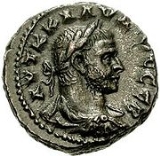
Marcus Aurelius Claudius (May 10,
213-Roman Empire:*Caracalla leaves Rome, never to return.*Caracalla defends the northern frontier against the Alamanni and the Chatti.-Asia:*Cao Cao, the prime minister of the Han dynasty, is given ten cities as his territories and the title Wei Gong...
- January, 270), often referred to as
Claudius Gothicus or
Claudius II, was a
Roman EmperorThe Roman emperor was the ruler of the Roman State during the imperial period . The Romans had no single term for the office: Latin titles such as imperator , augustus, caesar and princeps were all associated with it...
. He ruled the
Roman EmpireThe Roman Empire was the post-Republican phase of the ancient Roman civilization, characterised by an autocratic form of government and large territorial holdings in Europe and around the Mediterranean. The term is used to describe the Roman state during and after the time of the first emperor,...
for less than two years (268 - 270), but during that brief time he managed to obtain some successes. He was later given divine status.
Claudius' origin is uncertain. He was either from
SirmiumSirmium was an ancient city in Roman Pannonia. Sirmium originally was a Celtic town founded in the 3rd century BC and conquered by the Romans in the 1st century BC. It was a very important town in the later Roman Empire, being the economic capital of Roman Pannonia and one of the four capital...
(
SyrmiaSyrmia is a fertile region of the Pannonian Plain in Europe, between the Danube and Sava rivers. It is divided between Serbia in the east and Croatia in the west....
; in
PannoniaPannonia is an ancient province of the Roman Empire bounded north and east by the Danube, coterminous westward with Noricum and upper Italy, and southward with Dalmatia and upper Moesia....
Inferior) or from Naissus Dardania (in Moesia Superior); both areas are located in
SerbiaSerbia , officially the Republic of Serbia , is a country located in both Central and Southeastern Europe. Its territory covers the southern part of the Pannonian Plain and central part of the Balkans...
.
Claudius was the commander of the Roman army that decisively defeated the
GothsThe Goths were a heterogeneous East Germanic tribe. The historian Jordanes claimed that the Goths arrived from semi-legendary Scandza, believed to be somewhere in modern Götaland , and that a Gothic population had crossed the Baltic Sea before the 2nd century, lending their name to the region of...
at the
Battle of NaissusThe Battle of Naissus was the defeat of a Gothic coalition by the Roman Empire under Emperor Gallienus near Naissus...
in September 268; in the same month, he attained the throne, amid charges, never proven, that he murdered his predecessor
GallienusPublius Licinius Egnatius Gallienus ruled the Roman Empire as co-emperor with his father Valerian from 253 to 260, and then as the sole Roman Emperor from 260 to 268. He took control of the empire at a time when it was undergoing great crisis...
.
Marcus Aurelius Claudius (May 10,
213-Roman Empire:*Caracalla leaves Rome, never to return.*Caracalla defends the northern frontier against the Alamanni and the Chatti.-Asia:*Cao Cao, the prime minister of the Han dynasty, is given ten cities as his territories and the title Wei Gong...
- January, 270), often referred to as
Claudius Gothicus or
Claudius II, was a
Roman EmperorThe Roman emperor was the ruler of the Roman State during the imperial period . The Romans had no single term for the office: Latin titles such as imperator , augustus, caesar and princeps were all associated with it...
. He ruled the
Roman EmpireThe Roman Empire was the post-Republican phase of the ancient Roman civilization, characterised by an autocratic form of government and large territorial holdings in Europe and around the Mediterranean. The term is used to describe the Roman state during and after the time of the first emperor,...
for less than two years (268 - 270), but during that brief time he managed to obtain some successes. He was later given divine status.
Origin and rise to power
Claudius' origin is uncertain. He was either from
SirmiumSirmium was an ancient city in Roman Pannonia. Sirmium originally was a Celtic town founded in the 3rd century BC and conquered by the Romans in the 1st century BC. It was a very important town in the later Roman Empire, being the economic capital of Roman Pannonia and one of the four capital...
(
SyrmiaSyrmia is a fertile region of the Pannonian Plain in Europe, between the Danube and Sava rivers. It is divided between Serbia in the east and Croatia in the west....
; in
PannoniaPannonia is an ancient province of the Roman Empire bounded north and east by the Danube, coterminous westward with Noricum and upper Italy, and southward with Dalmatia and upper Moesia....
Inferior) or from Naissus Dardania (in Moesia Superior); both areas are located in
SerbiaSerbia , officially the Republic of Serbia , is a country located in both Central and Southeastern Europe. Its territory covers the southern part of the Pannonian Plain and central part of the Balkans...
.
Claudius was the commander of the Roman army that decisively defeated the
GothsThe Goths were a heterogeneous East Germanic tribe. The historian Jordanes claimed that the Goths arrived from semi-legendary Scandza, believed to be somewhere in modern Götaland , and that a Gothic population had crossed the Baltic Sea before the 2nd century, lending their name to the region of...
at the
Battle of NaissusThe Battle of Naissus was the defeat of a Gothic coalition by the Roman Empire under Emperor Gallienus near Naissus...
in September 268; in the same month, he attained the throne, amid charges, never proven, that he murdered his predecessor
GallienusPublius Licinius Egnatius Gallienus ruled the Roman Empire as co-emperor with his father Valerian from 253 to 260, and then as the sole Roman Emperor from 260 to 268. He took control of the empire at a time when it was undergoing great crisis...
. However, he soon proved to be less than bloodthirsty, as he asked the
Roman SenateThe Senate of the Roman Republic was a political institution in the ancient Roman Republic. According to the Greek historian Polybius, our principal source on the Constitution of the Roman Republic, the Roman Senate was the predominant branch of government...
to spare the lives of Gallienus' family and supporters. He was less magnanimous toward Rome's enemies, however, and it was to this that he owed his popularity.
Claudius, like
Maximinus ThraxGaius Iulius Verus Maximinus , also known as Maximinus Thrax and Maximinus I, was Roman Emperor from 235 to 238....
before him, was of barbarian birth. After an interlude of failed aristocratic Roman emperors since Maximinus's death, Claudius was the first in a series of tough soldier-emperors who would eventually restore the Empire from the
Crisis of the third centuryThe Crisis of the Third Century was a period in which the Roman Empire nearly collapsed under the combined pressures of invasion, civil war, plague, and economic depression...
.
Claudius as emperor
At the time of his accession, the Roman Empire was in serious danger from several incursions, both within and outside its borders. The most pressing of these was an invasion of Illyricum and
PannoniaPannonia is an ancient province of the Roman Empire bounded north and east by the Danube, coterminous westward with Noricum and upper Italy, and southward with Dalmatia and upper Moesia....
by the
GothsThe Goths were a heterogeneous East Germanic tribe. The historian Jordanes claimed that the Goths arrived from semi-legendary Scandza, believed to be somewhere in modern Götaland , and that a Gothic population had crossed the Baltic Sea before the 2nd century, lending their name to the region of...
. Not long after being named emperor (or just prior to Gallienus' death, depending on the source), he won his greatest victory, and one of the greatest in the history of Roman arms.
At the
Battle of NaissusThe Battle of Naissus was the defeat of a Gothic coalition by the Roman Empire under Emperor Gallienus near Naissus...
, Claudius and his legions routed a huge Gothic army. Together with his cavalry commander, the future Emperor
AurelianLucius Domitius Aurelianus , known in English as Aurelian, Roman Emperor , was the second of several highly successful "soldier-emperors" who helped the Roman Empire regain its power during the latter part of the third century and the beginning of the fourth.During his reign, the Empire was...
, the Romans took thousands of prisoners, destroyed the Gothic cavalry as a force and stormed their laager (a circular alignment of wagons long favored by the Goths). The victory earned Claudius his surname of "Gothicus" (conqueror of the Goths), and that is how he is known to this day. More importantly, the Goths were soon driven back across the Danube River, and a century passed before they again posed a serious threat to the empire.
While this was going on, the Germanic tribe known as the
AlamanniThe Alamanni, Allemanni, or Alemanni were originally an alliance of Germanic tribes located around the upper Main river . One of the earliest references to them is the cognomen Alamannicus assumed by Roman Emperor Caracalla, who ruled the Roman Empire from 211–17 and claimed thereby to be their...
had crossed the
AlpsThe Alps are one of the great mountain range systems of Europe, stretching from Austria and Slovenia in the east; through Italy, Switzerland, Liechtenstein and Germany; to France in the west....
and attacked the empire. Claudius responded quickly, routing the Alamanni at the
Battle of Lake BenacusThe Battle of Lake Benacus was one of the decisive battles that marked the beginning of the Roman Empire's emergence from the Crisis of the Third Century...
in the late fall of 268, a few months after the battle of Naissus. He then turned on the
Gallic EmpireThe Gallic Empire is the modern name for a breakaway realm that existed from 260 to 274. It originated during the Roman Empire's Crisis of the Third Century....
, ruled by a pretender for the past fifteen years and encompassing
BritainRoman Britain was those parts of the island of Great Britain controlled by the Roman Empire between AD 43 and about 410. The Romans referred to their province as Britannia...
,
GaulGaul is a historical name used in the context of the Roman Empire in references to the region of Western Europe approximating present day France and Belgium, but also sometimes including the Po Valley, western Switzerland, and the parts of the Netherlands and Germany on the west bank of the River...
, and the
Iberian PeninsulaThe Iberian Peninsula, or Iberia, is located in the extreme southwest of Europe and includes modern-day Spain, Portugal, Andorra and Gibraltar and a very small area of France. It is the westernmost of the three major southern European peninsulas—the Iberian, Italian, and Balkan peninsulas...
. He won several victories and soon regained control of Spain and the Rhone river valley of Gaul. This set the stage for the ultimate destruction of the Gallic Empire under Aurelian.
However, Claudius did not live long enough to fulfill his goal of reuniting all the lost territories of the empire. Late in 269 he was preparing to go to war against the
VandalsThe Vandals were an East Germanic tribe that entered the late Roman Empire during the 5th century. The Goth Theodoric the Great, king of the Ostrogoths and regent of the Visigoths, was allied by marriage with the Vandals as well as with the Burgundians and the Franks under .The Vandals are perhaps...
, who were raiding in
PannoniaPannonia is an ancient province of the Roman Empire bounded north and east by the Danube, coterminous westward with Noricum and upper Italy, and southward with Dalmatia and upper Moesia....
. However, he fell victim to the
Plague of CyprianThe Plague of Cyprian is the name given to a pandemic, probably of smallpox, that afflicted the Roman Empire from AD 251 onwards. It was still raging in 270, when it claimed the life of emperor Claudius II Gothicus . The plague caused widespread manpower shortages in agriculture and the Roman army....
(possibly
smallpoxSmallpox is an infectious disease unique to humans, caused by either of two virus variants, Variola major and Variola minor. The disease is also known by the Latin names Variola or Variola vera, which is a derivative of the Latin varius, meaning spotted, or varus, meaning "pimple"...
), and died early in January 270. Before his death, he is thought to have named Aurelian as his successor, although Claudius' brother
QuintillusMarcus Aurelius Claudius Quintillus was born in Sirmium in Illyricum. He was brother of Roman Emperor Claudius II, and became Emperor himself in 270. Quintillus' origin is uncertain. He was either from Sirmium or from Naissus Dardania ; both areas are located in Serbia...
briefly seized power.
The
SenateThe Senate of the Roman Republic was a political institution in the ancient Roman Republic. According to the Greek historian Polybius, our principal source on the Constitution of the Roman Republic, the Roman Senate was the predominant branch of government...
immediately deified Claudius as "Divus Claudius Gothicus".
Links to Constantinian dynasty
The
Historia Augusta reports Claudius and Quintillus having another brother named Crispus and through him a niece. Said niece Claudia reportedly married Eutropius and was mother to
Constantius ChlorusFlavius Valerius Constantius , also Constantius I, was an emperor of the Western Roman Empire . He was commonly called Chlorus an epithet given to him by Byzantine historians...
. Historians however suspect this account to be a genealogical fabrication intended to link
Constantine ICaesar Flavius Valerius Aurelius Constantinus Augustus , commonly known in English as Constantine I, Constantine the Great, or Saint Constantine , was Roman emperor from 306, and the sole holder of that office from 324 until his death in...
's family to that of a well-respected emperor.
Primary Sources
- Aurelius Victor
Sextus Aurelius Victor was an historian and politician of the Roman Empire.Aurelius Victor was the author of a History of Rome from Augustus to Julian , published ca. 361. Julian honoured him, and appointed Aurelius prefect of Pannonia Secunda...
, Epitome de Caesaribus
- Eutropius
Eutropius was an Ancient Roman Pagan historian who flourished in the latter half of the 4th century. He held the office of secretary at Constantinople, accompanied the Emperor Julian on his expedition against the Persians , and was alive during the reign of Valens , to whom he dedicates his...
, Breviarium ab urbe condita
- Historia Augusta, Life of Claudius
- Joannes Zonaras
Ioannes Zonaras was a Byzantine chronicler and theologian, who lived at Constantinople.Under Emperor Alexios I Komnenos he held the offices of commander of the bodyguard and private secretary to the emperor, but after Alexios' death, he retired to the monastery of St Glykeria, where he spent the...
, Compendium of History extract: Zonaras: Alexander Severus to Diocletian: 222-284
- Zosimus
Zosimus was a Byzantine historian, who lived in Constantinople during the reign of the Byzantine Emperor Anastasius I . According to Photius, he was a comes, and held the office of "advocate" of the imperial treasury....
, Historia Nova
External links