


Navis lusoria

Encyclopedia
Roman Empire
The Roman Empire was the post-Republican period of the ancient Roman civilization, characterised by an autocratic form of government and large territorial holdings in Europe and around the Mediterranean....
that served as a troop transport
Troopship
A troopship is a ship used to carry soldiers, either in peacetime or wartime...
. It was powered by about thirty soldier-oarsmen and an auxiliary sail
Sail
A sail is any type of surface intended to move a vessel, vehicle or rotor by being placed in a wind—in essence a propulsion wing. Sails are used in sailing.-History of sails:...
. Nimble, graceful, and of shallow draft, such a vessel was used on northern rivers close to the Limes Germanicus
Limes Germanicus
The Limes Germanicus was a line of frontier fortifications that bounded the ancient Roman provinces of Germania Inferior, Germania Superior and Raetia, dividing the Roman Empire and the unsubdued Germanic tribes from the years 83 to about 260 AD...
, the Germanic border, and thus saw service on the Rhine and the Danube
Danube
The Danube is a river in the Central Europe and the Europe's second longest river after the Volga. It is classified as an international waterway....
. The Roman historian Ammianus Marcellinus
Ammianus Marcellinus
Ammianus Marcellinus was a fourth-century Roman historian. He wrote the penultimate major historical account surviving from Antiquity...
mentioned the navis lusoria in his writings, but not much about it could be learned until the discovery of such boats at Mainz, Germany in 1981–82.
The Roman ships of Mainz
In November 1981, during excavation in the course of a construction of a Hilton Hotel at Mainz, wooden remains were found and identified as parts of an old ship. Before construction resumed three months later, the site yielded remnants of five ships that were dated to the 4th century using dendrochronologyDendrochronology
Dendrochronology or tree-ring dating is the scientific method of dating based on the analysis of patterns of tree-rings. Dendrochronology can date the time at which tree rings were formed, in many types of wood, to the exact calendar year...
. The wrecks were measured, taken apart, and, in 1992, brought to the Museum of Ancient Seafaring of the Romano-Germanic Central Museum (Römisch-Germanische Zentralmuseum) for further preservation and study.
Scientifically the wrecks were termed Mainz 1 through Mainz 5 and generally referred to as the Mainzer Römerschiffe, the Mainz Roman ships. They were identified as military vessels that belonged to the Roman flotilla in Germania, the Classis Germanica
Roman Navy
The Roman Navy comprised the naval forces of the Ancient Roman state. Although the navy was instrumental in the Roman conquest of the Mediterranean basin, it never enjoyed the prestige of the Roman legions...
. The vessels could be classified into two types, namely small troop transports (Mainz 1, 2, 4, 5) termed and a patrol vessel (Mainz 3). The lusoria is narrower than the navis actuaria, an earlier and wider type of Roman cargo vessel.
Reconstruction
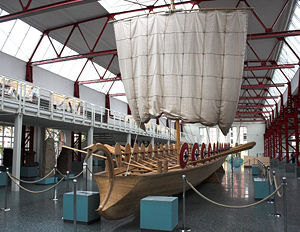
A full-sized reconstructed vessel is on display at the Museum of Ancient Seafaring, Mainz, and serves as a representative of the lusoria. For the reconstruction of this vessel specifically Mainz 1 and 5 served as templates. The replica measures 21 by while the gunwaleGunwale
The gunwale is a nautical term describing the top edge of the side of a boat.Wale is the same word as the skin injury, a wheal, which, too, forms a ridge. Originally the gunwale was the "Gun ridge" on a sailing warship. This represented the strengthening wale or structural band added to the design...
measures 0.96 metre. Again oak is used. The planks are 2 cm (0.78740157480315 in) thick, generally 25 cm (10 in) long and are carvel-built
Carvel (boat building)
In boat building, carvel built or carvel planking is a method of constructing wooden boats and tall ships by fixing planks to a frame so that the planks butt up against each other, edge to edge, gaining support from the frame and forming a smooth hull...
. The keel
Keel
In boats and ships, keel can refer to either of two parts: a structural element, or a hydrodynamic element. These parts overlap. As the laying down of the keel is the initial step in construction of a ship, in British and American shipbuilding traditions the construction is dated from this event...
is only 5 cm (2 in) thick and constructed of planks; it contains a central channel to collect water. There is no keelson. The frames are placed 33.5 cm (13.2 in) apart corresponding to the measuring unit of a pes Drusianus. The frames hold the ship together. The mastframe contains a hole to place the mast. While the ship could be sailed, the main method of propulsion was rowing by one open row of oarsmen on each side. The gunwale displays an outside fender
Fender (boating)
In boating, a fender is a bumper used to absorb the kinetic energy of a berthing boat or vessel against a jetty, quay wall or other vessel. Fenders are used to prevent damage to boats, vessels and berthing structures. Fenders are nowadays constructed in several ways, typically of rubber, foam...
and is topped by a covering board. The covering board contains the support for the oars. The protective effect of the gunwales is further extended by the shields of the soldiers which were hung on the outside. Boats were steered by a double rudder
Rudder
A rudder is a device used to steer a ship, boat, submarine, hovercraft, aircraft or other conveyance that moves through a medium . On an aircraft the rudder is used primarily to counter adverse yaw and p-factor and is not the primary control used to turn the airplane...
aft. Sails have not survived the centuries, so their reconstruction relies on ancient depictions. A navis lusoria was crewed by the steersman, two men to handle the sail, and about 30 soldiers who manned the oars.
It has been calculated that the narrow and relatively long lusoria could attain a travel speed of 11 to 13 km/h (5.6 to 6.6 kn) and a maximum speed of 18 km/h (9 kn).
The significance of the findings led to the establishment of a specific research center to study Roman ship transport at the Romano-Germanic Central Museum and of the Museum of Ancient Seafaring as its parent division. The latter museum has been in operation since 1994 and displays replicas of the lusoria and the patrol vessel as well as original artefacts. It specializes in Roman shipbuilding and ship transport, in the Germanic provinces and in the whole empire.
Historical background
After the establishment of the military castrum (fort)Castra
The Latin word castra, with its singular castrum, was used by the ancient Romans to mean buildings or plots of land reserved to or constructed for use as a military defensive position. The word appears in both Oscan and Umbrian as well as in Latin. It may have descended from Indo-European to Italic...
of Mogontiacum (modern Mainz) in 13–12 BC, ships of the became stationed at its harbor. Mogontiacum soon became the capital of the Roman province of Germania Superior
Germania Superior
Germania Superior , so called for the reason that it lay upstream of Germania Inferior, was a province of the Roman Empire. It comprised an area of western Switzerland, the French Jura and Alsace regions, and southwestern Germany...
and ships from its harbor could travel up and down the Rhine and east to the Main river. The military fleet was upgraded when the Emperor Julian
Julian the Apostate
Julian "the Apostate" , commonly known as Julian, or also Julian the Philosopher, was Roman Emperor from 361 to 363 and a noted philosopher and Greek writer....
increased defensive measures along the Rhine in the 4th century, and Marcellinus reported that the Emperor had 40 lusoriae that were used for his troops at Mogontiacum. At that time the border was increasingly threatened, and lusoriae became useful to ship troops to outposts or to points of crisis. Eventually however, Vandals, Suebi
Suebi
The Suebi or Suevi were a group of Germanic peoples who were first mentioned by Julius Caesar in connection with Ariovistus' campaign, c...
, and Alans
Alans
The Alans, or the Alani, occasionally termed Alauni or Halani, were a group of Sarmatian tribes, nomadic pastoralists of the 1st millennium AD who spoke an Eastern Iranian language which derived from Scytho-Sarmatian and which in turn evolved into modern Ossetian.-Name:The various forms of Alan —...
moved across the Rhine
Crossing of the Rhine
31 December 406, is the often-repeated date of the crossing of the Rhine by a mixed group of barbarians that included Vandals, Alans and Suebi...
and sacked Mogontiacum in or about 407. As Roman control ended, the local Roman fleet decayed and, over time, became covered with debris, mud and earth.
Other reconstructions
The Regina is a reconstruction of a navis lusoria by students of the Department for Ancient History of the University of RegensburgUniversity of Regensburg
The University of Regensburg is a public research university located in the medieval city of Regensburg, Bavaria, a city that is listed as a UNESCO World Heritage Site. The university was founded on July 18, 1962 by the Landtag of Bavaria as the fourth full-fledged university in Bavaria...
. Launched in 2004, the boat was used to test its abilities in numerous trips along the Naab
Naab
The Naab is a river in Bavaria, Germany, and is a left tributary of the Danube. It is approx. long, including its main source river Waldnaab....
and Danube
Danube
The Danube is a river in the Central Europe and the Europe's second longest river after the Volga. It is classified as an international waterway....
. In 2006, the Regina travelled from Regensburg
Regensburg
Regensburg is a city in Bavaria, Germany, located at the confluence of the Danube and Regen rivers, at the northernmost bend in the Danube. To the east lies the Bavarian Forest. Regensburg is the capital of the Bavarian administrative region Upper Palatinate...
to Budapest
Budapest
Budapest is the capital of Hungary. As the largest city of Hungary, it is the country's principal political, cultural, commercial, industrial, and transportation centre. In 2011, Budapest had 1,733,685 inhabitants, down from its 1989 peak of 2,113,645 due to suburbanization. The Budapest Commuter...
covering distances of up to 100 km (54 nmi) per day confirming that the vessel was speedy and demonstrating the great mobility the military could achieve by its use.
Literature
- Hans Ferkel, Heinrich Konen, Christoph Schäfer (Hrsg.): Navis lusoria. Ein Römerschiff in Regensburg. Scripta-Mercaturae-Verl., St. Katharinen 2004, ISBN 3-89590-152-0.
- Christoph Schäfer: Lusoria. Ein Römerschiff im Experiment. Rekonstruktion, Tests, Ergebnisse. Koehler, Hamburg 2008, ISBN 978-3-7822-0976-2 (Information, in German).
- Ronald Bockius: Die spätrömischen Schiffswracks aus Mainz. Schiffsarchäologisch-technikgeschichtliche Untersuchungen spätantiker Schiffsfunde vom nördlichen Oberrhein. Verlag des Römisch-Germanischen Zentralmuseums Mainz, Mainz 2006, ISBN 978-3-7954-1965-3 (Monographien des Römisch-Germanischen Zentralmuseums Mainz. Band 67).
- Barbara Pferdehirt: Das Museum für antike Schifffahrt. Ein Forschungsbericht des Römisch-Germanischen Zentralmuseums. Römisch-Germanisches Zentralmuseum, Mainz 1995, ISBN 3-88467-033-6.
External links
- Museum of Ancient Seafaring
- The NAVIS I project A European project about ancient ship transport