


Legio II Italica

Encyclopedia
Roman legion
A Roman legion normally indicates the basic ancient Roman army unit recruited specifically from Roman citizens. The organization of legions varied greatly over time but they were typically composed of perhaps 5,000 soldiers, divided into maniples and later into "cohorts"...
levied by emperor Marcus Aurelius in 165 together with I Italica
Legio I Italica
Legio prima Italica was a Roman legion levied by emperor Nero on September 22, 66 . There are still records of the I Italica in the Danube border in the beginning of the 5th century...
at a time when the Roman Empire
Roman Empire
The Roman Empire was the post-Republican period of the ancient Roman civilization, characterised by an autocratic form of government and large territorial holdings in Europe and around the Mediterranean....
was fighting both in Germania and in Parthia. There are still records of the II Italica in Noricum
Noricum
Noricum, in ancient geography, was a Celtic kingdom stretching over the area of today's Austria and a part of Slovenia. It became a province of the Roman Empire...
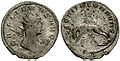
in the beginning of the 5th century. The legion symbol is a she-wolf and the twins Romulus
Romulus and Remus
Romulus and Remus are Rome's twin founders in its traditional foundation myth, although the former is sometimes said to be the sole founder...
and Remus
Remus
Remus is the twin brother of the mythical founder of Rome.Remus may also refer to:* Remus , a fictional planet in Star Trek* Remus , a moon of the asteroid 87 Sylvia...
, and is a reference to the contemporary rule of Marcus Aurelius and his colleague Lucius Verus
Lucius Verus
Lucius Verus , was Roman co-emperor with Marcus Aurelius, from 161 until his death.-Early life and career:Lucius Verus was the first born son to Avidia Plautia and Lucius Aelius Verus Caesar, the first adopted son and heir of Roman Emperor Hadrian . He was born and raised in Rome...
.
The legion main theatre of operations was the Roman province
Roman province
In Ancient Rome, a province was the basic, and, until the Tetrarchy , largest territorial and administrative unit of the empire's territorial possessions outside of Italy...
of Noricum, in the south margin of the Danube
Danube
The Danube is a river in the Central Europe and the Europe's second longest river after the Volga. It is classified as an international waterway....
, where Germanic incursions were frequent. In 180 II Italica was stationed in Lauriacum, modern Lorch
Lorch
Lorch may refer to:*Lorch, Hesse, a town in Hesse, Germany*Lorch , a town in Baden-Württemberg, Germany*Lorch, Austria, part of Enns in Upper Austria...
.
In 193, II Italica marched into Rome with Septimius Severus
Septimius Severus
Septimius Severus , also known as Severus, was Roman Emperor from 193 to 211. Severus was born in Leptis Magna in the province of Africa. As a young man he advanced through the customary succession of offices under the reigns of Marcus Aurelius and Commodus. Severus seized power after the death of...
, then fighting for power. The new emperor awarded them the title of Fidelis (loyal) to acknowledge the support. Later Septimius Severus would use II Italica against the rebellions of Pescennius Niger
Pescennius Niger
Pescennius Niger was a Roman usurper from 193 to 194 during the Year of the Five Emperors. He claimed the imperial throne in response to the murder of Pertinax and the elevation of Didius Julianus, but was defeated by a rival claimant, Septimius Severus and killed while attempting to flee from...
and Clodius Albinus
Clodius Albinus
Clodius Albinus was a Roman usurper proclaimed emperor by the legions in Britain and Hispania upon the murder of Pertinax in 193.-Life:...
, and in his Parthian campaigns.
In the 3rd century, support of the legions
Roman legion
A Roman legion normally indicates the basic ancient Roman army unit recruited specifically from Roman citizens. The organization of legions varied greatly over time but they were typically composed of perhaps 5,000 soldiers, divided into maniples and later into "cohorts"...
was a crucial demand for candidates to the throne. Well aware of this fact, Gallienus
Gallienus
Gallienus was Roman Emperor with his father Valerian from 253 to 260, and alone from 260 to 268. He took control of the Empire at a time when it was undergoing great crisis...
granted II Italica the cognomina VII Pia VII Fidelis (seven times faithful, seven times loyal) to secure their continuing support.