

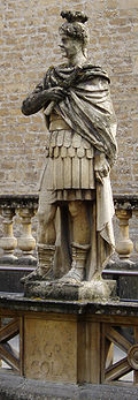
Gnaeus Julius Agricola

Encyclopedia
Gnaeus Julius Agricola was a Roman
general responsible for much of the Roman conquest
of Britain. His biography, the De vita et moribus Iulii Agricolae
, was the first published work of his son-in-law, the historian Tacitus
, and is the source for most of what is known about him.
Born to a noted political family, Agricola began his military career in Britain, serving under governor Gaius Suetonius Paulinus
. His subsequent career saw him serve in a variety of positions; he was appointed quaestor
in Asia province in 64, then Plebeian Tribune in 66, and praetor
in 68. He supported Vespasian
during the Year of the Four Emperors
(69), and was given a military command in Britain when the latter became emperor. When his command ended in 73 he was made patrician in Rome
and appointed governor of Gallia Aquitania
. He was made consul
and governor of Britannia
in 77. While there, he conquered much of what is now Wales
and northern England
, and ventured into lowland Scotland
, where he established Roman dominance for a time. Some speculate that he may have launched an expedition into Ireland
as well. He was recalled from Britain in 85 after an unusually lengthy service, and thereafter retired from military and public life.
of Forum Julii
, Gallia Narbonensis
(modern southern France
). Agricola's parents were from families of senatorial
rank. Both of his grandfathers served as Imperial Governors. His father Julius Graecinus was a praetor
and had become a member of the Roman Senate
in the year of his birth. Graecinus had become distinguished by his interest in philosophy. Between August 40-January 41, the Roman Emperor
Caligula
ordered his death because he refused to prosecute the Emperor's second cousin Marcus Junius Silanus.
His mother was Julia Procilla. The Roman historian Tacitus
describes her as "a lady of singular virtue". Tacitus states that Procilla had a fond affection for her son. Agricola was educated in Massilia (Marseille
), and showed what was considered an unhealthy interest in philosophy.
, serving in Britain under Gaius Suetonius Paulinus
from 58 to 62. He was probably attached to the Legio II Augusta
, but was chosen to serve on Suetonius's staff and thus almost certainly participated in the suppression of Boudica
's uprising in 61.
Returning from Britain to Rome
in 62, he married Domitia Decidiana
, a woman of noble birth. Their first child was a son. Agricola was appointed to the quaestor
ship for 64, which he served in the province of Asia under the corrupt proconsul Salvius Titianus. While he was there his daughter, Julia Agricola
, was born, but his son died shortly afterwards. He was tribune
of the plebs in 66 and praetor
in 68, during which time he was ordered by Galba
to take an inventory of the temple treasures.
In June of 68 the emperor Nero
was deposed and committed suicide, and the period of civil war known as the Year of the Four Emperors
began. Galba succeeded Nero, but was murdered in early 69 by Otho
, who took the throne. Agricola's mother was murdered on her estate in Liguria
by Otho's marauding fleet. Hearing of Vespasian
's bid for the empire, Agricola immediately gave him his support.
After Vespasian had established himself as emperor, Agricola was appointed to the command of the Legio XX Valeria Victrix
, stationed in Britain, in place of Marcus Roscius Coelius
, who had stirred up a mutiny against the governor, Marcus Vettius Bolanus
. Britain had suffered revolt during the year of civil war, and Bolanus was a mild governor. Agricola reimposed discipline on the legion and helped to consolidate Roman rule. In 71 Bolanus was replaced by a more aggressive governor, Quintus Petillius Cerialis
, and Agricola was able to display his talents as a commander in campaigns against the Brigantes
.
When his command ended in 75, Agricola was enrolled as a patrician and appointed to govern Gallia Aquitania
. In 76 or 77 he was recalled to Rome and appointed suffect consul
, and betrothed his daughter to Tacitus
. The following year Tacitus and Julia married; Agricola was appointed to the College of Pontiffs
, and returned to Britain for a third time, as its governor.
of north Wales had virtually destroyed the Roman cavalry stationed in their territory. He immediately moved against them and defeated them. He then moved north to the island of Mona (Anglesey
), which had previously been reduced by Suetonius Paulinus in 61 but must have been regained by the Britons in the meantime, and forced its inhabitants to sue for peace. He established a good reputation as an administrator as well as a commander by reforming the widely corrupt corn levy. He introduced Romanising measures, encouraging communities to build towns on the Roman model and educating the sons of the native nobility in the Roman manner.
He also expanded Roman rule north into Caledonia (modern Scotland
). In the summer of 79 he pushed his armies to the estuary of the river Taus, virtually unchallenged, and established forts there. This is often interpreted as the Firth of Tay
, but this would appear to be anomalous as it is further north than the Firths of Clyde
and Forth
, which Agricola did not reach until the following year. Others suggest the Taus was the Solway Firth
.
. The text of the Agricola has been emended here to record the Romans "crossing into trackless wastes", referring to the wilds of the Galloway peninsula. Agricola fortified the coast facing Ireland, and Tacitus recalls that his father-in-law often claimed the island could be conquered with a single legion
and auxiliaries
. He had given refuge to an exiled Irish king whom he hoped he might use as the excuse for conquest. This conquest never happened, but some historians believe that the crossing referred to was in fact a small-scale exploratory or punitive expedition
to Ireland.
Irish legend provides a striking parallel. Tuathal Teachtmhar
, a legendary High King
, is said to have been exiled from Ireland as a boy, and to have returned from Britain at the head of an army to claim the throne. The traditional date of his return is 76–80, and archaeology
has found Roman or Romano-British artefacts in several sites associated with Tuathal.
rose in great numbers against him. They attacked the camp of the Legio IX Hispana
at night
, but Agricola sent in his cavalry and they were put to flight. The Romans responded by pushing further north. Another son was born to Agricola this year, but he died before his first birthday.
In the summer of 83 Agricola faced the massed armies of the Caledonians, led by Calgacus
, at the Battle of Mons Graupius
. Tacitus estimates their numbers at more than 30,000. Agricola put his auxiliaries in the front line, keeping the legions in reserve, and relied on close-quarters fighting to make the Caledonians' unpointed slashing swords useless. Even though the Caledonians were put to rout and therefore lost this battle, two thirds of their army managed to escape and hide in the Scottish Highlands or the "trackless wilds" as Tacitus calls them. Battle casualties were estimated by Tacitus to be about 10,000 on the Caledonian side and 360 on the Roman side.
A number of authors have reckoned the battle to have occurred in the Grampian Mounth
within sight of the North Sea
. In particular, Roy, Surenne, Watt, Hogan and others have advanced notions that the site of the battle may have been Kempstone Hill
, Megray Hill
or other knolls near the Raedykes
Roman Camp. In addition these points of high ground are proximate to the Elsick Mounth
, an ancient trackway
used by Romans and Caledonians for military maneuvers.
Satisfied with his victory, Agricola extracted hostages from the Caledonian tribes. He may have marched his army to the northern coast of Britain, as evidenced by the probable discovery of a Roman fort at Cawdor
(near Inverness
).
He also instructed the prefect
of the fleet to sail around the north coast, confirming for the first time that Britain was in fact an island.
ordered his recall because Agricola's successes outshone the Emperor's own modest victories in Germany. The relationship between Agricola and the Emperor is unclear: on the one hand, Agricola was awarded triumphal decorations and a statue (the highest military honours apart from an actual triumph
); on the other, Agricola never again held a civil or military post, in spite of his experience and renown. He was offered the governorship of the province of Africa, but declined it, whether due to ill health or (as Tacitus claims) the machinations of Domitian.
In 93 Agricola died on his family estates in Gallia Narbonensis aged fifty-three.
Roman Empire
The Roman Empire was the post-Republican period of the ancient Roman civilization, characterised by an autocratic form of government and large territorial holdings in Europe and around the Mediterranean....
general responsible for much of the Roman conquest
Roman conquest of Britain
The Roman conquest of Britain was a gradual process, beginning effectively in AD 43 under Emperor Claudius, whose general Aulus Plautius served as first governor of Britannia. Great Britain had already frequently been the target of invasions, planned and actual, by forces of the Roman Republic and...
of Britain. His biography, the De vita et moribus Iulii Agricolae
Agricola (book)
The Agricola is a book by the Roman historian Tacitus, written c 98, which recounts the life of his father-in-law Gnaeus Julius Agricola, an eminent Roman general. It also covers, briefly, the geography and ethnography of ancient Britain...
, was the first published work of his son-in-law, the historian Tacitus
Tacitus
Publius Cornelius Tacitus was a senator and a historian of the Roman Empire. The surviving portions of his two major works—the Annals and the Histories—examine the reigns of the Roman Emperors Tiberius, Claudius, Nero and those who reigned in the Year of the Four Emperors...
, and is the source for most of what is known about him.
Born to a noted political family, Agricola began his military career in Britain, serving under governor Gaius Suetonius Paulinus
Gaius Suetonius Paulinus
Gaius Suetonius Paulinus, also spelled Paullinus, was a Roman general best known as the commander who defeated the rebellion of Boudica.-Career:...
. His subsequent career saw him serve in a variety of positions; he was appointed quaestor
Quaestor
A Quaestor was a type of public official in the "Cursus honorum" system who supervised financial affairs. In the Roman Republic a quaestor was an elected official whereas, with the autocratic government of the Roman Empire, quaestors were simply appointed....
in Asia province in 64, then Plebeian Tribune in 66, and praetor
Praetor
Praetor was a title granted by the government of Ancient Rome to men acting in one of two official capacities: the commander of an army, usually in the field, or the named commander before mustering the army; and an elected magistratus assigned varied duties...
in 68. He supported Vespasian
Vespasian
Vespasian , was Roman Emperor from 69 AD to 79 AD. Vespasian was the founder of the Flavian dynasty, which ruled the Empire for a quarter century. Vespasian was descended from a family of equestrians, who rose into the senatorial rank under the Emperors of the Julio-Claudian dynasty...
during the Year of the Four Emperors
Year of the Four Emperors
The Year of the Four Emperors was a year in the history of the Roman Empire, AD 69, in which four emperors ruled in a remarkable succession. These four emperors were Galba, Otho, Vitellius, and Vespasian....
(69), and was given a military command in Britain when the latter became emperor. When his command ended in 73 he was made patrician in Rome
Rome
Rome is the capital of Italy and the country's largest and most populated city and comune, with over 2.7 million residents in . The city is located in the central-western portion of the Italian Peninsula, on the Tiber River within the Lazio region of Italy.Rome's history spans two and a half...
and appointed governor of Gallia Aquitania
Gallia Aquitania
Gallia Aquitania was a province of the Roman Empire, bordered by the provinces of Gallia Lugdunensis, Gallia Narbonensis, and Hispania Tarraconensis...
. He was made consul
Consul
Consul was the highest elected office of the Roman Republic and an appointive office under the Empire. The title was also used in other city states and also revived in modern states, notably in the First French Republic...
and governor of Britannia
Governors of Roman Britain
This is a partial list of Governors of Roman Britain. As Britannia, Roman Britain was a consular province, which means its governors need to be appointed consul by Rome before they could govern it. While this rank could be obtained either as a suffect or ordinares, a number of governors were consul...
in 77. While there, he conquered much of what is now Wales
Wales
Wales is a country that is part of the United Kingdom and the island of Great Britain, bordered by England to its east and the Atlantic Ocean and Irish Sea to its west. It has a population of three million, and a total area of 20,779 km²...
and northern England
Northern England
Northern England, also known as the North of England, the North or the North Country, is a cultural region of England. It is not an official government region, but rather an informal amalgamation of counties. The southern extent of the region is roughly the River Trent, while the North is bordered...
, and ventured into lowland Scotland
Scottish Lowlands
The Scottish Lowlands is a name given to the Southern half of Scotland.The area is called a' Ghalldachd in Scottish Gaelic, and the Lawlands ....
, where he established Roman dominance for a time. Some speculate that he may have launched an expedition into Ireland
Ireland
Ireland is an island to the northwest of continental Europe. It is the third-largest island in Europe and the twentieth-largest island on Earth...
as well. He was recalled from Britain in 85 after an unusually lengthy service, and thereafter retired from military and public life.
Early life
Agricola was born in the coloniaColonia (Roman)
A Roman colonia was originally a Roman outpost established in conquered territory to secure it. Eventually, however, the term came to denote the highest status of Roman city.-History:...
of Forum Julii
Fréjus
Fréjus is a commune in the Var department in the Provence-Alpes-Côte d'Azur region in southeastern France.It neighbours Saint-Raphaël, effectively forming one town...
, Gallia Narbonensis
Gallia Narbonensis
Gallia Narbonensis was a Roman province located in what is now Languedoc and Provence, in southern France. It was also known as Gallia Transalpina , which was originally a designation for that part of Gaul lying across the Alps from Italia and it contained a western region known as Septimania...
(modern southern France
France
The French Republic , The French Republic , The French Republic , (commonly known as France , is a unitary semi-presidential republic in Western Europe with several overseas territories and islands located on other continents and in the Indian, Pacific, and Atlantic oceans. Metropolitan France...
). Agricola's parents were from families of senatorial
Roman Senate
The Senate of the Roman Republic was a political institution in the ancient Roman Republic, however, it was not an elected body, but one whose members were appointed by the consuls, and later by the censors. After a magistrate served his term in office, it usually was followed with automatic...
rank. Both of his grandfathers served as Imperial Governors. His father Julius Graecinus was a praetor
Praetor
Praetor was a title granted by the government of Ancient Rome to men acting in one of two official capacities: the commander of an army, usually in the field, or the named commander before mustering the army; and an elected magistratus assigned varied duties...
and had become a member of the Roman Senate
Roman Senate
The Senate of the Roman Republic was a political institution in the ancient Roman Republic, however, it was not an elected body, but one whose members were appointed by the consuls, and later by the censors. After a magistrate served his term in office, it usually was followed with automatic...
in the year of his birth. Graecinus had become distinguished by his interest in philosophy. Between August 40-January 41, the Roman Emperor
Roman Emperor
The Roman emperor was the ruler of the Roman State during the imperial period . The Romans had no single term for the office although at any given time, a given title was associated with the emperor...
Caligula
Caligula
Caligula , also known as Gaius, was Roman Emperor from 37 AD to 41 AD. Caligula was a member of the house of rulers conventionally known as the Julio-Claudian dynasty. Caligula's father Germanicus, the nephew and adopted son of Emperor Tiberius, was a very successful general and one of Rome's most...
ordered his death because he refused to prosecute the Emperor's second cousin Marcus Junius Silanus.
His mother was Julia Procilla. The Roman historian Tacitus
Tacitus
Publius Cornelius Tacitus was a senator and a historian of the Roman Empire. The surviving portions of his two major works—the Annals and the Histories—examine the reigns of the Roman Emperors Tiberius, Claudius, Nero and those who reigned in the Year of the Four Emperors...
describes her as "a lady of singular virtue". Tacitus states that Procilla had a fond affection for her son. Agricola was educated in Massilia (Marseille
Marseille
Marseille , known in antiquity as Massalia , is the second largest city in France, after Paris, with a population of 852,395 within its administrative limits on a land area of . The urban area of Marseille extends beyond the city limits with a population of over 1,420,000 on an area of...
), and showed what was considered an unhealthy interest in philosophy.
Political career
He began his career in Roman public life as a military tribuneTribune
Tribune was a title shared by elected officials in the Roman Republic. Tribunes had the power to convene the Plebeian Council and to act as its president, which also gave them the right to propose legislation before it. They were sacrosanct, in the sense that any assault on their person was...
, serving in Britain under Gaius Suetonius Paulinus
Gaius Suetonius Paulinus
Gaius Suetonius Paulinus, also spelled Paullinus, was a Roman general best known as the commander who defeated the rebellion of Boudica.-Career:...
from 58 to 62. He was probably attached to the Legio II Augusta
Legio II Augusta
Legio secunda Augusta , was a Roman legion, levied by Gaius Vibius Pansa Caetronianus in 43 BC, and still operative in Britannia in the 4th century...
, but was chosen to serve on Suetonius's staff and thus almost certainly participated in the suppression of Boudica
Boudica
Boudica , also known as Boadicea and known in Welsh as "Buddug" was queen of the British Iceni tribe who led an uprising against the occupying forces of the Roman Empire....
's uprising in 61.
Returning from Britain to Rome
Rome
Rome is the capital of Italy and the country's largest and most populated city and comune, with over 2.7 million residents in . The city is located in the central-western portion of the Italian Peninsula, on the Tiber River within the Lazio region of Italy.Rome's history spans two and a half...
in 62, he married Domitia Decidiana
Domitia Decidiana
Domitia Decidiana was a Roman woman who lived in the 1st century. She was a well-connected woman of illustrious descent.In 62 she married the Roman general Gnaeus Julius Agricola, who had just recently returned from service in Britain as a military tribune. She gave birth to a son, whose name is...
, a woman of noble birth. Their first child was a son. Agricola was appointed to the quaestor
Quaestor
A Quaestor was a type of public official in the "Cursus honorum" system who supervised financial affairs. In the Roman Republic a quaestor was an elected official whereas, with the autocratic government of the Roman Empire, quaestors were simply appointed....
ship for 64, which he served in the province of Asia under the corrupt proconsul Salvius Titianus. While he was there his daughter, Julia Agricola
Julia Agricola
Julia Agricola was the daughter of Roman general Gnaeus Julius Agricola and Domitia Decidiana, a lady of illustrious birth. Shortly after her birth her elder brother, who was just a young child, died. She had another brother, born in 83, who also died in infancy.In 78, at the age of fourteen,...
, was born, but his son died shortly afterwards. He was tribune
Tribune
Tribune was a title shared by elected officials in the Roman Republic. Tribunes had the power to convene the Plebeian Council and to act as its president, which also gave them the right to propose legislation before it. They were sacrosanct, in the sense that any assault on their person was...
of the plebs in 66 and praetor
Praetor
Praetor was a title granted by the government of Ancient Rome to men acting in one of two official capacities: the commander of an army, usually in the field, or the named commander before mustering the army; and an elected magistratus assigned varied duties...
in 68, during which time he was ordered by Galba
Galba
Galba , was Roman Emperor for seven months from 68 to 69. Galba was the governor of Hispania Tarraconensis, and made a bid for the throne during the rebellion of Julius Vindex...
to take an inventory of the temple treasures.
In June of 68 the emperor Nero
Nero
Nero , was Roman Emperor from 54 to 68, and the last in the Julio-Claudian dynasty. Nero was adopted by his great-uncle Claudius to become his heir and successor, and succeeded to the throne in 54 following Claudius' death....
was deposed and committed suicide, and the period of civil war known as the Year of the Four Emperors
Year of the Four Emperors
The Year of the Four Emperors was a year in the history of the Roman Empire, AD 69, in which four emperors ruled in a remarkable succession. These four emperors were Galba, Otho, Vitellius, and Vespasian....
began. Galba succeeded Nero, but was murdered in early 69 by Otho
Otho
Otho , was Roman Emperor for three months, from 15 January to 16 April 69. He was the second emperor of the Year of the four emperors.- Birth and lineage :...
, who took the throne. Agricola's mother was murdered on her estate in Liguria
Liguria
Liguria is a coastal region of north-western Italy, the third smallest of the Italian regions. Its capital is Genoa. It is a popular region with tourists for its beautiful beaches, picturesque little towns, and good food.-Geography:...
by Otho's marauding fleet. Hearing of Vespasian
Vespasian
Vespasian , was Roman Emperor from 69 AD to 79 AD. Vespasian was the founder of the Flavian dynasty, which ruled the Empire for a quarter century. Vespasian was descended from a family of equestrians, who rose into the senatorial rank under the Emperors of the Julio-Claudian dynasty...
's bid for the empire, Agricola immediately gave him his support.
After Vespasian had established himself as emperor, Agricola was appointed to the command of the Legio XX Valeria Victrix
Legio XX Valeria Victrix
Legio vigesima Valeria Victrix was a Roman legion, probably raised by Augustus some time after 31 BC. It served in Hispania, Illyricum, and Germania before participating in the invasion of Britannia in 43 AD, where it remained and was active until at least the beginning of the 4th century...
, stationed in Britain, in place of Marcus Roscius Coelius
Marcus Roscius Coelius
Marcus Roscius Coelius was a Roman military officer of the 1st century.He was the legate of the Legio XX Valeria Victrix, stationed in Britain in 68. He was on bad terms with the provincial governor, Marcus Trebellius Maximus, and took the opportunity during the turmoil of the year of four...
, who had stirred up a mutiny against the governor, Marcus Vettius Bolanus
Marcus Vettius Bolanus
Marcus Vettius Bolanus was a Roman soldier and politician.He served in Asia under Corbulo in AD 62 and was consul in AD 66.He became governor of Britain in AD 69 in the midst of the Year of four emperors, appointed by the short-lived emperor Vitellius...
. Britain had suffered revolt during the year of civil war, and Bolanus was a mild governor. Agricola reimposed discipline on the legion and helped to consolidate Roman rule. In 71 Bolanus was replaced by a more aggressive governor, Quintus Petillius Cerialis
Quintus Petillius Cerialis
Quintus Petilius Cerialis Caesius Rufus was a Roman general and administrator who served in Britain during Boudica's rebellion and who went on to participate in the civil wars after the death of Nero. He later defeated the rebellion of Julius Civilis and returned to Britain as its governor.His...
, and Agricola was able to display his talents as a commander in campaigns against the Brigantes
Brigantes
The Brigantes were a Celtic tribe who in pre-Roman times controlled the largest section of what would become Northern England, and a significant part of the Midlands. Their kingdom is sometimes called Brigantia, and it was centred in what was later known as Yorkshire...
.
When his command ended in 75, Agricola was enrolled as a patrician and appointed to govern Gallia Aquitania
Gallia Aquitania
Gallia Aquitania was a province of the Roman Empire, bordered by the provinces of Gallia Lugdunensis, Gallia Narbonensis, and Hispania Tarraconensis...
. In 76 or 77 he was recalled to Rome and appointed suffect consul
Consul
Consul was the highest elected office of the Roman Republic and an appointive office under the Empire. The title was also used in other city states and also revived in modern states, notably in the First French Republic...
, and betrothed his daughter to Tacitus
Tacitus
Publius Cornelius Tacitus was a senator and a historian of the Roman Empire. The surviving portions of his two major works—the Annals and the Histories—examine the reigns of the Roman Emperors Tiberius, Claudius, Nero and those who reigned in the Year of the Four Emperors...
. The following year Tacitus and Julia married; Agricola was appointed to the College of Pontiffs
College of Pontiffs
The College of Pontiffs or Collegium Pontificum was a body of the ancient Roman state whose members were the highest-ranking priests of the polytheistic state religion. The college consisted of the Pontifex Maximus, the Vestal Virgins, the Rex Sacrorum, and the flamines...
, and returned to Britain for a third time, as its governor.
Governor of Britain
Arriving in mid-summer of 77, Agricola found that the OrdovicesOrdovices
The Ordovices were one of the Celtic tribes living in Great Britain, before the Roman invasion of Britain. Its tribal lands were located in present day Wales and England between the Silures to the south and the Deceangli to the north-east...
of north Wales had virtually destroyed the Roman cavalry stationed in their territory. He immediately moved against them and defeated them. He then moved north to the island of Mona (Anglesey
Anglesey
Anglesey , also known by its Welsh name Ynys Môn , is an island and, as Isle of Anglesey, a county off the north west coast of Wales...
), which had previously been reduced by Suetonius Paulinus in 61 but must have been regained by the Britons in the meantime, and forced its inhabitants to sue for peace. He established a good reputation as an administrator as well as a commander by reforming the widely corrupt corn levy. He introduced Romanising measures, encouraging communities to build towns on the Roman model and educating the sons of the native nobility in the Roman manner.
He also expanded Roman rule north into Caledonia (modern Scotland
Scotland
Scotland is a country that is part of the United Kingdom. Occupying the northern third of the island of Great Britain, it shares a border with England to the south and is bounded by the North Sea to the east, the Atlantic Ocean to the north and west, and the North Channel and Irish Sea to the...
). In the summer of 79 he pushed his armies to the estuary of the river Taus, virtually unchallenged, and established forts there. This is often interpreted as the Firth of Tay
Firth of Tay
The Firth of Tay is a firth in Scotland between the council areas of Fife, Perth and Kinross, the City of Dundee and Angus, into which Scotland's largest river in terms of flow, the River Tay, empties....
, but this would appear to be anomalous as it is further north than the Firths of Clyde
Firth of Clyde
The Firth of Clyde forms a large area of coastal water, sheltered from the Atlantic Ocean by the Kintyre peninsula which encloses the outer firth in Argyll and Ayrshire, Scotland. The Kilbrannan Sound is a large arm of the Firth of Clyde, separating the Kintyre Peninsula from the Isle of Arran.At...
and Forth
Firth of Forth
The Firth of Forth is the estuary or firth of Scotland's River Forth, where it flows into the North Sea, between Fife to the north, and West Lothian, the City of Edinburgh and East Lothian to the south...
, which Agricola did not reach until the following year. Others suggest the Taus was the Solway Firth
Solway Firth
The Solway Firth is a firth that forms part of the border between England and Scotland, between Cumbria and Dumfries and Galloway. It stretches from St Bees Head, just south of Whitehaven in Cumbria, to the Mull of Galloway, on the western end of Dumfries and Galloway. The Isle of Man is also very...
.
Agricola in Ireland?
In 81 Agricola "crossed in the first ship" and defeated peoples unknown to the Romans until then. Tacitus, in Chapter 24 of Agricola, does not tell us what body of water he crossed, although most scholars believe it was the Clyde or Forth, and some translators even add the name of their preferred river to the text; however, the rest of the chapter exclusively concerns IrelandIreland
Ireland is an island to the northwest of continental Europe. It is the third-largest island in Europe and the twentieth-largest island on Earth...
. The text of the Agricola has been emended here to record the Romans "crossing into trackless wastes", referring to the wilds of the Galloway peninsula. Agricola fortified the coast facing Ireland, and Tacitus recalls that his father-in-law often claimed the island could be conquered with a single legion
Roman legion
A Roman legion normally indicates the basic ancient Roman army unit recruited specifically from Roman citizens. The organization of legions varied greatly over time but they were typically composed of perhaps 5,000 soldiers, divided into maniples and later into "cohorts"...
and auxiliaries
Auxiliaries (Roman military)
Auxiliaries formed the standing non-citizen corps of the Roman army of the Principate , alongside the citizen legions...
. He had given refuge to an exiled Irish king whom he hoped he might use as the excuse for conquest. This conquest never happened, but some historians believe that the crossing referred to was in fact a small-scale exploratory or punitive expedition
Punitive expedition
A punitive expedition is a military journey undertaken to punish a state or any group of persons outside the borders of the punishing state. It is usually undertaken in response to perceived disobedient or morally wrong behavior, but may be also be a covered revenge...
to Ireland.
Irish legend provides a striking parallel. Tuathal Teachtmhar
Tuathal Teachtmhar
Túathal Techtmar , son of Fíachu Finnolach, was a High King of Ireland, according to medieval Irish legend and historical tradition. He is said to be the ancestor of the Uí Néill and Connachta dynasties through his grandson Conn of the Hundred Battles...
, a legendary High King
High King of Ireland
The High Kings of Ireland were sometimes historical and sometimes legendary figures who had, or who are claimed to have had, lordship over the whole of Ireland. Medieval and early modern Irish literature portrays an almost unbroken sequence of High Kings, ruling from Tara over a hierarchy of...
, is said to have been exiled from Ireland as a boy, and to have returned from Britain at the head of an army to claim the throne. The traditional date of his return is 76–80, and archaeology
Archaeology
Archaeology, or archeology , is the study of human society, primarily through the recovery and analysis of the material culture and environmental data that they have left behind, which includes artifacts, architecture, biofacts and cultural landscapes...
has found Roman or Romano-British artefacts in several sites associated with Tuathal.
The invasion of Caledonia (Scotland)
The following year Agricola raised a fleet and encircled the tribes beyond the Forth, and the CaledoniansCaledonians
The Caledonians , or Caledonian Confederacy, is a name given by historians to a group of indigenous peoples of what is now Scotland during the Iron Age and Roman eras. The Romans referred to their territory as Caledonia and initially included them as Britons, but later distinguished as the Picts...
rose in great numbers against him. They attacked the camp of the Legio IX Hispana
Legio IX Hispana
Legio Nona Hispana was a Roman legion, which operated from the first century BCE until mid 2nd century CE. The Spanish Legion's disappearance has raised speculations over its fate, largely of its alleged destruction in Scotland in about 117 CE, though some scholars believe it was destroyed in the...
at night
Night combat
Night combat is combat that occurs during the hours of darkness. It is distinguished from daytime combat by lower visibility and its reversed relation to the Circadian cycle. Typically combat at night is favorable to the attacker, with offensive tactics being focused on exploiting the advantages...
, but Agricola sent in his cavalry and they were put to flight. The Romans responded by pushing further north. Another son was born to Agricola this year, but he died before his first birthday.
In the summer of 83 Agricola faced the massed armies of the Caledonians, led by Calgacus
Calgacus
According to Tacitus, Calgacus was a chieftain of the Caledonian Confederacy who fought the Roman army of Gnaeus Julius Agricola at the Battle of Mons Graupius in northern Scotland in AD 83 or 84...
, at the Battle of Mons Graupius
Battle of Mons Graupius
According to Tacitus, the Battle of Mons Graupius took place in AD 83 or, less probably, 84. Gnaeus Julius Agricola, the Roman governor and Tacitus' father-in-law, had sent his fleet ahead to panic the Caledonians, and, with light infantry reinforced with British auxiliaries, reached the site,...
. Tacitus estimates their numbers at more than 30,000. Agricola put his auxiliaries in the front line, keeping the legions in reserve, and relied on close-quarters fighting to make the Caledonians' unpointed slashing swords useless. Even though the Caledonians were put to rout and therefore lost this battle, two thirds of their army managed to escape and hide in the Scottish Highlands or the "trackless wilds" as Tacitus calls them. Battle casualties were estimated by Tacitus to be about 10,000 on the Caledonian side and 360 on the Roman side.
A number of authors have reckoned the battle to have occurred in the Grampian Mounth
Mounth
The Mounth is the range of hills on the southern edge of Strathdee in northeast Scotland. It was usually referred to with the article, i.e. "the Mounth". The name is a corruption of the Scottish Gaelic monadh which in turn is akin to the Welsh mynydd, and may be of Pictish origin...
within sight of the North Sea
North Sea
In the southwest, beyond the Straits of Dover, the North Sea becomes the English Channel connecting to the Atlantic Ocean. In the east, it connects to the Baltic Sea via the Skagerrak and Kattegat, narrow straits that separate Denmark from Norway and Sweden respectively...
. In particular, Roy, Surenne, Watt, Hogan and others have advanced notions that the site of the battle may have been Kempstone Hill
Kempstone Hill
Kempstone Hill is a landform in Aberdeenshire, Scotland within the Mounth Range of the Grampian Mountains. The peak elevation of this mountain is 132 metres above mean sea level. This hill has been posited by Gabriel Jacques Surenne, Archibald Watt and C.Michael Hogan as the location for the...
, Megray Hill
Megray Hill
Megray Hill is a low lying coastal mountainous landform in Aberdeenshire, Scotland within the Mounth Range of the Grampian Mountains. The peak elevation of this mountain is 120 metres above mean sea level. This hill has been posited as a likely location for the noted Battle of Mons Graupius...
or other knolls near the Raedykes
Raedykes
Raedykes is the site of a Roman marching camp located just over 3 miles NW of Stonehaven, Aberdeenshire, Scotland. National Grid Reference NO 842902...
Roman Camp. In addition these points of high ground are proximate to the Elsick Mounth
Elsick Mounth
The Elsick Mounth is an ancient trackway crossing the Grampian Mountains in the vicinity of Netherley, Scotland. This trackway was one of the few means of traversing the Grampian Mounth area in prehistoric and medieval times. The highest pass of the route is attained within the Durris Forest...
, an ancient trackway
Trackway
A trackway is an ancient route of travel for people or animals. In biology, a trackway can be a set of impressions in the soft earth, usually a set of footprints, left by an animal. A fossil trackway is the fossilized imprint of a trackway. Trackways have been found all over the world...
used by Romans and Caledonians for military maneuvers.
Satisfied with his victory, Agricola extracted hostages from the Caledonian tribes. He may have marched his army to the northern coast of Britain, as evidenced by the probable discovery of a Roman fort at Cawdor
Cawdor
Cawdor is a village and parish in Nairnshire, Highland council area, Scotland. The village is situated 5 miles south south west of Nairn, and 12 miles from Inverness.-History:The village is the location of Cawdor Castle, the seat of the Earl Cawdor....
(near Inverness
Inverness
Inverness is a city in the Scottish Highlands. It is the administrative centre for the Highland council area, and is regarded as the capital of the Highlands of Scotland...
).
He also instructed the prefect
Prefect
Prefect is a magisterial title of varying definition....
of the fleet to sail around the north coast, confirming for the first time that Britain was in fact an island.
Later years
Agricola was recalled from Britain in 85, after an unusually long tenure as governor. Tacitus claims that DomitianDomitian
Domitian was Roman Emperor from 81 to 96. Domitian was the third and last emperor of the Flavian dynasty.Domitian's youth and early career were largely spent in the shadow of his brother Titus, who gained military renown during the First Jewish-Roman War...
ordered his recall because Agricola's successes outshone the Emperor's own modest victories in Germany. The relationship between Agricola and the Emperor is unclear: on the one hand, Agricola was awarded triumphal decorations and a statue (the highest military honours apart from an actual triumph
Roman triumph
The Roman triumph was a civil ceremony and religious rite of ancient Rome, held to publicly celebrate and sanctify the military achievement of an army commander who had won great military successes, or originally and traditionally, one who had successfully completed a foreign war. In Republican...
); on the other, Agricola never again held a civil or military post, in spite of his experience and renown. He was offered the governorship of the province of Africa, but declined it, whether due to ill health or (as Tacitus claims) the machinations of Domitian.
In 93 Agricola died on his family estates in Gallia Narbonensis aged fifty-three.
Literature
- Anthony BirleyAnthony BirleyAnthony Richard Birley was the Professor of Ancient History at University of Manchester and at University of Düsseldorf . He is the son of the archaeologist Eric Birley, who bought the house next to Vindolanda where Anthony and his brother Robin began to excavate the site...
(1996), “Iulius Agricola, Cn.”, in Hornblower, Simon, Oxford Classical DictionaryOxford Classical Dictionary-Overview:The Oxford Classical Dictionary is considered to be the standard one-volume encyclopaedia in English of topics relating to the Ancient World and its civilizations. It was first published in 1949, edited by Max Cary with the assistance of H. J. Rose, H. P. Harvey, and A. Souter. A...
, Oxford: Oxford University Press - Duncan B Campbell, Mons Graupius AD 83, Oxford: Osprey Publishing, 2010. 96pp.
- "Agricola's Campaigns", special issue of Ancient WarfareAncient Warfare (magazine)Ancient Warfare is a glossy, bi-monthly military history magazine published by the Dutch publishing company Karwansaray. The founding and current magazine editor is Jasper Oorthuys....
, 1/1 (2007) - Wolfson, Stan. Tacitus, Thule and Caledonia: the achievements of Agricola's navy in their true perspective. Oxford, England: Archaeopress, 2008. 118pp. (BAR British series; 459).
External links
- Gnaeus Julius Agricola at Roman-Britain.org
- Germania and Agricola at Project GutenbergProject GutenbergProject Gutenberg is a volunteer effort to digitize and archive cultural works, to "encourage the creation and distribution of eBooks". Founded in 1971 by Michael S. Hart, it is the oldest digital library. Most of the items in its collection are the full texts of public domain books...