


Chauci

Encyclopedia
The Chauci were an ancient Germanic tribe
living in the low-lying region between the Rivers Ems and Elbe
, on both sides of the Weser and ranging as far inland as the upper Weser. Along the coast they lived on artificial hills called terpen
, built high enough to remain dry during the highest tide. A dense population of Chauci lived further inland, and they are presumed to have lived in a manner similar to the lives of the other Germanic peoples of the region.
Their ultimate origins are not well understood. In the Germanic
pre-Migration Period
(i.e., before c. 300 AD) the Chauci and the related Frisians
, Saxons
, and Angles
inhabited the Continental European coast from the Zuyder Zee to south Jutland
. All of these peoples shared a common material culture, and so cannot be defined archaeologically. The Chauci originally centered on the Weser and Elbe, but in c. AD 58 they expanded westward to the River Ems by expelling the neighboring Ampsivarii
, whereby they gained a border with the Frisians to the west. The Romans referred to the Chauci living between the Weser and Elbe as the 'Greater Chauci' and those living between the Ems and Weser as the 'Lesser Chauci'.
The Chauci entered the historical record in descriptions of them by classical Roman sources late in the 1st century BC in the context of Roman military campaigns and sea raiding. For the next 200 years the Chauci provided Roman auxiliaries through treaty obligations, but they also appear in their own right in concert with other Germanic tribes, opposing the Romans. Accounts of wars therefore mention the Chauci on both sides of the conflict, though the actions of troops under treaty obligation were separate from the policies of the tribe.
The Chauci lost their separate identity in the 3rd century when they merged with the Saxons, after which time they were considered to be Saxons
. The circumstances of the merger are an unsettled issue of scholarly research.
, for example when he mentioned the names of two kings of the 1st century Frisians
and added that they were kings "as far as the Germans are under kings". Haywood (Dark Age Naval Power, 1999) says the Chauci were originally neither highly centralised nor highly stratified, though they became more so after 100 AD. Yorke
(The Conversion of Britain c.600–800, 2006), speaking of the 5th century, describes the 'Continental Saxons' (which then included the Chauci) as having powerful local families and a dominant military leader.
Writing in AD 79, Pliny the Elder
said that the Germanic tribes were members of separate groups of people, suggesting a distinction among them. He said that the Chauci, Cimbri
and Teutoni
—the people from the River Ems through Jutland
and for some distance inland—were members of a group called Ingaevones
(a "Cimbri" people were also given as members of a different group, and this is likely a different people).
Tacitus
, writing in AD 98, described the inland, non-coastal Chauci homeland as immense, densely populated, and well-stocked with horses. He was effusive in his praise of their character as a people
, saying that they were the noblest of the Germans, preferring justice to violence, being neither aggressive nor predatory, but militarily capable and always prepared for war if the need arose.
 Pliny (AD 23–79) had visited the coastal region and described the Chauci who lived there. He said that they were "wretched natives" living on a barren coast in small cottages (or huts) on hilltops, or on mounds of turf built high enough to stay dry during the highest tide (i.e., terpen
). They fished for food, and unlike their neighbors (i.e., those living inland, away from the coast) they had no cattle, and had nothing to drink except rainwater caught in ditches. They used a type of dried mud (i.e., "surface peat
") as fuel for cooking and heating. He also mentioned their spirit of independence, saying that even though they had nothing of value, they would deeply resent any attempt to conquer them.
of Tacitus
, written in 117. Many parts of his works have not survived, including an entire section covering the years AD 38–46, as well as the years after AD 69.
The earliest mention of the Chauci is from 12 BC and suggests that they were assisting other Germanic tribes in a war against the Romans
. Drusus
campaigned against those Germans along the lower Rhine, and after devastating the lands west and north of the Rhine he won over (or defeated or intimidated) the Frisians
. He was in the process of attacking the Chauci when his vessels were trapped by an ebb tide
. Drusus gave up the attack and withdrew.
had destroyed 3 Roman legion
s under Varus
at the Battle of the Teutoburg Forest
in AD 9. The Romans recoiled at first but then Germanicus
initiated destructive campaigns against those Germans whom the Romans blamed for their defeat. The Chauci were not among them, and were said to have promised aid, and were associated with the Romans in "military fellowship". However, in defeating Arminius' own tribe (the Cherusci
) the Romans were unable to capture or kill Arminius, who escaped. There were Chauci among the Roman auxiliaries, and they were rumored to have allowed the escape. In one of the campaigns a Roman fleet (probably riverine, not ocean-going) was broken up by a storm, causing many casualties. Germanicus himself managed to survive by reaching the lands of the Chauci, who provided him with a safe haven.
A parenthetical note concerns the Ampsivarii
. They had not supported the German cause led by Arminius in 9 AD and had been ostracized as a result. The Chauci had suffered no such disaffection from the other Germanic tribes in the aftermath of Teutoburg Forest, nor had they alienated the Romans. Many years later, c. AD 58, the Chauci seized an opportunity to expel the Ampsivarii and occupy their lands at the mouth of the River Ems, whereby they gained a border with the Frisians to the west.
(i.e., the land south of the Rhine and north of the Rivers Marne and Seine
), and the Chauci made inroads into the region that would later become the Roman province of Germania Inferior
(which mostly consisted of the modern southern Netherlands
).
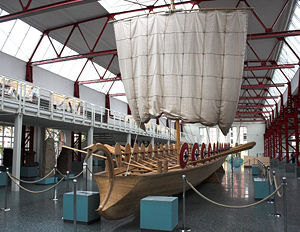 Corbulo
was made the local Roman military commander. He successfully engaged the Germans on both land and water, occupied the Rhine with his trireme
s and sent his smaller vessels up the estuaries and canals. The Germanic flotilla was destroyed in a naval engagement, Gannascus was driven out, and Frisian territory was forcibly occupied.
A negotiation between the Romans and Gannascus was arranged under the auspices of the 'Greater Chauci', which the Romans used as an opportunity to assassinate their opponent. The Chauci were outraged by the act of bad faith
, so the emperor Claudius
forebade further attacks on the Germans in an effort to ease tensions, and the Romans withdrew to the Rhine.
, they inflicted huge casualties on the Romans, including the destruction of a Roman fleet by a Germanic one off the North Sea
coast. Led by Cerialis
, the Romans gave as good as they had gotten, ultimately forcing a humiliating peace on the Batavi and stationing a legion on their territory.
Both the Chauci and the Frisians had auxiliaries serving under the Romans, and in a siege and assault by Civilis at Colonia Claudia Ara Agrippinensis (at modern Cologne
), a cohort
of Chauci and Frisians had been trapped and burned. The Chauci had supported Civilis in their own name, providing him with reinforcements.
in 12 BC. They were raiding the coasts of Roman Belgica
in AD 41, long before they participated in further raids of the same coasts under Gannascus in AD 47. It is likely that their raiding was endemic over the years, as the few surviving accounts probably do not reflect all occurrences. Tacitus
describes the Chauci as 'peaceful' in his Germania
(AD 98), but this is in a passage describing the non-coastal, inland Chauci, whereas sea raiders are necessarily a coastal people.
By the late 2nd century Chauci raiding was ongoing and more serious than before, continuing in the North Sea Channel
until their last recorded raids c. 170–175. While there are no historical sources to inform us one way or the other, it is likely that the Chauci continued their raiding until they were replaced by Frankish
and Saxon
raiders in the 3rd century.
There is archaeological evidence of destruction by raiders between 170–200, ranging along the Continental coast down to the Bay of Biscay
, to northwest Belgica (e.g., fire destruction at Amiens, Thérouanne, Vendeuil-Caply, Beauvais, Bavai, Tournai and Arras), to coastal Britain (e.g., fire destruction at the eastern Essex
sites of Chelmsford, Billericay, Gestingthorpe, Braintree, Wickford, Kelvedon, Great Chesterford and Harlow). The perpetrators are unknown, but Chauci raiders are among the prime suspects.
The Romans responded with defensive measures. Caistor-by-Norwich, Chelmsford and Voorburg (the civitas
of the Canninefates near The Hague
) were all fortified c. 200, and the Romans began a defensive system of protection especially along the coasts of Britain and the Continent. This system would be continually maintained and improved upon, which the Romans would not have done unless there was a continuing threat to be addressed. The system would continue to evolve through the disappearance of Chauci raiders and their replacement by the Frankish and Saxon ones, up to the end of the 4th century. By then it would be known as the Saxon Shore
, a name given it by the Notitia Dignitatum
.
is an Old English
heroic poem where the hero (Beowulf) engages in battles with antagonists. Set in long-ago Scandinavia
, it makes frequent references to the peoples who are a part of the story, and efforts have been made to connect those peoples with peoples mentioned in ancient historical records. The "Hugas" of the poem are said to be a reference to the Chauci.
Germanic peoples
The Germanic peoples are an Indo-European ethno-linguistic group of Northern European origin, identified by their use of the Indo-European Germanic languages which diversified out of Proto-Germanic during the Pre-Roman Iron Age.Originating about 1800 BCE from the Corded Ware Culture on the North...
living in the low-lying region between the Rivers Ems and Elbe
Elbe
The Elbe is one of the major rivers of Central Europe. It rises in the Krkonoše Mountains of the northwestern Czech Republic before traversing much of Bohemia , then Germany and flowing into the North Sea at Cuxhaven, 110 km northwest of Hamburg...
, on both sides of the Weser and ranging as far inland as the upper Weser. Along the coast they lived on artificial hills called terpen
Artificial dwelling hill
An artificial dwelling hill is a mound, created to provide safe ground during high tide and river floods....
, built high enough to remain dry during the highest tide. A dense population of Chauci lived further inland, and they are presumed to have lived in a manner similar to the lives of the other Germanic peoples of the region.
Their ultimate origins are not well understood. In the Germanic
Germanic peoples
The Germanic peoples are an Indo-European ethno-linguistic group of Northern European origin, identified by their use of the Indo-European Germanic languages which diversified out of Proto-Germanic during the Pre-Roman Iron Age.Originating about 1800 BCE from the Corded Ware Culture on the North...
pre-Migration Period
Migration Period
The Migration Period, also called the Barbarian Invasions , was a period of intensified human migration in Europe that occurred from c. 400 to 800 CE. This period marked the transition from Late Antiquity to the Early Middle Ages...
(i.e., before c. 300 AD) the Chauci and the related Frisians
Frisii
The Frisii were an ancient Germanic tribe living in the low-lying region between the Zuiderzee and the River Ems. In the Germanic pre-Migration Period the Frisii and the related Chauci, Saxons, and Angles inhabited the Continental European coast from the Zuyder Zee to south Jutland...
, Saxons
Saxons
The Saxons were a confederation of Germanic tribes originating on the North German plain. The Saxons earliest known area of settlement is Northern Albingia, an area approximately that of modern Holstein...
, and Angles
Angles
The Angles is a modern English term for a Germanic people who took their name from the ancestral cultural region of Angeln, a district located in Schleswig-Holstein, Germany...
inhabited the Continental European coast from the Zuyder Zee to south Jutland
Jutland
Jutland , historically also called Cimbria, is the name of the peninsula that juts out in Northern Europe toward the rest of Scandinavia, forming the mainland part of Denmark. It has the North Sea to its west, Kattegat and Skagerrak to its north, the Baltic Sea to its east, and the Danish–German...
. All of these peoples shared a common material culture, and so cannot be defined archaeologically. The Chauci originally centered on the Weser and Elbe, but in c. AD 58 they expanded westward to the River Ems by expelling the neighboring Ampsivarii
Ampsivarii
The Ampsivarii, sometimes referenced by modern writers as Ampsivari , were a Germanic tribe mentioned by ancient authors....
, whereby they gained a border with the Frisians to the west. The Romans referred to the Chauci living between the Weser and Elbe as the 'Greater Chauci' and those living between the Ems and Weser as the 'Lesser Chauci'.
The Chauci entered the historical record in descriptions of them by classical Roman sources late in the 1st century BC in the context of Roman military campaigns and sea raiding. For the next 200 years the Chauci provided Roman auxiliaries through treaty obligations, but they also appear in their own right in concert with other Germanic tribes, opposing the Romans. Accounts of wars therefore mention the Chauci on both sides of the conflict, though the actions of troops under treaty obligation were separate from the policies of the tribe.
The Chauci lost their separate identity in the 3rd century when they merged with the Saxons, after which time they were considered to be Saxons
Saxons
The Saxons were a confederation of Germanic tribes originating on the North German plain. The Saxons earliest known area of settlement is Northern Albingia, an area approximately that of modern Holstein...
. The circumstances of the merger are an unsettled issue of scholarly research.
Society and Life
The Germans of the region were not strongly hierarchical. This had been noted by TacitusTacitus
Publius Cornelius Tacitus was a senator and a historian of the Roman Empire. The surviving portions of his two major works—the Annals and the Histories—examine the reigns of the Roman Emperors Tiberius, Claudius, Nero and those who reigned in the Year of the Four Emperors...
, for example when he mentioned the names of two kings of the 1st century Frisians
Frisii
The Frisii were an ancient Germanic tribe living in the low-lying region between the Zuiderzee and the River Ems. In the Germanic pre-Migration Period the Frisii and the related Chauci, Saxons, and Angles inhabited the Continental European coast from the Zuyder Zee to south Jutland...
and added that they were kings "as far as the Germans are under kings". Haywood (Dark Age Naval Power, 1999) says the Chauci were originally neither highly centralised nor highly stratified, though they became more so after 100 AD. Yorke
Barbara Yorke
Barbara Yorke is a historian of Anglo-Saxon England.She studied history and archaeology at Exeter University, where she completed both her undergraduate degree and her Ph.D. She is currently Professor of Early Medieval History at the University of Winchester, and is a Fellow of the Royal...
(The Conversion of Britain c.600–800, 2006), speaking of the 5th century, describes the 'Continental Saxons' (which then included the Chauci) as having powerful local families and a dominant military leader.
Writing in AD 79, Pliny the Elder
Pliny the Elder
Gaius Plinius Secundus , better known as Pliny the Elder, was a Roman author, naturalist, and natural philosopher, as well as naval and army commander of the early Roman Empire, and personal friend of the emperor Vespasian...
said that the Germanic tribes were members of separate groups of people, suggesting a distinction among them. He said that the Chauci, Cimbri
Cimbri
The Cimbri were a tribe from Northern Europe, who, together with the Teutones and the Ambrones threatened the Roman Republic in the late 2nd century BC. The Cimbri were probably Germanic, though some believe them to be of Celtic origin...
and Teutoni
Teutons
The Teutons or Teutones were mentioned as a Germanic tribe by Greek and Roman authors, notably Strabo and Marcus Velleius Paterculus and normally in close connection with the Cimbri, whose ethnicity is contested between Gauls and Germani...
—the people from the River Ems through Jutland
Jutland
Jutland , historically also called Cimbria, is the name of the peninsula that juts out in Northern Europe toward the rest of Scandinavia, forming the mainland part of Denmark. It has the North Sea to its west, Kattegat and Skagerrak to its north, the Baltic Sea to its east, and the Danish–German...
and for some distance inland—were members of a group called Ingaevones
Ingaevones
The Ingaevones or, as Pliny has it, apparently more accurately, Ingvaeones , as described in Tacitus's Germania, written c. 98 AD, were a West Germanic cultural group living along the North Sea coast in the areas of Jutland, Holstein, Frisia and the Danish islands, where they had by the 1st...
(a "Cimbri" people were also given as members of a different group, and this is likely a different people).
Tacitus
Tacitus
Publius Cornelius Tacitus was a senator and a historian of the Roman Empire. The surviving portions of his two major works—the Annals and the Histories—examine the reigns of the Roman Emperors Tiberius, Claudius, Nero and those who reigned in the Year of the Four Emperors...
, writing in AD 98, described the inland, non-coastal Chauci homeland as immense, densely populated, and well-stocked with horses. He was effusive in his praise of their character as a people
Ethos
Ethos is a Greek word meaning "character" that is used to describe the guiding beliefs or ideals that characterize a community, nation, or ideology. The Greeks also used this word to refer to the power of music to influence its hearer's emotions, behaviors, and even morals. Early Greek stories of...
, saying that they were the noblest of the Germans, preferring justice to violence, being neither aggressive nor predatory, but militarily capable and always prepared for war if the need arose.
Artificial dwelling hill
An artificial dwelling hill is a mound, created to provide safe ground during high tide and river floods....
). They fished for food, and unlike their neighbors (i.e., those living inland, away from the coast) they had no cattle, and had nothing to drink except rainwater caught in ditches. They used a type of dried mud (i.e., "surface peat
Peat
Peat is an accumulation of partially decayed vegetation matter or histosol. Peat forms in wetland bogs, moors, muskegs, pocosins, mires, and peat swamp forests. Peat is harvested as an important source of fuel in certain parts of the world...
") as fuel for cooking and heating. He also mentioned their spirit of independence, saying that even though they had nothing of value, they would deeply resent any attempt to conquer them.
Classical Roman history
The record is incomplete. The bulk of historical information about the Chauci is from the AnnalsAnnals (Tacitus)
The Annals by Tacitus is a history of the reigns of the four Roman Emperors succeeding Caesar Augustus. The surviving parts of the Annals extensively cover most of the reigns of Tiberius and Nero. The title Annals was probably not given by Tacitus, but derives from the fact that he treated this...
of Tacitus
Tacitus
Publius Cornelius Tacitus was a senator and a historian of the Roman Empire. The surviving portions of his two major works—the Annals and the Histories—examine the reigns of the Roman Emperors Tiberius, Claudius, Nero and those who reigned in the Year of the Four Emperors...
, written in 117. Many parts of his works have not survived, including an entire section covering the years AD 38–46, as well as the years after AD 69.
The earliest mention of the Chauci is from 12 BC and suggests that they were assisting other Germanic tribes in a war against the Romans
Roman Empire
The Roman Empire was the post-Republican period of the ancient Roman civilization, characterised by an autocratic form of government and large territorial holdings in Europe and around the Mediterranean....
. Drusus
Nero Claudius Drusus
Nero Claudius Drusus Germanicus , born Decimus Claudius Drusus also called Drusus, Drusus I, Nero Drusus, or Drusus the Elder was a Roman politician and military commander. He was a fully patrician Claudian on his father's side but his maternal grandmother was from a plebeian family...
campaigned against those Germans along the lower Rhine, and after devastating the lands west and north of the Rhine he won over (or defeated or intimidated) the Frisians
Frisii
The Frisii were an ancient Germanic tribe living in the low-lying region between the Zuiderzee and the River Ems. In the Germanic pre-Migration Period the Frisii and the related Chauci, Saxons, and Angles inhabited the Continental European coast from the Zuyder Zee to south Jutland...
. He was in the process of attacking the Chauci when his vessels were trapped by an ebb tide
Tide
Tides are the rise and fall of sea levels caused by the combined effects of the gravitational forces exerted by the moon and the sun and the rotation of the Earth....
. Drusus gave up the attack and withdrew.
Aftermath of Teutoburg Forest, c. 15
The Germans under ArminiusArminius
Arminius , also known as Armin or Hermann was a chieftain of the Germanic Cherusci who defeated a Roman army in the Battle of the Teutoburg Forest...
had destroyed 3 Roman legion
Roman legion
A Roman legion normally indicates the basic ancient Roman army unit recruited specifically from Roman citizens. The organization of legions varied greatly over time but they were typically composed of perhaps 5,000 soldiers, divided into maniples and later into "cohorts"...
s under Varus
Varus
-People:*Publius Attius Varus , Roman governor of Africa.*Publius Quinctilius Varus , politician of the Roman Empire.*Quinctilius Varus -People:*Publius Attius Varus (died 17 March 45 BCE), Roman governor of Africa.*Publius Quinctilius Varus (46 BCE - 9 CE), politician of the Roman...
at the Battle of the Teutoburg Forest
Battle of the Teutoburg Forest
The Battle of the Teutoburg Forest took place in 9 CE, when an alliance of Germanic tribes led by Arminius of the Cherusci ambushed and decisively destroyed three Roman legions, along with their auxiliaries, led by Publius Quinctilius Varus.Despite numerous successful campaigns and raids by the...
in AD 9. The Romans recoiled at first but then Germanicus
Germanicus
Germanicus Julius Caesar , commonly known as Germanicus, was a member of the Julio-Claudian dynasty and a prominent general of the early Roman Empire. He was born in Rome, Italia, and was named either Nero Claudius Drusus after his father or Tiberius Claudius Nero after his uncle...
initiated destructive campaigns against those Germans whom the Romans blamed for their defeat. The Chauci were not among them, and were said to have promised aid, and were associated with the Romans in "military fellowship". However, in defeating Arminius' own tribe (the Cherusci
Cherusci
The Cherusci were a Germanic tribe that inhabited parts of the northern Rhine valley and the plains and forests of northwestern Germany, in the area between present-day Osnabrück and Hanover, during the 1st century BC and 1st century AD...
) the Romans were unable to capture or kill Arminius, who escaped. There were Chauci among the Roman auxiliaries, and they were rumored to have allowed the escape. In one of the campaigns a Roman fleet (probably riverine, not ocean-going) was broken up by a storm, causing many casualties. Germanicus himself managed to survive by reaching the lands of the Chauci, who provided him with a safe haven.
A parenthetical note concerns the Ampsivarii
Ampsivarii
The Ampsivarii, sometimes referenced by modern writers as Ampsivari , were a Germanic tribe mentioned by ancient authors....
. They had not supported the German cause led by Arminius in 9 AD and had been ostracized as a result. The Chauci had suffered no such disaffection from the other Germanic tribes in the aftermath of Teutoburg Forest, nor had they alienated the Romans. Many years later, c. AD 58, the Chauci seized an opportunity to expel the Ampsivarii and occupy their lands at the mouth of the River Ems, whereby they gained a border with the Frisians to the west.
Roman war against Gannascus, c. 47
In AD 47 (and perhaps for some time earlier) the Chauci along with the Frisians were led by a certain Gannascus of the Canninefates. They raided along the then-wealthy coast of Gallia BelgicaGallia Belgica
Gallia Belgica was a Roman province located in what is now the southern part of the Netherlands, Belgium, Luxembourg, northeastern France, and western Germany. The indigenous population of Gallia Belgica, the Belgae, consisted of a mixture of Celtic and Germanic tribes...
(i.e., the land south of the Rhine and north of the Rivers Marne and Seine
Seine
The Seine is a -long river and an important commercial waterway within the Paris Basin in the north of France. It rises at Saint-Seine near Dijon in northeastern France in the Langres plateau, flowing through Paris and into the English Channel at Le Havre . It is navigable by ocean-going vessels...
), and the Chauci made inroads into the region that would later become the Roman province of Germania Inferior
Germania Inferior
Germania Inferior was a Roman province located on the left bank of the Rhine, in today's Luxembourg, southern Netherlands, parts of Belgium, and North Rhine-Westphalia left of the Rhine....
(which mostly consisted of the modern southern Netherlands
Netherlands
The Netherlands is a constituent country of the Kingdom of the Netherlands, located mainly in North-West Europe and with several islands in the Caribbean. Mainland Netherlands borders the North Sea to the north and west, Belgium to the south, and Germany to the east, and shares maritime borders...
).
Gnaeus Domitius Corbulo
Gnaeus Domitius Corbulo was a Roman general and a brother-in-law of the emperor Caligula.-Descent:Corbulo was born in Italy into a senatorial family...
was made the local Roman military commander. He successfully engaged the Germans on both land and water, occupied the Rhine with his trireme
Trireme
A trireme was a type of galley, a Hellenistic-era warship that was used by the ancient maritime civilizations of the Mediterranean, especially the Phoenicians, ancient Greeks and Romans.The trireme derives its name from its three rows of oars on each side, manned with one man per oar...
s and sent his smaller vessels up the estuaries and canals. The Germanic flotilla was destroyed in a naval engagement, Gannascus was driven out, and Frisian territory was forcibly occupied.
A negotiation between the Romans and Gannascus was arranged under the auspices of the 'Greater Chauci', which the Romans used as an opportunity to assassinate their opponent. The Chauci were outraged by the act of bad faith
Bad faith
Bad faith is double mindedness or double heartedness in duplicity, fraud, or deception. It may involve intentional deceit of others, or self deception....
, so the emperor Claudius
Claudius
Claudius , was Roman Emperor from 41 to 54. A member of the Julio-Claudian dynasty, he was the son of Drusus and Antonia Minor. He was born at Lugdunum in Gaul and was the first Roman Emperor to be born outside Italy...
forebade further attacks on the Germans in an effort to ease tensions, and the Romans withdrew to the Rhine.
Batavian Revolt, c. 69
In AD 69 the Batavi and other tribes rose against Roman rule in the Revolt of the Batavi, becoming a general uprising by all the Germans in the region. Led by CivilisGaius Julius Civilis
Gaius Julius Civilis was the leader of the Batavian rebellion against the Romans in 69. By his nomen, it can be told that he was made a Roman citizen by either Augustus or Caligula....
, they inflicted huge casualties on the Romans, including the destruction of a Roman fleet by a Germanic one off the North Sea
North Sea
In the southwest, beyond the Straits of Dover, the North Sea becomes the English Channel connecting to the Atlantic Ocean. In the east, it connects to the Baltic Sea via the Skagerrak and Kattegat, narrow straits that separate Denmark from Norway and Sweden respectively...
coast. Led by Cerialis
Quintus Petillius Cerialis
Quintus Petilius Cerialis Caesius Rufus was a Roman general and administrator who served in Britain during Boudica's rebellion and who went on to participate in the civil wars after the death of Nero. He later defeated the rebellion of Julius Civilis and returned to Britain as its governor.His...
, the Romans gave as good as they had gotten, ultimately forcing a humiliating peace on the Batavi and stationing a legion on their territory.
Both the Chauci and the Frisians had auxiliaries serving under the Romans, and in a siege and assault by Civilis at Colonia Claudia Ara Agrippinensis (at modern Cologne
Cologne
Cologne is Germany's fourth-largest city , and is the largest city both in the Germany Federal State of North Rhine-Westphalia and within the Rhine-Ruhr Metropolitan Area, one of the major European metropolitan areas with more than ten million inhabitants.Cologne is located on both sides of the...
), a cohort
Cohort (military unit)
A cohort was the basic tactical unit of a Roman legion following the reforms of Gaius Marius in 107 BC.-Legionary cohort:...
of Chauci and Frisians had been trapped and burned. The Chauci had supported Civilis in their own name, providing him with reinforcements.
Sea raiding
The Chauci were one of the most prominent early Germanic sea raiders. They are probable participants in the Germanic flotilla that was destroyed by DrususNero Claudius Drusus
Nero Claudius Drusus Germanicus , born Decimus Claudius Drusus also called Drusus, Drusus I, Nero Drusus, or Drusus the Elder was a Roman politician and military commander. He was a fully patrician Claudian on his father's side but his maternal grandmother was from a plebeian family...
in 12 BC. They were raiding the coasts of Roman Belgica
Gallia Belgica
Gallia Belgica was a Roman province located in what is now the southern part of the Netherlands, Belgium, Luxembourg, northeastern France, and western Germany. The indigenous population of Gallia Belgica, the Belgae, consisted of a mixture of Celtic and Germanic tribes...
in AD 41, long before they participated in further raids of the same coasts under Gannascus in AD 47. It is likely that their raiding was endemic over the years, as the few surviving accounts probably do not reflect all occurrences. Tacitus
Tacitus
Publius Cornelius Tacitus was a senator and a historian of the Roman Empire. The surviving portions of his two major works—the Annals and the Histories—examine the reigns of the Roman Emperors Tiberius, Claudius, Nero and those who reigned in the Year of the Four Emperors...
describes the Chauci as 'peaceful' in his Germania
Germania (book)
The Germania , written by Gaius Cornelius Tacitus around 98, is an ethnographic work on the Germanic tribes outside the Roman Empire.-Contents:...
(AD 98), but this is in a passage describing the non-coastal, inland Chauci, whereas sea raiders are necessarily a coastal people.
By the late 2nd century Chauci raiding was ongoing and more serious than before, continuing in the North Sea Channel
English Channel
The English Channel , often referred to simply as the Channel, is an arm of the Atlantic Ocean that separates southern England from northern France, and joins the North Sea to the Atlantic. It is about long and varies in width from at its widest to in the Strait of Dover...
until their last recorded raids c. 170–175. While there are no historical sources to inform us one way or the other, it is likely that the Chauci continued their raiding until they were replaced by Frankish
Franks
The Franks were a confederation of Germanic tribes first attested in the third century AD as living north and east of the Lower Rhine River. From the third to fifth centuries some Franks raided Roman territory while other Franks joined the Roman troops in Gaul. Only the Salian Franks formed a...
and Saxon
Saxons
The Saxons were a confederation of Germanic tribes originating on the North German plain. The Saxons earliest known area of settlement is Northern Albingia, an area approximately that of modern Holstein...
raiders in the 3rd century.
There is archaeological evidence of destruction by raiders between 170–200, ranging along the Continental coast down to the Bay of Biscay
Bay of Biscay
The Bay of Biscay is a gulf of the northeast Atlantic Ocean located south of the Celtic Sea. It lies along the western coast of France from Brest south to the Spanish border, and the northern coast of Spain west to Cape Ortegal, and is named in English after the province of Biscay, in the Spanish...
, to northwest Belgica (e.g., fire destruction at Amiens, Thérouanne, Vendeuil-Caply, Beauvais, Bavai, Tournai and Arras), to coastal Britain (e.g., fire destruction at the eastern Essex
Essex
Essex is a ceremonial and non-metropolitan county in the East region of England, and one of the home counties. It is located to the northeast of Greater London. It borders with Cambridgeshire and Suffolk to the north, Hertfordshire to the west, Kent to the South and London to the south west...
sites of Chelmsford, Billericay, Gestingthorpe, Braintree, Wickford, Kelvedon, Great Chesterford and Harlow). The perpetrators are unknown, but Chauci raiders are among the prime suspects.
The Romans responded with defensive measures. Caistor-by-Norwich, Chelmsford and Voorburg (the civitas
Civitas
In the history of Rome, the Latin term civitas , according to Cicero in the time of the late Roman Republic, was the social body of the cives, or citizens, united by law . It is the law that binds them together, giving them responsibilities on the one hand and rights of citizenship on the other...
of the Canninefates near The Hague
The Hague
The Hague is the capital city of the province of South Holland in the Netherlands. With a population of 500,000 inhabitants , it is the third largest city of the Netherlands, after Amsterdam and Rotterdam...
) were all fortified c. 200, and the Romans began a defensive system of protection especially along the coasts of Britain and the Continent. This system would be continually maintained and improved upon, which the Romans would not have done unless there was a continuing threat to be addressed. The system would continue to evolve through the disappearance of Chauci raiders and their replacement by the Frankish and Saxon ones, up to the end of the 4th century. By then it would be known as the Saxon Shore
Saxon Shore
Saxon Shore could refer to one of the following:* Saxon Shore, a military command of the Late Roman Empire, encompassing southern Britain and the coasts of northern France...
, a name given it by the Notitia Dignitatum
Notitia Dignitatum
The Notitia Dignitatum is a unique document of the Roman imperial chanceries. One of the very few surviving documents of Roman government, it details the administrative organisation of the eastern and western empires, listing several thousand offices from the imperial court down to the provincial...
.
In literature
BeowulfBeowulf
Beowulf , but modern scholars agree in naming it after the hero whose life is its subject." of an Old English heroic epic poem consisting of 3182 alliterative long lines, set in Scandinavia, commonly cited as one of the most important works of Anglo-Saxon literature.It survives in a single...
is an Old English
Old English language
Old English or Anglo-Saxon is an early form of the English language that was spoken and written by the Anglo-Saxons and their descendants in parts of what are now England and southeastern Scotland between at least the mid-5th century and the mid-12th century...
heroic poem where the hero (Beowulf) engages in battles with antagonists. Set in long-ago Scandinavia
Scandza
Scandza was the name given to Scandinavia by the Roman historian Jordanes in his work Getica, written while in Constantinople around AD 551. He described the area to set the stage for his treatment of the Goths' migration from southern Sweden to Gothiscandza...
, it makes frequent references to the peoples who are a part of the story, and efforts have been made to connect those peoples with peoples mentioned in ancient historical records. The "Hugas" of the poem are said to be a reference to the Chauci.