


Euphrates

Encyclopedia
The Euphrates is the longest and one of the most historically important rivers of Western Asia. Together with the Tigris
, it is one of the two defining rivers of Mesopotamia
. Originating in eastern Turkey
, the Euphrates flows through Syria
and Iraq
to join the Tigris in the Shatt al-Arab, which empties into the Persian Gulf
.
lol
or Western Euphrates (450 kilometres (279.6 mi)) and the Murat Su
or Eastern Euphrates (650 kilometres (403.9 mi)) 10 kilometres (6.2 mi) upstream from the town of Keban in Turkey. Daoudy and Frenken put the length of the Euphrates from the source of the Murat River to the confluence with the Tigris
at 3000 kilometres (1,864.1 mi), of which 1230 kilometres (764.3 mi) falls in Turkey
, 710 kilometres (441.2 mi) in Syria
and 1060 kilometres (658.7 mi) in Iraq. The same figures are given by Isaev and Mikhailova. The length of the Shatt al-Arab, which connects the Euphrates and the Tigris with the Persian Gulf
, is given by various sources as 145 –.
Both the Kara Su and the Murat Su rise northwest from Lake Van
at elevations of 3290 metres (10,794 ft) and 3520 metres (11,548.6 ft) amsl
, respectively. At the location of the Keban Dam
, the two rivers, now combined into the Euphrates, have dropped to an elevation of 693 metres (2,273.6 ft) amsl. From Keban to the Syrian–Turkish border, the river drops another 368 metres (1,207.3 ft) over a distance of less than 600 kilometres (372.8 mi). Once the Euphrates enters the Upper Mesopotamian plains, its grade drops significantly; within Syria the river falls 163 metres (534.8 ft) while over the last stretch between Hīt
and the Shatt al-Arab the river drops only 55 metres (180.4 ft).
in these two months accounts for 36 percent of the total annual discharge of the Euphrates, or even 60–70 percent according to one source, while low runoff occurs in summer and autumn. The average natural annual flow of the Euphrates has been determined from early- and mid-twentieth century records as 20.9 cubic kilometres (5 cu mi) at Keban, 36.6 cubic kilometres (8.8 cu mi) at Hīt
and 21.5 cubic kilometres (5.2 cu mi) at Hindiya
. However, these averages mask the high inter-annual variability in discharge; at Birecik
, just above the Syro–Turkish border, annual discharges have been measured that ranged from a low volume of 15.3 cubic kilometres (3.7 cu mi) in 1961 to a high 42.7 cubic kilometres (10.2 cu mi) in 1963.
The discharge regime of the Euphrates has changed dramatically since the construction of the first dams in the 1970s. Data on Euphrates discharge collected after 1990 show the impact of the construction of the numerous dams in the Euphrates and of the increased withdrawal of water for irrigation. Average discharge at Hīt after 1990 has dropped to 356 cubic metres (12,572 cu ft) per second (11.2 cubic kilometres (2.7 cu mi) per year). The seasonal variability has equally changed. The pre-1990 peak volume recorded at Hīt was 7510 cubic metres (265,213.1 cu ft) per second, while after 1990 it is only 2514 cubic metres (88,781.1 cu ft) per second. The minimum volume at Hīt remained relatively unchanged, rising from 55 cubic metres (1,942.3 cu ft) per second before 1990 to 58 cubic metres (2,048.3 cu ft) per second afterward.
, the Balikh and the Khabur
. These rivers rise in the foothills of the Taurus Mountains along the Syro–Turkish border and add comparatively little water to the Euphrates. The Sajur is the smallest of these tributaries; emerging from two streams near Gaziantep
and draining the plain around Manbij before emptying into the reservoir
of the Tishrin Dam
. The Balikh receives most of its water from a karstic
spring near 'Ayn al-'Arus and flows due south until it reaches the Euphrates at the city of Ar-Raqqah. In terms of length, drainage basin and discharge, the Khabur is the largest of these three. Its main karstic springs are located around Ra's al-'Ayn
, from where the Khabur flows southeast past Al-Hasakah
, where the river turns south and drains into the Euphrates near Busayrah
. Once the Euphrates enters Iraq, there are no more natural tributaries to the Euphrates, although canals connecting the Euphrates basin with the Tigris basin exist.
s of the Kara Su and the Murat River cover an area of 22000 square kilometres (8,494.2 sq mi) and 40000 square kilometres (15,444.1 sq mi), respectively. The estimates that have been made for the area of the Euphrates drainage basin vary widely; from a low 233000 square kilometres (89,961.8 sq mi) to a high 766000 square kilometres (295,754.3 sq mi). Recent estimates put the basin area at 388000 square kilometres (149,807.6 sq mi), 444000 square kilometres (171,429.4 sq mi) and 579314 square kilometres (223,674.4 sq mi). The greater part of the Euphrates basin is located in Turkey, Syria and Iraq. According to both Daoudy and Frenken, Turkey's share is 28 percent, Syria's is 17 percent and that of Iraq is 40 percent. Isaev and Mikhailova estimate the percentages of the drainage basin lying within Turkey, Syria and Iraq at 33, 20 and 47 percent respectively. Some sources estimate that approximately 15 percent of the drainage basin is located within Saudi Arabia
, while a small part falls inside the borders of Kuwait
. Finally, some sources also include Jordan
in the drainage basin of the Euphrates; a small part of the eastern desert (220 square kilometres (84.9 sq mi)) drains toward the east rather than to the west.
zones. Although millennia-long human occupation in most parts of the Euphrates basin has significantly degraded the landscape, patches of original vegetation remain. The steady drop in annual rainfall from the sources of the Euphrates toward the Persian Gulf is a strong determinant for the vegetation that can be supported. In its upper reaches the Euphrates flows through the mountains of Southeast Turkey and their southern foothills which support a xeric woodland
. Plant species in the moister parts of this zone include various oak
s, pistachio trees
, and Rosaceae
(rose/plum family). The drier parts of the xeric woodland zone supports less dense oak forest and Rosaceae. Here can also be found the wild variants of many cereals, including einkorn wheat
, emmer wheat, oat
and rye
. South of this zone lies a zone of mixed woodland-steppe
vegetation. Between Raqqa and the Syro–Iraqi border the Euphrates flows through a steppe landscape. This steppe is characterised by white wormwood
(Artemisia herba-alba) and Chenopodiaceae
. Throughout history, this zone has been heavily overgrazed due to the practicing of sheep and goat
pastoralism
by its inhabitants. Southeast of the border between Syria and Iraq starts true desert
. This zone supports either no vegetation at all or small pockets of Chenopodiaceae or Poa sinaica
. Although today nothing of it survives due to human interference, research suggests that the Euphrates Valley would have supported a riverine forest
. Species characteristic of this type of forest include the Oriental plane
, the Euphrates poplar, the tamarisk
, the ash and various wetland plants.
Among the fish species in the Tigris–Euphrates basin, the family of the Cyprinidae are the most common, with 34 species out of 52 in total. Among the Cyprinids, the mangar
has good sport fishing
qualities, leading the British to nickname it "Tigris salmon." The Rafetus euphraticus
is an endangered soft-shelled turtle
that is limited to the Tigris–Euphrates river system.
The Neo-Assyrian palace reliefs from the 1st millennium BCE depict lion
and bull hunts in fertile landscapes. Sixteenth to nineteenth century European travellers in the Syrian Euphrates basin reported on an abundance of animals living in the area, many of which have become rare or even extinct. Species like gazelle
, onager
and the now-extinct Arabian ostrich
lived in the steppe bordering the Euphrates valley, while the valley itself was home to the wild boar. Carnivorous species include the gray wolf
, the golden jackal
, the red fox
, the leopard
and the lion. The Syrian brown bear
can be found in the mountains of Southeast Turkey. The presence of European beaver
has been attested in the bone assemblage of the prehistoric site of Abu Hureyra in Syria, but the beaver has never been sighted in historical times.
on the Iraqi Euphrates, based on plans by the British civil engineer William Willcocks
and finished in 1913, was the first modern water diversion structure built in the Tigris–Euphrates river system. The Hindiya Barrage was followed in the 1950s by the Ramadi Barrage
and the nearby Abu Dibbis Regulator, which serve to regulate the flow regime of the Euphrates and to discharge excess flood water into the depression
that is now Lake Habbaniyah. Iraq’s largest dam on the Euphrates is the Haditha Dam
; a 9 kilometres (5.6 mi) long earth-fill dam
creating Lake Qadisiyah
. Syria and Turkey built their first dams in the Euphrates in the 1970s. The Tabqa Dam in Syria was completed in 1973 while Turkey finished the Keban Dam, a prelude to the immense Southeastern Anatolia Project
, in 1974. Since then, Syria has built two more dams in the Euphrates, the Baath Dam
and the Tishrin Dam, and plans to build a fourth dam – the Halabiye Dam
– between Ar-Raqqah and Deir ez-Zor. The Tabqa Dam is Syria's largest dam and its reservoir (Lake Assad) is an important source of irrigation and drinking water. It was planned that 640000 hectares (2,471.1 sq mi) should be irrigated from Lake Assad, but in 2000 only 100000 – had been realized. Syria also built three smaller dams on the Khabur and its tributaries.
With the implementation of the Southeastern Anatolia Project (Güneydoğu Anadolu Projesi, or GAP) in the 1970s, Turkey launched an ambitious plan to harness the waters of the Tigris and the Euphrates for irrigation and hydroelectricity production and provide an economic stimulus to its southeastern provinces. GAP affects a total area of 75000 square kilometres (28,957.7 sq mi) and approximately 7 million people; representing about 10 percent of Turkey's total surface area and population, respectively. When completed, GAP will consist of 22 dams – including the Keban Dam – and 19 power plants and provide irrigation water to 1700000 hectares (6,563.7 sq mi) of agricultural land, which is about 20 percent of the irrigable land in Turkey. Circa 910000 hectares (3,513.5 sq mi) of this irrigated land is located in the Euphrates basin. By far the largest dam in GAP is the Atatürk Dam
, located circa 55 kilometres (34.2 mi) northwest of Şanlıurfa
. This 184 metres (603.7 ft) high and 1820 metres (5,971.1 ft) long dam was completed in 1992; thereby creating a reservoir that is the third-largest lake in Turkey. With a maximum capacity of 48.7 cubic kilometres (11.7 cu mi), the Atatürk Dam reservoir is large enough to hold the entire annual discharge of the Euphrates. Completion of GAP was scheduled for 2010 but has been delayed because the World Bank
has withheld funding due to the lack of an official agreement on water sharing between Turkey and the downstream states on the Euphrates and the Tigris.
Apart from barrages and dams, Iraq has also created an intricate network of canals connecting the Euphrates with Lake Habbaniyah, Lake Tharthar
, and Abu Dibbis reservoir; all of which can be used to store excess floodwater. Via the Shatt al-Hayy
, the Euphrates is connected with the Tigris. The largest canal in this network is the Main Outfall Drain or so-called "Third River;" constructed between 1953 and 1992. This 565 kilometres (351.1 mi) long canal is intended to drain the area between the Euphrates and the Tigris south of Baghdad
to prevent soil salinization from irrigation. It also allows large freight barges to navigate up to Baghdad.
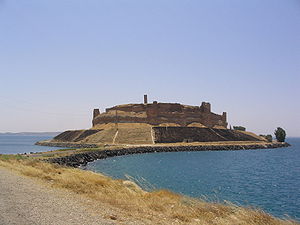 The construction of the dams and irrigation schemes on the Euphrates has had a significant impact on the environment and society of each riparian country. The dams constructed as part of GAP – in both the Euphrates and the Tigris basins – have affected 382 villages and almost 200,000 people have been resettled elsewhere. The largest number of people was displaced by the building of the Atatürk Dam, which alone affected 55,300 people. A survey among those who were displaced showed that the majority were unhappy with their new situation and that the compensation they had received was considered insufficient. The flooding of Lake Assad led to the forced displacement of circa 4,000 families, who were resettled in other parts of northern Syria as part of a now abandoned plan to create an "Arab belt" along the borders with Turkey and Iraq.
Apart from the changes in the discharge regime of the river, the numerous dams and irrigation projects have also had other effects on the environment. The creation of reservoirs with large surfaces in countries with high average temperatures has led to increased evaporation
; thereby reducing the total amount of water that is available for human use. Annual evaporation from reservoirs has been estimated at 2 cubic kilometre (0.479825517208573 cu mi) in Turkey, 1 cubic kilometre (0.239912758604287 cu mi) in Syria and 5 cubic kilometres (1.2 cu mi) in Iraq. Water quality in the Iraqi Euphrates is low because irrigation water tapped in Turkey and Syria flows back into the river, together with dissolved fertilizer chemicals used on the fields. The salinity of Euphrates water in Iraq has increased as a result of upstream dam construction, leading to lower suitability as drinking water. The many dams and irrigation schemes, and the associated large-scale water abstraction, have also had a detrimental effect on the ecologically already fragile Mesopotamian Marshes
and on freshwater fish habitat
s in Iraq.
The inundation of large parts of the Euphrates valley, especially in Turkey and Syria, has led to the flooding of many archaeological site
s and other places of cultural significance. Although concerted efforts have been made to record or save as much of the endangered cultural heritage
as possible, many sites are probably lost forever. The combined GAP projects on the Turkish Euphrates have led to major international efforts to document the archaeological and cultural heritage of the endangered parts of the valley. Especially the flooding of Zeugma
with its unique Roman
mosaic
s by the reservoir of the Birecik Dam
has generated much controversy in both the Turkish and international press. The construction of the Tabqa Dam in Syria led to a large international campaign coordinated by UNESCO
to document the heritage that would disappear under the waters of Lake Assad. Archaeologists from numerous countries excavated sites ranging in date from the Natufian
to the Abbasid period, and two minarets were dismantled and rebuilt outside the flood zone. Important sites that have been flooded or affected by the rising waters of Lake Assad include Mureybet
, Emar
and Abu Hureyra. A similar international effort was made when the Tishrin Dam was constructed, which led, among others, to the flooding of the important Pre-Pottery Neolithic B
site of Jerf el-Ahmar. An archaeological survey
and rescue excavations
were also carried out in the area flooded by Lake Qadisiya in Iraq. Parts of the flooded area have recently become accessible again due to the drying up of the lake, resulting not only in new possibilities for archaeologists to do more research, but also providing opportunities for looting
, which has been rampant elsewhere in Iraq in the wake of the 2003 invasion
.
. Acheulean
stone artifacts
have been found in the Sajur basin and in the El Kowm oasis
in the central Syrian steppe; the latter together with remains of Homo erectus
that were dated to 450,000 years old. In the Taurus Mountains and the upper part of the Syrian Euphrates valley, early permanent villages such as Abu Hureyra – at first occupied by hunter-gatherer
s but later by some of the earliest farmer
s, Jerf el-Ahmar, Mureybet and Nevalı Çori
became established from the eleventh millennium BCE onward. In the absence of irrigation, these early farming communities were limited to areas where rainfed agriculture was possible, that is, the upper parts of the Syrian Euphrates as well as Turkey. Late Neolithic villages, characterized by the introduction of pottery
in the early 7th millennium BCE, are known throughout this area. Occupation of lower Mesopotamia started in the 6th millennium and is generally associated with the introduction of irrigation, as rainfall in this area is insufficient for dry agriculture. Evidence for irrigation has been found at several sites dating to this period, including Tell es-Sawwan
. During the 5th millennium BCE, or late Ubaid period
, northeastern Syria was dotted by small villages, although some of them grew to a size of over 10 hectares (24.7 acre). In Iraq, sites like Eridu
and Ur
were already occupied during the Ubaid period. Clay boat models found at Tell Mashnaqa
along the Khabur
indicate that riverine transport was already practiced during this period. The Uruk period
, roughly coinciding with the 4th millennium BCE, saw the emergence of truly urban
settlements across Mesopotamia. Cities like Tell Brak
and Uruk
grew to over 100 hectares (247.1 acre) in size and displayed monumental architecture. The spread of southern Mesopotamian pottery, architecture and sealings
far into Turkey and Iran
has generally been interpreted as the material reflection of a widespread trade system aimed at providing the Mesopotamian cities with raw materials. Habuba Kabira
on the Syrian Euphrates is a prominent example of a settlement that is interpreted as an Uruk colony.
and Early Dynastic periods (3100–2350 BCE), southern Mesopotamia experienced a growth in the number and size of settlements, suggesting strong population growth. These settlements, including sites like Sippar, Uruk and Kish
, were organized in competing city-state
s. Many of these cities were located along canals of the Euphrates and the Tigris that have since dried up, but that can still be identified from remote sensing
imagery. A similar development took place in Upper Mesopotamia, although only in the second part of the 3rd millennium and on a smaller scale than in Lower Mesopotamia. Sites like Mari
and Tell Leilan
grew to prominence for the first time during this period. Large parts of the Euphrates basin were for the first time united under a single ruler during the Akkadian and Ur III
empires, which controlled – either directly or indirectly through vassals – large parts of modern-day Iraq and northeastern Syria. Following their collapse, Mari asserted its power over northeast Syria while southern Mesopotamia was controlled by city-states like Isin
and Larsa
before their territories were absorbed by Babylon
under Hammurabi
in the 18th century BCE. In the second half of the 2nd millennium BCE, the Euphrates basin was divided between Kassite
Babylon in the south and Mitanni
in the north, with the latter being eventually replaced by Assyria
and the Hittite Empire
. Following the collapse of the Hittite Empire and the reduction in power of Assyria and Babylonia during the 12th century BCE, struggles broke out between Babylonia and Assyria over the control of the Iraqi Euphrates basin. The Neo-Assyrian Empire eventually emerged victorious out of this conflict and also succeeded in gaining control of the northern Euphrates basin in the first half of the 1st millennium BCE. In the centuries to come, control of the wider Euphrates basin shifted from the Neo-Assyrian Empire to the Neo-Babylonian Empire
in the 7th century and to the Achaemenids
in the 6th century BCE. The Achaemenid Empire was in turn overran by Alexander the Great, who defeated the last king Darius III
and died in Babylon in 323 BCE. For several centuries, the river formed the eastern limit of effective Egypt
ian and Roman
control and western regions of the Persian Empire.
, the borders in Southwest Asia were redrawn in the Treaty of Lausanne
, when the Ottoman Empire
was partitioned
. Clause 109 of the treaty stipulated that the three riparian states of the Euphrates (at that time Turkey, France
for its Syrian mandate and the United Kingdom
for its mandate of Iraq) had to reach a mutual agreement on the use of its water and on the construction of any hydraulic installation. An agreement between Turkey and Iraq signed in 1946 required Turkey to report to Iraq on any hydraulic changes it made on the Tigris–Euphrates river system, and allowed Iraq to construct dams on Turkish territory to manage the flow of the Euphrates.
Turkey and Syria completed their first dams on the Euphrates – the Keban Dam and the Tabqa Dam, respectively – within one year of each other and filling of the reservoirs commenced in 1975. At the same time, the area was hit by severe drought and river flow toward Iraq was reduced from 15.3 cubic kilometres (3.7 cu mi) in 1973 to 9.4 cubic kilometres (2.3 cu mi) in 1975. This led to an international crisis during which Iraq threatened to bomb the Tabqa Dam. An agreement was eventually reached between Syria and Iraq after intervention by Saudi Arabia and the Soviet Union
. A similar crisis, although not escalating to the point of military threats, occurred in 1981 when the Keban Dam reservoir had to be refilled after it had been almost emptied to temporarily increase Turkey's hydroelectricity production. In 1984, Turkey unilaterally declared that it would ensure a flow of at least 500 cubic metres (17,657.3 cu ft) per second, or 16 cubic kilometres (3.8 cu mi) per year, into Syria, and in 1987 a bilateral treaty to that effect was signed between the two countries. Another bilateral agreement from 1989 between Syria and Iraq settles the amount of water flowing into Iraq at 60 percent of the amount that Syria receives from Turkey. In 2008, Turkey, Syria and Iraq instigated the Joint Trilateral Committee (JTC) on the management of the water in the Tigris–Euphrates basin and on 3 September 2009 a further agreement was signed to this effect.
, 75 kilometres (46.6 mi) to the west of the river valley. The lake also supports a modest state-operated fishing industry. Through a newly restored power line, the Haditha Dam in Iraq provides electricity to Baghdad.
Tigris
The Tigris River is the eastern member of the two great rivers that define Mesopotamia, the other being the Euphrates. The river flows south from the mountains of southeastern Turkey through Iraq.-Geography:...
, it is one of the two defining rivers of Mesopotamia
Mesopotamia
Mesopotamia is a toponym for the area of the Tigris–Euphrates river system, largely corresponding to modern-day Iraq, northeastern Syria, southeastern Turkey and southwestern Iran.Widely considered to be the cradle of civilization, Bronze Age Mesopotamia included Sumer and the...
. Originating in eastern Turkey
Turkey
Turkey , known officially as the Republic of Turkey , is a Eurasian country located in Western Asia and in East Thrace in Southeastern Europe...
, the Euphrates flows through Syria
Syria
Syria , officially the Syrian Arab Republic , is a country in Western Asia, bordering Lebanon and the Mediterranean Sea to the West, Turkey to the north, Iraq to the east, Jordan to the south, and Israel to the southwest....
and Iraq
Iraq
Iraq ; officially the Republic of Iraq is a country in Western Asia spanning most of the northwestern end of the Zagros mountain range, the eastern part of the Syrian Desert and the northern part of the Arabian Desert....
to join the Tigris in the Shatt al-Arab, which empties into the Persian Gulf
Persian Gulf
The Persian Gulf, in Southwest Asia, is an extension of the Indian Ocean located between Iran and the Arabian Peninsula.The Persian Gulf was the focus of the 1980–1988 Iran-Iraq War, in which each side attacked the other's oil tankers...
.
lol
Course
The Euphrates emerges from the confluence of the Kara SuKarasu (Euphrates)
The Karasu or Western Euphrates is a long river in eastern Turkey, one of the two sources of the Euphrates. It has a length of about 450 km. To the ancient Greeks the river was known as the Τηλεβόας ....
or Western Euphrates (450 kilometres (279.6 mi)) and the Murat Su
Murat River
The Murat River or Eastern Euphrates is the major source of the Euphrates. It was also called Arsanias in antiquity. The river originates near Mount Ararat north of Lake Van, in eastern Turkey, and flows westward for through mountainous area...
or Eastern Euphrates (650 kilometres (403.9 mi)) 10 kilometres (6.2 mi) upstream from the town of Keban in Turkey. Daoudy and Frenken put the length of the Euphrates from the source of the Murat River to the confluence with the Tigris
Tigris
The Tigris River is the eastern member of the two great rivers that define Mesopotamia, the other being the Euphrates. The river flows south from the mountains of southeastern Turkey through Iraq.-Geography:...
at 3000 kilometres (1,864.1 mi), of which 1230 kilometres (764.3 mi) falls in Turkey
Turkey
Turkey , known officially as the Republic of Turkey , is a Eurasian country located in Western Asia and in East Thrace in Southeastern Europe...
, 710 kilometres (441.2 mi) in Syria
Syria
Syria , officially the Syrian Arab Republic , is a country in Western Asia, bordering Lebanon and the Mediterranean Sea to the West, Turkey to the north, Iraq to the east, Jordan to the south, and Israel to the southwest....
and 1060 kilometres (658.7 mi) in Iraq. The same figures are given by Isaev and Mikhailova. The length of the Shatt al-Arab, which connects the Euphrates and the Tigris with the Persian Gulf
Persian Gulf
The Persian Gulf, in Southwest Asia, is an extension of the Indian Ocean located between Iran and the Arabian Peninsula.The Persian Gulf was the focus of the 1980–1988 Iran-Iraq War, in which each side attacked the other's oil tankers...
, is given by various sources as 145 –.
Both the Kara Su and the Murat Su rise northwest from Lake Van
Lake Van
Lake Van is the largest lake in Turkey, located in the far east of the country in Van district. It is a saline and soda lake, receiving water from numerous small streams that descend from the surrounding mountains. Lake Van is one of the world's largest endorheic lakes . The original outlet from...
at elevations of 3290 metres (10,794 ft) and 3520 metres (11,548.6 ft) amsl
Above mean sea level
The term above mean sea level refers to the elevation or altitude of any object, relative to the average sea level datum. AMSL is used extensively in radio by engineers to determine the coverage area a station will be able to reach...
, respectively. At the location of the Keban Dam
Keban Dam
The Keban Dam is a hydroelectric dam on the Euphrates, located in the Elazığ Province of Turkey. The dam was the first and most upstream of several large-scale dams to be built on the Euphrates by Turkey...
, the two rivers, now combined into the Euphrates, have dropped to an elevation of 693 metres (2,273.6 ft) amsl. From Keban to the Syrian–Turkish border, the river drops another 368 metres (1,207.3 ft) over a distance of less than 600 kilometres (372.8 mi). Once the Euphrates enters the Upper Mesopotamian plains, its grade drops significantly; within Syria the river falls 163 metres (534.8 ft) while over the last stretch between Hīt
Hīt
Hīt is an Iraqi city in Al-Anbar province. Hīt lies northwest of Ramadi, the provincial capital.On the Euphrates River, Hīt is a small walled town built on two mounds on the site of the ancient city of Is; bitumen wells in the vicinity have been utilized for at least 3,000 years and were used in...
and the Shatt al-Arab the river drops only 55 metres (180.4 ft).
Discharge of the Euphrates
The Euphrates receives most of its water in the form of rainfall and melting snow, resulting in peak volumes during the months April–May. DischargeDischarge (hydrology)
In hydrology, discharge is the volume rate of water flow, including any suspended solids , dissolved chemical species and/or biologic material , which is transported through a given cross-sectional area...
in these two months accounts for 36 percent of the total annual discharge of the Euphrates, or even 60–70 percent according to one source, while low runoff occurs in summer and autumn. The average natural annual flow of the Euphrates has been determined from early- and mid-twentieth century records as 20.9 cubic kilometres (5 cu mi) at Keban, 36.6 cubic kilometres (8.8 cu mi) at Hīt
Hīt
Hīt is an Iraqi city in Al-Anbar province. Hīt lies northwest of Ramadi, the provincial capital.On the Euphrates River, Hīt is a small walled town built on two mounds on the site of the ancient city of Is; bitumen wells in the vicinity have been utilized for at least 3,000 years and were used in...
and 21.5 cubic kilometres (5.2 cu mi) at Hindiya
Hindiya
Al-Hindiya or Hindiya is a city in Iraq on the Euphrates River. Nouri al Maliki went to school there in his younger days. Al-Hindiya is located in the Kerbala Governorate...
. However, these averages mask the high inter-annual variability in discharge; at Birecik
Birecik
Birecik , also formerly known as Bir and during the Crusades as Bile, is a town and district of Şanlıurfa Province of Turkey, on the River Euphrates....
, just above the Syro–Turkish border, annual discharges have been measured that ranged from a low volume of 15.3 cubic kilometres (3.7 cu mi) in 1961 to a high 42.7 cubic kilometres (10.2 cu mi) in 1963.
The discharge regime of the Euphrates has changed dramatically since the construction of the first dams in the 1970s. Data on Euphrates discharge collected after 1990 show the impact of the construction of the numerous dams in the Euphrates and of the increased withdrawal of water for irrigation. Average discharge at Hīt after 1990 has dropped to 356 cubic metres (12,572 cu ft) per second (11.2 cubic kilometres (2.7 cu mi) per year). The seasonal variability has equally changed. The pre-1990 peak volume recorded at Hīt was 7510 cubic metres (265,213.1 cu ft) per second, while after 1990 it is only 2514 cubic metres (88,781.1 cu ft) per second. The minimum volume at Hīt remained relatively unchanged, rising from 55 cubic metres (1,942.3 cu ft) per second before 1990 to 58 cubic metres (2,048.3 cu ft) per second afterward.
Tributaries
In Syria, three rivers add their water to the Euphrates; the SajurSajur River
The Sājūr River is a long river originating in Turkey and flowing into the Euphrates in Syria. It is the smallest of the three rivers joining the Euphrates in Syria, and the only one that joins the Euphrates on its right bank...
, the Balikh and the Khabur
Khabur River
The Khabur River , , , ) is the largest perennial tributary to the Euphrates in Syrian territory. Although the Khabur originates in Turkey, the karstic springs around Ra's al-'Ayn are the river's main source of water. Several important wadis join the Khabur north of Al-Hasakah, together creating...
. These rivers rise in the foothills of the Taurus Mountains along the Syro–Turkish border and add comparatively little water to the Euphrates. The Sajur is the smallest of these tributaries; emerging from two streams near Gaziantep
Gaziantep
Gaziantep , Ottoman Turkish: Ayintab) previously and still informally called Antep; ʻayn tāb is a city in southeast Turkey and amongst the oldest continually inhabited cities in the world. The city is located 185 kilometres northeast of Adana and 127 kilometres by road north of Aleppo, Syria...
and draining the plain around Manbij before emptying into the reservoir
Reservoir
A reservoir , artificial lake or dam is used to store water.Reservoirs may be created in river valleys by the construction of a dam or may be built by excavation in the ground or by conventional construction techniques such as brickwork or cast concrete.The term reservoir may also be used to...
of the Tishrin Dam
Tishrin Dam
The Tishrin Dam is a dam on the Euphrates, located east of Aleppo in Aleppo Governorate, Syria. The dam is high and has 6 water turbines capable of producing 630 MW. Construction lasted between 1991 and 1999...
. The Balikh receives most of its water from a karstic
Karst topography
Karst topography is a geologic formation shaped by the dissolution of a layer or layers of soluble bedrock, usually carbonate rock such as limestone or dolomite, but has also been documented for weathering resistant rocks like quartzite given the right conditions.Due to subterranean drainage, there...
spring near 'Ayn al-'Arus and flows due south until it reaches the Euphrates at the city of Ar-Raqqah. In terms of length, drainage basin and discharge, the Khabur is the largest of these three. Its main karstic springs are located around Ra's al-'Ayn
Ra's al-'Ayn
Ra's al-'Ayn is a Syrian city administratively belonging to Al-Hasakah Governorate. Ra's al-'Ayn has an altitude of 360 m. It has a population of 55,247, many of them being Assyrian/Syriacs, Arabs, Kurds, Armenians, Chechens, or Syrian Turkmen. There is a border crossing to Ceylanpınar in Turkey...
, from where the Khabur flows southeast past Al-Hasakah
Al-Hasakah
Al-Hasakah...
, where the river turns south and drains into the Euphrates near Busayrah
Busayrah
Busayrah is a town in eastern Syria, situated at the confluence of the Euphrates and Khabur Rivers. It was once known in Latin as Circesium....
. Once the Euphrates enters Iraq, there are no more natural tributaries to the Euphrates, although canals connecting the Euphrates basin with the Tigris basin exist.
| Name | Length | Watershed size | Discharge | Bank |
|---|---|---|---|---|
| Kara Su Karasu (Euphrates) The Karasu or Western Euphrates is a long river in eastern Turkey, one of the two sources of the Euphrates. It has a length of about 450 km. To the ancient Greeks the river was known as the Τηλεβόας .... |
450 km (279.6 mi) | 22000 km² (8,494.2 sq mi) | Confluence | |
| Murat River Murat River The Murat River or Eastern Euphrates is the major source of the Euphrates. It was also called Arsanias in antiquity. The river originates near Mount Ararat north of Lake Van, in eastern Turkey, and flows westward for through mountainous area... |
650 km (403.9 mi) | 40000 km² (15,444.1 sq mi) | Confluence | |
| Sajur River Sajur River The Sājūr River is a long river originating in Turkey and flowing into the Euphrates in Syria. It is the smallest of the three rivers joining the Euphrates in Syria, and the only one that joins the Euphrates on its right bank... |
108 km (67.1 mi) | 2042 km² (788.4 sq mi) | 4.1 m3/s (145 cu ft/s) | Right |
| Balikh River | 100 km (62.1 mi) | 14400 km² (5,559.9 sq mi) | 6 m3/s (212 cu ft/s) | Left |
| Khabur River Khabur River The Khabur River , , , ) is the largest perennial tributary to the Euphrates in Syrian territory. Although the Khabur originates in Turkey, the karstic springs around Ra's al-'Ayn are the river's main source of water. Several important wadis join the Khabur north of Al-Hasakah, together creating... |
486 km (302 mi) | 37081 km² (14,317.1 sq mi) | 45 m3/s (1,600 cu ft/s) | Left |
Watershed
The drainage basinDrainage basin
A drainage basin is an extent or an area of land where surface water from rain and melting snow or ice converges to a single point, usually the exit of the basin, where the waters join another waterbody, such as a river, lake, reservoir, estuary, wetland, sea, or ocean...
s of the Kara Su and the Murat River cover an area of 22000 square kilometres (8,494.2 sq mi) and 40000 square kilometres (15,444.1 sq mi), respectively. The estimates that have been made for the area of the Euphrates drainage basin vary widely; from a low 233000 square kilometres (89,961.8 sq mi) to a high 766000 square kilometres (295,754.3 sq mi). Recent estimates put the basin area at 388000 square kilometres (149,807.6 sq mi), 444000 square kilometres (171,429.4 sq mi) and 579314 square kilometres (223,674.4 sq mi). The greater part of the Euphrates basin is located in Turkey, Syria and Iraq. According to both Daoudy and Frenken, Turkey's share is 28 percent, Syria's is 17 percent and that of Iraq is 40 percent. Isaev and Mikhailova estimate the percentages of the drainage basin lying within Turkey, Syria and Iraq at 33, 20 and 47 percent respectively. Some sources estimate that approximately 15 percent of the drainage basin is located within Saudi Arabia
Saudi Arabia
The Kingdom of Saudi Arabia , commonly known in British English as Saudi Arabia and in Arabic as as-Sa‘ūdiyyah , is the largest state in Western Asia by land area, constituting the bulk of the Arabian Peninsula, and the second-largest in the Arab World...
, while a small part falls inside the borders of Kuwait
Kuwait
The State of Kuwait is a sovereign Arab state situated in the north-east of the Arabian Peninsula in Western Asia. It is bordered by Saudi Arabia to the south at Khafji, and Iraq to the north at Basra. It lies on the north-western shore of the Persian Gulf. The name Kuwait is derived from the...
. Finally, some sources also include Jordan
Jordan
Jordan , officially the Hashemite Kingdom of Jordan , Al-Mamlaka al-Urduniyya al-Hashemiyya) is a kingdom on the East Bank of the River Jordan. The country borders Saudi Arabia to the east and south-east, Iraq to the north-east, Syria to the north and the West Bank and Israel to the west, sharing...
in the drainage basin of the Euphrates; a small part of the eastern desert (220 square kilometres (84.9 sq mi)) drains toward the east rather than to the west.
Natural history
The Euphrates flows through a number of distinct vegetationVegetation
Vegetation is a general term for the plant life of a region; it refers to the ground cover provided by plants. It is a general term, without specific reference to particular taxa, life forms, structure, spatial extent, or any other specific botanical or geographic characteristics. It is broader...
zones. Although millennia-long human occupation in most parts of the Euphrates basin has significantly degraded the landscape, patches of original vegetation remain. The steady drop in annual rainfall from the sources of the Euphrates toward the Persian Gulf is a strong determinant for the vegetation that can be supported. In its upper reaches the Euphrates flows through the mountains of Southeast Turkey and their southern foothills which support a xeric woodland
Woodland
Ecologically, a woodland is a low-density forest forming open habitats with plenty of sunlight and limited shade. Woodlands may support an understory of shrubs and herbaceous plants including grasses. Woodland may form a transition to shrubland under drier conditions or during early stages of...
. Plant species in the moister parts of this zone include various oak
Oak
An oak is a tree or shrub in the genus Quercus , of which about 600 species exist. "Oak" may also appear in the names of species in related genera, notably Lithocarpus...
s, pistachio trees
Pistacia
Pistacia is a genus of flowering plants in the cashew family, Anacardiaceae. It contains ten to twenty species that are native to Africa and Eurasia from the Canary Islands, whole Africa, and southern Europe, warm and semi-desert areas across Asia, and also North America from Mexico to warm and...
, and Rosaceae
Rosaceae
Rosaceae are a medium-sized family of flowering plants, including about 2830 species in 95 genera. The name is derived from the type genus Rosa. Among the largest genera are Alchemilla , Sorbus , Crataegus , Cotoneaster , and Rubus...
(rose/plum family). The drier parts of the xeric woodland zone supports less dense oak forest and Rosaceae. Here can also be found the wild variants of many cereals, including einkorn wheat
Einkorn wheat
thumbnail|150px|left|Wild einkorn, Karadag, central TurkeyEinkorn wheat can refer either to the wild species of wheat, Triticum boeoticum , or to the domesticated form, Triticum monococcum...
, emmer wheat, oat
Oat
The common oat is a species of cereal grain grown for its seed, which is known by the same name . While oats are suitable for human consumption as oatmeal and rolled oats, one of the most common uses is as livestock feed...
and rye
Rye
Rye is a grass grown extensively as a grain and as a forage crop. It is a member of the wheat tribe and is closely related to barley and wheat. Rye grain is used for flour, rye bread, rye beer, some whiskeys, some vodkas, and animal fodder...
. South of this zone lies a zone of mixed woodland-steppe
Steppe
In physical geography, steppe is an ecoregion, in the montane grasslands and shrublands and temperate grasslands, savannas, and shrublands biomes, characterized by grassland plains without trees apart from those near rivers and lakes...
vegetation. Between Raqqa and the Syro–Iraqi border the Euphrates flows through a steppe landscape. This steppe is characterised by white wormwood
Artemisia herba-alba
Artemisia herba-alba, also known as white wormwood, is a perennial shrub in the Artemisia genus that grows commonly on the steppes of the Mediterranean regions in Northern Africa, Western Asia and Southwestern Europe, and in the Arabian Peninsula and Saharan Maghreb xeric steppes...
(Artemisia herba-alba) and Chenopodiaceae
Chenopodiaceae
Chenopodiaceae were a family of flowering plants, also called the Goosefoot Family. They are now included within family Amaranthaceae. The vast majority of Chenopods are weeds, and many are salt and drought tolerant. A few food crops also belong to the family: spinach, beets, chard, quinoa, and...
. Throughout history, this zone has been heavily overgrazed due to the practicing of sheep and goat
Goat
The domestic goat is a subspecies of goat domesticated from the wild goat of southwest Asia and Eastern Europe. The goat is a member of the Bovidae family and is closely related to the sheep as both are in the goat-antelope subfamily Caprinae. There are over three hundred distinct breeds of...
pastoralism
Pastoralism
Pastoralism or pastoral farming is the branch of agriculture concerned with the raising of livestock. It is animal husbandry: the care, tending and use of animals such as camels, goats, cattle, yaks, llamas, and sheep. It may have a mobile aspect, moving the herds in search of fresh pasture and...
by its inhabitants. Southeast of the border between Syria and Iraq starts true desert
Desert
A desert is a landscape or region that receives an extremely low amount of precipitation, less than enough to support growth of most plants. Most deserts have an average annual precipitation of less than...
. This zone supports either no vegetation at all or small pockets of Chenopodiaceae or Poa sinaica
Poa
Poa is a genus of about 500 species of grasses, native to the temperate regions of both hemispheres. Common names include meadow-grass , bluegrass , tussock , and speargrass. "Poa" is Greek for fodder...
. Although today nothing of it survives due to human interference, research suggests that the Euphrates Valley would have supported a riverine forest
Riparian zone
A riparian zone or riparian area is the interface between land and a river or stream. Riparian is also the proper nomenclature for one of the fifteen terrestrial biomes of the earth. Plant habitats and communities along the river margins and banks are called riparian vegetation, characterized by...
. Species characteristic of this type of forest include the Oriental plane
Platanus orientalis
Platanus orientalis, or the Oriental plane, is a large, deciduous tree of the Platanaceae family, known for its longevity and spreading crown. The species name derives from its historical distribution eastward from the Balkans, where it was recognized in ancient Greek history and literature....
, the Euphrates poplar, the tamarisk
Tamarix
The genus Tamarix is composed of about 50-60 species of flowering plants in the family Tamaricaceae, native to drier areas of Eurasia and Africa...
, the ash and various wetland plants.
Among the fish species in the Tigris–Euphrates basin, the family of the Cyprinidae are the most common, with 34 species out of 52 in total. Among the Cyprinids, the mangar
Mangar (fish)
Mangar is a species of ray-finned fish in the genus Luciobarbus....
has good sport fishing
Recreational fishing
Recreational fishing, also called sport fishing, is fishing for pleasure or competition. It can be contrasted with commercial fishing, which is fishing for profit, or subsistence fishing, which is fishing for survival....
qualities, leading the British to nickname it "Tigris salmon." The Rafetus euphraticus
Euphrates Softshell Turtle
The Euphrates softshell turtle is a species of softshell turtle in the Trionychidae family. It is found in the basin of the Tigris and Euphrates Rivers in Iraq, Syrian Arab Republic, Turkey, and Khūzestān Province of Iran...
is an endangered soft-shelled turtle
Trionychidae
Trionychidae is a taxonomic family which comprises a number of turtle genera commonly known as softshells. They are also sometimes called pancake turtles. Softshells consist of some of the world's largest fresh water turtles, though many can adapt to living in highly brackish areas. Members of this...
that is limited to the Tigris–Euphrates river system.
The Neo-Assyrian palace reliefs from the 1st millennium BCE depict lion
Lion
The lion is one of the four big cats in the genus Panthera, and a member of the family Felidae. With some males exceeding 250 kg in weight, it is the second-largest living cat after the tiger...
and bull hunts in fertile landscapes. Sixteenth to nineteenth century European travellers in the Syrian Euphrates basin reported on an abundance of animals living in the area, many of which have become rare or even extinct. Species like gazelle
Gazelle
A gazelle is any of many antelope species in the genus Gazella, or formerly considered to belong to it. Six species are included in two genera, Eudorcas and Nanger, which were formerly considered subgenera...
, onager
Onager
The Onager is a large member of the genus Equus of the family Equidae native to the deserts of Syria, Iran, Pakistan, India, Israel and Tibet...
and the now-extinct Arabian ostrich
Arabian Ostrich
The Middle Eastern Ostrich or Arabian Ostrich is an extinct subspecies of the ostrich which once lived on the Arabian Peninsula and in the Near East. Its range seems to have been continuous in prehistoric times, but with the drying-up of the Arabian Peninsula, it disappeared from the inhospitable...
lived in the steppe bordering the Euphrates valley, while the valley itself was home to the wild boar. Carnivorous species include the gray wolf
Gray Wolf
The gray wolf , also known as the wolf, is the largest extant wild member of the Canidae family...
, the golden jackal
Golden Jackal
The golden jackal , also known as the common jackal, Asiatic jackal, thos or gold-wolf is a Canid of the genus Canis indigenous to north and northeastern Africa, southeastern and central Europe , Asia Minor, the Middle East and southeast Asia...
, the red fox
Red Fox
The red fox is the largest of the true foxes, as well as being the most geographically spread member of the Carnivora, being distributed across the entire northern hemisphere from the Arctic Circle to North Africa, Central America, and the steppes of Asia...
, the leopard
Leopard
The leopard , Panthera pardus, is a member of the Felidae family and the smallest of the four "big cats" in the genus Panthera, the other three being the tiger, lion, and jaguar. The leopard was once distributed across eastern and southern Asia and Africa, from Siberia to South Africa, but its...
and the lion. The Syrian brown bear
Syrian Brown Bear
The Syrian brown bear is a relatively small subspecies of brown bear native to Eurasia.- Distribution :Within the former Soviet Union, it occurs in Transcaucasia, Talysh, Northern Armenia, Abkhazia, Karabakh and Kopet Dag. Outside the ex-USSR, it occurs in Iran, Iraq and Turkey...
can be found in the mountains of Southeast Turkey. The presence of European beaver
European Beaver
The Eurasian beaver or European beaver is a species of beaver, which was once widespread in Eurasia, where it was hunted to near extinction both for fur and for castoreum, a secretion of its scent gland believed to have medicinal properties...
has been attested in the bone assemblage of the prehistoric site of Abu Hureyra in Syria, but the beaver has never been sighted in historical times.
River modifications
The Hindiya BarrageHindiya Barrage
The Hindiya Barrage is located on the Euphrates south of the town of Musayyib in Babil Governorate, Iraq. It was designed by British civil engineer William Willcocks in response to the silting up of the Hillah branch of the Euphrates. Construction of the dam, with a length of over , lasted between...
on the Iraqi Euphrates, based on plans by the British civil engineer William Willcocks
William Willcocks
Sir William Willcocks KCMG was a British civil engineer. He is remembered as a renowned irrigation engineer, having proposed the first Aswan Dam and undertaken major projects of irrigation in South Africa and Turkey.A graduate of the Thomason College of Civil Engineering, Roorkee 1872 batch...
and finished in 1913, was the first modern water diversion structure built in the Tigris–Euphrates river system. The Hindiya Barrage was followed in the 1950s by the Ramadi Barrage
Ramadi Barrage
Ramadi Barrage is a two-section diversion dam on the Euphrates River adjacent of Ramadi, Iraq. The main purpose of the northern barrage is to slow or stop water if needed, allowing it to be diverted through the southern barrage into a canal...
and the nearby Abu Dibbis Regulator, which serve to regulate the flow regime of the Euphrates and to discharge excess flood water into the depression
Depression (geology)
A depression in geology is a landform sunken or depressed below the surrounding area. Depressions may be formed by various mechanisms.Structural or tectonic related:...
that is now Lake Habbaniyah. Iraq’s largest dam on the Euphrates is the Haditha Dam
Haditha Dam
The Haditha Dam or Qadisiya Dam is an earth-fill dam on the Euphrates, north of Haditha , creating Lake Qadisiyah . The dam is just over long and high. The purpose of the dam is to generate hydroelectricity, regulate the flow of the Euphrates and provide water for irrigation...
; a 9 kilometres (5.6 mi) long earth-fill dam
Embankment dam
An embankment dam is a massive artificial water barrier. It is typically created by the emplacement and compaction of a complex semi-plastic mound of various compositions of soil, sand, clay and/or rock. It has a semi-permanent waterproof natural covering for its surface, and a dense, waterproof...
creating Lake Qadisiyah
Lake Qadisiyah
A man-made reservoir in Al-Anbar, Iraq, Lake Qadisiyah sits on the north side of the Haditha Dam.Qadisiyah was formed by the damming of the Euphrates River above Haditha, Iraq...
. Syria and Turkey built their first dams in the Euphrates in the 1970s. The Tabqa Dam in Syria was completed in 1973 while Turkey finished the Keban Dam, a prelude to the immense Southeastern Anatolia Project
Southeastern Anatolia Project
The Southeastern Anatolia Project is a multi-sector integrated regional development project based on the concept of sustainable development for the 9 million people living in the Southeastern Anatolia region of Turkey...
, in 1974. Since then, Syria has built two more dams in the Euphrates, the Baath Dam
Baath Dam
The Baath Dam is a dam on the Euphrates, located upstream from the city of Ar-Raqqah in Ar-Raqqah Governorate, Syria. Construction of the dam started in 1983 and was finished in 1986. It is intended to generate hydroelectric power as well as regulate the irregular flow from the Tabqa Dam, which...
and the Tishrin Dam, and plans to build a fourth dam – the Halabiye Dam
Halabiye Dam
The Halabiye Dam is a proposed dam on the Euphrates in Deir ez-Zor Governorate, Syria. It will be the fourth and most southern dam on the Syrian Euphrates, after the Tishrin Dam, the Tabqa Dam and the Baath Dam...
– between Ar-Raqqah and Deir ez-Zor. The Tabqa Dam is Syria's largest dam and its reservoir (Lake Assad) is an important source of irrigation and drinking water. It was planned that 640000 hectares (2,471.1 sq mi) should be irrigated from Lake Assad, but in 2000 only 100000 – had been realized. Syria also built three smaller dams on the Khabur and its tributaries.
With the implementation of the Southeastern Anatolia Project (Güneydoğu Anadolu Projesi, or GAP) in the 1970s, Turkey launched an ambitious plan to harness the waters of the Tigris and the Euphrates for irrigation and hydroelectricity production and provide an economic stimulus to its southeastern provinces. GAP affects a total area of 75000 square kilometres (28,957.7 sq mi) and approximately 7 million people; representing about 10 percent of Turkey's total surface area and population, respectively. When completed, GAP will consist of 22 dams – including the Keban Dam – and 19 power plants and provide irrigation water to 1700000 hectares (6,563.7 sq mi) of agricultural land, which is about 20 percent of the irrigable land in Turkey. Circa 910000 hectares (3,513.5 sq mi) of this irrigated land is located in the Euphrates basin. By far the largest dam in GAP is the Atatürk Dam
Atatürk Dam
The Atatürk Dam , originally the Karababa Dam, is a zoned rock-fill dam with a central core on the Euphrates River on the border of Adıyaman Province and Şanlıurfa Province in Southeastern Anatolia Region of Turkey...
, located circa 55 kilometres (34.2 mi) northwest of Şanlıurfa
Sanliurfa
Şanlıurfa, , often simply known as Urfa in daily language , in ancient times Edessa, is a city with 482,323 inhabitants Şanlıurfa, , often simply known as Urfa in daily language (Syriac ܐܘܪܗܝ Urhoy,Armenian Ուռհա Owr'ha, Arabic الرها ar-Ruhā), in ancient times Edessa, is a city with 482,323...
. This 184 metres (603.7 ft) high and 1820 metres (5,971.1 ft) long dam was completed in 1992; thereby creating a reservoir that is the third-largest lake in Turkey. With a maximum capacity of 48.7 cubic kilometres (11.7 cu mi), the Atatürk Dam reservoir is large enough to hold the entire annual discharge of the Euphrates. Completion of GAP was scheduled for 2010 but has been delayed because the World Bank
World Bank
The World Bank is an international financial institution that provides loans to developing countries for capital programmes.The World Bank's official goal is the reduction of poverty...
has withheld funding due to the lack of an official agreement on water sharing between Turkey and the downstream states on the Euphrates and the Tigris.
Apart from barrages and dams, Iraq has also created an intricate network of canals connecting the Euphrates with Lake Habbaniyah, Lake Tharthar
Lake Tharthar
Lake Tharthar, known in Iraq as Buhayrat ath Tharthar , is a lake situated 120 kilometers north of Baghdad between the Tigris and the Euphrates rivers. It is the largest lake in Iraq. The construction of several dams has made it an important source for irrigation. Its size shrinks and expands...
, and Abu Dibbis reservoir; all of which can be used to store excess floodwater. Via the Shatt al-Hayy
Shatt al-Hayy
The Gharraf Canal, Shaṭṭ al-Ḥayy , also known as Shaṭṭ al-Gharrāf or the Hai river, is an ancient canal that connects Tigris with Euphrates in Iraq. As an Ottoman defensive line lay along the canal, it was a theater to intense military action during First World War; e.g. the siege of Kut...
, the Euphrates is connected with the Tigris. The largest canal in this network is the Main Outfall Drain or so-called "Third River;" constructed between 1953 and 1992. This 565 kilometres (351.1 mi) long canal is intended to drain the area between the Euphrates and the Tigris south of Baghdad
Baghdad
Baghdad is the capital of Iraq, as well as the coterminous Baghdad Governorate. The population of Baghdad in 2011 is approximately 7,216,040...
to prevent soil salinization from irrigation. It also allows large freight barges to navigate up to Baghdad.
Environmental and social effects
Apart from the changes in the discharge regime of the river, the numerous dams and irrigation projects have also had other effects on the environment. The creation of reservoirs with large surfaces in countries with high average temperatures has led to increased evaporation
Evaporation
Evaporation is a type of vaporization of a liquid that occurs only on the surface of a liquid. The other type of vaporization is boiling, which, instead, occurs on the entire mass of the liquid....
; thereby reducing the total amount of water that is available for human use. Annual evaporation from reservoirs has been estimated at 2 cubic kilometre (0.479825517208573 cu mi) in Turkey, 1 cubic kilometre (0.239912758604287 cu mi) in Syria and 5 cubic kilometres (1.2 cu mi) in Iraq. Water quality in the Iraqi Euphrates is low because irrigation water tapped in Turkey and Syria flows back into the river, together with dissolved fertilizer chemicals used on the fields. The salinity of Euphrates water in Iraq has increased as a result of upstream dam construction, leading to lower suitability as drinking water. The many dams and irrigation schemes, and the associated large-scale water abstraction, have also had a detrimental effect on the ecologically already fragile Mesopotamian Marshes
Mesopotamian Marshes
The Mesopotamian Marshes are a wetland area located in southern Iraq and partially in southwestern Iran. Historically the marshlands, mainly composed of the separate but adjacent Central, Hawizeh and Hammar Marshes, used to be the largest wetland ecosystem of Western Eurasia...
and on freshwater fish habitat
Habitat
* Habitat , a place where a species lives and grows*Human habitat, a place where humans live, work or play** Space habitat, a space station intended as a permanent settlement...
s in Iraq.
The inundation of large parts of the Euphrates valley, especially in Turkey and Syria, has led to the flooding of many archaeological site
Archaeological site
An archaeological site is a place in which evidence of past activity is preserved , and which has been, or may be, investigated using the discipline of archaeology and represents a part of the archaeological record.Beyond this, the definition and geographical extent of a 'site' can vary widely,...
s and other places of cultural significance. Although concerted efforts have been made to record or save as much of the endangered cultural heritage
Cultural heritage
Cultural heritage is the legacy of physical artifacts and intangible attributes of a group or society that are inherited from past generations, maintained in the present and bestowed for the benefit of future generations...
as possible, many sites are probably lost forever. The combined GAP projects on the Turkish Euphrates have led to major international efforts to document the archaeological and cultural heritage of the endangered parts of the valley. Especially the flooding of Zeugma
Zeugma
Zeugma is a figure of speech in which two or more parts of a sentence are joined with a single common verb or noun. A zeugma employs both ellipsis, the omission of words which are easily understood, and parallelism, the balance of several words or phrases...
with its unique Roman
Ancient Rome
Ancient Rome was a thriving civilization that grew on the Italian Peninsula as early as the 8th century BC. Located along the Mediterranean Sea and centered on the city of Rome, it expanded to one of the largest empires in the ancient world....
mosaic
Mosaic
Mosaic is the art of creating images with an assemblage of small pieces of colored glass, stone, or other materials. It may be a technique of decorative art, an aspect of interior decoration, or of cultural and spiritual significance as in a cathedral...
s by the reservoir of the Birecik Dam
Birecik Dam
The Birecik Dam, one of the 21 dams of the Southeastern Anatolia Project of Turkey, is located on the Euphrates River downstream of Atatürk Dam and upstream of Birecik town west of Province of Şanlıurfa in the southeastern region of Turkey. It was purposed for irrigation and energy production...
has generated much controversy in both the Turkish and international press. The construction of the Tabqa Dam in Syria led to a large international campaign coordinated by UNESCO
UNESCO
The United Nations Educational, Scientific and Cultural Organization is a specialized agency of the United Nations...
to document the heritage that would disappear under the waters of Lake Assad. Archaeologists from numerous countries excavated sites ranging in date from the Natufian
Natufian culture
The Natufian culture was a Mesolithic culture that existed from 12,500 to 9,500 BC in the Levant, a region in the Eastern Mediterranean. It was unusual in that it was sedentary, or semi-sedentary, before the introduction of agriculture...
to the Abbasid period, and two minarets were dismantled and rebuilt outside the flood zone. Important sites that have been flooded or affected by the rising waters of Lake Assad include Mureybet
Mureybet
Mureybet is a tell, or ancient settlement mound, located on the west bank of the Euphrates in Ar-Raqqah Governorate, northern Syria. The site was excavated between 1964 and 1974 and has since disappeared under the rising waters of Lake Assad...
, Emar
Emar
Emar was an ancient Amorite city on the great bend in the mid-Euphrates in northeastern Syria, now on the shoreline of the man-made Lake Assad. It has been the source of many cuneiform tablets, making it rank with Ugarit, Mari and Ebla among the most important archeological sites of Syria...
and Abu Hureyra. A similar international effort was made when the Tishrin Dam was constructed, which led, among others, to the flooding of the important Pre-Pottery Neolithic B
Pre-Pottery Neolithic B
Pre-Pottery Neolithic B is a division of the Neolithic developed by Dame Kathleen Kenyon during her archaeological excavations at Jericho in the southern Levant region....
site of Jerf el-Ahmar. An archaeological survey
Archaeological field survey
Archaeological field survey is the method by which archaeologists search for archaeological sites and collect information about the location, distribution and organization of past human cultures across a large area...
and rescue excavations
Rescue archaeology
Rescue archaeology, sometimes called "preventive" or "salvage" archaeology, is archaeological survey and excavation carried out in areas threatened by, or revealed by, construction or other development...
were also carried out in the area flooded by Lake Qadisiya in Iraq. Parts of the flooded area have recently become accessible again due to the drying up of the lake, resulting not only in new possibilities for archaeologists to do more research, but also providing opportunities for looting
Archaeological looting in Iraq
Since the 2003 invasion of Iraq, archaeological looting has become a major problem. Though some sites, such as Ur and Nippur, are officially protected by US and Coalition forces, most are not...
, which has been rampant elsewhere in Iraq in the wake of the 2003 invasion
2003 invasion of Iraq
The 2003 invasion of Iraq , was the start of the conflict known as the Iraq War, or Operation Iraqi Freedom, in which a combined force of troops from the United States, the United Kingdom, Australia and Poland invaded Iraq and toppled the regime of Saddam Hussein in 21 days of major combat operations...
.
Palaeolithic to Chalcolithic periods
The early occupation of the Euphrates basin was limited to its upper reaches; that is, the area that is popularly known as the Fertile CrescentFertile Crescent
The Fertile Crescent, nicknamed "The Cradle of Civilization" for the fact the first civilizations started there, is a crescent-shaped region containing the comparatively moist and fertile land of otherwise arid and semi-arid Western Asia. The term was first used by University of Chicago...
. Acheulean
Acheulean
Acheulean is the name given to an archaeological industry of stone tool manufacture associated with early humans during the Lower Palaeolithic era across Africa and much of West Asia, South Asia and Europe. Acheulean tools are typically found with Homo erectus remains...
stone artifacts
Artifact (archaeology)
An artifact or artefact is "something made or given shape by man, such as a tool or a work of art, esp an object of archaeological interest"...
have been found in the Sajur basin and in the El Kowm oasis
El Kowm (archaeological site)
El Kowm or Al Kawm is a circular, gap in the Syrian mountains that houses a series of archaeological sites. The El Kowm oasis is located northeast of Palmyra in Syria, near Al-Sukhnah...
in the central Syrian steppe; the latter together with remains of Homo erectus
Homo erectus
Homo erectus is an extinct species of hominid that lived from the end of the Pliocene epoch to the later Pleistocene, about . The species originated in Africa and spread as far as India, China and Java. There is still disagreement on the subject of the classification, ancestry, and progeny of H...
that were dated to 450,000 years old. In the Taurus Mountains and the upper part of the Syrian Euphrates valley, early permanent villages such as Abu Hureyra – at first occupied by hunter-gatherer
Hunter-gatherer
A hunter-gatherer or forage society is one in which most or all food is obtained from wild plants and animals, in contrast to agricultural societies which rely mainly on domesticated species. Hunting and gathering was the ancestral subsistence mode of Homo, and all modern humans were...
s but later by some of the earliest farmer
Farmer
A farmer is a person engaged in agriculture, who raises living organisms for food or raw materials, generally including livestock husbandry and growing crops, such as produce and grain...
s, Jerf el-Ahmar, Mureybet and Nevalı Çori
Nevali Cori
Nevalı Çori was an early Neolithic settlement on the middle Euphrates, in the province of Şanlıurfa , eastern Turkey. The site is famous for having revealed some of the world's most ancient known temples and monumental sculpture...
became established from the eleventh millennium BCE onward. In the absence of irrigation, these early farming communities were limited to areas where rainfed agriculture was possible, that is, the upper parts of the Syrian Euphrates as well as Turkey. Late Neolithic villages, characterized by the introduction of pottery
Pottery
Pottery is the material from which the potteryware is made, of which major types include earthenware, stoneware and porcelain. The place where such wares are made is also called a pottery . Pottery also refers to the art or craft of the potter or the manufacture of pottery...
in the early 7th millennium BCE, are known throughout this area. Occupation of lower Mesopotamia started in the 6th millennium and is generally associated with the introduction of irrigation, as rainfall in this area is insufficient for dry agriculture. Evidence for irrigation has been found at several sites dating to this period, including Tell es-Sawwan
Tell es Sawwan
Tell es-Sawwan was a city in ancient Mesopotamia 110 kilometers north of Baghdad, and south of Samarra.-History:The site is a primarily Ubaid, Hassuna, and Samarran culture occupation with some later Babylonian graves...
. During the 5th millennium BCE, or late Ubaid period
Ubaid period
The Ubaid period is a prehistoric period of Mesopotamia. The tell of al-`Ubaid west of nearby Ur in southern Iraq's Dhi Qar Governorate has given its name to the prehistoric Pottery Neolithic to Chalcolithic culture, which represents the earliest settlement on the alluvial plain of southern...
, northeastern Syria was dotted by small villages, although some of them grew to a size of over 10 hectares (24.7 acre). In Iraq, sites like Eridu
Eridu
Eridu is an ancient Sumerian city in what is now Tell Abu Shahrain, Dhi Qar Governorate, Iraq. Eridu was considered the earliest city in southern Mesopotamia, and is one of the oldest cities in the world...
and Ur
Ur
Ur was an important city-state in ancient Sumer located at the site of modern Tell el-Muqayyar in Iraq's Dhi Qar Governorate...
were already occupied during the Ubaid period. Clay boat models found at Tell Mashnaqa
Tell Mashnaqa
Tell Mashnaqa is an archaeological site located on the Khabur River, a tributary to the Euphrates, about south of Al-Hasakah in northeastern Syria. The site dates from the Ubaid period , and was excavated by a Danish team from 1990–1995 in four seasons.-Overview:The tell, now flooded by the...
along the Khabur
Khabur River
The Khabur River , , , ) is the largest perennial tributary to the Euphrates in Syrian territory. Although the Khabur originates in Turkey, the karstic springs around Ra's al-'Ayn are the river's main source of water. Several important wadis join the Khabur north of Al-Hasakah, together creating...
indicate that riverine transport was already practiced during this period. The Uruk period
Uruk period
The Uruk period existed from the protohistoric Chalcolithic to Early Bronze Age period in the history of Mesopotamia, following the Ubaid period and succeeded by the Jemdet Nasr period. Named after the Sumerian city of Uruk, this period saw the emergence of urban life in Mesopotamia. It was...
, roughly coinciding with the 4th millennium BCE, saw the emergence of truly urban
Urbanism
Broadly, urbanism is a focus on cities and urban areas, their geography, economies, politics, social characteristics, as well as the effects on, and caused by, the built environment.-Philosophy:...
settlements across Mesopotamia. Cities like Tell Brak
Nagar, Syria
Tell Brak, ancient Nagar, is a tell, or settlement mound, in the Upper Khabur area in Al-Hasakah Governorate, northeastern Syria. The site was occupied between the sixth and second millennia BCE...
and Uruk
Uruk
Uruk was an ancient city of Sumer and later Babylonia, situated east of the present bed of the Euphrates river, on the ancient dry former channel of the Euphrates River, some 30 km east of modern As-Samawah, Al-Muthannā, Iraq.Uruk gave its name to the Uruk...
grew to over 100 hectares (247.1 acre) in size and displayed monumental architecture. The spread of southern Mesopotamian pottery, architecture and sealings
Cylinder seal
A cylinder seal is a cylinder engraved with a 'picture story', used in ancient times to roll an impression onto a two-dimensional surface, generally wet clay. Cylinder seals were invented around 3500 BC in the Near East, at the contemporary site of Susa in south-western Iran and at the early site...
far into Turkey and Iran
Iran
Iran , officially the Islamic Republic of Iran , is a country in Southern and Western Asia. The name "Iran" has been in use natively since the Sassanian era and came into use internationally in 1935, before which the country was known to the Western world as Persia...
has generally been interpreted as the material reflection of a widespread trade system aimed at providing the Mesopotamian cities with raw materials. Habuba Kabira
Habuba Kabira
Habuba Kabira is the site of a Sumerian colony along the Euphrates River in Syria, founded during the later part of the Uruk period. It was about 800 mi from the city of Uruk, where it had its roots.-History:...
on the Syrian Euphrates is a prominent example of a settlement that is interpreted as an Uruk colony.
Ancient history
During the Jemdet NasrJemdet Nasr period
The Jemdet Nasr period is an archaeological culture in southern Mesopotamia that is generally dated to 3100–2900 BCE. It is named after the type-site Jemdet Nasr, where the assemblage typical for this period was first recognized. Its geographical distribution is limited to south–central Iraq...
and Early Dynastic periods (3100–2350 BCE), southern Mesopotamia experienced a growth in the number and size of settlements, suggesting strong population growth. These settlements, including sites like Sippar, Uruk and Kish
Kish (Sumer)
Kish is modern Tell al-Uhaymir , and was an ancient city of Sumer. Kish is located some 12 km east of Babylon, and 80 km south of Baghdad ....
, were organized in competing city-state
City-state
A city-state is an independent or autonomous entity whose territory consists of a city which is not administered as a part of another local government.-Historical city-states:...
s. Many of these cities were located along canals of the Euphrates and the Tigris that have since dried up, but that can still be identified from remote sensing
Remote sensing
Remote sensing is the acquisition of information about an object or phenomenon, without making physical contact with the object. In modern usage, the term generally refers to the use of aerial sensor technologies to detect and classify objects on Earth by means of propagated signals Remote sensing...
imagery. A similar development took place in Upper Mesopotamia, although only in the second part of the 3rd millennium and on a smaller scale than in Lower Mesopotamia. Sites like Mari
Mari, Syria
Mari was an ancient Sumerian and Amorite city, located 11 kilometers north-west of the modern town of Abu Kamal on the western bank of Euphrates river, some 120 km southeast of Deir ez-Zor, Syria...
and Tell Leilan
Tell Leilan
Tell Leilan is an archaeological site situated near the Wadi Jarrah in the Khabur River basin in Al-Hasakah Governorate, northeastern Syria. The site has been occupied since the 5th millennium BC. During the late third millennium, the site was known as Shekhna...
grew to prominence for the first time during this period. Large parts of the Euphrates basin were for the first time united under a single ruler during the Akkadian and Ur III
Third Dynasty of Ur
The Third Dynasty of Ur, also known as the Neo-Sumerian Empire or the Ur III Empire refers simultaneously to a 21st to 20th century BC Sumerian ruling dynasty based in the city of Ur and a short-lived territorial-political state that some historians regard as a nascent empire...
empires, which controlled – either directly or indirectly through vassals – large parts of modern-day Iraq and northeastern Syria. Following their collapse, Mari asserted its power over northeast Syria while southern Mesopotamia was controlled by city-states like Isin
Isin
Isin was an ancient city-state of lower Mesopotamia about 20 miles south of Nippur at the site of modern Ishan al-Bahriyat in Iraq's Al-Qādisiyyah Governorate.-History:...
and Larsa
Larsa
Larsa was an important city of ancient Sumer, the center of the cult of the sun god Utu. It lies some 25 km southeast of Uruk in Iraq's Dhi Qar Governorate, near the east bank of the Shatt-en-Nil canal at the site of the modern settlement Tell as-Senkereh or Sankarah.-History:According to...
before their territories were absorbed by Babylon
Babylon
Babylon was an Akkadian city-state of ancient Mesopotamia, the remains of which are found in present-day Al Hillah, Babil Province, Iraq, about 85 kilometers south of Baghdad...
under Hammurabi
Hammurabi
Hammurabi Hammurabi Hammurabi (Akkadian from Amorite ʻAmmurāpi, "the kinsman is a healer", from ʻAmmu, "paternal kinsman", and Rāpi, "healer"; (died c...
in the 18th century BCE. In the second half of the 2nd millennium BCE, the Euphrates basin was divided between Kassite
Kassites
The Kassites were an ancient Near Eastern people who gained control of Babylonia after the fall of the Old Babylonian Empire after ca. 1531 BC to ca. 1155 BC...
Babylon in the south and Mitanni
Mitanni
Mitanni or Hanigalbat was a loosely organized Hurrian-speaking state in northern Syria and south-east Anatolia from ca. 1500 BC–1300 BC...
in the north, with the latter being eventually replaced by Assyria
Assyria
Assyria was a Semitic Akkadian kingdom, extant as a nation state from the mid–23rd century BC to 608 BC centred on the Upper Tigris river, in northern Mesopotamia , that came to rule regional empires a number of times through history. It was named for its original capital, the ancient city of Assur...
and the Hittite Empire
Hittites
The Hittites were a Bronze Age people of Anatolia.They established a kingdom centered at Hattusa in north-central Anatolia c. the 18th century BC. The Hittite empire reached its height c...
. Following the collapse of the Hittite Empire and the reduction in power of Assyria and Babylonia during the 12th century BCE, struggles broke out between Babylonia and Assyria over the control of the Iraqi Euphrates basin. The Neo-Assyrian Empire eventually emerged victorious out of this conflict and also succeeded in gaining control of the northern Euphrates basin in the first half of the 1st millennium BCE. In the centuries to come, control of the wider Euphrates basin shifted from the Neo-Assyrian Empire to the Neo-Babylonian Empire
Neo-Babylonian Empire
The Neo-Babylonian Empire or Second Babylonian Empire was a period of Mesopotamian history which began in 626 BC and ended in 539 BC. During the preceding three centuries, Babylonia had been ruled by their fellow Akkadian speakers and northern neighbours, Assyria. Throughout that time Babylonia...
in the 7th century and to the Achaemenids
Achaemenid Empire
The Achaemenid Empire , sometimes known as First Persian Empire and/or Persian Empire, was founded in the 6th century BCE by Cyrus the Great who overthrew the Median confederation...
in the 6th century BCE. The Achaemenid Empire was in turn overran by Alexander the Great, who defeated the last king Darius III
Darius III of Persia
Darius III , also known by his given name of Codomannus, was the last king of the Achaemenid Empire of Persia from 336 BC to 330 BC....
and died in Babylon in 323 BCE. For several centuries, the river formed the eastern limit of effective Egypt
Egypt
Egypt , officially the Arab Republic of Egypt, Arabic: , is a country mainly in North Africa, with the Sinai Peninsula forming a land bridge in Southwest Asia. Egypt is thus a transcontinental country, and a major power in Africa, the Mediterranean Basin, the Middle East and the Muslim world...
ian and Roman
Ancient Rome
Ancient Rome was a thriving civilization that grew on the Italian Peninsula as early as the 8th century BC. Located along the Mediterranean Sea and centered on the city of Rome, it expanded to one of the largest empires in the ancient world....
control and western regions of the Persian Empire.
Modern era
After World War IWorld War I
World War I , which was predominantly called the World War or the Great War from its occurrence until 1939, and the First World War or World War I thereafter, was a major war centred in Europe that began on 28 July 1914 and lasted until 11 November 1918...
, the borders in Southwest Asia were redrawn in the Treaty of Lausanne
Treaty of Lausanne
The Treaty of Lausanne was a peace treaty signed in Lausanne, Switzerland on 24 July 1923, that settled the Anatolian and East Thracian parts of the partitioning of the Ottoman Empire. The treaty of Lausanne was ratified by the Greek government on 11 February 1924, by the Turkish government on 31...
, when the Ottoman Empire
Ottoman Empire
The Ottoman EmpireIt was usually referred to as the "Ottoman Empire", the "Turkish Empire", the "Ottoman Caliphate" or more commonly "Turkey" by its contemporaries...
was partitioned
Partitioning of the Ottoman Empire
The Partitioning of the Ottoman Empire was a political event that occurred after World War I. The huge conglomeration of territories and peoples formerly ruled by the Sultan of the Ottoman Empire was divided into several new nations.The partitioning was planned from the early days of the war,...
. Clause 109 of the treaty stipulated that the three riparian states of the Euphrates (at that time Turkey, France
France
The French Republic , The French Republic , The French Republic , (commonly known as France , is a unitary semi-presidential republic in Western Europe with several overseas territories and islands located on other continents and in the Indian, Pacific, and Atlantic oceans. Metropolitan France...
for its Syrian mandate and the United Kingdom
United Kingdom
The United Kingdom of Great Britain and Northern IrelandIn the United Kingdom and Dependencies, other languages have been officially recognised as legitimate autochthonous languages under the European Charter for Regional or Minority Languages...
for its mandate of Iraq) had to reach a mutual agreement on the use of its water and on the construction of any hydraulic installation. An agreement between Turkey and Iraq signed in 1946 required Turkey to report to Iraq on any hydraulic changes it made on the Tigris–Euphrates river system, and allowed Iraq to construct dams on Turkish territory to manage the flow of the Euphrates.
Turkey and Syria completed their first dams on the Euphrates – the Keban Dam and the Tabqa Dam, respectively – within one year of each other and filling of the reservoirs commenced in 1975. At the same time, the area was hit by severe drought and river flow toward Iraq was reduced from 15.3 cubic kilometres (3.7 cu mi) in 1973 to 9.4 cubic kilometres (2.3 cu mi) in 1975. This led to an international crisis during which Iraq threatened to bomb the Tabqa Dam. An agreement was eventually reached between Syria and Iraq after intervention by Saudi Arabia and the Soviet Union
Soviet Union
The Soviet Union , officially the Union of Soviet Socialist Republics , was a constitutionally socialist state that existed in Eurasia between 1922 and 1991....
. A similar crisis, although not escalating to the point of military threats, occurred in 1981 when the Keban Dam reservoir had to be refilled after it had been almost emptied to temporarily increase Turkey's hydroelectricity production. In 1984, Turkey unilaterally declared that it would ensure a flow of at least 500 cubic metres (17,657.3 cu ft) per second, or 16 cubic kilometres (3.8 cu mi) per year, into Syria, and in 1987 a bilateral treaty to that effect was signed between the two countries. Another bilateral agreement from 1989 between Syria and Iraq settles the amount of water flowing into Iraq at 60 percent of the amount that Syria receives from Turkey. In 2008, Turkey, Syria and Iraq instigated the Joint Trilateral Committee (JTC) on the management of the water in the Tigris–Euphrates basin and on 3 September 2009 a further agreement was signed to this effect.
Economy
Throughout history, the Euphrates has been of vital importance to those living along its course. With the construction of large hydropower stations, irrigation schemes, and pipelines capable of transporting water over large distances, many more people now depend on the river for basic amenities such as electricity and drinking water than in the past. Syria’s Lake Assad is the most important source of drinking water for the city of AleppoAleppo
Aleppo is the largest city in Syria and the capital of Aleppo Governorate, the most populous Syrian governorate. With an official population of 2,301,570 , expanding to over 2.5 million in the metropolitan area, it is also one of the largest cities in the Levant...
, 75 kilometres (46.6 mi) to the west of the river valley. The lake also supports a modest state-operated fishing industry. Through a newly restored power line, the Haditha Dam in Iraq provides electricity to Baghdad.
See also
- List of cities and towns on the Euphrates River
- Water resources management in SyriaWater resources management in SyriaWater resources management in Syria is confronted with numerous challenges. First, all of the country's major rivers are shared with neighboring countries, and Syria depends to a large extent on the inflow of water from Turkey through the Euphrates and its tributaries...
External links
- Bibliography on Water Resources and International Law Peace Palace Library