

Battle of Naissus

Encyclopedia
The Battle of Naissus was the defeat of a Gothic
coalition by the Roman Empire
under Emperor Gallienus
(or Claudius II
) near Naissus (Niš
in present-day Serbia
). The events around the invasion and the battle are an important part of the history of the Crisis of the Third Century
.
The result was a great Roman victory which, combined with the effective pursuit of the invaders in the aftermath of the battle and the energetic efforts of the Emperor Aurelian
, largely removed the threat from Germanic tribes in the Balkan frontier for the following decades.
' New History, Zonaras
' Epitome of the Histories, George Syncellus
' Selection of Chronography, and the Augustan History
, rely principally on the lost history of the Athenian Dexippus
. The text of Dexippus has survived only indirectly, through quotations in the fourth-century Augustan History and extracts in ninth-century Byzantine compilations. Despite his importance for the period, Dexippus has been declared a "poor" source by the modern historian David S. Potter. To make matters worse, the works making use of Dexippus (and likely another unknown contemporary source) provide an almost radically different interpretation of events. The imperial propaganda in the age of Constantine
's dynasty added more confusion by attributing all the calamities to the reign of Gallienus to avoid blemishing the memory of Claudius (supposed ancestor of the dynasty).
As a consequence, controversy still exists on the number of invasions and the order of events and on which reign those events must be attributed. Therefore, there is a dispute over who was the Emperor and head of the army at the time of the battle. In 1939, Andreas Alföldi, preferring the single invasion theory, suggested that Gallienus was the only one responsible for defeating the barbarian invasions, including the victory at Naissus. His view had been broadly accepted since then, but modern scholarship usually attributes the final victory to Claudius II. The single invasion theory has been also rejected in favour of the two separate invasions. The narrative below follows the latter view but the reader must be warned that the evidence is too confused for an entirely safe reconstruction.
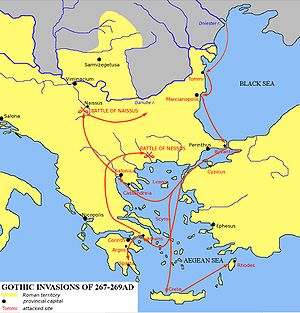 The battle of Naissus came about as a result of two massive invasions of "Scythian" tribes (as our sources anachronistically call them) into Roman territory between 267 and 269. The first wave came during Gallienus' reign (267) and started when the Heruli
, raiding on 500 ships, ravaged the southern Black Sea coast and unsuccessfully attacked Byzantium
and Cyzicus
. They were defeated by the Roman navy
but managed to escape into Aegean Sea
, where they ravaged the islands of Lemnos
and Scyros and sacked several cities of the southern Greece (province of Achaea
) including Athens
, Corinth
, Argos
and Sparta
. Then an Athenian militia, led by the historian Dexippus
, pushed the invaders to the north where they were intercepted by the Roman army under Gallienus. He won an important victory near the Nessos (Nestos
) river, on the boundary between Macedonia
and Thrace
, with the aid of the Dalmatian cavalry. Reported barbarian casualties were 3,000 men. Subsequently, the Heruli leader Naulobatus came to terms with the Romans.
In the past, the battle on the Nessos was identified as the Battle of Naissus, but modern scholarship has rejected this view. On the contrary, there is a theory that the victory at Nessos was so decisive that Claudius' efforts against the Goths (including the battle of Naissus) were no more than a mopping-up operation. After his victory, Gallienus left Marcianus in place and hastily left for Italy, intending to suppress the revolt of his cavalry officer Aureolus
. After Gallienus was assassinated outside Milan
in the summer of 268 in a plot led by high officers in his army, Claudius was proclaimed emperor and headed to Rome to establish his rule. Claudius' immediate concerns were with the Alamanni
, who had invaded Raetia
and Italy. After he defeated them in the Battle of Lake Benacus
, he was finally able to take care of the invasions in the Balkan provinces.
 In the meantime, the second and larger sea-borne invasion had started. An enormous coalition of "Scythians", actually consisting of Goths (Greuthungi
and Tervingi), Gepids and Peucini
, led again by the Heruli
, assembled at the mouth of river Tyras (Dniester
). The Augustan History and Zosimus claim a total number of 2,000–6,000 ships and 325,000 men. This is probably a gross exaggeration but remains indicative of the scale of the invasion. After failing to storm some towns on the coasts of the western Black Sea
and the Danube
(Tomi
, Marcianopolis
), the invaders attacked Byzantium
and Chrysopolis
. Part of their fleet was wrecked, either because of the Gothic inexperience in sailing through the violent currents of the Propontis or because it was defeated by the Roman navy. Then they entered Aegean Sea
and a detachment ravaged the Aegean islands as far as Crete
and Rhodes
. While their main force had constructed siege works and was close to taking the cities of Thessalonica and Cassandreia
, it retreated to the Balkan interior at the news that the emperor was advancing. On their way, they plundered Doberus (Paionia
?) and Pelagonia
.
where an epidemic affected the entrapped Goths. After a bloody but inconclusive battle, they escaped but were pursued again until they surrendered. Prisoners were admitted to the army or given land to cultivate and become coloni
. The members of the pirate fleet, after the failed attacks on Crete and Rhodes, retreated and many of them suffered a similar end. However the disease also affected the pursuing Romans and the emperor as well, who died from it in 270.
The psychological impact of this victory was so strong that Claudius became known to posterity as Claudius II Gothicus ("conqueror of the Goths"). However devastating the defeat, the battle did not entirely break the Gothic tribes' military strength. Besides, the troubles with Zenobia
in the East and the breakaway Gallic Empire
in the West were so urgent that the victory at Naissus could only serve as a temporary relief for the troubled Empire. In 271, after Aurelian repelled another Gothic invasion, he abandoned the province of Dacia
north of Danube forever, in order to rationalize the defense of the Empire.
Goths
The Goths were an East Germanic tribe of Scandinavian origin whose two branches, the Visigoths and the Ostrogoths, played an important role in the fall of the Roman Empire and the emergence of Medieval Europe....
coalition by the Roman Empire
Roman Empire
The Roman Empire was the post-Republican period of the ancient Roman civilization, characterised by an autocratic form of government and large territorial holdings in Europe and around the Mediterranean....
under Emperor Gallienus
Gallienus
Gallienus was Roman Emperor with his father Valerian from 253 to 260, and alone from 260 to 268. He took control of the Empire at a time when it was undergoing great crisis...
(or Claudius II
Claudius II
Claudius II , commonly known as Claudius Gothicus, was Roman Emperor from 268 to 270. During his reign he fought successfully against the Alamanni and scored a crushing victory against the Goths at the Battle of Naissus. He died after succumbing to a smallpox plague that ravaged the provinces of...
) near Naissus (Niš
Niš
Niš is the largest city of southern Serbia and third-largest city in Serbia . According to the data from 2011, the city of Niš has a population of 177,972 inhabitants, while the city municipality has a population of 257,867. The city covers an area of about 597 km2, including the urban area,...
in present-day Serbia
Serbia
Serbia , officially the Republic of Serbia , is a landlocked country located at the crossroads of Central and Southeast Europe, covering the southern part of the Carpathian basin and the central part of the Balkans...
). The events around the invasion and the battle are an important part of the history of the Crisis of the Third Century
Crisis of the Third Century
The Crisis of the Third Century was a period in which the Roman Empire nearly collapsed under the combined pressures of invasion, civil war, plague, and economic depression...
.
The result was a great Roman victory which, combined with the effective pursuit of the invaders in the aftermath of the battle and the energetic efforts of the Emperor Aurelian
Aurelian
Aurelian , was Roman Emperor from 270 to 275. During his reign, he defeated the Alamanni after a devastating war. He also defeated the Goths, Vandals, Juthungi, Sarmatians, and Carpi. Aurelian restored the Empire's eastern provinces after his conquest of the Palmyrene Empire in 273. The following...
, largely removed the threat from Germanic tribes in the Balkan frontier for the following decades.
Sources
As is often the case in the history of the Roman Empire in the troubled 3rd century, it is very difficult to reconstruct the course of events around the battle of Naissus. Surviving accounts of the period, including ZosimusZosimus
Zosimus was a Byzantine historian, who lived in Constantinople during the reign of the Byzantine Emperor Anastasius I . According to Photius, he was a comes, and held the office of "advocate" of the imperial treasury.- Historia Nova :...
' New History, Zonaras
Joannes Zonaras
Ioannes Zonaras was a Byzantine chronicler and theologian, who lived at Constantinople.Under Emperor Alexios I Komnenos he held the offices of head justice and private secretary to the emperor, but after Alexios' death, he retired to the monastery of St Glykeria, where he spent the rest of his...
' Epitome of the Histories, George Syncellus
George Syncellus
George Syncellus was a Byzantine chronicler and ecclesiastic. He had lived many years in Palestine as a monk, before coming to Constantinople, where he was appointed syncellus to Tarasius, patriarch of Constantinople...
' Selection of Chronography, and the Augustan History
Augustan History
The Augustan History is a late Roman collection of biographies, in Latin, of the Roman Emperors, their junior colleagues and usurpers of the period 117 to 284...
, rely principally on the lost history of the Athenian Dexippus
Dexippus
Publius Herennius Dexippus , Greek historian, statesman and general, was an hereditary priest of the Eleusinian family of the Kerykes, and held the offices of archon basileus and eponymous in Athens....
. The text of Dexippus has survived only indirectly, through quotations in the fourth-century Augustan History and extracts in ninth-century Byzantine compilations. Despite his importance for the period, Dexippus has been declared a "poor" source by the modern historian David S. Potter. To make matters worse, the works making use of Dexippus (and likely another unknown contemporary source) provide an almost radically different interpretation of events. The imperial propaganda in the age of Constantine
Constantine I
Constantine the Great , also known as Constantine I or Saint Constantine, was Roman Emperor from 306 to 337. Well known for being the first Roman emperor to convert to Christianity, Constantine and co-Emperor Licinius issued the Edict of Milan in 313, which proclaimed religious tolerance of all...
's dynasty added more confusion by attributing all the calamities to the reign of Gallienus to avoid blemishing the memory of Claudius (supposed ancestor of the dynasty).
As a consequence, controversy still exists on the number of invasions and the order of events and on which reign those events must be attributed. Therefore, there is a dispute over who was the Emperor and head of the army at the time of the battle. In 1939, Andreas Alföldi, preferring the single invasion theory, suggested that Gallienus was the only one responsible for defeating the barbarian invasions, including the victory at Naissus. His view had been broadly accepted since then, but modern scholarship usually attributes the final victory to Claudius II. The single invasion theory has been also rejected in favour of the two separate invasions. The narrative below follows the latter view but the reader must be warned that the evidence is too confused for an entirely safe reconstruction.
Background
Heruli
The Heruli were an East Germanic tribe who are famous for their naval exploits. Migrating from Northern Europe to the Black Sea in the third century They were part of the...
, raiding on 500 ships, ravaged the southern Black Sea coast and unsuccessfully attacked Byzantium
Byzantium
Byzantium was an ancient Greek city, founded by Greek colonists from Megara in 667 BC and named after their king Byzas . The name Byzantium is a Latinization of the original name Byzantion...
and Cyzicus
Cyzicus
Cyzicus was an ancient town of Mysia in Anatolia in the current Balıkesir Province of Turkey. It was located on the shoreward side of the present Kapıdağ Peninsula , a tombolo which is said to have originally been an island in the Sea of Marmara only to be connected to the mainland in historic...
. They were defeated by the Roman navy
Roman Navy
The Roman Navy comprised the naval forces of the Ancient Roman state. Although the navy was instrumental in the Roman conquest of the Mediterranean basin, it never enjoyed the prestige of the Roman legions...
but managed to escape into Aegean Sea
Aegean Sea
The Aegean Sea[p] is an elongated embayment of the Mediterranean Sea located between the southern Balkan and Anatolian peninsulas, i.e., between the mainlands of Greece and Turkey. In the north, it is connected to the Marmara Sea and Black Sea by the Dardanelles and Bosporus...
, where they ravaged the islands of Lemnos
Lemnos
Lemnos is an island of Greece in the northern part of the Aegean Sea. Administratively the island forms a separate municipality within the Lemnos peripheral unit, which is part of the North Aegean Periphery. The principal town of the island and seat of the municipality is Myrina...
and Scyros and sacked several cities of the southern Greece (province of Achaea
Achaea (Roman province)
Achaea, or Achaia, was a province of the Roman Empire, consisting of the Peloponnese, eastern Central Greece and parts of Thessaly. It bordered on the north by the provinces of Epirus vetus and Macedonia...
) including Athens
Athens
Athens , is the capital and largest city of Greece. Athens dominates the Attica region and is one of the world's oldest cities, as its recorded history spans around 3,400 years. Classical Athens was a powerful city-state...
, Corinth
Ancient Corinth
Corinth, or Korinth was a city-state on the Isthmus of Corinth, the narrow stretch of land that joins the Peloponnesus to the mainland of Greece, roughly halfway between Athens and Sparta. The modern town of Corinth is located approximately northeast of the ancient ruins...
, Argos
Argos
Argos is a city and a former municipality in Argolis, Peloponnese, Greece. Since the 2011 local government reform it is part of the municipality Argos-Mykines, of which it is a municipal unit. It is 11 kilometres from Nafplion, which was its historic harbour...
and Sparta
Sparta
Sparta or Lacedaemon, was a prominent city-state in ancient Greece, situated on the banks of the River Eurotas in Laconia, in south-eastern Peloponnese. It emerged as a political entity around the 10th century BC, when the invading Dorians subjugated the local, non-Dorian population. From c...
. Then an Athenian militia, led by the historian Dexippus
Dexippus
Publius Herennius Dexippus , Greek historian, statesman and general, was an hereditary priest of the Eleusinian family of the Kerykes, and held the offices of archon basileus and eponymous in Athens....
, pushed the invaders to the north where they were intercepted by the Roman army under Gallienus. He won an important victory near the Nessos (Nestos
Mesta River
The Nestos or Mesta , formerly the Mesta Karasu , is a river in Bulgaria and Greece. It rises in the Rila Mountains and flows into the Aegean Sea near the island of Thasos. It plunges down towering canyons toward the Aegean Sea through mostly metamorphic formations...
) river, on the boundary between Macedonia
Macedonia (Roman province)
The Roman province of Macedonia was officially established in 146 BC, after the Roman general Quintus Caecilius Metellus defeated Andriscus of Macedon, the last Ancient King of Macedon in 148 BC, and after the four client republics established by Rome in the region were dissolved...
and Thrace
Thrace
Thrace is a historical and geographic area in southeast Europe. As a geographical concept, Thrace designates a region bounded by the Balkan Mountains on the north, Rhodope Mountains and the Aegean Sea on the south, and by the Black Sea and the Sea of Marmara on the east...
, with the aid of the Dalmatian cavalry. Reported barbarian casualties were 3,000 men. Subsequently, the Heruli leader Naulobatus came to terms with the Romans.
In the past, the battle on the Nessos was identified as the Battle of Naissus, but modern scholarship has rejected this view. On the contrary, there is a theory that the victory at Nessos was so decisive that Claudius' efforts against the Goths (including the battle of Naissus) were no more than a mopping-up operation. After his victory, Gallienus left Marcianus in place and hastily left for Italy, intending to suppress the revolt of his cavalry officer Aureolus
Aureolus
For the Frankish ruler of Aragon, see Aureolus of Aragon.Manius Acilius Aureolus was a Roman military commander and would-be usurper. He was one of the so-called Thirty Tyrants who populated the reign of the Emperor Gallienus...
. After Gallienus was assassinated outside Milan
Milan
Milan is the second-largest city in Italy and the capital city of the region of Lombardy and of the province of Milan. The city proper has a population of about 1.3 million, while its urban area, roughly coinciding with its administrative province and the bordering Province of Monza and Brianza ,...
in the summer of 268 in a plot led by high officers in his army, Claudius was proclaimed emperor and headed to Rome to establish his rule. Claudius' immediate concerns were with the Alamanni
Alamanni
The Alamanni, Allemanni, or Alemanni were originally an alliance of Germanic tribes located around the upper Rhine river . One of the earliest references to them is the cognomen Alamannicus assumed by Roman Emperor Caracalla, who ruled the Roman Empire from 211 to 217 and claimed thereby to be...
, who had invaded Raetia
Raetia
Raetia was a province of the Roman Empire, named after the Rhaetian people. It was bounded on the west by the country of the Helvetii, on the east by Noricum, on the north by Vindelicia, on the west by Cisalpine Gaul and on south by Venetia et Histria...
and Italy. After he defeated them in the Battle of Lake Benacus
Battle of Lake Benacus
The Battle of Lake Benacus was one of the decisive battles that marked the beginning of the Roman Empire's emergence from the Crisis of the Third Century...
, he was finally able to take care of the invasions in the Balkan provinces.
Greuthungi
The Greuthungs, Greuthungi, or Greutungi were a Gothic people of the Black Sea steppes in the third and fourth centuries. They had close contacts with the Thervingi, another Gothic people from west of the river Dnestr. They may be the same people as the later Ostrogoths.-Etymology:"Greuthungi" may...
and Tervingi), Gepids and Peucini
Peuce Island
Peuce in ancient geography was an island located in the Danube Delta, in Scythia Minor . Its name came from the ancient Greek word peuke, 'pine tree'. It was about the size of the island of Rhodes...
, led again by the Heruli
Heruli
The Heruli were an East Germanic tribe who are famous for their naval exploits. Migrating from Northern Europe to the Black Sea in the third century They were part of the...
, assembled at the mouth of river Tyras (Dniester
Dniester
The Dniester is a river in Eastern Europe. It runs through Ukraine and Moldova and separates most of Moldova's territory from the breakaway de facto state of Transnistria.-Names:...
). The Augustan History and Zosimus claim a total number of 2,000–6,000 ships and 325,000 men. This is probably a gross exaggeration but remains indicative of the scale of the invasion. After failing to storm some towns on the coasts of the western Black Sea
Black Sea
The Black Sea is bounded by Europe, Anatolia and the Caucasus and is ultimately connected to the Atlantic Ocean via the Mediterranean and the Aegean seas and various straits. The Bosphorus strait connects it to the Sea of Marmara, and the strait of the Dardanelles connects that sea to the Aegean...
and the Danube
Danube
The Danube is a river in the Central Europe and the Europe's second longest river after the Volga. It is classified as an international waterway....
(Tomi
Constanta
Constanța is the oldest extant city in Romania, founded around 600 BC. The city is located in the Dobruja region of Romania, on the Black Sea coast. It is the capital of Constanța County and the largest city in the region....
, Marcianopolis
Marcianopolis
Marcianopolis or Marcianople was an ancient Roman city in Thracia. It was located at the site of modern day Devnya, Bulgaria.-History:...
), the invaders attacked Byzantium
Byzantium
Byzantium was an ancient Greek city, founded by Greek colonists from Megara in 667 BC and named after their king Byzas . The name Byzantium is a Latinization of the original name Byzantion...
and Chrysopolis
Üsküdar
Üsküdar is a large and densely populated municipality of Istanbul, Turkey, on the Anatolian shore of the Bosphorus. It is bordered on the north by Beykoz, on the east by Ümraniye, on the southeast by Ataşehir, on the south by Kadıköy, and on the west by the Bosphorus, with the areas of Beşiktaş,...
. Part of their fleet was wrecked, either because of the Gothic inexperience in sailing through the violent currents of the Propontis or because it was defeated by the Roman navy. Then they entered Aegean Sea
Aegean Sea
The Aegean Sea[p] is an elongated embayment of the Mediterranean Sea located between the southern Balkan and Anatolian peninsulas, i.e., between the mainlands of Greece and Turkey. In the north, it is connected to the Marmara Sea and Black Sea by the Dardanelles and Bosporus...
and a detachment ravaged the Aegean islands as far as Crete
Crete
Crete is the largest and most populous of the Greek islands, the fifth largest island in the Mediterranean Sea, and one of the thirteen administrative regions of Greece. It forms a significant part of the economy and cultural heritage of Greece while retaining its own local cultural traits...
and Rhodes
Rhodes
Rhodes is an island in Greece, located in the eastern Aegean Sea. It is the largest of the Dodecanese islands in terms of both land area and population, with a population of 117,007, and also the island group's historical capital. Administratively the island forms a separate municipality within...
. While their main force had constructed siege works and was close to taking the cities of Thessalonica and Cassandreia
Cassandreia
Cassandrea, Cassandreia, or Cassandria was once one of the most important cities in Ancient Macedonia founded by and named after Cassander in 316 BC located on the site of the earlier Ancient Greek city of Potidaea...
, it retreated to the Balkan interior at the news that the emperor was advancing. On their way, they plundered Doberus (Paionia
Paionia
In ancient geography, Paeonia or Paionia was the land of the Paeonians . The exact original boundaries of Paeonia, like the early history of its inhabitants, are very obscure, but it is believed that they lay in the region of Thrace...
?) and Pelagonia
Pelagonia
This is about the geographical plain between Greece and the Republic of Macedonia. For the political unit in Macedonia, go to Pelagonia Statistical Region....
.
The battle
The Goths were engaged near Naissus by a Roman army advancing from the north. The battle most likely took place in 269, and was fiercely contested. Large numbers on both sides were killed but, at the critical point, the Romans tricked the Goths into an ambush by pretended flight. Some 50,000 Goths were allegedly killed or taken captive. It seems that Aurelian who was in charge of all Roman cavalry during Claudius' reign, led the decisive attack in the battle.Aftermath
A large number of Goths managed to escape towards Macedonia, initially defending themselves behind their laager. Soon, many of them and their pack animals, distressed as they were by the harassment of the Roman cavalry and the lack of provisions, died of hunger. The Roman army methodically pursued and surrounded the survivors at Mount HaemusBalkan Mountains
The Balkan mountain range is a mountain range in the eastern part of the Balkan Peninsula. The Balkan range runs 560 km from the Vrashka Chuka Peak on the border between Bulgaria and eastern Serbia eastward through central Bulgaria to Cape Emine on the Black Sea...
where an epidemic affected the entrapped Goths. After a bloody but inconclusive battle, they escaped but were pursued again until they surrendered. Prisoners were admitted to the army or given land to cultivate and become coloni
Colonus (person)
A colonus was a type of Roman peasant farmer, a serf. This designation was carried into the Medieval period for much of Europe.Coloni worked on large Roman estates called "latifundia" and could never leave. Latifundia raised sheep and other types of cattle...
. The members of the pirate fleet, after the failed attacks on Crete and Rhodes, retreated and many of them suffered a similar end. However the disease also affected the pursuing Romans and the emperor as well, who died from it in 270.
The psychological impact of this victory was so strong that Claudius became known to posterity as Claudius II Gothicus ("conqueror of the Goths"). However devastating the defeat, the battle did not entirely break the Gothic tribes' military strength. Besides, the troubles with Zenobia
Zenobia
Zenobia was a 3rd-century Queen of the Palmyrene Empire in Roman Syria. She led a famous revolt against the Roman Empire. The second wife of King Septimius Odaenathus, Zenobia became queen of the Palmyrene Empire following Odaenathus' death in 267...
in the East and the breakaway Gallic Empire
Gallic Empire
The Gallic Empire is the modern name for a breakaway realm that existed from 260 to 274. It originated during the Roman Empire's Crisis of the Third Century....
in the West were so urgent that the victory at Naissus could only serve as a temporary relief for the troubled Empire. In 271, after Aurelian repelled another Gothic invasion, he abandoned the province of Dacia
Dacia
In ancient geography, especially in Roman sources, Dacia was the land inhabited by the Dacians or Getae as they were known by the Greeks—the branch of the Thracians north of the Haemus range...
north of Danube forever, in order to rationalize the defense of the Empire.