

Carausius

Encyclopedia
Marcus Aurelius Mausaeus Valerius Carausius (died 293) was a military commander of the Roman Empire
in the 3rd century. He was a Menapian
from Belgic Gaul
, who usurped
power in 286, declaring himself emperor in Britain
and northern Gaul
. He did this only 13 years after the Gallic Empire
of the Batavian Postumus
was ended in 273. He held power for seven years, before being assassinated by his finance minister Allectus
(see Carausian Revolt
).
who distinguished himself during Maximian
's campaign against the Bagaudae
rebels in northern Gaul
in 286. This success, and his former occupation as a pilot, led to his appointment to command the Classis Britannica
, a fleet based in the English Channel
, with the responsibility of eliminating Frankish
and Saxon pirates who had been raiding the coasts of Armorica
and Belgica. He was suspected of keeping captured treasure for himself, and of allowing pirates to carry out raids and enrich themselves before taking action against them, and Maximian ordered his execution. In late 286 or early 287 Carausius learned of this sentence and responded by declaring himself Emperor in Britain and northern Gaul. His forces comprised not only his fleet, augmented by new ships he had built, and the three legions
stationed in Britain, but a legion he had seized in Gaul, a number of foreign auxiliary
units, a levy of Gaulish merchant ships, and barbarian mercenaries attracted by the prospect of booty.
Sheppard Frere
wonders how Carausius was able to win support from the army when his command had been sea-based, and speculates that he had perhaps been involved in an unrecorded victory in Britain, connected with Diocletian
's assumption of the title Britannicus Maximus in 285, and signs of destruction in Romano-British towns at this time. The campaign against the Bagaudae, however, was evidently land-based, and may have been responsible for Carausius's popularity with the army. Equally, if the accusations of larceny are true, he could perhaps have afforded to buy their loyalty.
Maximian prepared an invasion of Britain in 288 or 289 to oust him, but it failed. A panegyric
delivered to Constantius Chlorus
attributes this failure to bad weather, but notes that Carausius claimed a military victory. Eutropius says that hostilities were in vain thanks to Carausius's military skill, and peace was agreed. Carausius began to entertain visions of legitimacy and official recognition. He minted his own coins and brought their value into line with Roman issues as well as acknowledging and honouring Maximian and then Diocletian
. Coinage is the main source of information about the rogue emperor; his issues were initially crude but soon became more elaborate and were issued from mints in Londinium, Rotomagnus
and a third site, possibly Colonia Claudia Victricensis
.
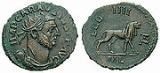
Carausius appears to have appealed to native British dissatisfaction with Roman rule: he issued coins with legends such as Restitutor Britanniae (Restorer of Britain) and Genius Britanniae (Spirit of Britain). He also used coins for more sophisticated propaganda. He issued the first proper silver coins that had appeared in the Roman Empire
for generations, knowing that good quality bullion coinage would enhance his legitimacy and make him look more successful than Diocletian
and Maximian
. Some of these silver coins bear the legend Expectate veni, 'Come long-awaited one', recognised to allude to a line in the Aeneid
by the Augustan poet Virgil
, written more than 300 years previously. He was trying to suggest that not only was he, Carausius, a kind of messianic new ruler, but was also showing his association with Roman culture rather than any kind of remote provincial culture.
Some of the silver coins bear the legend RSR in the exergue (an area on a coin below the legend). This was considered a mystery for some time. Two Carausian medallions, now in the British Museum
have also been found. One has RSR in the exergue, the other has INPCDA. Since 1998 these letters have been recognised as representing the sixth and seventh lines of the Fourth Eclogue
of Virgil, which reads Redeunt Saturnia Regna, Iam Nova Progenies Caelo Demittitur Alto, meaning 'The Golden Ages are back, now a new generation is let down from Heaven above'. This poem was as famous in the Roman world as Shakespeare's works are today, so any educated reader would certainly have realized what the initials stood for (it was commonplace in antiquity to reduce slogans and phrases to abbreviations).
No other Roman emperor in history ever made such an explicit reference to famous Roman literature. It is quite extraordinary that in a remote province like Britain a rebel emperor should utilise such a method to appeal to his public. He was claiming to represent a revival of traditional Roman virtues and the great traditions of the Empire as established by Augustus
in the last decades of the first century BC, not in Rome
but in Britain.
A milestone from Carlisle with his name on it suggests that the whole of Roman Britain
was in Carausius' grasp.
This situation continued until 293, when Constantius Chlorus
, now the western Caesar, marched into Gaul and reclaimed it for the empire. He isolated Carausius by besieging the port of Bononia
, and invading Batavia in the Rhine delta, securing his rear against Carausius's Frankish
allies. He could not yet mount an invasion of Britain until a suitable fleet could be built. Nevertheless, Carausius's grip on power was fatally undermined. Allectus
, whom he had put in charge of his treasury, assassinated him and assumed power himself. His reign would last only three years, after which he was defeated and killed by Constantius's subordinate Julius Asclepiodotus.
In April 2010 a large hoard of coins
was unearthed near Frome
, Somerset
, United Kingdom
, which includes the largest group of coins issued during Carausius' reign ever found; 760 coins from his reign were found in a group of 52,500 Roman coins that also included 5 rare silver denarii. The find was equivalent to four years pay for a Roman legionary and was probably buried in hopes of a good harvest or good weather. The hoard dates from later than his reign, however, as it includes coins struck at a later date.
's legendary History of the Kings of Britain
(1136) Carausius is a Briton of humble birth, who by his courage persuades the Roman Senate
to give him command of a fleet to defend Britain from barbarian attack. Once given the fleet, however, he sails around Britain stirring up unrest, and raises an army against Bassanius
, the historical Caracalla, here a king of Britain. Carausius defeats Bassanius by persuading his Pict
ish allies to desert him in exchange for grants of land in Scotland, and sets himself up as king. Hearing of Carausius's treachery, the Romans send Allectus
to Britain with three legions. Allectus defeats and kills Carausius and sets himself up as king in his place.
Roman Empire
The Roman Empire was the post-Republican period of the ancient Roman civilization, characterised by an autocratic form of government and large territorial holdings in Europe and around the Mediterranean....
in the 3rd century. He was a Menapian
Menapii
The Menapii were a Belgic tribe of northern Gaul in pre-Roman and Roman times. Their territory according to Strabo, Caesar and Ptolemy stretched from the mouth of the Rhine in the north, and southwards along the west of the Schelde. Their civitas under the Roman empire was Cassel , near Thérouanne...
from Belgic Gaul
Gallia Belgica
Gallia Belgica was a Roman province located in what is now the southern part of the Netherlands, Belgium, Luxembourg, northeastern France, and western Germany. The indigenous population of Gallia Belgica, the Belgae, consisted of a mixture of Celtic and Germanic tribes...
, who usurped
Roman usurper
Usurpers are individuals or groups of individuals who obtain and maintain the power or rights of another by force and without legal authority. Usurpation was endemic during roman imperial era, especially from the crisis of the third century onwards, when political instability became the rule.The...
power in 286, declaring himself emperor in Britain
Roman Britain
Roman Britain was the part of the island of Great Britain controlled by the Roman Empire from AD 43 until ca. AD 410.The Romans referred to the imperial province as Britannia, which eventually comprised all of the island of Great Britain south of the fluid frontier with Caledonia...
and northern Gaul
Gaul
Gaul was a region of Western Europe during the Iron Age and Roman era, encompassing present day France, Luxembourg and Belgium, most of Switzerland, the western part of Northern Italy, as well as the parts of the Netherlands and Germany on the left bank of the Rhine. The Gauls were the speakers of...
. He did this only 13 years after the Gallic Empire
Gallic Empire
The Gallic Empire is the modern name for a breakaway realm that existed from 260 to 274. It originated during the Roman Empire's Crisis of the Third Century....
of the Batavian Postumus
Postumus
Marcus Cassianius Latinius Postumus was a Roman emperor of Batavian origin. He usurped power from Gallienus in 260 and formed the so-called Gallic Empire...
was ended in 273. He held power for seven years, before being assassinated by his finance minister Allectus
Allectus
Allectus was a Roman usurper-emperor in Britain and northern Gaul from 293 to 296.-History:Allectus was treasurer to Carausius, a Menapian officer in the Roman navy who had seized power in Britain and northern Gaul in 286...
(see Carausian Revolt
Carausian Revolt
The Carausian Revolt was an episode in Roman history, during which a Roman naval commander, Carausius, declared himself emperor over Britain and northern Gaul. His Gallic territories were retaken by the western Caesar, Constantius Chlorus, in 293, after which Carausius was assassinated by his...
).
History
Carausius was of humble origin, a MenapianMenapii
The Menapii were a Belgic tribe of northern Gaul in pre-Roman and Roman times. Their territory according to Strabo, Caesar and Ptolemy stretched from the mouth of the Rhine in the north, and southwards along the west of the Schelde. Their civitas under the Roman empire was Cassel , near Thérouanne...
who distinguished himself during Maximian
Maximian
Maximian was Roman Emperor from 286 to 305. He was Caesar from 285 to 286, then Augustus from 286 to 305. He shared the latter title with his co-emperor and superior, Diocletian, whose political brain complemented Maximian's military brawn. Maximian established his residence at Trier but spent...
's campaign against the Bagaudae
Bagaudae
In the time of the later Roman Empire bagaudae were groups of peasant insurgents who emerged during the "Crisis of the Third Century", and persisted particularly in the less-Romanised areas of Gallia and Hispania, where they were "exposed to the depredations of the late Roman state, and the great...
rebels in northern Gaul
Gaul
Gaul was a region of Western Europe during the Iron Age and Roman era, encompassing present day France, Luxembourg and Belgium, most of Switzerland, the western part of Northern Italy, as well as the parts of the Netherlands and Germany on the left bank of the Rhine. The Gauls were the speakers of...
in 286. This success, and his former occupation as a pilot, led to his appointment to command the Classis Britannica
Classis Britannica
The Classis Britannica was a provincial naval fleet of the navy of ancient Rome. Its purpose was to control the English Channel and the waters around the Roman province of Britannia...
, a fleet based in the English Channel
English Channel
The English Channel , often referred to simply as the Channel, is an arm of the Atlantic Ocean that separates southern England from northern France, and joins the North Sea to the Atlantic. It is about long and varies in width from at its widest to in the Strait of Dover...
, with the responsibility of eliminating Frankish
Franks
The Franks were a confederation of Germanic tribes first attested in the third century AD as living north and east of the Lower Rhine River. From the third to fifth centuries some Franks raided Roman territory while other Franks joined the Roman troops in Gaul. Only the Salian Franks formed a...
and Saxon pirates who had been raiding the coasts of Armorica
Armorica
Armorica or Aremorica is the name given in ancient times to the part of Gaul that includes the Brittany peninsula and the territory between the Seine and Loire rivers, extending inland to an indeterminate point and down the Atlantic coast...
and Belgica. He was suspected of keeping captured treasure for himself, and of allowing pirates to carry out raids and enrich themselves before taking action against them, and Maximian ordered his execution. In late 286 or early 287 Carausius learned of this sentence and responded by declaring himself Emperor in Britain and northern Gaul. His forces comprised not only his fleet, augmented by new ships he had built, and the three legions
Roman legion
A Roman legion normally indicates the basic ancient Roman army unit recruited specifically from Roman citizens. The organization of legions varied greatly over time but they were typically composed of perhaps 5,000 soldiers, divided into maniples and later into "cohorts"...
stationed in Britain, but a legion he had seized in Gaul, a number of foreign auxiliary
Auxiliaries (Roman military)
Auxiliaries formed the standing non-citizen corps of the Roman army of the Principate , alongside the citizen legions...
units, a levy of Gaulish merchant ships, and barbarian mercenaries attracted by the prospect of booty.
Sheppard Frere
Sheppard Frere
Professor Sheppard Sunderland Frere, CBE, FSA, FBA is a former British historian and archaeologist who studied the Roman Empire.-Biography:...
wonders how Carausius was able to win support from the army when his command had been sea-based, and speculates that he had perhaps been involved in an unrecorded victory in Britain, connected with Diocletian
Diocletian
Diocletian |latinized]] upon his accession to Diocletian . c. 22 December 244 – 3 December 311), was a Roman Emperor from 284 to 305....
's assumption of the title Britannicus Maximus in 285, and signs of destruction in Romano-British towns at this time. The campaign against the Bagaudae, however, was evidently land-based, and may have been responsible for Carausius's popularity with the army. Equally, if the accusations of larceny are true, he could perhaps have afforded to buy their loyalty.
Maximian prepared an invasion of Britain in 288 or 289 to oust him, but it failed. A panegyric
Panegyrici Latini
The Panegyrici Latini or Latin Panegyrics is a collection of twelve ancient Roman panegyric orations. The authors of most of the speeches in the collection are anonymous, but appear to have been Gallic in origin. Aside from the first panegyric, composed by Pliny the Younger in 100 CE, the other...
delivered to Constantius Chlorus
Constantius Chlorus
Constantius I , commonly known as Constantius Chlorus, was Roman Emperor from 293 to 306. He was the father of Constantine the Great and founder of the Constantinian dynasty. As Caesar he defeated the usurper Allectus in Britain and campaigned extensively along the Rhine frontier, defeating the...
attributes this failure to bad weather, but notes that Carausius claimed a military victory. Eutropius says that hostilities were in vain thanks to Carausius's military skill, and peace was agreed. Carausius began to entertain visions of legitimacy and official recognition. He minted his own coins and brought their value into line with Roman issues as well as acknowledging and honouring Maximian and then Diocletian
Diocletian
Diocletian |latinized]] upon his accession to Diocletian . c. 22 December 244 – 3 December 311), was a Roman Emperor from 284 to 305....
. Coinage is the main source of information about the rogue emperor; his issues were initially crude but soon became more elaborate and were issued from mints in Londinium, Rotomagnus
Rouen
Rouen , in northern France on the River Seine, is the capital of the Haute-Normandie region and the historic capital city of Normandy. Once one of the largest and most prosperous cities of medieval Europe , it was the seat of the Exchequer of Normandy in the Middle Ages...
and a third site, possibly Colonia Claudia Victricensis
Camulodunum
Camulodunum is the Roman name for the ancient settlement which is today's Colchester, a town in Essex, England. Camulodunum is claimed to be the oldest town in Britain as recorded by the Romans, existing as a Celtic settlement before the Roman conquest, when it became the first Roman town, and...
.
Carausius appears to have appealed to native British dissatisfaction with Roman rule: he issued coins with legends such as Restitutor Britanniae (Restorer of Britain) and Genius Britanniae (Spirit of Britain). He also used coins for more sophisticated propaganda. He issued the first proper silver coins that had appeared in the Roman Empire
Roman Empire
The Roman Empire was the post-Republican period of the ancient Roman civilization, characterised by an autocratic form of government and large territorial holdings in Europe and around the Mediterranean....
for generations, knowing that good quality bullion coinage would enhance his legitimacy and make him look more successful than Diocletian
Diocletian
Diocletian |latinized]] upon his accession to Diocletian . c. 22 December 244 – 3 December 311), was a Roman Emperor from 284 to 305....
and Maximian
Maximian
Maximian was Roman Emperor from 286 to 305. He was Caesar from 285 to 286, then Augustus from 286 to 305. He shared the latter title with his co-emperor and superior, Diocletian, whose political brain complemented Maximian's military brawn. Maximian established his residence at Trier but spent...
. Some of these silver coins bear the legend Expectate veni, 'Come long-awaited one', recognised to allude to a line in the Aeneid
Aeneid
The Aeneid is a Latin epic poem, written by Virgil between 29 and 19 BC, that tells the legendary story of Aeneas, a Trojan who travelled to Italy, where he became the ancestor of the Romans. It is composed of roughly 10,000 lines in dactylic hexameter...
by the Augustan poet Virgil
Virgil
Publius Vergilius Maro, usually called Virgil or Vergil in English , was an ancient Roman poet of the Augustan period. He is known for three major works of Latin literature, the Eclogues , the Georgics, and the epic Aeneid...
, written more than 300 years previously. He was trying to suggest that not only was he, Carausius, a kind of messianic new ruler, but was also showing his association with Roman culture rather than any kind of remote provincial culture.
Some of the silver coins bear the legend RSR in the exergue (an area on a coin below the legend). This was considered a mystery for some time. Two Carausian medallions, now in the British Museum
British Museum
The British Museum is a museum of human history and culture in London. Its collections, which number more than seven million objects, are amongst the largest and most comprehensive in the world and originate from all continents, illustrating and documenting the story of human culture from its...
have also been found. One has RSR in the exergue, the other has INPCDA. Since 1998 these letters have been recognised as representing the sixth and seventh lines of the Fourth Eclogue
Eclogue
An eclogue is a poem in a classical style on a pastoral subject. Poems in the genre are sometimes also called bucolics.The form of the word in contemporary English is taken from French eclogue, from Old French, from Latin ecloga...
of Virgil, which reads Redeunt Saturnia Regna, Iam Nova Progenies Caelo Demittitur Alto, meaning 'The Golden Ages are back, now a new generation is let down from Heaven above'. This poem was as famous in the Roman world as Shakespeare's works are today, so any educated reader would certainly have realized what the initials stood for (it was commonplace in antiquity to reduce slogans and phrases to abbreviations).
No other Roman emperor in history ever made such an explicit reference to famous Roman literature. It is quite extraordinary that in a remote province like Britain a rebel emperor should utilise such a method to appeal to his public. He was claiming to represent a revival of traditional Roman virtues and the great traditions of the Empire as established by Augustus
Augustus
Augustus ;23 September 63 BC – 19 August AD 14) is considered the first emperor of the Roman Empire, which he ruled alone from 27 BC until his death in 14 AD.The dates of his rule are contemporary dates; Augustus lived under two calendars, the Roman Republican until 45 BC, and the Julian...
in the last decades of the first century BC, not in Rome
Rome
Rome is the capital of Italy and the country's largest and most populated city and comune, with over 2.7 million residents in . The city is located in the central-western portion of the Italian Peninsula, on the Tiber River within the Lazio region of Italy.Rome's history spans two and a half...
but in Britain.
A milestone from Carlisle with his name on it suggests that the whole of Roman Britain
Roman Britain
Roman Britain was the part of the island of Great Britain controlled by the Roman Empire from AD 43 until ca. AD 410.The Romans referred to the imperial province as Britannia, which eventually comprised all of the island of Great Britain south of the fluid frontier with Caledonia...
was in Carausius' grasp.
This situation continued until 293, when Constantius Chlorus
Constantius Chlorus
Constantius I , commonly known as Constantius Chlorus, was Roman Emperor from 293 to 306. He was the father of Constantine the Great and founder of the Constantinian dynasty. As Caesar he defeated the usurper Allectus in Britain and campaigned extensively along the Rhine frontier, defeating the...
, now the western Caesar, marched into Gaul and reclaimed it for the empire. He isolated Carausius by besieging the port of Bononia
Boulogne-sur-Mer
-Road:* Metropolitan bus services are operated by the TCRB* Coach services to Calais and Dunkerque* A16 motorway-Rail:* The main railway station is Gare de Boulogne-Ville and located in the south of the city....
, and invading Batavia in the Rhine delta, securing his rear against Carausius's Frankish
Franks
The Franks were a confederation of Germanic tribes first attested in the third century AD as living north and east of the Lower Rhine River. From the third to fifth centuries some Franks raided Roman territory while other Franks joined the Roman troops in Gaul. Only the Salian Franks formed a...
allies. He could not yet mount an invasion of Britain until a suitable fleet could be built. Nevertheless, Carausius's grip on power was fatally undermined. Allectus
Allectus
Allectus was a Roman usurper-emperor in Britain and northern Gaul from 293 to 296.-History:Allectus was treasurer to Carausius, a Menapian officer in the Roman navy who had seized power in Britain and northern Gaul in 286...
, whom he had put in charge of his treasury, assassinated him and assumed power himself. His reign would last only three years, after which he was defeated and killed by Constantius's subordinate Julius Asclepiodotus.
In April 2010 a large hoard of coins
Frome Hoard
The Frome Hoard is a hoard of 52,503 Roman coins found in April 2010 by metal detectorist Dave Crisp near Frome in Somerset, England. The coins were contained in a ceramic pot in diameter, and date from AD 253 to 305. Most of the coins are made from debased silver or bronze...
was unearthed near Frome
Frome
Frome is a town and civil parish in northeast Somerset, England. Located at the eastern end of the Mendip Hills, the town is built on uneven high ground, and centres around the River Frome. The town is approximately south of Bath, east of the county town, Taunton and west of London. In the 2001...
, Somerset
Somerset
The ceremonial and non-metropolitan county of Somerset in South West England borders Bristol and Gloucestershire to the north, Wiltshire to the east, Dorset to the south-east, and Devon to the south-west. It is partly bounded to the north and west by the Bristol Channel and the estuary of the...
, United Kingdom
United Kingdom
The United Kingdom of Great Britain and Northern IrelandIn the United Kingdom and Dependencies, other languages have been officially recognised as legitimate autochthonous languages under the European Charter for Regional or Minority Languages...
, which includes the largest group of coins issued during Carausius' reign ever found; 760 coins from his reign were found in a group of 52,500 Roman coins that also included 5 rare silver denarii. The find was equivalent to four years pay for a Roman legionary and was probably buried in hopes of a good harvest or good weather. The hoard dates from later than his reign, however, as it includes coins struck at a later date.
Legend
In Geoffrey of MonmouthGeoffrey of Monmouth
Geoffrey of Monmouth was a cleric and one of the major figures in the development of British historiography and the popularity of tales of King Arthur...
's legendary History of the Kings of Britain
Historia Regum Britanniae
The Historia Regum Britanniae is a pseudohistorical account of British history, written c. 1136 by Geoffrey of Monmouth. It chronicles the lives of the kings of the Britons in a chronological narrative spanning a time of two thousand years, beginning with the Trojans founding the British nation...
(1136) Carausius is a Briton of humble birth, who by his courage persuades the Roman Senate
Roman Senate
The Senate of the Roman Republic was a political institution in the ancient Roman Republic, however, it was not an elected body, but one whose members were appointed by the consuls, and later by the censors. After a magistrate served his term in office, it usually was followed with automatic...
to give him command of a fleet to defend Britain from barbarian attack. Once given the fleet, however, he sails around Britain stirring up unrest, and raises an army against Bassanius
Caracalla
Caracalla , was Roman emperor from 198 to 217. The eldest son of Septimius Severus, he ruled jointly with his younger brother Geta until he murdered the latter in 211...
, the historical Caracalla, here a king of Britain. Carausius defeats Bassanius by persuading his Pict
PICT
PICT is a graphics file format introduced on the original Apple Macintosh computer as its standard metafile format. It allows the interchange of graphics , and some limited text support, between Mac applications, and was the native graphics format of QuickDraw.The original version, PICT 1, was...
ish allies to desert him in exchange for grants of land in Scotland, and sets himself up as king. Hearing of Carausius's treachery, the Romans send Allectus
Allectus
Allectus was a Roman usurper-emperor in Britain and northern Gaul from 293 to 296.-History:Allectus was treasurer to Carausius, a Menapian officer in the Roman navy who had seized power in Britain and northern Gaul in 286...
to Britain with three legions. Allectus defeats and kills Carausius and sets himself up as king in his place.
External links
- Carausius, Rebel Emperor of Roman Britain
- The Pirate Emperor of Roman Britain
- http://www.independent.co.uk/news/science/archaeology/ahead-of-his-time-carausius-was-a-pirate-a-rebel-and-the-first-ruler-of-a-unified-britain-2039008.html