


Caucasian Iberia

Encyclopedia
Iberia also known as Iveria , was a name given by the ancient Greeks
and Romans
to the ancient Georgian
kingdom of Kartli
(4th century BC – 5th century AD), corresponding roughly to the eastern and southern parts of the present day Georgia. The term Caucasian Iberia (or Eastern Iberia) is used to distinguish it from the Iberian Peninsula
, where the present day countries of Spain
, Portugal
and Andorra
are located.
The Caucasian Iberians provided a basis for later Georgian statehood and along with Colchis
(early western Georgian state) formed a core of the present day Georgian people
(or Kartvelians).
, was that it was derived from the contemporary Armenian
designation for Georgia, Virkʿ , which itself was connected to the word Sver (or Svir), the Kartvelian designation for Georgians. The letter "s" in this instance served as a prefix for the root word "Ver" (or "Vir"). Accordingly, in following Ivane Javakhishvili
's theory, the ethnic designation of "Sber", a variant of Sver, was derived the word "Hber" ("Hver") (and thus Iberia) and the Armenian variants, Ver and Vir.
by several related tribes in Kura-Araxes culture
, collectively called Iberians
(the Eastern Iberians) by ancient authors. Locals called their country Kartli
after a mythic chief, Kartlos
. The Moschi
, mentioned by various classic historians, and their possible descendants, the Saspers (who were mentioned by Herodotus
), may have played a crucial role in the consolidation of the tribes inhabiting the area. The Moschi had moved slowly to the northeast forming settlements as they traveled. The chief of these was Mtskheta
, the future capital of the Iberian kingdom. The Mtskheta tribe was later ruled by a principal locally known as mamasakhlisi (“the father of the household” in Georgian
).
The medieval Georgian source Moktsevai Kartlisai (“Conversion of Kartli
”) also speaks about Azo
and his people, who came from Arian-Kartli
– the initial home of the proto-Iberians, which had been under Achaemenid rule until the fall of the Persian Empire
– to settle on the site where Mtskheta
was to be founded. Another Georgian chronicle Kartlis Tskhovreba (“History of Kartli”) claims Azo to be an officer of Alexander’s, who massacred a local ruling family and conquered the area, until being defeated at the end of the 4th century BC by Prince Pharnavaz
, who was at that time a local chief.
The story of Alexander’s invasion of Kartli, although entirely fictional, nevertheless reflects the establishment of Georgian monarchy in the Hellenistic period and the desire of later Georgian literati to connect this event to the celebrated conqueror.
), and seems to have secured recognition of the newly founded state by the Seleucids of Syria
. Then Pharnavaz focused on social projects, including the citadel of the capitol, the Armaztsikhe, and the idol of the god Armazi
. He also reformed the Georgian written language
, and created a new system of administration, subdividing the country into several counties called saeristavo
s. His successors managed to gain control over the mountainous passes of the Caucasus
with the Daryal (also known as the Iberian Gates) being the most important of them.
The period following this time of prosperity was one of incessant warfare as Iberia was forced to defend against numerous invasions into its territories. Some southern parts of Iberia, that were conquered from Kingdom of Armenia, in the 2nd century BC were reunited to Armenia and the Colchian lands seceded to form separate princedoms (sceptuchoi). At the end of the 2nd century BC, the Pharnavazid king Farnadjom
was dethroned by his own subjects and the crown given to the Armenian prince Arshak who ascended the Iberian throne in 93 BC, establishing the Arshakids dynasty.
brought upon the country an invasion (65 BC) by the Roman
general Pompey
, who was then at war with Mithradates VI of Pontus, and Armenia; but Rome did not establish her power permanently over Iberia. Nineteen years later, the Romans again marched (36 BC) on Iberia forcing King Pharnavaz II to join their campaign against Albania
.
While another Georgian kingdom of Colchis was administered as a Roman province, Iberia freely accepted the Roman Imperial protection. A stone inscription discovered at Mtskheta
speaks of the first-century ruler Mihdrat I
(AD 58-106) as "the friend of the Caesars" and the king "of the Roman-loving Iberians." Emperor Vespasian
fortified the ancient Mtskheta site of Arzami for the Iberian kings in 75 AD.
The next two centuries saw a continuation of Roman influence over the area, but by the reign of King Pharsman II (116 – 132) Iberia had regained some of its former power. Relations between the Roman Emperor
Hadrian
and Pharsman II were strained, though Hadrian is said to have sought to appease Pharsman. However, it was only under Hadrian's successor Antoninus Pius
that relations improved to the extent that Pharsman is said to have even visited Rome
, where Dio Cassius
reports that a statue was erected in his honor and that rights to sacrifice were given. The period brought a major change to the political status of Iberia with Rome recognizing them as an ally, rather than their former status as a subject state, a political situation which remained the same, even during the Empire's hostilities with the Parthia
ns.
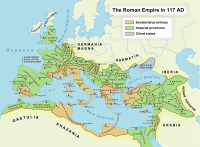 Decisive for the future history of Iberia was the foundation of the Sassanian Empire in 224. By replacing the weak Parthian realm with a strong, centralized state, it changed the political orientation of Iberia away from Rome
. Iberia became a tributary of the Sassanian state during the reign of Shapur I
(241-272). Relations between the two countries seem to have been friendly at first, as Iberia cooperated in Persian campaigns against Rome, and the Iberian king Amazasp III
(260-265) was listed as a high dignitary of the Sassanian realm, not a vassal
who had been subdued by force of arms. But the aggressive tendencies of the Sasanians were evident in their propagation of Zoroastrianism
, which was probably established in Iberia between the 260s and 290s.
However, in the Peace of Nisibis
(298) while the Roman empire
obtained control of Caucasian Iberia again as a vassal state and acknowledged the reign over all the caucasian area, it recognized Mirian III
, the first of the Chosroid dynasty, as King of Iberia.
Roman predominance proved crucial in religious matters, since King Mirian II and leading nobles converted to Christianity
around 317. The event is related with the mission of a Cappadocia
n woman, Saint Nino
, who since 303 had preached Christianity in the Georgian kingdom of Iberia (Eastern Georgia).
The religion would become a strong tie between Georgia
and Rome (later Byzantium
) and have a large scale impact on the state's culture and society.
However, after the emperor Julian
was slain during his failed campaign in Persia in 363, Rome ceded control of Iberia to Persia, and King Varaz-Bakur I (Asphagur) (363-365) became a Persian vassal, an outcome confirmed by the Peace of Acilisene
in 387. However, a later ruler of Kartli, Pharsman IV (406-409), preserved his country's autonomy and ceased to pay tribute to Persia. Persia prevailed, and Sassanian kings began to appoint a viceroy (pitiaxae/bidaxae) to keep watch on their vassal. They eventually made the office hereditary in the ruling house of Lower Kartli, thus inaugurating the Kartli pitiaxate, which brought an extensive territory under its control. Although it remained a part of the kingdom of Kartli, its viceroys turned their domain into a center of Persian influence. Sassanian rulers put the Christianity of the Georgians to a severe test. They promoted the teachings of Zoroaster
, and by the middle of the 5th century Zoroastrianism
had become a second official religion in eastern Georgia alongside Christianity
. However, efforts to convert the common Georgian people were generally unsuccessful.
The early reign of the Iberian king Vakhtang I dubbed Gorgasali (447-502) was marked by the relative revival of the kingdom. Formally a vassal of the Persians, he secured the northern borders by subjugating the Caucasian mountaineers, and brought the adjacent western and southern Georgian lands under his control. He established an autocephalic
patriarchate at Mtskheta
, and made Tbilisi
his capital. In 482 he led a general uprising against Persia and started a desperate war for independence that lasted for twenty years. He could not get Byzantine support and was eventually defeated, dying in battle in 502.
and Persia
for supremacy in the Caucasus
, and the next unsuccessful insurrection (523) of the Georgians under Gurgen had tragic consequences for the country. Thereafter, the king of Iberia had only nominal power, while the country was effectively ruled by the Persians. In 580, Hormizd IV
(578-590) abolished the monarchy after the death of King Bakur III, and Iberia became a Persian province ruled by a marzpan (governor). Georgian nobles urged the Byzantine emperor Maurice
to revive the kingdom of Iberia in 582, but in 591 Byzantium and Persia agreed to divide Iberia between them, with Tbilisi
to be in Persian hands and Mtskheta
to be under Byzantine control.
At the beginning of the 7th century the truce between Byzantium and Persia collapsed. The Iberian Prince Stephanoz I (ca. 590-627), decided in 607 to join forces with Persia in order to reunite all the territories of Iberia, a goal he seems to have accomplished. But Emperor Heraclius
's offensive in 627 and 628 brought victory over the Georgians and Persians and ensured Byzantine predominance in western and eastern Georgia
until the invasion of the Caucasus by the Arabs
.
s reached Iberia about 645 and forced its eristavi
(prince), Stephanoz II (637-ca. 650), to abandon his allegiance to Byzantium
and recognize the Caliph
as his suzerain. Iberia thus became a tributary state and an Arab emir was installed in Tbilisi
about 653. At the beginning of the 9th century, eristavi Ashot I
(813-830) of the new Bagrationi dynasty, from his base in southwestern Georgia, took advantage of the weakening of the Arab rule to establish himself as hereditary prince (with the Byzantine title kouropalates) of Iberia. A successor, Adarnase II of Tao-Klarjeti, formally a vassal of Byzantium
, was crowned as the “king of Georgians” in 888. His descendant Bagrat III
(975-1014), brought the various principalities together to form a united Georgian state.
, the 'Western' Iberians
, has led to an idea of ethnogenetical kinship between them and the people of Caucasian Iberia (called the 'Eastern' Iberians).
It has been advocated by various ancient and medieval authors, although they differed in approach to the problem of the initial place of their origin. The theory seems to have been popular in medieval Georgia
. The prominent Georgian religious writer Giorgi Mthatzmindeli (George of Mt Athos) (1009–1065) writes about the wish of certain Georgian nobles to travel to the Iberian peninsula
and visit the local “Georgians of the West”, as he called them.
Ancient Greece
Ancient Greece is a civilization belonging to a period of Greek history that lasted from the Archaic period of the 8th to 6th centuries BC to the end of antiquity. Immediately following this period was the beginning of the Early Middle Ages and the Byzantine era. Included in Ancient Greece is the...
and Romans
Roman Empire
The Roman Empire was the post-Republican period of the ancient Roman civilization, characterised by an autocratic form of government and large territorial holdings in Europe and around the Mediterranean....
to the ancient Georgian
Georgia (country)
Georgia is a sovereign state in the Caucasus region of Eurasia. Located at the crossroads of Western Asia and Eastern Europe, it is bounded to the west by the Black Sea, to the north by Russia, to the southwest by Turkey, to the south by Armenia, and to the southeast by Azerbaijan. The capital of...
kingdom of Kartli
Kartli
Kartli is a historical region in central-to-eastern Georgia traversed by the river Mtkvari , on which Georgia's capital, Tbilisi, is situated. Known to the Classical authors as Iberia, Kartli played a crucial role in ethnic and political consolidation of the Georgians in the Middle Ages...
(4th century BC – 5th century AD), corresponding roughly to the eastern and southern parts of the present day Georgia. The term Caucasian Iberia (or Eastern Iberia) is used to distinguish it from the Iberian Peninsula
Iberian Peninsula
The Iberian Peninsula , sometimes called Iberia, is located in the extreme southwest of Europe and includes the modern-day sovereign states of Spain, Portugal and Andorra, as well as the British Overseas Territory of Gibraltar...
, where the present day countries of Spain
Spain
Spain , officially the Kingdom of Spain languages]] under the European Charter for Regional or Minority Languages. In each of these, Spain's official name is as follows:;;;;;;), is a country and member state of the European Union located in southwestern Europe on the Iberian Peninsula...
, Portugal
Portugal
Portugal , officially the Portuguese Republic is a country situated in southwestern Europe on the Iberian Peninsula. Portugal is the westernmost country of Europe, and is bordered by the Atlantic Ocean to the West and South and by Spain to the North and East. The Atlantic archipelagos of the...
and Andorra
Andorra
Andorra , officially the Principality of Andorra , also called the Principality of the Valleys of Andorra, , is a small landlocked country in southwestern Europe, located in the eastern Pyrenees mountains and bordered by Spain and France. It is the sixth smallest nation in Europe having an area of...
are located.
The Caucasian Iberians provided a basis for later Georgian statehood and along with Colchis
Colchis
In ancient geography, Colchis or Kolkhis was an ancient Georgian state kingdom and region in Western Georgia, which played an important role in the ethnic and cultural formation of the Georgian nation.The Kingdom of Colchis contributed significantly to the development of medieval Georgian...
(early western Georgian state) formed a core of the present day Georgian people
Georgian people
The Georgians are an ethnic group that have originated in Georgia, where they constitute a majority of the population. Large Georgian communities are also present throughout Russia, European Union, United States, and South America....
(or Kartvelians).
Etymology
One theory on the etymology of the name Iberia, proposed by Giorgi MelikishviliGiorgi Melikishvili
Giorgi Melikishvili was a Georgian historian known for his fundamental works in the history of Georgia, Caucasia and the Middle East. He earned an international recognition for his research of Urartu....
, was that it was derived from the contemporary Armenian
Armenian language
The Armenian language is an Indo-European language spoken by the Armenian people. It is the official language of the Republic of Armenia as well as in the region of Nagorno-Karabakh. The language is also widely spoken by Armenian communities in the Armenian diaspora...
designation for Georgia, Virkʿ , which itself was connected to the word Sver (or Svir), the Kartvelian designation for Georgians. The letter "s" in this instance served as a prefix for the root word "Ver" (or "Vir"). Accordingly, in following Ivane Javakhishvili
Ivane Javakhishvili
Ivane Javakhishvili was a Georgian historian whose voluminous works heavily influenced the modern scholarship of the history and culture of Georgia...
's theory, the ethnic designation of "Sber", a variant of Sver, was derived the word "Hber" ("Hver") (and thus Iberia) and the Armenian variants, Ver and Vir.
Early history
The area was inhabited in earliest timesAncient history
Ancient history is the study of the written past from the beginning of recorded human history to the Early Middle Ages. The span of recorded history is roughly 5,000 years, with Cuneiform script, the oldest discovered form of coherent writing, from the protoliterate period around the 30th century BC...
by several related tribes in Kura-Araxes culture
Kura-Araxes culture
The Kura-Araxes culture or the Early trans-Caucasian culture, was a civilization that existed from 3400 BC until about 2000 BC. The earliest evidence for this culture is found on the Ararat plain; thence it spread to Georgia by 3000 BC, and during the next millennium it proceeded westward to the...
, collectively called Iberians
Caucasian Iberians
Caucasian Iberians was a Greco-Roman designation for ancient Georgians, Ibero-Caucasian people who inhabited the east and southeast of the Transcaucasus region in prehistoric and historic times...
(the Eastern Iberians) by ancient authors. Locals called their country Kartli
Kartli
Kartli is a historical region in central-to-eastern Georgia traversed by the river Mtkvari , on which Georgia's capital, Tbilisi, is situated. Known to the Classical authors as Iberia, Kartli played a crucial role in ethnic and political consolidation of the Georgians in the Middle Ages...
after a mythic chief, Kartlos
Kartlos
Kartlos or K'art'los was the legendary establisher and eponymous father of Georgia, and the mythic ancestor of Georgians, namely its nucleus Kartli...
. The Moschi
Moschi
Moschi or Moschoi is a term from ancient records, and may refer to one of the following peoples:*Mushki, an Iron Age people of Anatolia, known from Assyrian sources.*Moschia, a part of the Caucasus Mountains also associated with the Moschi/Moschoi....
, mentioned by various classic historians, and their possible descendants, the Saspers (who were mentioned by Herodotus
Herodotus
Herodotus was an ancient Greek historian who was born in Halicarnassus, Caria and lived in the 5th century BC . He has been called the "Father of History", and was the first historian known to collect his materials systematically, test their accuracy to a certain extent and arrange them in a...
), may have played a crucial role in the consolidation of the tribes inhabiting the area. The Moschi had moved slowly to the northeast forming settlements as they traveled. The chief of these was Mtskheta
Mtskheta
Mtskheta , one of the oldest cities of the country of Georgia , is located approximately 20 kilometers north of Tbilisi at the confluence of the Aragvi and Kura rivers. The city is now the administrative centre of the Mtskheta-Mtianeti region...
, the future capital of the Iberian kingdom. The Mtskheta tribe was later ruled by a principal locally known as mamasakhlisi (“the father of the household” in Georgian
Georgian language
Georgian is the native language of the Georgians and the official language of Georgia, a country in the Caucasus.Georgian is the primary language of about 4 million people in Georgia itself, and of another 500,000 abroad...
).
The medieval Georgian source Moktsevai Kartlisai (“Conversion of Kartli
Conversion of Kartli
The Conversion of Kartli is the earliest surviving medieval Georgian historical compendium, independent from The Georgian Chronicles, the major corpus historicum of medieval Georgia...
”) also speaks about Azo
Azo (Georgian history)
For other uses, see AzoAzo also known as Azon was a legendary ruler of Georgians of ancient Kartli claimed by medieval Georgian annals to have been installed by Alexander the Great, king of Macedon .- Medieval tradition :His name and origin are differently given by the medieval Georgian chronicles...
and his people, who came from Arian-Kartli
Arian-Kartli
Arian Kartli was a country claimed by the medieval Georgian chronicle "The Conversion of Kartli" to be the earlier homeland of the Georgians of Kartli ....
– the initial home of the proto-Iberians, which had been under Achaemenid rule until the fall of the Persian Empire
Achaemenid Empire
The Achaemenid Empire , sometimes known as First Persian Empire and/or Persian Empire, was founded in the 6th century BCE by Cyrus the Great who overthrew the Median confederation...
– to settle on the site where Mtskheta
Mtskheta
Mtskheta , one of the oldest cities of the country of Georgia , is located approximately 20 kilometers north of Tbilisi at the confluence of the Aragvi and Kura rivers. The city is now the administrative centre of the Mtskheta-Mtianeti region...
was to be founded. Another Georgian chronicle Kartlis Tskhovreba (“History of Kartli”) claims Azo to be an officer of Alexander’s, who massacred a local ruling family and conquered the area, until being defeated at the end of the 4th century BC by Prince Pharnavaz
Pharnavaz I of Iberia
Pharnavaz I was the first king of Kartli, an ancient Georgian kingdom known as Iberia to the Classical sources, who is credited by the medieval Georgian written tradition with founding the kingship of Kartli and the Parnavaziani dynasty...
, who was at that time a local chief.
The story of Alexander’s invasion of Kartli, although entirely fictional, nevertheless reflects the establishment of Georgian monarchy in the Hellenistic period and the desire of later Georgian literati to connect this event to the celebrated conqueror.
Pharnavaz I and his descendants
Pharnavaz, victorious in a power struggle, became the first king of Iberia (ca. 302-ca. 237 BC). Driving back an invasion, he subjugated the neighboring areas, including a significant part of the western Georgian state of Colchis (locally known as EgrisiEgrisi
Lazica or Egrisi in Georgian |Georgia]], named after the Laz tribe, which at some time dominated the local ruling élite.The kingdom flourished between the 6th century BC and the 7th century AD. It covered part of the territory of the former kingdom Colchis and subjugated the territory of modern...
), and seems to have secured recognition of the newly founded state by the Seleucids of Syria
Syria
Syria , officially the Syrian Arab Republic , is a country in Western Asia, bordering Lebanon and the Mediterranean Sea to the West, Turkey to the north, Iraq to the east, Jordan to the south, and Israel to the southwest....
. Then Pharnavaz focused on social projects, including the citadel of the capitol, the Armaztsikhe, and the idol of the god Armazi
Armazi
Armazi was, according to the medieval Georgian chronicles, the supreme deity in a pre-Christian pantheon of ancient Georgians of Kartli ....
. He also reformed the Georgian written language
Georgian alphabet
The Georgian alphabet is the writing system used to write the Georgian language and other Kartvelian languages , and occasionally other languages of the Caucasus such as Ossetic and Abkhaz during the 1940s...
, and created a new system of administration, subdividing the country into several counties called saeristavo
Eristavi
Eristavi was a Georgian feudal office, roughly equivalent to the Byzantine strategos and normally translated into English as "duke". In the Georgian aristocratic hierarchy, it was the title of the third rank of prince and governor of a large province...
s. His successors managed to gain control over the mountainous passes of the Caucasus
Caucasus Mountains
The Caucasus Mountains is a mountain system in Eurasia between the Black Sea and the Caspian Sea in the Caucasus region .The Caucasus Mountains includes:* the Greater Caucasus Mountain Range and* the Lesser Caucasus Mountains....
with the Daryal (also known as the Iberian Gates) being the most important of them.
The period following this time of prosperity was one of incessant warfare as Iberia was forced to defend against numerous invasions into its territories. Some southern parts of Iberia, that were conquered from Kingdom of Armenia, in the 2nd century BC were reunited to Armenia and the Colchian lands seceded to form separate princedoms (sceptuchoi). At the end of the 2nd century BC, the Pharnavazid king Farnadjom
Farnadjom of Iberia
P'arnajom or P'arnajob was a king of Iberia from 109 to 90 BC, the fourth in the P'arnavaziani line. He is known exclusively from the royal list included in the medieval Georgian chronicles....
was dethroned by his own subjects and the crown given to the Armenian prince Arshak who ascended the Iberian throne in 93 BC, establishing the Arshakids dynasty.
Roman period
This close association with ArmeniaArmenia
Armenia , officially the Republic of Armenia , is a landlocked mountainous country in the Caucasus region of Eurasia...
brought upon the country an invasion (65 BC) by the Roman
Roman Empire
The Roman Empire was the post-Republican period of the ancient Roman civilization, characterised by an autocratic form of government and large territorial holdings in Europe and around the Mediterranean....
general Pompey
Pompey
Gnaeus Pompeius Magnus, also known as Pompey or Pompey the Great , was a military and political leader of the late Roman Republic...
, who was then at war with Mithradates VI of Pontus, and Armenia; but Rome did not establish her power permanently over Iberia. Nineteen years later, the Romans again marched (36 BC) on Iberia forcing King Pharnavaz II to join their campaign against Albania
Caucasian Albania
Albania is a name for the historical region of the eastern Caucasus, that existed on the territory of present-day republic of...
.
While another Georgian kingdom of Colchis was administered as a Roman province, Iberia freely accepted the Roman Imperial protection. A stone inscription discovered at Mtskheta
Mtskheta
Mtskheta , one of the oldest cities of the country of Georgia , is located approximately 20 kilometers north of Tbilisi at the confluence of the Aragvi and Kura rivers. The city is now the administrative centre of the Mtskheta-Mtianeti region...
speaks of the first-century ruler Mihdrat I
Mithridates I of Iberia
Mithridates I was the 1st-century king of Iberia whose reign is evidenced by epigraphic material. Cyril Toumanoff suggests AD 58-106 as the years of his reign....
(AD 58-106) as "the friend of the Caesars" and the king "of the Roman-loving Iberians." Emperor Vespasian
Vespasian
Vespasian , was Roman Emperor from 69 AD to 79 AD. Vespasian was the founder of the Flavian dynasty, which ruled the Empire for a quarter century. Vespasian was descended from a family of equestrians, who rose into the senatorial rank under the Emperors of the Julio-Claudian dynasty...
fortified the ancient Mtskheta site of Arzami for the Iberian kings in 75 AD.
The next two centuries saw a continuation of Roman influence over the area, but by the reign of King Pharsman II (116 – 132) Iberia had regained some of its former power. Relations between the Roman Emperor
Roman Emperor
The Roman emperor was the ruler of the Roman State during the imperial period . The Romans had no single term for the office although at any given time, a given title was associated with the emperor...
Hadrian
Hadrian
Hadrian , was Roman Emperor from 117 to 138. He is best known for building Hadrian's Wall, which marked the northern limit of Roman Britain. In Rome, he re-built the Pantheon and constructed the Temple of Venus and Roma. In addition to being emperor, Hadrian was a humanist and was philhellene in...
and Pharsman II were strained, though Hadrian is said to have sought to appease Pharsman. However, it was only under Hadrian's successor Antoninus Pius
Antoninus Pius
Antoninus Pius , also known as Antoninus, was Roman Emperor from 138 to 161. He was a member of the Nerva-Antonine dynasty and the Aurelii. He did not possess the sobriquet "Pius" until after his accession to the throne...
that relations improved to the extent that Pharsman is said to have even visited Rome
Ancient Rome
Ancient Rome was a thriving civilization that grew on the Italian Peninsula as early as the 8th century BC. Located along the Mediterranean Sea and centered on the city of Rome, it expanded to one of the largest empires in the ancient world....
, where Dio Cassius
Dio Cassius
Lucius Cassius Dio Cocceianus , known in English as Cassius Dio, Dio Cassius, or Dio was a Roman consul and a noted historian writing in Greek...
reports that a statue was erected in his honor and that rights to sacrifice were given. The period brought a major change to the political status of Iberia with Rome recognizing them as an ally, rather than their former status as a subject state, a political situation which remained the same, even during the Empire's hostilities with the Parthia
Parthia
Parthia is a region of north-eastern Iran, best known for having been the political and cultural base of the Arsacid dynasty, rulers of the Parthian Empire....
ns.
Between Rome/Byzantium and Persia
Roman Empire
The Roman Empire was the post-Republican period of the ancient Roman civilization, characterised by an autocratic form of government and large territorial holdings in Europe and around the Mediterranean....
. Iberia became a tributary of the Sassanian state during the reign of Shapur I
Shapur I
Shapur I or also known as Shapur I the Great was the second Sassanid King of the Second Persian Empire. The dates of his reign are commonly given as 240/42 - 270/72, but it is likely that he also reigned as co-regent prior to his father's death in 242 .-Early years:Shapur was the son of Ardashir I...
(241-272). Relations between the two countries seem to have been friendly at first, as Iberia cooperated in Persian campaigns against Rome, and the Iberian king Amazasp III
Amazasp III of Iberia
Amazasp III |Latinized]] as Amazaspus) was a king of Iberia from 260 to 265 A.D.. He probably belonged to the Arsacid dynasty....
(260-265) was listed as a high dignitary of the Sassanian realm, not a vassal
Vassal
A vassal or feudatory is a person who has entered into a mutual obligation to a lord or monarch in the context of the feudal system in medieval Europe. The obligations often included military support and mutual protection, in exchange for certain privileges, usually including the grant of land held...
who had been subdued by force of arms. But the aggressive tendencies of the Sasanians were evident in their propagation of Zoroastrianism
Zoroastrianism
Zoroastrianism is a religion and philosophy based on the teachings of prophet Zoroaster and was formerly among the world's largest religions. It was probably founded some time before the 6th century BCE in Greater Iran.In Zoroastrianism, the Creator Ahura Mazda is all good, and no evil...
, which was probably established in Iberia between the 260s and 290s.
However, in the Peace of Nisibis
Peace of Nisibis
The peace treaty of Nisibis was concluded between the Roman and Sassanid Persian empires at Nisibis in 299. It ended the Roman–Sassanid war and enforced the Roman military exploits during the conflict...
(298) while the Roman empire
Roman Empire
The Roman Empire was the post-Republican period of the ancient Roman civilization, characterised by an autocratic form of government and large territorial holdings in Europe and around the Mediterranean....
obtained control of Caucasian Iberia again as a vassal state and acknowledged the reign over all the caucasian area, it recognized Mirian III
Mirian III of Iberia
Mirian III was a king of Iberia , contemporaneous to the Roman emperor Constantine I .According to the early medieval Georgian annals and hagiography, Mirian was the first Christian king of Iberia, converted through the ministry of Nino, a Cappadocian female missionary...
, the first of the Chosroid dynasty, as King of Iberia.
Roman predominance proved crucial in religious matters, since King Mirian II and leading nobles converted to Christianity
Christianity
Christianity is a monotheistic religion based on the life and teachings of Jesus as presented in canonical gospels and other New Testament writings...
around 317. The event is related with the mission of a Cappadocia
Cappadocia
Cappadocia is a historical region in Central Anatolia, largely in Nevşehir Province.In the time of Herodotus, the Cappadocians were reported as occupying the whole region from Mount Taurus to the vicinity of the Euxine...
n woman, Saint Nino
Saint Nino
Saint Nino , ), Equal to the Apostles in and the Enlightener of Georgia, was a woman who preached Christianity in Georgia....
, who since 303 had preached Christianity in the Georgian kingdom of Iberia (Eastern Georgia).
The religion would become a strong tie between Georgia
Georgia (country)
Georgia is a sovereign state in the Caucasus region of Eurasia. Located at the crossroads of Western Asia and Eastern Europe, it is bounded to the west by the Black Sea, to the north by Russia, to the southwest by Turkey, to the south by Armenia, and to the southeast by Azerbaijan. The capital of...
and Rome (later Byzantium
Byzantium
Byzantium was an ancient Greek city, founded by Greek colonists from Megara in 667 BC and named after their king Byzas . The name Byzantium is a Latinization of the original name Byzantion...
) and have a large scale impact on the state's culture and society.
However, after the emperor Julian
Julian the Apostate
Julian "the Apostate" , commonly known as Julian, or also Julian the Philosopher, was Roman Emperor from 361 to 363 and a noted philosopher and Greek writer....
was slain during his failed campaign in Persia in 363, Rome ceded control of Iberia to Persia, and King Varaz-Bakur I (Asphagur) (363-365) became a Persian vassal, an outcome confirmed by the Peace of Acilisene
Hachdeanq
Hachdeanq was a region and family of the ancient Kingdom of Armenia c. 400-800. It is also known as Acilisene in Greek and Latin works. It was a strip of land along the Upper Euphrates or Arsanias roughly corresponding to today's Erzincan Province of Turkey...
in 387. However, a later ruler of Kartli, Pharsman IV (406-409), preserved his country's autonomy and ceased to pay tribute to Persia. Persia prevailed, and Sassanian kings began to appoint a viceroy (pitiaxae/bidaxae) to keep watch on their vassal. They eventually made the office hereditary in the ruling house of Lower Kartli, thus inaugurating the Kartli pitiaxate, which brought an extensive territory under its control. Although it remained a part of the kingdom of Kartli, its viceroys turned their domain into a center of Persian influence. Sassanian rulers put the Christianity of the Georgians to a severe test. They promoted the teachings of Zoroaster
Zoroaster
Zoroaster , also known as Zarathustra , was a prophet and the founder of Zoroastrianism who was either born in North Western or Eastern Iran. He is credited with the authorship of the Yasna Haptanghaiti as well as the Gathas, hymns which are at the liturgical core of Zoroastrianism...
, and by the middle of the 5th century Zoroastrianism
Zoroastrianism
Zoroastrianism is a religion and philosophy based on the teachings of prophet Zoroaster and was formerly among the world's largest religions. It was probably founded some time before the 6th century BCE in Greater Iran.In Zoroastrianism, the Creator Ahura Mazda is all good, and no evil...
had become a second official religion in eastern Georgia alongside Christianity
Christianity
Christianity is a monotheistic religion based on the life and teachings of Jesus as presented in canonical gospels and other New Testament writings...
. However, efforts to convert the common Georgian people were generally unsuccessful.
The early reign of the Iberian king Vakhtang I dubbed Gorgasali (447-502) was marked by the relative revival of the kingdom. Formally a vassal of the Persians, he secured the northern borders by subjugating the Caucasian mountaineers, and brought the adjacent western and southern Georgian lands under his control. He established an autocephalic
Autocephaly
Autocephaly , in hierarchical Christian churches and especially Eastern Orthodox and Oriental Orthodox churches, is the status of a hierarchical church whose head bishop does not report to any higher-ranking bishop...
patriarchate at Mtskheta
Mtskheta
Mtskheta , one of the oldest cities of the country of Georgia , is located approximately 20 kilometers north of Tbilisi at the confluence of the Aragvi and Kura rivers. The city is now the administrative centre of the Mtskheta-Mtianeti region...
, and made Tbilisi
Tbilisi
Tbilisi is the capital and the largest city of Georgia, lying on the banks of the Mt'k'vari River. The name is derived from an early Georgian form T'pilisi and it was officially known as Tiflis until 1936...
his capital. In 482 he led a general uprising against Persia and started a desperate war for independence that lasted for twenty years. He could not get Byzantine support and was eventually defeated, dying in battle in 502.
Fall of the kingdom
The continuing rivalry between ByzantiumByzantine Empire
The Byzantine Empire was the Eastern Roman Empire during the periods of Late Antiquity and the Middle Ages, centred on the capital of Constantinople. Known simply as the Roman Empire or Romania to its inhabitants and neighbours, the Empire was the direct continuation of the Ancient Roman State...
and Persia
Achaemenid Empire
The Achaemenid Empire , sometimes known as First Persian Empire and/or Persian Empire, was founded in the 6th century BCE by Cyrus the Great who overthrew the Median confederation...
for supremacy in the Caucasus
Caucasus
The Caucasus, also Caucas or Caucasia , is a geopolitical region at the border of Europe and Asia, and situated between the Black and the Caspian sea...
, and the next unsuccessful insurrection (523) of the Georgians under Gurgen had tragic consequences for the country. Thereafter, the king of Iberia had only nominal power, while the country was effectively ruled by the Persians. In 580, Hormizd IV
Hormizd IV
Hormizd IV, son of Khosrau I, reigned as the twenty-first King of Persia from 579 to 590.He seems to have been imperious and violent, but not without some kindness of heart. Some very characteristic stories are told of him by Tabari. His father's sympathies had been with the nobles and the priests...
(578-590) abolished the monarchy after the death of King Bakur III, and Iberia became a Persian province ruled by a marzpan (governor). Georgian nobles urged the Byzantine emperor Maurice
Maurice (emperor)
Maurice was Byzantine Emperor from 582 to 602.A prominent general in his youth, Maurice fought with success against the Sassanid Persians...
to revive the kingdom of Iberia in 582, but in 591 Byzantium and Persia agreed to divide Iberia between them, with Tbilisi
Tbilisi
Tbilisi is the capital and the largest city of Georgia, lying on the banks of the Mt'k'vari River. The name is derived from an early Georgian form T'pilisi and it was officially known as Tiflis until 1936...
to be in Persian hands and Mtskheta
Mtskheta
Mtskheta , one of the oldest cities of the country of Georgia , is located approximately 20 kilometers north of Tbilisi at the confluence of the Aragvi and Kura rivers. The city is now the administrative centre of the Mtskheta-Mtianeti region...
to be under Byzantine control.
At the beginning of the 7th century the truce between Byzantium and Persia collapsed. The Iberian Prince Stephanoz I (ca. 590-627), decided in 607 to join forces with Persia in order to reunite all the territories of Iberia, a goal he seems to have accomplished. But Emperor Heraclius
Heraclius
Heraclius was Byzantine Emperor from 610 to 641.He was responsible for introducing Greek as the empire's official language. His rise to power began in 608, when he and his father, Heraclius the Elder, the exarch of Africa, successfully led a revolt against the unpopular usurper Phocas.Heraclius'...
's offensive in 627 and 628 brought victory over the Georgians and Persians and ensured Byzantine predominance in western and eastern Georgia
Georgia (country)
Georgia is a sovereign state in the Caucasus region of Eurasia. Located at the crossroads of Western Asia and Eastern Europe, it is bounded to the west by the Black Sea, to the north by Russia, to the southwest by Turkey, to the south by Armenia, and to the southeast by Azerbaijan. The capital of...
until the invasion of the Caucasus by the Arabs
Caliphate
The term caliphate, "dominion of a caliph " , refers to the first system of government established in Islam and represented the political unity of the Muslim Ummah...
.
Arab period
The ArabArab
Arab people, also known as Arabs , are a panethnicity primarily living in the Arab world, which is located in Western Asia and North Africa. They are identified as such on one or more of genealogical, linguistic, or cultural grounds, with tribal affiliations, and intra-tribal relationships playing...
s reached Iberia about 645 and forced its eristavi
Eristavi
Eristavi was a Georgian feudal office, roughly equivalent to the Byzantine strategos and normally translated into English as "duke". In the Georgian aristocratic hierarchy, it was the title of the third rank of prince and governor of a large province...
(prince), Stephanoz II (637-ca. 650), to abandon his allegiance to Byzantium
Byzantium
Byzantium was an ancient Greek city, founded by Greek colonists from Megara in 667 BC and named after their king Byzas . The name Byzantium is a Latinization of the original name Byzantion...
and recognize the Caliph
Caliph
The Caliph is the head of state in a Caliphate, and the title for the ruler of the Islamic Ummah, an Islamic community ruled by the Shari'ah. It is a transcribed version of the Arabic word which means "successor" or "representative"...
as his suzerain. Iberia thus became a tributary state and an Arab emir was installed in Tbilisi
Emirate of Tbilisi
The Emirs of Tbilisi ruled over the parts of today’s eastern Georgia from their base in the city of Tbilisi, from 736 to 1080 . Established by the Arabs during their invasions of Georgian lands, the emirate was an important outpost of the Muslim rule in the Caucasus until recaptured by the...
about 653. At the beginning of the 9th century, eristavi Ashot I
Ashot I Kuropalates
Ashot I the Great was a presiding prince of Iberia , first of the Bagratid family to have attained to this office c. 813. From his base in Tao-Klarjeti, he fought to enlarge the Bagratid territories and sought the Byzantine protectorate against the Arab encroachment until being murdered c. 830...
(813-830) of the new Bagrationi dynasty, from his base in southwestern Georgia, took advantage of the weakening of the Arab rule to establish himself as hereditary prince (with the Byzantine title kouropalates) of Iberia. A successor, Adarnase II of Tao-Klarjeti, formally a vassal of Byzantium
Byzantium
Byzantium was an ancient Greek city, founded by Greek colonists from Megara in 667 BC and named after their king Byzas . The name Byzantium is a Latinization of the original name Byzantion...
, was crowned as the “king of Georgians” in 888. His descendant Bagrat III
Bagrat III of Georgia
Bagrat III , of the Georgian Bagrationi dynasty, was King of the Abkhazians from 978 on and King of Georgia from 1008 on. He united these two titles by dynastic inheritance and, through conquest and diplomacy, added some more lands to his realm, effectively becoming the first king of what is...
(975-1014), brought the various principalities together to form a united Georgian state.
Eastern and Western Iberians
The similarity of the name with the old inhabitants of the Iberian peninsulaIberian Peninsula
The Iberian Peninsula , sometimes called Iberia, is located in the extreme southwest of Europe and includes the modern-day sovereign states of Spain, Portugal and Andorra, as well as the British Overseas Territory of Gibraltar...
, the 'Western' Iberians
Iberians
The Iberians were a set of peoples that Greek and Roman sources identified with that name in the eastern and southern coasts of the Iberian peninsula at least from the 6th century BC...
, has led to an idea of ethnogenetical kinship between them and the people of Caucasian Iberia (called the 'Eastern' Iberians).
It has been advocated by various ancient and medieval authors, although they differed in approach to the problem of the initial place of their origin. The theory seems to have been popular in medieval Georgia
Georgia (country)
Georgia is a sovereign state in the Caucasus region of Eurasia. Located at the crossroads of Western Asia and Eastern Europe, it is bounded to the west by the Black Sea, to the north by Russia, to the southwest by Turkey, to the south by Armenia, and to the southeast by Azerbaijan. The capital of...
. The prominent Georgian religious writer Giorgi Mthatzmindeli (George of Mt Athos) (1009–1065) writes about the wish of certain Georgian nobles to travel to the Iberian peninsula
Iberian Peninsula
The Iberian Peninsula , sometimes called Iberia, is located in the extreme southwest of Europe and includes the modern-day sovereign states of Spain, Portugal and Andorra, as well as the British Overseas Territory of Gibraltar...
and visit the local “Georgians of the West”, as he called them.
See also
- DzalisiDzalisiDzalisi is a historic village in Georgia, located in the Mukhrani valley, 50 km northwest of Tbilisi, and 20 km northwest of Mtskheta.It is the Zalissa of Ptolemy who mentions it as one of principal towns of Iberia, an ancient Georgian kingdom...
- Roman GeorgiaRoman GeorgiaRoman Georgia was the area of Georgia under Roman control. Between the 1st century BC and the 7th century AD Rome controlled directly or indirectly the kingdoms of Colchis and Iberia in the Caucasus region .-History:Rome's conquests reached the Caucasus area at the end of the 2nd century BC, when...
- Caucasian AlbaniaCaucasian AlbaniaAlbania is a name for the historical region of the eastern Caucasus, that existed on the territory of present-day republic of...
- Caucasian IberiansCaucasian IberiansCaucasian Iberians was a Greco-Roman designation for ancient Georgians, Ibero-Caucasian people who inhabited the east and southeast of the Transcaucasus region in prehistoric and historic times...
- IberiaIberiaThe name Iberia refers to three historical regions of the old world:* Iberian Peninsula, in Southwest Europe, location of modern-day Portugal and Spain** Prehistoric Iberia...
- Iberia (theme)
- Iberian WarIberian WarThe Iberian War was fought from 526 to 532 between the Eastern Roman Empire and Sassanid Empire over the eastern Georgian kingdom of Iberia.-Origin:After the Anastasian War, a seven-year truce was agreed on, yet it lasted for nearly twenty years...
- List of the Kings of Georgia#Ancient Iberia
Further reading
- Thomson, Robert W. Rewriting Caucasian History (1996) ISBN 0-19-826373-2
- Braund, David. Georgia in Antiquity: A History of Colchis and Transcaucasian Iberia, 550 BC-AD 562 (New York: Oxford University Press, 1994) ISBN 0-19-814473-3
- Lang, David Marshall. The Georgians (London: Thames & Hudson, 1966)
- Toumanoff, Cyril. Studies in Christian Caucasian History. Washington D.C.: Georgetown University Press, 1963