


Equestrian (Roman)

Encyclopedia
The Roman equestrian order constituted the lower of the two aristocratic classes of ancient Rome
, ranking below the patricians (patricii), a hereditary caste that monopolised political power during the regal era (to 501 BC)
and during the early Republic
(to 338 BC). A member of the equestrian order was known as an eques (plural: equites). Equites in Latin has the general meaning of "horsemen" or "cavalry" (from equus = "horse"), but in this context carries the specific meaning of "knights" in the sense of members of an aristocratic group. To avoid confusion, this article refers to the latter as "knights" or "equestrians".
It appears that, during the Roman kingdom
and the 1st century of the Republic, legionary cavalry was recruited exclusively from the ranks of the patricians, who were expected to provide 6 centuriae of cavalry (300 horses for each consular legion). At some stage in the regal era, patrician cavalry recruits were granted the right to a horse at public expense (equus publicus). Until ca. 400 BC, therefore, equites were synonymous with patricii. At some stage, however, most likely around 400 BC, 12 more centuriae of cavalry were established, probably because the patrician class was no longer numerous enough to fulfil the levy requirement. These 12 also admitted non-patricians (plebeians), most likely on the basis of a wealth requirement whose level is uncertain. They shared the patricians' right to an equus publicus. At this point, the order of equites was no longer limited to patricians, although the latter remained a distinct elite with special privileges and, probably, their own centuriae (the original 6 regal ones).
Around 300 BC the Samnite Wars
obliged Rome to double the normal annual military levy from 2 to 4 legions, and thus also double the cavalry levy to 1,200 horse. It is probably at this time that the legionary cavalry started to recruit wealthier citizens from outside the 18 centuriae, as the latter were no longer numerous enough to fulfil the levy requirement. However, these new recruits (from the First Class of commoners in the centuriate organisation) were never admitted to the 18 centuriae of equo publico knights nor granted the latters' privileges. At this point, therefore, equites (knights) were no longer fully synonymous with equites (cavalry). Eventually, by the time of the Second Punic War
(218-202 BC), all the members of the First Class of commoners were required to serve as cavalrymen. The presence of knights in the Roman cavalry diminished steadily in the period 200-88 BC. This is because only knights could serve as the army's senior officers, and as the number of legions proliferated, there were ever fewer available for ordinary cavalry service. After c. 88 BC, knights were no longer drafted into the legionary cavalry, although they remained technically liable to such service throughout the Principate
era (to AD 284). They continued to supply the senior officers of the army throughout the Principate.
With the exception of the purely hereditary patricians, the equites were originally defined by a property threshold. Although the rank, once attained, was passed from father to son, members of the order who, at the regular quinquennial census, no longer met the property requirement were usually removed from the order's rolls by the Roman censors. In the late Republic, the property threshold stood at 50,000 denarii and was doubled to 100,000 by the emperor Augustus
(sole rule 30 BC - AD 14) - roughly the equivalent to the annual salaries of 450 contemporary legionaries.
In the later Republican period, Roman Senators
and their offspring became an unofficial elite within the equestrian order. As senators' ability to engage in commerce was strictly limited by law, the bulk of non-agricultural activities were in the hands of non-senatorial knights. As well as holding large landed estates, knights came to dominate mining, shipping and manufacturing industry. In particular, tax farming
companies (publicani) were almost all in the hands of knights.
Under Augustus, the senatorial elite was given formal status (as the ordo senatorius) with a higher wealth threshold (250,000 denarii, or the pay of 1,100 legionaries) and superior rank and privileges to ordinary knights. But the senatorial elite never acquired an existence separate from the equestrian order, rather it remained a sub-set of the latter.
During the Principate, knights filled the senior administrative and military posts of the imperial government. There was a clear division between jobs reserved for senators (the most senior) and those reserved for non-senatorial knights. But the career structure of both groups was broadly similar: a period of junior administrative posts in Rome or Italy, followed by a period (normally a decade) of military service as a senior army officer, followed by senior administrative or military posts in the provinces. Overall, senators and knights formed a tiny elite of under 10,000 members who monopolised political, military and economic power in an empire of about 60 million inhabitants.
During the 3rd century AD, power shifted from the Italian aristocracy to a class of knights who had earned their membership by distinguished military service, often rising from the ranks: career military officers from the provinces (especially the Balkan provinces) who displaced the Italian aristocrats in the top military posts, and under Diocletian
(ruled 284-305) from the top civilian positions also. This effectively reduced the Italian aristocracy to an idle, but immensely wealthy group of large landowners. During the 4th century, the status of knights was debased to insignificance by excessive grants of the rank. At the same time the ranks of senators was swollen to over 4,000 by the establishment of a second senate in Constantinople
and the tripling of the membership of both senates. The senatorial order of the 4th century was thus the equivalent of the equestrian order of the Principate.
, in 753 BC. However, archaeological evidence suggests that Rome did not acquire the character of a unified city-state (as opposed to a number of separate hilltop settlements) until c. 625 BC. According to the Roman historian Livy
, Romulus established three centuries
of equites, totalling 300 men. The centuries were named the Ramnenses, Tatienses and Luceres.
After the defeat of Alba Longa
, and the removal of its citizens to Rome, King Tullus Hostilius
added ten turma
e of Albans (totalling an additional 300 men) to the ranks of the equites.
Livy also says that the equites were doubled in size by King Lucius Tarquinius Priscus (conventional dates 616-578 BC). After an attack on Rome by the Sabines, Tarquinius Priscus determined that Rome's military weakness lay in its lack of horsemen. It had originally been his intention to create fresh centuries of equites, named in his own honour. However, apparently out of respect for the augur
Attus Navius
, the king did not do this, but instead simply increased the number of men in each of the existing centuries. The effect of the changes, as described by Livy, appears confused. Livy says that:
P. Fraccaro's interpretation of the so-called Servian reforms to the army suggests that under king Servius Tullius
(traditional reign dates 578-535 BC), the hoplite
(armoured) infantry was also doubled in size to a single legion
of 6,000, which, together with 2,400 velites
(unarmoured infantry) and 600 cavalry adds up to a total regal levy of 9,000 iuniores (men of military age: aged 16 to 45). Until recently, Fraccaro's thesis was not widely accepted because of the prevailing 1960s theory of Andreas Alföldi
that Rome was an insignificant settlement until c. 500 BC and could not therefore have supported such a powerful army (or cavalry) in the regal era. But recent archaeology has established that Rome was one of the largest cities in the Mediterranean region in the period 625-500 BC. With an estimated 35,000 inhabitants, a military levy of 9,000 is plausible. According to Livy, Servius Tullius also established a further 12 centuriae of cavalry. But this is unlikely, as it would have increased the cavalry to 1,800 horse, implausibly large compared to 8,400 infantry (in peninsular Italy, cavalry typically constituted about 8% of a field army). This is confirmed by the fact that in the early Republic the cavalry fielded remained 600-strong (2 legions with 300 horse each). Apparently, knights were originally provided with a sum of money by the state to purchase a horse for military service and for its fodder. This was known as an equus publicus.
Mommsen
argues that the royal cavalry was drawn exclusively from the ranks of the Patricians (patricii), the aristocracy of early Rome, which was purely hereditary. Apart from the traditional association of the aristocracy with horsemanship, the evidence for this view is the fact that, during the Republic, 6 centuriae (voting constituencies) of equites in the comitia centuriata (electoral assembly) retained the names of the original 6 royal cavalry centuriae. These are very likely "the centuriae of patrician nobles" in the comitia mentioned by the lexicologist Festus
. If this view is correct, it implies that the cavalry was exclusively patrician (and therefore hereditary) in the regal period. (However, Cornell considers the evidence tenuous).
"dynasty"s populist policies in favour of the plebeian class. Indeed, Alfoldi suggests that the coup was carried out by the Celeres themselves. According to the Fraccaro interpretation, when the Roman monarchy was replaced by two annually elected praetores (later called Consuls), the royal army was divided equally among them for campaigning purposes, which if true explains why a later Polybian legion's cavalry contingent was 300-strong.
The 12 additional centuriae ascribed by Livy to Servius Tullius were in reality probably formed around 400 BC. In 403 BC, according to Livy, in a crisis during the siege of Veii, the army urgently needed to deploy more cavalry, and "those who possessed equestrian rating but had not yet been assigned public horses" volunteered to pay for their horses out of their own pocket. By way of compensation, pay was introduced for cavalry service, as it had already been for the infantry (in 406 BC). The persons referred to in this passage were probably members of the 12 new centuriae who were entitled to public horses, but temporarily waived that privilege. Mommsen, however, argues that the passage refers to members of the First Class of commoners being admitted to cavalry service in 403 BC for the first time as an emergency measure. If so, this group may be the original so-called knights equo privato, a rank that is attested throughout the history of the Republic (in contrast to knights equo publico). However, due to lack of evidence, the origins and definition of equo privato knights remain obscure.
It is widely agreed that the 12 new centuriae were open to non-patricians. Thus, from this date if not earlier, not all knights were patricians. The patricians, as a closed hereditary caste, steadily diminished in numbers over the centuries, as families died out. Around 450 BC, there are some 50 patrician gentes (clans) recorded, whereas just 14 remained at the time of Julius Caesar
(dictator
of Rome 48 -44 BC), whose own Iulii clan was patrician. In contrast, the ranks of knights, although also hereditary (in the male line), were open to new entrants who met the property requirement and who satisfied the Roman censors that they were suitable for membership. As a consequence, patricians rapidly became only a small minority of the Order of Knights. However, patricians retained political influence greatly out of proportion with their numbers. Until 172 BC, one of the two Consuls elected each year had to be a patrician. In addition, patricians may have retained their original 6 centuriae, which gave them a third of the total voting-power of the knights, even though they constituted only a tiny minority of the Order by 200 BC. Patricians also enjoyed official precedence, such as the right to speak first in senatorial debates, which were initiated by the princeps senatus ("Leader of the Senate"), a position reserved for patricians. In addition, patricians monopolised certain priesthoods and continued to enjoy enormous prestige.
(340-338 BC) and of the Samnite Wars
(343-290) saw the transformation of the Roman Republic from a powerful but beleaguered city-state into the hegemonic power of the Italian peninsula. This was accompanied by profound changes in its constitution and army. Internally, the critical development was the emergence of the Senate
as the all-powerful organ of state. By 280 BC, the Senate had assumed total control of state taxation, expenditure, declarations of war, treaties, raising of legions, establishing colonies and religious affairs. In other words, of virtually all political power. From an ad hoc group of advisors appointed by the Consuls, the Senate had become a permanent body of c. 300 life-peers who, as largely former Roman magistrates
, boasted enormous experience and influence. At the same time, the political unification of the Latin
nation under Roman rule after 338 BC gave Rome a populous regional base from which to launch its wars of aggression against its neighbours.
The gruelling contest for Italian hegemony that Rome fought against the Samnite League led to the transformation of the Roman army from the Greek-style hoplite
phalanx
that it was in the early period to the Italian-style manipular army
described by Polybius. It is believed that the Romans copied the manipular structure from their enemies the Samnites, learning through hard experience its greater flexibility and effectiveness in the mountainous terrain of central Italy. It is also from this period that every Roman army which took the field was regularly accompanied by at least as many troops supplied by the socii (Rome's Italian military confederates, often referred to as "Latin allies"). Each legion would be matched by a confederate ala (literally: "wing"), a formation that contained roughly the same number of infantry as a legion, but three times the number of horse (900).
Legionary cavalry also probably underwent a transformation during this period, from the light, unarmoured horsemen of the early period to the Greek-style armoured cuirassiers described by Polybius. As a result of the demands of the Samnite hostilities, a normal consular army was doubled in size to 2 legions, making 4 legions raised annually overall. Roman cavalry in the field thus increased to approximately 1,200 horse. But this now represented only 25% of the army's total cavalry contingent, the rest being supplied by the Italian confederates. A legion's modest cavalry share of 7% of its 4,500 total strength was thus increased to 12% in a confederate army, comparable with (or higher than) any other forces in Italy except the Gauls and also similar to those in Greek armies such as Pyrrhus'.
, in which political power was monopolised by the richest social echelon. Probably by c. 300 BC, the centuriate organisation of the Roman citizen-body for political purposes achieved the evolved form described by Polybius and Livy (see table below). The comitia centuriata was the most powerful people's assembly, as it promulgated Roman laws and annually elected the Roman magistrates
, the executive officers of the state: Consuls, Praetors, Aediles and Quaestors. In the assembly, the citizen-body was divided into 193 centuriae, or voting constituencies. Of these, 18 were allocated to knights (including patricians) and a further 80 to the First Class of commoners, securing an absolute majority of the votes (98 out of 193) for the wealthiest echelon of society, although it constituted only a small minority of the citizenry. (The lowest class, the proletarii, rated at under 400 drachmae, had just one vote, despite being the most numerous). As a result, the wealthiest echelon could ensure that the elected Magistrates were always their own members. In turn, this ensured that the Senate
was dominated by the wealthy classes, as its membership was composed almost entirely of current and former Magistrates.
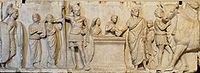
 In the "Polybian" army of the mid-republic (338 - 88 BC), knights held the exclusive right to serve as senior officers of the army. These were the 6 tribuni militum in each legion who were elected by the comitia at the start of each campaigning season and took turns to command the legion in pairs; the praefecti sociorum, commanders of the Italian confederate alae, who were appointed by the Consuls; and the 3 decurions
that led each squadron (turma
) of legionary cavalry (total 30 decurions per legion).
(218-201 BC), as the number of equestrians became insufficient to provide the senior officers of the army and general cavalrymen as well. Knights became exclusively an officer-class, with the First Class of commoners providing the legionary cavalry.
The higher the rank of the opponent killed in combat, the more prestigious the spolia, and none more so than spolia duci hostium detracta, spoils taken from an enemy leader himself. Many knights attempted to gain such an honour, but very few succeeded for the obvious reason that enemy leaders were always surrounded by large numbers of elite bodyguards. One successful attempt, but with a tragic twist, was that of the decurion Titus Manlius Torquatus
in 340 BC during the Latin War
. Despite strict orders from the Consuls (one of whom was his own father) not to engage the enemy, Manlius could not resist accepting a personal challenge from the commander of the Tusculan
cavalry, which his squadron encountered while on reconnaissance. There ensued a fiercely-contested joust with the opposing squadrons as spectators. Manlius won, spearing his adversary after the latter was thrown by his horse. But when the triumphant young man presented the spoils to his father, the latter ordered his son's immediate execution for disobeying orders. "Orders of Manlius" (Manliana imperia) became a proverbial army term for orders which must on no account be disregarded.
restricted the commercial activity of senators and their sons, on the grounds that it was incompatible with their status. Senators were prohibited from owning ships of greater capacity than 300 amphorae (about 7 tonnes) - this being judged sufficient to carry the produce of their own landed estates but too small to conduct large-scale sea transportation. From this time onwards, senatorial families mostly invested their capital in land. All other equestrians remained free to invest their wealth, greatly increased by the growth of Rome's overseas empire after the 2nd Punic War, in large-scale commercial enterprises including mining and industry, as well as land. Equestrians became especially prominent in tax farming
and, by 100 BC, owned virtually all tax-farming companies (publicani).
During the late Republican era, the collection of most taxes was contracted out to private individuals or companies by competitive tender, with the contract for each province awarded to the publicanus who bid the highest advance to the state treasury on the estimated tax-take of the province. The publicanus would then attempt to recoup his advance, with the right to retain any surplus collected as his profit. This system frequently resulted in extortion from the common people of the provinces, as unscrupulous publicani often sought to maximise their profit by demanding a much higher rates of tax than originally set by the government. The provincial governors whose duty it was to curb illegal demands were often bribed into acquiescence by the publicani. The system also led to political conflict between equites publicani and the majority of their fellow-knights, especially senators, who as big landowners wanted to minimise the tax on land outside Italy (tributum solis), which was the main source of state revenue. This pernicious system was terminated by the first Roman emperor, Augustus
(sole rule 30 BC - 14 AD), who transferred responsibility for tax collection from the publicani to provincial local authorities (civitates peregrinae). Although the latter also frequently employed private companies to collect their tax quotas, it was in their own interests to curb extortion. During the imperial era, tax collectors were generally paid an agreed percentage of the amount collected. Equites publicani became prominent in banking activities such as money-lending and money-changing.
, in such a manner that the stripe over the right shoulder was visible (as opposed to the broad stripe worn by senators. Knights bore the title eques Romanus, were entitled to wear an anulus aureus (gold ring) on their left hand, and, from 67 BC, enjoyed privileged seats at games and public functions (just behind those reserved for senators).
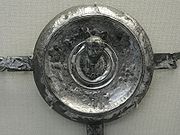
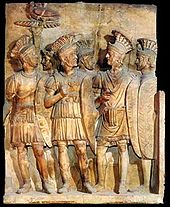
, Augustus (sole rule 30 BC-AD 14) and his successors until 312. Senators' sons and further descendants technically retained equestrian rank unless and until they won a seat in the Senate. But Talbert argues that Augustus established the existing senatorial elite as a separate and superior order to the knights for the first time. The evidence for this includes:
Despite these developments, the senatorial elite never acquired an independent existence, but remained a sub-set of the Order of Knights. A family's senatorial status depended not only on continuing to match the higher wealth qualification, but on their leading member holding a seat in the Senate. Failing either condition, the family would revert to ordinary knightly status. Although sons of sitting senators frequently won seats in the Senate, this was by no means guaranteed, as candidates often outnumbered the 20 seats available each year, leading to intense competition.
Beyond knights with equus publicus, Augustus' legislation permitted any Roman citizen who was assessed in an official census as meeting the property requirement of 100,000 denarii to use the title of eques and wear the narrow-striped tunic and gold ring. But such "property-qualified knights" were not apparently admitted to the ordo equester itself, but simply enjoyed equestrian status. Only those granted an equus publicus by the emperor (or who inherited the status from their fathers) were enrolled in the Order. Imperial knights were thus divided into two tiers: a few thousand mainly Italian equites equo publico, members of the Order eligible to hold the public offices reserved for the knights; and a much larger group of wealthy Italians and provincials (estimated at 25,000 in the 2nd century) of equestrian status but outside the Order.
Equestrians could in turn be elevated to senatorial rank (e.g. Pliny the Younger
), but in practice this was much more difficult than elevation from commoner to equestrian rank. To join the upper order, not only was the candidate required to meet the minimum property requirement of 250,000 denarii, but also had to be elected a member of the Senate
. There were two routes for this, both controlled by the emperor:
, or conventional career-path, which typically combined military and administrative posts. After an initial period of a few years in local government in their home regions as administrators (local aediles or duumviri) or as priests (augur
es), knights were required to serve as military officers for about 10 years before they would be appointed to senior administrative or military posts. Equestrians exclusively provided the praefecti (commanders) of the imperial army's auxiliary regiments and 5 of the 6 tribuni militum (senior staff officers) in each legion
. The standard equestrian officer progression was known as the tres militiae ("three services"): (1) praefectus of a cohors (auxiliary infantry regiment), followed by (2) tribunus militum in a legion, and finally (3) praefectus of an ala
(auxiliary cavalry regiment). From the time of Hadrian, a fourth militia was added for exceptionally gifted officers, commander of an ala milliaria (double-strength ala). Each post would be held for 3–4 years.
Most of the top posts in the imperial administration were reserved for senators, who provided the governors of the larger provinces (except Egypt), the legati legionis (legion commanders) of all legions outside Egypt, and the praefectus urbi
(prefect of the City of Rome), who controlled the Cohortes Urbanae
(public order battalions), the only fully armed force in the City apart from the Praetorian Guard. Nevertheless, a wide range of senior administrative and military posts were created and reserved for equestrians by Augustus, though most ranked below the senatorial posts.
In the imperial administration, equestrian posts included that of the governorship (praefectus Augusti) of the province of Egypt, which was considered the most prestigious of all the posts open to knights, often the culmination of a long and distinguished career serving the state. In addition, knights were appointed to the governorship (procurator Augusti) of some smaller provinces and sub-provinces e.g. Judaea
, whose governor was subordinate to the governor of Syria
. Equestrians were also the chief financial officers (also called procuratores Augusti
) of the imperial provinces, and the deputy financial officers of senatorial provinces. At Rome, equestrians filled numerous senior administrative posts such as the emperor's secretaries of state (from the time of Claudius
e.g. Correspondence and Treasury) and the praefecti annonae
(director of grain supplies). In the military, equestrians provided the praefecti praetorio (commanders of the Praetorian Guard
) who also acted as the emperor's chiefs of military staff. There were normally two of these, but at times irregular appointments resulted in just a single incumbent or even 3 at the same time. Equestrians also provided the praefecti classis (admirals commanding) of the two main imperial fleets at Misenum in the bay of Naples and at Ravenna
on the Italian Adriatic coast. The command of Rome's fire brigade and minor constabulary, the Vigiles
, was likewise reserved for knights.
Not all knights followed the conventional career-path. Those equestrians who specialised in a legal or administrative career, providing judges (iudices) in Rome's law courts and state secretaries in the imperial government, were granted dispensation from military service by emperor Hadrian
(r. AD 117-138). At the same time, many knights became career military officers, remaining in the army for much longer than 10 years. After completing their tres militiae, some would continue to command auxiliary regiments, moving across units and provinces.
Already wealthy to start with, equites equo publico accumulated even greater riches through holding their reserved senior posts in the administration, which carried enormous salaries (although they were generally smaller than senatorial salaries). For example, the salaries of equestrian procuratores (fiscal and gubernatorial) ranged from 15,000 to a maximum of 75,000 denarii (for the governor of Egypt) per annum, whilst an equestrian praefectus of an auxiliary cohort was paid about 50 times as much as a common foot soldier (about 10,000 denarii). A praefectus could thus earn in one year the same as two of his auxiliary rankers combined earned during their entire 25-year service terms.
According to Talbert, however, the evidence suggests that knights were no more loyal or less corrupt than senators. For example, ca. 26 BC, the equestrian governor of Egypt, Gaius Cornelius Gallus, was recalled for politically suspect behaviour and sundry other misdemeanours. His conduct was deemed sufficiently serious by the Senate to warrant the maximum penalty of exile and confiscation of assets. Under Tiberius, both the senatorial governor and the equestrian fiscal procurator of Asia province were convicted of corruption. There is evidence that emperors were as wary of powerful knights as they were of senators. Augustus enforced a tacit rule that senators and prominent equestrians must obtain his express permission to enter the province of Egypt, a policy that was continued by his successors. Also, the command of the Praetorian Guard was normally split between two knights, to reduce the potential for a successful coup d'état. At the same time, command of the second military force in Rome, the cohortes urbanae, was entrusted to a senator.
(r.54-68), half of all land in Africa proconsularis province was owned by just 6 senators) and of most major commercial enterprises. Overall, senators and knights cooperated smoothly in the running of the empire. In contrast to the chaotic civil wars of the late Republic, the rule of this tiny oligarchy achieved a remarkable degree of political stability. In the first 250 years of the Principate (30 BC - AD 218), there was only a single episode of major internal strife: the Civil war of 68-9
.
Augustus instituted a policy, followed by his successors, of elevating to the ordo equester the primus pilus (chief centurion) of each legion, at the end of his single year in the post. This resulted in about 30 career-soldiers, often risen from the ranks, joining the Order every year. These equites primipilares and their descendants formed a section of the Order which was quite distinct from the Italian aristocrats who had become nearly indistinguishable from their senatorial counterparts. They were almost entirely provincials, especially Romanised Illyrians
and Thracians
from the Danubian provinces where about half the Roman army was deployed. They were generally far less wealthy than the landowning Italians (not benefiting from centuries of inherited wealth) and they rarely held non-military posts.
Their professionalism led emperors to rely on them ever more heavily, especially in difficult conflicts such as the Marcomannic Wars
(166-80). But because they were only equestrians, they could not be appointed to the top military commands, those of legatus Augusti pro praetore
(governor of an imperial province, where virtually all military units were deployed) and legatus legionis
(commander of a legion). In the later 2nd century, emperors tried to circumvent the problem by elevating large numbers of primipilares to senatorial rank by adlectio. But this met resistance in the Senate, so that in the 3rd century, emperors simply appointed equestrians directly to the top commands, under the fiction that they were only temporary substitutes (praeses pro legato). Septimius Severus
(r. AD 193-211) appointed primipilares to command the 3 new legions that he raised in 197 for his Parthian War. Gallienus
(r. AD 253-268) completed the process by appointing knights to command all the legions. These appointees were mostly provincial soldier-equestrians, not Italian aristocrats.
Under the reforming emperor Diocletian
(r. AD 284-305), himself an Illyrian equestrian officer, the military equestrian "takeover" was brought a stage further, with the removal of hereditary senators from most administrative, as well as military posts. Hereditary senators were limited to administrative jobs in Italy and a few neighbouring provinces (Sicily, Africa, Achaea and Asia), despite the fact that senior administrative posts had been greatly multiplied by the tripling of the number of provinces and the establishment of dioceses
(super-provinces). The exclusion of the old Italian aristocracy, both senatorial and equestrian, from the political and military power that they had monopolised for many centuries was thus complete. The Senate became politically insignificant, although it retained great prestige.
The 3rd and 4th centuries saw the proliferation of hierarchical ranks within the aristocratic orders, in line with the greater stratification of society as a whole, which became divided into two broad classes, with discriminatory rights and privileges: the honestiores ("more noble") and humiliores ("more base"). Among the honestiores, equestrians were divided into 5 grades, depending on the salary-levels of the offices they held. These ranged from egregii or sexagenarii (salary of 60,000 sesterces = 15,000 denarii) to the eminentissimi ("most exalted"), limited to the 2 commanders of the Praetorian Guard and, with the establishment of Diocletian's Tetrarchy
, the 4 praefecti praetorio (not to be confused with the commanders of the Praetorian Guard in Rome) that assisted the Tetrarchs, each ruling over a quarter of the empire.
the Great (312–37) onwards, there was an explosive increase in the membership of both aristocratic orders. Under Diocletian, the number of sitting members of the Senate remained at around 600, the level it had retained for the whole duration of the Principate. But Constantine established Byzantium
as a twin capital of the empire, with its own senate, initially of 300 members. By 387, their number had swollen to 2,000, while the Senate in Rome probably reached a comparable size, so that the upper order reached total numbers similar to the equo publico knights of the early Principate. By this time, even some commanders of military regiments were accorded senatorial status.
At the same time the order of knights was also expanded vastly by the proliferation of public posts in the late empire, most of which were now filled by equestrians. The Principate had been a remarkably slim-line administration, with about 250 senior officials running the vast empire, relying on local government and private contractors to deliver the necessary taxes and services. By the time of the Notitia, comparable positions had grown to ca. 6,000, a 24-fold increase. In addition, large numbers of decuriones (local councillors) were granted equestrian rank, often obtaining it by bribery. Officials of ever lower rank were granted equestrian rank as reward for good service e.g. in 365, the actuarii (accountants) of military regiments. This inflation in knights' numbers inevitably led to the debasement of the order's prestige. By AD 400, knights were no longer an echelon of nobility, but just a title associated with mid-level administrative posts.
Constantine established a third order of nobility, the comites ("companions (of the emperor)", singular form comes
, the origin of the medieval noble rank of count
). This overlapped with senators and knights, drawing members from both. Originally, the comites were a highly exclusive group, comprising the most senior administrative and military officers, such as the commanders of the comitatus, or mobile field armies. But comites rapidly followed the same path as knights, being devalued by excessive grants until the title became meaningless by 450.
In the late 4th and in the 5th century, therefore, the senatorial class at Rome and Byzantium became the closest equivalent to the equo publico equestrian class of the early Principate. It contained many ancient and illustrious families, some of whom claimed descent from the aristocracy of the Republic, but had, as described, lost almost all political and military power. Nevertheless, senators retained great influence due to their enormous inherited wealth and their role as the guardians of Roman tradition and culture. Centuries of capital accumulation, in the form of vast landed estates (latifundia) across many provinces resulted in enormous wealth for most senators. Many received annual rents in cash and in kind of over 5,000 lbs of gold, equivalent to 360,000 solidi (or 5 million Augustan-era denarii), at a time when a miles (common soldier) would earn no more than 4 solidi a year in cash. Even senators of middling wealth could expect an income 1,000-1,500 lbs of gold. The 4th century historian Ammianus Marcellinus
, a former high-ranking military staff-officer who spent his retirement years in Rome, bitterly attacks the Italian aristocracy, denouncing their extravagant palaces, clothes, games and banquets and above all their lives of total idleness and frivolity. In his words can be heard the contempt for the senatorial class of a career-soldier who had spent his lifetime defending the empire, a view clearly shared by Diocletian and his Illyrian successors. But it is the latter who reduced the aristocracy to that state, by displacing them from their traditional role of governing the empire and leading the army.
Ancient Rome
Ancient Rome was a thriving civilization that grew on the Italian Peninsula as early as the 8th century BC. Located along the Mediterranean Sea and centered on the city of Rome, it expanded to one of the largest empires in the ancient world....
, ranking below the patricians (patricii), a hereditary caste that monopolised political power during the regal era (to 501 BC)
Roman Kingdom
The Roman Kingdom was the period of the ancient Roman civilization characterized by a monarchical form of government of the city of Rome and its territories....
and during the early Republic
Roman Republic
The Roman Republic was the period of the ancient Roman civilization where the government operated as a republic. It began with the overthrow of the Roman monarchy, traditionally dated around 508 BC, and its replacement by a government headed by two consuls, elected annually by the citizens and...
(to 338 BC). A member of the equestrian order was known as an eques (plural: equites). Equites in Latin has the general meaning of "horsemen" or "cavalry" (from equus = "horse"), but in this context carries the specific meaning of "knights" in the sense of members of an aristocratic group. To avoid confusion, this article refers to the latter as "knights" or "equestrians".
It appears that, during the Roman kingdom
Roman Kingdom
The Roman Kingdom was the period of the ancient Roman civilization characterized by a monarchical form of government of the city of Rome and its territories....
and the 1st century of the Republic, legionary cavalry was recruited exclusively from the ranks of the patricians, who were expected to provide 6 centuriae of cavalry (300 horses for each consular legion). At some stage in the regal era, patrician cavalry recruits were granted the right to a horse at public expense (equus publicus). Until ca. 400 BC, therefore, equites were synonymous with patricii. At some stage, however, most likely around 400 BC, 12 more centuriae of cavalry were established, probably because the patrician class was no longer numerous enough to fulfil the levy requirement. These 12 also admitted non-patricians (plebeians), most likely on the basis of a wealth requirement whose level is uncertain. They shared the patricians' right to an equus publicus. At this point, the order of equites was no longer limited to patricians, although the latter remained a distinct elite with special privileges and, probably, their own centuriae (the original 6 regal ones).
Around 300 BC the Samnite Wars
Samnite Wars
The First, Second, and Third Samnite Wars, between the early Roman Republic and the tribes of Samnium, extended over half a century, involving almost all the states of Italy, and ended in Roman domination of the Samnites...
obliged Rome to double the normal annual military levy from 2 to 4 legions, and thus also double the cavalry levy to 1,200 horse. It is probably at this time that the legionary cavalry started to recruit wealthier citizens from outside the 18 centuriae, as the latter were no longer numerous enough to fulfil the levy requirement. However, these new recruits (from the First Class of commoners in the centuriate organisation) were never admitted to the 18 centuriae of equo publico knights nor granted the latters' privileges. At this point, therefore, equites (knights) were no longer fully synonymous with equites (cavalry). Eventually, by the time of the Second Punic War
Second Punic War
The Second Punic War, also referred to as The Hannibalic War and The War Against Hannibal, lasted from 218 to 201 BC and involved combatants in the western and eastern Mediterranean. This was the second major war between Carthage and the Roman Republic, with the participation of the Berbers on...
(218-202 BC), all the members of the First Class of commoners were required to serve as cavalrymen. The presence of knights in the Roman cavalry diminished steadily in the period 200-88 BC. This is because only knights could serve as the army's senior officers, and as the number of legions proliferated, there were ever fewer available for ordinary cavalry service. After c. 88 BC, knights were no longer drafted into the legionary cavalry, although they remained technically liable to such service throughout the Principate
Principate
The Principate is the first period of the Roman Empire, extending from the beginning of the reign of Caesar Augustus to the Crisis of the Third Century, after which it was replaced with the Dominate. The Principate is characterized by a concerted effort on the part of the Emperors to preserve the...
era (to AD 284). They continued to supply the senior officers of the army throughout the Principate.
With the exception of the purely hereditary patricians, the equites were originally defined by a property threshold. Although the rank, once attained, was passed from father to son, members of the order who, at the regular quinquennial census, no longer met the property requirement were usually removed from the order's rolls by the Roman censors. In the late Republic, the property threshold stood at 50,000 denarii and was doubled to 100,000 by the emperor Augustus
Augustus
Augustus ;23 September 63 BC – 19 August AD 14) is considered the first emperor of the Roman Empire, which he ruled alone from 27 BC until his death in 14 AD.The dates of his rule are contemporary dates; Augustus lived under two calendars, the Roman Republican until 45 BC, and the Julian...
(sole rule 30 BC - AD 14) - roughly the equivalent to the annual salaries of 450 contemporary legionaries.
In the later Republican period, Roman Senators
Roman Senate
The Senate of the Roman Republic was a political institution in the ancient Roman Republic, however, it was not an elected body, but one whose members were appointed by the consuls, and later by the censors. After a magistrate served his term in office, it usually was followed with automatic...
and their offspring became an unofficial elite within the equestrian order. As senators' ability to engage in commerce was strictly limited by law, the bulk of non-agricultural activities were in the hands of non-senatorial knights. As well as holding large landed estates, knights came to dominate mining, shipping and manufacturing industry. In particular, tax farming
Tax farming
Farming is a technique of financial management, namely the process of commuting , by its assignment by legal contract to a third party, a future uncertain revenue stream into fixed and certain periodic rents, in consideration for which commutation a discount in value received is suffered...
companies (publicani) were almost all in the hands of knights.
Under Augustus, the senatorial elite was given formal status (as the ordo senatorius) with a higher wealth threshold (250,000 denarii, or the pay of 1,100 legionaries) and superior rank and privileges to ordinary knights. But the senatorial elite never acquired an existence separate from the equestrian order, rather it remained a sub-set of the latter.
During the Principate, knights filled the senior administrative and military posts of the imperial government. There was a clear division between jobs reserved for senators (the most senior) and those reserved for non-senatorial knights. But the career structure of both groups was broadly similar: a period of junior administrative posts in Rome or Italy, followed by a period (normally a decade) of military service as a senior army officer, followed by senior administrative or military posts in the provinces. Overall, senators and knights formed a tiny elite of under 10,000 members who monopolised political, military and economic power in an empire of about 60 million inhabitants.
During the 3rd century AD, power shifted from the Italian aristocracy to a class of knights who had earned their membership by distinguished military service, often rising from the ranks: career military officers from the provinces (especially the Balkan provinces) who displaced the Italian aristocrats in the top military posts, and under Diocletian
Diocletian
Diocletian |latinized]] upon his accession to Diocletian . c. 22 December 244 – 3 December 311), was a Roman Emperor from 284 to 305....
(ruled 284-305) from the top civilian positions also. This effectively reduced the Italian aristocracy to an idle, but immensely wealthy group of large landowners. During the 4th century, the status of knights was debased to insignificance by excessive grants of the rank. At the same time the ranks of senators was swollen to over 4,000 by the establishment of a second senate in Constantinople
Constantinople
Constantinople was the capital of the Roman, Eastern Roman, Byzantine, Latin, and Ottoman Empires. Throughout most of the Middle Ages, Constantinople was Europe's largest and wealthiest city.-Names:...
and the tripling of the membership of both senates. The senatorial order of the 4th century was thus the equivalent of the equestrian order of the Principate.
Regal era (753 to 509 BC)
According to Roman legend, Rome was founded by its first king, RomulusRomulus and Remus
Romulus and Remus are Rome's twin founders in its traditional foundation myth, although the former is sometimes said to be the sole founder...
, in 753 BC. However, archaeological evidence suggests that Rome did not acquire the character of a unified city-state (as opposed to a number of separate hilltop settlements) until c. 625 BC. According to the Roman historian Livy
Livy
Titus Livius — known as Livy in English — was a Roman historian who wrote a monumental history of Rome and the Roman people. Ab Urbe Condita Libri, "Chapters from the Foundation of the City," covering the period from the earliest legends of Rome well before the traditional foundation in 753 BC...
, Romulus established three centuries
Centuria
Centuria is a Latin substantive from the stem centum , denoting units consisting of 100 men. It also denotes a Roman unit of land area: 1 centuria = 100 heredia...
of equites, totalling 300 men. The centuries were named the Ramnenses, Tatienses and Luceres.
After the defeat of Alba Longa
Alba Longa
Alba Longa – in Italian sources occasionally written Albalonga – was an ancient city of Latium in central Italy southeast of Rome in the Alban Hills. Founder and head of the Latin League, it was destroyed by Rome around the middle of the 7th century BC. In legend, Romulus and Remus, founders of...
, and the removal of its citizens to Rome, King Tullus Hostilius
Tullus Hostilius
Tullus Hostilius was the legendary third of the Kings of Rome. He succeeded Numa Pompilius, and was succeeded by Ancus Marcius...
added ten turma
Turma
A turma was a cavalry squadron in the Roman army of the Republic and Empire. In the Byzantine Empire, it became applied to the larger, regiment-sized military-cum-administrative divisions of a thema....
e of Albans (totalling an additional 300 men) to the ranks of the equites.
Livy also says that the equites were doubled in size by King Lucius Tarquinius Priscus (conventional dates 616-578 BC). After an attack on Rome by the Sabines, Tarquinius Priscus determined that Rome's military weakness lay in its lack of horsemen. It had originally been his intention to create fresh centuries of equites, named in his own honour. However, apparently out of respect for the augur
Augur
The augur was a priest and official in the classical world, especially ancient Rome and Etruria. His main role was to interpret the will of the gods by studying the flight of birds: whether they are flying in groups/alone, what noises they make as they fly, direction of flight and what kind of...
Attus Navius
Attus Navius
In the legendary history of ancient Rome, Attus Navius was a famous augur during the reign of Tarquinius Priscus.When the latter desired to increase the number of the equestrian centuries, and to name them in his own honour, Navius opposed him, declaring that it must not be done unless the omens...
, the king did not do this, but instead simply increased the number of men in each of the existing centuries. The effect of the changes, as described by Livy, appears confused. Livy says that:
- Tarquinius doubled the number of men in each of the existing three centuries, without adding new centuries;
- the effect of the changes was that the three centuries comprised a total of 1,800 men (which suggests that there had previously been a total of 900); and
- three new centuries were in fact created, called Ramnenses Posteriores, etc.
P. Fraccaro's interpretation of the so-called Servian reforms to the army suggests that under king Servius Tullius
Servius Tullius
Servius Tullius was the legendary sixth king of ancient Rome, and the second of its Etruscan dynasty. He reigned 578-535 BC. Roman and Greek sources describe his servile origins and later marriage to a daughter of Lucius Tarquinius Priscus, Rome's first Etruscan king, who was assassinated in 579 BC...
(traditional reign dates 578-535 BC), the hoplite
Hoplite
A hoplite was a citizen-soldier of the Ancient Greek city-states. Hoplites were primarily armed as spearmen and fought in a phalanx formation. The word "hoplite" derives from "hoplon" , the type of the shield used by the soldiers, although, as a word, "hopla" could also denote weapons held or even...
(armoured) infantry was also doubled in size to a single legion
Roman legion
A Roman legion normally indicates the basic ancient Roman army unit recruited specifically from Roman citizens. The organization of legions varied greatly over time but they were typically composed of perhaps 5,000 soldiers, divided into maniples and later into "cohorts"...
of 6,000, which, together with 2,400 velites
Velites
Velites were a class of infantry in the Polybian legions of the early Roman republic. Velites were light infantry and skirmishers who were armed with a number of light javelins, or hastae velitares, to fling at the enemy, and also carried short thrusting swords, or gladii for use in melee...
(unarmoured infantry) and 600 cavalry adds up to a total regal levy of 9,000 iuniores (men of military age: aged 16 to 45). Until recently, Fraccaro's thesis was not widely accepted because of the prevailing 1960s theory of Andreas Alföldi
Andreas Alföldi
András Ede Zsigmond Alföldi was a Hungarian historian, epigraphist, numismatist and archaeologist. He was one of the most productive 20th-century scholars of the ancient world and is considered one of the leading researchers of his time...
that Rome was an insignificant settlement until c. 500 BC and could not therefore have supported such a powerful army (or cavalry) in the regal era. But recent archaeology has established that Rome was one of the largest cities in the Mediterranean region in the period 625-500 BC. With an estimated 35,000 inhabitants, a military levy of 9,000 is plausible. According to Livy, Servius Tullius also established a further 12 centuriae of cavalry. But this is unlikely, as it would have increased the cavalry to 1,800 horse, implausibly large compared to 8,400 infantry (in peninsular Italy, cavalry typically constituted about 8% of a field army). This is confirmed by the fact that in the early Republic the cavalry fielded remained 600-strong (2 legions with 300 horse each). Apparently, knights were originally provided with a sum of money by the state to purchase a horse for military service and for its fodder. This was known as an equus publicus.
Mommsen
Mommsen
Mommsen is a surname, and may refer to one of a family of German historians, see Mommsen family:* Theodor Mommsen , great classical scholar, and winner of the Nobel Prize in Literature* Tycho Mommsen...
argues that the royal cavalry was drawn exclusively from the ranks of the Patricians (patricii), the aristocracy of early Rome, which was purely hereditary. Apart from the traditional association of the aristocracy with horsemanship, the evidence for this view is the fact that, during the Republic, 6 centuriae (voting constituencies) of equites in the comitia centuriata (electoral assembly) retained the names of the original 6 royal cavalry centuriae. These are very likely "the centuriae of patrician nobles" in the comitia mentioned by the lexicologist Festus
Sextus Pompeius Festus
Sextus Pompeius Festus was a Roman grammarian, who probably flourished in the later 2nd century AD, perhaps at Narbo in Gaul.He made an epitome in 20 volumes of the encyclopedic treatise in many volumes De verborum significatu, of Verrius Flaccus, a celebrated grammarian who flourished in the...
. If this view is correct, it implies that the cavalry was exclusively patrician (and therefore hereditary) in the regal period. (However, Cornell considers the evidence tenuous).
Early Republic (509-338 BC)
It is widely accepted that the Roman monarchy was overthrown by a patrician coup, probably provoked by the TarquinTarquin
Tarquin may refer to:* Tarquin , a chamber operaPeople with the given name Tarquin:* Tarquin the Elder , fifth of the seven legendary kings of Rome* Tarquin the Proud , last of the seven legendary kings of Rome...
"dynasty"s populist policies in favour of the plebeian class. Indeed, Alfoldi suggests that the coup was carried out by the Celeres themselves. According to the Fraccaro interpretation, when the Roman monarchy was replaced by two annually elected praetores (later called Consuls), the royal army was divided equally among them for campaigning purposes, which if true explains why a later Polybian legion's cavalry contingent was 300-strong.
The 12 additional centuriae ascribed by Livy to Servius Tullius were in reality probably formed around 400 BC. In 403 BC, according to Livy, in a crisis during the siege of Veii, the army urgently needed to deploy more cavalry, and "those who possessed equestrian rating but had not yet been assigned public horses" volunteered to pay for their horses out of their own pocket. By way of compensation, pay was introduced for cavalry service, as it had already been for the infantry (in 406 BC). The persons referred to in this passage were probably members of the 12 new centuriae who were entitled to public horses, but temporarily waived that privilege. Mommsen, however, argues that the passage refers to members of the First Class of commoners being admitted to cavalry service in 403 BC for the first time as an emergency measure. If so, this group may be the original so-called knights equo privato, a rank that is attested throughout the history of the Republic (in contrast to knights equo publico). However, due to lack of evidence, the origins and definition of equo privato knights remain obscure.
It is widely agreed that the 12 new centuriae were open to non-patricians. Thus, from this date if not earlier, not all knights were patricians. The patricians, as a closed hereditary caste, steadily diminished in numbers over the centuries, as families died out. Around 450 BC, there are some 50 patrician gentes (clans) recorded, whereas just 14 remained at the time of Julius Caesar
Julius Caesar
Gaius Julius Caesar was a Roman general and statesman and a distinguished writer of Latin prose. He played a critical role in the gradual transformation of the Roman Republic into the Roman Empire....
(dictator
Dictator
A dictator is a ruler who assumes sole and absolute power but without hereditary ascension such as an absolute monarch. When other states call the head of state of a particular state a dictator, that state is called a dictatorship...
of Rome 48 -44 BC), whose own Iulii clan was patrician. In contrast, the ranks of knights, although also hereditary (in the male line), were open to new entrants who met the property requirement and who satisfied the Roman censors that they were suitable for membership. As a consequence, patricians rapidly became only a small minority of the Order of Knights. However, patricians retained political influence greatly out of proportion with their numbers. Until 172 BC, one of the two Consuls elected each year had to be a patrician. In addition, patricians may have retained their original 6 centuriae, which gave them a third of the total voting-power of the knights, even though they constituted only a tiny minority of the Order by 200 BC. Patricians also enjoyed official precedence, such as the right to speak first in senatorial debates, which were initiated by the princeps senatus ("Leader of the Senate"), a position reserved for patricians. In addition, patricians monopolised certain priesthoods and continued to enjoy enormous prestige.
Transformation of state and army (338-290)
The period following the end of the Latin WarLatin War
The Latin War was a conflict between the Roman Republic and its neighbors the Latin peoples of ancient Italy. It ended in the dissolution of the Latin League, and incorporation of its territory into the Roman sphere of influence, with the Latins gaining partial rights and varying levels of...
(340-338 BC) and of the Samnite Wars
Samnite Wars
The First, Second, and Third Samnite Wars, between the early Roman Republic and the tribes of Samnium, extended over half a century, involving almost all the states of Italy, and ended in Roman domination of the Samnites...
(343-290) saw the transformation of the Roman Republic from a powerful but beleaguered city-state into the hegemonic power of the Italian peninsula. This was accompanied by profound changes in its constitution and army. Internally, the critical development was the emergence of the Senate
Roman Senate
The Senate of the Roman Republic was a political institution in the ancient Roman Republic, however, it was not an elected body, but one whose members were appointed by the consuls, and later by the censors. After a magistrate served his term in office, it usually was followed with automatic...
as the all-powerful organ of state. By 280 BC, the Senate had assumed total control of state taxation, expenditure, declarations of war, treaties, raising of legions, establishing colonies and religious affairs. In other words, of virtually all political power. From an ad hoc group of advisors appointed by the Consuls, the Senate had become a permanent body of c. 300 life-peers who, as largely former Roman magistrates
Roman Magistrates
The Roman Magistrates were elected officials in Ancient Rome. During the period of the Roman Kingdom, the King of Rome was the principal executive magistrate. His power, in practice, was absolute. He was the chief priest, lawgiver, judge, and the sole commander of the army...
, boasted enormous experience and influence. At the same time, the political unification of the Latin
Latins
"Latins" refers to different groups of people and the meaning of the word changes for where and when it is used.The original Latins were an Italian tribe inhabiting central and south-central Italy. Through conquest by their most populous city-state, Rome, the original Latins culturally "Romanized"...
nation under Roman rule after 338 BC gave Rome a populous regional base from which to launch its wars of aggression against its neighbours.
The gruelling contest for Italian hegemony that Rome fought against the Samnite League led to the transformation of the Roman army from the Greek-style hoplite
Hoplite
A hoplite was a citizen-soldier of the Ancient Greek city-states. Hoplites were primarily armed as spearmen and fought in a phalanx formation. The word "hoplite" derives from "hoplon" , the type of the shield used by the soldiers, although, as a word, "hopla" could also denote weapons held or even...
phalanx
Phalanx formation
The phalanx is a rectangular mass military formation, usually composed entirely of heavy infantry armed with spears, pikes, sarissas, or similar weapons...
that it was in the early period to the Italian-style manipular army
Roman army of the mid-Republic
The Roman army of the mid-Republic , refers to the armed forces deployed by the mid- Roman Republic The Roman army of the mid-Republic (also known as the manipular Roman army or the "Polybian army"), refers to the armed forces deployed by the mid- Roman Republic The Roman army of the mid-Republic...
described by Polybius. It is believed that the Romans copied the manipular structure from their enemies the Samnites, learning through hard experience its greater flexibility and effectiveness in the mountainous terrain of central Italy. It is also from this period that every Roman army which took the field was regularly accompanied by at least as many troops supplied by the socii (Rome's Italian military confederates, often referred to as "Latin allies"). Each legion would be matched by a confederate ala (literally: "wing"), a formation that contained roughly the same number of infantry as a legion, but three times the number of horse (900).
Legionary cavalry also probably underwent a transformation during this period, from the light, unarmoured horsemen of the early period to the Greek-style armoured cuirassiers described by Polybius. As a result of the demands of the Samnite hostilities, a normal consular army was doubled in size to 2 legions, making 4 legions raised annually overall. Roman cavalry in the field thus increased to approximately 1,200 horse. But this now represented only 25% of the army's total cavalry contingent, the rest being supplied by the Italian confederates. A legion's modest cavalry share of 7% of its 4,500 total strength was thus increased to 12% in a confederate army, comparable with (or higher than) any other forces in Italy except the Gauls and also similar to those in Greek armies such as Pyrrhus'.
Political role
Despite an ostensibly democratic constitution based on the sovereignty of the people, the Roman Republic was in reality a classic oligarchyOligarchy
Oligarchy is a form of power structure in which power effectively rests with an elite class distinguished by royalty, wealth, family ties, commercial, and/or military legitimacy...
, in which political power was monopolised by the richest social echelon. Probably by c. 300 BC, the centuriate organisation of the Roman citizen-body for political purposes achieved the evolved form described by Polybius and Livy (see table below). The comitia centuriata was the most powerful people's assembly, as it promulgated Roman laws and annually elected the Roman magistrates
Roman Magistrates
The Roman Magistrates were elected officials in Ancient Rome. During the period of the Roman Kingdom, the King of Rome was the principal executive magistrate. His power, in practice, was absolute. He was the chief priest, lawgiver, judge, and the sole commander of the army...
, the executive officers of the state: Consuls, Praetors, Aediles and Quaestors. In the assembly, the citizen-body was divided into 193 centuriae, or voting constituencies. Of these, 18 were allocated to knights (including patricians) and a further 80 to the First Class of commoners, securing an absolute majority of the votes (98 out of 193) for the wealthiest echelon of society, although it constituted only a small minority of the citizenry. (The lowest class, the proletarii, rated at under 400 drachmae, had just one vote, despite being the most numerous). As a result, the wealthiest echelon could ensure that the elected Magistrates were always their own members. In turn, this ensured that the Senate
Roman Senate
The Senate of the Roman Republic was a political institution in the ancient Roman Republic, however, it was not an elected body, but one whose members were appointed by the consuls, and later by the censors. After a magistrate served his term in office, it usually was followed with automatic...
was dominated by the wealthy classes, as its membership was composed almost entirely of current and former Magistrates.
| Class | Property Rating (drachmae: denarii after 211 BC) | No. of votes in electoral assembly | Military service |
|---|---|---|---|
| Aristocrats | |||
| Patricii (patricians) | n.a. (hereditary) | 6 | Officers/legionary cavalry |
| Equites (knights) | hereditary/over 25,000?* | 12 | Officers/legionary cavalry |
| Commoners | |||
| First Class | 10,000 - 25,000? | 80 | Legionary cavalry |
| Second Class | 7,500 - 10,000 | 20 | Legionary infantry |
| Third Class | 5,000 - 7,500 | 20 | Legionary infantry |
| Fourth Class | 2,500 - 5,000 | 20 | Legionary infantry |
| Fifth Class | 400 (or 1,100) - 2,500 | 30 | Legionary infantry (velites Velites Velites were a class of infantry in the Polybian legions of the early Roman republic. Velites were light infantry and skirmishers who were armed with a number of light javelins, or hastae velitares, to fling at the enemy, and also carried short thrusting swords, or gladii for use in melee... ) |
| Proletarii (a.k.a. capite censi) | Under 400 (or 1,100) | 1 | Fleets (oarsmen) |
Military officer role
Decurion (military)
A decurion was a Roman cavalry officer in command of a squadron of cavalrymen in the Roman army.- Republican army :...
that led each squadron (turma
Turma
A turma was a cavalry squadron in the Roman army of the Republic and Empire. In the Byzantine Empire, it became applied to the larger, regiment-sized military-cum-administrative divisions of a thema....
) of legionary cavalry (total 30 decurions per legion).
Cavalry role
As their name implies, knights were liable to cavalry service in the legion of the mid-Republic. They originally provided a legion's entire cavalry contingent, although from an early stage (probably from c. 400 and not later than c. 300 BC), when equestrian numbers had become insufficient, large numbers of young men from the First Class of commoners were regularly volunteering for the service, which was considered more glamorous than the infantry. The cavalry role of knights dwindled after the Second Punic WarSecond Punic War
The Second Punic War, also referred to as The Hannibalic War and The War Against Hannibal, lasted from 218 to 201 BC and involved combatants in the western and eastern Mediterranean. This was the second major war between Carthage and the Roman Republic, with the participation of the Berbers on...
(218-201 BC), as the number of equestrians became insufficient to provide the senior officers of the army and general cavalrymen as well. Knights became exclusively an officer-class, with the First Class of commoners providing the legionary cavalry.
Ethos
From the earliest times and throughout the Republican period, Roman knights subscribed, in their role as Roman cavalrymen, to an ethos of personal heroism and glory. This was motivated by the desire to justify their privileged status to the lower classes that provided the infantry ranks, to enhance the renown of their family name, and to augment their chances of subsequent political advancement in a martial society. For knights, a focus of the heroic ethos was the quest for spolia militaria, the stripped armour and weapons of a foe whom they had killed in single combat. There are many recorded instances. For example, Servilius Geminus Pulex, who went on to become Consul in 202 BC, was reputed to have gained spolia 23 times.The higher the rank of the opponent killed in combat, the more prestigious the spolia, and none more so than spolia duci hostium detracta, spoils taken from an enemy leader himself. Many knights attempted to gain such an honour, but very few succeeded for the obvious reason that enemy leaders were always surrounded by large numbers of elite bodyguards. One successful attempt, but with a tragic twist, was that of the decurion Titus Manlius Torquatus
Titus Manlius Torquatus
Titus Manlius Torquatus may refer to three Roman Republic consuls of the gens Manlia:* Titus Manlius Torquatus , son of Lucius, consul in 347, 344, and 340 BC...
in 340 BC during the Latin War
Latin War
The Latin War was a conflict between the Roman Republic and its neighbors the Latin peoples of ancient Italy. It ended in the dissolution of the Latin League, and incorporation of its territory into the Roman sphere of influence, with the Latins gaining partial rights and varying levels of...
. Despite strict orders from the Consuls (one of whom was his own father) not to engage the enemy, Manlius could not resist accepting a personal challenge from the commander of the Tusculan
Tusculum
Tusculum is a ruined Roman city in the Alban Hills, in the Latium region of Italy.-Location:Tusculum is one of the largest Roman cities in Alban Hills. The ruins of Tusculum are located on Tuscolo hill—more specifically on the northern edge of the outer crater ring of the Alban volcano...
cavalry, which his squadron encountered while on reconnaissance. There ensued a fiercely-contested joust with the opposing squadrons as spectators. Manlius won, spearing his adversary after the latter was thrown by his horse. But when the triumphant young man presented the spoils to his father, the latter ordered his son's immediate execution for disobeying orders. "Orders of Manlius" (Manliana imperia) became a proverbial army term for orders which must on no account be disregarded.
Business activities
In 218 BC, the lex ClaudiaLex Claudia
Lex Claudia was a law established in ancient Rome in 218 BC. The law was written by Quintus Claudius, then Tribune of the Plebs, stating that no senator or senator’s son could own a sea-going ship with a capacity of more than 300 amphorae . Though Q...
restricted the commercial activity of senators and their sons, on the grounds that it was incompatible with their status. Senators were prohibited from owning ships of greater capacity than 300 amphorae (about 7 tonnes) - this being judged sufficient to carry the produce of their own landed estates but too small to conduct large-scale sea transportation. From this time onwards, senatorial families mostly invested their capital in land. All other equestrians remained free to invest their wealth, greatly increased by the growth of Rome's overseas empire after the 2nd Punic War, in large-scale commercial enterprises including mining and industry, as well as land. Equestrians became especially prominent in tax farming
Tax farming
Farming is a technique of financial management, namely the process of commuting , by its assignment by legal contract to a third party, a future uncertain revenue stream into fixed and certain periodic rents, in consideration for which commutation a discount in value received is suffered...
and, by 100 BC, owned virtually all tax-farming companies (publicani).
During the late Republican era, the collection of most taxes was contracted out to private individuals or companies by competitive tender, with the contract for each province awarded to the publicanus who bid the highest advance to the state treasury on the estimated tax-take of the province. The publicanus would then attempt to recoup his advance, with the right to retain any surplus collected as his profit. This system frequently resulted in extortion from the common people of the provinces, as unscrupulous publicani often sought to maximise their profit by demanding a much higher rates of tax than originally set by the government. The provincial governors whose duty it was to curb illegal demands were often bribed into acquiescence by the publicani. The system also led to political conflict between equites publicani and the majority of their fellow-knights, especially senators, who as big landowners wanted to minimise the tax on land outside Italy (tributum solis), which was the main source of state revenue. This pernicious system was terminated by the first Roman emperor, Augustus
Augustus
Augustus ;23 September 63 BC – 19 August AD 14) is considered the first emperor of the Roman Empire, which he ruled alone from 27 BC until his death in 14 AD.The dates of his rule are contemporary dates; Augustus lived under two calendars, the Roman Republican until 45 BC, and the Julian...
(sole rule 30 BC - 14 AD), who transferred responsibility for tax collection from the publicani to provincial local authorities (civitates peregrinae). Although the latter also frequently employed private companies to collect their tax quotas, it was in their own interests to curb extortion. During the imperial era, tax collectors were generally paid an agreed percentage of the amount collected. Equites publicani became prominent in banking activities such as money-lending and money-changing.
Privileges
The official dress of equestrians was the tunica angusticlavia ("narrow-striped tunic"), worn underneath the togaToga
The toga, a distinctive garment of Ancient Rome, was a cloth of perhaps 20 ft in length which was wrapped around the body and was generally worn over a tunic. The toga was made of wool, and the tunic under it often was made of linen. After the 2nd century BC, the toga was a garment worn...
, in such a manner that the stripe over the right shoulder was visible (as opposed to the broad stripe worn by senators. Knights bore the title eques Romanus, were entitled to wear an anulus aureus (gold ring) on their left hand, and, from 67 BC, enjoyed privileged seats at games and public functions (just behind those reserved for senators).
The Augustan equestrian order (Principate era)
Differentiation of the senatorial order
In its narrowest sense, the term ordo senatorius encompassed only sitting senators, whose number was held at around 600 by the founder of the PrincipatePrincipate
The Principate is the first period of the Roman Empire, extending from the beginning of the reign of Caesar Augustus to the Crisis of the Third Century, after which it was replaced with the Dominate. The Principate is characterized by a concerted effort on the part of the Emperors to preserve the...
, Augustus (sole rule 30 BC-AD 14) and his successors until 312. Senators' sons and further descendants technically retained equestrian rank unless and until they won a seat in the Senate. But Talbert argues that Augustus established the existing senatorial elite as a separate and superior order to the knights for the first time. The evidence for this includes:
- Augustus for the first time set a minimum property requirement for admission to the Senate, of 250,000 denarii, two and a half times the 100,000 denarii that he set for admission to the equestrian order.
- Augustus for the first time allowed the sons of senators to wear the tunica laticlavia (tunic with broad purple stripes that was the official dress of senators) on reaching their majority even though they were not yet members of the Senate.
- Senators' sons followed a separate cursus honorumCursus honorumThe cursus honorum was the sequential order of public offices held by aspiring politicians in both the Roman Republic and the early Empire. It was designed for men of senatorial rank. The cursus honorum comprised a mixture of military and political administration posts. Each office had a minimum...
(career-path) to other knights before entering the Senate: first an appointment as one of the vigintiviri ("Committee of Twenty", a body that included officials with a variety of minor administrative functions), or as an augur (priest), followed by at least a year in the military as tribunus militum laticlavius (deputy commander) of a legion. This post was normally held before the tribune had become a member of the Senate. - A marriage law of 18 BC (the lex JuliaLex JuliaLex Julia are ancient Roman laws, introduced by any member of the Julian family....
) seems to define not only senators but also their descendants unto the third generation (in the male line) as a distinct group. There was thus established a group of men with senatorial rank (senatorii) wider than just sitting senators (senatores).
Despite these developments, the senatorial elite never acquired an independent existence, but remained a sub-set of the Order of Knights. A family's senatorial status depended not only on continuing to match the higher wealth qualification, but on their leading member holding a seat in the Senate. Failing either condition, the family would revert to ordinary knightly status. Although sons of sitting senators frequently won seats in the Senate, this was by no means guaranteed, as candidates often outnumbered the 20 seats available each year, leading to intense competition.
The ordo equester under Augustus
As regards the equestrian order, Augustus apparently abolished the rank of equo privato, according all its members equo publico status. In addition, Augustus organised the Order in a quasi-military fashion, with members enrolled into 6 turmae (notional cavalry squadrons). The Order's governing body were the seviri ("Committee of Six"), composed of the "commanders" of the turmae. In an attempt to foster the knights' esprit de corps, Augustus revived a defunct Republican ceremony, the recognitio equitum ("inspection of the knights"), in which knights paraded every 5 years with their horses before the Consuls. At some stage during the early Principate, knights acquired the right to the title egregius ("distinguished gentleman"), while senators were styled clarissimus, "most distinguished").Beyond knights with equus publicus, Augustus' legislation permitted any Roman citizen who was assessed in an official census as meeting the property requirement of 100,000 denarii to use the title of eques and wear the narrow-striped tunic and gold ring. But such "property-qualified knights" were not apparently admitted to the ordo equester itself, but simply enjoyed equestrian status. Only those granted an equus publicus by the emperor (or who inherited the status from their fathers) were enrolled in the Order. Imperial knights were thus divided into two tiers: a few thousand mainly Italian equites equo publico, members of the Order eligible to hold the public offices reserved for the knights; and a much larger group of wealthy Italians and provincials (estimated at 25,000 in the 2nd century) of equestrian status but outside the Order.
Equestrians could in turn be elevated to senatorial rank (e.g. Pliny the Younger
Pliny the Younger
Gaius Plinius Caecilius Secundus, born Gaius Caecilius or Gaius Caecilius Cilo , better known as Pliny the Younger, was a lawyer, author, and magistrate of Ancient Rome. Pliny's uncle, Pliny the Elder, helped raise and educate him...
), but in practice this was much more difficult than elevation from commoner to equestrian rank. To join the upper order, not only was the candidate required to meet the minimum property requirement of 250,000 denarii, but also had to be elected a member of the Senate
Roman Senate
The Senate of the Roman Republic was a political institution in the ancient Roman Republic, however, it was not an elected body, but one whose members were appointed by the consuls, and later by the censors. After a magistrate served his term in office, it usually was followed with automatic...
. There were two routes for this, both controlled by the emperor:
- The normal route was election to the post of QuaestorQuaestorA Quaestor was a type of public official in the "Cursus honorum" system who supervised financial affairs. In the Roman Republic a quaestor was an elected official whereas, with the autocratic government of the Roman Empire, quaestors were simply appointed....
, the most junior magistracy (for which the minimum eligible age was 27 years), which carried automatic membership of the Senate. 20 Quaestors were appointed each year, a number which evidently broadly matched the average annual vacancies (caused by death or expulsion for misdemeanours or insufficient wealth) so that the 600-member limit was preserved. Under Augustus, senators' sons had the right to stand for election, while equestrians could only do so with the emperor's permission. Later in the Julio-Claudian period, the rule became established that all candidates required imperial leave. Previously conducted by the people's assembly (comitia centuriata), the election was in the hands, from the time of TiberiusTiberiusTiberius , was Roman Emperor from 14 AD to 37 AD. Tiberius was by birth a Claudian, son of Tiberius Claudius Nero and Livia Drusilla. His mother divorced Nero and married Augustus in 39 BC, making him a step-son of Octavian...
onwards, of the Senate itself, whose sitting members inevitably favoured the sons of their colleagues. Since the latter alone often outnumbered the number of available places, equestrian candidates stood little chance unless they enjoyed the special support of the emperor. - The exceptional route was direct appointment to a Senate seat by the emperor (adlectio), technically using the powers of Roman censor (which also entitled him to expel members). Adlectio was, however, generally used sparingly in order not to breach the 600-member ceiling. It was chiefly resorted to in periods when Senate numbers became severely depleted e.g. during the Civil War of 68-9Year of the Four EmperorsThe Year of the Four Emperors was a year in the history of the Roman Empire, AD 69, in which four emperors ruled in a remarkable succession. These four emperors were Galba, Otho, Vitellius, and Vespasian....
, following which the emperor VespasianVespasianVespasian , was Roman Emperor from 69 AD to 79 AD. Vespasian was the founder of the Flavian dynasty, which ruled the Empire for a quarter century. Vespasian was descended from a family of equestrians, who rose into the senatorial rank under the Emperors of the Julio-Claudian dynasty...
made large-scale adlectiones.
Equestrian public careers
In public service, knights equo publico had their own version of the senatorial cursus honorumCursus honorum
The cursus honorum was the sequential order of public offices held by aspiring politicians in both the Roman Republic and the early Empire. It was designed for men of senatorial rank. The cursus honorum comprised a mixture of military and political administration posts. Each office had a minimum...
, or conventional career-path, which typically combined military and administrative posts. After an initial period of a few years in local government in their home regions as administrators (local aediles or duumviri) or as priests (augur
Augur
The augur was a priest and official in the classical world, especially ancient Rome and Etruria. His main role was to interpret the will of the gods by studying the flight of birds: whether they are flying in groups/alone, what noises they make as they fly, direction of flight and what kind of...
es), knights were required to serve as military officers for about 10 years before they would be appointed to senior administrative or military posts. Equestrians exclusively provided the praefecti (commanders) of the imperial army's auxiliary regiments and 5 of the 6 tribuni militum (senior staff officers) in each legion
Roman legion
A Roman legion normally indicates the basic ancient Roman army unit recruited specifically from Roman citizens. The organization of legions varied greatly over time but they were typically composed of perhaps 5,000 soldiers, divided into maniples and later into "cohorts"...
. The standard equestrian officer progression was known as the tres militiae ("three services"): (1) praefectus of a cohors (auxiliary infantry regiment), followed by (2) tribunus militum in a legion, and finally (3) praefectus of an ala
Ala (Roman military)
An Ala was the term used during the mid- Roman Republic to denote a military formation composed of conscripts from the socii, Rome's Italian military allies. A normal consular army during this period consisted of 2 legions, composed of Roman citizens only, and 2 allied alae...
(auxiliary cavalry regiment). From the time of Hadrian, a fourth militia was added for exceptionally gifted officers, commander of an ala milliaria (double-strength ala). Each post would be held for 3–4 years.
Most of the top posts in the imperial administration were reserved for senators, who provided the governors of the larger provinces (except Egypt), the legati legionis (legion commanders) of all legions outside Egypt, and the praefectus urbi
Praefectus urbi
The praefectus urbanus or praefectus urbi, in English the urban prefect, was prefect of the city of Rome, and later also of Constantinople. The office originated under the Roman kings, continued during the Republic and Empire, and held high importance in late Antiquity...
(prefect of the City of Rome), who controlled the Cohortes Urbanae
Cohortes urbanae
The cohortes urbanae of ancient Rome were created by Augustus to counterbalance the enormous power of the Praetorian Guard in the city of Rome and serve as a police force...
(public order battalions), the only fully armed force in the City apart from the Praetorian Guard. Nevertheless, a wide range of senior administrative and military posts were created and reserved for equestrians by Augustus, though most ranked below the senatorial posts.
In the imperial administration, equestrian posts included that of the governorship (praefectus Augusti) of the province of Egypt, which was considered the most prestigious of all the posts open to knights, often the culmination of a long and distinguished career serving the state. In addition, knights were appointed to the governorship (procurator Augusti) of some smaller provinces and sub-provinces e.g. Judaea
Iudaea Province
Judaea or Iudaea are terms used by historians to refer to the Roman province that extended over parts of the former regions of the Hasmonean and Herodian kingdoms of Israel...
, whose governor was subordinate to the governor of Syria
Syria (Roman province)
Syria was a Roman province, annexed in 64 BC by Pompey, as a consequence of his military presence after pursuing victory in the Third Mithridatic War. It remained under Roman, and subsequently Byzantine, rule for seven centuries, until 637 when it fell to the Islamic conquests.- Principate :The...
. Equestrians were also the chief financial officers (also called procuratores Augusti
Procurator (Roman fiscal)
A Roman fiscal procurator was the chief financial officer of a province of the Roman Empire during the Principate era...
) of the imperial provinces, and the deputy financial officers of senatorial provinces. At Rome, equestrians filled numerous senior administrative posts such as the emperor's secretaries of state (from the time of Claudius
Claudius
Claudius , was Roman Emperor from 41 to 54. A member of the Julio-Claudian dynasty, he was the son of Drusus and Antonia Minor. He was born at Lugdunum in Gaul and was the first Roman Emperor to be born outside Italy...
e.g. Correspondence and Treasury) and the praefecti annonae
Praefectus annonae
The praefectus annonae was a Roman imperial official charged with the supervision of the grain supply to the city of Rome. Under the republic, the job was usually done by an aedile...
(director of grain supplies). In the military, equestrians provided the praefecti praetorio (commanders of the Praetorian Guard
Praetorian Guard
The Praetorian Guard was a force of bodyguards used by Roman Emperors. The title was already used during the Roman Republic for the guards of Roman generals, at least since the rise to prominence of the Scipio family around 275 BC...
) who also acted as the emperor's chiefs of military staff. There were normally two of these, but at times irregular appointments resulted in just a single incumbent or even 3 at the same time. Equestrians also provided the praefecti classis (admirals commanding) of the two main imperial fleets at Misenum in the bay of Naples and at Ravenna
Ravenna
Ravenna is the capital city of the Province of Ravenna in the Emilia-Romagna region of Italy and the second largest comune in Italy by land area, although, at , it is little more than half the size of the largest comune, Rome...
on the Italian Adriatic coast. The command of Rome's fire brigade and minor constabulary, the Vigiles
Vigiles
The Vigiles or more properly the Vigiles Urbani or Cohortes Vigilum were the firefighters and police of Ancient Rome.-History:...
, was likewise reserved for knights.
Not all knights followed the conventional career-path. Those equestrians who specialised in a legal or administrative career, providing judges (iudices) in Rome's law courts and state secretaries in the imperial government, were granted dispensation from military service by emperor Hadrian
Hadrian
Hadrian , was Roman Emperor from 117 to 138. He is best known for building Hadrian's Wall, which marked the northern limit of Roman Britain. In Rome, he re-built the Pantheon and constructed the Temple of Venus and Roma. In addition to being emperor, Hadrian was a humanist and was philhellene in...
(r. AD 117-138). At the same time, many knights became career military officers, remaining in the army for much longer than 10 years. After completing their tres militiae, some would continue to command auxiliary regiments, moving across units and provinces.
Already wealthy to start with, equites equo publico accumulated even greater riches through holding their reserved senior posts in the administration, which carried enormous salaries (although they were generally smaller than senatorial salaries). For example, the salaries of equestrian procuratores (fiscal and gubernatorial) ranged from 15,000 to a maximum of 75,000 denarii (for the governor of Egypt) per annum, whilst an equestrian praefectus of an auxiliary cohort was paid about 50 times as much as a common foot soldier (about 10,000 denarii). A praefectus could thus earn in one year the same as two of his auxiliary rankers combined earned during their entire 25-year service terms.
Relations with emperor
It was suggested by ancient writers, and accepted by many modern historians, that Roman emperors trusted equestrians more than men of senatorial rank, and used the former as a political counterweight to the senators. According to this view, senators were often regarded as potentially less loyal and honest by the emperor, as they could become powerful enough, through the command of provincial legions, to launch coups. They also had greater opportunities for peculation as provincial governors. Hence the appointment of equestrians to the most sensitive military commands. In Egypt, which supplied much of Italy's grain needs, the governor and the commanders of both provincial legions were drawn from the equestrian order, since placing a senator in a position to starve Italy was considered too risky. The commanders of the Praetorian Guard, the principal military force close to the emperor at Rome, were also usually drawn from the equestrian order. Also cited in support of this view is the appointment of equestrian fiscal procuratores, reporting direct to the emperor, alongside senatorial provincial governors. These would supervise the collection of taxes and act as watchdogs to limit opportunities for corruption by the governors (as well as managing the imperial estates in the province).According to Talbert, however, the evidence suggests that knights were no more loyal or less corrupt than senators. For example, ca. 26 BC, the equestrian governor of Egypt, Gaius Cornelius Gallus, was recalled for politically suspect behaviour and sundry other misdemeanours. His conduct was deemed sufficiently serious by the Senate to warrant the maximum penalty of exile and confiscation of assets. Under Tiberius, both the senatorial governor and the equestrian fiscal procurator of Asia province were convicted of corruption. There is evidence that emperors were as wary of powerful knights as they were of senators. Augustus enforced a tacit rule that senators and prominent equestrians must obtain his express permission to enter the province of Egypt, a policy that was continued by his successors. Also, the command of the Praetorian Guard was normally split between two knights, to reduce the potential for a successful coup d'état. At the same time, command of the second military force in Rome, the cohortes urbanae, was entrusted to a senator.
Oligarchical rule in the early Principate (to AD 197)
Because the Senate was limited to 600 members, knights equo publico, numbering several thousands, greatly outnumbered men of senatorial rank. Even so, senators and knights combined constituted a tiny elite in a citizen-body of about 6 million (in AD 47) and an empire with a total population of 60-70 millions. This immensely wealthy elite monopolised political, military and economic power in the empire. It controlled the major offices of state, command of all military units, ownership of a significant proportion of the empire's arable land (e.g. under NeroNero
Nero , was Roman Emperor from 54 to 68, and the last in the Julio-Claudian dynasty. Nero was adopted by his great-uncle Claudius to become his heir and successor, and succeeded to the throne in 54 following Claudius' death....
(r.54-68), half of all land in Africa proconsularis province was owned by just 6 senators) and of most major commercial enterprises. Overall, senators and knights cooperated smoothly in the running of the empire. In contrast to the chaotic civil wars of the late Republic, the rule of this tiny oligarchy achieved a remarkable degree of political stability. In the first 250 years of the Principate (30 BC - AD 218), there was only a single episode of major internal strife: the Civil war of 68-9
Year of the Four Emperors
The Year of the Four Emperors was a year in the history of the Roman Empire, AD 69, in which four emperors ruled in a remarkable succession. These four emperors were Galba, Otho, Vitellius, and Vespasian....
.
Equestrians in the later empire (AD 197-395)
Rise of the military equestrians (3rd century)
The 3rd century saw two major trends in the development of the Roman aristocracy: (1) the progressive takeover of the top positions in the empire's administration and army by military equestrians and the concomitant exclusion of the Italian aristocracy, both senators and knights; (2) the growth in hierarchy within the aristocratic orders.Augustus instituted a policy, followed by his successors, of elevating to the ordo equester the primus pilus (chief centurion) of each legion, at the end of his single year in the post. This resulted in about 30 career-soldiers, often risen from the ranks, joining the Order every year. These equites primipilares and their descendants formed a section of the Order which was quite distinct from the Italian aristocrats who had become nearly indistinguishable from their senatorial counterparts. They were almost entirely provincials, especially Romanised Illyrians
Illyrians
The Illyrians were a group of tribes who inhabited part of the western Balkans in antiquity and the south-eastern coasts of the Italian peninsula...
and Thracians
Thracians
The ancient Thracians were a group of Indo-European tribes inhabiting areas including Thrace in Southeastern Europe. They spoke the Thracian language – a scarcely attested branch of the Indo-European language family...
from the Danubian provinces where about half the Roman army was deployed. They were generally far less wealthy than the landowning Italians (not benefiting from centuries of inherited wealth) and they rarely held non-military posts.
Their professionalism led emperors to rely on them ever more heavily, especially in difficult conflicts such as the Marcomannic Wars
Marcomannic Wars
The Marcomannic Wars were a series of wars lasting over a dozen years from about AD 166 until 180. These wars pitted the Roman Empire against the Marcomanni, Quadi and other Germanic peoples, along both sides of the upper and middle Danube...
(166-80). But because they were only equestrians, they could not be appointed to the top military commands, those of legatus Augusti pro praetore
Legatus Augusti pro praetore
A legatus Augusti pro praetore was the official title of the governor of some imperial provinces of the Roman Empire during the Principate era, normally the larger ones or those where legions were based...
(governor of an imperial province, where virtually all military units were deployed) and legatus legionis
Legatus legionis
Legatus legionis was a title awarded to legion commanders in Ancient Rome.-History:By the time of the Roman Republic, the term legatus delegated authority...
(commander of a legion). In the later 2nd century, emperors tried to circumvent the problem by elevating large numbers of primipilares to senatorial rank by adlectio. But this met resistance in the Senate, so that in the 3rd century, emperors simply appointed equestrians directly to the top commands, under the fiction that they were only temporary substitutes (praeses pro legato). Septimius Severus
Septimius Severus
Septimius Severus , also known as Severus, was Roman Emperor from 193 to 211. Severus was born in Leptis Magna in the province of Africa. As a young man he advanced through the customary succession of offices under the reigns of Marcus Aurelius and Commodus. Severus seized power after the death of...
(r. AD 193-211) appointed primipilares to command the 3 new legions that he raised in 197 for his Parthian War. Gallienus
Gallienus
Gallienus was Roman Emperor with his father Valerian from 253 to 260, and alone from 260 to 268. He took control of the Empire at a time when it was undergoing great crisis...
(r. AD 253-268) completed the process by appointing knights to command all the legions. These appointees were mostly provincial soldier-equestrians, not Italian aristocrats.
Under the reforming emperor Diocletian
Diocletian
Diocletian |latinized]] upon his accession to Diocletian . c. 22 December 244 – 3 December 311), was a Roman Emperor from 284 to 305....
(r. AD 284-305), himself an Illyrian equestrian officer, the military equestrian "takeover" was brought a stage further, with the removal of hereditary senators from most administrative, as well as military posts. Hereditary senators were limited to administrative jobs in Italy and a few neighbouring provinces (Sicily, Africa, Achaea and Asia), despite the fact that senior administrative posts had been greatly multiplied by the tripling of the number of provinces and the establishment of dioceses
Roman diocese
A Roman or civil diocese was one of the administrative divisions of the later Roman Empire, starting with the Tetrarchy. It formed the intermediate level of government, grouping several provinces and being in turn subordinated to a praetorian prefecture....
(super-provinces). The exclusion of the old Italian aristocracy, both senatorial and equestrian, from the political and military power that they had monopolised for many centuries was thus complete. The Senate became politically insignificant, although it retained great prestige.
The 3rd and 4th centuries saw the proliferation of hierarchical ranks within the aristocratic orders, in line with the greater stratification of society as a whole, which became divided into two broad classes, with discriminatory rights and privileges: the honestiores ("more noble") and humiliores ("more base"). Among the honestiores, equestrians were divided into 5 grades, depending on the salary-levels of the offices they held. These ranged from egregii or sexagenarii (salary of 60,000 sesterces = 15,000 denarii) to the eminentissimi ("most exalted"), limited to the 2 commanders of the Praetorian Guard and, with the establishment of Diocletian's Tetrarchy
Tetrarchy
The term Tetrarchy describes any system of government where power is divided among four individuals, but usually refers to the tetrarchy instituted by Roman Emperor Diocletian in 293, marking the end of the Crisis of the Third Century and the recovery of the Roman Empire...
, the 4 praefecti praetorio (not to be confused with the commanders of the Praetorian Guard in Rome) that assisted the Tetrarchs, each ruling over a quarter of the empire.
The idle aristocracy (4th century)
From the reign of Constantine IConstantine I
Constantine the Great , also known as Constantine I or Saint Constantine, was Roman Emperor from 306 to 337. Well known for being the first Roman emperor to convert to Christianity, Constantine and co-Emperor Licinius issued the Edict of Milan in 313, which proclaimed religious tolerance of all...
the Great (312–37) onwards, there was an explosive increase in the membership of both aristocratic orders. Under Diocletian, the number of sitting members of the Senate remained at around 600, the level it had retained for the whole duration of the Principate. But Constantine established Byzantium
Istanbul
Istanbul , historically known as Byzantium and Constantinople , is the largest city of Turkey. Istanbul metropolitan province had 13.26 million people living in it as of December, 2010, which is 18% of Turkey's population and the 3rd largest metropolitan area in Europe after London and...
as a twin capital of the empire, with its own senate, initially of 300 members. By 387, their number had swollen to 2,000, while the Senate in Rome probably reached a comparable size, so that the upper order reached total numbers similar to the equo publico knights of the early Principate. By this time, even some commanders of military regiments were accorded senatorial status.
At the same time the order of knights was also expanded vastly by the proliferation of public posts in the late empire, most of which were now filled by equestrians. The Principate had been a remarkably slim-line administration, with about 250 senior officials running the vast empire, relying on local government and private contractors to deliver the necessary taxes and services. By the time of the Notitia, comparable positions had grown to ca. 6,000, a 24-fold increase. In addition, large numbers of decuriones (local councillors) were granted equestrian rank, often obtaining it by bribery. Officials of ever lower rank were granted equestrian rank as reward for good service e.g. in 365, the actuarii (accountants) of military regiments. This inflation in knights' numbers inevitably led to the debasement of the order's prestige. By AD 400, knights were no longer an echelon of nobility, but just a title associated with mid-level administrative posts.
Constantine established a third order of nobility, the comites ("companions (of the emperor)", singular form comes
Comes
Comes , plural comites , is the Latin word for companion, either individually or as a member of a collective known as comitatus, especially the suite of a magnate, in some cases large and/or formal enough to have a specific name, such as a cohors amicorum. The word comes derives from com- "with" +...
, the origin of the medieval noble rank of count
Count
A count or countess is an aristocratic nobleman in European countries. The word count came into English from the French comte, itself from Latin comes—in its accusative comitem—meaning "companion", and later "companion of the emperor, delegate of the emperor". The adjective form of the word is...
). This overlapped with senators and knights, drawing members from both. Originally, the comites were a highly exclusive group, comprising the most senior administrative and military officers, such as the commanders of the comitatus, or mobile field armies. But comites rapidly followed the same path as knights, being devalued by excessive grants until the title became meaningless by 450.
In the late 4th and in the 5th century, therefore, the senatorial class at Rome and Byzantium became the closest equivalent to the equo publico equestrian class of the early Principate. It contained many ancient and illustrious families, some of whom claimed descent from the aristocracy of the Republic, but had, as described, lost almost all political and military power. Nevertheless, senators retained great influence due to their enormous inherited wealth and their role as the guardians of Roman tradition and culture. Centuries of capital accumulation, in the form of vast landed estates (latifundia) across many provinces resulted in enormous wealth for most senators. Many received annual rents in cash and in kind of over 5,000 lbs of gold, equivalent to 360,000 solidi (or 5 million Augustan-era denarii), at a time when a miles (common soldier) would earn no more than 4 solidi a year in cash. Even senators of middling wealth could expect an income 1,000-1,500 lbs of gold. The 4th century historian Ammianus Marcellinus
Ammianus Marcellinus
Ammianus Marcellinus was a fourth-century Roman historian. He wrote the penultimate major historical account surviving from Antiquity...
, a former high-ranking military staff-officer who spent his retirement years in Rome, bitterly attacks the Italian aristocracy, denouncing their extravagant palaces, clothes, games and banquets and above all their lives of total idleness and frivolity. In his words can be heard the contempt for the senatorial class of a career-soldier who had spent his lifetime defending the empire, a view clearly shared by Diocletian and his Illyrian successors. But it is the latter who reduced the aristocracy to that state, by displacing them from their traditional role of governing the empire and leading the army.
See also
- Roman military confederationRoman military confederationThe socii were the autonomous tribes and city-states of the Italian Peninsula in permanent military alliance with the Roman Republic until the Social War of 91–88 BC. After this conflict, all Rome's peninsular Italian allies were awarded Roman citizenship and their territories incorporated in the...
- Roman SenateRoman SenateThe Senate of the Roman Republic was a political institution in the ancient Roman Republic, however, it was not an elected body, but one whose members were appointed by the consuls, and later by the censors. After a magistrate served his term in office, it usually was followed with automatic...
- Roman legionRoman legionA Roman legion normally indicates the basic ancient Roman army unit recruited specifically from Roman citizens. The organization of legions varied greatly over time but they were typically composed of perhaps 5,000 soldiers, divided into maniples and later into "cohorts"...
- Roman auxiliaries
- Hippeus
Ancient
- Ammianus MarcellinusAmmianus MarcellinusAmmianus Marcellinus was a fourth-century Roman historian. He wrote the penultimate major historical account surviving from Antiquity...
Res Gestae (c. 390 AD) - Dio CassiusDio CassiusLucius Cassius Dio Cocceianus , known in English as Cassius Dio, Dio Cassius, or Dio was a Roman consul and a noted historian writing in Greek...
Roman History (c. 250 AD) - LivyLivyTitus Livius — known as Livy in English — was a Roman historian who wrote a monumental history of Rome and the Roman people. Ab Urbe Condita Libri, "Chapters from the Foundation of the City," covering the period from the earliest legends of Rome well before the traditional foundation in 753 BC...
Ab Urbe Condita (c. 15 AD) - PlutarchPlutarchPlutarch then named, on his becoming a Roman citizen, Lucius Mestrius Plutarchus , c. 46 – 120 AD, was a Greek historian, biographer, essayist, and Middle Platonist known primarily for his Parallel Lives and Moralia...
Lives (c. 100 AD) - PolybiusPolybiusPolybius , Greek ) was a Greek historian of the Hellenistic Period noted for his work, The Histories, which covered the period of 220–146 BC in detail. The work describes in part the rise of the Roman Republic and its gradual domination over Greece...
Histories (c. 150 BC) - SuetoniusSuetoniusGaius Suetonius Tranquillus, commonly known as Suetonius , was a Roman historian belonging to the equestrian order in the early Imperial era....
Caesares XII (c. 100 AD) - TacitusTacitusPublius Cornelius Tacitus was a senator and a historian of the Roman Empire. The surviving portions of his two major works—the Annals and the Histories—examine the reigns of the Roman Emperors Tiberius, Claudius, Nero and those who reigned in the Year of the Four Emperors...
Annales (c. 100 AD) - TacitusTacitusPublius Cornelius Tacitus was a senator and a historian of the Roman Empire. The surviving portions of his two major works—the Annals and the Histories—examine the reigns of the Roman Emperors Tiberius, Claudius, Nero and those who reigned in the Year of the Four Emperors...
Historiae (c. 100 AD)
Modern
- Burton, G. (1987): Government and the Provinces. In J. Wacher ed. The Roman World Vol I
- Cornell, T. J. (1995): The Beginnings of Rome
- Eck, Werner (2000): Emperor, Senate & Magistrates. In Cambridge Ancient History 2nd Ed. Vol XI
- Goldsworthy, AdrianAdrian GoldsworthyAdrian Keith Goldsworthy is a British historian and author who specialises in ancient Roman history.-Biography:Goldsworthy attended Westbourne School, Penarth...
(2000): Roman Warfare - Goldsworthy, Adrian (2003): The Complete Roman Army
- Heather, Peter (2005): Fall of the Roman Empire
- Jones, A.H.M. (1964): Later Roman Empire
- Ritner, R.K. (1998): Egypt Under Roman Rule: the Legacy of Ancient Egypt. In Cambridge History of Egypt, Vol I. Ed. C.F. Petry. Cambridge University Press, Cambridge.
- Scheidel, WalterWalter ScheidelWalter Scheidel is an Austrian historian who teaches ancient history at Stanford University, California. Scheidel's main research interests are ancient social and economic history, pre-modern historical demography, and comparative and transdisciplinary approaches to world history.- Life :From 1984...
(2006): Population & Demography (Princeton-Stanford Working Papers in Classics) - Sidnell, Philip (2006): Warhorse
- Smith W. (1890): Dictionary of Greek and Roman Antiquities
- Talbert, Richard (1996): The Senate and Senatorial and Equestrian Posts. In Cambridge Ancient History, Vol X 2nd Edition. Cambridge University Press, Cambridge.