


Oak

Encyclopedia
An oak is a tree
or shrub
in the genus
Quercus (icon; Latin
"oak tree"), of which about 600 species exist. "Oak" may also appear in the names of species
in related genera, notably Lithocarpus
. The genus is native to the northern hemisphere
, and includes deciduous
and evergreen
species extending from cold latitudes to tropical Asia
and the Americas
.
Oaks have spiral
ly arranged leaves
, with a lobed margin in many species; some have serrated leaves or entire leaves with a smooth margin. The flower
s are catkin
s, produced in spring
. The fruit
is a nut
called an acorn
, borne in a cup-like structure known as a cupule
; each acorn contains one seed (rarely two or three) and takes 6–18 months to mature, depending on species. The live oak
s are distinguished for being evergreen
, but are not actually a distinct group and instead are dispersed across the genus.
:
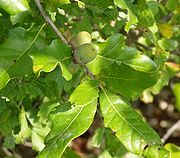
and they have weak internal barriers to hybridisation, hybridization produces functional seeds and fertile hybrid offspring. Ecological stresses, especially near habitat margins, can also cause a breakdown of mate recognition as well as a reduction of male function (pollen quantity and quality) in one parent species.
Frequent hybridisation among oaks has consequences for oak populations around the world; most notably, hybridization has produced large populations of hybrids with copious amounts of introgression
, and the evolution of new species. Frequent hybridisation and high levels of introgression have caused different species in the same populations to share up to 50% of their genetic information. Having high rates of hybridisation and introgression produces genetic data that often does not differentiate between two clearly morphologically distinct species, but instead differentiates populations. Numerous hypotheses have been proposed to explain how oak species are able to remain morphologically and ecologically distinct with such high levels of gene flow
, but the problem is still largely a mystery to botanists.
The Fagaceae
, or oak family, is a very slowly evolving clade
compared to other angiosperms, and the hybridisation patterns in Quercus pose a great challenge to the concept of a species. A species is often defined as a group of “actually or potentially interbreeding populations which are reproductively isolated from other such groups.” By this definition, many species of Quercus would be lumped together according to their geographic and ecological habitat, despite clear distinctions in morphology and, to a large extent, genetic data.
has a density of about 0.75 g/cm³, great strength and hardness, and is very resistant to insect and fungal attack because of its high tannin
content. It also has very attractive grain markings, particularly when quartersawn
. Wide, quarter-sawn boards of oak have been prized since the Middle Ages
for use in interior paneling of prestigious buildings such as the debating chamber of the House of Commons
in London
, England
, and in the construction of fine furniture. Oak wood, from Quercus robur and Quercus petraea, was used in Europe for the construction of ship
s, especially naval men of war, until the 19th century, and was the principal timber used in the construction of European timber-framed
buildings. Today oak wood
is still commonly used for furniture
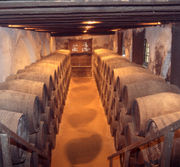
making and flooring, timber frame buildings, and for veneer production. Barrels in which red wine
s, sherry
, and spirits such as brandy
, Scotch whisky
and Bourbon whiskey
are aged are made from European and American oak. The use of oak in wine can add many different dimensions to wine based on the type and style of the oak. Oak barrels, which may be charred before use, contribute to the colour, taste, and aroma of the contents, imparting a desirable oaky vanillin
flavour to these drinks. The great dilemma for wine producers is to choose between French and American oakwoods. French oaks (Quercus robur, Q. petraea) give the wine greater refinement and are chosen for the best wines since they increase the price compared to those aged in American oak wood. American oak contributes greater texture and resistance to ageing, but produces more violent wine bouquets. Oak wood chips are used for smoking fish, meat, cheese
s and other foods.
 Japanese oak is used in the making of professional drums from manufacturer Yamaha Drums
. The higher density of oak gives the drum a brighter and louder tone compared to traditional drum materials such as maple
and birch
.
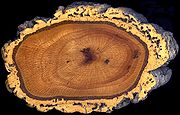 The bark of the Cork oak
, is used to produce wine
stoppers
(corks). This species grows in the Mediterranean Sea
region, with Portugal
, Spain
, Algeria
and Morocco
producing most of the world's supply. Of the North American oaks, the Northern red oak
is the most prized of the red oak group for lumber, all of which is marketed as red oak regardless of the species of origin. It is not good for outdoor use due to its open capillaries. One can blow air through an end grain piece 10 inches long to make bubbles come out in a glass of water. These openings give fungus easy access when the finish deteriorates. The standard for the lumber of the white oak group – all of which is marketed as white oak – is the White Oak. White Oak is often used to make wine barrel
s. The wood of the deciduous
Pedunculate Oak
and Sessile Oak
accounts for most of the European oak production, but evergreen species, such as Holm oak
and Cork oak also produce valuable timber.
The bark
of the White Oak is dried and used in medical preparations. Oak bark is also rich in tannin
, and is used by tanners for tanning
leather
. Acorn
s are used for making flour or roasted for acorn coffee.
Oak gall
s were used for centuries as the main ingredient in manuscript ink, harvested at a specific time of year. In Korea, oak bark is used to make shingle
s for traditional roof construction
.
in oak-heath forests. A number of kinds of truffles, including the two well known varieties, the black Périgord truffle and the white Piedmont truffle, have symbiotic relationships with oak trees.
Many species of oaks are under threat of extinction in the wild, largely due to land use changes, livestock grazing and unsustainable harvesting. For example, over the past 200 years, large areas of oak forest in the highlands of Mexico, Central America and the northern Andes have been cleared for coffee plantations and cattle ranching. There is a continuing threat to these forests from exploitation for timber, fuelwood and charcoal. In the USA, entire oak ecosystems have declined due to a combination of factors still imperfectly known, but thought to include fire suppression, increased consumption of acorns by growing mammal populations, herbivory of seedlings, and introduced pests. In a recent survey, 78 wild oak species have been identified as being in danger of extinction, from a global total of over 500 species. The proportion under threat may be much higher in reality, as there is insufficient information about over 300 species, making it near impossible to form any judgement of their status.
(Phytophthora ramorum) is a water mould
that can kill oaks within just a few weeks. Oak Wilt
, caused by the fungus Ceratocystis fagacearum (a fungus closely related to Dutch Elm Disease
), is also a lethal disease of some oaks, particularly the red oaks (the white oaks can be infected but generally live longer). Other dangers include wood-boring
beetle
s, as well as root rot
in older trees which may not be apparent on the outside, often being discovered only when the trees come down in a strong gale
. Oak apple
s are gall
s on oaks made by the gall wasp
. The female kermes scale
causes galls to grow on kermes oak
. Oaks are used as food plants by the larva
e of Lepidoptera
(butterfly
and moth
) species such as the Gypsy Moth
, Lymantria dispar, which can defoliate oak and other broadleaved tree species in North America.
A considerable number of galls are found on oak leaves, buds, flowers, roots, etc. Examples are Oak artichoke gall
, Oak Marble gall
, Oak apple
gall, Knopper gall
, and Spangle gall.
A number of species of fungus cause powdery mildew
on oak species. In Europe the species Erysiphe alphitoides
is the most common cause.
A new and as yet little understood disease of mature oaks, Acute oak decline
, has been reported in parts of the UK since 2009.
Additionally, the Oak Processionary Moth
(Thaumetopoea processionea) has become a serious threat in the UK since 2006. It defoliates the trees, and is hazardous to human health.
, horses, sheep, and goat
s in large amounts due to the toxin tannic acid
, and cause kidney damage and gastroenteritis
. Additionally, once livestock have a taste for the leaves and acorns, they may seek them out. Symptoms of poisoning include lack of appetite
, depression, constipation, diarrhea (which may contain blood), blood in urine
, and colic. The exception to livestock and oak toxicity is the domestic pig
, which may be fed entirely on acorns in the right conditions, and has traditionally been pastured in oak woodlands (such as the Spanish dehesa
and the English system of pannage
) for hundreds of years. Acorns are also edible to humans in processed form, after leaching of the tanins. They are a staple part of the forage consumed by wildlife, including squirrels
and jays.
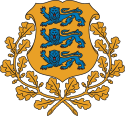
of strength
and endurance
and has been chosen as the national tree of many countries. Already an ancient Germanic symbol (in the form of the Donar Oak, for instance), certainly since the early nineteenth century, it stands for the nation of Germany
. In 2004 the Arbor Day Foundation held a vote for the official National Tree of the United States of America. In November 2004, Congress passed legislation designating the oak as America's National Tree.
Other countries have also designated the oak as their national tree including England
, Estonia
, France
, Germany
, Moldova
, Latvia
, Lithuania
, Poland
, the United States
, Basque Country
, Wales
, Galicia, Bulgaria
, and Serbia
.
in Northern Ireland
, as a vast amount of the county was covered in forests of the tree until relatively recently. The name of the county comes from the city of Derry
, which originally in Irish
was known as Doire meaning oak.
The Irish County Kildare
derives its name from the town of Kildare
which originally in Irish
was Cill Dara meaning the Church of the Oak or Oak Church.
Iowa
designated the oak as its official state tree in 1961; and the White Oak is the state tree of Connecticut
, Illinois
and Maryland
. The Northern Red Oak
is the provincial tree of Prince Edward Island
, as well as the state tree of New Jersey
. The Live Oak is the state tree of Georgia, USA
.
The oak is a national symbol from the Basque Country
, specially in the province of Biscay
, and Germany
.
. A gold oak leaf indicates an O-4 (Major
or Lt. Commander
), whereas a silver oak leaf indicates an O-5 (Lt. Colonel
or Commander
). Arrangements of oak leaves, acorns and sprigs indicate different branches of the United States Navy
Staff corps officers. Oak leaves are embroidered onto the covers (hats) worn by field grade officers and flag officers in the United States armed services.
If a service member earns multiple awards of the same medal, then instead of wearing a ribbon or medal for each award, he or she wears one metal representation of an "oak leaf cluster
" attached to the appropriate ribbon for each subsequent award.
in the United Kingdom
, and formerly of the Progressive Democrats
in Ireland
. In the cultural arena, the oakleaf is the symbol of the National Trust
(UK) and The Royal Oak Foundation
.
, the oak is the sacred tree of Latvian
Pērkons, Lithuanian
Perkūnas and Prussian
Perkūns. Pērkons is the god of thunder and one of the most important deities in the Baltic pantheon.
In Celtic mythology
, it is the tree of doors, believed to be a gateway between worlds, or a place where portals could be erected.
In Norse mythology
, the oak was sacred to the thunder god, Thor
. Some scholars speculate that the reason for this is that the oak – the largest tree in northern Europe – was the one most often struck by lightning. Thor's Oak
was a sacred tree of the Germanic Chatti
tribe. According to legend, the Christianisation of the heathen tribes by Saint Boniface
was marked by the oak's being replaced by the fir
(whose triangular shape symbolizes the Trinity
) as a "sacred" tree.
In the Bible
, the oak tree at Shechem
is the site where Jacob buries the foreign gods of his people (Gen. 35:4) . In addition, Joshua erects a stone under an oak tree as the first covenant of the Lord (Josh. 24.25-7). In Isaiah 61, the prophet refers to the Israelites as "Oaks of Righteousness".
In Slavonic mythology, the oak was the most important tree of the god Perun
.
in the United States, are of great historical or cultural importance; for a list of important oaks, see Individual oak trees.
"The Proscribed Royalist, 1651
", a famous painting by John Everett Millais
, depicted a Royalist fleeing from Cromwell
's forces and hidden in an oak. Millais painted the picture in Hayes, Kent, from a local oak tree that became known as the Millais Oak.
Approximately 50 km west of Toronto, Canada is the town of Oakville, ON, famous for its history as a shipbuilding port on Lake Ontario.
The city of Raleigh, N.C., is known as "The City of Oaks."
The Jurupa Oak
tree — a clonal colony of Quercus palmeria or Palmer’s Oak
found in Riverside County, California — is believed to be the world's oldest organism at 13,000 years.
described only five species of oak from eastern North America, based on general leaf form. These were White oak
, Quercus alba; Chestnut oak
, Q. montana; Red oak, Q. rubra; Willow oak
Q. phellos; and Water oak
, Q. nigra. Because he was dealing with confusing leaf forms, the Q. prinus and Q. rubra specimens actually included mixed foliage of more than one species. For that reason, some taxonomists in the past proposed different names for these two species (Q. montana and Q. borealis, respectively), but the original Linnaean names have now been lectotypified by removing some of the specimens in Linnaeus' herbarium.
Tree
A tree is a perennial woody plant. It is most often defined as a woody plant that has many secondary branches supported clear of the ground on a single main stem or trunk with clear apical dominance. A minimum height specification at maturity is cited by some authors, varying from 3 m to...
or shrub
Shrub
A shrub or bush is distinguished from a tree by its multiple stems and shorter height, usually under 5–6 m tall. A large number of plants may become either shrubs or trees, depending on the growing conditions they experience...
in the genus
Genus
In biology, a genus is a low-level taxonomic rank used in the biological classification of living and fossil organisms, which is an example of definition by genus and differentia...
Quercus (icon; Latin
Latin
Latin is an Italic language originally spoken in Latium and Ancient Rome. It, along with most European languages, is a descendant of the ancient Proto-Indo-European language. Although it is considered a dead language, a number of scholars and members of the Christian clergy speak it fluently, and...
"oak tree"), of which about 600 species exist. "Oak" may also appear in the names of species
Species
In biology, a species is one of the basic units of biological classification and a taxonomic rank. A species is often defined as a group of organisms capable of interbreeding and producing fertile offspring. While in many cases this definition is adequate, more precise or differing measures are...
in related genera, notably Lithocarpus
Lithocarpus
Lithocarpus is a genus in the beech family Fagaceae, differing from Quercus in the erect male spikes. The World Checklist accepts 334 species, though some other texts suggest as few as 100 species. About 100 Asian species of the genus were formerly treated in the genus Pasania. All but one are...
. The genus is native to the northern hemisphere
Northern Hemisphere
The Northern Hemisphere is the half of a planet that is north of its equator—the word hemisphere literally means “half sphere”. It is also that half of the celestial sphere north of the celestial equator...
, and includes deciduous
Deciduous
Deciduous means "falling off at maturity" or "tending to fall off", and is typically used in reference to trees or shrubs that lose their leaves seasonally, and to the shedding of other plant structures such as petals after flowering or fruit when ripe...
and evergreen
Evergreen
In botany, an evergreen plant is a plant that has leaves in all seasons. This contrasts with deciduous plants, which completely lose their foliage during the winter or dry season.There are many different kinds of evergreen plants, both trees and shrubs...
species extending from cold latitudes to tropical Asia
Asia
Asia is the world's largest and most populous continent, located primarily in the eastern and northern hemispheres. It covers 8.7% of the Earth's total surface area and with approximately 3.879 billion people, it hosts 60% of the world's current human population...
and the Americas
Americas
The Americas, or America , are lands in the Western hemisphere, also known as the New World. In English, the plural form the Americas is often used to refer to the landmasses of North America and South America with their associated islands and regions, while the singular form America is primarily...
.
Oaks have spiral
Spiral
In mathematics, a spiral is a curve which emanates from a central point, getting progressively farther away as it revolves around the point.-Spiral or helix:...
ly arranged leaves
Leaf
A leaf is an organ of a vascular plant, as defined in botanical terms, and in particular in plant morphology. Foliage is a mass noun that refers to leaves as a feature of plants....
, with a lobed margin in many species; some have serrated leaves or entire leaves with a smooth margin. The flower
Flower
A flower, sometimes known as a bloom or blossom, is the reproductive structure found in flowering plants . The biological function of a flower is to effect reproduction, usually by providing a mechanism for the union of sperm with eggs...
s are catkin
Catkin
A catkin or ament is a slim, cylindrical flower cluster, with inconspicuous or no petals, usually wind-pollinated but sometimes insect pollinated . They contain many, usually unisexual flowers, arranged closely along a central stem which is often drooping...
s, produced in spring
Spring (season)
Spring is one of the four temperate seasons, the transition period between winter and summer. Spring and "springtime" refer to the season, and broadly to ideas of rebirth, renewal and regrowth. The specific definition of the exact timing of "spring" varies according to local climate, cultures and...
. The fruit
Fruit
In broad terms, a fruit is a structure of a plant that contains its seeds.The term has different meanings dependent on context. In non-technical usage, such as food preparation, fruit normally means the fleshy seed-associated structures of certain plants that are sweet and edible in the raw state,...
is a nut
Nut (fruit)
A nut is a hard-shelled fruit of some plants having an indehiscent seed. While a wide variety of dried seeds and fruits are called nuts in English, only a certain number of them are considered by biologists to be true nuts...
called an acorn
Acorn
The acorn, or oak nut, is the nut of the oaks and their close relatives . It usually contains a single seed , enclosed in a tough, leathery shell, and borne in a cup-shaped cupule. Acorns vary from 1–6 cm long and 0.8–4 cm broad...
, borne in a cup-like structure known as a cupule
Cupule
The calybium and the cupule make up the accessory fruit of flowering plants in the family Fagaceae. These two parts derive from different flower components....
; each acorn contains one seed (rarely two or three) and takes 6–18 months to mature, depending on species. The live oak
Live oak
Live oak , also known as the southern live oak, is a normally evergreen oak tree native to the southeastern United States...
s are distinguished for being evergreen
Evergreen
In botany, an evergreen plant is a plant that has leaves in all seasons. This contrasts with deciduous plants, which completely lose their foliage during the winter or dry season.There are many different kinds of evergreen plants, both trees and shrubs...
, but are not actually a distinct group and instead are dispersed across the genus.
Classification
Oak trees are flowering plants. The genus is divided into two subgenera and a number of sectionsSection (botany)
In botany, a section is a taxonomic rank below the genus, but above the species. The subgenus, if present, is higher than the section, and the rank of series, if present, is below the section. Sections are typically used to help organise very large genera, which may have hundreds of species...
:
Subgenus Quercus
The Subgenus Quercus is divided into the following sections:- Sect. Quercus (synonyms Lepidobalanus and Leucobalanus), the white oaks of EuropeEuropeEurope is, by convention, one of the world's seven continents. Comprising the westernmost peninsula of Eurasia, Europe is generally 'divided' from Asia to its east by the watershed divides of the Ural and Caucasus Mountains, the Ural River, the Caspian and Black Seas, and the waterways connecting...
, AsiaAsiaAsia is the world's largest and most populous continent, located primarily in the eastern and northern hemispheres. It covers 8.7% of the Earth's total surface area and with approximately 3.879 billion people, it hosts 60% of the world's current human population...
and North AmericaNorth AmericaNorth America is a continent wholly within the Northern Hemisphere and almost wholly within the Western Hemisphere. It is also considered a northern subcontinent of the Americas...
. Styles are short; acorns mature in 6 months and taste sweet or slightly bitter; the inside of an acorn shell is hairless. The leaves mostly lack a bristle on their lobe tips, which are usually rounded. - Sect. Mesobalanus, Hungarian oak and its relatives of Europe and Asia. Styles long; acorns mature in about 6 months and taste bitter; the inside of this acorn's shell is hairless. The section Mesobalanus is closely related to section Quercus and sometimes included in it.
- Sect. Cerris, the Turkey oak and its relatives of Europe and Asia. Styles long; acorn mature in 18 months and taste very bitter. The inside of the acorn's shell is hairless. Its leaves typically have sharp lobe tips, with bristles at the lobe tip.
- Sect. Protobalanus, the Canyon live oak and its relatives, in southwest United StatesUnited StatesThe United States of America is a federal constitutional republic comprising fifty states and a federal district...
and northwest MexicoMexicoThe United Mexican States , commonly known as Mexico , is a federal constitutional republic in North America. It is bordered on the north by the United States; on the south and west by the Pacific Ocean; on the southeast by Guatemala, Belize, and the Caribbean Sea; and on the east by the Gulf of...
. Styles short, acorns mature in 18 months and taste very bitter. The inside of the acorn shell appears woolly. Leaves typically have sharp lobe tips, with bristles at the lobe tip. - Sect. Lobatae (synonym Erythrobalanus), the red oaks of North America, Central AmericaCentral AmericaCentral America is the central geographic region of the Americas. It is the southernmost, isthmian portion of the North American continent, which connects with South America on the southeast. When considered part of the unified continental model, it is considered a subcontinent...
and northern South AmericaSouth AmericaSouth America is a continent situated in the Western Hemisphere, mostly in the Southern Hemisphere, with a relatively small portion in the Northern Hemisphere. The continent is also considered a subcontinent of the Americas. It is bordered on the west by the Pacific Ocean and on the north and east...
. Styles long; acorns mature in 18 months and taste very bitter. The inside of the acorn shell appears woolly. The actual nut is encased in a thin, clinging, papery skin. Leaves typically have sharp lobe tips, with spiny bristles at the lobe.
Subgenus Cyclobalanopsis
- The ring-cupped oaks of eastern and southeastern AsiaAsiaAsia is the world's largest and most populous continent, located primarily in the eastern and northern hemispheres. It covers 8.7% of the Earth's total surface area and with approximately 3.879 billion people, it hosts 60% of the world's current human population...
. Evergreen trees growing 10–40 m tall. They are distinct from subgenus Quercus in that they have acorns with distinctive cups bearing concrescent rings of scales; they commonly also have densely clustered acorns, though this does not apply to all of the species. The Flora of China treats Cyclobalanopsis as a distinct genusGenusIn biology, a genus is a low-level taxonomic rank used in the biological classification of living and fossil organisms, which is an example of definition by genus and differentia...
, but most taxonomists consider it a subgenusSubgenusIn biology, a subgenus is a taxonomic rank directly below genus.In zoology, a subgeneric name can be used independently or included in a species name, in parentheses, placed between the generic name and the specific epithet: e.g. the Tiger Cowry of the Indo-Pacific, Cypraea tigris Linnaeus, which...
of Quercus. It contains about 150 species. Species of Cyclbalanopsis are common in the evergreen subtropical laurel forestLaurel forestLaurel forest is a subtropical or mild temperate forest, found in areas with high humidity and relatively stable and mild temperatures. They are characterized by tree species with evergreen, glossy, enlongated leaves, known as laurophyll or lauroide...
s which extend from southern Japan, southern Korea, and Taiwan across southern China and northern Indochina to the eastern Himalayas, in association with trees of genus CastanopsisCastanopsisCastanopsis is a genus of evergreen trees belonging to the beech family, Fagaceae. The genus contains about 120 species, which are today restricted to tropical and subtropical eastern Asia. A total of 58 species are native to China, with 30 endemic; the other species occur further south, through...
and the laurel family (LauraceaeLauraceaeThe Lauraceae or Laurel family comprises a group of flowering plants included in the order Laurales. The family contains about 55 genera and over 3500, perhaps as many as 4000, species world-wide, mostly from warm or tropical regions, especially Southeast Asia and South America...
).
Hybridisation
Interspecific hybridisation is quite common among oaks, but usually between species within the same section only, and most common in the white oak group (subgenus Quercus, section Quercus; see List of Quercus species). Inter-section hybrids, except between species of sections Quercus and Mesobalanus, are unknown. Recent systematic studies appear to confirm a high tendency of Quercus species to hybridize because of a combination of factors. White oaks are unable to discriminate against pollination by other species in the same section. Because they are wind pollinatedAnemophily
Anemophily or wind pollination is a form of pollination whereby pollen is distributed by wind. Anemophilous plants may be either gymnosperms or angiosperms ....
and they have weak internal barriers to hybridisation, hybridization produces functional seeds and fertile hybrid offspring. Ecological stresses, especially near habitat margins, can also cause a breakdown of mate recognition as well as a reduction of male function (pollen quantity and quality) in one parent species.
Frequent hybridisation among oaks has consequences for oak populations around the world; most notably, hybridization has produced large populations of hybrids with copious amounts of introgression
Introgression
Introgression, also known as introgressive hybridization, in genetics is the movement of a gene from one species into the gene pool of another by the repeated backcrossing of an interspecific hybrid with one of its parent species...
, and the evolution of new species. Frequent hybridisation and high levels of introgression have caused different species in the same populations to share up to 50% of their genetic information. Having high rates of hybridisation and introgression produces genetic data that often does not differentiate between two clearly morphologically distinct species, but instead differentiates populations. Numerous hypotheses have been proposed to explain how oak species are able to remain morphologically and ecologically distinct with such high levels of gene flow
Gene flow
In population genetics, gene flow is the transfer of alleles of genes from one population to another.Migration into or out of a population may be responsible for a marked change in allele frequencies...
, but the problem is still largely a mystery to botanists.
The Fagaceae
Fagaceae
The family Fagaceae, or beech family, comprises about 900 species of both evergreen and deciduous trees and shrubs, which are characterized by alternate simple leaves with pinnate venation, unisexual flowers in the form of catkins, and fruit in the form of cup-like nuts. Fagaceous leaves are often...
, or oak family, is a very slowly evolving clade
Clade
A clade is a group consisting of a species and all its descendants. In the terms of biological systematics, a clade is a single "branch" on the "tree of life". The idea that such a "natural group" of organisms should be grouped together and given a taxonomic name is central to biological...
compared to other angiosperms, and the hybridisation patterns in Quercus pose a great challenge to the concept of a species. A species is often defined as a group of “actually or potentially interbreeding populations which are reproductively isolated from other such groups.” By this definition, many species of Quercus would be lumped together according to their geographic and ecological habitat, despite clear distinctions in morphology and, to a large extent, genetic data.
Uses
Oak woodWood
Wood is a hard, fibrous tissue found in many trees. It has been used for hundreds of thousands of years for both fuel and as a construction material. It is an organic material, a natural composite of cellulose fibers embedded in a matrix of lignin which resists compression...
has a density of about 0.75 g/cm³, great strength and hardness, and is very resistant to insect and fungal attack because of its high tannin
Tannin
A tannin is an astringent, bitter plant polyphenolic compound that binds to and precipitates proteins and various other organic compounds including amino acids and alkaloids.The term tannin refers to the use of...
content. It also has very attractive grain markings, particularly when quartersawn
Quartersawn
thumb|250px|quarter sawn surface, showing ray fleck In speaking of wood, the term quartermortersawn is properly used for wood that is cut exactly radially , or to put it differently, at right angles to the growth rings...
. Wide, quarter-sawn boards of oak have been prized since the Middle Ages
Middle Ages
The Middle Ages is a periodization of European history from the 5th century to the 15th century. The Middle Ages follows the fall of the Western Roman Empire in 476 and precedes the Early Modern Era. It is the middle period of a three-period division of Western history: Classic, Medieval and Modern...
for use in interior paneling of prestigious buildings such as the debating chamber of the House of Commons
British House of Commons
The House of Commons is the lower house of the Parliament of the United Kingdom, which also comprises the Sovereign and the House of Lords . Both Commons and Lords meet in the Palace of Westminster. The Commons is a democratically elected body, consisting of 650 members , who are known as Members...
in London
London
London is the capital city of :England and the :United Kingdom, the largest metropolitan area in the United Kingdom, and the largest urban zone in the European Union by most measures. Located on the River Thames, London has been a major settlement for two millennia, its history going back to its...
, England
England
England is a country that is part of the United Kingdom. It shares land borders with Scotland to the north and Wales to the west; the Irish Sea is to the north west, the Celtic Sea to the south west, with the North Sea to the east and the English Channel to the south separating it from continental...
, and in the construction of fine furniture. Oak wood, from Quercus robur and Quercus petraea, was used in Europe for the construction of ship
Ship
Since the end of the age of sail a ship has been any large buoyant marine vessel. Ships are generally distinguished from boats based on size and cargo or passenger capacity. Ships are used on lakes, seas, and rivers for a variety of activities, such as the transport of people or goods, fishing,...
s, especially naval men of war, until the 19th century, and was the principal timber used in the construction of European timber-framed
Timber framing
Timber framing , or half-timbering, also called in North America "post-and-beam" construction, is the method of creating structures using heavy squared off and carefully fitted and joined timbers with joints secured by large wooden pegs . It is commonplace in large barns...
buildings. Today oak wood
Wood
Wood is a hard, fibrous tissue found in many trees. It has been used for hundreds of thousands of years for both fuel and as a construction material. It is an organic material, a natural composite of cellulose fibers embedded in a matrix of lignin which resists compression...
is still commonly used for furniture
Furniture
Furniture is the mass noun for the movable objects intended to support various human activities such as seating and sleeping in beds, to hold objects at a convenient height for work using horizontal surfaces above the ground, or to store things...
making and flooring, timber frame buildings, and for veneer production. Barrels in which red wine
Wine
Wine is an alcoholic beverage, made of fermented fruit juice, usually from grapes. The natural chemical balance of grapes lets them ferment without the addition of sugars, acids, enzymes, or other nutrients. Grape wine is produced by fermenting crushed grapes using various types of yeast. Yeast...
s, sherry
Sherry
Sherry is a fortified wine made from white grapes that are grown near the town of Jerez , Spain. In Spanish, it is called vino de Jerez....
, and spirits such as brandy
Brandy
Brandy is a spirit produced by distilling wine. Brandy generally contains 35%–60% alcohol by volume and is typically taken as an after-dinner drink...
, Scotch whisky
Scotch whisky
Scotch whisky is whisky made in Scotland.Scotch whisky is divided into five distinct categories: Single Malt Scotch Whisky, Single Grain Scotch Whisky, Blended Malt Scotch Whisky , Blended Grain Scotch Whisky, and Blended Scotch Whisky.All Scotch whisky must be aged in oak barrels for at least three...
and Bourbon whiskey
Bourbon whiskey
Bourbon is a type of American whiskey – a barrel-aged distilled spirit made primarily from corn. The name of the spirit derives from its historical association with an area known as Old Bourbon, around what is now Bourbon County, Kentucky . It has been produced since the 18th century...
are aged are made from European and American oak. The use of oak in wine can add many different dimensions to wine based on the type and style of the oak. Oak barrels, which may be charred before use, contribute to the colour, taste, and aroma of the contents, imparting a desirable oaky vanillin
Vanillin
Vanillin is a phenolic aldehyde, an organic compound with the molecular formula C8H8O3. Its functional groups include aldehyde, ether, and phenol. It is the primary component of the extract of the vanilla bean. It is also found in Leptotes bicolor, roasted coffee and the Chinese red pine...
flavour to these drinks. The great dilemma for wine producers is to choose between French and American oakwoods. French oaks (Quercus robur, Q. petraea) give the wine greater refinement and are chosen for the best wines since they increase the price compared to those aged in American oak wood. American oak contributes greater texture and resistance to ageing, but produces more violent wine bouquets. Oak wood chips are used for smoking fish, meat, cheese
Cheese
Cheese is a generic term for a diverse group of milk-based food products. Cheese is produced throughout the world in wide-ranging flavors, textures, and forms....
s and other foods.
Yamaha Drums
Yamaha Drums is a subsidiary of the Yamaha Corporation founded in 1967. The company manufactures acoustic and electronic drum kits as well as percussion instruments, marching band equipment, and drum hardware.-Production:...
. The higher density of oak gives the drum a brighter and louder tone compared to traditional drum materials such as maple
Maple
Acer is a genus of trees or shrubs commonly known as maple.Maples are variously classified in a family of their own, the Aceraceae, or together with the Hippocastanaceae included in the family Sapindaceae. Modern classifications, including the Angiosperm Phylogeny Group system, favour inclusion in...
and birch
Birch
Birch is a tree or shrub of the genus Betula , in the family Betulaceae, closely related to the beech/oak family, Fagaceae. The Betula genus contains 30–60 known taxa...
.
Cork Oak
Quercus suber, commonly called the Cork Oak, is a medium-sized, evergreen oak tree in the section Quercus sect. Cerris. It is the primary source of cork for wine bottle stoppers and other uses, such as cork flooring. It is native to southwest Europe and northwest Africa.It grows to up to 20 m,...
, is used to produce wine
Wine
Wine is an alcoholic beverage, made of fermented fruit juice, usually from grapes. The natural chemical balance of grapes lets them ferment without the addition of sugars, acids, enzymes, or other nutrients. Grape wine is produced by fermenting crushed grapes using various types of yeast. Yeast...
stoppers
Stopper (plug)
A bung is truncated cylindrical or conical closure to seal a container, such as a bottle, tube or barrel. Unlike a lid which encloses a container from the outside without displacing the inner volume, a bung is partially inserted inside the container to act as a seal...
(corks). This species grows in the Mediterranean Sea
Mediterranean Sea
The Mediterranean Sea is a sea connected to the Atlantic Ocean surrounded by the Mediterranean region and almost completely enclosed by land: on the north by Anatolia and Europe, on the south by North Africa, and on the east by the Levant...
region, with Portugal
Portugal
Portugal , officially the Portuguese Republic is a country situated in southwestern Europe on the Iberian Peninsula. Portugal is the westernmost country of Europe, and is bordered by the Atlantic Ocean to the West and South and by Spain to the North and East. The Atlantic archipelagos of the...
, Spain
Spain
Spain , officially the Kingdom of Spain languages]] under the European Charter for Regional or Minority Languages. In each of these, Spain's official name is as follows:;;;;;;), is a country and member state of the European Union located in southwestern Europe on the Iberian Peninsula...
, Algeria
Algeria
Algeria , officially the People's Democratic Republic of Algeria , also formally referred to as the Democratic and Popular Republic of Algeria, is a country in the Maghreb region of Northwest Africa with Algiers as its capital.In terms of land area, it is the largest country in Africa and the Arab...
and Morocco
Morocco
Morocco , officially the Kingdom of Morocco , is a country located in North Africa. It has a population of more than 32 million and an area of 710,850 km², and also primarily administers the disputed region of the Western Sahara...
producing most of the world's supply. Of the North American oaks, the Northern red oak
Northern Red Oak
Quercus rubra, commonly called northern red oak or champion oak, , is an oak in the red oak group . It is a native of North America, in the northeastern United States and southeast Canada...
is the most prized of the red oak group for lumber, all of which is marketed as red oak regardless of the species of origin. It is not good for outdoor use due to its open capillaries. One can blow air through an end grain piece 10 inches long to make bubbles come out in a glass of water. These openings give fungus easy access when the finish deteriorates. The standard for the lumber of the white oak group – all of which is marketed as white oak – is the White Oak. White Oak is often used to make wine barrel
Wine barrel
The use of oak plays a significant role in winemaking and can have a profound effect on the resulting wine, affecting the color, flavor, tannin profile and texture of the wine. Oak can come into contact with wine in the form of a barrel during the fermentation or aging periods...
s. The wood of the deciduous
Deciduous
Deciduous means "falling off at maturity" or "tending to fall off", and is typically used in reference to trees or shrubs that lose their leaves seasonally, and to the shedding of other plant structures such as petals after flowering or fruit when ripe...
Pedunculate Oak
Pedunculate Oak
Quercus robur is commonly known as the Pedunculate Oak or English oak. It is native to most of Europe, and to Anatolia to the Caucasus, and also to parts of North Africa.-Taxonomy:Q...
and Sessile Oak
Sessile Oak
Quercus petraea , the Sessile Oak, also known as the Durmast Oak, is a species of oak native to most of Europe, and into Anatolia.-Description:...
accounts for most of the European oak production, but evergreen species, such as Holm oak
Holm Oak
Quercus ilex, the Holm Oak or Holly Oak is a large evergreen oak native to the Mediterranean region. It takes its name from holm, an ancient name for holly...
and Cork oak also produce valuable timber.
The bark
Bark
Bark is the outermost layers of stems and roots of woody plants. Plants with bark include trees, woody vines and shrubs. Bark refers to all the tissues outside of the vascular cambium and is a nontechnical term. It overlays the wood and consists of the inner bark and the outer bark. The inner...
of the White Oak is dried and used in medical preparations. Oak bark is also rich in tannin
Tannin
A tannin is an astringent, bitter plant polyphenolic compound that binds to and precipitates proteins and various other organic compounds including amino acids and alkaloids.The term tannin refers to the use of...
, and is used by tanners for tanning
Tanning
Tanning is the making of leather from the skins of animals which does not easily decompose. Traditionally, tanning used tannin, an acidic chemical compound from which the tanning process draws its name . Coloring may occur during tanning...
leather
Leather
Leather is a durable and flexible material created via the tanning of putrescible animal rawhide and skin, primarily cattlehide. It can be produced through different manufacturing processes, ranging from cottage industry to heavy industry.-Forms:...
. Acorn
Acorn
The acorn, or oak nut, is the nut of the oaks and their close relatives . It usually contains a single seed , enclosed in a tough, leathery shell, and borne in a cup-shaped cupule. Acorns vary from 1–6 cm long and 0.8–4 cm broad...
s are used for making flour or roasted for acorn coffee.
Oak gall
Gall
Galls or cecidia are outgrowths on the surface of lifeforms caused by invasion by other lifeforms, such as parasites or bacterial infection. Plant galls are abnormal outgrowths of plant tissues and can be caused by various parasites, from fungi and bacteria, to insects and mites...
s were used for centuries as the main ingredient in manuscript ink, harvested at a specific time of year. In Korea, oak bark is used to make shingle
Roof shingle
Roof shingles are a roof covering consisting of individual overlapping elements. These elements are typically flat rectangular shapes laid in rows from the bottom edge of the roof up, with each successive higher row overlapping the joints in the row below...
s for traditional roof construction
Traditional Korean roof construction
Traditional Korean roof construction has traditionally used many kinds of natural materials. They are made of neowa , giwa , byeotjib , stone giwa , eoksae and goolpy -Neowa Roof:...
.
Biodiversity and ecology
Oaks are keystone species in a wide range of habitats from Mediterranean semi-desert to subtropical rainforest. For example, oak trees are important components of hardwood forests, and certain species are particularly known to grow in associations with members of the EricaceaeEricaceae
The Ericaceae, commonly known as the heath or heather family, is a group of mostly calcifuge flowering plants. The family is large, with roughly 4000 species spread across 126 genera, making it the 14th most speciose family of flowering plants...
in oak-heath forests. A number of kinds of truffles, including the two well known varieties, the black Périgord truffle and the white Piedmont truffle, have symbiotic relationships with oak trees.
Many species of oaks are under threat of extinction in the wild, largely due to land use changes, livestock grazing and unsustainable harvesting. For example, over the past 200 years, large areas of oak forest in the highlands of Mexico, Central America and the northern Andes have been cleared for coffee plantations and cattle ranching. There is a continuing threat to these forests from exploitation for timber, fuelwood and charcoal. In the USA, entire oak ecosystems have declined due to a combination of factors still imperfectly known, but thought to include fire suppression, increased consumption of acorns by growing mammal populations, herbivory of seedlings, and introduced pests. In a recent survey, 78 wild oak species have been identified as being in danger of extinction, from a global total of over 500 species. The proportion under threat may be much higher in reality, as there is insufficient information about over 300 species, making it near impossible to form any judgement of their status.
Diseases and pests
Sudden Oak DeathSudden oak death
Sudden Oak Death is the common name of a disease caused by the oomycete plant pathogen Phytophthora ramorum. The disease kills oak and other species of tree and has had devastating effects on the oak populations in California and Oregon as well as also being present in Europe...
(Phytophthora ramorum) is a water mould
Water mould
Oömycota or oömycetes form a distinct phylogenetic lineage of fungus-like eukaryotic microorganisms . They are filamentous, microscopic, absorptive organisms that reproduce both sexually and asexually...
that can kill oaks within just a few weeks. Oak Wilt
Oak wilt
Oak wilt is a fungal disease that can quickly kill an oak tree. It is caused by the fungus Ceratocystis fagacearum. Symptoms vary by tree species but generally consist of leaf discoloration, wilt, defoliation, and death. The fungus is spread from diseased to healthy trees by insect vectors or via...
, caused by the fungus Ceratocystis fagacearum (a fungus closely related to Dutch Elm Disease
Dutch elm disease
Dutch elm disease is a disease caused by a member of the sac fungi category, affecting elm trees which is spread by the elm bark beetle. Although believed to be originally native to Asia, the disease has been accidentally introduced into America and Europe, where it has devastated native...
), is also a lethal disease of some oaks, particularly the red oaks (the white oaks can be infected but generally live longer). Other dangers include wood-boring
Woodboring beetle
The term woodboring beetle encompasses many species and families of beetles whose larval or adult forms eat and destroy wood . Larval stages of some are commonly known as woodworms.-Invasion and control:...
beetle
Beetle
Coleoptera is an order of insects commonly called beetles. The word "coleoptera" is from the Greek , koleos, "sheath"; and , pteron, "wing", thus "sheathed wing". Coleoptera contains more species than any other order, constituting almost 25% of all known life-forms...
s, as well as root rot
ROT
The aviation term ROT stands for rate one turn, also known as a standard rate turn. All aircraft must be able to perform a standard rate turn....
in older trees which may not be apparent on the outside, often being discovered only when the trees come down in a strong gale
Gale
A gale is a very strong wind. There are conflicting definitions of how strong a wind must be to be considered a gale. The U.S. government's National Weather Service defines a gale as 34–47 knots of sustained surface winds. Forecasters typically issue gale warnings when winds of this strength are...
. Oak apple
Oak apple
Oak apple is the common name for a large, round, vaguely apple-like gall commonly found on many species of oak. Oak apples range in size from 2-5cm. Oak apples are caused by chemicals injected by the larva of certain kinds of gall wasp in the family Cynipidae. The adult female wasp lays single...
s are gall
Gall
Galls or cecidia are outgrowths on the surface of lifeforms caused by invasion by other lifeforms, such as parasites or bacterial infection. Plant galls are abnormal outgrowths of plant tissues and can be caused by various parasites, from fungi and bacteria, to insects and mites...
s on oaks made by the gall wasp
Gall wasp
Gall wasps , also called Gallflies, are a family of the order Hymenoptera and are classified with the Apocrita suborder of wasps in the superfamily Cynipoidea...
. The female kermes scale
Scale insect
The scale insects are small insects of the order Hemiptera, generally classified as the superfamily Coccoidea. There are about 8,000 species of scale insects.-Ecology:...
causes galls to grow on kermes oak
Kermes Oak
Quercus coccifera, the Kermes Oak, is an oak in the Turkey oak section Quercus sect. Cerris. It is native to the western Mediterranean region and Northern African Maghreb, from Morocco and Portugal east to Libya and Greece.-Description:...
. Oaks are used as food plants by the larva
Larva
A larva is a distinct juvenile form many animals undergo before metamorphosis into adults. Animals with indirect development such as insects, amphibians, or cnidarians typically have a larval phase of their life cycle...
e of Lepidoptera
Lepidoptera
Lepidoptera is a large order of insects that includes moths and butterflies . It is one of the most widespread and widely recognizable insect orders in the world, encompassing moths and the three superfamilies of butterflies, skipper butterflies, and moth-butterflies...
(butterfly
Butterfly
A butterfly is a mainly day-flying insect of the order Lepidoptera, which includes the butterflies and moths. Like other holometabolous insects, the butterfly's life cycle consists of four parts: egg, larva, pupa and adult. Most species are diurnal. Butterflies have large, often brightly coloured...
and moth
Moth
A moth is an insect closely related to the butterfly, both being of the order Lepidoptera. Moths form the majority of this order; there are thought to be 150,000 to 250,000 different species of moth , with thousands of species yet to be described...
) species such as the Gypsy Moth
Gypsy moth
The gypsy moth, Lymantria dispar, is a moth in the family Lymantriidae of Eurasian origin. Originally ranging from Europe to Asia, it was introduced to North America in the late 1860s and has been expanding its range ever since...
, Lymantria dispar, which can defoliate oak and other broadleaved tree species in North America.
A considerable number of galls are found on oak leaves, buds, flowers, roots, etc. Examples are Oak artichoke gall
Oak artichoke gall
Oak artichoke galls, oak hop galls, larch-cone galls or hop strobiledevelop as a chemically induced distortion of leaf axillary or terminal buds on Pedunculate Oak or Sessile Oak trees, caused by the parthenogenetic gall wasp Andricus fecundator, which lays single eggs within leaf buds using...
, Oak Marble gall
Oak marble gall
Oak marble galls develop as a chemically induced distortion of leaf buds on pedunculate oak , or sessile oak trees, caused by the parthenogenetic gall wasp which lays eggs within leaf buds using their ovipositor...
, Oak apple
Oak apple
Oak apple is the common name for a large, round, vaguely apple-like gall commonly found on many species of oak. Oak apples range in size from 2-5cm. Oak apples are caused by chemicals injected by the larva of certain kinds of gall wasp in the family Cynipidae. The adult female wasp lays single...
gall, Knopper gall
Knopper gall
Andricus quercuscalicis is a gall wasp species inducing Knopper galls.Knopper galls develop as a chemically induced distortion of growing acorns on Pedunculate Oak trees, caused by gall wasps, which lay eggs in buds with their ovipositor...
, and Spangle gall.
A number of species of fungus cause powdery mildew
Powdery mildew
Powdery mildew is a fungal disease that affects a wide range of plants. Powdery mildew diseases are caused by many different species of fungi in the order Erysiphales. It is one of the easier diseases to spot, as its symptoms are quite distinctive. Infected plants display white powdery spots on the...
on oak species. In Europe the species Erysiphe alphitoides
Erysiphe alphitoides
Erysiphe alphitoides is a species of fungus which causes powdery mildew on oak trees.-Discovery and taxonomy:Today oak powdery mildew is one of the most common diseases in European forests but it is thought to not always have been present in these forests...
is the most common cause.
A new and as yet little understood disease of mature oaks, Acute oak decline
Acute oak decline
Acute oak decline is a new disease that infects oak trees in the UK. It mainly affects mature oak trees of over 50 years old of both of Britain's native oaks: the pedunculate oak and the sessile oak . The disease is characterised by the trees bleeding or oozing a dark fluid from small lesions or...
, has been reported in parts of the UK since 2009.
Additionally, the Oak Processionary Moth
Oak Processionary
The Oak Processionary is a moth whose caterpillars are pests in oak forests and pose a health hazard because of their poisonous setae , which may cause skin irritation and asthma.- Distribution :...
(Thaumetopoea processionea) has become a serious threat in the UK since 2006. It defoliates the trees, and is hazardous to human health.
Toxicity
The leaves and acorns of the oak tree are poisonous to cattleCattle
Cattle are the most common type of large domesticated ungulates. They are a prominent modern member of the subfamily Bovinae, are the most widespread species of the genus Bos, and are most commonly classified collectively as Bos primigenius...
, horses, sheep, and goat
Goat
The domestic goat is a subspecies of goat domesticated from the wild goat of southwest Asia and Eastern Europe. The goat is a member of the Bovidae family and is closely related to the sheep as both are in the goat-antelope subfamily Caprinae. There are over three hundred distinct breeds of...
s in large amounts due to the toxin tannic acid
Tannic acid
Tannic acid is a specific commercial form of tannin, a type of polyphenol. Its weak acidity is due to the numerous phenol groups in the structure...
, and cause kidney damage and gastroenteritis
Gastroenteritis
Gastroenteritis is marked by severe inflammation of the gastrointestinal tract involving both the stomach and small intestine resulting in acute diarrhea and vomiting. It can be transferred by contact with contaminated food and water...
. Additionally, once livestock have a taste for the leaves and acorns, they may seek them out. Symptoms of poisoning include lack of appetite
Anorexia (symptom)
Anorexia is the decreased sensation of appetite...
, depression, constipation, diarrhea (which may contain blood), blood in urine
Hematuria
In medicine, hematuria, or haematuria, is the presence of red blood cells in the urine. It may be idiopathic and/or benign, or it can be a sign that there is a kidney stone or a tumor in the urinary tract , ranging from trivial to lethal...
, and colic. The exception to livestock and oak toxicity is the domestic pig
Domestic pig
The domestic pig is a domesticated animal that traces its ancestry to the wild boar, and is considered a subspecies of the wild boar or a distinct species in its own right. It is likely the wild boar was domesticated as early as 13,000 BC in the Tigris River basin...
, which may be fed entirely on acorns in the right conditions, and has traditionally been pastured in oak woodlands (such as the Spanish dehesa
Dehesa
Dehesa may refer to:Places*Dehesa , in the Granite Hills and Alpine areas of San Diego County the U.S. state of California.*Dehesa, Veracruz, Mexican municipality*Dehesa de Montejo, SpainThings...
and the English system of pannage
Pannage
Pannage is the practice of turning out domestic pigs in a wood or forest, in order that they may feed on fallen acorns, beechmast, chestnuts or other nuts. Historically, it was a right or privilege granted to local people on common land or in royal forests...
) for hundreds of years. Acorns are also edible to humans in processed form, after leaching of the tanins. They are a staple part of the forage consumed by wildlife, including squirrels
and jays.
Cultural significance
National symbol
The oak is a common symbolSymbol
A symbol is something which represents an idea, a physical entity or a process but is distinct from it. The purpose of a symbol is to communicate meaning. For example, a red octagon may be a symbol for "STOP". On a map, a picture of a tent might represent a campsite. Numerals are symbols for...
of strength
Virtue
Virtue is moral excellence. A virtue is a positive trait or quality subjectively deemed to be morally excellent and thus is valued as a foundation of principle and good moral being....
and endurance
Endurance
Endurance is the ability for a human or animal to exert itself and remain active for a long period of time, as well as its ability to resist, withstand, recover from, and have immunity to trauma, wounds, or fatigue. In humans, it is usually used in aerobic or anaerobic exercise...
and has been chosen as the national tree of many countries. Already an ancient Germanic symbol (in the form of the Donar Oak, for instance), certainly since the early nineteenth century, it stands for the nation of Germany
Germany
Germany , officially the Federal Republic of Germany , is a federal parliamentary republic in Europe. The country consists of 16 states while the capital and largest city is Berlin. Germany covers an area of 357,021 km2 and has a largely temperate seasonal climate...
. In 2004 the Arbor Day Foundation held a vote for the official National Tree of the United States of America. In November 2004, Congress passed legislation designating the oak as America's National Tree.
Other countries have also designated the oak as their national tree including England
England
England is a country that is part of the United Kingdom. It shares land borders with Scotland to the north and Wales to the west; the Irish Sea is to the north west, the Celtic Sea to the south west, with the North Sea to the east and the English Channel to the south separating it from continental...
, Estonia
Estonia
Estonia , officially the Republic of Estonia , is a state in the Baltic region of Northern Europe. It is bordered to the north by the Gulf of Finland, to the west by the Baltic Sea, to the south by Latvia , and to the east by Lake Peipsi and the Russian Federation . Across the Baltic Sea lies...
, France
France
The French Republic , The French Republic , The French Republic , (commonly known as France , is a unitary semi-presidential republic in Western Europe with several overseas territories and islands located on other continents and in the Indian, Pacific, and Atlantic oceans. Metropolitan France...
, Germany
Germany
Germany , officially the Federal Republic of Germany , is a federal parliamentary republic in Europe. The country consists of 16 states while the capital and largest city is Berlin. Germany covers an area of 357,021 km2 and has a largely temperate seasonal climate...
, Moldova
Moldova
Moldova , officially the Republic of Moldova is a landlocked state in Eastern Europe, located between Romania to the West and Ukraine to the North, East and South. It declared itself an independent state with the same boundaries as the preceding Moldavian Soviet Socialist Republic in 1991, as part...
, Latvia
Latvia
Latvia , officially the Republic of Latvia , is a country in the Baltic region of Northern Europe. It is bordered to the north by Estonia , to the south by Lithuania , to the east by the Russian Federation , to the southeast by Belarus and shares maritime borders to the west with Sweden...
, Lithuania
Lithuania
Lithuania , officially the Republic of Lithuania is a country in Northern Europe, the biggest of the three Baltic states. It is situated along the southeastern shore of the Baltic Sea, whereby to the west lie Sweden and Denmark...
, Poland
Poland
Poland , officially the Republic of Poland , is a country in Central Europe bordered by Germany to the west; the Czech Republic and Slovakia to the south; Ukraine, Belarus and Lithuania to the east; and the Baltic Sea and Kaliningrad Oblast, a Russian exclave, to the north...
, the United States
United States
The United States of America is a federal constitutional republic comprising fifty states and a federal district...
, Basque Country
Basque Country (autonomous community)
The Basque Country is an autonomous community of northern Spain. It includes the Basque provinces of Álava, Biscay and Gipuzkoa, also called Historical Territories....
, Wales
Wales
Wales is a country that is part of the United Kingdom and the island of Great Britain, bordered by England to its east and the Atlantic Ocean and Irish Sea to its west. It has a population of three million, and a total area of 20,779 km²...
, Galicia, Bulgaria
Bulgaria
Bulgaria , officially the Republic of Bulgaria , is a parliamentary democracy within a unitary constitutional republic in Southeast Europe. The country borders Romania to the north, Serbia and Macedonia to the west, Greece and Turkey to the south, as well as the Black Sea to the east...
, and Serbia
Serbia
Serbia , officially the Republic of Serbia , is a landlocked country located at the crossroads of Central and Southeast Europe, covering the southern part of the Carpathian basin and the central part of the Balkans...
.
Oaks as regional and state symbols
The oak is the emblem of County LondonderryCounty Londonderry
The place name Derry is an anglicisation of the old Irish Daire meaning oak-grove or oak-wood. As with the city, its name is subject to the Derry/Londonderry name dispute, with the form Derry preferred by nationalists and Londonderry preferred by unionists...
in Northern Ireland
Northern Ireland
Northern Ireland is one of the four countries of the United Kingdom. Situated in the north-east of the island of Ireland, it shares a border with the Republic of Ireland to the south and west...
, as a vast amount of the county was covered in forests of the tree until relatively recently. The name of the county comes from the city of Derry
Derry
Derry or Londonderry is the second-biggest city in Northern Ireland and the fourth-biggest city on the island of Ireland. The name Derry is an anglicisation of the Irish name Doire or Doire Cholmcille meaning "oak-wood of Colmcille"...
, which originally in Irish
Irish language
Irish , also known as Irish Gaelic, is a Goidelic language of the Indo-European language family, originating in Ireland and historically spoken by the Irish people. Irish is now spoken as a first language by a minority of Irish people, as well as being a second language of a larger proportion of...
was known as Doire meaning oak.
The Irish County Kildare
County Kildare
County Kildare is a county in Ireland. It is part of the Mid-East Region and is also located in the province of Leinster. It is named after the town of Kildare. Kildare County Council is the local authority for the county...
derives its name from the town of Kildare
Kildare
-External links:*******...
which originally in Irish
Irish language
Irish , also known as Irish Gaelic, is a Goidelic language of the Indo-European language family, originating in Ireland and historically spoken by the Irish people. Irish is now spoken as a first language by a minority of Irish people, as well as being a second language of a larger proportion of...
was Cill Dara meaning the Church of the Oak or Oak Church.
Iowa
Iowa
Iowa is a state located in the Midwestern United States, an area often referred to as the "American Heartland". It derives its name from the Ioway people, one of the many American Indian tribes that occupied the state at the time of European exploration. Iowa was a part of the French colony of New...
designated the oak as its official state tree in 1961; and the White Oak is the state tree of Connecticut
Connecticut
Connecticut is a state in the New England region of the northeastern United States. It is bordered by Rhode Island to the east, Massachusetts to the north, and the state of New York to the west and the south .Connecticut is named for the Connecticut River, the major U.S. river that approximately...
, Illinois
Illinois
Illinois is the fifth-most populous state of the United States of America, and is often noted for being a microcosm of the entire country. With Chicago in the northeast, small industrial cities and great agricultural productivity in central and northern Illinois, and natural resources like coal,...
and Maryland
Maryland
Maryland is a U.S. state located in the Mid Atlantic region of the United States, bordering Virginia, West Virginia, and the District of Columbia to its south and west; Pennsylvania to its north; and Delaware to its east...
. The Northern Red Oak
Northern Red Oak
Quercus rubra, commonly called northern red oak or champion oak, , is an oak in the red oak group . It is a native of North America, in the northeastern United States and southeast Canada...
is the provincial tree of Prince Edward Island
Prince Edward Island
Prince Edward Island is a Canadian province consisting of an island of the same name, as well as other islands. The maritime province is the smallest in the nation in both land area and population...
, as well as the state tree of New Jersey
New Jersey
New Jersey is a state in the Northeastern and Middle Atlantic regions of the United States. , its population was 8,791,894. It is bordered on the north and east by the state of New York, on the southeast and south by the Atlantic Ocean, on the west by Pennsylvania and on the southwest by Delaware...
. The Live Oak is the state tree of Georgia, USA
Georgia (U.S. state)
Georgia is a state located in the southeastern United States. It was established in 1732, the last of the original Thirteen Colonies. The state is named after King George II of Great Britain. Georgia was the fourth state to ratify the United States Constitution, on January 2, 1788...
.
The oak is a national symbol from the Basque Country
Basque Country
The Basque Country may refer to one of three areas inhabited by the Basque people:*The Basque Country , an autonomous community of Spain *The Basque Country , the approximate cultural area of...
, specially in the province of Biscay
Biscay
Biscay is a province of Spain and a historical territory of the Basque Country, heir of the ancient Lord of Biscay. Its capital city is Bilbao...
, and Germany
Germany
Germany , officially the Federal Republic of Germany , is a federal parliamentary republic in Europe. The country consists of 16 states while the capital and largest city is Berlin. Germany covers an area of 357,021 km2 and has a largely temperate seasonal climate...
.
Military use
Oak leaves are traditionally an important part of German Army regalia. They also symbolize rank in the United States Armed ForcesUnited States armed forces
The United States Armed Forces are the military forces of the United States. They consist of the Army, Navy, Marine Corps, Air Force, and Coast Guard.The United States has a strong tradition of civilian control of the military...
. A gold oak leaf indicates an O-4 (Major
Major (United States)
In the United States Army, Air Force, and Marine Corps, major is a field grade military officer rank just above the rank of captain and just below the rank of lieutenant colonel...
or Lt. Commander
LCDR
LCDR may refer to:* The London, Chatham and Dover Railway* The rank of lieutenant commander...
), whereas a silver oak leaf indicates an O-5 (Lt. Colonel
Lieutenant Colonel (United States)
In the United States Army, United States Air Force, and United States Marine Corps, a lieutenant colonel is a field grade military officer rank just above the rank of major and just below the rank of colonel. It is equivalent to the naval rank of commander in the other uniformed services.The pay...
or Commander
Commander
Commander is a naval rank which is also sometimes used as a military title depending on the individual customs of a given military service. Commander is also used as a rank or title in some organizations outside of the armed forces, particularly in police and law enforcement.-Commander as a naval...
). Arrangements of oak leaves, acorns and sprigs indicate different branches of the United States Navy
United States Navy
The United States Navy is the naval warfare service branch of the United States Armed Forces and one of the seven uniformed services of the United States. The U.S. Navy is the largest in the world; its battle fleet tonnage is greater than that of the next 13 largest navies combined. The U.S...
Staff corps officers. Oak leaves are embroidered onto the covers (hats) worn by field grade officers and flag officers in the United States armed services.
If a service member earns multiple awards of the same medal, then instead of wearing a ribbon or medal for each award, he or she wears one metal representation of an "oak leaf cluster
Oak leaf cluster
An oak leaf cluster is a common device which is placed on U.S. Army and Air Force awards and decorations to denote those who have received more than one bestowal of a particular decoration. The number of oak leaf clusters typically indicates the number of subsequent awards of the decoration...
" attached to the appropriate ribbon for each subsequent award.
Political use
The oak tree is used as a symbol by a number of political parties. It is the symbol of the Conservative PartyConservative Party (UK)
The Conservative Party, formally the Conservative and Unionist Party, is a centre-right political party in the United Kingdom that adheres to the philosophies of conservatism and British unionism. It is the largest political party in the UK, and is currently the largest single party in the House...
in the United Kingdom
United Kingdom
The United Kingdom of Great Britain and Northern IrelandIn the United Kingdom and Dependencies, other languages have been officially recognised as legitimate autochthonous languages under the European Charter for Regional or Minority Languages...
, and formerly of the Progressive Democrats
Progressive Democrats
The Progressive Democrats , commonly known as the PDs, was a pro-free market liberal political party in the Republic of Ireland.Launched on 21 December 1985 by Desmond O'Malley and other politicians who had split from Fianna Fáil and Fine Gael, the Progressive Democrats took liberal positions on...
in Ireland
Republic of Ireland
Ireland , described as the Republic of Ireland , is a sovereign state in Europe occupying approximately five-sixths of the island of the same name. Its capital is Dublin. Ireland, which had a population of 4.58 million in 2011, is a constitutional republic governed as a parliamentary democracy,...
. In the cultural arena, the oakleaf is the symbol of the National Trust
National Trust for Places of Historic Interest or Natural Beauty
The National Trust for Places of Historic Interest or Natural Beauty, usually known as the National Trust, is a conservation organisation in England, Wales and Northern Ireland...
(UK) and The Royal Oak Foundation
The Royal Oak Foundation
The Royal Oak Foundation is an alliance of American citizens supporting the mission of the National Trust of England, Wales, and Northern Ireland, which is Britain's largest heritage organisation. The foundation is headquartered in New York City....
.
Religious
In Baltic mythologyBaltic mythology
Baltic mythology generally covers the pre-Christian mythology of the Latvians, Lithuanians and Old Prussians, which are thought to have at least some common roots....
, the oak is the sacred tree of Latvian
Latvian mythology
Latvian culture, along with Lithuanian, is among the oldest surviving Indo-European cultures. Much of its symbolism is ancient. Its seasons, festivals, and numerous deities reflect the essential agrarian nature of Latvian tribal life...
Pērkons, Lithuanian
Lithuanian mythology
Lithuanian mythology is an example of Baltic mythology, developed by Lithuanians throughout the centuries.-History of scholarship:Surviving information about Baltic paganism in general is very sketchy and incomplete. As with most ancient Indo-European cultures Lithuanian mythology is an example of...
Perkūnas and Prussian
Prussian mythology
The Prussian mythology was a polytheistic religion of the Old Prussians, indigenous peoples of Prussia before the Prussian Crusade waged by the Teutonic Knights. It was closely related to other Baltic faiths, the Lithuanian and Latvian mythologies. Its myths and legends did not survive as Prussians...
Perkūns. Pērkons is the god of thunder and one of the most important deities in the Baltic pantheon.
In Celtic mythology
Celtic mythology
Celtic mythology is the mythology of Celtic polytheism, apparently the religion of the Iron Age Celts. Like other Iron Age Europeans, the early Celts maintained a polytheistic mythology and religious structure...
, it is the tree of doors, believed to be a gateway between worlds, or a place where portals could be erected.
In Norse mythology
Norse mythology
Norse mythology, a subset of Germanic mythology, is the overall term for the myths, legends and beliefs about supernatural beings of Norse pagans. It flourished prior to the Christianization of Scandinavia, during the Early Middle Ages, and passed into Nordic folklore, with some aspects surviving...
, the oak was sacred to the thunder god, Thor
Thor
In Norse mythology, Thor is a hammer-wielding god associated with thunder, lightning, storms, oak trees, strength, the protection of mankind, and also hallowing, healing, and fertility...
. Some scholars speculate that the reason for this is that the oak – the largest tree in northern Europe – was the one most often struck by lightning. Thor's Oak
Thor's Oak
The Donar Oak was a legendary oak tree sacred to the Germanic tribe of the Chatti, ancestors of the Hessians, and an important sacred site of the pagan Germanic peoples....
was a sacred tree of the Germanic Chatti
Chatti
The Chatti were an ancient Germanic tribe whose homeland was near the upper Weser. They settled in central and northern Hesse and southern Lower Saxony, along the upper reaches of the Weser River and in the valleys and mountains of the Eder, Fulda and Weser River regions, a district approximately...
tribe. According to legend, the Christianisation of the heathen tribes by Saint Boniface
Saint Boniface
Saint Boniface , the Apostle of the Germans, born Winfrid, Wynfrith, or Wynfryth in the kingdom of Wessex, probably at Crediton , was a missionary who propagated Christianity in the Frankish Empire during the 8th century. He is the patron saint of Germany and the first archbishop of Mainz...
was marked by the oak's being replaced by the fir
Fir
Firs are a genus of 48–55 species of evergreen conifers in the family Pinaceae. They are found through much of North and Central America, Europe, Asia, and North Africa, occurring in mountains over most of the range...
(whose triangular shape symbolizes the Trinity
Trinity
The Christian doctrine of the Trinity defines God as three divine persons : the Father, the Son , and the Holy Spirit. The three persons are distinct yet coexist in unity, and are co-equal, co-eternal and consubstantial . Put another way, the three persons of the Trinity are of one being...
) as a "sacred" tree.
In the Bible
Bible
The Bible refers to any one of the collections of the primary religious texts of Judaism and Christianity. There is no common version of the Bible, as the individual books , their contents and their order vary among denominations...
, the oak tree at Shechem
Shechem
Shechem was a Canaanite city mentioned in the Amarna letters, and is mentioned in the Hebrew Bible as an Israelite city of the tribe of Manasseh and the first capital of the Kingdom of Israel...
is the site where Jacob buries the foreign gods of his people (Gen. 35:4) . In addition, Joshua erects a stone under an oak tree as the first covenant of the Lord (Josh. 24.25-7). In Isaiah 61, the prophet refers to the Israelites as "Oaks of Righteousness".
In Slavonic mythology, the oak was the most important tree of the god Perun
Perun
In Slavic mythology, Perun is the highest god of the pantheon and the god of thunder and lightning. His other attributes were the fire, mountains, the oak, iris, eagle, firmament , horses and carts, weapons and war...
.
Historical
Several individual oak trees, such as the Royal Oak in Britain and the Charter OakCharter Oak
The Charter Oak was an unusually large white oak tree growing, from around the 12th or 13th century until 1856, on what the English colonists named Wyllys Hyll, in Hartford, Connecticut, USA...
in the United States, are of great historical or cultural importance; for a list of important oaks, see Individual oak trees.
"The Proscribed Royalist, 1651
The Proscribed Royalist, 1651
The Proscribed Royalist, 1651 is a painting by John Everett Millais which depicts a young Puritan woman protecting a fleeing Royalist after the Battle of Worcester in 1651, the decisive defeat of King Charles II by Oliver Cromwell. The Royalist is hiding in a hollow tree, a reference to a famous...
", a famous painting by John Everett Millais
John Everett Millais
Sir John Everett Millais, 1st Baronet, PRA was an English painter and illustrator and one of the founders of the Pre-Raphaelite Brotherhood.-Early life:...
, depicted a Royalist fleeing from Cromwell
Oliver Cromwell
Oliver Cromwell was an English military and political leader who overthrew the English monarchy and temporarily turned England into a republican Commonwealth, and served as Lord Protector of England, Scotland, and Ireland....
's forces and hidden in an oak. Millais painted the picture in Hayes, Kent, from a local oak tree that became known as the Millais Oak.
Approximately 50 km west of Toronto, Canada is the town of Oakville, ON, famous for its history as a shipbuilding port on Lake Ontario.
The city of Raleigh, N.C., is known as "The City of Oaks."
The Jurupa Oak
Jurupa Oak
The Jurupa Oak is a clonal colony of Quercus palmeri trees in Riverside County, southern California. The Oak colony has survived an estimated 13,000 years through clonal reproduction, following burning in wildfires....
tree — a clonal colony of Quercus palmeria or Palmer’s Oak
found in Riverside County, California — is believed to be the world's oldest organism at 13,000 years.
Historical note on Linnaean species
LinnaeusCarolus Linnaeus
Carl Linnaeus , also known after his ennoblement as , was a Swedish botanist, physician, and zoologist, who laid the foundations for the modern scheme of binomial nomenclature. He is known as the father of modern taxonomy, and is also considered one of the fathers of modern ecology...
described only five species of oak from eastern North America, based on general leaf form. These were White oak
White oak
Quercus alba, the white oak, is one of the pre-eminent hardwoods of eastern North America. It is a long-lived oak of the Fagaceae family, native to eastern North America and found from southern Quebec west to eastern Minnesota and south to northern Florida and eastern Texas. Specimens have been...
, Quercus alba; Chestnut oak
Chestnut oak
Quercus prinus , the chestnut oak, is a species of oak in the white oak group, Quercus sect. Quercus. It is native to the eastern United States, where it is one of the most important ridgetop trees from southern Maine southwest to central Mississippi, with an outlying northwestern population in...
, Q. montana; Red oak, Q. rubra; Willow oak
Willow Oak
Quercus phellos is a deciduous tree in the red oak group of oaks. It is native to eastern North America from southern New York south to northern Florida, and west to southernmost Illinois and eastern Texas...
Q. phellos; and Water oak
Water oak
Quercus nigra, the Water Oak, is an oak in the red oak group , native to the southeastern United States, from southern Delaware and south to the coastal areas of Maryland, Virginia, the piedmont of North Carolina, all of South Carolina, most of Georgia , all of Alabama, Mississippi, central...
, Q. nigra. Because he was dealing with confusing leaf forms, the Q. prinus and Q. rubra specimens actually included mixed foliage of more than one species. For that reason, some taxonomists in the past proposed different names for these two species (Q. montana and Q. borealis, respectively), but the original Linnaean names have now been lectotypified by removing some of the specimens in Linnaeus' herbarium.
See also
- List of plants poisonous to equines
- Thousand Oaks, CaliforniaThousand Oaks, CaliforniaThousand Oaks is a city in southeastern Ventura County, California, in the United States. It was named after the many oak trees that grace the area, and the city seal is adorned with an oak....
- Foloi oak forestFoloi oak forestThe Foloi oak forest is an oak forest in southwestern Greece. It is located in the Ilia Prefecture, in the western Peloponnese region. The Foloi oak forest is situated at an altitude of 688m, on the plateau of the Foloi mountain...
External links
- Flora of China – Cyclobalanopsis
- Flora Europaea: Quercus
- Oaks from Bialowieza Forest
- Common Oaks of Florida
- Oaks of the world
- The Global Trees Campaign The Red List of Oaks and Global Survey of Threatened Quercus
- Janka Hardness Scale for Oak - The Janka Hardness Scale for all Exotic and Domestic species