

Crispus

Encyclopedia
Caesar (title)
Caesar is a title of imperial character. It derives from the cognomen of Julius Caesar, the Roman dictator...
of the Roman Empire
Roman Empire
The Roman Empire was the post-Republican period of the ancient Roman civilization, characterised by an autocratic form of government and large territorial holdings in Europe and around the Mediterranean....
. He was the first-born son of Constantine I
Constantine I
Constantine the Great , also known as Constantine I or Saint Constantine, was Roman Emperor from 306 to 337. Well known for being the first Roman emperor to convert to Christianity, Constantine and co-Emperor Licinius issued the Edict of Milan in 313, which proclaimed religious tolerance of all...
and Minervina
Minervina
Minervina was the wife rather than the mistress of Constantine the Great. He married her in 303 AD, and the couple had one son, Crispus. When Constantine wanted to strengthen his bonds with the other Tetrarchs, in 307 AD. he set apart Minervina and married Fausta, daughter of Augustus...
.
Birth
Crispus' year and place of birth are uncertain. He is considered likely to have been born between 299 and 305, somewhere in the Eastern Roman Empire. His mother MinervinaMinervina
Minervina was the wife rather than the mistress of Constantine the Great. He married her in 303 AD, and the couple had one son, Crispus. When Constantine wanted to strengthen his bonds with the other Tetrarchs, in 307 AD. he set apart Minervina and married Fausta, daughter of Augustus...
was either a concubine or a first wife to Constantine. Nothing else is known about Minervina. His father served as a hostage in the court of Eastern Roman Emperor Diocletian
Diocletian
Diocletian |latinized]] upon his accession to Diocletian . c. 22 December 244 – 3 December 311), was a Roman Emperor from 284 to 305....
in Nicomedia
Nicomedia
Nicomedia was an ancient city in what is now Turkey, founded in 712/11 BC as a Megarian colony and was originally known as Astacus . After being destroyed by Lysimachus, it was rebuilt by Nicomedes I of Bithynia in 264 BC under the name of Nicomedia, and has ever since been one of the most...
. Thus securing the loyalty of Caesar of the Western Roman Empire
Western Roman Empire
The Western Roman Empire was the western half of the Roman Empire after its division by Diocletian in 285; the other half of the Roman Empire was the Eastern Roman Empire, commonly referred to today as the Byzantine Empire....
Constantius Chlorus
Constantius Chlorus
Constantius I , commonly known as Constantius Chlorus, was Roman Emperor from 293 to 306. He was the father of Constantine the Great and founder of the Constantinian dynasty. As Caesar he defeated the usurper Allectus in Britain and campaigned extensively along the Rhine frontier, defeating the...
, father of Constantine and grandfather of Crispus.
In 307, Constantine allied to the Italian Augusti
Augustus (honorific)
Augustus , Latin for "majestic," "the increaser," or "venerable", was an Ancient Roman title, which was first held by Gaius Julius Caesar Augustus , and subsequently came to be considered one of the titles of what are now known as the Roman Emperors...
, and this alliance was sealed with the marriage of Constantine to Fausta
Fausta
Fausta Flavia Maxima was a Roman Empress, daughter of the Roman Emperor Maximianus. To seal the alliance between them for control of the Tetrarchy, in 307 Maximianus married her to Constantine I, who set aside his wife Minervina in her favour. Constantine and Fausta had been betrothed since...
, daughter of Maximian and sister of Maxentius.
The marriage of Constantine to Fausta has caused modern historians to question the status of his relation to Minervina
Minervina
Minervina was the wife rather than the mistress of Constantine the Great. He married her in 303 AD, and the couple had one son, Crispus. When Constantine wanted to strengthen his bonds with the other Tetrarchs, in 307 AD. he set apart Minervina and married Fausta, daughter of Augustus...
and Crispus. If Minervina was his legitimate wife, Constantine would have needed to secure a divorce
Divorce
Divorce is the final termination of a marital union, canceling the legal duties and responsibilities of marriage and dissolving the bonds of matrimony between the parties...
before marrying Fausta. This would have required an official written order signed by Constantine himself, but no such order is mentioned by contemporary sources.
This silence in the sources has led many historians to conclude that the relationship between Constantine and Minervina was informal and to assume her to have been an unofficial lover. However, Minervina may have already been dead by 307. A widowed Constantine would need no divorce order.
Neither the true nature of the relationship between Constantine and Minervina nor the reason Crispus came under the protection of his father will ever probably be known. The offspring of an illegitimate affair could have caused dynastical problems and would likely be dismissed, but Crispus was raised by his father in Gaul
Gaul
Gaul was a region of Western Europe during the Iron Age and Roman era, encompassing present day France, Luxembourg and Belgium, most of Switzerland, the western part of Northern Italy, as well as the parts of the Netherlands and Germany on the left bank of the Rhine. The Gauls were the speakers of...
. This can be seen as evidence of a loving and public relationship between Constantine and Minervina which gave him a reason to protect her son.
The story of Minervina is quite similar to that of Constantine's mother Helena
Helena of Constantinople
Saint Helena also known as Saint Helen, Helena Augusta or Helena of Constantinople was the consort of Emperor Constantius, and the mother of Emperor Constantine I...
. Constantine's father later had to divorce her for political reasons, specifically, to marry Flavia Maximiana Theodora
Flavia Maximiana Theodora
Flavia Maximiana Theodora was the stepdaughter of Maximian. Her parents were Flavius Afranius Hannibalianus and wife, divorced before 283, Eutropia, later wife of Maximian. Theodora's father was consul in 292, and praetorian prefect under Diocletian...
, the daughter of Maximian
Maximian
Maximian was Roman Emperor from 286 to 305. He was Caesar from 285 to 286, then Augustus from 286 to 305. He shared the latter title with his co-emperor and superior, Diocletian, whose political brain complemented Maximian's military brawn. Maximian established his residence at Trier but spent...
, in order to secure his alliance with his new father-in-law. Constantine in turn may have had to put aside Minervina in order to secure an alliance with the same man. Constantius did not however dismiss Constantine
Constantine I
Constantine the Great , also known as Constantine I or Saint Constantine, was Roman Emperor from 306 to 337. Well known for being the first Roman emperor to convert to Christianity, Constantine and co-Emperor Licinius issued the Edict of Milan in 313, which proclaimed religious tolerance of all...
as his son, and perhaps Constantine chose to follow the example of his father.
Education
Whatever the reason, Constantine kept Crispus at his side. Surviving sources are unanimous in declaring him a loving, trusting and protective father to his first son. Constantine even entrusted his education to LactantiusLactantius
Lucius Caecilius Firmianus Lactantius was an early Christian author who became an advisor to the first Christian Roman emperor, Constantine I, guiding his religious policy as it developed, and tutor to his son.-Biography:...
, among the most important Christian
Christian
A Christian is a person who adheres to Christianity, an Abrahamic, monotheistic religion based on the life and teachings of Jesus of Nazareth as recorded in the Canonical gospels and the letters of the New Testament...
teacher
Teacher
A teacher or schoolteacher is a person who provides education for pupils and students . The role of teacher is often formal and ongoing, carried out at a school or other place of formal education. In many countries, a person who wishes to become a teacher must first obtain specified professional...
s of that time, who probably started teaching Crispus before 317.
Career
By 313, there were two remaining Augusti in control of the Roman Empire. Constantine reigned as an Western Roman Emperor and his brother-in-law LiciniusLicinius
Licinius I , was Roman Emperor from 308 to 324. Co-author of the Edict of Milan that granted official toleration to Christians in the Roman Empire, for the majority of his reign he was the rival of Constantine I...
as an Eastern Roman Emperor.
On 1 March 317, the two co-reigning Augusti jointly proclaimed three new Caesars. Crispus alongside his younger half-brother Constantine II
Constantine II (emperor)
Constantine II , was Roman Emperor from 337 to 340. Co-emperor alongside his brothers, his short reign saw the beginnings of conflict emerge between the sons of Constantine the Great, and his attempt to exert his perceived rights of primogeniture ended up causing his death in a failed invasion of...
and his first cousin Licinius iunior
Licinius II
Valerius Licinianus Licinius, Licinius II or Licinius the Younger , was the son of Roman emperor Licinius. He nominally served as Caesar in the eastern empire from 317 to 324 AD while his father was Augustus...
. Constantine II was the older son of Fausta but was probably about a month old at the time of his proclamation. Thus only Crispus assumed actual duties.
Constantine apparently believed in the abilities of his son and appointed Crispus as Commander of Gaul. The new Caesar soon held residence in Augusta Treverorum (modern Trier
Trier
Trier, historically called in English Treves is a city in Germany on the banks of the Moselle. It is the oldest city in Germany, founded in or before 16 BC....
), regional capital of Germania
Germania
Germania was the Greek and Roman geographical term for the geographical regions inhabited by mainly by peoples considered to be Germani. It was most often used to refer especially to the east of the Rhine and north of the Danube...
.
In January 322, Crispus was married to a young woman called Helena. Helena bore him a son in October, 322. There is no surviving account of the name or later fate of the son. Eusebius of Caesarea
Eusebius of Caesarea
Eusebius of Caesarea also called Eusebius Pamphili, was a Roman historian, exegete and Christian polemicist. He became the Bishop of Caesarea in Palestine about the year 314. Together with Pamphilus, he was a scholar of the Biblical canon...
reported that Constantine was proud of his son and very pleased to become a grandfather.
Crispus was leader in victorious military operations against the Franks
Franks
The Franks were a confederation of Germanic tribes first attested in the third century AD as living north and east of the Lower Rhine River. From the third to fifth centuries some Franks raided Roman territory while other Franks joined the Roman troops in Gaul. Only the Salian Franks formed a...
and the Alamanni
Alamanni
The Alamanni, Allemanni, or Alemanni were originally an alliance of Germanic tribes located around the upper Rhine river . One of the earliest references to them is the cognomen Alamannicus assumed by Roman Emperor Caracalla, who ruled the Roman Empire from 211 to 217 and claimed thereby to be...
in 318, 320 and 323. Thus he secured the continued Roman presence in the areas of Gaul and Germania.
Crispus joined his father in visiting Rome during 322, and received the warmest and most enthusiastic welcome by the crowds. The soldiers adored him thanks to his strategic abilities and the victories to which he had led the Roman legion
Roman legion
A Roman legion normally indicates the basic ancient Roman army unit recruited specifically from Roman citizens. The organization of legions varied greatly over time but they were typically composed of perhaps 5,000 soldiers, divided into maniples and later into "cohorts"...
s.
Crispus spent the following years assisting Constantine in the war against by then hostile Licinius. In 324, Constantine appointed Crispus as the commander of his fleet which left the port of Piraeus
Piraeus
Piraeus is a city in the region of Attica, Greece. Piraeus is located within the Athens Urban Area, 12 km southwest from its city center , and lies along the east coast of the Saronic Gulf....
to confront the rival fleet of Licinius. The subsequent Battle of Hellespont was fought in at the straits of Bosporus
Bosporus
The Bosphorus or Bosporus , also known as the Istanbul Strait , is a strait that forms part of the boundary between Europe and Asia. It is one of the Turkish Straits, along with the Dardanelles...
. The 200 ships under the command of Crispus managed to utterly beat the enemy forces which were at least double in number. Thus Crispus achieved his most important and difficult victory which further established his reputation as a brilliant soldier and general.
Following his navy activities, Crispus was assigned part of the legions loyal to his father. The other part was commanded by Constantine himself. Crispus led the legions assigned to him in another victorious battle outside Chrysopolis
Battle of Chrysopolis
The Battle of Chrysopolis was fought on 18 September 324 at Chrysopolis , near Chalcedon , between the two Roman emperors Constantine I and Licinius. The battle was the final encounter between the two emperors. After his navy's defeat in the Battle of the Hellespont, Licinius withdrew his forces...
against the armies of Licinius.
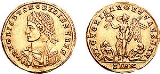
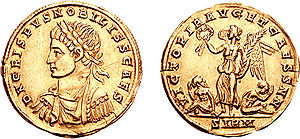
The two victories were his contribution to the final triumph of his father over Licinius. Constantine was the only Augustus left in the Empire. He honoured his son for his support and success by depicting his face in imperial coins, statues, mosaics, cameos, etc. Eusebius of Caesaria wrote for Crispus that he is "an Imperator
Imperator
The Latin word Imperator was originally a title roughly equivalent to commander under the Roman Republic. Later it became a part of the titulature of the Roman Emperors as part of their cognomen. The English word emperor derives from imperator via Old French Empreur...
most dear to God and in all regards comparable to his father."
Crispus was the most likely choice for an heir to the throne at the time. His siblings Constantine II
Constantine II (emperor)
Constantine II , was Roman Emperor from 337 to 340. Co-emperor alongside his brothers, his short reign saw the beginnings of conflict emerge between the sons of Constantine the Great, and his attempt to exert his perceived rights of primogeniture ended up causing his death in a failed invasion of...
, Constantius II
Constantius II
Constantius II , was Roman Emperor from 337 to 361. The second son of Constantine I and Fausta, he ascended to the throne with his brothers Constantine II and Constans upon their father's death....
and Constans
Constans
Constans , was Roman Emperor from 337 to 350. He defeated his brother Constantine II in 340, but anger in the army over his personal life and preference for his barbarian bodyguards saw the general Magnentius rebel, resulting in Constans’ assassination in 350.-Career:Constans was the third and...
were far too young and inexperienced.
Execution
In 326, Crispus' life came to a sudden end: on his father's orders, he was tried by a local court at PolaPula
Pula is the largest city in Istria County, Croatia, situated at the southern tip of the Istria peninsula, with a population of 62,080 .Like the rest of the region, it is known for its mild climate, smooth sea, and unspoiled nature. The city has a long tradition of winemaking, fishing,...
, Istria
Istria
Istria , formerly Histria , is the largest peninsula in the Adriatic Sea. The peninsula is located at the head of the Adriatic between the Gulf of Trieste and the Bay of Kvarner...
, condemned to death and executed. Soon afterwards, Constantine had his own wife, Fausta
Fausta
Fausta Flavia Maxima was a Roman Empress, daughter of the Roman Emperor Maximianus. To seal the alliance between them for control of the Tetrarchy, in 307 Maximianus married her to Constantine I, who set aside his wife Minervina in her favour. Constantine and Fausta had been betrothed since...
, killed; she was suffocated in an over-heated bath.
The reason for this act remains unclear and historians have long debated Constantine's motivation. Zosimus
Zosimus
Zosimus was a Byzantine historian, who lived in Constantinople during the reign of the Byzantine Emperor Anastasius I . According to Photius, he was a comes, and held the office of "advocate" of the imperial treasury.- Historia Nova :...
in the 5th century and Joannes Zonaras
Joannes Zonaras
Ioannes Zonaras was a Byzantine chronicler and theologian, who lived at Constantinople.Under Emperor Alexios I Komnenos he held the offices of head justice and private secretary to the emperor, but after Alexios' death, he retired to the monastery of St Glykeria, where he spent the rest of his...
in the 12th century both reported that Fausta, stepmother of Crispus, was extremely jealous of him. She was reportedly afraid that Constantine would put aside the sons she bore him. So, in order to get rid of Crispus, Fausta set him up. She reportedly told the young Caesar that she was in love with him and suggested an illegitimate love affair. Crispus denied the immoral wishes of Fausta and left the palace in a state of a shock. Then Fausta said to Constantine that Crispus had no respect for his father, since the Caesar was in love with his father's own wife. She reported to Constantine that she dismissed him after his attempt to rape her. Constantine believed her and, true to his strong personality and short temper, executed his beloved son. A few months later, Constantine reportedly found out the whole truth and then killed Fausta.
This version of events has become the most widely accepted, since all other reports are even less satisfactory. That Fausta and Crispus could have plotted treason against Constantine is rejected by most historians, as they would have nothing to gain considering their positions as favourites of Constantine. In any case, such a case would not have been tried by a local court as Crispus' case clearly was. Another view suggests that Constantine killed Crispus because as a supposedly illegitimate son, he would cause a crisis in the order of succession to the throne. However, Constantine had kept him at his side for twenty years without any such decision. Constantine also had the authority to appoint his younger, legitimate sons as his heirs. Some reports claimed that Constantine was envious of the success of his son and afraid of him. This seems improbable, given that Constantine had twenty years of experience as emperor while Crispus was still a young Caesar. Similarly, there seems to be no evidence that Crispus had any ambitions to harm or displace his father.
So while the story of Zosimus and Zonaras seems the most believable one, there are also problems relating to their version of events. Constantine's reaction suggests that he suspected Crispus of a crime so terrible that death was not enough. Crispus also suffered damnatio memoriae
Damnatio memoriae
Damnatio memoriae is the Latin phrase literally meaning "condemnation of memory" in the sense of a judgment that a person must not be remembered. It was a form of dishonor that could be passed by the Roman Senate upon traitors or others who brought discredit to the Roman State...
, meaning his name was never mentioned again and was deleted from all official documents and monuments. Crispus, his wife Helena and their son were never to be mentioned again in historical records. The eventual fate of Helena and her son is a mystery. Constantine did not restore his son's innocence and name, as he probably would have on learning of his son's innocence. Perhaps Constantine's pride, or shame at having executed his son, prevented him from publicly admitting having made a mistake.
It is beyond doubt that there was a connection between the deaths of Crispus and Fausta. Such agreement among different sources connecting two deaths is extremely rare in itself. A number of modern historians have suggested that Crispus and Fausta really did have an illegitimate affair. When Constantine found out, his reaction was to have both of them killed. What delayed the death of Fausta may have been a pregnancy
Pregnancy
Pregnancy refers to the fertilization and development of one or more offspring, known as a fetus or embryo, in a woman's uterus. In a pregnancy, there can be multiple gestations, as in the case of twins or triplets...
. Since the years of birth for the two known daughters of Constantine and Fausta remain unknown, one of their births may have delayed their mother's execution.
The story of Zosimus and Zonaras listed above is suspiciously similar to both the legend of Hippolytus
Hippolytus (mythology)
thumb|260px|The Death of Hippolytus, by [[Sir Lawrence Alma-Tadema]] .In Greek mythology, Hippolytus was a son of Theseus and either Antiope or Hippolyte...
of Athens
Athens
Athens , is the capital and largest city of Greece. Athens dominates the Attica region and is one of the world's oldest cities, as its recorded history spans around 3,400 years. Classical Athens was a powerful city-state...
(casting Crispus in the role of the youth, Constantine in the role of Theseus
Theseus
For other uses, see Theseus Theseus was the mythical founder-king of Athens, son of Aethra, and fathered by Aegeus and Poseidon, both of whom Aethra had slept with in one night. Theseus was a founder-hero, like Perseus, Cadmus, or Heracles, all of whom battled and overcame foes that were...
and Fausta in the role of Phaedra
Phaedra (mythology)
In Greek mythology, Phaedra is the daughter of Minos and Pasiphaë, wife of Theseus and the mother of Demophon of Athens and Acamas. Phaedra's name derives from the Greek word φαιδρός , which meant "bright"....
) as well as the Biblical account of Joseph and Potiphar's wife
Joseph (Hebrew Bible)
Joseph is an important character in the Hebrew bible, where he connects the story of Abraham, Isaac and Jacob in Canaan to the subsequent story of the liberation of the Israelites from slavery in Egypt....
.