
All Topics  
First Jewish-Roman War

 
First Jewish Roman War

   Email Print
   Bookmark   Link


First Jewish-Roman War


The first Jewish-Roman War (66
66

Year 66 was a common year starting on Wednesday of the Julian calendar....
73
73

Year 73 was a common year starting on Friday of the Julian calendar....
), sometimes called The Great Revolt (ha-Mered Ha-Gadol), was the first of three major rebellions
Jewish-Roman wars

The Jewish-Roman wars were a series of revolts by the Jews of Iudaea Province against the Roman Empire. Some sources use the term to refer only to the First Jewish-Roman War and Bar Kokhba revolt ....
 by the Jews of Iudaea Province
Iudaea Province

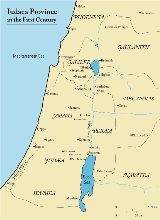
Iudaea was a Roman province that extended over the former region of the Hasmonean and Herodian kingdoms of Israel. It was named after the tetrarchy of Judea of which it was an expansion, the latter name deriving from the Kingdom of Judah of the 6th century BCE....
 against the Roman Empire
Roman Empire

The Roman Empire was the Roman Republic phase of the Ancient Rome, characterised by an autocracy form of government and large territorial holdings in Europe and around the Mediterranean....
 (the second was the Kitos War
Kitos War

The Kitos War is the name given to the second of the Jewish-Roman wars. The name comes from the Mauretanian Roman general Lusius Quietus who ruthlessly suppressed a Jewish revolt in Mesopotamia and was sent to Iudaea to handle the revolt there as procurator under Trajan, a position he held until he was recalled to Rome and executed by Hadr...
 in 115
115

Events...
117
117

Events...
; the third was Bar Kokhba's revolt
Bar Kokhba's revolt

The Bar Kokhba revolt against the Roman Empire was a second major rebellion by the Jews of Iudaea Province and the last of the Jewish-Roman Wars....
, 132
132

Events...
135
135

Events...
).

It began in the year 66, stemming from Greek and Jewish religious tension. It ended when legions
Roman legion

The Roman Legion is a term that can apply both as a translation of legio to the entire Roman army and also, more narrowly , to the heavy infantry that was the basic military unit of the Roman army in the period of the late Roman Republic and the Roman Empire....
 under Titus
Titus

Titus Flavius Vespasianus, commonly known as Titus , was a Roman Emperor who briefly reigned from 79 until his death in 81. Titus was the second emperor of the Flavian dynasty, which ruled the Roman Empire between 69 and 96, encompassing the reigns of Titus's father Vespasian , Titus himself and his younger brother Domitian ....
 besieged and destroyed Jerusalem, looted and burned Herod's Temple
Herod's Temple

Herod's Temple in Jerusalem was a massive expansion of the Temple Mount and construction of a completely new and much larger Jewish Temple by King Herod the Great around 19 BCE....
 (in the year 70
70

Year 70 was a common year starting on Monday of the Julian calendar....
) and Jewish strongholds (notably Gamla
Gamla

Gamla , a site inhabited since the Early Bronze Age, became the capital of the Jewish Golan from 87 BCE to 68 CE when it was sacked by the Romans....
 in 67
67

Year 67 was a common year starting on Thursday of the Julian calendar....
 and Masada
Masada

Masada is the name for a site of ancient palaces and fortifications in the South District of Israel on top of an isolated rock plateau, or large mesa, on the eastern edge of the Judean Desert overlooking the Dead Sea....
 in 73
73

Year 73 was a common year starting on Friday of the Julian calendar....
), and enslaved
Slavery

Slavery is a form of forced labor where a person is compelled to Labor for another . Slaves are held against their will from the time of their capture, purchase, or birth, and are deprived of the right to leave, to refuse to work, or to receive Remuneration in return for their labor....
 or massacred a large part of the Jewish population.

The defeat of the Jewish revolts by the Roman Empire substantially altered the Jewish diaspora
Jewish diaspora

The Jewish diaspora , the presence of Jews outside of the Land of Israel, is a result of the expulsion or emigration of Jews from Israel and religious conversion to Judaism....
, as many Jews were scattered or sold into slavery
Slavery

Slavery is a form of forced labor where a person is compelled to Labor for another . Slaves are held against their will from the time of their capture, purchase, or birth, and are deprived of the right to leave, to refuse to work, or to receive Remuneration in return for their labor....
 after losing their state.

rding to Josephus
Josephus

Josephus , also known as Yosef Ben Matityahu and, after he became a Roman citizenship, as Titus Flavius Josephus, was a first-century Jewish historian and apologist of priestly and royal ancestry who survived and recorded the destruction of Jerusalem in AD 70....
, the revolt, which began at Caesarea in 66
66

Year 66 was a common year starting on Wednesday of the Julian calendar....
, was provoked by Greeks sacrificing birds in front of a local synagogue
Synagogue

A synagogue is a Jewish house of prayer.Synagogues usually have a large hall for prayer , smaller rooms for study and sometimes a social hall and offices....
.


Discussion
Ask a question about 'First Jewish-Roman War'
Start a new discussion about 'First Jewish-Roman War'
Answer questions from other users
Full Discussion Forum


Encyclopedia


The first Jewish-Roman War (66
66

Year 66 was a common year starting on Wednesday of the Julian calendar....
73
73

Year 73 was a common year starting on Friday of the Julian calendar....
), sometimes called The Great Revolt (ha-Mered Ha-Gadol), was the first of three major rebellions
Jewish-Roman wars

The Jewish-Roman wars were a series of revolts by the Jews of Iudaea Province against the Roman Empire. Some sources use the term to refer only to the First Jewish-Roman War and Bar Kokhba revolt ....
 by the Jews of Iudaea Province
Iudaea Province

Iudaea was a Roman province that extended over the former region of the Hasmonean and Herodian kingdoms of Israel. It was named after the tetrarchy of Judea of which it was an expansion, the latter name deriving from the Kingdom of Judah of the 6th century BCE....
 against the Roman Empire
Roman Empire

The Roman Empire was the Roman Republic phase of the Ancient Rome, characterised by an autocracy form of government and large territorial holdings in Europe and around the Mediterranean....
 (the second was the Kitos War
Kitos War

The Kitos War is the name given to the second of the Jewish-Roman wars. The name comes from the Mauretanian Roman general Lusius Quietus who ruthlessly suppressed a Jewish revolt in Mesopotamia and was sent to Iudaea to handle the revolt there as procurator under Trajan, a position he held until he was recalled to Rome and executed by Hadr...
 in 115
115

Events...
117
117

Events...
; the third was Bar Kokhba's revolt
Bar Kokhba's revolt

The Bar Kokhba revolt against the Roman Empire was a second major rebellion by the Jews of Iudaea Province and the last of the Jewish-Roman Wars....
, 132
132

Events...
135
135

Events...
).

It began in the year 66, stemming from Greek and Jewish religious tension. It ended when legions
Roman legion

The Roman Legion is a term that can apply both as a translation of legio to the entire Roman army and also, more narrowly , to the heavy infantry that was the basic military unit of the Roman army in the period of the late Roman Republic and the Roman Empire....
 under Titus
Titus

Titus Flavius Vespasianus, commonly known as Titus , was a Roman Emperor who briefly reigned from 79 until his death in 81. Titus was the second emperor of the Flavian dynasty, which ruled the Roman Empire between 69 and 96, encompassing the reigns of Titus's father Vespasian , Titus himself and his younger brother Domitian ....
 besieged and destroyed Jerusalem, looted and burned Herod's Temple
Herod's Temple

Herod's Temple in Jerusalem was a massive expansion of the Temple Mount and construction of a completely new and much larger Jewish Temple by King Herod the Great around 19 BCE....
 (in the year 70
70

Year 70 was a common year starting on Monday of the Julian calendar....
) and Jewish strongholds (notably Gamla
Gamla

Gamla , a site inhabited since the Early Bronze Age, became the capital of the Jewish Golan from 87 BCE to 68 CE when it was sacked by the Romans....
 in 67
67

Year 67 was a common year starting on Thursday of the Julian calendar....
 and Masada
Masada

Masada is the name for a site of ancient palaces and fortifications in the South District of Israel on top of an isolated rock plateau, or large mesa, on the eastern edge of the Judean Desert overlooking the Dead Sea....
 in 73
73

Year 73 was a common year starting on Friday of the Julian calendar....
), and enslaved
Slavery

Slavery is a form of forced labor where a person is compelled to Labor for another . Slaves are held against their will from the time of their capture, purchase, or birth, and are deprived of the right to leave, to refuse to work, or to receive Remuneration in return for their labor....
 or massacred a large part of the Jewish population.

The defeat of the Jewish revolts by the Roman Empire substantially altered the Jewish diaspora
Jewish diaspora

The Jewish diaspora , the presence of Jews outside of the Land of Israel, is a result of the expulsion or emigration of Jews from Israel and religious conversion to Judaism....
, as many Jews were scattered or sold into slavery
Slavery

Slavery is a form of forced labor where a person is compelled to Labor for another . Slaves are held against their will from the time of their capture, purchase, or birth, and are deprived of the right to leave, to refuse to work, or to receive Remuneration in return for their labor....
 after losing their state.

First Jewish successes

According to Josephus
Josephus

Josephus , also known as Yosef Ben Matityahu and, after he became a Roman citizenship, as Titus Flavius Josephus, was a first-century Jewish historian and apologist of priestly and royal ancestry who survived and recorded the destruction of Jerusalem in AD 70....
, the revolt, which began at Caesarea in 66
66

Year 66 was a common year starting on Wednesday of the Julian calendar....
, was provoked by Greeks sacrificing birds in front of a local synagogue
Synagogue

A synagogue is a Jewish house of prayer.Synagogues usually have a large hall for prayer , smaller rooms for study and sometimes a social hall and offices....
. The Greek-speaking Roman garrison did not intercede. In an act of defiance, the son of Kohen Gadol
Kohen Gadol

Kohen Gadol or Kohen ha-Gadol is the title of wiktionary:High Priest of early Israelite religion and of Classical Age Judaism from the rise of the Israelite nation until the destruction of the Second Temple of Jerusalem....
 (High priest) Eliezar ben Hanania ceased prayers and sacrifices for the Roman Emperor
Roman Emperor

The Roman Emperor was the ruler of the Roman Empire during the imperial period . The Romans had no single term for the office: Latin language titles such as imperator , Augustus , Caesar and princeps were all associated with it....
 at the Temple and subsequently led a successful attack on the Roman garrison stationed in Jerusalem
Jerusalem

Jerusalem is the capital of Israel and its List of Israeli cities in both population and area, with a population of 747,600 residents over an area of if Positions on Jerusalem East Jerusalem is included....
. The pro-Roman king Agrippa II
Agrippa II

Agrippa II , son of Agrippa I, and like him originally named Marcus Julius Agrippa, was the seventh and last king of the family of Herod the Great, thus last of the Herodians....
 and his sister Berenice
Berenice of Cilicia

Berenice of Cilicia, also known as Julia Berenice and sometimes spelled Bernice , was a Jewish Client state of the Roman Empire during the second half of the 1st century....
 fled Jerusalem to Galilee
Galilee

Galilee , is a large region in northern Israel which overlaps with much of the administrative North District of the country. Traditionally divided into Upper Galilee , Lower Galilee , and Western Galilee , extending from Dan to the north, at the base of Mount Hermon, along Mount Lebanon to the ridges of Mount Carmel and Mount Gilboa t...
, where later they gave themselves up to the Romans. Cestius Gallus
Cestius Gallus

Gaius Cestius Gallus was the son of a consul in ancient Rome and himself a suffect consul in 42.He was Legatus of Syria from 63 or 65. He marched into Judea in 66 in an attempt to restore calm at the outset of the Great Jewish Revolt....
, the legate
Legatus

A legatus was a general in the Roman army, equivalent to a modern general officer. Being of Roman senate rank, his immediate superior was the dux, and he outranked all military tribunes....
 of Syria
Syria (Roman province)

Syria was a Roman province, annexed in 64 BC by Pompey, as a consequence of his military presence after pursuing victory in the Third Mithridatic War....
, brought reinforcements to restore order, but was soundly defeated at the Battle of Beth Horon
Battle of Beth Horon (66)

The Battle of Beth Horon was a battle fought in 66 CE between Roman and Jewish forces and was one of the decisive battles in the First Jewish-Roman War....
. While retreating, Legio XII Fulminata
Legio XII Fulminata

Legio duodecima Fulminata , also known as Paterna, Victrix, Antiqua, Certa Constans, and Galliena, was a Roman legion, levied by Julius Caesar in 58 BC and which accompanied him during the Gallic wars until 49 BC....
 even lost its aquila
Aquila (Roman)

The signa militaria were the Roman military ensigns or vexilloids. The most ancient standard employed by the Romans is said to have been a handful of straw fixed to the top of a spear or pole....
.

The fall

Emperor Nero
Nero

Nero Claudius Caesar Augustus Germanicus , born Lucius Domitius Ahenobarbus, also called Nero Claudius Caesar Drusus Germanicus, was the fifth and final Roman emperor of the Julio-Claudian dynasty....
 appointed general Vespasian
Vespasian

Titus Flavius Vespasianus, commonly known as Vespasian , was a Roman Emperor who reigned from 69 A.D. until his death in 79 A.D. Vespasian was the founder of the short lived Flavian dynasty, which ruled the Roman Empire between 69 A.D....
 instead of Gallus to crush the rebellion. Vespasian made Caesarea Maritima his headquarters and with his legions — among them X Fretensis
Legio X Fretensis

Legio decima Fretensis of the sea strait") was a Roman legion levied by Augustus in 41/40 BC to fight during the period of Roman Civil War that started the dissolution of the Roman Republic....
 and V Macedonica
Legio V Macedonica

Legio quinta Macedonica was a Roman legion. It was probably originally levied by consul Gaius Vibius Pansa Caetronianus and Augustus in 43 BC, and it existed in Moesia at least until 5th century....
, 60,000 professional soldiers — methodically cleared the coast and the North. Some towns gave up without a fight. By the year 68
68

Year 68 was a leap year starting on Friday of the Julian calendar....
, Jewish resistance in the North had been crushed.

The leaders of the collapsed Northern revolt, John of Giscala
John of Giscala

John of Giscala or Johannes ben Levi , was a leader of the Jewish revolt against the Romans in the First Jewish-Roman War.The Romans attacked Gush Halav , John's home town in the Upper Galilee and burned it to the ground....
 and Simon Bar Giora
Simon Bar Giora

Simon Bar Giora was a leader of the Sicarii faction during the First Jewish-Roman War in the 1st century Judea....
, managed to escape to Jerusalem. Brutal civil war erupted: the Zealots and Sicarii
Sicarii

Sicarii is a term applied, in the decades immediately preceding the destruction of Jerusalem in 70 CE, to an extremist splinter group to the Jewish Zealots, who attempted to expel the Roman Empire and their partisans from Judea....
 executed anyone advocating surrender, and by 68
68

Year 68 was a leap year starting on Friday of the Julian calendar....
 the entire leadership of the southern revolt was dead, all killed by the Jews, none by the Romans.

After the death of Nero and with the backing of the army, Vespasian
Vespasian

Titus Flavius Vespasianus, commonly known as Vespasian , was a Roman Emperor who reigned from 69 A.D. until his death in 79 A.D. Vespasian was the founder of the short lived Flavian dynasty, which ruled the Roman Empire between 69 A.D....
 was proclaimed emperor in 69
69

Year 69 was a common year starting on Sunday of the Julian calendar....
 and left for Rome to take the throne from Vitellius
Vitellius

Aulus Vitellius Germanicus, born Aulus Vitellius and commonly known as Vitellius , was a Roman Emperors who reigned from 16 April 69 to 22 December of the same year....
 in a brief Roman civil war, the so-called Year of the four emperors
Year of the Four Emperors

The Year of the Four Emperors was a year in the history of the Roman Empire, AD 69, in which four emperors ruled in a remarkable succession. These four emperors were Galba, Otho, Vitellius, and Vespasian....
.

The fall of Jerusalem


The siege of Jerusalem, the capital city, had begun early in the war, but had turned into a stalemate. Unable to breach the city's defenses, the Roman armies established a permanent camp just outside the city, digging a trench around the circumference of its walls and building a wall as high as the city walls themselves around Jerusalem. Anyone caught in the trench attempting to flee the city would be captured, crucified, and placed in lines on top of the dirt wall facing into Jerusalem.The two Zealot leaders, John of Gischala and Simon Bar Giora
Simon Bar Giora

Simon Bar Giora was a leader of the Sicarii faction during the First Jewish-Roman War in the 1st century Judea....
 only ceased hostilities and joined forces to defend the city when the Romans began to construct ramparts for the siege. Tens of thousands of crucified bodies encircled Jerusalem by the end of the siege.

Titus Flavius
Titus

Titus Flavius Vespasianus, commonly known as Titus , was a Roman Emperor who briefly reigned from 79 until his death in 81. Titus was the second emperor of the Flavian dynasty, which ruled the Roman Empire between 69 and 96, encompassing the reigns of Titus's father Vespasian , Titus himself and his younger brother Domitian ....
, Vespasian's son, led the final assault and siege of Jerusalem
Siege of Jerusalem (70)

The Siege of Jerusalem in the year 70 AD was a decisive event in the First Jewish-Roman War. It was followed by the Masada#History in 73 AD. The Roman Empire army, led by the future Emperor Titus, with Tiberius Julius Alexander as his second-in-command, besieged and conquered the city of Jerusalem, which had been occupied by its Jewish defend...
. During the infighting inside the city walls, a stockpiled supply of dry food was intentionally burned by Jewish leaders to induce the defenders to fight against the siege instead of negotiating peace; as a result many city dwellers and soldiers died of starvation during the siege. Zealots under Eleazar ben Simon
Eleazar ben Simon

Eleazar ben Simon was a Zealot leader during the First Jewish-Roman War who fought against the armies of Cestius Gallus, Vespasian, and Titus Flavius....
 held the Temple, Sicarii
Sicarii

Sicarii is a term applied, in the decades immediately preceding the destruction of Jerusalem in 70 CE, to an extremist splinter group to the Jewish Zealots, who attempted to expel the Roman Empire and their partisans from Judea....
 led by Simon Bar Giora held the upper city. Titus eventually wiped out the last remnants of Jewish resistance.

Sack of Jerusalem
By the summer of 70
70

Year 70 was a common year starting on Monday of the Julian calendar....
, the Romans had breached the walls of Jerusalem, ransacking and burning nearly the entire city. The Romans began by attacking the weakest spot which was the third wall. It was built shortly before the siege so it did not have as much time invested in its protection. They succeeded towards the end of May and shortly afterwards broke through the more important second wall. The Second Temple
Second Temple

The Second Temple was the reconstructed Temple in Jerusalem which stood between 516 BCE and 70 CE. During this time, it was the center of Judaism worship, which focused on the sacrifices known as the korbanot....
 was destroyed on Tisha B'Av
Tisha B'Av

is an annual ta'anit in Judaism, named for the ninth day of the month of Av in the Hebrew calendar. The fast commemorates the destruction of the Solomon's Temple and Second Temples in Jerusalem, which occurred about 656 years apart, but on the same date....
 (July 29 or July 30), 70
70

Year 70 was a common year starting on Monday of the Julian calendar....
. Tacitus
Tacitus

Publius Cornelius Tacitus was a Roman Senate and a historian of the Roman Empire. The surviving portions of his two major works—the Annals and the Histories —examine the reigns of the Roman Emperors Tiberius, Claudius, Nero and those that reigned in the Year of the Four Emperors....
, a historian of the time, notes that those who were besieged in Jerusalem amounted to no fewer than six hundred thousand, that men and women alike and every age engaged in armed resistance, everyone who could pick up a weapon did, both sexes showed equal determination, preferring death to a life that involved expulsion from their country. All three walls were destroyed and in turn so was the Temple. John of Giscala surrendered at Agrippa II
Agrippa II

Agrippa II , son of Agrippa I, and like him originally named Marcus Julius Agrippa, was the seventh and last king of the family of Herod the Great, thus last of the Herodians....
's fortress of Jotaphta and was sentenced to life imprisonment. The famous Arch of Titus
Arch of Titus

The Arch of Titus is a Pentelic marble triumphal arch with a single arched opening, located on the Via Sacra just to the south-east of the Roman Forum in Rome....
 still stands in Rome: it depicts Roman legionaries carrying off the Temple of Jerusalem's treasuries, including the menorah.

The fall of Masada

During the spring of 71
71

Year 71 was a common year starting on Tuesday of the Julian calendar....
, Titus set sail for Rome. A new military governor was then appointed from Rome, Lucilius Bassus
Lucilius Bassus

Lucilius Bassus was a Roman Empire legatus appointed by Emperor Vespasian to the Iudaea Province in 71 AD. Assigned to finish off the last remnants of the Great Jewish Revolt in the province, he led the legion Legio X Fretensis, destroying the Jewish strongholds Herodium and Machaerus on their march to the siege of Masada....
, whose assigned task was to undertake the "mopping-up" operations in Judaea. He used X Fretensis to oppose the few remaining fortresses that still resisted. Bassus took Herodium
Herodium

Herodium or Herodion is a hill shaped like a truncated cone , located in the West Bank, southeast of Bethlehem and under control of Israel, built as a fortress palace by King Herod the Great....
, and then crossed the Jordan to capture the fortress of Machaerus
Machaerus

Machaerus is a fortified hilltop palace located in Jordan fifteen miles southeast of the mouth of the Jordan river on the eastern side of the Dead Sea....
 on the shore of the Dead Sea. Due to illness, Bassus did not live to complete his mission. Lucius Flavius Silva
Lucius Flavius Silva

Lucius Flavius Silva was a late-1st century Roman general, governor of the province of Iudaea and Roman consul. History remembers Silva as the Roman commander who led his army, composed mainly of the Legio X Fretensis, in 73 AD up to Masada and laid siege to its near-impenetrable mountain fortress occupied by a group of Jewish rebels c...
 replaced him, and moved against the last Jewish stronghold, Masada
Masada

Masada is the name for a site of ancient palaces and fortifications in the South District of Israel on top of an isolated rock plateau, or large mesa, on the eastern edge of the Judean Desert overlooking the Dead Sea....
, in the autumn of 72
72

Year 72 was a leap year starting on Wednesday of the Julian calendar....
. He used Legio X
Legio X Fretensis

Legio decima Fretensis of the sea strait") was a Roman legion levied by Augustus in 41/40 BC to fight during the period of Roman Civil War that started the dissolution of the Roman Republic....
, auxiliary troops, and thousands of Jewish prisoners, for a total of 10,000 soldiers. After his orders for surrender were rejected, Silva established several base camps and circumvallated the fortress. According to Josephus
Josephus

Josephus , also known as Yosef Ben Matityahu and, after he became a Roman citizenship, as Titus Flavius Josephus, was a first-century Jewish historian and apologist of priestly and royal ancestry who survived and recorded the destruction of Jerusalem in AD 70....
, when the Romans finally broke through the walls of this citadel in 73
73

Year 73 was a common year starting on Friday of the Julian calendar....
, they discovered that the 967 defenders had all committed suicide, preferring death over defeat.

The outcome


Josephus claims that 1,100,000 people were killed during the siege, of which a majority were Jewish. 97,000 were captured and enslaved. Many fled to areas around the Mediterranean.

The Romans hunted down and slaughtered entire clans, such as descendants of the House of David
David

David , was the second king of the united Kingdom of Israel according to the Hebrew Bible/Old Testament. He is depicted as a righteous king, although not without fault, as well as an acclaimed warrior, musician and poet ....
. On one occasion, Titus condemned 2,500 Jews to fight with wild beasts in the amphitheatre of Caesarea in celebration of his brother Domitian
Domitian

Titus Flavius Domitianus , commonly known as Domitian, was a Roman Emperor who reigned from 14 September 81 until his death. Domitian was the last emperor of the Flavian dynasty, which ruled the Roman Empire between 69 and 96, encompassing the reigns of Domitian's father Vespasian , his elder brother Titus , and that of Domitian himself...
's birthday.

The Jewish Encyclopedia
Jewish Encyclopedia

The Jewish Encyclopedia was an encyclopedia originally published between 1901 and 1906 by Funk and Wagnalls. It contained over 15,000 articles in 12 volumes on the history and then-current state of Judaism and the Jews as of 1901....
 article on the Hebrew Alphabet states: "Not until the revolts against Nero and against Hadrian did the Jews return to the use of the old Hebrew script
Paleo-Hebrew alphabet

The Paleo-Hebrew alphabet, also known as Ktav Ivri, is an offshoot of the ancient Semitic alphabet . At the very least it dates to the 10th century BCE....
 on their coins, which they did from similar motives to those which had governed them two or three centuries previously; both times, it is true, only for a brief period."

Titus reportedly refused to accept a wreath of victory, as there is "no merit in vanquishing people forsaken by their own God".

Before Vespasian's departure, the Pharisaic sage and Rabbi
Rabbi

Rabbi , in Judaism, means a religious ?teacher?, or more literally, ?my great one?, when addressing any master. The word rabbi derives from the Hebrew root word , rav, which in biblical Hebrew means ?great?, used in many senses, including the sense of a ?master? and apprentice, whence someone who is a distinguished ?teacher?....
 Yohanan ben Zakkai obtained his permission to establish a Judaic school at Yavne
Council of Jamnia

The Council of Jamnia or Council of Yavne is a hypothetical 1st century council at which it is postulated the Development of the Jewish Bible canon was defined....
. Zakkai was smuggled away from Jerusalem in a coffin by his students. Later this school has become a major center of Talmud
Talmud

The Talmud is a record of rabbinic discussions pertaining to Halakha, Jewish ethics, customs, and history. It is a central text of mainstream Judaism....
ic study. (See Mishnah
Mishnah

The Mishnah or Mishna is a major work of Rabbinic literature, and the first major redaction into written form of Jewish oral traditions, called the Oral Torah....
)

Sources

The main account of the revolt comes from Josephus
Josephus

Josephus , also known as Yosef Ben Matityahu and, after he became a Roman citizenship, as Titus Flavius Josephus, was a first-century Jewish historian and apologist of priestly and royal ancestry who survived and recorded the destruction of Jerusalem in AD 70....
, the former Jewish commander of Galilee
Galilee

Galilee , is a large region in northern Israel which overlaps with much of the administrative North District of the country. Traditionally divided into Upper Galilee , Lower Galilee , and Western Galilee , extending from Dan to the north, at the base of Mount Hermon, along Mount Lebanon to the ridges of Mount Carmel and Mount Gilboa t...
 who was captured by the Romans and forced to witness and record the events of the revolt. Josephus had been granted citizenship and a pension in Rome and was well accepted at the courts of Vespasian
Vespasian

Titus Flavius Vespasianus, commonly known as Vespasian , was a Roman Emperor who reigned from 69 A.D. until his death in 79 A.D. Vespasian was the founder of the short lived Flavian dynasty, which ruled the Roman Empire between 69 A.D....
, Titus
Titus

Titus Flavius Vespasianus, commonly known as Titus , was a Roman Emperor who briefly reigned from 79 until his death in 81. Titus was the second emperor of the Flavian dynasty, which ruled the Roman Empire between 69 and 96, encompassing the reigns of Titus's father Vespasian , Titus himself and his younger brother Domitian ....
 and Domitian
Domitian

Titus Flavius Domitianus , commonly known as Domitian, was a Roman Emperor who reigned from 14 September 81 until his death. Domitian was the last emperor of the Flavian dynasty, which ruled the Roman Empire between 69 and 96, encompassing the reigns of Domitian's father Vespasian , his elder brother Titus , and that of Domitian himself...
.

His popular works The Wars of the Jews
The Wars of the Jews

The Wars of the Jews is a book written by the 1st century Jewish historian Josephus.It is a description of Jewish history from the capture of Jerusalem by the Seleucid Empire ruler Antiochus IV Epiphanes in 164 BC to the fall and destruction of Jerusalem in the First Jewish-Roman War in AD 70....
 (c. 79
79

Year 79 was a common year starting on Friday of the Julian calendar....
) and Jewish Antiquities (c. 94
94

Year 94 was a common year starting on Wednesday of the Julian calendar....
) — especially its autobiographical appendix — are frequently contradictory. He was loathed by the Jews as a turncoat and Roman apologist and never returned to his homeland after the fall of Jerusalem, living in Rome as an historian under the patronage of Flavius and Titus.

See also

  • First Jewish Revolt coinage
    First Jewish Revolt coinage

    First Jewish Revolt coinage was issued by the Jew after the Zealots captured Jerusalem and the Temple in Jerusalem from the Roman Empire in 66 AD at the beginning of the First Jewish-Roman War....
  • Judaea Capta coinage
    Judaea Capta coinage

    Judaea Capta coins were a series of commemorative coins originally issued by the Roman Emperor Vespasian to celebrate the capture of Iudaea Province and the destruction of the Jewish Temple in Jerusalem by his son Titus in 70 AD during the First Jewish-Roman War....
  • Jewish-Roman Wars
    Jewish-Roman wars

    The Jewish-Roman wars were a series of revolts by the Jews of Iudaea Province against the Roman Empire. Some sources use the term to refer only to the First Jewish-Roman War and Bar Kokhba revolt ....
  • Siege of Jerusalem
    Siege of Jerusalem (70)

    The Siege of Jerusalem in the year 70 AD was a decisive event in the First Jewish-Roman War. It was followed by the Masada#History in 73 AD. The Roman Empire army, led by the future Emperor Titus, with Tiberius Julius Alexander as his second-in-command, besieged and conquered the city of Jerusalem, which had been occupied by its Jewish defend...
  • Fall of Masada
    Masada

    Masada is the name for a site of ancient palaces and fortifications in the South District of Israel on top of an isolated rock plateau, or large mesa, on the eastern edge of the Judean Desert overlooking the Dead Sea....
  • Arch of Titus
    Arch of Titus

    The Arch of Titus is a Pentelic marble triumphal arch with a single arched opening, located on the Via Sacra just to the south-east of the Roman Forum in Rome....
  • Temple in Jerusalem
    Temple in Jerusalem

    The Temple in Jerusalem or Holy Temple , refers to a series of structures located on the Temple Mount in the old city of Jerusalem. Historically, two temples were built at this location, and a The Third Temple features in Jewish eschatology....
  • Second Temple
    Second Temple

    The Second Temple was the reconstructed Temple in Jerusalem which stood between 516 BCE and 70 CE. During this time, it was the center of Judaism worship, which focused on the sacrifices known as the korbanot....
  • Josephus
    Josephus

    Josephus , also known as Yosef Ben Matityahu and, after he became a Roman citizenship, as Titus Flavius Josephus, was a first-century Jewish historian and apologist of priestly and royal ancestry who survived and recorded the destruction of Jerusalem in AD 70....
     and
  • Tacitus
  • Timeline of Jewish History
    Timeline of Jewish history

    This is a timeline of the development of Jews and Judaism. All dates are given according to the Common Era, not the Hebrew calendar....
  • History of ancient Israel and Judah
    History of ancient Israel and Judah

    The history of ancient Kingdom of Israel and Kingdom of Judah is known to us essentially from the Hebrew Bible . Certain aspects of that history may also be derived from, elaborated and confirmed by other ancient sources and later classical writings such as the Talmud, the writings of Nicolaus of Damascus, Artapanus of Alexandria, Philo of A...
  • Israel
    Israel

    Israel officially the State of Israel , is a country in the Middle East located on the eastern shore of the Mediterranean Sea. It borders Lebanon in the north, Syria in the northeast, Jordan in the east, and Egypt on the southwest, and contains geographically diverse features within its relatively small area....
     and History of Israel
    History of Israel

    The State of Israel was Declaration of Independence in 1948 after nearly two thousand years of Jewish diaspora, and after 55 years of efforts to create a Jewish homeland ....
  • Judea
    Judea

    Judea or Jud?a is the name given to the mountainous southern part of the historic Land of Israel , an area now divided between Israel and the West Bank ....