

Roman Gaul

Encyclopedia
Roman Gaul consisted of an area of provincial rule in the Roman Empire
, in modern day France
, Belgium
, Luxembourg
, and western Germany
. Roman control of the area lasted for less than 500 years.
The Roman Republic
began its takeover of Celtic Gaul in 121 BC, when it conquered and annexed the southern reaches of the area. Julius Caesar
completed the task by defeating the Celtic tribes in the Gallic Wars
of 58-51 BC
and the romanization that ensued was quickest in the cities; Latin
was spoken by a majority of Gauls in the third century AD but with some remains of the Gallic language
.
The last vestige of Roman rule was effaced by the Franks
at the Battle of Soissons (486)
; displacing the Visigothic kingdom of Toulouse in 507, the Franks brought most of Gaul, except Septimania
in the south, under the rule of the Merovingians, the first kings of France.
The city of Lugdunum
(now Lyon
) had long been the capital of the Gaul
.
The Romans gave these divisions the term pagi (from which comes the French word pays, "region"); these pagi were organized into civitates, which corresponded more or less with the pre-Conquest communities or polities sometimes described misleadingly as "tribes," such as the Aedui
, Allobroges
, Bellovaci
, and Sequani
(see List of Celtic tribes). These administrative groupings would be taken over by the Romans in their system of local control, and these civitates would also be the basis of France's eventual division into ecclesiastical bishoprics and dioceses, which would remain in place—with slight changes—until the French revolution.
and cultural identity underwent a syncretism
with the Roman culture of the new governing class, and evolved into a hybrid Gallo-Roman culture
that eventually permeated all levels of society. Current historical research suggests that Roman Gaul was "Roman" only in certain (albeit major) social contexts, the prominence of which in material culture
has hindered a better historical understanding of the permanence of many Celtic elements. The Roman influence was most apparent in the areas of civic religion and administration. The Druidic
religion was suppressed by Emperor Claudius I, and in later centuries Christianity
was introduced. The prohibition of Druids and the syncretic nature of the Roman religion led to disappearance of the Celtic religion. It remains to this day poorly understood: current knowledge of the Celtic religion is based on archeology and via literary sources from several isolated areas such as Ireland
and Wales
.
The Romans easily imposed their administrative, economic, artistic (especially in terms of monumental art and architecture) and literary culture, all the more so given that there was little in the pre-existing Celtic culture to compete with these areas.
After the Roman conquest of Gaul (finished in 51 BC), Romanization
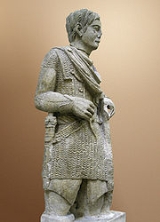
of the Celtic upper classes proceeded more rapidly than the less complete romanization of the lower classes, who may have spoken a Latin language mixed with Gallic. The Gauls wore the Roman tunic instead of their traditional clothing. The Romano-Gauls generally lived in the vici, small villages similar to those in Italy, or in villae, for the richest.
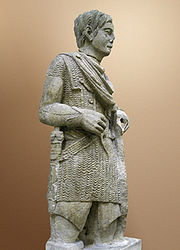 Surviving Celtic influences also infiltrated back into the Roman Imperial culture in the 3rd century. For example, the Gaulish tunic—which gave Emperor Caracalla
his surname—had not been replaced by Roman fashion. Similarly, certain Gaulish artisan techniques, such as the barrel (more durable than the Roman amphora
) and chain mail
were adopted by the Romans.
The Celtic heritage also continued in the spoken language (see History of French
). Gaulish spelling and pronunciation of Latin are apparent in several 5th century poets and transcribers of popular farces The last pockets of Gaulish speakers appear to have lingered until the 6th or 7th century.
Germanic placenames were first attested in border areas settled by Germanic colonizers (with Roman approval). From the 4th to 5th centuries, the Franks
settled in northern France and Belgium
, the Alemanni in Alsace
and Switzerland
, and the Burgundians
in Savoie
.
assumed power in Gaul. However, certain aspects of the ancient Celtic culture continued after the fall of Roman administration
and there was a remnant
of the Empire
for ten more years
.
In 486, Gaul ceased to be a Roman state by the Franks
at the Battle of Soissons
. Almost immediately afterwards, Gaul came under the rule of the Merovingians, the first kings of France.
Certain Gallo-Roman aristocratic families continued to exert power in episcopal cities (as in the cases of the Mauronitus family in Marseilles and Bishop Gregory of Tours
). The appearance of Germanic given and family names becomes noticeable in France from the middle of the 7th century on, most notably in powerful families, thus indicating that the centre of gravity had definitely shifted.
The Gallo-Roman, or Vulgar Latin
, dialect of the late Roman period evolved into the dialects of the Oïl languages and Old French
in the north, and Occitan in the south.
Gallia
and its equivalents continued to be used, at least in writing, until the end of the Merovingian period. Slowly, during the Carolingian
period, the expression Francia, then Francia occidentalis spread to describe the political reality of the kingdom of the Franks (regnum francorum).
Roman Empire
The Roman Empire was the post-Republican period of the ancient Roman civilization, characterised by an autocratic form of government and large territorial holdings in Europe and around the Mediterranean....
, in modern day France
France
The French Republic , The French Republic , The French Republic , (commonly known as France , is a unitary semi-presidential republic in Western Europe with several overseas territories and islands located on other continents and in the Indian, Pacific, and Atlantic oceans. Metropolitan France...
, Belgium
Belgium
Belgium , officially the Kingdom of Belgium, is a federal state in Western Europe. It is a founding member of the European Union and hosts the EU's headquarters, and those of several other major international organisations such as NATO.Belgium is also a member of, or affiliated to, many...
, Luxembourg
Luxembourg
Luxembourg , officially the Grand Duchy of Luxembourg , is a landlocked country in western Europe, bordered by Belgium, France, and Germany. It has two principal regions: the Oesling in the North as part of the Ardennes massif, and the Gutland in the south...
, and western Germany
Germany
Germany , officially the Federal Republic of Germany , is a federal parliamentary republic in Europe. The country consists of 16 states while the capital and largest city is Berlin. Germany covers an area of 357,021 km2 and has a largely temperate seasonal climate...
. Roman control of the area lasted for less than 500 years.
The Roman Republic
Roman Republic
The Roman Republic was the period of the ancient Roman civilization where the government operated as a republic. It began with the overthrow of the Roman monarchy, traditionally dated around 508 BC, and its replacement by a government headed by two consuls, elected annually by the citizens and...
began its takeover of Celtic Gaul in 121 BC, when it conquered and annexed the southern reaches of the area. Julius Caesar
Julius Caesar
Gaius Julius Caesar was a Roman general and statesman and a distinguished writer of Latin prose. He played a critical role in the gradual transformation of the Roman Republic into the Roman Empire....
completed the task by defeating the Celtic tribes in the Gallic Wars
Gallic Wars
The Gallic Wars were a series of military campaigns waged by the Roman proconsul Julius Caesar against several Gallic tribes. They lasted from 58 BC to 51 BC. The Gallic Wars culminated in the decisive Battle of Alesia in 52 BC, in which a complete Roman victory resulted in the expansion of the...
of 58-51 BC
50s BC
-Significant people:* Julius Caesar, Roman politician and general * Pharaoh Cleopatra VII of Egypt —meets Julius Caesar and later becomes teenager Pharaoh, after her brothers die young....
and the romanization that ensued was quickest in the cities; Latin
Latin
Latin is an Italic language originally spoken in Latium and Ancient Rome. It, along with most European languages, is a descendant of the ancient Proto-Indo-European language. Although it is considered a dead language, a number of scholars and members of the Christian clergy speak it fluently, and...
was spoken by a majority of Gauls in the third century AD but with some remains of the Gallic language
Gaulish language
The Gaulish language is an extinct Celtic language that was spoken by the Gauls, a people who inhabited the region known as Gaul from the Iron Age through the Roman period...
.
The last vestige of Roman rule was effaced by the Franks
Franks
The Franks were a confederation of Germanic tribes first attested in the third century AD as living north and east of the Lower Rhine River. From the third to fifth centuries some Franks raided Roman territory while other Franks joined the Roman troops in Gaul. Only the Salian Franks formed a...
at the Battle of Soissons (486)
Battle of Soissons (486)
The Battle of Soissons in the year 486 was fought between the Frankish forces under Clovis I, and the Gallo-Roman Kingdom of Soissons under Syagrius...
; displacing the Visigothic kingdom of Toulouse in 507, the Franks brought most of Gaul, except Septimania
Septimania
Septimania was the western region of the Roman province of Gallia Narbonensis that passed under the control of the Visigoths in 462, when Septimania was ceded to their king, Theodoric II. Under the Visigoths it was known as simply Gallia or Narbonensis. It corresponded roughly with the modern...
in the south, under the rule of the Merovingians, the first kings of France.
The city of Lugdunum
Lugdunum
Colonia Copia Claudia Augusta Lugdunum was an important Roman city in Gaul. The city was founded in 43 BC by Lucius Munatius Plancus. It served as the capital of the Roman province Gallia Lugdunensis. To 300 years after its foundation Lugdunum was the most important city to the west part of Roman...
(now Lyon
Lyon
Lyon , is a city in east-central France in the Rhône-Alpes region, situated between Paris and Marseille. Lyon is located at from Paris, from Marseille, from Geneva, from Turin, and from Barcelona. The residents of the city are called Lyonnais....
) had long been the capital of the Gaul
Gaul
Gaul was a region of Western Europe during the Iron Age and Roman era, encompassing present day France, Luxembourg and Belgium, most of Switzerland, the western part of Northern Italy, as well as the parts of the Netherlands and Germany on the left bank of the Rhine. The Gauls were the speakers of...
.
Geographical divisions
Gaul had three geographical divisions, one of which was divided into multiple Roman provinces:- Gallia Cisalpina or "Gaul this side of the AlpsAlpsThe Alps is one of the great mountain range systems of Europe, stretching from Austria and Slovenia in the east through Italy, Switzerland, Liechtenstein and Germany to France in the west....
", covered most of present-day northern ItalyItalyItaly , officially the Italian Republic languages]] under the European Charter for Regional or Minority Languages. In each of these, Italy's official name is as follows:;;;;;;;;), is a unitary parliamentary republic in South-Central Europe. To the north it borders France, Switzerland, Austria and...
. - Gallia NarbonensisGallia NarbonensisGallia Narbonensis was a Roman province located in what is now Languedoc and Provence, in southern France. It was also known as Gallia Transalpina , which was originally a designation for that part of Gaul lying across the Alps from Italia and it contained a western region known as Septimania...
, formerly Gallia Transalpina or "Gaul across the AlpsAlpsThe Alps is one of the great mountain range systems of Europe, stretching from Austria and Slovenia in the east through Italy, Switzerland, Liechtenstein and Germany to France in the west....
" was originally conquered and annexed in 121 BC in an attempt to solidify communications between RomeRoman EmpireThe Roman Empire was the post-Republican period of the ancient Roman civilization, characterised by an autocratic form of government and large territorial holdings in Europe and around the Mediterranean....
and the Iberian peninsula. It comprised the present-day region of Provence-Alpes-Côte d'AzurProvence-Alpes-Côte d'AzurProvence-Alpes-Côte d'Azur or PACA is one of the 27 regions of France.It is made up of:* the former French province of Provence* the former papal territory of Avignon, known as Comtat Venaissin...
, most of Languedoc-RoussillonLanguedoc-RoussillonLanguedoc-Roussillon is one of the 27 regions of France. It comprises five departments, and borders the other French regions of Provence-Alpes-Côte d'Azur, Rhône-Alpes, Auvergne, Midi-Pyrénées on the one side, and Spain, Andorra and the Mediterranean sea on the other side.-Geography:The region is...
, and roughly the southeastern half of Rhône-AlpesRhône-AlpesRhône-Alpes is one of the 27 regions of France, located on the eastern border of the country, towards the south. The region was named after the Rhône River and the Alps mountain range. Its capital, Lyon, is the second-largest metropolitan area in France after Paris...
. - Gallia Comata, or "long haired Gaul", encompassed the remainder of present-day France, Belgium, and westernmost Germany, which the Romans gained through the victory over the Celts in the Gallic WarsGallic WarsThe Gallic Wars were a series of military campaigns waged by the Roman proconsul Julius Caesar against several Gallic tribes. They lasted from 58 BC to 51 BC. The Gallic Wars culminated in the decisive Battle of Alesia in 52 BC, in which a complete Roman victory resulted in the expansion of the...
. The Romans divided Gallia Comata into three provinces:
-
-
- Gallia AquitaniaGallia AquitaniaGallia Aquitania was a province of the Roman Empire, bordered by the provinces of Gallia Lugdunensis, Gallia Narbonensis, and Hispania Tarraconensis...
- Gallia BelgicaGallia BelgicaGallia Belgica was a Roman province located in what is now the southern part of the Netherlands, Belgium, Luxembourg, northeastern France, and western Germany. The indigenous population of Gallia Belgica, the Belgae, consisted of a mixture of Celtic and Germanic tribes...
- Gallia LugdunensisGallia LugdunensisGallia Lugdunensis was a province of the Roman Empire in what is now the modern country of France, part of the Celtic territory of Gaul. It is named after its capital Lugdunum , possibly Roman Europe's major city west of Italy, and a major imperial mint...
- Gallia Aquitania
-
The Romans gave these divisions the term pagi (from which comes the French word pays, "region"); these pagi were organized into civitates, which corresponded more or less with the pre-Conquest communities or polities sometimes described misleadingly as "tribes," such as the Aedui
Aedui
Aedui, Haedui or Hedui , were a Gallic people of Gallia Lugdunensis, who inhabited the country between the Arar and Liger , in today's France. Their territory thus included the greater part of the modern departments of Saône-et-Loire, Côte-d'Or and Nièvre.-Geography:The country of the Aedui is...
, Allobroges
Allobroges
The Allobroges were a Celtic tribe of ancient Gaul, located between the Rhône River and the Lake of Geneva in what later became Savoy, Dauphiné, and Vivarais. Their cities were in the areas of modern-day Annecy, Chambéry and Grenoble, the modern of Isère, and modern Switzerland...
, Bellovaci
Bellovaci
The Bellovaci were among the most powerful and numerous of the Belgic tribes of north-eastern Gaul conquered by Julius Caesar in 57 BC. The name survives today in the French city of Beauvais, called by the Romans Caesaromagus.- Geography :...
, and Sequani
Sequani
Sequani, in ancient geography, were a Gallic people who occupied the upper river basin of the Arar , the valley of the Doubs and the Jura Mountains, their territory corresponding to Franche-Comté and part of Burgundy.-Etymology:...
(see List of Celtic tribes). These administrative groupings would be taken over by the Romans in their system of local control, and these civitates would also be the basis of France's eventual division into ecclesiastical bishoprics and dioceses, which would remain in place—with slight changes—until the French revolution.
Language and culture
In the five centuries between Caesar's conquest and the collapse of the Western Roman Empire, the Gaulish languageGaulish language
The Gaulish language is an extinct Celtic language that was spoken by the Gauls, a people who inhabited the region known as Gaul from the Iron Age through the Roman period...
and cultural identity underwent a syncretism
Syncretism
Syncretism is the combining of different beliefs, often while melding practices of various schools of thought. The term means "combining", but see below for the origin of the word...
with the Roman culture of the new governing class, and evolved into a hybrid Gallo-Roman culture
Gallo-Roman culture
The term Gallo-Roman describes the Romanized culture of Gaul under the rule of the Roman Empire. This was characterized by the Gaulish adoption or adaptation of Roman mores and way of life in a uniquely Gaulish context...
that eventually permeated all levels of society. Current historical research suggests that Roman Gaul was "Roman" only in certain (albeit major) social contexts, the prominence of which in material culture
Material culture
In the social sciences, material culture is a term that refers to the relationship between artifacts and social relations. Studying a culture's relationship to materiality is a lens through which social and cultural attitudes can be discussed...
has hindered a better historical understanding of the permanence of many Celtic elements. The Roman influence was most apparent in the areas of civic religion and administration. The Druidic
Celtic polytheism
Celtic polytheism, commonly known as Celtic paganism, refers to the religious beliefs and practices adhered to by the Iron Age peoples of Western Europe now known as the Celts, roughly between 500 BCE and 500 CE, spanning the La Tène period and the Roman era, and in the case of the Insular Celts...
religion was suppressed by Emperor Claudius I, and in later centuries Christianity
Christianity
Christianity is a monotheistic religion based on the life and teachings of Jesus as presented in canonical gospels and other New Testament writings...
was introduced. The prohibition of Druids and the syncretic nature of the Roman religion led to disappearance of the Celtic religion. It remains to this day poorly understood: current knowledge of the Celtic religion is based on archeology and via literary sources from several isolated areas such as Ireland
Ireland
Ireland is an island to the northwest of continental Europe. It is the third-largest island in Europe and the twentieth-largest island on Earth...
and Wales
Wales
Wales is a country that is part of the United Kingdom and the island of Great Britain, bordered by England to its east and the Atlantic Ocean and Irish Sea to its west. It has a population of three million, and a total area of 20,779 km²...
.
The Romans easily imposed their administrative, economic, artistic (especially in terms of monumental art and architecture) and literary culture, all the more so given that there was little in the pre-existing Celtic culture to compete with these areas.
After the Roman conquest of Gaul (finished in 51 BC), Romanization
Romanization (cultural)
Romanization or latinization indicate different historical processes, such as acculturation, integration and assimilation of newly incorporated and peripheral populations by the Roman Republic and the later Roman Empire...
of the Celtic upper classes proceeded more rapidly than the less complete romanization of the lower classes, who may have spoken a Latin language mixed with Gallic. The Gauls wore the Roman tunic instead of their traditional clothing. The Romano-Gauls generally lived in the vici, small villages similar to those in Italy, or in villae, for the richest.
Caracalla
Caracalla , was Roman emperor from 198 to 217. The eldest son of Septimius Severus, he ruled jointly with his younger brother Geta until he murdered the latter in 211...
his surname—had not been replaced by Roman fashion. Similarly, certain Gaulish artisan techniques, such as the barrel (more durable than the Roman amphora
Amphora
An amphora is a type of vase-shaped, usually ceramic container with two handles and a long neck narrower than the body...
) and chain mail
Chain Mail
"Chain Mail" is a single by Mancunian band James, released in March 1986 by Sire Records, the first after the band defected from Factory Records. The record was released in two different versions, as 7" single and 12" EP, with different artworks by John Carroll and, confusingly, under different...
were adopted by the Romans.
The Celtic heritage also continued in the spoken language (see History of French
History of French
French is a Romance language that evolved out of the Gallo-Romance dialects spoken in northern France....
). Gaulish spelling and pronunciation of Latin are apparent in several 5th century poets and transcribers of popular farces The last pockets of Gaulish speakers appear to have lingered until the 6th or 7th century.
Germanic placenames were first attested in border areas settled by Germanic colonizers (with Roman approval). From the 4th to 5th centuries, the Franks
Franks
The Franks were a confederation of Germanic tribes first attested in the third century AD as living north and east of the Lower Rhine River. From the third to fifth centuries some Franks raided Roman territory while other Franks joined the Roman troops in Gaul. Only the Salian Franks formed a...
settled in northern France and Belgium
Belgium
Belgium , officially the Kingdom of Belgium, is a federal state in Western Europe. It is a founding member of the European Union and hosts the EU's headquarters, and those of several other major international organisations such as NATO.Belgium is also a member of, or affiliated to, many...
, the Alemanni in Alsace
Alsace
Alsace is the fifth-smallest of the 27 regions of France in land area , and the smallest in metropolitan France. It is also the seventh-most densely populated region in France and third most densely populated region in metropolitan France, with ca. 220 inhabitants per km²...
and Switzerland
Switzerland
Switzerland name of one of the Swiss cantons. ; ; ; or ), in its full name the Swiss Confederation , is a federal republic consisting of 26 cantons, with Bern as the seat of the federal authorities. The country is situated in Western Europe,Or Central Europe depending on the definition....
, and the Burgundians
Burgundians
The Burgundians were an East Germanic tribe which may have emigrated from mainland Scandinavia to the island of Bornholm, whose old form in Old Norse still was Burgundarholmr , and from there to mainland Europe...
in Savoie
Savoie
Savoie is a French department located in the Rhône-Alpes region in the French Alps.Together with the Haute-Savoie, Savoie is one of the two departments of the historic region of Savoy that was annexed by France on June 14, 1860, following the signature of the Treaty of Turin on March 24, 1860...
.
After the fall of Rome
The Roman administration finally collapsed as remaining troops were withdrawn southeast to protect Italy. Between 455 and 476 the Visigoths, the Burgundians, and the FranksFranks
The Franks were a confederation of Germanic tribes first attested in the third century AD as living north and east of the Lower Rhine River. From the third to fifth centuries some Franks raided Roman territory while other Franks joined the Roman troops in Gaul. Only the Salian Franks formed a...
assumed power in Gaul. However, certain aspects of the ancient Celtic culture continued after the fall of Roman administration
Decline of the Roman Empire
The decline of the Roman Empire refers to the gradual societal collapse of the Western Roman Empire. Many theories of causality prevail, but most concern the disintegration of political, economic, military, and other social institutions, in tandem with foreign invasions and usurpers from within the...
and there was a remnant
Domain of Soissons
The Domain of Soissons, by later writers called the Kingdom of Soissons, Kingdom of Aegidius or the Kingdom of Syagrius, was a rump state of the Western Roman Empire in northern Gaul for some 25 years during Late Antiquity....
of the Empire
Western Roman Empire
The Western Roman Empire was the western half of the Roman Empire after its division by Diocletian in 285; the other half of the Roman Empire was the Eastern Roman Empire, commonly referred to today as the Byzantine Empire....
for ten more years
Decade
A decade is a period of 10 years. The word is derived from the Ancient Greek dekas which means ten. This etymology is sometime confused with the Latin decas and dies , which is not correct....
.
In 486, Gaul ceased to be a Roman state by the Franks
Franks
The Franks were a confederation of Germanic tribes first attested in the third century AD as living north and east of the Lower Rhine River. From the third to fifth centuries some Franks raided Roman territory while other Franks joined the Roman troops in Gaul. Only the Salian Franks formed a...
at the Battle of Soissons
Battle of Soissons (486)
The Battle of Soissons in the year 486 was fought between the Frankish forces under Clovis I, and the Gallo-Roman Kingdom of Soissons under Syagrius...
. Almost immediately afterwards, Gaul came under the rule of the Merovingians, the first kings of France.
Certain Gallo-Roman aristocratic families continued to exert power in episcopal cities (as in the cases of the Mauronitus family in Marseilles and Bishop Gregory of Tours
Gregory of Tours
Saint Gregory of Tours was a Gallo-Roman historian and Bishop of Tours, which made him a leading prelate of Gaul. He was born Georgius Florentius, later adding the name Gregorius in honour of his maternal great-grandfather...
). The appearance of Germanic given and family names becomes noticeable in France from the middle of the 7th century on, most notably in powerful families, thus indicating that the centre of gravity had definitely shifted.
The Gallo-Roman, or Vulgar Latin
Vulgar Latin
Vulgar Latin is any of the nonstandard forms of Latin from which the Romance languages developed. Because of its nonstandard nature, it had no official orthography. All written works used Classical Latin, with very few exceptions...
, dialect of the late Roman period evolved into the dialects of the Oïl languages and Old French
Old French
Old French was the Romance dialect continuum spoken in territories that span roughly the northern half of modern France and parts of modern Belgium and Switzerland from the 9th century to the 14th century...
in the north, and Occitan in the south.
Gallia
Gallia
Gallia may refer to:*Gaul , the region of Western Europe occupied by present-day France, Belgium and other neighbouring countries...
and its equivalents continued to be used, at least in writing, until the end of the Merovingian period. Slowly, during the Carolingian
Carolingian
The Carolingian dynasty was a Frankish noble family with origins in the Arnulfing and Pippinid clans of the 7th century AD. The name "Carolingian", Medieval Latin karolingi, an altered form of an unattested Old High German *karling, kerling The Carolingian dynasty (known variously as the...
period, the expression Francia, then Francia occidentalis spread to describe the political reality of the kingdom of the Franks (regnum francorum).
See also
- AsterixAsterixAsterix or The Adventures of Asterix is a series of French comic books written by René Goscinny and illustrated by Albert Uderzo . The series first appeared in French in the magazine Pilote on October 29, 1959...
, French comic set in 50 BC Gaul - Roman Britain's continental trade
External links
- Romans in Gaul : A Webliography - A Teacher Workshop held at Temple University, November 3, 2001. Dr. Janice Siegel, Department of Classics, Hampden-Sydney CollegeHampden-Sydney CollegeHampden–Sydney College is a liberal arts college for men located in Hampden Sydney, Virginia, United States. Founded in 1775, Hampden–Sydney is the oldest private charter college in the Southern U.S., the last college founded before the American Revolution, and one of only three four-year,...
, Virginia