

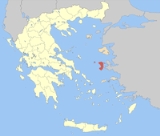
Chios

Encyclopedia
Chios is the fifth largest of the Greek
islands, situated in the Aegean Sea
, seven kilometres (five miles) off the Asia Minor
coast. The island is separated from Turkey
by the Chios Strait
. The island is noted for its strong merchant shipping
community, its unique mastic gum
and its medieval villages. The 11th century monastery of “Nea Moni
”, a UNESCO
World Heritage Site
, is located on the island.
Administratively the island forms a separate municipality within the Chios peripheral unit, which is part of the North Aegean Periphery
. The principal town of the island and seat of the municipality is Chios (town)
. Locals refer to Chios town as "Chora" ("Χώρα" literally means land or country, but usually refers to the capital or a settlement at the highest point of a Greek island).
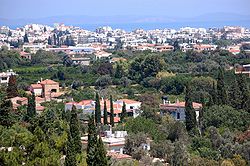
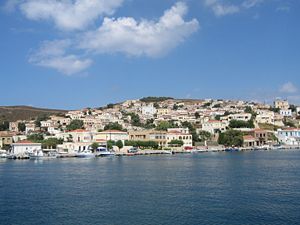 Midway up the east coast lies the main population centres, the main town of Chios and the regions of Vrontados and Kambos. Chios Town, with a population of 32,400, is built around the island's main harbour and medieval castle. The current castle, with a perimeter of 1400 m, was principally constructed during the time of Venetian and Ottoman rule; although remains have been found dating settlements there back to 2000 B.C. The town was substantially damaged by an earthquake in 1881 and only partially retains its original character.
North of Chios Town lies the large suburb of Vrontados
(population 4,500), which lays claim as the birthplace of Homer
. The suburb lies in the Omiroupoli
municipality, and its connection to the poet is supported by an archaeological site known traditionally as "Teacher's Rock" (Δασκαλóπετρα).
Directly south of Chios Town lies the island's airport and the region of Kambos (Κάμπος, "plain"), a large fertile plain noted for its stone mansions and walled orchards. At the southern edge of the Kambos plain lies the town of Thymiana (Θυμιανά). Thymiana is noted as the sole source of a beige-burgundy two-tone sandstone
used both in the local mansions and much of the town itself. Inland lie a number of villages rising up into the central mountains culminating with the village of Ayios Georgios Sykoussis perched at the peak dividing east from west. Along the coast lies Karfas (Καρφάς), a large sandy beach, which along with the nearby village of Ayia Ermioni (Άγια Ερμιόνη) is now the main tourist centre with a number of large and small hotels.
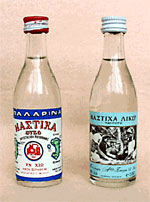
(Μαστιχοχώρια, literally: Mastic Villages), the seven villages of Mesta (Μεστά), Pyrgi (Πυργί), Olυmpi (Ολύμποι), Kalamoti (Καλαμωτń), Vessa (Βέσσα), Lithi (Λιθί) and Elata
(Ελάτα), which together have controlled the production of mastic gum
in the area since the Roman period. The villages, built between the 14th and 16th centuries, have a carefully designed layout with fortified gates and narrow streets to protect against the frequent raids by marauding pirates. Between Chios Town and the Mastichochoria lie a large number of historic villages including Armolia (Αρμόλια), Myrmighi (Μυρμήγκι), and Kalimassia (Καλλιμασιά). Along the east coast are the fishing villages of Kataraktis (Καταρράκτης) and to the south Nenita (Νένητα).
The south coast is sparsely populated with only two populated areas; the modern bay of Komi and the ancient village of "Emporio", inhabited since 1800 BC, and the site of the black volcanic beach of "Mavra Volia" believed to have been created by the explosion of Santorini island in 1600 BC.
on the west coast, and Kardamyla
on the east. Further to the north, are three villages where cherries are grown—Amades, Viki and Kambia. In June Kambia holds an annual Cherry Festival—"Yiortí ton Kerrasión". Kambia holds several festivals during the summer months. Also located in the northern region is the island's tallest mountain, Mount Pelineon, at 1297 metres (4,255 ft).
Spartounda and Fyta are a few miles before Kambia. In the village of Fyta stands a watchtower dating back to the late 16th century, the time of the Genoese occupation. Spartounda is the highest village of the island.
The village of Kourounia lies 20 kilometres (12 mi) north of Volissos in the northwestern part of the island. Next to Kourounia is the village of Egrigoros.
, a UNESCO
World Heritage Site
. The monastery was lavishly built with funds gifted by the Byzantine Emperor Constantine IX, after three monks, living in caves nearby, had petitioned him while he was in exile on the island of Mytilene. The monastery had substantial estates attached, with a thriving community until the massacre of 1822
. It was further damaged during the 1881 earthquake. In 1952, due to the shortage of monks, Nea Moni was converted to a convent.
Further south is the region of Kambochoria. This is a collection of medieval villages (Halkios, Vavili, Vassileoniko, Ververato, Dafnonas, and Zifias) with a combined population of about 3,000 and an agricultural economy. In this region grows four varieties of wild tulips.
West of the Kambochoria on the central ridge of the island lies the 16th century village of Agios Geórgios Sikousis. The village is situated 400 metres (1,312.3 ft) above sea level, strategically overlooks both sides of the island, and was previously fortified with both wall and tower.
, with modest variation due to the stabilising effect of the surrounding sea. Average temperatures normally range from a summer high of 27 °C (81 °F) to a winter low of 11 °C (52 °F) in January, although, temperatures of over 40 °C (104 °F) or below freezing can sometimes be encountered.
Rainfall while usually plentiful, varies greatly both throughout the year and between years. Rain is rare during the summer months, but the winters are changeable and wet. Sunshine is plentiful, as is typical of the Eastern Mediterranean, with almost no cloud cover in the summer months. Average humidity
varies from 75% in winter to 60% in summer.
The island normally experiences steady breezes (average 3–5 m/s) throughout the year, with winds direction predominantly northerly ("Etesian
" Wind—locally called the "Meltemi") or south westerly (Sirocco).
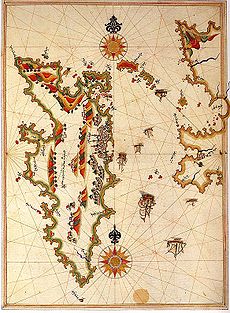
), Chio (Italian
) and Sakız (صاقيز —Ottoman Turkish
). The capital has also been called "Castro" or "Kastron"
(Καστρον; meaning castle).
era. The primary sites of research for this period, have been cave dwellings at Hagio(n) Galas, in the north, and a settlement and accompanying necropolis
in modern-day Emporeio at the far south of the island. The lack of information on this period however, cannot be overstated and theories on the size and duration of these settlements have not been well established.
The British School of Athens excavated the Emporeio site in 1952–1955, and most of our current information comes from these digs. The Greek Archaeological Service (G.A.S.) has been excavating periodically on Chios since 1970, though much of their work on the island remains unpublished.
The noticeable uniformity in the size of houses at Emporeio is what primarily drives scholar's theory that there may have been no serious social distinction
during the Neolithic on the island, the inhabitants instead all benefiting from agricultural and livestock farming.
It is also widely held by scholars that the island was not occupied by humans during the Middle Bronze Age (2300–1600), though researchers have suggested recently that the lack of evidence that exists during this period may only demonstrate the lack of excavations on Chios and the northern Aegean
.
By at least the 11th century BC the island was ruled by a kingdom/chiefdom, and the subsequent transition to aristocratic (or possibly tyrannic) rule occurred sometime over the next four centuries. Future excavations may reveal more information about this period. 9th-century Euboea
n and Cypriote
presence on the island is attested by ceramics, while a Phoenicia
n presence is noted at Erythrae
, the traditional competitor of Chios on the mainland.
, native to the Aegean, wrote that the island was occupied by the Leleges
, aboriginal Greeks themselves reported to be subject to the Minoans on Crete
. They were eventually driven out by invading Ionians
.
Chios was one of the original twelve member states of the Ionian League
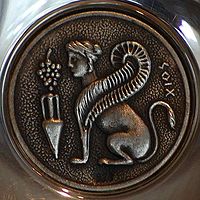
. As a result, Chios, at the end of the 7th century BC, was one of the first cities to strike or mint coins, establishing the sphinx as its specific symbol. A tradition it maintained for almost 900 years.
In the 6th century BC Chios’ government developed democratic elements with a voting assembly and people’s magistrates called damarchoi.
In 546 BC Chios became subject to the Persian Empire. Chios joined the Ionian Revolt
against the Persians in 499 BC. The naval power of Chios during this period is demonstrated by the fact that the Chians had the largest fleet of all the Ionians at the Battle of Lade
in 494 BC (100 ships). At Lade the Chian fleet continued doggedly fighting the Persian fleet even after the defection of the Samians
and others but ultimately the Chians were forced to retreat and were again subject to Persian domination.
The defeat of Persia at the Battle of Mycale
in 479 BC meant the liberation of Chios from Persian rule. When the Athenians formed the Delian League
Chios joined as one of the few members who did not have to pay tribute but instead supplied ships to the alliance.
By the fifth to 4th centuries BC, the island had grown to an estimated population of over 120,000 (two to three times the estimated population in 2005), and based on the huge necropoli at the main city of Chios, the asty, it is thought the majority lived in that area.
In 412 BC during the Peloponnesian War
Chios revolted against Athens and the Athenians besieged Chios. Relief only came the following year when the Spartans were able to raise the siege. In the 4th Century BC Chios was a member of the Second Athenian Empire
but revolted against Athens during the Social War (357–355 BC) and Chios became independent again until the rise of Macedonia.
 In the decades immediately preceding Macedon
's domination of the Greek city-states, Chios was home to a school of rhetoric which Isocrates
had opened, as well as a faction aligned with Sparta
. After the Battle of Leuctra
, supporters of the Lacedaemonia
ns were exiled. Among the exiled were Damasistratus and his son Theopompus
, who had received instruction from the school and went on to study with Isocrates in Athens before becoming a historian.
Theopompus moved back to Chios with the other exiles in 333 BC after Alexander had invaded Asia Minor
and decreed their return, as well as the exile or trial of Persian
supporters on the island. Theopompus was exiled again sometime after Alexander's death and took refuge in Egypt.
During this period, the island also had become the largest exporter of Greek wine, which was noted for being of relative high quality (see Chian wine
). Chian amphoras, with a characteristic sphinx emblem and bunches of grape have been found in nearly every country that the ancient Greeks traded with from as far away as Gaul
, Upper Egypt
and Eastern Russia
.
, thirty-five vessels allied to Rome, carrying about 1,000 Galatia
n troops, as well as a number of horses, were sent by Eumenes II
to his brother Attalus
.
Leaving from Elaea, they were headed to the harbour of Phanae, planning to disembark from there to Macedonia. However, Perseus
's naval commander Antenor intercepted the fleet between Erythrae
(on the Western coast of Turkey) and Chios.
According to Livy
, they were caught completely off-guard by Antenor. Eumenes' officers at first thought the intercepting fleet were friendly Romans, but scattered upon realizing they were facing an attack by their Macedonian enemy, some choosing to abandon ship and swim to Erythrae. Others, crashing their ships into land on Chios, fled toward the city.
The Chians however closed their gates, startled at the calamity. And the Macedonians, who had docked closer to the city anyway, cut the rest of the fleet off outside the city gates, and on the road leading to the city. Of the 1,000 men, 800 were killed, 200 taken prisoner.'
After the Roman conquest Chios became part of the province of Asia.
 After the permanent division of the Roman Empire
in 395 AD, Chios was for six centuries part of the Byzantine Empire
. This came to an end when the island was briefly held (1090–97) by Tzachas, a Turkish emir in the region of Smyrna during the first expansion of the Turks to the Aegean coast. However, the Turks were driven back from the Aegean coast by the First Crusade
, and the island reverted to Byzantine rule.
This relative stability was ended by the sacking of Constantinople during the Fourth Crusade
(1204) and during the turmoil of the 13th century the island ownership was constantly affected by the regional power struggles.
After the Fourth Crusade, the Byzantine empire was divided up by the Latin emperors of Constantinople
, with Chios nominally becoming a possession of the Republic of Venice
. However, defeats for the Latin empire resulted in the island reverting to Byzantine rule in 1225.
, authority was ceded to the Republic of Genoa
(1261). At this time the island was frequently attacked by pirates and by 1302–1303 was a target for the renewed Turkish fleets. To prevent Turkish expansion, the island was reconquered and kept as a renewable concession, at the behest of the Byzantine emperor Andronicus II, by the Genovese Benedetto I Zaccaria
(1304), then admiral to Philip of France. Zaccaria installed himself as ruler of the island, in the short-lived Lordship of Chios
. His rule was benign and effective rule remained in the hands of the local Greek landowners. Beneto Zacharia was followed by his nephew (Benedetto II
) and then son (Martino
). They attempted to turn the island towards the Latin and Papal powers, and away from the predominant Byzantine influence. The locals, still loyal to the Byzantine Empire, responded to a letter from the emperor and, despite a standing army of a thousand infantrymen, a hundred cavalrymen and two galleys, expelled the Zacharia family from the island (1329) and dissolved the fiefdom.
Local rule was brief. In 1346, a Chartered company or Maona
(the "Maona di Chio e di Focea
") was set up in Genoa
to reconquer and exploit Chios and the neighbouring town of Phocaea
in Asia Minor. Although the islanders firmly rejected an initial offer of protection, the island was invaded by a Genoese Fleet, led by Simone Vignoso, and the castle besieged. Again rule was transferred peacefully, as on 12 September the castle was surrendered and a treaty signed with no loss of privileges to the local landowners as long as the new authority was accepted.
The Genoese
, being interested in profit rather than conquest, controlled the trade-posts and warehouses, in particular the trade of mastic, alum, salt and pitch. Other trades such as grain, wine oil and cloth and most professions were run jointly with the locals. After a failed uprising in 1347, and being heavily outnumbered (less than 10% of the population in 1395), the Latins maintained light control over the local population, remaining largely in the town and allowing full religious freedom. In this way the island remained under Genoese control for two centuries. By 1566, when Genoa lost Chios to the Ottoman Empire
, there were 12.000 Greeks and 2.500 Genoese (or 20% of the total population) in the island.
By the early 15th century, Asia Minor and the surrounding islands had fallen under Ottoman rule, however the Genoese families managed to maintain control over the island through the payment of a tribute to the Sultan. By the 16th century, as Genoese power waned, trade with Genoa had decreased and the local rulers become assimilated into the local population.
This largely independent rule of Genoese families continued until 1566, when, with tensions rising, the Sultan decided that the island could potentially be used as a base for Western attacks on Constantinople. The island was invaded by Ottoman troops and absorbed into the Ottoman Empire
. Consequently, Greek Phanariotes
gradually replaced these Genoese families as a protectorate of Chios and maintained relative autonomy despite the Ottoman
occupation.
rule, the government and tax gathering again remained in the hands of Greeks and the Turkish garrison was small and inconspicuous.
As well as the Latin and Turkish influx, documents record a small Jewish population from at least 1049 AD. The original Greek (Romaniote
) Jews, thought to have been brought over by the Romans, were later joined by Sephardic Jews welcomed by the Ottomans during the Iberian expulsions of the 15th century.
The mainstay of the island's famous wealth was the mastic crop. Chios was able to make a substantial contribution to the imperial treasury while at the same time maintaining only a light level of taxation. The Ottoman government regarded it as one of the most valuable provinces of the Empire.
 When the Greek War of Independence
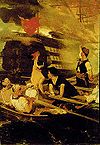
broke out, the island's leaders were reluctant to join the revolutionaries, fearing the loss of their security and prosperity. However, in March 1822, several hundred armed Greeks from the neighbouring island of Samos
landed in Chios. They proclaimed the Revolution and launched attacks against the Turks, at which point islanders decided to join the struggle.
Ottomans landed a large force on the island consequently and put down the rebellion. The Ottoman massacre of Chios
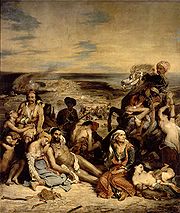
expelled, killed, or enslaved five sixths of the 120,000 Greek inhabitants of the island. It wiped out whole villages, and affected the valuable Mastichochoria
, the mastic growing villages in the south of the island. It triggered negative public reaction in Western Europe, as can be seen in the art of Delacroix, and in the writing of Lord Byron
and Victor Hugo
.
Further misfortune struck the island in 1881, when an earthquake
, estimated as 6.5 on the moment magnitude scale
, damaged a large portion of the island's buildings and resulted in great loss of life (reports of the time spoke of 5,500–10,000 fatalities).
Chios rejoined the rest of independent Greece after the First Balkan War
(1912). The Greek Navy liberated Chios in November 1912 in a hard fought but brief amphibious operation. Turkey recognized Greece's annexation of Chios and the other Aegean islands by the London Treaty of 1913.
It was affected by the population exchanges after the Greco–Turkish War of 1919–1922, the incoming Greek refugees settling in the, previously Turkish, Kastro and in new settlements hurriedly built south of Chios Town.
During World War II, the island was occupied by the Germans (1941–44), resulting in severe deprivation for the inhabitants. In 1943, the local government warned the dozen Jewish families residing in Chios that the Gestapo
had orders to arrest them all and take them to Germany. Some families heeded the warning and were smuggled off of the island. The remainder were taken by the Gestapo and nothing more is known of their fate. (Most of the Jews had fled the island during the Turkish attack of 1822, and subsequent earthquake 1881.)
Today, the island has perhaps the highest per capita income of any "nomos" (prefecturate) of Greece thanks to the fact the Chians own roughly fifty percent of the Greek merchant marine or about 12% of the world's merchant marine and to the presence of large Chian communities in New York and London which maintain strong ties with the island. Tourism, other than visiting diaspora Chians, is a negligible factor in the island's economy. Chios is home to a Greek ship-owning fraternity
, including the families of Livanos
and Chandris
, who were from the island.
celebrations and the summer season, a twofold increase is not unusual for the island's inhabitants. The Chora and Karfas attract the most tourists. The islands peak tourist season is in July-August.
community transports several locally grown products including mastic
, olive
s, fig
s, wine
, mandarins
and cherries
.
with the city of Genoa
, Italy
 since 1985.
Greece
Greece , officially the Hellenic Republic , and historically Hellas or the Republic of Greece in English, is a country in southeastern Europe....
islands, situated in the Aegean Sea
Aegean Sea
The Aegean Sea[p] is an elongated embayment of the Mediterranean Sea located between the southern Balkan and Anatolian peninsulas, i.e., between the mainlands of Greece and Turkey. In the north, it is connected to the Marmara Sea and Black Sea by the Dardanelles and Bosporus...
, seven kilometres (five miles) off the Asia Minor
Asia Minor
Asia Minor is a geographical location at the westernmost protrusion of Asia, also called Anatolia, and corresponds to the western two thirds of the Asian part of Turkey...
coast. The island is separated from Turkey
Turkey
Turkey , known officially as the Republic of Turkey , is a Eurasian country located in Western Asia and in East Thrace in Southeastern Europe...
by the Chios Strait
Chios Strait
The Chios Stait is a strait in the Aegean Sea that separates the Greek island of Chios from Turkey....
. The island is noted for its strong merchant shipping
Shipping
Shipping has multiple meanings. It can be a physical process of transporting commodities and merchandise goods and cargo, by land, air, and sea. It also can describe the movement of objects by ship.Land or "ground" shipping can be by train or by truck...
community, its unique mastic gum
Mastic (plant resin)
Mastic is a resin obtained from the mastic tree . In pharmacies and Nature shops it is called "arabic gum" and "Yemen gum". In Greece it is known as the "tears of Chios," being traditionally produced on that Greek island, and, like other natural resins is produced in "tears" or droplets...
and its medieval villages. The 11th century monastery of “Nea Moni
Nea Moni of Chios
Nea Moni is an 11th century monastery on the island of Chios that has been recognized as a UNESCO World Heritage Site. It is located on the Provateio Oros Mt. in the island's interior, about 15 km from Chios town...
”, a UNESCO
UNESCO
The United Nations Educational, Scientific and Cultural Organization is a specialized agency of the United Nations...
World Heritage Site
World Heritage Site
A UNESCO World Heritage Site is a place that is listed by the UNESCO as of special cultural or physical significance...
, is located on the island.
Administratively the island forms a separate municipality within the Chios peripheral unit, which is part of the North Aegean Periphery
Peripheries of Greece
The current official regional administrative divisions of Greece were instituted in 1987. Although best translated into English as "regions", the transcription peripheries is sometimes used, perhaps to distinguish them from the traditional regions which they replaced. The English word 'periphery'...
. The principal town of the island and seat of the municipality is Chios (town)
Chios (town)
Chios is the main town and a former municipality on the island of Chios, North Aegean, Greece. Since the 2011 local government reform it is part of the municipality Chios, of which it is a municipal unit. It is located on the eastern coast of the island facing the Turkish coastal town of Çeşme...
. Locals refer to Chios town as "Chora" ("Χώρα" literally means land or country, but usually refers to the capital or a settlement at the highest point of a Greek island).
Geography
Chios island is approximately crescent or kidney shaped, 50 kilometres (31.1 mi) long from north to south, 29 kilometres (18 mi) at its widest, and covers an area of 842 square kilometres (325.1 sq mi). The terrain is principally mountainous and arid, with a ridge of mountains running through the spine of the island. The largest of these, "Pelineon" (1297 metres (4,255.2 ft)) and "Epos" (1188 metres (3,897.6 ft)), are situated in the north of the island. The centre of the island is divided between east and west by a range of smaller peaks, known as "Provatas".East Coast
North of Chios Town lies the large suburb of Vrontados
Vrontados
Vrontados is a small coastal town located at the eastern part of the island of Chios in Greece. With a population of about 4,500 the town hosts the seat of the municipality of Omiroupolis.-Other:...
(population 4,500), which lays claim as the birthplace of Homer
Homer
In the Western classical tradition Homer , is the author of the Iliad and the Odyssey, and is revered as the greatest ancient Greek epic poet. These epics lie at the beginning of the Western canon of literature, and have had an enormous influence on the history of literature.When he lived is...
. The suburb lies in the Omiroupoli
Omiroupoli
Omiroupoli is a former municipality in the central part of on the island of Chios, North Aegean, Greece. Since the 2011 local government reform it is part of the municipality Chios, of which it is a municipal unit. Population 7,335 people . The seat of the municipality was Vrontados , the second...
municipality, and its connection to the poet is supported by an archaeological site known traditionally as "Teacher's Rock" (Δασκαλóπετρα).
Directly south of Chios Town lies the island's airport and the region of Kambos (Κάμπος, "plain"), a large fertile plain noted for its stone mansions and walled orchards. At the southern edge of the Kambos plain lies the town of Thymiana (Θυμιανά). Thymiana is noted as the sole source of a beige-burgundy two-tone sandstone
Sandstone
Sandstone is a sedimentary rock composed mainly of sand-sized minerals or rock grains.Most sandstone is composed of quartz and/or feldspar because these are the most common minerals in the Earth's crust. Like sand, sandstone may be any colour, but the most common colours are tan, brown, yellow,...
used both in the local mansions and much of the town itself. Inland lie a number of villages rising up into the central mountains culminating with the village of Ayios Georgios Sykoussis perched at the peak dividing east from west. Along the coast lies Karfas (Καρφάς), a large sandy beach, which along with the nearby village of Ayia Ermioni (Άγια Ερμιόνη) is now the main tourist centre with a number of large and small hotels.
Southern Region
The south of the island is noted for the MastichochoriaMastichochoria
Mastichochoria is a former municipality on the island of Chios, North Aegean, Greece. Since the 2011 local government reform it is part of the municipality Chios, of which it is a municipal unit. It is located in the southwestern and extreme southern part of the island...
(Μαστιχοχώρια, literally: Mastic Villages), the seven villages of Mesta (Μεστά), Pyrgi (Πυργί), Olυmpi (Ολύμποι), Kalamoti (Καλαμωτń), Vessa (Βέσσα), Lithi (Λιθί) and Elata
Elata
Elata is a Greek village on the island of Chios. The village is situated on hilly terrain and has a population of several hundred.- Elata :Elata became a village hundreds of years ago when seven tribes came together to protect themselves from Turkish pirates...
(Ελάτα), which together have controlled the production of mastic gum
Mastic (plant resin)
Mastic is a resin obtained from the mastic tree . In pharmacies and Nature shops it is called "arabic gum" and "Yemen gum". In Greece it is known as the "tears of Chios," being traditionally produced on that Greek island, and, like other natural resins is produced in "tears" or droplets...
in the area since the Roman period. The villages, built between the 14th and 16th centuries, have a carefully designed layout with fortified gates and narrow streets to protect against the frequent raids by marauding pirates. Between Chios Town and the Mastichochoria lie a large number of historic villages including Armolia (Αρμόλια), Myrmighi (Μυρμήγκι), and Kalimassia (Καλλιμασιά). Along the east coast are the fishing villages of Kataraktis (Καταρράκτης) and to the south Nenita (Νένητα).
The south coast is sparsely populated with only two populated areas; the modern bay of Komi and the ancient village of "Emporio", inhabited since 1800 BC, and the site of the black volcanic beach of "Mavra Volia" believed to have been created by the explosion of Santorini island in 1600 BC.
West Coast
The west coast, between the deep natural harbour of Limenas at the south and the town of Vrontados at the north, forms a crescent shaped series of almost uninhabited rocky bays. The nearest population centres being the two hillside villages of Lithi and Sidirounta, while further inland lie the villages of Elata, Vessa, Agio Giorgi, Avgonyma and the deserted village of Anavatos. On the west coast there still stands a system of stone beacons that were built at regular intervals to signal the approach of ships and warning the islanders against invasions by pirates.Northern Region
The north of the island contains two major villages: VolissosVolissos
Volissos is the largest village in the northwest part of Chios, Aegean Islands, Greece. The village is situated 40km away from the main town of Chios. Volissos has a port called "Limia" that connects the island with the island of Psara. Saint Markella of Chios lived in the village. Volissos is...
on the west coast, and Kardamyla
Kardamyla
Kardamyla is a village and a former municipality on the island of Chios, North Aegean, Greece. Since the 2011 local government reform it is part of the municipality Chios, of which it is a municipal unit. It is located in the northeastern corner of the island, opposite the island of Oinousses to...
on the east. Further to the north, are three villages where cherries are grown—Amades, Viki and Kambia. In June Kambia holds an annual Cherry Festival—"Yiortí ton Kerrasión". Kambia holds several festivals during the summer months. Also located in the northern region is the island's tallest mountain, Mount Pelineon, at 1297 metres (4,255 ft).
Spartounda and Fyta are a few miles before Kambia. In the village of Fyta stands a watchtower dating back to the late 16th century, the time of the Genoese occupation. Spartounda is the highest village of the island.
The village of Kourounia lies 20 kilometres (12 mi) north of Volissos in the northwestern part of the island. Next to Kourounia is the village of Egrigoros.
Interior
Directly in the centre of the island, between the villages of Avgonyma to the west and Karyes to the east, lies the 11th century monastery of Nea MoniNea Moni of Chios
Nea Moni is an 11th century monastery on the island of Chios that has been recognized as a UNESCO World Heritage Site. It is located on the Provateio Oros Mt. in the island's interior, about 15 km from Chios town...
, a UNESCO
UNESCO
The United Nations Educational, Scientific and Cultural Organization is a specialized agency of the United Nations...
World Heritage Site
World Heritage Site
A UNESCO World Heritage Site is a place that is listed by the UNESCO as of special cultural or physical significance...
. The monastery was lavishly built with funds gifted by the Byzantine Emperor Constantine IX, after three monks, living in caves nearby, had petitioned him while he was in exile on the island of Mytilene. The monastery had substantial estates attached, with a thriving community until the massacre of 1822
Chios Massacre
The Chios Massacre refers to the slaughter of tens of thousands of Greeks on the island of Chios by Ottoman troops during the Greek War of Independence in 1822. Greeks from neighbouring islands arrived on Chios and encouraged the Chians to join the struggle for independence. In response, Ottoman...
. It was further damaged during the 1881 earthquake. In 1952, due to the shortage of monks, Nea Moni was converted to a convent.
Further south is the region of Kambochoria. This is a collection of medieval villages (Halkios, Vavili, Vassileoniko, Ververato, Dafnonas, and Zifias) with a combined population of about 3,000 and an agricultural economy. In this region grows four varieties of wild tulips.
West of the Kambochoria on the central ridge of the island lies the 16th century village of Agios Geórgios Sikousis. The village is situated 400 metres (1,312.3 ft) above sea level, strategically overlooks both sides of the island, and was previously fortified with both wall and tower.
Geology
The Chios Basin is a hydrographic sub-unit of the Aegean Sea adjacent to the island of Chios.Climate
The island's climate is warm and moderate, categorised as Temperate, Mediterranean(Csa)Mediterranean climate
A Mediterranean climate is the climate typical of most of the lands in the Mediterranean Basin, and is a particular variety of subtropical climate...
, with modest variation due to the stabilising effect of the surrounding sea. Average temperatures normally range from a summer high of 27 °C (81 °F) to a winter low of 11 °C (52 °F) in January, although, temperatures of over 40 °C (104 °F) or below freezing can sometimes be encountered.
Rainfall while usually plentiful, varies greatly both throughout the year and between years. Rain is rare during the summer months, but the winters are changeable and wet. Sunshine is plentiful, as is typical of the Eastern Mediterranean, with almost no cloud cover in the summer months. Average humidity
Humidity
Humidity is a term for the amount of water vapor in the air, and can refer to any one of several measurements of humidity. Formally, humid air is not "moist air" but a mixture of water vapor and other constituents of air, and humidity is defined in terms of the water content of this mixture,...
varies from 75% in winter to 60% in summer.
The island normally experiences steady breezes (average 3–5 m/s) throughout the year, with winds direction predominantly northerly ("Etesian
Etesian
The etesians ', sometimes found in the Latin form etesiae), meltemi μελτέμι , or meltem are the strong, dry north windsof the Aegean Sea, which blow from about mid-May to mid-September...
" Wind—locally called the "Meltemi") or south westerly (Sirocco).
History
Etymology
Known as "Ofioussa" (having snakes) and "Pityoussa" (having pine trees) in antiquity, during the medieval age the island was ruled by a number of external powers and has been also known as Scio (GenoeseGenoese dialect
Genoese is a dialect of the Ligurian language, the one spoken in Genoa .Ligurian is listed by Ethnologue as a language in its own right, of the Romance branch, and not to be confused with the ancient Ligurian language...
), Chio (Italian
Italian language
Italian is a Romance language spoken mainly in Europe: Italy, Switzerland, San Marino, Vatican City, by minorities in Malta, Monaco, Croatia, Slovenia, France, Libya, Eritrea, and Somalia, and by immigrant communities in the Americas and Australia...
) and Sakız (صاقيز —Ottoman Turkish
Ottoman Turkish language
The Ottoman Turkish language or Ottoman language is the variety of the Turkish language that was used for administrative and literary purposes in the Ottoman Empire. It borrows extensively from Arabic and Persian, and was written in a variant of the Perso-Arabic script...
). The capital has also been called "Castro" or "Kastron"
Castle of Chios
The castle of Chios consists of an inhabited area surrounded by a large stonewall structure with various fortifications purposed to defend the enclosed population and properties against naval attack and siege....
(Καστρον; meaning castle).
Pre-historic Period
Archaeological research on Chios has found evidence that the island has been inhabited since at least the NeolithicNeolithic
The Neolithic Age, Era, or Period, or New Stone Age, was a period in the development of human technology, beginning about 9500 BC in some parts of the Middle East, and later in other parts of the world. It is traditionally considered as the last part of the Stone Age...
era. The primary sites of research for this period, have been cave dwellings at Hagio(n) Galas, in the north, and a settlement and accompanying necropolis
Necropolis
A necropolis is a large cemetery or burial ground, usually including structural tombs. The word comes from the Greek νεκρόπολις - nekropolis, literally meaning "city of the dead"...
in modern-day Emporeio at the far south of the island. The lack of information on this period however, cannot be overstated and theories on the size and duration of these settlements have not been well established.
The British School of Athens excavated the Emporeio site in 1952–1955, and most of our current information comes from these digs. The Greek Archaeological Service (G.A.S.) has been excavating periodically on Chios since 1970, though much of their work on the island remains unpublished.
The noticeable uniformity in the size of houses at Emporeio is what primarily drives scholar's theory that there may have been no serious social distinction
Acephalous Society
In anthropology, an acephalous society is a society which lacks political leaders or hierarchies. Such groups are also known as egalitarian or non-stratified societies. Typically these societies are small-scale, organized into bands or tribes that make decisions through consensus decision making...
during the Neolithic on the island, the inhabitants instead all benefiting from agricultural and livestock farming.
It is also widely held by scholars that the island was not occupied by humans during the Middle Bronze Age (2300–1600), though researchers have suggested recently that the lack of evidence that exists during this period may only demonstrate the lack of excavations on Chios and the northern Aegean
Aegean Sea
The Aegean Sea[p] is an elongated embayment of the Mediterranean Sea located between the southern Balkan and Anatolian peninsulas, i.e., between the mainlands of Greece and Turkey. In the north, it is connected to the Marmara Sea and Black Sea by the Dardanelles and Bosporus...
.
By at least the 11th century BC the island was ruled by a kingdom/chiefdom, and the subsequent transition to aristocratic (or possibly tyrannic) rule occurred sometime over the next four centuries. Future excavations may reveal more information about this period. 9th-century Euboea
Euboea
Euboea is the second largest Greek island in area and population, after Crete. The narrow Euripus Strait separates it from Boeotia in mainland Greece. In general outline it is a long and narrow, seahorse-shaped island; it is about long, and varies in breadth from to...
n and Cypriote
Cyprus
Cyprus , officially the Republic of Cyprus , is a Eurasian island country, member of the European Union, in the Eastern Mediterranean, east of Greece, south of Turkey, west of Syria and north of Egypt. It is the third largest island in the Mediterranean Sea.The earliest known human activity on the...
presence on the island is attested by ceramics, while a Phoenicia
Phoenicia
Phoenicia , was an ancient civilization in Canaan which covered most of the western, coastal part of the Fertile Crescent. Several major Phoenician cities were built on the coastline of the Mediterranean. It was an enterprising maritime trading culture that spread across the Mediterranean from 1550...
n presence is noted at Erythrae
Erythrae
Erythrae or Erythrai later Litri, was one of the twelve Ionian cities of Asia Minor, situated 22 km north-east of the port of Cyssus , on a small peninsula stretching into the Bay of Erythrae, at an equal distance from the mountains Mimas and Corycus, and directly opposite the island of Chios...
, the traditional competitor of Chios on the mainland.
Archaic & Classical Periods
PherecydesPherecydes of Leros
Pherecydes of Leros was a Greek mythographer and logographer. He came from the island of Leros. Pherecydes spent the greater part of his working life in Athens, and so he was also called Pherecydes of Athens: the encyclopedic Byzantine Suda consider Pherecydes of Athens and of Leros...
, native to the Aegean, wrote that the island was occupied by the Leleges
Leleges
The Leleges were one of the aboriginal peoples of southwest Anatolia , who were already there when the Indo-European Hellenes emerged. The distinction between the Leleges and the Carians is unclear. According to Homer the Leleges were a distinct Anatolian tribe Homer...
, aboriginal Greeks themselves reported to be subject to the Minoans on Crete
Crete
Crete is the largest and most populous of the Greek islands, the fifth largest island in the Mediterranean Sea, and one of the thirteen administrative regions of Greece. It forms a significant part of the economy and cultural heritage of Greece while retaining its own local cultural traits...
. They were eventually driven out by invading Ionians
Ionians
The Ionians were one of the four major tribes into which the Classical Greeks considered the population of Hellenes to have been divided...
.
Chios was one of the original twelve member states of the Ionian League
Ionian League
The Ionian League , also called the Panionic League, was a confederation formed at the end of the Meliac War in the mid-7th century BC comprising twelve Ionian cities .These were listed by Herodotus as*Miletus, Myus, and...
. As a result, Chios, at the end of the 7th century BC, was one of the first cities to strike or mint coins, establishing the sphinx as its specific symbol. A tradition it maintained for almost 900 years.
In the 6th century BC Chios’ government developed democratic elements with a voting assembly and people’s magistrates called damarchoi.
In 546 BC Chios became subject to the Persian Empire. Chios joined the Ionian Revolt
Ionian Revolt
The Ionian Revolt, and associated revolts in Aeolis, Doris, Cyprus and Caria, were military rebellions by several regions of Asia Minor against Persian rule, lasting from 499 BC to 493 BC...
against the Persians in 499 BC. The naval power of Chios during this period is demonstrated by the fact that the Chians had the largest fleet of all the Ionians at the Battle of Lade
Battle of Lade
The Battle of Lade was a naval battle which occurred during the Ionian Revolt, in 494 BC. It was fought between an alliance of the Ionian cities and the Persian Empire of Darius the Great, and resulted in a decisive victory for the Persians which all but ended the revolt.The Ionian Revolt was...
in 494 BC (100 ships). At Lade the Chian fleet continued doggedly fighting the Persian fleet even after the defection of the Samians
Samoš
Samoš is a village in Serbia. It is situated in the Kovačica municipality, in the South Banat District, Vojvodina province. The village has a Serb ethnic majority and its population numbering 1,247 people .-See also:...
and others but ultimately the Chians were forced to retreat and were again subject to Persian domination.
The defeat of Persia at the Battle of Mycale
Battle of Mycale
The Battle of Mycale was one of the two major battles that ended the second Persian invasion of Greece during the Greco-Persian Wars. It took place on or about August 27, 479 BC on the slopes of Mount Mycale, on the coast of Ionia, opposite the island of Samos...
in 479 BC meant the liberation of Chios from Persian rule. When the Athenians formed the Delian League
Delian League
The Delian League, founded in circa 477 BC, was an association of Greek city-states, members numbering between 150 to 173, under the leadership of Athens, whose purpose was to continue fighting the Persian Empire after the Greek victory in the Battle of Plataea at the end of the Greco–Persian Wars...
Chios joined as one of the few members who did not have to pay tribute but instead supplied ships to the alliance.
By the fifth to 4th centuries BC, the island had grown to an estimated population of over 120,000 (two to three times the estimated population in 2005), and based on the huge necropoli at the main city of Chios, the asty, it is thought the majority lived in that area.
In 412 BC during the Peloponnesian War
Peloponnesian War
The Peloponnesian War, 431 to 404 BC, was an ancient Greek war fought by Athens and its empire against the Peloponnesian League led by Sparta. Historians have traditionally divided the war into three phases...
Chios revolted against Athens and the Athenians besieged Chios. Relief only came the following year when the Spartans were able to raise the siege. In the 4th Century BC Chios was a member of the Second Athenian Empire
Second Athenian Empire
The Second Athenian Empire or Confederacy was a maritime confederation of Aegean city-states from 378 BC-355 BC and headed by Athens primarily for self-defense against the growth of Sparta and secondly, the Persian Empire.-Origins:...
but revolted against Athens during the Social War (357–355 BC) and Chios became independent again until the rise of Macedonia.
Hellenistic Period
Macedon
Macedonia or Macedon was an ancient kingdom, centered in the northeastern part of the Greek peninsula, bordered by Epirus to the west, Paeonia to the north, the region of Thrace to the east and Thessaly to the south....
's domination of the Greek city-states, Chios was home to a school of rhetoric which Isocrates
Isocrates
Isocrates , an ancient Greek rhetorician, was one of the ten Attic orators. In his time, he was probably the most influential rhetorician in Greece and made many contributions to rhetoric and education through his teaching and written works....
had opened, as well as a faction aligned with Sparta
Sparta
Sparta or Lacedaemon, was a prominent city-state in ancient Greece, situated on the banks of the River Eurotas in Laconia, in south-eastern Peloponnese. It emerged as a political entity around the 10th century BC, when the invading Dorians subjugated the local, non-Dorian population. From c...
. After the Battle of Leuctra
Battle of Leuctra
The Battle of Leuctra was a battle fought on July 6, 371 BC, between the Boeotians led by Thebans and the Spartans along with their allies amidst the post-Corinthian War conflict. The battle took place in the neighbourhood of Leuctra, a village in Boeotia in the territory of Thespiae...
, supporters of the Lacedaemonia
Lacedaemonia
Lacedaemonia may mean:*Laconia, a modern prefecture of Greece*The ancient region of Greece of the same name; see Laconia *Lacedaemonia, the name borne by the city of Sparta from Late Antiquity to the 19th century....
ns were exiled. Among the exiled were Damasistratus and his son Theopompus
Theopompus
Theopompus was a Greek historian and rhetorician- Biography :Theopompus was born on Chios. In early youth he seems to have spent some time at Athens, along with his father, who had been exiled on account of his Laconian sympathies...
, who had received instruction from the school and went on to study with Isocrates in Athens before becoming a historian.
Theopompus moved back to Chios with the other exiles in 333 BC after Alexander had invaded Asia Minor
Asia Minor
Asia Minor is a geographical location at the westernmost protrusion of Asia, also called Anatolia, and corresponds to the western two thirds of the Asian part of Turkey...
and decreed their return, as well as the exile or trial of Persian
Achaemenid Empire
The Achaemenid Empire , sometimes known as First Persian Empire and/or Persian Empire, was founded in the 6th century BCE by Cyrus the Great who overthrew the Median confederation...
supporters on the island. Theopompus was exiled again sometime after Alexander's death and took refuge in Egypt.
During this period, the island also had become the largest exporter of Greek wine, which was noted for being of relative high quality (see Chian wine
Chian wine
Chian wine is wine from the Greek island of Chios. It was among the most prized wines of classical antiquity, and, according to Theopompus and Greek mythology, was the first red wine, then called "black wine".-Greece:...
). Chian amphoras, with a characteristic sphinx emblem and bunches of grape have been found in nearly every country that the ancient Greeks traded with from as far away as Gaul
Gaul
Gaul was a region of Western Europe during the Iron Age and Roman era, encompassing present day France, Luxembourg and Belgium, most of Switzerland, the western part of Northern Italy, as well as the parts of the Netherlands and Germany on the left bank of the Rhine. The Gauls were the speakers of...
, Upper Egypt
Upper Egypt
Upper Egypt is the strip of land, on both sides of the Nile valley, that extends from the cataract boundaries of modern-day Aswan north to the area between El-Ayait and Zawyet Dahshur . The northern section of Upper Egypt, between El-Ayait and Sohag is sometimes known as Middle Egypt...
and Eastern Russia
Russia
Russia or , officially known as both Russia and the Russian Federation , is a country in northern Eurasia. It is a federal semi-presidential republic, comprising 83 federal subjects...
.
Roman Period
During the Third Macedonian WarThird Macedonian War
The Third Macedonian War was a war fought between Rome and King Perseus of Macedon. In 179 BC King Philip V of Macedon died and his talented and ambitious son, Perseus, took his throne. Perseus married Laodike, daughter of King Seleucus IV Keraunos of Asia, and increased the size of his army...
, thirty-five vessels allied to Rome, carrying about 1,000 Galatia
Galatia
Ancient Galatia was an area in the highlands of central Anatolia in modern Turkey. Galatia was named for the immigrant Gauls from Thrace , who settled here and became its ruling caste in the 3rd century BC, following the Gallic invasion of the Balkans in 279 BC. It has been called the "Gallia" of...
n troops, as well as a number of horses, were sent by Eumenes II
Eumenes II
Eumenes II of Pergamon was king of Pergamon and a member of the Attalid dynasty. The son of king Attalus I and queen Apollonis, he followed in his father's footsteps and collaborated with the Romans to oppose first Macedonian, then Seleucid expansion towards the Aegean, leading to the defeat of...
to his brother Attalus
Attalus II Philadelphus
Attalus II Philadelphus was a King of Pergamon and the founder of modern-day Turkish city Antalya...
.
Leaving from Elaea, they were headed to the harbour of Phanae, planning to disembark from there to Macedonia. However, Perseus
Perseus of Macedon
Perseus was the last king of the Antigonid dynasty, who ruled the successor state in Macedon created upon the death of Alexander the Great...
's naval commander Antenor intercepted the fleet between Erythrae
Erythrae
Erythrae or Erythrai later Litri, was one of the twelve Ionian cities of Asia Minor, situated 22 km north-east of the port of Cyssus , on a small peninsula stretching into the Bay of Erythrae, at an equal distance from the mountains Mimas and Corycus, and directly opposite the island of Chios...
(on the Western coast of Turkey) and Chios.
According to Livy
Livy
Titus Livius — known as Livy in English — was a Roman historian who wrote a monumental history of Rome and the Roman people. Ab Urbe Condita Libri, "Chapters from the Foundation of the City," covering the period from the earliest legends of Rome well before the traditional foundation in 753 BC...
, they were caught completely off-guard by Antenor. Eumenes' officers at first thought the intercepting fleet were friendly Romans, but scattered upon realizing they were facing an attack by their Macedonian enemy, some choosing to abandon ship and swim to Erythrae. Others, crashing their ships into land on Chios, fled toward the city.
The Chians however closed their gates, startled at the calamity. And the Macedonians, who had docked closer to the city anyway, cut the rest of the fleet off outside the city gates, and on the road leading to the city. Of the 1,000 men, 800 were killed, 200 taken prisoner.'
After the Roman conquest Chios became part of the province of Asia.
Middle Ages
Roman Empire
The Roman Empire was the post-Republican period of the ancient Roman civilization, characterised by an autocratic form of government and large territorial holdings in Europe and around the Mediterranean....
in 395 AD, Chios was for six centuries part of the Byzantine Empire
Byzantine Empire
The Byzantine Empire was the Eastern Roman Empire during the periods of Late Antiquity and the Middle Ages, centred on the capital of Constantinople. Known simply as the Roman Empire or Romania to its inhabitants and neighbours, the Empire was the direct continuation of the Ancient Roman State...
. This came to an end when the island was briefly held (1090–97) by Tzachas, a Turkish emir in the region of Smyrna during the first expansion of the Turks to the Aegean coast. However, the Turks were driven back from the Aegean coast by the First Crusade
First Crusade
The First Crusade was a military expedition by Western Christianity to regain the Holy Lands taken in the Muslim conquest of the Levant, ultimately resulting in the recapture of Jerusalem...
, and the island reverted to Byzantine rule.
This relative stability was ended by the sacking of Constantinople during the Fourth Crusade
Fourth Crusade
The Fourth Crusade was originally intended to conquer Muslim-controlled Jerusalem by means of an invasion through Egypt. Instead, in April 1204, the Crusaders of Western Europe invaded and conquered the Christian city of Constantinople, capital of the Eastern Roman Empire...
(1204) and during the turmoil of the 13th century the island ownership was constantly affected by the regional power struggles.
After the Fourth Crusade, the Byzantine empire was divided up by the Latin emperors of Constantinople
Latin Empire
The Latin Empire or Latin Empire of Constantinople is the name given by historians to the feudal Crusader state founded by the leaders of the Fourth Crusade on lands captured from the Byzantine Empire. It was established after the capture of Constantinople in 1204 and lasted until 1261...
, with Chios nominally becoming a possession of the Republic of Venice
Republic of Venice
The Republic of Venice or Venetian Republic was a state originating from the city of Venice in Northeastern Italy. It existed for over a millennium, from the late 7th century until 1797. It was formally known as the Most Serene Republic of Venice and is often referred to as La Serenissima, in...
. However, defeats for the Latin empire resulted in the island reverting to Byzantine rule in 1225.
Genoese period (1261–1566)
The Byzantine rulers had little influence and through the Treaty of NymphaeumTreaty of Nymphaeum (1261)
The Treaty of Nymphaeum was a trade and defense pact signed between the Empire of Nicaea and the Republic of Genoa in Nymphaion in March of 1261...
, authority was ceded to the Republic of Genoa
Republic of Genoa
The Most Serene Republic of Genoa |Ligurian]]: Repúbrica de Zêna) was an independent state from 1005 to 1797 in Liguria on the northwestern Italian coast, as well as Corsica from 1347 to 1768, and numerous other territories throughout the Mediterranean....
(1261). At this time the island was frequently attacked by pirates and by 1302–1303 was a target for the renewed Turkish fleets. To prevent Turkish expansion, the island was reconquered and kept as a renewable concession, at the behest of the Byzantine emperor Andronicus II, by the Genovese Benedetto I Zaccaria
Benedetto I Zaccaria
Benedetto I Zaccaria was an Italian admiral of the Republic of Genoa. He was the Lord of Phocaea and first Lord of Chios , and the founder of Zaccaria fortunes in Byzantine and Latin Greece...
(1304), then admiral to Philip of France. Zaccaria installed himself as ruler of the island, in the short-lived Lordship of Chios
Lordship of Chios
The Lordship of Chios was founded in 1304, when Benedetto I Zaccaria conquered the Greek island of Chios and received it as a fief from the Byzantine emperor Andronicus II Palaeologus. Chios remained well outside any practical Byzantine authority, however....
. His rule was benign and effective rule remained in the hands of the local Greek landowners. Beneto Zacharia was followed by his nephew (Benedetto II
Benedetto II Zaccaria
Benedetto II Paleologo Zaccaria was the Lord of Chios and Phocaea, as well as other Aegean islands from 1307 until his death.Benedetto II was the son of Benedetto I Zaccaria. On the death of his father, he was appointed governor of Chios....
) and then son (Martino
Martino Zaccaria
Martino Zaccaria was the lord of Phocea and Chios from 1314 to 1330. He co-reigned with his brother Benedetto III after the death of their father Paleologo....
). They attempted to turn the island towards the Latin and Papal powers, and away from the predominant Byzantine influence. The locals, still loyal to the Byzantine Empire, responded to a letter from the emperor and, despite a standing army of a thousand infantrymen, a hundred cavalrymen and two galleys, expelled the Zacharia family from the island (1329) and dissolved the fiefdom.
Local rule was brief. In 1346, a Chartered company or Maona
Maona
thumb|upright|Vincenzo Giustiniani was the last owner of the genoese "Maona of Chios"A maona or Societas comperarum was a medieval Italian association of investors formed to manage the purchased shares of the revenue due to the relevant city-state through tax farming; the shares were individually...
(the "Maona di Chio e di Focea
Maona di Chio e di Focea
The Maona di Chio e di Focea was a maona formed to exact taxes for Genoa upon the then-unconquered island of Chios and port of Phocaea; Genoa sold the rights to their taxes to the maona, which raised funds from its investors to buy galleys and conquer those places.-External links:**...
") was set up in Genoa
Genoa
Genoa |Ligurian]] Zena ; Latin and, archaically, English Genua) is a city and an important seaport in northern Italy, the capital of the Province of Genoa and of the region of Liguria....
to reconquer and exploit Chios and the neighbouring town of Phocaea
Phocaea
Phocaea, or Phokaia, was an ancient Ionian Greek city on the western coast of Anatolia. Greek colonists from Phocaea founded the colony of Massalia in 600 BC, Emporion in 575 BC and Elea in 540 BC.-Geography:Phocaea was the northernmost...
in Asia Minor. Although the islanders firmly rejected an initial offer of protection, the island was invaded by a Genoese Fleet, led by Simone Vignoso, and the castle besieged. Again rule was transferred peacefully, as on 12 September the castle was surrendered and a treaty signed with no loss of privileges to the local landowners as long as the new authority was accepted.
The Genoese
Genoa
Genoa |Ligurian]] Zena ; Latin and, archaically, English Genua) is a city and an important seaport in northern Italy, the capital of the Province of Genoa and of the region of Liguria....
, being interested in profit rather than conquest, controlled the trade-posts and warehouses, in particular the trade of mastic, alum, salt and pitch. Other trades such as grain, wine oil and cloth and most professions were run jointly with the locals. After a failed uprising in 1347, and being heavily outnumbered (less than 10% of the population in 1395), the Latins maintained light control over the local population, remaining largely in the town and allowing full religious freedom. In this way the island remained under Genoese control for two centuries. By 1566, when Genoa lost Chios to the Ottoman Empire
Ottoman Empire
The Ottoman EmpireIt was usually referred to as the "Ottoman Empire", the "Turkish Empire", the "Ottoman Caliphate" or more commonly "Turkey" by its contemporaries...
, there were 12.000 Greeks and 2.500 Genoese (or 20% of the total population) in the island.
By the early 15th century, Asia Minor and the surrounding islands had fallen under Ottoman rule, however the Genoese families managed to maintain control over the island through the payment of a tribute to the Sultan. By the 16th century, as Genoese power waned, trade with Genoa had decreased and the local rulers become assimilated into the local population.
This largely independent rule of Genoese families continued until 1566, when, with tensions rising, the Sultan decided that the island could potentially be used as a base for Western attacks on Constantinople. The island was invaded by Ottoman troops and absorbed into the Ottoman Empire
Ottoman Empire
The Ottoman EmpireIt was usually referred to as the "Ottoman Empire", the "Turkish Empire", the "Ottoman Caliphate" or more commonly "Turkey" by its contemporaries...
. Consequently, Greek Phanariotes
Phanariotes
Phanariots, Phanariotes, or Phanariote Greeks were members of those prominent Greek families residing in Phanar , the chief Greek quarter of Constantinople, where the Ecumenical Patriarchate is situated.For all their cosmopolitanism and often Western education, the Phanariots were...
gradually replaced these Genoese families as a protectorate of Chios and maintained relative autonomy despite the Ottoman
Ottoman Empire
The Ottoman EmpireIt was usually referred to as the "Ottoman Empire", the "Turkish Empire", the "Ottoman Caliphate" or more commonly "Turkey" by its contemporaries...
occupation.
Ottoman period
During the OttomanOttoman Empire
The Ottoman EmpireIt was usually referred to as the "Ottoman Empire", the "Turkish Empire", the "Ottoman Caliphate" or more commonly "Turkey" by its contemporaries...
rule, the government and tax gathering again remained in the hands of Greeks and the Turkish garrison was small and inconspicuous.
As well as the Latin and Turkish influx, documents record a small Jewish population from at least 1049 AD. The original Greek (Romaniote
Romaniotes
The Romaniotes or Romaniots are a Jewish population who have lived in the territory of today's Greece and neighboring areas with large Greek populations for more than 2,000 years. Their languages were Yevanic, a Greek dialect, and Greek. They derived their name from the old name for the people...
) Jews, thought to have been brought over by the Romans, were later joined by Sephardic Jews welcomed by the Ottomans during the Iberian expulsions of the 15th century.
The mainstay of the island's famous wealth was the mastic crop. Chios was able to make a substantial contribution to the imperial treasury while at the same time maintaining only a light level of taxation. The Ottoman government regarded it as one of the most valuable provinces of the Empire.
Modern Period
Greek War of Independence
The Greek War of Independence, also known as the Greek Revolution was a successful war of independence waged by the Greek revolutionaries between...
broke out, the island's leaders were reluctant to join the revolutionaries, fearing the loss of their security and prosperity. However, in March 1822, several hundred armed Greeks from the neighbouring island of Samos
Samos Island
Samos is a Greek island in the eastern Aegean Sea, south of Chios, north of Patmos and the Dodecanese, and off the coast of Asia Minor, from which it is separated by the -wide Mycale Strait. It is also a separate regional unit of the North Aegean region, and the only municipality of the regional...
landed in Chios. They proclaimed the Revolution and launched attacks against the Turks, at which point islanders decided to join the struggle.
Ottomans landed a large force on the island consequently and put down the rebellion. The Ottoman massacre of Chios
Chios Massacre
The Chios Massacre refers to the slaughter of tens of thousands of Greeks on the island of Chios by Ottoman troops during the Greek War of Independence in 1822. Greeks from neighbouring islands arrived on Chios and encouraged the Chians to join the struggle for independence. In response, Ottoman...
expelled, killed, or enslaved five sixths of the 120,000 Greek inhabitants of the island. It wiped out whole villages, and affected the valuable Mastichochoria
Mastichochoria
Mastichochoria is a former municipality on the island of Chios, North Aegean, Greece. Since the 2011 local government reform it is part of the municipality Chios, of which it is a municipal unit. It is located in the southwestern and extreme southern part of the island...
, the mastic growing villages in the south of the island. It triggered negative public reaction in Western Europe, as can be seen in the art of Delacroix, and in the writing of Lord Byron
George Gordon Byron, 6th Baron Byron
George Gordon Byron, 6th Baron Byron, later George Gordon Noel, 6th Baron Byron, FRS , commonly known simply as Lord Byron, was a British poet and a leading figure in the Romantic movement...
and Victor Hugo
Victor Hugo
Victor-Marie Hugo was a Frenchpoet, playwright, novelist, essayist, visual artist, statesman, human rights activist and exponent of the Romantic movement in France....
.
Further misfortune struck the island in 1881, when an earthquake
1881 Chios earthquake
The 1881 Chios earthquake occurred at 11:30 UTC on 3 April. It caused severe damage on the island of Chios and also affected Çeşme and Alaçatı on the coast of Turkey. The earthquake had an estimated magnitude of 7.3 and there were an estimated 7,866 casualties...
, estimated as 6.5 on the moment magnitude scale
Moment magnitude scale
The moment magnitude scale is used by seismologists to measure the size of earthquakes in terms of the energy released. The magnitude is based on the seismic moment of the earthquake, which is equal to the rigidity of the Earth multiplied by the average amount of slip on the fault and the size of...
, damaged a large portion of the island's buildings and resulted in great loss of life (reports of the time spoke of 5,500–10,000 fatalities).
Chios rejoined the rest of independent Greece after the First Balkan War
First Balkan War
The First Balkan War, which lasted from October 1912 to May 1913, pitted the Balkan League against the Ottoman Empire. The combined armies of the Balkan states overcame the numerically inferior and strategically disadvantaged Ottoman armies and achieved rapid success...
(1912). The Greek Navy liberated Chios in November 1912 in a hard fought but brief amphibious operation. Turkey recognized Greece's annexation of Chios and the other Aegean islands by the London Treaty of 1913.
It was affected by the population exchanges after the Greco–Turkish War of 1919–1922, the incoming Greek refugees settling in the, previously Turkish, Kastro and in new settlements hurriedly built south of Chios Town.
During World War II, the island was occupied by the Germans (1941–44), resulting in severe deprivation for the inhabitants. In 1943, the local government warned the dozen Jewish families residing in Chios that the Gestapo
Gestapo
The Gestapo was the official secret police of Nazi Germany. Beginning on 20 April 1934, it was under the administration of the SS leader Heinrich Himmler in his position as Chief of German Police...
had orders to arrest them all and take them to Germany. Some families heeded the warning and were smuggled off of the island. The remainder were taken by the Gestapo and nothing more is known of their fate. (Most of the Jews had fled the island during the Turkish attack of 1822, and subsequent earthquake 1881.)
Today, the island has perhaps the highest per capita income of any "nomos" (prefecturate) of Greece thanks to the fact the Chians own roughly fifty percent of the Greek merchant marine or about 12% of the world's merchant marine and to the presence of large Chian communities in New York and London which maintain strong ties with the island. Tourism, other than visiting diaspora Chians, is a negligible factor in the island's economy. Chios is home to a Greek ship-owning fraternity
Greek shipping
The Hellenic Merchant Marine refers to the Merchant Marine of Greece, engaged in commerce and transportation of goods and services universally. It consists of the merchant vessels owned by Greek civilians, flying either the Greek flag or a flag of convenience...
, including the families of Livanos
George Livanos
Georges P. Livanos was born in 1926 in New Orleans. His father was Peter Livanos. During the World War II, Georges Livanos served in the American army in Japan....
and Chandris
John D. Chandris
John D. Chandris was a Greek shipping magnate.Chandris was born in Chios, then part of the Ottoman Empire. In 1915, after years of experience in the shipping industry, he bought his first ship, the S/S Dimitrios. By World War I, Chandris' fleet was made up of four ships, including steamships...
, who were from the island.
Demographics
According to the 2001 census, Chios has a permanent resident population of 51,936.Government
The present municipality Chios was formed at the 2011 local government reform by the merger of the following 8 former municipalities, that became municipal units:- Agios MinasAgios MinasAgios Minas is a former municipality on the island of Chios, North Aegean, Greece. Since the 2011 local government reform it is part of the municipality Chios, of which it is a municipal unit. It is located on the central east coast of the island, just south of Chios . Its land area is...
- AmaniAmani, GreeceAmani is a former municipality on the island of Chios, North Aegean, Greece. Since the 2011 local government reform it is part of the municipality Chios, of which it is a municipal unit. It is located in the northwestern part of the island, and has a land area of 158.392 km². Its population...
- Chios (town)Chios (town)Chios is the main town and a former municipality on the island of Chios, North Aegean, Greece. Since the 2011 local government reform it is part of the municipality Chios, of which it is a municipal unit. It is located on the eastern coast of the island facing the Turkish coastal town of Çeşme...
- IoniaIonia, ChiosIonia is a former municipality on the island of Chios, North Aegean, Greece. Since the 2011 local government reform it is part of the municipality Chios, of which it is a municipal unit. It is located in the southeastern part of the island, and has a land area of 48.272 km². Its population...
- KampochoraKampochoraKampochora is a former municipality on the island of Chios, North Aegean, Greece. Since the 2011 local government reform it is part of the municipality Chios, of which it is a municipal unit. It is located in the south-central part of the island. It has a land area of 50.571 km². Its...
- KardamylaKardamylaKardamyla is a village and a former municipality on the island of Chios, North Aegean, Greece. Since the 2011 local government reform it is part of the municipality Chios, of which it is a municipal unit. It is located in the northeastern corner of the island, opposite the island of Oinousses to...
- MastichochoriaMastichochoriaMastichochoria is a former municipality on the island of Chios, North Aegean, Greece. Since the 2011 local government reform it is part of the municipality Chios, of which it is a municipal unit. It is located in the southwestern and extreme southern part of the island...
- OmiroupoliOmiroupoliOmiroupoli is a former municipality in the central part of on the island of Chios, North Aegean, Greece. Since the 2011 local government reform it is part of the municipality Chios, of which it is a municipal unit. Population 7,335 people . The seat of the municipality was Vrontados , the second...
Tourism
During Orthodox ChristianOrthodox Christianity
The term Orthodox Christianity may refer to:* the Eastern Orthodox Church and its various geographical subdivisions...
celebrations and the summer season, a twofold increase is not unusual for the island's inhabitants. The Chora and Karfas attract the most tourists. The islands peak tourist season is in July-August.
Commerce
The local merchant shippingGreek shipping
The Hellenic Merchant Marine refers to the Merchant Marine of Greece, engaged in commerce and transportation of goods and services universally. It consists of the merchant vessels owned by Greek civilians, flying either the Greek flag or a flag of convenience...
community transports several locally grown products including mastic
Mastic (plant resin)
Mastic is a resin obtained from the mastic tree . In pharmacies and Nature shops it is called "arabic gum" and "Yemen gum". In Greece it is known as the "tears of Chios," being traditionally produced on that Greek island, and, like other natural resins is produced in "tears" or droplets...
, olive
Olive
The olive , Olea europaea), is a species of a small tree in the family Oleaceae, native to the coastal areas of the eastern Mediterranean Basin as well as northern Iran at the south end of the Caspian Sea.Its fruit, also called the olive, is of major agricultural importance in the...
s, fig
Ficus
Ficus is a genus of about 850 species of woody trees, shrubs, vines, epiphytes, and hemiepiphyte in the family Moraceae. Collectively known as fig trees or figs, they are native throughout the tropics with a few species extending into the semi-warm temperate zone. The Common Fig Ficus is a genus of...
s, wine
Wine
Wine is an alcoholic beverage, made of fermented fruit juice, usually from grapes. The natural chemical balance of grapes lets them ferment without the addition of sugars, acids, enzymes, or other nutrients. Grape wine is produced by fermenting crushed grapes using various types of yeast. Yeast...
, mandarins
Mandarin orange
The orange, also known as the ' or mandarine , is a small citrus tree with fruit resembling other oranges. Mandarin oranges are usually eaten plain or in fruit salads...
and cherries
Cherry
The cherry is the fruit of many plants of the genus Prunus, and is a fleshy stone fruit. The cherry fruits of commerce are usually obtained from a limited number of species, including especially cultivars of the wild cherry, Prunus avium....
.
Landmarks
- Nea Moni is a monastery with fine mosaicMosaicMosaic is the art of creating images with an assemblage of small pieces of colored glass, stone, or other materials. It may be a technique of decorative art, an aspect of interior decoration, or of cultural and spiritual significance as in a cathedral...
s from Constantine IX's reign and a World Heritage SiteWorld Heritage SiteA UNESCO World Heritage Site is a place that is listed by the UNESCO as of special cultural or physical significance...
. - Castle of ChiosCastle of ChiosThe castle of Chios consists of an inhabited area surrounded by a large stonewall structure with various fortifications purposed to defend the enclosed population and properties against naval attack and siege....
- Chios Byzantine Museum
- Archaeological Museum of Chios
- The town of Vrontados is home to a unique Easter celebration, where competing teams of locals gather at the town's two (rival) churches to fire tens of thousands of homemade rockets at the other church's bell tower while the Easter service is going on inside the churches, in what has become known as rouketopolemosRouketopolemosRouketopolemos is the name of a local traditional event held annually at Easter in the town of Vrontados on the Greek island of Chios...
("the Easter church war"). - There is reportedly a "small country church" on Chios that has a family memorial which lists 14 generations of a family, starting at the fifth century BC and going back to the tenth century BC, before there were any written records in Greece.
Town twins
Chios has been twinnedTown twinning
Twin towns and sister cities are two of many terms used to describe the cooperative agreements between towns, cities, and even counties in geographically and politically distinct areas to promote cultural and commercial ties.- Terminology :...
with the city of Genoa
Genoa
Genoa |Ligurian]] Zena ; Latin and, archaically, English Genua) is a city and an important seaport in northern Italy, the capital of the Province of Genoa and of the region of Liguria....
, Italy
Italy
Italy , officially the Italian Republic languages]] under the European Charter for Regional or Minority Languages. In each of these, Italy's official name is as follows:;;;;;;;;), is a unitary parliamentary republic in South-Central Europe. To the north it borders France, Switzerland, Austria and...
since 1985.Notable natives and inhabitants
- ArchermusArchermusArchermus was a sculptor of Chios working in the middle of the 6th century BC. His father, Micciades, and his sons, Bupalus and Athenis, were sculptors of marble....
(6th century BC) sculptor - Athenis (6th century BC) sculptor
- BupalusBupalusBupalus and Athenis , were sons of Archermus, and members of the celebrated school of sculpture in marble which flourished in Chios in the 6th century BC. They were contemporaries of the poet Hipponax, whom they were said to have caricatured...
(6th century BC) sculptor - Glaucus of ChiosGlaucus of ChiosAccording to Herodotus, Alyattes, the Lydian King and father of Croesus, gave a salver of welded iron to the Oracle of Delphi. This salver, "the most remarkable of all the offerings at Delphi," was the work of Glaucus of Chios, "the inventor of the art of welding."...
(7th–6th century BC) early welder; credited by HerodotusHerodotusHerodotus was an ancient Greek historian who was born in Halicarnassus, Caria and lived in the 5th century BC . He has been called the "Father of History", and was the first historian known to collect his materials systematically, test their accuracy to a certain extent and arrange them in a...
with inventing "the art of welding" (HistoriesHistories (Herodotus)The Histories of Herodotus is considered one of the seminal works of history in Western literature. Written from the 450s to the 420s BC in the Ionic dialect of classical Greek, The Histories serves as a record of the ancient traditions, politics, geography, and clashes of various cultures that...
, 1.25) - HomerHomerIn the Western classical tradition Homer , is the author of the Iliad and the Odyssey, and is revered as the greatest ancient Greek epic poet. These epics lie at the beginning of the Western canon of literature, and have had an enormous influence on the history of literature.When he lived is...
(8th century BC) poet - Ion of ChiosIon of ChiosIon of Chios was a Greek writer, dramatist, lyric poet and philosopher. He was a contemporary of Aeschylus, Euripides and Sophocles. Of his many plays and poems only a few titles and fragments have survived...
(c.490–c.420 BC) writer of prose and poetry, historian and philosopher. - OenopidesOenopidesOenopides of Chios was an ancient Greek mathematician and astronomer, who lived around 450 BCE. He was born shortly after 500 BCE on the island of Chios, but mostly worked in Athens.- Astronomy :...
(c.490–c.420 BC) mathematician and geometer. - TheopompusTheopompusTheopompus was a Greek historian and rhetorician- Biography :Theopompus was born on Chios. In early youth he seems to have spent some time at Athens, along with his father, who had been exiled on account of his Laconian sympathies...
of Chios (378–ca.320) rhetorical historian, - ErasistratusErasistratusErasistratus was a Greek anatomist and royal physician under Seleucus I Nicator of Syria. Along with fellow physician Herophilus, he founded a school of anatomy in Alexandria, where they carried out anatomical research...
of Chios (304–250 BC) pioneering anatomist, royal physician and founder of the ancient medical school of Alexandria, who discovered the linking between organs through the systems of veins, arteries and nerves. - Aristo of Chios (c. 260 BC) Stoic philosopher
- Jani ChristouJani ChristouJani Christou was a Greek composer.He was born in Heliopolis, Egypt, of Greek parents. He was educated at the English School in Alexandria and he took his first piano lessons from various teachers and from the important Greek pianist Gina Bachauer...
(1926–1970) composer.
- Some claim Chios is Christopher ColumbusChristopher ColumbusChristopher Columbus was an explorer, colonizer, and navigator, born in the Republic of Genoa, in northwestern Italy. Under the auspices of the Catholic Monarchs of Spain, he completed four voyages across the Atlantic Ocean that led to general European awareness of the American continents in the...
's birthplace. Columbus himself said he was from the Republic of GenoaRepublic of GenoaThe Most Serene Republic of Genoa |Ligurian]]: Repúbrica de Zêna) was an independent state from 1005 to 1797 in Liguria on the northwestern Italian coast, as well as Corsica from 1347 to 1768, and numerous other territories throughout the Mediterranean....
, which included the island of Chios at the time. Columbus was friendly with a number of Chian Genoese families, referenced Chios in his writings and used the Greek language for some of his notes. 'Columbus' remains a common surname on Chios. Other common Greek spellings are: Kouloumbis and Couloumbis. - Andrea Bianco, 15th century Genoese cartographer resided on Chios.
- Ralli BrothersRalli BrothersThe five Ralli brothers, Zannis a.k.a. John , Augustus ,Pandia a.k.a. Zeus ,Toumazis , and...
founders of major 19th century trading enterprise. - Andreas PapandreouAndreas PapandreouAndreas G. Papandreou ; 5 February 1919 – 23 June 1996) was a Greek economist, a socialist politician and a dominant figure in Greek politics. The son of Georgios Papandreou, Andreas was a Harvard-trained academic...
(1919–1996) politician, Prime Minister of Greece - Mikis TheodorakisMikis TheodorakisMikis Theodorakis is one of the most renowned Greek songwriters and composers. Internationally, he is probably best known for his songs and for his scores for the films Zorba the Greek , Z , and Serpico .Politically, he identified with the left until the late 1980s; in 1989, he ran as an...
(1925) composer - Stamatios KrimigisStamatios KrimigisStamatios M. Krimigis is a Greek-American scientist in space exploration. He has contributed to the majority of the United States' unmanned space exploration programs of the Solar system and beyond. He has contributed to exploration missions to almost every planet of our solar system...
(1938) scientist - Takis FotopoulosTakis FotopoulosTakis Fotopoulos , born , is a political philosopher and economist who founded the inclusive democracy movement. He is noted for his synthesis of the classical democracy with the libertarian socialism and the radical currents in the new social movements...
(1940) political writer - Dimitris VarosDimitris VarosDimitris Varos was born 1949 on the island of Chios. He is a modern Greek poet, journalist, and photographer.- Career :...
(1949) author, poet, journalist - Patriarch Constantine V of ConstantinoplePatriarch Constantine V of ConstantinopleConstantine V was Ecumenical Patriarch of Constantinople from 1897 to 1901. His secular name was Konstantinos Valiadis and he was born in 1833 at Vessa, on the island of Chios.-References:...
(1856) - Ibrahim Edhem PashaIbrahim Edhem PashaIbrahim Edhem Pasha was an Ottoman statesman who held the office of Grand Vizier in the beginning of Abdulhamid II's reign between 5 February 1877 and 11 January 1878. He served numerous administrative positions in the Ottoman Empire including Ottoman minister of foreign affairs in 1856, Ottoman...
19th century OttomanOttoman EmpireThe Ottoman EmpireIt was usually referred to as the "Ottoman Empire", the "Turkish Empire", the "Ottoman Caliphate" or more commonly "Turkey" by its contemporaries...
Grand VizierGrand VizierGrand Vizier, in Turkish Vezir-i Azam or Sadr-ı Azam , deriving from the Arabic word vizier , was the greatest minister of the Sultan, with absolute power of attorney and, in principle, dismissable only by the Sultan himself...
was born on Chios - Osman Hamdi BeyOsman Hamdi BeyOsman Hamdi Bey was an Ottoman statesman, intellectual, art expert and also a prominent and pioneering Turkish painter. He was also an accomplished archaeologist, and is considered as the pioneer of the museum curator's profession in Turkey...
Ottoman Painter, Archeologist - Namık KemalNamık KemalNamık Kemal, born as Mehmed Kemal was a Turkish nationalist poet, translator, journalist, and social reformer.-Biography:...
, one of the principal founders of modern Turkish literature, served as a sub-prefect (exiled in practical terms) of Chios from 1886 to his death on the island in 1888. - Leo AllatiusLeo AllatiusLeo Allatius was a Greek scholar, theologian and keeper of the Vatican library....
(Leone Allacci), (c.1586–1669) Greek Catholic scholar and theologian. - Matthew MironesMatthew MironesMatthew Mirones is a former Republican politician from New York City who represented parts of Brooklyn and Staten Island in the New York State Assembly.-Education and background:...
, New York politician - Adamantios VassilakisAdamantios VassilakisAdamantios Vassilakis , is a distinguished Greek diplomat and negotiator.Adamantios Vassilakis is a graduate of the Commercial High School of Chios, Greece, and holds a Licence in Political and Diplomatic Sciences from the Free University of Brussels....
, diplomat - Stavros Livanos, Shipping Magnate
- Stamatios KrimigisStamatios KrimigisStamatios M. Krimigis is a Greek-American scientist in space exploration. He has contributed to the majority of the United States' unmanned space exploration programs of the Solar system and beyond. He has contributed to exploration missions to almost every planet of our solar system...
, NASA Space Scientist - Patriarch Diodoros of JerusalemPatriarch Diodoros of JerusalemDiodoros or Diodorus ; Damianos G. Karivalis was the Patriarch of Jerusalem in the Orthodox Church of Jerusalem from 1981 to 2000....
, Patriarch of Jerusalem 1981 - 2000 - Michel Emmanuel RodocanachiMichel Emmanuel RodocanachiMichel Emmanuel Rodocanachi was an influential Greek trader and banker of London.Rodocanachi's parents were wealthy merchants in their home at Chios, related to the influential Vlasto and Mavrogordato families...
(1821 - 1901) trader and banker of London.
External links
- Official Chios website—operated by Chios Prefecture (including tourist guide)
- Chios on wikitravel—All travel related links should go there
- Chios Photo Gallery/ History of Chios
- Chios - in ancient sources @ attalus.org