


Imperial cult (Ancient Rome)

Encyclopedia
The Imperial cult of ancient Rome identified emperors
and some members of their families with the divinely sanctioned authority
of the Roman State. The framework for Imperial cult was formulated during the early Principate
of Augustus
, and was rapidly established throughout the Empire
and its provinces
, with marked local variations in its reception and expression.
Augustus' reforms transformed Rome's Republican
system of government to a de facto monarchy, couched in traditional Roman practices
and Republican values. The princeps
(later known as Emperor) was expected to balance the interests of the Roman military
, senate and people
, and to maintain peace, security and prosperity throughout an ethnically diverse empire. The official offer of cult to a living emperor acknowledged his office and rule as divinely approved and constitutional: his Principate should therefore demonstrate pious respect
for traditional Republican deities and mores.
A deceased Emperor held worthy of the honour could be voted a state divinity (divus, plural divi) by the Senate
and elevated as such in an act of apotheosis
. The granting of apotheosis served religious, political and moral judgment on Imperial rulers and allowed living Emperors to associate themselves with a well-regarded lineage of Imperial divi from which unpopular or unworthy predecessors were excluded. This proved a useful instrument to Vespasian
in his establishment of the Flavian imperial dynasty
following the death of Nero
and civil war, and to Septimius
in his consolidation of the Severan dynasty after the assassination of Commodus
. In the development of Imperial rule from principate to Dominate
, the role of the senate was increasingly marginalised and military loyalty became the key to Imperial authority.
The Imperial cult was inseparable from that of Rome's official deities, whose cult was essential to Rome's survival and whose neglect was therefore treasonous. Traditional cult was a focus of Imperial revivalist legislation under Decius
and Diocletian
. Christian apologists and martyrologists
saw the cult of the Emperor as a particularly offensive instrument of "pagan" impiety and persecution. It therefore became a focus of theological and political debate during the ascendancy of Christianity under Constantine I
. The emperor Julian
failed to reverse the declining support for Rome's official religious practises: Theodosius I
adopted Christianity as Rome's State religion. Rome's traditional gods and "Imperial cult" were officially abandoned. However, many of the rites, practices and status distinctions that characterised the cult to emperors were perpetuated in the theology and politics of the Christianized Empire.
The Roman Imperial cult is sometimes considered a deviation from Rome's traditional Republican values, a religiously insincere cult of personality
which served Imperial propaganda. Many modern historians disagree with this interpretation, and regard the Imperial cult as a well-integrated unifying feature of the Principate. Its ritual, organisational and ideological frameworks can be found as distinctive features of later institutions, especially those of Western monarchies, Roman Catholicism and Eastern Orthodox Churches.
did not give worship to any historic figure, or any living man, although surrounded by divine and semi-divine monarchies. Rome's legendary kings had been its masters; with their removal, Republican Romans could identify Romulus
, the founder of the city, with the god Quirinus
and still retain Republican liberty. Similarly, Aeneas
was worshipped as Jupiter Indiges. The Romans worshipped several gods and demi-gods who had been human, and knew the theory that all the gods had originated as human beings, yet Republican traditions (mos maiorum
) were staunchly conservative and anti-monarchic. The aristocrats who held almost all Roman magistracies, and thereby occupied almost all of the Senate, acknowledged no human as their inherent superior. No citizen, living or dead, was officially regarded as divine, but the honors awarded by the state — crowns, garlands, statues, thrones, processions — were also suitable to the gods, and tinged with divinity; indeed, when the Emperors were later given state worship, it was done by a decree of the Senate, phrased like any other honor.
Among the highest of honors was the triumph
. When a general was acclaimed imperator
by his troops, the Senate would then choose whether to award him a triumph, a parade to the Capitol in which the triumphator displayed his captives and spoils of war in the company of his troops; by law, all were unarmed. The triumphator rode in a chariot, bearing divine emblems, in a manner supposed to be inherited from the ancient kings of Rome, and ended by offering his victory to Jupiter Capitolinus. Some scholars have viewed the triumphator as impersonating or even becoming a king or a god (or both) for the day but the circumstances of triumphal award and subsequent rites also functioned to limit his status. Whatever his personal ambitions, his victory and his triumph alike served the Roman Senate, people and gods and were recognised only through their consent.
In private life, however, tradition required that some human beings be treated as more or less divine; cult was due from familial inferiors to their superiors. Every head of household embodied the genius
– the generative principle and guardian spirit – of his ancestors, which others might worship and by which his family and slaves took oaths; his wife had a juno
. A client
could call his patron "Jupiter on earth". The dead, collectively and individually, were gods of the underworld or afterlife (dii manes
). A letter has survived from Cornelia
, the mother of the Gracchi
, expecting that when she was dead, her sons would venerate her as deus parens
, a parental (or a nurturing) divinity; such piety was expected from any dutiful son.
A prominent clan might claim divine influence and quasi-divine honors for its leader. Death mask
s (imagines) were made for all notable Romans and were displayed in the atria
of their houses; they were used to represent their ghostly presence at family funerals. The mask of Scipio Africanus
, Cornelia's father and victor over Hannibal, was stored in the temple of Jupiter; his epitaph (by Ennius
) said that he had ascended to Heaven. A tradition arose in the centuries after his death that Africanus had been inspired by prophetic dreams, and was himself the son of Jupiter.
There are several cases of unofficial cult directed at men viewed as saviors, military or political. In Further Spain in the 70s BCE, loyalist Romans greeted the proconsul Metellus Pius as a savior, burning incense "as if to a god" for his efforts to quash the Lusitania
n rebellion led by the Roman Sertorius, a member of the faction which called itself "men of the People" (populares
). This celebration, in Spain, featured a lavish banquet with local and imported delicacies, and a mechanical statue of Victory to crown Metellus, who wore (extralegally) a triumphator's toga picta for the occasion. These festivities were organized by the quaestor
Gaius Urbinus, but were not acts of the state. Metellus liked all this, but his older and pious (veteres et sanctos) contemporaries thought it arrogant and intolerable. After the land reformers Tiberius
and Gaius Gracchus
were both murdered by their opponents, their supporters "fell down" and offered daily sacrifice at the statues of the Gracchi "as though they were visiting the shrines of the gods". After Gaius Marius
defeated the Teutones, private citizens would offer food and drink to him alongside their household gods; he was called the third founder of Rome after Romulus and Camillus
. In 86 BCE, offerings of incense and wine were made at crossroad shrines
to statues of the still-living Marius Gratidianus
, the nephew of the elder Marius, who was wildly popular in his own right, in large part for monetary reforms that eased an economic crisis in Rome during his praetor
ship.
to declare their allegiance to an outside power; such a cult committed the city to obey and respect the king as they obeyed and respected Apollo or any of the other gods.
The cities of Ionia
worshipped the Spartan general Lysander
, when he personally dominated Greece, immediately following the Peloponnesian War
; according to Plutarch, this was the first instance of ruler-cult in Greek history. There were similar instances of divine cult to humans in the same century, although some rulers, like Agesilaus
, declined it. Clearchus, tyrant of Heraclea
, dressed up like Zeus and claimed godhood; this did not stop the Heracleots from assassinating him. Isocrates
said of Philip II of Macedon
that after he conquered the Persian Empire, there would be nothing for him to attain but to become a god; the city of Amphipolis
, and a private society at Athens, worshiped him even without this conquest; he himself set out his statue, dressed as a god, as the thirteenth of the Twelve Olympians.
But it was Philip's son Alexander the Great who made the divinity of kings standard practice among the Greeks. The Egyptians accepted him as Pharaoh
, and therefore divine, after he drove the Persians out of Egypt; other nations received him as their traditional divine or quasi-divine ruler as he acquired them. In 324, he sent word to the Greek cities that they should also make him a god; they did so, with marked indifference – which did not stop them from rebelling when they heard of his death next year.
His immediate successors, the Diadochi
, offered sacrifices to Alexander, and made themselves gods even before they claimed to be kings; they put their own portraits on the coinage, whereas the Greeks had always reserved this for a god or for an emblem of the city. When the Athenians allied with Demetrius Poliorcetes, eighteen years after the deification of Alexander, they lodged him in the Parthenon with Athena, and sang a hymn extolling him as a present god, who heard them, as the other gods did not.
Euhemerus
, a contemporary of Alexander, wrote a fictitious history of the world, which showed Zeus and the other established gods of Greece as mortal men, who had made themselves into gods in the same way; Ennius
appears to have translated this into Latin some two centuries later, in Scipio Africanus
' time.
The Ptolemies
of Egypt
and the Seleucids
claimed godhood as long as they lasted; they may have been influenced in this by the Persian and Egyptian traditions of divine kings – although the Ptolemies had separate cults in Egyptian, as Pharaoh, and in Greek. Not all Greek dynasties made the same claims; the descendants of Demetrius, who were kings of Macedon
and dominated the mainland of Greece, did not claim godhead or worship Alexander.
, when he conquered Sicily at the end of the Second Punic War
, as the Olympian games were for Zeus; they were kept up for a century and a half until another Roman Governor
abolished them, to make way for his own honors. When T. Quinctius Flamininus
extended Roman influence to Greece proper, temples were built for him and cities placed his portrait on their coinage; he called himself godlike (isotheos) in an inscription at Delphi – but not in Latin, or at Rome. The Greeks also devised a goddess Roma
, not worshipped at Rome, who was worshipped with Flamininus (their joint cult is attested in 195 BCE); she would become a symbol of idealised romanitas in the later Roman provinces, and a continuing link, whereas a Marcellus or Flamininus might only hold power for a couple years.
When King Prusias I of Bithynia
was granted an interview by the Roman Senate, he prostrated himself and addressed them as "Saviour Gods", which would have been etiquette at his own court; Livy
was shocked by Polybius
' account of this, and insists that there is no Roman source it ever happened.
Worship and temples appear to have been routinely offered to Roman Governors; their reaction varied. Cicero
declined a temple proposed by the city officials of Roman Asia to his brother and himself, while the latter was proconsul, to avoid jealousy from other Romans; when Cicero himself was Governor of Cilicia
, he claimed to have accepted no statues, shrines, or chariots. His predecessor, Appius Claudius Pulcher, was so pleased, however, when the Cilicians built a temple to him that, when it was not finished at the end of Claudius' year in office, Claudius wrote Cicero to make sure it was done, and complaining that Cicero wasn't active enough in the matter.
The Greeks did not consider the dead to be gods, but they did pay them homage, and give them sacrifices – using different rituals than those for the gods of Olympus. The Greeks called the extraordinary dead – founders of cities and the like – heroes
; in the simplest form, hero cult was the burial and the memorials which any respectable Greek family gave their dead, but paid for by their City in perpetuity. Most heroes were the figures of ancient legend, but some were historical: the Athenians revered Harmodius and Aristogeiton
as heroes, as saviours of Athens from tyranny; also, collectively, those who fell at the battle of Marathon
. Statesmen did not generally become heroes, but Sophocles
was the hero Dexion ("the Receiver") – not as a playwright, nor a general, but because, when the Athenians took Aesculapius' cult during the Peloponnesian War, he housed it until a shrine could be built. The Athenian leader Hagnon
founded Amphipolis
shortly before the Peloponnesian War; thirteen years later, while Hagnon was still alive, the Spartan general Brasidas
liberated it from the Athenian empire, and was fatally wounded in the process. The Amphipolitans buried him as a hero, declaring him the second founder of the city, and erased Hagnon's honors as much as they could.
The Greeks also honored founders of cities while they were still alive, like Hagnon. This could also be extended to men who did equally important things; during the period when Dion
ruled in Syracuse, the Syracusans gave him "heroic honors" for suppressing the tyrants, and repeated this for Timoleon
; these could also be described as worshipping his good spirit (agathos daimon, agathodaemon
; every Greek had an agathodaemon, and the Greek equivalent of a toast was offered to one's agathodaemon). Timoleon was called savior; he set up a shrine to Fortune (Automatia) in his house; and his birthday, the festival of his daimon, became a public holiday.
Other men might claim divine favor by having a patron among the gods; so Alcibiades
may have had both Eros
and Cybele
as patrons; and Clearchus of Heraclea claimed to be "son of Zeus". Alexander claimed the patronage of Dionysus and other gods and heroes; he held a banquet at Bactra which combined the toast to his agathos daimon and libation
s to Dionysus, who was present within Alexander (and therefore the celebrants saluted Alexander rather than the hearth and altar, as they would have done for a toast).
It was not always easy to distinguish between heroic honors, veneration for a man's good spirit, worship of his patron deity, worship of the Fortune of a city he founded, and worship of the man himself. One might slide into another; In Egypt, there was a cult of Alexander as god and as founder of Alexandria; Ptolemy I Soter
had a separate cult as founder of Ptolemais
, which presumably worshipped his daimon and then gave him heroic honors, but in his son's reign
, the priests of Alexander also worshipped Ptolemy and Berenice
as the Savior Gods (theoi soteres).
Finally, a man might, like Philip II, assume some prerogatives of godhood and not others. The first Attalid kings, of Pergamum, were not gods, and supported a cult of Dionysus Cathegemon, as their ancestor; they put the picture of Philetaerus
, the first prince, on the coins, rather than their own. Eventually, like the Seleucids, they acquired a eponymous priest, and put themselves on the coinage; but they still were not called gods before their deaths. Pergamum was usually allied with Rome, and this may have influenced the eventual Roman practice.
were founded by boards of three men; but these new leaders held power by themselves, and often for years.
The same men were often given extraordinary honors. Triumphs grew ever more splendid; Marius
and Sulla, the rival leaders in Rome's first civil war, each founded cities, which they named after themselves; Sulla had annual games in his honor, at Rome itself, bearing his name; the unofficial worship of Marius is above. In the next generation, Pompey
was allowed to wear his triumphal ornaments whenever he went to the Games at the Circus
. Such men also claimed a special relationship to the gods: Sulla's patron was Venus Felix, and at the height of his power, he added Felix to his own name; his opponent Marius believed he had a destiny, and that no ordinary man might kill him. Pompey also claimed Venus' personal favour, and built her a temple. But the first Roman to become a god, as part of aiming at monarchy, was Julius Caesar
.
Caesar had personal ties to the gods, both by descent and by office. He was descended from Aeneas
and his mother Venus
; more doubtfully, from Ancus Marcius
and the kings of Rome, and so from Mars
. When he was a teenager, Marius had named him flamen Dialis
, the special priest of Jupiter
. Sulla had cancelled this appointment; however, relatively early in his career, Caesar had become pontifex maximus
, the chief priest of Rome, who fulfilled most of the religious duties of the ancient kings. He had spent his twenties in the divine monarchies of the eastern Mediterranean, and was intimately familiar with Bithynia.
Caesar made use of these connections in his rise to power, but not more than his rivals would have, or more than his other advantages. When he spoke at the funeral
of his aunt Julia
in 69 BC, Julius Caesar spoke of her descent from the Roman kings, and implied his own; but he also reminded his audience she had been Marius' wife, and (by implication) that he was one of the few surviving Marians.
When, however, he defeated his rivals, in 45 BC, and assumed full personal control of the Roman state, he asserted more. During the Roman Civil War
, since 49 BC, he had returned to the Eastern Mediterranean, where he had been called god and savior, and been familiar with the Ptolemaic Egyptian monarchy of Cleopatra, called Cleopatra Thea because of the weight she placed on her own divinity. Also, he had a new Senate to deal with. Most of the more resolute defenders of the Senate had joined with Pompey, and – one way or another – they were not sitting in the Senate. Caesar had replaced them with his own partisans, few of whom were committed to the old Roman methods; some of them were not even from Italy. It was rumoured that Caesar intended a despotic removal of power and wealth from Rome eastwards, perhaps to Alexandria or Ilium
(Troy).
During the Civil War, he had declared Venus his patron goddess: he vowed to erect a temple for Venus Victrix if she granted him the battle of Pharsalia, but he had built it, in 46 BC, to Venus Genetrix, which epithet combined her aspects as his ancestress, the mother of the Roman people, and the goddess invoked in the philosophical poem De rerum natura. The new Senate had also put up a statue of Caesar, with an inscription declaring him a demi-god, but he had it effaced, as not the claim he wished to make. Granted the same extension of rights to triumphal dress as Pompey had been given, Caesar took to wearing his triumphal head-wreath "wherever and whenever", excusing this as a cover for his baldness. He may also have publicly worn the red boots and the toga picta ("painted", purple toga) usually reserved to a triumphing general for the day of his triumph; a costume also associated with the rex sacrorum
(the priestly "king of the sacred rites" of Rome's monarchic era, later the pontifex maximus), the Monte Albano kings, and possibly the statue of Jupiter Capitolinus.
When the news of his final victory, at the battle of Munda
, reached Rome, the Parilia
, the games commemorating the founding of the city, were to be held the next day; they were rededicated to Caesar, as if he were founder. Statues were set up to his Liberty, and to Caesar himself, as "unconquered god." He was accorded a house at public expense which was built like a temple; his image was paraded with those of the gods; his portrait was put on the coins (the first time a living man had appeared on Roman coinage). Early in 44 BC, he was called parens patriae (father of the fatherland); legal oaths were taken by his Genius; his birthday was made a public festival; the month Quinctilis was renamed July, in his honor (as June was named for Juno
). At last a special priest, a flamen
, was ordained for him; the first was to be Marc Antony, Caesar's adjutant, then consul – an honor which once officially adopted would rank Caesar not only as divine, but as a divinity honoured equally with Quirinus, Jupiter, and Mars. In Cicero
's hostile account, the living Caesar's honours in Rome were already and unambiguously those of a full-blown god (deus).
His name as a living divinity – not as yet ratified by senatorial vote – was Divus Julius (or perhaps Jupiter Julius); divus, at that time, was a slightly archaic form of deus, suitable for poetry, implying some association with the bright heavens. A statue of him was erected next to the statues of Rome's ancient kings: with this, he seemed set to make himself King of Rome, in the Hellenistic style, as soon as he came back from the expedition to Parthia
he was planning; but "friends" in the Senate killed him on 15 March 44 BC
.
to see his corpse and hear Mark Antony
's funeral oration. Antony appealed to Caesar's divinity and vowed vengeance on his killers. A fervent popular cult to divus Julius followed. It was forcefully suppressed but the senate soon succumbed to Caesarian pressure and confirmed Caesar as a divus of the Roman state. A comet interpreted as Caesar's soul in heaven was named the "Julian star"
(sidus Iulium) and in 42 BCE, with the "full consent of the Senate and people of Rome", Caesar's young heir, Octavian, held ceremonial apotheosis for his adoptive father. In 40 BCE Antony took up his appointment as flamen of the divus Julius. Provincial cult centres (caesarea) to the divus Julius were founded in Caesarian colonies such as Corinth
. Antony's loyalty to his late patron did not extend to Caesar's heir: but in the last significant act of the long-drawn civil war, on 1 August 31 BCE, Octavian defeated Antony at Actium
and was left in undisputed power.
In 30/29 BCE, the koina of Asia and Bithynia
requested permission to worship Octavian as their "deliverer" or "saviour". This was by no means a novel request but it placed Octavian in a difficult position. He must satisfy popularist and traditionalist expectations and these could be notoriously incompatible. Marius Gratidianus
's popular support and cult had ended in his public and spectacular death in 82 BCE, at the hands of his enemies in the Senate; likewise Caesar's murder now marked an hubris
tic connection between living divinity and death. Octavian had to respect the overtures of his Eastern allies, acknowledge the nature and intent of Hellenic honours and formalise his own pre-eminence among any possible rivals: he must also avoid a potentially fatal identification in Rome as a monarchic-deistic aspirant. It was decided that cult honours to him could be jointly offered to dea Roma, at cult centres to be built at Pergamum and Nicomedia
. Provincials who were also Roman citizens were not to worship the living emperor, but might worship dea Roma and the divus Julius at precincts in Ephesus
and Nicaea.
In 29 BCE Octavian dedicated the temple
of the divus Julius at the site of Caesar's cremation. Not only had he dutifully, legally and officially honoured his adoptive father as a divus of the Roman state. He "had come into being" through the Julian star and was therefore the divi filius (son of the divinity). But where Caesar had failed, Octavian had succeeded: he had restored the pax deorum (divinely ordained peace) and re-founded Rome through "August augury". In 27 BCE he was voted – and accepted – the elevated title of Augustus
.
. He re-invented the Roman Republic with due deference to the senatorial and consular tradition. His unique – and still traditional – position within the Senate as princeps
or primus inter pares (first among equals) offered a curb to the ambitions and rivalries that had led to the recent civil wars: but Augustus' principate
was unprecedented in its extraordinary breadth, totality and duration. As censor and pontifex maximus he was morally obliged to renew the mos maiores by the will of the gods and the "Senate and People of Rome" (senatus populusque romanus
). As tribune
he encouraged generous public spending, and as princeps of the Senate he discouraged ambitious extravagance
. He disbanded the remnants of the civil war armies to form new legions and a personal imperial guard (the Praetorian Guard
): the patricians who still clung to the upper echelons of political, military and priestly power were gradually replaced from a vast, Empire-wide reserve of ambitious and talented equestrians. For the first time, senatorial status became heritable.
Augustan renewal of mos maiorum
included the seating arrangements at theatres and games, sumptuary law
, and family life. Ordinary citizens could circumvent the complex, hierarchic bureaucracy of the State, and appeal directly to his magnanimity and judgment. Throughout Rome and its provinces, his name and image were ubiquitous – on state coinage and on the streets, within and upon the temples of the gods, and particularly in the courts and offices of the civil and military administration. By the end of his reign, the official res gestae
(achievements) of Augustus included his repair of 82 temples in 28 BCE alone, the founding or repair of 14 others in Rome during his lifetime and the overhauling or foundation of civic amenities including a new road, water supplies, senate house and theatres. Above all, his military pre-eminence had brought an enduring and sacred peace
, which earned him the permanent title of imperator
and made the triumph an Imperial privilege. He seems to have managed all this within due process of law through a combination of personal brio, cheerfully veiled threats and self-deprecation as "just another senator".
Most tellingly, Rome's Imperial Mausoleum identified Augustus, his family (and later, his descendants) by name only, not as divi. In Rome, it was enough that the office, munificence, auctoritas and gens
of Augustus were identified with every possible legal, religious and social institution of the city. Should "foreigners" or private citizens wish to honour him as something more, that was their prerogative, within moderation. The official acknowledgment of cult demonstrated the emperor's moral responsibility and generosity towards his subjects: the Imperial revenue funded temples, amphitheatres, theatres, baths, festivals and government. This unitary principle laid the foundations for what is now known as "Imperial cult", which would be expressed in many different forms and emphases throughout the multicultural Empire. After Augustus' reign, the only new cults to Roman officials are those connected to the Imperial household.
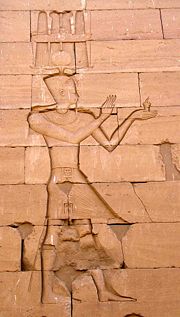 In the Eastern provinces, cultural precedent ensured a rapid and geographically widespread dissemination of cult, extending as far as the Augustan military settlement at modern-day Najran
. Considered as a whole, these provinces present the Empire's broadest and most complex syntheses of imperial and native cult, funded through private and public initiatives and ranging from the god-like honours due a living patron to what Harland (2003) interprets as privately funded communal mystery rites. The Greek cities of Roman Asia competed for the privilege of building high-status Imperial cult centres (neocorate
s). Ephesus
and Sardis
, ancient rivals, had two apiece until the early 3rd century CE, when Ephesus was allowed an additional temple, to the reigning emperor Caracalla
. When he died, the city lost its brief, celebrated advantage through a religious technicality.
The Eastern provinces offer some of the clearest material evidence for the imperial domus and familia as official models of divine virtue and moral propriety. Centres including Pergamum, Lesbos and Cyprus offered cult honours to Augustus and the Empress Livia: the Cypriot Calendar honoured the entire Augustan familia by dedicating a month each (and presumably cult practise) to imperial family members, their ancestral deities and some of the major gods of the Romano-Greek pantheon. Coin evidence links Thea Livia with Hera
and Demeter
, and Julia the Elder
with Venus Genetrix and Aphrodite
. In Athens, Livia and Julia shared cult honour with Hestia
(equivalent to Vesta
), and the name of Gaius
was linked to Ares
(Mars). These Eastern connections were made within Augustus' lifetime – Livia was not officially consecrated in Rome until some time after her death. Eastern Imperial cult had a life of its own.
and most fell outside the Graeco-Roman cultural ambit. There were exceptions: Polybius mentions a past benefactor of New Carthage in Republican Iberia "said to have been offered divine honours". In 74 BCE, Roman citizens in Iberia burned incense to Metellus Pius
as "more than mortal" in hope of his victory against Sertorius. Otherwise, the West offered no native traditions of monarchic divinity or political parallels to the Greek koina to absorb the Imperial cult as a romanising agency. The Western provincial concilia emerged as direct creations of the imperial cult, which recruited existing local military, political and religious traditions to a Roman model. This required only the willingness of barbarian elites to "Romanise" themselves and their communities.
The first known Western regional cults to Augustus were established with his permission around 19 BCE in north-western ("Celtic") Spain and named arae sestianae after their military founder, L. Sestius Quirinalis Albinianus
. Soon after, in either 12 BCE or 10 BCE, the first provincial imperial cult centre in the West was founded at Lugdunum
by Drusus
, as a focus for his new tripartite administrative division of Gallia Comata. Lugdunum set the type for official Western cult as a form of Roman-provincial identity, parceled into the establishment of military-administrative centres. These were strategically located within the unstable, "barbarian" Western provinces of the new Principate and inaugurated by military commanders who were – in all but one instance – members of the imperial family.
The first priest of the Ara (altar) at Lugdunum's great Imperial cult complex
was Caius Julius Vercondaridubnus
, a Gaul of the provincial elite, given Roman citizenship
and entitled by his priestly office to participate in the local government of his provincial concilium. Though not leading to senatorial status, and almost certainly an annually elected office (unlike the traditional lifetime priesthoods of Roman flamines), priesthood in imperial provinces thus offered a provincial equivalent to the traditional Roman cursus honorum
. The rejection of cult spurned romanitas, priesthood and citizenship; in 9 CE Segimundus, imperial cult priest of what would later be known as Colonia Claudia Ara Agrippinensium
(sited at modern Cologne
in Germany) cast off or destroyed his priestly regalia to join the rebellion of his kinsman Arminius
.
, altars to the Dii Magifie Augusti attest (according to Potter) a deity who was simultaneously local and universal, rather than one whose local identity was subsumed or absorbed by an Imperial divus or deity.
Two temples are attested to Roma and the divus Augustus – one dedicated under Tiberius at Leptis Magna
, and another (Julio-Claudian) at Mactar.
and recommended him to the senate as a worthy successor, Augustus seems to have doubted the propriety of dynastic imperium
; this, however, was probably his only feasible course. On his death, the senate debated and passed a lex de imperio which voted Tiberius princeps through his "proven merit in office", and awarded him the honorific "Augustus" as name and title.
Tiberius accepted the titles with apparent reluctance. Though he proved a capable and efficient administrator, he could not match his predecessor's extraordinary energy and charisma. Roman historians described him as morose and mistrustful. With a self-deprecation that may have been entirely genuine, he encouraged the cult to his father, and discouraged his own. After much wrangling, he allowed a single temple in Smyrna
to himself and the genius
of the Senate in 26 CE; eleven cities had competed – with some vehemence and even violence – for the honour. His lack of personal auctoritas
allowed increasing praetorian influence over the Imperial house, the senate and through it, the state. In 31 CE, his praetorian prefect Sejanus
– by now a virtual co-ruler – was implicated in the death of Tiberius' son and heir apparent Drusus, and was executed as a public enemy. In Umbria, the Imperial cult priest (sevir Augustalis
) memorialised "the providence of Tiberius Caesar Augustus, born for the eternity of the Roman name, upon the removal of that most pernicious enemy of the Roman people". In Crete, thanks were given to "the numen
and foresight of Tiberius Caesar Augustus and the Senate" in foiling the conspiracy – but at his death, the senate and his heir Caligula
chose not to officially deify him.
Caligula
's rule exposed the legal and moral contradictions of the Augustan "Republic". To legalise his succession, the Senate was compelled to constitutionally define his role, but the rites and sacrifices to the living genius of the emperor already acknowledged his constitutionally unlimited powers. The princeps played the role of "primus inter pares
" only through personal self-restraint and decorum. It became evident that Caligula had little of either. He seems to have taken the cult of his own genius very seriously, and is said to have enjoyed acting the god – or rather, several of them. However, his infamous and oft-cited impersonations of major deities may represent no more than his priesthood of their cults, a desire to shock and a penchant for triumphal dress. Whatever his plans, there is no evidence for his official cult as a living divus in Rome or his replacement of state gods, and none for major deviations or innovations in his provincial cult. His reported sexual relations with his sister Drusilla and her deification after death aroused scorn from later historians; after Caligula's death, her cult was simply allowed to fade. His reported compulsion of priesthood fees from unwilling senators are marks of private cult and personal humiliations among the elite. Caligula's fatal offense was to willfully "insult or offend everyone who mattered", including the senior military officers who assassinated him. The histories of his reign highlight his wayward impiety. Perhaps not only his: in 40 CE the Senate decreed that the "emperor should sit on a high platform even in the very senate house". Claudius (his successor and uncle) intervened to limit the damage to the imperial house and those who had conspired against it, and had Caligula's public statues discreetly removed.
Claudius
was chosen emperor by Caligula's praetorians and consolidated his position with cash payments (donativa) to the military. The senate were forced to ratify the choice and accept the affront. Claudius adopted the cognomen Caesar, deified Augustus' wife, Livia, 13 years after her death and in 42 CE was granted the title pater patriae (father of the fatherland) but relations between emperor and Senate seem to have been irreparable. Claudius showed none of Caligula's excesses. He seems to have entirely refused a cult to his own genius: but the offer of cult simultaneously acknowledged the high status of those empowered to grant it and the extraordinary status of the princeps – Claudius' repeated refusals may have been interpreted as offensive to Senate, provincials and the imperial office itself. He further offended the traditional hierarchy by promoting his own trusted freedmen as imperial procurators
: those closest to the Emperor held high status through their proximity.
It has been assumed that he allowed a single temple for his cult in Britain
, following his conquest there. The temple is certain – it was sited at Camulodunum
(modern Colchester
), the colonia
-capital of the Iceni
under their client king, Prasutagus
, and was a focus of British wrath during the Boudiccan revolt of 60 CE. But cult to the living Claudius there is very unlikely: he had already refused Alexandrine cult honours as "vulgar" and impious and cult to living emperors was associated with arae (altars), not temples. The British worship offered him as a living divus is probably no more than a cruel literary judgment on his worth as emperor. Despite his evident respect for Republican norms he was not taken seriously by his own class, and in Seneca's fawning Neronian fiction, the Roman gods cannot take him seriously as a divus – the wild British might be more gullible. In reality, they proved resentful enough to rebel, though probably less against the Claudian divus than against brutal abuses and the financial burden represented by its temple.
Claudius died in 54 CE and was deified by his adopted son and successor Nero
. After an apparently magnificent funeral, the divus Claudius was given a temple on Rome's disreputable Mons Caelius
. Fishwick remarks that "the malicious humour of the site can hardly have been lost by those in the know... the location of Claudius' temple in Britain (the occasion for his "pathetic triumph") may be more of the same".
Once in power, Nero
allowed Claudius' cult to lapse, built his Domus Aurea
over the unfinished temple, indulged his sybaritic and artistic inclinations and allowed the cult of his own genius as paterfamilias of the Roman people. Senatorial attitudes to him appear to have been largely negative. He was overthrown in a military coup, and his institutions of cult to his dead wife Poppaea and infant daughter Claudia Augusta were abandoned. Otherwise, he seems to have been a popular emperor, particularly in the Eastern provinces. Tacitus reports a senatorial proposal to dedicate a temple to Nero as a living divus, taken as ominous because "divine honours are not paid to an emperor till he has ceased to live among men". After his death, Pliny the Elder
remarked the resemblance between Nero's own head and that of his colossal sun-god statue (now known as the Colossus
) but this was probably meant to flatter Titus
, a more modest emperor.
. The first three promoted their own genius cult: the last two of these attempted Nero's restitution and promotion to divus. The fourth, Vespasian
– son of an equestrian from Reate – secured his Flavian dynasty
through reversion to an Augustan form of principate
and renewed the imperial cult of divus Julius. Vespasian was respected for his "restoration" of Roman tradition and the Augustan modesty of his reign. He dedicated state cult to genio populi Romani (the genius of the Roman people), respected senatorial "Republican" values and repudiated Neronian practice by removing various festivals from the public calendars, which had (in Tacitus' unsparing assessment) become "foully sullied by the flattery of the times". He may have had the head of Nero's Colossus replaced or recut for its dedication (or rededication) to the sun god
in 75CE. Following the first Jewish Revolt and the destruction of the Temple in Jerusalem in 70 CE, he imposed the didrachmon
, formerly paid by Jews for their Temple's upkeep but now re-routed to Jupiter Capitolinus as victor over them "and their God". Jews who paid the tax were exempt from the cult to imperial state deities. Those who offered it however were ostracised from their own communities. Vespasian appears to have approached his own impending cult with dry humour – according to Suetonius
, his last words were puto deus fio ("I think I'm turning into a god"). Vespasian's son Titus
reigned for two successful years then died of natural causes. He was deified and replaced by his younger brother, Domitian.
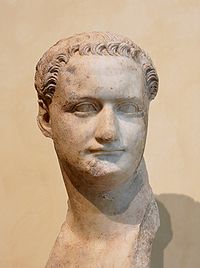 Within two weeks of accession, Domitian
had restored the cult of the ruling emperor's genius. He remains a controversial figure, described as one of the very few emperors to scandalously style himself a living divus, as evidenced by the use of "master and god" (dominus et deus) in imperial documents. However, there are no records of Domitian's personal use of the title, its use in official address or cult to him, its presence on his coinage or in the Arval Acts relating to his state cult. It occurs only in his later reign and was almost certainly initiated and used by his own procurators (who in the Claudian tradition were also his freedmen). Like any other paterfamilias and patron
, Domitian was "master and god" to his extended familia, including his slaves, freedmen and clients. Pliny's descriptions of sacrifice to Domitian on the Capitol are consistent with the entirely unremarkable "private and informal" rites accorded to living emperors. Domitian was a traditionalist, severe and repressive but respected by the military and the general populace. He admired Augustus and may have sought to emulate him, but made the same tactless error as Caligula in treating the Senate as clients and inferiors, rather than as the fictive equals required by Augustan ideology. His assassination was planned and implemented from within his court, and his name officially but rather unsystematically erased from inscriptions.
as emperor. Nerva had long-standing family and consular connections with the Julio-Claudian and Flavian families, but proved a dangerously mild and indecisive princeps: he was persuaded to abdicate in favour of Trajan
. Pliny the Younger
's panegyric
of 100 CE claims the visible restoration of senatorial authority and dignity throughout the empire under Trajan
, but while he praises the emperor's modesty, Pliny does not disguise the precarious nature of this autocratic gift. Under Trajan's very capable civil and military leadership, the office of emperor was increasingly interpreted as an earthly viceregency of the divine order. He would prove an enduring model for Roman imperial virtues.
The Emperor Hadrian
's Hispano-Roman origins and marked pro-Hellenism changed the focus of imperial cult. His standard coinage still identifies with the genius populi Romani, but other issues stress his identification with Hercules Gaditanus (Hercules of Gades), and Rome's imperial protection of Greek civilisation. Commemorative coinage shows him "raising up" provincial deities (thus elevating and "restoring" the provinces); he promoted Sagalassos
in Greek Pisidia
as the Empire's leading Imperial cult centre and in 131–2 CE he sponsored the exclusively Greek Panhellenion
. He was said to have "wept like a woman" at the death of his young companion Antinous
, and arranged his apotheosis. Dio claims that Hadrian was held to ridicule for this emotional indulgence, particularly as he had delayed the apotheosis of his own sister Paulina after her death.
The cult of Antinous
would prove one of remarkable longevity and devotion, particularly in the Eastern provinces. Bithynia, as his birthplace, featured his image on coinage as late as the reign of Caracalla
(r. 211–217). His popular cult appears to have thrived well into the 4th century, when he became the "whipping boy of pagan worship" in Christian polemic. Vout (2007) remarks his humble origins, untimely death and "resurrection" as theos, and his identification – and sometimes misidentification by later scholarship – with the images and religious functions of Apollo, Dionysius/Bacchus, and later, Osiris. In Rome itself he was also theos on two of three surviving inscriptions but was more closely associated with hero-cult, which allowed direct appeals for his intercession with "higher gods". Hadrian imposed the imperial cult to himself and Jupiter in Judaea following the Bar Kokhba revolt. He was predeceased by his wife Vibia Sabina
. Both were deified but Hadrian's case had to be pleaded by his successor Antoninus Pius
.
Marcus Aurelius' tutor Fronto
offers the best evidence of imperial portraiture as a near-ubiquitous feature of private and public life. Though evidence for private emperor worship is as sparse in this era as in all others, Fronto's letters imply the genius cult of the living emperor as an official, domestic and personal practice, probably more common than cult to the divi in this and other periods.
Marcus' son Commodus
succumbed to the lures of self-indulgence, easy populism and rule by favourites. He described his reign as a "golden age", and himself as a new Romulus and "re-founder" of Rome, but was deeply antagonistic toward the Senate – he reversed the standard "Republican" imperial formula to populus senatusque romanus (the people and senate of Rome). He increasingly identified himself with the demigod Hercules in statuary, temples and the arena, where – to the horror of the senate and (probably) the delight of the plebs – he liked to entertain as a bestiarius in the morning and a gladiator in the afternoon. In the last year of his life he was voted the official title "Romanus Hercules" ; the state cult to Hercules acknowledged him as heroic, a divinity or semi-divinity (but not a divus) who had once been mortal. Commodus may have intended declaring himself as a living god some time before his murder on the last day of 192 CE.
The Nervan-Antonine dynasty ended in chaos. The senate declared damnatio memoriae on Commodus, whose urban prefect Pertinax
was declared Emperor by the Praetorian Guard in return for the promise of very large donative
s. Pertinax had risen through equestrian ranks by military talent and administrative efficiency to become senator, consul and finally and briefly Emperor; he was murdered by his Praetorians for attempting to cap their pay. Pertinax was replaced by Didius Julianus
, who had promised cash to the Praetorians and restoration of power to the Senate. Julianus began his reign with an ill-judged appeal to the memory of Commodus, a much resented attempt to bribe the populace en masse and the use of Praetorian force against them. In protest, a defiant urban crowd occupied the senatorial seats at the Circus Maximus
. Against a background of civil war among competing claimants
in the provinces, Septimius Severus
emerged as a likely victor. The Senate soon voted for the death of Julianus, the deification of Pertinax and the elevation of Septimius as Emperor. Only a year had passed since the death of Commodus.
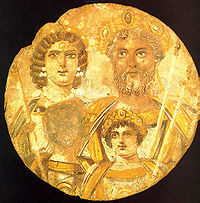 In 193 CE, Septimius Severus
triumphally
entered Rome and gave apotheosis to Pertinax
. He cancelled the Senate's damnatio memoriae of Commodus
, deified him as a frater (brother) and thereby adopted Marcus Aurelius as his own ancestor through an act of filial piety. Severan coin images further re-enforced Septimius' association with prestigious Antonine dynasts and the genius populi Romani.
Septimius' reign represents a watershed in relations between Senate, Emperors, and the military. Senatorial consent defined divine imperium as a Republican permission for the benefit of the Roman people, and apotheosis was a statement of senatorial powers. Where Vespasian had secured his position with appeals to the genius of the Senate and Augustan tradition, Septimius overrode the customary preferment of senators to senior military office. He increased plebeian privilege in Rome, stationed a loyal garrison there and selected his own commanders. He paid personal attention to the provinces, as sources of revenue, military manpower and unrest. Following his defeat of his rival Clodius Albinus
at Lugdunum, he re-founded and reformed its imperial cult centre: dea Roma was removed from the altar and confined to the temple along with the deified Augusti. Fishwick interprets the obligatory new rites as those due any paterfamilias from his inferiors. Septimius' own patron deities, Melqart
/Hercules and Liber
/Bacchus
, took pride of place with himself and his two sons at the Saecular Games of 204 CE. Septimius died of natural causes in 211 CE at Eboracum
(modern York) while on campaign in Britannia, after leaving the Empire equally to Caracalla
and his older brother Geta
, along with advice to "be harmonious, enrich the soldiers, and scorn all other men."
By 212 CE, Caracalla had murdered Geta, pronounced his damnatio memoriae and issued the Constitutio Antoniniana
: this gave full Roman citizenship to all free inhabitants of the Empire. and was couched as a generous invitation to celebrate the "victory of the Roman people" in foiling Geta's "conspiracy". In reality, Caracalla was faced by an endemic shortfall of cash and recruits. His "gift" was a far from popular move, as most of its recipients were humiliores of peasant status and occupation – approximately 90% of the total population. Humiliores they remained, but now liable to pay taxes, serve in the legions and adopt the name of their "liberator". Where other emperors had employed the mos maiorum of family obligation at the largely symbolic level of genius cult, Caracalla literally identified his personal survival with the state and "his" citizens. Caracalla inherited the devotion of his father's soldiery but his new citizens were not inclined to celebrate and his attempts to court popularity in Commodan style seem to have misfired. In Philostratus' estimation, his embrace of Empire foundered on his grudging, parochial mindset. He was assassinated in 217 CE, with the possible collusion of his praetorian prefect Macrinus
.
The military hailed Macrinus as imperator, and he arranged for the apotheosis of Caracalla. Aware of the impropriety of his unprecedented leap through the traditional cursus honorum
from equestrian to Emperor, he respectfully sought senatorial approval for his "self-nomination". It was granted – the new emperor had a lawyer's approach to imperium but his foreign policy proved too cautious and placatory for the military. After little more than a year, he was murdered in a coup and replaced with an emperor of Syrian background and Severan descent, Varius Avitus Bassianus
, more usually known by the Latinised name of his god and his priesthood, Elagabalus
.
The 14 year old emperor brought his solar-mountain deity from his native Emesa to Rome and into official imperial cult. In Syria, the cult of Elagabalus was popular and well established. In Rome, it was a foreign and (according to some ancient sources) disgusting Eastern novelty. In 220 CE, the priest Elagabalus replaced Jupiter with the god Elagabalus as sol invictus
(the unconquered Sun) and thereafter neglected his Imperial role as pontifex maximus
. According to Marius Maximus, he ruled from his degenerate domus through prefects who included among others a charioteer, a locksmith, a barber, and a cook. At the very least, he appears to have been regarded as an unacceptably effete eccentric by the Senate and military alike. He was assassinated by the Praetorians at the age of 18, subjected to the fullest indignities of damnatio memoriae and replaced with his young cousin Alexander Severus
, who reigned for 13 years until killed in a mutiny. Alexander was the last "Severan" Emperor.
The end of the Severan dynasty marked the breakdown of central imperium
. Against a background of economic hyperinflation and latterly, endemic plague, rival provincial claimants fought for supremacy and failing this, set up their own provincial Empires. Most Emperors seldom even saw Rome, and had only notional relationships with their senates. In the absence of coordinated Imperial military response, foreign peoples seized the opportunity for invasion and plunder.
Maximinus Thrax
(reigned 235–8 CE) sequestered the resources of state temples in Rome to pay his armies. The temples of the divi were first in line. It was an unwise move for his own posterity, as the grant or withholding of apotheosis remained an official judgment of Imperial worthiness, but the stripping of the temples of state gods caused far greater offense. Maximinus's actions more likely show need in extreme crisis than impiety, as he had his wife deified on her death but in a rare display of defiance the senate deified his murdered predecessor, then openly rebelled. His replacement, Claudius Gothicus, reigned briefly but successfully and was made a divus on his death. A succession of short-lived soldier-emperors followed. Further development in imperial cult appears to have stalled until Philip the Arab
, who dedicated a statue to his father as divine in his home town of Philippopolis
and brought the body of his young predecessor Gordian III
to Rome for apotheosis. Coins of Philip show him in the radiate solar crown (suggestive of solar cult or a hellenised form of imperial monarchy), with Rome's temple to Venus and dea Roma on the reverse.
In 249 CE, Philip was succeeded (or murdered and usurped) by his praetorian prefect Decius
, a traditionalist ex-consul and governor. After an accession of doubtful validity, Decius justified himself as rightful "restorer and saviour" of Empire and its religio: early in his reign he issued a coin series of imperial divi in radiate (solar) crowns. Philip, the three Gordians, Pertinax and Claudius were omitted, presumably because Decius thought them unworthy of the honour. In the wake of religious riots in Egypt, he decreed that all subjects of the Empire must actively seek to benefit the state through witnessed and certified sacrifice to "ancestral gods" or suffer a penalty: only Jews were exempt. The Decian edict required that refusal of sacrifice be tried and punished at proconsul
ar level. Apostasy
was sought, rather than capital punishment. A year after its due deadline, the edict was allowed to expire and shortly after this, Decius himself died.
The Decian edict appealed to whatever common mos maiores might reunite a politically and socially fractured Empire. Within its multitude of cults, no ancestral gods need be specified by name. The fulfillment of this sacrificial obligation by loyal subjects would define them and their gods as Roman. Yet despite its appeal to tradition, the Decian edict represents a significant departure from precedent. Most oaths of loyalty were collective; the Decian oath has been interpreted as a design to root out individual subversives. Crisis had helped reformulate what Empire was, and what it was not: in the earliest days of the Principate, Livy had been convinced that the problems of the late Republic stemmed from impiety. The principate of Augustus had been justified by its restoration of peace and the mos maiorum. Then, as now, devotion to private and mystery cults was acceptable within limits; excessive or exclusive devotion to one cult were marks of superstition and obsession. This was not merely improper but robbed Rome's gods of their dues from its citizens. Valerian
(253–60) singled out the largest and most stubbornly self-interested of these cults: he outlawed Christian assembly and urged Christians to sacrifice to Rome's traditional gods. His son and co-Augustus Gallienus
– himself an initiate of the Eleusinian Mysteries
– also identified himself with traditional Roman gods and the virtue of military loyalty. Aurelian
(270–75) appealed for harmony among his soldiers (concordia militum), stabilised the Empire and its borders and successfully established an official, Hellenic form of unitary cult to the Palmyrene
Sol Invictus
in Rome's Campus Martius
. The senate hailed him as restitutor orbis (restorer of the world) and deus et dominus natus (god and born ruler) but his intolerance of military corruption led to his murder by the Praetorians. Aurelian's immediate successors consolidated his achievements: coinage of Probus (276–82) shows him in radiate solar crown, and his prolific variety of coin types include issues showing the temple of Venus and Dea Roma in Rome.
These policies and preoccupations culminated in Diocletian
's Tetrarchy
. This divided the empire into Western and Eastern administrative blocs: each had its Augustus (senior emperor), helped by a Caesar (junior emperor) as Augustus-in-waiting. Provinces were divided and subdivided: their imperial bureaucracy was extraordinary in size, scope and attention to detail but their senior Augustus was fundamentally conservative. On his accession in 284 CE, he held games in honour of the divus Antinous
. Where his predecessors preferred persuasion and coercion of recalcitrant sects, Diocletian launched a series of ferocious reactions known in Church history as the Great Persecution. According to Lactantius
, this began with a report of ominous haruspicy in Diocletian's domus and a subsequent (but undated) dictat of placatory sacrifice by the entire military. A date of 302 is regarded as likely and Eusebius also says the persecutions of Christians began in the army. However Maximilian's martyrdom (295) came from his refusal of military service, and Marcellus
' (298) for renouncing his military oath. Legally, these were military insurrections and Diocletian's edict may have followed these and similar acts of conscience and faith. An unknown number of Christians appear to have suffered the extreme and exemplary punishments traditionally reserved for rebels and traitors.
The nature and intent of the imperial cult under Diocletian are hard to discern through the taints of his notoriety but his expanded imperial collegia seems to have had major implications. While the division of empire and imperium catered to a peaceful and well-prepared succession, its unity still required the highest investiture of power and status in one man. In matters of titulature and ceremonial alike, the hyperinflation of imperial honours distinguished both Augusti from their Caesares and Diocletian (as senior Augustus) from his colleague Maximian
. An elaborate choreography of etiquette surrounded the approach to the imperial person and imperial progressions. The senior Augustus in particular was made a separate and unique being, accessible only through those closest to him. By this period, low-born, trusted imperial eunuchs played a major procuratorial role and as in Claudius' time, their proximity to the source of imperium was resented by the Senate, whose role in government was supplanted by the imperial bureaucracy.
Diocletian's avowed conservatism almost certainly precludes a systematic design toward personal elevation as a "divine monarch". Rather, he formally elaborated imperial ceremony as a manifestation of the divine order of empire and elevated emperorship as the supreme instrument of the divine will. The idea was Augustan, or earlier, expressed most clearly in Stoic philosophy and the solar cult, especially under Aurelian. At the very beginning of his reign, before his Tetrarchy, Diocletian had adopted the signum
of Jovius
; his co-Augustus adopted the title Herculius
. During the Tetrarchy, the titles were multiplied, but with no clear reflection of implicit divine seniority: in one case, the divine signum of the Augustus is inferior to that of his Caesar. These divine associations may have followed a military precedent of emperors as comes
to divinities (or divinities as comes to emperors). Moreover, the divine signum appears in the fairly narrow context of court panegyric and civil etiquette. It makes no appearance on the general coinage of the Tetrarchy: coin images and group statuary of the Tetrarchs themselves show each as an impersonal, near-homogenous abstraction of imperial might and unity.
as "first among equals" elaborated the hierarchal honours of mos maiorum to justify the unprecedented range and permanence of his powers. The official gift of Caesar's apotheosis in a stable Republic justified the future cult of Imperial divi.
The official offer of divine honours to the living princeps weighed his god-like powers against his self-restraint and pious respect for Republican tradition. "Good" emperors rejected the offer with every appearance of gratitude and humility, accepting the more modest offer of genius cult as an honour to the donor and the imperial office. Claims that later emperors sought and obtained divine honours in Rome reflect their bad relationship with their senates: in Tertullian's day, it was still "a curse to name the emperor a god before his death". On the other hand, to judge from the domestic ubiquity of the emperor's image, private cults to "good" living emperors are as likely in Rome as elsewhere and as Gradel observes, no Roman was ever prosecuted for sacrificing to his emperor.
, who were elevated to "godhead" by their sons and accorded ancestral rites, but dead ancestors, no matter how honoured, remained manes
of the underworld. A mortal did not normally possess the divine power (numen
), which according to Gradel "can also be synonymous with deus". Official divi were politico-religious creations of the senate – or at least the senate played a formal role in their creation. As long as the correct rituals and sacrifice were offered, the divus would be received by the heavenly gods as a coelicola (a dweller in heaven), a lesser being than themselves. What the divus was supposed to be or do in heaven was left to imagination, not theology. Popular belief held that the divus Augustus would be personally welcomed by Jupiter but in Seneca's Apocolocyntosis, the unexpected arrival of Augustus' equally divine descendant Claudius creates a problem for the Olympians. They have no idea who or what he is and when they find out, they cannot think what to do with him. Seneca's sarcastic wit – an unacceptable impiety towards a deus – freely portrays the divus Claudius as just a dead, ridiculous and possibly quite bad emperor. Later Roman divi range from "dead but not guilty emperor" to "emperor of fond memory". Their images were sacrosanct and their rites definitively divine but divi could be made, unmade, remade or simply forgotten. Augustus and Trajan appear to have remained the ideals for longer than any, and cult to "good" divi appears to have lasted well into the late Imperial dominate. In Rome's state cult, deceased divi were not credited with "personal" divine power – this was reserved for their divine patrons – but they may have functioned as intercessors.
The immense power of living emperors, on the other hand, was mediated through the encompassing agency of the state. Once acknowledged as paterfamilias to an Empire, a princeps was naturally entitled to genius cult from Imperial subjects of all classes. Cult to a living emperor's numen was quite another matter, and might be interpreted as no less than a statement of divine monarchy. Imperial responses to the first overtures of cult to the August numen were therefore extremely cautious. Only much later, probably in consequence of the hyperinflation of honours to living Emperors, could a living emperor be openly, formally addressed as numen praesens (the numinous presence).
The obscure relationship between deus
, divus and numen
in Imperial cult might simply reflect its origins as a pragmatic, respectful and somewhat evasive Imperial solution using broad terminology whose meanings varied according to context. For Beard et al., a practicable and universal Roman cult of deified emperors and others of the Imperial house must have hinged on the paradox that a mortal might – like the semi-divine "heroic" figures of Hercules, Aeneas and Romulus – possess or acquire sufficient measure of numen to rise above their mortal condition and be in the company of the gods, yet remain mortal in the eyes of Roman traditionalists.
speculated in Stoic
terms on a distinction between res divina
("divine matters"), which were spiritual and godly, and res humanae ("human affairs"), which were material and temporal. Balancing intellectual skepticism
with his role as augur
and senator
, Cicero concludes that it is better to honour the gods, even if there is no incontrovertible evidence of their existence. Religio was a matter of transactional reciprocity (do ut des, "I give, that you may give"), and piety was a system of offering honors and receiving benefactions. State religion provided a bridge between the divine will and the ordering of human affairs, with the city as earthly home to the gods and the center of Roman order. Cult to the State gods would benefit the community: cult offered by individuals to their personal deities sought only their own interest. The religions and offices of the state were entwined: its senior priesthoods were held by its senior magistrates. This represented a continuous strand in Rome's religious, social and political life, from the days of the kings, then of the rex sacrorum, then of the pontifex maximus and later the emperor, the highest magistrates had access to the most powerful gods of Rome. Public religion at Rome incorporated local and regional cults from the earliest period; as the empire expanded, gods and cults of both allies and the conquered were imported. The simultaneous preservation and subordination of others' religions facilitated unity under Rome rule and fostered mutual religious tolerance within the hierarchy.
"Sacred offerings" (sacrificium) formed the contract of public and private religio, from oaths of office, treaty and loyalty to business contracts and marriage. Participation in sacrificium acknowledged personal commitment to the broader community and its values, which under Decius became a compulsory observance. Livy believed that military and civil disasters were the consequence of error (vitium) in augury, neglect of due and proper sacrifice and the impious proliferation of "foreign" cults and superstitio. Religious law focused on the sacrificial requirements of particular deities on specific occasions.
In Julio-Claudian Rome, the Arval
priesthood sacrificed to Roman state gods at various temples for the continued welfare of the Imperial family on their birthdays, accession anniversaries and to mark extraordinary events such as the quashing of conspiracy or revolt. On 3 January they consecrated the annual vows: sacrifice promised in the previous year was paid, as long as the gods had kept the Imperial family safe for the contracted time. If not, it could be withheld, as it was in the annual vow following the death of Trajan. In Pompeii, the genius of the living emperor was offered a bull: presumably a standard practice in Imperial cult at this time, though lesser offerings of wine, cakes and incense were also given, especially in the later Imperial era. The divi and genii were offered the same kind of sacrifice as the state gods, but cult officials seem to have offered Christians the possibility of sacrifice to emperors as the lesser act.
In the later Republic, augury came under the supervision of the college of pontifices, a priestly-magistral office whose powers were increasingly woven into the cursus honorum
. The office of pontifex maximus
eventually became a de facto consular office. When the consul Lepidus
died, his office as pontifex maximus passed to Augustus, who took priestly control over the State oracles (including the Sibylline books
), and used his powers as censor to suppress unapproved oracles. Octavian's honorific title of Augustus indicated his achievements as expressions of divine will: where the impiety of the Late Republic had provoked heavenly disorder and wrath (ira deorum), his obedience to divine ordinance brought divine peace (pax deorum).
and domestic penates. His position was hereditary and dynastic, unlike the elected, time-limited offices of Republican magistrates. His family – and especially his slaves and freedmen – owed a reciprocal duty of cult to his genius
.
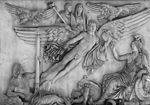 Genius was the essential spirit and generative power – depicted as a serpent or as a perennial youth, often winged – within an individual and their clan (gens
(pl. gentes), such as the Julli (Julians) of Julius Caesar. A paterfamilias could confer his name, a measure of his genius and a role in his household rites, obligations and honours upon those he adopted. As Caesar's adopted heir, Octavian stood to inherited the genius, heritable property and honours of his adoptive father in addition to those obtained through his own birth gens and efforts. The exceptionally potent genius of living emperors expressed the will of the gods through Imperial actions. In 30 BCE, libation-offerings to the genius of Octavian (later Augustus) became a duty at public and private banquets, and from 12 BCE, state oaths were sworn by the genius of the living emperor.
The Roman paterfamilias offered daily cult to his lares and penates, and to his di parentes/divi parentes, in domestic shrines and in the fires of the household hearth. As goddess of hearths, Vesta's cult was thus both a "public" and "private" duty. Its public and collegial functions were supervised by the pontifex maximus from a state-owned house near the temple of Vesta.
In Vergil's Aeneid, Aeneas brought the Trojan cult of the lares
and penates from Troy, along with the Palladium
which was later installed in the temple of Vesta
. When Augustus became pontifex maximus in 12 BCE he gave the Vestals his own house on the Palatine. His penates remained there as its domestic deities, and were soon joined by his lares. His gift therefore tied his domestic cult to the sanctified Vestals and Rome's sacred hearth and symbolically extended his domus to the state itself. He also co-opted and promoted the traditional and predominantly plebian Compitalia
shrines and extended their festivals, whose Lares were known thereafter as Augusti.
The traditional familia structure and rites of adoption helped develop and justify Imperial cult despite often violent changes of dynasty, and the affairs of the Imperial domus were accounted in deliberations for and against apotheosis – against, because like any other domus, the Imperial household might be seen as a potential hotbed of sexual immorality, disloyalty, unhealthy role-reversal (such as the "henpecked" paterfamilias and disobedient children or slaves), and outright conspiracy.
Despite the Augustan reforms, the citizen legionaries appear to have maintained their Marian traditions. With customary staid obedience, they gave cult to Jupiter for the emperor's well-being and regular cult to State, local and personal divinities. Cult to the Imperial person and familia was generally offered on Imperial accessions, anniversaries and renewal of annual vows: a bust of the ruling emperor was kept in the legionary insignia shrine for the purpose, attended by a designated military imaginifer
. By the time of the early Severans, the legions offered cult to the state gods, the Imperial divi, the current emperor's numen, genius and domus (or familia), and special cult to the Empress as "mother of the camp." At around this time, Mithraic cults became very popular with the military, and provided a basis for syncretic Imperial cult which absorbed Mithras into Solar
and Stoic Monism
as a focus of military concordia
and loyalty.
The Imperial divi and living genii appear to have been served by separate ceremonies and priesthoods. Emperors themselves could be priests of state gods, the divi and their own genius cult images. The latter practice illustrates the Imperial genius as innate to its holder but separable from him as a focus of respect and cult, formally consistent with cult to the personification of ideas and ideals such as Fortune (Fortuna
), peace (Pax
) or victory (Victoria
) et al. in conjunction with the genius of the Emperor, Senate or Roman people; Julius Caesar had showed his affinity with the virtue of clemency (Clementia
), a personal quality associated with his divine ancestor and patron goddess Venus. Priests typically and respectfully identified their function by manifesting the appearance and other properties of their deus. The duties of Imperial priests were both religious and magistral: they included the provision of approved Imperial portraits, statues and sacrifice, the institution of regular calendrical cult and the inauguration of public works, Imperial games (state ludi
) and munera
to authorised models. In effect, priests throughout the empire were responsible for re-creating, expounding and celebrating the extraordinary gifts, powers and charisma of emperors.
As part of his religious reforms, Augustus revived, subsidised and expanded the Compitalia
games and priesthoods, dedicated to the Lares
of the vici
(neighbourhoods), to include cult to his own Lares (or to his genius as a popular benefactor). Thereafter, the Lares Compitales were known as Lares Augusti. Tiberius created a specialised priesthood, the Sodales Augustales
, dedicated to the cult of the deceased, deified Augustus. This priestly office, and the connections between the Compitalia cults and the Imperial household, appear to have lasted for as long as the Imperial cult itself.
(luck or fortune), fatum (fate) and logos
(the universal divine principle). The same forces inevitably produced a sōtēr
(saviour) who would transform the destructive and "unnatural disorder" of chaos and strife to pax, fortuna and salus (peace, good fortune and well-being) and is thus identified with solar cults such as Apollo
and Sol Invictus
. Livy (in the early to mid 1st century BCE), and Lucan (in the 1st century CE) interpreted the crisis of the late Republic as a destructive phase which led to religious and constitutional renewal by Augustus and his restoration of peace, good fortune and well-being to the Roman people. Augustus was a messianic figure who personally and rationally instigated a "golden age" – the pax Augusta – and was patron, priest and protege to a range of solar deities. The Imperial order was therefore not merely justified by appeals to the divine; it was an innately natural, benevolent and divine institution.
The Imperial cult tolerated and later included specific forms of pluralistic monism
. For Imperial cult apologists, monotheists had no rational grounds for refusal, but imposition of cult was counter-productive. Jews presented a special case. Long before the civil war, Judaism had been tolerated in Rome by diplomatic treaty with Graeco-Judaean rulers. It was brought to prominence and scrutiny after Judaea's enrollment as a client kingdom in 63 BCE. The following Jewish diaspora helped disperse early "Judaic" Christianity. Early Christians appear to have been regarded as a sub-sect of Judaism and as such were sporadically tolerated. Judaism's highly developed textual tradition provided a model for Pauline Christianity's distinctively "non-Jewish" literary-religious narrative.
Jewish sources on Emperors, polytheistic cult and the meaning of Empire are fraught with interpretive difficulties. In Caligula's reign, Jews resisted the placing of Caligula's statue in their Temple and pleaded their compliance with his cult through offerings and prayer to Yahweh on his behalf. According to Philo
, Caligula was unimpressed because the offering was not made directly to him (whether to his genius or his numen is never made clear) but the statue was never installed. Philo does not challenge the Imperial cult itself: he commends the god-like honours given Augustus as "the first and the greatest and the common benefactor" but Caligula shames the Imperial tradition by acting "like an Egyptian". However, Philo is clearly pro-Roman: a major feature of the first (66 CE) Jewish revolt was the ending of Jewish sacrifices to Rome and the Emperor and the defacement of imperial images.
After the destruction of the Temple of Jerusalem (and most of the city) in the first Jewish revolt, Hadrian rebuilt both in Greek style, dedicated the rebuilt Temple (in Dio's account) to Jupiter, renamed Jerusalem Aelia Capitolina
and sought a ban on circumcision as impious disfigurement. The ensuing Bar Kokhba
revolt overwhelmed the Roman military occupation and destabilised much of the Empire. For almost three years, Judea was an independent state, led by the messianic commander Simon Bar Kokhba. Then it was obliterated by the Imperial armies and erased from the Roman map – Hadrian renamed it as Syria Palaestina
. Christians described their persecution under Bar Kokhba. Jews described theirs in its aftermath. Jewish messianism retreated into abstraction, and a Jewish nation-state became an ideal. Christians were less inclined to identify with the Judaic roots of their religion: some actively repudiated them. Hadrian's restrictions on Judaism were later relaxed and Jewish exemption from the full obligations of Imperial cult proved a source of suspicion and resentment for Hellenists and Christians alike.
represented Rome as the "Beast from the sea", Judaeo-Roman elites as the "Beast from the land" and the charagma (official Roman stamp) as a sign of the Beast. To others Christ's birth, at the very beginning of the Empire that brought peace, laid paths for the spread of the Gospels and destroyed Jerusalem and its Temple to punish the Jews for refusing the Christ, seemed providential. With the abatement of persecution Jerome could acknowledge Empire as a bulwark against evil but insist that "imperial honours" were contrary to Christian teaching.
As pontifex maximus Constantine I
favoured the "Catholic Church of the Christians" against the Donatists because:
In this change of Imperial formula Constantine acknowledged responsibility to an earthly realm whose discord and conflict might arouse the ira deorum but recognised the power of the new Christian priestly hierarchy in determining what was auspicious or orthodox. Though unbaptised, Constantine had triumphed under the signum of the Christ (probably some form of Labarum
as an adapted or re-interpreted legionary standard). He may have officially ended – or attempted to end – blood sacrifices to the genius of living emperors but his Imperial iconography and court ceremonial outstripped Diocletian's in their elevation of the Imperial hierarch to superhuman status. Constantine's permission for a new cult temple to himself and his family in Umbria is extant: the cult "should not be polluted by the deception of any contagious superstition". At the First Council of Nicaea
Constantine united and re-founded the empire under an absolute head of state by divine dispensation and was honoured as the first Christian Imperial divus. On his death he was venerated and was held to have ascended to heaven. Philostorgius
later criticised Christians who offered sacrifice at statues of the divus Constantine. His three sons re-divided their Imperial inheritance: Constantius II
was an Arian
– his brothers were Nicene.
Constantine's nephew Julian
, Rome's last non-Christian emperor, rejected the "Galilean madness" of his upbringing for a synthesis of neo-Platonism, Stoic asceticism and universal solar cult and actively fostered religious and cultural pluralism. His restored Augustan form of principate, with himself as primus inter pares, ended with his death in 363, after which his reforms were reversed or abandoned. The Western emperor Gratian
refused the office of pontifex maximus and, against the protests of the senate, removed the altar of Victoria
(Victory) from the senate house and began the disestablishment of the Vestals. Theodosius I
briefly re-united the Empire, officially adopted Nicene Christianity as the Imperial religion and ended official support for all other creeds and cults. He refused to restore Victoria to the senate-house, extinguished the sacred fire and vacated their temple yet accepted comparison with Hercules and Jupiter as a living divinity and commended his heirs to its overwhelmingly Hellenic senate in traditional Hellenic terms. He was the last emperor of both East and West. After his death the sundered Eastern and Western halves of Empire followed increasingly divergent paths: nevertheless both were Roman and both had emperors. Imperial ceremonial – notably the Imperial adventus
or ceremony of arrival, which derived in greater part from the Triumph – was embedded within Roman culture, Church ceremony and the Gospels themselves.
The last Western divus was probably Libius Severus
, who died in 465 CE. Very little is known about him. His Imperium was not recognised by his Eastern counterpart and he may have been a puppet-emperor of the Germanic general Ricimer
. The ineffectiveness and eventual collapse of Western Imperium was partly replaced by the spiritual supremacy and political influence of the Roman Catholic Church, whose popes could anoint or excommunicate kings and emperors.
In the Eastern empire Christian orthodoxy became a prerequisite of Imperial accession – Anastasius
signed a document attesting his obedience to its doctrine and practices. He is the last emperor known to be consecrated as divus on his death (518 CE). The title appears to have been abandoned on grounds of its spiritual impropriety but the consecration of Eastern emperors continued: they held power through divine ordinance and their rule was the manifestation of sacred power on earth. The adventus and the veneration of the Imperial image continued to provide analogies for devotional representations (Icon
s) of the heavenly hierarchy and the rituals of the orthodox Churches.
of paganism which led to the triumph of Christianity as Rome's state religion.
Very few modern historians would now support this point of view. Some – among them Beard et al. – find no distinct category of Imperial cult within the religio-political life of Empire: the Romans themselves used no such enveloping term. Cult to living or dead emperors was inseparable from Imperial state religion, which was inextricably interwoven with Roman identity and whose beliefs and practices were founded within the ancient commonality of Rome's social and domestic mos maiorum. Descriptions of cult to emperors as a tool of "Imperial propaganda" or the less pejorative "civil religion" emerge from modern political thought and are of doubtful value: in Republican Rome, cult could be given to state gods, personal gods, triumphal generals, magnates, benefactors, patrons and the ordinary paterfamilias – living or dead. Cult to mortals was not an alien practise: it acknowledged their power, status and their bestowal of benefits. The Augustan settlement appealed directly to the Republican mos maiorum and under the principate, cult to emperors defined them as emperors.
With rare exceptions, the earliest institution of cult to emperors succeeded in providing a common focus of identity for Empire. It celebrated the charisma of Roman Imperial power and the meaning of Empire according to local interpretations of romanitas, firstly an agency of transformation, then of stability. Cult to Imperial deities was associated with commonplace public ceremonies, celebrations of extraordinary splendour and unnumbered acts of private and personal devotion. The political usefulness of such an institution implies neither mechanical insincerity nor lack of questioning about its meaning and propriety: an Empire-wide, unifying cult would necessarily be open to a multitude of personal interpretations but its significance to ordinary Romans is almost entirely lost in the critical interpretations of a small number of philosophically literate, skeptical or antagonistic Romans and Greeks, whether Christian or Hellene. The decline of prosperity, security and unity of Empire was clearly accompanied by loss of faith in Rome's traditional gods and – at least in the West – in Roman emperors. For some Romans, this was caused by the neglect of traditional religious practices. For others – equally Roman – breakdown of empire was God's judgment on faithless or heretical Christians and hardened pagans alike.
As Roman society evolved, so did cult to emperors: both proved remarkably resilient and adaptable. Until its confrontation by fully developed Christian orthodoxy, "Imperial cult" needed no systematic or coherent theology. Its part in Rome's continued success was probably sufficient to justify, sanctify and "explain" it to most Romans. Confronted with crisis in Empire, Constantine matched the Augustan achievement by absorbing Christian monotheism into the Imperial hierarchy. Cult to emperors was not so much abolished or abandoned as transformed out of recognition.
Roman Emperor
The Roman emperor was the ruler of the Roman State during the imperial period . The Romans had no single term for the office although at any given time, a given title was associated with the emperor...
and some members of their families with the divinely sanctioned authority
Auctoritas
Auctoritas is a Latin word and is the origin of English "authority." While historically its use in English was restricted to discussions of the political history of Rome, the beginning of phenomenological philosophy in the twentieth century expanded the use of the word.In ancient Rome, Auctoritas...
of the Roman State. The framework for Imperial cult was formulated during the early Principate
Principate
The Principate is the first period of the Roman Empire, extending from the beginning of the reign of Caesar Augustus to the Crisis of the Third Century, after which it was replaced with the Dominate. The Principate is characterized by a concerted effort on the part of the Emperors to preserve the...
of Augustus
Augustus
Augustus ;23 September 63 BC – 19 August AD 14) is considered the first emperor of the Roman Empire, which he ruled alone from 27 BC until his death in 14 AD.The dates of his rule are contemporary dates; Augustus lived under two calendars, the Roman Republican until 45 BC, and the Julian...
, and was rapidly established throughout the Empire
Roman Empire
The Roman Empire was the post-Republican period of the ancient Roman civilization, characterised by an autocratic form of government and large territorial holdings in Europe and around the Mediterranean....
and its provinces
Roman province
In Ancient Rome, a province was the basic, and, until the Tetrarchy , largest territorial and administrative unit of the empire's territorial possessions outside of Italy...
, with marked local variations in its reception and expression.
Augustus' reforms transformed Rome's Republican
Roman Republic
The Roman Republic was the period of the ancient Roman civilization where the government operated as a republic. It began with the overthrow of the Roman monarchy, traditionally dated around 508 BC, and its replacement by a government headed by two consuls, elected annually by the citizens and...
system of government to a de facto monarchy, couched in traditional Roman practices
Mos maiorum
The mos maiorum is the unwritten code from which the ancient Romans derived their social norms. It is the core concept of Roman traditionalism, distinguished from but in dynamic complement to written law. The mos maiorum The mos maiorum ("ancestral custom") is the unwritten code from which the...
and Republican values. The princeps
Princeps
Princeps is a Latin word meaning "first in time or order; the first, chief, the most eminent, distinguished, or noble; the first man, first person."...
(later known as Emperor) was expected to balance the interests of the Roman military
Military of ancient Rome
The Roman military was intertwined with the Roman state much more closely than in a modern European nation. Josephus describes the Roman people being as if they were "born ready armed." and the Romans were for long periods prepared to engage in almost continuous warfare, absorbing massive losses...
, senate and people
SPQR
SPQR is an initialism from a Latin phrase, Senatus Populusque Romanus , referring to the government of the ancient Roman Republic, and used as an official emblem of the modern day comune of Rome...
, and to maintain peace, security and prosperity throughout an ethnically diverse empire. The official offer of cult to a living emperor acknowledged his office and rule as divinely approved and constitutional: his Principate should therefore demonstrate pious respect
Pietas
Pietas was one of the Roman virtues, along with gravitas and dignitas. It is usually translated as "duty" or "devotion."-Definition:The word pietas is originally from Latin. The first printed record of the word’s use in English is from Anselm Bayly’s The Alliance of Music, Poetry, and Oratory,...
for traditional Republican deities and mores.
A deceased Emperor held worthy of the honour could be voted a state divinity (divus, plural divi) by the Senate
Roman Senate
The Senate of the Roman Republic was a political institution in the ancient Roman Republic, however, it was not an elected body, but one whose members were appointed by the consuls, and later by the censors. After a magistrate served his term in office, it usually was followed with automatic...
and elevated as such in an act of apotheosis
Apotheosis
Apotheosis is the glorification of a subject to divine level. The term has meanings in theology, where it refers to a belief, and in art, where it refers to a genre.In theology, the term apotheosis refers to the idea that an individual has been raised to godlike stature...
. The granting of apotheosis served religious, political and moral judgment on Imperial rulers and allowed living Emperors to associate themselves with a well-regarded lineage of Imperial divi from which unpopular or unworthy predecessors were excluded. This proved a useful instrument to Vespasian
Vespasian
Vespasian , was Roman Emperor from 69 AD to 79 AD. Vespasian was the founder of the Flavian dynasty, which ruled the Empire for a quarter century. Vespasian was descended from a family of equestrians, who rose into the senatorial rank under the Emperors of the Julio-Claudian dynasty...
in his establishment of the Flavian imperial dynasty
Flavian dynasty
The Flavian dynasty was a Roman Imperial Dynasty, which ruled the Roman Empire between 69 and 96 AD, encompassing the reigns of Vespasian , and his two sons Titus and Domitian . The Flavians rose to power during the civil war of 69, known as the Year of the Four Emperors...
following the death of Nero
Nero
Nero , was Roman Emperor from 54 to 68, and the last in the Julio-Claudian dynasty. Nero was adopted by his great-uncle Claudius to become his heir and successor, and succeeded to the throne in 54 following Claudius' death....
and civil war, and to Septimius
Septimius Severus
Septimius Severus , also known as Severus, was Roman Emperor from 193 to 211. Severus was born in Leptis Magna in the province of Africa. As a young man he advanced through the customary succession of offices under the reigns of Marcus Aurelius and Commodus. Severus seized power after the death of...
in his consolidation of the Severan dynasty after the assassination of Commodus
Commodus
Commodus , was Roman Emperor from 180 to 192. He also ruled as co-emperor with his father Marcus Aurelius from 177 until his father's death in 180. His name changed throughout his reign; see changes of name for earlier and later forms. His accession as emperor was the first time a son had succeeded...
. In the development of Imperial rule from principate to Dominate
Dominate
The Dominate was the "despotic" latter phase of government in the ancient Roman Empire from the conclusion of the Third Century Crisis of 235–284 until the formal date of the collapse of the Western Empire in AD 476. It followed the period known as the Principate...
, the role of the senate was increasingly marginalised and military loyalty became the key to Imperial authority.
The Imperial cult was inseparable from that of Rome's official deities, whose cult was essential to Rome's survival and whose neglect was therefore treasonous. Traditional cult was a focus of Imperial revivalist legislation under Decius
Decius
Trajan Decius , was Roman Emperor from 249 to 251. In the last year of his reign, he co-ruled with his son Herennius Etruscus until they were both killed in the Battle of Abrittus.-Early life and rise to power:...
and Diocletian
Diocletian
Diocletian |latinized]] upon his accession to Diocletian . c. 22 December 244 – 3 December 311), was a Roman Emperor from 284 to 305....
. Christian apologists and martyrologists
Martyrology
A martyrology is a catalogue or list of martyrs , arranged in the calendar order of their anniversaries or feasts. Local martyrologies record exclusively the custom of a particular Church. Local lists were enriched by names borrowed from neighbouring churches...
saw the cult of the Emperor as a particularly offensive instrument of "pagan" impiety and persecution. It therefore became a focus of theological and political debate during the ascendancy of Christianity under Constantine I
Constantine I
Constantine the Great , also known as Constantine I or Saint Constantine, was Roman Emperor from 306 to 337. Well known for being the first Roman emperor to convert to Christianity, Constantine and co-Emperor Licinius issued the Edict of Milan in 313, which proclaimed religious tolerance of all...
. The emperor Julian
Julian the Apostate
Julian "the Apostate" , commonly known as Julian, or also Julian the Philosopher, was Roman Emperor from 361 to 363 and a noted philosopher and Greek writer....
failed to reverse the declining support for Rome's official religious practises: Theodosius I
Theodosius I
Theodosius I , also known as Theodosius the Great, was Roman Emperor from 379 to 395. Theodosius was the last emperor to rule over both the eastern and the western halves of the Roman Empire. During his reign, the Goths secured control of Illyricum after the Gothic War, establishing their homeland...
adopted Christianity as Rome's State religion. Rome's traditional gods and "Imperial cult" were officially abandoned. However, many of the rites, practices and status distinctions that characterised the cult to emperors were perpetuated in the theology and politics of the Christianized Empire.
The Roman Imperial cult is sometimes considered a deviation from Rome's traditional Republican values, a religiously insincere cult of personality
Cult of personality
A cult of personality arises when an individual uses mass media, propaganda, or other methods, to create an idealized and heroic public image, often through unquestioning flattery and praise. Cults of personality are usually associated with dictatorships...
which served Imperial propaganda. Many modern historians disagree with this interpretation, and regard the Imperial cult as a well-integrated unifying feature of the Principate. Its ritual, organisational and ideological frameworks can be found as distinctive features of later institutions, especially those of Western monarchies, Roman Catholicism and Eastern Orthodox Churches.
Roman
For five centuries, the Roman RepublicRoman Republic
The Roman Republic was the period of the ancient Roman civilization where the government operated as a republic. It began with the overthrow of the Roman monarchy, traditionally dated around 508 BC, and its replacement by a government headed by two consuls, elected annually by the citizens and...
did not give worship to any historic figure, or any living man, although surrounded by divine and semi-divine monarchies. Rome's legendary kings had been its masters; with their removal, Republican Romans could identify Romulus
Romulus
- People:* Romulus and Remus, the mythical founders of Rome* Romulus Augustulus, the last Western Roman Emperor* Valerius Romulus , deified son of the Roman emperor Maxentius* Romulus , son of the Western Roman emperor Anthemius...
, the founder of the city, with the god Quirinus
Quirinus
In Roman mythology, Quirinus was an early god of the Roman state. In Augustan Rome, Quirinus was also an epithet of Janus, as Janus Quirinus. His name is derived from Quiris meaning "spear."-History:...
and still retain Republican liberty. Similarly, Aeneas
Aeneas
Aeneas , in Greco-Roman mythology, was a Trojan hero, the son of the prince Anchises and the goddess Aphrodite. His father was the second cousin of King Priam of Troy, making Aeneas Priam's second cousin, once removed. The journey of Aeneas from Troy , which led to the founding a hamlet south of...
was worshipped as Jupiter Indiges. The Romans worshipped several gods and demi-gods who had been human, and knew the theory that all the gods had originated as human beings, yet Republican traditions (mos maiorum
Mos maiorum
The mos maiorum is the unwritten code from which the ancient Romans derived their social norms. It is the core concept of Roman traditionalism, distinguished from but in dynamic complement to written law. The mos maiorum The mos maiorum ("ancestral custom") is the unwritten code from which the...
) were staunchly conservative and anti-monarchic. The aristocrats who held almost all Roman magistracies, and thereby occupied almost all of the Senate, acknowledged no human as their inherent superior. No citizen, living or dead, was officially regarded as divine, but the honors awarded by the state — crowns, garlands, statues, thrones, processions — were also suitable to the gods, and tinged with divinity; indeed, when the Emperors were later given state worship, it was done by a decree of the Senate, phrased like any other honor.
Among the highest of honors was the triumph
Roman triumph
The Roman triumph was a civil ceremony and religious rite of ancient Rome, held to publicly celebrate and sanctify the military achievement of an army commander who had won great military successes, or originally and traditionally, one who had successfully completed a foreign war. In Republican...
. When a general was acclaimed imperator
Imperator
The Latin word Imperator was originally a title roughly equivalent to commander under the Roman Republic. Later it became a part of the titulature of the Roman Emperors as part of their cognomen. The English word emperor derives from imperator via Old French Empreur...
by his troops, the Senate would then choose whether to award him a triumph, a parade to the Capitol in which the triumphator displayed his captives and spoils of war in the company of his troops; by law, all were unarmed. The triumphator rode in a chariot, bearing divine emblems, in a manner supposed to be inherited from the ancient kings of Rome, and ended by offering his victory to Jupiter Capitolinus. Some scholars have viewed the triumphator as impersonating or even becoming a king or a god (or both) for the day but the circumstances of triumphal award and subsequent rites also functioned to limit his status. Whatever his personal ambitions, his victory and his triumph alike served the Roman Senate, people and gods and were recognised only through their consent.
In private life, however, tradition required that some human beings be treated as more or less divine; cult was due from familial inferiors to their superiors. Every head of household embodied the genius
Genius (mythology)
In ancient Roman religion, the genius was the individual instance of a general divine nature that is present in every individual person, place or thing.-Nature of the genius:...
– the generative principle and guardian spirit – of his ancestors, which others might worship and by which his family and slaves took oaths; his wife had a juno
Juno (mythology)
Juno is an ancient Roman goddess, the protector and special counselor of the state. She is a daughter of Saturn and sister of the chief god Jupiter and the mother of Mars and Vulcan. Juno also looked after the women of Rome. Her Greek equivalent is Hera...
. A client
Patronage in ancient Rome
Patronage was the distinctive relationship in ancient Roman society between the patronus and his client . The relationship was hierarchical, but obligations were mutual. The patronus was the protector, sponsor, and benefactor of the client...
could call his patron "Jupiter on earth". The dead, collectively and individually, were gods of the underworld or afterlife (dii manes
Manes
In ancient Roman religion, the Manes or Di Manes are chthonic deities sometimes thought to represent the souls of deceased loved ones. They were associated with the Lares, Genii, and Di Penates as deities that pertained to domestic, local, and personal cult...
). A letter has survived from Cornelia
Cornelia Africana
Cornelia Scipionis Africana was the second daughter of Publius Cornelius Scipio Africanus, the hero of the Second Punic War, and Aemilia Paulla. She is remembered as the perfect example of a virtuous Roman woman....
, the mother of the Gracchi
Gracchi
The Gracchi brothers, Tiberius and Gaius, were Roman Plebian nobiles who both served as tribunes in 2nd century BC. They attempted to pass land reform legislation that would redistribute the major patrician landholdings among the plebeians. For this legislation and their membership in the...
, expecting that when she was dead, her sons would venerate her as deus parens
Parentalia
In ancient Rome, the Parentalia or dies parentales was a nine-day festival held in honor of family ancestors, beginning February 13....
, a parental (or a nurturing) divinity; such piety was expected from any dutiful son.
A prominent clan might claim divine influence and quasi-divine honors for its leader. Death mask
Death mask
In Western cultures a death mask is a wax or plaster cast made of a person’s face following death. Death masks may be mementos of the dead, or be used for creation of portraits...
s (imagines) were made for all notable Romans and were displayed in the atria
Atrium (architecture)
In modern architecture, an atrium is a large open space, often several stories high and having a glazed roof and/or large windows, often situated within a larger multistory building and often located immediately beyond the main entrance doors...
of their houses; they were used to represent their ghostly presence at family funerals. The mask of Scipio Africanus
Scipio Africanus
Publius Cornelius Scipio Africanus , also known as Scipio Africanus and Scipio the Elder, was a general in the Second Punic War and statesman of the Roman Republic...
, Cornelia's father and victor over Hannibal, was stored in the temple of Jupiter; his epitaph (by Ennius
Ennius
Quintus Ennius was a writer during the period of the Roman Republic, and is often considered the father of Roman poetry. He was of Calabrian descent...
) said that he had ascended to Heaven. A tradition arose in the centuries after his death that Africanus had been inspired by prophetic dreams, and was himself the son of Jupiter.
There are several cases of unofficial cult directed at men viewed as saviors, military or political. In Further Spain in the 70s BCE, loyalist Romans greeted the proconsul Metellus Pius as a savior, burning incense "as if to a god" for his efforts to quash the Lusitania
Lusitania
Lusitania or Hispania Lusitania was an ancient Roman province including approximately all of modern Portugal south of the Douro river and part of modern Spain . It was named after the Lusitani or Lusitanian people...
n rebellion led by the Roman Sertorius, a member of the faction which called itself "men of the People" (populares
Populares
Populares were aristocratic leaders in the late Roman Republic who relied on the people's assemblies and tribunate to acquire political power. They are regarded in modern scholarship as in opposition to the optimates, who are identified with the conservative interests of a senatorial elite...
). This celebration, in Spain, featured a lavish banquet with local and imported delicacies, and a mechanical statue of Victory to crown Metellus, who wore (extralegally) a triumphator's toga picta for the occasion. These festivities were organized by the quaestor
Quaestor
A Quaestor was a type of public official in the "Cursus honorum" system who supervised financial affairs. In the Roman Republic a quaestor was an elected official whereas, with the autocratic government of the Roman Empire, quaestors were simply appointed....
Gaius Urbinus, but were not acts of the state. Metellus liked all this, but his older and pious (veteres et sanctos) contemporaries thought it arrogant and intolerable. After the land reformers Tiberius
Tiberius Gracchus
Tiberius Sempronius Gracchus was a Roman Populares politician of the 2nd century BC and brother of Gaius Gracchus. As a plebeian tribune, his reforms of agrarian legislation caused political turmoil in the Republic. These reforms threatened the holdings of rich landowners in Italy...
and Gaius Gracchus
Gaius Gracchus
Gaius Sempronius Gracchus was a Roman Populari politician in the 2nd century BC and brother of the ill-fated reformer Tiberius Sempronius Gracchus...
were both murdered by their opponents, their supporters "fell down" and offered daily sacrifice at the statues of the Gracchi "as though they were visiting the shrines of the gods". After Gaius Marius
Gaius Marius
Gaius Marius was a Roman general and statesman. He was elected consul an unprecedented seven times during his career. He was also noted for his dramatic reforms of Roman armies, authorizing recruitment of landless citizens, eliminating the manipular military formations, and reorganizing the...
defeated the Teutones, private citizens would offer food and drink to him alongside their household gods; he was called the third founder of Rome after Romulus and Camillus
Marcus Furius Camillus
Marcus Furius Camillus was a Roman soldier and statesman of patrician descent. According to Livy and Plutarch, Camillus triumphed four times, was five times dictator, and was honoured with the title of Second Founder of Rome....
. In 86 BCE, offerings of incense and wine were made at crossroad shrines
Compitalia
In ancient Roman religion, the Compitalia was a festival celebrated once a year in honor of the Lares Compitales, household deities of the crossroads, to whom sacrifices were offered at the places where two or more ways meet. The word comes from the Latin compitum, a cross-way.This festival is...
to statues of the still-living Marius Gratidianus
Marcus Marius Gratidianus
Marcus Marius Gratidianus was a praetor and a partisan of the popularist faction led by his uncle Gaius Marius during the Roman Republican civil wars of the 80s...
, the nephew of the elder Marius, who was wildly popular in his own right, in large part for monetary reforms that eased an economic crisis in Rome during his praetor
Praetor
Praetor was a title granted by the government of Ancient Rome to men acting in one of two official capacities: the commander of an army, usually in the field, or the named commander before mustering the army; and an elected magistratus assigned varied duties...
ship.
Greek
When the Romans began to dominate large parts of the Greek world, Rome's senior representatives there were given the same divine honours as were Hellenistic rulers. This was a well-established method for Greek city-statesPolis
Polis , plural poleis , literally means city in Greek. It could also mean citizenship and body of citizens. In modern historiography "polis" is normally used to indicate the ancient Greek city-states, like Classical Athens and its contemporaries, so polis is often translated as "city-state."The...
to declare their allegiance to an outside power; such a cult committed the city to obey and respect the king as they obeyed and respected Apollo or any of the other gods.
The cities of Ionia
Ionia
Ionia is an ancient region of central coastal Anatolia in present-day Turkey, the region nearest İzmir, which was historically Smyrna. It consisted of the northernmost territories of the Ionian League of Greek settlements...
worshipped the Spartan general Lysander
Lysander
Lysander was a Spartan general who commanded the Spartan fleet in the Hellespont which defeated the Athenians at Aegospotami in 405 BC...
, when he personally dominated Greece, immediately following the Peloponnesian War
Peloponnesian War
The Peloponnesian War, 431 to 404 BC, was an ancient Greek war fought by Athens and its empire against the Peloponnesian League led by Sparta. Historians have traditionally divided the war into three phases...
; according to Plutarch, this was the first instance of ruler-cult in Greek history. There were similar instances of divine cult to humans in the same century, although some rulers, like Agesilaus
Agesilaus
Agesilaus was a Greek historian who wrote a work on the early history of Italy, fragments of which are preserved in Plutarch's "Parallel Lives", and in Stobaeus' Florilegium....
, declined it. Clearchus, tyrant of Heraclea
Clearchus of Heraclea
Clearchus was a citizen of Heraclea on the Euxine who was recalled from exile by the nobles to aid them in quelling the seditious temper and demands of the people. According to Justin, he made an agreement with Mithridates of Cius to betray the city to him on condition, of holding it under him...
, dressed up like Zeus and claimed godhood; this did not stop the Heracleots from assassinating him. Isocrates
Isocrates
Isocrates , an ancient Greek rhetorician, was one of the ten Attic orators. In his time, he was probably the most influential rhetorician in Greece and made many contributions to rhetoric and education through his teaching and written works....
said of Philip II of Macedon
Philip II of Macedon
Philip II of Macedon "friend" + ἵππος "horse" — transliterated ; 382 – 336 BC), was a king of Macedon from 359 BC until his assassination in 336 BC. He was the father of Alexander the Great and Philip III.-Biography:...
that after he conquered the Persian Empire, there would be nothing for him to attain but to become a god; the city of Amphipolis
Amphipolis
Amphipolis was an ancient Greek city in the region once inhabited by the Edoni people in the present-day region of Central Macedonia. It was built on a raised plateau overlooking the east bank of the river Strymon where it emerged from Lake Cercinitis, about 3 m. from the Aegean Sea. Founded in...
, and a private society at Athens, worshiped him even without this conquest; he himself set out his statue, dressed as a god, as the thirteenth of the Twelve Olympians.
But it was Philip's son Alexander the Great who made the divinity of kings standard practice among the Greeks. The Egyptians accepted him as Pharaoh
Pharaoh
Pharaoh is a title used in many modern discussions of the ancient Egyptian rulers of all periods. The title originates in the term "pr-aa" which means "great house" and describes the royal palace...
, and therefore divine, after he drove the Persians out of Egypt; other nations received him as their traditional divine or quasi-divine ruler as he acquired them. In 324, he sent word to the Greek cities that they should also make him a god; they did so, with marked indifference – which did not stop them from rebelling when they heard of his death next year.
His immediate successors, the Diadochi
Diadochi
The Diadochi were the rival generals, family and friends of Alexander the Great who fought for the control of Alexander's empire after his death in 323 BC...
, offered sacrifices to Alexander, and made themselves gods even before they claimed to be kings; they put their own portraits on the coinage, whereas the Greeks had always reserved this for a god or for an emblem of the city. When the Athenians allied with Demetrius Poliorcetes, eighteen years after the deification of Alexander, they lodged him in the Parthenon with Athena, and sang a hymn extolling him as a present god, who heard them, as the other gods did not.
Euhemerus
Euhemerus
Euhemerus was a Greek mythographer at the court of Cassander, the king of Macedon. Euhemerus' birthplace is disputed, with Messina in Sicily as the most probable location, while others champion Chios, or Tegea.-Life:...
, a contemporary of Alexander, wrote a fictitious history of the world, which showed Zeus and the other established gods of Greece as mortal men, who had made themselves into gods in the same way; Ennius
Ennius
Quintus Ennius was a writer during the period of the Roman Republic, and is often considered the father of Roman poetry. He was of Calabrian descent...
appears to have translated this into Latin some two centuries later, in Scipio Africanus
Scipio Africanus
Publius Cornelius Scipio Africanus , also known as Scipio Africanus and Scipio the Elder, was a general in the Second Punic War and statesman of the Roman Republic...
' time.
The Ptolemies
Ptolemaic dynasty
The Ptolemaic dynasty, was a Macedonian Greek royal family which ruled the Ptolemaic Empire in Egypt during the Hellenistic period. Their rule lasted for 275 years, from 305 BC to 30 BC...
of Egypt
Egypt
Egypt , officially the Arab Republic of Egypt, Arabic: , is a country mainly in North Africa, with the Sinai Peninsula forming a land bridge in Southwest Asia. Egypt is thus a transcontinental country, and a major power in Africa, the Mediterranean Basin, the Middle East and the Muslim world...
and the Seleucids
Seleucid Empire
The Seleucid Empire was a Greek-Macedonian state that was created out of the eastern conquests of Alexander the Great. At the height of its power, it included central Anatolia, the Levant, Mesopotamia, Persia, today's Turkmenistan, Pamir and parts of Pakistan.The Seleucid Empire was a major centre...
claimed godhood as long as they lasted; they may have been influenced in this by the Persian and Egyptian traditions of divine kings – although the Ptolemies had separate cults in Egyptian, as Pharaoh, and in Greek. Not all Greek dynasties made the same claims; the descendants of Demetrius, who were kings of Macedon
Macedon
Macedonia or Macedon was an ancient kingdom, centered in the northeastern part of the Greek peninsula, bordered by Epirus to the west, Paeonia to the north, the region of Thrace to the east and Thessaly to the south....
and dominated the mainland of Greece, did not claim godhead or worship Alexander.
Romans among the Greeks
The Roman magistrates who conquered the Greek world were fitted into this tradition; games were set up in honor of M. Claudius MarcellusMarcus Claudius Marcellus
Marcus Claudius Marcellus , five times elected as consul of the Roman Republic, was an important Roman military leader during the Gallic War of 225 BC and the Second Punic War...
, when he conquered Sicily at the end of the Second Punic War
Second Punic War
The Second Punic War, also referred to as The Hannibalic War and The War Against Hannibal, lasted from 218 to 201 BC and involved combatants in the western and eastern Mediterranean. This was the second major war between Carthage and the Roman Republic, with the participation of the Berbers on...
, as the Olympian games were for Zeus; they were kept up for a century and a half until another Roman Governor
Verres
Gaius Verres was a Roman magistrate, notorious for his misgovernment of Sicily. It is not known what gens he belonged to, though some give him the nomen Licinius.-As governor:...
abolished them, to make way for his own honors. When T. Quinctius Flamininus
Titus Quinctius Flamininus
Titus Quinctius Flamininus was a Roman politician and general instrumental in the Roman conquest of Greece.Member of the gens Quinctia, and brother to Lucius Quinctius Flamininus, he served as a military tribune in the Second Punic war and in 205 BC he was appointed propraetor in Tarentum...
extended Roman influence to Greece proper, temples were built for him and cities placed his portrait on their coinage; he called himself godlike (isotheos) in an inscription at Delphi – but not in Latin, or at Rome. The Greeks also devised a goddess Roma
Roma (mythology)
In traditional Roman religion, Roma was a female deity who personifed the city of Rome and more broadly, the Roman state. Her image appears on the base of the column of Antoninus Pius.-Problems in earliest attestation:...
, not worshipped at Rome, who was worshipped with Flamininus (their joint cult is attested in 195 BCE); she would become a symbol of idealised romanitas in the later Roman provinces, and a continuing link, whereas a Marcellus or Flamininus might only hold power for a couple years.
When King Prusias I of Bithynia
Prusias I of Bithynia
Prusias I Cholus was a king of Bithynia...
was granted an interview by the Roman Senate, he prostrated himself and addressed them as "Saviour Gods", which would have been etiquette at his own court; Livy
Livy
Titus Livius — known as Livy in English — was a Roman historian who wrote a monumental history of Rome and the Roman people. Ab Urbe Condita Libri, "Chapters from the Foundation of the City," covering the period from the earliest legends of Rome well before the traditional foundation in 753 BC...
was shocked by Polybius
Polybius
Polybius , Greek ) was a Greek historian of the Hellenistic Period noted for his work, The Histories, which covered the period of 220–146 BC in detail. The work describes in part the rise of the Roman Republic and its gradual domination over Greece...
' account of this, and insists that there is no Roman source it ever happened.
Worship and temples appear to have been routinely offered to Roman Governors; their reaction varied. Cicero
Cicero
Marcus Tullius Cicero , was a Roman philosopher, statesman, lawyer, political theorist, and Roman constitutionalist. He came from a wealthy municipal family of the equestrian order, and is widely considered one of Rome's greatest orators and prose stylists.He introduced the Romans to the chief...
declined a temple proposed by the city officials of Roman Asia to his brother and himself, while the latter was proconsul, to avoid jealousy from other Romans; when Cicero himself was Governor of Cilicia
Cilicia
In antiquity, Cilicia was the south coastal region of Asia Minor, south of the central Anatolian plateau. It existed as a political entity from Hittite times into the Byzantine empire...
, he claimed to have accepted no statues, shrines, or chariots. His predecessor, Appius Claudius Pulcher, was so pleased, however, when the Cilicians built a temple to him that, when it was not finished at the end of Claudius' year in office, Claudius wrote Cicero to make sure it was done, and complaining that Cicero wasn't active enough in the matter.
Intermediate forms
The Romans and the Greeks gave religious reverence to and for human beings in ways that did not make the recipients gods; these made the first Greek apotheoses easier. Similar middle forms appeared as Augustus approached official divinity.The Greeks did not consider the dead to be gods, but they did pay them homage, and give them sacrifices – using different rituals than those for the gods of Olympus. The Greeks called the extraordinary dead – founders of cities and the like – heroes
Greek hero cult
Hero cults were one of the most distinctive features of ancient Greek religion. In Homeric Greek, "hero" refers to a man who was fighting on either side during the Trojan War...
; in the simplest form, hero cult was the burial and the memorials which any respectable Greek family gave their dead, but paid for by their City in perpetuity. Most heroes were the figures of ancient legend, but some were historical: the Athenians revered Harmodius and Aristogeiton
Harmodius and Aristogeiton
Harmodius and Aristogeiton were two men from ancient Athens...
as heroes, as saviours of Athens from tyranny; also, collectively, those who fell at the battle of Marathon
Battle of Marathon
The Battle of Marathon took place in 490 BC, during the first Persian invasion of Greece. It was fought between the citizens of Athens, aided by Plataea, and a Persian force commanded by Datis and Artaphernes. It was the culmination of the first attempt by Persia, under King Darius I, to subjugate...
. Statesmen did not generally become heroes, but Sophocles
Sophocles
Sophocles is one of three ancient Greek tragedians whose plays have survived. His first plays were written later than those of Aeschylus, and earlier than or contemporary with those of Euripides...
was the hero Dexion ("the Receiver") – not as a playwright, nor a general, but because, when the Athenians took Aesculapius' cult during the Peloponnesian War, he housed it until a shrine could be built. The Athenian leader Hagnon
Hagnon
Hagnon was an Athenian general and statesman. In 437/6 BC, he led the settlers who founded the city of Amphipolis in Thrace; in the Peloponnesian War, he served as an Athenian general on several occasions, and was one of the signers of the Peace of Nicias and the alliance between Athens and Sparta...
founded Amphipolis
Amphipolis
Amphipolis was an ancient Greek city in the region once inhabited by the Edoni people in the present-day region of Central Macedonia. It was built on a raised plateau overlooking the east bank of the river Strymon where it emerged from Lake Cercinitis, about 3 m. from the Aegean Sea. Founded in...
shortly before the Peloponnesian War; thirteen years later, while Hagnon was still alive, the Spartan general Brasidas
Brasidas
Brasidas was a Spartan officer during the first decade of the Peloponnesian War.He was the son of Tellis and Argileonis, and won his first laurels by the relief of Methone, which was besieged by the Athenians . During the following year he seems to have been eponymous ephor Brasidas (died 422...
liberated it from the Athenian empire, and was fatally wounded in the process. The Amphipolitans buried him as a hero, declaring him the second founder of the city, and erased Hagnon's honors as much as they could.
The Greeks also honored founders of cities while they were still alive, like Hagnon. This could also be extended to men who did equally important things; during the period when Dion
Dion of Syracuse
Dion , tyrant of Syracuse in Sicily, was the son of Hipparinus, and brother-in-law of Dionysius I of Syracuse.-Family:Dion was the son of the Syracusan statesman Hipparinus, who had assisted the despot Dionysius I, in the Syracusan army. Hipparinus' other children were Megacles and Aristomache...
ruled in Syracuse, the Syracusans gave him "heroic honors" for suppressing the tyrants, and repeated this for Timoleon
Timoleon
Timoleon , son of Timodemus, of Corinth was a Greek statesman and general.As the champion of Greece against Carthage he is closely connected with the history of Sicily, especially Syracuse.-Early life:...
; these could also be described as worshipping his good spirit (agathos daimon, agathodaemon
Agathodaemon
In ancient Greek religion, Agathos Daimon or Agathodaemon was a daemon or presiding spirit of the vineyards and grainfields and a personal companion spirit, similar to the Roman genius, ensuring good luck, health, and wisdom....
; every Greek had an agathodaemon, and the Greek equivalent of a toast was offered to one's agathodaemon). Timoleon was called savior; he set up a shrine to Fortune (Automatia) in his house; and his birthday, the festival of his daimon, became a public holiday.
Other men might claim divine favor by having a patron among the gods; so Alcibiades
Alcibiades
Alcibiades, son of Clinias, from the deme of Scambonidae , was a prominent Athenian statesman, orator, and general. He was the last famous member of his mother's aristocratic family, the Alcmaeonidae, which fell from prominence after the Peloponnesian War...
may have had both Eros
Eros
Eros , in Greek mythology, was the Greek god of love. His Roman counterpart was Cupid . Some myths make him a primordial god, while in other myths, he is the son of Aphrodite....
and Cybele
Cybele
Cybele , was a Phrygian form of the Earth Mother or Great Mother. As with Greek Gaia , her Minoan equivalent Rhea and some aspects of Demeter, Cybele embodies the fertile Earth...
as patrons; and Clearchus of Heraclea claimed to be "son of Zeus". Alexander claimed the patronage of Dionysus and other gods and heroes; he held a banquet at Bactra which combined the toast to his agathos daimon and libation
Libation
A libation is a ritual pouring of a liquid as an offering to a god or spirit or in memory of those who have died. It was common in many religions of antiquity and continues to be offered in various cultures today....
s to Dionysus, who was present within Alexander (and therefore the celebrants saluted Alexander rather than the hearth and altar, as they would have done for a toast).
It was not always easy to distinguish between heroic honors, veneration for a man's good spirit, worship of his patron deity, worship of the Fortune of a city he founded, and worship of the man himself. One might slide into another; In Egypt, there was a cult of Alexander as god and as founder of Alexandria; Ptolemy I Soter
Ptolemy I Soter
Ptolemy I Soter I , also known as Ptolemy Lagides, c. 367 BC – c. 283 BC, was a Macedonian general under Alexander the Great, who became ruler of Egypt and founder of both the Ptolemaic Kingdom and the Ptolemaic Dynasty...
had a separate cult as founder of Ptolemais
Ptolemais
Ptolemais, an Ancient Greek place name and feminine personal name, may refer to:Places*Acre, Israel, once named Antiochia Ptolemais after Ptolemy I Soter*Crocodilopolis, an Egyptian city renamed Ptolemais Euergetis by Ptolemy III Euergetes...
, which presumably worshipped his daimon and then gave him heroic honors, but in his son's reign
Ptolemy II Philadelphus
Ptolemy II Philadelphus was the king of Ptolemaic Egypt from 283 BCE to 246 BCE. He was the son of the founder of the Ptolemaic kingdom Ptolemy I Soter and Berenice, and was educated by Philitas of Cos...
, the priests of Alexander also worshipped Ptolemy and Berenice
Berenice I of Egypt
Berenice I was a Greek Macedonian noblewoman and through her marriage to Ptolemy I Soter, became the first Queen of the Ptolemaic dynasty of Egypt.-Family:...
as the Savior Gods (theoi soteres).
Finally, a man might, like Philip II, assume some prerogatives of godhood and not others. The first Attalid kings, of Pergamum, were not gods, and supported a cult of Dionysus Cathegemon, as their ancestor; they put the picture of Philetaerus
Philetaerus
Philetaerus was the founder of the Attalid dynasty of Pergamon in Anatolia.- Early life and career under Lysimachus :...
, the first prince, on the coins, rather than their own. Eventually, like the Seleucids, they acquired a eponymous priest, and put themselves on the coinage; but they still were not called gods before their deaths. Pergamum was usually allied with Rome, and this may have influenced the eventual Roman practice.
End of the Republic
In the last decades of the Roman Republic, its leaders regularly assumed extra-constitutional powers. The mos majorum had required that magistrates hold office collectively, and for short periods; there were two consuls; even coloniesColonies in antiquity
Colonies in antiquity were city-states founded from a mother-city—its "metropolis"—, not from a territory-at-large. Bonds between a colony and its metropolis remained often close, and took specific forms...
were founded by boards of three men; but these new leaders held power by themselves, and often for years.
The same men were often given extraordinary honors. Triumphs grew ever more splendid; Marius
Gaius Marius
Gaius Marius was a Roman general and statesman. He was elected consul an unprecedented seven times during his career. He was also noted for his dramatic reforms of Roman armies, authorizing recruitment of landless citizens, eliminating the manipular military formations, and reorganizing the...
and Sulla, the rival leaders in Rome's first civil war, each founded cities, which they named after themselves; Sulla had annual games in his honor, at Rome itself, bearing his name; the unofficial worship of Marius is above. In the next generation, Pompey
Pompey
Gnaeus Pompeius Magnus, also known as Pompey or Pompey the Great , was a military and political leader of the late Roman Republic...
was allowed to wear his triumphal ornaments whenever he went to the Games at the Circus
Circus (building)
The Roman circus was a large open-air venue used for public events in the ancient Roman Empire. The circuses were similar to the ancient Greek hippodromes, although serving varying purposes. Along with theatres and amphitheatres, Circuses were one of the main entertainment sites of the time...
. Such men also claimed a special relationship to the gods: Sulla's patron was Venus Felix, and at the height of his power, he added Felix to his own name; his opponent Marius believed he had a destiny, and that no ordinary man might kill him. Pompey also claimed Venus' personal favour, and built her a temple. But the first Roman to become a god, as part of aiming at monarchy, was Julius Caesar
Julius Caesar
Gaius Julius Caesar was a Roman general and statesman and a distinguished writer of Latin prose. He played a critical role in the gradual transformation of the Roman Republic into the Roman Empire....
.
Caesar had personal ties to the gods, both by descent and by office. He was descended from Aeneas
Aeneas
Aeneas , in Greco-Roman mythology, was a Trojan hero, the son of the prince Anchises and the goddess Aphrodite. His father was the second cousin of King Priam of Troy, making Aeneas Priam's second cousin, once removed. The journey of Aeneas from Troy , which led to the founding a hamlet south of...
and his mother Venus
Venus (mythology)
Venus is a Roman goddess principally associated with love, beauty, sex,sexual seduction and fertility, who played a key role in many Roman religious festivals and myths...
; more doubtfully, from Ancus Marcius
Ancus Marcius
Ancus Marcius was the legendary fourth of the Kings of Rome.He was the son of Marcius and Pompilia...
and the kings of Rome, and so from Mars
Mars
Mars is the fourth planet from the Sun in the Solar System. The planet is named after the Roman god of war, Mars. It is often described as the "Red Planet", as the iron oxide prevalent on its surface gives it a reddish appearance...
. When he was a teenager, Marius had named him flamen Dialis
Flamen Dialis
In ancient Roman religion, the Flamen Dialis was the high priest of Jupiter. There were 15 flamines, of which three were flamines maiores, serving the three gods of the Archaic Triad...
, the special priest of Jupiter
Jupiter (mythology)
In ancient Roman religion and myth, Jupiter or Jove is the king of the gods, and the god of the sky and thunder. He is the equivalent of Zeus in the Greek pantheon....
. Sulla had cancelled this appointment; however, relatively early in his career, Caesar had become pontifex maximus
Pontifex Maximus
The Pontifex Maximus was the high priest of the College of Pontiffs in ancient Rome. This was the most important position in the ancient Roman religion, open only to patricians until 254 BC, when a plebeian first occupied this post...
, the chief priest of Rome, who fulfilled most of the religious duties of the ancient kings. He had spent his twenties in the divine monarchies of the eastern Mediterranean, and was intimately familiar with Bithynia.
Caesar made use of these connections in his rise to power, but not more than his rivals would have, or more than his other advantages. When he spoke at the funeral
Laudatio Iuliae amitae
The laudatio Iuliae amitae is a well-known funeral oration that Julius Caesar delivered in 68 BC to honor his deceased aunt Julia, the widow of Marius...
of his aunt Julia
Julia Caesaris (wife of Marius)
Julia Caesaris was a daughter of Gaius Julius Caesar II and Marcia . She was a sister of Gaius Julius Caesar III and Sextus Julius Caesar III....
in 69 BC, Julius Caesar spoke of her descent from the Roman kings, and implied his own; but he also reminded his audience she had been Marius' wife, and (by implication) that he was one of the few surviving Marians.
When, however, he defeated his rivals, in 45 BC, and assumed full personal control of the Roman state, he asserted more. During the Roman Civil War
Caesar's civil war
The Great Roman Civil War , also known as Caesar's Civil War, was one of the last politico-military conflicts in the Roman Republic before the establishment of the Roman Empire...
, since 49 BC, he had returned to the Eastern Mediterranean, where he had been called god and savior, and been familiar with the Ptolemaic Egyptian monarchy of Cleopatra, called Cleopatra Thea because of the weight she placed on her own divinity. Also, he had a new Senate to deal with. Most of the more resolute defenders of the Senate had joined with Pompey, and – one way or another – they were not sitting in the Senate. Caesar had replaced them with his own partisans, few of whom were committed to the old Roman methods; some of them were not even from Italy. It was rumoured that Caesar intended a despotic removal of power and wealth from Rome eastwards, perhaps to Alexandria or Ilium
Troy
Troy was a city, both factual and legendary, located in northwest Anatolia in what is now Turkey, southeast of the Dardanelles and beside Mount Ida...
(Troy).
During the Civil War, he had declared Venus his patron goddess: he vowed to erect a temple for Venus Victrix if she granted him the battle of Pharsalia, but he had built it, in 46 BC, to Venus Genetrix, which epithet combined her aspects as his ancestress, the mother of the Roman people, and the goddess invoked in the philosophical poem De rerum natura. The new Senate had also put up a statue of Caesar, with an inscription declaring him a demi-god, but he had it effaced, as not the claim he wished to make. Granted the same extension of rights to triumphal dress as Pompey had been given, Caesar took to wearing his triumphal head-wreath "wherever and whenever", excusing this as a cover for his baldness. He may also have publicly worn the red boots and the toga picta ("painted", purple toga) usually reserved to a triumphing general for the day of his triumph; a costume also associated with the rex sacrorum
Rex Sacrorum
In ancient Roman religion, the rex sacrorum was a senatorial priesthood reserved for patricians. Although in the historical era the pontifex maximus was the head of Roman state religion, Festus says that in the ranking of priests, the rex sacrorum was of highest prestige, followed by the flamines...
(the priestly "king of the sacred rites" of Rome's monarchic era, later the pontifex maximus), the Monte Albano kings, and possibly the statue of Jupiter Capitolinus.
When the news of his final victory, at the battle of Munda
Battle of Munda
The Battle of Munda took place on March 17, 45 BC in the plains of Munda, modern southern Spain. This was the last battle of Julius Caesar's civil war against the republican armies of the Optimate leaders...
, reached Rome, the Parilia
Parilia
thumb|250px|Festa di Pales, o L'estate , a reimagining of the Festival of Pales by [[Joseph-Benoît Suvée]]In ancient Roman religion, the Parilia is an agricultural festival performed annually on April 21, aimed at cleansing both sheep and shepherd. It is carried out in acknowledgment to the Roman...
, the games commemorating the founding of the city, were to be held the next day; they were rededicated to Caesar, as if he were founder. Statues were set up to his Liberty, and to Caesar himself, as "unconquered god." He was accorded a house at public expense which was built like a temple; his image was paraded with those of the gods; his portrait was put on the coins (the first time a living man had appeared on Roman coinage). Early in 44 BC, he was called parens patriae (father of the fatherland); legal oaths were taken by his Genius; his birthday was made a public festival; the month Quinctilis was renamed July, in his honor (as June was named for Juno
Juno (mythology)
Juno is an ancient Roman goddess, the protector and special counselor of the state. She is a daughter of Saturn and sister of the chief god Jupiter and the mother of Mars and Vulcan. Juno also looked after the women of Rome. Her Greek equivalent is Hera...
). At last a special priest, a flamen
Flamen
In ancient Roman religion, a flamen was a priest assigned to one of fifteen deities with official cults during the Roman Republic. The most important three were the flamines maiores , who served the three chief Roman gods of the Archaic Triad. The remaining twelve were the flamines minores...
, was ordained for him; the first was to be Marc Antony, Caesar's adjutant, then consul – an honor which once officially adopted would rank Caesar not only as divine, but as a divinity honoured equally with Quirinus, Jupiter, and Mars. In Cicero
Cicero
Marcus Tullius Cicero , was a Roman philosopher, statesman, lawyer, political theorist, and Roman constitutionalist. He came from a wealthy municipal family of the equestrian order, and is widely considered one of Rome's greatest orators and prose stylists.He introduced the Romans to the chief...
's hostile account, the living Caesar's honours in Rome were already and unambiguously those of a full-blown god (deus).
His name as a living divinity – not as yet ratified by senatorial vote – was Divus Julius (or perhaps Jupiter Julius); divus, at that time, was a slightly archaic form of deus, suitable for poetry, implying some association with the bright heavens. A statue of him was erected next to the statues of Rome's ancient kings: with this, he seemed set to make himself King of Rome, in the Hellenistic style, as soon as he came back from the expedition to Parthia
Parthia
Parthia is a region of north-eastern Iran, best known for having been the political and cultural base of the Arsacid dynasty, rulers of the Parthian Empire....
he was planning; but "friends" in the Senate killed him on 15 March 44 BC
Ides of March
The Ides of March is the name of the 15th day of March in the Roman calendar, probably referring to the day of the full moon. The word Ides comes from the Latin word "Idus" and means "half division" especially in relation to a month. It is a word that was used widely in the Roman calendar...
.
Caesar's heir
An angry, grief-stricken crowd gathered in the Roman ForumRoman Forum
The Roman Forum is a rectangular forum surrounded by the ruins of several important ancient government buildings at the center of the city of Rome. Citizens of the ancient city referred to this space, originally a marketplace, as the Forum Magnum, or simply the Forum...
to see his corpse and hear Mark Antony
Mark Antony
Marcus Antonius , known in English as Mark Antony, was a Roman politician and general. As a military commander and administrator, he was an important supporter and loyal friend of his mother's cousin Julius Caesar...
's funeral oration. Antony appealed to Caesar's divinity and vowed vengeance on his killers. A fervent popular cult to divus Julius followed. It was forcefully suppressed but the senate soon succumbed to Caesarian pressure and confirmed Caesar as a divus of the Roman state. A comet interpreted as Caesar's soul in heaven was named the "Julian star"
Caesar's Comet
Caesar's Comet – also known as Comet Caesar and the Great Comet of 44 BC – was perhaps the most famous comet of antiquity...
(sidus Iulium) and in 42 BCE, with the "full consent of the Senate and people of Rome", Caesar's young heir, Octavian, held ceremonial apotheosis for his adoptive father. In 40 BCE Antony took up his appointment as flamen of the divus Julius. Provincial cult centres (caesarea) to the divus Julius were founded in Caesarian colonies such as Corinth
Corinth
Corinth is a city and former municipality in Corinthia, Peloponnese, Greece. Since the 2011 local government reform it is part of the municipality Corinth, of which it is the seat and a municipal unit...
. Antony's loyalty to his late patron did not extend to Caesar's heir: but in the last significant act of the long-drawn civil war, on 1 August 31 BCE, Octavian defeated Antony at Actium
Battle of Actium
The Battle of Actium was the decisive confrontation of the Final War of the Roman Republic. It was fought between the forces of Octavian and the combined forces of Mark Antony and Cleopatra VII. The battle took place on 2 September 31 BC, on the Ionian Sea near the city of Actium, at the Roman...
and was left in undisputed power.
In 30/29 BCE, the koina of Asia and Bithynia
Bithynia
Bithynia was an ancient region, kingdom and Roman province in the northwest of Asia Minor, adjoining the Propontis, the Thracian Bosporus and the Euxine .-Description:...
requested permission to worship Octavian as their "deliverer" or "saviour". This was by no means a novel request but it placed Octavian in a difficult position. He must satisfy popularist and traditionalist expectations and these could be notoriously incompatible. Marius Gratidianus
Marcus Marius Gratidianus
Marcus Marius Gratidianus was a praetor and a partisan of the popularist faction led by his uncle Gaius Marius during the Roman Republican civil wars of the 80s...
's popular support and cult had ended in his public and spectacular death in 82 BCE, at the hands of his enemies in the Senate; likewise Caesar's murder now marked an hubris
Hubris
Hubris , also hybris, means extreme haughtiness, pride or arrogance. Hubris often indicates a loss of contact with reality and an overestimation of one's own competence or capabilities, especially when the person exhibiting it is in a position of power....
tic connection between living divinity and death. Octavian had to respect the overtures of his Eastern allies, acknowledge the nature and intent of Hellenic honours and formalise his own pre-eminence among any possible rivals: he must also avoid a potentially fatal identification in Rome as a monarchic-deistic aspirant. It was decided that cult honours to him could be jointly offered to dea Roma, at cult centres to be built at Pergamum and Nicomedia
Nicomedia
Nicomedia was an ancient city in what is now Turkey, founded in 712/11 BC as a Megarian colony and was originally known as Astacus . After being destroyed by Lysimachus, it was rebuilt by Nicomedes I of Bithynia in 264 BC under the name of Nicomedia, and has ever since been one of the most...
. Provincials who were also Roman citizens were not to worship the living emperor, but might worship dea Roma and the divus Julius at precincts in Ephesus
Ephesus
Ephesus was an ancient Greek city, and later a major Roman city, on the west coast of Asia Minor, near present-day Selçuk, Izmir Province, Turkey. It was one of the twelve cities of the Ionian League during the Classical Greek era...
and Nicaea.
In 29 BCE Octavian dedicated the temple
Temple of Caesar
The Temple of Caesar or Temple of Divus Iulius also known as Temple of the Deified Julius Caesar, delubrum, heroon or Temple of the Comet Star, is an ancient structure in the Roman Forum of Rome, Italy, located near the Regia and the Temple of Vesta.-History:It was begun by...
of the divus Julius at the site of Caesar's cremation. Not only had he dutifully, legally and officially honoured his adoptive father as a divus of the Roman state. He "had come into being" through the Julian star and was therefore the divi filius (son of the divinity). But where Caesar had failed, Octavian had succeeded: he had restored the pax deorum (divinely ordained peace) and re-founded Rome through "August augury". In 27 BCE he was voted – and accepted – the elevated title of Augustus
Augustus (honorific)
Augustus , Latin for "majestic," "the increaser," or "venerable", was an Ancient Roman title, which was first held by Gaius Julius Caesar Augustus , and subsequently came to be considered one of the titles of what are now known as the Roman Emperors...
.
Religion and Imperium under Augustus
Augustus appeared to claim nothing for himself, and innovate nothing: even the cult to the divus Julius had a respectable antecedent in the traditional cult to di parentesParentalia
In ancient Rome, the Parentalia or dies parentales was a nine-day festival held in honor of family ancestors, beginning February 13....
. He re-invented the Roman Republic with due deference to the senatorial and consular tradition. His unique – and still traditional – position within the Senate as princeps
Princeps
Princeps is a Latin word meaning "first in time or order; the first, chief, the most eminent, distinguished, or noble; the first man, first person."...
or primus inter pares (first among equals) offered a curb to the ambitions and rivalries that had led to the recent civil wars: but Augustus' principate
Principate
The Principate is the first period of the Roman Empire, extending from the beginning of the reign of Caesar Augustus to the Crisis of the Third Century, after which it was replaced with the Dominate. The Principate is characterized by a concerted effort on the part of the Emperors to preserve the...
was unprecedented in its extraordinary breadth, totality and duration. As censor and pontifex maximus he was morally obliged to renew the mos maiores by the will of the gods and the "Senate and People of Rome" (senatus populusque romanus
SPQR
SPQR is an initialism from a Latin phrase, Senatus Populusque Romanus , referring to the government of the ancient Roman Republic, and used as an official emblem of the modern day comune of Rome...
). As tribune
Tribune
Tribune was a title shared by elected officials in the Roman Republic. Tribunes had the power to convene the Plebeian Council and to act as its president, which also gave them the right to propose legislation before it. They were sacrosanct, in the sense that any assault on their person was...
he encouraged generous public spending, and as princeps of the Senate he discouraged ambitious extravagance
Ambitus
In ancient Roman law, ambitus was a crime of political corruption, mainly a candidate's attempt to influence the outcome of an election through bribery or other forms of soft power...
. He disbanded the remnants of the civil war armies to form new legions and a personal imperial guard (the Praetorian Guard
Praetorian Guard
The Praetorian Guard was a force of bodyguards used by Roman Emperors. The title was already used during the Roman Republic for the guards of Roman generals, at least since the rise to prominence of the Scipio family around 275 BC...
): the patricians who still clung to the upper echelons of political, military and priestly power were gradually replaced from a vast, Empire-wide reserve of ambitious and talented equestrians. For the first time, senatorial status became heritable.
Augustan renewal of mos maiorum
Mos maiorum
The mos maiorum is the unwritten code from which the ancient Romans derived their social norms. It is the core concept of Roman traditionalism, distinguished from but in dynamic complement to written law. The mos maiorum The mos maiorum ("ancestral custom") is the unwritten code from which the...
included the seating arrangements at theatres and games, sumptuary law
Sumptuary law
Sumptuary laws are laws that attempt to regulate habits of consumption. Black's Law Dictionary defines them as "Laws made for the purpose of restraining luxury or extravagance, particularly against inordinate expenditures in the matter of apparel, food, furniture, etc." Traditionally, they were...
, and family life. Ordinary citizens could circumvent the complex, hierarchic bureaucracy of the State, and appeal directly to his magnanimity and judgment. Throughout Rome and its provinces, his name and image were ubiquitous – on state coinage and on the streets, within and upon the temples of the gods, and particularly in the courts and offices of the civil and military administration. By the end of his reign, the official res gestae
Res Gestae Divi Augusti
Res Gestae Divi Augusti, is the funerary inscription of the first Roman emperor, Augustus, giving a first-person record of his life and accomplishments. The Res Gestae is especially significant because it gives an insight into the image Augustus portrayed to the Roman people...
(achievements) of Augustus included his repair of 82 temples in 28 BCE alone, the founding or repair of 14 others in Rome during his lifetime and the overhauling or foundation of civic amenities including a new road, water supplies, senate house and theatres. Above all, his military pre-eminence had brought an enduring and sacred peace
Ara Pacis
The Ara Pacis Augustae is an altar to Peace, envisioned as a Roman goddess...
, which earned him the permanent title of imperator
Imperator
The Latin word Imperator was originally a title roughly equivalent to commander under the Roman Republic. Later it became a part of the titulature of the Roman Emperors as part of their cognomen. The English word emperor derives from imperator via Old French Empreur...
and made the triumph an Imperial privilege. He seems to have managed all this within due process of law through a combination of personal brio, cheerfully veiled threats and self-deprecation as "just another senator".
Most tellingly, Rome's Imperial Mausoleum identified Augustus, his family (and later, his descendants) by name only, not as divi. In Rome, it was enough that the office, munificence, auctoritas and gens
Gens
In ancient Rome, a gens , plural gentes, referred to a family, consisting of all those individuals who shared the same nomen and claimed descent from a common ancestor. A branch of a gens was called a stirps . The gens was an important social structure at Rome and throughout Italy during the...
of Augustus were identified with every possible legal, religious and social institution of the city. Should "foreigners" or private citizens wish to honour him as something more, that was their prerogative, within moderation. The official acknowledgment of cult demonstrated the emperor's moral responsibility and generosity towards his subjects: the Imperial revenue funded temples, amphitheatres, theatres, baths, festivals and government. This unitary principle laid the foundations for what is now known as "Imperial cult", which would be expressed in many different forms and emphases throughout the multicultural Empire. After Augustus' reign, the only new cults to Roman officials are those connected to the Imperial household.
Eastern provinces
Najran
Najran , formerly known as Aba as Sa'ud, is a city in southwestern Saudi Arabia near the border with Yemen. It is the capital of Najran Province. Designated a New town, Najran is one of the fastest-growing cities in the kingdom; its population has risen from 47,500 in 1974 and 90,983 in 1992 to...
. Considered as a whole, these provinces present the Empire's broadest and most complex syntheses of imperial and native cult, funded through private and public initiatives and ranging from the god-like honours due a living patron to what Harland (2003) interprets as privately funded communal mystery rites. The Greek cities of Roman Asia competed for the privilege of building high-status Imperial cult centres (neocorate
Neocorate
Neocorate was a rank or dignity granted by the Roman Senate under the Roman Empire to certain cities of Asia, which had built temples for the worship of the Roman Emperors or had established cults of members of the Imperial family....
s). Ephesus
Ephesus
Ephesus was an ancient Greek city, and later a major Roman city, on the west coast of Asia Minor, near present-day Selçuk, Izmir Province, Turkey. It was one of the twelve cities of the Ionian League during the Classical Greek era...
and Sardis
Sardis
Sardis or Sardes was an ancient city at the location of modern Sart in Turkey's Manisa Province...
, ancient rivals, had two apiece until the early 3rd century CE, when Ephesus was allowed an additional temple, to the reigning emperor Caracalla
Caracalla
Caracalla , was Roman emperor from 198 to 217. The eldest son of Septimius Severus, he ruled jointly with his younger brother Geta until he murdered the latter in 211...
. When he died, the city lost its brief, celebrated advantage through a religious technicality.
The Eastern provinces offer some of the clearest material evidence for the imperial domus and familia as official models of divine virtue and moral propriety. Centres including Pergamum, Lesbos and Cyprus offered cult honours to Augustus and the Empress Livia: the Cypriot Calendar honoured the entire Augustan familia by dedicating a month each (and presumably cult practise) to imperial family members, their ancestral deities and some of the major gods of the Romano-Greek pantheon. Coin evidence links Thea Livia with Hera
Hera
Hera was the wife and one of three sisters of Zeus in the Olympian pantheon of Greek mythology and religion. Her chief function was as the goddess of women and marriage. Her counterpart in the religion of ancient Rome was Juno. The cow and the peacock were sacred to her...
and Demeter
Demeter
In Greek mythology, Demeter is the goddess of the harvest, who presided over grains, the fertility of the earth, and the seasons . Her common surnames are Sito as the giver of food or corn/grain and Thesmophoros as a mark of the civilized existence of agricultural society...
, and Julia the Elder
Julia the Elder
Julia the Elder , known to her contemporaries as Julia Caesaris filia or Julia Augusti filia was the daughter and only biological child of Augustus, the first emperor of the Roman Empire. Augustus subsequently adopted several male members of his close family as sons...
with Venus Genetrix and Aphrodite
Aphrodite
Aphrodite is the Greek goddess of love, beauty, pleasure, and procreation.Her Roman equivalent is the goddess .Historically, her cult in Greece was imported from, or influenced by, the cult of Astarte in Phoenicia....
. In Athens, Livia and Julia shared cult honour with Hestia
Hestia
In Greek mythology Hestia , first daughter of Cronus and Rhea , is the virgin goddess of the hearth, architecture, and of the right ordering of domesticity and the family. She received the first offering at every sacrifice in the household. In the public domain, the hearth of the prytaneum...
(equivalent to Vesta
Vesta (mythology)
Vesta was the virgin goddess of the hearth, home, and family in Roman religion. Vesta's presence was symbolized by the sacred fire that burned at her hearth and temples...
), and the name of Gaius
Gaius Caesar
Gaius Julius Caesar , most commonly known as Gaius Caesar or Caius Caesar, was the oldest son of Marcus Vipsanius Agrippa and Julia the Elder...
was linked to Ares
Ares
Ares is the Greek god of war. He is one of the Twelve Olympians, and the son of Zeus and Hera. In Greek literature, he often represents the physical or violent aspect of war, in contrast to the armored Athena, whose functions as a goddess of intelligence include military strategy and...
(Mars). These Eastern connections were made within Augustus' lifetime – Livia was not officially consecrated in Rome until some time after her death. Eastern Imperial cult had a life of its own.
Western provinces
The Western provinces were only recently "Latinised" following Caesar's Gallic WarsGallic Wars
The Gallic Wars were a series of military campaigns waged by the Roman proconsul Julius Caesar against several Gallic tribes. They lasted from 58 BC to 51 BC. The Gallic Wars culminated in the decisive Battle of Alesia in 52 BC, in which a complete Roman victory resulted in the expansion of the...
and most fell outside the Graeco-Roman cultural ambit. There were exceptions: Polybius mentions a past benefactor of New Carthage in Republican Iberia "said to have been offered divine honours". In 74 BCE, Roman citizens in Iberia burned incense to Metellus Pius
Quintus Caecilius Metellus Pius
Quintus Caecilius Metellus Pius was a pro-Sullan politician and general. He was named Pius because of his 99 BC petition to return his father from exile and was true to his cognomen for the constance and inflexibility with which he always fought for his father's rehabilitation and return to...
as "more than mortal" in hope of his victory against Sertorius. Otherwise, the West offered no native traditions of monarchic divinity or political parallels to the Greek koina to absorb the Imperial cult as a romanising agency. The Western provincial concilia emerged as direct creations of the imperial cult, which recruited existing local military, political and religious traditions to a Roman model. This required only the willingness of barbarian elites to "Romanise" themselves and their communities.
The first known Western regional cults to Augustus were established with his permission around 19 BCE in north-western ("Celtic") Spain and named arae sestianae after their military founder, L. Sestius Quirinalis Albinianus
Lucius Sestius Quirinalis Albinianus
Lucius Sestius Quirinalis Albinianus was a proquaestor of Marcus Iunius Brutus and a suffect consul in 23 BC. Albinianus was a son of Publius Sestius...
. Soon after, in either 12 BCE or 10 BCE, the first provincial imperial cult centre in the West was founded at Lugdunum
Lugdunum
Colonia Copia Claudia Augusta Lugdunum was an important Roman city in Gaul. The city was founded in 43 BC by Lucius Munatius Plancus. It served as the capital of the Roman province Gallia Lugdunensis. To 300 years after its foundation Lugdunum was the most important city to the west part of Roman...
by Drusus
Nero Claudius Drusus
Nero Claudius Drusus Germanicus , born Decimus Claudius Drusus also called Drusus, Drusus I, Nero Drusus, or Drusus the Elder was a Roman politician and military commander. He was a fully patrician Claudian on his father's side but his maternal grandmother was from a plebeian family...
, as a focus for his new tripartite administrative division of Gallia Comata. Lugdunum set the type for official Western cult as a form of Roman-provincial identity, parceled into the establishment of military-administrative centres. These were strategically located within the unstable, "barbarian" Western provinces of the new Principate and inaugurated by military commanders who were – in all but one instance – members of the imperial family.
The first priest of the Ara (altar) at Lugdunum's great Imperial cult complex
Sanctuary of the Three Gauls
The Sanctuary of the Three Gauls was the focal structure within an administrative and religious complex established by Rome in the very late 1st century BC at Lugdunum . Its institution served to federalise and Romanise Gallia Comata as an Imperial province under Augustus, following the Gallic...
was Caius Julius Vercondaridubnus
Caius Julius Vercondaridubnus
Gaius Julius Vercondaridubnus was a Gaul of the civitas of the Aedui. He was the first high priest of the Altar of the Deified Caesar at Lugdunum , which was inaugurated August 1 in either 12 or 10 BCE at the confluence of the Saône and Rhone rivers...
, a Gaul of the provincial elite, given Roman citizenship
Roman citizenship
Citizenship in ancient Rome was a privileged political and legal status afforded to certain free-born individuals with respect to laws, property, and governance....
and entitled by his priestly office to participate in the local government of his provincial concilium. Though not leading to senatorial status, and almost certainly an annually elected office (unlike the traditional lifetime priesthoods of Roman flamines), priesthood in imperial provinces thus offered a provincial equivalent to the traditional Roman cursus honorum
Cursus honorum
The cursus honorum was the sequential order of public offices held by aspiring politicians in both the Roman Republic and the early Empire. It was designed for men of senatorial rank. The cursus honorum comprised a mixture of military and political administration posts. Each office had a minimum...
. The rejection of cult spurned romanitas, priesthood and citizenship; in 9 CE Segimundus, imperial cult priest of what would later be known as Colonia Claudia Ara Agrippinensium
Colonia Claudia Ara Agrippinensium
Colonia Claudia Ara Agrippinensium was the name of the Roman colony in the Rhineland out of which the German city of Cologne developed.It was the capital of the Roman province of Germania Inferior and the headquarters of the military in the region. With the administrative reforms under Diocletian,...
(sited at modern Cologne
Cologne
Cologne is Germany's fourth-largest city , and is the largest city both in the Germany Federal State of North Rhine-Westphalia and within the Rhine-Ruhr Metropolitan Area, one of the major European metropolitan areas with more than ten million inhabitants.Cologne is located on both sides of the...
in Germany) cast off or destroyed his priestly regalia to join the rebellion of his kinsman Arminius
Arminius
Arminius , also known as Armin or Hermann was a chieftain of the Germanic Cherusci who defeated a Roman army in the Battle of the Teutoburg Forest...
.
Western provinces of Roman Africa
In the early Principate, an altar inscribed Marazgu Aug(usto) Sac(rum) ("Dedicated to Marazgu Augustus"), identifies a local Libyan (Berber) deity with the supreme power of Augustus. In the senatorial province of AfricaAfrica Province
The Roman province of Africa was established after the Romans defeated Carthage in the Third Punic War. It roughly comprised the territory of present-day northern Tunisia, and the small Mediterranean coast of modern-day western Libya along the Syrtis Minor...
, altars to the Dii Magifie Augusti attest (according to Potter) a deity who was simultaneously local and universal, rather than one whose local identity was subsumed or absorbed by an Imperial divus or deity.
Two temples are attested to Roma and the divus Augustus – one dedicated under Tiberius at Leptis Magna
Leptis Magna
Leptis Magna also known as Lectis Magna , also called Lpqy, Neapolis, Lebida or Lebda to modern-day residents of Libya, was a prominent city of the Roman Empire. Its ruins are located in Khoms, Libya, east of Tripoli, on the coast where the Wadi Lebda meets the sea...
, and another (Julio-Claudian) at Mactar.
Julio-Claudian
Even as he prepared his adopted son Tiberius for the role of princepsPrinceps
Princeps is a Latin word meaning "first in time or order; the first, chief, the most eminent, distinguished, or noble; the first man, first person."...
and recommended him to the senate as a worthy successor, Augustus seems to have doubted the propriety of dynastic imperium
Imperium
Imperium is a Latin word which, in a broad sense, translates roughly as 'power to command'. In ancient Rome, different kinds of power or authority were distinguished by different terms. Imperium, referred to the sovereignty of the state over the individual...
; this, however, was probably his only feasible course. On his death, the senate debated and passed a lex de imperio which voted Tiberius princeps through his "proven merit in office", and awarded him the honorific "Augustus" as name and title.
Tiberius accepted the titles with apparent reluctance. Though he proved a capable and efficient administrator, he could not match his predecessor's extraordinary energy and charisma. Roman historians described him as morose and mistrustful. With a self-deprecation that may have been entirely genuine, he encouraged the cult to his father, and discouraged his own. After much wrangling, he allowed a single temple in Smyrna
Smyrna
Smyrna was an ancient city located at a central and strategic point on the Aegean coast of Anatolia. Thanks to its advantageous port conditions, its ease of defence and its good inland connections, Smyrna rose to prominence. The ancient city is located at two sites within modern İzmir, Turkey...
to himself and the genius
Genius (mythology)
In ancient Roman religion, the genius was the individual instance of a general divine nature that is present in every individual person, place or thing.-Nature of the genius:...
of the Senate in 26 CE; eleven cities had competed – with some vehemence and even violence – for the honour. His lack of personal auctoritas
Auctoritas
Auctoritas is a Latin word and is the origin of English "authority." While historically its use in English was restricted to discussions of the political history of Rome, the beginning of phenomenological philosophy in the twentieth century expanded the use of the word.In ancient Rome, Auctoritas...
allowed increasing praetorian influence over the Imperial house, the senate and through it, the state. In 31 CE, his praetorian prefect Sejanus
Sejanus
Lucius Aelius Seianus , commonly known as Sejanus, was an ambitious soldier, friend and confidant of the Roman Emperor Tiberius...
– by now a virtual co-ruler – was implicated in the death of Tiberius' son and heir apparent Drusus, and was executed as a public enemy. In Umbria, the Imperial cult priest (sevir Augustalis
Sodales Augustales
The Sodales Augustales or Sacerdotes Augustales, or simply Augustales, were an order of Roman priests instituted by Tiberius to attend to the maintenance of the cult of Augustus and the Iulii....
) memorialised "the providence of Tiberius Caesar Augustus, born for the eternity of the Roman name, upon the removal of that most pernicious enemy of the Roman people". In Crete, thanks were given to "the numen
Numen
Numen is a Latin term for a potential, guiding the course of events in a particular place or in the whole world, used in Roman philosophical and religious thought...
and foresight of Tiberius Caesar Augustus and the Senate" in foiling the conspiracy – but at his death, the senate and his heir Caligula
Caligula
Caligula , also known as Gaius, was Roman Emperor from 37 AD to 41 AD. Caligula was a member of the house of rulers conventionally known as the Julio-Claudian dynasty. Caligula's father Germanicus, the nephew and adopted son of Emperor Tiberius, was a very successful general and one of Rome's most...
chose not to officially deify him.
Caligula
Caligula
Caligula , also known as Gaius, was Roman Emperor from 37 AD to 41 AD. Caligula was a member of the house of rulers conventionally known as the Julio-Claudian dynasty. Caligula's father Germanicus, the nephew and adopted son of Emperor Tiberius, was a very successful general and one of Rome's most...
's rule exposed the legal and moral contradictions of the Augustan "Republic". To legalise his succession, the Senate was compelled to constitutionally define his role, but the rites and sacrifices to the living genius of the emperor already acknowledged his constitutionally unlimited powers. The princeps played the role of "primus inter pares
Primus inter pares
Primus inter pares is Latin phrase describing the most senior person of a group sharing the same rank or office.When not used in reference to a specific title, it may indicate that the person so described is formally equal, but looked upon as an authority of special importance by their peers...
" only through personal self-restraint and decorum. It became evident that Caligula had little of either. He seems to have taken the cult of his own genius very seriously, and is said to have enjoyed acting the god – or rather, several of them. However, his infamous and oft-cited impersonations of major deities may represent no more than his priesthood of their cults, a desire to shock and a penchant for triumphal dress. Whatever his plans, there is no evidence for his official cult as a living divus in Rome or his replacement of state gods, and none for major deviations or innovations in his provincial cult. His reported sexual relations with his sister Drusilla and her deification after death aroused scorn from later historians; after Caligula's death, her cult was simply allowed to fade. His reported compulsion of priesthood fees from unwilling senators are marks of private cult and personal humiliations among the elite. Caligula's fatal offense was to willfully "insult or offend everyone who mattered", including the senior military officers who assassinated him. The histories of his reign highlight his wayward impiety. Perhaps not only his: in 40 CE the Senate decreed that the "emperor should sit on a high platform even in the very senate house". Claudius (his successor and uncle) intervened to limit the damage to the imperial house and those who had conspired against it, and had Caligula's public statues discreetly removed.
Claudius
Claudius
Claudius , was Roman Emperor from 41 to 54. A member of the Julio-Claudian dynasty, he was the son of Drusus and Antonia Minor. He was born at Lugdunum in Gaul and was the first Roman Emperor to be born outside Italy...
was chosen emperor by Caligula's praetorians and consolidated his position with cash payments (donativa) to the military. The senate were forced to ratify the choice and accept the affront. Claudius adopted the cognomen Caesar, deified Augustus' wife, Livia, 13 years after her death and in 42 CE was granted the title pater patriae (father of the fatherland) but relations between emperor and Senate seem to have been irreparable. Claudius showed none of Caligula's excesses. He seems to have entirely refused a cult to his own genius: but the offer of cult simultaneously acknowledged the high status of those empowered to grant it and the extraordinary status of the princeps – Claudius' repeated refusals may have been interpreted as offensive to Senate, provincials and the imperial office itself. He further offended the traditional hierarchy by promoting his own trusted freedmen as imperial procurators
Procurator (Roman)
A procurator was the title of various officials of the Roman Empire, posts mostly filled by equites . A procurator Augusti was the governor of the smaller imperial provinces...
: those closest to the Emperor held high status through their proximity.
It has been assumed that he allowed a single temple for his cult in Britain
Roman Britain
Roman Britain was the part of the island of Great Britain controlled by the Roman Empire from AD 43 until ca. AD 410.The Romans referred to the imperial province as Britannia, which eventually comprised all of the island of Great Britain south of the fluid frontier with Caledonia...
, following his conquest there. The temple is certain – it was sited at Camulodunum
Camulodunum
Camulodunum is the Roman name for the ancient settlement which is today's Colchester, a town in Essex, England. Camulodunum is claimed to be the oldest town in Britain as recorded by the Romans, existing as a Celtic settlement before the Roman conquest, when it became the first Roman town, and...
(modern Colchester
Colchester
Colchester is an historic town and the largest settlement within the borough of Colchester in Essex, England.At the time of the census in 2001, it had a population of 104,390. However, the population is rapidly increasing, and has been named as one of Britain's fastest growing towns. As the...
), the colonia
Colonia (Roman)
A Roman colonia was originally a Roman outpost established in conquered territory to secure it. Eventually, however, the term came to denote the highest status of Roman city.-History:...
-capital of the Iceni
Iceni
The Iceni or Eceni were a British tribe who inhabited an area of East Anglia corresponding roughly to the modern-day county of Norfolk between the 1st century BC and the 1st century AD...
under their client king, Prasutagus
Prasutagus
Prasutagus was king of a British Celtic tribe called the Iceni, who inhabited roughly what is now Norfolk, in the 1st century AD. He is best known as the husband of Boudica....
, and was a focus of British wrath during the Boudiccan revolt of 60 CE. But cult to the living Claudius there is very unlikely: he had already refused Alexandrine cult honours as "vulgar" and impious and cult to living emperors was associated with arae (altars), not temples. The British worship offered him as a living divus is probably no more than a cruel literary judgment on his worth as emperor. Despite his evident respect for Republican norms he was not taken seriously by his own class, and in Seneca's fawning Neronian fiction, the Roman gods cannot take him seriously as a divus – the wild British might be more gullible. In reality, they proved resentful enough to rebel, though probably less against the Claudian divus than against brutal abuses and the financial burden represented by its temple.
Claudius died in 54 CE and was deified by his adopted son and successor Nero
Nero
Nero , was Roman Emperor from 54 to 68, and the last in the Julio-Claudian dynasty. Nero was adopted by his great-uncle Claudius to become his heir and successor, and succeeded to the throne in 54 following Claudius' death....
. After an apparently magnificent funeral, the divus Claudius was given a temple on Rome's disreputable Mons Caelius
Caelian Hill
The Caelian Hill is one of the famous Seven Hills of Rome. Under reign of Tullus Hostilius, the entire population of Alba Longa was forcibly resettled on the Caelian Hill...
. Fishwick remarks that "the malicious humour of the site can hardly have been lost by those in the know... the location of Claudius' temple in Britain (the occasion for his "pathetic triumph") may be more of the same".
Once in power, Nero
Nero
Nero , was Roman Emperor from 54 to 68, and the last in the Julio-Claudian dynasty. Nero was adopted by his great-uncle Claudius to become his heir and successor, and succeeded to the throne in 54 following Claudius' death....
allowed Claudius' cult to lapse, built his Domus Aurea
Domus Aurea
The Domus Aurea was a large landscaped portico villa, designed to take advantage of artificially created landscapes built in the heart of Ancient Rome by the Emperor Nero after the Great Fire of Rome had cleared away the aristocratic dwellings on the slopes of the Palatine...
over the unfinished temple, indulged his sybaritic and artistic inclinations and allowed the cult of his own genius as paterfamilias of the Roman people. Senatorial attitudes to him appear to have been largely negative. He was overthrown in a military coup, and his institutions of cult to his dead wife Poppaea and infant daughter Claudia Augusta were abandoned. Otherwise, he seems to have been a popular emperor, particularly in the Eastern provinces. Tacitus reports a senatorial proposal to dedicate a temple to Nero as a living divus, taken as ominous because "divine honours are not paid to an emperor till he has ceased to live among men". After his death, Pliny the Elder
Pliny the Elder
Gaius Plinius Secundus , better known as Pliny the Elder, was a Roman author, naturalist, and natural philosopher, as well as naval and army commander of the early Roman Empire, and personal friend of the emperor Vespasian...
remarked the resemblance between Nero's own head and that of his colossal sun-god statue (now known as the Colossus
Colossus of Nero
The Colossus Neronis was an enormous, 30 m bronze statue that the Emperor Nero erected in the vestibule of his Domus Aurea, the imperial villa complex on the Palatine Hill. It was modified by Nero's successors into a statue of the sun god Sol Invictus. It is last mentioned in the 4th century AD...
) but this was probably meant to flatter Titus
Titus
Titus , was Roman Emperor from 79 to 81. A member of the Flavian dynasty, Titus succeeded his father Vespasian upon his death, thus becoming the first Roman Emperor to come to the throne after his own father....
, a more modest emperor.
Flavian
Nero's death saw the end of imperial tenure as a privilege of ancient Roman (patrician and senatorial) families. In a single chaotic year, power passed violently from one to another of four emperorsYear of the Four Emperors
The Year of the Four Emperors was a year in the history of the Roman Empire, AD 69, in which four emperors ruled in a remarkable succession. These four emperors were Galba, Otho, Vitellius, and Vespasian....
. The first three promoted their own genius cult: the last two of these attempted Nero's restitution and promotion to divus. The fourth, Vespasian
Vespasian
Vespasian , was Roman Emperor from 69 AD to 79 AD. Vespasian was the founder of the Flavian dynasty, which ruled the Empire for a quarter century. Vespasian was descended from a family of equestrians, who rose into the senatorial rank under the Emperors of the Julio-Claudian dynasty...
– son of an equestrian from Reate – secured his Flavian dynasty
Flavian dynasty
The Flavian dynasty was a Roman Imperial Dynasty, which ruled the Roman Empire between 69 and 96 AD, encompassing the reigns of Vespasian , and his two sons Titus and Domitian . The Flavians rose to power during the civil war of 69, known as the Year of the Four Emperors...
through reversion to an Augustan form of principate
Principate
The Principate is the first period of the Roman Empire, extending from the beginning of the reign of Caesar Augustus to the Crisis of the Third Century, after which it was replaced with the Dominate. The Principate is characterized by a concerted effort on the part of the Emperors to preserve the...
and renewed the imperial cult of divus Julius. Vespasian was respected for his "restoration" of Roman tradition and the Augustan modesty of his reign. He dedicated state cult to genio populi Romani (the genius of the Roman people), respected senatorial "Republican" values and repudiated Neronian practice by removing various festivals from the public calendars, which had (in Tacitus' unsparing assessment) become "foully sullied by the flattery of the times". He may have had the head of Nero's Colossus replaced or recut for its dedication (or rededication) to the sun god
Helios
Helios was the personification of the Sun in Greek mythology. Homer often calls him simply Titan or Hyperion, while Hesiod and the Homeric Hymn separate him as a son of the Titans Hyperion and Theia or Euryphaessa and brother of the goddesses Selene, the moon, and Eos, the dawn...
in 75CE. Following the first Jewish Revolt and the destruction of the Temple in Jerusalem in 70 CE, he imposed the didrachmon
Fiscus Judaicus
The Fiscus Iudaicus or Fiscus Judaicus was a tax collecting agency instituted to collect the tax imposed on Jews in the Roman Empire after the destruction of the Temple of Jerusalem in 70 CE in favor of the temple of Jupiter Capitolinus in Rome.-Imposition:The tax was initially imposed by Roman...
, formerly paid by Jews for their Temple's upkeep but now re-routed to Jupiter Capitolinus as victor over them "and their God". Jews who paid the tax were exempt from the cult to imperial state deities. Those who offered it however were ostracised from their own communities. Vespasian appears to have approached his own impending cult with dry humour – according to Suetonius
Suetonius
Gaius Suetonius Tranquillus, commonly known as Suetonius , was a Roman historian belonging to the equestrian order in the early Imperial era....
, his last words were puto deus fio ("I think I'm turning into a god"). Vespasian's son Titus
Titus
Titus , was Roman Emperor from 79 to 81. A member of the Flavian dynasty, Titus succeeded his father Vespasian upon his death, thus becoming the first Roman Emperor to come to the throne after his own father....
reigned for two successful years then died of natural causes. He was deified and replaced by his younger brother, Domitian.
Domitian
Domitian was Roman Emperor from 81 to 96. Domitian was the third and last emperor of the Flavian dynasty.Domitian's youth and early career were largely spent in the shadow of his brother Titus, who gained military renown during the First Jewish-Roman War...
had restored the cult of the ruling emperor's genius. He remains a controversial figure, described as one of the very few emperors to scandalously style himself a living divus, as evidenced by the use of "master and god" (dominus et deus) in imperial documents. However, there are no records of Domitian's personal use of the title, its use in official address or cult to him, its presence on his coinage or in the Arval Acts relating to his state cult. It occurs only in his later reign and was almost certainly initiated and used by his own procurators (who in the Claudian tradition were also his freedmen). Like any other paterfamilias and patron
Patronage in ancient Rome
Patronage was the distinctive relationship in ancient Roman society between the patronus and his client . The relationship was hierarchical, but obligations were mutual. The patronus was the protector, sponsor, and benefactor of the client...
, Domitian was "master and god" to his extended familia, including his slaves, freedmen and clients. Pliny's descriptions of sacrifice to Domitian on the Capitol are consistent with the entirely unremarkable "private and informal" rites accorded to living emperors. Domitian was a traditionalist, severe and repressive but respected by the military and the general populace. He admired Augustus and may have sought to emulate him, but made the same tactless error as Caligula in treating the Senate as clients and inferiors, rather than as the fictive equals required by Augustan ideology. His assassination was planned and implemented from within his court, and his name officially but rather unsystematically erased from inscriptions.
Nervan-Antonine
The Senate chose the elderly, childless and apparently reluctant NervaNerva
Nerva , was Roman Emperor from 96 to 98. Nerva became Emperor at the age of sixty-five, after a lifetime of imperial service under Nero and the rulers of the Flavian dynasty. Under Nero, he was a member of the imperial entourage and played a vital part in exposing the Pisonian conspiracy of 65...
as emperor. Nerva had long-standing family and consular connections with the Julio-Claudian and Flavian families, but proved a dangerously mild and indecisive princeps: he was persuaded to abdicate in favour of Trajan
Trajan
Trajan , was Roman Emperor from 98 to 117 AD. Born into a non-patrician family in the province of Hispania Baetica, in Spain Trajan rose to prominence during the reign of emperor Domitian. Serving as a legatus legionis in Hispania Tarraconensis, in Spain, in 89 Trajan supported the emperor against...
. Pliny the Younger
Pliny the Younger
Gaius Plinius Caecilius Secundus, born Gaius Caecilius or Gaius Caecilius Cilo , better known as Pliny the Younger, was a lawyer, author, and magistrate of Ancient Rome. Pliny's uncle, Pliny the Elder, helped raise and educate him...
's panegyric
Panegyric
A panegyric is a formal public speech, or written verse, delivered in high praise of a person or thing, a generally highly studied and discriminating eulogy, not expected to be critical. It is derived from the Greek πανηγυρικός meaning "a speech fit for a general assembly"...
of 100 CE claims the visible restoration of senatorial authority and dignity throughout the empire under Trajan
Trajan
Trajan , was Roman Emperor from 98 to 117 AD. Born into a non-patrician family in the province of Hispania Baetica, in Spain Trajan rose to prominence during the reign of emperor Domitian. Serving as a legatus legionis in Hispania Tarraconensis, in Spain, in 89 Trajan supported the emperor against...
, but while he praises the emperor's modesty, Pliny does not disguise the precarious nature of this autocratic gift. Under Trajan's very capable civil and military leadership, the office of emperor was increasingly interpreted as an earthly viceregency of the divine order. He would prove an enduring model for Roman imperial virtues.
The Emperor Hadrian
Hadrian
Hadrian , was Roman Emperor from 117 to 138. He is best known for building Hadrian's Wall, which marked the northern limit of Roman Britain. In Rome, he re-built the Pantheon and constructed the Temple of Venus and Roma. In addition to being emperor, Hadrian was a humanist and was philhellene in...
's Hispano-Roman origins and marked pro-Hellenism changed the focus of imperial cult. His standard coinage still identifies with the genius populi Romani, but other issues stress his identification with Hercules Gaditanus (Hercules of Gades), and Rome's imperial protection of Greek civilisation. Commemorative coinage shows him "raising up" provincial deities (thus elevating and "restoring" the provinces); he promoted Sagalassos
Sagalassos
Sagalassos is an archaeological site in southwestern Turkey, about 100 km north of Antalya , and 30 km from Burdur and Isparta...
in Greek Pisidia
Pisidia
Pisidia was a region of ancient Asia Minor located north of Lycia, and bordering Caria, Lydia, Phrygia and Pamphylia. It corresponds roughly to the modern-day province of Antalya in Turkey...
as the Empire's leading Imperial cult centre and in 131–2 CE he sponsored the exclusively Greek Panhellenion
Panhellenion
The Panhellenion or Panhellenium was an institution of cities established in the year 131-132 AD by the Roman Emperor Hadrian while he was touring the Roman provinces of Greece.Hadrian was philhellenic, and idealized the Classical past of Greece...
. He was said to have "wept like a woman" at the death of his young companion Antinous
Antinous
Antinoüs or Antinoös was a beautiful Bithynian youth and the favourite of the Roman emperor Hadrian...
, and arranged his apotheosis. Dio claims that Hadrian was held to ridicule for this emotional indulgence, particularly as he had delayed the apotheosis of his own sister Paulina after her death.
The cult of Antinous
Antinous
Antinoüs or Antinoös was a beautiful Bithynian youth and the favourite of the Roman emperor Hadrian...
would prove one of remarkable longevity and devotion, particularly in the Eastern provinces. Bithynia, as his birthplace, featured his image on coinage as late as the reign of Caracalla
Caracalla
Caracalla , was Roman emperor from 198 to 217. The eldest son of Septimius Severus, he ruled jointly with his younger brother Geta until he murdered the latter in 211...
(r. 211–217). His popular cult appears to have thrived well into the 4th century, when he became the "whipping boy of pagan worship" in Christian polemic. Vout (2007) remarks his humble origins, untimely death and "resurrection" as theos, and his identification – and sometimes misidentification by later scholarship – with the images and religious functions of Apollo, Dionysius/Bacchus, and later, Osiris. In Rome itself he was also theos on two of three surviving inscriptions but was more closely associated with hero-cult, which allowed direct appeals for his intercession with "higher gods". Hadrian imposed the imperial cult to himself and Jupiter in Judaea following the Bar Kokhba revolt. He was predeceased by his wife Vibia Sabina
Vibia Sabina
Vibia Sabina was a Roman Empress, wife and second cousin, once removed, to Roman Emperor Hadrian. She was the daughter to Salonina Matidia , and suffect consul Lucius Vibius Sabinus...
. Both were deified but Hadrian's case had to be pleaded by his successor Antoninus Pius
Antoninus Pius
Antoninus Pius , also known as Antoninus, was Roman Emperor from 138 to 161. He was a member of the Nerva-Antonine dynasty and the Aurelii. He did not possess the sobriquet "Pius" until after his accession to the throne...
.
Marcus Aurelius' tutor Fronto
Marcus Cornelius Fronto
Marcus Cornelius Fronto , Roman grammarian, rhetorician and advocate, was born at Cirta in Numidia. He also was suffect consul of 142.- Life :Fronto, who was born a Roman citizen c...
offers the best evidence of imperial portraiture as a near-ubiquitous feature of private and public life. Though evidence for private emperor worship is as sparse in this era as in all others, Fronto's letters imply the genius cult of the living emperor as an official, domestic and personal practice, probably more common than cult to the divi in this and other periods.
Marcus' son Commodus
Commodus
Commodus , was Roman Emperor from 180 to 192. He also ruled as co-emperor with his father Marcus Aurelius from 177 until his father's death in 180. His name changed throughout his reign; see changes of name for earlier and later forms. His accession as emperor was the first time a son had succeeded...
succumbed to the lures of self-indulgence, easy populism and rule by favourites. He described his reign as a "golden age", and himself as a new Romulus and "re-founder" of Rome, but was deeply antagonistic toward the Senate – he reversed the standard "Republican" imperial formula to populus senatusque romanus (the people and senate of Rome). He increasingly identified himself with the demigod Hercules in statuary, temples and the arena, where – to the horror of the senate and (probably) the delight of the plebs – he liked to entertain as a bestiarius in the morning and a gladiator in the afternoon. In the last year of his life he was voted the official title "Romanus Hercules" ; the state cult to Hercules acknowledged him as heroic, a divinity or semi-divinity (but not a divus) who had once been mortal. Commodus may have intended declaring himself as a living god some time before his murder on the last day of 192 CE.
The Nervan-Antonine dynasty ended in chaos. The senate declared damnatio memoriae on Commodus, whose urban prefect Pertinax
Pertinax
Pertinax , was Roman Emperor for three months in 193. He is known as the first emperor of the tumultuous Year of the Five Emperors. A high ranking military and Senatorial figure, he tried to restore discipline in the Praetorian Guards, whereupon they rebelled and killed him...
was declared Emperor by the Praetorian Guard in return for the promise of very large donative
Donativum
Donativum was the name given to the gifts of money dispersed to the soldiers of the Roman legions or to the Praetorian Guard by the Roman Emperors....
s. Pertinax had risen through equestrian ranks by military talent and administrative efficiency to become senator, consul and finally and briefly Emperor; he was murdered by his Praetorians for attempting to cap their pay. Pertinax was replaced by Didius Julianus
Didius Julianus
Didius Julianus , was Roman Emperor for three months during the year 193. He ascended the throne after buying it from the Praetorian Guard, who had assassinated his predecessor Pertinax. This led to the Roman Civil War of 193–197...
, who had promised cash to the Praetorians and restoration of power to the Senate. Julianus began his reign with an ill-judged appeal to the memory of Commodus, a much resented attempt to bribe the populace en masse and the use of Praetorian force against them. In protest, a defiant urban crowd occupied the senatorial seats at the Circus Maximus
Circus Maximus
The Circus Maximus is an ancient Roman chariot racing stadium and mass entertainment venue located in Rome, Italy. Situated in the valley between the Aventine and Palatine hills, it was the first and largest stadium in ancient Rome and its later Empire...
. Against a background of civil war among competing claimants
Year of the Five Emperors
The Year of the Five Emperors refers to the year 193 AD, in which there were five claimants for the title of Roman Emperor. The five were Pertinax, Didius Julianus, Pescennius Niger, Clodius Albinus and Septimius Severus....
in the provinces, Septimius Severus
Septimius Severus
Septimius Severus , also known as Severus, was Roman Emperor from 193 to 211. Severus was born in Leptis Magna in the province of Africa. As a young man he advanced through the customary succession of offices under the reigns of Marcus Aurelius and Commodus. Severus seized power after the death of...
emerged as a likely victor. The Senate soon voted for the death of Julianus, the deification of Pertinax and the elevation of Septimius as Emperor. Only a year had passed since the death of Commodus.
Severan
"Sit divus dum non sit vivus" (let him be a divus as long as he is not alive). Attributed to Caracalla, before murdering his co-emperor and brother Geta.
Septimius Severus
Septimius Severus , also known as Severus, was Roman Emperor from 193 to 211. Severus was born in Leptis Magna in the province of Africa. As a young man he advanced through the customary succession of offices under the reigns of Marcus Aurelius and Commodus. Severus seized power after the death of...
triumphally
Roman triumph
The Roman triumph was a civil ceremony and religious rite of ancient Rome, held to publicly celebrate and sanctify the military achievement of an army commander who had won great military successes, or originally and traditionally, one who had successfully completed a foreign war. In Republican...
entered Rome and gave apotheosis to Pertinax
Pertinax
Pertinax , was Roman Emperor for three months in 193. He is known as the first emperor of the tumultuous Year of the Five Emperors. A high ranking military and Senatorial figure, he tried to restore discipline in the Praetorian Guards, whereupon they rebelled and killed him...
. He cancelled the Senate's damnatio memoriae of Commodus
Commodus
Commodus , was Roman Emperor from 180 to 192. He also ruled as co-emperor with his father Marcus Aurelius from 177 until his father's death in 180. His name changed throughout his reign; see changes of name for earlier and later forms. His accession as emperor was the first time a son had succeeded...
, deified him as a frater (brother) and thereby adopted Marcus Aurelius as his own ancestor through an act of filial piety. Severan coin images further re-enforced Septimius' association with prestigious Antonine dynasts and the genius populi Romani.
Septimius' reign represents a watershed in relations between Senate, Emperors, and the military. Senatorial consent defined divine imperium as a Republican permission for the benefit of the Roman people, and apotheosis was a statement of senatorial powers. Where Vespasian had secured his position with appeals to the genius of the Senate and Augustan tradition, Septimius overrode the customary preferment of senators to senior military office. He increased plebeian privilege in Rome, stationed a loyal garrison there and selected his own commanders. He paid personal attention to the provinces, as sources of revenue, military manpower and unrest. Following his defeat of his rival Clodius Albinus
Clodius Albinus
Clodius Albinus was a Roman usurper proclaimed emperor by the legions in Britain and Hispania upon the murder of Pertinax in 193.-Life:...
at Lugdunum, he re-founded and reformed its imperial cult centre: dea Roma was removed from the altar and confined to the temple along with the deified Augusti. Fishwick interprets the obligatory new rites as those due any paterfamilias from his inferiors. Septimius' own patron deities, Melqart
Melqart
Melqart, properly Phoenician Milk-Qart "King of the City", less accurately Melkart, Melkarth or Melgart , Akkadian Milqartu, was tutelary god of the Phoenician city of Tyre as Eshmun protected Sidon. Melqart was often titled Ba‘l Ṣūr "Lord of Tyre", the ancestral king of the royal line...
/Hercules and Liber
Liber
In ancient Roman religion and mythology, Liber , also known as Liber Pater was a god of viticulture and wine, fertility and freedom. He was a patron deity of Rome's plebeians and was part of their Aventine Triad. His festival of Liberalia became associated with free speech and the rights...
/Bacchus
Dionysus
Dionysus was the god of the grape harvest, winemaking and wine, of ritual madness and ecstasy in Greek mythology. His name in Linear B tablets shows he was worshipped from c. 1500—1100 BC by Mycenean Greeks: other traces of Dionysian-type cult have been found in ancient Minoan Crete...
, took pride of place with himself and his two sons at the Saecular Games of 204 CE. Septimius died of natural causes in 211 CE at Eboracum
Eboracum
Eboracum was a fort and city in Roman Britain. The settlement evolved into York, located in North Yorkshire, England.-Etymology:The first known recorded mention of Eboracum by name is dated circa 95-104 AD and is an address containing the Latin form of the settlement's name, "Eburaci", on a wooden...
(modern York) while on campaign in Britannia, after leaving the Empire equally to Caracalla
Caracalla
Caracalla , was Roman emperor from 198 to 217. The eldest son of Septimius Severus, he ruled jointly with his younger brother Geta until he murdered the latter in 211...
and his older brother Geta
Publius Septimius Geta
Geta , was a Roman Emperor co-ruling with his father Septimius Severus and his older brother Caracalla from 209 to his death.-Early life:Geta was the younger son of Septimius Severus by his second wife Julia Domna...
, along with advice to "be harmonious, enrich the soldiers, and scorn all other men."
By 212 CE, Caracalla had murdered Geta, pronounced his damnatio memoriae and issued the Constitutio Antoniniana
Constitutio Antoniniana
The Constitutio Antoniniana was an edict issued in 212 AD, by the Roman Emperor Caracalla...
: this gave full Roman citizenship to all free inhabitants of the Empire. and was couched as a generous invitation to celebrate the "victory of the Roman people" in foiling Geta's "conspiracy". In reality, Caracalla was faced by an endemic shortfall of cash and recruits. His "gift" was a far from popular move, as most of its recipients were humiliores of peasant status and occupation – approximately 90% of the total population. Humiliores they remained, but now liable to pay taxes, serve in the legions and adopt the name of their "liberator". Where other emperors had employed the mos maiorum of family obligation at the largely symbolic level of genius cult, Caracalla literally identified his personal survival with the state and "his" citizens. Caracalla inherited the devotion of his father's soldiery but his new citizens were not inclined to celebrate and his attempts to court popularity in Commodan style seem to have misfired. In Philostratus' estimation, his embrace of Empire foundered on his grudging, parochial mindset. He was assassinated in 217 CE, with the possible collusion of his praetorian prefect Macrinus
Macrinus
Macrinus , was Roman Emperor from 217 to 218. Macrinus was of "Moorish" descent and the first emperor to become so without membership in the senatorial class.-Background and career:...
.
The military hailed Macrinus as imperator, and he arranged for the apotheosis of Caracalla. Aware of the impropriety of his unprecedented leap through the traditional cursus honorum
Cursus honorum
The cursus honorum was the sequential order of public offices held by aspiring politicians in both the Roman Republic and the early Empire. It was designed for men of senatorial rank. The cursus honorum comprised a mixture of military and political administration posts. Each office had a minimum...
from equestrian to Emperor, he respectfully sought senatorial approval for his "self-nomination". It was granted – the new emperor had a lawyer's approach to imperium but his foreign policy proved too cautious and placatory for the military. After little more than a year, he was murdered in a coup and replaced with an emperor of Syrian background and Severan descent, Varius Avitus Bassianus
Elagabalus
Elagabalus , also known as Heliogabalus, was Roman Emperor from 218 to 222. A member of the Severan Dynasty, he was Syrian on his mother's side, the son of Julia Soaemias and Sextus Varius Marcellus. Early in his youth he served as a priest of the god El-Gabal at his hometown, Emesa...
, more usually known by the Latinised name of his god and his priesthood, Elagabalus
Elagabalus
Elagabalus , also known as Heliogabalus, was Roman Emperor from 218 to 222. A member of the Severan Dynasty, he was Syrian on his mother's side, the son of Julia Soaemias and Sextus Varius Marcellus. Early in his youth he served as a priest of the god El-Gabal at his hometown, Emesa...
.
The 14 year old emperor brought his solar-mountain deity from his native Emesa to Rome and into official imperial cult. In Syria, the cult of Elagabalus was popular and well established. In Rome, it was a foreign and (according to some ancient sources) disgusting Eastern novelty. In 220 CE, the priest Elagabalus replaced Jupiter with the god Elagabalus as sol invictus
Sol Invictus
Sol Invictus was the official sun god of the later Roman empire. In 274 Aurelian made it an official cult alongside the traditional Roman cults. Scholars disagree whether the new deity was a refoundation of the ancient Latin cult of Sol, a revival of the cult of Elagabalus or completely new...
(the unconquered Sun) and thereafter neglected his Imperial role as pontifex maximus
Pontifex Maximus
The Pontifex Maximus was the high priest of the College of Pontiffs in ancient Rome. This was the most important position in the ancient Roman religion, open only to patricians until 254 BC, when a plebeian first occupied this post...
. According to Marius Maximus, he ruled from his degenerate domus through prefects who included among others a charioteer, a locksmith, a barber, and a cook. At the very least, he appears to have been regarded as an unacceptably effete eccentric by the Senate and military alike. He was assassinated by the Praetorians at the age of 18, subjected to the fullest indignities of damnatio memoriae and replaced with his young cousin Alexander Severus
Alexander Severus
Severus Alexander was Roman Emperor from 222 to 235. Alexander was the last emperor of the Severan dynasty. He succeeded his cousin Elagabalus upon the latter's assassination in 222, and was ultimately assassinated himself, marking the epoch event for the Crisis of the Third Century — nearly fifty...
, who reigned for 13 years until killed in a mutiny. Alexander was the last "Severan" Emperor.
Imperial crisis and the Dominate
This section provides an overview of developments most relevant to cult: for a full listing of Emperors by name and date, see List of Roman Emperors.The end of the Severan dynasty marked the breakdown of central imperium
Crisis of the Third Century
The Crisis of the Third Century was a period in which the Roman Empire nearly collapsed under the combined pressures of invasion, civil war, plague, and economic depression...
. Against a background of economic hyperinflation and latterly, endemic plague, rival provincial claimants fought for supremacy and failing this, set up their own provincial Empires. Most Emperors seldom even saw Rome, and had only notional relationships with their senates. In the absence of coordinated Imperial military response, foreign peoples seized the opportunity for invasion and plunder.
Maximinus Thrax
Maximinus Thrax
Maximinus Thrax , also known as Maximinus I, was Roman Emperor from 235 to 238.Maximinus is described by several ancient sources, though none are contemporary except Herodian's Roman History. Maximinus was the first emperor never to set foot in Rome...
(reigned 235–8 CE) sequestered the resources of state temples in Rome to pay his armies. The temples of the divi were first in line. It was an unwise move for his own posterity, as the grant or withholding of apotheosis remained an official judgment of Imperial worthiness, but the stripping of the temples of state gods caused far greater offense. Maximinus's actions more likely show need in extreme crisis than impiety, as he had his wife deified on her death but in a rare display of defiance the senate deified his murdered predecessor, then openly rebelled. His replacement, Claudius Gothicus, reigned briefly but successfully and was made a divus on his death. A succession of short-lived soldier-emperors followed. Further development in imperial cult appears to have stalled until Philip the Arab
Philip the Arab
Philip the Arab , also known as Philip or Philippus Arabs, was Roman Emperor from 244 to 249. He came from Syria, and rose to become a major figure in the Roman Empire. He achieved power after the death of Gordian III, quickly negotiating peace with the Sassanid Empire...
, who dedicated a statue to his father as divine in his home town of Philippopolis
Shahba
Shahba , known in Late Antiquity as Philippopolis, is a city located 87 km south of Damascus in the Jabal el Druze in As-Suwayda Governorate of Syria, but formerly in the Roman province of Arabia Petraea.-Roman history:...
and brought the body of his young predecessor Gordian III
Gordian III
Gordian III , was Roman Emperor from 238 to 244. Gordian was the son of Antonia Gordiana and an unnamed Roman Senator who died before 238. Antonia Gordiana was the daughter of Emperor Gordian I and younger sister of Emperor Gordian II. Very little is known on his early life before his acclamation...
to Rome for apotheosis. Coins of Philip show him in the radiate solar crown (suggestive of solar cult or a hellenised form of imperial monarchy), with Rome's temple to Venus and dea Roma on the reverse.
In 249 CE, Philip was succeeded (or murdered and usurped) by his praetorian prefect Decius
Decius
Trajan Decius , was Roman Emperor from 249 to 251. In the last year of his reign, he co-ruled with his son Herennius Etruscus until they were both killed in the Battle of Abrittus.-Early life and rise to power:...
, a traditionalist ex-consul and governor. After an accession of doubtful validity, Decius justified himself as rightful "restorer and saviour" of Empire and its religio: early in his reign he issued a coin series of imperial divi in radiate (solar) crowns. Philip, the three Gordians, Pertinax and Claudius were omitted, presumably because Decius thought them unworthy of the honour. In the wake of religious riots in Egypt, he decreed that all subjects of the Empire must actively seek to benefit the state through witnessed and certified sacrifice to "ancestral gods" or suffer a penalty: only Jews were exempt. The Decian edict required that refusal of sacrifice be tried and punished at proconsul
Proconsul
A proconsul was a governor of a province in the Roman Republic appointed for one year by the senate. In modern usage, the title has been used for a person from one country ruling another country or bluntly interfering in another country's internal affairs.-Ancient Rome:In the Roman Republic, a...
ar level. Apostasy
Apostasy
Apostasy , 'a defection or revolt', from ἀπό, apo, 'away, apart', στάσις, stasis, 'stand, 'standing') is the formal disaffiliation from or abandonment or renunciation of a religion by a person. One who commits apostasy is known as an apostate. These terms have a pejorative implication in everyday...
was sought, rather than capital punishment. A year after its due deadline, the edict was allowed to expire and shortly after this, Decius himself died.
The Decian edict appealed to whatever common mos maiores might reunite a politically and socially fractured Empire. Within its multitude of cults, no ancestral gods need be specified by name. The fulfillment of this sacrificial obligation by loyal subjects would define them and their gods as Roman. Yet despite its appeal to tradition, the Decian edict represents a significant departure from precedent. Most oaths of loyalty were collective; the Decian oath has been interpreted as a design to root out individual subversives. Crisis had helped reformulate what Empire was, and what it was not: in the earliest days of the Principate, Livy had been convinced that the problems of the late Republic stemmed from impiety. The principate of Augustus had been justified by its restoration of peace and the mos maiorum. Then, as now, devotion to private and mystery cults was acceptable within limits; excessive or exclusive devotion to one cult were marks of superstition and obsession. This was not merely improper but robbed Rome's gods of their dues from its citizens. Valerian
Valerian (emperor)
Valerian , also known as Valerian the Elder, was Roman Emperor from 253 to 260. He was taken captive by Persian king Shapur I after the Battle of Edessa, becoming the only Roman Emperor who was captured as a prisoner of war, resulting in wide-ranging instability across the Empire.-Origins and rise...
(253–60) singled out the largest and most stubbornly self-interested of these cults: he outlawed Christian assembly and urged Christians to sacrifice to Rome's traditional gods. His son and co-Augustus Gallienus
Gallienus
Gallienus was Roman Emperor with his father Valerian from 253 to 260, and alone from 260 to 268. He took control of the Empire at a time when it was undergoing great crisis...
– himself an initiate of the Eleusinian Mysteries
Eleusinian Mysteries
The Eleusinian Mysteries were initiation ceremonies held every year for the cult of Demeter and Persephone based at Eleusis in ancient Greece. Of all the mysteries celebrated in ancient times, these were held to be the ones of greatest importance...
– also identified himself with traditional Roman gods and the virtue of military loyalty. Aurelian
Aurelian
Aurelian , was Roman Emperor from 270 to 275. During his reign, he defeated the Alamanni after a devastating war. He also defeated the Goths, Vandals, Juthungi, Sarmatians, and Carpi. Aurelian restored the Empire's eastern provinces after his conquest of the Palmyrene Empire in 273. The following...
(270–75) appealed for harmony among his soldiers (concordia militum), stabilised the Empire and its borders and successfully established an official, Hellenic form of unitary cult to the Palmyrene
Palmyra
Palmyra was an ancient city in Syria. In the age of antiquity, it was an important city of central Syria, located in an oasis 215 km northeast of Damascus and 180 km southwest of the Euphrates at Deir ez-Zor. It had long been a vital caravan city for travellers crossing the Syrian desert...
Sol Invictus
Sol Invictus
Sol Invictus was the official sun god of the later Roman empire. In 274 Aurelian made it an official cult alongside the traditional Roman cults. Scholars disagree whether the new deity was a refoundation of the ancient Latin cult of Sol, a revival of the cult of Elagabalus or completely new...
in Rome's Campus Martius
Campus Martius
The Campus Martius , was a publicly owned area of ancient Rome about in extent. In the Middle Ages, it was the most populous area of Rome...
. The senate hailed him as restitutor orbis (restorer of the world) and deus et dominus natus (god and born ruler) but his intolerance of military corruption led to his murder by the Praetorians. Aurelian's immediate successors consolidated his achievements: coinage of Probus (276–82) shows him in radiate solar crown, and his prolific variety of coin types include issues showing the temple of Venus and Dea Roma in Rome.
These policies and preoccupations culminated in Diocletian
Diocletian
Diocletian |latinized]] upon his accession to Diocletian . c. 22 December 244 – 3 December 311), was a Roman Emperor from 284 to 305....
's Tetrarchy
Tetrarchy
The term Tetrarchy describes any system of government where power is divided among four individuals, but usually refers to the tetrarchy instituted by Roman Emperor Diocletian in 293, marking the end of the Crisis of the Third Century and the recovery of the Roman Empire...
. This divided the empire into Western and Eastern administrative blocs: each had its Augustus (senior emperor), helped by a Caesar (junior emperor) as Augustus-in-waiting. Provinces were divided and subdivided: their imperial bureaucracy was extraordinary in size, scope and attention to detail but their senior Augustus was fundamentally conservative. On his accession in 284 CE, he held games in honour of the divus Antinous
Antinous
Antinoüs or Antinoös was a beautiful Bithynian youth and the favourite of the Roman emperor Hadrian...
. Where his predecessors preferred persuasion and coercion of recalcitrant sects, Diocletian launched a series of ferocious reactions known in Church history as the Great Persecution. According to Lactantius
Lactantius
Lucius Caecilius Firmianus Lactantius was an early Christian author who became an advisor to the first Christian Roman emperor, Constantine I, guiding his religious policy as it developed, and tutor to his son.-Biography:...
, this began with a report of ominous haruspicy in Diocletian's domus and a subsequent (but undated) dictat of placatory sacrifice by the entire military. A date of 302 is regarded as likely and Eusebius also says the persecutions of Christians began in the army. However Maximilian's martyrdom (295) came from his refusal of military service, and Marcellus
Marcellus of Tangier
Saint Marcellus of Tangier or Saint Marcellus the Centurion is venerated as a Martyr Saint by the Roman Catholic Church and the Eastern Orthodox Church...
' (298) for renouncing his military oath. Legally, these were military insurrections and Diocletian's edict may have followed these and similar acts of conscience and faith. An unknown number of Christians appear to have suffered the extreme and exemplary punishments traditionally reserved for rebels and traitors.
The nature and intent of the imperial cult under Diocletian are hard to discern through the taints of his notoriety but his expanded imperial collegia seems to have had major implications. While the division of empire and imperium catered to a peaceful and well-prepared succession, its unity still required the highest investiture of power and status in one man. In matters of titulature and ceremonial alike, the hyperinflation of imperial honours distinguished both Augusti from their Caesares and Diocletian (as senior Augustus) from his colleague Maximian
Maximian
Maximian was Roman Emperor from 286 to 305. He was Caesar from 285 to 286, then Augustus from 286 to 305. He shared the latter title with his co-emperor and superior, Diocletian, whose political brain complemented Maximian's military brawn. Maximian established his residence at Trier but spent...
. An elaborate choreography of etiquette surrounded the approach to the imperial person and imperial progressions. The senior Augustus in particular was made a separate and unique being, accessible only through those closest to him. By this period, low-born, trusted imperial eunuchs played a major procuratorial role and as in Claudius' time, their proximity to the source of imperium was resented by the Senate, whose role in government was supplanted by the imperial bureaucracy.
Diocletian's avowed conservatism almost certainly precludes a systematic design toward personal elevation as a "divine monarch". Rather, he formally elaborated imperial ceremony as a manifestation of the divine order of empire and elevated emperorship as the supreme instrument of the divine will. The idea was Augustan, or earlier, expressed most clearly in Stoic philosophy and the solar cult, especially under Aurelian. At the very beginning of his reign, before his Tetrarchy, Diocletian had adopted the signum
Signum
Signum is Latin for "sign" and may refer to:* Signum function or sign function in mathematics* Signum, a part of the female Lepidoptera genitalia* Signum , a 1995 by German industrial music artist P·A·L* Signum Framework...
of Jovius
Jupiter (mythology)
In ancient Roman religion and myth, Jupiter or Jove is the king of the gods, and the god of the sky and thunder. He is the equivalent of Zeus in the Greek pantheon....
; his co-Augustus adopted the title Herculius
Hercules
Hercules is the Roman name for Greek demigod Heracles, son of Zeus , and the mortal Alcmene...
. During the Tetrarchy, the titles were multiplied, but with no clear reflection of implicit divine seniority: in one case, the divine signum of the Augustus is inferior to that of his Caesar. These divine associations may have followed a military precedent of emperors as comes
Comes
Comes , plural comites , is the Latin word for companion, either individually or as a member of a collective known as comitatus, especially the suite of a magnate, in some cases large and/or formal enough to have a specific name, such as a cohors amicorum. The word comes derives from com- "with" +...
to divinities (or divinities as comes to emperors). Moreover, the divine signum appears in the fairly narrow context of court panegyric and civil etiquette. It makes no appearance on the general coinage of the Tetrarchy: coin images and group statuary of the Tetrarchs themselves show each as an impersonal, near-homogenous abstraction of imperial might and unity.
The context and precedents for Imperial Cult
The Augustan settlement was promoted by its contemporary apologists as restorative and conservative rather than revolutionary. Official cult to the genius of the living princepsPrinceps
Princeps is a Latin word meaning "first in time or order; the first, chief, the most eminent, distinguished, or noble; the first man, first person."...
as "first among equals" elaborated the hierarchal honours of mos maiorum to justify the unprecedented range and permanence of his powers. The official gift of Caesar's apotheosis in a stable Republic justified the future cult of Imperial divi.
The official offer of divine honours to the living princeps weighed his god-like powers against his self-restraint and pious respect for Republican tradition. "Good" emperors rejected the offer with every appearance of gratitude and humility, accepting the more modest offer of genius cult as an honour to the donor and the imperial office. Claims that later emperors sought and obtained divine honours in Rome reflect their bad relationship with their senates: in Tertullian's day, it was still "a curse to name the emperor a god before his death". On the other hand, to judge from the domestic ubiquity of the emperor's image, private cults to "good" living emperors are as likely in Rome as elsewhere and as Gradel observes, no Roman was ever prosecuted for sacrificing to his emperor.
Divus, deus and the numen
The place of the divi among state deities is far from clear. They had precedent in the di parentesParentalia
In ancient Rome, the Parentalia or dies parentales was a nine-day festival held in honor of family ancestors, beginning February 13....
, who were elevated to "godhead" by their sons and accorded ancestral rites, but dead ancestors, no matter how honoured, remained manes
Manes
In ancient Roman religion, the Manes or Di Manes are chthonic deities sometimes thought to represent the souls of deceased loved ones. They were associated with the Lares, Genii, and Di Penates as deities that pertained to domestic, local, and personal cult...
of the underworld. A mortal did not normally possess the divine power (numen
Numen
Numen is a Latin term for a potential, guiding the course of events in a particular place or in the whole world, used in Roman philosophical and religious thought...
), which according to Gradel "can also be synonymous with deus". Official divi were politico-religious creations of the senate – or at least the senate played a formal role in their creation. As long as the correct rituals and sacrifice were offered, the divus would be received by the heavenly gods as a coelicola (a dweller in heaven), a lesser being than themselves. What the divus was supposed to be or do in heaven was left to imagination, not theology. Popular belief held that the divus Augustus would be personally welcomed by Jupiter but in Seneca's Apocolocyntosis, the unexpected arrival of Augustus' equally divine descendant Claudius creates a problem for the Olympians. They have no idea who or what he is and when they find out, they cannot think what to do with him. Seneca's sarcastic wit – an unacceptable impiety towards a deus – freely portrays the divus Claudius as just a dead, ridiculous and possibly quite bad emperor. Later Roman divi range from "dead but not guilty emperor" to "emperor of fond memory". Their images were sacrosanct and their rites definitively divine but divi could be made, unmade, remade or simply forgotten. Augustus and Trajan appear to have remained the ideals for longer than any, and cult to "good" divi appears to have lasted well into the late Imperial dominate. In Rome's state cult, deceased divi were not credited with "personal" divine power – this was reserved for their divine patrons – but they may have functioned as intercessors.
The immense power of living emperors, on the other hand, was mediated through the encompassing agency of the state. Once acknowledged as paterfamilias to an Empire, a princeps was naturally entitled to genius cult from Imperial subjects of all classes. Cult to a living emperor's numen was quite another matter, and might be interpreted as no less than a statement of divine monarchy. Imperial responses to the first overtures of cult to the August numen were therefore extremely cautious. Only much later, probably in consequence of the hyperinflation of honours to living Emperors, could a living emperor be openly, formally addressed as numen praesens (the numinous presence).
The obscure relationship between deus
Deus
Deus is Latin for "god" or "deity".Latin deus and dīvus "divine", are descended from Proto-Indo-European *deiwos, from the same root as *Dyēus, the reconstructed chief god of the Proto-Indo-European pantheon...
, divus and numen
Numen
Numen is a Latin term for a potential, guiding the course of events in a particular place or in the whole world, used in Roman philosophical and religious thought...
in Imperial cult might simply reflect its origins as a pragmatic, respectful and somewhat evasive Imperial solution using broad terminology whose meanings varied according to context. For Beard et al., a practicable and universal Roman cult of deified emperors and others of the Imperial house must have hinged on the paradox that a mortal might – like the semi-divine "heroic" figures of Hercules, Aeneas and Romulus – possess or acquire sufficient measure of numen to rise above their mortal condition and be in the company of the gods, yet remain mortal in the eyes of Roman traditionalists.
Res divinae, res humanae and religio
In the Late Republican era, CiceroCicero
Marcus Tullius Cicero , was a Roman philosopher, statesman, lawyer, political theorist, and Roman constitutionalist. He came from a wealthy municipal family of the equestrian order, and is widely considered one of Rome's greatest orators and prose stylists.He introduced the Romans to the chief...
speculated in Stoic
STOIC
STOIC was a variant of Forth.It started out at the MIT and Harvard Biomedical Engineering Centre in Boston, and was written in the mid 1970s by Jonathan Sachs...
terms on a distinction between res divina
Res divina
In ancient Rome, res divinae, singular res divina , were the laws that pertained to the religious duties of the state and its officials...
("divine matters"), which were spiritual and godly, and res humanae ("human affairs"), which were material and temporal. Balancing intellectual skepticism
Skepticism
Skepticism has many definitions, but generally refers to any questioning attitude towards knowledge, facts, or opinions/beliefs stated as facts, or doubt regarding claims that are taken for granted elsewhere...
with his role as augur
Augur
The augur was a priest and official in the classical world, especially ancient Rome and Etruria. His main role was to interpret the will of the gods by studying the flight of birds: whether they are flying in groups/alone, what noises they make as they fly, direction of flight and what kind of...
and senator
Roman Senate
The Senate of the Roman Republic was a political institution in the ancient Roman Republic, however, it was not an elected body, but one whose members were appointed by the consuls, and later by the censors. After a magistrate served his term in office, it usually was followed with automatic...
, Cicero concludes that it is better to honour the gods, even if there is no incontrovertible evidence of their existence. Religio was a matter of transactional reciprocity (do ut des, "I give, that you may give"), and piety was a system of offering honors and receiving benefactions. State religion provided a bridge between the divine will and the ordering of human affairs, with the city as earthly home to the gods and the center of Roman order. Cult to the State gods would benefit the community: cult offered by individuals to their personal deities sought only their own interest. The religions and offices of the state were entwined: its senior priesthoods were held by its senior magistrates. This represented a continuous strand in Rome's religious, social and political life, from the days of the kings, then of the rex sacrorum, then of the pontifex maximus and later the emperor, the highest magistrates had access to the most powerful gods of Rome. Public religion at Rome incorporated local and regional cults from the earliest period; as the empire expanded, gods and cults of both allies and the conquered were imported. The simultaneous preservation and subordination of others' religions facilitated unity under Rome rule and fostered mutual religious tolerance within the hierarchy.
Sacrificium
- For general context, see Religion in ancient Rome
"Sacred offerings" (sacrificium) formed the contract of public and private religio, from oaths of office, treaty and loyalty to business contracts and marriage. Participation in sacrificium acknowledged personal commitment to the broader community and its values, which under Decius became a compulsory observance. Livy believed that military and civil disasters were the consequence of error (vitium) in augury, neglect of due and proper sacrifice and the impious proliferation of "foreign" cults and superstitio. Religious law focused on the sacrificial requirements of particular deities on specific occasions.
In Julio-Claudian Rome, the Arval
Arval Brethren
In ancient Roman religion, the Arval Brethren or Arval Brothers were a body of priests who offered annual sacrifices to the Lares and gods to guarantee good harvests...
priesthood sacrificed to Roman state gods at various temples for the continued welfare of the Imperial family on their birthdays, accession anniversaries and to mark extraordinary events such as the quashing of conspiracy or revolt. On 3 January they consecrated the annual vows: sacrifice promised in the previous year was paid, as long as the gods had kept the Imperial family safe for the contracted time. If not, it could be withheld, as it was in the annual vow following the death of Trajan. In Pompeii, the genius of the living emperor was offered a bull: presumably a standard practice in Imperial cult at this time, though lesser offerings of wine, cakes and incense were also given, especially in the later Imperial era. The divi and genii were offered the same kind of sacrifice as the state gods, but cult officials seem to have offered Christians the possibility of sacrifice to emperors as the lesser act.
Augury, ira deorum and pax deorum
By ancient tradition, presiding magistrates sought divine opinion of proposed actions through an augur, who read the divine will through the observation of natural signs in the sacred space (templum) of sacrifice. Magistrates could use their right of augury (ius augurum) to adjourn and overturn the process of law, but were obliged to base their decision on the augur's observations and advice. For Cicero, this made the augur the most powerful authority in the Late Republic.In the later Republic, augury came under the supervision of the college of pontifices, a priestly-magistral office whose powers were increasingly woven into the cursus honorum
Cursus honorum
The cursus honorum was the sequential order of public offices held by aspiring politicians in both the Roman Republic and the early Empire. It was designed for men of senatorial rank. The cursus honorum comprised a mixture of military and political administration posts. Each office had a minimum...
. The office of pontifex maximus
Pontifex Maximus
The Pontifex Maximus was the high priest of the College of Pontiffs in ancient Rome. This was the most important position in the ancient Roman religion, open only to patricians until 254 BC, when a plebeian first occupied this post...
eventually became a de facto consular office. When the consul Lepidus
Marcus Aemilius Lepidus (triumvir)
Marcus Aemilius Lepidus , was a Roman patrician who rose to become a member of the Second Triumvirate and Pontifex Maximus. His father, Marcus Aemilius Lepidus, had been involved in a rebellion against the Roman Republic.Lepidus was among Julius Caesar's greatest supporters...
died, his office as pontifex maximus passed to Augustus, who took priestly control over the State oracles (including the Sibylline books
Sibylline Books
The Sibylline Books or Libri Sibyllini were a collection of oracular utterances, set out in Greek hexameters, purchased from a sibyl by the last king of Rome, Tarquinius Superbus, and consulted at momentous crises through the history of the Republic and the Empire...
), and used his powers as censor to suppress unapproved oracles. Octavian's honorific title of Augustus indicated his achievements as expressions of divine will: where the impiety of the Late Republic had provoked heavenly disorder and wrath (ira deorum), his obedience to divine ordinance brought divine peace (pax deorum).
Genius and "household" cults
The mos maiorum established the near-monarchic familial authority of the ordinary paterfamilias ("the father of the family" or the "owner of the family estate"), his obligations to family and community and his priestly duties to his laresLares
Lares , archaically Lases, were guardian deities in ancient Roman religion. Their origin is uncertain; they may have been guardians of the hearth, fields, boundaries or fruitfulness, hero-ancestors, or an amalgam of these....
and domestic penates. His position was hereditary and dynastic, unlike the elected, time-limited offices of Republican magistrates. His family – and especially his slaves and freedmen – owed a reciprocal duty of cult to his genius
Genius (mythology)
In ancient Roman religion, the genius was the individual instance of a general divine nature that is present in every individual person, place or thing.-Nature of the genius:...
.
Gens
In ancient Rome, a gens , plural gentes, referred to a family, consisting of all those individuals who shared the same nomen and claimed descent from a common ancestor. A branch of a gens was called a stirps . The gens was an important social structure at Rome and throughout Italy during the...
(pl. gentes), such as the Julli (Julians) of Julius Caesar. A paterfamilias could confer his name, a measure of his genius and a role in his household rites, obligations and honours upon those he adopted. As Caesar's adopted heir, Octavian stood to inherited the genius, heritable property and honours of his adoptive father in addition to those obtained through his own birth gens and efforts. The exceptionally potent genius of living emperors expressed the will of the gods through Imperial actions. In 30 BCE, libation-offerings to the genius of Octavian (later Augustus) became a duty at public and private banquets, and from 12 BCE, state oaths were sworn by the genius of the living emperor.
The Roman paterfamilias offered daily cult to his lares and penates, and to his di parentes/divi parentes, in domestic shrines and in the fires of the household hearth. As goddess of hearths, Vesta's cult was thus both a "public" and "private" duty. Its public and collegial functions were supervised by the pontifex maximus from a state-owned house near the temple of Vesta.
In Vergil's Aeneid, Aeneas brought the Trojan cult of the lares
Lares
Lares , archaically Lases, were guardian deities in ancient Roman religion. Their origin is uncertain; they may have been guardians of the hearth, fields, boundaries or fruitfulness, hero-ancestors, or an amalgam of these....
and penates from Troy, along with the Palladium
Palladium (mythology)
In Greek and Roman mythology, a palladium or palladion was an image of great antiquity on which the safety of a city was said to depend. "Palladium" especially signified the wooden statue of Pallas Athena that Odysseus and Diomedes stole from the citadel of Troy and which was later taken to the...
which was later installed in the temple of Vesta
Vesta (mythology)
Vesta was the virgin goddess of the hearth, home, and family in Roman religion. Vesta's presence was symbolized by the sacred fire that burned at her hearth and temples...
. When Augustus became pontifex maximus in 12 BCE he gave the Vestals his own house on the Palatine. His penates remained there as its domestic deities, and were soon joined by his lares. His gift therefore tied his domestic cult to the sanctified Vestals and Rome's sacred hearth and symbolically extended his domus to the state itself. He also co-opted and promoted the traditional and predominantly plebian Compitalia
Compitalia
In ancient Roman religion, the Compitalia was a festival celebrated once a year in honor of the Lares Compitales, household deities of the crossroads, to whom sacrifices were offered at the places where two or more ways meet. The word comes from the Latin compitum, a cross-way.This festival is...
shrines and extended their festivals, whose Lares were known thereafter as Augusti.
The traditional familia structure and rites of adoption helped develop and justify Imperial cult despite often violent changes of dynasty, and the affairs of the Imperial domus were accounted in deliberations for and against apotheosis – against, because like any other domus, the Imperial household might be seen as a potential hotbed of sexual immorality, disloyalty, unhealthy role-reversal (such as the "henpecked" paterfamilias and disobedient children or slaves), and outright conspiracy.
Imperial cult in the military
The praetorians stood to gain immensely from their unique proximity and personal loyalty to the emperor and proved a source of anxiety for the people, senate and emperors alike. Where the senate and people must rely on due process of law and Imperial permissions, the praetorians could create, support or remove the head of state. Tiberius' praetorian prefect Sejanus appears to have approached the legions for support in his alleged plot and Suetonius implicates his replacement Macro in Tiberius' death. Septimius' praetorian prefect Plautianus, "the clarissimus praetorian prefect and our kinsman" was executed after an alleged attempted coup. Whatever the truth of these accusations, praetorian prefects exercised dangerously charismatic influence. For Sejanus and Plautianus this may have extended to their own cult: both were certainly included in the annual vows to the Imperial familia. The praetorian corps were disbanded and reformed by various emperors until abolished by Constantine I.Despite the Augustan reforms, the citizen legionaries appear to have maintained their Marian traditions. With customary staid obedience, they gave cult to Jupiter for the emperor's well-being and regular cult to State, local and personal divinities. Cult to the Imperial person and familia was generally offered on Imperial accessions, anniversaries and renewal of annual vows: a bust of the ruling emperor was kept in the legionary insignia shrine for the purpose, attended by a designated military imaginifer
Imaginifer
The imaginifer was one of the signiferi in a legion in the times of the Roman Empire, who carried the imago - the image - of the emperor. The imaginifer was added to the ranks of the legions when the Imperial Cult was first established during the reign of Augustus. The imago was a three...
. By the time of the early Severans, the legions offered cult to the state gods, the Imperial divi, the current emperor's numen, genius and domus (or familia), and special cult to the Empress as "mother of the camp." At around this time, Mithraic cults became very popular with the military, and provided a basis for syncretic Imperial cult which absorbed Mithras into Solar
Sol Invictus
Sol Invictus was the official sun god of the later Roman empire. In 274 Aurelian made it an official cult alongside the traditional Roman cults. Scholars disagree whether the new deity was a refoundation of the ancient Latin cult of Sol, a revival of the cult of Elagabalus or completely new...
and Stoic Monism
Monism
Monism is any philosophical view which holds that there is unity in a given field of inquiry. Accordingly, some philosophers may hold that the universe is one rather than dualistic or pluralistic...
as a focus of military concordia
Concordia (mythology)
In Roman religion, Concord was the goddess of agreement, understanding, and marital harmony. Her Greek version is Harmonia, and the Harmonians and some Discordians equate her with Aneris. Her opposite is Discordia ....
and loyalty.
Altars, temples and priesthoods
In Fishwick's analysis, cult to Roman state divi was associated with temples, and cult to the genius of the living emperor was offered at his altar. In both cases, the image of the emperor focused attention on his person and attributes, and its siting within the sacred precinct underlined his position in the divine and human hierarchies. Expenditure on the physical expression of Imperial cult was vast, and was only curbed by the Imperial crisis of the 3rd century. As far as is known, no new temples to state divi were built after the reign of Marcus Aurelius.The Imperial divi and living genii appear to have been served by separate ceremonies and priesthoods. Emperors themselves could be priests of state gods, the divi and their own genius cult images. The latter practice illustrates the Imperial genius as innate to its holder but separable from him as a focus of respect and cult, formally consistent with cult to the personification of ideas and ideals such as Fortune (Fortuna
Fortuna
Fortuna can mean:*Fortuna, the Roman goddess of luck -Geographical:*19 Fortuna, asteroid*Fortuna, California, town located on the north coast of California*Fortuna, United States Virgin Islands...
), peace (Pax
Pax (mythology)
In Roman mythology, Pax [paqs] was recognized as a goddess during the rule of Augustus. On the Campus Martius, she had a temple called the Ara Pacis, and another temple on the Forum Pacis. She was depicted in art with olive branches, a cornucopia and a scepter...
) or victory (Victoria
Victoria (mythology)
In ancient Roman religion, Victoria was the personified goddess of victory. She is the Roman equivalent of the Greek goddess Nike, and was associated with Bellona. She was adapted from the Sabine agricultural goddess Vacuna and had a temple on the Palatine Hill...
) et al. in conjunction with the genius of the Emperor, Senate or Roman people; Julius Caesar had showed his affinity with the virtue of clemency (Clementia
Clementia
In Roman mythology, Clementia was the goddess of forgiveness and mercy. She was deified as a celebrated virtue of Julius Caesar, who was famed for his forbearance, especially following Caesar's civil war with Pompey from 49 BC. In 44 BC, a temple was consecrated to her by the Roman Senate, possibly...
), a personal quality associated with his divine ancestor and patron goddess Venus. Priests typically and respectfully identified their function by manifesting the appearance and other properties of their deus. The duties of Imperial priests were both religious and magistral: they included the provision of approved Imperial portraits, statues and sacrifice, the institution of regular calendrical cult and the inauguration of public works, Imperial games (state ludi
Ludi
Ludi were public games held for the benefit and entertainment of the Roman people . Ludi were held in conjunction with, or sometimes as the major feature of, Roman religious festivals, and were also presented as part of the cult of state.The earliest ludi were horse races in the circus...
) and munera
Gladiator
A gladiator was an armed combatant who entertained audiences in the Roman Republic and Roman Empire in violent confrontations with other gladiators, wild animals, and condemned criminals. Some gladiators were volunteers who risked their legal and social standing and their lives by appearing in the...
to authorised models. In effect, priests throughout the empire were responsible for re-creating, expounding and celebrating the extraordinary gifts, powers and charisma of emperors.
As part of his religious reforms, Augustus revived, subsidised and expanded the Compitalia
Compitalia
In ancient Roman religion, the Compitalia was a festival celebrated once a year in honor of the Lares Compitales, household deities of the crossroads, to whom sacrifices were offered at the places where two or more ways meet. The word comes from the Latin compitum, a cross-way.This festival is...
games and priesthoods, dedicated to the Lares
Lares
Lares , archaically Lases, were guardian deities in ancient Roman religion. Their origin is uncertain; they may have been guardians of the hearth, fields, boundaries or fruitfulness, hero-ancestors, or an amalgam of these....
of the vici
Vicus
Vicus may refer to:*Vicus , plural vici, a neighborhood or local administrative unit of ancient Rome**Vicus Tuscus in Rome**Vicus Jugarius, leading into the Roman Forum** Gensis in Moesia Superior...
(neighbourhoods), to include cult to his own Lares (or to his genius as a popular benefactor). Thereafter, the Lares Compitales were known as Lares Augusti. Tiberius created a specialised priesthood, the Sodales Augustales
Sodales Augustales
The Sodales Augustales or Sacerdotes Augustales, or simply Augustales, were an order of Roman priests instituted by Tiberius to attend to the maintenance of the cult of Augustus and the Iulii....
, dedicated to the cult of the deceased, deified Augustus. This priestly office, and the connections between the Compitalia cults and the Imperial household, appear to have lasted for as long as the Imperial cult itself.
Saviours and monotheists
Greek philosophies had significant influence in the development of Imperial cult. Stoic cosmologists saw history as an endless cycle of destruction and renewal, driven by fortunaFortuna
Fortuna can mean:*Fortuna, the Roman goddess of luck -Geographical:*19 Fortuna, asteroid*Fortuna, California, town located on the north coast of California*Fortuna, United States Virgin Islands...
(luck or fortune), fatum (fate) and logos
Logos
' is an important term in philosophy, psychology, rhetoric and religion. Originally a word meaning "a ground", "a plea", "an opinion", "an expectation", "word," "speech," "account," "reason," it became a technical term in philosophy, beginning with Heraclitus ' is an important term in...
(the universal divine principle). The same forces inevitably produced a sōtēr
Soter
Soter derives from the Greek epithet , meaning a saviour, a deliverer; initial capitalised ; fully capitalised ; feminine Soteira...
(saviour) who would transform the destructive and "unnatural disorder" of chaos and strife to pax, fortuna and salus (peace, good fortune and well-being) and is thus identified with solar cults such as Apollo
Apollo
Apollo is one of the most important and complex of the Olympian deities in Greek and Roman mythology...
and Sol Invictus
Sol Invictus
Sol Invictus was the official sun god of the later Roman empire. In 274 Aurelian made it an official cult alongside the traditional Roman cults. Scholars disagree whether the new deity was a refoundation of the ancient Latin cult of Sol, a revival of the cult of Elagabalus or completely new...
. Livy (in the early to mid 1st century BCE), and Lucan (in the 1st century CE) interpreted the crisis of the late Republic as a destructive phase which led to religious and constitutional renewal by Augustus and his restoration of peace, good fortune and well-being to the Roman people. Augustus was a messianic figure who personally and rationally instigated a "golden age" – the pax Augusta – and was patron, priest and protege to a range of solar deities. The Imperial order was therefore not merely justified by appeals to the divine; it was an innately natural, benevolent and divine institution.
The Imperial cult tolerated and later included specific forms of pluralistic monism
Monism
Monism is any philosophical view which holds that there is unity in a given field of inquiry. Accordingly, some philosophers may hold that the universe is one rather than dualistic or pluralistic...
. For Imperial cult apologists, monotheists had no rational grounds for refusal, but imposition of cult was counter-productive. Jews presented a special case. Long before the civil war, Judaism had been tolerated in Rome by diplomatic treaty with Graeco-Judaean rulers. It was brought to prominence and scrutiny after Judaea's enrollment as a client kingdom in 63 BCE. The following Jewish diaspora helped disperse early "Judaic" Christianity. Early Christians appear to have been regarded as a sub-sect of Judaism and as such were sporadically tolerated. Judaism's highly developed textual tradition provided a model for Pauline Christianity's distinctively "non-Jewish" literary-religious narrative.
Jewish sources on Emperors, polytheistic cult and the meaning of Empire are fraught with interpretive difficulties. In Caligula's reign, Jews resisted the placing of Caligula's statue in their Temple and pleaded their compliance with his cult through offerings and prayer to Yahweh on his behalf. According to Philo
Philo
Philo , known also as Philo of Alexandria , Philo Judaeus, Philo Judaeus of Alexandria, Yedidia, "Philon", and Philo the Jew, was a Hellenistic Jewish Biblical philosopher born in Alexandria....
, Caligula was unimpressed because the offering was not made directly to him (whether to his genius or his numen is never made clear) but the statue was never installed. Philo does not challenge the Imperial cult itself: he commends the god-like honours given Augustus as "the first and the greatest and the common benefactor" but Caligula shames the Imperial tradition by acting "like an Egyptian". However, Philo is clearly pro-Roman: a major feature of the first (66 CE) Jewish revolt was the ending of Jewish sacrifices to Rome and the Emperor and the defacement of imperial images.
After the destruction of the Temple of Jerusalem (and most of the city) in the first Jewish revolt, Hadrian rebuilt both in Greek style, dedicated the rebuilt Temple (in Dio's account) to Jupiter, renamed Jerusalem Aelia Capitolina
Aelia Capitolina
Aelia Capitolina was a city built by the emperor Hadrian, and occupied by a Roman colony, on the site of Jerusalem, which was in ruins since 70 AD, leading in part to the Bar Kokhba revolt of 132–136.-Politics:...
and sought a ban on circumcision as impious disfigurement. The ensuing Bar Kokhba
Bar Kokhba's revolt
The Bar Kokhba revolt 132–136 CE; or mered bar kokhba) against the Roman Empire, was the third major rebellion by the Jews of Judaea Province being the last of the Jewish-Roman Wars. Simon bar Kokhba, the commander of the revolt, was acclaimed as a Messiah, a heroic figure who could restore Israel...
revolt overwhelmed the Roman military occupation and destabilised much of the Empire. For almost three years, Judea was an independent state, led by the messianic commander Simon Bar Kokhba. Then it was obliterated by the Imperial armies and erased from the Roman map – Hadrian renamed it as Syria Palaestina
Syria Palaestina
Syria Palæstina was a Roman province between 135CE and 390CE. It had been established by the merge of Roman Syria and Roman Judaea, following the defeat of the Bar Kokhba Revolt in 135 CE. In 193 Syria-Coele was split to form a separate provincial locality...
. Christians described their persecution under Bar Kokhba. Jews described theirs in its aftermath. Jewish messianism retreated into abstraction, and a Jewish nation-state became an ideal. Christians were less inclined to identify with the Judaic roots of their religion: some actively repudiated them. Hadrian's restrictions on Judaism were later relaxed and Jewish exemption from the full obligations of Imperial cult proved a source of suspicion and resentment for Hellenists and Christians alike.
The Imperial cult and Christianity
To pagan Romans a simple act of sacrifice, whether to ancestral gods under Decius or state gods under Diocletian, represented adherence to Roman tradition and loyalty to the pluralistic unity of Empire. Refusal was treason. Christians, however, identified "Hellenistic honours" as parodies of true "worship". Under the reign of Nero or Domitian, the author of the Book of RevelationBook of Revelation
The Book of Revelation is the final book of the New Testament. The title came into usage from the first word of the book in Koine Greek: apokalupsis, meaning "unveiling" or "revelation"...
represented Rome as the "Beast from the sea", Judaeo-Roman elites as the "Beast from the land" and the charagma (official Roman stamp) as a sign of the Beast. To others Christ's birth, at the very beginning of the Empire that brought peace, laid paths for the spread of the Gospels and destroyed Jerusalem and its Temple to punish the Jews for refusing the Christ, seemed providential. With the abatement of persecution Jerome could acknowledge Empire as a bulwark against evil but insist that "imperial honours" were contrary to Christian teaching.
As pontifex maximus Constantine I
Constantine I
Constantine the Great , also known as Constantine I or Saint Constantine, was Roman Emperor from 306 to 337. Well known for being the first Roman emperor to convert to Christianity, Constantine and co-Emperor Licinius issued the Edict of Milan in 313, which proclaimed religious tolerance of all...
favoured the "Catholic Church of the Christians" against the Donatists because:
it is contrary to the divine law... that we should overlook such quarrels and contentions, whereby the Highest Divinity may perhaps be roused not only against the human race but also against myself, to whose care he has by his celestial will committed the government of all earthly things. Official letter from Constantine, dated 314 CE.
In this change of Imperial formula Constantine acknowledged responsibility to an earthly realm whose discord and conflict might arouse the ira deorum but recognised the power of the new Christian priestly hierarchy in determining what was auspicious or orthodox. Though unbaptised, Constantine had triumphed under the signum of the Christ (probably some form of Labarum
Labarum
The labarum was a vexillum that displayed the "Chi-Rho" symbol ☧, formed from the first two Greek letters of the word "Christ" — Chi and Rho . It was used by the Roman emperor Constantine I...
as an adapted or re-interpreted legionary standard). He may have officially ended – or attempted to end – blood sacrifices to the genius of living emperors but his Imperial iconography and court ceremonial outstripped Diocletian's in their elevation of the Imperial hierarch to superhuman status. Constantine's permission for a new cult temple to himself and his family in Umbria is extant: the cult "should not be polluted by the deception of any contagious superstition". At the First Council of Nicaea
First Council of Nicaea
The First Council of Nicaea was a council of Christian bishops convened in Nicaea in Bithynia by the Roman Emperor Constantine I in AD 325...
Constantine united and re-founded the empire under an absolute head of state by divine dispensation and was honoured as the first Christian Imperial divus. On his death he was venerated and was held to have ascended to heaven. Philostorgius
Philostorgius
Philostorgius was an Anomoean Church historian of the 4th and 5th centuries. Anomoeanism questioned the Trinitarian account of the relationship between God the Father and Christ and was considered a heresy by the Orthodox Church, which adopted the term "homoousia" in the Nicene Creed. Very little...
later criticised Christians who offered sacrifice at statues of the divus Constantine. His three sons re-divided their Imperial inheritance: Constantius II
Constantius II
Constantius II , was Roman Emperor from 337 to 361. The second son of Constantine I and Fausta, he ascended to the throne with his brothers Constantine II and Constans upon their father's death....
was an Arian
Arianism
Arianism is the theological teaching attributed to Arius , a Christian presbyter from Alexandria, Egypt, concerning the relationship of the entities of the Trinity and the precise nature of the Son of God as being a subordinate entity to God the Father...
– his brothers were Nicene.
Constantine's nephew Julian
Julian the Apostate
Julian "the Apostate" , commonly known as Julian, or also Julian the Philosopher, was Roman Emperor from 361 to 363 and a noted philosopher and Greek writer....
, Rome's last non-Christian emperor, rejected the "Galilean madness" of his upbringing for a synthesis of neo-Platonism, Stoic asceticism and universal solar cult and actively fostered religious and cultural pluralism. His restored Augustan form of principate, with himself as primus inter pares, ended with his death in 363, after which his reforms were reversed or abandoned. The Western emperor Gratian
Gratian
Gratian was Roman Emperor from 375 to 383.The eldest son of Valentinian I, during his youth Gratian accompanied his father on several campaigns along the Rhine and Danube frontiers. Upon the death of Valentinian in 375, Gratian's brother Valentinian II was declared emperor by his father's soldiers...
refused the office of pontifex maximus and, against the protests of the senate, removed the altar of Victoria
Victoria (mythology)
In ancient Roman religion, Victoria was the personified goddess of victory. She is the Roman equivalent of the Greek goddess Nike, and was associated with Bellona. She was adapted from the Sabine agricultural goddess Vacuna and had a temple on the Palatine Hill...
(Victory) from the senate house and began the disestablishment of the Vestals. Theodosius I
Theodosius I
Theodosius I , also known as Theodosius the Great, was Roman Emperor from 379 to 395. Theodosius was the last emperor to rule over both the eastern and the western halves of the Roman Empire. During his reign, the Goths secured control of Illyricum after the Gothic War, establishing their homeland...
briefly re-united the Empire, officially adopted Nicene Christianity as the Imperial religion and ended official support for all other creeds and cults. He refused to restore Victoria to the senate-house, extinguished the sacred fire and vacated their temple yet accepted comparison with Hercules and Jupiter as a living divinity and commended his heirs to its overwhelmingly Hellenic senate in traditional Hellenic terms. He was the last emperor of both East and West. After his death the sundered Eastern and Western halves of Empire followed increasingly divergent paths: nevertheless both were Roman and both had emperors. Imperial ceremonial – notably the Imperial adventus
Adventus (ceremony)
The adventus was a ceremony in ancient Rome, in which an emperor was formally welcomed into a city either during a progress or after a military campaign, often Rome. The term is also used to refer to artistic depicitions of such ceremonies. Its 'opposite' is the profectio.-External links:*...
or ceremony of arrival, which derived in greater part from the Triumph – was embedded within Roman culture, Church ceremony and the Gospels themselves.
The last Western divus was probably Libius Severus
Libius Severus
Flavius Libius Severus Serpentius was Western Roman Emperor from November 19, 461 to his death.A Roman senator from Lucania Severus was one of the last Western Emperors, emptied of any effective power , and unable to solve the many problems affecting the Empire; the sources...
, who died in 465 CE. Very little is known about him. His Imperium was not recognised by his Eastern counterpart and he may have been a puppet-emperor of the Germanic general Ricimer
Ricimer
Flavius Ricimer was a Germanic general who achieved effective control of the remaining parts of the Western Roman Empire, during the middle of the 5th century...
. The ineffectiveness and eventual collapse of Western Imperium was partly replaced by the spiritual supremacy and political influence of the Roman Catholic Church, whose popes could anoint or excommunicate kings and emperors.
In the Eastern empire Christian orthodoxy became a prerequisite of Imperial accession – Anastasius
Anastasius I (emperor)
Anastasius I was Byzantine Emperor from 491 to 518. During his reign the Roman eastern frontier underwent extensive re-fortification, including the construction of Dara, a stronghold intended to counter the Persian fortress of Nisibis....
signed a document attesting his obedience to its doctrine and practices. He is the last emperor known to be consecrated as divus on his death (518 CE). The title appears to have been abandoned on grounds of its spiritual impropriety but the consecration of Eastern emperors continued: they held power through divine ordinance and their rule was the manifestation of sacred power on earth. The adventus and the veneration of the Imperial image continued to provide analogies for devotional representations (Icon
Icon
An icon is a religious work of art, most commonly a painting, from Eastern Christianity and in certain Eastern Catholic churches...
s) of the heavenly hierarchy and the rituals of the orthodox Churches.
Historical evaluations
The nature and function of Imperial cult remain contentious, not least because its Roman historians employed it equally as a topos for Imperial worth and Imperial hubris. It has been interpreted as an essentially foreign, Graeco-Eastern institution, imposed cautiously and with some difficulty upon a Latin-Western Roman culture in which the deification of rulers was constitutionally alien, if not obnoxious. In this viewpoint, the essentially servile and "un-Roman" Imperial cult was established at the expense of the traditional Roman ethics which had sustained the Republic. For Christians and secularists alike, the identification of mortal emperors with godhead represented the spiritual and moral bankruptcyMoral bankruptcy
Moral bankruptcy is a synonym for immorality that has gained popular usage in the fields of business and politics, in which it specifically implies some instance of political corruption or corporate crime...
of paganism which led to the triumph of Christianity as Rome's state religion.
Very few modern historians would now support this point of view. Some – among them Beard et al. – find no distinct category of Imperial cult within the religio-political life of Empire: the Romans themselves used no such enveloping term. Cult to living or dead emperors was inseparable from Imperial state religion, which was inextricably interwoven with Roman identity and whose beliefs and practices were founded within the ancient commonality of Rome's social and domestic mos maiorum. Descriptions of cult to emperors as a tool of "Imperial propaganda" or the less pejorative "civil religion" emerge from modern political thought and are of doubtful value: in Republican Rome, cult could be given to state gods, personal gods, triumphal generals, magnates, benefactors, patrons and the ordinary paterfamilias – living or dead. Cult to mortals was not an alien practise: it acknowledged their power, status and their bestowal of benefits. The Augustan settlement appealed directly to the Republican mos maiorum and under the principate, cult to emperors defined them as emperors.
With rare exceptions, the earliest institution of cult to emperors succeeded in providing a common focus of identity for Empire. It celebrated the charisma of Roman Imperial power and the meaning of Empire according to local interpretations of romanitas, firstly an agency of transformation, then of stability. Cult to Imperial deities was associated with commonplace public ceremonies, celebrations of extraordinary splendour and unnumbered acts of private and personal devotion. The political usefulness of such an institution implies neither mechanical insincerity nor lack of questioning about its meaning and propriety: an Empire-wide, unifying cult would necessarily be open to a multitude of personal interpretations but its significance to ordinary Romans is almost entirely lost in the critical interpretations of a small number of philosophically literate, skeptical or antagonistic Romans and Greeks, whether Christian or Hellene. The decline of prosperity, security and unity of Empire was clearly accompanied by loss of faith in Rome's traditional gods and – at least in the West – in Roman emperors. For some Romans, this was caused by the neglect of traditional religious practices. For others – equally Roman – breakdown of empire was God's judgment on faithless or heretical Christians and hardened pagans alike.
As Roman society evolved, so did cult to emperors: both proved remarkably resilient and adaptable. Until its confrontation by fully developed Christian orthodoxy, "Imperial cult" needed no systematic or coherent theology. Its part in Rome's continued success was probably sufficient to justify, sanctify and "explain" it to most Romans. Confronted with crisis in Empire, Constantine matched the Augustan achievement by absorbing Christian monotheism into the Imperial hierarchy. Cult to emperors was not so much abolished or abandoned as transformed out of recognition.
See also
- Genius (mythology)Genius (mythology)In ancient Roman religion, the genius was the individual instance of a general divine nature that is present in every individual person, place or thing.-Nature of the genius:...
- Imperial cultImperial cultAn imperial cult is a form of state religion in which an emperor, or a dynasty of emperors , are worshipped as messiahs, demigods or deities. "Cult" here is used to mean "worship", not in the modern pejorative sense...
- Religion in ancient RomeReligion in ancient RomeReligion in ancient Rome encompassed the religious beliefs and cult practices regarded by the Romans as indigenous and central to their identity as a people, as well as the various and many cults imported from other peoples brought under Roman rule. Romans thus offered cult to innumerable deities...
- Cult of PersonalityCult of personalityA cult of personality arises when an individual uses mass media, propaganda, or other methods, to create an idealized and heroic public image, often through unquestioning flattery and praise. Cults of personality are usually associated with dictatorships...