


Pietas

Encyclopedia
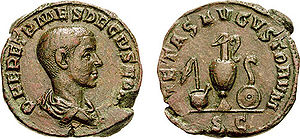
- See Pietas (goddess)Pietas (goddess)In Roman mythology, Pietas was the goddess of duty to one's state, gods and family and a personification of the Roman virtue of pietas. One of the di indigetes, her main temple was a 2nd century BC one in the Forum Holitorium....
for the divine personification of this virtue.
Pietas was one of the Roman
Ancient Rome
Ancient Rome was a thriving civilization that grew on the Italian Peninsula as early as the 8th century BC. Located along the Mediterranean Sea and centered on the city of Rome, it expanded to one of the largest empires in the ancient world....
virtue
Virtue
Virtue is moral excellence. A virtue is a positive trait or quality subjectively deemed to be morally excellent and thus is valued as a foundation of principle and good moral being....
s, along with gravitas
Gravitas
Gravitas was one of the Roman virtues, along with pietas, dignitas and virtus. It may be translated variously as weight, seriousness, dignity, or importance, and connotes a certain substance or depth of personality.-See also:*Auctoritas...
and dignitas. It is usually translated as "duty" or "devotion."
Definition
The word pietas is originally from Latin. The first printed record of the word’s use in English is from Anselm Bayly’s The Alliance of Music, Poetry, and Oratory, published in 1789. Georg WissowaGeorg Wissowa
Georg Otto August Wissowa was a German classical philologist who was born in Neudorf, near Breslau.Wissowa studied at the University of Breslau, and in 1886 became a professor at the University of Marburg, and in 1895 a professor at the University of Halle.Wissowa was a specialist in the study of...
notes that pietas was meant by the Romans as "the conduct of the man who performed all his duties towards the deity and his fellow human beings fully and in every respect." Around the year 70 BC, Cicero defined pietas as the virtue "which admonishes us to do our duty to our country or our parents or other blood relations."
Literary Examples
Roman literature has many examples of characters who exemplify the value of pietas, such as Virgil'sVirgil
Publius Vergilius Maro, usually called Virgil or Vergil in English , was an ancient Roman poet of the Augustan period. He is known for three major works of Latin literature, the Eclogues , the Georgics, and the epic Aeneid...
hero Aeneas. Aeneas embodies this virtue, and is particularly emblematic of it in book II of the Aeneid
Aeneid
The Aeneid is a Latin epic poem, written by Virgil between 29 and 19 BC, that tells the legendary story of Aeneas, a Trojan who travelled to Italy, where he became the ancestor of the Romans. It is composed of roughly 10,000 lines in dactylic hexameter...
when he flees burning Troy bearing his father, who carries the household gods
Household Gods
Household Gods is a science fiction time-travel novel written by Harry Turtledove and Judith Tarr.-Plot summary:The story focuses on Nicole Gunther-Perrin, a young lawyer in late 20th Century Los Angeles who is dissatisfied with her hectic life, which includes balancing her career with being a...
, on his back. In this example, Aeneas illustrates pietas both by carrying his father, which is devotion to family, and by rescuing the household gods, which is devotion to the gods.
In the Aeneid, Pietas is far more than a simple sense of devotion, as it is translated such, it is a dedication to everything, Aeneas's family, country, government, etc.
Historical Examples
CiceroCicero
Marcus Tullius Cicero , was a Roman philosopher, statesman, lawyer, political theorist, and Roman constitutionalist. He came from a wealthy municipal family of the equestrian order, and is widely considered one of Rome's greatest orators and prose stylists.He introduced the Romans to the chief...
exhibited pietas over the course of his life. One prominent example occurred when he was opposed politically by Quintus Caecilius Metellus Nepos
Quintus Caecilius Metellus Nepos
Quintus Caecilius Metellus Nepos was a son of Quintus Caecilius Metellus Balearicus. He was a Consul in 98 BC, having fought at the Iberian Peninsula against the Celtiberians and the Vaccaei, suffering before these ones a memorable defeat.He married Licinia Prima, who after widowed married the...
. Cicero excused Metellus' condemnation since it was because of Metellus' pietas for his brother. Cicero wrote, "Not only do I excuse your resentment, but I even pay it tribute of my highest commendation."