
See Also

Sardis

Sardis, , modern Sart in the Manisa province of Turkey Turkey

Turkey, officially the Republic of Turkey, is a Eurasia [i]n country that stretches across the Anatolia [i] ... 

, was the capital of the ancient kingdom of Lydia Lydia

Lydia is a historic region of western Anatolia [i], congruent with Turkey [i]'s modern provinces of Izmir [i] ... 

, the seat of a proconsul under the Roman Empire Roman Empire

The Roman Empire was a phase of the ancient Roman [i] civilization characterized by an autocratic [i] ... 

, and the metropolis of the province Lydia in later Roman and Byzantine Byzantine Empire

Byzantine Empire is the term conventionally used since the 19th century [i] to describe the Greek-spea ... 

 times. As one of the Seven churches of Asia, it was addressed by the author of the Book of Revelation Book of Revelation

[i] of John is the last [[Biblical canon|canonical book]... 

 in terms which seem to imply that its population was notoriously soft and fainthearted. Its importance was due, first to its military strength, secondly to its situation on an important highway leading from the interior to the Aegean Aegean Sea

The Aegean Sea is an arm of the Mediterranean Sea [i], located between the Greek peninsula and Anatolia [i] ... 

 coast, and thirdly to its commanding the wide and fertile plain of the Hermus.

Discussions

  Discussion Features

   Ask a question about 'Sardis'

   Start a new discussion about 'Sardis'

   Answer questions about 'Sardis'

   'Sardis' discussion forum

Timeline

480 BC   King Xerxes I Xerxes I of Persia

Xerxes I , was a Persian Emperor [i] of the Achaemenid dynasty [i]. ... 

 of Persia Persian Empire

The Persian Empire was a series of historical empires that ruled over the Iranian plateau [i] ... 

 marches from Sardis and onto Thrace Thrace

Thrace is a historical and geographic area in southeast Europe [i]. ... 

 and Macedonia.

1118   The Byzantine Byzantine Empire

Byzantine Empire is the term conventionally used since the 19th century [i] to describe the Greek-spea ... 

 general Philocales captured Sardis from the Seljuk Sultanate of Rum.


Encyclopedia


Sardis, , modern Sart in the Manisa province of Turkey Turkey

Turkey, officially the Republic of Turkey, is a Eurasia [i]n country that stretches across the Anatolia [i] ... 

, was the capital of the ancient kingdom of Lydia Lydia

Lydia is a historic region of western Anatolia [i], congruent with Turkey [i]'s modern provinces of Izmir [i] ... 

, the seat of a proconsul under the Roman Empire Roman Empire

The Roman Empire was a phase of the ancient Roman [i] civilization characterized by an autocratic [i] ... 

, and the metropolis of the province Lydia in later Roman and Byzantine Byzantine Empire

Byzantine Empire is the term conventionally used since the 19th century [i] to describe the Greek-spea ... 

 times. As one of the Seven churches of Asia, it was addressed by the author of the Book of Revelation Book of Revelation

[i] of John is the last [[Biblical canon|canonical book]... 

 in terms which seem to imply that its population was notoriously soft and fainthearted. Its importance was due, first to its military strength, secondly to its situation on an important highway leading from the interior to the Aegean Aegean Sea

The Aegean Sea is an arm of the Mediterranean Sea [i], located between the Greek peninsula and Anatolia [i] ... 

 coast, and thirdly to its commanding the wide and fertile plain of the Hermus.

Location


Sardis was situated in the middle of Hermus valley, at the foot of Mount Tmolus, a steep and lofty spur which formed the citadel. It was about 21/2 miles south of the Hermus. Today, the site is located by the present day village of Sart, near Salihli Salihli

Salihli is a district in Manisa Province [i] in Western Turkey.... 

 in the Manisa province of Turkey, close to the Ankara Ankara

Ankara is the capital [i] of Turkey [i] and the country's second largest city [i] ... 

 - Izmir Izmir

Izmir is the third most populous city of Turkey [i] and the country's largest port after Istanbul [i]... 

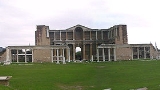
 highway . The part of remains including the bath-gymnasium complex, synagogue and Byzantine shops is open to visitors year-round.

History


The earliest reference to Sardis is in the The Persians The Persians

The Persians is a tragedy [i] by the ancient Greek [i] playwright Aeschylus [i]. ... 

of Aeschylus Aeschylus

Aeschylus was a playwright [i] of ancient Greece [i].
... 

 ; in the Iliad Iliad

The Iliad is, together with the Odyssey [i], one of two ancient Greek [i] epic [i]... 

 the name Hyde seems to be given to the city of the Maeonian  chiefs, and in later times Hyde was said to be the older name of Sardis, or the name of its citadel. It is, however, more probable that Sardis was not the original capital of the Maeonians, but that it became so amid the changes which produced the powerful Lydian empire of the 8th century BC.

The city was captured by the Cimmerians Cimmerians

The Cimmerians were ancient equestrian nomad [i]s who, according to Herodotus [i], originally inhabited ... 

 in the 7th century 7th century BC

----
The 7th century BC started on January 1 [i], 700 BC [i] and ended on December 31 [i], 601 BC [i]. ... 

, by the Persians Persian people

The Persians are an Iranian people [i] who speak the Persian language [i] and share a co ... 

 and by the Athenians Athens

Athens is the capital [i] and the largest city of Greece [i]. ... 

 in the 6th 6th century BC

----
The 6th century BC started on January 1 [i], 600 BC [i] and ended on December 31 [i], 501 BC [i]. ... 

, and by Antiochus III the Great Antiochus III the Great

Antiochus III the Great,, younger son of Seleucus II Callinicus [i], became ruler of the Seleucid Empire [i] ... 

 at the end of the 3rd century 3rd century BC

----
The 3rd century BC started on January 1 [i], 300 BC [i] and ended on December 31 [i], 201 BC [i]. ... 

. In the Persian era Sardis was conquered by Cyrus the Great Cyrus the Great

Cyrus the Great [i], also known as Cyrus II of Persia and Cyr ... 

 and formed the end station for the Persian Royal Road Royal Road

The Persian Royal Road was an ancient highway built by the Persian [i] king Darius I [i] ... 

 which began in Persepolis Persepolis

Persepolis was an ancient ceremonial capital of the second Iranian dynasty, the Achaemenid Empire [i], s ... 

, capital of Persia Persian Empire

The Persian Empire was a series of historical empires that ruled over the Iranian plateau [i] ... 

. Once at least, under the emperor Tiberius Tiberius

Tiberius Caesar Augustus, born Tiberius Claudius Nero , was the second Roman Emperor [i], from the ... 

, in 17 AD, it was destroyed by an earthquake; but it was always rebuilt. It was one of the great cities of western Asia Minor Anatolia

Anatolia is a region of Southwest Asia [i] which corresponds today to the Asiatic portion of Turkey [i] ... 

 till the later Byzantine period.

The early Lydian kingdom was far advanced in the industrial arts and Sardis was the chief seat of its manufactures. The most important of these trades was the manufacture and dyeing of delicate woollen stuffs and carpets. The stream Pactolus which flowed through the market-place "carried golden sands" in early antiquity, in reality gold dust out of Mt. Tmolus; later, trade and the organization of commerce continued to be sources of great wealth. After Constantinople Constantinople

Constantinople was the capital of the Byzantine Empire [i] and following its fall in 1453 [i], of the O ... 

 became the capital of the East, a new road system grew up connecting the provinces with the capital. Sardis then lay rather apart from the great lines of communication and lost some of its importance. It still, however, retained its titular supremacy and continued to be the seat of the metropolitan bishop of the province of Lydia, formed in 295 AD. It is enumerated as third, after Ephesus Ephesus

Ephesus or Efes , was one of the great cities of the Ionia [i]n Greeks in Anatolia [i], located in Lydia [i] ... 

 and Smyrna Izmir

Izmir is the third most populous city of Turkey [i] and the country's largest port after Istanbul [i]... 

, in the list of cities of the Thracesion thema Theme (Byzantine administrative unit)

The themes or themata of the Byzantine Empire [i] were administrative units established by a refor ... 

 given by Constantine Porphyrogenitus Constantine VII

Constantine VII Porphyrogennetos or Porphyrogenitus [i], " ... 

 in the 10th century 10th century

As a means of recording the passage of time [i], the 10th century was that century [i] which lasted from ... 

; but over the next four centuries it is in the shadow of the provinces of Magnesia ad Sipylum and Philadelphia, which retained their importance in the region.

The Hermus valley began to suffer from the inroads of the Seljuk Turks Seljuq dynasty

The Seljuqs were a Muslim dynasty of Oghuz Turkic [i] descentConcise Britannica Online a ... 

 about the end of the 11th century 11th century

As a means of recording the passage of time [i], the 11th century was that century [i] which lasted from ... 

; but the successes of the Greek general Philocales in 1118 relieved the district for the time, and the ability of the Comneni Komnenos

The Komnenos or Comnenus family was an important dynasty in the history of the [[Byzantine Empire]... 

, together with the gradual decay of the Seljuk power, retained it in the Byzantine dominions. The country round Sardis was frequently ravaged both by Christians and by Turks during the 13th century 13th century

As a means of recording the passage of time [i], the 13th century was that century [i] which lasted from ... 

. Soon after 1301, the Seljuk Turks overran the whole of the Hermus and Cayster valleys, and a fort on the citadel of Sardis was handed over to them by treaty in 1306. The city continued its decline until its capture by the Mongol Mongols

Mongols are an ethnic group [i] that originated in what is now Mongolia [i], Russia [i], and China [i] ... 

 warlord Timur Timur

Timur bin Taraghay Barlas was a 14th century warlord [i] of Turco-Mongol [i] descent, conqueror of much ... 

 in 1402.

Archaeological expeditions


By the nineteenth century, Sardis was in ruins, showing construction chiefly of the Roman period. The first large scale archaeological expedition in Sardis was directed by Howard Crosby Butler of Princeton University Princeton University

Princeton University is a coeducation [i]al private university [i] located in Princeton, New Jersey [i]. ... 

 between years 1910 - 1914, unearthing the Temple of Artemis, and more than a thousand Lydian tombs. The excavation campaign was halted by World War I World War I

World War I, also known as the First World War, the Great War and "The War to End All War... 

, followed by the Turkish War of Independence Turkish War of Independence

The Turkish War of Independence, or sometimes referred to as "birth of a nation" was part of the ... 

. Some surviving artifacts from the Butler excavation were added to the collection of the Metropolitan Museum of Art Metropolitan Museum of Art

The Metropolitan Museum of Art, often referred to simply as The Met, is one of the world's largest... 

 in New York New York

New York is a state [i] in the northeastern [i] United States [i]. ... 

.

Today, the laws governing archaeological expeditions in Turkey ensure that all archaeological artifacts remain in Turkey. Some of the important finds from the site of Sardis are housed in the Archaeological Museum of Manisa, including Late Roman mosaics and sculpture, a helmet from the mid-6th century BC, and pottery from various periods.

Sardis synagogue


Since 1958, both Harvard Harvard University

"Harvard" redirects here. For other uses of the name Harvard, see Harvard [i].
... 

 and Cornell Universities Cornell University

Cornell University is a private [i] research university [i] located in Ithaca, New York [i] ... 

 have sponsored annual archeological expeditions to Sardis. These excavations unearthed perhaps the most impressive synagogue in the western diaspora yet discovered from antiquity, yielding over eighty Greek and seven Hebrew inscriptions as well as numerous mosaic floors. The discovery of the Sardis synagogue has reversed previous assumptions about Judaism in the later Roman empire. Along with the discovery of the godfearers/theosebeis inscription from Aphrodisias Aphrodisias

Aphrodisias was a town in Caria [i], now part of modern Turkey [i], about 230 km [i] from Izmir [i]... 

, it provides indisputable evidence for the continued vitality of Jewish communities in Asia Minor, their integration into general Roman imperial civic life, and their size and importance at a time when many scholars previously assumed that Christianity had eclipsed Judaism.

The synagogue was a section of a large bath-gymnasium complex, that was in use for about 450 - 500 years. In the beginning, middle of the second century AD, the rooms the synagogue is situated in were used as changing rooms or resting rooms. The complex was destroyed in 616 AD by the Sassanian-Persians.

External links


  • , of the Harvard University Art Museums
  • , history of the archaeological excavations in Sardis, in the Harvard Magazine
  • , at the Metropolitan Museum of Art, New York
  • , a comprehensive photographic tour of the site


Bibliography


  • Sardis from Prehistoric to Roman Times: Results of the Archaeological Exploration of Sardis 1958-1975, George M. A. Hanfmann et. al., ISBN 0-674-78925-3, Harvard University Press