
All Topics  
Troy

 
Troy

   Email Print
   Bookmark   Link


Troy


Troy (Greek
Ancient Greek

Ancient Greek is the historical stage in the development of the Greek language spanning across the Archaic Greece , Classical Greece , and Hellenistic civilization periods of ancient Greece and the classical antiquity....
: , Troia, also , Ilion; Latin
Latin

Latin is an Italic language, historically spoken in Latium and Ancient Rome. Through the Military history of the Roman Empire, Latin spread throughout the Mediterranean and a large part of Europe....
: Troia, Ilium; Hittite
Hittite language

Hittite or Nesili is the extinct language once spoken by the Hittites, a people who created an empire centered on ancient Hattusas in north-central Anatolia ....
: Wilusa or Truwisa) is a legendary city and center of the Trojan War
Trojan War

In Greek mythology, the Trojan War was waged against the city of Troy by the Achaeans after Paris of Troy stole Helen from her husband Menelaus, the king of Sparta....
, as described in the Epic Cycle, and especially in the Iliad
ILiad

The iLiad is an electronic handheld device, or e-book device, which can be used for document reading and editing. Like the Sony Reader or Amazon Kindle, the iLiad makes use of an electronic paper display....
, one of the two epic poems attributed to Homer
Homer

Homer is traditionally held to be the author of the ancient Greek language epic poems the Iliad and the Odyssey, as well as of the Homeric Hymns....
. Trojan refers to the inhabitants and culture of Troy.

Today it is the name of an archaeological site, the traditional location of Homeric Troy, Turkish
Turkish language

Turkish is a language spoken by over 63 million people worldwide, making it the most commonly spoken of the Turkic languages. Its speakers are located predominantly in Turkey and Cyprus, with smaller groups in Iraq, Greece, Bulgaria, the Republic of Macedonia, Kosovo, Albania and other parts of Eastern Europe....
 Truva, in Hisarlik
Hisarlik

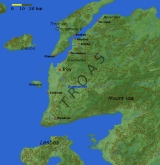
Hisarlik , is the modern name for the site of ancient Troy, also known as Ilion, and is located in what is now Turkey . The unoccupied archaeological site lies approximately 6.5 km from the Aegean Sea and equidistant from the Dardanelles....
 in Anatolia
Anatolia

Anatolia or Asia Minor is a region of Western Asia, comprising most of the modern Republic of Turkey. It is a geographic region bounded by the Black Sea to the north, the Caucasus to the northeast, the Aegean Sea to the west, the Mediterranean Sea to the south, and the Iranian plateau to the east and southeast....
, close to the seacoast in what is now Çanakkale province
Çanakkale Province

?anakkale is a province of Turkey, located in the northwestern part of the country. It takes its name from the town of ?anakkale.Like Istanbul Province, ?anakkale province has a European and an Asian part....
 in northwest Turkey
Turkey

Turkey , known officially as the Republic of Turkey , is a Eurasian country that stretches across the Anatolian peninsula in southwest Asia and Thrace in the Balkans region of Southern Europe....
, southwest of the Dardanelles
Dardanelles

.The Dardanelles , formerly known as the Hellespont, is a narrow strait in northwestern Turkey connecting the Aegean Sea to the Sea of Marmara....
 under Mount Ida.

A new city of Ilium was founded on the site in the reign of the Roman Emperor
Roman Emperor

The Roman Emperor was the ruler of the Roman Empire during the imperial period . The Romans had no single term for the office: Latin language titles such as imperator , Augustus , Caesar and princeps were all associated with it....
 Augustus.


Discussion
Ask a question about 'Troy'
Start a new discussion about 'Troy'
Answer questions from other users
Full Discussion Forum


Quotations


Andromache: 50,000 men did not come to watch your brother fight. You know this.

Andromache: To Hector I can't imagine life without you.

At night I sometimes see them. The faces of the men I killed. They're waiting for me on the far bank of the Styx. They say, Welcome, brother.

Briseis: I thought you were a dumb brute. I could have forgiven a dumb brute.

Briseis: Stop! Too many men have died today! If killing is your only talent, that's your curse. I don't want anyone dying for me.

Eudorus: We were going to sail home today. I don't think anyone's sailing home now.


Encyclopedia


Troy (Greek
Ancient Greek

Ancient Greek is the historical stage in the development of the Greek language spanning across the Archaic Greece , Classical Greece , and Hellenistic civilization periods of ancient Greece and the classical antiquity....
: , Troia, also , Ilion; Latin
Latin

Latin is an Italic language, historically spoken in Latium and Ancient Rome. Through the Military history of the Roman Empire, Latin spread throughout the Mediterranean and a large part of Europe....
: Troia, Ilium; Hittite
Hittite language

Hittite or Nesili is the extinct language once spoken by the Hittites, a people who created an empire centered on ancient Hattusas in north-central Anatolia ....
: Wilusa or Truwisa) is a legendary city and center of the Trojan War
Trojan War

In Greek mythology, the Trojan War was waged against the city of Troy by the Achaeans after Paris of Troy stole Helen from her husband Menelaus, the king of Sparta....
, as described in the Epic Cycle, and especially in the Iliad
ILiad

The iLiad is an electronic handheld device, or e-book device, which can be used for document reading and editing. Like the Sony Reader or Amazon Kindle, the iLiad makes use of an electronic paper display....
, one of the two epic poems attributed to Homer
Homer

Homer is traditionally held to be the author of the ancient Greek language epic poems the Iliad and the Odyssey, as well as of the Homeric Hymns....
. Trojan refers to the inhabitants and culture of Troy.

Today it is the name of an archaeological site, the traditional location of Homeric Troy, Turkish
Turkish language

Turkish is a language spoken by over 63 million people worldwide, making it the most commonly spoken of the Turkic languages. Its speakers are located predominantly in Turkey and Cyprus, with smaller groups in Iraq, Greece, Bulgaria, the Republic of Macedonia, Kosovo, Albania and other parts of Eastern Europe....
 Truva, in Hisarlik
Hisarlik

Hisarlik , is the modern name for the site of ancient Troy, also known as Ilion, and is located in what is now Turkey . The unoccupied archaeological site lies approximately 6.5 km from the Aegean Sea and equidistant from the Dardanelles....
 in Anatolia
Anatolia

Anatolia or Asia Minor is a region of Western Asia, comprising most of the modern Republic of Turkey. It is a geographic region bounded by the Black Sea to the north, the Caucasus to the northeast, the Aegean Sea to the west, the Mediterranean Sea to the south, and the Iranian plateau to the east and southeast....
, close to the seacoast in what is now Çanakkale province
Çanakkale Province

?anakkale is a province of Turkey, located in the northwestern part of the country. It takes its name from the town of ?anakkale.Like Istanbul Province, ?anakkale province has a European and an Asian part....
 in northwest Turkey
Turkey

Turkey , known officially as the Republic of Turkey , is a Eurasian country that stretches across the Anatolian peninsula in southwest Asia and Thrace in the Balkans region of Southern Europe....
, southwest of the Dardanelles
Dardanelles

.The Dardanelles , formerly known as the Hellespont, is a narrow strait in northwestern Turkey connecting the Aegean Sea to the Sea of Marmara....
 under Mount Ida.

A new city of Ilium was founded on the site in the reign of the Roman Emperor
Roman Emperor

The Roman Emperor was the ruler of the Roman Empire during the imperial period . The Romans had no single term for the office: Latin language titles such as imperator , Augustus , Caesar and princeps were all associated with it....
 Augustus. It flourished until the establishment of Constantinople
Constantinople

Constantinople was the empire capital of the Roman Empire , the Byzantine Empire , the Latin Empire , and the Ottoman Empire . Strategically located between the Golden Horn and the Sea of Marmara at the point where Europe meets Asia, Byzantine Constantinople had been the capital of a Christendom empire, successor to ancient ancient Greece...
 and declined gradually during the Byzantine
Byzantine Empire

Byzantine Empire and Eastern Roman Empire are conventional names used to describe the Roman Empire during the Middle Ages, centered on its capital of Constantinople....
 era.

In the 1870s a wealthy German
Germany

Germany , officially the Federal Republic of Germany , is a country in Central Europe. It is bordered to the north by the North Sea, Denmark, and the Baltic Sea; to the east by Poland and the Czech Republic; to the south by Austria and Switzerland; and to the west by France, Luxembourg, Belgium, and the Netherlands....
 businessman, Heinrich Schliemann
Heinrich Schliemann

Heinrich Schliemann...
, excavated the area. Later excavations revealed several cities built in succession to each other. One of the earlier cities (Troy VII
Troy VII

Troy VII, in the mound at Hisarlik, is an archaeological layer of Troy representing late Hittite Empire to Neo-Hittite times . It was a walled city with towers reaching a height of nine meters; the foundations of one of its bastions measure 18 meters by 18 meters....
) is often identified with Homeric Troy. While such an identity is disputed, the site has been successfully identified with the city called Wilusa
Wilusa

Wilusa was a city of the late Bronze Age Assuwa confederation of western Anatolia.It is known from six references in 13th century BC Hittite language sources, including...
 in Hittite
Hittite language

Hittite or Nesili is the extinct language once spoken by the Hittites, a people who created an empire centered on ancient Hattusas in north-central Anatolia ....
 texts; Ilion (which goes back to earlier Wilion with a digamma
Digamma

Digamma is an Archaic Greece letter of the Greek alphabet, used primarily as a Greek numeral.The letter had the phonetic value of a voiced labial-velar approximant ....
) is thought to be the Greek rendition of that name.

The archaeological site of Troy was added to the UNESCO World Heritage
World Heritage Site

A UNESCO World Heritage Site is a site that is on the list maintained by the international World Heritage Programme administered by the UNESCO World Heritage Committee, composed of 21 Sovereign state which are elected by their General Assembly for a four-year term....
 list in 1998.

Legendary Troy


Details concerning Troy were transmitted to the historical Greeks entirely through the written Epic Cycle, of which Homer's Iliad
ILiad

The iLiad is an electronic handheld device, or e-book device, which can be used for document reading and editing. Like the Sony Reader or Amazon Kindle, the iLiad makes use of an electronic paper display....
 is the familiar part. Other epic material, such as Cypria was known in Antiquity
Classical antiquity

Classical antiquity is a broad term for a long period of cultural history centered on the Mediterranean Sea, comprising the interlocking civilizations of Ancient Greece and Ancient Rome....
 but is lost to us. Further ancient material is only known to us in much later literary recension
Recension

Recension is the practice of editing or revising a text based on critical analysis. When referring to manuscripts, this may be a revision by another author....
s, such as the fourth century CE Posthomerica
Posthomerica

The Posthomerica is an epic poem by Quintus of Smyrna, probably written in the latter half of the 4th century, and telling the story of the period between the death of Hektor and the fall of Troy....
 of Quintus of Smyrna. Aside from this mass of material, modern philologists
Philology

Philology, derived from the Greek language considers both morphology and Meaning in linguistic expression, combining linguistics and literary studies....
 have laboured to tease out the few discernible threads of the earlier legendary material that preceded Homer, from which he worked.

According to Greek mythology
Greek mythology

Greek mythology is the body of myths and legends belonging to the Ancient Greece concerning their List of Greek mythological figures#Immortals and Greek hero cult, Cosmology#Metaphysical cosmology, and the origins and significance of their own cult and ritual practices....
 Troy was an ancient city in the Troad region of Anatolia
Anatolia

Anatolia or Asia Minor is a region of Western Asia, comprising most of the modern Republic of Turkey. It is a geographic region bounded by the Black Sea to the north, the Caucasus to the northeast, the Aegean Sea to the west, the Mediterranean Sea to the south, and the Iranian plateau to the east and southeast....
. It is presented anachronistically in legend as if it were part of the Greek culture of city-state
City-state

A city-state is an independent country whose territory consists solely of a single major city and the area immediately surrounding it. Examples include the city-states of ancient Greece , the Phoenician cities of Canaan , the Sumerian cities of Mesopotamia , the Mayans of pre-Columbian Mesoamerica , the central Asian cities along the Silk Roa...
s. Since the entire state comprised more than the city of Troy itself, anyone from its jurisdiction, which was mainly the Troad, might be termed "Trojan" in ancient literature. An alternative classical Greek and Latin term was "Teucrians
Tjeker

The Tjekker or Tjeker were one of the Sea Peoples and are known mainly from the Story of Wenamun The name tkr/skl has been transliterated variously as Tjekru, Tjekker, skl, Sikil, Djekker, etc....
", a name taken from an ethnicity of the south Troad. Troy was known for its riches gained from port trade with east and west, fancy clothes, iron production, and massive defensive walls. The major language spoken there and the derivative cultures remain uncertain. Legend for the most part ignores language and makes the presumption that Trojans were fluent in Greek.

The Trojan royal kinship, in Greek eyes, traced its descent from the Pleiad
Pleiades (mythology)

The Pleiades , , companions of Artemis, were the seven daughters of the Titan Atlas and the sea-nymph Pleione born on Mount Kyllini. They are the sisters of Calypso , Hyas, the Hyades , and the Hesperides....
 Electra
Electra (Pleiad)

The Pleiad Electra of Greek mythology was one of the seven daughters of Atlas and Pleione . Electra was the wife of Corythus. She was raped by Zeus and gave birth to Dardanus, who became the founder of Troy, ancestor of Priam and his house....
 and Zeus
Zeus

Zeus in Greek mythology is the king of the gods, the ruler of Mount Olympus and the god of the sky father and List of thunder gods. His symbols are the thunderbolt, eagle, bull , and oak....
, the parents of Dardanus
Dardanus

In Greek mythology, Dardanus was a son of Zeus and Electra , daughter of Atlas , and founder of the city of Dardania on Mount Ida in the Troad....
. According to Greek myths, Dardanus was originally from Arcadia
Arcadia

Arcadia, Arkad?a , or Arcady is a region of Greece in the Peloponnesus. It takes its name from the mythological character Arcas....
 but according to Roman myths, he was originally from Italy, having crossed over to Asia Minor from the island of Samothrace
Samothrace

Samothrace is a Greek island in the northern Aegean Sea. It is a self-governing deme in the prefecture of Evros, Greece. The island is long and is in size and has a population of 2,723 ....
, where he met King Teucer. Teucer was himself also a coloniser from Attica
Attica

Attica is a Peripheries of Greece in Greece, containing Athens, the capital of Greece. Attica is subdivided into the prefectures of Greece of Athens Prefecture, Piraeus Prefecture, East Attica and West Attica....
, and treated Dardanus with respect. Eventually Dardanus married Teucer's daughters, and founded Dardania (later ruled by Aeneas
Aeneas

This article is about the Roman hero. For other uses, see Aeneas .In Greco-Roman mythology, Aeneas was a Troy hero, the son of prince Anchises and the goddess Venus_....
). Upon Dardanus' death, the Kingdom was passed to his grandson Tros, who called the people Trojans and the land Troad, after himself. Ilus
Ilus

Ilus is the name of several mythological persons associated directly or indirectly with Troy....
, son of Tros, founded the city of Ilium (Troy) that he called after himself. Zeus gave Ilus the Palladium
Palladium (mythology)

In Greek mythology and Roman mythology, a palladium or palladion was an Cult image of great antiquity on which the safety of a city was said to depend....
. Poseidon
Poseidon

In Greek mythology, Poseidon was the god of the sea and, as "Earth-Shaker," of earthquakes. The name of the god Nethuns in Etruscan mythology was adopted in Latin for Neptune in Roman mythology: both were sea gods analogous to Poseidon....
 and Apollo
Apollo

In Greek mythology and Roman mythology, Apollo , is one of the most important and many-sided of the Twelve Olympians. The ideal of the kouros , Apollo has been variously recognized as a god of light and the sun; truth and prophecy; archery; medicine and healing; music, poetry, and the arts; and more....
 built the walls and fortifications around Troy for Laomedon
Laomedon

In Greek mythology, Laomedon was a Troy king, son of Ilus, brother of Ganymede and father of Priam, Astyoche, Lampus, Hicetaon, Clytius, Cilla , Proclia, Aethilla, Clytodora, and Hesione....
, son of Ilus the younger. When Laomedon refused to pay, Poseidon flooded the land and demanded the sacrifice of Hesione
Hesione

file:HerculesHesione.jpgIn Greek mythology, the most prominent Hesione was a Troy princess, daughter of King Laomedon of Troy, sister of Priam and second wife of King Telamon of Salamis Island....
 to a sea monster
Sea monster

Sea monsters are sea-dwelling legendary creatures, often believed to be of immense size.Marine monsters can take many forms, including sea dragons, sea serpents, or multi-armed beasts; they can be slimy or scaly, often spouting jets of water....
. Pestilence
Pestilence

A pestilence is any virulent and highly infectious disease that can cause an epidemic or even a pandemic. The word can also be used about parasites causing large scale sickness and death, such as Guinea worm....
 came and the sea monster snatched away the people of the plain.

Cassandra1
In Sardis
Sardis

Sardis, also Sardes , modern Sart in the Manisa province of Turkey, was the capital of the ancient kingdom of Lydia, one of the important cities of the Persian Empire, the seat of a proconsul under the Roman Empire, and the metropolis of the province Lydia in later Roman and Byzantine Empire times....
 a self-identified Heracleid dynasty ruled for 505 years until the time of Candaules
Candaules

Candaules , also known as Myrsilos was a king of the ancient Kingdom of Lydia from 735 BC to 718 BC. He succeeded Meles of Lydia and was followed by Gyges of Lydia....
. The dynasty's founding myth
Founding myth

A national myth is an inspiring narrative or anecdote about a nation's past. Such myths often serve as an important national symbol and affirm a set of national values....
 legitimizes their rule by asserting that one generation before the Trojan War
Trojan War

In Greek mythology, the Trojan War was waged against the city of Troy by the Achaeans after Paris of Troy stole Helen from her husband Menelaus, the king of Sparta....
, Heracles
Heracles

In Greek mythology, Heracles or Herakles meaning "glory of Hera", or "Glorious through Hera" Alcides or Alcaeus " was a hero, the son of Zeus and Alcmene, foster son of Amphitryon and great-grandson of Perseus....
 captured Troy and killed Laomedon and his sons, except for young Priam
Priam

In Greek mythology, Priam was the king of Troy during the Trojan War and youngest son of Laomedon. Modern scholars derive his name from the Luwian compound Priimuua, which means "exceptionally courageous"....
. Priam later became king. During his reign, the Mycenaean
Mycenaean Greece

Mycenaean Greece is a cultural period of ancient Greece taking its name from the archaeological site of Mycenae in northeastern Argolis, in the Peloponnese of southern Greece....
 Greeks invaded and captured Troy in the Trojan War (traditionally dated to 1193–1183 BCE, most recently dated to 1188 BCE). The Ionia
Ionia

Ionia is an ancient region of central coastal Anatolia in present-day Turkey, the region nearest Izmir, which was historically Smyrna. It consisted of the northernmost territories of the Ionian League of Hellenes settlements....
ns, Cimmerians
Cimmerians

The Cimmerians or Kimmerians were ancient equestrian nomads who, according to Herodotus, originally inhabited the region north of the Caucasus and the Black Sea, in what is now Ukraine and Russia, in the 8th century BC and 7th century BC....
, Phrygia
Phrygia

In antiquity, Phrygia was a kingdom in the west central part of Anatolia, in what is now modern-day Turkey. The Phrygians initially lived in the Southern Balkans; according to Herodotus, under the name of Bryges, changing it to Phruges after their final migration to Anatolia, via the Hellespont....
ns, Milesians
Miletus

Miletus was an ancient city on the western coast of Anatolia , near the mouth of the Maeander River in ancient Caria. Evidence of first settlement at the site has been made inaccessible by the rise of sea level and deposition of sediments from the Maeander....
 of Sinope
Sinop, Turkey

Sinop is a city with a population of 47,000 on Ince Burun , by its Cape Sinop which is situated on the most northern edge of the Turkish side of Black Sea coast, in the ancient region of Paphlagonia, in modern-day northern Turkey, historically known as Sinope....
, and Lydia
Lydia

Lydia was an Iron Age kingdom of western Asia Minor located generally east of ancient Ionia in the modern Turkey provinces of Manisa Province and inland Izmir Province....
ns moved into Asia Minor. The Persians
Persian Empire

The 'Persian Empire' was a series of successive Iranian or Persianization empires that ruled over the Iranian plateau, the original Persian homeland, and beyond in Southwest Asia, South Asia, Central Asia and the Caucasus....
 invaded in 546 BCE.

Several far-flung tribes claimed descent from the Trojans: the Paeonians, the Elymi of Egesta, and the west Libyan Maxyes. The Trojan ships transformed into naiad
Naiad

In Greek mythology, the Naiads or Naiades were a type of nymph who presided over fountains, wells, springs, streams, and brooks.They are distinct from river gods, who embodied rivers, and the very ancient spirits that inhabited the still waters of marshes, ponds and lagoon-lakes, such as pre-Mycenaean Lerna in the Argolid....
s, who rejoiced to see the wreckage of Odysseus
Odysseus

Odysseus or Ulysses , in Greek mythology , was a legendary Greeks king of Ithaca and the hero of Homer's Epic poetry, the Odyssey. Odysseus also plays a key role in Homer's Iliad and other works in the Epic Cycle....
' ship.

Some famous Trojans are Dardanus
Dardanus

In Greek mythology, Dardanus was a son of Zeus and Electra , daughter of Atlas , and founder of the city of Dardania on Mount Ida in the Troad....
 (founder of Troy), Laomedon
Laomedon

In Greek mythology, Laomedon was a Troy king, son of Ilus, brother of Ganymede and father of Priam, Astyoche, Lampus, Hicetaon, Clytius, Cilla , Proclia, Aethilla, Clytodora, and Hesione....
, Ganymede
Ganymede (mythology)

In Greek mythology, Ganymede, or Ganymedes is a divine hero whose homeland was the Troad. He was a Troy prince, son of the eponym Tros of Dardania, and of Callirrhoe , and brother of Ilus and Assaracus....
, Priam
Priam

In Greek mythology, Priam was the king of Troy during the Trojan War and youngest son of Laomedon. Modern scholars derive his name from the Luwian compound Priimuua, which means "exceptionally courageous"....
 and his children (including Paris
Paris (mythology)

Paris , the son of Priam, king of Troy, appears in a number of Greek mythology. Probably the best-known was his elopement with Helen, queen of Sparta, this being one of the immediate causes of the Trojan War....
, Cassandra
Cassandra

In Greek mythology, Cassandra was the daughter of King Priam and Queen Hecuba of Troy. Her beauty caused Apollo to grant her the gift of prophecy....
, and Troilus
Troilus

Troilus is a legendary character associated with the story of the Trojan War. The first surviving reference to him is in Homer's Iliad which is believed to have been written in the late 9th century BC or 8th century BC....
), Tithonus
Tithonus

In Greek mythology, Tithonus or Tithonos was the lover of Eos, Titan of the dawn. He was a Troy by birth, the son of King Laomedon of Troy by a Naiad named Strymo ....
, Corythus
Corythus

Corythus is the name of six mortal men in Greek mythology*Corythus, son of Paris and Oenone. After Paris abandoned Oenone, she sent the boy, now grown, to Troy, where he fell in love with Helen, and she received him warmly....
, Aeneas
Aeneas

This article is about the Roman hero. For other uses, see Aeneas .In Greco-Roman mythology, Aeneas was a Troy hero, the son of prince Anchises and the goddess Venus_....
, and Brutus
Brutus of Troy

Brutus or Brute of Troy is a legendary descendant of the Troy hero Aeneas, was known in medieval British legend as the eponymous founder and first king of Great Britain....
. Kapys, Boukolion, and Aisakos
Aesacus

Aesacus or Aisakos, in Greek mythology, was a son of King Priam of Troy. Aesacus sorrowed for the death of his wife or would-be lover, a daughter of the river Cebren, and was transformed into a bird....
 were Trojan princes who had naiad
Naiad

In Greek mythology, the Naiads or Naiades were a type of nymph who presided over fountains, wells, springs, streams, and brooks.They are distinct from river gods, who embodied rivers, and the very ancient spirits that inhabited the still waters of marshes, ponds and lagoon-lakes, such as pre-Mycenaean Lerna in the Argolid....
 wives. Some of the Trojan allies were the Lycians
Lycians

The Lycians were the ancient inhabitants of Lycia....
, the Ethiopians led by Memnon
Memnon (mythology)

In Greek mythology, Memnon was an Ethiopia king and son of Tithonus and Eos. At the Trojan War, he brought an army to Troy's defense and was killed by Achilles in retribution for killing Antilochus....
, and the Amazons
Amazons

The Amazons , ) are a nation of all-female warriors in Classical and Greek mythology, who were possibly historical. Herodotus placed them in a region bordering Scythia in Sarmatians....
, led by their Queen Hippolyta
Hippolyta

In Greek mythology, Hippolyta or Hippolyte is the Amazons queen who possessed a magical girdle she was given by her father Ares, the god of war....
. The Aisepid nymph
Nymph

In Greek mythology, a nymph is any member of a large class of mythological entities in human form. They were typically associated with a particular location or landform....
s were the naiad
Naiad

In Greek mythology, the Naiads or Naiades were a type of nymph who presided over fountains, wells, springs, streams, and brooks.They are distinct from river gods, who embodied rivers, and the very ancient spirits that inhabited the still waters of marshes, ponds and lagoon-lakes, such as pre-Mycenaean Lerna in the Argolid....
s of the Trojan River Aisepos
Aesepus

In Greek mythology, Aesepus was the son of the naiads Abarbarea and Bucolion. His twin brother was Pedasus; the pair appears briefly in the Iliad, Book VI....
. Pegsis was the naiad of the River Granicus
Granicus

Biga ?ayi or Kocabas ?ayi is a small water flow in northwestern Turkey. The flow begins at the base of the Mount Ida and trends generally northeasterly to the Sea of Marmara....
 near Troy. "Helen of Troy" was born not in Troy, but in Sparta
Sparta

Sparta was a city-state in ancient Greece, situated on the Eurotas River in the southern part of the Peloponnese. From circa 650 BC it rose to become the dominant military power in the region and as such was recognized as the overall leader of the combined Greek forces during the Greco-Persian Wars....
, of which she was queen until she eloped with Paris to Troy.

Mount Ida in Asia Minor is where Ganymede was abducted by Zeus, where Anchises
Anchises

In Greek mythology, Anchises was a son of Capys and Themiste or Hieromneme, a naiad. His major claim to fame in Greek mythology is that he was a mortal lover of the goddess Aphrodite ....
 was seduced by Aphrodite
Aphrodite

Aphrodite is the classical Greek mythology goddess of love, sex, and beauty. According to Greek oral poet Hesiod, she was born when Uranus was castrated by his son Cronus....
, where Aphrodite gave birth to Aeneas
Aeneas

This article is about the Roman hero. For other uses, see Aeneas .In Greco-Roman mythology, Aeneas was a Troy hero, the son of prince Anchises and the goddess Venus_....
, where Paris lived as a shepherd, where the nymphs lived, where the "Judgement of Paris
Judgement of Paris

The Judgement of Paris is a story from Greek mythology, which was one of the events that led up to the Trojan War and to the foundation of Rome....
" took place, where the Greek gods watched the Trojan War, where Hera
Hera

In the Twelve Olympians of classical Greek Mythology, Hera or Here was the wife and older sister of Zeus. Her chief function was as goddess of women and marriage....
 distracted Zeus with her seductions long enough to permit the Achaeans, aided by Poseidon, to hold the Trojans off their ships, and where Aeneas
Aeneas

This article is about the Roman hero. For other uses, see Aeneas .In Greco-Roman mythology, Aeneas was a Troy hero, the son of prince Anchises and the goddess Venus_....
 and his followers rested and waited until the Greeks
Greeks

The Greeks , also known as Hellenes, are a nation and ethnic group native to Greece, Cyprus and neighbouring regions, who can also be found in Greek diaspora communities around the world....
 set out for Greece
Greece

Greece , officially the Hellenic Republic , is a country in southeastern Europe, situated on the southern end of the Balkans. It has borders with Albania, Bulgaria and the former Yugoslav Republic of Macedonia to the north, and Turkey to the east....
. Buthrotos
Butrint

Butrint is an Ancient Greek city and an archaeology site in Sarand? District, Albania, some 14 kilometres south of Sarand? and close to the Greece border....
 (or Buthrotum) was a city in Epirus
Epirus (region)

Epirus is a region in south-eastern Europe, currently divided between the Peripheries of Greece Epirus in Greece and the prefectures of Gjirokast?r, Vlor?, Kor??, and Berat in southern Albania....
 where Helenus
Helenus

Helenus was a Trojan soldier and prophet in the Trojan War.In Greek mythology, Helenus was the son of King Priam and Queen Hecuba of Troy, and the twin brother of the prophetess Cassandra....
, the Trojan seer
Clairvoyance

Clairvoyance is the apparent ability to gain information about an object, person, location or physical event through means other than the known human senses, a form of extra-sensory perception....
, built a replica of Troy. Aeneas landed there and Helenus foretold his future.

Homeric Troy

Troy1
Ancient Greek historians placed the Trojan War variously in the 12th, 13th or 14th century BCE: Eratosthenes
Eratosthenes

Eratosthenes of Cyrene was a Greeks mathematician, poet, sportsperson, geographer and astronomer. He made several discoveries and inventions including a system of latitude and longitude....
 to 1184 BCE, Herodotus
Herodotus

Herodotus of Halicarnassus was a Greeks historian who lived in the 5th century BC and is regarded as the "Father of History" in Western culture....
 to 1250 BCE, Duris of Samos
Duris of Samos

Duris of Samos ; probably born around 350 BC; died after 281 BC) was a Greeks historian and was at some period tyrant of Samos Island....
 to 1334 BCE. Modern archaeologists associate Homeric Troy with archaeological Troy VII
Troy VII

Troy VII, in the mound at Hisarlik, is an archaeological layer of Troy representing late Hittite Empire to Neo-Hittite times . It was a walled city with towers reaching a height of nine meters; the foundations of one of its bastions measure 18 meters by 18 meters....
.

In the Iliad, the Achaeans
Achaeans

The Achaeans is one of the collective names used for the Greeks in Homer's Iliad and Odyssey. The other names are the Danaans and Argives ....
 set up their camp near the mouth of the river Scamander
Scamander

In Greek mythology, Scamander was a river god, son of Oceanus and Tethys according to Hesiod. Scamander is also thought of as the river god, son of Zeus....
 (presumably modern Karamenderes), where they had beached their ships. The city of Troy itself stood on a hill, across the plain of Scamander, where the battles of the Trojan War took place. The site of the ancient city is some 5 kilometers from the coast today, but the ancient mouths of alleged Scamander, some 3,000 years ago, were about that distance inland, pouring into a large bay which formed a natural harbour, but has since been filled with alluvial material. Recent geological findings have permitted the reconstruction of how the original Trojan coastline would have looked, and the results largely confirm the accuracy of the Homeric geography of Troy.

Besides the Iliad, there are references to Troy in the other major work attributed to Homer, the Odyssey
Odyssey

The Odyssey is one of two major ancient Hellenic civilization epic poetrys attributed to Homer. It is, in part, a sequel to the Iliad, the other work traditionally ascribed to Homer....
, as well as in other ancient Greek literature. The Homeric legend of Troy was elaborated by the Roman poet Virgil
Virgil

Publius Vergilius Maro was a classical Roman poet, best known for three major works?the Bucolics , the Georgics and the Aeneid?although several Appendix Vergiliana are also attributed to him....
 in his work the Aeneid
Aeneid

The Aeneid is a Latin Epic poetry written by Virgil in the late 1st century BC that tells the legendary story of Aeneas, a Troy who traveled to Italy, where he became the ancestor of the Rome....
. The Greeks and Romans took for a fact the historicity of the Trojan War, and in the identity of Homeric Troy with the site in Anatolia. Alexander the Great
Alexander the Great

Alexander the Great , also known as Alexander III of Macedon was an ancient Greeks King of Macedon . He was one of the most successful military commanders of all time and is presumed undefeated in battle....
, for example, visited the site in 334 BCE and made sacrifices at the alleged tombs of the Homeric heroes Achilles
Achilles

In Greek mythology, Achilles was a Greeks hero of the Trojan War, the central character and the greatest warrior of Homer's Iliad, which takes for its theme ; the Wrath of Achilles....
 and Patroclus
Patroclus

In Greek mythology, as recorded in the Iliad by Homer, Patroclus, or Patroklos , son of Menoetius , was Achilles? beloved comrade and, according to some , his lover....
.

In November 2001, geologists John C. Kraft from the University of Delaware
University of Delaware

The University of Delaware is the largest university in the U.S. state of Delaware. The main campus is located in Newark, Delaware, with satellite campuses in Dover, Delaware, Wilmington, Delaware, Lewes, Delaware and Georgetown, Delaware....
 and John V. Luce from Trinity College, Dublin
Trinity College, Dublin

Trinity College, Dublin , corporately designated as the Provost, Fellows and Scholars of the College of the Holy and Undivided Trinity of Queen Elizabeth near Dublin, was founded in 1592 by Queen Elizabeth I of England as the "mother of a university", and is the only constituent residential college of the University of Dublin....
 presented the results of investigations, begun in 1977, into the geology
Geology

Geology is the science and study of the solid and liquid matter that constitute the Earth. The field of geology encompasses the study of the composition, structural geology, physical properties, dynamics, and History of the Earth of Earth materials, and the processes by which they are formed, moved, and changed....
 of the region. They compared the present geology with the landscapes and coastal features described in the Iliad and other classical sources, notably Strabo
Strabo

Strabo was a Ancient Greeks history, geography and philosophy....
's Geographia, and concluded that there is a regular consistency between the location of Schliemann's Troy and other locations such as the Greek camp, the geological evidence, descriptions of the topography
Topography

Topography is the study of Earth's surface shape and features or those ofplanets, Natural satellite, and asteroids. It is also the description of such surface shapes and features ....
 and accounts of the battle in the Iliad. Further work by John Kraft and others was published in 2003.

After the 1995 find of a Luwian biconvex seal at Troy VII, there has been a heated discussion over the language that was spoken in Homeric Troy
Trojan language

The language spoken by the Trojans in the Iliad is Homeric Greek. However, it is unlikely that this is the language actually spoken by the inhabitants of Troy....
. Frank Starke of the University of Tübingen recently demonstrated that the name of Priam
Priam

In Greek mythology, Priam was the king of Troy during the Trojan War and youngest son of Laomedon. Modern scholars derive his name from the Luwian compound Priimuua, which means "exceptionally courageous"....
 is connected to the Luwian compound Priimuua, which means 'exceptionally courageous'. 'The certainty is growing that Wilusa/Troy belonged to the greater Luwian-speaking community', although it is not entirely clear whether Luwian was primarily the official language or in daily colloquial use.

Archaeological Troy


The layers of ruins in the citadel at Hisarlik are numbered Troy I Troy IX, with various subdivisions:

  • Troy I 3000–2600 (Western Anatolian EB 1)
  • Troy II 2600–2250 (Western Anatolian EB 2)
  • Troy III 2250–2100 (Western Anatolian EB 3 [early])
  • Troy IV 2100–1950 (Western Anatolian EB 3 [middle])
  • Troy V: 20th–18th centuries BCE (Western Anatolian EB 3 [late])
  • Troy VI: 17th–15th centuries BCE
  • Troy VIh: late Bronze Age, 14th century BCE
  • Troy VII
    Troy VII

    Troy VII, in the mound at Hisarlik, is an archaeological layer of Troy representing late Hittite Empire to Neo-Hittite times . It was a walled city with towers reaching a height of nine meters; the foundations of one of its bastions measure 18 meters by 18 meters....
    a: ca. 1300–1190 BC, most likely setting for Homer's story
  • Troy VIIb1: 12th century BCE
  • Troy VIIb2: 11th century BCE
  • Troy VIIb3: until ca. 950 BCE
  • Troy VIII: around 700 BCE
  • Troy IX: Hellenistic Ilium, 1st century BCE


The archaeological site of Troy was added to the UNESCO World Heritage list in 1998.

Troy I–V

The first city was founded in the 3rd millennium BCE. During the Bronze Age, the site seems to have been a flourishing mercantile city, since its location allowed for complete control of the Dardanelles
Dardanelles

.The Dardanelles , formerly known as the Hellespont, is a narrow strait in northwestern Turkey connecting the Aegean Sea to the Sea of Marmara....
, through which every merchant ship from the Aegean Sea
Aegean Sea

The Aegean Sea is an elongated embayment of the Mediterranean Sea located between the southern Balkans and Anatolian peninsulas, i.e., between the mainlands of Greece and Turkey respectively....
 heading for the Black Sea
Black Sea

The Black Sea is an inland sea sea bounded by southeastern Europe, the Caucasus and the Anatolia and is ultimately connected to the Atlantic Ocean via the Mediterranean Sea and Aegean Seas and various straits....
 had to pass.

Troy VI

Troy VI was destroyed around 1300 BCE, probably by an earthquake
Earthquake

An earthquake is the result of a sudden release of energy in the Earth's crust that creates seismic waves. Earthquakes are recorded with a seismometer, also known as a seismograph....
. Only a single arrowhead was found in this layer, and no remains of bodies.

Troy VII

Troy VIIa, which has been dated to the mid- to late-13th century BCE, is the most often-cited candidate for the Troy of Homer. It appears to have been destroyed by war.

Troy IX

The last city on this site, Hellenistic Ilium, was founded by Romans
Roman Empire

The Roman Empire was the Roman Republic phase of the Ancient Rome, characterised by an autocracy form of government and large territorial holdings in Europe and around the Mediterranean....
 during the reign of the emperor Augustus and was an important trading city until the establishment of Constantinople
Constantinople

Constantinople was the empire capital of the Roman Empire , the Byzantine Empire , the Latin Empire , and the Ottoman Empire . Strategically located between the Golden Horn and the Sea of Marmara at the point where Europe meets Asia, Byzantine Constantinople had been the capital of a Christendom empire, successor to ancient ancient Greece...
 in the fourth century as the eastern capital of the Roman Empire
Roman Empire

The Roman Empire was the Roman Republic phase of the Ancient Rome, characterised by an autocracy form of government and large territorial holdings in Europe and around the Mediterranean....
. In Byzantine
Byzantine Empire

Byzantine Empire and Eastern Roman Empire are conventional names used to describe the Roman Empire during the Middle Ages, centered on its capital of Constantinople....
 times the city declined gradually, and eventually disappeared.

Beneath part of the Roman city, the ruins of which cover a much larger area than the citadel excavated by Schliemann, recent excavations have found traces of an additional Bronze-Age settlement area (of lower status than the adjoining citadel) defended by a ditch.

Excavation campaigns

With the rise of modern critical history, Troy and the Trojan War were consigned to the realms of legend. However, the true location of ancient Troy had from classical
Classical antiquity

Classical antiquity is a broad term for a long period of cultural history centered on the Mediterranean Sea, comprising the interlocking civilizations of Ancient Greece and Ancient Rome....
 times remained the subject of interest and speculation, so when in 1822 the Scottish journalist Charles Maclaren
Charles Maclaren

Charles Maclaren was a Scottish editor born in Ormiston, Haddingtonshire, the son of a farmer and cattle-dealer. He was almost entirely self-educated, and when a young man became a clerk in Edinburgh....
 reviewed the available material and published A dissertation on the topography of the plain of Troy he was able to identify with confidence the position of the acropolis
Acropolis

Acropolis literally means city on the edge . For purposes of defense, early settlers naturally chose elevated ground, frequently a hill with precipitous sides....
 of Augustus's New Ilium in north-western Anatolia. In 1866 Frank Calvert
Frank Calvert

Frank Calvert was an England expatriate who was a consular official in the eastern Mediterranean region and an amateur archaeologist. He began excavating Hissarlik , 7 years before the arrival of Heinrich Schliemann....
, the brother of the United States' consular agent
Consul

Consul was the highest elected office of the Roman Republic and an appointive office under the Roman Empire. The title was also used in other city states, and revived in modern states, notably French Republic before the Napoleon I of Franceic counter-revolution....
 in the region, made extensive surveys and published in scholarly journals his identification of the hill of New Ilium (which was on farmland owned by his family) as the site of ancient Troy. The hill, near the town of Chanak
Çanakkale

?anakkale is a town and seaport in Turkey, in ?anakkale Province, on the southern coast of the Dardanelles at their narrowest point.?anakkale Province, like Istanbul Province, has territory in both Europe and Asia....
, was known to the Turks as Hisarlik.

Schliemann

In 1868 the German, self-taught archaeologist
Archaeology

Archaeology, archeology, or arch?ology is the science that studies Homo cultures through the recovery, documentation, analysis, and interpretation of material remains and environmental data, including architecture, Artifact , features, Biofact s, and cultural landscape....
 Heinrich Schliemann
Heinrich Schliemann

Heinrich Schliemann...
 visited Calvert and secured permission to excavate Hisarlik. In the 1870s (in two campaigns, 1871–73 and 1878–9) he excavated the hill and discovered the ruins of a series of ancient cities dating from the Bronze Age
Bronze Age

The Bronze Age is, with respect to a given prehistory, the period in that society when the most advanced metalworking included smelting copper and tin from naturally-occurring outcroppings of copper and tin ores, creating a bronze alloy by melting those metals together, and casting them into bronze artifact s....
 to the Roman period. Schliemann declared one of these cities—at first Troy I, later Troy II—to be the city of Troy, and this identification was widely accepted at that time. Schliemann's finds at Hisarlik have become known as Priam's Treasure
Priam's Treasure

Priam?s Treasure is a cache of gold and other artifacts discovered by classical archaeologist Heinrich Schliemann. Schliemann claimed the site to be that of ancient Troy, and assigned the artifacts to the Iliad king Priam....
. They were acquired from him by the Berlin museums, but significant doubts about their authenticity persist.
Ac

Dörpfeld, Blegen

After Schliemann, the site was further excavated under the direction of Wilhelm Dörpfeld
Wilhelm Dörpfeld

Wilhelm D?rpfeld was a Germany architect, best known for his contributions to classical archaeology.D?rpfeld was born in Barmen, Wuppertal. In 1877 he became an assistant at the Olympia, Greece excavations under Richard Bohn, Friedrich Adler , and Ernst Curtius....
 (1893-4) and later Carl Blegen
Carl Blegen

Carl William Blegen was an archaeologist famous for his work on the site of Pylos in modern day Greece and Troy in modern day Turkey. Blegen was professor of classical archaeology at the University of Cincinnati, Ohio ....
 (1932-8). These excavations have shown that there were at least nine cities built one on top of each other at this site.

Korfmann

In 1988 excavations were resumed by a team of the University of Tübingen
Eberhard Karls University of Tübingen

Eberhard Karls University, T?bingen is a public university located in the city of T?bingen, Baden-W?rttemberg, Germany. It is one of Germany's oldest universities, internationally noted in medicine, natural sciences and the humanities....
 and the University of Cincinnati
University of Cincinnati

The University of Cincinnati is a coeducational public university research university in Cincinnati, Ohio, Ohio, part of the University System of Ohio....
 under the direction of Professor Manfred Korfmann
Manfred Korfmann

Manfred O. Korfmann was a Germany archaeology....
. Possible evidence of a battle was found in the form of arrowheads found in layers dated to the early 12th century BCE. The question of Troy's status in the Bronze Age world has been the subject of a sometimes acerbic debate between Korfmann and the Tübingen historian Frank Kolb
Frank Kolb

Frank Kolb is a Germany professor of ancient history at the Eberhard Karls University of T?bingen in Germany. He has been involved in a controversy over findings concerning the late Bronze Age in Troy, and accused Dr....
 in 2001/2002.

In August 2003 following a magnetic imaging survey of the fields below the fort, a deep ditch was located and excavated among the ruins of a later Greek and Roman city. Remains found in the ditch were dated to the late Bronze Age, the alleged time of Homeric Troy. It is claimed by Korfmann that the ditch may have once marked the outer defences of a much larger city than had previously been suspected.

Pernicka

In summer 2006 the excavations continued under the direction of Korfmann's colleague Ernst Pernicka, with a new digging permit.

Hittite and Egyptian evidence

In the 1920s the Swiss
Switzerland

Switzerland is a landlocked Swiss Alps country of roughly 7.7 million people in Western Europe with an area of 41,285 km?. Switzerland is a federal republic consisting of 26 states called Cantons of Switzerland....
 scholar Emil Forrer claimed that placenames found in Hittite
Hittite language

Hittite or Nesili is the extinct language once spoken by the Hittites, a people who created an empire centered on ancient Hattusas in north-central Anatolia ....
 texts—Wilusa and Taruisa—should be identified with Ilium and Troia respectively. He further noted that the name of Alaksandus, king of Wilusa, mentioned in one of the Hittite texts is quite similar to the name of Prince Alexandros or Paris, of Troy.

An unnamed Hittite
Hittites

The Hittites were an ancient Anatolian people who spoke a Hittite language of the Anatolian languages of the Indo-European languages family, and established a kingdom centered at Hattusa in north-central Anatolia ca....
 king wrote a letter to the king of the Ahhiyawa, treating him as an equal and implying that Miletus
Miletus

Miletus was an ancient city on the western coast of Anatolia , near the mouth of the Maeander River in ancient Caria. Evidence of first settlement at the site has been made inaccessible by the rise of sea level and deposition of sediments from the Maeander....
 (Millawanda) was controlled by the Ahhiyawa, and also referring to an earlier "Wilusa episode" involving hostility on the part of the Ahhiyawa. This people has been identified with the Homeric Greeks (Achaeans
Achaeans

The Achaeans is one of the collective names used for the Greeks in Homer's Iliad and Odyssey. The other names are the Danaans and Argives ....
). The Hittite king was long held to be Mursili II
Mursili II

Mursili II was a king of the Hittite Empire ca. 1321 ? 1295 BC . He was the younger son of Suppiluliuma I, one of the most powerful rulers of the Hittite Empire....
 (ca 1321–1296), but since the 1980s his son Hattusili III
Hattusili III

Hattusili III was a king of the Hittite empire ca. 1267 ? 1237 BC . He was the fourth and last son of Mursili II. Mursili appointed Hattusili as priest of Sausga of Samuha, and Hattusili remained loyal to the "Ishtar of Samuha" to the end of his days....
 (1265–1240) is commonly preferred, although Mursili's other son Muwatalli (ca. 1296–1272) is still considered a possibility.

The nation T-R-S is mentioned as one of the "Peoples of the Sea
Sea Peoples

The Sea Peoples is the term used for a confederacy of seafaring raiders of the second millennium BC who sailed into the eastern shores of the Mediterranean, caused political unrest, and attempted to enter or control Egyptian territory during the late Nineteenth dynasty of Egypt, and especially during Year 8 of Ramesses III of the Twentieth dy...
" in ancient Egyption inscriptions.

An Egyptian
Ancient Egypt

Ancient Egypt was an Ancient history civilization in eastern North Africa, concentrated along the lower reaches of the Nile in what is now the modern nation of Egypt....
 inscription at Deir al-Madinah
Deir al-Madinah

Deir el-Madinah is an ancient Egyptian village which was home to the artisans who built the temples and tombs ordered by the Pharaohs and other dignitaries in the Valley of the Kings during the New Kingdom period ...
 records a victory of Ramesses III
Ramesses III

Usimare Ramesses III was the second Pharaoh of the Twentieth dynasty of Egypt and is considered to be the last great New Kingdom king to wield any substantial authority over Egypt....
 over Sea Peoples, including some named Tursha (spelled [twrš3] in Egyptian script). These are probably the same as the earlier Teresh (found written as [trš.w]) of the Merneptah Stele
Merneptah Stele

The Merneptah Stele ? also known as the Israel Stele or Victory Stele of Merneptah ? is an inscription by the Ancient Egyptian Pharaoh Merneptah , which appears on the reverse side of a granite stela erected by the Pharaoh Amenhotep III....
, commemorating Merneptah
Merneptah

Merneptah was the fourth ruler of the Nineteenth dynasty of Egypt of Ancient Egypt. He ruled Egypt for almost ten years between late July or early August 1213 to May 2, 1203 BC, according to contemporary historical records....
’s victory in a Libyan campaign at about 1220 BCE. Although this may be too early for the Trojan War
Trojan War

In Greek mythology, the Trojan War was waged against the city of Troy by the Achaeans after Paris of Troy stole Helen from her husband Menelaus, the king of Sparta....
, some scholars have connected the name to the city mentioned in Hittite records as Taruisas, or Troy.

These identifications were rejected by many scholars as being improbable or at least not provable. Trevor Bryce in 1998 championed them in his book The Kingdom of the Hittites, citing a recovered piece of the so-called Manapa-Tarhunda letter, which refers to the kingdom of Wilusa as beyond the land of the Seha (known in classical times as the Caicus
Caicus

Bakir?ay is the ancient name of a river of Asia Minor that rises in the Temnus mountains and flows through Lydia, Mysia, and Aeolis before it debouches into the Elatic Gulf....
) river, and near the land of Lazpa (Lesbos Island
Lesbos Island

Lesbos is a Greece List of islands of Greece located in the northeastern Aegean Sea. It has an area of 1632 Square kilometre with 320 kilometres of coastline, making it the third largest Greek island and the largest of the numerous Greek islands scattered in the Aegean....
).

Recent evidence adds weight to the theory that Wilusa is identical to archaeological Troy. Hittite texts mention a water tunnel
Water tunnel (physical infrastructure)

Water tunnels are tunnels used to transport water to areas with large populations or agriculture. They are part of aqueducts....
 at Wilusa, and a water tunnel excavated by Korfmann, previously thought to be Roman, has been dated to around 2600 BCE. The identifications of Wilusa with archaeological Troy and of the Achaeans with the Ahhiyawa remain controversial, but gained enough popularity during the 1990s to be considered a majority opinion.

Trojan language and script

The language of Trojans is unknown, although several Trojan names may be identified as Luwian. The status of the so-called Trojan script
Trojan script

Trojan script is a series of signs of unknown origin found on vessels from Troy excavated by Heinrich Schliemann's expedition. Their status is disputable....
 is still disputable.

Troy in later legend


Such was the fame of the Epic Cycle in Roman and medieval times that it was built upon to provide a starting point for various founding myth
Founding myth

A national myth is an inspiring narrative or anecdote about a nation's past. Such myths often serve as an important national symbol and affirm a set of national values....
s of national origins. The progenitor of all of them is undoubtedly that promulgated by Virgil
Virgil

Publius Vergilius Maro was a classical Roman poet, best known for three major works?the Bucolics , the Georgics and the Aeneid?although several Appendix Vergiliana are also attributed to him....
 in the Aeneid
Aeneid

The Aeneid is a Latin Epic poetry written by Virgil in the late 1st century BC that tells the legendary story of Aeneas, a Troy who traveled to Italy, where he became the ancestor of the Rome....
, tracing the ancestry of the founders of Rome
Rome

Rome is the capital city of Italy and Lazio, and is Italy's largest and most populous city, with 2,724,347 residents in an urban area of some ....
, more specifically the Julio-Claudian dynasty
Julio-Claudian Dynasty

The Julio-Claudian Dynasty refers to the four Roman Emperors: Tiberius, Caligula , Claudius, and Nero. They ruled the Roman Empire from 27 BC to AD 68, when the last of the line, Nero, committed suicide....
, to the Trojan prince Aeneas. The heroes of Troy, both those noted in the epic texts or those purpose-invented, continued to perform the role of founder for the nations of Early Medieval Europe. Denys Hay
Denys Hay

Denys Hay was a historian specializing in medieval and Renaissance Europe, and notable for demonstrating the influence of Italy on events in the rest of the continent....
 noted the widespread adoption of Trojan forebears as an authentication of national status, in Europe: the Emergence of an Idea (Edinburgh 1957). The Roman de Troie was common cultural ground for European governing classes, for whom a Trojan pedigree was gloriously ancient, and it established the successor-kingdoms of which they were direct heirs as equals of the Romans. A Trojan pedigree justified the occupation of parts of Rome's erstwhile territories (Huppert 1965).

The Franks filled the lacunae of their legendary origins with Trojan and pseudo-Trojan names; in Fredegar's seventh-century chronicle of Frankish history, Priam appears as the first king of the Franks. The Trojan origin of Franks and France was such an established article of faith that in 1714 the learned Nicolas Fréret
Nicolas Fréret

Nicolas Fr?ret was a France scholar....
 was Bastille
Bastille

The bastille was a fortress-prison in Paris, known formally as Bastille Saint-Antoine?Number 232, Rue Saint-Antoine?best known today because of the storming of the Bastille on 14 July 1789, which along with the Tennis Court Oath is considered the beginning of the French Revolution....
d for showing through historical criticism that the Franks had been Germanic, a sore point counter to Valois and Bourbon propaganda.

Similarly Geoffrey of Monmouth
Geoffrey of Monmouth

Geoffrey of Monmouth was a clergyman and one of the major figures in the English historians in the Middle Ages and the popularity of tales of King Arthur....
 traces the legendary Kings of the Britons
List of legendary kings of Britain

The following list of legendary kings of Britain derives predominantly from Geoffrey of Monmouth's circa 1136 work Historia Regum Britanniae ....
 to a supposed descendant of Aeneas
Aeneas

This article is about the Roman hero. For other uses, see Aeneas .In Greco-Roman mythology, Aeneas was a Troy hero, the son of prince Anchises and the goddess Venus_....
 called Brutus
Brutus of Troy

Brutus or Brute of Troy is a legendary descendant of the Troy hero Aeneas, was known in medieval British legend as the eponymous founder and first king of Great Britain....
. Snorri Sturluson
Snorri Sturluson

Snorri Sturluson was an Icelandic historian, poet and politician. He was two-time elected lawspeaker at the Icelandic parliament, the Althing....
, in the Prologue to his Prose Edda
Prose Edda

The Prose Edda, also known as the Younger Edda, Snorri's Edda or simply Edda, is an Old Norse language Icelandic collection of four sections interspersed with excerpts from earlier skaldic and Eddic poetry containing tales from Norse mythology....
, converts several half-remembered characters from Troy into characters from Norse mythology
Norse mythology

Norse, Viking or Scandinavian mythology comprises the beliefs, myths and legends of the Norse paganism of the North Germanic language people, including those who settled on Faroe Islands and Iceland, where most of the written sources for Norse mythology were assembled....
, and refers to them having made a journey across Europe towards Scandinavia
Scandinavia

Scandinavia is a historical and geographical subregion in northern Europe that includes the Scandinavian Peninsula. It consists of the kingdoms of Norway, Sweden, and Denmark; some authorities also include Finland and some might even include Iceland....
, setting up kingdoms as they went.

Tourism

Today there is a Turkish town called Truva in the vicinity of the archaeological site, but this town has grown up recently to service the tourist trade. The archaeological site is officially called Troia by the Turkish government and appears as such on many maps.

A large number of tourists visit the site each year, mostly coming from Istanbul
Istanbul

Istanbul is the largest city in Turkey, List of metropolitan areas in Europe by population, and List of cities proper by population in the world with a population of 12.6 million....
 by bus or by ferry via Çanakkale
Çanakkale

?anakkale is a town and seaport in Turkey, in ?anakkale Province, on the southern coast of the Dardanelles at their narrowest point.?anakkale Province, like Istanbul Province, has territory in both Europe and Asia....
, the nearest major town about 50 km to the north-east. The visitor sees a highly commercialised site, with a large wooden horse built as a playground for children, then shops and a museum. The archaeological site itself is, as a recent writer said, "a ruin of a ruin," because the site has been frequently excavated, and because Schliemann's archaeological methods were very destructive: in his conviction that the city of Priam would be found in the earliest layers, he demolished many interesting structures from later eras, including all of the house walls from Troy II. For many years also the site was unguarded and was thoroughly looted.

External links

  • General
    • Educational website, University of Cincinnati
    • by Jan Sammer
  • Archaeology
  • Photos
  • Geography
    • (with an image of a model of Troy II)
    • , article by Neil Thomas on the University of Delaware site.