

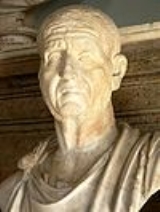
Decius

Encyclopedia
- See also Decius (gens)Decius (gens)Decius is an ancient Roman nomen; notable individuals of the gens Decia include:**Publius Decius Mus , son of Quintus, consul in 340 BC, fought the Battle of Vesuvius...
.
Trajan Decius , was Roman Emperor
Roman Emperor
The Roman emperor was the ruler of the Roman State during the imperial period . The Romans had no single term for the office although at any given time, a given title was associated with the emperor...
from 249 to 251. In the last year of his reign, he co-ruled with his son Herennius Etruscus
Herennius Etruscus
Herennius Etruscus , was Roman emperor in 251, in a joint rule with his father Decius. Emperor Hostilian was his younger brother.Herennius was born in near Sirmium in Pannonia , during one of his father's military postings. His mother was Herennia Cupressenia Etruscilla, a Roman lady of an...
until they were both killed in the Battle of Abrittus
Battle of Abrittus
The Battle of Abritus, also known as the Battle of Forum Terebronii, occurred in the Roman province of Moesia Inferior probably in July, 251, between the Roman Empire and a federation of Scythian tribesmen under the Goth king Cniva. The Romans were soundly defeated, and Roman emperors Decius and...
.
Early life and rise to power
Decius, who was born at BudaliaMartinci
Martinci is a village in Serbia. It is situated in the Sremska Mitrovica municipality, Srem District, Vojvodina province. The village has a Serb ethnic majority and its population numbering 3,639 people .-Name:...
, now Martinci
Martinci
Martinci is a village in Serbia. It is situated in the Sremska Mitrovica municipality, Srem District, Vojvodina province. The village has a Serb ethnic majority and its population numbering 3,639 people .-Name:...
, Serbia
Serbia
Serbia , officially the Republic of Serbia , is a landlocked country located at the crossroads of Central and Southeast Europe, covering the southern part of the Carpathian basin and the central part of the Balkans...
near Sirmium
Sirmium
Sirmium was a city in ancient Roman Pannonia. Firstly mentioned in the 4th century BC and originally inhabited by the Illyrians and Celts, it was conquered by the Romans in the 1st century BC and subsequently became the capital of the Roman province of Lower Pannonia. In 294 AD, Sirmium was...
(Sremska Mitrovica
Sremska Mitrovica
Sremska Mitrovica is a city and municipality located in the Vojvodina province of Serbia, on the left bank of the Sava river. As of 2002 the town had a total population of 39,041, while Sremska Mitrovica municipality had a population of 85,605...
), in Lower Pannonia
Lower Pannonia
The Lower Pannonia or Pannonia Inferior was an ancient Roman province. It was formed in the year 103 AD. The Lower Pannonia included parts of present-day Hungary, Serbia, Croatia, and Bosnia and Herzegovina.-Cities:...
was one of the first among a long succession of future Roman Emperors to originate from the province of Illyricum
Illyricum (Roman province)
The Roman province of Illyricum or Illyris Romana or Illyris Barbara or Illyria Barbara replaced most of the region of Illyria. It stretched from the Drilon river in modern north Albania to Istria in the west and to the Sava river in the north. Salona functioned as its capital...
in the Danube
Danube
The Danube is a river in the Central Europe and the Europe's second longest river after the Volga. It is classified as an international waterway....
. Unlike some of his immediate imperial predecessors such as Philip the Arab
Philip the Arab
Philip the Arab , also known as Philip or Philippus Arabs, was Roman Emperor from 244 to 249. He came from Syria, and rose to become a major figure in the Roman Empire. He achieved power after the death of Gordian III, quickly negotiating peace with the Sassanid Empire...
or Maximinus, Decius was a distinguished senator who had served as consul
Consul
Consul was the highest elected office of the Roman Republic and an appointive office under the Empire. The title was also used in other city states and also revived in modern states, notably in the First French Republic...
in 232, had been governor of Moesia
Moesia
Moesia was an ancient region and later Roman province situated in the Balkans, along the south bank of the Danube River. It included territories of modern-day Southern Serbia , Northern Republic of Macedonia, Northern Bulgaria, Romanian Dobrudja, Southern Moldova, and Budjak .-History:In ancient...
and Germania Inferior
Germania Inferior
Germania Inferior was a Roman province located on the left bank of the Rhine, in today's Luxembourg, southern Netherlands, parts of Belgium, and North Rhine-Westphalia left of the Rhine....
soon afterwards, served as governor of Hispania Tarraconensis
Hispania Tarraconensis
Hispania Tarraconensis was one of three Roman provinces in Hispania. It encompassed much of the Mediterranean coast of Spain along with the central plateau. Southern Spain, the region now called Andalusia, was the province of Hispania Baetica...
between 235–238, and was urban prefect of Rome during the early reign of Emperor Philip the Arab
Philip the Arab
Philip the Arab , also known as Philip or Philippus Arabs, was Roman Emperor from 244 to 249. He came from Syria, and rose to become a major figure in the Roman Empire. He achieved power after the death of Gordian III, quickly negotiating peace with the Sassanid Empire...
(Marcus Iulius Phillipus).
Around 245, Emperor Philip entrusted Decius with an important command on the Danube. By the end of 248 or 249, Decius was sent to quell the revolt of Pacatianus
Pacatianus
Tiberius Claudius Marinus Pacatianus was an usurper in the Danube area of the Roman Empire during the time of Philip the Arab....
and to rid the region of the Goths, Germans and Dacian Carpi who had flooded in during the crisis and his troops in Moesia and Pannonia; the soldiers were enraged because of the peace treaty signed between Philip and the Sassanids
Sassanid Empire
The Sassanid Empire , known to its inhabitants as Ērānshahr and Ērān in Middle Persian and resulting in the New Persian terms Iranshahr and Iran , was the last pre-Islamic Persian Empire, ruled by the Sasanian Dynasty from 224 to 651...
. Once arrived, the troops forced Decius to assume the imperial dignity himself instead. Decius still protested his loyalty to Philip, but the latter advanced against him and was killed near Verona
Verona
Verona ; German Bern, Dietrichsbern or Welschbern) is a city in the Veneto, northern Italy, with approx. 265,000 inhabitants and one of the seven chef-lieus of the region. It is the second largest city municipality in the region and the third of North-Eastern Italy. The metropolitan area of Verona...
, Italy
Italy
Italy , officially the Italian Republic languages]] under the European Charter for Regional or Minority Languages. In each of these, Italy's official name is as follows:;;;;;;;;), is a unitary parliamentary republic in South-Central Europe. To the north it borders France, Switzerland, Austria and...
. The Senate
Roman Senate
The Senate of the Roman Republic was a political institution in the ancient Roman Republic, however, it was not an elected body, but one whose members were appointed by the consuls, and later by the censors. After a magistrate served his term in office, it usually was followed with automatic...
then recognized Decius as Emperor, giving him the attribute Traianus as a reference to the good emperor Trajan
Trajan
Trajan , was Roman Emperor from 98 to 117 AD. Born into a non-patrician family in the province of Hispania Baetica, in Spain Trajan rose to prominence during the reign of emperor Domitian. Serving as a legatus legionis in Hispania Tarraconensis, in Spain, in 89 Trajan supported the emperor against...
. As the Byzantine historian Zosimus
Zosimus
Zosimus was a Byzantine historian, who lived in Constantinople during the reign of the Byzantine Emperor Anastasius I . According to Photius, he was a comes, and held the office of "advocate" of the imperial treasury.- Historia Nova :...
later noted:
Political and monumental initiatives
Decius' political program was focused on the restoration of the strength of the State, both military opposing the external threats, and restoring the public pietyPiety
In spiritual terminology, piety is a virtue that can mean religious devotion, spirituality, or a combination of both. A common element in most conceptions of piety is humility.- Etymology :...
with a program of renovation of the State religion
State religion
A state religion is a religious body or creed officially endorsed by the state...
.
Either as a concession to the Senate, or perhaps with the idea of improving public morality, Decius endeavoured to revive the separate office and authority of the censor
Censor (ancient Rome)
The censor was an officer in ancient Rome who was responsible for maintaining the census, supervising public morality, and overseeing certain aspects of the government's finances....
. The choice was left to the Senate, who unanimously selected Valerian (the future emperor). But Valerian, well aware of the dangers and difficulties attaching to the office at such a time, declined the responsibility. The invasion of the Goths and Decius' death put an end to the abortive attempt.
During his reign, he proceeded with several building projects in Rome, "including the Thermae Deciane or Baths of Decius on the Aventine", which was completed in 252 and survived through to the 16th century; Decius also acted to repair the Colosseum, which had been damaged by lightning strikes.
Persecution of Christians
- See also Persecution of Christians in the Roman Empire#Under Decius
In January 250, Decius issued an edict for the suppression of Christianity
Christianity
Christianity is a monotheistic religion based on the life and teachings of Jesus as presented in canonical gospels and other New Testament writings...
. The edict itself was fairly clear:
While Decius himself may have intended the edict as a way to reaffirm his conservative vision of the Pax Romana and to reassure Rome's citizens that the empire was still secure, it nevertheless sparked a "terrible crisis of authority as various Christian
Christian
A Christian is a person who adheres to Christianity, an Abrahamic, monotheistic religion based on the life and teachings of Jesus of Nazareth as recorded in the Canonical gospels and the letters of the New Testament...
bishops and their flocks reacted to it in different ways." Measures were first taken demanding that the bishops and officers of the church make a sacrifice for the Emperor, a matter of an oath of allegiance that Christians considered offensive. Certificates were issued to those who satisfied the pagan
Paganism
Paganism is a blanket term, typically used to refer to non-Abrahamic, indigenous polytheistic religious traditions....
commissioners during the persecution of Christians under Decius. Forty-six such certificates have been published, all dating from 250, four of them from Oxyrhynchus
Oxyrhynchus
Oxyrhynchus is a city in Upper Egypt, located about 160 km south-southwest of Cairo, in the governorate of Al Minya. It is also an archaeological site, considered one of the most important ever discovered...
. Christian followers who refused to offer a pagan sacrifice for the Emperor and the Empire's well-being by a specified date risked torture and execution. A number of prominent Christians did, in fact, refuse to make a sacrifice and were killed in the process, including Pope Fabian
Pope Fabian
Pope Fabian was Pope from January 10, 236 to January 20, 250, succeeding Pope Anterus.Eusebius of Caesarea relates how the Christians, having assembled in Rome to elect a new bishop, saw a dove alight upon the head of Fabian, a layman and stranger to the city, who was thus marked out for this...
himself in 250, and "anti-Christian feeling[s] led to pogroms at Carthage and Alexandria." In reality, however, towards the end of the second year of Decius' reign, "the ferocity of the [anti-Christian] persecution had eased off, and the earlier tradition of tolerance had begun to reassert itself." The Christian church, though, never forgot the reign of Decius whom they labelled as that "fierce tyrant".
At this time, there was a second outbreak of the Antonine Plague
Antonine Plague
The Antonine Plague, AD 165–180, also known as the Plague of Galen, who described it, was an ancient pandemic, either of smallpox or measles, brought back to the Roman Empire by troops returning from campaigns in the Near East...
, which at its height from 251 to 266, took the lives of 5,000 daily in Rome. This outbreak is referred to as the "Plague of Cyprian
Cyprian
Cyprian was bishop of Carthage and an important Early Christian writer, many of whose Latin works are extant. He was born around the beginning of the 3rd century in North Africa, perhaps at Carthage, where he received a classical education...
" (the bishop of Carthage
Carthage
Carthage , implying it was a 'new Tyre') is a major urban centre that has existed for nearly 3,000 years on the Gulf of Tunis, developing from a Phoenician colony of the 1st millennium BC...
), where both the plague and the persecution of Christians
Persecution of Christians
Persecution of Christians as a consequence of professing their faith can be traced both historically and in the current era. Early Christians were persecuted for their faith, at the hands of both Jews from whose religion Christianity arose, and the Roman Empire which controlled much of the land...
were especially severe. Cyprian's biographer Pontius
Pontius of Carthage
Pontius, or Pontius the Deacon, was a Christian saint and Latin author from Carthage. He served as a deacon under Cyprian of Carthage and wrote the Vita Cypriani shortly after his death.-Life:...
gave a vivid picture of the demoralizing effects of the plague and Cyprian moralized the event in his essay De mortalitate. In Carthage, the "Decian persecution", unleashed at the onset of the plague, sought out Christian scapegoats. Decius' edicts were renewed under Valerius in 253 and repealed under his son, Gallienus
Gallienus
Gallienus was Roman Emperor with his father Valerian from 253 to 260, and alone from 260 to 268. He took control of the Empire at a time when it was undergoing great crisis...
, in 260-1.
Military actions and death
The barbarianBarbarian
Barbarian and savage are terms used to refer to a person who is perceived to be uncivilized. The word is often used either in a general reference to a member of a nation or ethnos, typically a tribal society as seen by an urban civilization either viewed as inferior, or admired as a noble savage...
incursions into the Empire were becoming more and more daring and frequent whereas the Empire was facing a serious economic crisis in Decius' time. During his brief reign, Decius engaged in important operations against the Goths
Goths
The Goths were an East Germanic tribe of Scandinavian origin whose two branches, the Visigoths and the Ostrogoths, played an important role in the fall of the Roman Empire and the emergence of Medieval Europe....
, who crossed the Danube to raid districts of Moesia and Thrace
Thrace
Thrace is a historical and geographic area in southeast Europe. As a geographical concept, Thrace designates a region bounded by the Balkan Mountains on the north, Rhodope Mountains and the Aegean Sea on the south, and by the Black Sea and the Sea of Marmara on the east...
. This is the first considerable occasion the Goths — who would later come to play such an important role — appear in the historical record. The Goths under King Cniva
Cniva
Cniva was the Gothic chieftain who invaded the Roman Empire in the third century CE. He successfully conquered the city of Philippopolis, now present day Bulgarian city Plovdiv, and killed the emperor Decius and his son Herennius Etruscus at the Battle of Abrittus as he was attempting to leave...
were surprised by the emperor while besieging Nicopolis
Nikopol, Bulgaria
Nikopol is a town in northern Bulgaria, the administrative center of Nikopol municipality, part of Pleven Province, on the right bank of the Danube river, 4 km downstream from the mouth of the Osam river. It spreads at the foot of steep chalk cliffs along the Danube and up a narrow valley...
on the Danube; the Goths fled through the difficult terrain of the Balkans
Balkans
The Balkans is a geopolitical and cultural region of southeastern Europe...
, but then doubled back and surprised the Romans near Beroë (modern Stara Zagora
Stara Zagora
Stara Zagora is the sixth largest city in Bulgaria, and a nationally important economic center. Located in Southern Bulgaria, it is the administrative capital of the homonymous Stara Zagora Province...
), sacking their camp and dispersing the Roman troops. It was the first time a Roman emperor fled in the face of Barbarians. The Goths then moved to attack Philippopolis (modern Plovdiv
Plovdiv
Plovdiv is the second-largest city in Bulgaria after Sofia with a population of 338,153 inhabitants according to Census 2011. Plovdiv's history spans some 6,000 years, with traces of a Neolithic settlement dating to roughly 4000 BC; it is one of the oldest cities in Europe...
), which fell into their hands. The governor of Thrace, Titus Julius Priscus
Titus Julius Priscus
Titus Julius Priscus was a mid 3rd century Roman usurper.He was the governor of Thrace, and proclaimed himself Emperor in opposition to Emperor Decius at Philippopolis towards the end of 251, probably with Gothic collusion following their successful siege at the Battle of Philippopolis. The Roman...
, declared himself Emperor under Gothic protection in opposition to Decius but Priscus's challenge was rendered moot when he was killed soon afterwards.
The siege of Philippopolis had so exhausted the numbers and resources of the Goths that they offered to surrender their treasure and prisoners, on condition of being allowed to retire. Decius, who had succeeded in surrounding them and hoped to cut off their retreat, refused to entertain their proposals. The final engagement, the battle of Abrittus
Battle of Abrittus
The Battle of Abritus, also known as the Battle of Forum Terebronii, occurred in the Roman province of Moesia Inferior probably in July, 251, between the Roman Empire and a federation of Scythian tribesmen under the Goth king Cniva. The Romans were soundly defeated, and Roman emperors Decius and...
, in which the Goths fought with the courage of despair, under the command of Cniva, took place during the second week of June 251 on swampy ground in the Ludogorie
Ludogorie
The Ludogorie or Deliorman is a region in northeastern Bulgaria stretching over the plateau of the same name. Major cities in the region are Razgrad, Novi Pazar, Pliska and Isperih...
(region in northeastern Bulgaria which merges with Dobruja plateau and the Danube Plain to the north) near the small settlement of Abrittus or Forum Terebronii (modern Razgrad
Razgrad
Razgrad is a city in northeastern Bulgaria, administrative and industrial centre of the homonymous Razgrad Province. As of February 2011, it has a population of 33,238 inhabitants.-History:...
). Jordanes
Jordanes
Jordanes, also written Jordanis or Jornandes, was a 6th century Roman bureaucrat, who turned his hand to history later in life....
records that Decius' son Herennius Etruscus
Herennius Etruscus
Herennius Etruscus , was Roman emperor in 251, in a joint rule with his father Decius. Emperor Hostilian was his younger brother.Herennius was born in near Sirmium in Pannonia , during one of his father's military postings. His mother was Herennia Cupressenia Etruscilla, a Roman lady of an...
was killed by an arrow early in the battle, and to cheer his men Decius exclaimed, "Let no one mourn; the death of one soldier is not a great loss to the republic." Nevertheless, Decius' army was entangled in the swamp and annihilated in this battle, while he himself was killed on the field of battle. As the historian Aurelius Victor
Aurelius Victor
Sextus Aurelius Victor was a historian and politician of the Roman Empire.Aurelius Victor was the author of a History of Rome from Augustus to Julian , published ca. 361. Julian honoured him and appointed him prefect of Pannonia Secunda...
relates:
One literary tradition claims that Decius was betrayed by his successor Trebonianus Gallus
Trebonianus Gallus
Trebonianus Gallus , also known as Gallus, was Roman Emperor from 251 to 253, in a joint rule with his son Volusianus.-Early life:Gallus was born in Italy, in a family with respected ancestry of Etruscan senatorial background. He had two children in his marriage with Afinia Gemina Baebiana: Gaius...
, who was involved in a secret alliance with the Goths but this cannot be substantiated and was most likely a later invention since Gallus felt compelled to adopt Decius' younger son, Gaius Valens Hostilianus, as joint emperor even though the latter was too young to rule in his own right. It is also unlikely that the shattered Roman legions would proclaim as emperor a traitor who was responsible for the loss of so many soldiers from their ranks. Decius was the first Roman Emperor to die in battle against a foreign enemy.