
In Depth
See Also

Cult of personality

A cult of personality is a political institution in which a country's leader uses mass media Mass media

Mass media is a term used to denote, as a class, that section of the media specifically conceived and de... 

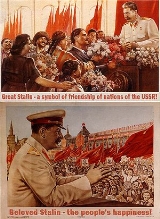
 to create a larger-than-life public image through unquestioning flattery and praise. The term often refers as well to leaders who did not use such methods during their lifetime, but are built up in the mass media by later governments. A cult of personality differs from general hero worship in that it is specifically built around political leaders. However, the term cult of personality is often applied by analogy to refer to adulation of non-political leaders.

Discussions

  Discussion Features

   Ask a question about 'Cult of personality'

   Start a new discussion about 'Cult of personality'

   Answer questions about 'Cult of personality'

   'Cult of personality' discussion forum


Encyclopedia


A cult of personality is a political institution in which a country's leader uses mass media Mass media

Mass media is a term used to denote, as a class, that section of the media specifically conceived and de... 

 to create a larger-than-life public image through unquestioning flattery and praise. The term often refers as well to leaders who did not use such methods during their lifetime, but are built up in the mass media by later governments.

A cult of personality differs from general hero worship in that it is specifically built around political leaders. However, the term cult of personality is often applied by analogy to refer to adulation of non-political leaders.

Background

Throughout history there have always been leaders who have fostered adulation. For much of premodern times, absolute monarchies Absolute monarchy

Absolute monarchy is a monarchical [i] form of government [i] where the king has the power to r ... 

 were the dominant form of government, and monarchs were almost always held in enormous reverence. Through the principle of the divine right of kings, rulers were said to hold office by the will of God God

God is the deity [i] believed by monotheists [i] to be the supreme reality.... 

. Imperial China Imperial China

Sorry, no overview for this topic 

, ancient Egypt Ancient Egypt

Ancient Egypt was a long-lived ancient civilization [i] in north-eastern Africa [i]. ... 

, and the Roman Empire Roman Empire

The Roman Empire was a phase of the ancient Roman [i] civilization characterized by an autocratic [i] ... 

 are especially noted for elevating monarchs to the status of god-kings.

The advent of democratic ideas in Europe in the 18th 18th century

As a means of recording the passage of time [i], the 18th century refers to the century [i] that las ... 

 and 19th centuries 19th century

The 19th century lasted from 1801 [i] through 1900 [i] in the Gregorian calendar [i].
... 

 made it increasingly difficult for monarchs to preserve this aura. However, the subsequent development of photography Photography

Photography is the process of making pictures by means of the action of light.... 

, sound recording Sound recording and reproduction

Sound recording and reproduction is the electrical [i] or mechanical [i] re-creation and/or amplification [i] ... 

, film Film

Film is a term that encompasses motion pictures as individual projects, as well as the field in general.... 

 and mass production, as well as public education and techniques used in commercial advertising Advertising

Advertising is the business of drawing public attention to goods and services, and performed through a v... 

, enabled political leaders to project a positive image like never before. It was under these circumstances in the 20th century 20th century

The 20th century started on 1 January [i] 1901 [i] and ended on 31 December [i] 2000 [i], according to t... 

 that the best-known personality cults arose.

The criticism of personality cults often focuses on the regimes of Joseph Stalin Joseph Stalin

Joseph Vissarionovich Stalin , alternatively transliterated Josef Stalin, was the de facto [i] ... 

, Mao Zedong Mao Zedong


Mao Zedong was a Chinese Marxist [i] military and political leader, who led China's communist [i]... 

, Kim Il-Sung Kim Il-sung

Kim Il-sung was the leader of North Korea [i] from its founding in 1948 until his death, when he was su ... 

 and his son, Kim Jong-Il Kim Jong-il

Kim Jong-il has been the leader of Democratic People's Republic of Korea [i] since 1994 [i]. ... 

. During the peak of their reigns these leaders appeared as god-like infallible rulers. Their portraits were hung in every home or public building, and many artists and poets were instructed to produce only works that glorified the leader. The term "cult of personality" comes from Karl Marx Karl Marx

Karl Heinrich Marx was an immensely influential German philosopher [i], political economist [i] ... 

's critique of the "cult of the individual."

From my antipathy to any cult of the individual, I never made public during the existence of the [1st] International the numerous addresses from various countries which recognized my merits and which annoyed me. . . . Engels Friedrich Engels

Friedrich Engels , a 19th-century [i] German [i]
... 

 and I first joined the secret society of Communists on the condition that everything making for superstitious worship of authority would be deleted from its statute.


Nikita Khrushchev Nikita Khrushchev

Nikita Sergeyevich Khrushchyov was the leader of the Soviet Union [i] after the death of Joseph Stalin [i] ... 

 recalled Marx's criticism in his 1956 "Secret Speech" denouncing Stalin to the 20th Party Congress:

Comrades, the cult of the individual acquired such monstrous size chiefly because Stalin himself, using all conceivable methods, supported the glorification of his own person. . . . One of the most characteristic examples of Stalin's self-glorification and of his lack of even elementary modesty is the edition of his Short Biography, which was published in 1948.


This book is an expression of the most dissolute flattery, an example of making a man into a godhead, of transforming him into an infallible sage, "the greatest leader," "sublime strategist of all times and nations." Finally no other words could be found with which to lift Stalin up to the heavens.


We need not give here examples of the loathsome adulation filling this book. All we need to add is that they all were approved and edited by Stalin personally and some of them were added in his own handwriting to the draft text of the book.


The most famous fiction Fiction

[i] events and stands in contrast to [[non-fiction]... 

al cult of personality is probably that of Big Brother in the novel
Nineteen Eighty-Four Nineteen Eighty-Four

Nineteen Eighty-Four is a dystopian [i] novel [i] written by the English [i] ... 

 by George Orwell George Orwell

Eric Arthur Blair , better known by the pen name [i] George Orwell, was an English [i] aut ... 

. The character was possibly based on Britain's Earl Kitchener Herbert Kitchener, 1st Earl Kitchener

Horatio Herbert Kitchener, 1st Earl Kitchener, KG [i], KP [i], GCB [i]... 

 although more likely based on Stalin.

Examples


Kim Il-sung Kim Il-sung

Kim Il-sung was the leader of North Korea [i] from its founding in 1948 until his death, when he was su ... 

 and Kim Jong-il Kim Jong-il

Kim Jong-il has been the leader of Democratic People's Republic of Korea [i] since 1994 [i]. ... 

Journalist Bradley Martin documents the personality cults of North Korea North Korea

[i]n [[country]... 

's leaders extensively. While visiting North Korea in 1979 he noted that nearly all music, art, and sculpture that he observed glorified Kim Il-sung, whose personality cult was then being extended to his son Kim Jong-il. The younger Kim's pictures were then ubiquitous and his abilities were described as superhuman. Kim Il-sung rejected the notion that he had created a cult around himself and accused those who suggested so of "factionalism." A US religious freedom investigation confirmed Martin's observation that children learn to thank Kim Il-sung for all blessings as part of the cult.

Saparmurat Niyazov Saparmurat Niyazov

Saparmurat Atayevich Niyazov has been the most powerful figure in Turkmenistan [i] since 1985. ... 

Known in the west for his absolute power and cult of personality Niyazov attempted to improve his image.
Speaking to 60 Minutes 60 Minutes

60 Minutes is an investigative television newsmagazine [i] on United States [i] television, which ha ... 

in January 2004, the president of Turkmenistan Turkmenistan

Turkmenistan is a country in Central Asia [i]. ... 

 said he personally disapproved of seeing his image everywhere, but it reflected the will of the people. Shortly after this report aired, Russian newspaper Novye Izvestiya reported the government was taking down hundreds of Niyazov's portraits, and that Niyazov had blamed accusations of a cult on "toadying" by his subordinates.

References


See also

  • Anax
  • Apotheosis Apotheosis

    Apotheosis means glorification, usually to a divine [i] level, coming from the Greek word apotheoun, ... 

  • Charisma
  • Dictator
  • Emperor Emperor

    An emperor is a monarch [i], usually the sovereign [i] ruler of an empire [i] or another type o... 

  • God-King
  • High King
  • King of Kings
  • Monarch
  • Pope Pope

    The Pope is the Bishop of Rome [i], and, as Successor [i] of Saint Peter [i], is t ... 


Categories: